EP1003320A1 - Appareil de communication de donnees - Google Patents
Appareil de communication de donnees Download PDFInfo
- Publication number
- EP1003320A1 EP1003320A1 EP99912091A EP99912091A EP1003320A1 EP 1003320 A1 EP1003320 A1 EP 1003320A1 EP 99912091 A EP99912091 A EP 99912091A EP 99912091 A EP99912091 A EP 99912091A EP 1003320 A1 EP1003320 A1 EP 1003320A1
- Authority
- EP
- European Patent Office
- Prior art keywords
- communication
- audio band
- data communication
- telephone line
- band communication
- Prior art date
- Legal status (The legal status is an assumption and is not a legal conclusion. Google has not performed a legal analysis and makes no representation as to the accuracy of the status listed.)
- Withdrawn
Links
Images


Classifications
-
- H—ELECTRICITY
- H04—ELECTRIC COMMUNICATION TECHNIQUE
- H04L—TRANSMISSION OF DIGITAL INFORMATION, e.g. TELEGRAPHIC COMMUNICATION
- H04L12/00—Data switching networks
- H04L12/66—Arrangements for connecting between networks having differing types of switching systems, e.g. gateways
-
- H—ELECTRICITY
- H04—ELECTRIC COMMUNICATION TECHNIQUE
- H04M—TELEPHONIC COMMUNICATION
- H04M3/00—Automatic or semi-automatic exchanges
- H04M3/22—Arrangements for supervision, monitoring or testing
- H04M3/26—Arrangements for supervision, monitoring or testing with means for applying test signals or for measuring
- H04M3/28—Automatic routine testing ; Fault testing; Installation testing; Test methods, test equipment or test arrangements therefor
- H04M3/30—Automatic routine testing ; Fault testing; Installation testing; Test methods, test equipment or test arrangements therefor for subscriber's lines, for the local loop
-
- H—ELECTRICITY
- H04—ELECTRIC COMMUNICATION TECHNIQUE
- H04M—TELEPHONIC COMMUNICATION
- H04M11/00—Telephonic communication systems specially adapted for combination with other electrical systems
- H04M11/06—Simultaneous speech and data transmission, e.g. telegraphic transmission over the same conductors
- H04M11/062—Simultaneous speech and data transmission, e.g. telegraphic transmission over the same conductors using different frequency bands for speech and other data
-
- H—ELECTRICITY
- H04—ELECTRIC COMMUNICATION TECHNIQUE
- H04L—TRANSMISSION OF DIGITAL INFORMATION, e.g. TELEGRAPHIC COMMUNICATION
- H04L12/00—Data switching networks
- H04L12/64—Hybrid switching systems
- H04L12/6418—Hybrid transport
- H04L2012/6478—Digital subscriber line, e.g. DSL, ADSL, HDSL, XDSL, VDSL
Definitions
- the present invention relates to a data communication apparatus which can perform data communication such as the xDSL scheme using the telephone line for audio band communication.
- the xDSL communication system such as the ADSL (Asymmetric Digital Subscriber Line) communication system, the HDSL (High-bitrate Digital Subscriber Line) communication system and the SDSL (Symmetric Digital Subscriber Line) communication system which can perform high-speed digital communication of several Mbits/sec using the existing telephone copper cable have been closely watched as a wired digital communication system.
- the xDSL communication system also called the DMT (Discrete Multi-Tone) modem system, is standardized by T1.413 of ANSI.
- Fig. 7 shows a spectrum of the transmission signal of the DMT modem system.
- the band of 4 kHz or lower represents the normal telephone service constituting an audio band communication using the audio band
- the band of 30 kHz to 320 kHz represents the up multicarrier wave for the ADSL communication of the DMT modem system
- the band of 30 kHz to about 1.1 MHz represents the down multicarrier wave for the ADSL communication of the DMT modem system.
- the down multicarrier and the up multicarrier are overlapped and separated from each other by an echo canceller.
- the data communication is normally preceded by a training for measuring the S/N ratio of the received wave for each channel. According to the measured values, the gain and the number of transmission bits are assigned to each subchannel. Thus, the gain and the number of transmission bits are determined according to the S/N ratio. Therefore, when the line attenuation is large or noises exist, the S/N ratio is decreased and the bit transmission rate assigned is also reduced.
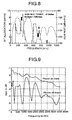
- Fig. 8 shows an example of bit allocation in the case where the interference noises in the assembled-type line of the TCM-ISDN transmission path have an effect on the system.
- This diagram has been presented in the General Assembly (spring), the Institute of Electronics, Information and Communication Engineers, NTT, B-8-54, 1998, as "Influence of ISDN line on DMT based ADSL transmission characteristics".
- the number of the transmission bits is allocated to each subchannel in such a manner that a frequency of low interference noises has a large bit allocation as indicated by solid line.
- the gain allocation unlike the bit allocation, is normally carried out in such a manner that a large gain is allocated to portions with a large interference noise and a small noise to portions with a small interference noise.
- the data communication is conducted using the telephone line for the audio band communication with a telephone set or the like. Therefore, the data communication service is unavoidably affected by the telephone service using the audio band. Thus, the characteristics of the telephone line is affected and differentiated between the on-hook state where the audio band communication is not conducted and the off-hook state where the audio band communication is being conducted.
- Fig. 9 shows the frequency characteristic on the telephone line in the on-hook and off-hook states for the audio band communication. This was announced in AMD, D.176 (WP1/15) ITU-T SG15, Geneva, 9-20 February 1998, as "Empirical Characterization of In-Home Telephone Wiring".
- the gain level of the data communication conducted using the telephone line varies between the on-hook state and the off-hook state in audio band communication.
- This diagram shows that the gain varies considerably in the off-hook state where the audio band communication is being conducted using the telephone line, and as compared with the on-hook state where the audio band communication is not being conducted the gain characteristic is extremely deteriorated.
- the training is conducted only in the on-hook state where the receiver is hung up to form a bit map for determining the bit allocation and gain of each channel or to conduct the coefficient training for adaptive equalization on the data communication apparatus side using the telephone line, so that the communication is conducted with the optimum bit allocation, the optimum gain setting and the optimum adaptive equalization filter for the particular telephone line.
- the off-hook state where the receiver is picked up for audio band communication, the characteristics of the telephone line undergo a change.
- the problem is that each characteristic is no longer optimum, and the data transmission rate is required to be improved more without which an efficient communication becomes impossible.
- the present invention has been developed to obviate these problems. It is an object of this invention is to provide a data communication apparatus in which data communication can be effected efficiently using the telephone line inspite of the characteristic change occurring between the on-hook state with the audio band communication not going on using the telephone line and the off-hook state where the audio band communication is being conducted data communication can be effected efficiently using the telephone line.
- the on-hook or off-hook state of the audio band communication is detected, and the characteristic of each state is trained.
- a table of the bit allocation, the gain setting, the adaptive equalization coefficient is prepared for each of the on-hook and off-hook states.
- the respective values are switched between the on-hook and off-hook states.
- the communication band is shifted or enlarged to the telephone service band.
- the present invention provides a data communication apparatus for conducting the data communication using the telephone line for the audio band communication, characterized by comprising a detection unit for detecting whether the audio band communication is being conducted or not on the telephone line and a communication unit for conducting the data communication through the telephone line with the characteristics changed between the active audio band communication and the inactive audio band communication based on the detection output of the detection unit.
- the communication unit includes an active audio band communication coefficient table for storing the equalization coefficients when the audio band communication is being conducted on the telephone line, an inactive audio band communication coefficient table for storing the equalization coefficients when the audio band communication is not being conducted on the telephone line, and an equalizer for equalizing, based on the detection output of the detection unit, the receive signal of the data communication according to the audio band communication coefficient table when the audio band communication is being conducted on the telephone line, and the receive signal of the data communication according to the inactive audio band communication coefficient table when the audio band communication is not being conducted on the telephone line, characterized in that the noise removal characteristic is changed between the active audio band communication and the inactive audio band communication thereby to conduct the data communication through the telephone line.
- the communication unit includes an active audio band communication bit allocation table for storing the bit allocation of each channel of data communication when the audio band communication is being conducted on the telephone line, an inactive audio band communication bit allocation table for storing the bit allocation of each channel of data communication when the audio band communication is not being conducted on the telephone line, and a bit allocator for allocating, based on the detection output of the detection unit, bits to each channel according to the active audio band communication bit allocation table when the audio band communication is being conducted on the telephone line, and bits to each channel according to the inactive audio band communication table when the audio band communication is not being conducted on the telephone line, characterized in that the bit allocation characteristic to each channel is changed between the active audio band communication and the inactive audio band communication thereby to conduct the data communication through the telephone line.
- the communication unit includes an active audio band communication gain allocation table for storing the gain allocation of each channel of data communication when the audio band communication is being conducted on the telephone line, an inactive audio band communication gain allocation table for storing the gain allocation of each channel of data communication when the audio band communication is not being conducted on the telephone line, and a gain allocator for allocating, based on the detection output of the detection unit, the gain to each channel according to the active audio band communication gain allocation table when the audio band communication is being conducted on the telephone line, and the gain to each channel according to the inactive audio band communication table when the audio band communication is not being conducted on the telephone line, characterized in that the gain allocation characteristic to each channel is changed between the active audio band communication and the inactive audio band communication thereby to conduct the data communication through the telephone line.
- a data communication apparatus for conducting the data communication using the telephone line for audio band communication, characterized by comprising a detection unit for detecting whether or not the audio band communication is being conducted on the telephone line, and a communication unit for conducting, based on the detection output of the detection unit, the data communication using a predetermined band not interfering with the audio band communication at the time of active audio band communication, and the data communication using up to the neighborhood of the audio band interfering with the audio band communication at the time of inactive audio band communication.
- a data communication apparatus for conducting the data communication using the telephone line for audio band communication, characterized by comprising a detection unit for detecting whether or not the audio band communication is being conducted on the telephone line, and a communication unit for conducting, based on the detection output of the detection unit, the data communication using a predetermined band not interfering with the audio band communication at the time of active audio band communication, and the data communication using up to the audio band at the time of inactive audio band communication, the communication unit including, on the transmitting end alone, a filter for removing the frequency band of the ring tone signal for transmitting an audio band communication request to the receiving end.
- a data communication apparatus characterized in that the data communication is the ADSL data communication of discrete multitone modem scheme, and the apparatus is an ADSL communication modem.
- FIG. 1 shows the entire data communication system employing a data communication apparatus according to a first embodiment of the invention.
- A designates a subscriber
- 1a an ADSL modem employing the data communication apparatus according to the first embodiment
- 2a a splitter
- 3a a telephone set for conducting the audio band communication in the audio band through a telephone line C
- 4a a computer system for conducting the data communication by transmitting/receiving or downloading the multimedia data such as images and voices free of charge or on a fee-charging basis through the telephone line C.
- B designates a telephone station, 1b an ADSL modem employing the data communication apparatus according to the first embodiment, 2b a splitter, 3b a router, 4b a local switch, and 5b an ATM unit.
- C designates a telephone line such as a coaxial cable made of copper, N1 the Internet for the ATM unit 5b to conduct the data communication, and N2 a public telephone network for the local switch 4b to conduct the communication.
- Fig. 2 shows a detailed configuration of the receiver of the ADSL modems 1a, 1b employing the data communication apparatus according to the first embodiment of the invention.
- 61 designates an on-hook/off-hook detection circuit
- 62 an analog processing and A/D converter (ADC)
- TEQ time domain equalizer
- 64 an input serial/parallel buffer
- 65 a discrete Fourier transform unit (DFT)
- 66 a frequency domain equalizer (FEQ)
- FEQ frequency domain equalizer
- 67 a constellation encoder and gain scaling
- 68 a tone ordering
- 69 a deinterleaver
- 70, 71 are descramble and forward error correction (FEC)
- 72, 73 are cyclic redundancy check (CRC)
- 74 a mux/sync control.
- 75 designates an on-hook TEQ table for providing the on-hook equalization coefficient to the time domain equalizer (TEQ) 63
- TEQ time domain equalizer
- TEQ time domain equalizer
- FEQ frequency domain equalizer
- FEQ frequency domain equalizer
- the equalization coefficients are set in the tables 75 to 78 for each time component and frequency component by carrying out a training during the training period before the start of the ADSL communication in such a manner as to secure substantially the same gain for each time component and each frequency component in on-hook and off-hook states for each of the TEQ 63 and FEQ 66.
- 79 designates an on-hook bit/gain allocation table for presetting the bit allocation and the gain allocation for each frequency in on-hook state
- 80 an off-hook bit/gain allocation table for presetting the bit allocation and the gain allocation for each frequency in off-hook state.
- Each allocation data set in these tables 79, 80 like the tables 75 to 78 of the TEQ 63 and FEQ 66, is set by a training during the training period before starting the ADSL communication.
- These tables 75 to 80 may be configured into a single table.
- the frequency division between the telephone service using the conventional telephone set 3a and the ADSL data communication service using the computer system 4a is carried out by the splitters 2a, 2b, so that the frequency of 4 kHz or lower is used as the audio band for the telephone service, and higher frequencies are used as the ADSL modem band for data communication.
- the telephone service is provided by connecting the telephone set 3a using the audio band not more than 4 kHz from the public network N2 on the telephone station B side through the local switch 4b, the splitter 2b on the telephone station B side and the splitter 2a on the subscriber A side.
- the signal in the audio band is not transmitted to the ADSL modems 1b, 1a side due to the low-pass filter or the like in the splitters 2b, 2a.
- the data communication service is provided by connecting the ADSL modem 1b through a router (not shown) constituting the Internet N1 on the telephone station B side, the ATM unit 5b and the router 3b thereby to conduct the communication with the computer system 4a through the splitter 2b on the telephone station B side, the splitter 2a on the subscriber A side and the ADSL modem 1a.
- the ADSL modems 1a, 1b receive and download multimedia data such as data, images and voices free of charge or on a fee-charging basis from the provider or the like using the audio band higher than 4 kHz through a high-pass filter or the like in the splitters 2a, 2b, or the data communication is conducted with other computer systems or the like through a network such as the internet N1.
- multimedia data such as data, images and voices free of charge or on a fee-charging basis from the provider or the like using the audio band higher than 4 kHz through a high-pass filter or the like in the splitters 2a, 2b, or the data communication is conducted with other computer systems or the like through a network such as the internet N1.
- the receive digital signal is input to the on-hook/off-hook detection circuit 61 of the ADSL modem 1a through the telephone line C.
- the on-hook/off-hook detection circuit 61 detects the DC voltage level of the telephone line C, of which the voltage level is -48 V in the on-hook state where the audio band communication is not conducted by the telephone set 3a or the like and -5 V in the off-hook state where the audio band communication is being conducted by the telephone set 3a. It is therefore detected from the voltage value of this telephone line C whether the telephone line C is in on-hook or off-hook state, and the state detection signal 81 is output.
- the analog processing and A/D converter 62 applies the received wave through a LPF (low-pass filter), and converts the analog waveform into the digital waveform through the A/D converter, followed by the tine domain equalizer (TEQ) 63 performing the adaptive equalization process in the time domain.
- LPF low-pass filter
- TEQ tine domain equalizer
- the time domain equalizer (TEQ) 63 is supplied from the on-hook/off-hook detection circuit 61 with a status detection signal 81 indicating whether the telephone line C is currently in on-hook state or in off-hook state.
- the received signal is subjected to the equalization processing based on the equalization coefficient of the on-hook TEQ table 75, while in the case where the status detection signal indicates an off-hook state, the received signal is subjected to the equalization processing based on the equalization coefficient of the off-hook TEQ table 76.
- the gain level in the time domain varies from one time to another separately for the on-hook state and off-hook state.
- the gain level is adjusted each time separately for on-hook and off-hook states in such a manner that the gain level at each time in the time domain does not affect the gain level at other times.
- the data subjected to the adaptive equalization processing in the time domain by the time domain equalizer (TEQ) 63 is converted from serial data to parallel data through the input serial/parallel buffer 64, subjected to the discrete Fourier transform in the discrete Fourier transform unit (DFT) 65, and further subjected to the frequency domain adaptive equalization processing in the frequency domain equalizer (FEQ) 66.
- DFT discrete Fourier transform unit
- FEQ frequency domain adaptive equalization processing in the frequency domain equalizer
- the frequency domain equalizer (FEQ) 66 is supplied with, as in the case of the time domain equalizer (TEQ) 63, the status detection signal 81 from the on-hook/off-hook detection circuit 61 indicating whether the telephone line C is in off-hook or on-hook state.
- the receive signal is subjected to the equalization processing based on the equalization coefficient of the on-hook FEQ table 77.
- the received signal is subjected to the equalization processing based on the equalization coefficient of the off-hook FEQ table 78.
- the gain level for each frequency in the frequency domain changes separately in on-hook state and off-hook state. Therefore, the gain level is adjusted separately for on-hook and off-hook states to assure a constant gain level for each frequency.
- the data subjected to the frequency domain adaptive equalization processing by the frequency domain equalizer (FEQ) 66 is input into the constellation encoder gain scaling 67, which allocates bits and gain to regenerate the constellation data.
- the constellation encoder gain scaling 67 like the time domain equalizer (TEQ) 63 or the frequency domain equalizer (FEQ) 66, is supplied with the status detection signal 81 from the on-hook/off-hook detection circuit 61 indicating whether the telephone line C is currently on-hook or off-hook.
- the status detection signal 81 indicates an on-hook state
- the bits and gain are allocated to the received signal based on the allocation data of the on-hook bit/gain allocation table 79, while in the case where an off-hook state is indicated, on the other hand, bits and gain are allocated to the received signal based on the allocation data of the off-hook bit/gain allocation table 80.
- the constellation encoder gain scaling 67 is supplied with a signal subjected to the gain equalization processing in accordance with the on-hook or off-hook state in the time and frequency domains by the time domain equalizer (TEQ) 63 and the frequency domain equalizer (FEQ) 66, respectively.
- TEQ time domain equalizer
- FEQ frequency domain equalizer
- the on-hook bit/gain allocation table 79 and the off-hook bit/gain allocation table 80 are used by being switched, so that the gain allocation and the bit allocation are conducted in a manner corresponding to the gain level for each time and frequency separately for the on-hook and the off-hook states.
- the subsequent processing is the same as the ordinary processing, in which the data are converted into serial one in the tone ordering 68, the FEC or the descramble processing is performed in the descramble forward error correction 70.
- the data are subjected to the FEC or the descramble processing in the descramble forward error correction 71.
- the cyclic redundancy check is performed in the crc 72, 73, and then the data are reproduced in the mux/sync control 74.
- the on-hook or off-hook state indicating whether the audio band communication using the telephone line C is going on or not is detected during what is called the training period before the data communication is conducted by the apparatus.
- the bit allocation, the gain allocation and the adaptive equalization (TEQ, FEQ) coefficients are determined separately for the off-hook and on-hook states and set in separate tables 75 to 80.
- the on-hook or off-hook state of the audio band communication on the telephone line C is detected, so that the bit allocation, the gain allocation and the adaptive equalization are performed by different tables 75 to 80 for the on-hook state and the off-hook state.
- the optimum communication can be conducted in each of the on-hook and off-hook states, with the data transmission rate improved and the error rate reduced as compared with the case where such actions are not taken.
- the bit allocation, the gain allocation and the adaptive equalization (TEQ, FEQ) coefficient are determined and set in tables 75 to 80 separately for the off-hook and the on-hook states so that at the time of data transmission, the bit allocation, the gain allocation and the adaptive equalization are carried out according to different tables 75 to 80 for the on-hook and off-hook states.
- the invention is not limited to such a processing, but only the bit allocation, only the gain allocation, only the frequency domain adaptive equalization (FEQ) or only the time domain adaptive equalization (TEQ) may be performed in accordance with the on-hook or off-hook state.
- an arbitrary combination of actions can of course be executed, such as the bit allocation combined with the gain allocation, the gain allocation combined with the frequency domain adaptive equalization (FEQ) or the bit allocation combined with the frequency domain adaptive equalization (FEQ).
- the first embodiment is described above by reference to a data communication apparatus and a data communication system using the splitters 2a, 2b as shown in Fig. 1.
- the invention is not limited to them, however, but is also applicable with equal effect to a data communication apparatus or a data communication system free of splitter on both the subscriber side and the telephone station side and a data communication apparatus or a data communication system free of splitter only on the subscriber side, as described with the second embodiment shown in Fig. 3.
- the work for installing the splitter is required of an ordinary telephone subscriber, which led to the tendency of rejecting the introduction of the xDSL communication system such as ADSL.
- the communication system under consideration has been proposed as a splitterless system with a low 1.5 Mbps communication speed specified in a standard.
- the transmission rate of about 1.5 Mbps is considered to satisfy the users for the time being to access the internet.
- Fig. 3 shows a general configuration of a data communication system employing the data communication apparatus according to the second embodiment of the invention.
- character A designates a subscriber, 3a a telephone set for conducting the audio band communication on the telephone line C, 4a a computer system for conducting the data communication on the telephone line C, and 6a an ADSL.Lite modem employing the data communication apparatus according to the second embodiment.
- B designates a telephone station, 3b a router, 4b a local switch, 5b an ATM unit, and 6b an ADSL.Lite modem employing the data communication apparatus according to the second embodiment.
- C designates a telephone line such as a coaxial cable made of copper wire, N1 the Internet used by the ATM unit 5b for communication, and N2 a public telephone network used by the local switch 4b for communication.
- the configuration other than the ADSL.Lite modems 6a, 6b is the same as the one shown in the first embodiment of Fig. 1 and is provided with the same reference numerals.
- Fig. 4 shows a detailed configuration of the ADSL.Lite modems 6a, 6b employing the data communication apparatus according to the second embodiment of the invention.
- the configuration on the receiver side of the ADSL.Lite modems 6a, 6b according to this second embodiment is the same as that of the conventional ADSL modem except for the on-hook/off-hook detection circuit 61 inserted in the former.
- the configuration is also identical to the configuration on the receiver side of the ADSL modems 1a, 1b according to the first embodiment shown in Fig. 2. Therefore, the components shown in Fig. 4 which have the same configuration as the components on the receiver side of the ADSL modems 1a, 1b according to the first embodiment of Fig. 2 will be provided with the same reference numerals and description theirof will be omitted. Only the configuration on the transmitter side will be explained anew.
- the transmitter side is so configured that, 82 designates a mux/sync control, 83, 84 are cyclic redundancy check (crc), 85, 86 are scramble and forward error correction (FEC), 87 an interleaver, 88 a tone ordering, 89 a constellation encoder and gain scaling, 90 an inverse discrete Fourier transform unit (IDFT), 91 an output serial/parallel buffer, and 92 a D/A converter (DAC) and analog processing.
- This configuration corresponds to the configuration on the receiver side except that the TEQ 63 and the FEQ 66 are not included.
- 93 designates an on-hook operating band table in which one or a plurality of operating bands for on-hook data communication are set in the case where the audio band communication on the telephone line C is not being conducted
- 94 designates an off-hook operating band table in which operating bands for off-hook data communication are set in the case where the audio band communication on the telephone line C is being conducted.
- the on-hook operating band table 93 and the off-hook operating band table 94 are described as separate entities. Nevertheless, the operating bands for data communication for on-hook and off-hook states may of course be set in a single table. This is also the case with the tables 75 to 80 of the first embodiment.
- the operation is referred to in which the data communication is conducted by the ADSL.Lite modem 6a on the subscriber A side.
- the data input from the computer system 4a (from the ATM unit 5b, etc. through the router 3b in the case of the ADSL.Lite modem 6b on the telephone station B side) to this ADSL.Lite modem 6a are modulated in the mux/sync control 82, subjected to a predetermined processing in the CRC 83, 84 and the scramble and forward error correction 85, 86, and in some cases subjected to the interleave processing by the interleaver 87.
- the processing up to this point is the same as the conventional processing.
- the tone ordering 88 assigns the signal thus processed to each channel including the carrier (subchannel) for each frequency band of the DMT modem scheme.
- the tone ordering 88 is supplied with the status detection signal 81 indicating whether the existing telephone line C is on-hook or off-hook, from the on-hook/off-hook detection circuit 61 on the receiver side explained with reference to the first embodiment.
- the tone ordering 88 allocates the data to each channel in the manner shown in Fig. 5 described later, for example, based on the operating band set in the on-hook operating band table 93.
- the data are allocated to each channel in the conventional or normal operating band not interfering with the audio band based on the operating band set in the off-hook operating band table 94.
- the tone ordering 88 is required to notify the data communication apparatus at the receiving end of data communication of the fact that the data allocation to each channel is changed between on-hook and off-hook states, and which of a plurality, if any, of allocation methods to each channel as shown in Figs. 5(a) to 5(c) described later has been employed.
- the tone ordering 88 thus transmits the data indicating the allocation method together with or multiplexed on the data to be communicated.
- the subsequent operation is the same as that of the normal ADSL.Lite modem 6a.
- the constellation and the gain are set by the constellation encoder gain scaling 89
- the inverse discrete Fourier transform is performed by the inverse discrete Fourier transform unit (IDFT) 90
- the parallel output is converted into a serial one by the output serial/parallel buffer 91
- the digital/analog conversion is effected by the D/A converter and analog processing 92
- the data are transmitted onto the telephone line C through an internal LPF (not shown), thus sending the data to the telephone station B.
- IDFT inverse discrete Fourier transform unit
- the subscriber connected through the telephone station B or through the telephone station B and the Internet N1 receives the particular data by way of his computer system or the like.
- the tone ordering on the receiver side such as the ADSL modem or the ADSL.Lite modem of the computer system decodes the data indicating the method of allocating data to each channel at the data transmitting side, and detects the channel to be used, through which the data transmitted are reproduced as serial data.
- Figs. 5(a) to 5(c) show specific examples of the operating band for the data communication set in the on-hook band table 93 according to the second embodiment.
- Fig. 5(a) shows the state of the carrier (subcarrier) of DMT modem scheme increased up to the neighborhood of the audio band of 4 kHz for providing the telephone service of audio band communication in the on-hook state where the audio band communication is not being conducted.
- the band of 4 kHz to 320 kHz is used by the multicarrier of the up channel
- the band of 4 kHz to 1.104 MHz is used by the multicarrier of the down channel.
- the operating band for data communication is expanded and so is the operating channel.
- the lower the frequency the smaller the attenuation of the transmission path, thereby making it possible to extend the communication distance in terms of each ADSL transmission rate, while increasing the transmission rate in the service area.
- Fig. 5(b) shows the state of the carrier in the case where the operating band of the DMT modem scheme is shifted (about 26 kHz) up to the neighborhood of the audio band of 4 kHz in the on-hook state where the audio band communication is not being conducted.
- the multicarrier for the up channel uses the band of 4 kHz to 294 kHz and the multicarrier of the down channel uses the band of 4 kHz to 1.078 MHz.
- the communication distance for each ADSL transmission rate can be increased while at the same time increasing the transmission rate in the service area.
- Fig. 5(c) shows the state of the carrier (subcarrier) of DMT modem scheme increased up to the audio band of 4 kHz in the on-hook state where the audio band communication providing the telephone service is not being conducted.
- the operating band for data communication expands.
- the communication distance for each ADSL transmission rate can be further increased as compared with the case shown in Fig. 5(a), while increasing the transmission rate or the transmission data amount in the service area.
- the data communication is conducted using even the audio band of 4 kHz or less, and therefore, the signal transmitted on the audio band carrier and received by the telephone set is liable to be detected as a ring tone signal for calling out the other party which is transmitted for the audio band communication in the on-hook state, often resulting in calling out the local telephone set or the telephone set of the other party of communication.
- a high-pass filter having the characteristic as shown in Fig. 6 is provided in the output unit on the transmitter side of the ADSL.Lite modem 6a, which is the output serial/parallel buffer 91 or the DA converter analog processing 92, for example, in such a manner as to remove the band of about 15 to 20 Hz constituting the ring tone signal frequency.
- the carrier (subcarrier) is increased up to the neighborhood of the audio band, the operating band for data communication is shifted to the neighborhood of the audio band or the subcarrier is increased using up to the audio band.
- the transmission data amount can be increased.
- the carrier frequency is decreased, the attenuation amount of the telephone line providing the transmission path is decreased.
- the communication distance for each transmission rate of ADSL can be extended, while at the same time increasing the transmission rate within the service area.
- the second embodiment was explained above as a separate embodiment from the first embodiment. Nevertheless, the second embodiment may of course be configured as an addition to the first embodiment. Specifically, the time domain equalizer (TEQ) 63, the frequency domain equalizer (FEQ) 66 and the constellation encoder gain scaling 67 of the ADSL.Lite modem 6a according to the second embodiment shown in Fig. 4 may be provided with, like the ADSL modem 1a according to the first embodiment shown in Fig.
- TEQ time domain equalizer
- FEQ frequency domain equalizer
- an on-hook TEQ table 75 an off-hook TEQ table 76, an on-hook FEQ table 77, an off-hook FEQ table 78, an off-hook bit/gain allocation table 79 and an off-hook bit/gain allocation table 80, respectively, and further supplied with a status detection signal 81 from the on-hook/off-hook detection circuit 61 or otherwise configured similarly to the configuration of the first embodiment.
- the data communication apparatus is explained with a modem of ADSL communication scheme such as the ADSL modems 1a, 1b, the ADSL.Lite modems 6a, 6b.
- a modem of ADSL communication scheme such as the ADSL modems 1a, 1b, the ADSL.Lite modems 6a, 6b.
- the invention is not limited to such modems, but is applicable with equal effect to the modems for the xDSL communication such as the HDSL communication and the SDSL communication other than the ADSL communication scheme, and to the data communication apparatuses other than xDSL, and further to the data communication apparatuses other than modems.
- the equipment connected to the ADSL modems 1a, 1b of the first embodiment and the ADSL.Lite modems 6a, 6b of the second embodiment may include, as described above, not only the computer system 4a but also the digital TV set, AV equipment, domestic electric appliances and the whole variety of digital communication devices or domestic electric appliances having such data communication device as a communication modem.
- a digital communication device may be built in a cooking unit of a microwave oven or the like which can conduct digital communication through the network, so that the multimedia data such as images and sounds showing the cooking recipe, etc. are downloaded and displayed on the display unit, or provided as an aural guide through the speaker.
- the characteristic is changed between the active audio band communication mode and the inactive audio band communication mode for conducting the data communication through the telephone line. In this way, the optimum data communication can be conducted at the time of both the active audio band communication and the inactive audio band communication.
- the characteristics of the equalizer including the equalization coefficient, the bit allocation and the gain allocation are changed between the active audio band communication and the inactive audio band communication for conducting the data communication.
- the S/N ratio can be improved both in the active audio band communication mode and the inactive audio band communication mode for a reduced error probability, while at the same time leading to the effects of extending the communication distance for each transmission rate or increasing the transmission rate within the service area.
- the data communication is conducted using a predetermined band not interfering with the audio band communication which may be going on, whereas the data communication is conducted using up to the neighborhood of the audio band in the inactive audio band communication mode.
- the transmission data amount can be increased while at the same time reducing the attenuation amount of the telephone line providing the transmission path due to the reduced carrier frequency, thereby extending the communication distance and the transmission rate within the service area.
- the data communication apparatus is suitable for the data communication of xDSL scheme using the telephone line for audio band communication.
Landscapes
- Engineering & Computer Science (AREA)
- Signal Processing (AREA)
- Computer Networks & Wireless Communication (AREA)
- Telephonic Communication Services (AREA)
Applications Claiming Priority (2)
| Application Number | Priority Date | Filing Date | Title |
|---|---|---|---|
| JP11528898A JP3186693B2 (ja) | 1998-04-24 | 1998-04-24 | データ通信装置 |
| JP11528898 | 1998-04-24 |
Publications (2)
| Publication Number | Publication Date |
|---|---|
| EP1003320A1 true EP1003320A1 (fr) | 2000-05-24 |
| EP1003320A4 EP1003320A4 (fr) | 2002-08-28 |
Family
ID=14658961
Family Applications (1)
| Application Number | Title | Priority Date | Filing Date |
|---|---|---|---|
| EP99912091A Withdrawn EP1003320A4 (fr) | 1998-04-24 | 1999-04-01 | Appareil de communication de donnees |
Country Status (8)
| Country | Link |
|---|---|
| US (1) | US6522731B2 (fr) |
| EP (1) | EP1003320A4 (fr) |
| JP (1) | JP3186693B2 (fr) |
| KR (1) | KR100337105B1 (fr) |
| AU (1) | AU3055299A (fr) |
| CA (1) | CA2294532A1 (fr) |
| TW (1) | TW411671B (fr) |
| WO (1) | WO1999056452A1 (fr) |
Cited By (2)
| Publication number | Priority date | Publication date | Assignee | Title |
|---|---|---|---|---|
| GB2385232A (en) * | 2002-09-28 | 2003-08-13 | Richard Herman | Telephone detector |
| EP1434414A1 (fr) * | 2002-12-27 | 2004-06-30 | Koninklijke KPN N.V. | Système pour mesurer l'effet d'un diviseur ADSL sur un réseau ISDN |
Families Citing this family (36)
| Publication number | Priority date | Publication date | Assignee | Title |
|---|---|---|---|---|
| US6480510B1 (en) | 1998-07-28 | 2002-11-12 | Serconet Ltd. | Local area network of serial intelligent cells |
| US6782096B1 (en) | 1998-11-12 | 2004-08-24 | Paradyne Corporation | Subscriber line driver and termination |
| US6690677B1 (en) | 1999-07-20 | 2004-02-10 | Serconet Ltd. | Network for telephony and data communication |
| US6975694B1 (en) * | 1999-12-15 | 2005-12-13 | Paradyne Corporation | Digital subscriber line driver |
| US7200156B2 (en) * | 1999-12-21 | 2007-04-03 | Skarpness Mark L | Modular broadband adapter system |
| KR100316142B1 (ko) * | 1999-12-23 | 2001-12-12 | 송문섭 | 무선가입자 정합 장치의 후크 상태 감지 장치 |
| US7787525B1 (en) * | 1999-12-24 | 2010-08-31 | Schlumberger Technology Corporation | Method and apparatus for transmission of well-bore data on multiple carrier frequencies |
| FR2803709B1 (fr) * | 2000-01-06 | 2003-10-10 | Ibm | Methode pour inverser dynamiquement un systeme adsl (asymmetric digital subscriber line) et systeme pour mettre en oeuvre cette methode |
| US6959036B1 (en) * | 2000-02-02 | 2005-10-25 | Ikanos Communications Inc. | Method and apparatus for an X-DSL modem supporting multiple X-DSL line codes |
| KR100328474B1 (ko) * | 2000-02-14 | 2002-03-16 | 정경훈 | 홈 pna 방식의 인터넷 서비스 접속거리 확장 및 댁내응용 확장을 위한 인터넷 서비스 시스템 |
| US6549616B1 (en) | 2000-03-20 | 2003-04-15 | Serconet Ltd. | Telephone outlet for implementing a local area network over telephone lines and a local area network using such outlets |
| IL135744A (en) | 2000-04-18 | 2008-08-07 | Mosaid Technologies Inc | Telephone communication system over a single telephone line |
| US6842459B1 (en) | 2000-04-19 | 2005-01-11 | Serconet Ltd. | Network combining wired and non-wired segments |
| IL144158A (en) | 2001-07-05 | 2011-06-30 | Mosaid Technologies Inc | Socket for connecting an analog telephone to a digital communications network that carries digital voice signals |
| IL161190A0 (en) | 2001-10-11 | 2004-08-31 | Serconet Ltd | Outlet with analog signal adapter, method for use thereof and a network using said outlet |
| US7154996B2 (en) * | 2002-10-29 | 2006-12-26 | Agere Systems Inc. | Dynamic frequency passband switching in home phone-line networks |
| US20040120482A1 (en) * | 2002-12-20 | 2004-06-24 | Bentley Ronald Locker | System and method for reducing disruption in a DSL environment caused by a pots transient event |
| IL154234A (en) * | 2003-01-30 | 2010-12-30 | Mosaid Technologies Inc | Method and system for providing dc power on local telephone lines |
| IL154921A (en) * | 2003-03-13 | 2011-02-28 | Mosaid Technologies Inc | A telephone system that includes many separate sources and accessories for it |
| IL157787A (en) | 2003-09-07 | 2010-12-30 | Mosaid Technologies Inc | Modular outlet for data communications network |
| US7103820B2 (en) * | 2003-09-22 | 2006-09-05 | Adtran, Inc. | System and method for interleaving forward error correction code words across multiple communication connections |
| IL159838A0 (en) | 2004-01-13 | 2004-06-20 | Yehuda Binder | Information device |
| US20060034449A1 (en) * | 2004-03-09 | 2006-02-16 | Joerger Richard B | System and method of delivering operating power and power source status signals over a single pair of wires |
| IL161869A (en) | 2004-05-06 | 2014-05-28 | Serconet Ltd | A system and method for carrying a signal originating is wired using wires |
| US7873058B2 (en) | 2004-11-08 | 2011-01-18 | Mosaid Technologies Incorporated | Outlet with analog signal adapter, a method for use thereof and a network using said outlet |
| US7813451B2 (en) | 2006-01-11 | 2010-10-12 | Mobileaccess Networks Ltd. | Apparatus and method for frequency shifting of a wireless signal and systems using frequency shifting |
| US7479912B1 (en) * | 2007-09-13 | 2009-01-20 | Texas Instruments Incorporated | Low-power high-performance audio DAC system including internal oscillator, FIFO memory, and ASRC |
| WO2009053910A2 (fr) | 2007-10-22 | 2009-04-30 | Mobileaccess Networks Ltd. | Système de communication utilisant des fils à faible bande passante |
| US8175649B2 (en) | 2008-06-20 | 2012-05-08 | Corning Mobileaccess Ltd | Method and system for real time control of an active antenna over a distributed antenna system |
| WO2010089719A1 (fr) | 2009-02-08 | 2010-08-12 | Mobileaccess Networks Ltd. | Système de communication utilisant des câbles transportant des signaux ethernet |
| CN102131014A (zh) * | 2010-01-13 | 2011-07-20 | 歌尔声学股份有限公司 | 时频域联合回声消除装置及方法 |
| US8903092B2 (en) * | 2010-06-04 | 2014-12-02 | Maxim Integrated Products, Inc. | High speed digital to analog converter with reduced spurious outputs |
| JP2011055494A (ja) * | 2010-08-30 | 2011-03-17 | Oki Electric Industry Co Ltd | エコーキャンセラ |
| WO2013142662A2 (fr) | 2012-03-23 | 2013-09-26 | Corning Mobile Access Ltd. | Puce(s) de circuit intégré à radiofréquence (rfic) servant à fournir des fonctionnalités de système d'antenne à répartition, et composants, systèmes, et procédés connexes |
| US9184960B1 (en) | 2014-09-25 | 2015-11-10 | Corning Optical Communications Wireless Ltd | Frequency shifting a communications signal(s) in a multi-frequency distributed antenna system (DAS) to avoid or reduce frequency interference |
| WO2017066159A1 (fr) | 2015-10-12 | 2017-04-20 | Commscope Technologies Llc | Soufflet d'étanchéité pour couplage électrique |
Family Cites Families (26)
| Publication number | Priority date | Publication date | Assignee | Title |
|---|---|---|---|---|
| CH621025A5 (en) * | 1977-09-01 | 1980-12-31 | Sodeco Compteurs De Geneve | Circuit arrangement for starting a telephone charge calculating mechanism in a payphone |
| JPS59172851A (ja) | 1983-03-22 | 1984-09-29 | Hitachi Ltd | デ−タ通信システムにおける通話制御方法 |
| JPS60112357A (ja) * | 1983-11-22 | 1985-06-18 | Mitsubishi Electric Corp | 情報伝送方式 |
| JPH0770970B2 (ja) | 1991-01-23 | 1995-07-31 | 富士通株式会社 | 適応等化器 |
| KR950002588B1 (ko) * | 1992-12-16 | 1995-03-23 | 대우전자주식회사 | 전화기의 자동 콜링(calling)장치 및 그 제어방법 |
| JPH06291876A (ja) * | 1993-04-06 | 1994-10-18 | Meisei Electric Co Ltd | 電話回線の直流ループ閉結回路 |
| US5479447A (en) * | 1993-05-03 | 1995-12-26 | The Board Of Trustees Of The Leland Stanford, Junior University | Method and apparatus for adaptive, variable bandwidth, high-speed data transmission of a multicarrier signal over digital subscriber lines |
| US5376387A (en) | 1993-07-16 | 1994-12-27 | Eastman Kodak Company | Hydrogen peroxide composition |
| US5475691A (en) | 1993-11-15 | 1995-12-12 | At&T Corp. | Voice activated date rate change in simultaneous voice and data transmission |
| JPH07327065A (ja) | 1994-06-01 | 1995-12-12 | Oki Electric Ind Co Ltd | オフフック検出装置 |
| JPH07336460A (ja) * | 1994-06-03 | 1995-12-22 | Hitachi Ltd | データ通信装置 |
| JPH08242304A (ja) * | 1995-03-02 | 1996-09-17 | Matsushita Electric Ind Co Ltd | 端末網制御装置、センタ網制御装置及びこれらから形成されたデータ通信システム |
| JPH08293928A (ja) * | 1995-04-25 | 1996-11-05 | Hitachi Home Tec Ltd | 通報システム |
| KR100331437B1 (ko) | 1995-06-30 | 2002-08-08 | 삼성전자 주식회사 | 디.엠.티.시스템에서적응형비트교환방법및장치 |
| US5781728A (en) | 1996-03-15 | 1998-07-14 | Motorola Inc. | Flexible asymmetrical digital subscriber line ADSL transmitter, remote terminal using same, and method therefor |
| US6002722A (en) | 1996-05-09 | 1999-12-14 | Texas Instruments Incorporated | Multimode digital modem |
| US5852633A (en) | 1996-06-07 | 1998-12-22 | Motorola, Inc. | Method for allocating data in a data communication system |
| US6072779A (en) * | 1997-06-12 | 2000-06-06 | Aware, Inc. | Adaptive allocation for variable bandwidth multicarrier communication |
| US6061392A (en) * | 1996-12-17 | 2000-05-09 | Paradyne Corporation | Apparatus and method for communicating voice and data between a customer premises and a central office |
| US6092122A (en) * | 1997-06-30 | 2000-07-18 | Integrated Telecom Express | xDSL DMT modem using sub-channel selection to achieve scaleable data rate based on available signal processing resources |
| US6101216A (en) * | 1997-10-03 | 2000-08-08 | Rockwell International Corporation | Splitterless digital subscriber line communication system |
| DK1021901T3 (da) * | 1997-10-10 | 2010-03-08 | Daphimo Co B V Llc | Splitterløst multibærermodem |
| EP1021901B1 (fr) * | 1997-10-10 | 2009-11-25 | Daphimo Co. B.V., LLC | Modem a porteuses multiples sans repartiteur |
| US6151335A (en) * | 1997-12-02 | 2000-11-21 | Conexant Systems, Inc. | Modulation switching for DSL signal transmission |
| KR100302148B1 (ko) * | 1998-03-20 | 2001-10-27 | 제임스 지민 김 | 전화선에서의데이터및음성신호검출과표시및자동라인단락장치 |
| JP3415434B2 (ja) | 1998-04-17 | 2003-06-09 | Necエレクトロニクス株式会社 | Adsl通信システム |
-
1998
- 1998-04-24 JP JP11528898A patent/JP3186693B2/ja not_active Expired - Fee Related
-
1999
- 1999-04-01 US US09/445,599 patent/US6522731B2/en not_active Expired - Fee Related
- 1999-04-01 CA CA002294532A patent/CA2294532A1/fr not_active Abandoned
- 1999-04-01 AU AU30552/99A patent/AU3055299A/en not_active Abandoned
- 1999-04-01 EP EP99912091A patent/EP1003320A4/fr not_active Withdrawn
- 1999-04-01 KR KR1019997012195A patent/KR100337105B1/ko not_active Expired - Fee Related
- 1999-04-01 WO PCT/JP1999/001719 patent/WO1999056452A1/fr not_active Ceased
- 1999-04-23 TW TW088106512A patent/TW411671B/zh not_active IP Right Cessation
Cited By (3)
| Publication number | Priority date | Publication date | Assignee | Title |
|---|---|---|---|---|
| GB2385232A (en) * | 2002-09-28 | 2003-08-13 | Richard Herman | Telephone detector |
| GB2385232B (en) * | 2002-09-28 | 2005-01-19 | Richard Herman | Telephone detector |
| EP1434414A1 (fr) * | 2002-12-27 | 2004-06-30 | Koninklijke KPN N.V. | Système pour mesurer l'effet d'un diviseur ADSL sur un réseau ISDN |
Also Published As
| Publication number | Publication date |
|---|---|
| US20020067811A1 (en) | 2002-06-06 |
| EP1003320A4 (fr) | 2002-08-28 |
| AU3055299A (en) | 1999-11-16 |
| WO1999056452A1 (fr) | 1999-11-04 |
| CA2294532A1 (fr) | 1999-11-04 |
| TW411671B (en) | 2000-11-11 |
| US6522731B2 (en) | 2003-02-18 |
| JPH11308357A (ja) | 1999-11-05 |
| JP3186693B2 (ja) | 2001-07-11 |
| KR20010014136A (ko) | 2001-02-26 |
| KR100337105B1 (ko) | 2002-05-16 |
Similar Documents
| Publication | Publication Date | Title |
|---|---|---|
| US6522731B2 (en) | Data communication apparatus | |
| CN1116754C (zh) | 数据传输系统中发送多载波信号的方法和多载波发送机 | |
| CA2577489C (fr) | Systeme de suppression d'interferences | |
| US6151335A (en) | Modulation switching for DSL signal transmission | |
| JP2007195218A (ja) | デジタル無線周波数干渉打消器 | |
| JP2001520487A (ja) | スプリッタレス多搬送波モデム | |
| US6111895A (en) | Wideband transmission through wire | |
| US6456650B1 (en) | Splitterless modem using harmonics reduction | |
| CN103039008B (zh) | 用于优化dmt调制解调器中的动态范围的方法和装置 | |
| US7386040B1 (en) | System and method for optimizing digital subscriber line performance between transceivers from multiple manufacturers | |
| US20020075949A1 (en) | Variable bandwidth discrete multi-tone (DMT) rate-adaptive asymmetric digital subscriber line (RADSL) transceiver | |
| CN101997796B (zh) | 一种消除多载波调制系统中混叠噪声的方法、装置和系统 | |
| JP3380851B2 (ja) | ディスクリートマルチトーン通信システム、そのデータ通信装置およびディスクリートマルチトーン通信方法 | |
| US7864737B2 (en) | Method and device for transmitting data via a transmission link | |
| JP2003199129A (ja) | 縒り線対において音声帯域信号とxdsl信号とを結合するラインインタフェース | |
| JP2001036494A (ja) | 通信システムおよび通信装置および通信方法 | |
| KR100316782B1 (ko) | 불연속 멀티 톤 방식을 이용한 디지털 가입자 라인 시스템 | |
| JP2001069048A (ja) | 通信装置 | |
| JP2000295196A (ja) | 通信装置および通信方法 | |
| EP2146496A1 (fr) | Procédé et dispositif de traitement de données et système de communication comprenant un tel dispositif | |
| JPH11308334A (ja) | デジタル加入者線伝送システム | |
| JPH11289403A (ja) | デジタル加入者線伝送システム |
Legal Events
| Date | Code | Title | Description |
|---|---|---|---|
| PUAI | Public reference made under article 153(3) epc to a published international application that has entered the european phase |
Free format text: ORIGINAL CODE: 0009012 |
|
| 17P | Request for examination filed |
Effective date: 19991220 |
|
| AK | Designated contracting states |
Kind code of ref document: A1 Designated state(s): BE DE FR GB |
|
| A4 | Supplementary search report drawn up and despatched |
Effective date: 20020711 |
|
| AK | Designated contracting states |
Kind code of ref document: A4 Designated state(s): BE DE FR GB |
|
| STAA | Information on the status of an ep patent application or granted ep patent |
Free format text: STATUS: THE APPLICATION IS DEEMED TO BE WITHDRAWN |
|
| 18D | Application deemed to be withdrawn |
Effective date: 20030107 |