EP1006154B1 - Kationische Aminoanthrachinone, deren Verwendung zum Färben keratinischer Fasern, diese enthaltende Färbemittel sowie Färbeverfahren - Google Patents
Kationische Aminoanthrachinone, deren Verwendung zum Färben keratinischer Fasern, diese enthaltende Färbemittel sowie Färbeverfahren Download PDFInfo
- Publication number
- EP1006154B1 EP1006154B1 EP99402629A EP99402629A EP1006154B1 EP 1006154 B1 EP1006154 B1 EP 1006154B1 EP 99402629 A EP99402629 A EP 99402629A EP 99402629 A EP99402629 A EP 99402629A EP 1006154 B1 EP1006154 B1 EP 1006154B1
- Authority
- EP
- European Patent Office
- Prior art keywords
- radical
- alkyl
- formula
- atom
- dioxo
- Prior art date
- Legal status (The legal status is an assumption and is not a legal conclusion. Google has not performed a legal analysis and makes no representation as to the accuracy of the status listed.)
- Expired - Lifetime
Links
Classifications
-
- A—HUMAN NECESSITIES
- A61—MEDICAL OR VETERINARY SCIENCE; HYGIENE
- A61K—PREPARATIONS FOR MEDICAL, DENTAL OR TOILETRY PURPOSES
- A61K8/00—Cosmetics or similar toiletry preparations
- A61K8/18—Cosmetics or similar toiletry preparations characterised by the composition
- A61K8/30—Cosmetics or similar toiletry preparations characterised by the composition containing organic compounds
- A61K8/33—Cosmetics or similar toiletry preparations characterised by the composition containing organic compounds containing oxygen
- A61K8/35—Ketones, e.g. benzophenone
- A61K8/355—Quinones
-
- A—HUMAN NECESSITIES
- A61—MEDICAL OR VETERINARY SCIENCE; HYGIENE
- A61Q—SPECIFIC USE OF COSMETICS OR SIMILAR TOILETRY PREPARATIONS
- A61Q5/00—Preparations for care of the hair
- A61Q5/06—Preparations for styling the hair, e.g. by temporary shaping or colouring
- A61Q5/065—Preparations for temporary colouring the hair, e.g. direct dyes
-
- C—CHEMISTRY; METALLURGY
- C09—DYES; PAINTS; POLISHES; NATURAL RESINS; ADHESIVES; COMPOSITIONS NOT OTHERWISE PROVIDED FOR; APPLICATIONS OF MATERIALS NOT OTHERWISE PROVIDED FOR
- C09B—ORGANIC DYES OR CLOSELY-RELATED COMPOUNDS FOR PRODUCING DYES, e.g. PIGMENTS; MORDANTS; LAKES
- C09B1/00—Dyes with anthracene nucleus not condensed with any other ring
- C09B1/16—Amino-anthraquinones
- C09B1/20—Preparation from starting materials already containing the anthracene nucleus
- C09B1/207—Dyes with amino groups and with onium groups
Definitions
- the present invention relates to aminoanthraquinones comprising at least a cationic group chosen from aliphatic chains comprising at minus a cationic charge delocalized on an unsaturated polyazotated cycle at 5 chains, their use as a direct dye in dye applications keratin materials, in particular human keratin fibers, and especially the hair, and more particularly the dyeing compositions containing.
- the resulting colorings are temporary or semi-permanent colorations, because the nature of the interactions which bind the direct dyes to the keratinous fiber, and their desorption from the surface and / or of the core of the fiber are responsible for their low dye power and their poor resistance to washing or perspiration.
- direct dyes cationic aminoanthraquinones have already been described, the charge of which is localized on the nitrogen atom.
- aminoanthraquinones are for example described in French patents No. 1,422,016 and its addition 87,902, 1,391,675, 1,401,163, 379,649, 1,430,089, 1,584,965, 2,050,397, 2,548,895, U.S. patents # 5,169,403, 5,314,505, 5,486,629, 5,520,707, and European patents # 818,193 and 852,136.
- This new family of dyes has the very advantageous characteristic of greater solubility in dyeing media and these new dyes generate dyes, by direct coloring, endowed with power and resistance (to the various aggressions that can be subjected hair: light, bad weather, shampoos, perspiration), notably improved compared to that of dyes produced with cationic aminoanthraquinones known from the prior art.
- the compounds of formula (I) can optionally be salified with strong mineral acids such as HCI, HBr, H 2 SO 4 , or organic acids such as acetic, lactic, tartaric, citric or succinic.
- strong mineral acids such as HCI, HBr, H 2 SO 4
- organic acids such as acetic, lactic, tartaric, citric or succinic.
- alkyls and alkoxy mentioned above in formulas (I), (II) (III) and (IV) can be linear or branched.
- cycles of the unsaturated groups Z of formula (III) above it is possible to in particular, by way of example, mention the pyridine, pyrimidine cycles, pyrazine, oxazine and triazine.
- the quaternization stage is, generally for convenience, the last stage of synthesis, but can intervene earlier in the sequence of reactions leading to the preparation of the compounds of formula (I).
- a subject of the invention is also a dye composition for materials keratin, comprising, in a medium suitable for dyeing, a quantity effective of at least one cationic aminoanthraquinone of formula (I) defined above.
- a subject of the invention is also a direct dyeing composition for fibers.
- human keratin, and in particular the hair comprising in a medium suitable for tincture, an effective amount of at least one cationic aminoanthraquinone as defined above by formula (I).
- Another subject of the invention is the use of cationic aminoanthraquinones of formula (I), as direct dyes, in, or for the preparation of, dye compositions for keratin materials, in particular for fibers human keratin such as hair.
- the concentration of cationic aminoanthraquinone of formula (I) is preferably between about 0.005 and 12%, and even more preferably between about 0.05 and 6% by weight, relative to the total weight of the dye composition.
- the dye composition according to the invention may also contain, in order to obtain various shades, in addition to the cationic aminoanthraquinones of formula (I), other direct dye (s) conventionally used, and in particular, nitrobenzene dyes, such as nitrophenylenediamines, nitrodiphenylamines, nitroanilines, nitrated phenol ethers or nitrophenols, nitropyridines, anthraquinone dyes other than those of formula (I), mono- or di-azo, triarylmethane dyes, azine, acridinic and xanthenic, or metalliferous dyes.
- the proportion of all these other direct addition dyes can vary between about 0.05 and 10% by weight relative to the total weight of the composition dye.
- the cationic aminoanthraquinones of formula (I) can also be incorporated in dye compositions for oxidation coloring which contain oxidation bases and possibly couplers, to enrich in reflections the nuances obtained with the oxidation dyes.
- the medium suitable for dyeing generally consists of water or a mixture of water and at least one organic solvent to dissolve the compounds which are not sufficiently soluble in water.
- organic solvent mention may, for example, be made of lower C 1 -C 4 alkanols, such as ethanol and isopropanol; glycerol; glycols and glycol ethers such as 2-butoxyethanol, propylene glycol, propylene glycol monomethyl ether, as well as aromatic alcohols such as benzyl alcohol or phenoxyethanol, similar products and mixtures thereof.
- the solvents may be present in proportions preferably of between 1 and 40% by weight relative to the total weight of the dye composition, and more preferably still between 5 and 30% by weight approximately.
- composition according to the invention fatty amides such as mono- and di-ethanolamides of acids derived from coconut, lauric acid or oleic acid, at concentrations of between approximately 0.05 and 10% by weight. It is also possible to add to the composition according to the invention surfactants well known from the prior art and of anionic, cationic, nonionic, amphoteric, zwitterionic type or their mixtures, preferably in a proportion of between about 0.1 and 50% by weight and advantageously between about 1 and 20% by weight relative to the total weight of the composition. Thickening agents can also be used in an amount ranging from about 0.2 to 5%.
- Said dye composition may also contain various usual adjuvants such as antioxidants, perfumes, sequestering agents, dispersing agents, hair conditioning agents, preserving agents, opacifying agents, as well as any other adjuvant used usually in tincture of keratin materials.
- adjuvants such as antioxidants, perfumes, sequestering agents, dispersing agents, hair conditioning agents, preserving agents, opacifying agents, as well as any other adjuvant used usually in tincture of keratin materials.
- the dye composition according to the invention can be formulated at acidic, neutral or alkaline pH, the pH possibly varying for example from 3 to 12 and preferably from 5 to 11, and being able to be adjusted by means of alkalinizing agents or d previously known acidifying or buffering agents.
- alkalizing agents there may be mentioned ammonia, alkali carbonates, alkanolamines, for example mono- and triethanolamines and their derivatives, sodium or potassium hydroxides, and the compounds of formula: in which, W is a propylene residue optionally substituted by a hydroxyl group or a C 1 -C 4 alkyl radical; R 12 R 13, R 14 and R 15, simultaneously or independently of one another, represent a hydrogen atom, an alkyl radical C 1 -C 6 alkyl or hydroxy C 1 -C 6.
- the acidifying agents are conventionally mineral or organic acids such as hydrochloric, tartaric, citric and phosphoric acids.
- buffers mention may be made, for example, of potassium diacid phosphate / sodium hydroxide.
- composition applied to the hair can be in forms various, such as liquid, cream, gel or any other suitable form for dyeing keratin fibers.
- it can be packaged under pressure in an aerosol can in the presence of a propellant and form a foam.
- Another object of the present invention relates to a process for dyeing keratin fibers, in particular human keratin fibers such as the hair, by direct dyeing, consisting in allowing a dye composition containing at least one cationic aminoanthraquinone of formula (I) to act. on dry or wet keratin fibers.
- the composition according to the invention can be used as a leave-in composition, that is to say that after application of the composition to the fibers, it is dried without intermediate rinsing.
- the composition is left to act on the fibers for an exposure time varying between 3 and 60 minutes approximately, preferably between 5 and 45 minutes approximately, rinsed, optionally washed, then rinsed again , and we dry.
- 1- (3-imidazol-yl-propylamino) -4-methylamino-anthraquinone was prepared, by heating for 9 hours, in a boiling water bath, and with stirring, the mixture comprising 47.4 g (0.15 mole) of 1-bromo-4-methylamino-anthraquinone (RN 128-93-8), 56.3 g (0.45 mole) of 3-imidazol-1-yl-propylamine (RN 5036-48 -6), and 3.0 g of copper sulfate pentahydrate, in 60 ml of 1-methyl-2-pyrrolidone.
- the following dye composition was prepared Aminoanthraquinone prepared in Example 1. (10 -3 mole) 0,412g Benzyl alcohol 4.0g Polyethylene glycol 60E 6.0 g hydroxyethyl 0.7 g Alkylpolyglucoside in aqueous solution at 60% MA 4.5 g MA Phosphate buffer qs pH 7 Demineralized water qs 100, g
- the above composition was applied to locks of natural gray hair or permed to 90% white and left to stand for 20 minutes. After rinsing with running water and drying, the hair was dyed in a shade coppery-red.
- the following dye composition was prepared: Aminoanthraquinone prepared in Example 2 0.49 g Oleic diethanolamide 3 g Lauric acid 1 g Ethylene glycol monoethyl ether 5 g hydroxyethyl 2 g 2-amino-2-methyl-1-propanol qs pH 9.5 Demineralized water qs 100g
- the above composition was applied to locks of natural gray hair or permed to 90% white and left to stand for 30 minutes. After rinsing with running water and drying, the hair was dyed in a shade blue-powerful.
- the other constituents of the comparative compositions (3A) and (3B) were identical, in nature and in concentration, to those of composition 3 according to the invention. Then strands of hair were dyed with each of the comparative compositions (3A) and (3B) according to the same protocol and with the same quality of hair as in Example 3. The shades obtained using each of the three compositions and the shade of undyed hair (control composition) were measured using a Minolta CM 2002 colorimeter and expressed in H, V, C, in the MUNSELL notation (Standard ASTM D 1535- 68), H denoting the shade or HUE, V denoting the intensity or VALUE, and C denoting purity or CHROMATICITY.
- Dyed hair is fixed on a support (cardboard or plastic). These supports are arranged on sample holders which revolve around a Xenon lamp for a period of 40 hours under a humidity level of 60% RH (Humidity Relative) and at a temperature of 25 ° C.
- 60% RH Humanity Relative
- composition 3 The direct dye composition comprising an aminoanthraquinone according to the present invention (composition 3) generates a shade more resistant to light than those obtained with the two direct dye compositions comprising prior art aminoanthraquinones [compositions (3A) and (3B)], only 17.4% degradation for the composition according to the present invention versus 30.9% and 28.8% for the two compositions of the prior art.
Landscapes
- Health & Medical Sciences (AREA)
- Life Sciences & Earth Sciences (AREA)
- Public Health (AREA)
- Animal Behavior & Ethology (AREA)
- General Health & Medical Sciences (AREA)
- Veterinary Medicine (AREA)
- Organic Chemistry (AREA)
- Chemical & Material Sciences (AREA)
- Emergency Medicine (AREA)
- Birds (AREA)
- Epidemiology (AREA)
- Cosmetics (AREA)
- Heterocyclic Carbon Compounds Containing A Hetero Ring Having Nitrogen And Oxygen As The Only Ring Hetero Atoms (AREA)
Claims (17)
- Kationische Aminoanthrachinone der folgenden Formel (I) und ihre Additionssalze mit einer Säure:in der Formel:
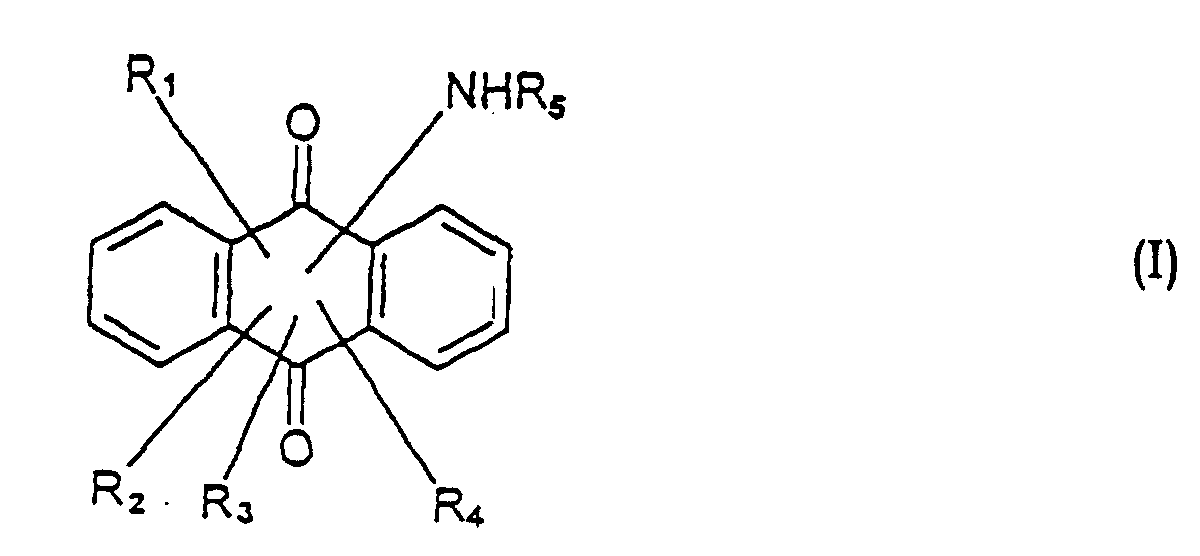 mit der Maßgabe, daß:R1, R2, R3 und R4, die identisch oder voneinander verschieden sein können, bedeuten Wasserstoff; Halogen; eine nachfolgend definierte Gruppe Z; C1-6-Alkyl; C1-6-Monohydroxyalkyl; C2-6-Polyhydroxyalkyl; Cyano; Nitro; Carboxy; Carbamoyl; Sulfo; eine substituierte oder unsubstituierte Aminögruppe, die die nachstehend angegebenen Bedeutungen der Gruppe NHR5 aufweist und identisch oder verschieden sein kann; eine nachfolgend definierte Gruppe OR6 oder SR6;R5 bedeutet Wasserstoff; eine nachfolgend definierte Gruppe Z; C1-6-Alkyl; C1-6-Monohydroxyalkyl; C2-6-Polyhydroxyalkyl; Alkoxy-(C1-6)alkyl(C1-6); Aryl; Benzyl; C1-6-Cyanoalkyl; C1-6-Carbamoylalkyl; N-Alkyl(C1-6)carbamoylalkyl(C1-6); N,N-Dialkyl(C1-6)carbamoylalkyl(C1-6); C1-6-Thiocarbamoylalkyl; C1-6-Trifluoralkyl; C1-6-Sulfoalkyl; Alkyl(C1-6)carboxyalkyl(C1-6); Alkyl(C1-6)sulfinylalkyl(C1- 6); C1-6-Aminosulfonylalkyl; N-Z-C1-6-Aminosulfonylalkyl; N-Alkyl(C1-6)aminosulfonylalkyl(C1-6); N,N-Dialkyl(C1-6)-aminosulfonylalkyl(C1-6); Alkyl(C1-6)carbonylalkyl(C1-6); C1-6-Aminoalkyl, wobei die Alkylgruppe unsubstituiert vorliegt oder mit einer oder mehreren Hydroxygruppen substituiert ist; C1-6-Aminoalkyl, wobei die Alkylgruppe unsubstituiert vorliegt oder mit einer oder mehreren Hydroxygruppen substituiert ist und wobei die Aminogruppe mit einer oder zwei Gruppen substituiert ist, die identisch oder voneinander verschieden sind und unter den folgenden Gruppen ausgewählt sind: C1-6-Alkyl, C1-6-Monohydroxyalkyl, C2-6-Polyhydroxyalkyl, Alkyl-(C1-6)carbonyl, Carbamoyl, N-Alkyl(C1-6)-carbamoyl, N,N-Dialkyl(C1-6)carbamoyl, Alkyl(C1-6)sulfonyl, Formyl, Trifluoralkyl(C1-6)carbonyl, Alkyl(C1-6)carboxy, Thiocarbamoyl oder den Gruppen Z (nachstehend definiert); oder die gemeinsam mit dem Stickstoffatom, an das sie gebunden sind, einen 5- oder 6-gliedrigen Ring bilden können, der nur Kohlenstoffatome aufweist oder auch ein oder mehrere Heteroatome enthält;R6 bedeutet Wasserstoff; C1-6-Alkyl; C1-6-Monohydroxyalkyl; C2-6-Polyhydroxyalkyl; eine Gruppe Z (nachstehend definiert); Alkoxy-(C1-6)alkyl-(C1-6); Aryl; Benzyl; C1-6-Carboxyalkyl; Alkyl(C1-6)-carboxyalkyl(C1-6); C1-6-Cyanoalkyl; C1-6-Carbamoylalkyl; N-Alkyl-(C1-6)carbamoylalkyl(C1-6); N,N-Dialkyl(C1-6)carbamoylalkyl(C1-6); C1-6-Trifluoralkyl; C1-6-Aminosulfonylalkyl; N-Z-C1-6-Aminosulfonylalkyl; N-Alkyl(C1-6)aminosulfonylalkyl(C1-6); N,N-Dialkyl-(C1-6)aminosulfonylalkyl(C1-6); Alkyl(C1-6)sulfinylalkyl(C1-6); Alkyl-(C1-6)sulfonylalkyl(C1-6); Alkyl- (C1-6)carbonylalkyl(C1-6); C1-6-Aminoalkyl, wobei die Alkylgruppe unsubstituiert vorliegt oder mit einer oder mehreren Hydroxygruppen substituiert ist; C1-6-Aminoalkyl, wobei die Alkylgruppe unsubstituiert vorliegt oder mit einer oder mehreren Hydroxygruppen substituiert ist und wobei die Aminogruppe mit einer oder zwei Gruppen substituiert ist, die identisch oder voneinander verschieden sind und unter den folgenden Gruppen ausgewählt sind: C1-6-Alkyl, C1-6-Monohydroxyalkyl, C2-6-Polyhydroxyalkyl, Alkyl(C1-6)carbonyl, Formyl, Trifluoralkyl(C1-6)-carbonyl, Alkyl(C1-6)-carboxy, Carbamoyl, N-Alkyl(C1-6)carbamoyl, N,N-Dialkyl(C1-6)carbamoyl, Thiocarbamoyl, Alkyl(C1-6)sulfonyl oder den Gruppen Z; oder die gemeinsam mit dem Stickstoffatom, an das sie gebunden sind, einen 5- oder 6-gliedrigen Ring bilden können, der nur Kohlenstoffatome enthält oder auch ein oder mehrere Heteroatome aufweist;Z ist unter den ungesättigten kationischen Gruppen der folgenden Formeln (II) und (III) und den gesättigten kationischen Gruppen der folgenden Formel (IV) ausgewählt:
 worin bedeuten:
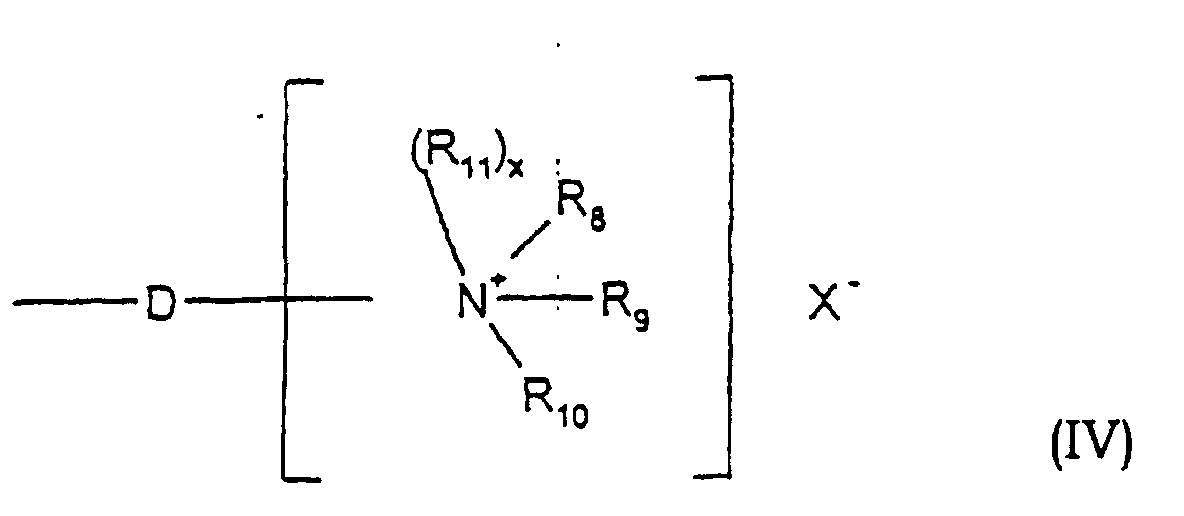 D eine Verbindungsgruppe, die eine Alkylkette mit vorzugsweise 1 bis 14 Kohlenstoffatome bedeutet, die geradkettig oder verzweigt vorliegt und mit einem oder mehreren Heteroatomen, wie beispielsweise Sauerstoff, Schwefel oder Stickstoff, unterbrochen sein kann, mit einer oder mehreren Hydroxygruppen oder C1-6-Alkoxygruppen substituiert sein kann und eine oder mehrere Ketogruppen tragen kann;E, G, J, L und M, die identisch oder voneinander verschieden sind, bedeuten ein Kohlenstoffatom, ein Sauerstoffatom, ein Schwefelatom oder ein Stickstoffatom;n ist 0 öder eine ganze Zahl von 1 bis 4;m ist 0 oder eine ganze Zahl von 1 bis 5;die Gruppen R, die identisch oder voneinander verschieden sind, bedeuten eine zweite Gruppe Z, die identisch mit der ersten Gruppe Z oder von ihr verschieden sein kann, Halogen, Hydroxy, C1-6-Alkyl, C1-6-Monohydroxyalkyl, C2-6-Polyhydroxyalkyl, Nitro, Cyano, C1-6-Cyanoalkyl, C1-6-Alkoxy, Trialkyl(C1-6)-silanalkyl(C1-6), Amido, Aldehydo, Carboxy, C1-6-Alkylcarbonyl, Thio, C1-6-Thioalkyl, Alkyl(C1-6)thio, Amino, eine Aminogruppe, die mit Alkyl(C1-6)carbonyl, Carbamoyl oder Alkyl(C1-6)sulfonyl geschützt ist; eine Gruppe NHR" oder NR"R"', worin R" und R"', die identisch oder voneinander verschieden sind, C1-6-Alkyl, C1- 6-Monohydroxyalkyl oder C2-6-Polyhydroxyalkyl bedeuten;R7 bedeutet C1-6-Alkyl, C1-6-Monohydroxyalkyl, C2-6-Polyhydroxyalkyl, C1-6-Cyanoalkyl, Trialkyl(C1-6)silanalkyl(C1-6), Alkoxy(C1-6)alkyl(C1-6), C1-6-Carbamoylalkyl, Alkyl(C1-6)carboxyalkyl(C1-6), Benzyl oder eine zweite Gruppe Z, die identisch mit der ersten Gruppe Z oder von ihr verschieden ist;R8, R9 und R10, die identisch oder voneinander verschieden sind, C1-6-Alkyl, C1-6-Monohydroxyalkyl, C2-6-Polyhydroxyalkyl, Alkoxy(C1-6)alkyl(C1-6), C1-6-Cyanoalkyl, Aryl, Benzyl, C1-6-Amidoalkyl, Trialkyl(C1-6)silanalkyl(C1-6) oder C1-6-Aminoalkyl, wobei die Aminogruppe mit Alkyl(C1-6)carbonyl, Carbamoyl oder Alkyl(C1-6)sulfonyl geschützt ist; zwei der Gruppen R8, R9 und R10 können auch gemeinsam mit dem Stickstoffatom, an das sie gebunden sind, einen gesättigten 5- oder 6-gliedrigen Ring bilden, der nur Kohlenstoffatome aufweist oder ein oder mehrere Heteroatome enthalten kann, beispielsweise Pyrrolidin, Piperidin, Piperazin oder Morpholin, wobei der Ring unsubstituiert vorliegen kann oder substituiert sein kann mit Halogen, Hydroxy, C1-6-Alkyl, C1-6-Monohydroxyalkyl, C2-6-Polyhydroxyalkyl, Nitro, Cyano, C1-6-Cyanoalkyl, C1-6-Alkoxy, Trialkyl(C1-6) silanalkyl(C1- 6), Amido, Aldehydo, Carboxy, C1-6-Ketoalkyl, Thio, C1-6-Thioalkyl, Alkyl(C1-6)thio, Amino, einer Aminogruppe, die mit Alkyl-(C1-6)Carbonyl, Carbamoyl oder Alkyl(C1-6)sulfonyl geschützt ist;
wobei eine der Gruppen R8, R9 und R10 auch eine zweite Gruppe Z bedeuten kann, die identisch mit der ersten Gruppe Z oder von ihr verschieden ist;R11 bedeutet C1-6-Alkyl; C1-6-Monohydroxyalkyl; C2-6-Polyhydroxyalkyl; Aryl; Benzyl; C1-6-Aminoalkyl; C1-6-Aminoalkyl, wobei die Aminogruppe mit Alkyl(C1-6)carbonyl, Carbamoyl oder Alkyl(C1-6)sulfonyl geschützt ist; C1-6-Carboxyalkyl; C1-6-Cyanoalkyl; C1-6-Carbamoylalkyl; C1-6-Trifluoralkyl; Trialkyl(C1-6)-silanalkyl(C1-6); C1-6-Sulfonamidoalkyl; Alkyl(C1-6)carboxyalkyl(C1-6); Alkyl(C1-6)sulfinylalkyl(C1-6); Alkyl(C1-6)sulfonylalkyl(C1-6); Alkyl(C1-6)ketoalkyl(C1-6); N- Alkyl(C1-6)carbamoylalkyl(C1-6); N-Alkyl(C1-6)sulfonamidoalkyl(C1-6);x und y bedeuten 0 oder 1; mit den folgenden Bedingungen:in den ungesättigten kationischen Gruppen der Formel (II):die Verbindungsgruppe D ist an das Stickstoffatom gebunden, wenn x = 0,die Verbindungsgruppe D ist'an eines der Atome E, G, J oder L gebunden, wenn x = 1,y kann nur den Wert 1 annehmen, wenn: ,1) die Gruppe R7 von dem Stickstoffatom des ungesättigten Rings getragen wird, wenn die Atome E, G, J und L gleichzeitig ein Kohlenstoffatom bedeuten; oder2) mindestens eines der Atome E, G, J und L ein Stickstoffatom bedeutet, an das R7 gebunden ist;in den ungesättigten kationischen Gruppen der Formel (III):die Verbindungsgruppe D an das Stickstoffatom gebunden ist, wenn x = 0,die Verbindungsgruppe D an eines der Atome E, G, J, L oder M gebunden ist, wenn x = 1,y nur den Wert 1 annehmen kann, wenn mindestens eines der Atome E, G, J, L und M ein zweiwertiges Atom bedeutet und die Gruppe R7 von dem Stickstoffatom des ungesättigten Rings getragen wird;in den kationischen Gruppen der Formel (IV):die Verbindungsgruppe D an das Stickstoffatom gebunden ist, das die Gruppen R8 bis R10 trägt, wenn x = 0,zwei der Gruppen R8 bis R10 gemeinsam mit dem Stickstoffatom, an das sie gebunden sind, einen oben definierten gesättigten 5- oder 6-gliedrigen Ring bilden und die Verbindungsgruppe D von einem Kohlenstoffatom des gesättigten Rings getragen wird, wenn x = 1;X- bedeutet ein einwertiges oder zweiwertiges Anion;die Anzahl der ungesättigten kationischen Gruppen Z der Formel (II), in denen mindestens eines der Atome E,G, J und L Stickstoff bedeutet, mindestens 1 ist. - Kationische Aminoanthrachinone nach Anspruch 1, dadurch gekennzeichnet, daß die Ringe der ungesättigten Gruppen Z der Formel (II) unter Pyrrolringen, Imidazolringen, Pyrazolringen, Oxazolringen, Thiazolringen und Triazolringen ausgewählt sind.
- Kationische Aminoanthrachinone nach Anspruch 1, dadurch gekennzeichnet, daß die Ringe der ungesättigten Gruppen Z der Formel (III) unter den Pyridinringen, Pyrimidinringen, Pyrazinringen, Oxazinringen und Triazinringen ausgewählt sind.
- Kationische Aminoanthrachinone nach einem der vorhergehenden Ansprüche, dadurch gekennzeichnet, daß in der Formel (IV) zwei der Gruppen R8, R9 und R10 einen Pyrrolidinring, Piperidinring, Piperazinring oder Morpholinring bilden, wobei der Ring unsubstituiert vorliegen oder gegebenenfalls mit einem Halogenatom, Hydroxy, C1-6-Alkyl, C1-6-Monohydroxyalkyl, C2-6-Polyhydroxyalkyl, Nitro, Cyano, C1-6-Cyanoalkyl, C1-6-Alkoxy, Trialkyl(C1-6)silanalkyl(C1-6), Amido, Aldehydo, Carboxy, C1-6-Alkylcarbonyl, Thio, C1-6-Thioalkyl, Alkyl(C1- 6)thio, Amino oder einer Aminogruppe substituiert sein kann, die mit Alkyl(C1-6)carbonyl, Carbamoyl oder Alkyl(C1-6)sulfonyl geschützt ist.
- Kationische Aminoanthrachinone nach einem der vorhergehenden Ansprüche, dadurch gekennzeichnet, daß X- Halogen, Hydroxid, Hydrogensulfat oder Alkyl(C1-6)sulfat bedeutet.
- Verbindungen nach einem der vorhergehenden Ansprüche, dadurch gekennzeichnet, daß sie ausgewählt sind unter:1-[2-(9,10-Dioxo-9,10-dihydro-anthracen-1-ylamino)-ethyl]-3-methyl-3H-imidazol-1-ium-bromid;1-Methyl-3-[3-(4-methylamino-9,10-dioxo-9,10-dihydroanthracen-1-ylamino)-propyl]-3H-imidazol-1-ium-hydrogensulfat;1-[2-(4-Hydroxy-9,10-dioxo-9,10-dihydro-anthracen-1-ylamino)-ethyl]-3-methyl-3H-imidazol-1-ium-bromid;1-[3-(9,10-Dioxo-9,10-dihydro-anthracen-1-ylamino)-propyl]-3-methyl-3H-imidazol-1-ium-methosulfat;1-[3-(4-Hydroxy-9,10-dioxo-9,10-dihydro-anthracen-1-ylamino)-propyl]-3-methyl-3H-imidazol-1-ium-methosulfat;1-{3-[4-(2-Hydroxy-ethylamino)-9,10-dioxo-9,10-dihydroanthracen-1-ylamino)-propyl]-3-methyl-3H-imidazol-1-iummethosulfat;1-{3-[4-(2,3-Dihydroxy-propylamino)-9,10-dioxo-9,10-dihydroanthracen-1-ylamino)-propyl]-3-methyl-3H-imidazol-1-iummethosulfat;1,4-Bis[3-(9,10-dioxo-9,10-dihydro-anthracen-1,4-diylamino)-propyl]-3-methyl-3H-imidazol-1-ium-dimethosulfat;1-[2-(9,10-Dioxo-9,10-dihydro-anthracen-2-ylamino)-ethyl]-3-methyl-3H-imidazol-1-ium-bromid;1-[2-(9,10-Dioxo-9,10-dihydro-anthracen-2-ylamino)-ethyl]-2-methyl-3H-pyrazol-1-ium-bromid;1-[2-(9,10-Dioxo-9,10-dihydro-anthracen-1-ylamino)-ethyl]-2-methyl-3H-pyrazol-1-ium-bromid;1,5-Bis[3-(9,10-dioxo-9,10-dihydro-anthracen-1,5-diylamino)-propyl]-3-methyl-3H-imidazol-1-ium-dimethosulfat;1,8-Bis[3-(9,10-dioxo-9,10-dihydro-anthracen-1,8-diylamino)-propyl]-3-methyl-3H-imidazol-1-ium-dimethosulfat;1-[2-(5,8-Diamino-9,10-dioxo-9,10-dihydro-anthracen-1-ylamino)-ethyl]-3-methyl-3H-imidazol-1-ium-bromid; und1-[3-(5,8-Diamino-9,10-dioxo-9,10-dihydro-anthracen-1-ylamino)-propyl]-3-methyl-3H-pyrazol-1-ium-methosulfat.
- Kationische Aminoanthrachinone nach einem der vorhergehenden Ansprüche, dadurch gekennzeichnet, daß die Additionssalze mit einer Säure unter den Hydrochloriden, Hydrobromiden, Sulfaten, Citraten, Succinaten, Tartraten, Lactaten und Acetaten ausgewählt sind.
- Verwendung von kationischen Aminoanthrachinonen der Formel (I) nach einem der vorhergehenden Ansprüche als Direktfarbstoffe in Farbmittelzusammensetzungen oder zur Herstellung von Farbmittelzusammensetzungen zum Färben von Keratinsubstanzen und insbesondere menschlichen Keratinfasern, wie dem Haar.
- Zusammensetzung zum Färben von Keratinsubstanzen, dadurch gekennzeichnet, daß sie in einem zum Färben geeigneten Medium mindestens ein kationisches Aminoanthrachinon der Formel (I) nach einem der Ansprüche 1 bis 7 in einer wirksamen Menge enthält.
- Zusammensetzung zum direkten Färben von menschlichen Keratinfasern und insbesondere zum Färben der Haare, dadurch gekennzeichnet, daß sie in einem zum Färben geeigneten Medium mindestens ein kationisches Aminoanthrachinon der Formel (I) nach einem der Ansprüche 1 bis 7 in einer wirksamen Menge enthält.
- Zusammensetzung nach den Ansprüchen 9 oder 10, dadurch gekennzeichnet, daß der pH-Wert im Bereich von 3 bis 12 liegt.
- Zusammensetzung nach einem der Ansprüche 9 bis 11, dadurch gekennzeichnet, daß die kationischen Aminoanthrachinone der Formel (I) in einer Konzentration von 0,005 bis 12 Gew.-%, bezogen auf das Gesamtgewicht der Zusammerisetzung, vorliegen.
- Zusammensetzung nach Anspruch 12, dadurch gekennzeichnet, daß die kationischen Aminoanthrachinone der Formel (I) in einer Konzentration von 0,05 bis 6 Gew.-%, bezogen auf das Gesamtgewicht der Zusammensetzung, vorliegen.
- Zusammensetzung nach einem der Ansprüche 9 bis 13, dadurch gekennzeichnet, daß sie weitere Direktfarbstoffe enthält, die unter den Nitrobenzol-Farbstoffen, wie Nitrophenylendiaminen, Nitrodiphenylaminen, Nitroanilinen, Nitrophenolethern oder Nitrophenolen, Nitropyridinen, Anthrachinon-Farbstoffen, die von den Verbindungen der Formel (I) verschieden sind, Mono- oder Diazofarbstoffen, Triarylmethan-Farbstoffen, Azin-Farbstoffen, Acridin-Farbstoffen und Xanthen-Farbstoffen oder metallhaltigen Farbstoffen ausgewählt sind.
- Zusammensetzung nach einem der Ansprüche 9 bis 14, dadurch gekennzeichnet, daß das zum Färben geeignete Medium ein wäßriges Medium ist, das aus Wasser und/oder organischen Lösungsmitteln in Mengenanteilen von 1 bis 40 Gew.-%, bezogen auf das Gesamtgewicht der Zusammensetzung, besteht, die unter den Alkoholen, Glykolen und Glykolethern ausgewählt sind.
- Verfahren zum Färben von Keratinfasern und insbesondere menschlichen Keratinfasern, wie dem Haar, durch direktes Färben, dadurch gekennzeichnet, daß eine Farbmittelzusammensetzung nach einem der Ansprüche 9 bis 15 auf die trockenen oder feuchten Keratinfasern aufgetragen wird und die Fasern ohne zwischenzeitliches Spülen getrocknet werden.
- Verfahren zum Färben von Keratinfasern und insbesondere menschlichen Keratinfasern, wie dem Haar, durch direktes Färben, dadurch gekennzeichnet, daß eine Farbmittelzusammensetzung nach einem der Ansprüche 9 bis 15 auf die trockenen oder feuchten Keratinfasern aufgetragen wird und nach einer Einwirkzeit von etwa 3 bis 60 min die Fasern gespült, gegebenenfalls gewaschen, nochmals gespült und getrocknet werden.
Applications Claiming Priority (2)
| Application Number | Priority Date | Filing Date | Title |
|---|---|---|---|
| FR9815046 | 1998-11-30 | ||
| FR9815046A FR2786484B1 (fr) | 1998-11-30 | 1998-11-30 | Aminoanthraquinones cationiques, leur utilisation pour la teinture des fibres keratiniques, compositions tinctoriales les renfermant et procedes de teinture |
Publications (2)
| Publication Number | Publication Date |
|---|---|
| EP1006154A1 EP1006154A1 (de) | 2000-06-07 |
| EP1006154B1 true EP1006154B1 (de) | 2002-04-17 |
Family
ID=9533345
Family Applications (1)
| Application Number | Title | Priority Date | Filing Date |
|---|---|---|---|
| EP99402629A Expired - Lifetime EP1006154B1 (de) | 1998-11-30 | 1999-10-22 | Kationische Aminoanthrachinone, deren Verwendung zum Färben keratinischer Fasern, diese enthaltende Färbemittel sowie Färbeverfahren |
Country Status (8)
| Country | Link |
|---|---|
| US (2) | US6437149B1 (de) |
| EP (1) | EP1006154B1 (de) |
| JP (1) | JP3531801B2 (de) |
| AT (1) | ATE216413T1 (de) |
| CA (1) | CA2290843C (de) |
| DE (1) | DE69901280T2 (de) |
| ES (1) | ES2175910T3 (de) |
| FR (1) | FR2786484B1 (de) |
Cited By (8)
| Publication number | Priority date | Publication date | Assignee | Title |
|---|---|---|---|---|
| DE102011089221A1 (de) | 2011-12-20 | 2013-06-20 | Henkel Ag & Co. Kgaa | Färbemittel mit direktziehenden Farbstoffen und Phospat-Tensiden |
| DE102011089219A1 (de) | 2011-12-20 | 2013-06-20 | Henkel Ag & Co. Kgaa | Färbemittel mit direktziehenden Farbstoffen und nichtionischen Tensiden |
| DE102011089220A1 (de) | 2011-12-20 | 2013-06-20 | Henkel Ag & Co. Kgaa | Mittel zum Färben von keratinischen Fasern enthaltend kationische Anthrachinonfarbstoffe und Fettsäuretriglyceride |
| DE102011089217A1 (de) | 2011-12-20 | 2013-06-20 | Henkel Ag & Co. Kgaa | Mittel zum Färben von keratinischen Fasern enthaltend hationische Anthrachinonfarbstoffe und anionische Polymere |
| DE102011089216A1 (de) | 2011-12-20 | 2013-06-20 | Henkel Ag & Co. Kgaa | Färbemittel mit direktziehenden Farbstoffen und amphotere Tensiden |
| DE102011089218A1 (de) | 2011-12-20 | 2013-06-20 | Henkel Ag & Co. Kgaa | Färbemittel mit kationischen direktziehenden Farbstoffen und Lecithine |
| DE102011089223A1 (de) | 2011-12-20 | 2013-06-20 | Henkel Ag & Co. Kgaa | Färbemittel mit direktziehenden Farbstoffen und zwitterionischen Tensiden |
| WO2013092007A2 (de) | 2011-12-20 | 2013-06-27 | Henkel Ag & Co. Kgaa | Mittel zum färben von keratinischen fasern enthaltend kationische anthrachinonfarbstoffe und fettsäurediester von alkandiolen |
Families Citing this family (14)
| Publication number | Priority date | Publication date | Assignee | Title |
|---|---|---|---|---|
| JP3831836B2 (ja) * | 2001-04-20 | 2006-10-11 | 富士電機ホールディングス株式会社 | 固体高分子形燃料電池発電装置 |
| DE10144881A1 (de) * | 2001-09-12 | 2003-03-27 | Wella Ag | Mittel zur Färbung von Keratinfasern |
| CN101061099B (zh) * | 2004-07-23 | 2013-10-30 | 西格马-奥利奇有限公司 | 高稳定性双离子液体盐 |
| US8168830B2 (en) * | 2004-07-23 | 2012-05-01 | Sigma-Aldrich Co. Llc | High stability diionic liquid salts |
| US20070117784A1 (en) * | 2005-03-04 | 2007-05-24 | Novacea, Inc. | Treatment of hyperproliferative diseases with anthraquinones |
| ES2356771T3 (es) * | 2005-06-23 | 2011-04-13 | Basf Se | Colorantes de sulfuro. |
| FR2889954B1 (fr) * | 2005-08-26 | 2007-10-19 | Oreal | Colorants mixtes cationiques comprenant un chromophore anthraquinone et leur utilisation en colorant capillaire |
| EP1820826A1 (de) * | 2006-02-09 | 2007-08-22 | DyStar Textilfarben GmbH & Co. Deutschland KG | Farbstoffe und Haarfaerbezusammensetzungen |
| JP5528815B2 (ja) | 2007-01-31 | 2014-06-25 | シグマ−アルドリッチ・カンパニー、エルエルシー | 安定性の高いポリイオン液体塩 |
| FR2967684B1 (fr) * | 2010-11-18 | 2015-09-11 | Oreal | Colorant direct anionique a contre ion tetra-alkylammonium, composition de teinture les comprenant et procede de coloration des fibres keratiniques a partir de ces colorants |
| JP7001343B2 (ja) * | 2016-12-28 | 2022-01-19 | 小林製薬株式会社 | 芳香剤組成物 |
| FR3111802B1 (fr) | 2020-06-30 | 2023-01-06 | Oreal | Composition de coloration comprenant un colorant direct cationique anthraquinonique particulier, un tensioactif cationique, un tensioactif amphotère ou zwittérionique et un alcool gras |
| FR3111800B1 (fr) * | 2020-06-30 | 2022-11-11 | Oreal | Composition de coloration comprenant un colorant direct cationique anthraquinonique, un polyol, un tensioactif anionique et un polysaccharide non ionique. |
| CN114685583A (zh) * | 2020-12-30 | 2022-07-01 | 西格莱(苏州)生物医药有限公司 | 一类糖苷化合物及其制备方法与用途 |
Family Cites Families (42)
| Publication number | Priority date | Publication date | Assignee | Title |
|---|---|---|---|---|
| US2611772A (en) * | 1950-12-30 | 1952-09-23 | Eastman Kodak Co | Preparation of 1, 4, 5, 8-tetraamino-anthraquinone compounds |
| US3272792A (en) * | 1961-12-18 | 1966-09-13 | American Aniline Prod | Quaternary ammonium salts of amino halohydrin dyestuffs |
| NL131931C (de) | 1962-10-29 | |||
| FR1401163A (fr) * | 1963-04-02 | 1965-06-04 | Oreal | Nouveaux colorants dérivés de la 2-aminoanthraquinone et leur application à la teinture des cheveux |
| FR1422016A (fr) | 1962-10-29 | 1965-12-24 | Oreal | Nouveaux colorants anthraquinoniques et leur application à la teinture des cheveux |
| FR1391675A (fr) | 1963-01-08 | 1965-03-12 | Oreal | Nouvelles solutions pour la teinture des cheveux et nouveaux composés pouvant êtreutilisés dans ces solutions |
| FR1379649A (fr) * | 1963-06-20 | 1964-11-27 | Oreal | Nouveaux colorants anthraquinoniques et leur utilisation pour la teinture des cheveux |
| US3528972A (en) | 1962-10-29 | 1970-09-15 | Oreal | Quaternary anthraquinone morpholino and piperidino salts |
| GB1053536A (de) | 1962-10-29 | |||
| FR1430089A (fr) | 1964-01-27 | 1966-03-04 | Oreal | Nouveaux colorants anthraquinoniques et nouveaux procédés de teinture des cheveux à l'aide de ces colorants |
| CH468188A (fr) | 1966-02-15 | 1969-02-15 | Oreal | Procédé de teinture décolorante pour cheveux et composition tinctoriale pour la mise en oeuvre dudit procédé |
| GB1205365A (en) * | 1969-05-27 | 1970-09-16 | Gillette Industries Ltd | Anthraquinone dyes |
| AU1553270A (en) * | 1969-05-27 | 1971-12-02 | THE GILLETTE COMPANY Actual Inventor (M) JOHN MICHAEL BIRD | Anthraquinone dyes and manufacture thereof |
| US3671529A (en) * | 1969-08-20 | 1972-06-20 | Sandoz Ltd | Basic anthraquinone dyes, with pyridinium 2- or 4-dimethylene group |
| US3997519A (en) * | 1972-05-15 | 1976-12-14 | Gaf Corporation | Method of producing quaternary pyridinium compounds |
| US4051155A (en) * | 1975-12-15 | 1977-09-27 | Allied Chemical Corporation | Anthraquinone dyes |
| US4123222A (en) * | 1976-03-23 | 1978-10-31 | Ciba-Geigy Corporation | Process for the dyeing or printing of polyacrylonitrile material |
| DE2730342C3 (de) * | 1976-07-07 | 1980-12-18 | Ciba-Geigy Ag, Basel (Schweiz) | Verfahren zur Herstellung von Anthrachinonverbindungen |
| US4310666A (en) * | 1978-04-10 | 1982-01-12 | United States Of America | Anti-neoplastic 1,4-bis-(substituted aminoalkyl amino)-anthraquinones |
| DE2906132A1 (de) * | 1979-02-17 | 1980-08-28 | Bayer Ag | Verfahren zur herstellung kationischer anthrachinon-farbstoffe |
| DE3164935D1 (en) * | 1980-02-18 | 1984-08-30 | Basf Ag | Dyestuffs containing imidazolylethylene groups and their use |
| US4715993A (en) * | 1983-03-18 | 1987-12-29 | American Cyanamid Company | Process for preparing certain 1,4-di[ω-(2-hydroxyethylamino)alkylamino]anthraquinone free bases |
| LU84875A1 (fr) | 1983-06-27 | 1985-03-29 | Oreal | Compositions tinctoriales pour fibres keratiniques a base de colorants directs et de gomme de xanthane |
| US4540788A (en) * | 1983-07-14 | 1985-09-10 | American Cyanamid Company | Schiff bases of [(aminoalkyl or substituted aminoalkyl)amino]-9,10-anthracenediones |
| US4661293A (en) * | 1983-12-01 | 1987-04-28 | The Clorox Company | Method for preparing 1,4-diaminoanthraquinones and intermediates thereof |
| IL76002A0 (en) * | 1984-08-03 | 1985-12-31 | Boehringer Biochemia Srl | Amino-anthracenediones-platinum complexes useful as anti-cancer compounds |
| US4894451A (en) * | 1985-04-01 | 1990-01-16 | The University Of Vermont | Unsymmetrical 1,4-bis(aminoalkylamino)-anthracene-9, 10-diones and derivatives |
| EP0198795B1 (de) * | 1985-04-01 | 1991-06-12 | Ciba-Geigy Ag | Verfahren zur Herstellung von 1,4-Diaminoanthrachinonen |
| DE3812053A1 (de) * | 1988-04-12 | 1989-10-26 | Basf Ag | Verfahren zur uebertragung von farbstoffen |
| EP0368750B1 (de) * | 1988-11-10 | 1994-10-26 | Sumitomo Chemical Company Limited | Verfahren zur Herstellung von substituierten Aminoanthrachinonen |
| GB8923075D0 (en) * | 1989-10-13 | 1989-11-29 | Patterson Laurence H | Anti-cancer compounds |
| US5204370A (en) * | 1990-11-05 | 1993-04-20 | Sphinx Pharmaceuticals Corporation | Bis-(hydroxyalkylamino)-anthraquinone inhibitors of protein kinase C |
| US5169403A (en) | 1991-11-01 | 1992-12-08 | Clairol, Inc. | Direct dyes having a quaternary center with a long aliphatic chain |
| EP0570333B1 (de) * | 1992-05-04 | 1996-02-21 | Ciba-Geigy Ag | Faserreaktive Anthrachinonfarbstoffe, Verfahren zu deren Herstellung und deren Verwendung |
| US5486629A (en) | 1992-09-01 | 1996-01-23 | Clairol, Inc. | Direct dyes having a quaternary center with a long aliphatic chain |
| TW311089B (de) | 1993-07-05 | 1997-07-21 | Ciba Sc Holding Ag | |
| GB9320191D0 (en) * | 1993-09-30 | 1993-11-17 | Univ Napier | Compounds |
| US5558808A (en) * | 1995-06-07 | 1996-09-24 | United Color Manufacturing, Inc. | Colored transmission fluid |
| US5520707A (en) * | 1995-08-07 | 1996-05-28 | Clairol, Inc. | Methods for dyeing hair with anthraquinone hair dyes having a quaternary ammonium side chain |
| US5746779A (en) | 1996-07-12 | 1998-05-05 | Bristol-Myers Squibb Company | Quaternized blue anthraqinone hair dyes in an isatin/amine dye system |
| EP0852136A1 (de) * | 1996-11-19 | 1998-07-08 | Ciba SC Holding AG | Verfahren zum Färben von keratinhaltigen Fasern |
| US5961664A (en) * | 1997-07-10 | 1999-10-05 | Bristol-Myers Squibb Company | Direct hair dye compositions and methods containing novel anthraquinone mixtures |
-
1998
- 1998-11-30 FR FR9815046A patent/FR2786484B1/fr not_active Expired - Fee Related
-
1999
- 1999-10-22 EP EP99402629A patent/EP1006154B1/de not_active Expired - Lifetime
- 1999-10-22 AT AT99402629T patent/ATE216413T1/de not_active IP Right Cessation
- 1999-10-22 DE DE69901280T patent/DE69901280T2/de not_active Expired - Lifetime
- 1999-10-22 ES ES99402629T patent/ES2175910T3/es not_active Expired - Lifetime
- 1999-11-26 CA CA002290843A patent/CA2290843C/fr not_active Expired - Fee Related
- 1999-11-29 US US09/449,539 patent/US6437149B1/en not_active Expired - Fee Related
- 1999-11-30 JP JP34063399A patent/JP3531801B2/ja not_active Expired - Lifetime
-
2002
- 2002-07-09 US US10/190,518 patent/US6645259B2/en not_active Expired - Fee Related
Cited By (23)
| Publication number | Priority date | Publication date | Assignee | Title |
|---|---|---|---|---|
| DE102011089221A1 (de) | 2011-12-20 | 2013-06-20 | Henkel Ag & Co. Kgaa | Färbemittel mit direktziehenden Farbstoffen und Phospat-Tensiden |
| DE102011089219A1 (de) | 2011-12-20 | 2013-06-20 | Henkel Ag & Co. Kgaa | Färbemittel mit direktziehenden Farbstoffen und nichtionischen Tensiden |
| DE102011089220A1 (de) | 2011-12-20 | 2013-06-20 | Henkel Ag & Co. Kgaa | Mittel zum Färben von keratinischen Fasern enthaltend kationische Anthrachinonfarbstoffe und Fettsäuretriglyceride |
| DE102011089217A1 (de) | 2011-12-20 | 2013-06-20 | Henkel Ag & Co. Kgaa | Mittel zum Färben von keratinischen Fasern enthaltend hationische Anthrachinonfarbstoffe und anionische Polymere |
| DE102011089216A1 (de) | 2011-12-20 | 2013-06-20 | Henkel Ag & Co. Kgaa | Färbemittel mit direktziehenden Farbstoffen und amphotere Tensiden |
| DE102011089218A1 (de) | 2011-12-20 | 2013-06-20 | Henkel Ag & Co. Kgaa | Färbemittel mit kationischen direktziehenden Farbstoffen und Lecithine |
| DE102011089223A1 (de) | 2011-12-20 | 2013-06-20 | Henkel Ag & Co. Kgaa | Färbemittel mit direktziehenden Farbstoffen und zwitterionischen Tensiden |
| WO2013092139A2 (de) | 2011-12-20 | 2013-06-27 | Henkel Ag & Co. Kgaa | Färbemittel mit direktziehenden farbstoffen und amphotere tensiden |
| WO2013092088A2 (de) | 2011-12-20 | 2013-06-27 | Henkel Ag & Co. Kgaa | Färbemittel mit direktziehenden farbstoffen und zwitterionischen tensiden |
| WO2013092061A2 (de) | 2011-12-20 | 2013-06-27 | Henkel Ag & Co. Kgaa | Mittel zum färben von keratinischen fasern enthaltend kationische anthrachinonfarbstoffe und anionische polymere |
| WO2013092210A2 (de) | 2011-12-20 | 2013-06-27 | Henkel Ag & Co. Kgaa | Färbemittel mit direktziehenden farbstoffen und nichtionischen tensiden |
| WO2013092060A2 (de) | 2011-12-20 | 2013-06-27 | Henkel Ag & Co. Kgaa | Mittel zum färben von keratinischen fasern enthaltend kationische anthrachinonfarbstoffe und fettsäuretriglyceride |
| WO2013092092A2 (de) | 2011-12-20 | 2013-06-27 | Henkel Ag & Co. Kgaa | Färbemittel mit kationischen direktziehenden farbstoffen und lecithine |
| WO2013092007A2 (de) | 2011-12-20 | 2013-06-27 | Henkel Ag & Co. Kgaa | Mittel zum färben von keratinischen fasern enthaltend kationische anthrachinonfarbstoffe und fettsäurediester von alkandiolen |
| WO2013092087A2 (de) | 2011-12-20 | 2013-06-27 | Henkel Ag & Co. Kgaa | Färbemittel mit direktziehenden farbstoffen und phosphat-tensiden |
| US9125831B2 (en) | 2011-12-20 | 2015-09-08 | Henkel Ag & Co. Kgaa | Coloring agent comprising direct dyes and phosphate surfactants |
| US9125830B2 (en) | 2011-12-20 | 2015-09-08 | Henkel Ag & Co., Kgaa | Coloring agent comprising cationic direct dyes and lecithins |
| US9125832B2 (en) | 2011-12-20 | 2015-09-08 | Henkel Ag & Co. Kgaa | Coloring composition with direct dyes and zwitterionic surfactants |
| US9132288B2 (en) | 2011-12-20 | 2015-09-15 | Henkel Ag & Co. Kgaa | Substance for dyeing keratin fibers, including cationic anthraquinone dyes and anionic polymers |
| US9132072B2 (en) | 2011-12-20 | 2015-09-15 | Henkel Ag & Co. Kgaa | Coloring agent having direct dyes and non-ionic surfactants |
| US9155689B2 (en) | 2011-12-20 | 2015-10-13 | Henkel Ag & Co. Kgaa | Coloring agent comprising direct dyes and amphoteric surfactants |
| US9186309B2 (en) | 2011-12-20 | 2015-11-17 | Henkel Ag & Co. Kgaa | Substance for dyeing keratin fibers, including cationic anthraquinone dyes and fatty acid diesters of alkane diols |
| US9192556B2 (en) | 2011-12-20 | 2015-11-24 | Henkel Ag & Co. Kgaa | Substance for dyeing keratin fibers, including cationic anthraquinone dyes and fatty acid triglycerides |
Also Published As
| Publication number | Publication date |
|---|---|
| US6437149B1 (en) | 2002-08-20 |
| ATE216413T1 (de) | 2002-05-15 |
| DE69901280D1 (de) | 2002-05-23 |
| US20030073853A1 (en) | 2003-04-17 |
| ES2175910T3 (es) | 2002-11-16 |
| JP3531801B2 (ja) | 2004-05-31 |
| CA2290843A1 (fr) | 2000-05-30 |
| JP2000229947A (ja) | 2000-08-22 |
| EP1006154A1 (de) | 2000-06-07 |
| FR2786484A1 (fr) | 2000-06-02 |
| CA2290843C (fr) | 2003-04-15 |
| US6645259B2 (en) | 2003-11-11 |
| DE69901280T2 (de) | 2002-08-14 |
| FR2786484B1 (fr) | 2001-01-05 |
Similar Documents
| Publication | Publication Date | Title |
|---|---|---|
| EP1006153B1 (de) | Kationische Aminodianthrachinone, deren Verwendung, diese enthaltende Färbemittel sowie Färbeverfahren | |
| CA2290843C (fr) | Aminoanthraquinones cationiques, leur utilisation pour la teinture des fibres keratiniques, compositions tinctoriales les renfermant et procedes de teinture | |
| EP0796850B1 (de) | 4,5-Diiminopyrazoline, Verfahren zu ihrer Herstellung und diese enthaltende Färbemittel | |
| EP1022016B1 (de) | Verwendung von kationischen Phenylazobenzol-Verbindungen zur Färbung von Keratinfasern, Zusammensetzungen unf Färbeverfahren | |
| EP0667143B1 (de) | Oxydationsfärbemittel für Keratinfasern, enthaltend ein Paraphenylendiamin, ein Metaphenylendiamin und ein Paraaminophenol oder ein Metaaminophenol | |
| CA2275938C (fr) | Composition de teinture des fibres keratiniques et procede de teinture mettant en oeuvre cette composition | |
| EP0918053A1 (de) | Azoverbindungen, ihre Verwendung zum Färben, diese enthaltende Zusammensetzungen und Farbverfahren | |
| FR2788432A1 (fr) | Utilisation pour la teinture directe des fibres keratiniques d'une association de deux colorants cationiques | |
| EP1018508B1 (de) | Kationische Monobenzol-nitrophenylendiamine, ihre Verwendung zum Färben von Keratinfasern, sie enthaltende Färbemittelzusammensetzungen und Färbeverfahren | |
| EP1073407B1 (de) | Verfahren zur haarfärbung unter verwendung von einem kationischen aliphatischen amin und einem aldehyd oder einem keton , einer chinonverbindung oder derivaten von diimino-isoindolin oder 3-amino-isoindolon | |
| EP1056435B9 (de) | Verfahren zur haarfärbung unter verwendung von einem kationischen heterocyklichen amin und einem aldehyd oder einem keton, einer chinoverbindung oder derivaten von diimino-isoindolin oder 3-amino-isoindolon | |
| CA2053352C (fr) | Utilisation de 1,4-di(mono ou poly) hydroxyalkylamino-9,10-anthraquinones pour la teinture de fibres keratiniques humaines, compositions cosmetiques les contenant en association avec des colorants azoiques et nitres benzeniques, et procede de teinture des cheveux les mettant en oeuvre | |
| EP1020176A2 (de) | Verwendung von kationischen bis-nitrobenzolen zur Färbung keratinischer Fasern, Färbemittel und Färbeverfahren | |
| EP0686389B1 (de) | Zusammensetzung zum Färben von Keratinfasern, enthaltend 2-(beta-Hydroxyethyl)paraphenylendiamin, 2-Methylresorcin und 3-Aminophenol, und Verfahren zur Anwendung | |
| LU83686A1 (fr) | Composition tinctoriale pour fibres keratiniques a base de colorants nitres benzeniques | |
| FR2555046A1 (fr) | Composition tinctoriale pour la coloration directe des fibres keratiniques, renfermant au moins une nitro-2 paraphenylenediamine n-substituee cosolubilisee et procedes de teinture de fibres keratiniques correspondants | |
| EP1018333B1 (de) | Verwendung von kationischen Monobenzolanilinen zur Färbung von Keratinfasern, Zusammensetzungen und Färbeverfahren | |
| FR2570375A1 (fr) | Nouveau colorant nitre benzenique, son procede de preparation et son utilisation en teinture de fibres keratiniques | |
| FR2582939A1 (fr) | Compositions de teinture pour fibres keratiniques a base de metaphenylene-diamines halogenees | |
| EP0722712B1 (de) | Oxidationsfärbemittel für keratinische Fasern sowie Färbungsverfahren unter Verwendung dieser Zusammensetzung | |
| FR2886842A1 (fr) | Composition de teinture de fibres keratiniques comprenant un colorant direct particulier et procedes de coloration la mettant en oeuvre | |
| FR2858219A1 (fr) | Composition de teinture de fibres keratiniques comprenant un colorant direct azodiazine particulier amine en position 7 et procedes de coloration la mettant en oeuvre |
Legal Events
| Date | Code | Title | Description |
|---|---|---|---|
| PUAI | Public reference made under article 153(3) epc to a published international application that has entered the european phase |
Free format text: ORIGINAL CODE: 0009012 |
|
| AK | Designated contracting states |
Kind code of ref document: A1 Designated state(s): AT BE CH CY DE DK ES FI FR GB GR IE IT LI LU MC NL PT SE |
|
| AX | Request for extension of the european patent |
Free format text: AL;LT;LV;MK;RO;SI |
|
| 17P | Request for examination filed |
Effective date: 20001207 |
|
| AKX | Designation fees paid |
Free format text: AT BE CH CY DE DK ES FI FR GB GR IE IT LI LU MC NL PT SE |
|
| 17Q | First examination report despatched |
Effective date: 20010514 |
|
| GRAG | Despatch of communication of intention to grant |
Free format text: ORIGINAL CODE: EPIDOS AGRA |
|
| REG | Reference to a national code |
Ref country code: GB Ref legal event code: IF02 |
|
| GRAG | Despatch of communication of intention to grant |
Free format text: ORIGINAL CODE: EPIDOS AGRA |
|
| GRAH | Despatch of communication of intention to grant a patent |
Free format text: ORIGINAL CODE: EPIDOS IGRA |
|
| GRAH | Despatch of communication of intention to grant a patent |
Free format text: ORIGINAL CODE: EPIDOS IGRA |
|
| GRAA | (expected) grant |
Free format text: ORIGINAL CODE: 0009210 |
|
| AK | Designated contracting states |
Kind code of ref document: B1 Designated state(s): AT BE CH CY DE DK ES FI FR GB GR IE IT LI LU MC NL PT SE |
|
| PG25 | Lapsed in a contracting state [announced via postgrant information from national office to epo] |
Ref country code: NL Free format text: LAPSE BECAUSE OF FAILURE TO SUBMIT A TRANSLATION OF THE DESCRIPTION OR TO PAY THE FEE WITHIN THE PRESCRIBED TIME-LIMIT Effective date: 20020417 Ref country code: IE Free format text: LAPSE BECAUSE OF FAILURE TO SUBMIT A TRANSLATION OF THE DESCRIPTION OR TO PAY THE FEE WITHIN THE PRESCRIBED TIME-LIMIT Effective date: 20020417 Ref country code: GR Free format text: LAPSE BECAUSE OF FAILURE TO SUBMIT A TRANSLATION OF THE DESCRIPTION OR TO PAY THE FEE WITHIN THE PRESCRIBED TIME-LIMIT Effective date: 20020417 Ref country code: FI Free format text: LAPSE BECAUSE OF FAILURE TO SUBMIT A TRANSLATION OF THE DESCRIPTION OR TO PAY THE FEE WITHIN THE PRESCRIBED TIME-LIMIT Effective date: 20020417 Ref country code: AT Free format text: LAPSE BECAUSE OF FAILURE TO SUBMIT A TRANSLATION OF THE DESCRIPTION OR TO PAY THE FEE WITHIN THE PRESCRIBED TIME-LIMIT Effective date: 20020417 |
|
| REF | Corresponds to: |
Ref document number: 216413 Country of ref document: AT Date of ref document: 20020515 Kind code of ref document: T |
|
| REG | Reference to a national code |
Ref country code: CH Ref legal event code: EP |
|
| REG | Reference to a national code |
Ref country code: IE Ref legal event code: FG4D Free format text: FRENCH |
|
| REF | Corresponds to: |
Ref document number: 69901280 Country of ref document: DE Date of ref document: 20020523 |
|
| PG25 | Lapsed in a contracting state [announced via postgrant information from national office to epo] |
Ref country code: SE Free format text: LAPSE BECAUSE OF FAILURE TO SUBMIT A TRANSLATION OF THE DESCRIPTION OR TO PAY THE FEE WITHIN THE PRESCRIBED TIME-LIMIT Effective date: 20020717 Ref country code: PT Free format text: LAPSE BECAUSE OF FAILURE TO SUBMIT A TRANSLATION OF THE DESCRIPTION OR TO PAY THE FEE WITHIN THE PRESCRIBED TIME-LIMIT Effective date: 20020717 Ref country code: DK Free format text: LAPSE BECAUSE OF FAILURE TO SUBMIT A TRANSLATION OF THE DESCRIPTION OR TO PAY THE FEE WITHIN THE PRESCRIBED TIME-LIMIT Effective date: 20020717 |
|
| GBT | Gb: translation of ep patent filed (gb section 77(6)(a)/1977) |
Effective date: 20020711 |
|
| NLV1 | Nl: lapsed or annulled due to failure to fulfill the requirements of art. 29p and 29m of the patents act | ||
| PG25 | Lapsed in a contracting state [announced via postgrant information from national office to epo] |
Ref country code: LU Free format text: LAPSE BECAUSE OF NON-PAYMENT OF DUE FEES Effective date: 20021022 |
|
| PG25 | Lapsed in a contracting state [announced via postgrant information from national office to epo] |
Ref country code: CY Free format text: LAPSE BECAUSE OF FAILURE TO SUBMIT A TRANSLATION OF THE DESCRIPTION OR TO PAY THE FEE WITHIN THE PRESCRIBED TIME-LIMIT Effective date: 20021031 Ref country code: BE Free format text: LAPSE BECAUSE OF NON-PAYMENT OF DUE FEES Effective date: 20021031 |
|
| REG | Reference to a national code |
Ref country code: ES Ref legal event code: FG2A Ref document number: 2175910 Country of ref document: ES Kind code of ref document: T3 |
|
| REG | Reference to a national code |
Ref country code: IE Ref legal event code: FD4D Ref document number: 1006154E Country of ref document: IE |
|
| PLBE | No opposition filed within time limit |
Free format text: ORIGINAL CODE: 0009261 |
|
| STAA | Information on the status of an ep patent application or granted ep patent |
Free format text: STATUS: NO OPPOSITION FILED WITHIN TIME LIMIT |
|
| 26N | No opposition filed |
Effective date: 20030120 |
|
| BERE | Be: lapsed |
Owner name: L'*OREAL Effective date: 20021031 |
|
| PG25 | Lapsed in a contracting state [announced via postgrant information from national office to epo] |
Ref country code: MC Free format text: LAPSE BECAUSE OF NON-PAYMENT OF DUE FEES Effective date: 20030501 |
|
| PG25 | Lapsed in a contracting state [announced via postgrant information from national office to epo] |
Ref country code: LI Free format text: LAPSE BECAUSE OF NON-PAYMENT OF DUE FEES Effective date: 20031031 Ref country code: CH Free format text: LAPSE BECAUSE OF NON-PAYMENT OF DUE FEES Effective date: 20031031 |
|
| REG | Reference to a national code |
Ref country code: CH Ref legal event code: PL |
|
| PGFP | Annual fee paid to national office [announced via postgrant information from national office to epo] |
Ref country code: DE Payment date: 20101020 Year of fee payment: 12 |
|
| PGFP | Annual fee paid to national office [announced via postgrant information from national office to epo] |
Ref country code: GB Payment date: 20101020 Year of fee payment: 12 Ref country code: IT Payment date: 20101023 Year of fee payment: 12 |
|
| PGFP | Annual fee paid to national office [announced via postgrant information from national office to epo] |
Ref country code: ES Payment date: 20111115 Year of fee payment: 13 Ref country code: FR Payment date: 20111103 Year of fee payment: 13 |
|
| GBPC | Gb: european patent ceased through non-payment of renewal fee |
Effective date: 20121022 |
|
| REG | Reference to a national code |
Ref country code: FR Ref legal event code: ST Effective date: 20130628 |
|
| PG25 | Lapsed in a contracting state [announced via postgrant information from national office to epo] |
Ref country code: DE Free format text: LAPSE BECAUSE OF NON-PAYMENT OF DUE FEES Effective date: 20130501 Ref country code: GB Free format text: LAPSE BECAUSE OF NON-PAYMENT OF DUE FEES Effective date: 20121022 |
|
| REG | Reference to a national code |
Ref country code: DE Ref legal event code: R119 Ref document number: 69901280 Country of ref document: DE Effective date: 20130501 |
|
| PG25 | Lapsed in a contracting state [announced via postgrant information from national office to epo] |
Ref country code: FR Free format text: LAPSE BECAUSE OF NON-PAYMENT OF DUE FEES Effective date: 20121031 Ref country code: IT Free format text: LAPSE BECAUSE OF NON-PAYMENT OF DUE FEES Effective date: 20121022 |
|
| REG | Reference to a national code |
Ref country code: ES Ref legal event code: FD2A Effective date: 20140116 |
|
| PG25 | Lapsed in a contracting state [announced via postgrant information from national office to epo] |
Ref country code: ES Free format text: LAPSE BECAUSE OF NON-PAYMENT OF DUE FEES Effective date: 20121023 |