EP1006200A2 - Verfahren zur Herstellung von ausgewählten intermolekularen in Nukleinsäuren und ihre Verwendungen - Google Patents
Verfahren zur Herstellung von ausgewählten intermolekularen in Nukleinsäuren und ihre Verwendungen Download PDFInfo
- Publication number
- EP1006200A2 EP1006200A2 EP99204141A EP99204141A EP1006200A2 EP 1006200 A2 EP1006200 A2 EP 1006200A2 EP 99204141 A EP99204141 A EP 99204141A EP 99204141 A EP99204141 A EP 99204141A EP 1006200 A2 EP1006200 A2 EP 1006200A2
- Authority
- EP
- European Patent Office
- Prior art keywords
- probe
- nucleic acid
- labelled
- cross
- sequences
- Prior art date
- Legal status (The legal status is an assumption and is not a legal conclusion. Google has not performed a legal analysis and makes no representation as to the accuracy of the status listed.)
- Granted
Links
- 150000007523 nucleic acids Chemical class 0.000 title claims abstract description 116
- 108020004707 nucleic acids Proteins 0.000 title claims abstract description 108
- 102000039446 nucleic acids Human genes 0.000 title claims abstract description 108
- 238000000034 method Methods 0.000 title claims abstract description 96
- 230000000295 complement effect Effects 0.000 claims abstract description 55
- 239000003431 cross linking reagent Substances 0.000 claims abstract description 30
- 208000037265 diseases, disorders, signs and symptoms Diseases 0.000 claims abstract description 5
- 201000010099 disease Diseases 0.000 claims abstract description 4
- 239000000523 sample Substances 0.000 claims description 231
- 210000000349 chromosome Anatomy 0.000 claims description 161
- 238000002372 labelling Methods 0.000 claims description 106
- 238000009396 hybridization Methods 0.000 claims description 92
- 239000003086 colorant Substances 0.000 claims description 51
- 230000003252 repetitive effect Effects 0.000 claims description 47
- 230000003321 amplification Effects 0.000 claims description 31
- 238000003199 nucleic acid amplification method Methods 0.000 claims description 31
- 102000004169 proteins and genes Human genes 0.000 claims description 28
- 108090000623 proteins and genes Proteins 0.000 claims description 28
- 238000001514 detection method Methods 0.000 claims description 27
- 238000006243 chemical reaction Methods 0.000 claims description 14
- BASFCYQUMIYNBI-UHFFFAOYSA-N platinum Chemical compound [Pt] BASFCYQUMIYNBI-UHFFFAOYSA-N 0.000 claims description 10
- 241000270295 Serpentes Species 0.000 claims description 9
- 229910052723 transition metal Inorganic materials 0.000 claims description 6
- 150000003624 transition metals Chemical class 0.000 claims description 6
- 229910052697 platinum Inorganic materials 0.000 claims description 5
- 230000007423 decrease Effects 0.000 claims description 4
- 230000003247 decreasing effect Effects 0.000 claims description 4
- 230000010076 replication Effects 0.000 claims description 4
- 108091093037 Peptide nucleic acid Proteins 0.000 claims description 3
- 150000001720 carbohydrates Chemical class 0.000 claims description 3
- 150000002632 lipids Chemical class 0.000 claims description 3
- 238000012986 modification Methods 0.000 claims description 2
- 230000004048 modification Effects 0.000 claims description 2
- 206010028980 Neoplasm Diseases 0.000 abstract description 4
- 201000011510 cancer Diseases 0.000 abstract description 4
- 108020004711 Nucleic Acid Probes Proteins 0.000 abstract description 2
- 239000002853 nucleic acid probe Substances 0.000 abstract description 2
- 230000009286 beneficial effect Effects 0.000 abstract 1
- 108020004414 DNA Proteins 0.000 description 64
- 239000000203 mixture Substances 0.000 description 38
- 108091034117 Oligonucleotide Proteins 0.000 description 33
- 238000004132 cross linking Methods 0.000 description 33
- 241000701806 Human papillomavirus Species 0.000 description 30
- GNBHRKFJIUUOQI-UHFFFAOYSA-N fluorescein Chemical compound O1C(=O)C2=CC=CC=C2C21C1=CC=C(O)C=C1OC1=CC(O)=CC=C21 GNBHRKFJIUUOQI-UHFFFAOYSA-N 0.000 description 29
- YBJHBAHKTGYVGT-ZKWXMUAHSA-N (+)-Biotin Chemical compound N1C(=O)N[C@@H]2[C@H](CCCCC(=O)O)SC[C@@H]21 YBJHBAHKTGYVGT-ZKWXMUAHSA-N 0.000 description 28
- 210000003917 human chromosome Anatomy 0.000 description 24
- 230000031864 metaphase Effects 0.000 description 22
- 238000010186 staining Methods 0.000 description 22
- JLCPHMBAVCMARE-UHFFFAOYSA-N [3-[[3-[[3-[[3-[[3-[[3-[[3-[[3-[[3-[[3-[[3-[[5-(2-amino-6-oxo-1H-purin-9-yl)-3-[[3-[[3-[[3-[[3-[[3-[[5-(2-amino-6-oxo-1H-purin-9-yl)-3-[[5-(2-amino-6-oxo-1H-purin-9-yl)-3-hydroxyoxolan-2-yl]methoxy-hydroxyphosphoryl]oxyoxolan-2-yl]methoxy-hydroxyphosphoryl]oxy-5-(5-methyl-2,4-dioxopyrimidin-1-yl)oxolan-2-yl]methoxy-hydroxyphosphoryl]oxy-5-(6-aminopurin-9-yl)oxolan-2-yl]methoxy-hydroxyphosphoryl]oxy-5-(6-aminopurin-9-yl)oxolan-2-yl]methoxy-hydroxyphosphoryl]oxy-5-(6-aminopurin-9-yl)oxolan-2-yl]methoxy-hydroxyphosphoryl]oxy-5-(6-aminopurin-9-yl)oxolan-2-yl]methoxy-hydroxyphosphoryl]oxyoxolan-2-yl]methoxy-hydroxyphosphoryl]oxy-5-(5-methyl-2,4-dioxopyrimidin-1-yl)oxolan-2-yl]methoxy-hydroxyphosphoryl]oxy-5-(4-amino-2-oxopyrimidin-1-yl)oxolan-2-yl]methoxy-hydroxyphosphoryl]oxy-5-(5-methyl-2,4-dioxopyrimidin-1-yl)oxolan-2-yl]methoxy-hydroxyphosphoryl]oxy-5-(5-methyl-2,4-dioxopyrimidin-1-yl)oxolan-2-yl]methoxy-hydroxyphosphoryl]oxy-5-(6-aminopurin-9-yl)oxolan-2-yl]methoxy-hydroxyphosphoryl]oxy-5-(6-aminopurin-9-yl)oxolan-2-yl]methoxy-hydroxyphosphoryl]oxy-5-(4-amino-2-oxopyrimidin-1-yl)oxolan-2-yl]methoxy-hydroxyphosphoryl]oxy-5-(4-amino-2-oxopyrimidin-1-yl)oxolan-2-yl]methoxy-hydroxyphosphoryl]oxy-5-(4-amino-2-oxopyrimidin-1-yl)oxolan-2-yl]methoxy-hydroxyphosphoryl]oxy-5-(6-aminopurin-9-yl)oxolan-2-yl]methoxy-hydroxyphosphoryl]oxy-5-(4-amino-2-oxopyrimidin-1-yl)oxolan-2-yl]methyl [5-(6-aminopurin-9-yl)-2-(hydroxymethyl)oxolan-3-yl] hydrogen phosphate Polymers Cc1cn(C2CC(OP(O)(=O)OCC3OC(CC3OP(O)(=O)OCC3OC(CC3O)n3cnc4c3nc(N)[nH]c4=O)n3cnc4c3nc(N)[nH]c4=O)C(COP(O)(=O)OC3CC(OC3COP(O)(=O)OC3CC(OC3COP(O)(=O)OC3CC(OC3COP(O)(=O)OC3CC(OC3COP(O)(=O)OC3CC(OC3COP(O)(=O)OC3CC(OC3COP(O)(=O)OC3CC(OC3COP(O)(=O)OC3CC(OC3COP(O)(=O)OC3CC(OC3COP(O)(=O)OC3CC(OC3COP(O)(=O)OC3CC(OC3COP(O)(=O)OC3CC(OC3COP(O)(=O)OC3CC(OC3COP(O)(=O)OC3CC(OC3COP(O)(=O)OC3CC(OC3COP(O)(=O)OC3CC(OC3COP(O)(=O)OC3CC(OC3CO)n3cnc4c(N)ncnc34)n3ccc(N)nc3=O)n3cnc4c(N)ncnc34)n3ccc(N)nc3=O)n3ccc(N)nc3=O)n3ccc(N)nc3=O)n3cnc4c(N)ncnc34)n3cnc4c(N)ncnc34)n3cc(C)c(=O)[nH]c3=O)n3cc(C)c(=O)[nH]c3=O)n3ccc(N)nc3=O)n3cc(C)c(=O)[nH]c3=O)n3cnc4c3nc(N)[nH]c4=O)n3cnc4c(N)ncnc34)n3cnc4c(N)ncnc34)n3cnc4c(N)ncnc34)n3cnc4c(N)ncnc34)O2)c(=O)[nH]c1=O JLCPHMBAVCMARE-UHFFFAOYSA-N 0.000 description 21
- 238000003752 polymerase chain reaction Methods 0.000 description 21
- 102000002260 Alkaline Phosphatase Human genes 0.000 description 19
- 108020004774 Alkaline Phosphatase Proteins 0.000 description 19
- 238000010422 painting Methods 0.000 description 18
- 108091081062 Repeated sequence (DNA) Proteins 0.000 description 17
- ZHNUHDYFZUAESO-UHFFFAOYSA-N Formamide Chemical compound NC=O ZHNUHDYFZUAESO-UHFFFAOYSA-N 0.000 description 16
- 210000004027 cell Anatomy 0.000 description 15
- 229960002685 biotin Drugs 0.000 description 14
- 235000020958 biotin Nutrition 0.000 description 14
- 239000011616 biotin Substances 0.000 description 14
- 230000000903 blocking effect Effects 0.000 description 14
- 239000000243 solution Substances 0.000 description 13
- 108091028043 Nucleic acid sequence Proteins 0.000 description 12
- 238000013459 approach Methods 0.000 description 12
- 238000002474 experimental method Methods 0.000 description 12
- 239000000126 substance Substances 0.000 description 11
- FWBHETKCLVMNFS-UHFFFAOYSA-N 4',6-Diamino-2-phenylindol Chemical compound C1=CC(C(=N)N)=CC=C1C1=CC2=CC=C(C(N)=N)C=C2N1 FWBHETKCLVMNFS-UHFFFAOYSA-N 0.000 description 10
- 238000004458 analytical method Methods 0.000 description 10
- 230000000670 limiting effect Effects 0.000 description 9
- LFQSCWFLJHTTHZ-UHFFFAOYSA-N Ethanol Chemical compound CCO LFQSCWFLJHTTHZ-UHFFFAOYSA-N 0.000 description 8
- 239000012634 fragment Substances 0.000 description 8
- 238000011065 in-situ storage Methods 0.000 description 8
- 238000002156 mixing Methods 0.000 description 8
- 238000002360 preparation method Methods 0.000 description 8
- 230000008569 process Effects 0.000 description 8
- 230000000694 effects Effects 0.000 description 7
- 230000002829 reductive effect Effects 0.000 description 7
- QKNYBSVHEMOAJP-UHFFFAOYSA-N 2-amino-2-(hydroxymethyl)propane-1,3-diol;hydron;chloride Chemical compound Cl.OCC(N)(CO)CO QKNYBSVHEMOAJP-UHFFFAOYSA-N 0.000 description 6
- 108090001008 Avidin Proteins 0.000 description 6
- 241000341655 Human papillomavirus type 16 Species 0.000 description 6
- 230000002159 abnormal effect Effects 0.000 description 6
- 150000001875 compounds Chemical class 0.000 description 6
- 239000000975 dye Substances 0.000 description 6
- 230000001965 increasing effect Effects 0.000 description 6
- 230000005945 translocation Effects 0.000 description 6
- 108091003079 Bovine Serum Albumin Proteins 0.000 description 5
- 230000008901 benefit Effects 0.000 description 5
- 229940098773 bovine serum albumin Drugs 0.000 description 5
- 230000002559 cytogenic effect Effects 0.000 description 5
- 238000005516 engineering process Methods 0.000 description 5
- 238000003384 imaging method Methods 0.000 description 5
- 238000011534 incubation Methods 0.000 description 5
- 230000002265 prevention Effects 0.000 description 5
- 230000001629 suppression Effects 0.000 description 5
- 238000013519 translation Methods 0.000 description 5
- 241000251468 Actinopterygii Species 0.000 description 4
- SHIBSTMRCDJXLN-UHFFFAOYSA-N Digoxigenin Natural products C1CC(C2C(C3(C)CCC(O)CC3CC2)CC2O)(O)C2(C)C1C1=CC(=O)OC1 SHIBSTMRCDJXLN-UHFFFAOYSA-N 0.000 description 4
- 102000043276 Oncogene Human genes 0.000 description 4
- 108700020796 Oncogene Proteins 0.000 description 4
- 229920001213 Polysorbate 20 Polymers 0.000 description 4
- FAPWRFPIFSIZLT-UHFFFAOYSA-M Sodium chloride Chemical compound [Na+].[Cl-] FAPWRFPIFSIZLT-UHFFFAOYSA-M 0.000 description 4
- 239000000872 buffer Substances 0.000 description 4
- OPTASPLRGRRNAP-UHFFFAOYSA-N cytosine Chemical compound NC=1C=CNC(=O)N=1 OPTASPLRGRRNAP-UHFFFAOYSA-N 0.000 description 4
- 238000004925 denaturation Methods 0.000 description 4
- 230000036425 denaturation Effects 0.000 description 4
- QONQRTHLHBTMGP-UHFFFAOYSA-N digitoxigenin Natural products CC12CCC(C3(CCC(O)CC3CC3)C)C3C11OC1CC2C1=CC(=O)OC1 QONQRTHLHBTMGP-UHFFFAOYSA-N 0.000 description 4
- SHIBSTMRCDJXLN-KCZCNTNESA-N digoxigenin Chemical compound C1([C@@H]2[C@@]3([C@@](CC2)(O)[C@H]2[C@@H]([C@@]4(C)CC[C@H](O)C[C@H]4CC2)C[C@H]3O)C)=CC(=O)OC1 SHIBSTMRCDJXLN-KCZCNTNESA-N 0.000 description 4
- 230000002255 enzymatic effect Effects 0.000 description 4
- 125000002887 hydroxy group Chemical group [H]O* 0.000 description 4
- 230000010354 integration Effects 0.000 description 4
- 108020004999 messenger RNA Proteins 0.000 description 4
- 239000000256 polyoxyethylene sorbitan monolaurate Substances 0.000 description 4
- 235000010486 polyoxyethylene sorbitan monolaurate Nutrition 0.000 description 4
- 239000001488 sodium phosphate Substances 0.000 description 4
- 229910000162 sodium phosphate Inorganic materials 0.000 description 4
- RYFMWSXOAZQYPI-UHFFFAOYSA-K trisodium phosphate Chemical compound [Na+].[Na+].[Na+].[O-]P([O-])([O-])=O RYFMWSXOAZQYPI-UHFFFAOYSA-K 0.000 description 4
- 108010008286 DNA nucleotidylexotransferase Proteins 0.000 description 3
- 102100029764 DNA-directed DNA/RNA polymerase mu Human genes 0.000 description 3
- 241000283973 Oryctolagus cuniculus Species 0.000 description 3
- 238000000338 in vitro Methods 0.000 description 3
- 238000000386 microscopy Methods 0.000 description 3
- 239000002773 nucleotide Substances 0.000 description 3
- 125000003729 nucleotide group Chemical group 0.000 description 3
- 239000003973 paint Substances 0.000 description 3
- 239000013612 plasmid Substances 0.000 description 3
- XLYOFNOQVPJJNP-UHFFFAOYSA-N water Substances O XLYOFNOQVPJJNP-UHFFFAOYSA-N 0.000 description 3
- OAKPWEUQDVLTCN-NKWVEPMBSA-N 2',3'-Dideoxyadenosine-5-triphosphate Chemical compound C1=NC=2C(N)=NC=NC=2N1[C@H]1CC[C@@H](CO[P@@](O)(=O)O[P@](O)(=O)OP(O)(O)=O)O1 OAKPWEUQDVLTCN-NKWVEPMBSA-N 0.000 description 2
- UFBJCMHMOXMLKC-UHFFFAOYSA-N 2,4-dinitrophenol Chemical compound OC1=CC=C([N+]([O-])=O)C=C1[N+]([O-])=O UFBJCMHMOXMLKC-UHFFFAOYSA-N 0.000 description 2
- SMBSZJBWYCGCJP-UHFFFAOYSA-N 3-(diethylamino)chromen-2-one Chemical compound C1=CC=C2OC(=O)C(N(CC)CC)=CC2=C1 SMBSZJBWYCGCJP-UHFFFAOYSA-N 0.000 description 2
- 229920001817 Agar Polymers 0.000 description 2
- 108010014303 DNA-directed DNA polymerase Proteins 0.000 description 2
- 102000016928 DNA-directed DNA polymerase Human genes 0.000 description 2
- 101150040913 DUT gene Proteins 0.000 description 2
- 229920002307 Dextran Polymers 0.000 description 2
- LTMHDMANZUZIPE-AMTYYWEZSA-N Digoxin Natural products O([C@H]1[C@H](C)O[C@H](O[C@@H]2C[C@@H]3[C@@](C)([C@@H]4[C@H]([C@]5(O)[C@](C)([C@H](O)C4)[C@H](C4=CC(=O)OC4)CC5)CC3)CC2)C[C@@H]1O)[C@H]1O[C@H](C)[C@@H](O[C@H]2O[C@@H](C)[C@H](O)[C@@H](O)C2)[C@@H](O)C1 LTMHDMANZUZIPE-AMTYYWEZSA-N 0.000 description 2
- 239000004677 Nylon Substances 0.000 description 2
- 241001494479 Pecora Species 0.000 description 2
- 102000057297 Pepsin A Human genes 0.000 description 2
- 108090000284 Pepsin A Proteins 0.000 description 2
- 108010090804 Streptavidin Proteins 0.000 description 2
- QAOWNCQODCNURD-UHFFFAOYSA-L Sulfate Chemical compound [O-]S([O-])(=O)=O QAOWNCQODCNURD-UHFFFAOYSA-L 0.000 description 2
- 206010042602 Supraventricular extrasystoles Diseases 0.000 description 2
- 239000008272 agar Substances 0.000 description 2
- 239000011543 agarose gel Substances 0.000 description 2
- 238000000137 annealing Methods 0.000 description 2
- 238000003556 assay Methods 0.000 description 2
- 239000011324 bead Substances 0.000 description 2
- 239000004568 cement Substances 0.000 description 2
- 239000013611 chromosomal DNA Substances 0.000 description 2
- 238000001816 cooling Methods 0.000 description 2
- 238000004163 cytometry Methods 0.000 description 2
- 229940104302 cytosine Drugs 0.000 description 2
- 229960002086 dextran Drugs 0.000 description 2
- 229960000633 dextran sulfate Drugs 0.000 description 2
- LTMHDMANZUZIPE-PUGKRICDSA-N digoxin Chemical compound C1[C@H](O)[C@H](O)[C@@H](C)O[C@H]1O[C@@H]1[C@@H](C)O[C@@H](O[C@@H]2[C@H](O[C@@H](O[C@@H]3C[C@@H]4[C@]([C@@H]5[C@H]([C@]6(CC[C@@H]([C@@]6(C)[C@H](O)C5)C=5COC(=O)C=5)O)CC4)(C)CC3)C[C@@H]2O)C)C[C@@H]1O LTMHDMANZUZIPE-PUGKRICDSA-N 0.000 description 2
- 229960005156 digoxin Drugs 0.000 description 2
- LTMHDMANZUZIPE-UHFFFAOYSA-N digoxine Natural products C1C(O)C(O)C(C)OC1OC1C(C)OC(OC2C(OC(OC3CC4C(C5C(C6(CCC(C6(C)C(O)C5)C=5COC(=O)C=5)O)CC4)(C)CC3)CC2O)C)CC1O LTMHDMANZUZIPE-UHFFFAOYSA-N 0.000 description 2
- BFMYDTVEBKDAKJ-UHFFFAOYSA-L disodium;(2',7'-dibromo-3',6'-dioxido-3-oxospiro[2-benzofuran-1,9'-xanthene]-4'-yl)mercury;hydrate Chemical compound O.[Na+].[Na+].O1C(=O)C2=CC=CC=C2C21C1=CC(Br)=C([O-])C([Hg])=C1OC1=C2C=C(Br)C([O-])=C1 BFMYDTVEBKDAKJ-UHFFFAOYSA-L 0.000 description 2
- 238000009826 distribution Methods 0.000 description 2
- 229920001971 elastomer Polymers 0.000 description 2
- 238000011156 evaluation Methods 0.000 description 2
- 230000005284 excitation Effects 0.000 description 2
- MHMNJMPURVTYEJ-UHFFFAOYSA-N fluorescein-5-isothiocyanate Chemical compound O1C(=O)C2=CC(N=C=S)=CC=C2C21C1=CC=C(O)C=C1OC1=CC(O)=CC=C21 MHMNJMPURVTYEJ-UHFFFAOYSA-N 0.000 description 2
- 238000000799 fluorescence microscopy Methods 0.000 description 2
- UYTPUPDQBNUYGX-UHFFFAOYSA-N guanine Chemical compound O=C1NC(N)=NC2=C1N=CN2 UYTPUPDQBNUYGX-UHFFFAOYSA-N 0.000 description 2
- 229940127121 immunoconjugate Drugs 0.000 description 2
- 238000010348 incorporation Methods 0.000 description 2
- 230000002452 interceptive effect Effects 0.000 description 2
- 239000000543 intermediate Substances 0.000 description 2
- 230000002427 irreversible effect Effects 0.000 description 2
- 238000011031 large-scale manufacturing process Methods 0.000 description 2
- 238000004519 manufacturing process Methods 0.000 description 2
- 239000012528 membrane Substances 0.000 description 2
- QSHDDOUJBYECFT-UHFFFAOYSA-N mercury Chemical compound [Hg] QSHDDOUJBYECFT-UHFFFAOYSA-N 0.000 description 2
- 229910052753 mercury Inorganic materials 0.000 description 2
- 238000009660 micro-sectioning Methods 0.000 description 2
- 239000003068 molecular probe Substances 0.000 description 2
- 229940126619 mouse monoclonal antibody Drugs 0.000 description 2
- 229920001778 nylon Polymers 0.000 description 2
- 229940111202 pepsin Drugs 0.000 description 2
- 230000002035 prolonged effect Effects 0.000 description 2
- 230000008707 rearrangement Effects 0.000 description 2
- 108091035233 repetitive DNA sequence Proteins 0.000 description 2
- 102000053632 repetitive DNA sequence Human genes 0.000 description 2
- 229920006395 saturated elastomer Polymers 0.000 description 2
- 239000011780 sodium chloride Substances 0.000 description 2
- 229910021653 sulphate ion Inorganic materials 0.000 description 2
- 230000001225 therapeutic effect Effects 0.000 description 2
- 238000012549 training Methods 0.000 description 2
- 238000013518 transcription Methods 0.000 description 2
- 230000035897 transcription Effects 0.000 description 2
- 238000012800 visualization Methods 0.000 description 2
- 108091032973 (ribonucleotides)n+m Proteins 0.000 description 1
- QRXMUCSWCMTJGU-UHFFFAOYSA-N 5-bromo-4-chloro-3-indolyl phosphate Chemical compound C1=C(Br)C(Cl)=C2C(OP(O)(=O)O)=CNC2=C1 QRXMUCSWCMTJGU-UHFFFAOYSA-N 0.000 description 1
- 108020000948 Antisense Oligonucleotides Proteins 0.000 description 1
- 208000032568 B-cell prolymphocytic leukaemia Diseases 0.000 description 1
- 102000053602 DNA Human genes 0.000 description 1
- 101000663831 Homo sapiens SH3 and PX domain-containing protein 2A Proteins 0.000 description 1
- 241000722343 Human papillomavirus types Species 0.000 description 1
- 208000036626 Mental retardation Diseases 0.000 description 1
- 239000000020 Nitrocellulose Substances 0.000 description 1
- 238000000636 Northern blotting Methods 0.000 description 1
- 238000012408 PCR amplification Methods 0.000 description 1
- 238000002105 Southern blotting Methods 0.000 description 1
- 239000007984 Tris EDTA buffer Substances 0.000 description 1
- 239000007976 Tris-NaCl-Tween buffer Substances 0.000 description 1
- 230000000692 anti-sense effect Effects 0.000 description 1
- 239000000074 antisense oligonucleotide Substances 0.000 description 1
- 238000012230 antisense oligonucleotides Methods 0.000 description 1
- 239000007864 aqueous solution Substances 0.000 description 1
- 239000007806 chemical reaction intermediate Substances 0.000 description 1
- 238000002038 chemiluminescence detection Methods 0.000 description 1
- 239000002299 complementary DNA Substances 0.000 description 1
- 238000011109 contamination Methods 0.000 description 1
- 238000007796 conventional method Methods 0.000 description 1
- 230000003412 degenerative effect Effects 0.000 description 1
- 239000005546 dideoxynucleotide Substances 0.000 description 1
- 230000029087 digestion Effects 0.000 description 1
- 230000002708 enhancing effect Effects 0.000 description 1
- 230000002349 favourable effect Effects 0.000 description 1
- 239000007850 fluorescent dye Substances 0.000 description 1
- 102000057479 human SH3PXD2A Human genes 0.000 description 1
- 239000011159 matrix material Substances 0.000 description 1
- 238000005259 measurement Methods 0.000 description 1
- 229910052751 metal Inorganic materials 0.000 description 1
- 239000002184 metal Substances 0.000 description 1
- 238000002493 microarray Methods 0.000 description 1
- 229920001220 nitrocellulos Polymers 0.000 description 1
- 230000000737 periodic effect Effects 0.000 description 1
- 230000004962 physiological condition Effects 0.000 description 1
- 230000002062 proliferating effect Effects 0.000 description 1
- 230000035755 proliferation Effects 0.000 description 1
- 239000012460 protein solution Substances 0.000 description 1
- 238000000746 purification Methods 0.000 description 1
- 239000011541 reaction mixture Substances 0.000 description 1
- 108091008146 restriction endonucleases Proteins 0.000 description 1
- 230000002441 reversible effect Effects 0.000 description 1
- 238000011895 specific detection Methods 0.000 description 1
- 230000003019 stabilising effect Effects 0.000 description 1
- 238000010561 standard procedure Methods 0.000 description 1
- 239000011550 stock solution Substances 0.000 description 1
- 239000000758 substrate Substances 0.000 description 1
- 238000011410 subtraction method Methods 0.000 description 1
- 238000012360 testing method Methods 0.000 description 1
- 230000009466 transformation Effects 0.000 description 1
- 230000001131 transforming effect Effects 0.000 description 1
- 238000005406 washing Methods 0.000 description 1
Images


Classifications
-
- C—CHEMISTRY; METALLURGY
- C12—BIOCHEMISTRY; BEER; SPIRITS; WINE; VINEGAR; MICROBIOLOGY; ENZYMOLOGY; MUTATION OR GENETIC ENGINEERING
- C12Q—MEASURING OR TESTING PROCESSES INVOLVING ENZYMES, NUCLEIC ACIDS OR MICROORGANISMS; COMPOSITIONS OR TEST PAPERS THEREFOR; PROCESSES OF PREPARING SUCH COMPOSITIONS; CONDITION-RESPONSIVE CONTROL IN MICROBIOLOGICAL OR ENZYMOLOGICAL PROCESSES
- C12Q1/00—Measuring or testing processes involving enzymes, nucleic acids or microorganisms; Compositions therefor; Processes of preparing such compositions
- C12Q1/68—Measuring or testing processes involving enzymes, nucleic acids or microorganisms; Compositions therefor; Processes of preparing such compositions involving nucleic acids
- C12Q1/6813—Hybridisation assays
- C12Q1/6832—Enhancement of hybridisation reaction
-
- C—CHEMISTRY; METALLURGY
- C07—ORGANIC CHEMISTRY
- C07H—SUGARS; DERIVATIVES THEREOF; NUCLEOSIDES; NUCLEOTIDES; NUCLEIC ACIDS
- C07H21/00—Compounds containing two or more mononucleotide units having separate phosphate or polyphosphate groups linked by saccharide radicals of nucleoside groups, e.g. nucleic acids
- C07H21/04—Compounds containing two or more mononucleotide units having separate phosphate or polyphosphate groups linked by saccharide radicals of nucleoside groups, e.g. nucleic acids with deoxyribosyl as saccharide radical
-
- C—CHEMISTRY; METALLURGY
- C12—BIOCHEMISTRY; BEER; SPIRITS; WINE; VINEGAR; MICROBIOLOGY; ENZYMOLOGY; MUTATION OR GENETIC ENGINEERING
- C12Q—MEASURING OR TESTING PROCESSES INVOLVING ENZYMES, NUCLEIC ACIDS OR MICROORGANISMS; COMPOSITIONS OR TEST PAPERS THEREFOR; PROCESSES OF PREPARING SUCH COMPOSITIONS; CONDITION-RESPONSIVE CONTROL IN MICROBIOLOGICAL OR ENZYMOLOGICAL PROCESSES
- C12Q1/00—Measuring or testing processes involving enzymes, nucleic acids or microorganisms; Compositions therefor; Processes of preparing such compositions
- C12Q1/68—Measuring or testing processes involving enzymes, nucleic acids or microorganisms; Compositions therefor; Processes of preparing such compositions involving nucleic acids
- C12Q1/6813—Hybridisation assays
- C12Q1/6816—Hybridisation assays characterised by the detection means
-
- C—CHEMISTRY; METALLURGY
- C12—BIOCHEMISTRY; BEER; SPIRITS; WINE; VINEGAR; MICROBIOLOGY; ENZYMOLOGY; MUTATION OR GENETIC ENGINEERING
- C12Q—MEASURING OR TESTING PROCESSES INVOLVING ENZYMES, NUCLEIC ACIDS OR MICROORGANISMS; COMPOSITIONS OR TEST PAPERS THEREFOR; PROCESSES OF PREPARING SUCH COMPOSITIONS; CONDITION-RESPONSIVE CONTROL IN MICROBIOLOGICAL OR ENZYMOLOGICAL PROCESSES
- C12Q1/00—Measuring or testing processes involving enzymes, nucleic acids or microorganisms; Compositions therefor; Processes of preparing such compositions
- C12Q1/68—Measuring or testing processes involving enzymes, nucleic acids or microorganisms; Compositions therefor; Processes of preparing such compositions involving nucleic acids
- C12Q1/6813—Hybridisation assays
- C12Q1/6841—In situ hybridisation
-
- C—CHEMISTRY; METALLURGY
- C12—BIOCHEMISTRY; BEER; SPIRITS; WINE; VINEGAR; MICROBIOLOGY; ENZYMOLOGY; MUTATION OR GENETIC ENGINEERING
- C12Q—MEASURING OR TESTING PROCESSES INVOLVING ENZYMES, NUCLEIC ACIDS OR MICROORGANISMS; COMPOSITIONS OR TEST PAPERS THEREFOR; PROCESSES OF PREPARING SUCH COMPOSITIONS; CONDITION-RESPONSIVE CONTROL IN MICROBIOLOGICAL OR ENZYMOLOGICAL PROCESSES
- C12Q1/00—Measuring or testing processes involving enzymes, nucleic acids or microorganisms; Compositions therefor; Processes of preparing such compositions
- C12Q1/68—Measuring or testing processes involving enzymes, nucleic acids or microorganisms; Compositions therefor; Processes of preparing such compositions involving nucleic acids
- C12Q1/6844—Nucleic acid amplification reactions
- C12Q1/686—Polymerase chain reaction [PCR]
Definitions
- the invention lies in the field of nucleic acid cross-linking and uses thereof. More specifically the invention relates to method for producing selected interstrand cross-links in nucleic acids and uses thereof. One important aspect of the invention relates to the use of selected interstrand cross-links for the selective amplification of certain nucleic acids in an amplification reaction.
- nucleic acid cross-linking activity Many different compounds have been identified that posses nucleic acid cross-linking activity.
- Cross-linking of nucleic acids is most commonly used for therapeutic purposes in the intervention with proliferative disorders such as cancer. Most cross-linking agents cross-link nucleic acids in very specific ways and on specific places in nucleic acids. However, the frequency of these specific places in most nucleic acids are so high that effectively the cross-links are provided throughout the nucleic acid molecules. For the use of these cross-linking compounds in the intervention of cancer this so-called apparently random cross-linking activity does not prevent some kind of a therapeutic effect. However, in the ideal situation cross-links would only be applied in the nucleic acid of the cells of which the proliferation should be interfered with.
- the invention provides a method for producing cross-links in selected regions of a nucleic acid.
- said method may be used to prevent at least in part, certain regions in a nucleic acid from taking part in a process such as, but not limited to a process comprising a hybridisation or an amplification or both.
- said method of producing selected interstrand cross-links is used in a process for producing a probe deprived at least in part of repetitive sequences.
- a probe is useful for the detection of for example nucleic acid sequences in chromosome painting in the field of cytogenetics.
- FISH fluorescence in situ hybridisation
- combinatorial labelling also called multiplex FISH
- Five fluorophores thus allow a maximum of 31 colours, sufficient to recognise 24 chromosomes, but insufficient for instance to explore the use of p and q arm specific probes for the detection of intrachromosomal rearrangements.
- multi-colour FISH analysis of chromosomes would benefit directly from a method to increase the number of simultaneously recognisable targets beyond the 27 reported so far (Nederlof et al ., 1992; Dauwerse et al ., 1992; Morrison and Legator, 1997). Higher FISH multiplicity is achievable by ratio labelling. This technique, by which a given probe is composed of a mixture of probes with different fluorescent labels, has great potential.
- ratio labelling is considerably more complex than combinatorial labelling. Recognition of chromosomes stained with ratio labelled probes is not a "yes or no colour” decision (as in the binary approach) but requires accurate measurement of colour.
- the present invention provides methods for the selected cross-linking of nucleic acids. Specific regions in nucleic acids can be selected and specifically cross-linked with minor or not detectable "a-specific" cross-linking in not selected regions.
- the method is used in one non-limiting application, for the selected amplification of certain sequences from a pool of potentially amplifiable sequences.
- the method is used in another non-limiting application for the preparation of a probe for the detection of nucleic acids wherein selected sequences are at least in part prevented from taking part in a hybridisation reaction.
- the invention provides a method for the generation of a probe for the detection of chromosomes or parts thereof. In one non-limiting example of such a probe said probe is labelled by means of one aspect of the COBRA technique of the invention.
- the invention provides a process for producing selected interstrand cross-links in nucleic acids comprising hybridising single strand nucleic acid(s) with complementary single strand nucleic acid(s) or a functional analogue thereof, wherein said nucleic acid(s) or said complementary nucleic acid(s) or both comprise a cross-linking agent.
- said single stranded nucleic acid(s) or said complementary nucleic acid(s) comprises a cross-linking agent.
- Said nucleic acid, preferably said complementary nucleic acid may also be a functional analogue of a nucleic acid.
- One such analogue comprises peptide nucleic acid (PNA).
- nucleic acid or said complementary nucleic acid or both are DNA.
- a preferred principle for selecting a nucleic acid region is through hybridisation with one or more nucleic acids complementary to said region.
- Cross-links may be provided through a cross-linking agent.
- Cross-links may be provided by hybridising one or more complementary nucleic acids to a nucleic acid thereby selecting regions for cross-linking, and contacting said nucleic acid with a cross-linking agent. The selected double stranded regions are cross-linked whereas the non-selected single stranded regions are not cross-linked.
- cross-linking agent and/or cross-linking agent not contributing to double stranded intermediates can be removed or inactivated before use of the selectively cross-linked nucleic acid.
- cross-linking agents are used that cross-link double stranded nucleic acids and that have minor or undetectable cross-linking activity in single stranded nucleic acids.
- cross-linking agent is linked to the one or more complementary nucleic acids before hybridisation whereupon cross-linking of selected regions is achieved after hybridisation of said complementary nucleic acid to the selected region.
- cross-linking activity of the cross-linking agent is low when the nucleic acid is a single strand form and high when the nucleic acid is in a double stranded form.
- Regions in a nucleic acid may be selected for cross-linking by adding complementary nucleic acid to the single stranded form of said nucleic acid and performing a hybridisation.
- advantage may be taken of complementary regions in a nucleic acid in that said complementary regions are induced to hybridise to each other after said nucleic acid has been made single strand and allowed to hybridise. Particularly in this case, but not limited to this case, selection of different regions can be varied by varying the hybridisation conditions.
- Regions may also be selected for cross-linking by using a combination of the methods mentioned above. For instance some regions may be selected through the addition of complementary nucleic acid(s), whereas other and or the same regions may be selected through hybridisation of complementary regions within a nucleic acid. It is of course essential that complementary nucleic acids comprises sequences that are complementary to a selected region in a nucleic acid. However, it is not necessary that all sequences in the complementary nucleic acids are in fact complementary to a selected region in a nucleic acid. Extra sequences in said complementary nucleic acids may be useful for a specific purpose or may just be present for convenience as long as they do not prevent the primary function of said complementary nucleic acids, i.e. hybridising to a selected region.
- the level of cross-linking and the nature of the cross-link determine tightness of the cross-linking between the selected nucleic acid region and the complementary nucleic acid.
- the required tightness of the cross-linking varies with the specific application of the invention. In applications wherein selected cross-linking is performed to prevent denaturation of a selectively cross-linked double stranded nucleic acid, the tightness of the linking should be sufficiently high to at least in part prevent denaturation in conditions that would enable denaturation of the selected region without cross-linking.
- the cross-linking agent comprises a transition metal, preferably platinum, capable of cross-linking double stranded nucleic acids.
- the cross-linking agent comprises (trans)-dichlorodiam(m)ineplatinum.
- Trans-dichlorodiammineplatinum (II) can form intrastrand cross-links between adjacent base residues in a DNA strand (Cohen et al ., 1980).
- the intrastrand cross-links between two guanine (G) residues, or between a G and a cytosine (C) residue, or between a G and a cytosine (C) residue separated by at least one residue are the most favourable ones (Eastman et al .,1988; Pinto et al ., 1985; Lepre et al , 1987).
- the 1,3-intrastrand cross-links between trans -DDP and two G residues separated by one intermediate base are stable within single-stranded oligonucleotides. As soon as the platinated oligonucleotides hybridise to their complementary strands the 1,3-intrastrand cross-links rearranges to form an interstrand cross-link (Dalbies et al ., 1994).
- This interstrand cross-linking effect of trans -DDP can be used in a strategy to selectively cross-link certain nucleic acid sequences in a pool of nucleic acid sequences.
- selected interstrand cross-links are provided in oncogenes present in the DNA of cells that are transformed or in the process of transforming.
- said interstrand cross-links are provided to hamper at least in part replication and/or transcription of said oncogenes.
- Said application may be useful in the treatment or prevention of cancer.
- a method for the selected interstrand cross-linking of selected sequences in a nucleic acid sequence comprising hybridising at least one selected single strand sequence with a complementary single strand nucleic acid wherein said selected sequence or said complementary nucleic acid or both comprise a cross-linking agent, wherein said cross-linking hampers further hybridisation and/or replication of said selected sequence.
- repetitive sequences in a nucleic acid are selectively cross-linked to block the amplification of the selected region(s).
- chromosome-specific DNA is used as a probe. This probe is generally obtained by performing a PCR based amplification, such as but not-limited to DOP-PCR, on DNA of specific chromosome, which is isolated by flow sorting or micro-sectioning.
- Chromosomal DNA contains a lot of repetitive sequences, like telomeric DNA, centromeric repeats, LINEs, SINEs and VNTRs.
- these repetitive sequences will also be amplified and in in situ hybridisation experiments, they will create differential labelling of all chromosomes.
- DOP-PCR is performed with degenerative primers on chromosomal DNA, isolated by flow sorting or micro-sectioning.
- the repetitive sequences are being cross-linked by trans -DDP labelled nucleotide sequences, complementary to these sequences, wherein said nucleotide sequences are preferably one or more trans -DDP labelled oligonucleotide sequences.
- Hybridisation of the trans -DDP labelled nucleotide sequences to their target results in stable interstrand cross-link of the nucleotide sequences to the selected repetitive regions.
- nucleotide sequences may be modified to lack the 3' hydroxy group thus disabling the nucleotide sequences to function as a primer by the polymerase. Therefore amplification will be blocked at the position of the cross-linked nucleotide sequences and preferentially unblocked sequences, which do not contain selected repetitive sequences will be amplified.
- the amplification product can be used as a probe for chromosome painting experiments directly without adding repetitive nucleic acid(s) to the hybridisation mixture.
- Blocking of amplification of specific sequences can also be used in other PCR-applications or in vitro transcription assays. Furthermore in all situations where an increased stability of a connection between a DNA or a RNA-strand and its target is required, selective cross-linking, for instance through trans -DDP, can be applied.
- trans -DDP In the antisense technique, translation of certain messenger RNAs (mRNA) is prevented by the presence of selectively cross-linked antisense oligonucleotides.
- Trans -DDP can create a stable connection between these oligo's and the mRNA. In contrast, enhancing translation by stabilising secondary structures of mRNAs is also possible with trans -DDP.
- a process for the generation of a probe from which selected sequences, preferably repetitive sequences, are at least partially prevented from functioning as a probe i.e. a nucleic acid provided with a label used for detection of the presence of said probe
- a probe i.e. a nucleic acid provided with a label used for detection of the presence of said probe
- Said probe may be used in applications were nucleic acids probes are used for the detection of the presence of the probe such as but not limited to micro arrays, southern blots, northern blots, chromosome painting, etc.
- Advantages of a probe from which selected sequences are prevented from functioning of a probe are clear to the person skilled in the art and include but are not limited to improved specificity of said probe.
- a process for the selected amplification of certain amplifiable sequences from a pool of amplifiable sequences comprising providing selected interstrand cross-links to decrease, or block at least in part, the amplification of a subset of amplifiable sequences, and subjecting said pool to an amplification reaction
- a pool of amplifiable sequences is selected from sequences present in a chromosome.
- a pool of amplifiable sequences is selected from sequences of a part of a chromosome.
- a collection of fragments produced during the selected amplification can be used as a probe for the detection of nucleic acid sequences.
- the probe may be labelled with conventional techniques or the probe may be labelled through the ULS, universal linkage system as described in (WO 92/01699, WO 96/35696, WO 98/15564 and WO 98/45304).
- the probe When the probe is made from sequences from an entire chromosome, the probe may be used to stain an entire chromosome.
- the probe when the probe is made from sequences from a part of a chromosome, the probe may be used to stain a part of said chromosome.
- Such labelled chromosomes or parts thereof may be used for the typing of a chromosome and/or a cell or for the identification of a disease.0000
- COBRA Co mbined B inary Ra tio labelling
- COBRA is based on the strategic combination of binary labelling and ratio labelling. In a non limiting application the technique is used to achieve FISH multiplicity of 24, 48, 96 or more based on existing technology and only requires a good digital fluorescence microscope.
- COBRA utilises combinatorial (i.e. binary) labelling and so-called ratio labelling for increasing the number of identifiable colours for use in detection of nucleic acid in for instance cytogenetics.
- the COBRA labelling can be used for the labelling and/or detection of bio-organic molecules such as nucleic acid, protein, lipid and/or carbohydrate.
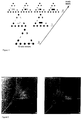
- a number of spectrally separated fluorophores is used for ratio labelling, in such a way that two fluorophores are used to produce a certain colour. When this is applied for three fluorophores, and each pair of fluorophores results in 5 colours, a total of 12 colours is achieved (lower triangle in Figure 1).
- This primary probe set is directly fluorescently labelled using methods such as nick translation, random primed labelling, PCR-labelling, and/or chemical labelling.
- a second set of 12 probes, recognising different targets is labelled exactly the same, but in addition is given a fluorophore.
- said fluorophore is a hapten, for instance biotin or digoxigenin.
- This hapten is developed using avidin or antibodies labelled with a fourth fluorescent label, spectrally well distinguishable from the three primary fluorophores used for ratio labelling.
- the set of 12 is multiplied by 2, which results in 24 colours using 4 fluorophores only (two middle triangles in Figure 1), which is one fluorophore less than reported so far to accomplish staining of the 24 human chromosomes.
- Extra "free" fluorophores may be used to repeat this process, exploring a second binary label, which again results in a doubling of the number of achievable colours (giving 48 colours) (upper triangles in Figure 1).
- Even stronger increments in number of colours are achievable if more than 12 primary colours are produced in the basic triangle, either by using more than three fluorophores or by distinguishing more ratios.
- the total number of achievable COBRA colours can, at least in the case wherein two fluorophores are simultaneously used per target, be described as follows. Assume that n fluorochromes are used for ratio labelling and assume that, as a non-limiting example, only 2 of those fluorochromes are simultaneously used per target, while additionally m fluorochromes can be binary labelled to the same target and r ratios can be resolved for ratio labelling, then the number of different colours that can be distinguished is given by the following formula: No.
- the invention provides a method for the generation of colours called COBRA, suitable for the labelling of probes, by mixing fluorochromes according to formula I, wherein n is the number of fluorochromes used for ratio labelling while, in this non-limiting example, only 2 of those fluorochromes are simultaneously used per target, m is the number of fluorochromes used to binary label the same target, and r is the number of ratios that can be resolved by ratio labelling.
- n is the number of fluorochromes used for ratio labelling while, in this non-limiting example, only 2 of those fluorochromes are simultaneously used per target
- m is the number of fluorochromes used to binary label the same target
- r is the number of ratios that can be resolved by ratio labelling.
- the fluorochromes used for labelling may be selected from the group DEAC, Cy3®, fluorescein, LissamineTM etc.
- transition metal means a metal of group VIII of the periodic chart of the elements.
- a preferred transition metal for use in a cross-linking agent is platinum.
- the invention provides a method for providing at least one selected sequence in a nucleic acid with interstrand cross-links comprising hybridising at least one selected single strand sequence with a complementary single strand nucleic acid wherein said selected sequence or said complementary nucleic acid or both comprise a cross-linking agent.
- said selected interstrand cross-links hamper further hybridisation and/or replication of said selected sequences.
- the invention provides a method for the generation of a probe wherein at least one selected sequence in said probe is at least in part prevented from functioning as a probe through providing said selected sequence with interstrand cross-links.
- said selected sequence comprises at least one repetitive sequence.
- a method for the selected amplification of certain amplifiable sequences from a pool of amplifiable sequences comprising producing a selected interstrand cross-linked nucleic acid or probe, wherein said selected interstrand cross-links are provided to decrease the amount of amplification of a subset of amplifiable sequences and subjecting said pool to an amplification reaction.
- a single stranded nucleic acid is prevented from taking part in said amplification through disabling the primer extension function of hybridised and cross-linked complementary single nucleic acid, preferably through modification of the 3'-hydroxy group.
- said pool of amplifiable sequences is selected from sequences present in a chromosome. Following amplification said amplification will lead to a collection of amplified sequences, which among others may, upon labelling, be used as a probe. When such pool of amplifiable sequences is selected from sequences present in a chromosome such a probe may be used in the preparation of a chromosome paint.
- a method referred to as COBRA is used for the labelling of a set of at least two bio-organic molecules with a set of at least two colours, comprising generating said set of colours through combining ratio labelling with binary labelling.
- the total number of distinguishable colours of said combination can be calculated according to formula I, No.
- n the number of fluorophores used for ratio labelling where in a non-limiting example, only 2 of those fluorochromes are simultaneously used per target
- m the number of fluorophores used to binary label the same target
- r the number of ratios that can be resolved by ratio labelling.
- At least one of said bio-organic molecules comprises nucleic acid, protein, carbohydrate and/or lipid.
- a method for simultaneous identification of sequences of at least one chromosome or part thereof through the use of at least one probe, preferably prepared according to a method of the invention, wherein said probe is labelled according to a COBRA method for doubling the number of identifiable labels obtainable by ratio labelling, comprising adding to a first set of fluorophores, used for the ratio labelling of a first set of probes, a novel fluorophore and labelling a second set of probes.
- a probe for the improved detection of chromosomes or parts thereof is provided.
- the invention provides the use of selected interstrand cross-links for decreasing the amount of amplified product of certain amplifiable sequences.
- the invention provides the identification of a disease through the typing of at least one chromosome wherein at least one chromosome is labelled, with at least one probe prepared according to the methods of the invention.
- a kit for the detection of nucleic acid comprising at least one probe obtainable by methods of the invention.
- the invention provides a kit for performing the methods of the invention comprising at least one probe labelled with a COBRA method.
- the invention provides a kit for generating a probe according to the invention, comprising at least a cross-linking agent, preferably linked to a single stranded nucleic acid.
- the invention further provides a kit for the detection of nucleic acid comprising at least a collection of amplified sequences or a probe.
- the invention further provides a kit for performing the selective cross-linking of nucleic acid wherein said kit comprising at least a cross-linking agent, preferably linked to a single stranded nucleic acid.
- the invention also provides a molecule comprising at least two parts, cross-linked with a cross-linking agent, wherein said cross-linking agent comprises a transition metal, preferably platinum, wherein at least two of said parts comprise a protein.
- a cross-linking agent comprises a transition metal, preferably platinum, wherein at least two of said parts comprise a protein.
- Such a molecule is for instance produced with a method wherein a protein is labelled with a ULS comprising a label, wherein said label comprises a protein.
- said molecule comprises at least two different proteins.
- interstrand cross-link refers to a physical link between a cross-linking agent and a double stranded nucleic acid, wherein said physical link decreases the propensity of a double stranded nucleic acid, to denaturate.
- an interstrand cross-link physically links the two complementary strands of the double stranded nucleic acid.
- physical link is a covalent or non-covalent bond.
- a probe is defined as collection of nucleic acid sequences comprising at least two different sequences, preferably labelled with a label facilitating detection of said probe.
- Said probe may by used directly for the detection of for instance nucleic acid sequences or said probe may be manipulated according to the methods of the invention prior to the detection of for instance nucleic acid sequences.
- complementary in relation to nucleic acids is used functionally, meaning that the homology of a nucleic acid to a complementary nucleic acid is sufficiently high to allow hybridisation of a complementary nucleic acid to a nucleic acid under the desired stringent or non-stringent hybridisation conditions. This functional definition is necessary to allow for different hybridisation conditions that may be utilised in practising the invention.
- One non-limiting example that illustrates the necessity for a functional definition is the cross-linking of a specific region which is repeated several times in a nucleic acid but where the repeated regions vary slightly in the exact nucleotide sequence. Choosing a nucleotide sequence which is completely homologous to one region automatically implies that said nucleotide sequence is not completely homologous to the sequences of the repeated regions. The chosen sequence is however functionally homologous to the sequences in the repeated regions , i.e. complementary, when the sequence dissimilarity of said repeated regions does not, under the chosen hybridisation conditions, prevent hybridisation of the chosen sequence with said repeated regions.
- PCR Blocking amplification of specific sequences during PCR, by trans -DDP labelled dideoxy primer.
- Two PCR reactions are run in parallel: In the first reaction PCR is performed on plasmid DNA with two sequence-specific primers (primer A and primer B). This reaction yields an amplification product of a defined length. In the second reaction an identical PCR is performed. To the reaction mixture however, also two trans -DDP labelled oligonucleotides are added, which have a dideoxy nucleotide at their 3' end, and which are complementary to sequences within the region that can be amplified by primer A and B. This second reaction will not yield a product, since amplification is blocked by the trans -DDP labelled oligonucleotides.
- a DOP-PCR is performed in which amplification of repetitive sequences is blocked by adding trans -DDP labelled nucleotide sequences which lack the 3' hydroxy group and are complementary to several repetitive sequences.
- trans -DDP labelled nucleotide sequences which lack the 3' hydroxy group and are complementary to several repetitive sequences.
- an in situ hybridisation experiment on metaphase chromosomes is performed. In comparison to a non-blocked amplification product, this probe gives considerably less background on the non-target chromosomes.
- All probes were fluorescently labelled by incorporation of labelled dUTPs either by PCR or nick translation using fluorescein-, digoxigenin-dUTP (Boehringer Mannheim, Germany), lissamine-dUTP (NEN life Science Products, USA) or Cy5-dUTP (Amersham, UK).
- the digoxygenin-labelled probes were detected indirectly using diethylaminocoumarin (DEAC, Molecular Probes, USA).
- the hybridisation mixture contained 50% formamide, 2xSSC, 50 mM sodium phosphate pH 7, 10 % dextran sulphate, 100-500 ng of each DEAC-, Cy3- and Cy5-labeled probe (both single-and ratio-labelled probes) (see Table 2), 100-400 ng of each dig-ULS labelled probe, 3 x excess human C o t1-DNA and 10 x excess low molecular weight fish sperm DNA in 10 ⁇ l.
- the probes were denatured for 10 min at 80°C, followed by 60 min incubation at 37°C to allow pre-annealing with the 3 times excess of C o t1-DNA
- the slides were washed 2 x 5 min in 50 % formamide, 2XSSC, pH 7 at 44°C. This was followed by 2 washes (5 min each) in 0.1xSSC at 60°C and a 5 min wash at RT in TNT (0.1M Tris.HCl pH 7.4, 0.15 M NaCl, 0.05% Tween 20).
- the DIG-ULS labelled probes were detected with a mouse monoclonal antibody against digoxin (Sigma) followed by a rabbit anti mouse antibody conjugated to FITC (Sigma). Chromosomes were counterstained with DAPI. The slides were embedded in Vectashield (when enzymatically labelled probes were used) or Citifluor (Agar, Stansted, UK) (when chemically labelled probes were used) prior to microscopical evaluation.
- Digital fluorescence imaging was performed using a Leica DM-RXA epifluorescence microscope (Leica, Wetzlar, Germany) equipped with a 100-W mercury arc lamp and computer controlled filter wheels with excitation and emission filters for visualisation of DEAC, Fluorescein, Cy3 and Cy5, using HQ-FITC, Pinkel set plus SP 570, HQ-Cy3, HQ-Cy5 and DEAC filter (Chroma Technology) respectively.
- DAPI was excited with UV light using block A.
- a 63x objective ((N.A. 1.32, PL APO, Leica) was used. Image acquisition and analysis was performed on a Cytovision workstation (Applied Imaging, Sunderland, UK).
- This system consists of a PC (Pentium 133MHz processor, 24Mb Ram, 2.1 Gb disc and 17" display) interfaced to a Coolview camera (Photonic Science).
- the camera has thermo-electric cooling, which allows on chip integration up to circa 30 seconds. Images are digitised in an 8-bit 768 x 512 image format.
- Image acquisition was performed as described before. Chromosomes were segmented interactively by thresholding the DAPI image. The segmented image was used as a mask for the colour image, which was composed of the 3 images corresponding with the ratio labelled fluorochromes (green for DEAC, red for Cy3 and blue for Cy5) and of the Fluorescein image. Note that this procedure does not require thresholding of the three colours.
- the fourth Fluorescein image was evaluated binary, that is chromosomes with or without Fluorescein fluorescence were distinguished. This was performed by finding the optimal threshold in the histogram of the Fluorescein image for the pixels lying within the DAPI mask.
- Chromosome classification was based mainly on the modal colour value of each chromosome, e.g. its position in one of the colour triangles (the one with or without the binary label), as shown in Figure 1. The shortest distance of the measured modal colour value of a chromosome to the theoretical expected ratio colour of all chromosome classes was therefore calculated.
- a karyogram was generated based on chromosome classification showing the ratio colours, as described above.
- a karyogram, in which a pseudo colour was assigned to the corresponding chromosome class of each separate chromosome pixel was produced to facilitate the interactive detection of chromosome translocations.
- the DAPI banding image was used for comparison purposes.
- the robustness of COBRA depended on the quality of the metaphase chromosomes obtained, as is the case for both automated analysis of Giemsa banded and FISH stained chromosomes. Good quality slides always resulted in images of good signal to noise ratio that could be classified automatically, whereas user intervention increased with decreasing staining quality.
- the Cobra principle combines the advantages of ratio labelling and binary labelling. It "settles"for making ratios of two fluorophores only, but utilises the possibility of doubling the number of colours by introducing indirectly labelled haptens, that require a binary decision only. As shown, this approach is feasible and allows for identifying 24 human chromosomes using 4 fluorophores only.
- one aspect of the Cobra principle is implemented with TRANS-ULS labelled probes in an application using mFISH.
- a DOP-PCR is performed on human chromosome 4 or chromosome 20 preparations according to the procedure described in Multi-colour FISH staining of human chromosomes, in which amplification of repetitive sequences is blocked by adding trans -DDP labelled nucleotide sequences which lack the 3' hydroxy group and are complementary to several repetitive sequences.
- the chromosome 4 specific probe was ratio labelled with DEAC-ULS and Cy3-ULS (50:50) according to the procedure described in Chemical labelling of probes using ULS.
- the chromosome 20 specific probe was ratio labelled with DEAC-ULS and Cy3-ULS (50:50) and combinatorial labelled with Fluorescein according to the procedure described in Chemical labelling of probes using ULS.
- Slides with metaphase chromosomes spreads of JVM-2 cells were prepared and FISH- stained according to the procedure described in FISH staining of human metaphase chromosomes. Results were visualised according to the procedure described under imaging microscopy.
- optimal staining results were obtained after surprisingly short hybridisation times, compared to the non-trans-ULS probes, in for instance example 4. Overnight hybridisation was often sufficient for staining.
- primer TU16for1 (5'-AGAGCTGCAAAAAGGAGATTATTTGAAAGCGA-3')
- primer TU16for2 (5'-AGAGACAACTGATCTCTACTGTTATGAGCA-3')
- primer TU16rev1 (5'-TCCTGTGCAGTAAACAACGCATGTGCTGTC-3')
- primer TU16rev2 (5'-CGTGTGTGCTTTGTACGCCACAACCGAAGCGTAGAGT-3').
- the oligonucleotide mix was column purified in order to remove free trans-ULS.
- Total genomic HPV 16 DNA 40 ng final
- trans-ULS labelled internal primers 120-160 ng final
- 6x SSC 6x SSC
- a PCR amplification was carried out as follows: a PCR master mix consisting of a PCR buffer, HPVfor and HPVrev primers (10 ⁇ M each, dNTPs (2.5 mM each), and Tag DNA polymerase (5 units) was added to a 0.5 ml PCR tube containing either (i) HPV 16 genomic DNA only, (ii) HPV 16 DNA and internal primers, or (iii) HPV 16 DNA cross-linked with trans-ULS labeled internal primers.
- the PCR profile was: 95 °C for 2 minutes, 23 cycles of 95 °C for 45 seconds; 57 °C for 45 seconds; 72 °C for 1 minute, and 1 cycle of 95 °C for 45 seconds; 57 °C for 45 seconds; 72 °C for 15 minutes.
- Ten ⁇ l of each PCR amplified mix was run on a 1% agarose gel (see figure 6).
- Lane 1 shows the 945 bp fragment (see above).
- the yield of the 945 bp fragment was reduced when the internal primers were added to the PCR mix (lane 2).
- trans-ULS labeled internal primers no 945 bp PCR fragment was amplified. Irreversible cross-linking of the internal primers blocked the DNA polymerase chain elongation at well defined positions within the 945 bp fragment. Similar results can be obtained when use is made of trans-ULS labelled dideoxy internal primers.
- Example 10 Blocking repetitive sequences during DOP-PCR and use of such probes in in situ hybridisation.
- Human C o t 1 DNA was end labelled with ddATP according to the following protocol: 50 ⁇ g of C o t 1 DNA was denatured at 90 °C for 10 minutes and mixed with TdT buffer, ddATP, and TdT (terminal transferase). The mixture was incubated at 37 °C over night and ethanol precipitated. Next, the 3'-ddATP human C o t 1 DNA was labelled with the cross-linking agent trans-ULS. Five ⁇ g of the DNA was mixed with various amounts of trans-ULS, incubated at 85 °C for 30 minutes, and column purified.
- Example 11 Prevention of cross-hybridisation between different Human Papillomavirus types.
- HPV Human Papillomavirus
- HPV 18 and HPV 45 genomes show an identity of 79.7%.
- the generation of a HPV 45 specific probe free of HPV 18 homologous sequences can be made possible through the use of a cross-linking agent.
- HPV 45 total genomic DNA was labelled with DIG-ULS according to the standard ULS labelling procedure.
- HPV 18 total genomic DNA was sonicated, biotin end labelled, and labelled with trans-DDP at a DNA:trans-ULS ratio of 1:1.
- the labelled DNAs were column purified and mixed according to the following scheme:
- the hybridisation mixture contained 50% formamide, 2xSSC, 50 mM sodium phosphate pH 7, 10 % dextran sulphate, 100-500 ng of each DEAC-, Cy3- and Cy5-labeled probe (both single- and ratio-labelled probes) (see Table 2), 100-400 ng of each DIG-ULS labelled probe, 3 x excess human C 0 t 1 DNA and 10 x excess low molecular weight fish sperm DNA in 10 ⁇ l. Before application, the probes were denatured for 10 min at 80°C, followed by 60 min incubation at 37°C to allow pre-annealing with the 3 times excess of C 0 t 1 DNA.
- Digital fluorescence imaging was performed using a Leica DM-RXA epifluorescence microscope (Leica, Wetzlar, Germany) equipped with a 100-W mercury arc lamp and computer controlled filter wheels with excitation and emission filters for visualisation of DEAC, Fluorescein, Cy3 and Cy5, using HQ-FITC, Pinkel set plus SP 570, HQ-Cy3, HQ-Cy5 and DEAC filter (Chroma Technology) respectively.
- DAPI was excited with UV light using block A.
- a 63x objective ((N.A. 1.32, PL APO, Leica) was used. Image acquisition and analysis was performed on a Cytovision workstation (Applied Imaging, Sunderland, UK).
- This system consists of a PC (Pentium 133MHz processor, 24Mb Ram, 2.1 Gb disc and 17" display) interfaced to a Coolview camera (Photonic Science).
- the camera has thermo-electric cooling, which allows on chip integration up to circa 30 seconds. Images are digitised in an 8-bit 768 x 512 image format.
- Chromosomes were segmented interactively by thresholding the DAPI image.
- the segmented image was used as a mask for the colour image, which was composed of the 3 images corresponding with the ratio labelled fluorochromes (green for DEAC, red for Cy3 and blue for Cy5) and of the Fluorescein image. Note that this procedure does not require thresholding of the three colours.
- the fourth Fluorescein image was evaluated binary, that is chromosomes with or without Fluorescein fluorescence were distinguished. This was performed by finding the optimal threshold in the histogram of the Fluorescein image for the pixels lying within the DAPI mask. Typically, two gaussion distributions were observed, corresponding to Fluorescein positive and negative chromosomes.
- Chromosome classification was based mainly on the modal colour value of each chromosome, e.g. its position in one of the colour triangles (the one with or without the binary label), as shown in Figure 1.
- the shortest distance of the measured modal colour value of a chromosome to the theoretical expected ratio colour of all chromosome classes was therefore calculated.
- the theoretical expected colour values were warped onto a triangle formed by the measured modal values of the chromosomes with only one ratio colour.
- the length of the chromosomes was used for classification.
- the colour values of the chromosomes should correspond with the original probe ratios.
- a more robust approach is obtained, when a number of metaphases was used for training of the classifier.
- each pixel within a chromosome was classified on the basis of the shortest distance to the measured chromosome classes.
- the binary (fourth colour) information of each pixel was used to decide, within which colour triangle distance calculations should be performed. Assignment of classification colours is considered useful and foreseen, but was not implemented in the current software.
- a karyogram was generated based on chromosome classification showing the ratio colours, as described above.
- a karyogram, in which a pseudo colour was assigned to the corresponding chromosome class of each separate chromosome pixel was produced to facilitate the interactive detection of chromosome translocations. When needed the DAPI banding image was used for comparison purposes.
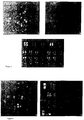
- Figure 3 shows the actual chromosome images and the resulting karyogram. Integration times varied depending on the fluorophore used and ranged from 0.5 to 20 sec. An entire COBRA acquisition and analysis procedure typically took approximately 1 min. Applied to abnormal chromosomes as shown in the JVM cell line, COBRA allowed for easy detection of abnormal chromosomes ( Figure 4).
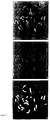
- Essential in the ULS method is that in principle each probe molecule contains the ratio code, making mixing obsolete. Ratio labelling of DEAC, Cy3 and Cy5 performed excellent, and could be well combined with binary fluorescein labelling. Results obtained with these probes are shown in Figure 5.
- the robustness of COBRA depended on the quality of the metaphase chromosomes obtained, as is the case for both automated analysis of Giemsa banded and FISH stained chromosomes. Good quality slides always resulted in images of good signal to noise ratio that could be classified automatically, whereas user intervention increased with decreasing staining quality.
- the COBRA principle combines the advantages of ratio labelling and binary labelling. It "settles"for making ratios of two fluorophores only, but utilises the possibility of doubling the number of colours by introducing indirectly labelled haptens, that require a binary decision only. As shown, this approach is feasible and allows for identifying 24 human chromosomes using 4 fluorophores only.
- one aspect of the COBRA principle is implemented with trans-ULS labelled probes in a mFISH application.
- a DOP-PCR was performed on human chromosome 1 and chromosome 8 preparations according to the procedure described in example 2.
- Amplification of repetitive sequences was blocked by trans -DDP labelled complementary repetitive nucleotide sequences which lacked the 3' hydroxy group.
- Labelling of probes was as described in chemical labelling of probes using ULS in example 4.
- the chromosome 8 specific probe was ratio labelled with Cy3-ULS and Cy5-ULS (50:50).
- the chromosome 1 specific probe was ratio labelled with Cy3-ULS and Cy5-ULS (50:50) and combinatorial labelled with dGREEN-ULS.
- Slides with metaphase chromosomes spreads were prepared and FISH-stained according to the procedure described in FISH staining of human metaphase chromosomes in example 4. Results are depicted in Figure 10.
- optimal staining results were obtained after surprisingly short hybridisation times, compared to the non-trans-ULS probes, in for instance example 4. Overnight hybridisation was often sufficient for staining whereas for non trans-ULS FISH-techniques, as in example 4, hybridisation times of several days are optimal.
- the COBRA labelling allowed clear and unambiguous typing of chromosome 1 and chromosome 8 in metaphase spreads following overnight hybridisation with the probes.
- the COBRA method offers the possibility to detect many proteins simultaneously, even when the number of labels available is limited (less then the number of proteins to be investigated). Important is the broad applicability of the ULS labelling technology in labelling bio-organic molecules. This example demonstrates both the successful use of ULS labels in labelling proteins and shows proof of principle of COBRA labelling and detection of proteins.
- the proteins that are going to be detected in this example are avidin and bovine serum albumin (BSA). These two proteins were single and multiple labelled with ULS labels in an aqueous solution at physiological conditions.
- BSA bovine serum albumin
- the labels with which the proteins were labelled are Flu-ULS (fluorescein), DNP-ULS (dinitrophenol), and DIG-ULS (digoxigenin).
- the labels used for ratio labelling were Flu and DNP.
- Digoxigenin was the binary label.
- the generation of the various labelling solutions was performed as follows. For single labelling of avidin or BSA, which served as a control for the labelling of proteins with ULS per se, the label consisted of 1 mg/ml of either Flu-ULS, DNP-ULS or DIG-ULS. For ratio labelling the label consisted of Flu-ULS and DNP-ULS, mixed in a 1:1 ratio. For the combined ratio-binary labelling, the labelling mixture consisted of the ratio labels + the binary label (DIG-ULS) in an equimolar amount.
- the proteins were incubated with the labels according to the description below.
- Each protein (2 ⁇ g/ ⁇ l in 0.5 PBS) was labelled by mixing 50 ⁇ l of the protein solution with 50 ⁇ l of a stock solution of 1 mg/ml label in 0.5 x PBS of
- the antibodies used are alkaline phosphatase labelled antibodies specific for digoxigenin (sheep anti-digoxigenin-AP; 1:5000; Roche Molecular Biochemicals 1 093 274), dinitrophenol (rabbit anti-DNP-AP; 1:1000; Sigma D5103), and fluorescein (sheep anti-fluorescein-AP; 1:5000; Roche Molecular Biochemicals 1 426 338). This incubation took place at room temperature for 30 min. Next, the filters were washed 3 times for 5 min. in TNT buffer followed by 2 washes in water for 2 min. each. The NBT/BCIP detection system for AP was applied according to the manufactures instructions. The AP reaction was allowed to take place for 16 hours in the dark at room temperature.
Landscapes
- Chemical & Material Sciences (AREA)
- Organic Chemistry (AREA)
- Life Sciences & Earth Sciences (AREA)
- Health & Medical Sciences (AREA)
- Engineering & Computer Science (AREA)
- Proteomics, Peptides & Aminoacids (AREA)
- Wood Science & Technology (AREA)
- Zoology (AREA)
- Biochemistry (AREA)
- Molecular Biology (AREA)
- Genetics & Genomics (AREA)
- General Health & Medical Sciences (AREA)
- Biotechnology (AREA)
- Biophysics (AREA)
- Immunology (AREA)
- Microbiology (AREA)
- Analytical Chemistry (AREA)
- Physics & Mathematics (AREA)
- Bioinformatics & Cheminformatics (AREA)
- General Engineering & Computer Science (AREA)
- Chemical Kinetics & Catalysis (AREA)
- Measuring Or Testing Involving Enzymes Or Micro-Organisms (AREA)
- Pharmaceuticals Containing Other Organic And Inorganic Compounds (AREA)
- Investigating Or Analysing Biological Materials (AREA)
- Peptides Or Proteins (AREA)
- Saccharide Compounds (AREA)
Priority Applications (1)
| Application Number | Priority Date | Filing Date | Title |
|---|---|---|---|
| EP99204141A EP1006200B1 (de) | 1998-12-03 | 1999-12-03 | Verfahren zur Herstellung von ausgewählten intermolekularen Quervernetzungen in Nukleinsäuren und ihre Verwendungen |
Applications Claiming Priority (3)
| Application Number | Priority Date | Filing Date | Title |
|---|---|---|---|
| EP98204094A EP1006199A1 (de) | 1998-12-03 | 1998-12-03 | Verfahren zur Herstellung von Verknüpfungen an ausgewählten Positionen von Nukleinsäuresträngen und deren Verwendung |
| EP98204094 | 1998-12-03 | ||
| EP99204141A EP1006200B1 (de) | 1998-12-03 | 1999-12-03 | Verfahren zur Herstellung von ausgewählten intermolekularen Quervernetzungen in Nukleinsäuren und ihre Verwendungen |
Publications (3)
| Publication Number | Publication Date |
|---|---|
| EP1006200A2 true EP1006200A2 (de) | 2000-06-07 |
| EP1006200A3 EP1006200A3 (de) | 2000-10-11 |
| EP1006200B1 EP1006200B1 (de) | 2011-08-10 |
Family
ID=8234427
Family Applications (2)
| Application Number | Title | Priority Date | Filing Date |
|---|---|---|---|
| EP98204094A Withdrawn EP1006199A1 (de) | 1998-12-03 | 1998-12-03 | Verfahren zur Herstellung von Verknüpfungen an ausgewählten Positionen von Nukleinsäuresträngen und deren Verwendung |
| EP99204141A Expired - Lifetime EP1006200B1 (de) | 1998-12-03 | 1999-12-03 | Verfahren zur Herstellung von ausgewählten intermolekularen Quervernetzungen in Nukleinsäuren und ihre Verwendungen |
Family Applications Before (1)
| Application Number | Title | Priority Date | Filing Date |
|---|---|---|---|
| EP98204094A Withdrawn EP1006199A1 (de) | 1998-12-03 | 1998-12-03 | Verfahren zur Herstellung von Verknüpfungen an ausgewählten Positionen von Nukleinsäuresträngen und deren Verwendung |
Country Status (11)
| Country | Link |
|---|---|
| US (4) | US6406850B2 (de) |
| EP (2) | EP1006199A1 (de) |
| JP (1) | JP4838937B2 (de) |
| AT (1) | ATE519859T1 (de) |
| AU (2) | AU778429B2 (de) |
| CA (1) | CA2353643C (de) |
| DK (1) | DK1006200T3 (de) |
| ES (1) | ES2366660T3 (de) |
| NZ (2) | NZ512312A (de) |
| PT (1) | PT1006200E (de) |
| WO (1) | WO2000032814A2 (de) |
Cited By (1)
| Publication number | Priority date | Publication date | Assignee | Title |
|---|---|---|---|---|
| US8148512B2 (en) | 2001-07-03 | 2012-04-03 | The Institute For Systems Biology | Methods for detection and quantification of analytes in complex mixtures |
Families Citing this family (11)
| Publication number | Priority date | Publication date | Assignee | Title |
|---|---|---|---|---|
| US20040266706A1 (en) * | 2002-11-05 | 2004-12-30 | Muthiah Manoharan | Cross-linked oligomeric compounds and their use in gene modulation |
| EP1006199A1 (de) * | 1998-12-03 | 2000-06-07 | Kreatech Biotechnology B.V. | Verfahren zur Herstellung von Verknüpfungen an ausgewählten Positionen von Nukleinsäuresträngen und deren Verwendung |
| US6613582B1 (en) * | 1999-05-25 | 2003-09-02 | Board Of Regents, The University Of Texas System | Methods for rapid and efficient protein cross-linking |
| KR20050073466A (ko) * | 2002-09-30 | 2005-07-13 | 칠드런스 머시 호스피탈 | 서브텔로미어 디엔에이 프로브 및 이의 제조 방법 |
| US20050016555A1 (en) * | 2003-07-24 | 2005-01-27 | Lyles Mark B. | Nucleic acid based filters |
| EP1819835B1 (de) | 2004-12-08 | 2010-08-04 | Gen-Probe Incorporated | Nukleinsäuredetektion aus verschiedenen typen des humanen papillomavirus |
| CA2623405C (en) * | 2005-09-20 | 2014-11-25 | Immunivest Corporation | Methods and composition to generate unique sequence dna probes labeling of dna probes and the use of these probes |
| US8715927B2 (en) * | 2008-12-02 | 2014-05-06 | Oregon Health & Science University | Inhibition of DNA polymerases to augment chemotherapeutic and antimicrobial agents |
| CA2756233A1 (en) * | 2009-03-26 | 2010-09-30 | Trustees Of Boston University | Method for imaging on thin solid-state interface between two fluids |
| EP2734320B1 (de) * | 2011-07-19 | 2016-11-16 | Ask Chemicals L. P. | Verfahren zur härtung einer kaltgussform mit einem gasförmigen katalysator |
| JP2017533733A (ja) | 2014-11-11 | 2017-11-16 | アボツト・モレキユラー・インコーポレイテツド | ハイブリダイゼーションプローブおよび方法 |
Citations (4)
| Publication number | Priority date | Publication date | Assignee | Title |
|---|---|---|---|---|
| WO1996035696A1 (en) | 1995-05-09 | 1996-11-14 | Kreatech Biotechnology B.V. | Methods for the production of platinum-based linkers between labels and bio-organic molecules, for labelling bio-organic molecules, for detecting biological substances of interest and diagnostic test kits |
| US5589339A (en) | 1993-04-07 | 1996-12-31 | Amersham International Plc | Subtraction hybridization |
| WO1998015564A1 (en) | 1996-10-08 | 1998-04-16 | Kreatech Biotechnology B.V. | Methods for labeling nucleotides, labeled nucleotides and useful intermediates |
| WO1998045304A1 (en) | 1997-04-10 | 1998-10-15 | Kreatech Biotechnology B.V. | Trans-platinum compound, and diagnostic kit |
Family Cites Families (12)
| Publication number | Priority date | Publication date | Assignee | Title |
|---|---|---|---|---|
| US4711955A (en) * | 1981-04-17 | 1987-12-08 | Yale University | Modified nucleotides and methods of preparing and using same |
| US4599303A (en) * | 1983-12-12 | 1986-07-08 | Hri Associates, Inc. | Nucleic acid hybridization assay employing probes crosslinkable to target sequences |
| AU4181089A (en) * | 1988-08-01 | 1990-03-05 | George D. Cimino | Identification of allele specific nucleic acid sequences by hybridization with crosslinkable oligonucleotide probes |
| US4997758A (en) * | 1989-01-17 | 1991-03-05 | Iowa State University Research Foundation, Inc. | Cross-linking proteins with bimetallic tetracarboxylate compounds of transition metals |
| EP0472648A4 (en) * | 1989-05-18 | 1992-09-16 | Microprobe Corporation | Crosslinking oligonucleotides |
| US5831073A (en) * | 1990-10-31 | 1998-11-03 | The Research Foundation Of State University Of New York | Ion triggered alkylation of biological targets by silyloxy aromatic agents |
| US5538869A (en) * | 1990-12-13 | 1996-07-23 | Board Of Regents, The University Of Texas System | In-situ hybridization probes for identification and banding of specific human chromosomes and regions |
| US5767259A (en) * | 1994-12-27 | 1998-06-16 | Naxcor | Oligonucleotides containing base-free linking groups with photoactivatable side chains |
| WO1995029921A1 (en) * | 1994-04-29 | 1995-11-09 | Perseptive Biosystems, Inc. | Activated esters of 1-phenylpyrazolin-5-one for labelling amine-functionalized molecules |
| US6133464A (en) | 1996-10-07 | 2000-10-17 | Novartis Ag | Chiral ferrocenyls |
| FR2755146B1 (fr) * | 1996-10-28 | 1998-12-04 | Centre Nat Rech Scient | Procede de pontage selectif et irreversible d'oligonucleotides platines sur de l'arn et ses applications |
| EP1006199A1 (de) * | 1998-12-03 | 2000-06-07 | Kreatech Biotechnology B.V. | Verfahren zur Herstellung von Verknüpfungen an ausgewählten Positionen von Nukleinsäuresträngen und deren Verwendung |
-
1998
- 1998-12-03 EP EP98204094A patent/EP1006199A1/de not_active Withdrawn
-
1999
- 1999-12-03 PT PT99204141T patent/PT1006200E/pt unknown
- 1999-12-03 CA CA2353643A patent/CA2353643C/en not_active Expired - Fee Related
- 1999-12-03 DK DK99204141.8T patent/DK1006200T3/da active
- 1999-12-03 NZ NZ512312A patent/NZ512312A/en not_active IP Right Cessation
- 1999-12-03 WO PCT/NL1999/000740 patent/WO2000032814A2/en not_active Ceased
- 1999-12-03 US US09/454,404 patent/US6406850B2/en not_active Expired - Lifetime
- 1999-12-03 NZ NZ529273A patent/NZ529273A/en unknown
- 1999-12-03 AU AU16966/00A patent/AU778429B2/en not_active Ceased
- 1999-12-03 AT AT99204141T patent/ATE519859T1/de active
- 1999-12-03 EP EP99204141A patent/EP1006200B1/de not_active Expired - Lifetime
- 1999-12-03 ES ES99204141T patent/ES2366660T3/es not_active Expired - Lifetime
- 1999-12-03 JP JP2000585445A patent/JP4838937B2/ja not_active Expired - Lifetime
-
2001
- 2001-12-05 US US10/005,371 patent/US20040161743A1/en not_active Abandoned
-
2005
- 2005-02-23 AU AU2005200819A patent/AU2005200819A1/en not_active Abandoned
-
2006
- 2006-02-15 US US11/354,679 patent/US20060204987A1/en not_active Abandoned
-
2008
- 2008-08-25 US US12/197,590 patent/US20090023910A1/en not_active Abandoned
Patent Citations (4)
| Publication number | Priority date | Publication date | Assignee | Title |
|---|---|---|---|---|
| US5589339A (en) | 1993-04-07 | 1996-12-31 | Amersham International Plc | Subtraction hybridization |
| WO1996035696A1 (en) | 1995-05-09 | 1996-11-14 | Kreatech Biotechnology B.V. | Methods for the production of platinum-based linkers between labels and bio-organic molecules, for labelling bio-organic molecules, for detecting biological substances of interest and diagnostic test kits |
| WO1998015564A1 (en) | 1996-10-08 | 1998-04-16 | Kreatech Biotechnology B.V. | Methods for labeling nucleotides, labeled nucleotides and useful intermediates |
| WO1998045304A1 (en) | 1997-04-10 | 1998-10-15 | Kreatech Biotechnology B.V. | Trans-platinum compound, and diagnostic kit |
Non-Patent Citations (1)
| Title |
|---|
| LICHTER ET AL., TIG DECEMBER, vol. 13, no. 12, 1997, pages 475 - 479 |
Cited By (3)
| Publication number | Priority date | Publication date | Assignee | Title |
|---|---|---|---|---|
| US8148512B2 (en) | 2001-07-03 | 2012-04-03 | The Institute For Systems Biology | Methods for detection and quantification of analytes in complex mixtures |
| US8492094B2 (en) | 2001-07-03 | 2013-07-23 | The Institute For Systems Biology | Methods for detection and quantification of analytes in complex mixtures |
| US9920380B2 (en) | 2001-07-03 | 2018-03-20 | The Institute For Systems Biology | Methods for detection and quantification of analytes in complex mixtures |
Also Published As
| Publication number | Publication date |
|---|---|
| WO2000032814A3 (en) | 2000-11-16 |
| AU1696600A (en) | 2000-06-19 |
| ES2366660T3 (es) | 2011-10-24 |
| EP1006200A3 (de) | 2000-10-11 |
| ATE519859T1 (de) | 2011-08-15 |
| JP2002531101A (ja) | 2002-09-24 |
| WO2000032814A2 (en) | 2000-06-08 |
| US20060204987A1 (en) | 2006-09-14 |
| US20090023910A1 (en) | 2009-01-22 |
| NZ529273A (en) | 2006-04-28 |
| DK1006200T3 (da) | 2011-09-05 |
| AU2005200819A1 (en) | 2005-03-17 |
| US6406850B2 (en) | 2002-06-18 |
| CA2353643A1 (en) | 2000-06-08 |
| EP1006200B1 (de) | 2011-08-10 |
| US20040161743A1 (en) | 2004-08-19 |
| AU778429B2 (en) | 2004-12-02 |
| US20020012915A1 (en) | 2002-01-31 |
| EP1006199A1 (de) | 2000-06-07 |
| JP4838937B2 (ja) | 2011-12-14 |
| NZ512312A (en) | 2004-04-30 |
| PT1006200E (pt) | 2011-10-06 |
| CA2353643C (en) | 2013-10-15 |
Similar Documents
| Publication | Publication Date | Title |
|---|---|---|
| US20090023910A1 (en) | Applications with and Methods for Producing Selected Interstrand Cross-Links in Nucleic Acids | |
| EP1948832B1 (de) | Nachweis von nukleinsäuren durch ein targetspezifisches hybriderfassungsverfahren | |
| Tanke et al. | New strategy for multi-colour fluorescence in situ hybridisation: COBRA: COmbined Binary RAtio labelling | |
| CA2369878C (en) | Comparative fluorescence hybridization to oligonucleotide microarrays | |
| US6270971B1 (en) | Methods for detecting chromosomal aberrations using chromosome-specific paint probes | |
| US6635418B2 (en) | Assay methods for nucleic acid in a sample | |
| US20050059049A1 (en) | Hairpin-labeled probes and methods of use | |
| Van Gijlswijk et al. | Horseradish peroxidase-labeled oligonucleotides and fluorescent tyramides for rapid detection of chromosome-specific repeat sequences | |
| Carter | Fluorescence in situ hybridization—state of the art | |
| Difilippantonio et al. | Technicolor genome analysis | |
| MXPA01005591A (en) | Applications with and methods for producing selected interstrand cross-links in nucleic acids | |
| Troyer et al. | Use of disc‐PCR to map a porcine microsatellite | |
| Zudaire | 4 Comparative genomic hybridization |
Legal Events
| Date | Code | Title | Description |
|---|---|---|---|
| PUAI | Public reference made under article 153(3) epc to a published international application that has entered the european phase |
Free format text: ORIGINAL CODE: 0009012 |
|
| AK | Designated contracting states |
Kind code of ref document: A2 Designated state(s): AT BE CH CY DE DK ES FI FR GB GR IE IT LI LU MC NL PT SE |
|
| AX | Request for extension of the european patent |
Free format text: AL;LT;LV;MK;RO;SI |
|
| RIN1 | Information on inventor provided before grant (corrected) |
Inventor name: RAAP, ANTON KLAAS Inventor name: TANKE, HENDRIKUS JOHANNES Inventor name: VAN GIJLSWIJK, ROBERTUS PETRUS MARIA Inventor name: HEETEBRIJ, ROBERT JOCHEM Inventor name: HOUTHOFF, HENDRIK JAN Inventor name: VOLKERS, HERMAN |
|
| PUAL | Search report despatched |
Free format text: ORIGINAL CODE: 0009013 |
|
| AK | Designated contracting states |
Kind code of ref document: A3 Designated state(s): AT BE CH CY DE DK ES FI FR GB GR IE IT LI LU MC NL PT SE |
|
| AX | Request for extension of the european patent |
Free format text: AL;LT;LV;MK;RO;SI |
|
| 17P | Request for examination filed |
Effective date: 20010411 |
|
| AKX | Designation fees paid |
Free format text: AT BE CH CY DE DK ES FI FR GB GR IE IT LI LU MC NL PT SE |
|
| RIN1 | Information on inventor provided before grant (corrected) |
Inventor name: RAAP, ANTON KLAAS Inventor name: TANKE, HENDRIKUS JOHANNES Inventor name: VAN GIJSWIJK, ROBERTUS PETRUS MARIA Inventor name: HEETEBRIJ, ROBERT JOCHEM Inventor name: HOUTHOFF, HENDRIK JAN Inventor name: VOLKERS, HERMAN |
|
| 17Q | First examination report despatched |
Effective date: 20011004 |
|
| RAP1 | Party data changed (applicant data changed or rights of an application transferred) |
Owner name: KREATECH BIOTECHNOLOGY B.V. |
|
| GRAP | Despatch of communication of intention to grant a patent |
Free format text: ORIGINAL CODE: EPIDOSNIGR1 |
|
| GRAS | Grant fee paid |
Free format text: ORIGINAL CODE: EPIDOSNIGR3 |
|
| GRAA | (expected) grant |
Free format text: ORIGINAL CODE: 0009210 |
|
| AK | Designated contracting states |
Kind code of ref document: B1 Designated state(s): AT BE CH CY DE DK ES FI FR GB GR IE IT LI LU MC NL PT SE |
|
| REG | Reference to a national code |
Ref country code: GB Ref legal event code: FG4D |
|
| REG | Reference to a national code |
Ref country code: CH Ref legal event code: NV Representative=s name: TROESCH SCHEIDEGGER WERNER AG Ref country code: CH Ref legal event code: EP |
|
| REG | Reference to a national code |
Ref country code: DE Ref legal event code: R081 Ref document number: 69943630 Country of ref document: DE Owner name: LEICA BIOSYSTEMS NEWCASTLE LTD., GB Free format text: FORMER OWNER: KREATECH BIOTECHNOLOGY B.V., AMSTERDAM, NL |
|
| REG | Reference to a national code |
Ref country code: DK Ref legal event code: T3 |
|
| REG | Reference to a national code |
Ref country code: IE Ref legal event code: FG4D |
|
| REG | Reference to a national code |
Ref country code: PT Ref legal event code: SC4A Free format text: AVAILABILITY OF NATIONAL TRANSLATION Effective date: 20110928 |
|
| REG | Reference to a national code |
Ref country code: DE Ref legal event code: R096 Ref document number: 69943630 Country of ref document: DE Effective date: 20111013 |
|
| REG | Reference to a national code |
Ref country code: ES Ref legal event code: FG2A Ref document number: 2366660 Country of ref document: ES Kind code of ref document: T3 Effective date: 20111024 |
|
| REG | Reference to a national code |
Ref country code: NL Ref legal event code: T3 |
|
| PG25 | Lapsed in a contracting state [announced via postgrant information from national office to epo] |
Ref country code: FI Free format text: LAPSE BECAUSE OF FAILURE TO SUBMIT A TRANSLATION OF THE DESCRIPTION OR TO PAY THE FEE WITHIN THE PRESCRIBED TIME-LIMIT Effective date: 20110810 Ref country code: SE Free format text: LAPSE BECAUSE OF FAILURE TO SUBMIT A TRANSLATION OF THE DESCRIPTION OR TO PAY THE FEE WITHIN THE PRESCRIBED TIME-LIMIT Effective date: 20110810 |
|
| PGFP | Annual fee paid to national office [announced via postgrant information from national office to epo] |
Ref country code: PT Payment date: 20111202 Year of fee payment: 13 |
|
| PG25 | Lapsed in a contracting state [announced via postgrant information from national office to epo] |
Ref country code: CY Free format text: LAPSE BECAUSE OF FAILURE TO SUBMIT A TRANSLATION OF THE DESCRIPTION OR TO PAY THE FEE WITHIN THE PRESCRIBED TIME-LIMIT Effective date: 20110810 Ref country code: GR Free format text: LAPSE BECAUSE OF FAILURE TO SUBMIT A TRANSLATION OF THE DESCRIPTION OR TO PAY THE FEE WITHIN THE PRESCRIBED TIME-LIMIT Effective date: 20111111 |
|
| PLBE | No opposition filed within time limit |
Free format text: ORIGINAL CODE: 0009261 |
|
| STAA | Information on the status of an ep patent application or granted ep patent |
Free format text: STATUS: NO OPPOSITION FILED WITHIN TIME LIMIT |
|
| 26N | No opposition filed |
Effective date: 20120511 |
|
| PG25 | Lapsed in a contracting state [announced via postgrant information from national office to epo] |
Ref country code: MC Free format text: LAPSE BECAUSE OF NON-PAYMENT OF DUE FEES Effective date: 20111231 |
|
| REG | Reference to a national code |
Ref country code: DE Ref legal event code: R097 Ref document number: 69943630 Country of ref document: DE Effective date: 20120511 |
|
| PG25 | Lapsed in a contracting state [announced via postgrant information from national office to epo] |
Ref country code: LU Free format text: LAPSE BECAUSE OF NON-PAYMENT OF DUE FEES Effective date: 20111203 |
|
| REG | Reference to a national code |
Ref country code: PT Ref legal event code: MM4A Free format text: LAPSE DUE TO NON-PAYMENT OF FEES Effective date: 20130603 |
|
| PG25 | Lapsed in a contracting state [announced via postgrant information from national office to epo] |
Ref country code: PT Free format text: LAPSE BECAUSE OF NON-PAYMENT OF DUE FEES Effective date: 20130603 |
|
| REG | Reference to a national code |
Ref country code: GB Ref legal event code: 732E Free format text: REGISTERED BETWEEN 20150507 AND 20150513 |
|
| REG | Reference to a national code |
Ref country code: CH Ref legal event code: PUE Owner name: LEICA BIOSYSTEMS NEWCASTLE LTD., GB Free format text: FORMER OWNER: KREATECH BIOTECHNOLOGY B.V., NL |
|
| REG | Reference to a national code |
Ref country code: NL Ref legal event code: SD Effective date: 20150626 |
|
| REG | Reference to a national code |
Ref country code: DE Ref legal event code: R082 Ref document number: 69943630 Country of ref document: DE Representative=s name: BLUMBACH ZINNGREBE PATENT- UND RECHTSANWAELTE , DE Ref country code: DE Ref legal event code: R082 Ref document number: 69943630 Country of ref document: DE Representative=s name: BLUMBACH ZINNGREBE PATENT- UND RECHTSANWAELTE, DE Ref country code: DE Ref legal event code: R081 Ref document number: 69943630 Country of ref document: DE Owner name: LEICA BIOSYSTEMS NEWCASTLE LTD., GB Free format text: FORMER OWNER: KREATECH BIOTECHNOLOGY B.V., AMSTERDAM, NL Ref country code: DE Ref legal event code: R081 Ref document number: 69943630 Country of ref document: DE Owner name: LEICA BIOSYSTEMS NEWCASTLE LTD., GB Free format text: FORMER OWNER: PRIMOSA INTERNATIONAL N.V., CURACAO, NL |
|
| REG | Reference to a national code |
Ref country code: ES Ref legal event code: PC2A Owner name: LEICA BIOSYSTEMS NEWCASTLE LTD. Effective date: 20150810 |
|
| REG | Reference to a national code |
Ref country code: FR Ref legal event code: TP Owner name: LEICA BIOSYSTEMS NEWCASTLE LTD., GB Effective date: 20150721 |
|
| REG | Reference to a national code |
Ref country code: FR Ref legal event code: PLFP Year of fee payment: 17 |
|
| REG | Reference to a national code |
Ref country code: AT Ref legal event code: PC Ref document number: 519859 Country of ref document: AT Kind code of ref document: T Owner name: LEICA BIOSYSTEMS NEWCASTLE LTD, GB Effective date: 20160628 |
|
| REG | Reference to a national code |
Ref country code: FR Ref legal event code: PLFP Year of fee payment: 18 |
|
| PGFP | Annual fee paid to national office [announced via postgrant information from national office to epo] |
Ref country code: CH Payment date: 20161221 Year of fee payment: 18 Ref country code: NL Payment date: 20161221 Year of fee payment: 18 Ref country code: IE Payment date: 20161227 Year of fee payment: 18 |
|
| PGFP | Annual fee paid to national office [announced via postgrant information from national office to epo] |
Ref country code: BE Payment date: 20161221 Year of fee payment: 18 Ref country code: ES Payment date: 20161213 Year of fee payment: 18 |
|
| REG | Reference to a national code |
Ref country code: FR Ref legal event code: PLFP Year of fee payment: 19 |
|
| PGFP | Annual fee paid to national office [announced via postgrant information from national office to epo] |
Ref country code: DK Payment date: 20171215 Year of fee payment: 19 |
|
| PGFP | Annual fee paid to national office [announced via postgrant information from national office to epo] |
Ref country code: AT Payment date: 20171221 Year of fee payment: 19 |
|
| PGFP | Annual fee paid to national office [announced via postgrant information from national office to epo] |
Ref country code: IT Payment date: 20171221 Year of fee payment: 19 |
|
| REG | Reference to a national code |
Ref country code: CH Ref legal event code: PL |
|
| REG | Reference to a national code |
Ref country code: NL Ref legal event code: MM Effective date: 20180101 |
|
| REG | Reference to a national code |
Ref country code: AT Ref legal event code: MM01 Ref document number: 519859 Country of ref document: AT Kind code of ref document: T Effective date: 20171203 |
|
| REG | Reference to a national code |
Ref country code: IE Ref legal event code: MM4A |
|
| PG25 | Lapsed in a contracting state [announced via postgrant information from national office to epo] |
Ref country code: NL Free format text: LAPSE BECAUSE OF NON-PAYMENT OF DUE FEES Effective date: 20180101 |
|
| REG | Reference to a national code |
Ref country code: BE Ref legal event code: PD Owner name: LEICA BIOSYSTEMS NEWCASTLE LTD; GB Free format text: DETAILS ASSIGNMENT: CHANGE OF OWNER(S), AFFECTATION / CESSION; FORMER OWNER NAME: PRIMOSA INTERNATIONAL B.V. Effective date: 20150526 Ref country code: BE Ref legal event code: MM Effective date: 20171231 |
|
| PG25 | Lapsed in a contracting state [announced via postgrant information from national office to epo] |
Ref country code: IE Free format text: LAPSE BECAUSE OF NON-PAYMENT OF DUE FEES Effective date: 20171203 |
|
| PG25 | Lapsed in a contracting state [announced via postgrant information from national office to epo] |
Ref country code: BE Free format text: LAPSE BECAUSE OF NON-PAYMENT OF DUE FEES Effective date: 20171231 Ref country code: AT Free format text: LAPSE BECAUSE OF NON-PAYMENT OF DUE FEES Effective date: 20171203 Ref country code: CH Free format text: LAPSE BECAUSE OF NON-PAYMENT OF DUE FEES Effective date: 20171231 Ref country code: LI Free format text: LAPSE BECAUSE OF NON-PAYMENT OF DUE FEES Effective date: 20171231 |
|
| PGFP | Annual fee paid to national office [announced via postgrant information from national office to epo] |
Ref country code: DE Payment date: 20181210 Year of fee payment: 20 |
|
| PGFP | Annual fee paid to national office [announced via postgrant information from national office to epo] |
Ref country code: FR Payment date: 20181219 Year of fee payment: 20 Ref country code: GB Payment date: 20181218 Year of fee payment: 20 |
|
| REG | Reference to a national code |
Ref country code: ES Ref legal event code: FD2A Effective date: 20190702 |
|
| REG | Reference to a national code |
Ref country code: DK Ref legal event code: EBP Effective date: 20181231 |
|
| PG25 | Lapsed in a contracting state [announced via postgrant information from national office to epo] |
Ref country code: ES Free format text: LAPSE BECAUSE OF NON-PAYMENT OF DUE FEES Effective date: 20171204 |
|
| PG25 | Lapsed in a contracting state [announced via postgrant information from national office to epo] |
Ref country code: IT Free format text: LAPSE BECAUSE OF NON-PAYMENT OF DUE FEES Effective date: 20181203 |
|
| REG | Reference to a national code |
Ref country code: DE Ref legal event code: R071 Ref document number: 69943630 Country of ref document: DE |
|
| REG | Reference to a national code |
Ref country code: GB Ref legal event code: PE20 Expiry date: 20191202 |
|
| PG25 | Lapsed in a contracting state [announced via postgrant information from national office to epo] |
Ref country code: DK Free format text: LAPSE BECAUSE OF NON-PAYMENT OF DUE FEES Effective date: 20181231 Ref country code: GB Free format text: LAPSE BECAUSE OF EXPIRATION OF PROTECTION Effective date: 20191202 |