EP1010457A1 - Film poreux d'une resine de fluorure de polyvinylidene et son procede de production - Google Patents
Film poreux d'une resine de fluorure de polyvinylidene et son procede de production Download PDFInfo
- Publication number
- EP1010457A1 EP1010457A1 EP98928604A EP98928604A EP1010457A1 EP 1010457 A1 EP1010457 A1 EP 1010457A1 EP 98928604 A EP98928604 A EP 98928604A EP 98928604 A EP98928604 A EP 98928604A EP 1010457 A1 EP1010457 A1 EP 1010457A1
- Authority
- EP
- European Patent Office
- Prior art keywords
- membrane
- hollow fiber
- polyvinylidene fluoride
- fluoride resin
- wall thickness
- Prior art date
- Legal status (The legal status is an assumption and is not a legal conclusion. Google has not performed a legal analysis and makes no representation as to the accuracy of the status listed.)
- Withdrawn
Links
Images
Classifications
-
- B—PERFORMING OPERATIONS; TRANSPORTING
- B01—PHYSICAL OR CHEMICAL PROCESSES OR APPARATUS IN GENERAL
- B01D—SEPARATION
- B01D71/00—Semi-permeable membranes for separation processes or apparatus characterised by the material; Manufacturing processes specially adapted therefor
- B01D71/06—Organic material
- B01D71/30—Polyalkenyl halides
- B01D71/32—Polyalkenyl halides containing fluorine atoms
- B01D71/34—Polyvinylidene fluoride
-
- B—PERFORMING OPERATIONS; TRANSPORTING
- B01—PHYSICAL OR CHEMICAL PROCESSES OR APPARATUS IN GENERAL
- B01D—SEPARATION
- B01D67/00—Processes specially adapted for manufacturing semi-permeable membranes for separation processes or apparatus
- B01D67/0002—Organic membrane manufacture
- B01D67/0009—Organic membrane manufacture by phase separation, sol-gel transition, evaporation or solvent quenching
- B01D67/0011—Casting solutions therefor
- B01D67/00111—Polymer pretreatment in the casting solutions
-
- B—PERFORMING OPERATIONS; TRANSPORTING
- B01—PHYSICAL OR CHEMICAL PROCESSES OR APPARATUS IN GENERAL
- B01D—SEPARATION
- B01D67/00—Processes specially adapted for manufacturing semi-permeable membranes for separation processes or apparatus
- B01D67/0002—Organic membrane manufacture
- B01D67/0009—Organic membrane manufacture by phase separation, sol-gel transition, evaporation or solvent quenching
- B01D67/0011—Casting solutions therefor
- B01D67/00113—Pretreatment of the casting solutions, e.g. thermal treatment or ageing
-
- B—PERFORMING OPERATIONS; TRANSPORTING
- B01—PHYSICAL OR CHEMICAL PROCESSES OR APPARATUS IN GENERAL
- B01D—SEPARATION
- B01D67/00—Processes specially adapted for manufacturing semi-permeable membranes for separation processes or apparatus
- B01D67/0002—Organic membrane manufacture
- B01D67/002—Organic membrane manufacture from melts
-
- B—PERFORMING OPERATIONS; TRANSPORTING
- B01—PHYSICAL OR CHEMICAL PROCESSES OR APPARATUS IN GENERAL
- B01D—SEPARATION
- B01D67/00—Processes specially adapted for manufacturing semi-permeable membranes for separation processes or apparatus
- B01D67/0002—Organic membrane manufacture
- B01D67/0023—Organic membrane manufacture by inducing porosity into non porous precursor membranes
- B01D67/0025—Organic membrane manufacture by inducing porosity into non porous precursor membranes by mechanical treatment, e.g. pore-stretching
- B01D67/0027—Organic membrane manufacture by inducing porosity into non porous precursor membranes by mechanical treatment, e.g. pore-stretching by stretching
-
- B—PERFORMING OPERATIONS; TRANSPORTING
- B01—PHYSICAL OR CHEMICAL PROCESSES OR APPARATUS IN GENERAL
- B01D—SEPARATION
- B01D69/00—Semi-permeable membranes for separation processes or apparatus characterised by their form, structure or properties; Manufacturing processes specially adapted therefor
- B01D69/02—Semi-permeable membranes for separation processes or apparatus characterised by their form, structure or properties; Manufacturing processes specially adapted therefor characterised by their properties
-
- B—PERFORMING OPERATIONS; TRANSPORTING
- B01—PHYSICAL OR CHEMICAL PROCESSES OR APPARATUS IN GENERAL
- B01D—SEPARATION
- B01D69/00—Semi-permeable membranes for separation processes or apparatus characterised by their form, structure or properties; Manufacturing processes specially adapted therefor
- B01D69/08—Hollow fibre membranes
-
- B—PERFORMING OPERATIONS; TRANSPORTING
- B01—PHYSICAL OR CHEMICAL PROCESSES OR APPARATUS IN GENERAL
- B01D—SEPARATION
- B01D69/00—Semi-permeable membranes for separation processes or apparatus characterised by their form, structure or properties; Manufacturing processes specially adapted therefor
- B01D69/08—Hollow fibre membranes
- B01D69/081—Hollow fibre membranes characterised by the fibre diameter
-
- B—PERFORMING OPERATIONS; TRANSPORTING
- B01—PHYSICAL OR CHEMICAL PROCESSES OR APPARATUS IN GENERAL
- B01D—SEPARATION
- B01D69/00—Semi-permeable membranes for separation processes or apparatus characterised by their form, structure or properties; Manufacturing processes specially adapted therefor
- B01D69/08—Hollow fibre membranes
- B01D69/087—Details relating to the spinning process
- B01D69/0871—Fibre guidance after spinning through the manufacturing apparatus
-
- B—PERFORMING OPERATIONS; TRANSPORTING
- B01—PHYSICAL OR CHEMICAL PROCESSES OR APPARATUS IN GENERAL
- B01D—SEPARATION
- B01D69/00—Semi-permeable membranes for separation processes or apparatus characterised by their form, structure or properties; Manufacturing processes specially adapted therefor
- B01D69/14—Dynamic membranes
- B01D69/141—Heterogeneous membranes, e.g. containing dispersed material; Mixed matrix membranes
- B01D69/1411—Heterogeneous membranes, e.g. containing dispersed material; Mixed matrix membranes containing dispersed material in a continuous matrix
-
- D—TEXTILES; PAPER
- D01—NATURAL OR MAN-MADE THREADS OR FIBRES; SPINNING
- D01D—MECHANICAL METHODS OR APPARATUS IN THE MANUFACTURE OF ARTIFICIAL FILAMENTS, THREADS, FIBRES, BRISTLES OR RIBBONS
- D01D5/00—Formation of filaments, threads, or the like
- D01D5/24—Formation of filaments, threads, or the like with a hollow structure; Spinnerette packs therefor
-
- D—TEXTILES; PAPER
- D01—NATURAL OR MAN-MADE THREADS OR FIBRES; SPINNING
- D01F—CHEMICAL FEATURES IN THE MANUFACTURE OF ARTIFICIAL FILAMENTS, THREADS, FIBRES, BRISTLES OR RIBBONS; APPARATUS SPECIALLY ADAPTED FOR THE MANUFACTURE OF CARBON FILAMENTS
- D01F1/00—General methods for the manufacture of artificial filaments or the like
- D01F1/02—Addition of substances to the spinning solution or to the melt
- D01F1/08—Addition of substances to the spinning solution or to the melt for forming hollow filaments
-
- D—TEXTILES; PAPER
- D01—NATURAL OR MAN-MADE THREADS OR FIBRES; SPINNING
- D01F—CHEMICAL FEATURES IN THE MANUFACTURE OF ARTIFICIAL FILAMENTS, THREADS, FIBRES, BRISTLES OR RIBBONS; APPARATUS SPECIALLY ADAPTED FOR THE MANUFACTURE OF CARBON FILAMENTS
- D01F6/00—Monocomponent artificial filaments or the like of synthetic polymers; Manufacture thereof
- D01F6/02—Monocomponent artificial filaments or the like of synthetic polymers; Manufacture thereof from homopolymers obtained by reactions only involving carbon-to-carbon unsaturated bonds
- D01F6/08—Monocomponent artificial filaments or the like of synthetic polymers; Manufacture thereof from homopolymers obtained by reactions only involving carbon-to-carbon unsaturated bonds from polymers of halogenated hydrocarbons
- D01F6/12—Monocomponent artificial filaments or the like of synthetic polymers; Manufacture thereof from homopolymers obtained by reactions only involving carbon-to-carbon unsaturated bonds from polymers of halogenated hydrocarbons from polymers of fluorinated hydrocarbons
-
- B—PERFORMING OPERATIONS; TRANSPORTING
- B01—PHYSICAL OR CHEMICAL PROCESSES OR APPARATUS IN GENERAL
- B01D—SEPARATION
- B01D2323/00—Details relating to membrane preparation
- B01D2323/08—Specific temperatures applied
- B01D2323/081—Heating
-
- B—PERFORMING OPERATIONS; TRANSPORTING
- B01—PHYSICAL OR CHEMICAL PROCESSES OR APPARATUS IN GENERAL
- B01D—SEPARATION
- B01D2323/00—Details relating to membrane preparation
- B01D2323/12—Specific ratios of components used
-
- B—PERFORMING OPERATIONS; TRANSPORTING
- B01—PHYSICAL OR CHEMICAL PROCESSES OR APPARATUS IN GENERAL
- B01D—SEPARATION
- B01D2323/00—Details relating to membrane preparation
- B01D2323/15—Use of additives
- B01D2323/18—Pore-control agents or pore formers
-
- B—PERFORMING OPERATIONS; TRANSPORTING
- B01—PHYSICAL OR CHEMICAL PROCESSES OR APPARATUS IN GENERAL
- B01D—SEPARATION
- B01D2325/00—Details relating to properties of membranes
- B01D2325/04—Characteristic thickness
-
- B—PERFORMING OPERATIONS; TRANSPORTING
- B01—PHYSICAL OR CHEMICAL PROCESSES OR APPARATUS IN GENERAL
- B01D—SEPARATION
- B01D2325/00—Details relating to properties of membranes
- B01D2325/22—Thermal or heat-resistance properties
-
- B—PERFORMING OPERATIONS; TRANSPORTING
- B01—PHYSICAL OR CHEMICAL PROCESSES OR APPARATUS IN GENERAL
- B01D—SEPARATION
- B01D2325/00—Details relating to properties of membranes
- B01D2325/24—Mechanical properties, e.g. strength
Definitions
- the present invention relates to a porous polyvinylidene fluoride resin membrane and a process for preparing the same.
- the membrane is excellent in chemical resistance, mechanical properties and water permeability and is therefore suitable for treatment of highly viscous liquids.
- PVDF Polyvinylidene fluoride resins
- U.S. Pat. No. 5,022,990 discloses a process for producing a porous polyvinylidene fluoride membrane which comprises blending a polyvinylidene fluoride resin with an organic liquid and an inorganic particulate material and subsequently melt molding the resulting blend in the form of a hollow fiber, tubular or flat membrane.
- the porous membrane prepared with this process has a uniform, three-dimensional, network structure.
- an example of the U.S. patent describes a porous hollow fiber membrane having an inside diameter of 1.10 mm and a wall thickness of 0.45 mm.
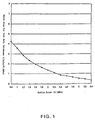
- the porous hollow fiber membrane of the present invention is characterized in that the membrane has a unitary, three-dimensional, network pore structure composed entirely of a polyvinylidene fluoride resin and has an inside diameter of 1.5 - 5 mm and a wall thickness of 0.5 - 2 mm and in that the relationship between membrane bubble point (hereinafter referred to as BP) and water flux per unit membrane wall thickness is on or above the curve shown in FIG. 1.
- BP membrane bubble point
- the production process of the porous hollow fiber membrane comprises blending a polyvinylidene fluoride resin with an organic liquid and an inorganic particulate material; heat melting the resulting blend at a temperature of 60°C or more above the melting point of the resin; extruding the resulting molten blend in the form of a hollow fiber; passing the resulting hollow fiber-shaped extrudate through the air; and taking up the extrudate.
- vinylidene fluoride resins from which the porous membrane of the present invention is prepared there are vinylidene fluoride homopolymers and copolymers.
- the vinylidene fluoride copolymers used according to the present invention include copolymers of vinylidene fluoride and one or more selected from the group consisting of tetrafluoroethylene, tetrafluoropropylene, trifluoromonochloroethylene and ethylene.
- the vinylidene fluoride homopolymers are used. Further, mixtures of these polymers may also be used.
- the porous hollow fiber membrane of the present invention which is composed entirely of a polyvinylidene fluoride resin, has a unitary, three-dimensional, network pore structure throughout the whole thereof. Further, the membrane has highly uniform micropores with openings on the membrane surface at a high ratio without the presence of macrovoids therein although it has a large wall thickness.
- the porous hollow fiber membrane of the present invention has an inside diameter of 1.5 - 5 mm and a wall thickness of 0.5 - 2 mm.
- the excellent pressure resistance which results from the large inside diameter and the thick wall of the porous hollow fiber membrane makes it possible to subject a highly concentrated and highly viscous liquid to crossflow or circulation filtration at a high linear velocity while keeping a lower pressure loss in the bore of the membrane. If the inside diameter of a porous hollow fiber membrane is less than 1.5 mm, the permeate-to-feed concentration ratio does not increase while filtering a highly viscous liquid because of its large pressure loss in the bore of the membrane.
- the inside diameter of a hollow fiber membrane exceeds 5 mm, the surface area of the membrane which can be housed in a module is too small for practical use because of the limited capacity of the module.
- the inside diameter ranges preferably from 1.7 mm to 4 mm and more preferably from 2 mm to 3.5 mm.
- the membrane pressure resistance improves but pressure loss becomes larger within the flow channels in the direction of the wall thickness, so that water permeability tends to degrade.
- the wall thickness ranges preferably from 0.5 mm to 2 mm.
- the porous hollow fiber polyvinylidene fluoride resin membrane of the present invention which has such a large inside diameter and wall thickness as mentioned above, has a pore diameter ranging preferably from 0.8 to 3.4 and more preferably from 1.3 to 3.3 in terms of the bubble point expressed as a multiple of unit 0.1 MPa.
- porous hollow fiber polyvinylidene fluoride resin membrane of the present invention has a relationship between bubble point (expressed as a multiple of unit 0.1 MPa) and water flux per unit wall thickness (expressed as l/m/hr/0.1 MPa at 25°C) which is on or above the curve shown in FIG. 1.
- the production method of the porous hollow fiber polyvinylidene fluoride resin membrane comprises blending a polyvinylidene fluoride resin with an organic liquid and an inorganic particulate material; heat melting the resulting blend at a temperature of 60°C or more above the melting point of the resin; extruding the resulting molten blend in the form of a hollow fiber; passing the resulting hollow fiber-shaped extrudate through the air; and taking up the extrudate.
- a thin porous hollow fiber membrane having a wall thickness of 0.40 mm or less may be prepared by a conventional spinning technique.
- the membrane thus prepared has a relatively homogeneous structure, irrespective of spinning conditions, and the water flux of the membrane tends to be almost inversely proportional to its wall thickness.
- the membrane production process of the present invention comprises a combination of steps which include blending of a polyvinylidene fluoride resin with an organic liquid and an inorganic particulate material; heat melting of the resultant blend at a temperature of 60°C or more above the melting point of the resin (which has not been performed in any conventional technique); passing the resulting hollow fiber-shaped extrudate through the air; and taking-up of the extrudate.
- This combination of the steps provides a membrane which has excellent permeability and highly uniform micropores with openings on its surface at a high ratio despite having a large wall thickness.
- the polyvinylidene fluoride resins used in accordance with the present invention include vinylidene fluoride homopolymers and copolymers.
- vinylidene fluoride copolymers there are used copolymers of vinylidene fluoride and one or more selected from the group consisting of tetrafluoroethylene, hexafluoropropylene, trifluoromonochloroethylene and ethylene; however, the vinylidene fluoride homopolymers are preferably used. These polymers may be used in combination.
- the polyvinylidene fluoride resin of the present invention has a weight average molecular weight (Mw) ranging preferably from 100,000 to 600,000. If a polyvinylidene fluoride resin having a weight average molecular weight (Mw) of less than 100,000 is used, the resulting porous membrane is brittle because the tensile elongation of the membrane is 50 % or lower, so that the use of such a membrane would be impractical.
- Mw weight average molecular weight
- a polyvinylidene fluoride resin having a Mw of more than 600,000 is used, the moldability of the resulting blend becomes unacceptable when the blend is extruded in the form of a hollow fiber because of low melt flowability of the resin and further, the average pore diameter becomes smaller than 0.01 ⁇ m on the surface of the hollow fiber membrane having a network structure composed of the resin. This results in an undesirably decrease in pore opening area and porosity and in degradation of water permeability.
- the organic liquid used according to the present invention is required to be a liquid which is inactive in the melt molding process.
- the solubility parameter (hereinafter referred to as SP) of the organic liquid ranges preferably from 8.4 to 10.5 and more preferably from 8.4 to 9.9.
- Such an organic liquid having the above-mentioned SP range may be dissolved in the polyvinylidene fluoride resin to a proper degree in the melt molding process and may be mostly adsorbed on the surface of an inorganic particulate material in the resulting extrudate when the extrudate is cooled and solidified. This makes it possible to provide the resulting blend with excellent moldability and to improve extractability of the particulate material and the liquid from the extrudate, thereby facilitating production of a porous hollow fiber membrane having excellent mechanical strength.
- the SP of the organic liquid exceeds 10.5
- the high solubility of the liquid in the polyvinylidene fluoride resin under a molten condition tends to prevent microphase separation at the time of cooling.
- This increases the melt-bonding between the resin molecules, which results in increased membrane mechanical strength, and yet decreases the pore-forming effect of the organic liquid, which brings about a large shrinkage of the resulting hollow fiber-shaped extrudate upon extraction of the organic liquid and the inorganic particulate material.
- This shrinkage results in a decrease in porosity and deterioration in appearance of the resulting membrane.
- the SP of the organic liquid is less than 8.4
- the low solubility of the organic liquid in the molten resin brings about the liberation of the organic liquid during the melt molding process, which results in the prevention of melt-bonding between the resin molecules, the degradation in the moldability of the resulting blend, an increase in average pore diameter in the network structure of the resulting polyvinylidene fluoride resin membrane, and a decrease in the tensile strength and the tensile elongation of the membrane.
- Examples of the organic liquids having an SP of 8.4 - 10.5, which are employed according to the present invention, include phthalic esters such as diethyl phthalate (DEP), dibutyl phthalate (DBP), dioctyl phthalate (DnOP), bis(2-ethylhexyl) phthalate (DOP) and the like; phosphoric esters and the like.
- phthalic esters such as diethyl phthalate (DEP), dibutyl phthalate (DBP), dioctyl phthalate (DnOP), bis(2-ethylhexyl) phthalate (DOP) and the like; phosphoric esters and the like.
- phthalic esters such as diethyl phthalate (DEP), dibutyl phthalate (DBP), dioctyl phthalate (DnOP), bis(2-ethylhexyl) phthalate (DOP) and the like
- phosphoric esters and the
- the inorganic particulate material employed in the process of the present invention functions as a carrier for retaining the organic liquid and as nuclei in microphase separation. Specifically, this material prevents liberation of the organic liquid during the melt molding process to increase moldability and functions as nuclei for microphase separation to facilitate a high-degree of microdispersion of the organic liquid, which strictly prevents aggregation of the dispersed liquid particles.
- the inorganic particulate material functions as a substance for membrane pore formation in combination with subsequent extraction of the material.
- silica is preferred and especially, hydrophobic silica is preferred.
- the hydrophobic silica refers to a silica of which the surface is converted from hydrophilicity to hydrophobicity by the chemical substitution of the silanol groups in the hydrophilic surface layer of the silica with methyl groups of an organosilicon compound such as dimethylsilane, dimethyl dichorosilane or the like.
- the hydrophobic silica has an average primary particle diameter of 0.005 - 0.5 ⁇ m, a specific surface area of 30 - 500 m 2 /g and a methanol wettability (MW) of 30 % by volume or more in terms of the volume of methanol completely wetting the silica.
- the hydrophobic silica prevents its aggregation during the melt molding process and is superior to a hydrophilic silica in affinity for the hydrophobic polyvinylidene fluoride resin and the organic liquid to thereby attain a high-degree microdispersion of the hydrophobic silica. Presumably, this may prevent formation of macrovoids and makes it possible to provide a porous polyvinylidene fluoride resin membrane having a macrovoid-free, uniform, three-dimensional, network pore structure composed of micropores throughout the membrane.
- the blend of the above-mentioned starting materials comprises 35 - 50% by weight of the polyvinylidene fluoride resin, 30 - 45% by weight of the organic liquid and 20 - 30% by weight of the inorganic particulate material.
- the content of the polyvinylidene fluoride resin is less than 35% by weight, the moldability of the blend is not preferable and the mechanical strength of the resultant porous membrane is low since the quantity of the resin is too small. If the resin content exceeds 50% by weight, on the other hand, the resultant porous membrane is low in porosity, so that water flux tends to decrease.
- the content of the organic liquid is less than 30% by weight, contribution of the organic liquid to pore formation is decreased to lower the porosity of the resulting membrane to less than 40% and it is therefore difficult to obtain an effective porous membrane.
- the content of the liquid exceeds 45% by weight, it is difficult to obtain a porous membrane which is excellent in mechanical strength because of the difficulty in molding of the blend.
- the content of the inorganic particulate material is less than 20% by weight, the amount of the material is not sufficient for adsorption of the organic liquid necessary for production of a practical porous membrane, so that the blend cannot be kept in a pulverized or granular condition, which makes it difficult to mold the blend.
- the content of the particulate material is more than 30% by weight, the melt flowability of the blend is deteriorated and the resultant porous membrane tends to be brittle.
- a blend used for melt molding primarily comprises three materials which include a polyvinylidene fluoride resin, an inorganic particulate material and an organic liquid. If necessary, lubricants, antioxidants, ultraviolet absorbers, plasticizers and other molding additives may be added to the blend in such quantities that they do not have an unwanted influence on the resultant porous membrane.
- These three materials may be blended with each other according to an ordinary blending method by use of a blender such as a Henschel mixer, V-shaped blender, ribbon blender or the like.
- a blender such as a Henschel mixer, V-shaped blender, ribbon blender or the like.
- a blending method which comprises blending of the inorganic particulate material with the organic liquid to cause the particulate material to sufficiently adsorb the organic liquid and subsequent blending of the polyvinylidene fluoride resin with the resulting blend.
- This blending method is more advantageous than the simultaneous blending of the three materials for enhancing the melt moldability of the resulting blend and increasing the porosity and mechanical strength of the resulting porous membrane.
- the blend is melt kneaded with a melt-kneading apparatus such as an extruder, a Banbury mixer, a twin-roll mill, a kneader or the like.
- a melt-kneading apparatus such as an extruder, a Banbury mixer, a twin-roll mill, a kneader or the like.
- the resulting kneaded blend is melt molded in the form of a hollow fiber through a die designed therefor.
- the blend may also be melt kneaded and extruded into a hollow fiber membrane in a continuous process by use of an apparatus such as an extruder, a kneader or the like which functions to both melt knead and melt extrude therein.
- the present invention it is necessary to heat melt the blend during the melt kneading and/or melt extrusion process at a temperature of 60°C or more above the melting point of the polyvinylidene fluoride resin in order to prepare a porous hollow fiber membrane having a large inside diameter, a large wall thickness and excellent water permeability. If a porous hollow fiber membrane having a large inside diameter and a large wall thickness is extruded without heat melting the blend at such a temperature of 60°C or more above the melting point of the resin as in the present invention, the water flux of the membrane is lowered because uniform pores are not formed throughout the membrane.
- the heat melting of the blend at a temperature of 60°C or more above the resin melting point increases solubility of the organic liquid in the molten resin, further promotes homogeneity of the molten blend of the resin and the organic liquid, and lowers the viscosity of the molten blend to make the microdispersion of the solid inorganic particulate material more uniform.
- the uniformity of the microdispersion leads to that of microphase separation in the subsequent process of cooling, which causes the resulting membrane to have a uniformly porous structure despite having a large wall thickness, so that the membrane exhibits excellent water permeability.
- the maximum temperature in the melt kneading and/or melt extrusion of the present invention is the decomposition temperature of the poly-vinylidene fluoride resin.
- the present invention after the blend is extruded in the form of a hollow fiber, it is necessary to pass the resulting extrudate through the air between a hollow fiber spinning nozzle and a cooling bath and to take up the extrudate.
- the passing of the extrudate through the air for a distance may increase the pore opening ratio on the surface of the porous membrane, which results in an increase in the water flux of the membrane.
- the distance for passing the hollow fiber-shaped extrudate through the air depends on its take-up rate and ranges preferably from 20 to 150 cm and more preferably from 30 to 100 cm. If the distance is less than 20 cm, the water flux of the resulting membrane is decreased because quenching of the extrudate forms a skin layer having a lower pore opening ratio on membrane surface. The distance in excess of 150 cm deteriorates the tensile strength of the molten extrudate in the form of a hollow fiber, so that the uniformity of the hollow fiber diameter is difficult to obtain because of diameter fluctuation.
- the cooling bath is necessary for the final setting of the extrudate in the form of a hollow fiber.
- cooling media which are preferably employed include water and plasticizers.
- the cooling bath may be replaced by contact with a cooled gas.
- Solvents used to extract the organic liquid are required to be those that are capable of dissolving the liquid without substantially dissolving the polyvinylidene fluoride resin.
- the solvents used for the extraction include methanol, acetone, methyl ethyl ketone and the like, but halogenated hydrocarbons such as methylene chloride, trichloroethylene and the like are particularly preferable.
- solvents used for extraction of the inorganic particulate material include aqueous alkaline solutions such as aqueous sodium hydroxide solutions and aqueous potassium hydroxide solutions. Further, it is possible to extract the organic liquid and the inorganic particulate material at the same time by use of an alcoholic solution of sodium hydroxide or the like.
- porous hollow fiber membrane in order to increase the pore size and porosity after extraction of either or both of the organic liquid and the inorganic particulate material.
- a direct or relative decrease in resin content makes it possible to prepare a porous hollow fiber membrane having a BP of less than 0.8 (expressed as a multiple of unit 0.1 MPa) but deteriorates the moldability of the resulting blend and decreases the mechanical strength of the resulting membrane to such an extent that said membrane may not be fit for practical use.
- An extreme increase in the resin content or quenching of a molten extrudate makes it possible to prepare a porous hollow fiber membrane having a BP of more than 3.4 (also expressed as a multiple of unit 0.1 MPa) but decreases membrane porosity and forms a skin layer on the membrane surface, so that it is difficult to obtain an improved water permeability.
- hydrophobic silica (Japan Aerosil R-972, trade name) having a MW of 50%, an average primary particle diameter of 16 nm and a specific surface area of 110 m 2 /g; 30.7% by weight of bis(2-ethymexyl) phthalate having a SP of 8.9; and 6.2% by weight of dibutyl phthalate having a SP of 9.4 were blended together in a Henschel mixer.
- 40.0% by weight of polyvinylidene fluoride (Kureha KF Polymer #1000, trade name) having a Mw of 242,000 and a melting point of 177°C was added, followed by further blending with each other in said Henschel mixer.
- the resultant blend was melt kneaded and was pelletized with a twin-screw extruder having a barrel diameter of 30 mm.
- the resulting pellets were melt kneaded at 250°C by use of a twin-screw extruder having a barrel diameter of 30 mm and equipped with an annular hollow fiber spinning die nozzle and was then extruded through the nozzle having an outside diameter of 5.8 mm and an inside diameter of 3.5 mm.
- the resulting extrudate was cooled while passing it through the air for a distance of 30 cm, further cooled in a water bath and taken up at a spinning rate of 5 m/min.
- the hollow fiber-shaped extrudate thus obtained was immersed in methylene chloride for one hour to extract bis(2-ethylhexyl) phthalate and dibutyl phthalate and was then dried. Subsequently, the extrudate was immersed in a 50% aqueous solution of ethyl alcohol for 30 minutes to make the extrudate hydrophilic. Further, the extrudate was immersed in a 20% aqueous solution of sodium hydroxide at 70°C for one hour to extract the hydrophobic silica and was then subjected to water washing and drying.
- hydrophobic silica (Japan Aerosil R-972, trade name) having a MW of 50%, an average primary particle diameter of 16 nm and a specific surface area of 110 m 2 /g; 28.0% by weight of bis(2-ethylhexyl) phthalate having a SP of 8.9; and 7.0% by weight of dibutyl phthalate having a SP of 9.4 were blended together in a Henschel mixer.
- 40.0% by weight of polyvinylidene fluoride (Kureha KF Polymer #1000, trade name) having a Mw of 242,000 and a melting point of 177°C was added, followed by further blending with each other in said Henschel mixer. Except for use of the resulting blend, a hollow fiber membrane was prepared in the same way as described in Example 1.
- hydrophobic silica (Japan Aerosil R-972, trade name) having a MW value of 50%, an average primary particle diameter of 16 nm and a specific surface area of 110 m 2 /g; 25.7% by weight of bis(2-ethylhexyl) phthalate having a SP of 8.9; and 6.4% by weight of dibutyl phthalate having a SP of 9.4 were blended with each other in a Henschel mixer.
- polyvinylidene fluoride (Kureha KF Polymer #1000, trade name) having a Mw of 242,000 and a melting point of 177°C was added, followed by further blending with each other in said Henschel mixer to obtain a blend. Except for the specific blend, a hollow fiber membrane was prepared in the same way as described in Example 1.
- Example 1 was repeated to prepare a hollow fiber membrane except for melt kneading the pellets at 230°C by use of a twin-screw extruder having a barrel diameter of 30 mm.
- Example 2 was repeated to obtain a hollow fiber membrane except for a 10 cm distance for air cooling immediately after melt extrusion process by use of a hollow fiber production apparatus equipped with an annular die nozzle having an outside diameter of 5.8 mm and an inside diameter of 3.5 mm.
- Example 1 ( ⁇ m) BP (0.1MPa) Max.Pore Dia. ( ⁇ m) Water Flux Per Unit Wall Thickness (l/m/hr/0.1MPa)
- Example 2 (This Invention) 3.9/2.6 0.24 2.30 0.38 1.00
- Example 3 (This Invention) 3.9/2.6 0.17 3.25 0.27 0.43
- Example 4 (Comparative) 3.9/2.6 0.46 1.18 0.74 2.37
- Example 5 (Comparative) 3.9/2.6 0.22 2.50 0.35 0.72
- the membrane of the present invention is a porous hollow fiber polyvinylidene fluoride resin membrane having a large inside diameter and a large wall thickness.
- the membrane is especially useful for filtration of highly viscous liquids because of excellent water permeability.
- the large inside diameter makes it possible to reduce pressure loss in membrane bore to a lower level
- the large wall thickness which results in excellent pressure resistance makes it possible to apply high filtration pressure to the membrane, and further, the excellent water permeability makes it possible to highly concentrate the highly viscous liquids with great efficiency.
- the membrane of the present invention makes it possible to efficiently perform solid-liquid separation while filtering such a liquid even though crystallization is apt to occur at low temperatures as the viscosity of the liquid is increased because of lowered filtration temperatures.
- the membrane of the present invention may be applied to purification of vegetable oils such as sunflower oil, rapeseed oil and the like; purification of mineral oils and chemicals; recovery of useful substances from fermentation broths in the production of beer, sugars and the like; and recovery of useful substances from fermentation broths in the manufacture of amino acids and the like.
- the membrane of the present invention makes it possible to achieve higher concentrations of liquids than have been possible with conventional membranes, so that the inventive membrane is expected to see an expanded application field for filtration of highly viscous liquids.
Landscapes
- Chemical & Material Sciences (AREA)
- Chemical Kinetics & Catalysis (AREA)
- Engineering & Computer Science (AREA)
- Manufacturing & Machinery (AREA)
- Dispersion Chemistry (AREA)
- Textile Engineering (AREA)
- General Chemical & Material Sciences (AREA)
- Physics & Mathematics (AREA)
- Thermal Sciences (AREA)
- Mechanical Engineering (AREA)
- Separation Using Semi-Permeable Membranes (AREA)
- Artificial Filaments (AREA)
- Manufacture Of Porous Articles, And Recovery And Treatment Of Waste Products (AREA)
Priority Applications (1)
| Application Number | Priority Date | Filing Date | Title |
|---|---|---|---|
| EP07117715A EP1897606B1 (fr) | 1996-12-10 | 1998-06-22 | Procédé pour la préparation d'une membrane de résine au fluorure de polyvinylidène poreux |
Applications Claiming Priority (2)
| Application Number | Priority Date | Filing Date | Title |
|---|---|---|---|
| JP8329387A JPH10168218A (ja) | 1996-12-10 | 1996-12-10 | フッ化ビニリデン系樹脂多孔膜 |
| PCT/JP1998/002762 WO1999067013A1 (fr) | 1996-12-10 | 1998-06-22 | Film poreux d'une resine de fluorure de polyvinylidene et son procede de production |
Related Child Applications (1)
| Application Number | Title | Priority Date | Filing Date |
|---|---|---|---|
| EP07117715A Division EP1897606B1 (fr) | 1996-12-10 | 1998-06-22 | Procédé pour la préparation d'une membrane de résine au fluorure de polyvinylidène poreux |
Publications (2)
| Publication Number | Publication Date |
|---|---|
| EP1010457A1 true EP1010457A1 (fr) | 2000-06-21 |
| EP1010457A4 EP1010457A4 (fr) | 2006-03-22 |
Family
ID=14208441
Family Applications (1)
| Application Number | Title | Priority Date | Filing Date |
|---|---|---|---|
| EP98928604A Withdrawn EP1010457A4 (fr) | 1996-12-10 | 1998-06-22 | Film poreux d'une resine de fluorure de polyvinylidene et son procede de production |
Country Status (4)
| Country | Link |
|---|---|
| US (1) | US6299773B1 (fr) |
| EP (1) | EP1010457A4 (fr) |
| AU (1) | AU736329B2 (fr) |
| WO (1) | WO1999067013A1 (fr) |
Cited By (6)
| Publication number | Priority date | Publication date | Assignee | Title |
|---|---|---|---|---|
| WO2000068956A1 (fr) * | 1999-05-07 | 2000-11-16 | Alliedsignal Inc. | Materiau nanoporeux fabrique au moyen d'un reactif soluble |
| WO2002070115A1 (fr) * | 2001-03-06 | 2002-09-12 | Asahi Kasei Kabushiki Kaisha | Procede de fabrication d'une pellicule de fil creux |
| ES2228241A1 (es) * | 2003-02-20 | 2005-04-01 | Tratasa 2000, S.L. | Procedimiento para fabricar un filtro para agua y otros fluidos. |
| WO2007043553A1 (fr) | 2005-10-13 | 2007-04-19 | Asahi Kasei Chemicals Corporation | Membrane en fibres creuses multicouche poreuse et processus de production correspondant |
| EP2052771A4 (fr) * | 2006-08-10 | 2010-07-21 | Kuraray Co | Membrane poreuse en résine de fluorure de vinylidène et son procédé de production |
| US8931647B2 (en) * | 2006-04-19 | 2015-01-13 | Asahi Kasei Chemicals Corporation | Highly durable porous PVDF film, method of producing the same and washing method and filtration method using the same |
Families Citing this family (69)
| Publication number | Priority date | Publication date | Assignee | Title |
|---|---|---|---|---|
| EP0952885B1 (fr) | 1996-12-20 | 2010-09-22 | Siemens Water Technologies Corp. | Procede de decapage |
| TW581709B (en) * | 1999-10-22 | 2004-04-01 | Asahi Kasei Corp | Heat-resistant microporous film |
| AUPR143400A0 (en) * | 2000-11-13 | 2000-12-07 | Usf Filtration And Separations Group Inc. | Modified membranes |
| AUPR421501A0 (en) | 2001-04-04 | 2001-05-03 | U.S. Filter Wastewater Group, Inc. | Potting method |
| DE60236696D1 (de) * | 2001-04-27 | 2010-07-22 | Millipore Corp | Neue beschichtete Membranen und andere Artikel |
| AUPR584301A0 (en) * | 2001-06-20 | 2001-07-12 | U.S. Filter Wastewater Group, Inc. | Membrane polymer compositions |
| WO2003026779A1 (fr) * | 2001-08-01 | 2003-04-03 | Asahi Kasei Kabushiki Kaisha | Film microporeux multicouches |
| AUPR692401A0 (en) | 2001-08-09 | 2001-08-30 | U.S. Filter Wastewater Group, Inc. | Method of cleaning membrane modules |
| US7247238B2 (en) | 2002-02-12 | 2007-07-24 | Siemens Water Technologies Corp. | Poly(ethylene chlorotrifluoroethylene) membranes |
| AUPS300602A0 (en) | 2002-06-18 | 2002-07-11 | U.S. Filter Wastewater Group, Inc. | Methods of minimising the effect of integrity loss in hollow fibre membrane modules |
| CA2501628C (fr) | 2002-10-10 | 2012-12-04 | U.S. Filter Wastewater Group, Inc. | Agencement de filtration et de lavage a contre-courant pour modules de membranes |
| KR100668573B1 (ko) * | 2002-10-18 | 2007-01-16 | 아사히 카세이 메디칼 가부시키가이샤 | 친수성 미다공막 |
| AU2002953111A0 (en) | 2002-12-05 | 2002-12-19 | U. S. Filter Wastewater Group, Inc. | Mixing chamber |
| DE10320197A1 (de) * | 2002-12-20 | 2004-07-08 | Degussa Ag | Umhüllte Persauerstoffverbindungen mit kontrollierter Freisetzung, Verfahren zu ihrer Herstellung und ihrer Verwendung |
| EP1572852B1 (fr) * | 2002-12-20 | 2006-10-11 | Degussa AG | Composes peroxygenes enrobes, a liberation lente, leur procede de preparation et d'utilisation |
| KR20060003347A (ko) * | 2003-04-16 | 2006-01-10 | 가부시끼가이샤 구레하 | 불화비닐리덴계 수지 다공막 및 그의 제조 방법 |
| PT1475350E (pt) * | 2003-05-07 | 2005-09-30 | Degussa | Granulado de percarbonato de sodio revestido com estabilidade no armazenamento melhorada |
| JP2007504089A (ja) * | 2003-05-23 | 2007-03-01 | デグサ アクチエンゲゼルシャフト | 過酸化水素又は酸素の制御された放出のための、過酸化水素及び疎水化した二酸化ケイ素を含有する粉体状混合物の使用 |
| US20090252815A1 (en) * | 2003-05-23 | 2009-10-08 | Evonik Degussa Gmbh | Pulverulent mixtures containing hydrogen peroxide and hydrophobized silicon dioxide |
| WO2004104154A2 (fr) * | 2003-05-23 | 2004-12-02 | Degussa Ag | Melange pulverulent comprenant du peroxyde d'hydrogene et du dioxyde de silicium hydrophobe |
| AU2003903507A0 (en) | 2003-07-08 | 2003-07-24 | U. S. Filter Wastewater Group, Inc. | Membrane post-treatment |
| WO2005014151A1 (fr) * | 2003-08-06 | 2005-02-17 | Zhejiang Omex Environmental Engineering Ltd. | Procede de preparation de membrane a fibres creuses de poly(fluorure de vinylidene) du type a pression externe filee par un procede d'immersion-coagulation, et produit obtenu |
| US8268176B2 (en) | 2003-08-29 | 2012-09-18 | Siemens Industry, Inc. | Backwash |
| JP4761967B2 (ja) * | 2003-10-03 | 2011-08-31 | 株式会社クレハ | フッ化ビニリデン系樹脂多孔質中空糸およびその製造方法 |
| US20050142280A1 (en) * | 2003-10-20 | 2005-06-30 | Kim Kwon I. | System and method for synthesizing a polymer membrane |
| AU2004289373B2 (en) | 2003-11-14 | 2010-07-29 | Evoqua Water Technologies Llc | Improved module cleaning method |
| US8758621B2 (en) | 2004-03-26 | 2014-06-24 | Evoqua Water Technologies Llc | Process and apparatus for purifying impure water using microfiltration or ultrafiltration in combination with reverse osmosis |
| EP1769840A4 (fr) * | 2004-04-14 | 2008-12-31 | Kureha Corp | Membrane de filtrage d"eau poresue de fibre creuse de resine de fluorure de vinylidene et procédé de fabrication de celle-ci |
| WO2005107929A2 (fr) | 2004-04-22 | 2005-11-17 | Siemens Water Technologies Corp. | Appareil de filtration comprenant un bioreacteur a membrane et une cuve de traitement pour la digestion de matieres organiques |
| JP5339677B2 (ja) * | 2004-06-15 | 2013-11-13 | 株式会社クレハ | フッ化ビニリデン系樹脂中空糸多孔濾水膜およびその製造方法 |
| JP2008504122A (ja) | 2004-07-02 | 2008-02-14 | シーメンス・ウォーター・テクノロジーズ・コーポレーション | 気体輸送膜 |
| EP1773477B1 (fr) | 2004-07-05 | 2011-09-07 | Siemens Water Technologies Corp. | Membranes hydrophiliques |
| JP4864707B2 (ja) * | 2004-07-07 | 2012-02-01 | 株式会社クレハ | フッ化ビニリデン系樹脂多孔水処理膜の製造方法 |
| NZ588094A (en) | 2004-08-20 | 2012-04-27 | Siemens Water Tech Corp | Potting head for hollow fibre filter module |
| AU2005282211B2 (en) | 2004-09-07 | 2011-04-21 | Evoqua Water Technologies Llc | Reduction of backwash liquid waste |
| US8506806B2 (en) | 2004-09-14 | 2013-08-13 | Siemens Industry, Inc. | Methods and apparatus for removing solids from a membrane module |
| EP1807181A4 (fr) | 2004-09-15 | 2009-04-22 | Siemens Water Tech Corp | Aeration variable en continu |
| US7591950B2 (en) | 2004-11-02 | 2009-09-22 | Siemens Water Technologies Corp. | Submerged cross-flow filtration |
| DE102004054495A1 (de) * | 2004-11-11 | 2006-05-24 | Degussa Ag | Natriumpercarbonatpartikel mit einer Thiosulfat enthaltenden Hüllschicht |
| MY141919A (en) | 2004-12-03 | 2010-07-30 | Siemens Water Tech Corp | Membrane post treatment |
| CA2591580A1 (fr) | 2004-12-24 | 2006-06-29 | Siemens Water Technologies Corp. | Procede et appareil simples de lavage au gaz |
| ATE549076T1 (de) | 2004-12-24 | 2012-03-15 | Siemens Industry Inc | Reinigung in membranfiltrationssystemen |
| CN101184548B (zh) | 2005-04-29 | 2011-10-05 | 西门子水技术公司 | 用于膜滤器的化学清洗剂 |
| WO2007006104A1 (fr) | 2005-07-14 | 2007-01-18 | Siemens Water Technologies Corp. | Traitement de membranes avec un monopersulfate |
| CN101287538B (zh) | 2005-08-22 | 2013-03-06 | 西门子工业公司 | 使用歧管以减少回洗的水过滤装置 |
| WO2007044415A2 (fr) | 2005-10-05 | 2007-04-19 | Siemens Water Technologies Corp. | Procédé et appareil destinés à traiter les eaux usées |
| US7563363B2 (en) | 2005-10-05 | 2009-07-21 | Siemens Water Technologies Corp. | System for treating wastewater |
| US7455765B2 (en) | 2006-01-25 | 2008-11-25 | Siemens Water Technologies Corp. | Wastewater treatment system and method |
| US8293098B2 (en) | 2006-10-24 | 2012-10-23 | Siemens Industry, Inc. | Infiltration/inflow control for membrane bioreactor |
| EP2129629A1 (fr) | 2007-04-02 | 2009-12-09 | Siemens Water Technologies Corp. | Commande d'infiltration/afflux améliorée pour bioréacteur à membranes |
| US9764288B2 (en) | 2007-04-04 | 2017-09-19 | Evoqua Water Technologies Llc | Membrane module protection |
| EP2152390B1 (fr) | 2007-05-29 | 2012-05-23 | Siemens Industry, Inc. | Nettoyage d'une membrane avec une pompe pneumatique pulsée |
| CN101293185A (zh) * | 2008-01-30 | 2008-10-29 | 清华大学 | 一种制备聚偏氟乙烯多孔膜的方法 |
| EP2331242B1 (fr) | 2008-07-24 | 2018-09-05 | Evoqua Water Technologies LLC | Système de cadre pour modules de filtration sur membrane |
| AU2009282912B2 (en) | 2008-08-20 | 2014-11-27 | Evoqua Water Technologies Llc | Improved membrane system backwash energy efficiency |
| WO2010142673A1 (fr) | 2009-06-11 | 2010-12-16 | Siemens Water Technologies Corp. | Procédés de nettoyage d'une membrane polymère poreuse et kit pour le nettoyage d'une membrane polymère poreuse |
| EP2563501B1 (fr) | 2010-04-30 | 2019-05-15 | Evoqua Water Technologies LLC | Dispositif de distribution d'un écoulement de fluide |
| US9022224B2 (en) | 2010-09-24 | 2015-05-05 | Evoqua Water Technologies Llc | Fluid control manifold for membrane filtration system |
| CN103958024B (zh) | 2011-09-30 | 2016-07-06 | 伊沃夸水处理技术有限责任公司 | 改进的歧管排列 |
| US9925499B2 (en) | 2011-09-30 | 2018-03-27 | Evoqua Water Technologies Llc | Isolation valve with seal for end cap of a filtration system |
| AU2013280452B2 (en) | 2012-06-28 | 2017-07-20 | Evoqua Water Technologies Llc | A potting method |
| KR20150054918A (ko) | 2012-09-14 | 2015-05-20 | 에보쿠아 워터 테크놀로지스 엘엘씨 | 막을 위한 중합체 블렌드 |
| US9962865B2 (en) | 2012-09-26 | 2018-05-08 | Evoqua Water Technologies Llc | Membrane potting methods |
| WO2014052071A1 (fr) | 2012-09-26 | 2014-04-03 | Evoqua Water Technologies Llc | Dispositif de sécurisation de membrane |
| KR20150059788A (ko) | 2012-09-27 | 2015-06-02 | 에보쿠아 워터 테크놀로지스 엘엘씨 | 침지된 막을 위한 가스 스코어링 장치 |
| EP3052221B1 (fr) | 2013-10-02 | 2022-12-14 | Rohm & Haas Electronic Materials Singapore Pte. Ltd | Dispositif de réparation de module de filtration sur membrane |
| CN107847869B (zh) | 2015-07-14 | 2021-09-10 | 罗门哈斯电子材料新加坡私人有限公司 | 用于过滤系统的通气装置 |
| CN105126648B (zh) | 2015-09-21 | 2018-03-09 | 江苏凯米膜科技股份有限公司 | 一种基于聚乙烯醇凝胶制备网络孔聚偏氟乙烯膜的方法 |
| CN116808851B (zh) * | 2023-03-08 | 2024-11-08 | 杭州师范大学 | 一种基于体积排斥效应的聚偏氟乙烯阶层式多孔薄膜及其制备方法和应用 |
Family Cites Families (13)
| Publication number | Priority date | Publication date | Assignee | Title |
|---|---|---|---|---|
| DE1694094B2 (de) * | 1966-12-07 | 1974-08-22 | Bayer Ag, 5090 Leverkusen | Verfahren zur Herstellung unbrennbarer Schaumstoffe |
| JPS4922472A (fr) * | 1972-06-22 | 1974-02-27 | ||
| JPS5180686A (ja) | 1975-01-13 | 1976-07-14 | Asahi Chemical Ind | Chukujohantomaku |
| US4203848A (en) * | 1977-05-25 | 1980-05-20 | Millipore Corporation | Processes of making a porous membrane material from polyvinylidene fluoride, and products |
| CH625966A5 (fr) * | 1977-07-15 | 1981-10-30 | Kilcher Chemie Ag | |
| JPS5893734A (ja) * | 1981-11-30 | 1983-06-03 | Asahi Chem Ind Co Ltd | 親水性ポリフツ化ビニリデン樹脂多孔膜の製造方法 |
| JPH06104753B2 (ja) * | 1986-02-04 | 1994-12-21 | 旭化成工業株式会社 | 非吸着性親水性中空糸状多孔膜 |
| FR2600265B1 (fr) * | 1986-06-20 | 1991-09-06 | Rhone Poulenc Rech | Membranes semi-permeables sechables et hydrophiles a base de polyfluorure de vinylidene |
| DK173505B1 (da) | 1987-02-20 | 2001-01-15 | Pharmatec Internat S R L | Fremgangsmåde til fremstilling af en diltiazempellet med langsom afgivelse og anvendelse af således fremstillede pelleter t |
| US4806291A (en) * | 1988-02-22 | 1989-02-21 | Ionics, Incorporated | Process for preparing microporous polyvinylidene fluoride membranes |
| JPH01224005A (ja) | 1988-03-04 | 1989-09-07 | Asahi Chem Ind Co Ltd | ポリフッ化ビニリデンを骨格とする複層中空系ミクロフィルター |
| US5022990A (en) * | 1989-01-12 | 1991-06-11 | Asahi Kasei Kogyo Kabushiki Kaisha | Polyvinylidene fluoride porous membrane and a method for producing the same |
| JP2899903B2 (ja) * | 1989-01-12 | 1999-06-02 | 旭化成工業株式会社 | ポリフツ化ビニリデン多孔膜及びその製造方法 |
-
1998
- 1998-06-22 WO PCT/JP1998/002762 patent/WO1999067013A1/fr not_active Ceased
- 1998-06-22 AU AU80371/98A patent/AU736329B2/en not_active Ceased
- 1998-06-22 EP EP98928604A patent/EP1010457A4/fr not_active Withdrawn
- 1998-06-22 US US09/445,955 patent/US6299773B1/en not_active Expired - Lifetime
Cited By (14)
| Publication number | Priority date | Publication date | Assignee | Title |
|---|---|---|---|---|
| WO2000068956A1 (fr) * | 1999-05-07 | 2000-11-16 | Alliedsignal Inc. | Materiau nanoporeux fabrique au moyen d'un reactif soluble |
| WO2002070115A1 (fr) * | 2001-03-06 | 2002-09-12 | Asahi Kasei Kabushiki Kaisha | Procede de fabrication d'une pellicule de fil creux |
| AU2002236221B2 (en) * | 2001-03-06 | 2004-09-23 | Asahi Kasei Chemicals Corporation | Method for producing hollow yarn film |
| US7128861B2 (en) | 2001-03-06 | 2006-10-31 | Asahi Kasei Chemicals Corporation | Method for producing hollow yarn film |
| ES2228241A1 (es) * | 2003-02-20 | 2005-04-01 | Tratasa 2000, S.L. | Procedimiento para fabricar un filtro para agua y otros fluidos. |
| ES2228241B1 (es) * | 2003-02-20 | 2006-06-01 | Tratasa 2000, S.L. | Procedimiento para fabricar un filtro para agua y otros fluidos. |
| WO2007043553A1 (fr) | 2005-10-13 | 2007-04-19 | Asahi Kasei Chemicals Corporation | Membrane en fibres creuses multicouche poreuse et processus de production correspondant |
| EP1935480A4 (fr) * | 2005-10-13 | 2010-04-28 | Asahi Kasei Chemicals Corp | Membrane en fibres creuses multicouche poreuse et processus de production correspondant |
| US8137800B2 (en) | 2005-10-13 | 2012-03-20 | Asahi Kasei Chemicals Corporation | Porous multilayered hollow-fiber membrane and process for producing the same |
| EP2260931A3 (fr) * | 2005-10-13 | 2012-03-21 | Asahi Kasei Chemicals Corporation | Membrane en fibres creuses multicouche poreuse et processus de production correspondant |
| CN101282780B (zh) * | 2005-10-13 | 2012-10-31 | 旭化成化学株式会社 | 多孔性多层中空纤维膜及其制造方法 |
| US8931647B2 (en) * | 2006-04-19 | 2015-01-13 | Asahi Kasei Chemicals Corporation | Highly durable porous PVDF film, method of producing the same and washing method and filtration method using the same |
| EP2052771A4 (fr) * | 2006-08-10 | 2010-07-21 | Kuraray Co | Membrane poreuse en résine de fluorure de vinylidène et son procédé de production |
| US7909178B2 (en) | 2006-08-10 | 2011-03-22 | Kuraray Co., Ltd. | Porous membrane of vinylidene fluoride resin and process for producing the same |
Also Published As
| Publication number | Publication date |
|---|---|
| WO1999067013A1 (fr) | 1999-12-29 |
| US6299773B1 (en) | 2001-10-09 |
| AU736329B2 (en) | 2001-07-26 |
| AU8037198A (en) | 2000-01-10 |
| EP1010457A4 (fr) | 2006-03-22 |
Similar Documents
| Publication | Publication Date | Title |
|---|---|---|
| US6299773B1 (en) | Porous polyvinylidene fluoride resin film and process for producing the same | |
| US5022990A (en) | Polyvinylidene fluoride porous membrane and a method for producing the same | |
| US8523981B2 (en) | Hydrophobic ozone-stable membrane made of polyvinylidene fluoride | |
| KR100991596B1 (ko) | 할라 막 | |
| KR101408473B1 (ko) | 평균 기공 크기가 비교적 큰 미세다공성 막 및 이를 제조하는 방법 | |
| KR101462939B1 (ko) | 친수성 폴리불화비닐리덴계 중공사 분리막 및 이의 제조방법 | |
| JPH01293102A (ja) | 微多孔性中空糸膜及びその製造方法 | |
| CN101227967B (zh) | 偏二氟乙烯系树脂中空丝多孔膜 | |
| CN102512986A (zh) | 气体可透膜 | |
| EP1669128A1 (fr) | Procede de preparation de membrane a fibres creuses de poly(fluorure de vinylidene) du type a pression externe filee par un procede d'immersion-coagulation, et produit obtenu | |
| EP1897606B1 (fr) | Procédé pour la préparation d'une membrane de résine au fluorure de polyvinylidène poreux | |
| KR20160081612A (ko) | 다공성 pvdf 중공사막 및 이의 제조방법 | |
| JP5292890B2 (ja) | 複合中空糸膜 | |
| KR20130040620A (ko) | 친수화 개질 폴리불화비닐리덴 수지를 이용한 고강도 수처리용 중공사막의 제조방법 | |
| JP2008062227A (ja) | 製膜原液、多孔膜及び多孔膜の製造方法 | |
| JPH10168218A (ja) | フッ化ビニリデン系樹脂多孔膜 | |
| KR102316308B1 (ko) | 친수성 플렉서블 폴리페닐렌설파이드 중공사막 제조용 방사조액, 이를 이용한 친수성 플렉서블 폴리페닐렌설파이드 중공사막 및 이를 이용한 친수성 플렉서블 폴리페닐렌설파이드 중공사막의 제조방법 | |
| KR101350866B1 (ko) | 열유도상분리 및 연신에 기초한 피브이디에프 중공사막 제조방법 | |
| CN114828990B (zh) | 分离膜和分离膜的制造方法 | |
| JP3979751B2 (ja) | 酸化剤含有水のろ過方法 | |
| KR20130040622A (ko) | 고투과도를 갖는 친수화 폴리불화비닐리덴 수지를 이용한 수처리용 중공사막의 제조방법 | |
| KR20070103187A (ko) | 폴리불화비닐리덴계 다공성 중공사막 및 이의 제조방법 | |
| KR20130040625A (ko) | 이차저지층을 갖는 수처리용 폴리불화비닐리덴 중공사막 및 그 제조방법 | |
| JPH0373328B2 (fr) | ||
| JP2005193201A (ja) | 親水性中空糸膜およびその製造方法 |
Legal Events
| Date | Code | Title | Description |
|---|---|---|---|
| PUAI | Public reference made under article 153(3) epc to a published international application that has entered the european phase |
Free format text: ORIGINAL CODE: 0009012 |
|
| 17P | Request for examination filed |
Effective date: 19991215 |
|
| AK | Designated contracting states |
Kind code of ref document: A1 Designated state(s): FR GB |
|
| RAP1 | Party data changed (applicant data changed or rights of an application transferred) |
Owner name: ASAHI KASEI KABUSHIKI KAISHA |
|
| A4 | Supplementary search report drawn up and despatched |
Effective date: 20060203 |
|
| 17Q | First examination report despatched |
Effective date: 20061219 |
|
| 17Q | First examination report despatched |
Effective date: 20061219 |
|
| APBK | Appeal reference recorded |
Free format text: ORIGINAL CODE: EPIDOSNREFNE |
|
| APBN | Date of receipt of notice of appeal recorded |
Free format text: ORIGINAL CODE: EPIDOSNNOA2E |
|
| APBR | Date of receipt of statement of grounds of appeal recorded |
Free format text: ORIGINAL CODE: EPIDOSNNOA3E |
|
| APAF | Appeal reference modified |
Free format text: ORIGINAL CODE: EPIDOSCREFNE |
|
| APBT | Appeal procedure closed |
Free format text: ORIGINAL CODE: EPIDOSNNOA9E |
|
| STAA | Information on the status of an ep patent application or granted ep patent |
Free format text: STATUS: THE APPLICATION HAS BEEN WITHDRAWN |
|
| 18W | Application withdrawn |
Effective date: 20120103 |