EP1011843B1 - Verfahren und verbindung zur selektiven adsorption von stickoxiden - Google Patents
Verfahren und verbindung zur selektiven adsorption von stickoxiden Download PDFInfo
- Publication number
- EP1011843B1 EP1011843B1 EP98936428A EP98936428A EP1011843B1 EP 1011843 B1 EP1011843 B1 EP 1011843B1 EP 98936428 A EP98936428 A EP 98936428A EP 98936428 A EP98936428 A EP 98936428A EP 1011843 B1 EP1011843 B1 EP 1011843B1
- Authority
- EP
- European Patent Office
- Prior art keywords
- compound
- intensity
- mode
- wave number
- oxides
- Prior art date
- Legal status (The legal status is an assumption and is not a legal conclusion. Google has not performed a legal analysis and makes no representation as to the accuracy of the status listed.)
- Expired - Lifetime
Links
- 150000001875 compounds Chemical class 0.000 title claims description 54
- MWUXSHHQAYIFBG-UHFFFAOYSA-N nitrogen oxide Inorganic materials O=[N] MWUXSHHQAYIFBG-UHFFFAOYSA-N 0.000 title claims description 51
- 238000000034 method Methods 0.000 title claims description 21
- 238000001179 sorption measurement Methods 0.000 title 1
- CURLTUGMZLYLDI-UHFFFAOYSA-N Carbon dioxide Chemical compound O=C=O CURLTUGMZLYLDI-UHFFFAOYSA-N 0.000 claims description 26
- 239000010949 copper Substances 0.000 claims description 26
- 238000010521 absorption reaction Methods 0.000 claims description 24
- IWOUKMZUPDVPGQ-UHFFFAOYSA-N barium nitrate Chemical compound [Ba+2].[O-][N+]([O-])=O.[O-][N+]([O-])=O IWOUKMZUPDVPGQ-UHFFFAOYSA-N 0.000 claims description 21
- 239000000203 mixture Substances 0.000 claims description 21
- 229910002092 carbon dioxide Inorganic materials 0.000 claims description 18
- QVGXLLKOCUKJST-UHFFFAOYSA-N atomic oxygen Chemical compound [O] QVGXLLKOCUKJST-UHFFFAOYSA-N 0.000 claims description 17
- 239000001301 oxygen Substances 0.000 claims description 17
- 229910052760 oxygen Inorganic materials 0.000 claims description 17
- QPLDLSVMHZLSFG-UHFFFAOYSA-N Copper oxide Chemical compound [Cu]=O QPLDLSVMHZLSFG-UHFFFAOYSA-N 0.000 claims description 14
- IJGRMHOSHXDMSA-UHFFFAOYSA-N Atomic nitrogen Chemical compound N#N IJGRMHOSHXDMSA-UHFFFAOYSA-N 0.000 claims description 12
- XLYOFNOQVPJJNP-UHFFFAOYSA-N water Chemical compound O XLYOFNOQVPJJNP-UHFFFAOYSA-N 0.000 claims description 12
- 239000007789 gas Substances 0.000 claims description 11
- 238000010438 heat treatment Methods 0.000 claims description 11
- 229960004643 cupric oxide Drugs 0.000 claims description 10
- 238000001237 Raman spectrum Methods 0.000 claims description 9
- 239000001569 carbon dioxide Substances 0.000 claims description 8
- 239000005751 Copper oxide Substances 0.000 claims description 7
- 229910000431 copper oxide Inorganic materials 0.000 claims description 7
- 239000003517 fume Substances 0.000 claims description 7
- 229910001868 water Inorganic materials 0.000 claims description 7
- 229910052757 nitrogen Inorganic materials 0.000 claims description 6
- 238000001816 cooling Methods 0.000 claims description 5
- 238000000354 decomposition reaction Methods 0.000 claims description 5
- 238000002360 preparation method Methods 0.000 claims description 5
- XKRFYHLGVUSROY-UHFFFAOYSA-N Argon Chemical compound [Ar] XKRFYHLGVUSROY-UHFFFAOYSA-N 0.000 claims description 4
- 239000008246 gaseous mixture Substances 0.000 claims description 4
- 239000000969 carrier Substances 0.000 claims description 3
- 125000002091 cationic group Chemical group 0.000 claims description 3
- 238000006243 chemical reaction Methods 0.000 claims description 3
- 238000002485 combustion reaction Methods 0.000 claims description 3
- GRYLNZFGIOXLOG-UHFFFAOYSA-N Nitric acid Chemical compound O[N+]([O-])=O GRYLNZFGIOXLOG-UHFFFAOYSA-N 0.000 claims description 2
- 229910052786 argon Inorganic materials 0.000 claims description 2
- 229910000420 cerium oxide Inorganic materials 0.000 claims description 2
- 230000000295 complement effect Effects 0.000 claims description 2
- 229910017604 nitric acid Inorganic materials 0.000 claims description 2
- BMMGVYCKOGBVEV-UHFFFAOYSA-N oxo(oxoceriooxy)cerium Chemical compound [Ce]=O.O=[Ce]=O BMMGVYCKOGBVEV-UHFFFAOYSA-N 0.000 claims description 2
- RVTZCBVAJQQJTK-UHFFFAOYSA-N oxygen(2-);zirconium(4+) Chemical compound [O-2].[O-2].[Zr+4] RVTZCBVAJQQJTK-UHFFFAOYSA-N 0.000 claims description 2
- 229910052761 rare earth metal Inorganic materials 0.000 claims description 2
- 150000002910 rare earth metals Chemical class 0.000 claims description 2
- 229910052710 silicon Inorganic materials 0.000 claims description 2
- 239000010703 silicon Substances 0.000 claims description 2
- 229910001928 zirconium oxide Inorganic materials 0.000 claims description 2
- XUIMIQQOPSSXEZ-UHFFFAOYSA-N Silicon Chemical compound [Si] XUIMIQQOPSSXEZ-UHFFFAOYSA-N 0.000 claims 1
- 238000004519 manufacturing process Methods 0.000 claims 1
- VUZPPFZMUPKLLV-UHFFFAOYSA-N methane;hydrate Chemical compound C.O VUZPPFZMUPKLLV-UHFFFAOYSA-N 0.000 claims 1
- 239000011541 reaction mixture Substances 0.000 claims 1
- 239000000463 material Substances 0.000 description 12
- MGWGWNFMUOTEHG-UHFFFAOYSA-N 4-(3,5-dimethylphenyl)-1,3-thiazol-2-amine Chemical compound CC1=CC(C)=CC(C=2N=C(N)SC=2)=C1 MGWGWNFMUOTEHG-UHFFFAOYSA-N 0.000 description 11
- JCXJVPUVTGWSNB-UHFFFAOYSA-N nitrogen dioxide Inorganic materials O=[N]=O JCXJVPUVTGWSNB-UHFFFAOYSA-N 0.000 description 11
- 229910002089 NOx Inorganic materials 0.000 description 7
- XTVVROIMIGLXTD-UHFFFAOYSA-N copper(II) nitrate Chemical group [Cu+2].[O-][N+]([O-])=O.[O-][N+]([O-])=O XTVVROIMIGLXTD-UHFFFAOYSA-N 0.000 description 6
- VNWKTOKETHGBQD-UHFFFAOYSA-N methane Chemical compound C VNWKTOKETHGBQD-UHFFFAOYSA-N 0.000 description 6
- AYJRCSIUFZENHW-UHFFFAOYSA-L barium carbonate Chemical compound [Ba+2].[O-]C([O-])=O AYJRCSIUFZENHW-UHFFFAOYSA-L 0.000 description 4
- GJTDJAPHKDIQIQ-UHFFFAOYSA-L barium(2+);dinitrite Chemical class [Ba+2].[O-]N=O.[O-]N=O GJTDJAPHKDIQIQ-UHFFFAOYSA-L 0.000 description 4
- 229910002651 NO3 Inorganic materials 0.000 description 3
- NHNBFGGVMKEFGY-UHFFFAOYSA-N Nitrate Chemical compound [O-][N+]([O-])=O NHNBFGGVMKEFGY-UHFFFAOYSA-N 0.000 description 3
- 239000006096 absorbing agent Substances 0.000 description 3
- PNEYBMLMFCGWSK-UHFFFAOYSA-N aluminium oxide Inorganic materials [O-2].[O-2].[O-2].[Al+3].[Al+3] PNEYBMLMFCGWSK-UHFFFAOYSA-N 0.000 description 3
- 238000006555 catalytic reaction Methods 0.000 description 3
- 230000000694 effects Effects 0.000 description 3
- 229930195733 hydrocarbon Natural products 0.000 description 3
- 239000000843 powder Substances 0.000 description 3
- GWEVSGVZZGPLCZ-UHFFFAOYSA-N Titan oxide Chemical compound O=[Ti]=O GWEVSGVZZGPLCZ-UHFFFAOYSA-N 0.000 description 2
- 238000002441 X-ray diffraction Methods 0.000 description 2
- MCMNRKCIXSYSNV-UHFFFAOYSA-N Zirconium dioxide Chemical compound O=[Zr]=O MCMNRKCIXSYSNV-UHFFFAOYSA-N 0.000 description 2
- -1 among others Substances 0.000 description 2
- 230000015572 biosynthetic process Effects 0.000 description 2
- 239000013078 crystal Substances 0.000 description 2
- 230000006735 deficit Effects 0.000 description 2
- 150000002430 hydrocarbons Chemical class 0.000 description 2
- NUJOXMJBOLGQSY-UHFFFAOYSA-N manganese dioxide Chemical compound O=[Mn]=O NUJOXMJBOLGQSY-UHFFFAOYSA-N 0.000 description 2
- 150000002823 nitrates Chemical class 0.000 description 2
- 238000007254 oxidation reaction Methods 0.000 description 2
- TWNQGVIAIRXVLR-UHFFFAOYSA-N oxo(oxoalumanyloxy)alumane Chemical compound O=[Al]O[Al]=O TWNQGVIAIRXVLR-UHFFFAOYSA-N 0.000 description 2
- 239000000243 solution Substances 0.000 description 2
- 238000011282 treatment Methods 0.000 description 2
- QNRATNLHPGXHMA-XZHTYLCXSA-N (r)-(6-ethoxyquinolin-4-yl)-[(2s,4s,5r)-5-ethyl-1-azabicyclo[2.2.2]octan-2-yl]methanol;hydrochloride Chemical compound Cl.C([C@H]([C@H](C1)CC)C2)CN1[C@@H]2[C@H](O)C1=CC=NC2=CC=C(OCC)C=C21 QNRATNLHPGXHMA-XZHTYLCXSA-N 0.000 description 1
- 229910052582 BN Inorganic materials 0.000 description 1
- PZNSFCLAULLKQX-UHFFFAOYSA-N Boron nitride Chemical compound N#B PZNSFCLAULLKQX-UHFFFAOYSA-N 0.000 description 1
- 229910052684 Cerium Inorganic materials 0.000 description 1
- JPVYNHNXODAKFH-UHFFFAOYSA-N Cu2+ Chemical compound [Cu+2] JPVYNHNXODAKFH-UHFFFAOYSA-N 0.000 description 1
- 229910016553 CuOx Inorganic materials 0.000 description 1
- ITHZDDVSAWDQPZ-UHFFFAOYSA-L barium acetate Chemical compound [Ba+2].CC([O-])=O.CC([O-])=O ITHZDDVSAWDQPZ-UHFFFAOYSA-L 0.000 description 1
- 229910001422 barium ion Inorganic materials 0.000 description 1
- FFWQPZCNBYQCBT-UHFFFAOYSA-N barium;oxocopper Chemical class [Ba].[Cu]=O FFWQPZCNBYQCBT-UHFFFAOYSA-N 0.000 description 1
- 230000003197 catalytic effect Effects 0.000 description 1
- ZMIGMASIKSOYAM-UHFFFAOYSA-N cerium Chemical compound [Ce][Ce][Ce][Ce][Ce][Ce][Ce][Ce][Ce][Ce][Ce][Ce][Ce][Ce][Ce][Ce][Ce][Ce][Ce][Ce][Ce][Ce][Ce][Ce][Ce][Ce][Ce][Ce][Ce][Ce][Ce][Ce][Ce][Ce][Ce][Ce][Ce][Ce] ZMIGMASIKSOYAM-UHFFFAOYSA-N 0.000 description 1
- 229910001431 copper ion Inorganic materials 0.000 description 1
- 230000007423 decrease Effects 0.000 description 1
- 239000008367 deionised water Substances 0.000 description 1
- 229910021641 deionized water Inorganic materials 0.000 description 1
- 238000000151 deposition Methods 0.000 description 1
- 238000002050 diffraction method Methods 0.000 description 1
- KSCFJBIXMNOVSH-UHFFFAOYSA-N dyphylline Chemical compound O=C1N(C)C(=O)N(C)C2=C1N(CC(O)CO)C=N2 KSCFJBIXMNOVSH-UHFFFAOYSA-N 0.000 description 1
- 239000003344 environmental pollutant Substances 0.000 description 1
- 238000011049 filling Methods 0.000 description 1
- 239000001307 helium Substances 0.000 description 1
- 229910052734 helium Inorganic materials 0.000 description 1
- SWQJXJOGLNCZEY-UHFFFAOYSA-N helium atom Chemical compound [He] SWQJXJOGLNCZEY-UHFFFAOYSA-N 0.000 description 1
- JSRLCNHTWASAJT-UHFFFAOYSA-N helium;molecular nitrogen Chemical compound [He].N#N JSRLCNHTWASAJT-UHFFFAOYSA-N 0.000 description 1
- 238000005470 impregnation Methods 0.000 description 1
- 239000011261 inert gas Substances 0.000 description 1
- 238000005259 measurement Methods 0.000 description 1
- 229910052751 metal Inorganic materials 0.000 description 1
- 239000002184 metal Substances 0.000 description 1
- 150000002826 nitrites Chemical class 0.000 description 1
- 230000003647 oxidation Effects 0.000 description 1
- 230000001590 oxidative effect Effects 0.000 description 1
- 238000012856 packing Methods 0.000 description 1
- 231100000719 pollutant Toxicity 0.000 description 1
- 239000011148 porous material Substances 0.000 description 1
- 238000000634 powder X-ray diffraction Methods 0.000 description 1
- 230000001737 promoting effect Effects 0.000 description 1
- 230000005855 radiation Effects 0.000 description 1
- 239000000376 reactant Substances 0.000 description 1
- 230000009257 reactivity Effects 0.000 description 1
- 238000012552 review Methods 0.000 description 1
- 239000012047 saturated solution Substances 0.000 description 1
- HBMJWWWQQXIZIP-UHFFFAOYSA-N silicon carbide Chemical compound [Si+]#[C-] HBMJWWWQQXIZIP-UHFFFAOYSA-N 0.000 description 1
- 229910010271 silicon carbide Inorganic materials 0.000 description 1
- 238000001228 spectrum Methods 0.000 description 1
- 239000007858 starting material Substances 0.000 description 1
- 239000000126 substance Substances 0.000 description 1
- 238000003786 synthesis reaction Methods 0.000 description 1
- 238000012360 testing method Methods 0.000 description 1
Images


Classifications
-
- B—PERFORMING OPERATIONS; TRANSPORTING
- B01—PHYSICAL OR CHEMICAL PROCESSES OR APPARATUS IN GENERAL
- B01J—CHEMICAL OR PHYSICAL PROCESSES, e.g. CATALYSIS OR COLLOID CHEMISTRY; THEIR RELEVANT APPARATUS
- B01J20/00—Solid sorbent compositions or filter aid compositions; Sorbents for chromatography; Processes for preparing, regenerating or reactivating thereof
- B01J20/30—Processes for preparing, regenerating, or reactivating
- B01J20/3078—Thermal treatment, e.g. calcining or pyrolizing
-
- B—PERFORMING OPERATIONS; TRANSPORTING
- B01—PHYSICAL OR CHEMICAL PROCESSES OR APPARATUS IN GENERAL
- B01J—CHEMICAL OR PHYSICAL PROCESSES, e.g. CATALYSIS OR COLLOID CHEMISTRY; THEIR RELEVANT APPARATUS
- B01J20/00—Solid sorbent compositions or filter aid compositions; Sorbents for chromatography; Processes for preparing, regenerating or reactivating thereof
- B01J20/02—Solid sorbent compositions or filter aid compositions; Sorbents for chromatography; Processes for preparing, regenerating or reactivating thereof comprising inorganic material
- B01J20/04—Solid sorbent compositions or filter aid compositions; Sorbents for chromatography; Processes for preparing, regenerating or reactivating thereof comprising inorganic material comprising compounds of alkali metals, alkaline earth metals or magnesium
- B01J20/041—Oxides or hydroxides
-
- B—PERFORMING OPERATIONS; TRANSPORTING
- B01—PHYSICAL OR CHEMICAL PROCESSES OR APPARATUS IN GENERAL
- B01J—CHEMICAL OR PHYSICAL PROCESSES, e.g. CATALYSIS OR COLLOID CHEMISTRY; THEIR RELEVANT APPARATUS
- B01J20/00—Solid sorbent compositions or filter aid compositions; Sorbents for chromatography; Processes for preparing, regenerating or reactivating thereof
- B01J20/02—Solid sorbent compositions or filter aid compositions; Sorbents for chromatography; Processes for preparing, regenerating or reactivating thereof comprising inorganic material
- B01J20/06—Solid sorbent compositions or filter aid compositions; Sorbents for chromatography; Processes for preparing, regenerating or reactivating thereof comprising inorganic material comprising oxides or hydroxides of metals not provided for in group B01J20/04
-
- B—PERFORMING OPERATIONS; TRANSPORTING
- B01—PHYSICAL OR CHEMICAL PROCESSES OR APPARATUS IN GENERAL
- B01J—CHEMICAL OR PHYSICAL PROCESSES, e.g. CATALYSIS OR COLLOID CHEMISTRY; THEIR RELEVANT APPARATUS
- B01J20/00—Solid sorbent compositions or filter aid compositions; Sorbents for chromatography; Processes for preparing, regenerating or reactivating thereof
- B01J20/30—Processes for preparing, regenerating, or reactivating
- B01J20/32—Impregnating or coating ; Solid sorbent compositions obtained from processes involving impregnating or coating
- B01J20/3202—Impregnating or coating ; Solid sorbent compositions obtained from processes involving impregnating or coating characterised by the carrier, support or substrate used for impregnation or coating
- B01J20/3204—Inorganic carriers, supports or substrates
-
- B—PERFORMING OPERATIONS; TRANSPORTING
- B01—PHYSICAL OR CHEMICAL PROCESSES OR APPARATUS IN GENERAL
- B01J—CHEMICAL OR PHYSICAL PROCESSES, e.g. CATALYSIS OR COLLOID CHEMISTRY; THEIR RELEVANT APPARATUS
- B01J20/00—Solid sorbent compositions or filter aid compositions; Sorbents for chromatography; Processes for preparing, regenerating or reactivating thereof
- B01J20/30—Processes for preparing, regenerating, or reactivating
- B01J20/32—Impregnating or coating ; Solid sorbent compositions obtained from processes involving impregnating or coating
- B01J20/3231—Impregnating or coating ; Solid sorbent compositions obtained from processes involving impregnating or coating characterised by the coating or impregnating layer
- B01J20/3234—Inorganic material layers
- B01J20/3236—Inorganic material layers containing metal, other than zeolites, e.g. oxides, hydroxides, sulphides or salts
-
- B—PERFORMING OPERATIONS; TRANSPORTING
- B01—PHYSICAL OR CHEMICAL PROCESSES OR APPARATUS IN GENERAL
- B01J—CHEMICAL OR PHYSICAL PROCESSES, e.g. CATALYSIS OR COLLOID CHEMISTRY; THEIR RELEVANT APPARATUS
- B01J2220/00—Aspects relating to sorbent materials
- B01J2220/40—Aspects relating to the composition of sorbent or filter aid materials
- B01J2220/42—Materials comprising a mixture of inorganic materials
-
- Y—GENERAL TAGGING OF NEW TECHNOLOGICAL DEVELOPMENTS; GENERAL TAGGING OF CROSS-SECTIONAL TECHNOLOGIES SPANNING OVER SEVERAL SECTIONS OF THE IPC; TECHNICAL SUBJECTS COVERED BY FORMER USPC CROSS-REFERENCE ART COLLECTIONS [XRACs] AND DIGESTS
- Y10—TECHNICAL SUBJECTS COVERED BY FORMER USPC
- Y10S—TECHNICAL SUBJECTS COVERED BY FORMER USPC CROSS-REFERENCE ART COLLECTIONS [XRACs] AND DIGESTS
- Y10S95/00—Gas separation: processes
- Y10S95/90—Solid sorbent
Definitions
- the present invention relates to a compound and a method for the selective absorption of NO x nitrogen oxides from gaseous mixtures containing carbon dioxide.
- the above mentioned mixed oxides are highly reactive also to carbon dioxide, which they fix as highly stable barium carbonate which, by depositing on the surface of the material, inhibits its further absorbing capability.
- BaCuO x compounds tend to lose, over time, their capability of absorbing nitrogen oxides.
- Application EP-A-666 102 describes the use of substances for absorbing nitrogen oxides from the exhaust gas of engines designed to work with an excess of oxygen in the air/gasoline mix, capable of absorbing NO and of converting it into NO 2 by virtue of the action of the excess oxygen that is present in the mix.
- the absorbers used in the European application are essentially constituted by mixtures of barium carbonate and copper oxide formed locally during preparation by decomposition of copper nitrate and barium acetate with Ba/Cu ratios within broad ranges (from 1:3 to 3:1).
- absorbers are entirely inactive in fixing nitrogen oxides in the absence of oxygen or in case of oxygen deficit, such as when the engine, at startup, runs with gasoline-rich air/gasoline mixes.
- the temperature window in which the absorbers are active is shifted toward high temperatures, thus preventing absorption when the engine is running cold.
- WO 97/28884 discloses compounds of formula Ba 2 Cu 3 O 6 ⁇ d , with d between 0 and 1, suitable for absorbing gases, among others, carbon dioxide.
- the compound having the formula Ba 2 Cu 3 O 6 and the Raman spectrum characteristics as set forth in the claims and obtainable by the process as set forth in the claims is capable of selectively absorbing nitrogen oxides NO x from gaseous mixtures rich in carbon dioxide, possibly containing pollutants such as CO, SO 2 hydrocarbons and mixture thereof.
- Absorption occurs at temperatures between approximately 180°C and 480°C, working at atmospheric pressure.
- nitrogen oxide absorption kinetics is accelerated considerably by the presence of water vapor in the mixtures.
- the presence of oxygen and moisture shifts the absorption toward relatively low temperatures comprised between approximately 180°C and ambient temperature.
- NO 2 absorption is performed at temperatures above 35°C-40°C.
- the compound of the invention decomposes forming barium nitrite and mono and divalent copper oxides, if exposed to NO in the absence of oxygen, barium nitrate and bivalent copper oxide, if they are exposed to NO 2 or NO in the presence of oxygen.
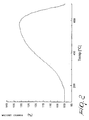
- thermogravimetric curves plotted in figures 1 and 2 show the absorption of NO and NO 2 as a function of the temperature (absorption of mixtures of 2.5% NO and 3% O 2 in helium, with a space velocity of 3000/h and 2.5% NO 2 and 2% O 2 in helium/nitrogen with a space velocity of 3000/h and a heating rate of 20°C/min (percentages expressed by volume)).
- the compounds that have formed begin to decompose, releasing the nitrogen oxides and restoring the Ba 2 Cu 3 O 6 structure of the starting compound.
- Ba 2 Cu 3 O 6 coexists alongside with barium nitrite and nitrate and with copper oxide; the Ba 2 Cu 3 O 6 fraction increases with time and temperature.
- the selectivity of the Ba 2 Cu 3 O 6 with respect to CO 2 depends considerably on the preparation method.
- the compound of the invention considerably increases its resistance to carbonatation if it is prepared starting from barium nitrate and copper oxide intimately mixed in a cationic ratio of 2:3, subsequently heating the mixture to 640°C-650°C in an air stream until the barium nitrate is completely decomposed and then cooling the mixture in air stream at a rate of no more than 20°C/min.
- the air can be replaced with oxygen/nitrogen mixtures or oxygen/inert gas mixtures containing up to 25 g/m 3 of water vapor and up to 400 ppm of CO 2 .
- the carbonatation curve of the compound supported on alumina is similar to the curve of the above mentioned compound.
- the preparation is made by immersing porous aluminum oxide, dehydrated beforehand, in a near-saturated solution of barium nitrate and copper nitrate in deionized water, using a barium ion/copper ion ratio of 2:3 and working at temperatures between 20°C and 80°C.
- the material, impregnated with the solution, is dried at 110°C-150°C and then subjected to the above described heat treatment (reaction at 640°C-650°C and then cooling at a rate of no more than 20°C/min).
- the procedure can be repeated in order to increase the filling of the pores of the aluminum oxide until saturation is reached.
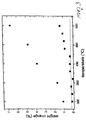
- the curve of figure 3 shows that the compound Ba 2 Cu 3 O 6 prepared as mentioned above is not sensitive to carbonatation up to approximately 420°C (less than 0.4% increase in weight after 5h of exposure). The increase is less than 2% at 500°C, again after 5h of exposure.
- Table 1 reports the weight increases by isothermal treatments in NO 1% by volume, 99% N 2 of Ba 2 Cu 3 O 6 , in comparison with the "compound" Ba 2 CuO 2.5 prepared according to the methods described in literature.
- "BaCuO 2.5 300°C 400°C 500°C 12 hours 17.4% 17.1% 7.9% 36 hours 17.3% 17.4% 11.5% 60 hours 17.5% 17.4% 12.9% Ba 2 Cu 3 O 6 300°C 400°C 500°C 12 hours 17.8% 16.5% 11.7% 36 hours 19.5% 19.8% 19.3% 60 hours 21.7% 21.5% 18.2%
- the table shows that the compounds BaCuO 2.5 ceases to absorb after approximately 12h at temperatures between 300°C and 400°C, whilst absorption continues at 500°C. Absorption at 500°C is slightly more than half the absorption of Ba 2 Cu 3 O 6 , which instead continues to absorb for prolonged periods at all temperatures from 300°C to 500°C.
- the Raman spectrum of the carbonatation-resistant compound Ba 2 Cu 3 O 6 (prepared as herein before indicated) shown in figure 4 shows that the maximum intesity peak in the wave number range from 0 to 800 cm -1 appears at wave number of 598 ⁇ 5 cm -1 , and that at wave number 633 ⁇ 3 cm -1 there is a mode whose intensity is between 0% and 30% of the intensity of the mode that appears at 598 ⁇ 5 cm -1 , or that said mode is absent.
- the Raman spectra were recorded with a Dilor LabRam apparatus, using a laser beam at 632.8 nm with an intensity of 1 mW, focused on sample portions measuring 1 micron in diameter.
- the powder X-ray diffraction measurements were made using a Philips X-pert diffractometer constituted by a PW1830/40 generator, PW3719 goniometer and PW3710 control unit using Cu K ⁇ radiation.
- the compound used in the absorption method of the invention is supported on porous carriers having surface area higher than 50m 2 /g preferably higher than 100 m 2 /g and more preferably comprised in the range of 150-500 m2/g, which are inert towards the reactants used for preparing the compound.
- Examples of said carriers are alumina, titania, zirconia boron nitride, silicon carbide.
- the compound according to the invention is applied particularly in the absorption of NO x oxides from the exhaust gas of internal-combustion engines.
- the compound is used in mufflers preferably placed in a portion of exhaust pipe which is at a temperature between approximately 200°C and 500°C when the motor is running cold and at temperatures above approximately 550°C when the motor is running steady.
- Another application of interest of the compound relates to the absorption of nitrogen dioxide (NO 2 ) from the fumes of plants such as those for nitric acid and for preparing silicon.
- NO 2 nitrogen dioxide
- the compound once converted into Ba nitrites and nitrates can be restored to the initial fully active form by heating.
- Porous alumina was impregnated in a solution of Ba(NO 3 ) 2 and Cu(NO 3 ) 2 in a cationic ratio of 2:3, dried at 150°C and then treated at 650°C until full nitrate decomposition was achieved.
- the resulting product was quickly cooled to ambient temperature and was found to be constituted by 3.5% by weight of the compound Ba 2 Cu 3 O 5+d .
- Part of this material was exposed for 1 hour to a stream of gas composed of 90% synthetic air, 2% H 2 O and 8% NO 2 . Under these conditions, approximately 50% of the compound Ba 2 Cu 3 O 6 decomposed to barium nitrate and copper nitrate.
- the material was then heated in air at 250°C to convert the copper nitrate into copper oxide.
- the treatment with oxygen can be omitted when the material is used in the oxidation reaction at 250°C or higher temperatures.
- the activity of the compounds Ba 2 Cu 3 O 5+d can be significantly increased by promoting it with oxides selected from cerium oxide, zirconium oxide and the oxides of rare earth metals particularly lanthanium and cerium.
- the amount of the promoter generally is up to 10% by weight expressed as metal.
Landscapes
- Chemical & Material Sciences (AREA)
- Analytical Chemistry (AREA)
- Organic Chemistry (AREA)
- Chemical Kinetics & Catalysis (AREA)
- Inorganic Chemistry (AREA)
- Physics & Mathematics (AREA)
- Thermal Sciences (AREA)
- Catalysts (AREA)
- Solid-Sorbent Or Filter-Aiding Compositions (AREA)
- Treating Waste Gases (AREA)
- Exhaust Gas Treatment By Means Of Catalyst (AREA)
Claims (16)
- Verfahren zur Herstellung der Verbindung Ba2Cu3O6, umfassend das Erhitzen einer Mischung aus Bariumnitrat und Kupferoxyd in einem kationischen Verhältnis von 2:3 bei einer Temperatur von 640°-650°C in einem Luftstrom oder in Sauerstoff-/Stickstoffmischungen, die bis zu 25 g/m3 Wasserdampf und bis zu 400 ppm CO2 enthalten, bis das Bariumnitrat vollständig zersetzt ist und dann das Abkühlen der Reaktionsmischung in dem Luftstrom oder in den Sauerstoff-/Stickstoffmischungen enthaltend bis zu 25 g/m3 Wasserdampf und bis zu 400 ppm CO2 bei einer Geschwindigkeit von nicht mehr als 20°C/min, wobei die Verbindung einen Peak der maximalen Intensität in einem Ramanspektrum im Wellenzahlenbereich von 0 bis 800 cm-1 bei einer Wellenzahl von 598 ± 5 cm-1 aufweist, und wobei bei der Wellenzahl 633 ± 3 cm-1 eine Schwingungsmode auftritt, deren Intensität 30 % unter der Intensität der Schwingungsmode bei 598 ± 5 cm-1 oder weniger beträgt, oder diese Schwingungsmode nicht auftritt, wobei in dem Ramanspektrum bei einer Wellenzahl von 560 ± 5 cm-1 eine Schwingungsmode auftritt, deren. Intensität 30 % unter der Intensität der Schwingungsmode bei 598 ± 5 cm-1 liegt, wobei das Ramanspektrum ein symmetrisches Band umfasst, das bei einer Wellenzahl von 520 ± 7 cm-1 zentriert ist und eine Intensität zwischen 20 % und 40 % der Intensität der Schwingungsmode bei 598 ± 5 cm-1 aufweist.
- Verfahren gemäß Anspruch 1, wobei der Reaktionsatmosphäre und/oder der Kühlatmosphäre Stickstoffoxide zugesetzt werden.
- Verbindung Ba2Cu3O6, erhältlich durch ein Verfahren gemäß den Ansprüchen 1 oder 2, mit einem Ramanspektrum, das einen Peak der maximalen Intensität im Bereich der Wellenzahlen von 0 bis 800 cm-1 bei einer Wellenzahl von 598 ± 5 cm-1 aufweist, und in dem bei der Wellenzahl 633 ± 3 cm-1 eine Schwingungsmode auftritt, deren Intensität 30 % unter der Intensität der Schwingungsmode bei 598 ± 5 cm-1 oder darunter liegt, oder wobei diese Schwingungsmode nicht vorliegt, wobei in dem Ramanspektrum bei einer Wellenzahl von 560 ± 5 cm-1 eine Schwingungsmode vorliegt, deren Intensität 30 % unter der Intensität bei 598 ± 5 cm-1 liegt, und wobei das Ramanspektrum ein symmetrisches Band umfasst, das bei der Wellenzahl 520 ± 7 cm-1 sein Zentrum hat und eine Intensität von zwischen 20 % und 40 % der Intensität der Schwingungsmode bei 598 ± 5 cm-1 aufweist.
- Verbindung gemäß Anspruch 3, auf inerten porösen Trägern mit einer Oberfläche von mehr als 50 m2/g.
- Verbindung gemäß den Ansprüchen 3 oder 4, enthaltend einen Promotor, ausgewählt aus der Gruppe, die aus Ceroxid, Zirconiumoxid und Oxiden der Seltenerdmetalle besteht.
- Verbindung Ba2Cu3O6 gemäß den Ansprüchen 3 bis 5, gekennzeichnet durch Resistenz gegenüber einer Karbonisation in einem Strom aus 10 % CO2, 10 % H2O, wobei der Rest eine Mischung aus Stickstoff und Argon ist, gemessen durch eine Gewichtszunahme der Verbindung von weniger als 0,4 % bei 420°C nach fünf Stunden Exposition und weniger als 2 % bei 500°C ebenfalls nach fünf Stunden Exposition.
- Verfahren zur selektiven Absorption von Stickstoffoxiden NOx aus Gasmischungen, die Kohlendioxid oder Kohlendioxid und Wasser enthaltend, umfassend das in Kontakt bringen gemäß einem der Ansprüche 3 bis 6 von gasförmigen Mischungen mit einer Verbindung Ba2Cu3O6.
- Verfahren gemäß Anspruch 7, wobei die Absorption in Gegenwart von Sauerstoff durchgeführt wird.
- Verfahren gemäß Anspruch 7 bis 8, wobei der Absorption bei Temperaturen zwischen 180 und 480°C durchgeführt wird.
- Verfahren gemäß den Ansprüchen 7 bis 9, wobei die Stickstoffoxide aus Gasmischungen absorbiert werden, die aus dem Abgas von Verbrennungsmotoren stammen.
- Verfahren gemäß Anspruch 10, wobei die Verbindung in Auspufftöpfen verwendet wird, die in einem Teil des Abgasstranges lokalisiert sind, der Temperaturen zwischen 200 °C und 550°C aufweist, wenn die Maschine kalt läuft, und in einem Teil, der Temperaturen oberhalb von 550°C erreicht, wenn die Maschine warm läuft.
- Verfahren zur Absorption von NO2 aus den Abgasen von Salpetersäurewerken oder Werken zur Produktion von Silikonen, wobei die Abgase über eine Verbindung gemäß mindestens einem der Ansprüche 3 bis 6 geleitet wird.
- Verfahren gemäß Anspruch 12, wobei die Absorption bei einer Temperatur von 40 bis 180°C durchgeführt wird.
- Verfahren zur Absorption von NOx Stickstoffoxiden aus den Abgasen von Wohnraumheizsystemen oder Kraftwerken, die Treibstoff verbrennen, wobei die Gase über eine Verbindung gemäß mindestens einem der Ansprüche 3 bis 6 geleitet werden.
- Verfahren gemäß mindestens einem der Ansprüche 7 bis 14, dadurch gekennzeichnet, dass die Verbindung NOx Oxiden ausgesetzt worden ist, und zwar bis zu einem Punkt, bei dem noch keine vollständige Zersetzung der Verbindung zu Bariumnitrat und Kupfer(II)oxid erreicht worden ist.
- Verfahren gemäß Anspruch 15, wobei das Aussetzen gegenüber den NOx Oxiden zu dem Zeitpunkt unterbrochen worden ist, zu dem die Zersetzung der Verbindung beginnt.
Applications Claiming Priority (3)
| Application Number | Priority Date | Filing Date | Title |
|---|---|---|---|
| ITBO970453 | 1997-07-23 | ||
| IT97BO000453A IT1293266B1 (it) | 1997-07-23 | 1997-07-23 | Procedimento per l'assorbimento selettivo di ossidi di azoto. |
| PCT/EP1998/004432 WO1999004881A1 (en) | 1997-07-23 | 1998-07-16 | Method and compound for the selective adsorption of nitrogen oxides |
Publications (2)
| Publication Number | Publication Date |
|---|---|
| EP1011843A1 EP1011843A1 (de) | 2000-06-28 |
| EP1011843B1 true EP1011843B1 (de) | 2003-12-17 |
Family
ID=11342427
Family Applications (1)
| Application Number | Title | Priority Date | Filing Date |
|---|---|---|---|
| EP98936428A Expired - Lifetime EP1011843B1 (de) | 1997-07-23 | 1998-07-16 | Verfahren und verbindung zur selektiven adsorption von stickoxiden |
Country Status (11)
| Country | Link |
|---|---|
| US (1) | US6379432B1 (de) |
| EP (1) | EP1011843B1 (de) |
| AR (1) | AR009888A1 (de) |
| AU (1) | AU8542698A (de) |
| CA (1) | CA2297973A1 (de) |
| DE (1) | DE69820649T2 (de) |
| DK (1) | DK1011843T3 (de) |
| ES (1) | ES2212324T3 (de) |
| IT (1) | IT1293266B1 (de) |
| PT (1) | PT1011843E (de) |
| WO (1) | WO1999004881A1 (de) |
Families Citing this family (5)
| Publication number | Priority date | Publication date | Assignee | Title |
|---|---|---|---|---|
| IT1304405B1 (it) * | 1998-10-21 | 2001-03-19 | Consiglio Nazionale Ricerche | Processo per l'assorbimento di ossidi di azoto da miscele gassosecontenenti gli stessi. |
| WO2005069767A2 (en) * | 2003-11-26 | 2005-08-04 | Cabot Corporation | Particulate absorbent materials and methods for making same |
| ITMI20042455A1 (it) * | 2004-12-22 | 2005-03-22 | Sued Chemie Mt Srl | Procedimento per la rimozione di ossidi di azoto con materiale absorbente di ossidi stessi |
| EP2473065B1 (de) | 2009-09-02 | 2016-04-13 | OmniActive Health Technologies Ltd. | Xanthophyl zubereitung enthaltend pigmente aus der macula und verfahren zur herstellung |
| CN106198486B (zh) * | 2016-06-29 | 2019-01-01 | 安徽精准产品质量检测有限公司 | 碱液吸收-拉曼光谱法测定空气中氮氧化物含量的方法 |
Family Cites Families (7)
| Publication number | Priority date | Publication date | Assignee | Title |
|---|---|---|---|---|
| JPS5256088A (en) * | 1975-11-01 | 1977-05-09 | Kogyo Kaihatsu Kenkyusho Kk | Removal of nitrogen oxides |
| SU1357053A1 (ru) * | 1986-03-05 | 1987-12-07 | Пермский политехнический институт | Способ адсорбционной очистки газовых смесей от оксида азота (1) |
| IT1246784B (it) * | 1991-04-16 | 1994-11-26 | Getters Spa | Procedimento per assorbire gas residui mediante una lega getter di bario non evaporata. |
| US5238913A (en) | 1992-03-30 | 1993-08-24 | The United States Of America As Represented By The United States Department Of Energy | Superconducting microcircuitry by the microlithgraphic patterning of superconducting compounds and related materials |
| IT1285562B1 (it) | 1996-02-12 | 1998-06-18 | Univ Bologna | Composti ad attivita' di fissaggio di gas |
| EP0968763A4 (de) * | 1997-10-14 | 2002-06-12 | Isuzu Ceramics Res Inst | Katalysator zur reinigung von abgasen |
| US6033461A (en) * | 1998-01-02 | 2000-03-07 | Gas Research Institute | Selective nitrogen oxides adsorption from hot gas mixtures and thermal release by adsorbent |
-
1997
- 1997-07-23 IT IT97BO000453A patent/IT1293266B1/it active IP Right Grant
-
1998
- 1998-07-16 US US09/463,159 patent/US6379432B1/en not_active Expired - Fee Related
- 1998-07-16 AU AU85426/98A patent/AU8542698A/en not_active Abandoned
- 1998-07-16 WO PCT/EP1998/004432 patent/WO1999004881A1/en not_active Ceased
- 1998-07-16 CA CA002297973A patent/CA2297973A1/en not_active Abandoned
- 1998-07-16 ES ES98936428T patent/ES2212324T3/es not_active Expired - Lifetime
- 1998-07-16 PT PT98936428T patent/PT1011843E/pt unknown
- 1998-07-16 EP EP98936428A patent/EP1011843B1/de not_active Expired - Lifetime
- 1998-07-16 DK DK98936428T patent/DK1011843T3/da active
- 1998-07-16 DE DE69820649T patent/DE69820649T2/de not_active Expired - Fee Related
- 1998-07-17 AR ARP980103501A patent/AR009888A1/es unknown
Also Published As
| Publication number | Publication date |
|---|---|
| DE69820649T2 (de) | 2004-11-11 |
| DK1011843T3 (da) | 2004-03-01 |
| ITBO970453A1 (it) | 1999-01-23 |
| PT1011843E (pt) | 2004-04-30 |
| EP1011843A1 (de) | 2000-06-28 |
| IT1293266B1 (it) | 1999-02-16 |
| ITBO970453A0 (it) | 1997-07-23 |
| WO1999004881A1 (en) | 1999-02-04 |
| ES2212324T3 (es) | 2004-07-16 |
| US6379432B1 (en) | 2002-04-30 |
| DE69820649D1 (de) | 2004-01-29 |
| CA2297973A1 (en) | 1999-02-04 |
| AU8542698A (en) | 1999-02-16 |
| AR009888A1 (es) | 2000-05-03 |
Similar Documents
| Publication | Publication Date | Title |
|---|---|---|
| Tejuca et al. | Surface behaviour of reduced LaCoO3 as studied by TPD of CO, CO2 and H2 probes and by XPS | |
| Kim et al. | Base catalysis by intrazeolitic cesium oxides | |
| JP4567120B2 (ja) | 酸化窒素−蓄積物質及びそれから製造される酸化窒素−蓄積触媒 | |
| Lv et al. | Promoting effect of zirconium doping on Mn/ZSM-5 for the selective catalytic reduction of NO with NH3 | |
| EP0671208B1 (de) | Adsorptionsmaterial für stickstoffoxyden und katalysator zur regelung der abgasemission | |
| Huang et al. | TPD, TPR and DRIFTS studies of adsorption and reduction of NO on La2O3 dispersed on Al2O3 | |
| US5795553A (en) | Nitrogen oxide adsorbing material | |
| Yamamoto et al. | Generation of acid sites on silica-supported rare earth oxide catalysts: Structural characterization and catalysis for α-pinene isomerization | |
| JP4927862B2 (ja) | 水素による窒素酸化物の選択的触媒還元 | |
| Wen et al. | Function of Pd0n clusters, Pd2+ (oxo-) ions, and PdO clusters in the catalytic reduction of NO with methane over Pd/MFI catalysts | |
| EP1011843B1 (de) | Verfahren und verbindung zur selektiven adsorption von stickoxiden | |
| Kang et al. | Inhibition of CO oxidation over Cu-Mn-Ce-O composite catalyst in the presence of dry powder fire extinguishing agent: Mechanism investigation and mitigation strategy | |
| EP0801972A1 (de) | Katalysator zur Regelung der Abgasemission | |
| Takita et al. | The effects of water coadsorption on the adsorption of oxygen over metal oxides: I. Temperature-programmed desorption study of Co3O4 | |
| Zeng et al. | Monoclinic ZrO2 and its supported materials Co/Ni/ZrO2 for N2O decomposition | |
| Hernández-Huesca et al. | Selective catalytic reduction of NO by propane on copper containing alumina pillared α-zirconium phosphates | |
| Horiuchi et al. | Selective catalytic reduction of NO by C3H6 over Co/Al2O3 catalyst with extremely low cobalt loading | |
| Takasu et al. | The catalytic contribution of the lattice oxygen atoms of praseodymium oxide to the oxidation of carbon monoxide | |
| Eguchi et al. | Selective removal of NO by absorption in mixed oxide catalysts | |
| Eguchi et al. | Removal of Dilute Nitrogen Oxide by the Absorption in Mn-Zr Oxide. | |
| Ogura et al. | Formation of active sites for reduction of NO2 with methane by solid state exchange of In2O3 into H-zeolites | |
| Iwakuni et al. | Direct decomposition of NO into N2 and O2 on SrFe0. 7Mg0. 3O3 perovskite oxide | |
| Xiaoyuan et al. | Effect of pretreatment atmosphere on CuO/TiO2 activities in NO+ CO reaction | |
| EP1123151B1 (de) | Verfahren zum absorbieren von stickstoffoxiden aus gasen | |
| Nagamoto et al. | Methane oxidation over strontium cerium oxide (SrCeO3) catalysts: effect of solid-state reaction temperature |
Legal Events
| Date | Code | Title | Description |
|---|---|---|---|
| PUAI | Public reference made under article 153(3) epc to a published international application that has entered the european phase |
Free format text: ORIGINAL CODE: 0009012 |
|
| 17P | Request for examination filed |
Effective date: 20000207 |
|
| AK | Designated contracting states |
Kind code of ref document: A1 Designated state(s): AT BE CH CY DE DK ES FI FR GB GR IE IT LI LU MC NL PT SE |
|
| 17Q | First examination report despatched |
Effective date: 20010530 |
|
| GRAH | Despatch of communication of intention to grant a patent |
Free format text: ORIGINAL CODE: EPIDOS IGRA |
|
| RBV | Designated contracting states (corrected) |
Designated state(s): BE DE DK ES FR GB GR IE IT NL PT SE |
|
| GRAS | Grant fee paid |
Free format text: ORIGINAL CODE: EPIDOSNIGR3 |
|
| GRAA | (expected) grant |
Free format text: ORIGINAL CODE: 0009210 |
|
| AK | Designated contracting states |
Kind code of ref document: B1 Designated state(s): BE DE DK ES FR GB GR IE IT NL PT SE |
|
| REG | Reference to a national code |
Ref country code: GB Ref legal event code: FG4D |
|
| REG | Reference to a national code |
Ref country code: IE Ref legal event code: FG4D |
|
| REF | Corresponds to: |
Ref document number: 69820649 Country of ref document: DE Date of ref document: 20040129 Kind code of ref document: P |
|
| REG | Reference to a national code |
Ref country code: DK Ref legal event code: T3 |
|
| REG | Reference to a national code |
Ref country code: GR Ref legal event code: EP Ref document number: 20040400519 Country of ref document: GR |
|
| REG | Reference to a national code |
Ref country code: SE Ref legal event code: TRGR |
|
| REG | Reference to a national code |
Ref country code: PT Ref legal event code: SC4A Free format text: AVAILABILITY OF NATIONAL TRANSLATION Effective date: 20040310 |
|
| ET | Fr: translation filed | ||
| REG | Reference to a national code |
Ref country code: ES Ref legal event code: FG2A Ref document number: 2212324 Country of ref document: ES Kind code of ref document: T3 |
|
| PLBE | No opposition filed within time limit |
Free format text: ORIGINAL CODE: 0009261 |
|
| STAA | Information on the status of an ep patent application or granted ep patent |
Free format text: STATUS: NO OPPOSITION FILED WITHIN TIME LIMIT |
|
| 26N | No opposition filed |
Effective date: 20040920 |
|
| PGFP | Annual fee paid to national office [announced via postgrant information from national office to epo] |
Ref country code: IE Payment date: 20060706 Year of fee payment: 9 |
|
| PGFP | Annual fee paid to national office [announced via postgrant information from national office to epo] |
Ref country code: GR Payment date: 20060707 Year of fee payment: 9 |
|
| PGFP | Annual fee paid to national office [announced via postgrant information from national office to epo] |
Ref country code: BE Payment date: 20060710 Year of fee payment: 9 |
|
| PGFP | Annual fee paid to national office [announced via postgrant information from national office to epo] |
Ref country code: FR Payment date: 20060712 Year of fee payment: 9 |
|
| PGFP | Annual fee paid to national office [announced via postgrant information from national office to epo] |
Ref country code: PT Payment date: 20060713 Year of fee payment: 9 |
|
| PGFP | Annual fee paid to national office [announced via postgrant information from national office to epo] |
Ref country code: ES Payment date: 20060717 Year of fee payment: 9 |
|
| PGFP | Annual fee paid to national office [announced via postgrant information from national office to epo] |
Ref country code: GB Payment date: 20060721 Year of fee payment: 9 |
|
| PGFP | Annual fee paid to national office [announced via postgrant information from national office to epo] |
Ref country code: NL Payment date: 20060731 Year of fee payment: 9 Ref country code: IT Payment date: 20060731 Year of fee payment: 9 |
|
| PGFP | Annual fee paid to national office [announced via postgrant information from national office to epo] |
Ref country code: DE Payment date: 20060928 Year of fee payment: 9 |
|
| REG | Reference to a national code |
Ref country code: PT Ref legal event code: MM4A Free format text: LAPSE DUE TO NON-PAYMENT OF FEES Effective date: 20080116 |
|
| BERE | Be: lapsed |
Owner name: *UNIVERSITA' DEGLI STUDI DI BOLOGNA Effective date: 20070731 Owner name: *CONSIGLIO NAZIONALE DELLE RICERCHE Effective date: 20070731 |
|
| PGFP | Annual fee paid to national office [announced via postgrant information from national office to epo] |
Ref country code: SE Payment date: 20060710 Year of fee payment: 9 |
|
| EUG | Se: european patent has lapsed | ||
| REG | Reference to a national code |
Ref country code: DK Ref legal event code: EBP |
|
| GBPC | Gb: european patent ceased through non-payment of renewal fee |
Effective date: 20070716 |
|
| NLV4 | Nl: lapsed or anulled due to non-payment of the annual fee |
Effective date: 20080201 |
|
| PG25 | Lapsed in a contracting state [announced via postgrant information from national office to epo] |
Ref country code: SE Free format text: LAPSE BECAUSE OF NON-PAYMENT OF DUE FEES Effective date: 20070717 Ref country code: NL Free format text: LAPSE BECAUSE OF NON-PAYMENT OF DUE FEES Effective date: 20080201 Ref country code: DE Free format text: LAPSE BECAUSE OF NON-PAYMENT OF DUE FEES Effective date: 20080201 |
|
| PGFP | Annual fee paid to national office [announced via postgrant information from national office to epo] |
Ref country code: DK Payment date: 20060717 Year of fee payment: 9 |
|
| REG | Reference to a national code |
Ref country code: IE Ref legal event code: MM4A |
|
| PG25 | Lapsed in a contracting state [announced via postgrant information from national office to epo] |
Ref country code: PT Free format text: LAPSE BECAUSE OF NON-PAYMENT OF DUE FEES Effective date: 20080116 Ref country code: GB Free format text: LAPSE BECAUSE OF NON-PAYMENT OF DUE FEES Effective date: 20070716 |
|
| REG | Reference to a national code |
Ref country code: FR Ref legal event code: ST Effective date: 20080331 |
|
| PG25 | Lapsed in a contracting state [announced via postgrant information from national office to epo] |
Ref country code: DK Free format text: LAPSE BECAUSE OF NON-PAYMENT OF DUE FEES Effective date: 20070731 |
|
| PG25 | Lapsed in a contracting state [announced via postgrant information from national office to epo] |
Ref country code: BE Free format text: LAPSE BECAUSE OF NON-PAYMENT OF DUE FEES Effective date: 20070731 |
|
| PG25 | Lapsed in a contracting state [announced via postgrant information from national office to epo] |
Ref country code: FR Free format text: LAPSE BECAUSE OF NON-PAYMENT OF DUE FEES Effective date: 20070731 |
|
| REG | Reference to a national code |
Ref country code: ES Ref legal event code: FD2A Effective date: 20070717 |
|
| PG25 | Lapsed in a contracting state [announced via postgrant information from national office to epo] |
Ref country code: IE Free format text: LAPSE BECAUSE OF NON-PAYMENT OF DUE FEES Effective date: 20070716 |
|
| PG25 | Lapsed in a contracting state [announced via postgrant information from national office to epo] |
Ref country code: GR Free format text: LAPSE BECAUSE OF NON-PAYMENT OF DUE FEES Effective date: 20080206 Ref country code: ES Free format text: LAPSE BECAUSE OF NON-PAYMENT OF DUE FEES Effective date: 20070717 |
|
| PG25 | Lapsed in a contracting state [announced via postgrant information from national office to epo] |
Ref country code: IT Free format text: LAPSE BECAUSE OF NON-PAYMENT OF DUE FEES Effective date: 20070716 |