EP1013219B1 - Dispositif et procédure de mesure de l'information du corps vivant et de la graisse corporelle et un support d'enregistrement de programme - Google Patents
Dispositif et procédure de mesure de l'information du corps vivant et de la graisse corporelle et un support d'enregistrement de programme Download PDFInfo
- Publication number
- EP1013219B1 EP1013219B1 EP99125837A EP99125837A EP1013219B1 EP 1013219 B1 EP1013219 B1 EP 1013219B1 EP 99125837 A EP99125837 A EP 99125837A EP 99125837 A EP99125837 A EP 99125837A EP 1013219 B1 EP1013219 B1 EP 1013219B1
- Authority
- EP
- European Patent Office
- Prior art keywords
- light
- light receiving
- living body
- light emitting
- subject
- Prior art date
- Legal status (The legal status is an assumption and is not a legal conclusion. Google has not performed a legal analysis and makes no representation as to the accuracy of the status listed.)
- Expired - Lifetime
Links
Images















Classifications
-
- A—HUMAN NECESSITIES
- A61—MEDICAL OR VETERINARY SCIENCE; HYGIENE
- A61B—DIAGNOSIS; SURGERY; IDENTIFICATION
- A61B5/00—Measuring for diagnostic purposes; Identification of persons
- A61B5/145—Measuring characteristics of blood in vivo, e.g. gas concentration or pH-value ; Measuring characteristics of body fluids or tissues, e.g. interstitial fluid or cerebral tissue
- A61B5/1455—Measuring characteristics of blood in vivo, e.g. gas concentration or pH-value ; Measuring characteristics of body fluids or tissues, e.g. interstitial fluid or cerebral tissue using optical sensors, e.g. spectral photometrical oximeters
-
- A—HUMAN NECESSITIES
- A61—MEDICAL OR VETERINARY SCIENCE; HYGIENE
- A61B—DIAGNOSIS; SURGERY; IDENTIFICATION
- A61B5/00—Measuring for diagnostic purposes; Identification of persons
- A61B5/0059—Measuring for diagnostic purposes; Identification of persons using light, e.g. diagnosis by transillumination, diascopy, fluorescence
-
- A—HUMAN NECESSITIES
- A61—MEDICAL OR VETERINARY SCIENCE; HYGIENE
- A61B—DIAGNOSIS; SURGERY; IDENTIFICATION
- A61B5/00—Measuring for diagnostic purposes; Identification of persons
- A61B5/103—Measuring devices for testing the shape, pattern, colour, size or movement of the body or parts thereof, for diagnostic purposes
- A61B5/107—Measuring physical dimensions, e.g. size of the entire body or parts thereof
- A61B5/1075—Measuring physical dimensions, e.g. size of the entire body or parts thereof for measuring dimensions by non-invasive methods, e.g. for determining thickness of tissue layer
-
- A—HUMAN NECESSITIES
- A61—MEDICAL OR VETERINARY SCIENCE; HYGIENE
- A61B—DIAGNOSIS; SURGERY; IDENTIFICATION
- A61B5/00—Measuring for diagnostic purposes; Identification of persons
- A61B5/145—Measuring characteristics of blood in vivo, e.g. gas concentration or pH-value ; Measuring characteristics of body fluids or tissues, e.g. interstitial fluid or cerebral tissue
- A61B5/14532—Measuring characteristics of blood in vivo, e.g. gas concentration or pH-value ; Measuring characteristics of body fluids or tissues, e.g. interstitial fluid or cerebral tissue for measuring glucose, e.g. by tissue impedance measurement
-
- A—HUMAN NECESSITIES
- A61—MEDICAL OR VETERINARY SCIENCE; HYGIENE
- A61B—DIAGNOSIS; SURGERY; IDENTIFICATION
- A61B5/00—Measuring for diagnostic purposes; Identification of persons
- A61B5/48—Other medical applications
- A61B5/4869—Determining body composition
- A61B5/4872—Body fat
Definitions
- the present invention relates to a living body information measuring apparatus and the like for noninvasively measuring a subject's living body information such as the pulse rate, the blood-sugar level, subject's subcutaneous fat thickness and fat percentage.
- United States Patent No. 4,990,772 proposes a method of measuring a subject's body fat percentage by use of near infrared rays.
- near infrared rays used for ingredient analysis of food and the like are projected to a subject, and a specific wavelength component of the light having intruded into the subject is analyzed.
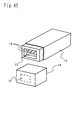
- FIG. 45 shows the structure of a body fat percentage measuring apparatus according to the prior art.
- a pair of light emitting devices 12A and a light receiving device 13A are disposed on one end surface of a body 11A.
- an optical standard plate 15A is disposed so as to be opposed to the light emitting devices 12A and the light receiving device 13A.
- the light emitting devices 12A project near infrared rays to a subject being in intimate contact with the end surface of the body 11A.
- the projected light is reflected after intruding into the subj ect.
- the light receiving device 13A detects the reflected light.
- a microcomputer (not shown) incorporated in the body 11A calculates the subject's body fat percentage based on data on the subject's height and weight and the information on the reflected light detected by the light receiving device 13A.
- the actual measurement first, light projection and reflected light detection are performed with the cap 14A being fitted on the body 11A, and a reference value for the subsequent measurement is obtained. Thereafter, light projection to the subject and reflected light detection are performed.
- the conventional body fat measuring apparatus uses near infrared rays which is largely absorbed by fat component, when the subject persons have different fat quality, the amount of light becomes largely changed, and Then it is difficult to detect accurately the thickness of fat.
- EP 0516251 A2 discloses a method and an apparatus for determining the thickness of a fat layer, where the fat layer is illuminated at different locations. The intensity of the light emerging from the fat layer is measured for an illumination from the different location. From the ratio of the different intensities, the thickness of the fat layer can be derived.
- an apparatus and means for non-invasively measuring the thickness of body fat by using infrared radiation where a pair of infrared-emitting diodes, one emitting a steady, low-intensity light and the other emitting periodic, high-intensity pulses of light, are placed against the skin where the fat thickness is to be measured.
- the low-intensity steady illumination provides a base infrared level in the tissue and reduces the effect of ambient light, while the high intensity pulses refract through the fat, providing an indication of its thickness.
- An array of infrared photo transistors are placed against the skin at predetermined locations near the two diodes, yet shielded from ambient light. The photo transistors provide detection signals proportional to the amount of infrared light detected, which are then summed and amplified, forming a composite signal. The amplitude of this composite signal is indicative of the thickness of the layer of fat and may be displayed and recorded.
- US patent 5,676,143 discloses an apparatus for determining a glucose concentration in a biological matrix.
- This apparatus has an irradiation device for irradiating light as primary light into a biological matrix and detection device for measuring the intensity of light emerging as secondary light through the boundary surface of the biological matrix.
- the primary light 15 is irradiated into the matrix 10 through an irradiation field 12a and the secondary light 17 is detected emerging from two detection fields 14a and 14b running at different measurement distances D1 and D2 from the irradiation field 12a.
- the detection device generates separate measurement signals for each of the at least two detection measurements.
- a plurality of light-emitting portions is realized by a row 35 of optical fibers connected to a central unit in which there is a preferably monochromatic light source.
- a common measuring receiver is provided for each row 36 and 39 of optical fibers 29 to define a possible detection site. The optical fibers of these rows are bundled together and guided to a measuring receiver by which the light emerging from these optical fibers is detected.
- the problem underlying the present invention is to provide an apparatus for measuring living body information, in particular, subcutaneous fat thickness and/or fat percentage, quickly and non-invasively in a more accurate manner.
- a living body information measuring method is shown wherein a plurality of paths from a light emitting portion to a light receiving portion are created, and based on a light reception signal, from a path with higher accuracy, of a plurality of light reception signals obtained from the paths, living body information is calculated by a signal processor.
- a living body information measuring apparatus comprising: a light emitting portion for projecting light rays to a subject; a light receiving portion for detecting, of the light rays, a transmitted light ray having.passed through the subject or a reflected light ray; and a signal processor for calculating the subject's living body information by analyzing a light ray detected by the light receiving portion, wherein at least one of the number of light emitting portions and the number of light receiving portions is not less than two, and wherein the signal processor analyzes, of a plurality of light rays detected by the light receiving portion, a light ray with higher accuracy to calculate the subject's living body information.
- a body fat measuring apparatus comprises: a light emitting portion for projecting light rays to a subject's tissue; a light receiving portion for detecting, of the light rays, a transmitted light ray having passed through the subject's tissue and/or a reflected light ray reflected inside the subject's body; and signal processing operation means for calculating the subject's subcutaneous fat thickness and/or body fat percentage by performing an operation by use of a detection result of the light receiving portion, wherein either the number of light emitting portions or the number of light receiving portions is not less than two, and wherein the not less than two light emitting portions or light receiving portions are situated at different distances from corresponding light receiving portion or light emitting means.
- a body fat measuring method comprises the steps of: projecting light rays to the subject by the light emitting portion; detecting a transmitted light ray (and/or a reflected light ray) having arrived by way of the subject's skin or skin and a layer in the vicinity thereof by the first light receiving portion; detecting a transmitted light ray (and/or a reflected light ray)having arrived by way of the subject's skin and subcutaneous fat layer by the second light receiving portion; and calculating the subject's subcutaneous fat thickness or body fat percentage by the signal processing operation means by correcting a detection result of the second light receiving portion by a detection result of the first light receiving portion and performing an operation by use of a result of the correction.
- Another body fat measuring method comprises: a step in which a light ray projected by the first light emitting portion is detected by the light receiving portion as a first transmitted light ray (and/or a reflected light ray)having passed through the subject's skin or skin and a layer in the vicinity thereof; a step in which a light ray projected by the second light emitting portion is detected by the light receiving portion as a second transmitted light ray (and/or a reflected light ray)having passed through the subject's skin and subcutaneous fat layer; and a step in which the subject's subcutaneous fat thickness or body fat percentage is calculated by the signal processing operation means by correcting a detection result obtained by the second light emitting portion and the light receiving portion by a detection result obtained by the first light emitting portion and the light receiving portion and performing an operation by use of a result of the correction.
- the body fat measuring apparatus as described above is provided with a light emitting portion for projecting light rays to the subject, a light receiving portion for detecting, of the light rays, a transmitted light ray having passed through the subject or a reflected light ray, and a signal processor for calculating the subject's living body information by analyzing the light detected by the light receiving portion.
- Two or more light receiving portions or light emitting portions are provided, and the body fat is calculated by use of a measurement value from the light receiving portions. Further, it is desirable to use a light emitting diode with a central wavelength of not more than 650 nm as the light emitting portion.
- a living body information measuring apparatus comprises: a light emitting portion for proj ecting light rays to a subject's tissue; a light receiving portion for detecting, of the light rays, a transmitted light ray having passed through the subject's tissue and/or a reflected light ray reflected inside the subject's body; and signal processing operation means for calculating the subject's living body information by performing an operation by use of a detection result of the light receiving portion, wherein either the number of light emitting portions or the number of light receiving portions is not less than two, wherein the not less than two light emitting portions or light receiving portions are situated at different distances from corresponding light receiving portion or light emitting portions, wherein light sources of the plurality of light emitting portions are the same, or photoelectric conversion devices of the plurality of light receiving portions are the same, and wherein one of outputs of the plurality of light emitting portions or outputs of the plurality of light receiving portions is corrected by another one of the outputs.
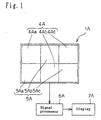
- a plurality of light emitting portions 4Aa to 4Ac and a plurality of light receiving portions 5Aa to 5Ac are alternately disposed so as to be in intimate contact with one another.
- the light emitting portions 4Aa to 4Ac project light rays of a specific wavelength to the subject.
- the light ray projected by the light emitting portion 4Aa is incident on the light receiving portion 5Aa after passing through the subject.
- the light rays projected by the light emitting portions 4Ab and 4Ac are incident on the light receiving portions 5Ab and 5Ac, respectively, after passing through the subject. In that case, the light emission and the light reception are performed at staggered times.
- some contrivance is necessary such as varying the each wavelength among the light rays.
- the light receiving portions 5Aa to 5Ac detect light rays projected by the light emitting portions 4Aa to 4Ac, respectively.
- the light emitting portions and the light receiving portions be placed on the same plane.
- the light rays projected by the light emitting portions are selected based on what is measured by the apparatus. That is, when the body fat percentage is measured, small-size light emitting devices (LEDs) emitting light rays of wavelengths of 930 to 950 nm that are excellently absorbed by body fat are used as the light sources.
- LEDs small-size light emitting devices
- the light receiving portions for example silicon photodiode are used.
- the light receiving portions 5Aa to 5Ac output signals responsive to the intensities of the detected light rays to a signal processor 6A.
- the signal processor 6A performs excellent signal processing as described below.
- noise caused by the blood vessel can be avoided.
- the part of a blood vessel excellently absorbs, of the projected light, a component of a wavelength of 580 nm.
- the light absorption by body fat is at its peak when the wavelength is 930 to 950 nm.
- the light absorption by moisture is at its peak when the wavelength is 970 nm.
- the ratio of intensity of a component, of a wavelength in the vicinity of 580 nm, of the light ray detected by a light receiving portion is lower than that of the light rays detected by the other light receiving portions or that of the projected light rays, the light ray detected by the light receiving portion is considered to have passed through a blood vessel. In the measurement of body fat, normally, such light must be excluded.
- the living body information measuring apparatus of the present invention since a plurality of light rays having traveled along different paths are analyzed, of the light rays detected by the light receiving portions, the light ray considered to have passed through a blood vessel can be excluded so that the light rays detected by the other light receiving portions are analyzed. Consequently, body fat measurement can be performed with high accuracy.
- Light rays having passed through foreign substances adhering to the surface of a living body, tumors, pimples, wounds and the like can be identified and excluded based on a similar principle.
- the living body information measuring apparatus of the present invention which is capable of detecting the subject's blood vessels as described above can be used not only for measuring the body fat but also for analyzing blood ingredients.
- the concentrations of these ingredients in the blood can be measured.
- a light ray of a component of a wavelength of 1600 nm is emitted to perform spectroscopic analysis.
- a light ray of a wavelength of 960 nm is emitted to perform spectroscopic analysis.
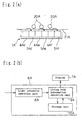
- the signal processor 6A includes a light intensity operation unit 8A, a living body information operation unit 9A and a storage unit 10A as shown in FIG. 2.
- the light intensity operation unit 8A monitors the input signal from the light receiving portion 5A and detects the start and the end of the measurement based on a fluctuation of the input signal. When an abnormal condition such as separation of the sensor device 1A from the subject is encountered during the measurement, the light intensity operation unit 8A detects that. On detecting the start of the measurement, the light intensity operation unit 8A outputs a signal responsive to the intensity of the light detected by the light receiving portion 5A to the living body information operation unit 9A.
- the living body information operation unit 9A calculates living body information such as the body fat percentage based on the input signal. At this time, in the measurement of the body fat percentage, the living body information operation unit 9A identifies the light ray with higher accuracy by comparing a plurality of signals based on light rays having traveled along different paths with one another or comparing the signals with a preset reference value, and analyzes the light ray.
- the signal based on the light ray having passed through a vessel 20A of a subject 21A like the light ray projected from a light emitting portion 4Ae shown in FIG. 1(a) to be incident on a light receiving portion 5Ae is excluded, and living body information is calculated by using only the signals based on the light rays projected from light receiving portions 4Ad and 4Af to the subject 21A to be incident on light receiving portions 5Ad and 5Af, respectively.
- the obtained living body information is stored in the storage unit 10A having a magnetic recording medium, a semiconductor memory or the like.
- the living body information obtained in the above-described manner is displayed on a display 7A such as a liquid crystal display so as to inform the subject, etc.
- a living body information measuring apparatus capable of easily obtaining living body information with high accuracy can be provided.
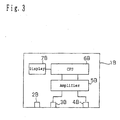
- a light emitting device 2B and light receiving devices 3B and 4B are disposed on one end surface of a body 1B.
- an amplifier 5B, a central processing unit (CPU) 6B and a display 7B are disposed on the body 1B.
- the basic operation of the body fat measuring apparatus of the embodiment having such a structure is as described below.
- the light emitting device 2B projects a visible light ray with a central wavelength of not more than 650 nm to the subject being in intimate contact with the end surface of the body 1B.
- a light emitting diode with a central wavelength of 635 nm for example, FR1111C manufactured by Stanley
- the light receiving devices 3B and 4B for example, silicon photodiodes are used.
- the light receiving device 3B is situated approximately 3 mm away from the light source. While the distance from the light source to the light receiving device 3B is not limited to 3 mm, it is desirable that the light receiving device 3B be situated within 5 mm from the light source.
- the light receiving device 4B is situated approximately 9 mm away from the light source. While the distance from the light source to the light receiving device 4B is not limited to 9 mm like in the case of the light receiving device 3B, it is desirable that the light receiving device 4B be not less than 6 mm away from the light source.
- the light projected from the light emitting device 2B intrudes into the subject, and then, part of the light is scattered and repetitively reflected to exit from the surface of the living body.
- the light receiving devices 3B and 4B detect the reflected light.
- the light detected by the light receiving devices 3B and 4B is amplified by the amplifier 5A, and is corrected by the CPU 6B by dividing the output of the light receiving device 4B by the output of the light receiving device 3B, and is converted into the body fat amount or thickness, which is displayed on the display 7B.
- the present invention applies such a characteristic of light propagation and the operation principle is described referring to FIG. 4 as a schematic figure.
- the principle to be able to detect thickness is presumed by using light propagation route between the light emitting device 21B and the light receiving device 23B.
- the light emitted from the device 21B enters into the surface of skin.
- the living body has light scattering property for near infrared ray or visible ray and then the entered light is scattered at the fat part.
- the light entering the fat part spreads and scatters and a part of the light reaches a muscle part. Since the muscle part has much blood and water and muscular fiber, the Reached light is largely absorbed and scattered at the muscle part.
- the light which does not reach the muscle part, that is, mainly penetrates the fat part is not so attenuated as that in the muscle part.
- the distance between the light source and the first light receiving device closest to the light source is set to 3 mm and the light having propagated through a part close to the surface of the subject is detected, and the distance between the light source and the second light receiving device is set to 9 mm and the light having propagated mainly through a deep part of the living body is detected. Then, the detection value of the second light receiving device is divided by the detection value of the first light receiving device to correct the detection value of the second light receiving device, and the amount of body fat is calculated by use of the correction value, thereby improving the correlation with the true measurement value.
- the light from the device 21B enters into the skin and then is scattered to various directions and a part of these light enters into the receiving device 22B. Since the distance between the Device 21B and 22B strong light can be detected. Almost light which penetrates the skin and reaches the fat is scattered further and spreads. A few of the light can enters into the receiving device 22B but they are very weak in comparison with that of the light propagated near the skin and then almost lights scatter into deeper part and broad wise and do not reach the receiving device 22B.
- the light reached the receiving device 23B is effected by the fat part which is positioned at a deep part of the living body as well as by the skin to the contrary to the light entering the receiving device 22B.
- Both the lights which are entering into the receiving device 22B and the receiving device 23B have almost same skin informations or near skin informations.
- Test data of the present invention which confirms the effect of the body fat measuring apparatus and the body fat measuring method according to the embodiment will be explained.
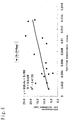
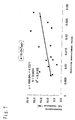
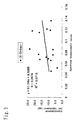
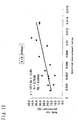
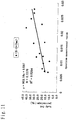
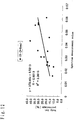
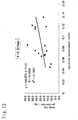
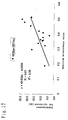
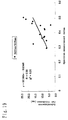
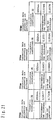
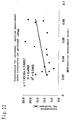
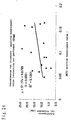
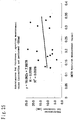
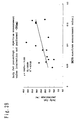
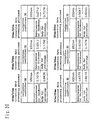
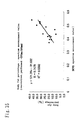
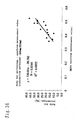
- the inventors measured the body fat percentages and the body fat thicknesses of fifteen subjects whose true body fat percentages and body fat thicknesses were previously known by use of the conventional measuring apparatus and the measuring apparatus of the present invention. Data on the relationship between the true values and the values calculated by the measuring apparatuses are graphed and tabulated as shown in FIGs. 5 to 42.
- the inventors obtained a correlation expression of an equation of first degree representing the true body fat percentages and body fat thicknesses, and the calculated values as accurately as possible by a mathematical method such as the method of least squares, and obtained the correlation coefficients of the equation of first degree.
- FIGs. 5 to 13 show cases of the conventional apparatus where the wavelength used is 950 nm.
- FIGs. 14 to 20 show cases of the present invention where the wavelength used is 950 nm.
- FIGs. 21 to 29 show cases, although not of the conventional apparatus, where processing is performed with one light receiving device and the wavelength used is 650 nm.
- FIGs. 30 to 42 show cases of the present invention where the wavelength used is 650 nm. The body fat thickness and the body fat percentage were measured in all the cases except the cases of the present invention shown in FIGs. 14 to 20.
- the leftmost column in FIG. 5 showing the cases of the conventional apparatus where the wavelength is 950 nm shows a case where the number of light receiving portions is one and the light receiving portion is situated 9 mm away from the light emitting portion.
- the graphs corresponding to the case are shown in FIG. 6 (body fat thickness) and FIG. 10 (body fat percentage).
- the other columns show cases where the distances are 7 mm, 5 mm and 3 mm, and the data are shown in a similar manner to the case of 9 mm.
- the leftmost column of the uppermost table in FIG. 14 showing the cases of the present invention where the wavelength is 950 nm shows a case where the number of light receiving portions is two and the distance from the light emitting portion is 9mm for the farther one and 3 mm for the closer one.
- the graph corresponding to the case is shown in FIG. 15.
- the other columns show cases of 7 mm and 5 mm, 7mm and 3mm, and 5 mm and 3 mm, and the data are shown in a similar manner to the case of 9 mm.
- the correlation coefficients are considerably more excellent than those of the conventional apparatus by correcting the output of the light receiving portion at a longer distance by the output of the light receiving portion at a shorter distance.
- the leftmost column in FIG. 21 showing the cases where the number of light receiving portions is one and the wavelength is 650 nm shows a case where the number of light receiving portions is one and the light receiving portion is situated 9 mm away from the light emitting portion.
- the graphs corresponding to the case are shown in FIG. 22 (body fat thickness) and FIG. 26 (body fat percentage).
- the other columns show cases of the distances of 7 mm, 5 mm and 3mm, and the data are shown in a similar manner to the case of 9 mm.
- the leftmost column of the uppermost table in FIG. 30 showing the cases of the present invention where the wavelength is 650 nm shows a case where the number of light receiving portions is two and the distance from the light emitting portion is 9mm for the farther one and 3 mm for the closer one.
- the graphs corresponding to the case are shown in FIGs. 31 and 37.
- the other columns show cases of 7mm and 5mm, 7mm and 3mm, and 5 mm and 3mm, and the data are displayed in a similar manner to the case of 9 mm.
- the other columns show cases of 7mm and 5 mm, 7 mm and 3 mm, and 5 mm and 3 mm, and the data are displayed in a similar manner to the case of 9mm.
- the correlation coefficients are considerably more excellent than those of the conventional apparatus by correcting the output of the light receiving portion at a longer distance by the output of the light receiving portion at a shorter distance.
- the living body transmittance is inferior, even when a disturbance such as sunlight is present, the 650-nm wavelength of sunlight does not readily intrude into the living body, so that noise is suppressed to be low.
- light of a wavelength shorter than 600 nm cannot be used because a necessary quantity of light can not transmit through the living body.
- a wavelength of approximately 650 nm is most suitable. Therefore, it is desirable to perform the measurement by use of all or some of the wavelength components among 600 nm and 660 nm.
- the correlation is susceptible to improvement even when the light receiving device 4B is situated at a distance of 9 mm or more. However, this is not practical because attenuation of a quantity of the light is large.
- both the body fat percentage and the body fat thickness can be more accurately measured when the distance is not more than 3 mm for the closer light receiving portion and not more than 9 mm for the farther light receiving portion.
- the above means that dividing the detection value obtained by detecting the light having propagated through a deep part of a living body by the detection value of the light having propagated through the surface of the living body produces an effect of correcting an individual difference in the surface configuration of the living body, that is, a difference in skin color.
- the values detected by the two light receiving portions both change in the structure of the present invention although the value significantly deviates when only one light receiving portion is provided. Even if the apparatus is not completely in contact with the living body and the light reception quantity uniformly decreases, since one of the values is divided by the other value to calculate the body fat percentage or the body fat thickness, deviation is suppressed. This fact is can be said to be effective because a practical effect that the measurement accuracy is improved is produced.
- the amount of the penetration of the infrared ray having about 950nm wavelength changes largely at the position of the fat where there is absorbing peak and then the amount is effected from the quality of fat.
- the detected value does not have precision.
- the present invention uses visible wavelength which is hard to be effected with absorbing property of fat, the fat thickness and body fat percentage can be precisely detected.
- the preferable wavelength has such wavelength that is less absorbed by fat and the visible light is preferable, especially the 600nm to 660 nm.
- the present invention has superior detection precision which is less effected from the difference of the quality of fat in the persons.
- the body fat detecting apparatus of this embodiment since the light emitting device 2B and the two light receiving devices 3B and 4B situated at different distances from the light emitting device are provided, individual differences due to differences in skin color among subjects, the scattering coefficient of the fat layer, the condition of contact of the measuring apparatus and the like can be eliminated, so that the subject's body fat percentage or body fat thickness can be excellently measured.
- the correlation function is made in consideration of weight, age, sex, height and so on of the person.
- the portion to be detected can be any portion of the living body.
- arm, belly, shoulder blade are can be portion to be detected.
- one portion of the living body is detected but a plurality of portion of the living body can be detected in order to improve the thickness or percentage.
- the present invention is not limited thereto; two light emitting portions and one light receiving portion may be provided. In this case, the light emitting portions are situated at different distances from the light receiving portion to calculate the body fat amount.
- the light emitting portion of the present invention corresponds to the light emitting device 2B of this embodiment
- the first light receiving portion of the present invention corresponds to the light receiving device 3B of this embodiment
- the second light receiving portion of the present invention corresponds to the light receiving portion 4B of this embodiment
- the signal processing operation means of the present invention corresponds to the CPU 6B of this embodiment.
- the present invention can be said to be very effective because the body fat percentage and the subcutaneous fat thickness can be easily measured with high accuracy since individual variation can be suppressed.
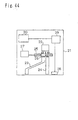
- a first embodiment of the present invention will be described with reference to FIG. 43.
- a body 1 is provided with a light source 2 for emitting light from an end surface of the body 1, and a light receiving portion 3 having a photoelectric conversion device for detecting the quantity of the light emitted from the light source 2 and having passed through the subject.
- a light emitting diode with a central wavelength of 635 nm for example, FR1111C manufactured by Stanley
- FR1111C manufactured by Stanley
- An attenuating filter 5 for attenuating the light emitted from the light source 2 is disposed below the light source 2.
- Reference numeral 4 represents moving means for moving the light source 2 to a position 2', shown by the dotted line in the figure, being farther away from the light receiving portion 3. With this, the distance between the light source 2, 2' and the light receiving portion 3 can be easily changed.
- Reference numeral 6 represents a signal processing circuit for processing a signal from the light receiving portion 3 to calculate living body information.
- Reference numeral 7 represents a display for displaying the values of the living body information.
- the light emitting portion 2 is situated 3 mm away from the light receiving portion 3, and light is projected to the subject from an end surface of the body 1. At this time, it is desirable to attenuate the light quantity by causing the light to pass through the attenuating filter 5.
- the light projected to the subject is propagated through the subject's body while being diffuse-reflected, and part of the light reaches the light receiving portion 3.
- the light quantity value at this time is calculated by the signal processor 6.
- the moving means 4 moves the light emitting portion 2 to the position 2' being approximately 9 mm away from the light receiving portion 3. Since the quantity of the light reaching the light receiving portion 3 decreases because of the increase in the distance from the light receiving portion 3, it is desirable not to provide the attenuating filter at the position 2'. That is, the difference between the light quantity in a case where the light emitted from the light emitting portion 2 reaches the light receiving portion 3 and the light quantity in a case where the light emitted from the position 2' of the light receiving portion reaches the light receiving portion 3 is reduced by the provision of the attenuating filter at the position 2, so that saturation does not occur even when the range associated with the light quantity of the photoelectric conversion device serving as the light receiving device of the light receiving portion 3 is small. Needless to say, a known ratio is used as the attenuation ratio of the attenuating filter.
- the light reception quantities at the two positions are considerably of the same level, so that the range required of the photoelectric conversion device is reduced, which is desirable.
- the examination was also performed for cases where wavelengths among 600 nm and 1100 nm were used as the light emission wavelength of the light emitting portion 2, and a substantially similar tendency was shown.
- the light emitted from the position 2' of the light emitting portion is diffuse-reflected inside the living body to reach the light receiving portion 3.
- the quantity of the light having reached the light receiving portion 3 is calculated by the signal processor 6.
- the light reception quantity when the light emitting portion is at the position 2' is divided by the light reception quantity when the light emitting portion is at the position 2 by the signal processor 6. Using this value, living body information is calculated, and the result is displayed on the display 7. Details thereof are as described above.
- the light emission characteristic of the light emitting portion 2 varies in the stage of manufacture.
- the light emission intensity characteristic changes during use due to the temperature, with time and for other reasons.
- the sensitivity characteristic of the light receiving portion 3 also varies in the stage of manufacture, and it is known that the sensitivity thereof changes with time and the characteristic thereof changes due to the temperature.
- the light emission intensity of the light emitting portion 2 changes by L times and the sensitivity of the light receiving portion 3 changes by M times.
- the light quantity measured when the light emitting portion 2 is set above the attenuating means 5 changes from P3 to P3 ⁇ L ⁇ M, and the light quantity measured when the light emitting portion is moved to the position 2' changes from P4 to P4 ⁇ L ⁇ M.
- the above-mentioned problems can be solved by moving the light emitting portion, measuring the light quantity at each position and dividing one light quantity from the other to obtain living body information.
- the light source is the same, so that the present invention is more tolerant for changes with time at least in that point than apparatuses having two or more light sources.
- the present invention is not limited thereto; the light receiving portion may be moved to measure living body information.
- a body 21 is provided with a light emitting device 22, and light directing means 23 and 24 for directing the light emitted from the light emitting device 22 to an end surface of the body 21.
- the light directing means 23 and 24 correspond to the optical path of the present invention.
- a shutter 25 for selecting light rays to be made incident on the light directing means 23 and 24 from among the light rays emitted from the light source 22 is disposed between the light source 22 and the light directing means 23 and.24.
- the shutter 25 has a hole 26, and can be moved in a horizontal direction by moving means 27.
- the light directing means 23 and 24 for example, a plastic optical fiber or a transparent material such as transparent acrylic resin is used.
- a metal or plastic is used. It is desirable to black the shutter 25 with black anodized aluminum or the like in order that no light is reflected therefrom.
- the shutter 25 and the light directing means 23 and 24 constitute the optical path adjusting means of the present invention.
- Reference numeral 28 represents a light receiving portion having a photoelectric conversion device for detecting the quantity of the light exiting from end surfaces of the light directing means 23 and 24 and passing through the living body while being diffuse-reflected.
- Reference numeral 29 represents a signal processor for processing electric signals from the light receiving portion 28 to calculate living body information values such as the body fat and the blood-sugar level.
- Reference numeral 20 represents a display for displaying the living body information such as the body fat and the blood-sugar level calculated by the signal processor 29.
- the light emitted from the light emitting device 22 is directed only to the light directing means 23 through the hole 26 of the shutter 25, so that the light is projected to the subject from the part being in intimate contact with the end surface of the body 21. At this time, no light is directed to the light directing means 24.
- the light receiving portion 28 is situated, for example, approximately 7 mm away from the light exit end surface of the light directing means 23. By setting the distance between the light receiving portion 28 and the light exit end surface of the light directing means 23 to 7 mm, information on a comparatively deep part of the living body can be measured.
- the light having reached the light receiving portion 28 is converted into an electric signal and sent to the signal processing means 29. Let the measurement value at this time be P3.
- the shutter 25 is moved by the moving means 27 so that the hole 26 is situated above the light directing means 24. Consequently, the light emitted from the light emitting portion 22 is directed only to the light directing means 24. At this time, no light is directed to the light directing means 23.
- the light exit end surface of the light directing means 24 is situated approximately 3 mm away from the light receiving portion 28.
- the projected light intrudes into the subject, and then, part of the light is scattered and repetitively reflected to exit from the surface of the living body. Unlike the light exiting from the end surface of the light directing means 23, much of the light having propagated through the vicinity of the surface of the living body can be detected because the distance from the light receiving portion 28 is a comparatively short distance of 3 mm.
- the light detected by the light receiving portion 28 is also converted into an electric signal and transmitted to the signal processing means 29. Let the measurement value at this time be P4.
- P3 is divided by P4 to obtain P3/P4, and living body information is calculated from this value and displayed on the display 20.
- P3/P4 can be easily measured like the previous embodiment and the influence of the change in the intensity of the light source and the change in the sensitivity of the light receiving portion can be suppressed.
- this embodiment can be said to be extremely effective.
- the present invention is not limited thereto; for example, a structure may be used in which the light emitting portion 22 is disposed in the position of the light receiving portion 28 of the figure and the light receiving portion 28 is disposed in the position of the light emitting portion 22.
- the present invention is not limited thereto; the light emitting portion 22 may be moved to choose between the light directing means 23 and 24.
- Attenuating means at the upper end of the light directing means 24.
- this can be easily realized, for example, by attaching an attenuating film.
- the present invention is also a program recording medium such as a CD-ROM or a DVD being readable by a computer and recording therein a program and/or data for causing a computer to perform all or some of the functions of all or some of the elements of the measuring apparatus of all the above-described implementations of the prevent invention.
- the read program and/or data performs the functions in conjunction with the computer.
- the present invention is also a program recording medium such as a CD-ROM or a DVD being readable by a computer and recording therein a program and/or data for causing a computer to perform all or some of the operations of all or some of the steps of the measuring methods of all the above-described implementations of the present invention.
- the read program and/or data performs the functions in conjunction with the computer.
- a living body information measuring apparatus capable of easily obtaining living body information with high accuracy can be provided.
- the present invention since individual variation among subjects can be suppressed, the body fat percentage and the subcutaneous fat thickness can be easily measured with high accuracy. Thus, the present invention can be said to be very effective.
- the influence of the changes can be suppressed, so that living body information such as the body fat percentage and the subcutaneous fat thickness can be measured with high accuracy.
- the present invention can be said to be extremely effective.
Landscapes
- Health & Medical Sciences (AREA)
- Life Sciences & Earth Sciences (AREA)
- Physics & Mathematics (AREA)
- Surgery (AREA)
- General Health & Medical Sciences (AREA)
- Engineering & Computer Science (AREA)
- Biomedical Technology (AREA)
- Heart & Thoracic Surgery (AREA)
- Medical Informatics (AREA)
- Molecular Biology (AREA)
- Biophysics (AREA)
- Animal Behavior & Ethology (AREA)
- Pathology (AREA)
- Public Health (AREA)
- Veterinary Medicine (AREA)
- Optics & Photonics (AREA)
- Emergency Medicine (AREA)
- Dentistry (AREA)
- Oral & Maxillofacial Surgery (AREA)
- Spectroscopy & Molecular Physics (AREA)
- Measurement Of The Respiration, Hearing Ability, Form, And Blood Characteristics Of Living Organisms (AREA)
- Investigating Or Analysing Materials By Optical Means (AREA)
- Measuring Pulse, Heart Rate, Blood Pressure Or Blood Flow (AREA)
Claims (24)
- Un dispositif de mesure de l'information du corps vivant comprenant :caractérisé en ce que les parties réceptrices de lumière partagent un seul dispositif de conversion photoélectrique,une partie émettrice de lumière (4A, 4Aa à 4Af ; 2B; 21B ; 2, 2', 22) pour projeter des rayons de lumière sur le tissu d'un sujet;une partie réceptrice de lumière (5A, 5Aa à 5Af ; 3B, 4B ; 22B, 23B ; 3, 28) pour détecter, parmi les rayons de lumière, un rayon de lumière transmis ayant traversé le tissu du sujet et/ou un rayon de lumière réfléchi à l'intérieur du corps du sujet ; etun moyen d'opération de traitement de signaux (6, 6A, 29) pour calculer l'information du corps vivant du sujet par l'exécution de l'opération en utilisant un résultat de détection des parties réceptrices de lumière (5A, 5Aa à 5Af; 3B, 4B ; 22B, 23B ; 3,28),dans lequel le nombre de parties réceptrices de lumière (5A, 5Aa à 5Af; 3B, 4B ; 22B, 23B ; 3, 28) est au moins de deux,dans lequel les au moins deux parties réceptrices de lumière (5A, 5Aa à 5Af ; 3B, 4B ; 22B, 23B ; 3, 28) sont situées à des distances différentes par rapport à la partie émettrice de lumière correspondante (4A, 4Aa à 4Af ; 2B ; 21B; 2, 2', 22),dans lequel une des sorties délivrées par les parties réceptrices de lumière est corrigée par une autre des sorties,
dans lequel la partie réceptrice de lumière comprend une première partie réceptrice de lumière située à une distance prédéterminé de la partie émettrice de lumière, et une seconde partie réceptrice de lumière située plus loin de la partie émettrice de lumière que la première partie réceptrice de lumière,
que la première partie réceptrice de lumière (3B ; 22B) détecte le rayon de lumière transmis et/ou le rayon de lumière réfléchi arrivé(s) par la voie de la peau du sujet ou par la voie de la peau du sujet et d'une couche qui en est voisine,
que la seconde partie réceptrice de lumière (4B ; 23B) détecte le rayon de lumière transmis et/ou le rayon de lumière réfléchi arrivé(s) par la voie de la peau du sujet et de la couche de graisse sous-cutanée,
dans lequel les première et seconde parties réceptrices de lumière sont réalisées par le fait que le dispositif de conversion photoélectrique est déplacé par le moyen de déplacement. - Le dispositif de mesure de l'information du corps vivant selon la revendication 1, dans lequel l'information du corps vivant est une épaisseur de graisse sous-cutanée et/ou un pourcentage de graisse du corps.
- Le dispositif de mesure de l'information du corps vivant selon la revendication 1 ou 2, dans lequel le moyen d'opération de traitement de signaux calcule l'information du corps vivant du sujet en divisant le résultat de détection de la seconde partie réceptrice de lumière (4B ; 23B) par le résultat de détection de la première partie réceptrice de lumière (3B ; 22B).
- Le dispositif de mesure de l'information du corps vivant selon l'une quelconque des revendications 1 à 3,
dans lequel le moyen d'opération de traitement de signaux (6; 6A; 29) analyse une composante de lumière d'une longueur d'onde de 950 nm essentiellement, et
dans lequel la distance entre la première partie réceptrice de lumière (3B ; 22B) et la seconde partie réceptrice de lumière (4B ; 23B) dépasse 2 mm. - Le dispositif de mesure de l'information du corps vivant selon l'une quelconque des revendications 1 à 4,
dans lequel le moyen d'opération de traitement de signaux (6, 6A, 29) analyse la totalité ou un certain nombre des composantes de la lumière de longueurs d'onde de 600 nm à 660 nm essentiellement, et
dans lequel la distance entre la première partie réceptrice de lumière (3B ; 22B) et la seconde partie réceptrice de lumière (4B ; 23B) est d'au moins 2 mm. - Le dispositif de mesure de l'information du corps vivant selon la revendication 5, dans lequel une longueur d'onde centrale de la lumière projetée depuis la partie émettrice de lumière est de 650 nm.
- Le dispositif de mesure de l'information du corps vivant selon la revendication 1,
dans lequel un moyen d'atténuation est fourni pour atténuer une quantité de lumière produite par, parmi la pluralité de parties émettrices de lumière, une partie émettrice de lumière plus proche de la partie réceptrice de lumière. - Le dispositif de mesure de l'information du corps vivant selon la revendication 7,
dans lequel le moyen d'atténuation a une fonction d'atténuer la quantité de la lumière de 50 % à 5 %. - Le dispositif de mesure de l'information du corps vivant selon la revendication 7,
dans lequel le moyen d'atténuation est fait d'un substrat de résine transparente et d'un élément absorbant qui est fixé sur celui-ci. - Un dispositif de mesure de l'information du corps vivant comprenant :caractérisé en ce que la partie émettrice de lumière comprend :une partie émettrice de lumière (4A, 4Aa à 4Af; 2B ; 21B ; 2, 2', 22) pour projeter des rayons de lumière sur le tissu d'un sujet ;une partie réceptrice de lumière (5A, 5Aa à 5Af ; 3B, 4B ; 22B, 23B ; 3, 28) pour détecter, parmi les rayons de lumière, un rayon de lumière transmis ayant traversé le tissu du sujet et/ou un rayon de lumière réfléchi à l'intérieur du corps du.sujet ; etun moyen d'opération de traitement de signaux (6, 6A, 29) pour calculer l'information du corps vivant du sujet par l'exécution de l'opération en utilisant un résultat de détection des parties réceptrices de lumière (5A, 5Aa à 5Af; 3B, 4B ; 22B, 23B ; 3,28),dans lequel le nombre de parties émettrices de lumière (4A, 4Aa à 4Af ; 2B ; 21B; 2, 2', 22) est au moins de deux,dans lequel les au moins deux parties émettrices de lumière (4A, 4Aa à 4Af ; 2B ; 21B ; 2, 2', 22) sont situées à des.distances différentes par rapport à la partie réceptrice de lumière correspondante (5A, 5Aa à 5Af; 3B, 4B; 22B, 23B; 3, 28)dans lequel les parties émettrices de lumière partagent une seule source de lumière,dans lequel une des sorties délivrées par les parties émettrices de lumière est corrigée par une autre des sorties,dans lequel la partie réceptrice de lumière détecte un rayon de lumière projeté depuis la partie émettrice de lumière comme au moins l'un parmi un premier rayon de lumière transmis et un premier rayon de lumière réfléchi ayant traversé la peau du sujet ou la peau et une couche qui en est voisine et détecte un rayon de lumière projeté depuis la seconde partie émettrice de lumière comme au moins l'un parmi un second rayon de lumière transmis et un second rayon de lumière réfléchi ayant traversé la peau du sujet et une couche de graisse sous-cutanée, etune première partie émettrice de lumière (2) située à une distance prédéterminée de la partie réceptrice de lumière et une seconde partie émettrice de lumière (2') située plus loin de la partie réceptrice de lumière que la première partie émettrice de lumière,
dans lequel les première et seconde parties émettrices de lumière sont réalisées par le fait que la source de lumière est déplacée par le moyen de déplacement. - Le dispositif de mesure de l'information du corps vivant selon la revendication 10, dans lequel l'information du corps vivant est une épaisseur de graisse sous-cutanée et/ou un pourcentage de graisse du corps.
- Le dispositif de mesure de l'information du corps vivant selon la revendication 10 ou 11, dans lequel le moyen d'opération de traitement de signaux calcule l'information du corps vivant en divisant le résultat de détection obtenu par la seconde partie émettrice de lumière et par la partie réceptrice de lumière par le résultat de détection obtenu par la première partie émettrice de lumière et la partie réceptrice de lumière.
- Le dispositif de mesure de l'information du corps vivant selon l'une quelconque des revendications 10 à 12,
dans lequel le moyen d'opération de traitement de signaux (6 ; 6A; 29) analyse une composante de lumière d'une longueur d'onde de 950 nm essentiellement, et
dans lequel la distance entre la première partie émettrice de lumière et la seconde partie émettrice de lumière dépasse 2 mm. - Le dispositif de mesure de l'information du corps vivant selon l'une quelconque des revendications 10 à 13,
dans lequel le moyen d'opération de traitement de signaux (6, 6A, 29) analyse la totalité ou un certain nombre des composantes de la lumière de longueurs d'onde de 600 nm à 660 nm essentiellement, et
dans lequel la distance entre la première partie émettrice de lumière et la seconde partie émettrice de lumière est d'au moins 2 mm. - Le dispositif de mesure de l'information du corps vivant selon la revendication 14, dans lequel une longueur d'onde centrale de la lumière projetée depuis la partie émettrice de lumière est de 650 nm.
- Le dispositif de mesure de l'information du corps vivant selon la revendication 10,
dans lequel un moyen d'atténuation est fourni pour atténuer une quantité de lumière produite par, parmi la pluralité de parties émettrices de lumière, une partie émettrice de lumière plus proche de la partie réceptrice de lumière. - Le dispositif de mesure de l'information du corps vivant selon la revendication 16,
dans lequel le moyen d'atténuation a une fonction d'atténuer la quantité de la lumière de 50 % à 5%. - Le dispositif de mesure de l'information du corps vivant selon la revendication 16,
dans lequel le moyen d'atténuation est fait d'un substrat de résine transparente et d'un élément absorbant qui est fixé sur celui-ci. - Un dispositif de mesure de l'information du corps vivant comprenant :caractérisé en ce que les plusieurs parties émettrices de lumière partagent une seule source de lumière, ou les plusieurs parties réceptrices de lumière partagent un seul dispositif de conversion photoélectrique, etune partie émettrice de lumière (4A, 4Aa à 4Af; 2B ; 21B ; 2, 2', 22) pour projeter des rayons de lumière sur le tissu d'un sujet ;une partie réceptrice de lumière (5A, 5Aa à 5Af ; 3B, 4B ; 22B, 23B ; 3, 28) pour détecter, parmi les rayons de lumière, un rayon de lumière transmis ayant traversé le tissu du sujet et/ou un rayon de lumière réfléchi à l'intérieur du corps du sujet ; etun moyen d'opération de traitement de signaux (6, 6A, 29) pour calculer l'information du corps vivant du sujet par l'exécution de l'opération en utilisant un résultat de détection des parties réceptrices de lumière (5A, 5Aa à 5Af; 3B, 4B ; 22B, 23B ; 3,28),dans lequel le nombre de parties émettrices de lumière (4A, 4Aa à 4Af ; 2B ; 21B; 2, 2', 22) ou le nombre de parties réceptrices de lumière (5A, 5Aa à 5Af ; 3B,4B ; 22B, 23B ; 3, 28) est au moins de deux,dans lequel les au moins deux parties émettrices de lumière (4A, 4Aa à 4Af ; 2B ; 21B ; 2, 2', 22) ou parties réceptrices de lumière (5A, 5Aa-5Af; 3B, 4B; 22B, 23B; 3, 28) sont situées à des distances différentes par rapport à la partie réceptrice de lumière correspondante (5A, 5Aa à 5Af; 3B, 4B; 22B, 23B; 3, 28) ou partie émettrice de lumière correspondante (4A, 4Aa à 4Af ; 2B ; 21B ; 2, 2', 22),
qu'une des sorties de la pluralité de parties émettrices de lumière ou des sorties de la pluralité de parties réceptrices de lumière est corrigée par une autre des sorties,
dans lequel une pluralité de chemins optiques est fournie depuis une seule source de lumière et les plusieurs parties émettrices de lumière sont réalisées par commutation entre les chemins optiques, ou une pluralité de chemins optiques est fournie depuis le dispositif de conversion photoélectrique et les plusieurs parties.réceptrices de lumière sont réalisées par commutation parmi les chemins optiques. - Le dispositif de mesure de l'information du corps vivant selon la revendication 19,
dans lequel la commutation entre les chemins optiques est exécutée par un moyen de réglage de chemin optique comprenant un obturateur mobile placé en face de la source de lumière et ayant un trou et une pluralité d'éléments de chemins optiques obtenus de l'obturateur. - Le dispositif de mesure de l'information du corps vivant selon la revendication 19 ou 20,
dans lequel les chemins optiques sont faits d'une fibre optique ou d'une résine acrylique. - Une procédure de mesure de l'information du corps vivant, ladite procédure comprenant les étapes consistant à :caractérisée en ce que les plusieurs parties réceptrices de lumière partagent un seul dispositif de conversion photoélectrique, etprojeter un rayon de lumière sur un sujet par au moins une partie émettrice de lumière ;détecter un rayon de lumière transmis et/ou un rayon de lumière réfléchi qui est arrivé par la voie de la peau du sujet ou de la peau du sujet et d'une couche voisine de celle-ci, par une première partie réceptrice de lumière ;détecter un rayon de lumière transmis et/ou un rayon de lumière réfléchi arrivé(s) par la voie de la peau du sujet et d'une couche de graisse sous-cutanée, par une seconde partie réceptrice de lumière, dans laquelle la seconde partie réceptrice de lumière est située plus loin de l'au moins une partie émettrice de lumière que la première partie réceptrice de lumière ; etcorriger une des sorties de la pluralité de parties réceptrices de lumière par une autre des sorties,
la procédure comprenant en outre l'étape suivante qui consiste à :déplacer le dispositif de conversion photoélectrique de sorte à réaliser la pluralité de parties réceptrices de lumière. - Une procédure de mesure de l'information du corps vivant, ladite procédure comprenant les étapes consistant à :caractérisée en ce queprojeter un rayon de lumière sur le sujet par une première partie émettrice de lumière ;détecter un rayon de lumière transmis et/ou un rayon de lumière réfléchi arrivé(s) par la voie de la peau du sujet ou d'une couche voisine de celle-ci, par une partie réceptrice de lumière ;projeter un rayon de lumière sur le sujet par une seconde partie émettrice de lumière, dans laquelle la seconde partie émettrice de lumière est située plus loin de la partie réceptrice de lumière que la première partie émettrice de lumière ;détecter un rayon de lumière transmis et/ou un rayon de lumière réfléchi arrivé(s) par la voie de la peau du sujet et d'une couche de graisse sous-cutanée par la partie réceptrice de lumière ; etcorriger une des sorties de la pluralité de parties émettrices de lumière par une autre des sorties ;
les plusieurs parties émettrices de lumière partagent une seule source de lumière, et
la procédure comprend en outre l'étape suivante qui consiste à :déplacer la source de lumière de sorte à réaliser la pluralité de parties émettrices de lumière. - Un support d'enregistrement de programme lisible par un calculateur et qui y enregistre un programme et/ou des données pour faire que ledit calculateur exécute les étapes de la procédure de mesure d'information du corps vivant selon la revendication 22 ou 23.
Applications Claiming Priority (2)
| Application Number | Priority Date | Filing Date | Title |
|---|---|---|---|
| JP36756598 | 1998-12-24 | ||
| JP36756598 | 1998-12-24 |
Publications (2)
| Publication Number | Publication Date |
|---|---|
| EP1013219A1 EP1013219A1 (fr) | 2000-06-28 |
| EP1013219B1 true EP1013219B1 (fr) | 2004-06-30 |
Family
ID=18489631
Family Applications (1)
| Application Number | Title | Priority Date | Filing Date |
|---|---|---|---|
| EP99125837A Expired - Lifetime EP1013219B1 (fr) | 1998-12-24 | 1999-12-23 | Dispositif et procédure de mesure de l'information du corps vivant et de la graisse corporelle et un support d'enregistrement de programme |
Country Status (4)
| Country | Link |
|---|---|
| US (2) | US6584340B1 (fr) |
| EP (1) | EP1013219B1 (fr) |
| JP (1) | JP4701468B2 (fr) |
| DE (1) | DE69918401T2 (fr) |
Families Citing this family (39)
| Publication number | Priority date | Publication date | Assignee | Title |
|---|---|---|---|---|
| US6584340B1 (en) * | 1998-12-24 | 2003-06-24 | Matsushita Electric Industrial Co., Ltd. | Living body information measuring apparatus living body information measuring method body fat measuring apparatus body fat measuring method and program recording medium |
| CN1503644A (zh) * | 2001-11-06 | 2004-06-09 | ���µ�����ҵ��ʽ���� | 有机组织信息的测量装置及有机组织信息的测量方法 |
| JP3931638B2 (ja) | 2001-11-15 | 2007-06-20 | 松下電工株式会社 | 生体成分の定量装置 |
| US7251513B2 (en) | 2002-01-25 | 2007-07-31 | Matsushita Electric Industrial Co., Ltd. | Method of measuring biological information using light and apparatus of measuring biological information using light |
| US8135447B2 (en) * | 2003-10-02 | 2012-03-13 | Panasonic Electric Works Co., Ltd. | Optical biological information measuring apparatus, optical biological information measuring method, biological information decision apparatus, program and recording medium |
| JP4552609B2 (ja) * | 2003-11-14 | 2010-09-29 | パナソニック電工株式会社 | 皮下脂肪厚測定方法、皮下脂肪厚測定装置、プログラム、及び記録媒体 |
| US7720527B2 (en) * | 2003-11-14 | 2010-05-18 | Panasonic Corp. | Subcutaneous fat thickness measuring method, subcutaneous fat thickness measuring apparatus, program and recording medium |
| US7236814B2 (en) * | 2004-08-20 | 2007-06-26 | Matsushita Electric Industrial Co., Ltd. | Optical member for biological information measurement, biological information calculation apparatus, biological information calculation method, computer-executable program, and recording medium |
| KR100612863B1 (ko) * | 2004-10-11 | 2006-08-14 | 삼성전자주식회사 | 체지방 측정 장치 및 방법 |
| WO2006040841A1 (fr) * | 2004-10-15 | 2006-04-20 | Nagasaki Prefectural Government | Instrument de mesure non invasive de la glycemie |
| JP4327738B2 (ja) | 2005-01-18 | 2009-09-09 | 株式会社東芝 | 生体光計測装置及び生体光計測方法 |
| WO2006104534A2 (fr) * | 2005-03-25 | 2006-10-05 | The Motley Fool, Inc. | Systeme, procede et progiciel pour la notation d'objets basee sur le sentiment de l'utilisateur et pour la determination de la competence des moyens de prediction |
| KR100806577B1 (ko) * | 2005-09-07 | 2008-02-28 | 엘지전자 주식회사 | 생체 신호 측정 장치 및 방법 |
| KR100829217B1 (ko) * | 2006-03-27 | 2008-05-14 | 삼성전자주식회사 | 부분 체지방 측정 장치 및 그에 따른 동작 방법 |
| KR101181506B1 (ko) | 2006-04-12 | 2012-09-10 | 삼성전자주식회사 | 부분 체지방 측정 장치 및 그 방법 |
| KR100795921B1 (ko) * | 2006-05-02 | 2008-01-21 | 삼성전자주식회사 | 휴대용 체지방 측정 장치 및 상기 장치에 장착되는 광 센서모듈 |
| KR100792259B1 (ko) * | 2006-05-19 | 2008-01-07 | 삼성전자주식회사 | 휴대용 체지방 측정 장치 및 상기 장치에 장착되는 광센서모듈 |
| KR100827138B1 (ko) | 2006-08-10 | 2008-05-02 | 삼성전자주식회사 | 생체 정보 측정 장치 |
| US20100168551A1 (en) * | 2006-11-14 | 2010-07-01 | Medizinische Universität Graz | Determining a Thickness of a Layer of Fat of an Organism |
| JP5236413B2 (ja) * | 2008-09-29 | 2013-07-17 | パナソニック株式会社 | 皮下脂肪厚測定装置 |
| US10062356B1 (en) | 2008-09-30 | 2018-08-28 | The United States of America as Represented by the Admin of National Aeronautics and Space Administration | Two and three dimensional near infrared subcutaneous structure imager using real time nonlinear video processing |
| JP4715930B2 (ja) * | 2009-02-03 | 2011-07-06 | パナソニック電工株式会社 | 光学式皮下脂肪厚測定装置 |
| JP2010246578A (ja) * | 2009-04-10 | 2010-11-04 | Utsunomiya Univ | 血中コレステロールの検査方法および検査装置 |
| JP5661801B2 (ja) * | 2010-01-06 | 2015-01-28 | ヒルズ・ペット・ニュートリシャン・インコーポレーテッド | 動物において体重状態を管理する方法 |
| JP5589709B2 (ja) * | 2010-09-21 | 2014-09-17 | 富士通株式会社 | 脂肪厚計測装置および脂肪厚算出プログラム |
| EP2692375B1 (fr) * | 2011-03-31 | 2018-05-30 | Nemoto Kyorindo Co., Ltd. | Capteur de détection de fuite et système de perfusion de médicament |
| GB201111138D0 (en) | 2011-06-30 | 2011-08-17 | Leman Micro Devices Uk Ltd | Personal health data collection |
| JP5716589B2 (ja) * | 2011-07-25 | 2015-05-13 | 富士通株式会社 | 生体成分測定装置及び生体成分測定方法 |
| JP5909999B2 (ja) * | 2011-11-02 | 2016-04-27 | セイコーエプソン株式会社 | 脈波信号処理装置及び脈波計測装置 |
| JP6036122B2 (ja) * | 2012-02-02 | 2016-11-30 | セイコーエプソン株式会社 | 脈波測定装置及びプログラム |
| JP5935498B2 (ja) * | 2012-05-15 | 2016-06-15 | ソニー株式会社 | 情報処理装置、情報処理方法、プログラム及び情報処理システム |
| CN105147314A (zh) * | 2015-08-20 | 2015-12-16 | 京东方科技集团股份有限公司 | 一种人体参数检测方法及检测装置 |
| US9964485B2 (en) * | 2015-09-03 | 2018-05-08 | National Cheng Kung University | Optical device and method for determining an optical property of specimen |
| JP6790412B2 (ja) * | 2016-03-28 | 2020-11-25 | 富士ゼロックス株式会社 | 生体情報測定装置 |
| US12089928B2 (en) | 2017-05-18 | 2024-09-17 | Wear2B Ltd. | Device, system and method for non-invasive monitoring of physiological measurements |
| WO2019163198A1 (fr) * | 2018-02-23 | 2019-08-29 | 株式会社村田製作所 | Capteur de signal biologique |
| CN109543541B (zh) * | 2018-10-23 | 2024-03-08 | 合肥的卢深视科技有限公司 | 一种活体检测方法及装置 |
| JP7244351B2 (ja) * | 2019-05-21 | 2023-03-22 | 愛知時計電機株式会社 | 測定装置 |
| DE102020103068A1 (de) | 2020-02-06 | 2021-08-12 | Uwe Falkenburger | Verfahren zur Behandlung eines Körpers eines Lebewesens |
Family Cites Families (21)
| Publication number | Priority date | Publication date | Assignee | Title |
|---|---|---|---|---|
| US4850365A (en) | 1988-03-14 | 1989-07-25 | Futrex, Inc. | Near infrared apparatus and method for determining percent fat in a body |
| JP2648377B2 (ja) | 1988-03-14 | 1997-08-27 | ヒュートレックス インコーポレイテッド | 体脂肪率を測定するための近赤外線定量測定装置 |
| US4928014A (en) | 1988-10-03 | 1990-05-22 | Futrex, Inc. | Near-infrared apparatus and method for determining percent fat in a body |
| US4990772A (en) | 1988-10-03 | 1991-02-05 | Futrex, Inc. | Apparatus and method for calibrating a near-infrared interactance probe |
| JPH02172473A (ja) * | 1988-12-26 | 1990-07-04 | Akai Electric Co Ltd | 静脈探査装置 |
| US5365066A (en) * | 1989-01-19 | 1994-11-15 | Futrex, Inc. | Low cost means for increasing measurement sensitivity in LED/IRED near-infrared instruments |
| CA2009194A1 (fr) | 1989-02-08 | 1990-08-08 | Hideo Kado | Methode de production d'une substance polysaccharidique ron active |
| US5014713A (en) | 1989-12-05 | 1991-05-14 | Tarris Enterprises, Inc. | Method and apparatus for measuring thickness of fat using infrared light |
| JPH04231944A (ja) * | 1990-12-28 | 1992-08-20 | Shimadzu Corp | 皮下脂肪表示計測器 |
| DE4113749A1 (de) | 1991-04-26 | 1992-11-05 | Lba Labor Fuer Bioanalytik Und | Vorrichtung und verfahren zum bestimmen der dicke einer fettschicht |
| EP0527703B1 (fr) | 1991-08-12 | 1995-06-28 | AVL Medical Instruments AG | Dispositif permettant de déterminer la concentration d'au moins un composé gazeux en particulier la teneur en oxygène du sang |
| IL107396A (en) | 1992-11-09 | 1997-02-18 | Boehringer Mannheim Gmbh | Method and apparatus for analytical determination of glucose in a biological matrix |
| US5490506A (en) | 1994-03-28 | 1996-02-13 | Colin Corporation | Peripheral blood flow evaluating apparatus |
| JPH1094523A (ja) * | 1996-09-25 | 1998-04-14 | Matsushita Electric Works Ltd | 体脂肪測定装置 |
| WO1998023916A1 (fr) * | 1996-11-26 | 1998-06-04 | Omron Corporation | Procede et appareil permettant de mesurer la concentration d'une substance absorbant la lumiere dans un tissu vivant et l'epaisseur d'un tissu intercalaire |
| JP3035791B2 (ja) | 1996-11-26 | 2000-04-24 | オムロン株式会社 | 生体組織内の吸光物質濃度および生体の介在組織厚の計測方法ならびに計測装置 |
| SE9701303L (sv) | 1997-04-09 | 1998-10-10 | Haakan Ugnell | Optisk teknik för identifiering av blodkärl på hud eller organ |
| JP3564995B2 (ja) * | 1998-02-26 | 2004-09-15 | オムロンヘルスケア株式会社 | 皮下脂肪厚計測装置 |
| US6662030B2 (en) * | 1998-05-18 | 2003-12-09 | Abbott Laboratories | Non-invasive sensor having controllable temperature feature |
| JP2000155091A (ja) | 1998-11-20 | 2000-06-06 | Omron Corp | 皮下脂肪測定装置、近赤外生体計測装置及び近赤外生体計測方法 |
| US6584340B1 (en) * | 1998-12-24 | 2003-06-24 | Matsushita Electric Industrial Co., Ltd. | Living body information measuring apparatus living body information measuring method body fat measuring apparatus body fat measuring method and program recording medium |
-
1999
- 1999-12-22 US US09/469,219 patent/US6584340B1/en not_active Expired - Fee Related
- 1999-12-22 JP JP36550599A patent/JP4701468B2/ja not_active Expired - Fee Related
- 1999-12-23 EP EP99125837A patent/EP1013219B1/fr not_active Expired - Lifetime
- 1999-12-23 DE DE69918401T patent/DE69918401T2/de not_active Expired - Lifetime
-
2003
- 2003-04-14 US US10/412,680 patent/US6985767B2/en not_active Expired - Fee Related
Also Published As
| Publication number | Publication date |
|---|---|
| DE69918401D1 (de) | 2004-08-05 |
| US6985767B2 (en) | 2006-01-10 |
| JP2000237195A (ja) | 2000-09-05 |
| US20040039287A1 (en) | 2004-02-26 |
| EP1013219A1 (fr) | 2000-06-28 |
| DE69918401T2 (de) | 2005-08-18 |
| US6584340B1 (en) | 2003-06-24 |
| JP4701468B2 (ja) | 2011-06-15 |
Similar Documents
| Publication | Publication Date | Title |
|---|---|---|
| EP1013219B1 (fr) | Dispositif et procédure de mesure de l'information du corps vivant et de la graisse corporelle et un support d'enregistrement de programme | |
| US7315752B2 (en) | Method and device for determining a light transport parameter in a biological matrix | |
| JP3433498B2 (ja) | 散乱吸収体の内部情報計測方法及び装置 | |
| CA2147639C (fr) | Procede et dispositif pour le dosage du glucose dans une matrice biologique | |
| EP0627619B1 (fr) | Procédé et appareil pour mesurer dans un milieu diffusant | |
| US5962852A (en) | Process and device for determining an analyte contained in a scattering matrix | |
| US9265457B2 (en) | Apparatus and method for measuring a tissue analyte such as bilirubin using the Brewster's angle | |
| GB2307295A (en) | Depth selection optical measurement system, particularly for transcutaneous measurement of substances in body tissues or fluid | |
| JPH08322821A (ja) | 光吸収体の光学的測定装置 | |
| US20210196135A1 (en) | Blood vessel detection device and method therefor | |
| EP1136811B1 (fr) | Procede et dispositif permettant d'obtenir une information medicale interne a partir d'un element absorbant la lumiere diffusee | |
| EP3455607B1 (fr) | Capteur de so2 de sang total | |
| JPH11244266A (ja) | 生体表層組織の分析方法及び生体表層組織の分析装置 | |
| US10422745B2 (en) | Scattering absorber measurement device and scattering absorber measurement method | |
| JP2007020735A (ja) | 生体光計測装置 | |
| JP2015125090A (ja) | 散乱吸収体測定装置及び散乱吸収体測定方法 | |
| US20080285029A1 (en) | Calibration Device for a Spectrophotometric System | |
| US12471779B2 (en) | Blood vessel detection device and method therefor | |
| US20260033754A1 (en) | Pulse oximetry by removing the effects of tissue scattering | |
| US20250302287A1 (en) | Device For Estimating Glucose Concentration | |
| US20240315612A1 (en) | Measuring device | |
| JP4077477B2 (ja) | 散乱体の吸収情報計測方法及び装置 | |
| JP2005095193A (ja) | 生体情報測定方法及び測定装置 | |
| US20210196158A1 (en) | Self-reference point setting type blood component measuring method and apparatus | |
| WO2024240916A1 (fr) | Procédé de détermination de concentration d'une substance et dispositif de détection |
Legal Events
| Date | Code | Title | Description |
|---|---|---|---|
| PUAI | Public reference made under article 153(3) epc to a published international application that has entered the european phase |
Free format text: ORIGINAL CODE: 0009012 |
|
| AK | Designated contracting states |
Kind code of ref document: A1 Designated state(s): DE FR GB |
|
| AX | Request for extension of the european patent |
Free format text: AL;LT;LV;MK;RO;SI |
|
| 17P | Request for examination filed |
Effective date: 20000519 |
|
| AKX | Designation fees paid |
Free format text: DE FR GB |
|
| 17Q | First examination report despatched |
Effective date: 20010827 |
|
| GRAP | Despatch of communication of intention to grant a patent |
Free format text: ORIGINAL CODE: EPIDOSNIGR1 |
|
| GRAS | Grant fee paid |
Free format text: ORIGINAL CODE: EPIDOSNIGR3 |
|
| GRAA | (expected) grant |
Free format text: ORIGINAL CODE: 0009210 |
|
| AK | Designated contracting states |
Kind code of ref document: B1 Designated state(s): DE FR GB |
|
| REG | Reference to a national code |
Ref country code: GB Ref legal event code: FG4D |
|
| REF | Corresponds to: |
Ref document number: 69918401 Country of ref document: DE Date of ref document: 20040805 Kind code of ref document: P |
|
| ET | Fr: translation filed | ||
| PLBE | No opposition filed within time limit |
Free format text: ORIGINAL CODE: 0009261 |
|
| STAA | Information on the status of an ep patent application or granted ep patent |
Free format text: STATUS: NO OPPOSITION FILED WITHIN TIME LIMIT |
|
| 26N | No opposition filed |
Effective date: 20050331 |
|
| PGFP | Annual fee paid to national office [announced via postgrant information from national office to epo] |
Ref country code: FR Payment date: 20081212 Year of fee payment: 10 |
|
| PGFP | Annual fee paid to national office [announced via postgrant information from national office to epo] |
Ref country code: GB Payment date: 20081217 Year of fee payment: 10 |
|
| GBPC | Gb: european patent ceased through non-payment of renewal fee |
Effective date: 20091223 |
|
| REG | Reference to a national code |
Ref country code: FR Ref legal event code: ST Effective date: 20100831 |
|
| PG25 | Lapsed in a contracting state [announced via postgrant information from national office to epo] |
Ref country code: FR Free format text: LAPSE BECAUSE OF NON-PAYMENT OF DUE FEES Effective date: 20091231 |
|
| PG25 | Lapsed in a contracting state [announced via postgrant information from national office to epo] |
Ref country code: GB Free format text: LAPSE BECAUSE OF NON-PAYMENT OF DUE FEES Effective date: 20091223 |
|
| PGFP | Annual fee paid to national office [announced via postgrant information from national office to epo] |
Ref country code: DE Payment date: 20121219 Year of fee payment: 14 |
|
| REG | Reference to a national code |
Ref country code: DE Ref legal event code: R119 Ref document number: 69918401 Country of ref document: DE |
|
| REG | Reference to a national code |
Ref country code: DE Ref legal event code: R119 Ref document number: 69918401 Country of ref document: DE Effective date: 20140701 |
|
| PG25 | Lapsed in a contracting state [announced via postgrant information from national office to epo] |
Ref country code: DE Free format text: LAPSE BECAUSE OF NON-PAYMENT OF DUE FEES Effective date: 20140701 |