EP1013263A2 - Kosmetische und dermatologische W/O-Emulsionen mit einem Gehalt an Bornitrid - Google Patents
Kosmetische und dermatologische W/O-Emulsionen mit einem Gehalt an Bornitrid Download PDFInfo
- Publication number
- EP1013263A2 EP1013263A2 EP99124016A EP99124016A EP1013263A2 EP 1013263 A2 EP1013263 A2 EP 1013263A2 EP 99124016 A EP99124016 A EP 99124016A EP 99124016 A EP99124016 A EP 99124016A EP 1013263 A2 EP1013263 A2 EP 1013263A2
- Authority
- EP
- European Patent Office
- Prior art keywords
- bis
- triazine
- acid
- hydroxy
- phenyl
- Prior art date
- Legal status (The legal status is an assumption and is not a legal conclusion. Google has not performed a legal analysis and makes no representation as to the accuracy of the status listed.)
- Granted
Links
Classifications
-
- A—HUMAN NECESSITIES
- A61—MEDICAL OR VETERINARY SCIENCE; HYGIENE
- A61Q—SPECIFIC USE OF COSMETICS OR SIMILAR TOILETRY PREPARATIONS
- A61Q17/00—Barrier preparations; Preparations brought into direct contact with the skin for affording protection against external influences, e.g. sunlight, X-rays or other harmful rays, corrosive materials, bacteria or insect stings
- A61Q17/04—Topical preparations for affording protection against sunlight or other radiation; Topical sun tanning preparations
-
- A—HUMAN NECESSITIES
- A61—MEDICAL OR VETERINARY SCIENCE; HYGIENE
- A61K—PREPARATIONS FOR MEDICAL, DENTAL OR TOILETRY PURPOSES
- A61K8/00—Cosmetics or similar toiletry preparations
- A61K8/18—Cosmetics or similar toiletry preparations characterised by the composition
- A61K8/30—Cosmetics or similar toiletry preparations characterised by the composition containing organic compounds
- A61K8/49—Cosmetics or similar toiletry preparations characterised by the composition containing organic compounds containing heterocyclic compounds
- A61K8/494—Cosmetics or similar toiletry preparations characterised by the composition containing organic compounds containing heterocyclic compounds with more than one nitrogen as the only hetero atom
- A61K8/4966—Triazines or their condensed derivatives
Definitions
- the present invention relates to cosmetic and dermatological W / O emulsions containing boron nitride.
- the present relates Invention an application which allows the stability of W / O emulsions increase.
- Emulsions are generally understood to be heterogeneous systems that do not consist of two or only exist to a limited extent with miscible liquids, which are usually used as Phases.
- One of the two liquids is in shape in an emulsion finest droplets dispersed in the other liquid.
- O / W emulsion oil-in-water emulsion
- the basic character of an O / W emulsion is characterized by the water.
- W / O emulsion water-in-oil emulsion, e.g. butter
- W / O emulsion e.g. butter
- Cosmetic emulsions consist of at least one fat phase (for example natural and mineral oils, fatty alcohols, fatty acid esters etc.) and at least one Water phase (e.g. water, glycerin, sorbitol, glycols, etc.) using emulsifiers be finely divided into one another.
- a surfactant is necessary to achieve permanent dispersion. It forms at the phase boundary Oil / water interface films, causing the irreversible confluence the droplet is counteracted.
- To stabilize emulsions are common also emulsifier mixtures used.
- emulsions are fundamental unstable systems. Nevertheless, cosmetic emulsions with years of stability succeed to manufacture. An instability of the emulsion manifests itself in breaking or creaming the emulsion, d. H. in the formation of two or more layers into which the water and Separate the fat phase, including the emulsifier. An emulsion will then unstable when the finely dispersed particles become larger aggregates again clump together and the touching droplets flow together. This process is also called coalescence. This ultimately leads to a W / O emulsion an aqueous layer deposited on the bottom (sedimentation).
- Simple emulsions can be formulated in a stable manner with modern emulsifiers. However, larger amounts of fats and oils that are difficult to emulsify are solvent-based Active ingredients, pigments or similar insoluble additives part of the emulsion, then stabilizers are almost inevitable. This applies in particular to W / O emulsions.
- Disperse preparations of the type of emulsions play in the most diverse areas the cosmetics industry plays an outstanding role. This is the case, for example for skin care products and dermatics mainly around complex emulsion-like preparations, whose formulation, production and testing require extensive knowledge.
- An object of the present invention was therefore cosmetic or dermatological To provide W / O emulsions that are easy to formulate and have a high stability.
- the skin is the largest human organ. Among its many functions (for example for heat regulation and as a sensory organ) is the barrier function that prevents drying out the skin (and ultimately the entire organism), which probably prevents most important. At the same time, the skin acts as a protective device against penetration and the absorption of substances coming from outside. This barrier function is brought about by the epidermis, which as the outermost layer is the actual protective cover against the Environment forms.
- Cosmetic preparations are mainly used for skin care.
- Skin care In the cosmetic sense it is primarily that the natural function of the skin as a barrier against environmental influences (e.g. dirt, chemicals, microorganisms) and against strengthens the loss of the body's own substances (e.g. water, lipids, electrolytes) or is restored. If this function is disturbed, increased absorption can occur toxic or allergenic substances or to infest microorganisms and as a result toxic or allergic skin reactions.
- the aim of skin care is also to reduce the fat and fat caused by daily washing Compensate for skin water loss. This is especially important when the natural Regeneration capacity is not sufficient.
- skin care products are said to exist Protect environmental influences, especially from the sun and wind, and skin aging delay.
- UV-C radiation with a wavelength that is less than 290 nm has no physiological meaning, cause rays in the range between 290 nm and 320 nm, the so-called UV-B range, an erythema, a simple sunburn or even more or less severe burns.
- UV-A radiation is in terms of triggering photodynamic, especially phototoxic reactions and chronic changes of the skin far more dangerous than UV-B radiation. Even the harmful one Influence of UV-B radiation can be further increased by UV-A radiation.
- UV filter substances are used to protect against UV radiation known, which are mostly polar compounds.
- Cosmetic light stabilizers should be applied to the skin in a thin layer protect against the negative effects of the sun's rays.
- UV filter substances absorb unwanted UV radiation or parts of the UV radiation in the protective layer of sunscreen on the skin.
- W / O emulsions with polar UV filter substances or with polar constituents, which are used to dissolve UV filter substances as a solid should contribute without the addition of titanium dioxide and / or zinc oxide as a stabilizer generally insufficient.
- W / O emulsions that are less than 10% by weight are non-polar
- oils (based on the total weight of the preparations) not stable without the addition of further stabilizers.
- Another object of the present invention was therefore to overcome the disadvantages of To remedy the state of the art and to provide W / O emulsions, which even with a high content of polar components over a long period of time are storable and stable.
- polar oil components are oil components whose Interfacial tension against water (can be determined with a ring tensiometer from Krüss, ring tensiometer K10) is less than 35 mN / m (milli-Newtons per meter).
- oil components are those whose interfacial tension against Water (can be determined with a ring tensiometer from Krüss, ring tensiometer K10) is greater than 35 mN / m.
- the invention Preparations even without the addition of titanium dioxide as a stabilizer in one high content of UV filters (such as symmetrically or asymmetrically substituted Triazine derivatives and / or benzotriazoles) and / or polar oil components and one accordingly low content of non-polar oils excellent stability against decay in oil and water phases.
- UV filters such as symmetrically or asymmetrically substituted Triazine derivatives and / or benzotriazoles
- non-polar oils excellent stability against decay in oil and water phases.
- titanium dioxide-free W / O emulsions according to the invention are less than 5% by weight of non-polar oils (based on the total weight of the preparations), are still stable.
- the use of at least one boron nitride is therefore also in accordance with the invention to achieve or increase the stability of W / O emulsions, in particular for Achieve or increase the stability of W / O emulsions containing polar Oil components and / or UV filters, especially to achieve or increase the Stability of W / O emulsions containing polar oil components and / or UV filters which contain less than 2% by weight of titanium dioxide.
- Boron nitride exists in three natural modifications, namely as graphite analogs hexagonal ⁇ -BN, as diamond-analogous cubic ⁇ -BN (borazone) and as metastable ⁇ -BN (Wurtzit-BN).
- boron nitride can also have an amorphous structure. in the It is essentially irrelevant to the present invention in which of course occurring modifications that Borntrid is present. Amorphous is particularly preferred Boron nitride.
- the boron nitride particles used are smaller than 25 ⁇ m, particularly advantageously smaller than 7 ⁇ m to choose.
- the average particle diameter can be used Boron nitride particles are between 1 and 7 ⁇ m.
- boron nitride types listed below Trade name Available at Boron nitride powder Advanced Ceramics Boron nitride powder Sintec ceramics Ceram Blanche Kawasaki HCST Boron Nitride Strong réelle BN® Carborundum Wacker boron nitride BNP Wacker chemistry
- boron nitride particles which are surface-water-repellent are also advantageous ( are coated "), whereby an amphiphilic character can be formed or retained.
- boron nitride particles consists of dimethylpolysiloxane (also: Dimethicone), a mixture of fully methylated, linear siloxane polymers that are terminal are blocked with trimethylsiloxy units.
- dimethylpolysiloxane also: Dimethicone
- a mixture of fully methylated, linear siloxane polymers that are terminal are blocked with trimethylsiloxy units.
- boron nitride particles with polymethylhydrogensiloxane, a linear polysiloxane, which is also referred to as methicone.
- Boron nitride particles treated with Methicone are, for example, those at the company Carborundum available under the trade name réelle BN® UHP 1107.
- the total amount of one or more boron nitrides in the finished cosmetic or dermatological preparations is advantageously in the range from 0.1 to 20.0 % By weight, preferably 0.5 to 10.0% by weight, based on the total weight of the Preparations.
- R 1 and R 2 can advantageously represent hydrogen atoms, but are also advantageously selected from the group consisting of methyl, ethyl, propyl and isopropyl, myristoyl, palmitoyl, stearoyl, isostearoyl and eicosoyl as well as from the group that is formed by substances of the chemical structures where n takes numbers from 10 to 20, or where m takes numbers from 9 to 19.
- Emulsifiers which monoglycerol esters, Represent diglycerol esters, triglycerol esters or tetraglycerol esters and for example Are monoesters of isostearic acid.
- the tetraglycerol monoisostearate is particularly advantageous, which, analogous to the CTFA nomenclature, also polyglyceryl-4-isostearate is called.
- Such isostearic acid esters are available, for example, under the product name Isolan GI 34 "at Th. Goldschmidt AG.
- Emulsifiers which contain a monoglycerol ester, Represent diglycerol esters, triglycerol esters or tetraglycerol esters and Diesters of isostearic acid, the triglycerol diisostearate being particularly preferred, which is also called polyglyceryl-3-diisostearate in analogy to the CTFA nomenclature.
- Such isostearic acid esters are available, for example, under the product name Lameform TGI "from Henkel KGaA.
- Emulsifiers for which the polyester residues are derived from hydroxystearic acid have also proven to be particularly advantageous, particularly advantageously that Polyglyceryl-2-polyhydroxystearate ", soft under the registration numbers 156531-21-4 and 144470-58-6 in the Chemical Abstracts "and which is available, for example, from Henkel KGaA under the trade name DEHYMULS® PGPH.
- Emulsifiers PEG-30 dipolyhydroxystearate which is available from the company ICI Surfactants is sold under the trademark ARLACEL® P135.
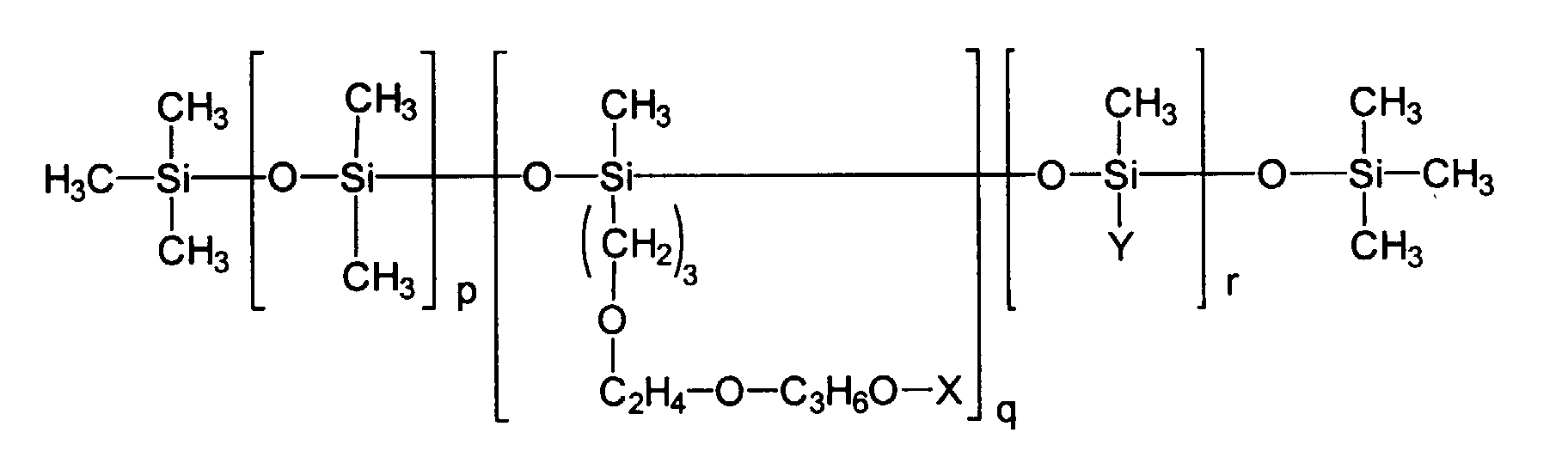
- silicone emulsifiers for example those which are selected from the group of the alkyl methicon copolyols and / or alkyl dimethicone copolyols, in particular from the group of the compounds, which are characterized by the following chemical structure: in which X and Y are selected independently of one another from the group H and the branched and unbranched alkyl groups, acyl groups and alkoxy groups having 1 to 24 carbon atoms, p represents a number from 0 to 200, q represents a number from 1 to 40 and r represents a number from 1 to 100.
- emulsifiers which are particularly advantageous in the sense of the present invention is the cetyl dimethicone copolyol, which is available from Th. Goldschmidt AG under the product name ABIL® EM 90 is sold.
- Emulsifiers is the cyclomethicone dimethicone copolyol, which is available from society Goldschmidt AG is sold under the trademark ABIL® EM 97.
- the emulsifier laurylmethicone copolyol has also proven to be particularly advantageous highlighted, which under the trade name Dow Corning® 5200 Formulation Aid from Dow Corning Ltd. is available.
- the total amount of one or more emulsifiers in the inventive Cosmetic or dermatological preparations are advantageous from the range of 0.1-10.0% by weight, preferably 3.0-8.0% by weight, based on the total weight of the preparations.
- the oil phase of the W / O emulsions according to the invention is advantageously chosen from the Group of polar oils, for example from the group of lecithins and fatty acid triglycerides, namely the triglycerol esters saturated and / or unsaturated, branched and / or unbranched alkane carboxylic acids with a chain length of 8 to 24, in particular 12 to 18 carbon atoms.
- the fatty acid triglycerides can be advantageous, for example can be selected from the group of synthetic, semi-synthetic and natural Oils such as Olive oil, sunflower oil, soybean oil, peanut oil, rapeseed oil, almond oil, palm oil, coconut oil, castor oil, wheat germ oil, grape seed oil, safflower oil, evening primrose oil, macadamia nut oil and the like.
- synthetic, semi-synthetic and natural Oils such as Olive oil, sunflower oil, soybean oil, peanut oil, rapeseed oil, almond oil, palm oil, coconut oil, castor oil, wheat germ oil, grape seed oil, safflower oil, evening primrose oil, macadamia nut oil and the like.
- polar oil components can be used for the purposes of the present invention furthermore selected from the group of the esters from saturated and / or unsaturated, branched and / or unbranched alkane carboxylic acids with a chain length of 3 to 30 C atoms and saturated and / or unsaturated, branched and / or unbranched Alcohols with a chain length of 3 to 30 carbon atoms and from the group of esters aromatic carboxylic acids and saturated and / or unsaturated, branched and / or unbranched alcohols with a chain length of 3 to 30 carbon atoms.
- Ester oils can then advantageously be selected from the group of isopropyl myristate, isopropyl palmitate, Isopropyl stearate, isopropyl oleate, n-butyl stearate, n-hexyl laurate, n-decyl oleate, Isooctyl stearate, isononyl stearate, isononyl isononanoate, 2-ethylhexyl palmitate, 2-ethylhexyl laurate, 2-hexyldecyl stearate, 2-octyldodecyl palmitate, oleyl oleate, olerlerucate, Erucyl oleate, erucylerucate and synthetic, semi-synthetic and natural mixtures such esters, e.g. Jojoba oil.
- the oil phase can advantageously be chosen from the group of dialkyl ethers, the group of saturated or unsaturated, branched or unbranched alcohols. It is particularly advantageous if the oil phase of the W / O emulsions according to the invention has a content of C 12-15 alkyl benzoate or consists entirely of this.
- any mixtures of such oil and wax components are also advantageous To use the sense of the present invention. It can also be advantageous if necessary be waxes, for example cetyl palmitate, as the sole lipid component of the oil phase to use.
- oil phase of the W / O emulsions according to the invention can, although not mandatory, likewise advantageously also contain non-polar oils, for example those which are selected from the group of branched and unbranched hydrocarbons and waxes, in particular petroleum jelly (petrolatum), paraffin oil, squalane and squalene, Polyolefins and hydrogenated polyisobutenes.
- non-polar oils for example those which are selected from the group of branched and unbranched hydrocarbons and waxes, in particular petroleum jelly (petrolatum), paraffin oil, squalane and squalene, Polyolefins and hydrogenated polyisobutenes.
- Polydecenes are among the polyolefins the preferred substances.
- the oil phase can also advantageously contain cyclic or linear silicone oils have or consist entirely of such oils, although it is preferred in addition to the silicone oil or the silicone oils, an additional content of other oil phase components to use.
- Cyclomethicone (octamethylcyclotetrasiloxane) is advantageous as according to the invention using silicone oil. But other silicone oils are also beneficial in the sense of the present invention, for example hexamethylcyclotrisiloxane, polydimethylsiloxane, Poly (methylphenylsiloxane).
- the aqueous phase of the preparations according to the invention advantageously advantageously contains alcohols, diols or polyols of low C number, and also their ethers, preferably ethanol, isopropanol, propylene glycol, glycerol, ethylene glycol, ethylene glycol monoethyl or monobutyl ether, propylene glycol monomethyl, monoethyl or monobutyl ether, diethylene glycol monomethyl - or monoethyl ether and analog products, furthermore low C number alcohols, e.g.
- ethanol isopropanol, 1,2-propanediol, glycerol and in particular one or more thickeners, which one or more can advantageously be selected from the group consisting of silicon dioxide, aluminum silicates, polysaccharides and their derivatives, for example hyaluronic acid, xanthan gum, hydroxypropylmethyl cellulose, particularly advantageously from the group of the polyacrylates, preferably a polyacrylate from the group of the so-called carbopoles, for example carbopoles of types 980, 981, 1382, 2984, 5984, or also of types EID ( E ASY- t o d isperse) 2001 202 0, 2050, individually or in any combination with each other.
- the polyacrylates preferably a polyacrylate from the group of the so-called carbopoles, for example carbopoles of types 980, 981, 1382, 2984, 5984, or also of types EID ( E ASY- t o d ispers
- compositions are also obtained when added or Active ingredients antioxidants are used.
- the preparations contain advantageously one or more antioxidants.
- Antioxidants to be used can all be for cosmetic and / or dermatological Suitable or customary antioxidants are used.
- the antioxidants are advantageously selected from the group consisting of amino acids (eg glycine, histidine, tyrosine, tryptophan) and their derivatives, imidazoles (eg urocanic acid) and their derivatives, peptides such as D, L-carnosine, D-carnosine, L-carnosine and their derivatives (e.g. anserine), carotenoids, carotenes (e.g. ⁇ -carotene, ⁇ -carotene, lycopene) and their derivatives, lipoic acid and their derivatives (e.g. dihydroliponic acid), aurothioglucose, propylthiouracil and other thiols (e.g.
- amino acids eg glycine, histidine, tyrosine, tryptophan
- imidazoles eg urocanic acid
- peptides such as D, L-carnosine, D-carnosine, L
- thioredoxin glutathione, cysteine, cystine , Cystamine and their glycosyl, N-acetyl, methyl, ethyl, propyl, amyl, butyl and lauryl, palmitoyl, oleyl, ⁇ -linoleyl, cholesteryl and glyceryl esters) and their salts, Dilauryl thiodipropionate, distearyl thiodipropionate, thiodipropionic acid and their derivatives (esters, ethers, peptides, lipids, nucleotides, nucleosides and salts) as well as sulfoximine compounds (e.g.
- buthioninsulfoximines homocysteine sulfoximines, buthioninsulfones, penta-, hexa-, heptathioninsulfiimin compatible doses (e.g. pmol to ⁇ mol / kg), (metal) chelators (e.g. ⁇ -hydroxy fatty acids, palmitic acid, phytic acid, lactoferrin), ⁇ -hydroxy acids (e.g. citric acid, lactic acid, malic acid), humic acid, bile acid, bile extracts, bilirubin , Biliverdin, EDTA, EGTA and their derivatives, unsaturated fatty acids and their derivatives (e.g.
- Oil-soluble antioxidants can be particularly advantageous for the purposes of the present invention be used.
- the amount of antioxidants (one or more compounds) in the preparations is preferably 0.001 to 30% by weight, particularly preferably 0.05 to 20% by weight, in particular 1 - 10 wt .-%, based on the total weight of the preparation.
- vitamin E and / or its derivatives are the antioxidant (s) advantageous, their respective concentrations based on the range of 0.001 - 10 wt .-% based on the total weight of the formulation.
- vitamin A or vitamin A derivatives or carotenes or their derivatives the or which are antioxidants are advantageous, their respective concentrations out of the range of 0.001-10% by weight, based on the total weight of the formulation choose.
- the cosmetic according to the invention and dermatological preparations can accordingly also be cosmetic Contain auxiliary substances, as they are usually used in such preparations for example, consistency agents, stabilizers, fillers, preservatives, Perfumes, anti-foaming substances, dyes, pigments, the coloring Have an effect, thickeners, surface-active substances, emulsifiers, softening, moisturizing and / or moisturizing substances, anti-inflammatory Substances, additional active ingredients such as vitamins or proteins, light stabilizers, Insect repellents, bactericides, virucides, water, salts, antimicrobial, proteolytic or keratolytically active substances, medicines or other usual components a cosmetic or dermatological formulation such as alcohols, polyols, polymers, Foam stabilizers, organic solvents or other electrolytes.
- auxiliary substances as they are usually used in such preparations for example, consistency agents, stabilizers, fillers, preservatives, Perfumes, anti-foaming substances,
- the latter can for example be selected from the group of salts with the following Anions: chlorides, also inorganic oxo element anions, of these in particular Sulfates, carbonates, phosphates, borates and aluminates. Even on organic anions based electrolytes are advantageous e.g. Lactates, acetates, benzoates, propionates, tartrates, Citrates, amino acids, ethylenediaminetetraacetic acid and their salts and others more.
- the cations of the salts are preferably ammonium, alkylammonium, alkali metal, Alkaline earth metal, magnesium, iron or zinc ions used. It takes there is no mention that in cosmetics only physiologically acceptable electrolytes should be used. Potassium chloride, common salt, magnesium sulfate, Zinc sulfate and mixtures thereof.
- the W / O emulsions according to the invention can be used as the basis for cosmetic or serve dermatological formulations. These can be composed as usual be and for example for the treatment and care of the skin and / or hair, as Lip care product, as a demo product and as a make-up or make-up removal product in the decorative cosmetics or as a sunscreen preparation.
- cosmetic and dermatological preparations according to the invention in the for cosmetics or dermatics usual way on the skin and / or hair in sufficient Amount applied.
- Cosmetic or topical dermatological compositions can accordingly used in the sense of the present invention, depending on its structure, for example are used as skin protection cream, cleansing milk, sun protection lotion, nutrient cream, daily or Night cream, etc. It may be possible and advantageous to use the inventive Compositions as the basis for pharmaceutical formulations use.
- Those cosmetic and dermatological preparations which are in the Form of a sunscreen. These preferably contain in addition to those according to the invention Active ingredient combinations additionally at least one UV-A filter substance and / or at least one UV-B filter substance. Such formulations can although not necessary, optionally one or more inorganic pigments included as UV filter substances.
- Inorganic pigments based on metal oxides and / or other metal compounds which are sparingly soluble or insoluble in water are preferably present, in particular the oxides of titanium (TiO 2 ), zinc (ZnO), iron (eg Fe 2 O 3 ), zirconium (ZrO 2 ), Silicon (SiO 2 ), manganese (e.g. MnO), aluminum (Al 2 O 3 ), cerium (e.g. Ce 2 O 3 ), mixed oxides of the corresponding metals and mixtures of such oxides.
- an additional content of stabilizing titanium dioxide and / or zinc oxide particles can of course be advantageous, but is in the sense of the present Invention not necessary.
- UV protection substances for example, in day creams usually UV-A or UV-B filter substances incorporated.
- UV protection substances as well as antioxidants and, if desired, Preservatives, an effective protection of the preparations themselves against spoilage represents.
- Preparations according to the invention advantageously contain substances which emit UV radiation Absorb UV-B range, the total amount of filter substances e.g. 0.1% by weight to 30% by weight, preferably 0.5 to 10% by weight, in particular 1.0 to 6.0% by weight, based on the total weight of the preparations, is cosmetic To provide preparations that the hair or skin before protect the entire range of ultraviolet radiation. You can also use it as a sunscreen serve for hair or skin.
- the total amount of filter substances e.g. 0.1% by weight to 30% by weight, preferably 0.5 to 10% by weight, in particular 1.0 to 6.0% by weight, based on the total weight of the preparations, is cosmetic To provide preparations that the hair or skin before protect the entire range of ultraviolet radiation. You can also use it as a sunscreen serve for hair or skin.
- UV-A filter substances for the purposes of the present invention are dibenzoylmethane derivatives, in particular 4- (tert-butyl) -4 -methoxydibenzoylmethane (CAS No. 70356-09-1), which is sold by Givaudan under the brand Parsol® 1789 and by Merck under the trade name Eusolex® 9020.
- dibenzoylmethane derivatives in particular 4- (tert-butyl) -4 -methoxydibenzoylmethane (CAS No. 70356-09-1), which is sold by Givaudan under the brand Parsol® 1789 and by Merck under the trade name Eusolex® 9020.
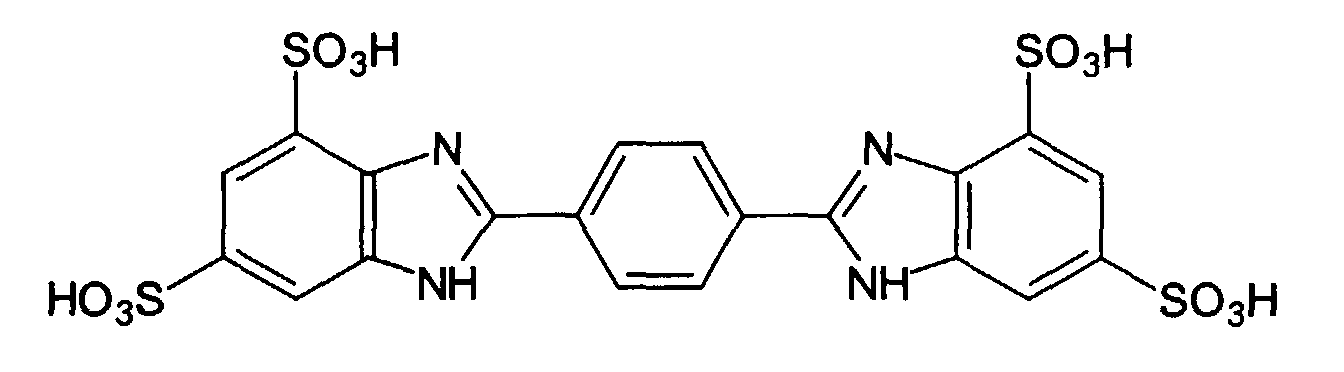
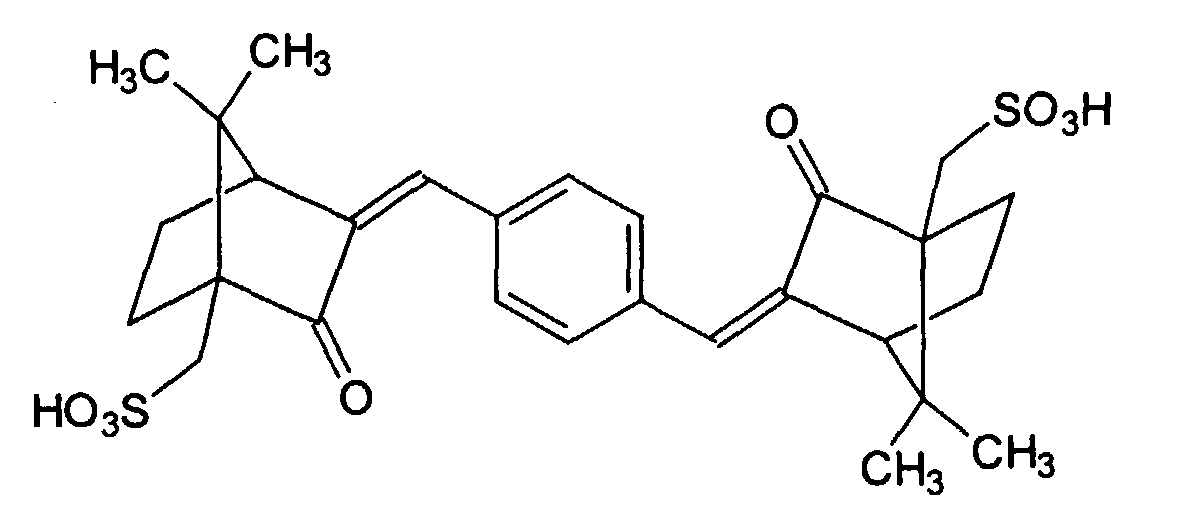
- UV-A filter substances are the phenylene-1,4-bis (2-benzimidazyl) -3,3 -5.5 -tetrasulfonic acid: and their salts, especially the corresponding sodium, potassium or triethanolammonium salts, especially the phenylene-1,4-bis (2-benzimidazyl) -3,3 -5.5 -tetrasulfonic acid bis-sodium salt, as well as the 1,4-di (2-oxo-10-sulfo-3-bornylidenemethyl) benzene and its salts (especially the corresponding 10-sulfato compounds, especially the corresponding sodium, potassium) or triethanolammonium salt), which is also known as benzene-1,4-di (2-oxo-3-bornylidenemethyl-10-sulfonic acid) and is characterized by the following structure:
- UV filter substances in the sense of the present invention are also so-called Broadband filter, i.e. Filter substances that contain both UV-A and UV-B radiation absorb.
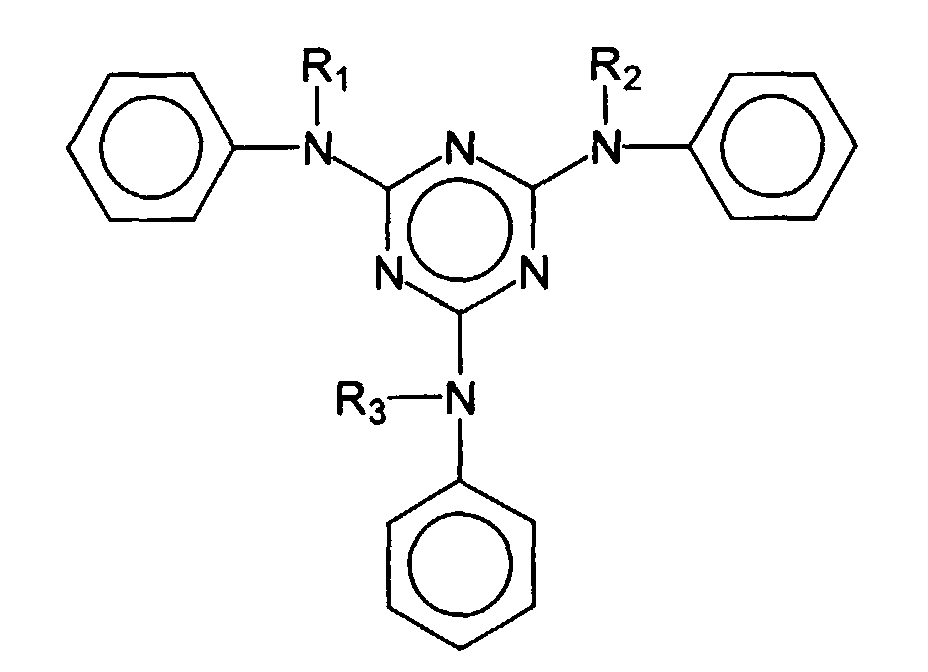
- Examples of advantageous broadband filters are bis-resorcinyltriazine derivatives with the following structure: where R 1 , R 2 and R 3 are independently selected from the group of branched and unbranched alkyl groups having 1 to 10 carbon atoms or a single hydrogen atom.
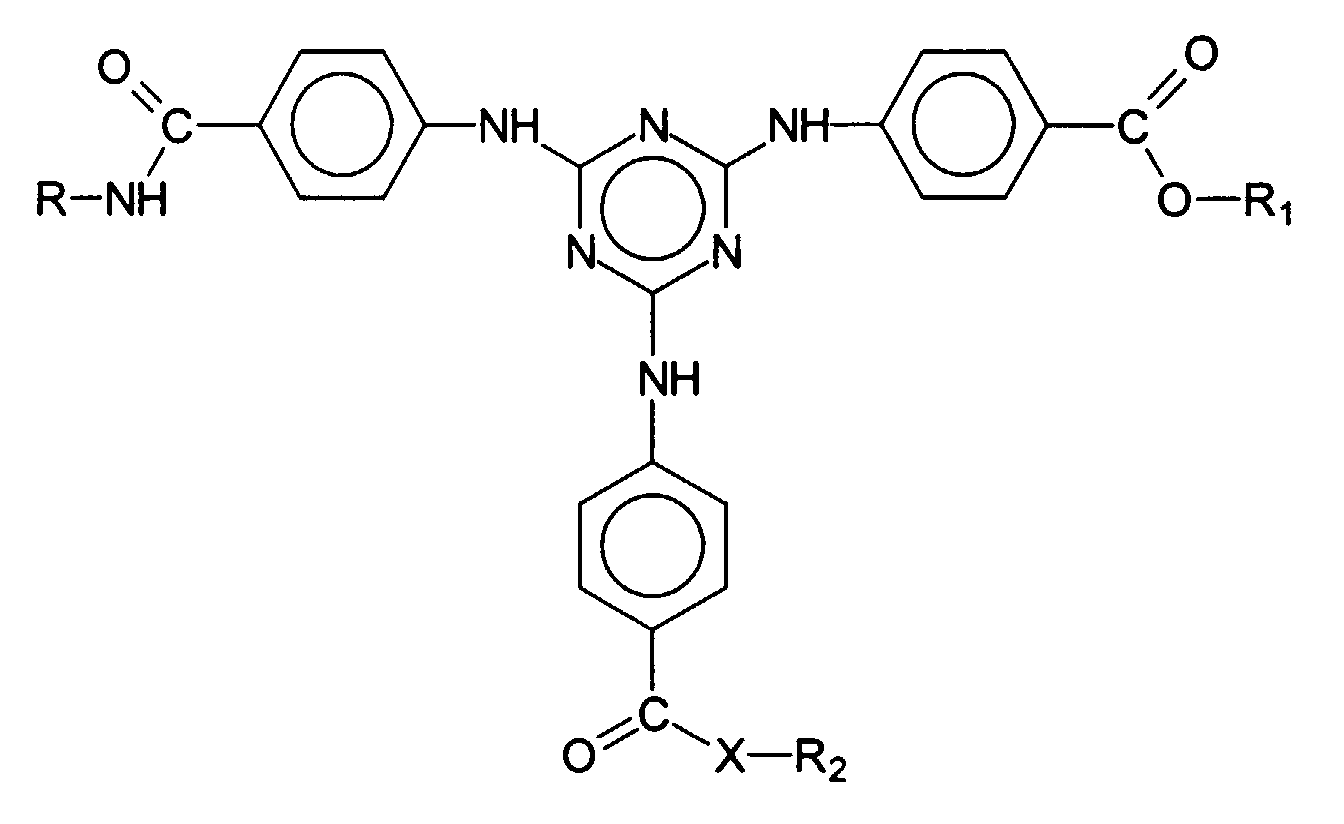
- the 2,4-bis - ⁇ [4- (2-ethylhexyloxy) -2-hydroxy] phenyl ⁇ -6- (4-methoxyphenyl) -1,3,5-triazine and 4,4 are particularly preferred ', 4''- (1,3,5-triazine-2,4,6-triyltriimino) -tris-benzoic acid-tris (2-ethylhexyl ester), synonymous: 2,4,6-tris [anilino- (p -carbo-2'-ethyl-1'-hexyloxy)] - 1,3,5-triazine, which is sold by BASF Aktiengesellschaft under the trade name UVINUL® T 150.
- UV filter substances whose incorporation into cosmetic or dermatological light protection formulations have hitherto been problematic are also known.
- European Offenlegungsschrift 775 698 describes bis-resorcinyltriazine derivatives whose chemical structure is represented by the generic formula is reproduced, wherein R 1 , R 2 and A 1 represent a wide variety of organic radicals.
- Also advantageous for the purposes of the present invention are 2,4-bis - ⁇ [4- (3-sulfonato) -2-hydroxypropyloxy) -2-hydroxy] phenyl ⁇ -6- (4-methoxyphenyl) -1, 3,5-triazine sodium salt, the 2,4-bis - ⁇ [4- (3- (2-propyloxy) -2-hydroxypropyloxy) -2-hydroxy] phenyl ⁇ -6- (4-methoxyphenyl) - 1,3,5-triazine, the 2,4-bis - ⁇ [4- (2-ethylhexyloxy) -2-hydroxy] phenyl ⁇ -6- [4- (2-methoxyethylcarboxyl) phenylamino] -1,3,5-triazine, the 2,4-bis - ⁇ [4- (3- (2-propyloxy) -2-hydroxypropyloxy) -2-hydroxy] phenyl ⁇ -6- [4-
- Another advantageous UV filter in the sense of the present invention is the 2.2 -Methylene-bis- (6- (2H-benzotriazol-2-yl) -4- (1,1,3,3-tetramethylbutyl) phenol), which is characterized by the chemical structural formula is marked.
- a further light protection filter substance to be used advantageously according to the invention is ethylhexyl-2-cyano-3,3-diphenylacrylate (octocrylene), which is available from BASF under the name Uvinul® N 539 and is characterized by the following structure:
- UV filters mentioned used in the sense of the present invention of course, should not be limiting.
Landscapes
- Health & Medical Sciences (AREA)
- Life Sciences & Earth Sciences (AREA)
- Animal Behavior & Ethology (AREA)
- General Health & Medical Sciences (AREA)
- Public Health (AREA)
- Veterinary Medicine (AREA)
- Birds (AREA)
- Epidemiology (AREA)
- Dermatology (AREA)
- Cosmetics (AREA)
Abstract
Description
| Handelsname | erhältlich bei |
| Boron Nitride Powder | Advanced Ceramics |
| Boron Nitride Powder | Sintec Keramik |
| Ceram Blanche | Kawasaki |
| HCST Boron Nitride | Stark |
| Très BN® | Carborundum |
| Wacker-Bornitrid BNP | Wacker-Chemie |


- a eine Zahl von 1 bis 100, vorzugsweise 2 bis 60, insbesondere 5 bis 40 darstellt,
- R1 und R2 unabhängig voneinander gewählt werden aus der Gruppe H und Methyl,
- X eine Einfachbindung darstellt oder die Gruppe
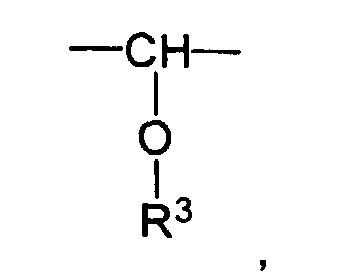
- R3 gewählt wird aus der Gruppe H und verzweigte und unverzweigte, gesättigte und ungesättigte Alkyl- und Acylreste mit 1 - 20 Kohlenstoffatomen und
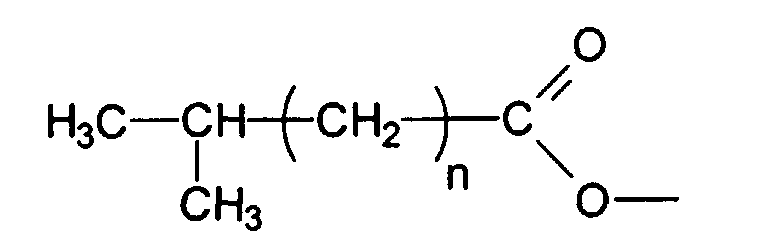
- A und Agleiche oder verschiedene organische Reste darstellen, gewählt aus der Gruppe der verzweigten und unverzweigten, gesättigten und ungesättigten Alkyl-, Acyl- und Hydroxyacylreste mit 10 - 30 Kohlenstoffatomen sowie ferner aus der Gruppe der über Esterfunktionen nach dem Schema
 miteinander verbundenen Hydroxyacylgruppen, wobei R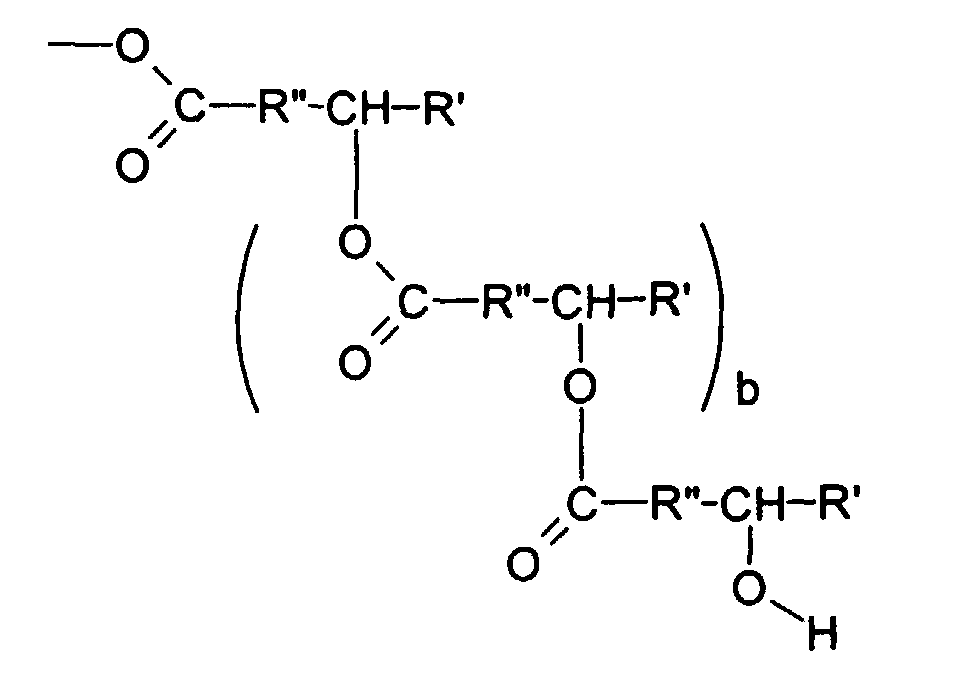



- R
- einen verzweigten oder unverzweigten C1-C18-Alkylrest, einen C5-C12-Cycloalkylrest, gegebenenfalls substituiert mit einer oder mehreren C1-C4- Alkylgruppen, darstellt,
- X
- ein Sauerstoffatom oder eine NH-Gruppe darstellt,
- R1
- einen verzweigten oder unverzweigten C1-C18-Alkylrest, einen C5-C12-Cycloalkylrest,
gegebenenfalls substituiert mit einer oder mehreren C1-C4- Alkylgruppen, oder
ein Wasserstoffatom, ein Alkalimetallatom, eine Ammoniumgruppe oder eine
Gruppe der Formel
bedeutet, in welcher
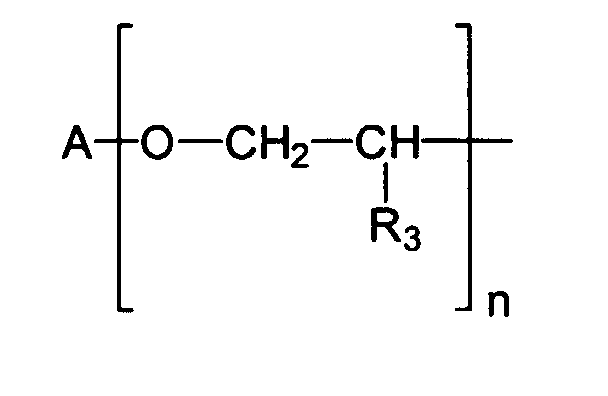
- A
- einen verzweigten oder unverzweigten C1-C18-Alkylrest, einen C5-C12-Cycloalkyl- oder Arylrest darstellt, gegebenenfalls substituiert mit einer oder mehreren C1-C4- Alkylgruppen,
- R3
- ein Wasserstoffatom oder eine Methylgruppe darstellt,
- n
- eine Zahl von 1 bis 10 darstellt,
- R2
- einen verzweigten oder unverzweigten C1-C18-Alkylrest, einen C5-C12-Cycloalkylrest,
gegebenenfalls substituiert mit einer oder mehreren C1-C4- Alkylgruppen, darstellt,
wenn X die NH-Gruppe darstellt, und
einen verzweigten oder unverzweigten C1-C18-Alkylrest, einen C5-C12-Cycloalkylrest, gegebenenfalls substituiert mit einer oder mehreren C1-C4- Alkylgruppen, oder ein Wasserstoffatom, ein Alkalimetallatom, eine Ammoniumgruppe oder eine Gruppe der Formelbedeutet, in welcher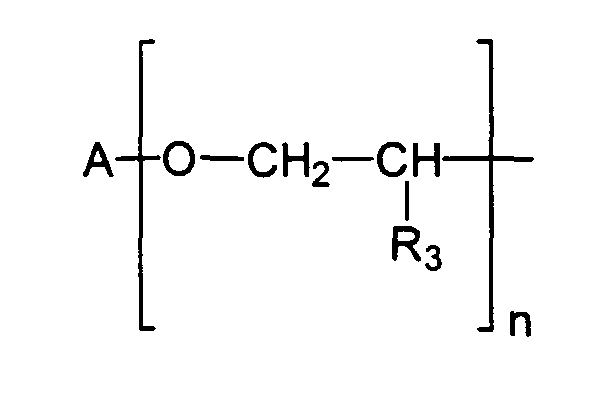
- A
- einen verzweigten oder unverzweigten C1-C18-Alkylrest, einen C5-C12-Cycloalkyl- oder Arylrest darstellt, gegebenenfalls substituiert mit einer oder mehreren C1-C4- Alkylgruppen,
- R3
- ein Wasserstoffatom oder eine Methylgruppe darstellt,
- n
- eine Zahl von 1 bis 10 darstellt,
wenn X ein Sauerstoffatom darstellt.


- 3-Benzylidencampher-Derivate, vorzugsweise 3-(4-Methylbenzyliden)campher, 3-Benzylidencampher;
- 4-Aminobenzoesäure-Derivate, vorzugsweise 4-(Dimethylamino)-benzoesäure(2-ethylhexyl)ester, 4-(Dimethylamino)benzoesäureamylester;
- 2,4,6-Trianilino-(p-carbo-2'-ethyl-1'-hexyloxy)-1,3,5-triazin;
- Ester der Benzalmalonsäure, vorzugsweise 4-Methoxybenzalmalonsäuredi(2-ethylhexyl)ester;
- Ester der Zimtsäure, vorzugsweise 4-Methoxyzimtsäure(2-ethylhexyl)ester, 4-Methoxyzimtsäureisopentylester;
- Derivate des Benzophenons, vorzugsweise 2-Hydroxy-4-methoxybenzophenon, 2-Hydroxy-4-methoxy-4'-methylbenzophenon, 2,2'-Dihydroxy-4-methoxybenzophenon;
- Salze der 2-Phenylbenzimidazol-5-sulfonsäure, wie ihr Natrium-, Kalium- oder ihr Triethanolammonium-Salz, sowie die Sulfonsäure selbst;
- Sulfonsäure-Derivate des 3-Benzylidencamphers, wie z.B. 4-(2-Oxo-3-bornylidenmethyl)benzolsulfonsäure, 2-Methyl-5-(2-oxo-3-bornylidenmethyl)sulfonsäure und deren Salze.

| Beispiele: | |||||
| W/O1 | W/O2 | W/O3 | W/O4 | W/O5 | |
| Polyglyceryl-2 Dipolyhydroxystearat | 5 | 2 | |||
| Cetyl Dimethicon Copolyol | 2 | 5 | |||
| PEG-30 Dipolyhydroxystearat | 2 | 4 | 3 | ||
| Caprylic/Capric Triglycerid | 5 | 5 | 5 | 5 | |
| Octyldodecanol | 5 | 5 | 5 | ||
| Dicaprylylether | 4 | 5 | |||
| Dimethicon | 2 | 2 | 2 | ||
| Mineralöl | 2 | 5 | 5 | ||
| Hydriertes Polyisobuten | 1 | 5 | 1 | ||
| Butylen Glycol Dicaprylat/Caprat | 10 | 6 | 10 | ||
| C12-15- Alkylbenzoat | 10 | 6 | 6 | 5 | |
| Vitamen E-Acetat | 0,5 | 0,5 | 0,5 | 0,5 | 0,5 |
| Octyltriazon | 2 | 3 | 2 | 2 | 4 |
| Dioctyl Butamido Triazon | 2 | 4 | |||
| Methylbenzyliden Campher | 2 | 4 | 2 | 4 | |
| Butylmethoxydibenzoylmethan | 2 | 2 | 2 | 2 | |
| Octocrylen | 10 | ||||
| Titandioxid | 0,5 | ||||
| Aerosil R972 | 0,5 | ||||
| Bornitrid | 2 | 1 | 5 | 5 | 3 |
| Konservierung | 0,5 | 0,5 | 0,5 | 0,5 | 0,5 |
| Glycerin | 5 | 5 | 10 | 10 | 5 |
| MgSO4 | 1 | 1 | 1 | 1 | |
| NaCl | 1 | ||||
| Phenylbenzimidazolsulfonsäure | 4 | ||||
| Natronlauge 45% | 1,3 | ||||
| Wasser | ad 100 | ad 100 | ad 100 | ad 100 | ad 100 |
Claims (11)
- Kosmetische oder dermatologische W/O-Emulsionen mit einem Gehalt an mindestens einem Bornitrid und mindestens einer polaren UV-Filtersubstanz und/oder einer polaren Ölkomponente.
- Verwendung von mindestens einem Bornitrid zum Erzielen oder Erhöhen der Stabilität von W/O-Emulsionen.
- Verwendung von mindestens einem Bornitrid zum Erzielen oder Erhöhen der Stabilität von W/O-Emulsionen in Gegenwart von polaren Ölkomponenten und/oder polaren UV-Filtern.
- W/O-Emulsion nach Anspruch 1 oder Verwendung nach einem der Ansprüche 3 und 4, dadurch gekennzeichnet, daß die Emulsion weniger als 2 Gew.-%, insbesondere weniger als 1 Gew.-%, ganz besonders weniger als 0,5 Gew.-% eines oder mehrerer Titandioxide enthält, bezogen auf das Gesamtgewicht der Zubereitungen.
- W/O-Emulsion nach Anspruch 1 oder Verwendung nach einem der Ansprüche 3 und 4, dadurch gekennzeichnet, daß der mittlere Partikeldurchmesser der verwendeten Bornitridpartikel kleiner als 25 µm, besonders vorteilhaft kleiner als 7 µm gewählt wird.
- W/O-Emulsion nach Anspruch 1 oder Verwendung nach einem der Ansprüche 3 und 4, dadurch gekennzeichnet, daß die Gesamtmenge an einem oder mehreren Bornitriden in den fertigen kosmetischen oder dermatologischen Zubereitungen aus dem Bereich von 0,1 bis 20,0 Gew.-%, bevorzugt 0,5 bis 10,0 Gew.-% gewählt wird, bezogen auf das Gesamtgewicht der Zubereitungen.
- W/O-Emulsion nach Anspruch 1 oder Verwendung nach einem der Ansprüche 3 und 4, dadurch gekennzeichnet, daß der oder die Emulgatoren gewählt werden aus der Gruppe der Monoglycerinester, Diglycerinester, Triglycerinester und/oder Tetraglycerinester der Isostearinsäure und/oder der Hydroxystearinsäure, der Alkylmethiconcopolyole und Alkyl-Dimethiconcopolyole sowie PEG-30-Dipolyhydroxystearat.
- W/O-Emulsion nach Anspruch 1 oder Verwendung nach einem der Ansprüche 3 und 4, dadurch gekennzeichnet, daß mindestens eine UV-Filtersubstanz gewählt wird aus der Gruppe der Triazinderivate, insbesondere aus der Gruppe (1,3,5-Triazin-2,4,6-triyltriimino)-tris-benzoesäure-tris(2-ethylhexylester), 2,4-Bis-{[4-(2-Ethyl-hexyloxy)-2-hydroxy]-phenyl}-6-(4-methoxyphenyl)-1,3,5-triazin, 2,4-Bis-{[4-(3-sulfonato)-2-hydroxy-propyloxy)-2-hydroxy]-phenyl}-6-(4-methoxyphenyl)-1,3,5-triazin Natriumsalz, 2,4-Bis-{[4-(3-(2-Propyloxy)-2-hydroxy-propyloxy)-2-hydroxy]-phenyl}-6-(4-methoxyphenyl)-1,3,5-triazin, 2,4-Bis-{[4-(2-ethyl-hexyloxy)-2-hydroxy]-phenyl}-6-[4-(2-methoxyethyl-carboxyl)-phenylamino]-1,3,5-triazin, 2,4-Bis-{[4-(3-(2-propyloxy)-2-hydroxy-propyloxy)-2-hydroxy]-phenyl}-6-[4-(2-ethylcarboxyl)-phenylamino]-1,3,5-triazin, 2,4-Bis-{[4-(2-ethyl-hexyloxy)-2-hydroxy]-phenyl}-6-(1-methyl-pyrrol-2-yl)-1,3,5-triazin, 2,4-Bis-{[4-tris(trimethylsiloxy-silylpropyloxy)-2-hydroxy]-phenyl}-6-(4-methoxyphenyl)-1,3,5-triazin, 2,4-Bis-{[4-(2-methylpropenyloxy)-2-hydroxy]-phenyl}-6-(4-methoxyphenyl)-1,3,5-triazin, 2,4-Bis-{[4-(1
 ,1
,1
- W/O-Emulsion nach Anspruch 1 oder Verwendung nach einem der Ansprüche 3 und 4, dadurch gekennzeichnet, daß mindestens eine UV-Filtersubstanz gewählt wird aus der Gruppe Phenylen-1,4-bis-(2-benzimidazyl)-3,3
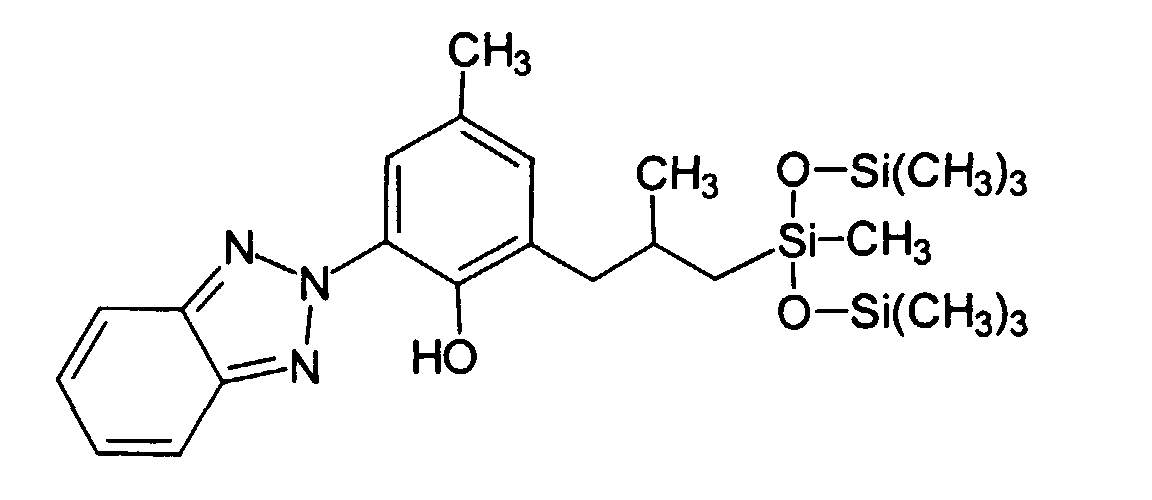
- W/O-Emulsion nach Anspruch 1 oder Verwendung nach einem der Ansprüche 3 und 4, dadurch gekennzeichnet, daß mindestens eine UV-Filtersubstanz gewählt wird aus der Gruppe der Benzotriazole, insbesondere aus der Gruppe 2,2
- W/O-Emulsion nach Anspruch 1 oder Verwendung nach einem der Ansprüche 3 und 4, dadurch gekennzeichnet, daß zusätzlich weitere kosmetische oder pharmazeutische Hilfs-, Zusatz- und/oder Wirkstoffe enthalten sind.
Applications Claiming Priority (2)
| Application Number | Priority Date | Filing Date | Title |
|---|---|---|---|
| DE19860268 | 1998-12-24 | ||
| DE19860268A DE19860268A1 (de) | 1998-12-24 | 1998-12-24 | Kosmetische und dermatologische W-O-Emulsionen mit einem Gehalt an Bornitrid |
Publications (3)
| Publication Number | Publication Date |
|---|---|
| EP1013263A2 true EP1013263A2 (de) | 2000-06-28 |
| EP1013263A3 EP1013263A3 (de) | 2001-12-19 |
| EP1013263B1 EP1013263B1 (de) | 2006-04-05 |
Family
ID=7892810
Family Applications (1)
| Application Number | Title | Priority Date | Filing Date |
|---|---|---|---|
| EP99124016A Expired - Lifetime EP1013263B1 (de) | 1998-12-24 | 1999-12-08 | Kosmetische und dermatologische W/O-Emulsionen mit einem Gehalt an Bornitrid |
Country Status (4)
| Country | Link |
|---|---|
| EP (1) | EP1013263B1 (de) |
| AT (1) | ATE322313T1 (de) |
| DE (2) | DE19860268A1 (de) |
| ES (1) | ES2260879T3 (de) |
Cited By (5)
| Publication number | Priority date | Publication date | Assignee | Title |
|---|---|---|---|---|
| EP1055419A2 (de) * | 1999-05-22 | 2000-11-29 | Beiersdorf AG | Kosmetische oder dermatologische Lichtschutzzubereitungen mit einem Gehalt an Dioctylbutamidotriazon und einem oder mehreren Filmbildnern |
| EP1055414A1 (de) * | 1999-05-22 | 2000-11-29 | Beiersdorf Aktiengesellschaft | Kosmetische oder dermatologische Lichtschutzzubereitungen mit einem Gehalt an Bornitrid und sulfonierten UV-Filtersubstanzen sowie die Verwendung von Bornitrid zur Stabilisierung von Emulsionen, die einen Gehalt an Elektrolyten, insbesondere einen Gehalt an sulfonierten UV-Filtersubstanzen, aufweisen |
| EP1062943A3 (de) * | 1999-05-22 | 2003-10-01 | Beiersdorf Aktiengesellschaft | Kosmetische oder dermatologische Lichtschutzzubereitungen mit einem Gehalt an Bornitrid und UV-Filtersubstanzen, welche das Strukturmotiv des Triazins aufweisen |
| FR2886853A1 (fr) * | 2005-06-14 | 2006-12-15 | Alain Saintrond | Composition cosmetique et/ou dermatologique au nitrure de bore |
| EP1055410B1 (de) * | 1999-05-22 | 2007-08-22 | Beiersdorf Aktiengesellschaft | Kosmetische oder dermatologische Lichtschutzzubereitungen mit einem Gehalt an Bornitrid und Ethylhexyl-2-cyano-3,3-diphenylacrylat sowie die Verwendung von Bornitrid zur Verstärkung des Lichtschutzfaktors und/oder der UV-Schutzleistung kosmetischer oder dermatologischer Lichtschutzmittel |
Family Cites Families (4)
| Publication number | Priority date | Publication date | Assignee | Title |
|---|---|---|---|---|
| GB9114317D0 (en) * | 1991-07-02 | 1991-08-21 | Unilever Plc | Cosmetic composition |
| DE19842744B4 (de) * | 1998-09-18 | 2006-12-21 | Beiersdorf Ag | Emulgatorfreie feindisperse Systeme vom Typ Öl-in-Wasser und Wasser-in-Öl und deren Verwendung |
| DE19923771A1 (de) * | 1999-05-22 | 2000-11-23 | Beiersdorf Ag | Kosmetische oder dermatologische Lichtschutzzubereitungen mit einem Gehalt an Bornitrid und Ethylhexyl-2-cyano-3,3-diphenylacrylat sowie die Verwendung von Bornitrid zur Verstärkung des Lichtschutzfaktors und/oder der UV-A-Schutzleistung kosmetischer oder dermatologischer Lichtschutzmittel |
| DE19923667A1 (de) * | 1999-05-22 | 2000-11-23 | Beiersdorf Ag | Kosmetische oder dermatologische Lichtschutzzubereitungen mit einem Gehalt an Bornitrid und sowie die Verwendung von Bornitrid zur Verbesserung des Hautgefühls von Zubereitungen, die sich durch einen Gehalt an UV-Filtersubstanzen auszeichnen, welche das Strukturmotiv des s-Triazins aufweisen |
-
1998
- 1998-12-24 DE DE19860268A patent/DE19860268A1/de not_active Withdrawn
-
1999
- 1999-12-08 AT AT99124016T patent/ATE322313T1/de not_active IP Right Cessation
- 1999-12-08 DE DE59913306T patent/DE59913306D1/de not_active Expired - Lifetime
- 1999-12-08 EP EP99124016A patent/EP1013263B1/de not_active Expired - Lifetime
- 1999-12-08 ES ES99124016T patent/ES2260879T3/es not_active Expired - Lifetime
Cited By (6)
| Publication number | Priority date | Publication date | Assignee | Title |
|---|---|---|---|---|
| EP1055419A2 (de) * | 1999-05-22 | 2000-11-29 | Beiersdorf AG | Kosmetische oder dermatologische Lichtschutzzubereitungen mit einem Gehalt an Dioctylbutamidotriazon und einem oder mehreren Filmbildnern |
| EP1055414A1 (de) * | 1999-05-22 | 2000-11-29 | Beiersdorf Aktiengesellschaft | Kosmetische oder dermatologische Lichtschutzzubereitungen mit einem Gehalt an Bornitrid und sulfonierten UV-Filtersubstanzen sowie die Verwendung von Bornitrid zur Stabilisierung von Emulsionen, die einen Gehalt an Elektrolyten, insbesondere einen Gehalt an sulfonierten UV-Filtersubstanzen, aufweisen |
| EP1062943A3 (de) * | 1999-05-22 | 2003-10-01 | Beiersdorf Aktiengesellschaft | Kosmetische oder dermatologische Lichtschutzzubereitungen mit einem Gehalt an Bornitrid und UV-Filtersubstanzen, welche das Strukturmotiv des Triazins aufweisen |
| EP1055410B1 (de) * | 1999-05-22 | 2007-08-22 | Beiersdorf Aktiengesellschaft | Kosmetische oder dermatologische Lichtschutzzubereitungen mit einem Gehalt an Bornitrid und Ethylhexyl-2-cyano-3,3-diphenylacrylat sowie die Verwendung von Bornitrid zur Verstärkung des Lichtschutzfaktors und/oder der UV-Schutzleistung kosmetischer oder dermatologischer Lichtschutzmittel |
| FR2886853A1 (fr) * | 2005-06-14 | 2006-12-15 | Alain Saintrond | Composition cosmetique et/ou dermatologique au nitrure de bore |
| EP1769786A1 (de) * | 2005-06-14 | 2007-04-04 | Alain Saintrond | Kosmetische und/oder dermatologische Zusammensetzung mit Bornitrid |
Also Published As
| Publication number | Publication date |
|---|---|
| DE19860268A1 (de) | 2000-06-29 |
| ATE322313T1 (de) | 2006-04-15 |
| ES2260879T3 (es) | 2006-11-01 |
| DE59913306D1 (de) | 2006-05-18 |
| EP1013263B1 (de) | 2006-04-05 |
| EP1013263A3 (de) | 2001-12-19 |
Similar Documents
| Publication | Publication Date | Title |
|---|---|---|
| EP0821945B1 (de) | Schaumförmige Lichtzubereitungen mit einem Gehalt an wasserlöslichen Lichtschutzsubstanzen und grenzflächenaktiven Substanzen | |
| DE19933463A1 (de) | W/O-Emulsionen mit einem Gehalt an Ectoinen | |
| EP1129696B1 (de) | Stabilisierung oxidations- und/oder UV-empfindlicher Wirkstoffe | |
| EP0987006B1 (de) | Emulgatorfreie feindisperse Systeme vom Typ Wasser-in-Öl | |
| EP1077062A2 (de) | Dünnflüssige kosmetische oder dermatologische Zubereitungen von Typ Öl-in-Wasser | |
| EP0847750A2 (de) | Lichtschutzzubereitungen mit einem Gehalt an oberflächenaktiven Mono- bzw. Oligoglycerylverbindungen und wasserlöslichen UV-Filtersubstanzen und ggf. anorganischen Mikropigmenten | |
| EP1077058A2 (de) | Emulgatorfreie feindisperse Systeme vom Typ Wasser-in-Öl | |
| DE10038713B4 (de) | Kosmetische und dermatologische Lichtschutzformulierungen mit einem Gehalt an unsymmetrisch substituierten Triazinderivaten und Dialkyladipaten | |
| EP0821946B1 (de) | Stabile Lichtschutzzubereitungen mit einem Gehalt an grenzflächenaktiven Glucosederivaten und wasserlöslichen UV-Filtersubstanzen | |
| EP1013262B1 (de) | Kosmetische und dermatologische O/W-Emulsionen mit einem Gehalt an Bornitrid | |
| EP0876136B1 (de) | Stabile kosmetische und dermatologische lichtschutzzubereitungen in form von w/o-emulsionen mit einem gehalt an anorganischen mikropigmenten, triazinderivaten und/oder weiteren komponenten | |
| EP1213010A2 (de) | Verwendung von wasserlöslichen, filmbildenden Polymeren zur Verstärkung des Lichtschutzfaktors und/oder der UV-A-Schutzleistung kosmetischer oder dermatologischer Formulierungen | |
| EP1192937A2 (de) | Emulgatorarme feindisperse Systeme vom Typ Wasser-in-Öl mit einem Gehalt an Ethylcellulose | |
| EP1075834A2 (de) | Kosmetische und dermatologische W/O-Emulsionen mit einem Gehalt an modifizierte Schichtsilikaten | |
| EP0821944B1 (de) | Wasserfeste Lichtschutzzubereitungen mit einem Gehalt an anorganischen Mikropigmenten und wasserlöslichen UV-Filtersubstanzen | |
| EP1013263B1 (de) | Kosmetische und dermatologische W/O-Emulsionen mit einem Gehalt an Bornitrid | |
| EP0826360B1 (de) | Verwendung von Dibenzoylmethanderivaten zur Erzielung oder Erhöhung der Löslichkeit von Triazinderivaten in Ölkomponenten | |
| EP0904773B1 (de) | Dünnflüssige kosmetische oder dermatologische Zubereitungen vom Typ Wasser-in-Öl | |
| EP0868904A2 (de) | Lichtschutzzubereitungen mit einem Gehalt an basischen Aminosäuren und wasserlöslichen UV-Filtersubtanzen | |
| EP1559413A2 (de) | Stabile kosmetische oder dermatologische Zubereitungen in Form von W/O-Emulsionen enthaltend unsymmetrisch substituierte Triazinderivate | |
| EP1055414B1 (de) | Kosmetische oder dermatologische Lichtschutzzubereitungen mit einem Gehalt an Bornitrid und sulfonierten UV-Filtersubstanzen sowie die Verwendung von Bornitrid zur Stabilisierung von Emulsionen, die einen Gehalt an Elektrolyten, insbesondere einen Gehalt an sulfonierten UV-Filtersubstanzen, aufweisen | |
| EP1074241A2 (de) | Ölfreie kosmetische oder dermatologische Zubereitungen mit einem Gehalt an unsymmetrisch substituierten Triazinderivaten und flüssigen UV-Filtersubstanzen | |
| EP1180360A2 (de) | Kosmetische und dermatologische Lichtschutzformulierungen mit einem Gehalt an unsymmetrisch substituierten Triazinderivaten und Dialkylcarbonaten | |
| DE19645320B4 (de) | Schaumförmige Lichtschutzzubereitungen mit einem Gehalt an wasserlöslichen Lichtschutzfiltersubstanzen und grenzflächenaktiven Substanzen und deren Verwendung | |
| EP0803244B1 (de) | Verwendung einer oder mehreren Monoester und Diester aus verzweigten Alkancarbonsäuren und dem Diglycerin oder Triglycerin als Lösungsmittel für Triazinderivaten in kosmetischen und dermatologischen Lichtschutzformulierungen |
Legal Events
| Date | Code | Title | Description |
|---|---|---|---|
| PUAI | Public reference made under article 153(3) epc to a published international application that has entered the european phase |
Free format text: ORIGINAL CODE: 0009012 |
|
| AK | Designated contracting states |
Kind code of ref document: A2 Designated state(s): AT BE CH CY DE DK ES FI FR GB GR IE IT LI LU MC NL PT SE |
|
| AX | Request for extension of the european patent |
Free format text: AL;LT;LV;MK;RO;SI |
|
| PUAL | Search report despatched |
Free format text: ORIGINAL CODE: 0009013 |
|
| AK | Designated contracting states |
Kind code of ref document: A3 Designated state(s): AT BE CH CY DE DK ES FI FR GB GR IE IT LI LU MC NL PT SE |
|
| AX | Request for extension of the european patent |
Free format text: AL;LT;LV;MK;RO;SI |
|
| RIC1 | Information provided on ipc code assigned before grant |
Free format text: 7A 61K 7/42 A, 7A 61K 7/48 B, 7A 61K 7/00 B |
|
| 17P | Request for examination filed |
Effective date: 20020110 |
|
| AKX | Designation fees paid |
Free format text: AT BE CH CY DE DK ES FI FR GB GR IE IT LI LU MC NL PT SE |
|
| 17Q | First examination report despatched |
Effective date: 20031119 |
|
| GRAP | Despatch of communication of intention to grant a patent |
Free format text: ORIGINAL CODE: EPIDOSNIGR1 |
|
| GRAS | Grant fee paid |
Free format text: ORIGINAL CODE: EPIDOSNIGR3 |
|
| GRAA | (expected) grant |
Free format text: ORIGINAL CODE: 0009210 |
|
| AK | Designated contracting states |
Kind code of ref document: B1 Designated state(s): AT BE CH CY DE DK ES FI FR GB GR IE IT LI LU MC NL PT SE |
|
| PG25 | Lapsed in a contracting state [announced via postgrant information from national office to epo] |
Ref country code: NL Free format text: LAPSE BECAUSE OF FAILURE TO SUBMIT A TRANSLATION OF THE DESCRIPTION OR TO PAY THE FEE WITHIN THE PRESCRIBED TIME-LIMIT Effective date: 20060405 Ref country code: IT Free format text: LAPSE BECAUSE OF FAILURE TO SUBMIT A TRANSLATION OF THE DESCRIPTION OR TO PAY THE FEE WITHIN THE PRESCRIBED TIME-LIMIT;WARNING: LAPSES OF ITALIAN PATENTS WITH EFFECTIVE DATE BEFORE 2007 MAY HAVE OCCURRED AT ANY TIME BEFORE 2007. THE CORRECT EFFECTIVE DATE MAY BE DIFFERENT FROM THE ONE RECORDED. Effective date: 20060405 Ref country code: IE Free format text: LAPSE BECAUSE OF FAILURE TO SUBMIT A TRANSLATION OF THE DESCRIPTION OR TO PAY THE FEE WITHIN THE PRESCRIBED TIME-LIMIT Effective date: 20060405 Ref country code: FI Free format text: LAPSE BECAUSE OF FAILURE TO SUBMIT A TRANSLATION OF THE DESCRIPTION OR TO PAY THE FEE WITHIN THE PRESCRIBED TIME-LIMIT Effective date: 20060405 |
|
| REG | Reference to a national code |
Ref country code: GB Ref legal event code: FG4D Free format text: NOT ENGLISH |
|
| RIC1 | Information provided on ipc code assigned before grant |
Ipc: A61K 8/40 20060101ALI20060214BHEP Ipc: A61Q 19/00 20060101ALI20060214BHEP Ipc: A61Q 17/04 20060101AFI20060214BHEP |
|
| REG | Reference to a national code |
Ref country code: CH Ref legal event code: EP |
|
| REG | Reference to a national code |
Ref country code: IE Ref legal event code: FG4D Free format text: LANGUAGE OF EP DOCUMENT: GERMAN |
|
| REF | Corresponds to: |
Ref document number: 59913306 Country of ref document: DE Date of ref document: 20060518 Kind code of ref document: P |
|
| REG | Reference to a national code |
Ref country code: CH Ref legal event code: NV Representative=s name: BOVARD AG PATENTANWAELTE |
|
| GBT | Gb: translation of ep patent filed (gb section 77(6)(a)/1977) |
Effective date: 20060530 |
|
| PG25 | Lapsed in a contracting state [announced via postgrant information from national office to epo] |
Ref country code: SE Free format text: LAPSE BECAUSE OF FAILURE TO SUBMIT A TRANSLATION OF THE DESCRIPTION OR TO PAY THE FEE WITHIN THE PRESCRIBED TIME-LIMIT Effective date: 20060705 Ref country code: DK Free format text: LAPSE BECAUSE OF FAILURE TO SUBMIT A TRANSLATION OF THE DESCRIPTION OR TO PAY THE FEE WITHIN THE PRESCRIBED TIME-LIMIT Effective date: 20060705 |
|
| PG25 | Lapsed in a contracting state [announced via postgrant information from national office to epo] |
Ref country code: PT Free format text: LAPSE BECAUSE OF FAILURE TO SUBMIT A TRANSLATION OF THE DESCRIPTION OR TO PAY THE FEE WITHIN THE PRESCRIBED TIME-LIMIT Effective date: 20060905 |
|
| NLV1 | Nl: lapsed or annulled due to failure to fulfill the requirements of art. 29p and 29m of the patents act | ||
| REG | Reference to a national code |
Ref country code: ES Ref legal event code: FG2A Ref document number: 2260879 Country of ref document: ES Kind code of ref document: T3 |
|
| ET | Fr: translation filed | ||
| REG | Reference to a national code |
Ref country code: IE Ref legal event code: FD4D |
|
| PG25 | Lapsed in a contracting state [announced via postgrant information from national office to epo] |
Ref country code: MC Free format text: LAPSE BECAUSE OF NON-PAYMENT OF DUE FEES Effective date: 20061231 Ref country code: BE Free format text: LAPSE BECAUSE OF NON-PAYMENT OF DUE FEES Effective date: 20061231 |
|
| PLBE | No opposition filed within time limit |
Free format text: ORIGINAL CODE: 0009261 |
|
| STAA | Information on the status of an ep patent application or granted ep patent |
Free format text: STATUS: NO OPPOSITION FILED WITHIN TIME LIMIT |
|
| 26N | No opposition filed |
Effective date: 20070108 |
|
| BERE | Be: lapsed |
Owner name: BEIERSDORF A.G. Effective date: 20061231 |
|
| PG25 | Lapsed in a contracting state [announced via postgrant information from national office to epo] |
Ref country code: AT Free format text: LAPSE BECAUSE OF NON-PAYMENT OF DUE FEES Effective date: 20061208 |
|
| PG25 | Lapsed in a contracting state [announced via postgrant information from national office to epo] |
Ref country code: GR Free format text: LAPSE BECAUSE OF FAILURE TO SUBMIT A TRANSLATION OF THE DESCRIPTION OR TO PAY THE FEE WITHIN THE PRESCRIBED TIME-LIMIT Effective date: 20060706 |
|
| PG25 | Lapsed in a contracting state [announced via postgrant information from national office to epo] |
Ref country code: LU Free format text: LAPSE BECAUSE OF NON-PAYMENT OF DUE FEES Effective date: 20061208 |
|
| PG25 | Lapsed in a contracting state [announced via postgrant information from national office to epo] |
Ref country code: CY Free format text: LAPSE BECAUSE OF FAILURE TO SUBMIT A TRANSLATION OF THE DESCRIPTION OR TO PAY THE FEE WITHIN THE PRESCRIBED TIME-LIMIT Effective date: 20060405 |
|
| PGFP | Annual fee paid to national office [announced via postgrant information from national office to epo] |
Ref country code: ES Payment date: 20091222 Year of fee payment: 11 Ref country code: CH Payment date: 20091224 Year of fee payment: 11 |
|
| PGFP | Annual fee paid to national office [announced via postgrant information from national office to epo] |
Ref country code: GB Payment date: 20091218 Year of fee payment: 11 |
|
| REG | Reference to a national code |
Ref country code: CH Ref legal event code: PFA Owner name: BEIERSDORF AKTIENGESELLSCHAFT Free format text: BEIERSDORF AKTIENGESELLSCHAFT#UNNASTRASSE 48#20245 HAMBURG (DE) -TRANSFER TO- BEIERSDORF AKTIENGESELLSCHAFT#UNNASTRASSE 48#20245 HAMBURG (DE) |
|
| REG | Reference to a national code |
Ref country code: CH Ref legal event code: PL |
|
| GBPC | Gb: european patent ceased through non-payment of renewal fee |
Effective date: 20101208 |
|
| PG25 | Lapsed in a contracting state [announced via postgrant information from national office to epo] |
Ref country code: CH Free format text: LAPSE BECAUSE OF NON-PAYMENT OF DUE FEES Effective date: 20101231 Ref country code: LI Free format text: LAPSE BECAUSE OF NON-PAYMENT OF DUE FEES Effective date: 20101231 |
|
| PG25 | Lapsed in a contracting state [announced via postgrant information from national office to epo] |
Ref country code: GB Free format text: LAPSE BECAUSE OF NON-PAYMENT OF DUE FEES Effective date: 20101208 |
|
| REG | Reference to a national code |
Ref country code: ES Ref legal event code: FD2A Effective date: 20120411 |
|
| PG25 | Lapsed in a contracting state [announced via postgrant information from national office to epo] |
Ref country code: ES Free format text: LAPSE BECAUSE OF NON-PAYMENT OF DUE FEES Effective date: 20101209 |
|
| REG | Reference to a national code |
Ref country code: FR Ref legal event code: PLFP Year of fee payment: 17 |
|
| REG | Reference to a national code |
Ref country code: FR Ref legal event code: PLFP Year of fee payment: 18 |
|
| REG | Reference to a national code |
Ref country code: FR Ref legal event code: PLFP Year of fee payment: 19 |
|
| PGFP | Annual fee paid to national office [announced via postgrant information from national office to epo] |
Ref country code: FR Payment date: 20181219 Year of fee payment: 20 |
|
| PGFP | Annual fee paid to national office [announced via postgrant information from national office to epo] |
Ref country code: DE Payment date: 20181231 Year of fee payment: 20 |
|
| REG | Reference to a national code |
Ref country code: DE Ref legal event code: R071 Ref document number: 59913306 Country of ref document: DE |