EP1013678A2 - Verfahren zum Verdichten ethylenisch ungesättigter Monomerer - Google Patents
Verfahren zum Verdichten ethylenisch ungesättigter Monomerer Download PDFInfo
- Publication number
- EP1013678A2 EP1013678A2 EP99124190A EP99124190A EP1013678A2 EP 1013678 A2 EP1013678 A2 EP 1013678A2 EP 99124190 A EP99124190 A EP 99124190A EP 99124190 A EP99124190 A EP 99124190A EP 1013678 A2 EP1013678 A2 EP 1013678A2
- Authority
- EP
- European Patent Office
- Prior art keywords
- alkyl
- compression
- ethylenically unsaturated
- unsaturated monomers
- polymerization initiator
- Prior art date
- Legal status (The legal status is an assumption and is not a legal conclusion. Google has not performed a legal analysis and makes no representation as to the accuracy of the status listed.)
- Granted
Links
Classifications
-
- C—CHEMISTRY; METALLURGY
- C07—ORGANIC CHEMISTRY
- C07C—ACYCLIC OR CARBOCYCLIC COMPOUNDS
- C07C7/00—Purification; Separation; Use of additives
- C07C7/20—Use of additives, e.g. for stabilisation
-
- C—CHEMISTRY; METALLURGY
- C08—ORGANIC MACROMOLECULAR COMPOUNDS; THEIR PREPARATION OR CHEMICAL WORKING-UP; COMPOSITIONS BASED THEREON
- C08F—MACROMOLECULAR COMPOUNDS OBTAINED BY REACTIONS ONLY INVOLVING CARBON-TO-CARBON UNSATURATED BONDS
- C08F10/00—Homopolymers and copolymers of unsaturated aliphatic hydrocarbons having only one carbon-to-carbon double bond
-
- C—CHEMISTRY; METALLURGY
- C08—ORGANIC MACROMOLECULAR COMPOUNDS; THEIR PREPARATION OR CHEMICAL WORKING-UP; COMPOSITIONS BASED THEREON
- C08F—MACROMOLECULAR COMPOUNDS OBTAINED BY REACTIONS ONLY INVOLVING CARBON-TO-CARBON UNSATURATED BONDS
- C08F2/00—Processes of polymerisation
- C08F2/38—Polymerisation using regulators, e.g. chain terminating agents, e.g. telomerisation
- C08F2/40—Polymerisation using regulators, e.g. chain terminating agents, e.g. telomerisation using retarding agents
Definitions
- the present invention furthermore relates to a method for the production of copolymers by appropriate compression and subsequent polymerization and copolymers available according to this procedure.
- Derivatives of sterically hindered amines are known as stabilizers of Plastics and radically polymerizable monomers since known for a long time.
- EP-A-178 168 describes a method for inhibiting ⁇ , ⁇ -ethylenically unsaturated monocarboxylic acids, for example from Acrylic acid, known when working up by distillation.
- US 5,449,724 describes a process for making thermoplastic Ethylene homo- and copolymers at temperatures from 40 to 500 ° C and a pressure between 500 and 5000 bar in the presence of a Radical generator and a stable free radical compound described.
- the presence of the stable free radical compound in particular of derivatives of 2,2,6,6-tetramethylpiperidine-N-oxyl, leads to a particularly narrow molecular weight distribution and associated with special physical properties of the polymers.
- EP 0 811 590 is a method for compressing ethylenically unsaturated monomers at pressures between 500 and Known 5000 bar with the addition of polymerization inhibitors. As such are among others also described nitroxyl compounds.
- the addition of the inhibitor mentioned makes it possible to run the Post-compressor of at least 124 h compared to a running time of only 27 h in the absence of the inhibitor.
- the longer ones Maturities are due to the significantly lower education of polymers possible because the latter to cover and thus lead to leaks in the post-compressor and the shutdown and cleaning of this unit is necessary.
- the object of the present invention was therefore a method for the compression of ethylenically unsaturated monomers, which is due to premature polymerization Layer formation during compression even more effective than before reduced.
- All customary ethylenically unsaturated monomers can be compressed by the process according to the invention.
- monomers are ethylene, propylene, butene and butadiene and vinyl esters of C 2 -C 18 -alkanecarboxylic acids such as vinyl acetate and vinyl propionate, C 2 -C 18 -alkyl esters of acrylic or methacrylic acid such as methyl, ethyl, propyl or butyl - and 2-ethylhexyl acrylate and methacrylate, esters of monoethylenically unsaturated dicarboxylic acids such as mono- and diesters of maleic and fumaric acid, monoethylenically unsaturated carboxylic acids such as acrylic acid, methacrylic acid, maleic acid and fumaric acid, amides of monoethylenically unsaturated carboxylic acids such as acrylamide, methacrylamide, N-mono- C 1 -C 18 ) alkyl
- Particularly suitable monomer mixtures are those which Ethylene, propylene, butene and / or butadiene and optionally one or contain more of the above-mentioned comonomers.
- the method according to the invention is suitable for the compression of Monomer mixtures as used for copolymerization.
- Suitable derivatives of these acids are, for example, the C 1 -C 18 alkyl esters, C 1 -C 18 mono- and dialkylamides and the unsubstituted amides.
- C 1 -C 18 alkyl groups for example methyl, ethyl, n-propyl, isopropyl, n-butyl, isobutyl, sec-butyl, tert-butyl, n-pentyl, isopentyl, sec-pentyl, tert-pentyl, neopentyl and the various isomeric hexyl, heptyl, octyl, nonyl, decyl, undecyl, dodecyl, tridecyl, tetradecyl, pentadecyl, hexadecyl, heptadecyl and octadecyl radicals.
- mixtures can be made using the process according to the invention compress from ethylene and acrylic acid or methacrylic acid.
- Suitable C 1 -C 4 alkyl groups for R 1 , R 2 and R 3 in formula I include, for example, methyl, ethyl, n-propyl, i-propyl, n-butyl, i-butyl, sec-butyl or tert- Butyl.
- the radicals R 1 and R 2 are preferably the same C 1 -C 4 alkyl.
- the radicals R 1 and R 2 are particularly preferably methyl groups.
- R 1 and R 2 can also form, together with the carbon atom to which they are attached, a 5- or 6-membered saturated hydrocarbon ring.
- R 1 and R 2 can together represent a tetra or pentamethylene group.
- R 3 can be different, but they preferably mean the same C 1 -C 4 alkyl.
- R 3 is preferably the same tert-butyl or i-propyl radicals, particularly preferably the same methyl radicals.
- C 1 -C 12 alkyl groups for R 4 include the above-mentioned C 1 -C 4 alkyl groups and also pentyl, sec-pentyl, tert-pentyl, neopentyl, hexyl, 2-methylpentyl, heptyl, 2-methylhexyl, octyl, Isooctyl, 2-ethylhexyl, nonyl, 2-methylnonyl, isononyl, 2-methyloctyl, decyl, isodecyl, 2-methylnonyl, undecyl, isoundecyl, dodecyl and isododecyl (the names isooctyl, isononyl and isodecyl are trivial names and are derived from the carbonyl compounds obtained; cf. Ullmann's Encyklopedia of Industrial Chemistry, 5th Edition, Vol. A1. Pages 290
- Aromatic nitro or nitroso compounds come as such as well as hydroxylamines.
- aromatic nitro compounds for example 1,3-dinitrobenzene, 1,4-dinitrobenzene, 2,6-dinitro-4-methylphenol, 2-nitro-4-methylphenol, 2,4,6-trinitrophenol, 2,4-dinitro-1-naphthol, 2,4-dinitro-6-methylphenol, 2,4-dinitrochlorobenzene, 2,4-dinitrophenol, 2,4-dinitro-6-sec-butylphenol, 4-cyano-2-nitrophenol, 3-iodo-4-cyano-5-nitrophenol, particularly preferred 2,6-dinitro-4-methylphenol, 2-nitro-4-methylphenol, 2,4-dinitro-6-sec-butylphenol or 2,4-dinitro-6-methylphenol used become.
- Aromatic nitroso compounds e.g. p-nitrosophenol, p-Nitroso-o-cresol and p-Nitroso-N, N'-diethylaniline.
- compounds from the group come as costabilizers of quinones, phenothiazines and phenols, also in combination with the aromatic nitro or nitroso compounds mentioned above as well as hydroxylamines.
- Suitable substituted phenols are, for example, 4-tert-butyl catechol, Methoxyhydroquinone, 2,6-di-tert-butyl-4-methylphenol, n-octadecyl- ⁇ - (3,5-di-tert-butyl-4-hydroxyphenyl) propionate, 1,1,3-tris (2-methyl-4-hydroxy-5-tert-butylphenyl) butane, 1,3,5-trimethyl-2,4,6-tris (3,5-di-tert-butyl-4-hydroxybenzyl) benzene, 1,3,5-tris (3,5-di-tert-butyl-4-hydroxybenzyl) isocyanurate, 1,3,5-tris- [ ⁇ - (3,5-di-tert-butyl-4-hydroxyphenyl) propionyloxyethyl isocyanurate, 1,3,5-tris (2,6-dimethyl-3-hydroxy-4-tert-butylbenz
- nitroxyl compounds of formula I are in the invention Compression processes in a concentration between 0.00001 and 1% by weight, based on the amount of the monomers to be compressed, preferably used between 0.0001 and 0.1 wt .-%. This concentration range also applies to the above-mentioned costabilizers.
- the monomers are compresses a pressure of 200 to 5000 bar.
- the compression takes place preferably gradually, the final pressure is preferably between 1000 and 4000, particularly preferably between 1500 and 3000 bar.
- the temperatures during the compression are preferably between 20 and 140 ° C, particularly preferably between 30 and 100 ° C.
- polymerization initiator there is no polymerization initiator during the compression process present.
- polymerization initiators all connections are to be understood that are for initiation the radical polymerization are added to the monomers, such as azo compounds, organic peroxides and hydroperoxides. Perhaps Oxygen present in the compression mixture is said to be here should not be understood as a polymerization initiator.
- the compression method according to the invention is preferably part a high pressure copolymerization process, which characterized is that you mix the comonomers individually or compressed by the method according to the invention and then at a temperature between 50 and 350 ° C by adding a Polymerization initiator polymerizes.
- the preferred polymerization temperature is between 150 and 300 ° C, the preferred pressure between 1000 and 4000 bar, especially preferably between 1500 and 3000 bar.
- the polymerization can be carried out by conventional methods e.g. in tubular reactors or in autoclave reactors.
- People can usual additives, for example molecular weight regulators, Solvent, etc., be present in the polymerization mixture.
- the advantage of this polymerization process according to the invention is not only due to the longer running times of the compression equipment, but also in an improvement of the polymerization products.
- the copolymerization of Ethylene and acrylic acid especially the acrylic acid too premature Polymerization during compaction.
- Those obtainable by the process according to the invention Copolymers are more homogeneous.
- ethylene was pressurized to 220 bar compressed.
- the compressed gas stream (1400 kg / hour) were 85 l of a mixture of acrylic acid and isododecane in 60 minutes (1: 1, Vol: Vol), in which the given in the table Amounts of TMS-TEMPO had been dissolved, pumped.
- the mixture was compressed to 2300 bar in the post-compressor and continuously in transferred a 35 liter steel flow autoclave.
- the polymerization was determined by adding 0.0025 mol% (based on the total molar amount of the monomers) started tert-butyl perpivalate.
- the reaction temperature was 220 ° C. The reaction was stopped as soon as the amount of leakage gas at the booster due to deposits Exceeded 50 kg / hour.
Landscapes
- Chemical & Material Sciences (AREA)
- Organic Chemistry (AREA)
- Health & Medical Sciences (AREA)
- Chemical Kinetics & Catalysis (AREA)
- Medicinal Chemistry (AREA)
- Polymers & Plastics (AREA)
- Engineering & Computer Science (AREA)
- Analytical Chemistry (AREA)
- Oil, Petroleum & Natural Gas (AREA)
- Water Supply & Treatment (AREA)
- Organic Low-Molecular-Weight Compounds And Preparation Thereof (AREA)
- Polymerisation Methods In General (AREA)
- Low-Molecular Organic Synthesis Reactions Using Catalysts (AREA)
- Addition Polymer Or Copolymer, Post-Treatments, Or Chemical Modifications (AREA)
Abstract

- R1, R2
- C1-C4-Alkyl oder gemeinsam mit dem C-Atom, an das sie gebunden sind, einen 5- oder 6-gliedrigen gesättigten Kohlenwasserstoffring,
- R3
- C1-C4-Alkyl und
- R4
- Wasserstoff oder C1-C12-Alkyl bedeuten.
Description
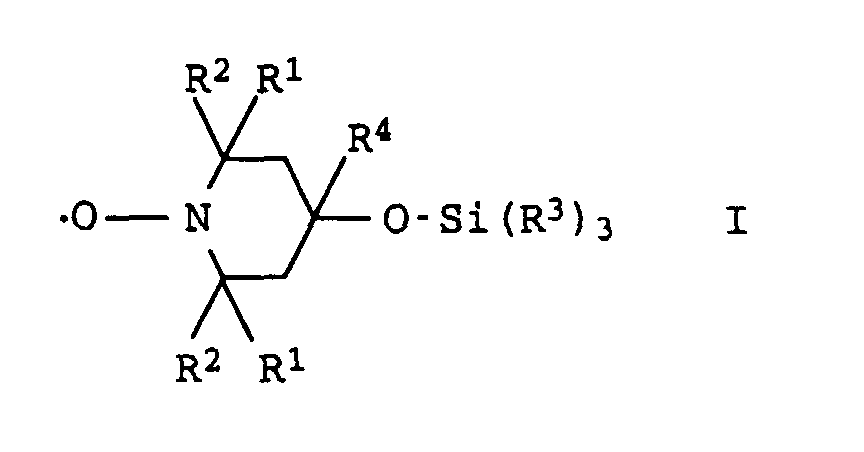
- R1, R2
- C1-C4-Alkyl oder gemeinsam mit dem C-Atom, an das sie gebunden sind, einen 5- oder 6-gliedrigen gesättigten Kohlenwasserstoffring,
- R3
- C1-C4-Alkyl und
- R4
- Wasserstoff oder C1-C12-Alkyl bedeuten.
| Beispiel | Inhibitorkonz. [Gew.-%] | Laufzeit [h] |
| 1 | 0,020 | >168 (> 168) |
| 2 | 0,010 | >168 (> 168) |
| 3 | 0,005 | >168 (124) |
| Vergleich | 0 | 25 (27) |
Claims (8)
- Verfahren zum Verdichten von ethylenisch ungesättigten Monomeren auf einen Druck zwischen 200 und 5000 bar in Abwesenheit eines Polymerisationsinitiators, dadurch gekennzeichnet, daß die Verdichtung in Gegenwart von Nitroxylverbindungen der Formel Ivorgenommen wird wobei

- R1, R2
- C1-C4-Alkyl oder gemeinsam mit dem C-Atom, an das sie gebunden sind, einen 5- oder 6-gliedrigen gesättigten Kohlenwasserstoffring,
- R3
- C1-C4-Alkyl und
- R4
- Wasserstoff oder C1-C12-Alkyl.
- Verfahren nach Anspruch 1, dadurch gekennzeichnet, daß als ethylenisch ungesättigte Monomere Gemische, enthaltend Ethylen, Propylen, Buten und/oder Butadien, eingesetzt werden.
- Verfahren nach Anspruch 1, dadurch gekennzeichnet, daß als ethylenisch ungesättigte Monomere Gemische, enthaltend Acrylsäure und/oder Methacrylsäure und/oder Derivate dieser Säuren, eingesetzt werden.
- Verfahren nach Anspruch 1, dadurch gekennzeichnet, daß als ethylenisch ungesättigte Monomere Gemische, enthaltend Ethylen und Acrylsäure oder Methacrylsäure, eingesetzt werden.
- Verfahren nach den Ansprüchen 1 bis 4, dadurch gekennzeichnet, daß die Verdichtung in Anwesenheit von Hydroxylaminen oder von aromatischen Nitro- oder Nitrosoverbindungen vorgenommen wird.
- Verfahren nach den Ansprüchen 1 bis 5, dadurch gekennzeichnet, daß die Verdichtung in Anwesenheit einer Verbindung aus der Gruppe der Chinone, der Phenothiazine und der Phenole vorgenommen wird.
- Verfahren zur Herstellung von Copolymeren, dadurch gekennzeichnet, daß man die Comonomeren einzeln oder gemischt nach einem Verfahren gemäß den Ansprüchen 1 bis 6 verdichtet und anschließend bei einer Temperatur zwischen 50 und 350°C durch Zugabe eines Polymerisationsinitiators polymerisiert.
- Copolymere erhältlich nach einem Verfahren gemäß Anspruch 7.
Applications Claiming Priority (2)
| Application Number | Priority Date | Filing Date | Title |
|---|---|---|---|
| DE19859391 | 1998-12-22 | ||
| DE19859391A DE19859391A1 (de) | 1998-12-22 | 1998-12-22 | Verfahren zum Verdichten ethylenisch ungesättigter Monomerer |
Publications (3)
| Publication Number | Publication Date |
|---|---|
| EP1013678A2 true EP1013678A2 (de) | 2000-06-28 |
| EP1013678A3 EP1013678A3 (de) | 2000-09-20 |
| EP1013678B1 EP1013678B1 (de) | 2002-03-20 |
Family
ID=7892211
Family Applications (1)
| Application Number | Title | Priority Date | Filing Date |
|---|---|---|---|
| EP99124190A Expired - Lifetime EP1013678B1 (de) | 1998-12-22 | 1999-12-03 | Verfahren zum Verdichten ethylenisch ungesättigter Monomerer |
Country Status (5)
| Country | Link |
|---|---|
| US (1) | US6350827B1 (de) |
| EP (1) | EP1013678B1 (de) |
| JP (1) | JP2000191558A (de) |
| AT (1) | ATE214714T1 (de) |
| DE (2) | DE19859391A1 (de) |
Cited By (1)
| Publication number | Priority date | Publication date | Assignee | Title |
|---|---|---|---|---|
| EP2589612A1 (de) | 2011-11-03 | 2013-05-08 | Basell Polyolefine GmbH | Verfahren zur Polymerisierung oder Copolymerisierung ethylenisch ungesättigter Monomere bei Vorhandensein von Radikalpolymerisationsinitiatoren |
Family Cites Families (4)
| Publication number | Priority date | Publication date | Assignee | Title |
|---|---|---|---|---|
| US5290888A (en) | 1990-07-20 | 1994-03-01 | Ciba-Geigy Corporation | Process for stabilizing ethylenically unsaturated compounds and stabilized monomer compositions |
| DE19622441A1 (de) * | 1996-06-05 | 1997-12-11 | Basf Ag | Verfahren zum Verdichten ethylenisch ungesättigter Monomerer |
| DE19725519A1 (de) * | 1997-06-17 | 1998-12-24 | Basf Ag | Stoffmischung, enthaltend vinylgruppenhaltige Verbindungen und Stabilisatoren |
| DE19739530C1 (de) | 1997-09-09 | 1998-12-24 | Siemens Ag | Schaltungsanordnung zur Erzeugung eines Interruptsignals für einen Mikroprozessor |
-
1998
- 1998-12-22 DE DE19859391A patent/DE19859391A1/de not_active Withdrawn
-
1999
- 1999-12-02 US US09/452,451 patent/US6350827B1/en not_active Expired - Fee Related
- 1999-12-03 DE DE59901005T patent/DE59901005D1/de not_active Expired - Fee Related
- 1999-12-03 EP EP99124190A patent/EP1013678B1/de not_active Expired - Lifetime
- 1999-12-03 AT AT99124190T patent/ATE214714T1/de not_active IP Right Cessation
- 1999-12-20 JP JP11361535A patent/JP2000191558A/ja not_active Withdrawn
Cited By (2)
| Publication number | Priority date | Publication date | Assignee | Title |
|---|---|---|---|---|
| EP2589612A1 (de) | 2011-11-03 | 2013-05-08 | Basell Polyolefine GmbH | Verfahren zur Polymerisierung oder Copolymerisierung ethylenisch ungesättigter Monomere bei Vorhandensein von Radikalpolymerisationsinitiatoren |
| WO2013064586A1 (en) | 2011-11-03 | 2013-05-10 | Basell Polyolefine Gmbh | Process for polymerizing or copolymerizing ethylenically unsaturated monomers in the presence of free-radical polymerization initiators |
Also Published As
| Publication number | Publication date |
|---|---|
| EP1013678A3 (de) | 2000-09-20 |
| DE59901005D1 (de) | 2002-04-25 |
| ATE214714T1 (de) | 2002-04-15 |
| EP1013678B1 (de) | 2002-03-20 |
| US6350827B1 (en) | 2002-02-26 |
| JP2000191558A (ja) | 2000-07-11 |
| DE19859391A1 (de) | 2000-06-29 |
Similar Documents
| Publication | Publication Date | Title |
|---|---|---|
| EP0811590B1 (de) | Verfahren zum Verdichten ethylenisch ungesättigter Monomerer | |
| EP0184083B1 (de) | Terpolymerisate des Ethylens, Verfahren zu ihrer Herstellung und ihre Verwendung | |
| DE69112735T2 (de) | Stabilisierte Monomerenzusammensetzungen. | |
| DE2514127C3 (de) | Verfahren zur Herstellung von Polymerisaten des N-vinylpyrrolidon-2 | |
| DE69724432T2 (de) | Polymerisationsinhibitor | |
| EP0471258B1 (de) | Verfahren zur Herstellung von Homooligomeren und Cooligomeren | |
| DD144782A5 (de) | Verfahren zur herstellung von n-vinylamid-polymeren | |
| EP1013678B1 (de) | Verfahren zum Verdichten ethylenisch ungesättigter Monomerer | |
| DE1720272C3 (de) | Verfahren zur Herstellung von Chloroprenpolymerisaten | |
| WO1997021744A1 (de) | Copolymerisate aus carbonsäuren und mehrfach olefinisch ungesättigten carbonsäurederivaten und ihre verwendung als verdickungs- oder dispergiermittel | |
| DE3642633A1 (de) | Verfahren zur herstellung von vinylpyrrolidon-polymerisaten | |
| DE69108626T2 (de) | Stabilisierte Monomerenzusammensetzungen. | |
| EP0463519B1 (de) | Verfahren zur Herstellung von Ethylen-/Vinylester-Copolymerisaten | |
| DE1493316A1 (de) | Stabilisierte monomere Acrylverbindungen | |
| DE19734171A1 (de) | Verfahren zur Stabilisierung von (Meth)acrylsäureestern gegen unerwünschte radikalische Polymerisation | |
| WO1999042501A2 (de) | Verfahren zur herstellung von polymeren aus n-vinylverbindungen | |
| EP0548764B1 (de) | Oxadimethacryl-Verbindungen und Verfahren zu ihrer Herstellung | |
| DE3444094A1 (de) | Copolymerisate des ethylens | |
| EP1218419B1 (de) | Polymerisationsverfahren | |
| EP0779901B1 (de) | Verfahren zur herstellung von ethylene-copolymeren | |
| DE2518622A1 (de) | Symmetrische azo-bis-merkaptoverbindungen | |
| EP1090044A1 (de) | Verfahren zur polymerisation und copolymerisation von ethylen | |
| DD140890A1 (de) | Vermeidung der hydrierung bei der herstellung niedermolekularer aethylenkopolymerer | |
| DE2806044A1 (de) | Vernetzte, mit wasser quellbare polymerisate aus inden und maleinsaeureanhydrid | |
| DE1919919B2 (de) | Verfahren zur herstellung eines copolymerisates aus maleinsaeureanhydrid und einem sterisch ungehinderten konjugierten dien |
Legal Events
| Date | Code | Title | Description |
|---|---|---|---|
| PUAI | Public reference made under article 153(3) epc to a published international application that has entered the european phase |
Free format text: ORIGINAL CODE: 0009012 |
|
| AK | Designated contracting states |
Kind code of ref document: A2 Designated state(s): AT BE CH CY DE DK ES FI FR GB GR IE IT LI LU MC NL PT SE |
|
| AX | Request for extension of the european patent |
Free format text: AL;LT;LV;MK;RO;SI |
|
| PUAL | Search report despatched |
Free format text: ORIGINAL CODE: 0009013 |
|
| AK | Designated contracting states |
Kind code of ref document: A3 Designated state(s): AT BE CH CY DE DK ES FI FR GB GR IE IT LI LU MC NL PT SE |
|
| AX | Request for extension of the european patent |
Free format text: AL;LT;LV;MK;RO;SI |
|
| RIC1 | Information provided on ipc code assigned before grant |
Free format text: 7C 08F 210/00 A, 7C 08F 10/00 B |
|
| RIN1 | Information on inventor provided before grant (corrected) |
Inventor name: WEBER, WILHELM, DR. Inventor name: DECKERS, ANDREAS, DR. Inventor name: SUTORIS, HEINZ FRIEDRICH, DR. |
|
| 17P | Request for examination filed |
Effective date: 20000829 |
|
| GRAG | Despatch of communication of intention to grant |
Free format text: ORIGINAL CODE: EPIDOS AGRA |
|
| 17Q | First examination report despatched |
Effective date: 20010406 |
|
| AKX | Designation fees paid |
Free format text: AT BE CH CY DE DK ES FI FR GB GR IE IT LI LU MC NL PT SE |
|
| GRAG | Despatch of communication of intention to grant |
Free format text: ORIGINAL CODE: EPIDOS AGRA |
|
| GRAH | Despatch of communication of intention to grant a patent |
Free format text: ORIGINAL CODE: EPIDOS IGRA |
|
| GRAH | Despatch of communication of intention to grant a patent |
Free format text: ORIGINAL CODE: EPIDOS IGRA |
|
| REG | Reference to a national code |
Ref country code: GB Ref legal event code: IF02 |
|
| GRAA | (expected) grant |
Free format text: ORIGINAL CODE: 0009210 |
|
| AK | Designated contracting states |
Kind code of ref document: B1 Designated state(s): AT BE CH CY DE DK ES FI FR GB GR IE IT LI LU MC NL PT SE |
|
| PG25 | Lapsed in a contracting state [announced via postgrant information from national office to epo] |
Ref country code: NL Free format text: LAPSE BECAUSE OF FAILURE TO SUBMIT A TRANSLATION OF THE DESCRIPTION OR TO PAY THE FEE WITHIN THE PRESCRIBED TIME-LIMIT Effective date: 20020320 Ref country code: IT Free format text: LAPSE BECAUSE OF FAILURE TO SUBMIT A TRANSLATION OF THE DESCRIPTION OR TO PAY THE FEE WITHIN THE PRE;WARNING: LAPSES OF ITALIAN PATENTS WITH EFFECTIVE DATE BEFORE 2007 MAY HAVE OCCURRED AT ANY TIME BEFORE 2007. THE CORRECT EFFECTIVE DATE MAY BE DIFFERENT FROM THE ONE RECORDED.SCRIBED TIME-LIMIT Effective date: 20020320 Ref country code: IE Free format text: LAPSE BECAUSE OF FAILURE TO SUBMIT A TRANSLATION OF THE DESCRIPTION OR TO PAY THE FEE WITHIN THE PRESCRIBED TIME-LIMIT Effective date: 20020320 Ref country code: GR Free format text: LAPSE BECAUSE OF FAILURE TO SUBMIT A TRANSLATION OF THE DESCRIPTION OR TO PAY THE FEE WITHIN THE PRESCRIBED TIME-LIMIT Effective date: 20020320 Ref country code: FI Free format text: LAPSE BECAUSE OF FAILURE TO SUBMIT A TRANSLATION OF THE DESCRIPTION OR TO PAY THE FEE WITHIN THE PRESCRIBED TIME-LIMIT Effective date: 20020320 |
|
| REF | Corresponds to: |
Ref document number: 214714 Country of ref document: AT Date of ref document: 20020415 Kind code of ref document: T |
|
| REG | Reference to a national code |
Ref country code: CH Ref legal event code: EP |
|
| REF | Corresponds to: |
Ref document number: 59901005 Country of ref document: DE Date of ref document: 20020425 |
|
| GBT | Gb: translation of ep patent filed (gb section 77(6)(a)/1977) |
Effective date: 20020527 |
|
| PG25 | Lapsed in a contracting state [announced via postgrant information from national office to epo] |
Ref country code: SE Free format text: LAPSE BECAUSE OF FAILURE TO SUBMIT A TRANSLATION OF THE DESCRIPTION OR TO PAY THE FEE WITHIN THE PRESCRIBED TIME-LIMIT Effective date: 20020620 Ref country code: PT Free format text: LAPSE BECAUSE OF FAILURE TO SUBMIT A TRANSLATION OF THE DESCRIPTION OR TO PAY THE FEE WITHIN THE PRESCRIBED TIME-LIMIT Effective date: 20020620 Ref country code: DK Free format text: LAPSE BECAUSE OF FAILURE TO SUBMIT A TRANSLATION OF THE DESCRIPTION OR TO PAY THE FEE WITHIN THE PRESCRIBED TIME-LIMIT Effective date: 20020620 |
|
| ET | Fr: translation filed | ||
| NLV1 | Nl: lapsed or annulled due to failure to fulfill the requirements of art. 29p and 29m of the patents act | ||
| ET | Fr: translation filed | ||
| PG25 | Lapsed in a contracting state [announced via postgrant information from national office to epo] |
Ref country code: ES Free format text: LAPSE BECAUSE OF FAILURE TO SUBMIT A TRANSLATION OF THE DESCRIPTION OR TO PAY THE FEE WITHIN THE PRESCRIBED TIME-LIMIT Effective date: 20020925 |
|
| REG | Reference to a national code |
Ref country code: IE Ref legal event code: FD4D |
|
| PG25 | Lapsed in a contracting state [announced via postgrant information from national office to epo] |
Ref country code: LU Free format text: LAPSE BECAUSE OF NON-PAYMENT OF DUE FEES Effective date: 20021203 Ref country code: AT Free format text: LAPSE BECAUSE OF NON-PAYMENT OF DUE FEES Effective date: 20021203 |
|
| PG25 | Lapsed in a contracting state [announced via postgrant information from national office to epo] |
Ref country code: CY Free format text: LAPSE BECAUSE OF FAILURE TO SUBMIT A TRANSLATION OF THE DESCRIPTION OR TO PAY THE FEE WITHIN THE PRESCRIBED TIME-LIMIT Effective date: 20021231 |
|
| PLBE | No opposition filed within time limit |
Free format text: ORIGINAL CODE: 0009261 |
|
| STAA | Information on the status of an ep patent application or granted ep patent |
Free format text: STATUS: NO OPPOSITION FILED WITHIN TIME LIMIT |
|
| 26N | No opposition filed |
Effective date: 20021223 |
|
| PG25 | Lapsed in a contracting state [announced via postgrant information from national office to epo] |
Ref country code: MC Free format text: LAPSE BECAUSE OF NON-PAYMENT OF DUE FEES Effective date: 20030701 |
|
| PG25 | Lapsed in a contracting state [announced via postgrant information from national office to epo] |
Ref country code: LI Free format text: LAPSE BECAUSE OF NON-PAYMENT OF DUE FEES Effective date: 20031231 Ref country code: CH Free format text: LAPSE BECAUSE OF NON-PAYMENT OF DUE FEES Effective date: 20031231 |
|
| REG | Reference to a national code |
Ref country code: CH Ref legal event code: PL |
|
| PGFP | Annual fee paid to national office [announced via postgrant information from national office to epo] |
Ref country code: GB Payment date: 20071128 Year of fee payment: 9 Ref country code: FR Payment date: 20071210 Year of fee payment: 9 |
|
| PGFP | Annual fee paid to national office [announced via postgrant information from national office to epo] |
Ref country code: DE Payment date: 20071129 Year of fee payment: 9 |
|
| PGFP | Annual fee paid to national office [announced via postgrant information from national office to epo] |
Ref country code: BE Payment date: 20080327 Year of fee payment: 9 |
|
| BERE | Be: lapsed |
Owner name: *BASF A.G. Effective date: 20081231 |
|
| GBPC | Gb: european patent ceased through non-payment of renewal fee |
Effective date: 20081203 |
|
| PG25 | Lapsed in a contracting state [announced via postgrant information from national office to epo] |
Ref country code: BE Free format text: LAPSE BECAUSE OF NON-PAYMENT OF DUE FEES Effective date: 20081231 |
|
| REG | Reference to a national code |
Ref country code: FR Ref legal event code: ST Effective date: 20090831 |
|
| PG25 | Lapsed in a contracting state [announced via postgrant information from national office to epo] |
Ref country code: DE Free format text: LAPSE BECAUSE OF NON-PAYMENT OF DUE FEES Effective date: 20090701 |
|
| PG25 | Lapsed in a contracting state [announced via postgrant information from national office to epo] |
Ref country code: GB Free format text: LAPSE BECAUSE OF NON-PAYMENT OF DUE FEES Effective date: 20081203 |
|
| PG25 | Lapsed in a contracting state [announced via postgrant information from national office to epo] |
Ref country code: FR Free format text: LAPSE BECAUSE OF NON-PAYMENT OF DUE FEES Effective date: 20081231 |