EP1014766A2 - Flexible Platte - Google Patents
Flexible Platte Download PDFInfo
- Publication number
- EP1014766A2 EP1014766A2 EP99125418A EP99125418A EP1014766A2 EP 1014766 A2 EP1014766 A2 EP 1014766A2 EP 99125418 A EP99125418 A EP 99125418A EP 99125418 A EP99125418 A EP 99125418A EP 1014766 A2 EP1014766 A2 EP 1014766A2
- Authority
- EP
- European Patent Office
- Prior art keywords
- polyimide
- based resin
- resin layer
- coefficient
- thermal expansion
- Prior art date
- Legal status (The legal status is an assumption and is not a legal conclusion. Google has not performed a legal analysis and makes no representation as to the accuracy of the status listed.)
- Granted
Links
Images
Classifications
-
- H—ELECTRICITY
- H05—ELECTRIC TECHNIQUES NOT OTHERWISE PROVIDED FOR
- H05K—PRINTED CIRCUITS; CASINGS OR CONSTRUCTIONAL DETAILS OF ELECTRIC APPARATUS; MANUFACTURE OF ASSEMBLAGES OF ELECTRICAL COMPONENTS
- H05K1/00—Printed circuits
- H05K1/02—Details
- H05K1/03—Use of materials for the substrate
- H05K1/0313—Organic insulating material
- H05K1/032—Organic insulating material consisting of one material
- H05K1/0346—Organic insulating material consisting of one material containing N
-
- H—ELECTRICITY
- H05—ELECTRIC TECHNIQUES NOT OTHERWISE PROVIDED FOR
- H05K—PRINTED CIRCUITS; CASINGS OR CONSTRUCTIONAL DETAILS OF ELECTRIC APPARATUS; MANUFACTURE OF ASSEMBLAGES OF ELECTRICAL COMPONENTS
- H05K1/00—Printed circuits
- H05K1/02—Details
- H05K1/03—Use of materials for the substrate
- H05K1/0313—Organic insulating material
- H05K1/0353—Organic insulating material consisting of two or more materials, e.g. two or more polymers, polymer + filler, + reinforcement
- H05K1/036—Multilayers with layers of different types
-
- H—ELECTRICITY
- H05—ELECTRIC TECHNIQUES NOT OTHERWISE PROVIDED FOR
- H05K—PRINTED CIRCUITS; CASINGS OR CONSTRUCTIONAL DETAILS OF ELECTRIC APPARATUS; MANUFACTURE OF ASSEMBLAGES OF ELECTRICAL COMPONENTS
- H05K2201/00—Indexing scheme relating to printed circuits covered by H05K1/00
- H05K2201/01—Dielectrics
- H05K2201/0137—Materials
- H05K2201/0154—Polyimide
-
- H—ELECTRICITY
- H05—ELECTRIC TECHNIQUES NOT OTHERWISE PROVIDED FOR
- H05K—PRINTED CIRCUITS; CASINGS OR CONSTRUCTIONAL DETAILS OF ELECTRIC APPARATUS; MANUFACTURE OF ASSEMBLAGES OF ELECTRICAL COMPONENTS
- H05K2201/00—Indexing scheme relating to printed circuits covered by H05K1/00
- H05K2201/06—Thermal details
- H05K2201/068—Thermal details wherein the coefficient of thermal expansion is important
-
- Y—GENERAL TAGGING OF NEW TECHNOLOGICAL DEVELOPMENTS; GENERAL TAGGING OF CROSS-SECTIONAL TECHNOLOGIES SPANNING OVER SEVERAL SECTIONS OF THE IPC; TECHNICAL SUBJECTS COVERED BY FORMER USPC CROSS-REFERENCE ART COLLECTIONS [XRACs] AND DIGESTS
- Y10—TECHNICAL SUBJECTS COVERED BY FORMER USPC
- Y10T—TECHNICAL SUBJECTS COVERED BY FORMER US CLASSIFICATION
- Y10T428/00—Stock material or miscellaneous articles
- Y10T428/31504—Composite [nonstructural laminate]
- Y10T428/31678—Of metal
- Y10T428/31681—Next to polyester, polyamide or polyimide [e.g., alkyd, glue, or nylon, etc.]
-
- Y—GENERAL TAGGING OF NEW TECHNOLOGICAL DEVELOPMENTS; GENERAL TAGGING OF CROSS-SECTIONAL TECHNOLOGIES SPANNING OVER SEVERAL SECTIONS OF THE IPC; TECHNICAL SUBJECTS COVERED BY FORMER USPC CROSS-REFERENCE ART COLLECTIONS [XRACs] AND DIGESTS
- Y10—TECHNICAL SUBJECTS COVERED BY FORMER USPC
- Y10T—TECHNICAL SUBJECTS COVERED BY FORMER US CLASSIFICATION
- Y10T428/00—Stock material or miscellaneous articles
- Y10T428/31504—Composite [nonstructural laminate]
- Y10T428/31721—Of polyimide
Definitions
- the present invention relates to a flexible board obtained by forming a polyimide insulating layer of a three-layer structure on metal foil.
- Products as obtained by pasting a single-layer polyimide film (insulating layer) to copper foil by thermocompression bonding with the aid of adhesives are widely used as typical single-sided flexible boards.
- thermocompression bonding Since copper foil and polyimide films are not the same in terms of their coefficients of linear thermal expansion, cooling such single-sided flexible boards following thermocompression bonding sometimes causes curling, twisting, warping, or the like.
- These flexible printed boards have laminated polyimide-based resin layers whose three-layer structure on a copper foil used as a conductor comprises a first polyimide-based resin layer that has a coefficient of linear thermal expansion of 20 ⁇ 10 -6 /K or greater and that is formed by means of coating on the copper foil side, a second polyimide-based resin layer that has a coefficient of linear thermal expansion of less than 20 ⁇ 10 -6 /K and that is formed by means of coating in the same manner on the first layer, and a third polyimide-based resin layer that has a coefficient of linear thermal expansion of 20 ⁇ 10 -6 /K or greater and that is further formed by means of coating on the second layer.
- the specific relation among the coefficients of linear thermal expansion of the first polyimide-based resin layer (coefficient of linear thermal expansion: k 1 ), second polyimide-based resin layer (coefficient of linear thermal expansion: k 2 ), and third polyimide-based resin layer (coefficient of linear thermal expansion: k 3 ) is expressed as k 3 ⁇ k 1 > k 2 , as shown in Table 1 below (see Working Examples 8 to 12 and Table 2 in Japanese Patent No.2746555).
- the coefficient of linear thermal expansion (K 0 ) of a laminated film (substantially corresponds to a laminated polyimide-based resin film having a three-layer structure) following conductor etching is 9 to 11 ⁇ 10 -6 /K.
- the flexible printed board described in Japanese Patent 2746555 has a large difference in the coefficient of linear thermal expansion (8 to 11 ⁇ 10 -6 /K) between the electrolytic copper foil (coefficient of linear thermal expansion following polyimidation heat treatment: about 19 x 10 -6 /K) and the laminated polyimide-based resin layer (coefficient of linear thermal expansion: about 9 to 11 ⁇ 10 -6 /K), so the board undergoes substantial curling, twisting, or warping following copper foil etching when the flexible printed board is cooled to room temperature and allowed to shrink following imidation heat treatment.
- the coefficient of linear thermal expansion of copper foil is greater than the coefficient of linear thermal expansion of the laminated polyimide-based resin layer, so the board contracts and curls such that a convexity is formed on the laminated polyimide-based resin layer side.
- the coefficient of linear thermal expansion of the third polyimide-based resin layer is equal to or greater than the coefficient of linear thermal expansion of the first polyimide-based resin layer, so the curling of the entire laminated polyimide-based resin layer fails to produce a convexity on the copper foil side despite the fact that the presence of a convex curl on the copper foil side is preferred, taking into account the lamination of a cover layer on a circuit pattern following the formation and treatment of this circuit pattern.
- a resulting drawback is that when curling occurs in such a way that a convexity forms on the laminated polyimide-based resin layer side of the flexible printed board, it is difficult to hold the board by vacuum chucking (with the copper foil side facing up) in order to pattern the copper foil, and when the board is transported along a line, the ends of the board curl up and become caught or otherwise damaged in a transporting device during transport.
- An object of the present invention is to overcome the above-described drawbacks of the prior art and to provide a flexible board obtained by forming a laminated polyimide-based resin layer having a three-layer structure and serving as an insulating layer on metal foil, wherein this flexible board is configured such that the curling is absent or is negligibly small following metal foil patterning or imidation heat treatment, and that a convexity is formed on the metal foil side when slight curling does occur.
- the present invention provides a flexible board, comprising a metal foil and provided thereon a laminated polyimide-based resin layer of a three-layer structure comprising a first polyimide-based resin layer, a second polyimide-based resin layer, and a third polyimide-based resin layer, wherein said flexible board satisfies the equation k 1 > k 3 > k 2 where k 1 is the coefficient of linear thermal expansion of the first polyimide-based resin layer on the metal foil side, k 2 is the coefficient of linear thermal expansion of the second polyimide-based resin layer, and k 3 is the coefficient of linear thermal expansion of the third polyimide-based resin layer.
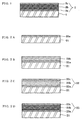
- the flexible board of the present invention is configured such that a laminated polyimide-based resin layer 2 of a three-layer structure comprising a first polyimide-based resin layer 2a on the metal foil side, a second polyimide-based resin layer 2b, and a third polyimide-based resin layer 2c is formed on a metal foil 1, as shown in Fig. 1.
- k 1 > k 3 > k 2 where k 1 is the coefficient of linear thermal expansion of the first polyimide-based resin layer on the metal foil side, k 2 is the coefficient of linear thermal expansion of the second polyimide-based resin layer, and k 3 is the coefficient of linear thermal expansion of the third polyimide-based resin layer. If this equation is not satisfied, substantial curling occurs following imidation heat treatment or metal foil patterning, and the resulting curling sometimes fails to form a convexity on the metal foil side. Based on this fact, the first polyimide-based resin layer, second polyimide-based resin layer, and third polyimide-based resin layer will now be described in detail.
- an important function of the first polyimide-based resin layer 2a in contact with the metal foil 1 is to bond the laminated polyimide-based resin layer 2 to the metal foil 1.
- a resin whose coefficient of linear thermal expansion has been increased by the introduction of sulfonic groups or other polar functional groups commonly has lower heat resistance but better adhesion to metal foil than does a resin with a lower coefficient of linear thermal expansion.
- the coefficient of linear thermal expansion k 1 of the first polyimide-based resin layer 2a is set higher than the coefficient of linear thermal expansion k 2 of the second polyimide-based resin layer 2b in order to ensure proper adhesion to the metal foil 1 while allowing the laminated polyimide-based resin layer 2 as a whole to maintain its heat resistance.
- the specific coefficient of linear thermal expansion k 1 of the first polyimide-based resin layer 2a should be set to 20 ⁇ 10 -6 /K or higher, and preferably 25 to 50 ⁇ 10 -6 /K.
- the coefficient of linear thermal expansion k 1 of the first polyimide-based resin layer 2a can be adjusted by varying the below-described types of starting material components or the mixing rates thereof.
- varnishes include polyamic acids obtained from acid dianhydrides and diamines (see Japanese Patent Application Laid-open Nos. SHO60-157286, SHO60-243120, SHO63-239998.
- HEI1-245586, HEI3-123093, and HEI5-139027 partially imidated polyimide amic acids obtained from diisocyanate compounds and polyamic acid prepolymers, which have terminal acid dianhydrides and which are synthesized from excess acid dianhydrides and diamines (see “Polyamide Resin Handbook,” Published by Nikkan Kogyo Shinbunsha, p. 536, 1988); polyamide-imide resins obtained from diisocyanate compounds, diamines, and acid anhydrides (tricarboxylic anhydrides) having free carboxylic acid groups (see "Practical Plastics Dictionary,” p. 485, Compiled by Sangyo Chosakai, 1993; Japanese Patent Application Laid-open Nos.
- a low-acidity polyimide-based resin layer may preferably be used because it prevents the metal foil 1 from becoming corroded. Consequently, a low-acidity polyamic acid imidated film, or a soluble polyimide film or polyamide-imide film devoid of acid groups can be used to advantage.
- polyamide-imide resins which are high-melting thermoplastic resins, are preferred for use because of their ability to relax the stress induced in flexible boards during an imidation heat treatment or other high-temperature heat treatment.
- Preferred examples of acid dianhydrides that can be used as the starting materials constituting the first polyimide-based resin layer 2a include pyromellitic dianhydride (PMDA), 3,4,3',4'-biphenyltetracarboxylic dianhydride (BPDA), 3,4,3'4'-benzophenonetetracarboxylic dianhydride (BTDA), 3,4,3',4'-diphenylsulfonetetracarboxylic dianhydride (DSDA), and 3,4,3',4'-diphenylethertetracarboxylic dianhydride (DEDA).
- PMDA pyromellitic dianhydride
- BPDA 3,4,3',4'-biphenyltetracarboxylic dianhydride
- BTDA 3,4,3'4'-benzophenonetetracarboxylic dianhydride
- DSDA 3,4,3',4'-diphenylsulfonetetracar
- tricarboxylic anhydrides include trimellitic anhydride, 3,3',4-benzophenonetricarboxylic anhydride, and 2,3,4'-diphenyltricarboxylic anhydride.
- diamines include 4,4'-diaminodiphenyl ether (DPE), paraphenylenediamine ( p -PDA), orthophenylenediamine ( o -PDA), metaphenylenediamine ( m -PDA), 2,4-diaminotoluene (TDA), 3,3'-dimethyl-4,4'-diaminobiphenyl (DMDBP), 4,4'-diaminobenzanilide (DABA), and 4,4'-bis( p -aminophenoxy)diphenyl sulfone (BAPS).
- DPE 4,4'-diaminodiphenyl ether
- p -PDA paraphenylenediamine
- o -PDA orthophenylenediamine
- m -PDA metaphenylenediamine
- TDA 3,3'-dimethyl-4,4'-diaminobiphenyl
- DABA 4,4'-di
- diisocyanate compounds include 4,4'-diphenylmethane diisocyanate, 2,4-tolylene diisocyanate, tolidine isocyanate, 1,5-naphthalene diisocyanate, xylylene diisocyanate, and hexamethylene diisocyanate.
- the second polyimide-based resin layer 2b functions to ensure that the entire laminated polyimide-based resin layer 2 has proper heat resistance and to bring its coefficient close to the coefficient of linear thermal expansion k m of the metal foil 1. Consequently, the difference between the coefficient of linear thermal expansion k 2 of the second polyimide-based resin layer 2b and the coefficient of linear thermal expansion k m of the metal foil 1 is adjusted preferably to within ⁇ 5 ⁇ 10 -6 /K, and more preferably to within ⁇ 3 ⁇ 10 -6 /K.
- the curling of the flexible board can thus be controlled irrespective of the specifics of an ordinary heat history (storage at normal temperature, solder dipping, and the like).
- the specific coefficient of linear thermal expansion k 2 of the second polyimide-based resin layer 2b may be preferably (10 to 25) ⁇ 10 -6 /K, and more preferably (17 to 23) ⁇ 10 -6 /K, in view of the fact that the coefficient of linear thermal expansion k m of an imidation heat-treated metal foil 1 commonly used for the flexible board assumes the numerical values shown in Table 2 below. Similar to the first polyimide-based resin layer 2a, the coefficient of linear thermal expansion k 2 of the second polyimide-based resin layer 2b can be adjusted by varying the types of starting material components or the mixing rates thereof.
- the second polyimide-based resin layer 2b having the above-described characteristics can be fashioned by forming films of polyamic acids, polyimide amic acids, polyamide-imide acids, soluble imide resins or other varnishes, and optionally imidating these films.
- the third polyimide-based resin layer 2c is provided to one side of the second polyimide-based resin layer 2b as a layer whose coefficient of linear thermal expansion compensates for that of the first polyimide-based resin layer 2a in order to control the curling of the laminated polyimide-based resin layer 2 per se when large areas of the metal foil 1 are removed and both sides of the laminated polyimide-based resin layer 2 are exposed during the patterning of the metal foil 1. Consequently, the coefficient of linear thermal expansion k 3 of the third polyimide-based resin layer 2c in the present invention is set higher than the coefficient of linear thermal expansion k 2 of the second polyimide-based resin layer 2b.
- the surface roughness imparted to the metal foil and designed to improve adhesion to a polyimide layer acts to form a convexity in the curling direction of the metal foil, that is, causes the first polyimide-based resin layer 2a to form a convexity on the side of the metal foil 1, because shrinkage force acting on the surface along which the metal foil is bonded to the polyimide layer is created by an increase in the adhesion between the metal foil and the polyimide layer when the flexible board is substantially uncurled or forms a slight convexity on the side of the metal foil 1.
- the coefficient of linear thermal expansion k 3 of the third polyimide-based resin layer 2c must be set lower than the coefficient of linear thermal expansion k 1 of the first polyimide-based resin layer 2a in order to compensate for such curling.
- the difference (k 1 - k 3 ) between the coefficient of linear thermal expansion k 1 of the first polyimide-based resin layer 2a and the coefficient of linear thermal expansion k 3 of the third polyimide-based resin layer 2c may be confined preferably to +5 ⁇ 10 -6 /K, and more preferably to +3 ⁇ 10 -6 /K.
- the coefficient of linear thermal expansion k 0 of the entire laminated polyimide-based resin layer 2 comprising the above-described first polyimide-based resin layer 2a, second polyimide-based resin layer 2b, and third polyimide-based resin layer 2c may be preferably (10 to 30) ⁇ 10 -6 /K, and more preferably (17 to 28) ⁇ 10 -6 /K.
- This coefficient is set higher than the coefficient of linear thermal expansion k m of the metal foil 1 in order to control curling or to form a convexity on the side of the metal foil 1 when slight curling does occur.
- the difference (k 0 - k m ) between them may be preferably 0 to +7 ⁇ 10 -6 /K, and more preferably 0 to +5 ⁇ 10 -6 /K.
- the thicknesses of the first polyimide-based resin layer 2a, second polyimide-based resin layer 2b, and third polyimide-based resin layer 2c may be set preferably such that the thickness t 2 of the second polyimide-based resin layer 2b is greater than the thickness t 1 of the first polyimide-based resin layer 2a or the thickness t 3 of the third polyimide-based resin layer 2c.
- the thickness t 2 of the second polyimide-based resin layer 2b may be preferably 5 to 100 ⁇ m, and more preferably 10 to 50 ⁇ m, because an excessively thin layer lowers the mechanical strength of the entire laminated polyimide-based resin layer, whereas an excessively thick layer increases the stiffness of the laminated polyimide-based resin layer per se and makes it impossible to obtain roll-wound articles of prescribed size.
- the thickness t 1 of the first polyimide-based resin layer 2a or the thickness t 3 of the third polyimide-based resin layer 2c may be preferably 1 to 10 ⁇ m, and more preferably 2 to 5 ⁇ m, because an excessively thin layer is difficult to form, whereas an excessively thick layer may increase the difference between the coefficient of linear thermal expansion k m of the metal foil 1 and the coefficient of linear thermal expansion k 0 of the entire laminated polyimide-based resin layer 2, which depends on the coefficient of linear thermal expansion k 2 of the second polyimide-based resin layer 2b.
- the ratio t 1 /t 3 of the thickness t 1 of the first polyimide-based resin layer 2a and the thickness t 3 of the third polyimide-based resin layer 2c may be preferably 0.5 to 2.0, and more preferably 1.0 to 2.0. With the ratio within this range, it is possible to achieve higher efficiency in preventing the flexible board from curling.
- a heat-resistant resin other than a polysulfone an adhesive such as an epoxy adhesive, a rust inhibitor such as a triazole or imidazole, or the like may also be added as needed to the first polyimide-based resin layer 2a, second polyimide-based resin layer 2b, and third polyimide-based resin layer 2c.
- an adhesive such as an epoxy adhesive, a rust inhibitor such as a triazole or imidazole, or the like may also be added as needed to the first polyimide-based resin layer 2a, second polyimide-based resin layer 2b, and third polyimide-based resin layer 2c.
- SUS 304 foil, SUS 430 foil, aluminum foil, beryllium-copper foil, phosphor bronze foil, or the like may be used as the metal foil 1.
- the surface of the metal foil 1 may also be subjected to matting, Ni/Zn plating, oxidation, or the like in order to improve adhesion to the laminated polyimide-based resin layer 2. It is also possible to perform an aluminum alcoholate treatment, aluminum chelate treatment, silane coupling treatment, imidazole treatment, or other chemical treatment.
- a metal foil 21 is coated with a polyamic acid varnish for forming the first polyimide-based resin layer by a comma coater, knife coater, roll coater, lip coater, gravure coater, die coater, or the like, and the coated foil is dried in a continuous drying furnace (arch-type furnace, floating furnace, or the like) to prevent foaming and to bring the content of residual volatile fractions (solvents, condensed water, and the like) to within a range of 20 to 30 wt%, yielding a polyimide precursor film 22a (Fig. 2A).
- a continuous drying furnace architectural-type furnace, floating furnace, or the like
- a volatile fraction content below 20 wt% creates a danger that the adhesion between the first polyimide-based resin layer and second polyimide-based resin layer will be inadequate, while a content in excess of 30 wt% fails to stabilize the coefficient of contraction or the adhesive strength between the first polyimide-based resin layer and second polyimide-based resin layer.
- the term “content of residual volatile fractions” refers to the weight percentage (wt%) of all the volatile components in the polyimide precursor film.
- the first polyimide precursor film 22a is subsequently coated in the same manner with a polyamic acid varnish for forming a second polyimide-based resin layer, and the coated film is dried to bring the content of residual volatile fractions to within a range of 30 to 50 wt%, yielding a second polyimide precursor film 22b (Fig. 2B).
- a second polyimide precursor film 22b Fig. 2B
- it is unsuitable for the content of residual volatile fractions to fall below 30 wt% or to exceed 50 wt% because in the first case there is a danger that the adhesion between the first polyimide-based resin layer and second polyimide-based resin layer will be inadequate, and in the second case foaming occurs during imidation.
- the second polyimide precursor film 22b is subsequently coated in the same manner with a polyamic acid varnish for forming a third polyimide-based resin layer, and the coated film is dried to bring the content of residual volatile fractions to within a range of 30 to 50 wt%, yielding a third polyimide precursor film 22c.
- a laminated polyimide precursor film 22 having a three-layer structure is thereby obtained (Fig. 2C).
- the laminated polyimide precursor film 22 is subsequently imidated.
- the imidation is carried out by performing a heat treatment in a continuous furnace at a temperature of 210 to 250°C, and preferably 230 to 240°C, to set the content of residual volatile fractions to a level that is preferably 7 to 10%, and to bring the imidation ratio to 50% or lower.
- Imidation ratio is a value calculated by IR absorption spectrum analysis (surface reflection technique (ATR technique) on the basis of the absorption of imide groups at an absorption wavelength of 1780 cm -1 , in relation to the absorption observed when the same sample is 100% imidated.) It is unsuitable in this case for the content of residual volatile fractions to fall below 7% or to exceed 10% because in the first case it is impossible to adequately control curling, and in the second case blocking tends to occur. In addition, an imidation ratio that is greater than 50% makes it impossible to achieve adequate curling control.
- the heating temperature it is unsuitable for the heating temperature to fall below 210°C or to exceed 250°C because when below 210°C the content of residual volatile fractions is higher than 7%, and when above 250°C the imidation ratio is higher than 50%.
- the laminated polyimide precursor layer 22 is transformed into a laminated polyimide-based resin layer 23 whose three-layer structure comprises a first polyimide-based resin layer 23a, a second polyimide-based resin layer 23b, and a third polyimide-based resin layer 23c (Fig. 2D).
- a flexible board of the present invention such as that shown in Fig. 1 is thus obtained.
- the flexible board of the present invention also has excellent dimensional stability in the crosswise and longitudinal directions because the coefficient of contraction thereof remains stable irrespective of the heat history. Correction values can therefore be kept constant during circuit design, and circuits can be designed with greater ease. In addition, metal foil is easier to pattern, and fine patterning can be readily performed.
- the flexible board of the present invention also has adequate roll winding characteristics in relation to curling because the adhesive strength between the metal foil and the laminated polyimide-based resin layer remains stable in the crosswise and longitudinal directions.
- 2,4-Tolylene diisocyanate (TODI) was subsequently added in an amount of 69.6 g (0.4 mol) to the prepolymer solution, and the system was slowly heated to 60°C. Carbon dioxide bubbles were observed forming at the start of the reaction, and the system thickened. The reaction was continued for another 2 hours while 2.8 kg N -methyl-2-pyrrolidone was added in portions. A viscous polyimide amic acid varnish with a solids content of about 8.5% and a viscosity of 20 Pa ⁇ S was obtained as a result (imidation ratio of charge (molar percentage of diisocyanate compound): 40%).
- the resulting polyimide amic acid varnish was applied to copper foil, the solvent was vaporized in a 80 to 160°C continuous furnace, the atmosphere temperature was raised to 230 to 350°C, and an imidation treatment was performed for 10 minutes at 350°C.
- the copper foil was etched away in a ferric chloride solution, yielding a single-layer polyimide film with a thickness of 25 ⁇ m.
- the coefficient of linear thermal expansion of the resulting polyimide film was 35 ⁇ 10 -6 /K.
- a thermomechanical analyzer (TMA/SCC 150CU) manufactured by SII was used at an operating load of 2.5 to 5 g according to a tension technique.
- a viscous polyimide amic acid varnish (imidation ratio of charge (molar percentage of diisocyanate compound): 40%) was obtained by repeating the same procedures as in Reference Example A1 except that 3,4,3',4'-biphenyltetracarboxylic dianhydride (BPDA) was used instead of the PMDA, and 4,4'-diphenylmethane diisocyanate (MDI) was used instead of the TODI.
- BPDA 3,4,3',4'-biphenyltetracarboxylic dianhydride
- MDI 4,4'-diphenylmethane diisocyanate
- a single-layer polyimide film was obtained by treating the resulting polyimide amic acid varnish in the same manner as in Reference Example A1.
- the coefficient of linear thermal expansion of the resulting polyimide film was 48 ⁇ 10 -6 /K.
- Reference Examples A1 and A2 are shown in Table 3.
- Reference Example Acid dianhydride (number of moles) Diamine (number of moles) Diisocyanate (number of moles) Coefficient of linear thermal expansion ( ⁇ 10 -6 /K)
- A1 PMDA (1.0) DPE (0.6) TODI (0.4) 30
- A2 BPDA (1.0) DPE (0.6) MDI (0.4) 48
- Trimellitic anhydride (TMA; 192 g, or 1.0 mol), 4,4'-diaminodiphenylmethane (DMA; 158.4 g, or 0.8 mol), and N -methyl-2-pyrrolidone (NMP; 350 g) were added in a single batch to a separable flask, and the system was slowly heated in an oil bath under agitation while dry nitrogen gas was passed in order to rapidly remove formation water. The temperature of the oil bath reached 240°C one hour later. A reaction was allowed to occur for 4 hours in this state, and the temperature of the oil bath was then lowered to 120°C.
- TMA 4,4'-diaminodiphenylmethane
- NMP N -methyl-2-pyrrolidone
- a single-layer polyamide-imide resin film was obtained by treating the resulting polyamide-imide resin varnish in the same manner as in Reference Example A1.
- the coefficient of linear thermal expansion of the resulting polyamide-imide resin film was 50 ⁇ 10 -6 /K.
- a viscous polyamide-imide resin varnish was obtained by repeating the same procedures as in Reference Example B1 except that 4,4'-diaminodiphenyl ether (DPE) was used instead of the DMA.
- DPE 4,4'-diaminodiphenyl ether
- a single-layer polyamide-imide resin film was obtained by treating the resulting polyamide-imide resin in the same manner as in Reference Example A1.
- the coefficient of linear thermal expansion of the resulting polyamide-imide resin film was 34 x 10 -6 /K.
- Reference Examples B1 and B2 are shown in Table 4.
- Reference Example Acid anhydride T (mol) Diamine A (mol) Diisocyanate I (mol) Molar ratio T/A (A+I)/T Coefficient of linear thermal expansion ( ⁇ 10 -6 /K)
- B1 TMA (1.0) DMA (0.8) MDI (0.25) 1.25 50 1.05
- B2 TMA (1.0) DPE (0.8) MDI (0.25) 1.25 34 1.05
- PDA Paraphenylenediamine
- DPE 4,4'-diaminodiphenyl ether
- NMP solvent N -methyl-2-pyrrolidone
- PMDA Pyromellitic dianhydride
- a single-layer polyimide resin film was obtained by treating the resulting polyamic acid varnish in the same manner as in Reference Example A1.
- the coefficient of linear thermal expansion of the resulting polyimide film was 30 ⁇ 10 -6 /K.
- polyamic acid varnishes were prepared by repeating the procedures of Reference Example C1.
- Table 6 shows the metal foil used in the working and comparative examples.
- the metal foil articles used were subjected to the imidation treatment described below, and the coefficients of linear thermal expansion thereof were measured. The results are shown in Table 6.
- Metal foil Coefficient of linear thermal expansion following imidation treatment Cu foil (electrolytic copper foil of 18 ⁇ m thickness; CF-T9-LP, manufactured by Fukuda Kinzoku) 19.0 ⁇ 10 -6 /K SUS foil (stainless steel foil of 25 ⁇ m thickness; SUS 304, manufactured by Nippon Steel Corp.) 17.5 ⁇ 10 -6 /K Al foil (aluminum foil of 25 ⁇ m thickness, manufactured by Nippon Foil Mfg.) 24.0 ⁇ 10 -6 /K
- the metal foil (width: 540 mm) shown in Table 6 was coated to an intended dry film thickness with a varnish (polyimide amic acid varnish, polyamide-imide resin varnish, or polyamic acid varnish) shown in Table 7 and designed for the first polyimide-based resin layer, and the coated foil was dried at a temperature of 80 to 170°C using a floating furnace, yielding a first polyimide-based resin precursor film.
- a varnish polyimide amic acid varnish, polyamide-imide resin varnish, or polyamic acid varnish
- the content of residual volatile fractions in the first polyimide-based resin precursor film of Working Example 1 was 25%.
- the first polyimide-based resin precursor film was coated to an intended dry film thickness with a varnish (polyimide amic acid varnish, polyamide-imide resin varnish, or polyamic acid varnish) shown in Table 7 and designed for the second polyimide-based resin layer, and the coated foil was dried at a temperature of 80 to 170°C using a floating furnace, yielding a second polyimide-based resin precursor film.
- a varnish polyimide amic acid varnish, polyamide-imide resin varnish, or polyamic acid varnish
- the content of residual volatile fractions in the laminated film obtained by combining the first polyimide-based resin precursor film and second polyimide-based resin precursor film of Working Example 1 was 40%.
- the second polyimide-based resin precursor film was coated to an intended dry film thickness with a varnish (polyimide amic acid varnish, polyamide-imide resin varnish, or polyamic acid varnish) of Table 7 for the third polyimide-based resin layer, and the coated foil was dried, yielding a third polyimide-based resin precursor film.
- a varnish polyimide amic acid varnish, polyamide-imide resin varnish, or polyamic acid varnish
- the content of residual volatile fractions in the laminated film obtained by combining the first polyimide-based resin precursor film, second polyimide-based resin precursor film, and third polyimide-based resin precursor film of Working Example 1 was 38%.
- a laminate obtained by forming a laminated polyimide precursor film on metal foil in accordance with the above-described procedures was subsequently heat-treated in a continuous furnace at 230°C.
- the corresponding content of residual volatile fractions was 7.9%, and the imidation ratio, as measured by IR spectral analysis, was 20%.
- the heat-treated laminate 100 m was then wound on a stainless steel pipe having a diameter of 250 mm, with the metal foil facing inward, placed in a batch oven with a nitrogen gas atmosphere (oxygen concentration: 0.1% or less), heated to 350°C over a period of 1 hour, and kept at 350°C for 15 minutes. The temperature was then reduced to 200°C in a nitrogen gas atmosphere, and the product was cooled in the atmosphere.
- a flexible board clad with metal foil on one side was thus obtained.
- the laminated polyimide-based resin layers of the flexible boards in Working Examples 1 through 7 satisfied the relation k 1 > k 3 > k 2 .
- the relation k 1 > k 3 > k 2 was also satisfied by Comparative Example 1, whereas the relation k 3 > k 1 > k 2 held true for Comparative Examples 2 and 3.
- the curling properties, dimensional stability, and adhesive strength of the flexible boards in the working and comparative examples were studied as described below.
- the metal foil of the flexible boards was removed by etching to obtain laminated polyimide-based resin films, and the coefficients of linear thermal expansion of these films were measured.
- the curling properties of the flexible boards and laminated polyimide-based resin films of Working Examples 1 through 7 were as follows.
- the flexible boards were measured in respect of a curvature radius to yield an infinite value (flat), the direction in which their end portions were slightly curved corresponded to a convexity on the metal side, and the laminated polyimide-based resin films were uncurled and had an infinitely large radius of curvature.
- Comparative Example 1 on the other hand, the laminated polyimide-based resin film was only slightly curved, but the curling of the flexible board was considerable, and the curling was directed such that a concavity formed on the metal side. In Comparative Examples 2 and 3, the curling of the flexible boards produced a convexity on the metal side and was so pronounced as to render the products unusable.
- the laminated polyimide-based resin films were noticeably curled inward into the third layer.
- the dimensional stability of flexible boards was measured according to the method described in JIS C 6471. Specifically, gauge marks of 210 mm square were provided to a flexible board, and the distance between the gauge marks (L 01 , L 02 ) in the MD (flow) direction was measured. The metal foil was then removed by etching from the flexible board, the remaining laminated polyimide-based resin film was dried, and the distance between the gage points (L 11 , L 12 ) was remeasured. In addition, a flexible board devoid of gauge points was heated to 280°C over a period of 10 minutes without being etched. The heated board was allowed to cool, and the distance between the gage points (L 21 , L 22 ) was measured. The results are shown in Table 9.
- the flexible board of the present invention develops no or very little curling following metal foil patterning or imidation heat treatment. When slight curling does occur, this curling creates a situation in which a convexity is formed on the metal foil side. Consequently, excellent dimensional stability (coefficient of contraction) is obtained, low-curling flexible wiring boards can be fabricated, and components can be mounted on the surface thereof with greater ease.
- a flexible board comprises metal foil 1 and provided thereon a laminated polyimide-based resin layer 2 of a three-layer structure comprising a first polyimide-based resin layer 2a, a second polyimide-based resin layer 2b, and a third polyimide-based resin layer 2c, wherein the following equation is satisfied.
- k 1 > k 3 > k 2 where k 1 is the coefficient of linear thermal expansion of the first polyimide-based resin layer 2a on the side of the metal foil 1, k 2 is the coefficient of linear thermal expansion of the second polyimide-based resin layer 2b, and k 3 is the coefficient of linear thermal expansion of the third polyimide-based resin layer 2c.
Landscapes
- Engineering & Computer Science (AREA)
- Microelectronics & Electronic Packaging (AREA)
- Laminated Bodies (AREA)
- Structure Of Printed Boards (AREA)
Applications Claiming Priority (2)
| Application Number | Priority Date | Filing Date | Title |
|---|---|---|---|
| JP36353698 | 1998-12-21 | ||
| JP36353698A JP3405242B2 (ja) | 1998-12-21 | 1998-12-21 | フレキシブル基板 |
Publications (3)
| Publication Number | Publication Date |
|---|---|
| EP1014766A2 true EP1014766A2 (de) | 2000-06-28 |
| EP1014766A3 EP1014766A3 (de) | 2003-02-05 |
| EP1014766B1 EP1014766B1 (de) | 2007-03-21 |
Family
ID=18479562
Family Applications (1)
| Application Number | Title | Priority Date | Filing Date |
|---|---|---|---|
| EP99125418A Expired - Lifetime EP1014766B1 (de) | 1998-12-21 | 1999-12-20 | Flexible Platte |
Country Status (5)
| Country | Link |
|---|---|
| US (1) | US6346298B1 (de) |
| EP (1) | EP1014766B1 (de) |
| JP (1) | JP3405242B2 (de) |
| CN (1) | CN1159151C (de) |
| DE (1) | DE69935571T2 (de) |
Cited By (4)
| Publication number | Priority date | Publication date | Assignee | Title |
|---|---|---|---|---|
| WO2004048082A1 (ja) | 2002-11-28 | 2004-06-10 | Kaneka Corporation | 耐熱性フレキシブル積層板の製造方法およびこれにより製造される耐熱性フレキシブル積層板 |
| WO2004062909A1 (ja) * | 2003-01-09 | 2004-07-29 | Kaneka Corporation | ボンディングシートおよび片面金属張積層板 |
| EP1881748A3 (de) * | 2006-06-22 | 2009-07-08 | E.I. Du Pont De Nemours And Company | Mehrschichtiges laminiertes Substrat für elektronische Anwendungen. |
| EP2039715A4 (de) * | 2006-07-06 | 2010-07-21 | Toray Industries | Thermoplastisches polyimid und kaschierte polyimidfolie und metallfolienkaschierte polyimidfolie unter verwendung des thermoplastischen polyimids |
Families Citing this family (23)
| Publication number | Priority date | Publication date | Assignee | Title |
|---|---|---|---|---|
| JP2003059979A (ja) * | 2001-08-20 | 2003-02-28 | Mitsui Mining & Smelting Co Ltd | 電子部品実装用積層フィルム及び電子部品実装用フィルムキャリアテープ |
| JP2005186274A (ja) * | 2003-12-24 | 2005-07-14 | Kaneka Corp | フレキシブル積層板およびその製造方法 |
| EP1721740A1 (de) * | 2004-03-04 | 2006-11-15 | Toray Industries, Inc. | Warmfeste, harzlaminierte folie, eine metalllage enthaltende mehrlagige folie und halbleiterbauelement |
| JP2005259790A (ja) * | 2004-03-09 | 2005-09-22 | Nippon Steel Chem Co Ltd | フレキシブルプリント配線用基板とその製造方法 |
| WO2005095882A1 (ja) * | 2004-03-31 | 2005-10-13 | Daikin Industries, Ltd. | 熱交換器 |
| KR100668948B1 (ko) * | 2004-09-21 | 2007-01-12 | 주식회사 엘지화학 | 금속 적층판 및 그의 제조방법 |
| JP2006206756A (ja) | 2005-01-28 | 2006-08-10 | Sony Chem Corp | ポリイミド化合物及びフレキシブル配線板 |
| US20100061093A1 (en) * | 2005-03-12 | 2010-03-11 | Janssen Jeffrey R | Illumination devices and methods for making the same |
| JP2007152653A (ja) * | 2005-12-02 | 2007-06-21 | Amt Kenkyusho:Kk | インクジェットヘッド用金属箔−芳香族ポリマー積層体 |
| TWI297342B (en) * | 2006-01-17 | 2008-06-01 | Ind Tech Res Inst | Thermoplastic polyimide composition and double-sided flexible copper clad laminate using the same |
| KR100868848B1 (ko) * | 2006-03-06 | 2008-11-14 | 주식회사 엘지화학 | 금속적층판 및 이의 제조방법 |
| US8525402B2 (en) | 2006-09-11 | 2013-09-03 | 3M Innovative Properties Company | Illumination devices and methods for making the same |
| US8581393B2 (en) * | 2006-09-21 | 2013-11-12 | 3M Innovative Properties Company | Thermally conductive LED assembly |
| US20080174016A1 (en) * | 2006-12-28 | 2008-07-24 | Mitsui Mining & Smelting Co., Ltd. | Flexible Printed Wiring Board and Semiconductor Device |
| US20080295327A1 (en) * | 2007-06-01 | 2008-12-04 | 3M Innovative Properties Company | Flexible circuit |
| WO2009019968A1 (ja) * | 2007-08-03 | 2009-02-12 | Kaneka Corporation | 多層ポリイミドフィルム、積層板および金属張積層板 |
| CN101516159B (zh) * | 2008-02-18 | 2011-03-23 | 富葵精密组件(深圳)有限公司 | 补强板及包括该补强板的补强软性电路板 |
| TWI385198B (zh) * | 2008-08-11 | 2013-02-11 | Ind Tech Res Inst | 雙面金屬箔層積層板及其製法 |
| CN101670697B (zh) * | 2008-09-12 | 2012-06-27 | 财团法人工业技术研究院 | 双面金属箔层积层板及其制法 |
| TWI405667B (zh) * | 2010-12-15 | 2013-08-21 | Ind Tech Res Inst | 聚醯亞胺薄膜層合物及包含其之金屬積層板 |
| TWI490115B (zh) * | 2014-03-07 | 2015-07-01 | Azotek Co Ltd | 金屬基板及其製作方法 |
| KR101932326B1 (ko) * | 2016-12-20 | 2018-12-24 | 주식회사 두산 | 인쇄회로기판 및 이의 제조방법 |
| CN112875639B (zh) * | 2021-01-25 | 2025-01-03 | 上海交通大学 | 复合柔性衬底及其制作方法 |
Family Cites Families (14)
| Publication number | Priority date | Publication date | Assignee | Title |
|---|---|---|---|---|
| JPS4998897A (de) | 1973-01-13 | 1974-09-18 | ||
| JPS5714622A (en) | 1980-06-30 | 1982-01-25 | Toray Ind Inc | Production of polyamideimide resin |
| JPS60157286A (ja) | 1984-01-27 | 1985-08-17 | 株式会社日立製作所 | フレキシブルプリント基板の製造方法 |
| JPS60243120A (ja) | 1984-05-18 | 1985-12-03 | Hitachi Ltd | フレキシブルプリント基板の製造方法 |
| JPS63199239A (ja) | 1987-02-13 | 1988-08-17 | New Japan Chem Co Ltd | 新規な溶剤可溶性ポリイミド及びその製造方法 |
| JPS63239998A (ja) | 1987-03-27 | 1988-10-05 | 新日鐵化学株式会社 | 配線材料の製造方法 |
| US4937133A (en) * | 1988-03-28 | 1990-06-26 | Nippon Steel Chemical Co., Ltd. | Flexible base materials for printed circuits |
| JPH01245586A (ja) | 1988-03-28 | 1989-09-29 | Nippon Steel Chem Co Ltd | フレキシブルプリント基板 |
| JP2738453B2 (ja) | 1989-10-03 | 1998-04-08 | 新日鐵化学株式会社 | 銅張積層板の製造方法 |
| JPH0513902A (ja) * | 1990-09-04 | 1993-01-22 | Chisso Corp | フレキシブルプリント基板及びその製造法 |
| JPH05139027A (ja) | 1991-11-18 | 1993-06-08 | Oji Paper Co Ltd | 感熱記録体 |
| JP2746555B2 (ja) | 1995-11-13 | 1998-05-06 | 新日鐵化学株式会社 | フレキシブルプリント基板 |
| JPH09148695A (ja) * | 1995-11-24 | 1997-06-06 | Mitsui Toatsu Chem Inc | フレキシブルプリント回路基板及びその製造方法 |
| US6203918B1 (en) * | 1996-08-19 | 2001-03-20 | Nippon Steel Chemical Co., Ltd. | Laminate for HDD suspension and its manufacture |
-
1998
- 1998-12-21 JP JP36353698A patent/JP3405242B2/ja not_active Expired - Lifetime
-
1999
- 1999-12-08 US US09/456,440 patent/US6346298B1/en not_active Expired - Lifetime
- 1999-12-20 EP EP99125418A patent/EP1014766B1/de not_active Expired - Lifetime
- 1999-12-20 DE DE69935571T patent/DE69935571T2/de not_active Expired - Lifetime
- 1999-12-21 CN CNB991229878A patent/CN1159151C/zh not_active Expired - Lifetime
Cited By (7)
| Publication number | Priority date | Publication date | Assignee | Title |
|---|---|---|---|---|
| WO2004048082A1 (ja) | 2002-11-28 | 2004-06-10 | Kaneka Corporation | 耐熱性フレキシブル積層板の製造方法およびこれにより製造される耐熱性フレキシブル積層板 |
| EP1566263A4 (de) * | 2002-11-28 | 2010-05-05 | Kaneka Corp | Verfahren zur herstellung von wärmebeständigem flexiblem laminat und dadurch hergestelltes wärmebeständiges flexibles laminat |
| US8435641B2 (en) | 2002-11-28 | 2013-05-07 | Kaneka Corporation | Process for producing heat-resistant flexible laminate and heat-resistant flexible laminate produced thereby |
| WO2004062909A1 (ja) * | 2003-01-09 | 2004-07-29 | Kaneka Corporation | ボンディングシートおよび片面金属張積層板 |
| CN1320996C (zh) * | 2003-01-09 | 2007-06-13 | 株式会社钟化 | 接合片及单面金属包覆层积板 |
| EP1881748A3 (de) * | 2006-06-22 | 2009-07-08 | E.I. Du Pont De Nemours And Company | Mehrschichtiges laminiertes Substrat für elektronische Anwendungen. |
| EP2039715A4 (de) * | 2006-07-06 | 2010-07-21 | Toray Industries | Thermoplastisches polyimid und kaschierte polyimidfolie und metallfolienkaschierte polyimidfolie unter verwendung des thermoplastischen polyimids |
Also Published As
| Publication number | Publication date |
|---|---|
| EP1014766B1 (de) | 2007-03-21 |
| CN1269285A (zh) | 2000-10-11 |
| EP1014766A3 (de) | 2003-02-05 |
| US6346298B1 (en) | 2002-02-12 |
| CN1159151C (zh) | 2004-07-28 |
| DE69935571T2 (de) | 2007-12-06 |
| DE69935571D1 (de) | 2007-05-03 |
| JP2000188445A (ja) | 2000-07-04 |
| JP3405242B2 (ja) | 2003-05-12 |
Similar Documents
| Publication | Publication Date | Title |
|---|---|---|
| US6346298B1 (en) | Flexible board | |
| KR100952796B1 (ko) | 신규한 폴리이미드 필름 및 이를 이용하여 얻어지는 접착필름, 플렉시블 금속장 적층판 | |
| CN101897246B (zh) | 一种制造印刷布线板的方法 | |
| US7459047B2 (en) | Preparation of flexible copper foil/polyimide laminate | |
| KR100668948B1 (ko) | 금속 적층판 및 그의 제조방법 | |
| US20120244275A1 (en) | Flexible laminate board, process for manufacture of the board, and flexible print wiring board | |
| KR100958466B1 (ko) | 신규한 폴리이미드 필름 및 그의 이용 | |
| KR100573514B1 (ko) | 신규 폴리이미드 공중합체 및 그 금속 적층체 | |
| KR100229637B1 (ko) | 2층 tab 테이프의 제조방법 | |
| JP2000151046A (ja) | ポリイミドフィルム及びフレキシブル基板 | |
| EP1017258B1 (de) | Verfahren zur Herstellung einer doppelseitigen flexiblen Leiterplatte | |
| JP2783389B2 (ja) | フレキシブル金属箔積層板の製造方法 | |
| WO2022085398A1 (ja) | ポリイミド樹脂前駆体、ポリイミド樹脂、金属張り積層板、積層体及びフレキシブルプリント配線板 | |
| US6233821B1 (en) | Processes for manufacturing flexible printed wiring boards | |
| CN1320996C (zh) | 接合片及单面金属包覆层积板 | |
| KR100852943B1 (ko) | 플랙시블 금속박 폴리이미드 적층판의 제조방법 | |
| US7951251B2 (en) | Adhesive film, flexible metal-clad laminate including the same with improved dimensional stability, and production method therefor | |
| KR20120029380A (ko) | 폴리이미드 필름, 이의 제조 방법, 및 금속 적층 폴리이미드 필름 | |
| JP2007098791A (ja) | フレキシブル片面銅張ポリイミド積層板 | |
| JPS61111181A (ja) | ポリイミド−金属箔複合フイルムの製法 | |
| JP2007062274A (ja) | フレキシブル片面銅張積層板及びその製造方法 | |
| JP2005117058A (ja) | 金属張積層板及びその製造方法、フレキシブルプリント配線板及びその製造方法 | |
| JP2000101205A (ja) | 金属張積層板及びこれを用いたフレキシブルプリント配線板 | |
| JPH02122926A (ja) | フレキシブル銅張り板 | |
| JPH04334090A (ja) | フレキシブル印刷回路板の製造方法 |
Legal Events
| Date | Code | Title | Description |
|---|---|---|---|
| PUAI | Public reference made under article 153(3) epc to a published international application that has entered the european phase |
Free format text: ORIGINAL CODE: 0009012 |
|
| AK | Designated contracting states |
Kind code of ref document: A2 Designated state(s): AT BE CH CY DE DK ES FI FR GB GR IE IT LI LU MC NL PT SE |
|
| AX | Request for extension of the european patent |
Free format text: AL;LT;LV;MK;RO;SI |
|
| PUAL | Search report despatched |
Free format text: ORIGINAL CODE: 0009013 |
|
| AK | Designated contracting states |
Designated state(s): AT BE CH CY DE DK ES FI FR GB GR IE IT LI LU MC NL PT SE |
|
| AX | Request for extension of the european patent |
Extension state: AL LT LV MK RO SI |
|
| 17P | Request for examination filed |
Effective date: 20030724 |
|
| AKX | Designation fees paid |
Designated state(s): DE FR GR |
|
| 17Q | First examination report despatched |
Effective date: 20041027 |
|
| GRAP | Despatch of communication of intention to grant a patent |
Free format text: ORIGINAL CODE: EPIDOSNIGR1 |
|
| RBV | Designated contracting states (corrected) |
Designated state(s): DE FR GB |
|
| RAP1 | Party data changed (applicant data changed or rights of an application transferred) |
Owner name: SONY CHEMICAL & INFORMATION DEVICE CORPORATION |
|
| GRAS | Grant fee paid |
Free format text: ORIGINAL CODE: EPIDOSNIGR3 |
|
| GRAA | (expected) grant |
Free format text: ORIGINAL CODE: 0009210 |
|
| AK | Designated contracting states |
Kind code of ref document: B1 Designated state(s): DE FR GB |
|
| REG | Reference to a national code |
Ref country code: GB Ref legal event code: FG4D |
|
| REF | Corresponds to: |
Ref document number: 69935571 Country of ref document: DE Date of ref document: 20070503 Kind code of ref document: P |
|
| ET | Fr: translation filed | ||
| PLBE | No opposition filed within time limit |
Free format text: ORIGINAL CODE: 0009261 |
|
| STAA | Information on the status of an ep patent application or granted ep patent |
Free format text: STATUS: NO OPPOSITION FILED WITHIN TIME LIMIT |
|
| 26N | No opposition filed |
Effective date: 20071227 |
|
| REG | Reference to a national code |
Ref country code: FR Ref legal event code: PLFP Year of fee payment: 17 |
|
| REG | Reference to a national code |
Ref country code: FR Ref legal event code: PLFP Year of fee payment: 18 |
|
| REG | Reference to a national code |
Ref country code: FR Ref legal event code: PLFP Year of fee payment: 19 |
|
| PGFP | Annual fee paid to national office [announced via postgrant information from national office to epo] |
Ref country code: DE Payment date: 20181204 Year of fee payment: 20 |
|
| PGFP | Annual fee paid to national office [announced via postgrant information from national office to epo] |
Ref country code: GB Payment date: 20181219 Year of fee payment: 20 Ref country code: FR Payment date: 20181122 Year of fee payment: 20 |
|
| REG | Reference to a national code |
Ref country code: DE Ref legal event code: R071 Ref document number: 69935571 Country of ref document: DE |
|
| REG | Reference to a national code |
Ref country code: GB Ref legal event code: PE20 Expiry date: 20191219 |
|
| PG25 | Lapsed in a contracting state [announced via postgrant information from national office to epo] |
Ref country code: GB Free format text: LAPSE BECAUSE OF EXPIRATION OF PROTECTION Effective date: 20191219 |