EP1018732A2 - Informationswiedergabeverfahren und -gerät - Google Patents
Informationswiedergabeverfahren und -gerät Download PDFInfo
- Publication number
- EP1018732A2 EP1018732A2 EP99126087A EP99126087A EP1018732A2 EP 1018732 A2 EP1018732 A2 EP 1018732A2 EP 99126087 A EP99126087 A EP 99126087A EP 99126087 A EP99126087 A EP 99126087A EP 1018732 A2 EP1018732 A2 EP 1018732A2
- Authority
- EP
- European Patent Office
- Prior art keywords
- information
- equalization
- coefficient
- signal
- optical
- Prior art date
- Legal status (The legal status is an assumption and is not a legal conclusion. Google has not performed a legal analysis and makes no representation as to the accuracy of the status listed.)
- Granted
Links
Images



Classifications
-
- G—PHYSICS
- G11—INFORMATION STORAGE
- G11B—INFORMATION STORAGE BASED ON RELATIVE MOVEMENT BETWEEN RECORD CARRIER AND TRANSDUCER
- G11B7/00—Recording or reproducing by optical means, e.g. recording using a thermal beam of optical radiation by modifying optical properties or the physical structure, reproducing using an optical beam at lower power by sensing optical properties; Record carriers therefor
- G11B7/004—Recording, reproducing or erasing methods; Read, write or erase circuits therefor
- G11B7/005—Reproducing
-
- G—PHYSICS
- G11—INFORMATION STORAGE
- G11B—INFORMATION STORAGE BASED ON RELATIVE MOVEMENT BETWEEN RECORD CARRIER AND TRANSDUCER
- G11B20/00—Signal processing not specific to the method of recording or reproducing; Circuits therefor
- G11B20/10—Digital recording or reproducing
- G11B20/10009—Improvement or modification of read or write signals
-
- G—PHYSICS
- G11—INFORMATION STORAGE
- G11B—INFORMATION STORAGE BASED ON RELATIVE MOVEMENT BETWEEN RECORD CARRIER AND TRANSDUCER
- G11B20/00—Signal processing not specific to the method of recording or reproducing; Circuits therefor
- G11B20/10—Digital recording or reproducing
Definitions
- This invention relates to an information reproducing method for reproducing information recorded on an optical recording medium by using a laser beam, and to an apparatus for executing this method.
- the laser beam is condensed as small as possible on the optical recording medium by using an objective lens.
- the minimum diameter of the optical spot formed by this means on the optical information recording medium is defined substantially as ⁇ /NA by the wavelength ⁇ of the laser beam and the numerical aperture NA of the objective lens.
- the arrangement gaps (mark pitch) of the information marks in the optical spot scanning direction may be reduced. When the mark pitch becomes smaller than the spot diameter, however, the optical spot radiates simultaneously parts of other adjacent information marks when it radiates a target information mark.
- interference signals of the adjacent information marks leak to the signal of the information mark that is to be reproduced (this leak will be hereinafter referred to as "inter-symbol interference").
- This interference interferes with noise components and lowers reproduction accuracy.
- the interference of the signals of the adjacent information marks renders a critical problem for achieving the high density
- a method that applies a wave form equalization processing to a reproducing signal and reduces the inter-symbol interference has been employed in the past as means for lowering the mark pitch.
- this equalization processing method will be explained with reference to Fig. 7 that schematically shows the wave form equalization processing.
- a reproducing signal 104 is inputted to a coefficient generator 500-1 and to a delay circuit 510-2.
- An amplitude adjustment circuit 500-1 multiplies the reproducing signal 104 by a predetermined multiple in accordance with the equalization coefficient signal 502-1 outputted from the coefficient generator 501.
- the reproducing signal 104 is multiplied by C1 by a multiplication circuit 505-1 contained in the amplitude adjustment circuit 500-1, and is outputted as a signal-after-amplitude adjustment 520-1.
- the reproducing signal 104 inputted to the delay circuit 510-2 is delayed by a predetermined delay amount and is converted to a signal-after-delay 511-2.
- the equalization processing comprises a plurality of processing as shown in Fig. 7, and is therefore executed serially. In consequence, signals-after-amplitude adjustment 520-1 to 520-n, each receiving an intrinsic delay amount and an intrinsic amplitude change, are acquired.
- reference numerals 500-2, 502-2, 500-n, 502-n, 510-n and 511-n will be omitted because it is the same as the explanation of the reference numerals 500-1, 502-1, 510-2 and 511-2.
- the diameter of the optical spot used for reproduction is defined substantially as ⁇ /NA by the wavelength ⁇ of the laser beam and the numerical aperture NA of the objective lens, as described above.
- the highest temporal frequency that can be reproduced is (4 x NA)/ ⁇ .
- the frequency of the highest density repetition signal recorded approaches the temporal frequency, the signal amplitude in reproduction becomes smaller, and reproduction becomes more difficult. Therefore, when the high density is achieved by reducing the mark pitch, the highest density repetition signal involves deterioration of a signal-to-noise ratio (S/N) resulting from the drop of the amplitude, and reproduction accuracy drops.
- S/N signal-to-noise ratio
- the amplitude of the highest density repetition signal can be increased generally when the inter-symbol interference is reduced by the equalization processing described above. In consequence, the S/N can be improved. However, when a higher density is attained by reducing further the mark pitch, the wave form equalization system cannot acquire a sufficient S/N improvement effect while reducing the inter-symbol interference.
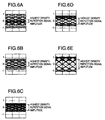
- Figs. 6A-6E show the simulation result of the reproducing signals in accordance with the Hopkins' diffraction calculation described in "J. Opt. Soc. Am.”, Vol. 69, No.
- Fig. 6A shows the display of the eye pattern of the reproducing signals before processing. It can be appreciated that opening cannot be obtained sufficiently in the proximity of the slice level (level "0") due to the inter-symbol interference from the preceding and subsequent recorded marks.
- Fig. 6B shows the eye pattern as a result of the equalization processing of this signal.
- the wave form equalization processing system cannot obtain a sufficient S/N improvement effect while reducing the inter-symbol interference, and the problem encountered in achieving the high density by reducing the mark pitch remains yet unsolved.
- the present invention scans information marks recorded in tracks on a recording medium by a laser beam to generate a reproducing signal, and executes an equalization processing for reducing an inter-symbol interference by serially changing equalization coefficients in accordance with the level of the reproducing signal.
- the equalization processing is executed using equalization coefficients that have a large absolute value in order to reduce the inter-symbol interference generated by the continuation of short marks and short non-recorded portions, and to increase the amplitude of the highest density repetition signal.
- the equalization coefficient for reducing the edge shift is different between the highest density repetition signal and other signals. For this reason, the equalization processing using the equalization coefficient that is kept fixed at a predetermined value cannot increase the amplitude of the highest density repetition signal while keeping the inter-symbol interference at a low level.
- the present invention executes the equalization processing using an appropriate equalization coefficient for each signal.
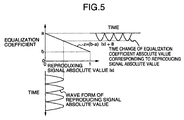
- Fig. 5 shows the relation between the absolute value of the reproducing signal and the equalization coefficient.
- the present system gives an appropriate equalization coefficient to each signal on the basis of this relation. The smaller the absolute value of the reproducing signal, the greater becomes the equalization coefficient. When the absolute value is 0, the equalization coefficient is a . As the absolute value of the reproducing signal becomes great, the equalization coefficient becomes small. When the absolute value of the reproducing signal attains the maximum value 1, the equalization coefficient becomes b.
- the equalization is positively executed near the portions where the absolute value is small, that is, the portions where the inter-symbol interference is likely to occur because the mark length and the length of the non-recorded portions are small.
- the equalization is hardly executed near the portions where the absolute value is great, that is, near the portions where the inter-symbol interference is difficult to occur because the mark length and the length of the non-recorded portions are large.
- the waveform distortion resulting from excessive equalization can be eliminated, in principle.
- Fig. 3 is a circuit diagram showing an example of a non-linear equalization circuit 107 according to the present invention.
- Amplitude adjustment circuits 160-01 to 160-03 adjust the amplitude of a reproducing signal 106 in accordance with the rule shown in Fig. 5. As a result, a portion having a small amplitude is adjusted to a large amplitude and is outputted. A portion having a large amplitude is converted to a small amplitude and is outputted.
- Coefficient generators 210-1 to 210-3 give the maximum value a shown in Fig. 5 of coefficients a1 to a3 and give the minimum value b shown in Fig. 5 among the coefficients b1 to b3.
- the coefficient generators 210-1 to 210-3 output also coefficients c1 to c3 that determine the polarity of the signal that is subjected to amplitude adjustment.
- Fig. 6D shows the eye pattern when the coefficients a1, b1 and c1 are set to 0.4, 0.1 and -1, respectively, the coefficients a2, b2 and c2 are set to 1.0, 1.0 and +1, respectively and the coefficients a3, b3 and c3 are set to 0.4, 0.1 and -1, respectively, and the delay amount by delay circuits 150-2 to 150-3 is twice the detection window width. It can be seen that in comparison with the eye pattern obtained by the equalization processing shown in Fig. 6B, the edge shift amount remains unaltered but the amplitude of the highest density repetition signal is improved more greatly.
- reference numerals 161-1, 161-2 and 161-3 denote signals-after-amplitude adjustment.
- Reference numeral 151-2 and 151-3 denote signals-after-delay.
- Reference numerals 211-1, 211-2 and 211-3 denote the maximum value signals of the coefficients, and reference numerals 212-1, 212-2 and 212-3 denote the minimum value signals of the coefficients.
- Reference numerals 213-1, 213-2 and 213-3 denote polarity signals.
- Reference numeral 170 denotes an addition circuit and reference numeral 108 denotes a signal-after-equalization.
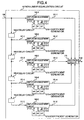
- Fig. 4 shows another example of the non-linear equalization circuit 107 according to the present invention.
- the amplitude adjustment circuits 160-1 to 160-5 and the coefficient generators 210-1 to 210-5 function in exactly the same way as the corresponding ones shown in Fig. 3, respectively.
- 6E shows the eye pattern when the coefficients a1, b1 and c1 are set to 1.0, 0.3 and -1, respectively, the coefficients a2, b2 and c2 are set to 1.0, 0.8 and +1, respectively, the coefficients a3, b3 and c3 are set to 1.0, 1.0 and +1, respectively, the coefficients a4, b4 and c4 are set to 1.0, 0.3 and +1, respectively, and the coefficients a5, b5 and c5 are set to 1.0, 0.3 and -1, respectively, and the delay amount by the delay circuits 150-2 to 150-5 is set to the same amount as the detection window width. It can be seen that the amplitude of the highest density repetition signal is improved most greatly in the eye patterns shown in Figs. 6A-6E.
- reference numerals 161-1 to 161-5 denote signals-after-amplitude adjustment.
- Reference numerals 151-2 to 151-5 denote signals-after-delay.
- Reference numerals 211-1 to 211-5 denote the maximum values of the coefficients and reference numerals 212-1 to 212-5 denote the minimum values of the coefficients.
- Reference numerals 213-1 to 213-5 denote polarity signals.
- Reference numeral 106 denotes a reproduction signal.
- Reference numeral 170 denotes an addition circuit and reference numeral 108 denotes a signal-after- equalization.
- the amplitude of the highest density repetition signal can be improved without increasing the edge shift. Because the S/N can be improved eventually, the high density can be achieved by decreasing the mark pitch.
- Fig. 1 is a schematic structural view of the optical information reproducing apparatus according to the present invention.
- This optical information reproducing apparatus comprises an optical recording medium 100 that is mounted to a driving device 101 and rotated, an optical head 102 that radiates an optical spot 103 to the optical recording medium 100 and reproduces the recorded information, a laser driving circuit 115 that drives the optical head 102 so that a ray of light having predetermined optical power can be outputted from the optical head 102, a servo circuit 113 that positions the optical spot 103, an automatic gain control circuit 105 that adjusts the amplitude of the reproducing signal to a predetermined amplitude on the basis of the reproducing signal 104 obtained when the optical spot 103 scans the tracks, a non-linear equalization circuit 107 that executes a signal processing for reducing inter-symbol interference by serially changing the equalization coefficients in accordance with the level of the reproducing signal the gain of which is adjusted, a phase locked loop circuit 109 that generates a clock signal in synchronism with the revolution of the optical recording medium 100 on the basis of the reproducing signal that is subjected to the
- Reference numeral 108 denotes a signal-after-equalization.
- Reference numeral 110 denotes a sync signal.
- Reference numeral 112 denotes output data.
- Reference numeral 114 denotes a servo signal to be applied to the optical head 102.
- Reference numeral 116 denotes a laser driving signal for generating the optical spot 103 from the optical head 102.
- Reference numeral 118 denotes a control signal to be applied from the control circuit 117 to the servo circuit 113.
- Reference numeral 119 denotes a control signal to be applied from the control circuit 117 to the laser driving circuit 115.
- Reference numeral 120 denotes a control signal to be applied from the control circuit 117 to the data demodulation circuit 111.
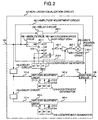
- FIG. 2 shows another example of the non-linear equalization circuit according to the present invention.
- This circuit comprises a plurality of amplitude adjustment circuits 160-1 to 160-n, a plurality of coefficient generators 210-1 to 210-n, a plurality of delay circuits 150-2 to 150-n, and one addition circuit 170, in the same way as the non-linear equalization circuit 107 that is explained with reference to Figs. 3 and 4.
- the amplitude adjustment circuit 160-1 comprises an absolute value circuit 180-1, multiplication circuits 190-1 and 200-1, a polarity circuit 220-1 and a delay circuit 230-1.
- the reproducing signal-after-gain control 106 that is inputted to the non-linear equalization circuit 107, exhibits the eye pattern such as the one shown in Fig. 6A.
- the signal is subjected to the amplitude adjustment by the automatic gain control circuit 105 of the pre-stage so that the maximum value of the amplitude and its minimum value reach the predetermined values.
- the amplitude adjustment is made so that the maximum value is +1 and the minimum value is -1.
- the automatic gain control circuit 105 adjusts the amplitude so that the maximum value of the reproducing signal 104 is +1 with its minimum value being -1, and outputs the reproducing signal 106 after gain control.
- the absolute value circuit 180-1 generates the absolute value of this reproducing signal 106 after gain control and outputs an absolute value signal 181-1.
- the multiplication circuit 190-1 outputs the equalization coefficient 191-1 corresponding to the absolute value of the reproducing signal 106 on the basis of the maximum value signal 211-1 of the equalization coefficient signal and its minimum value signal 212-1 that are given by the coefficient generator 210-1.
- of the reproducing signal 106 may use the relationship shown in Fig. 5, for example.
- the maximum value of the equalization coefficient signal is a and its minimum value is b.
- the polarity circuit 220-1 outputs the equalization coefficient 191-1 as the equalization coefficient with polarity 221-1 when the polarity signal 213-1 given by the coefficient generator 210-1 is +1, and outputs the equalization coefficient 191-1, the polarity of which is inverted, as the equalization coefficient with polarity 221-1 when the polarity signal 213-1 is -1.
- the delay circuit 230-1 has the delay amount equal to the propagation delay amount of the signal that occurs in the absolute value circuit 180-1, the multiplication circuit 190-1 and the polarity circuit 220-1, and functions in such a fashion that the signal-after-phase compensation 231-1, that adds the delay to the reproducing signal-after-gain control, and the equalization coefficient with polarity 221-1 have the same phase.
- the multiplication circuit 200-1 multiplies the signal-after -phase compensation 231-1 by the equalization coefficient with polarity 221-1 and outputs the product as the signal-after-amplitude adjustment 161-1.
- the reproducing signal-after-amplitude adjustment 106 is delayed by the delay amount set in advance by the delay circuit 150-2 and is converted to the reproducing signal-after-delay and gain adjustment 151-2.
- This signal is processed by the amplitude adjustment circuit 160-2 in the same way as described above, and the signal-after-amplitude adjustment 161-2 is generated. Therefore, each of the signals 161-1 to 161-n generated by each amplitude adjustment circuit is the signal to which an intrinsic delay amount and intrinsic amplitude adjustment are imparted.
- the addition circuit 170 adds all of these signals-after-amplitude adjustment 161-1 to 161-n and outputs the signal-after- equalization 108.
- the values of the coefficient generators 210-1 to 210-n and the values of the delay circuit 150-2 to 150-n are set in advance so that the inter-symbol interference contained in the signal-after-equalization 108 becomes minimal.
- reference numerals 211-2 and 211-n denote the maximum value signals of the coefficient
- reference numeral 212-2 and 212-n denote the minimum value signals of the coefficient
- reference numerals 213-2 and 213-n denote the polarity signals.
- Fig. 3 shows an example of a 3-tap equalization circuit according to the present system.
- Fig. 6D shows the eye pattern when the coefficients a1, b1 and c1 in Fig. 3 are set to 0.4, 0.1 and -1, respectively, the coefficients a2, b2 and c2 are set to 1.0, 1.0 and +1, respectively, and the coefficients a3, b3 and c3 are set to 0.4, 0.1 and -1, respectively, and the delay amount by the delay circuit is twice the detection window width. It can be seen that in comparison with the eye pattern obtained by the conventional equalization processing shown in Fig. 6B, the amplitude of the highest density repetition signal can be drastically improved though the edge shift quantity remains unaltered.
- the absolute value circuit 181-1 shown in Fig. 2 determines the absolute value
- the difference is likely to occur as a mean DC level in the case where the detection window width is the highest density reproducing signal (3Tw) or the lowest density reproducing signal (11Tw), if the mean DC level of the highest density reproducing signal (eTw) is an asymmetry X 0 as positioned at a central or maximum amplitude, but the eye pattern shown in Fig. 6E can be obtained when the absolute value circuit 181-1 is so constituted as to determine the absolute value
- Fig. 4 shows an example of a 5-tap non-linear equalization circuit according to the present system.
- Fig. 6E shows the eye pattern when the coefficients a1, b1 and 1 in Fig. 4 are set to 1.0, 0.3 and -1, respectively, the coefficients a2, b2 and c2 are set to 1.0, 0.3 and +1, respectively, the coefficients a3, b3 and c3 are set to 1.0, 1.0 and +1, respectively, the coefficients a4, b4 and c4 are set to 1.0, 0.3 and +1, and the coefficients a5, b5 and c5 are set to 1.0, 0.3 and -1, respectively, and the delay amount by the delay circuit is equal to the detection window width. It can be seen that the amplitude of the highest repetition signal is improved most greatly in each eye pattern shown in Figs. 6A-6E.
- the amplitude of the highest density repetition signal can be increased according to the equalization processing of the present invention without increasing the edge shift. Because the S/N can be eventually improved, high reliability can be secured and the high density can be achieved even when the mark pitch is reduced.
- the information reproducing apparatus explained in the foregoing embodiments can be applied to both the analog system and the digital system.
- the present invention applies the signal processing, that reduces the inter-symbol interference by serially changing the equalization coefficients in accordance with the level of the reproducing signals, to the reproducing signals, and can increase the amplitude of the highest density repetition signal without increasing the edge shift. Therefore, since the S/N can be improved, high reliability can be secured even when the mark pitch is decreased, and the high density can be achieved. Additionally, the equalization processing according to the present invention can be applied to not only the phase-change optical disk but also the opto-magnetic disk.
Landscapes
- Engineering & Computer Science (AREA)
- Signal Processing (AREA)
- Optical Recording Or Reproduction (AREA)
- Signal Processing For Digital Recording And Reproducing (AREA)
Applications Claiming Priority (2)
| Application Number | Priority Date | Filing Date | Title |
|---|---|---|---|
| JP00167299A JP3781911B2 (ja) | 1999-01-07 | 1999-01-07 | 情報再生方法及び装置 |
| JP167299 | 1999-01-07 |
Publications (3)
| Publication Number | Publication Date |
|---|---|
| EP1018732A2 true EP1018732A2 (de) | 2000-07-12 |
| EP1018732A3 EP1018732A3 (de) | 2001-07-18 |
| EP1018732B1 EP1018732B1 (de) | 2003-07-30 |
Family
ID=11508022
Family Applications (1)
| Application Number | Title | Priority Date | Filing Date |
|---|---|---|---|
| EP99126087A Expired - Lifetime EP1018732B1 (de) | 1999-01-07 | 1999-12-28 | Informationswiedergabeverfahren und -gerät |
Country Status (6)
| Country | Link |
|---|---|
| US (5) | US6480447B1 (de) |
| EP (1) | EP1018732B1 (de) |
| JP (1) | JP3781911B2 (de) |
| KR (1) | KR100570237B1 (de) |
| DE (1) | DE69909955T2 (de) |
| TW (1) | TW455866B (de) |
Cited By (2)
| Publication number | Priority date | Publication date | Assignee | Title |
|---|---|---|---|---|
| WO2005022532A1 (en) * | 2003-08-27 | 2005-03-10 | Koninklijke Philips Electronics N.V. | Read equalizer for a data storage system |
| EP1320097A3 (de) * | 2001-12-11 | 2005-11-30 | Samsung Electronics Co., Ltd. | Adaptiver Entzerrer |
Families Citing this family (36)
| Publication number | Priority date | Publication date | Assignee | Title |
|---|---|---|---|---|
| JP3781911B2 (ja) * | 1999-01-07 | 2006-06-07 | 株式会社日立製作所 | 情報再生方法及び装置 |
| US6678230B2 (en) * | 2000-10-31 | 2004-01-13 | Matsushita Electric Industrial Co., Ltd. | Waveform equalizer for a reproduction signal obtained by reproducing marks and non-marks recorded on a recording medium |
| JP3647817B2 (ja) * | 2002-03-26 | 2005-05-18 | 松下電器産業株式会社 | 等化器および等化方法 |
| US7532425B2 (en) * | 2005-06-21 | 2009-05-12 | Fujifilm Corporation | Reproducing method, reproducing apparatus, recording and reproducing apparatus, and magnetic recording medium |
| US8389048B2 (en) | 2006-02-10 | 2013-03-05 | Showa Denko K.K. | Magnetic recording medium, method for production thereof and magnetic recording and reproducing device |
| JP5202340B2 (ja) | 2006-03-24 | 2013-06-05 | ジェネラル・インスツルメント・コーポレーション | ネットワークにおける論理チャネルを構成するための装置、方法、およびコンピュータ読取可能な記録媒体 |
| US9088355B2 (en) | 2006-03-24 | 2015-07-21 | Arris Technology, Inc. | Method and apparatus for determining the dynamic range of an optical link in an HFC network |
| US8537972B2 (en) | 2006-12-07 | 2013-09-17 | General Instrument Corporation | Method and apparatus for determining micro-reflections in a network |
| JP4580380B2 (ja) | 2006-12-28 | 2010-11-10 | 株式会社日立製作所 | 光ディスク装置 |
| JP5320567B2 (ja) * | 2007-03-29 | 2013-10-23 | 独立行政法人国立高等専門学校機構 | 光ディスク用再生等化方法および再生等化回路 |
| US8107329B1 (en) | 2007-07-05 | 2012-01-31 | Marvell International Ltd. | Optical storage system having differential phase detector |
| TWI390506B (zh) * | 2009-05-20 | 2013-03-21 | Novatek Microelectronics Corp | 資料復原之校正電路與方法 |
| TWI391918B (zh) * | 2009-06-15 | 2013-04-01 | Novatek Microelectronics Corp | 資料復原裝置與方法 |
| US8516532B2 (en) * | 2009-07-28 | 2013-08-20 | Motorola Mobility Llc | IP video delivery using flexible channel bonding |
| US8526485B2 (en) | 2009-09-23 | 2013-09-03 | General Instrument Corporation | Using equalization coefficients of end devices in a cable television network to determine and diagnose impairments in upstream channels |
| US8416697B2 (en) | 2010-02-05 | 2013-04-09 | Comcast Cable Communications, Llc | Identification of a fault |
| US8971394B2 (en) | 2010-02-05 | 2015-03-03 | Comcast Cable Communications, Llc | Inducing response signatures in a communication network |
| US8654640B2 (en) | 2010-12-08 | 2014-02-18 | General Instrument Corporation | System and method for IP video delivery using distributed flexible channel bonding |
| US8937992B2 (en) | 2011-08-30 | 2015-01-20 | General Instrument Corporation | Method and apparatus for updating equalization coefficients of adaptive pre-equalizers |
| US8576705B2 (en) | 2011-11-18 | 2013-11-05 | General Instrument Corporation | Upstream channel bonding partial service using spectrum management |
| US9113181B2 (en) | 2011-12-13 | 2015-08-18 | Arris Technology, Inc. | Dynamic channel bonding partial service triggering |
| US8837302B2 (en) | 2012-04-27 | 2014-09-16 | Motorola Mobility Llc | Mapping a network fault |
| US8868736B2 (en) | 2012-04-27 | 2014-10-21 | Motorola Mobility Llc | Estimating a severity level of a network fault |
| US8867371B2 (en) | 2012-04-27 | 2014-10-21 | Motorola Mobility Llc | Estimating physical locations of network faults |
| US9003460B2 (en) | 2012-04-27 | 2015-04-07 | Google Technology Holdings LLC | Network monitoring with estimation of network path to network element location |
| US9065731B2 (en) | 2012-05-01 | 2015-06-23 | Arris Technology, Inc. | Ensure upstream channel quality measurement stability in an upstream channel bonding system using T4 timeout multiplier |
| US9136943B2 (en) | 2012-07-30 | 2015-09-15 | Arris Technology, Inc. | Method of characterizing impairments detected by equalization on a channel of a network |
| US9137164B2 (en) | 2012-11-15 | 2015-09-15 | Arris Technology, Inc. | Upstream receiver integrity assessment for modem registration |
| US9015786B2 (en) | 2012-12-03 | 2015-04-21 | Comcast Cable Communications, Llc | Noise ingress detection |
| US9203639B2 (en) | 2012-12-27 | 2015-12-01 | Arris Technology, Inc. | Dynamic load balancing under partial service conditions |
| US9380475B2 (en) | 2013-03-05 | 2016-06-28 | Comcast Cable Communications, Llc | Network implementation of spectrum analysis |
| US9444719B2 (en) | 2013-03-05 | 2016-09-13 | Comcast Cable Communications, Llc | Remote detection and measurement of data signal leakage |
| US9197886B2 (en) | 2013-03-13 | 2015-11-24 | Arris Enterprises, Inc. | Detecting plant degradation using peer-comparison |
| US9042236B2 (en) | 2013-03-15 | 2015-05-26 | Arris Technology, Inc. | Method using equalization data to determine defects in a cable plant |
| US10477199B2 (en) | 2013-03-15 | 2019-11-12 | Arris Enterprises Llc | Method for identifying and prioritizing fault location in a cable plant |
| US9025469B2 (en) | 2013-03-15 | 2015-05-05 | Arris Technology, Inc. | Method for estimating cable plant topology |
Family Cites Families (26)
| Publication number | Priority date | Publication date | Assignee | Title |
|---|---|---|---|---|
| EP0375342B1 (de) * | 1988-12-21 | 1995-02-15 | Matsushita Electric Industrial Co., Ltd. | Datenaufzeichnungs-wiedergabegerät auf einer Aufzeichnungsscheibe |
| US5418770A (en) * | 1990-06-29 | 1995-05-23 | Hitachi, Ltd. | Method of and apparatus for correcting edge interval of pit in optical recording/read-out apparatus |
| US5297165A (en) * | 1990-07-06 | 1994-03-22 | Nippon Telegraph And Telephone Corporation | Equalizer for radio receive signal |
| JPH0520614A (ja) | 1991-07-10 | 1993-01-29 | Canon Inc | 波形等化装置 |
| JP3005090B2 (ja) * | 1991-10-23 | 2000-01-31 | 株式会社リコー | 学習型波形等化器 |
| EP0569597B1 (de) | 1991-11-20 | 1998-07-15 | Sony Corporation | Gerät für optische platten |
| US5881039A (en) * | 1993-03-09 | 1999-03-09 | Matsushita Electric Industrial Co., Ltd. | Signal processing device for an optical information reproducing apparatus |
| JP3094726B2 (ja) * | 1993-04-02 | 2000-10-03 | 松下電器産業株式会社 | 波形等化方法及び波形等化器 |
| JP3224181B2 (ja) * | 1993-11-09 | 2001-10-29 | 富士通株式会社 | 光ディスクからのデータ再生システム |
| JPH07169055A (ja) * | 1993-12-15 | 1995-07-04 | Hitachi Ltd | 光ディスク装置及び光ディスク |
| US5761172A (en) * | 1994-03-25 | 1998-06-02 | Hitachi, Ltd. | Method of optical reproduction using pulsed light |
| US5898654A (en) | 1994-07-14 | 1999-04-27 | Matsushita Electric Industrial Co., Ltd. | Optical disk and optical disk apparatus having a predetermined pattern of marks on tracks such that a reproduced signal is caused to jitter |
| KR100300954B1 (ko) * | 1994-09-27 | 2001-10-22 | 윤종용 | 고정각속도방식의디스크재생장치의적응형등화기 |
| JPH08124167A (ja) * | 1994-10-19 | 1996-05-17 | Hitachi Ltd | 光学的情報記録再生方法及び装置 |
| JPH08129789A (ja) | 1994-10-31 | 1996-05-21 | Olympus Optical Co Ltd | 光磁気記録用再生回路 |
| US5808988A (en) * | 1995-02-15 | 1998-09-15 | Hitachi, Ltd. | Reproduction of optical information by one-beam optics with reduced crosstalk as recorded in multi-phases and multi-levels at staggered lattice points, and apparatus and recording medium therefor |
| JP3453002B2 (ja) | 1995-04-21 | 2003-10-06 | 富士通株式会社 | 自動調整方法、再生装置及び記憶装置 |
| JPH0944983A (ja) * | 1995-07-28 | 1997-02-14 | Pioneer Electron Corp | 記録情報再生装置 |
| US5757758A (en) | 1995-12-19 | 1998-05-26 | Konica Corporation | Optical pickup apparatus objective lens and converging optical system for optical pickup and optical disk apparatus |
| JP3800653B2 (ja) | 1995-12-26 | 2006-07-26 | ソニー株式会社 | クロストーク除去装置 |
| KR0179258B1 (ko) * | 1996-01-05 | 1999-04-15 | 구자홍 | 광디스크 기록재생장치 |
| JP2853650B2 (ja) * | 1996-04-19 | 1999-02-03 | 日本電気株式会社 | 信号処理装置 |
| JP3776530B2 (ja) * | 1996-09-30 | 2006-05-17 | 株式会社東芝 | 光学的情報再生装置 |
| JPH10112031A (ja) * | 1996-10-04 | 1998-04-28 | Hitachi Ltd | 光学的情報記録再生方法及び装置 |
| US5999349A (en) * | 1996-12-30 | 1999-12-07 | Daewoo Electronics Co., Ltd. | Waveform equalization apparatus |
| JP3781911B2 (ja) * | 1999-01-07 | 2006-06-07 | 株式会社日立製作所 | 情報再生方法及び装置 |
-
1999
- 1999-01-07 JP JP00167299A patent/JP3781911B2/ja not_active Expired - Lifetime
- 1999-12-27 TW TW088123050A patent/TW455866B/zh not_active IP Right Cessation
- 1999-12-28 EP EP99126087A patent/EP1018732B1/de not_active Expired - Lifetime
- 1999-12-28 DE DE69909955T patent/DE69909955T2/de not_active Expired - Lifetime
-
2000
- 2000-01-06 US US09/478,343 patent/US6480447B1/en not_active Expired - Lifetime
- 2000-01-06 KR KR1020000000391A patent/KR100570237B1/ko not_active Expired - Fee Related
-
2002
- 2002-02-14 US US10/074,049 patent/US6552977B2/en not_active Expired - Lifetime
- 2002-10-30 US US10/283,143 patent/US6944105B2/en not_active Expired - Lifetime
-
2003
- 2003-11-19 US US10/715,387 patent/US7046595B2/en not_active Expired - Lifetime
- 2003-11-19 US US10/715,378 patent/US7079457B2/en not_active Expired - Lifetime
Cited By (3)
| Publication number | Priority date | Publication date | Assignee | Title |
|---|---|---|---|---|
| EP1320097A3 (de) * | 2001-12-11 | 2005-11-30 | Samsung Electronics Co., Ltd. | Adaptiver Entzerrer |
| US7184476B2 (en) | 2001-12-11 | 2007-02-27 | Samsung Electronics Co., Ltd. | Adaptive equalizer for controlling operation thereof by using sign and absolute value of output signal thereof |
| WO2005022532A1 (en) * | 2003-08-27 | 2005-03-10 | Koninklijke Philips Electronics N.V. | Read equalizer for a data storage system |
Also Published As
| Publication number | Publication date |
|---|---|
| US20040100882A1 (en) | 2004-05-27 |
| US7046595B2 (en) | 2006-05-16 |
| KR100570237B1 (ko) | 2006-04-12 |
| US6480447B1 (en) | 2002-11-12 |
| EP1018732B1 (de) | 2003-07-30 |
| US20030147318A1 (en) | 2003-08-07 |
| US20040100881A1 (en) | 2004-05-27 |
| US6552977B2 (en) | 2003-04-22 |
| JP2000200463A (ja) | 2000-07-18 |
| TW455866B (en) | 2001-09-21 |
| EP1018732A3 (de) | 2001-07-18 |
| KR20000053396A (ko) | 2000-08-25 |
| JP3781911B2 (ja) | 2006-06-07 |
| US7079457B2 (en) | 2006-07-18 |
| DE69909955T2 (de) | 2004-06-03 |
| US20020080696A1 (en) | 2002-06-27 |
| US6944105B2 (en) | 2005-09-13 |
| DE69909955D1 (de) | 2003-09-04 |
Similar Documents
| Publication | Publication Date | Title |
|---|---|---|
| EP1018732A2 (de) | Informationswiedergabeverfahren und -gerät | |
| US5809004A (en) | Information recording medium with pits edges shifted in a step-wise fashion | |
| EP0632433B1 (de) | Informationswiedergabegerät und Informationsaufzeichnungsmedium | |
| US6894965B2 (en) | Method for recording/reproducing data on/from optical disk | |
| US6510130B2 (en) | Optical recording medium | |
| US6272105B1 (en) | Optical disc and optical disc reproducing apparatus | |
| JP3730084B2 (ja) | 光制御回路 | |
| US6324145B1 (en) | Digital data reproducing apparatus and reproduction signal binarization level correcting method | |
| KR0179258B1 (ko) | 광디스크 기록재생장치 | |
| US20020176335A1 (en) | Crosstalk removal apparatus and information reproduction apparatus | |
| KR19990063012A (ko) | 광디스크의 신호처리방법 및 광디스크장치 | |
| JP2883538B2 (ja) | 光学的情報再生装置 | |
| JP3319161B2 (ja) | スキュー制御装置 | |
| US6272102B1 (en) | Amplitude detector for signals having a periodical character, recorded on a recording medium, and optical tape recorder comprising such an amplitude detector | |
| US6172959B1 (en) | Optical information processing apparatus | |
| KR100755833B1 (ko) | 광 기록 재생기의 등화 방법 및 장치 | |
| JP2000215458A (ja) | 光ディスク及び光ディスク再生装置 | |
| JP2000348361A (ja) | 光ディスク装置 | |
| JPH11149639A (ja) | 信号再生装置及び方法 | |
| JPH08249667A (ja) | 光ディスク装置の信号再生装置 | |
| JP2001034968A (ja) | トラッキング誤差信号生成装置及びそれを具備する光学的情報再生装置 | |
| JP2008234757A (ja) | 光学的フォーカス制御装置、半導体および光学的フォーカス制御方法 |
Legal Events
| Date | Code | Title | Description |
|---|---|---|---|
| PUAI | Public reference made under article 153(3) epc to a published international application that has entered the european phase |
Free format text: ORIGINAL CODE: 0009012 |
|
| AK | Designated contracting states |
Kind code of ref document: A2 Designated state(s): DE FR GB NL |
|
| AX | Request for extension of the european patent |
Free format text: AL;LT;LV;MK;RO;SI |
|
| PUAL | Search report despatched |
Free format text: ORIGINAL CODE: 0009013 |
|
| AK | Designated contracting states |
Kind code of ref document: A3 Designated state(s): AT BE CH CY DE DK ES FI FR GB GR IE IT LI LU MC NL PT SE |
|
| AX | Request for extension of the european patent |
Free format text: AL;LT;LV;MK;RO;SI |
|
| 17P | Request for examination filed |
Effective date: 20010822 |
|
| 17Q | First examination report despatched |
Effective date: 20011025 |
|
| AKX | Designation fees paid |
Free format text: DE FR GB NL |
|
| GRAH | Despatch of communication of intention to grant a patent |
Free format text: ORIGINAL CODE: EPIDOS IGRA |
|
| GRAA | (expected) grant |
Free format text: ORIGINAL CODE: 0009210 |
|
| GRAH | Despatch of communication of intention to grant a patent |
Free format text: ORIGINAL CODE: EPIDOS IGRA |
|
| AK | Designated contracting states |
Designated state(s): DE FR GB NL |
|
| REG | Reference to a national code |
Ref country code: GB Ref legal event code: FG4D |
|
| REF | Corresponds to: |
Ref document number: 69909955 Country of ref document: DE Date of ref document: 20030904 Kind code of ref document: P |
|
| ET | Fr: translation filed | ||
| PLBE | No opposition filed within time limit |
Free format text: ORIGINAL CODE: 0009261 |
|
| STAA | Information on the status of an ep patent application or granted ep patent |
Free format text: STATUS: NO OPPOSITION FILED WITHIN TIME LIMIT |
|
| 26N | No opposition filed |
Effective date: 20040504 |
|
| PGFP | Annual fee paid to national office [announced via postgrant information from national office to epo] |
Ref country code: DE Payment date: 20111221 Year of fee payment: 13 |
|
| REG | Reference to a national code |
Ref country code: NL Ref legal event code: SD Effective date: 20130716 |
|
| REG | Reference to a national code |
Ref country code: GB Ref legal event code: 732E Free format text: REGISTERED BETWEEN 20130822 AND 20130828 |
|
| REG | Reference to a national code |
Ref country code: FR Ref legal event code: TP Owner name: HITACHI CONSUMER ELECTRONICS CO., LTD., JP Effective date: 20130906 |
|
| PG25 | Lapsed in a contracting state [announced via postgrant information from national office to epo] |
Ref country code: DE Free format text: LAPSE BECAUSE OF NON-PAYMENT OF DUE FEES Effective date: 20130702 |
|
| REG | Reference to a national code |
Ref country code: DE Ref legal event code: R119 Ref document number: 69909955 Country of ref document: DE Effective date: 20130702 |
|
| PGFP | Annual fee paid to national office [announced via postgrant information from national office to epo] |
Ref country code: GB Payment date: 20141224 Year of fee payment: 16 |
|
| PGFP | Annual fee paid to national office [announced via postgrant information from national office to epo] |
Ref country code: NL Payment date: 20141108 Year of fee payment: 16 Ref country code: FR Payment date: 20141208 Year of fee payment: 16 |
|
| GBPC | Gb: european patent ceased through non-payment of renewal fee |
Effective date: 20151228 |
|
| REG | Reference to a national code |
Ref country code: NL Ref legal event code: MM Effective date: 20160101 |
|
| REG | Reference to a national code |
Ref country code: FR Ref legal event code: ST Effective date: 20160831 |
|
| PG25 | Lapsed in a contracting state [announced via postgrant information from national office to epo] |
Ref country code: GB Free format text: LAPSE BECAUSE OF NON-PAYMENT OF DUE FEES Effective date: 20151228 Ref country code: NL Free format text: LAPSE BECAUSE OF NON-PAYMENT OF DUE FEES Effective date: 20160101 |
|
| PG25 | Lapsed in a contracting state [announced via postgrant information from national office to epo] |
Ref country code: FR Free format text: LAPSE BECAUSE OF NON-PAYMENT OF DUE FEES Effective date: 20151231 |