EP1024155B1 - Resine co-codensee d'un derive de phenol et de triazine - Google Patents
Resine co-codensee d'un derive de phenol et de triazine Download PDFInfo
- Publication number
- EP1024155B1 EP1024155B1 EP98937786A EP98937786A EP1024155B1 EP 1024155 B1 EP1024155 B1 EP 1024155B1 EP 98937786 A EP98937786 A EP 98937786A EP 98937786 A EP98937786 A EP 98937786A EP 1024155 B1 EP1024155 B1 EP 1024155B1
- Authority
- EP
- European Patent Office
- Prior art keywords
- phenol
- triazine derivative
- reaction
- condensation
- alkylated methylol
- Prior art date
- Legal status (The legal status is an assumption and is not a legal conclusion. Google has not performed a legal analysis and makes no representation as to the accuracy of the status listed.)
- Expired - Lifetime
Links
- 229920005989 resin Polymers 0.000 title claims description 83
- 239000011347 resin Substances 0.000 title claims description 83
- 238000000034 method Methods 0.000 title description 18
- 150000002989 phenols Chemical class 0.000 title description 4
- 230000008569 process Effects 0.000 title description 2
- ISWSIDIOOBJBQZ-UHFFFAOYSA-N Phenol Chemical compound OC1=CC=CC=C1 ISWSIDIOOBJBQZ-UHFFFAOYSA-N 0.000 claims description 92
- 238000009833 condensation Methods 0.000 claims description 83
- 150000003918 triazines Chemical class 0.000 claims description 79
- 238000006243 chemical reaction Methods 0.000 claims description 78
- WSFSSNUMVMOOMR-UHFFFAOYSA-N Formaldehyde Chemical compound O=C WSFSSNUMVMOOMR-UHFFFAOYSA-N 0.000 claims description 66
- OKKJLVBELUTLKV-UHFFFAOYSA-N Methanol Chemical class OC OKKJLVBELUTLKV-UHFFFAOYSA-N 0.000 claims description 53
- WAKMOVBCOYGSDK-UHFFFAOYSA-N phenol;triazine Chemical class C1=CN=NN=C1.OC1=CC=CC=C1 WAKMOVBCOYGSDK-UHFFFAOYSA-N 0.000 claims description 45
- 238000004519 manufacturing process Methods 0.000 claims description 44
- 229920000877 Melamine resin Polymers 0.000 claims description 42
- JDSHMPZPIAZGSV-UHFFFAOYSA-N melamine Chemical compound NC1=NC(N)=NC(N)=N1 JDSHMPZPIAZGSV-UHFFFAOYSA-N 0.000 claims description 41
- 239000000203 mixture Substances 0.000 claims description 35
- LFQSCWFLJHTTHZ-UHFFFAOYSA-N Ethanol Chemical compound CCO LFQSCWFLJHTTHZ-UHFFFAOYSA-N 0.000 claims description 28
- 150000001875 compounds Chemical class 0.000 claims description 24
- 125000002485 formyl group Chemical class [H]C(*)=O 0.000 claims description 20
- HXAIVLUWSUILIN-UHFFFAOYSA-N triazin-4-ylmethanol Chemical class OCC1=CC=NN=N1 HXAIVLUWSUILIN-UHFFFAOYSA-N 0.000 claims description 20
- 238000006297 dehydration reaction Methods 0.000 claims description 18
- 230000018044 dehydration Effects 0.000 claims description 17
- 238000010438 heat treatment Methods 0.000 claims description 13
- 238000006467 substitution reaction Methods 0.000 claims description 13
- 238000007259 addition reaction Methods 0.000 claims description 10
- 230000000694 effects Effects 0.000 claims description 10
- CQRYARSYNCAZFO-UHFFFAOYSA-N salicyl alcohol Chemical compound OCC1=CC=CC=C1O CQRYARSYNCAZFO-UHFFFAOYSA-N 0.000 claims description 10
- 238000006482 condensation reaction Methods 0.000 claims description 9
- GZVHEAJQGPRDLQ-UHFFFAOYSA-N 6-phenyl-1,3,5-triazine-2,4-diamine Chemical compound NC1=NC(N)=NC(C=2C=CC=CC=2)=N1 GZVHEAJQGPRDLQ-UHFFFAOYSA-N 0.000 claims description 8
- -1 methylol group Chemical class 0.000 claims description 8
- 125000002887 hydroxy group Chemical group [H]O* 0.000 claims description 7
- NJYZCEFQAIUHSD-UHFFFAOYSA-N acetoguanamine Chemical compound CC1=NC(N)=NC(N)=N1 NJYZCEFQAIUHSD-UHFFFAOYSA-N 0.000 claims description 5
- 125000003700 epoxy group Chemical group 0.000 claims description 5
- 125000000217 alkyl group Chemical group 0.000 claims description 4
- 125000003277 amino group Chemical group 0.000 claims description 4
- 125000005843 halogen group Chemical group 0.000 claims description 4
- 239000002253 acid Substances 0.000 claims description 3
- 230000015572 biosynthetic process Effects 0.000 claims description 3
- 125000004093 cyano group Chemical group *C#N 0.000 claims description 3
- 125000004185 ester group Chemical group 0.000 claims description 3
- 125000001033 ether group Chemical group 0.000 claims description 3
- 125000004435 hydrogen atom Chemical group [H]* 0.000 claims description 3
- 125000002768 hydroxyalkyl group Chemical group 0.000 claims description 3
- 238000002156 mixing Methods 0.000 claims description 3
- 125000001997 phenyl group Chemical group [H]C1=C([H])C([H])=C(*)C([H])=C1[H] 0.000 claims description 3
- 230000002152 alkylating effect Effects 0.000 claims 2
- HEMHJVSKTPXQMS-UHFFFAOYSA-M Sodium hydroxide Chemical compound [OH-].[Na+] HEMHJVSKTPXQMS-UHFFFAOYSA-M 0.000 description 24
- 239000003795 chemical substances by application Substances 0.000 description 12
- 238000009826 distribution Methods 0.000 description 11
- 230000000052 comparative effect Effects 0.000 description 10
- 230000005494 condensation Effects 0.000 description 10
- JYIZNFVTKLARKT-UHFFFAOYSA-N phenol;1,3,5-triazine-2,4,6-triamine Chemical compound OC1=CC=CC=C1.NC1=NC(N)=NC(N)=N1 JYIZNFVTKLARKT-UHFFFAOYSA-N 0.000 description 9
- 230000009257 reactivity Effects 0.000 description 9
- 239000011342 resin composition Substances 0.000 description 9
- IJGRMHOSHXDMSA-UHFFFAOYSA-N Atomic nitrogen Chemical compound N#N IJGRMHOSHXDMSA-UHFFFAOYSA-N 0.000 description 8
- QAOWNCQODCNURD-UHFFFAOYSA-N Sulfuric acid Chemical compound OS(O)(=O)=O QAOWNCQODCNURD-UHFFFAOYSA-N 0.000 description 8
- 230000008901 benefit Effects 0.000 description 8
- 239000003822 epoxy resin Substances 0.000 description 8
- 229920003986 novolac Polymers 0.000 description 8
- 229920000647 polyepoxide Polymers 0.000 description 8
- 239000003054 catalyst Substances 0.000 description 7
- 238000001879 gelation Methods 0.000 description 7
- 238000005259 measurement Methods 0.000 description 7
- 239000011541 reaction mixture Substances 0.000 description 7
- ZMANZCXQSJIPKH-UHFFFAOYSA-N Triethylamine Chemical compound CCN(CC)CC ZMANZCXQSJIPKH-UHFFFAOYSA-N 0.000 description 6
- 230000003467 diminishing effect Effects 0.000 description 5
- 239000000463 material Substances 0.000 description 5
- 238000001644 13C nuclear magnetic resonance spectroscopy Methods 0.000 description 4
- 239000004640 Melamine resin Substances 0.000 description 4
- IISBACLAFKSPIT-UHFFFAOYSA-N bisphenol A Chemical compound C=1C=C(O)C=CC=1C(C)(C)C1=CC=C(O)C=C1 IISBACLAFKSPIT-UHFFFAOYSA-N 0.000 description 4
- 238000004090 dissolution Methods 0.000 description 4
- 230000007062 hydrolysis Effects 0.000 description 4
- 238000006460 hydrolysis reaction Methods 0.000 description 4
- 238000010348 incorporation Methods 0.000 description 4
- 229910052757 nitrogen Inorganic materials 0.000 description 4
- 230000035484 reaction time Effects 0.000 description 4
- 238000001228 spectrum Methods 0.000 description 4
- 239000004593 Epoxy Substances 0.000 description 3
- MUBZPKHOEPUJKR-UHFFFAOYSA-N Oxalic acid Chemical compound OC(=O)C(O)=O MUBZPKHOEPUJKR-UHFFFAOYSA-N 0.000 description 3
- KWYUFKZDYYNOTN-UHFFFAOYSA-M Potassium hydroxide Chemical compound [OH-].[K+] KWYUFKZDYYNOTN-UHFFFAOYSA-M 0.000 description 3
- 238000010521 absorption reaction Methods 0.000 description 3
- 150000008044 alkali metal hydroxides Chemical class 0.000 description 3
- AXCZMVOFGPJBDE-UHFFFAOYSA-L calcium dihydroxide Chemical compound [OH-].[OH-].[Ca+2] AXCZMVOFGPJBDE-UHFFFAOYSA-L 0.000 description 3
- 239000000920 calcium hydroxide Substances 0.000 description 3
- 229910001861 calcium hydroxide Inorganic materials 0.000 description 3
- 238000001816 cooling Methods 0.000 description 3
- 238000004925 denaturation Methods 0.000 description 3
- 230000036425 denaturation Effects 0.000 description 3
- 239000002783 friction material Substances 0.000 description 3
- 239000005011 phenolic resin Substances 0.000 description 3
- 238000010992 reflux Methods 0.000 description 3
- 238000007711 solidification Methods 0.000 description 3
- 230000008023 solidification Effects 0.000 description 3
- 239000002341 toxic gas Substances 0.000 description 3
- RNFJDJUURJAICM-UHFFFAOYSA-N 2,2,4,4,6,6-hexaphenoxy-1,3,5-triaza-2$l^{5},4$l^{5},6$l^{5}-triphosphacyclohexa-1,3,5-triene Chemical compound N=1P(OC=2C=CC=CC=2)(OC=2C=CC=CC=2)=NP(OC=2C=CC=CC=2)(OC=2C=CC=CC=2)=NP=1(OC=1C=CC=CC=1)OC1=CC=CC=C1 RNFJDJUURJAICM-UHFFFAOYSA-N 0.000 description 2
- GJYCVCVHRSWLNY-UHFFFAOYSA-N 2-butylphenol Chemical compound CCCCC1=CC=CC=C1O GJYCVCVHRSWLNY-UHFFFAOYSA-N 0.000 description 2
- QTWJRLJHJPIABL-UHFFFAOYSA-N 2-methylphenol;3-methylphenol;4-methylphenol Chemical compound CC1=CC=C(O)C=C1.CC1=CC=CC(O)=C1.CC1=CC=CC=C1O QTWJRLJHJPIABL-UHFFFAOYSA-N 0.000 description 2
- CSCPPACGZOOCGX-UHFFFAOYSA-N Acetone Chemical compound CC(C)=O CSCPPACGZOOCGX-UHFFFAOYSA-N 0.000 description 2
- VTYYLEPIZMXCLO-UHFFFAOYSA-L Calcium carbonate Chemical compound [Ca+2].[O-]C([O-])=O VTYYLEPIZMXCLO-UHFFFAOYSA-L 0.000 description 2
- BRLQWZUYTZBJKN-UHFFFAOYSA-N Epichlorohydrin Chemical compound ClCC1CO1 BRLQWZUYTZBJKN-UHFFFAOYSA-N 0.000 description 2
- UQSXHKLRYXJYBZ-UHFFFAOYSA-N Iron oxide Chemical compound [Fe]=O UQSXHKLRYXJYBZ-UHFFFAOYSA-N 0.000 description 2
- LRHPLDYGYMQRHN-UHFFFAOYSA-N N-Butanol Chemical compound CCCCO LRHPLDYGYMQRHN-UHFFFAOYSA-N 0.000 description 2
- PXKLMJQFEQBVLD-UHFFFAOYSA-N bisphenol F Chemical compound C1=CC(O)=CC=C1CC1=CC=C(O)C=C1 PXKLMJQFEQBVLD-UHFFFAOYSA-N 0.000 description 2
- 230000015556 catabolic process Effects 0.000 description 2
- YCIMNLLNPGFGHC-UHFFFAOYSA-N catechol Chemical compound OC1=CC=CC=C1O YCIMNLLNPGFGHC-UHFFFAOYSA-N 0.000 description 2
- 229930003836 cresol Natural products 0.000 description 2
- 238000006731 degradation reaction Methods 0.000 description 2
- 239000000945 filler Substances 0.000 description 2
- 239000003063 flame retardant Substances 0.000 description 2
- 238000000227 grinding Methods 0.000 description 2
- 239000012535 impurity Substances 0.000 description 2
- 230000002401 inhibitory effect Effects 0.000 description 2
- 230000004048 modification Effects 0.000 description 2
- 238000012986 modification Methods 0.000 description 2
- 239000012778 molding material Substances 0.000 description 2
- IXQGCWUGDFDQMF-UHFFFAOYSA-N o-Hydroxyethylbenzene Natural products CCC1=CC=CC=C1O IXQGCWUGDFDQMF-UHFFFAOYSA-N 0.000 description 2
- 239000000843 powder Substances 0.000 description 2
- 239000002994 raw material Substances 0.000 description 2
- 239000000376 reactant Substances 0.000 description 2
- 230000001105 regulatory effect Effects 0.000 description 2
- GHMLBKRAJCXXBS-UHFFFAOYSA-N resorcinol Chemical compound OC1=CC=CC(O)=C1 GHMLBKRAJCXXBS-UHFFFAOYSA-N 0.000 description 2
- 239000000565 sealant Substances 0.000 description 2
- 239000007787 solid Substances 0.000 description 2
- 125000002256 xylenyl group Chemical class C1(C(C=CC=C1)C)(C)* 0.000 description 2
- JYEUMXHLPRZUAT-UHFFFAOYSA-N 1,2,3-triazine Chemical class C1=CN=NN=C1 JYEUMXHLPRZUAT-UHFFFAOYSA-N 0.000 description 1
- VVHFXJOCUKBZFS-UHFFFAOYSA-N 2-(chloromethyl)-2-methyloxirane Chemical compound ClCC1(C)CO1 VVHFXJOCUKBZFS-UHFFFAOYSA-N 0.000 description 1
- AGIBHMPYXXPGAX-UHFFFAOYSA-N 2-(iodomethyl)oxirane Chemical compound ICC1CO1 AGIBHMPYXXPGAX-UHFFFAOYSA-N 0.000 description 1
- CDAWCLOXVUBKRW-UHFFFAOYSA-N 2-aminophenol Chemical compound NC1=CC=CC=C1O CDAWCLOXVUBKRW-UHFFFAOYSA-N 0.000 description 1
- DUIOKRXOKLLURE-UHFFFAOYSA-N 2-octylphenol Chemical compound CCCCCCCCC1=CC=CC=C1O DUIOKRXOKLLURE-UHFFFAOYSA-N 0.000 description 1
- VPWNQTHUCYMVMZ-UHFFFAOYSA-N 4,4'-sulfonyldiphenol Chemical compound C1=CC(O)=CC=C1S(=O)(=O)C1=CC=C(O)C=C1 VPWNQTHUCYMVMZ-UHFFFAOYSA-N 0.000 description 1
- SNULTPQANPFFQH-UHFFFAOYSA-N 6-methoxy-1h-1,3,5-triazine-2,4-dione Chemical compound COC1=NC(=O)NC(=O)N1 SNULTPQANPFFQH-UHFFFAOYSA-N 0.000 description 1
- 239000005995 Aluminium silicate Substances 0.000 description 1
- FCSUZQKGHWERCS-GESMCTFVSA-N CC/C=C\C(\[O](C)=C)=C/C=C\CNC Chemical compound CC/C=C\C(\[O](C)=C)=C/C=C\CNC FCSUZQKGHWERCS-GESMCTFVSA-N 0.000 description 1
- OKTJSMMVPCPJKN-UHFFFAOYSA-N Carbon Chemical compound [C] OKTJSMMVPCPJKN-UHFFFAOYSA-N 0.000 description 1
- 101150096839 Fcmr gene Proteins 0.000 description 1
- 238000005481 NMR spectroscopy Methods 0.000 description 1
- IGFHQQFPSIBGKE-UHFFFAOYSA-N Nonylphenol Natural products CCCCCCCCCC1=CC=C(O)C=C1 IGFHQQFPSIBGKE-UHFFFAOYSA-N 0.000 description 1
- 229930040373 Paraformaldehyde Natural products 0.000 description 1
- 239000002202 Polyethylene glycol Substances 0.000 description 1
- VYPSYNLAJGMNEJ-UHFFFAOYSA-N Silicium dioxide Chemical compound O=[Si]=O VYPSYNLAJGMNEJ-UHFFFAOYSA-N 0.000 description 1
- 238000000944 Soxhlet extraction Methods 0.000 description 1
- GWEVSGVZZGPLCZ-UHFFFAOYSA-N Titan oxide Chemical compound O=[Ti]=O GWEVSGVZZGPLCZ-UHFFFAOYSA-N 0.000 description 1
- MBHRHUJRKGNOKX-UHFFFAOYSA-N [(4,6-diamino-1,3,5-triazin-2-yl)amino]methanol Chemical compound NC1=NC(N)=NC(NCO)=N1 MBHRHUJRKGNOKX-UHFFFAOYSA-N 0.000 description 1
- 125000003158 alcohol group Chemical group 0.000 description 1
- 150000005325 alkali earth metal hydroxides Chemical class 0.000 description 1
- WNROFYMDJYEPJX-UHFFFAOYSA-K aluminium hydroxide Chemical compound [OH-].[OH-].[OH-].[Al+3] WNROFYMDJYEPJX-UHFFFAOYSA-K 0.000 description 1
- 229910021502 aluminium hydroxide Inorganic materials 0.000 description 1
- PNEYBMLMFCGWSK-UHFFFAOYSA-N aluminium oxide Inorganic materials [O-2].[O-2].[O-2].[Al+3].[Al+3] PNEYBMLMFCGWSK-UHFFFAOYSA-N 0.000 description 1
- 235000012211 aluminium silicate Nutrition 0.000 description 1
- 229960000892 attapulgite Drugs 0.000 description 1
- TZCXTZWJZNENPQ-UHFFFAOYSA-L barium sulfate Chemical compound [Ba+2].[O-]S([O-])(=O)=O TZCXTZWJZNENPQ-UHFFFAOYSA-L 0.000 description 1
- LLEMOWNGBBNAJR-UHFFFAOYSA-N biphenyl-2-ol Chemical compound OC1=CC=CC=C1C1=CC=CC=C1 LLEMOWNGBBNAJR-UHFFFAOYSA-N 0.000 description 1
- 229910000019 calcium carbonate Inorganic materials 0.000 description 1
- 239000000378 calcium silicate Substances 0.000 description 1
- 229910052918 calcium silicate Inorganic materials 0.000 description 1
- OSGAYBCDTDRGGQ-UHFFFAOYSA-L calcium sulfate Chemical compound [Ca+2].[O-]S([O-])(=O)=O OSGAYBCDTDRGGQ-UHFFFAOYSA-L 0.000 description 1
- OYACROKNLOSFPA-UHFFFAOYSA-N calcium;dioxido(oxo)silane Chemical compound [Ca+2].[O-][Si]([O-])=O OYACROKNLOSFPA-UHFFFAOYSA-N 0.000 description 1
- 239000006229 carbon black Substances 0.000 description 1
- MGNCLNQXLYJVJD-UHFFFAOYSA-N cyanuric chloride Chemical compound ClC1=NC(Cl)=NC(Cl)=N1 MGNCLNQXLYJVJD-UHFFFAOYSA-N 0.000 description 1
- 230000002939 deleterious effect Effects 0.000 description 1
- GKIPXFAANLTWBM-UHFFFAOYSA-N epibromohydrin Chemical compound BrCC1CO1 GKIPXFAANLTWBM-UHFFFAOYSA-N 0.000 description 1
- 238000002474 experimental method Methods 0.000 description 1
- 230000002349 favourable effect Effects 0.000 description 1
- 239000010433 feldspar Substances 0.000 description 1
- 238000011049 filling Methods 0.000 description 1
- 239000010439 graphite Substances 0.000 description 1
- 229910002804 graphite Inorganic materials 0.000 description 1
- 235000010299 hexamethylene tetramine Nutrition 0.000 description 1
- 230000006872 improvement Effects 0.000 description 1
- ZFSLODLOARCGLH-UHFFFAOYSA-N isocyanuric acid Chemical compound OC1=NC(O)=NC(O)=N1 ZFSLODLOARCGLH-UHFFFAOYSA-N 0.000 description 1
- NLYAJNPCOHFWQQ-UHFFFAOYSA-N kaolin Chemical compound O.O.O=[Al]O[Si](=O)O[Si](=O)O[Al]=O NLYAJNPCOHFWQQ-UHFFFAOYSA-N 0.000 description 1
- ZLNQQNXFFQJAID-UHFFFAOYSA-L magnesium carbonate Chemical compound [Mg+2].[O-]C([O-])=O ZLNQQNXFFQJAID-UHFFFAOYSA-L 0.000 description 1
- 239000001095 magnesium carbonate Substances 0.000 description 1
- 229910000021 magnesium carbonate Inorganic materials 0.000 description 1
- VTHJTEIRLNZDEV-UHFFFAOYSA-L magnesium dihydroxide Chemical compound [OH-].[OH-].[Mg+2] VTHJTEIRLNZDEV-UHFFFAOYSA-L 0.000 description 1
- 239000000347 magnesium hydroxide Substances 0.000 description 1
- 229910001862 magnesium hydroxide Inorganic materials 0.000 description 1
- 239000000395 magnesium oxide Substances 0.000 description 1
- CPLXHLVBOLITMK-UHFFFAOYSA-N magnesium oxide Inorganic materials [Mg]=O CPLXHLVBOLITMK-UHFFFAOYSA-N 0.000 description 1
- AXZKOIWUVFPNLO-UHFFFAOYSA-N magnesium;oxygen(2-) Chemical compound [O-2].[Mg+2] AXZKOIWUVFPNLO-UHFFFAOYSA-N 0.000 description 1
- WSFSSNUMVMOOMR-NJFSPNSNSA-N methanone Chemical compound O=[14CH2] WSFSSNUMVMOOMR-NJFSPNSNSA-N 0.000 description 1
- 239000010445 mica Substances 0.000 description 1
- 229910052618 mica group Inorganic materials 0.000 description 1
- CWQXQMHSOZUFJS-UHFFFAOYSA-N molybdenum disulfide Chemical compound S=[Mo]=S CWQXQMHSOZUFJS-UHFFFAOYSA-N 0.000 description 1
- 229910052982 molybdenum disulfide Inorganic materials 0.000 description 1
- 238000000465 moulding Methods 0.000 description 1
- 125000004433 nitrogen atom Chemical group N* 0.000 description 1
- SNQQPOLDUKLAAF-UHFFFAOYSA-N nonylphenol Chemical compound CCCCCCCCCC1=CC=CC=C1O SNQQPOLDUKLAAF-UHFFFAOYSA-N 0.000 description 1
- 235000006408 oxalic acid Nutrition 0.000 description 1
- 125000004430 oxygen atom Chemical group O* 0.000 description 1
- 229910052625 palygorskite Inorganic materials 0.000 description 1
- 229920002866 paraformaldehyde Polymers 0.000 description 1
- 230000000704 physical effect Effects 0.000 description 1
- 239000002574 poison Substances 0.000 description 1
- 231100000614 poison Toxicity 0.000 description 1
- 229920001223 polyethylene glycol Polymers 0.000 description 1
- 239000004065 semiconductor Substances 0.000 description 1
- 229910052814 silicon oxide Inorganic materials 0.000 description 1
- 239000010454 slate Substances 0.000 description 1
- 239000002904 solvent Substances 0.000 description 1
- 239000000126 substance Substances 0.000 description 1
- 239000000454 talc Substances 0.000 description 1
- 229910052623 talc Inorganic materials 0.000 description 1
- 238000012360 testing method Methods 0.000 description 1
- OGIDPMRJRNCKJF-UHFFFAOYSA-N titanium oxide Inorganic materials [Ti]=O OGIDPMRJRNCKJF-UHFFFAOYSA-N 0.000 description 1
- 239000002966 varnish Substances 0.000 description 1
Images


Classifications
-
- C—CHEMISTRY; METALLURGY
- C08—ORGANIC MACROMOLECULAR COMPOUNDS; THEIR PREPARATION OR CHEMICAL WORKING-UP; COMPOSITIONS BASED THEREON
- C08L—COMPOSITIONS OF MACROMOLECULAR COMPOUNDS
- C08L61/00—Compositions of condensation polymers of aldehydes or ketones; Compositions of derivatives of such polymers
- C08L61/34—Condensation polymers of aldehydes or ketones with monomers covered by at least two of the groups C08L61/04, C08L61/18 and C08L61/20
-
- C—CHEMISTRY; METALLURGY
- C08—ORGANIC MACROMOLECULAR COMPOUNDS; THEIR PREPARATION OR CHEMICAL WORKING-UP; COMPOSITIONS BASED THEREON
- C08G—MACROMOLECULAR COMPOUNDS OBTAINED OTHERWISE THAN BY REACTIONS ONLY INVOLVING UNSATURATED CARBON-TO-CARBON BONDS
- C08G14/00—Condensation polymers of aldehydes or ketones with two or more other monomers covered by at least two of the groups C08G8/00 - C08G12/00
- C08G14/02—Condensation polymers of aldehydes or ketones with two or more other monomers covered by at least two of the groups C08G8/00 - C08G12/00 of aldehydes
- C08G14/04—Condensation polymers of aldehydes or ketones with two or more other monomers covered by at least two of the groups C08G8/00 - C08G12/00 of aldehydes with phenols
- C08G14/06—Condensation polymers of aldehydes or ketones with two or more other monomers covered by at least two of the groups C08G8/00 - C08G12/00 of aldehydes with phenols and monomers containing hydrogen attached to nitrogen
- C08G14/10—Melamines
-
- H—ELECTRICITY
- H05—ELECTRIC TECHNIQUES NOT OTHERWISE PROVIDED FOR
- H05K—PRINTED CIRCUITS; CASINGS OR CONSTRUCTIONAL DETAILS OF ELECTRIC APPARATUS; MANUFACTURE OF ASSEMBLAGES OF ELECTRICAL COMPONENTS
- H05K1/00—Printed circuits
- H05K1/02—Details
- H05K1/03—Use of materials for the substrate
- H05K1/0313—Organic insulating material
- H05K1/032—Organic insulating material consisting of one material
- H05K1/0346—Organic insulating material consisting of one material containing N
Definitions
- the present invention relates to phenol triazine derivative co-condensation resins, and a manufacturing method thereof.
- Phenol resins obtained by condensation of phenol and formaldehyde display excellent durability, heat resistance and resistance to hydrolysis, but have undesirably slow curing times. Furthermore, melamine resins obtained by condensation of melamine and formaldehyde display good curability, but are inferior to phenol resins in terms of durability, heat resistance and resistance to hydrolysis.
- JP-A-58-104918 is directed to a process according to which a methyl-etherified methylol melamine varnish is obtained by a reaction between melamine, formaline and methanol, and the resulting mixture is reacted with a mixture obtained from reacting phenol and formaline at reaction temperatures of 80°C or below.
- JP-A-55-152714 describes a method, wherein phenol and formaline are reacted to yield a methylol phenol initial condensate, which subsequently is reacted with melamine and methanol.
- the reaction temperature in any step is 80°C or less.
- JP-A-55-135123 discloses a method comprising the reaction of melamine, formaldehyde and methanol in a first step, to yield a denatured melamine resin. Separately, phenol and formaldehyde are reacted to yield a phenol initial condensate. The denatured melamine resin and phenol initial condensate are then mixed and reacted at a low temperature of 60°C.
- the present invention takes the above situations into consideration, with the object of providing a phenol triazine derivative co-condensation resin and a manufacturing method thereof, in which the co-condensation ratio of the phenol and the triazine derivative is high and the molecular weight distribution of the produced resin is narrow.
- a phenol triazine derivative co-condensation resin according to the present invention is a co-condensate of a triazine derivative and a phenol, wherein the average proportion of the amount of [-NH-CH 2 -phenol] bonding expressed, as a percentage of the total bonding incorporating [-NH-CH 2 -phenol] bonding, [-NH-CH 2 -NH-] bonding and [phenol-CH 2 -phenol] bonding, is between 30 ⁇ 80% as measured by 13 C-NMR for example, and wherein the number average molecular weight (Mn) is between 300 ⁇ 800, and the ratio (Mw/Mn) of the weight average molecular weight (Mw) to the number average molecular weight (Mn) is no more than 1.30.
- Phenol triazine derivative co-condensation resins of this type display high rates of co-condensation of the phenol and the triazine derivative, and because the amount of nitrogen incorporation is necessarily high, also display high levels of flame retardancy. Furthermore being novolak type resins, no toxic gas is generated during curing, and as the molecular weight distribution is narrow, viscosity remains low even if the denaturation ratio of the triazine derivative is high, making manufacturing simple. Moreover, the resins display excellent resistance to heat and humidity, and because no free triazine derivative remains, the resins are uniform and degradation of compatibility is unlikely to occur.
- a first manufacturing method for preparing a phenol triazine derivative co-condensation resin according to the present invention is characterized by comprising: a step for preparing a methylolated triazine derivative wherein an aldehyde undergoes an addition reaction with a triazine derivative; a step for preparing an alkylated methylol triazine derivative wherein the aforementioned methylolated triazine derivative undergoes a substitution reaction with an alcohol; and a step for manufacturing the phenol triazine derivative co-condensation resin wherein a phenol is added to the alkylated methylol triazine derivative and the mixture then heated to effect a co-condensation reaction through a dealcoholization reaction and a dehydration concentration.
- the phenol triazine derivative co-condensation resin by selectively generating the methylolated triazine derivative by mixing the triazine derivative, the aldehyde, the phenol, and the alcohol, and then generating the alkylated methylol triazine derivative by a substitution reaction of the methylolated triazine derivative with the aforementioned alcohol, and finally conducting a co-condensation of the alkylated methylol triazine derivative and the phenol by heating the mixture following the formation of the alkylated methylol triazine derivative.
- a second manufacturing method is characterized by comprising: a step for preparing a methylolated phenol wherein an aldehyde undergoes an addition reaction to a phenol; a step for preparing an alkylated methylol phenol wherein the methylolated phenol undergoes a substitution reaction with an alcohol; and a step for manufacturing the phenol triazine derivative co-condensation resin wherein a triazine derivative is added to the alkylated methylol phenol and the mixture then heated to effect a co-condensation reaction through a dealcoholization reaction and a dehydration concentration.
- the reactivity between the triazine derivative and the phenol is able to be increased beyond the reactivity of two molecules of the triazine derivative. Consequently, not only can the co-condensation ratio between the phenol and the triazine derivative be improved significantly, but furthermore by inhibiting the inherently fast condensation of the triazine derivative, an ununiform high molecular weight can be prevented, and the molecular weight distribution is able to be kept narrow.
- a phenol triazine derivative co-condensation resins according to the present invention is a co-condensate of a triazine derivative and a phenol, wherein the average proportion of the amount of [-NH-CH 2 -phenol] bonding expressed as a percentage of the total bonding incorporating [-NH-CH 2 -phenol] bonding, [-NH-CH 2 -NH-] bonding and [phenol-CH 2 -phenol] bonding (hereafter termed the "bonding ratio”) is between 30 ⁇ 80%. Furthermore, the number average molecular weight (Mn) of the resin is between 300 ⁇ 800, and the ratio (Mw/Mn) of the weight average molecular weight (Mw) to the number average molecular weight (Mn) is no more than 1.30.
- the bonding ratio can be easily determined using 13 C-NMR measurements for example.
- the absorption region for [-NH-CH 2 -phenol] bonds is in the vicinity of 41ppm (41.2ppm)
- the absorption region for [-NH-CH 2 -NH-] bonds is in the vicinity of 45ppm (45.5ppm)
- the absorption region for [phenol-CH 2 -phenol] bonds is in the vicinity of 31ppm for 2-2', 44ppm for 2-4', and 41ppm for 4-4', and consequently by determining the ratio of the integral of each type of CH 2 bond with respect to the combined integrals of all the CH 2 bonds, the bonding ratio can be determined.
- the bonding ratio is a measure of the co-condensation ratio of the triazine derivative and the phenol, and at bonding ratios less than 30% the durability, heat resistance, and resistance to hydrolysis of the resin is relatively lower. At bonding ratios greater than 80% the resin manufacture becomes difficult making such resins unrealistic. Preferred bonding ratios are between 50 ⁇ 80%, with values between 60 ⁇ 70% being the most suitable.
- R1, R2, and R3 each represent one of the group consisting of an alkylated methylol group, a hydrogen atom, an amino group, an alkyl group, a phenyl group, a hydroxyl group, a hydroxylalkyl group, an ether group, an ester group, an acid group, an unsaturated group, a cyano group, or a halogen atom.
- the groups R1, R2 and R3 are alkylated methylol groups.
- examples of such preferred triazine derivatives include either one, or alternatively a mixture of two or more, of the compounds selected from di-(alkylated methylol) melamine, tri-(alkylated methylol) melamine, di-(alkylated methylol) benzoguanamine, and di-(alkylated methylol) acetoguanamine.
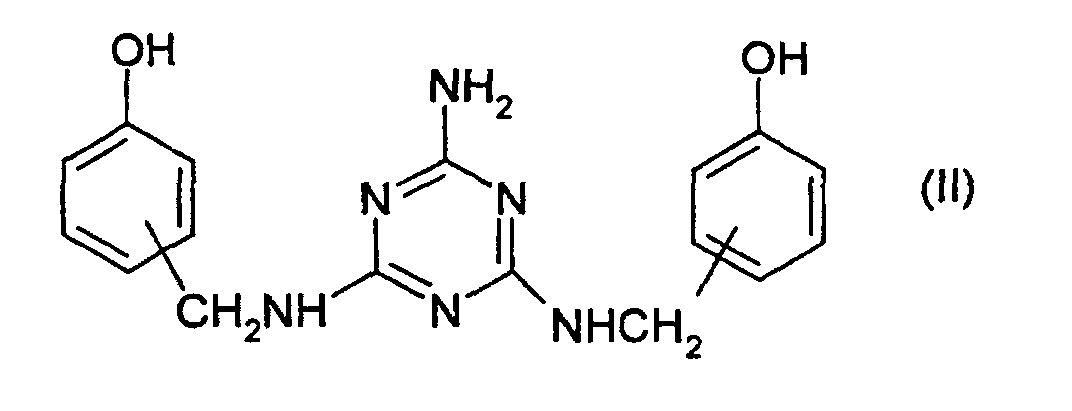
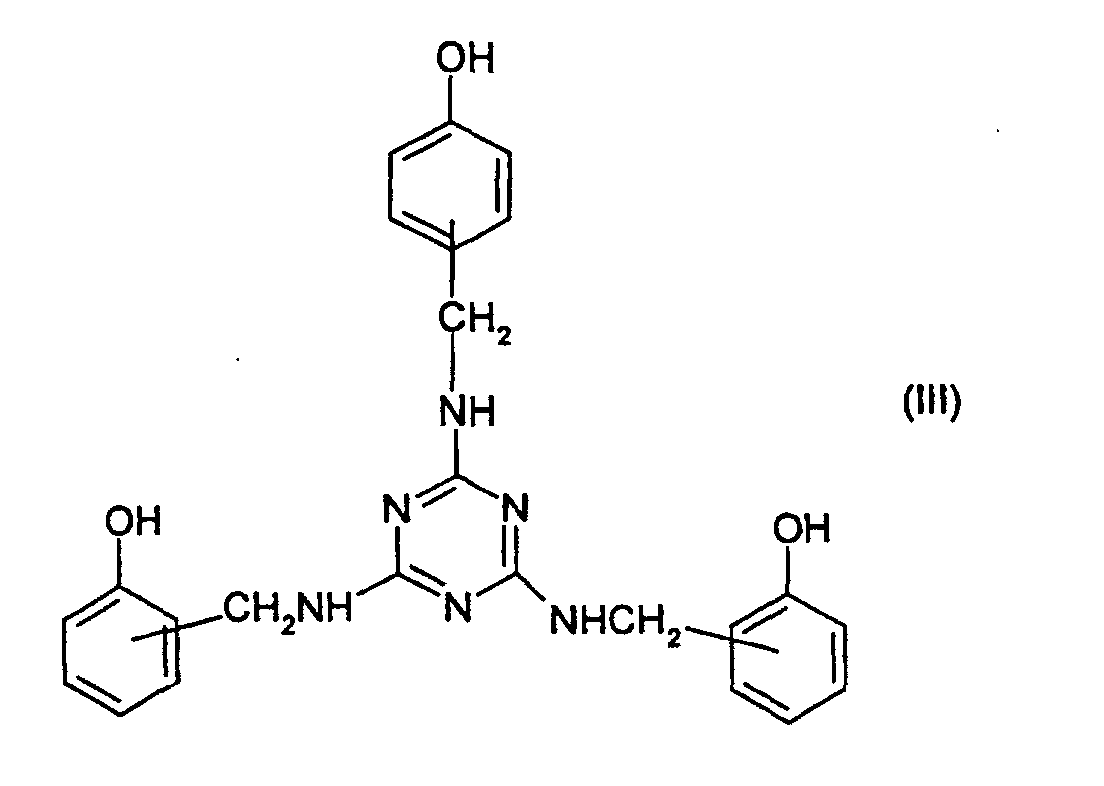
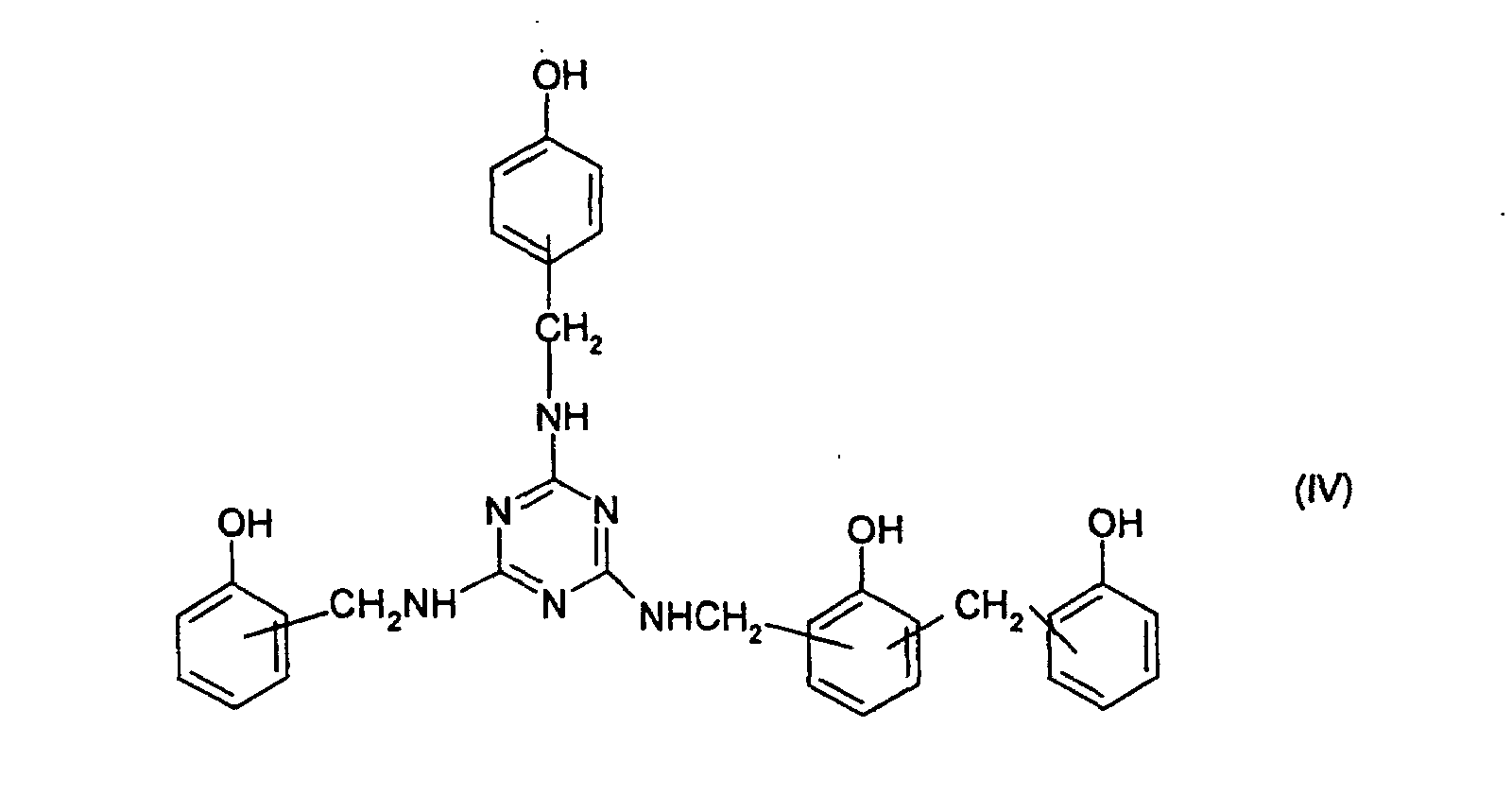
- a phenol triazine derivative co-condensation resin of the present invention should preferably be composed primarily of a mixture of a three nucleus compound of the basic structure shown in the formula (II) below, a four nucleus compound of the basic structure shown in the formula (III), a five nucleus compound of the basic structure shown in the formula (IV), and a six nucleus compound of the basic structure shown in the formula (V).
- the hydrogen atoms shown in the chemical formulae can also be substituted with other groups such as amino groups, alkyl groups, phenyl groups, hydroxyl groups, hydroxylalkyl groups, ether groups, ester groups, acid groups, unsaturated groups, cyano groups, or halogen atoms.
- a resin of the present invention may also comprise up to 20% by weight of the entire resin of unavoidable impurities such as the compounds of the basic structures shown in the formulae (VI), (VII) and (VIII) below, as well as straight novolak (novolak which has not bonded with the triazine derivative). Of these impurities, it is preferable that the amount of straight novolak incorporated in the resin is no more than 5% by weight.
- a phenol triazine derivative co-condensation resin of the present invention the molecular weight distribution is narrow and the bonding ratio between phenol and melamine is high, and moreover the phenol and melamine are arranged in a regular, approximately alternating pattern, and so the denaturation ratio (modification ratio) of the melamine is high.
- the resin displays good flame retardancy and heat resistance even if halogen groups are not incorporated in the structure.
- the resin has the great advantage of not releasing toxic gas during curing.
- At least a portion of the aforementioned triazine derivative, or alternatively a portion of the OH groups of the phenol may be modified by an epoxy group.
- an epoxy modified phenol triazine derivative co-condensation resin With such an epoxy modified phenol triazine derivative co-condensation resin, exactly the same effects are achieved when used as a curing agent.
- the same flame retardant effects are achieved when a melamine denatured novolak is combined with an epoxylated epoxy resin and a typical curing agent, as when a melamine denatured novolak is used as the curing agent with a typical epoxy resin (such as a bisphenol A type resin).
- Sufficient flame retardant effect can be achieved by using a melamine denatured compound with either one of the epoxy resin or the curing agent, but by using a melamine denatured compound with both, an even better flame retardancy is achieved.
- an aldehyde undergoes an addition reaction with a triazine derivative to yield a methylolated triazine derivative.
- Suitable triazine derivatives include melamine, acetoguanamine, benzoguanamine, cyanuric acid, methyl cyanurate, ethyl cyanurate, acetyl cyanurate and cyanuryl chloride.
- compounds such as melamine, acetoguanamine and benzoguanamine, where either two or three of the groups R1, R2 and R3 of the formula (I) are amino groups are preferable.
- compounds such as melamine, acetoguanamine and benzoguanamine which have a greater number of nitrogen atoms and fewer oxygen atoms within the molecule, are preferable.
- aldehydes such as formalin and paraformaldehyde are preferable.
- mol ratios between 0.5 ⁇ 6.0 are preferable, with values between 1.5 ⁇ 4.0 being even more desirable, and ratios between 2.0 ⁇ 3.5 being the most suitable. At mol ratios less than 0.5 unreacted triazine derivative is left over following reaction which is undesirable, whereas at mol ratios greater than 6.0 there is an undesirable diminishing of the improvement in flame retardancy effect.
- pH5 ⁇ 8 require no catalyst and so are preferable.
- Another benefit of the methods of the present invention is that the use of catalysts and pH regulating agents is not required. At values less than pH5 the condensation between melamine molecules proceeds rapidly, whereas at values greater than pH8 the use of catalysts becomes necessary which is undesirable from the viewpoint of cost. Particularly preferable pH values are between pH6 ⁇ 7.
- the reaction temperature should preferably be within the range 50 ⁇ 80°C, with the reaction time at such temperatures being of the order 0.5 ⁇ 2.0 hours. At reaction temperatures less than 50°C the reaction does not proceed to completion and the problem arises of unreacted free formalin, whereas at temperatures greater than 80°C the condensation between molecules of the triazine derivative accelerates, increasing the danger of gelation. Particularly desirable reaction temperatures are within the range 60 ⁇ 70°C.
- the methylolated triazine derivative undergoes a substitution reaction with an alcohol to produce an alkylated methylol triazine derivative.
- the reactivity thereof at the subsequent third step is reduced, enabling the bonding with the phenol to occur preferentially and thus ensuring an increase in the phenol triazine derivative co-condensation ratio, which enables the manufacture of resins with the aforementioned bonding ratios.
- the aforementioned alcohol should preferably be a monovalent alcohol such as methanol, ethanol or butanol.
- methanol which from an industrial viewpoint offers the advantages of low cost and good reactivity, is preferable.
- the mol ratio of the alcohol with respect to the triazine derivative should preferably be within the range 1 ⁇ 20. At mol ratios less than 1, the bonding ratio between triazine derivative molecules increases, whereas at ratios greater than 20 the amount of excess alcohol which does not participate in the reaction increases, thus diminishing the yield. Mol ratios within the range 5 ⁇ 15 are even more desirable, with ratios between 7 ⁇ 10 being the most suitable.
- the pH of the reaction system should preferably be between pH5 ⁇ 8, as at values less than pH5 the condensation between molecules of the triazine derivative proceeds too rapidly, whereas at values greater than pH8 the use of catalysts becomes necessary which is undesirable.
- Particularly preferable pH values are between pH6 ⁇ 7.
- the reaction temperature should preferably be within the range 50 ⁇ 80°C, with the reaction time at such temperatures being of the order 0.5 ⁇ 5 hours.
- the reaction is best conducted with a reflux apparatus. At reaction temperatures less than 50°C the reaction does not proceed to completion and problems arise due to the remaining unsubstituted methylol groups, whereas at temperatures greater than 80°C the condensation between molecules of the triazine derivative accelerates, increasing the danger of gelation.
- Particularly desirable reaction temperatures are within the range 60 ⁇ 70°C.
- a phenol is added to the alkylated methylol triazine derivative and the reaction system then heated, and a co-condensation proceeds via a dealcoholization and a dehydration concentration, to yield a phenol triazine derivative co-condensation resin.
- a solvent there is no necessity to include a solvent during this step, as the alkyl methylolation suppresses the reactivity of the triazine derivative.
- phenol used with the present invention, although suitable examples include phenol; alkyl phenols such as cresol, xylenol, ethyl phenol, butyl phenol, nonyl phenol and octyl phenol; polyhydric phenols such as bisphenol A, bisphenol F, bisphenol S, resorcinol and catechol; and phenyl phenol and aminophenol.
- the phenol is not restricted to a single phenol, but may also be a combination of two or more such phenols.
- phenol, cresol and xylenol are particularly preferred, as the softening points of the products thus generated are very suitable, making them easy to use in an industrial setting.
- the mol ratio of the phenol with respect to the triazine derivative should preferably be within the range 1 ⁇ 20. At mol ratios less than 1, the bonding ratio between triazine derivative molecules increases, whereas at ratios greater than 20 the amount of excess phenol which does not participate in the reaction increases, thus diminishing the yield. Mol ratios within the range 5 ⁇ 15 are even more desirable, with ratios between 7 ⁇ 10 being the most suitable.
- the maximum heating temperature during the dealcoholization reaction and the dehydration concentration should preferably be greater than 120°C, with temperatures between 160 ⁇ 200°C being the most suitable. At maximum heating temperatures lower than 120°C the reaction does not progress sufficiently well.
- the viscosity of the prepared resin is typically of the order 100 ⁇ 1000cP at 200°C.
- the method was divided into a first, second and third step which were carried out separately, but even in the case where all the raw materials are batch mixed, it is still possible to ensure that the chemical reactions progress in the same order as that described by the first, second, and third steps above.
- a methylolated triazine derivative is generated selectively due to the differing reactivities, and the thus generated methylolated triazine derivative then undergoes an alcohol substitution reaction with the alcohol to form an alkylated methylol triazine derivative, and by heating the reaction mixture following the formation of the alkylated methylol triazine derivative, a co-condensation reaction with the phenol enables the manufacture of a phenol triazine derivative co-condensation resin.
- This second method offers the advantage of a simplification of the manufacturing operation, associated with being able to batch mix all the raw materials.
- the reaction conditions are the same as those described above for the first manufacturing method.
- a first step involves an addition reaction of an aldehyde to a phenol to yield a methylolated phenol.
- the phenol and aldehyde are of the same type as those described above for the first manufacturing method.
- mol ratios between 0.5 ⁇ 6.0 are preferable, with values between 1.5 ⁇ 4.0 being even more desirable, and ratios between 2.0 ⁇ 3.5 being the most suitable.
- mol ratios less than 0.5 unreacted phenol is left over following reaction which is undesirable, whereas at mol ratios greater than 6.0 free formalin remains in the mixture, so that when a triazine derivative is subsequently added, the undesirable condensation reaction between molecules of the triazine derivative is more likely to occur.
- pH5 ⁇ 8 Although there are no particular restrictions on the system pH during the reaction, values between pH5 ⁇ 8 require no catalyst and so are preferable. Another benefit of the methods of the present invention is that the use of catalysts and pH regulating agents is not required. At values less than pH5 the condensation between phenol molecules proceeds rapidly, whereas at values greater than pH8 the use of catalysts becomes necessary which is undesirable. Particularly preferable pH values are between pH6 ⁇ 7.
- the reaction temperature should preferably be within the range 50 ⁇ 100°C, with the reaction time at such temperatures being of the order 0.5 ⁇ 4 hours. At reaction temperatures less than 50°C the reaction does not proceed to completion and the problem arises of unreacted free formalin, whereas at temperatures greater than 100°C there is a danger of gelation. Particularly desirable reaction temperatures are within the range 70 ⁇ 80°C.
- the methylolated phenol undergoes a substitution reaction with an alcohol to produce an alkylated methylol phenol.
- the alcohol is of the same type as that described above for the first manufacturing method.
- the mol ratio of the alcohol with respect to the phenol should preferably be within the range 1 ⁇ 20. At mol ratios less than 1, the bonding ratio between phenol molecules increases, whereas at ratios greater than 20 the amount of excess alcohol which does not participate in the reaction increases, thus diminishing the yield. Mol ratios within the range 5 ⁇ 15 are even more desirable, with ratios between 7 ⁇ 10 being the most suitable.
- the pH of the reaction system should preferably be between 10 ⁇ 14, as at values less than pH10 the substitution reaction does not progress well. Particularly suitable pH values are between pH12 ⁇ 13.
- a compound such as an alkali metal hydroxide, an alkali earth metal hydroxide, or 1,8-diazabicyclo-7-undecene (DBU) is added to the reaction mixture.
- DBU 1,8-diazabicyclo-7-undecene
- the reaction temperature should preferably be within the range 50 ⁇ 100°C, with the reaction time at such temperatures being of the order 0.5 ⁇ 4 hours.
- the reaction is best conducted with a reflux apparatus. At reaction temperatures less than 50°C the reaction does not proceed to completion and the problem of unsubstituted methylol groups arises, whereas at temperatures greater than 100°C there is a danger of gelation. Particularly desirable reaction temperatures are within the range 70 ⁇ 80°C.
- a triazine derivative is added to the alkylated methylol phenol and the mixture is heated, and a co-condensation proceeds via a dealcoholization reaction and a dehydration concentration, to yield a phenol triazine derivative co-condensation resin.
- a co-condensation proceeds via a dealcoholization reaction and a dehydration concentration, to yield a phenol triazine derivative co-condensation resin.
- molecules of the triazine derivative do not inter-react.
- the triazine derivative can be the same as those compounds described in the aforementioned first manufacturing method.
- the mol ratio of the phenol with respect to the triazine derivative should preferably be within the range 1 ⁇ 20. At mol ratios less than 1, the bonding ratio between molecules of the triazine derivative increases, whereas at ratios greater than 20 the amount of excess phenol which does not participate in the reaction increases, thus diminishing the yield. Mol ratios within the range 5 ⁇ 15 are even more desirable, with ratios between 7 ⁇ 10 being the most suitable.
- the maximum heating temperature during the dealcoholization reaction and the dehydration concentration should preferably be greater than 120°C, with temperatures between 160 ⁇ 200°C being the most suitable. At maximum heating temperatures lower than 120°C the reaction does not progress sufficiently well.
- the resin can be cooled and removed.
- the physical properties of the prepared resin are substantially the same as those of the first manufacturing method.
- the first manufacturing method is the most preferred.
- the reason that the first manufacturing method is able to narrow the molecular weight distribution and increase the co-condensation ratio is that by converting the triazine derivative into an alkylated methylol derivative the reactivity can be controlled to ensure preferential bonding with the phenol.
- the phenol triazine derivative co-condensation resins obtained by the above manufacturing methods can be used in laminates (printed circuit boards), friction materials, refractory products, and sealants for semiconductor packages, as well as in the manufacture of grinding stones and molding materials.
- the resins in each of the above materials either the phenol triazine derivative co-condensation resin can be mixed with a suitable curing agent and filler and then heat cured, or alternatively the phenol triazine derivative co-condensation resin can be added to an epoxy resin as the curing agent and the subsequent mixture heat cured.
- Examples of the curing agent which can be added to the phenol triazine derivative co-condensation resins include either one, or alternatively a mixture of two or more hexamethylenetetramines, and the amount of curing agent added should preferably be between 5 ⁇ 20 parts by weight of the curing agent per 100 parts by weight of the phenol triazine derivative co-condensation resin, with values between 10 ⁇ 15 parts by weight being even more desirable.
- the curing conditions involve heating at a temperature of 120 ⁇ 200°C for a period of 0.5 ⁇ 3.0 minutes.
- phenol triazine derivative co-condensation resin is used as the curing agent for hardening an epoxy resin
- Favourable curing conditions involve heat molding at 150 ⁇ 200°C for a period of 2 ⁇ 10 minutes, followed by 1 ⁇ 10 hours of after cure.
- Suitable fillers include either one, or mixtures of two or more, of the materials selected from the group comprising alumina, attapulgite, kaolin, carbon black, graphite, silicon oxide, calcium silicate, magnesium oxide, titanium oxide, iron oxide, magnesium hydroxide, aluminium hydroxide, slate powder, sericite, calcium carbonate, magnesium carbonate, talc, feldspar powder, molybdenum disulfide, barytes, mica, and anhydrous gypsum.
- the materials selected from the group comprising alumina, attapulgite, kaolin, carbon black, graphite, silicon oxide, calcium silicate, magnesium oxide, titanium oxide, iron oxide, magnesium hydroxide, aluminium hydroxide, slate powder, sericite, calcium carbonate, magnesium carbonate, talc, feldspar powder, molybdenum disulfide, barytes, mica, and anhydrous gypsum.
- At least a portion of the aforementioned triazine derivative section of the phenol triazine derivative co-condensation resin of the present invention, and a portion of the OH groups of the phenol section may be modified by an epoxy group.
- an epihalohydrin and the phenol triazine derivative co-condensation resin are mixed together and allowed to react.
- epihalohydrins include epichlorohydrin, ⁇ -methyl epichlorohydrin, epibromohydrin, ⁇ -methyl epibromohydrin, epiiodohydrin, and ⁇ -ethyl epichlorohydrin, but of these epichlorohydrin is particularly desirable, being industrially easy to obtain, and of low cost.
- the reaction is carried out by adding a solid alkali metal hydroxide such as sodium hydroxide or potassium hydroxide, either in a single batch or gradually over time, to a mixture of the epihalohydrin and the phenol triazine derivative co-condensation resin, and then allowing the reaction to proceed for a period of 30 minutes ⁇ 10 hours at a temperature of 20 ⁇ 120°C.
- a solid alkali metal hydroxide such as sodium hydroxide or potassium hydroxide
- the amount of epihalohydrin added to the mixture should preferably be between 0.5 ⁇ 20 mols per mol equivalent of hydroxyl groups within the phenol triazine derivative co-condensation resin, with values between 0.7 ⁇ 10 mols being even more desirable, and the amount of alkali metal hydroxide added should preferably be between 0.5 ⁇ 1.5 mols per mol equivalent of hydroxyl groups within the phenol triazine derivative co-condensation resin, with values between 0.7 ⁇ 1.2 mols being even more desirable.
- the epoxy modified phenol triazine derivative co-condensation resin thus obtained is an epoxy resin which offers the advantages of displaying excellent properties of flame retardancy and heat resistance, and consequently is suitable for use in filling materials, laminates, friction materials and refractory products.
- the resin compositions of the working examples 1 ⁇ 5 and the comparative examples 1 ⁇ 2 were analyzed by 13 C-NMR with the densities of [-NH-CH 2 -phenol] bonding, [-NH-CH 2 -NH-] bonding, [phenol-CH 2 -phenol] bonding, and [-NH-CH 2 -OH] bonding measured, and the respective bonding ratios then calculated.
- the measurements were conducted using a JNM-LA400 type nuclear magnetic resonance apparatus made by Japan Electron Optics Laboratory Corporation, Ltd (JEOL). The results of the measurements are shown in table 1.
- the weight average molecular weight (Mw), the number average molecular weight (Mn), the nitrogen incorporation rate, and the softening point (R&B method) were measured, and the amounts of unreacted formaldehyde, phenol and triazine derivative were also measured.
- the measurements of the weight average molecular weight (Mw) and the number average molecular weight (Mn) were conducted using a high speed GPC apparatus (HLC-8020) made by Toso Corporation.
- the columns used were a single TSK-GEL G3000H XL column and two TSK-GEL G2000H XL columns.
- the measurements of the nitrogen incorporation rate were conducted by subtracting the distilled phenol from the value of the initial combination.
- the measurements of the amounts of unreacted material were carried out by determining the acetone insoluble portion (unreacted material) from a Soxhlet extraction. The results are shown in table 1.
- the phenol triazine derivative co-condensation resins according to the present invention display high ratios of [-NH-CH 2 -phenol] bonding expressed as percentages of the total bonding, and high co-condensation ratios between the phenol and the triazine derivative. Furthermore, the Mw/Mn ratios are low in comparison with the comparative examples, the molecular weight distribution is obviously narrow, and the softening points are low. Moreover, the resin compositions according to the present invention contained no unreacted triazines.
- FIGS. 1 ⁇ 5 show the GPC spectra for the working examples 1 ⁇ 5 respectively
- FIGS. 6 and 7 show the GPC spectra for the comparative examples 1 and 2. Comparison of these graphs reveals that the resins of the working examples 1-5 display narrow molecular weight distributions.
- the average proportion of the number of [-NH-CH 2 -phenol] bonds, expressed as a percentage of the total bonding incorporating [-NH-CH 2 -phenol] bonds, [-NH-CH 2 -NH-] bonds and [phenol-CH 2 -phenol] bonds is between 30 ⁇ 80%
- the number average molecular weight (Mn) is between 300 ⁇ 800
- the ratio (Mw/Mn) of the weight average molecular weight (Mw) to the number average molecular weight (Mn) is no more than 1.30
Landscapes
- Chemical & Material Sciences (AREA)
- Health & Medical Sciences (AREA)
- Chemical Kinetics & Catalysis (AREA)
- Medicinal Chemistry (AREA)
- Polymers & Plastics (AREA)
- Organic Chemistry (AREA)
- Phenolic Resins Or Amino Resins (AREA)
Claims (12)
- Une résine de co-condensation de dérivé de triazine phénol qui est un co-condensat d'un dérivé de triazine et d'un phénol, dans laquelle la proportion moyenne de la quantité de liaison [-NH-CH2-phenol], exprimée en tant que pourcentage de la totalité des liaisons incorporant la liaison [-NH-CH2-phenol], la liaison [-NH-CH2-NH-] et la liaison [-phénol-CH2-phenol], est entre 30 et 80%, et dans lequel le poids moléculaire moyen en nombre (Mn) est entre 300 et 800 et le rapport (Mw/Mn) du poids moléculaire moyen en poids (Mw) au poids moléculaire moyen en nombre (Mn) n'est pas supérieur à 1,30.
- Une résine de co-condensation de dérivé de triazine phénol selon la revendication 1, dans laquelle ledit dérivé de triazine est un composé de structure représentée par la formule (I) ci-dessous.(dans la formule, R1, R2 et R3 représentent chacun un parmi le groupe constitué d'un groupe méthylol alcoylé, d'un atome d'hydrogène, d'un groupe amino, d'un groupe alcoyle, d'un groupe phényle, d'un groupe hydroxyle, d'un groupe hydroxyalcoyle, d'un groupe éther, d'un groupe ester, d'un groupe acide, d'un groupe insaturé, d'un groupe cyano ou d'un atome d'halogène)

- Une résine de co-condensation de dérivé de triazine phénol selon la revendication 2, dans laquelle au moins deux desdits groupes R1, R2 et R3 provenant de la formule (I) sont des groupes méthylol alcoylés.
- Une résine de co-condensation de dérivé de triazine phénol selon la revendication 1, dans laquelle ledit dérivé de triazine est soit l'un, ou alternativement un mélange de deux ou davantage, des composés sélectionnés parmi le groupe constitué de la mélamine di-(méthylol alcoylée), la mélamine tri-(méthylol alcoylée), la benzoguanamine di-(méthylol alcoylée), et l'acétoguanamine di-(méthylol alcoylée).
- Une résine de co-condensation de dérivé de triazine phénol conforme à la revendication 1, dans laquelle ladite résine de co-condensation de dérivé de triazine phénol est composée principalement d'un mélange d'un composé de la structure de base représentée par la formule (II) ci-dessous, d'un composé de la structure de base représentée par la formule (III), d'un composé de la structure de base représentée par la formule (IV), et d'un composé de la structure de base représentée par la formule (V).

- Une résine de co-condensation de dérivé de triazine phénol selon la revendication 1, dans laquelle au moins une partie de la section dérivée de triazine est modifiée par un groupe époxy.
- Procédé pour préparer une résine de co-condensation de dérivé de triazine phénol comprenant les étapes consistant à :i) préparer un dérivé méthylolé de triazine par une réaction d'addition entre un aldéhyde et un dérivé de triazine;ii) alcoyler le dérivé méthylolé de triazine en le soumettant à une réaction de substitution avec un alcool ; etiii) ajouter un phénol au dérivé de triazine méthylol alcoylé et chauffer le mélange en l'absence de formaline libre jusqu'à une température supérieure à 120°C pour effectuer une réaction de co-condensation à travers une désalcoolisation et une déshydratation.
- Une méthode de fabrication pour préparer une résine de co-condensation de dérivé de triazine phénol selon la revendication 7, dans laquelle les conditions pour ladite réaction d'addition d'un aldéhyde sur un dérivé de triazine comprennent un rapport molaire entre 0,5 et 6,0 pour ledit aldéhyde par rapport audit dérivé de triazine, un pH de 5 à 8, et une température réactionnelle de 50 à 80°C, les conditions pour ladite réaction de substitution dudit dérivé méthylolé de triazine par un alcool pour former un dérivé de triazine méthylol alcoylé comprennent un rapport molaire entre 1 et 20 pour ledit alcool par rapport audit dérivé de triazine, un pH de 5 à 8, et une température réactionnelle de 50 à 80°C, et les conditions pour ladite réaction de co-condensation dudit dérivé de triazine méthylol alcoylé et d'un phénol comprennent un rapport molaire entre 1 et 20 pour ledit phénol par rapport audit dérivé de triazine, et une température de chauffage d'au moins 120°C.
- Une méthode de fabrication pour préparer une résine de co-condensation de dérivé de triazine phénol selon la revendication 7, dans laquelle ladite résine de co-condensation de dérivé de triazine phénol est fabriquée en générant sélectivement un dérivé de triazine méthylolé en mélangeant ledit dérivé de triazine, ledit aldéhyde, ledit phénol, et ledit alcool, puis en générant le dérivé de triazine méthylol alcoylé par une réaction de substitution dudit dérivé méthylolé de triazine par ledit alcool, et finalement en conduisant une co-condensation dudit dérivé de triazine méthylol alcoylé et dudit phénol en chauffant le mélange après la formation dudit dérivé de triazine méthylol alcoylé.
- Une méthode de fabrication pour préparer une résine de co-condensation de dérivé de triazine phénol selon la revendication 9, dans laquelle les conditions pour ladite réaction d'addition d'un aldéhyde sur un dérivé de triazine comprennent un rapport molaire entre 0,5 et 6,0 pour ledit aldéhyde par rapport audit dérivé de triazine, un pH de 5 à 8, et une température réactionnelle de 50 à 80°C, les conditions pour ladite réaction de substitution dudit dérivé méthylolé de triazine par un alcool pour former un dérivé de triazine méthylol alcoylé comprennent un rapport molaire entre 1 et 20 pour ledit alcool par rapport audit dérivé de triazine, un pH de 5 à 8, et une température réactionnelle de 50 à 80°C, et les conditions pour ladite réaction de co-condensation dudit dérivé de triazine méthylol alcoylé et d'un phénol comprennent un rapport molaire entre 1 et 20 pour ledit phénol par rapport audit dérivé de triazine, et une température de chauffage d'au moins 120°C.
- Procédé pour préparer une résine de co-condensation de dérivé de triazine phénol comprenant les étapes consistant à :i) préparer un phénol méthylolé par une réaction d'addition entre un aldéhyde et un phénol ;ii) alcoyler le phénol méthylolé en le soumettant à une réaction de substitution avec un alcool ; etiii) ajouter un dérivé de triazine au phénol méthylol alcoylé et chauffer le mélange en l'absence de formaline libre jusqu'à une température supérieure à 120°C pour effectuer une réaction de co-condensation à travers une désalcoolisation et une déshydratation.
- Une méthode de fabrication pour préparer une résine de co-condensation de dérivé de triazine phénol selon la revendication 11, dans laquelle les conditions pour ladite réaction d'addition d'un aldéhyde sur un phénol comprennent un rapport molaire entre 0,5 et 6,0 pour ledit aldéhyde par rapport audit phénol, un pH de 5 à 8, et une température réactionnelle de 50 à 100°C, les conditions pour ladite réaction de substitution dudit phénol méthylolé par un alcool comprennent un rapport molaire entre 1 et 20 pour ledit alcool par rapport audit phénol méthylolé, un pH de 10 à 14, et une température réactionnelle de 50 à 100°C, et les conditions pour ladite réaction de co-condensation dudit phénol méthylol alcoylé et d'un . dérivé de triazine comprennent un rapport molaire entre 0,05 et 1,0 pour ledit dérivé de triazine par rapport audit phénol méthylol alcoylé, et une température de chauffage d'au moins 120°C.
Applications Claiming Priority (1)
| Application Number | Priority Date | Filing Date | Title |
|---|---|---|---|
| PCT/JP1998/003583 WO2000009579A1 (fr) | 1998-08-12 | 1998-08-12 | Resine co-codensee d'un derive de phenol et de triazine |
Publications (3)
| Publication Number | Publication Date |
|---|---|
| EP1024155A1 EP1024155A1 (fr) | 2000-08-02 |
| EP1024155A4 EP1024155A4 (fr) | 2002-05-02 |
| EP1024155B1 true EP1024155B1 (fr) | 2003-10-22 |
Family
ID=14208786
Family Applications (1)
| Application Number | Title | Priority Date | Filing Date |
|---|---|---|---|
| EP98937786A Expired - Lifetime EP1024155B1 (fr) | 1998-08-12 | 1998-08-12 | Resine co-codensee d'un derive de phenol et de triazine |
Country Status (4)
| Country | Link |
|---|---|
| EP (1) | EP1024155B1 (fr) |
| JP (1) | JP3502042B2 (fr) |
| DE (1) | DE69819190T2 (fr) |
| WO (1) | WO2000009579A1 (fr) |
Families Citing this family (3)
| Publication number | Priority date | Publication date | Assignee | Title |
|---|---|---|---|---|
| TWI475038B (zh) | 2005-11-30 | 2015-03-01 | Dainippon Ink & Chemicals | 苯酚樹脂組成物、其硬化物、覆銅積層板用樹脂組成物、覆銅積層板及新穎苯酚樹脂 |
| JP5416990B2 (ja) * | 2008-03-05 | 2014-02-12 | 三菱レイヨン株式会社 | 多孔質炭素電極基材、並びにそれを用いた膜−電極接合体及び固体高分子型燃料電池 |
| US9249251B2 (en) * | 2010-08-17 | 2016-02-02 | Hexion Inc. | Compositions and methods to produce triazine-arylhydroxy-aldehyde condensates with improved solubility |
Family Cites Families (6)
| Publication number | Priority date | Publication date | Assignee | Title |
|---|---|---|---|---|
| JPS55135123A (en) * | 1979-04-10 | 1980-10-21 | Mitsui Toatsu Chem Inc | Phenolic resin-modified melamine resin composition |
| JPS55152714A (en) * | 1979-05-16 | 1980-11-28 | Gunei Kagaku Kogyo Kk | Preparation of melamine-modified phenol resin excellent in storage stability |
| JPS58104918A (ja) * | 1981-12-18 | 1983-06-22 | Sumitomo Deyurezu Kk | 固形のトリアジン類変性フエノ−ル樹脂 |
| JP3207410B2 (ja) * | 1990-02-20 | 2001-09-10 | 三井化学株式会社 | フェノールメラミン共縮合樹脂の製造方法 |
| JP3207411B2 (ja) * | 1990-03-16 | 2001-09-10 | 三井化学株式会社 | フェノール系共縮合樹脂の製造方法 |
| JP3190055B2 (ja) * | 1991-03-19 | 2001-07-16 | 三井化学株式会社 | 水溶性を向上させた新規なフェノール系共縮合樹脂及びその製法 |
-
1998
- 1998-08-12 WO PCT/JP1998/003583 patent/WO2000009579A1/fr not_active Ceased
- 1998-08-12 EP EP98937786A patent/EP1024155B1/fr not_active Expired - Lifetime
- 1998-08-12 DE DE69819190T patent/DE69819190T2/de not_active Expired - Lifetime
- 1998-08-12 JP JP2000565021A patent/JP3502042B2/ja not_active Expired - Fee Related
Also Published As
| Publication number | Publication date |
|---|---|
| EP1024155A1 (fr) | 2000-08-02 |
| DE69819190T2 (de) | 2004-07-29 |
| DE69819190D1 (de) | 2003-11-27 |
| JP3502042B2 (ja) | 2004-03-02 |
| EP1024155A4 (fr) | 2002-05-02 |
| WO2000009579A1 (fr) | 2000-02-24 |
Similar Documents
| Publication | Publication Date | Title |
|---|---|---|
| KR100893562B1 (ko) | 에폭시 수지 조성물, 그 경화물, 반도체 밀봉 재료, 신규페놀 수지, 및 신규 에폭시 수지 | |
| JP5013234B2 (ja) | 硬化性樹脂組成物、その硬化物、フェノール系樹脂、エポキシ樹脂、及び半導体封止材料 | |
| US6605354B1 (en) | High nitrogen containing triazine-phenol-aldehyde condensate | |
| KR100946206B1 (ko) | 페놀계 중합체, 그 제법 및 그 용도 | |
| CN103897143A (zh) | 环氧树脂、环氧树脂的制造方法及其使用 | |
| JP5760794B2 (ja) | ポリヒドロキシ化合物、エポキシ樹脂、熱硬化性樹脂組成物、その硬化物及び半導体封止材料 | |
| JP2002275248A (ja) | ノボラックアラルキル樹脂及びその製造方法、並びに該樹脂組成物 | |
| EP1024155B1 (fr) | Resine co-codensee d'un derive de phenol et de triazine | |
| JP5708306B2 (ja) | エポキシ樹脂、硬化性樹脂組成物、その硬化物、半導体封止材料、及びプリント配線基板 | |
| JP5716963B2 (ja) | ポリヒドロキシ化合物、エポキシ樹脂、熱硬化性樹脂組成物、その硬化物及び半導体封止材料 | |
| KR100352522B1 (ko) | 페놀-트리아진유도체 공축합 수지 및 그 제조방법 | |
| JP3236382B2 (ja) | フェノール系樹脂の製造法 | |
| US5721332A (en) | Phenolic resin | |
| JPH11255868A (ja) | フェノールアラルキル樹脂の製造方法 | |
| JP5590416B2 (ja) | 硬化性樹脂組成物、その硬化物、フェノール樹脂、エポキシ樹脂、及び半導体封止材料 | |
| JPWO2000009579A1 (ja) | フェノール・トリアジン誘導体共縮合樹脂およびその製造方法 | |
| JP5433294B2 (ja) | ジヒドロキシナフタレン系重合体、その製造方法およびその用途 | |
| JP2002226556A (ja) | エポキシ樹脂組成物 | |
| JP3422808B2 (ja) | エポキシ樹脂硬化剤及びその製造方法 | |
| JPH08169939A (ja) | 半導体封止用に適したエポキシ樹脂組成物 | |
| JP2010070471A (ja) | フェノール系重合体、その製法およびその用途 | |
| JP5668987B2 (ja) | 硬化性樹脂組成物、その硬化物、フェノール樹脂、エポキシ樹脂、及び半導体封止材料 | |
| KR20000053657A (ko) | 페놀ㆍ아미노 축합수지와 그 제조법 및 이 수지를 사용한 에폭시수지 조성물, 프리프레그 및 적층판 | |
| JP2001151856A (ja) | 電子部品封止用エポキシ樹脂組成物 | |
| JP2003160715A (ja) | 電子部品封止用エポキシ樹脂組成物及び電子部品 |
Legal Events
| Date | Code | Title | Description |
|---|---|---|---|
| PUAI | Public reference made under article 153(3) epc to a published international application that has entered the european phase |
Free format text: ORIGINAL CODE: 0009012 |
|
| 17P | Request for examination filed |
Effective date: 20000412 |
|
| AK | Designated contracting states |
Kind code of ref document: A1 Designated state(s): DE NL |
|
| A4 | Supplementary search report drawn up and despatched |
Effective date: 20020320 |
|
| AK | Designated contracting states |
Kind code of ref document: A4 Designated state(s): DE NL |
|
| RIC1 | Information provided on ipc code assigned before grant |
Free format text: 7C 08G 14/10 A, 7C 08L 61/34 B |
|
| 17Q | First examination report despatched |
Effective date: 20020812 |
|
| RIC1 | Information provided on ipc code assigned before grant |
Ipc: 7C 08G 14/10 A |
|
| RIC1 | Information provided on ipc code assigned before grant |
Ipc: 7C 08G 14/10 A |
|
| GRAH | Despatch of communication of intention to grant a patent |
Free format text: ORIGINAL CODE: EPIDOS IGRA |
|
| GRAS | Grant fee paid |
Free format text: ORIGINAL CODE: EPIDOSNIGR3 |
|
| GRAA | (expected) grant |
Free format text: ORIGINAL CODE: 0009210 |
|
| AK | Designated contracting states |
Kind code of ref document: B1 Designated state(s): DE NL |
|
| RAP2 | Party data changed (patent owner data changed or rights of a patent transferred) |
Owner name: GUN EI CHEMICAL INDUSTRY CO., LTD. |
|
| REF | Corresponds to: |
Ref document number: 69819190 Country of ref document: DE Date of ref document: 20031127 Kind code of ref document: P |
|
| NLT2 | Nl: modifications (of names), taken from the european patent patent bulletin |
Owner name: GUN EI CHEMICAL INDUSTRY CO., LTD. |
|
| PLBE | No opposition filed within time limit |
Free format text: ORIGINAL CODE: 0009261 |
|
| STAA | Information on the status of an ep patent application or granted ep patent |
Free format text: STATUS: NO OPPOSITION FILED WITHIN TIME LIMIT |
|
| 26N | No opposition filed |
Effective date: 20040723 |
|
| PGFP | Annual fee paid to national office [announced via postgrant information from national office to epo] |
Ref country code: NL Payment date: 20090826 Year of fee payment: 12 Ref country code: DE Payment date: 20090825 Year of fee payment: 12 |
|
| REG | Reference to a national code |
Ref country code: NL Ref legal event code: V1 Effective date: 20110301 |
|
| PG25 | Lapsed in a contracting state [announced via postgrant information from national office to epo] |
Ref country code: NL Free format text: LAPSE BECAUSE OF NON-PAYMENT OF DUE FEES Effective date: 20110301 |
|
| REG | Reference to a national code |
Ref country code: DE Ref legal event code: R119 Ref document number: 69819190 Country of ref document: DE Effective date: 20110301 |
|
| PG25 | Lapsed in a contracting state [announced via postgrant information from national office to epo] |
Ref country code: DE Free format text: LAPSE BECAUSE OF NON-PAYMENT OF DUE FEES Effective date: 20110301 |