EP1027398B1 - Lichtemittierende dendrimere - Google Patents
Lichtemittierende dendrimere Download PDFInfo
- Publication number
- EP1027398B1 EP1027398B1 EP19980949141 EP98949141A EP1027398B1 EP 1027398 B1 EP1027398 B1 EP 1027398B1 EP 19980949141 EP19980949141 EP 19980949141 EP 98949141 A EP98949141 A EP 98949141A EP 1027398 B1 EP1027398 B1 EP 1027398B1
- Authority
- EP
- European Patent Office
- Prior art keywords
- core
- group
- dendrite
- compound according
- aryl
- Prior art date
- Legal status (The legal status is an assumption and is not a legal conclusion. Google has not performed a legal analysis and makes no representation as to the accuracy of the status listed.)
- Expired - Lifetime
Links
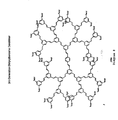
- 0 CCC=*c1cc(C2[C@](C)C2)cc(CC)c1 Chemical compound CCC=*c1cc(C2[C@](C)C2)cc(CC)c1 0.000 description 4
Images







Classifications
-
- C—CHEMISTRY; METALLURGY
- C08—ORGANIC MACROMOLECULAR COMPOUNDS; THEIR PREPARATION OR CHEMICAL WORKING-UP; COMPOSITIONS BASED THEREON
- C08G—MACROMOLECULAR COMPOUNDS OBTAINED OTHERWISE THAN BY REACTIONS ONLY INVOLVING UNSATURATED CARBON-TO-CARBON BONDS
- C08G61/00—Macromolecular compounds obtained by reactions forming a carbon-to-carbon link in the main chain of the macromolecule
- C08G61/02—Macromolecular compounds containing only carbon atoms in the main chain of the macromolecule, e.g. polyxylylenes
-
- C—CHEMISTRY; METALLURGY
- C08—ORGANIC MACROMOLECULAR COMPOUNDS; THEIR PREPARATION OR CHEMICAL WORKING-UP; COMPOSITIONS BASED THEREON
- C08G—MACROMOLECULAR COMPOUNDS OBTAINED OTHERWISE THAN BY REACTIONS ONLY INVOLVING UNSATURATED CARBON-TO-CARBON BONDS
- C08G83/00—Macromolecular compounds not provided for in groups C08G2/00 - C08G81/00
- C08G83/002—Dendritic macromolecules
- C08G83/003—Dendrimers
-
- C—CHEMISTRY; METALLURGY
- C08—ORGANIC MACROMOLECULAR COMPOUNDS; THEIR PREPARATION OR CHEMICAL WORKING-UP; COMPOSITIONS BASED THEREON
- C08J—WORKING-UP; GENERAL PROCESSES OF COMPOUNDING; AFTER-TREATMENT NOT COVERED BY SUBCLASSES C08B, C08C, C08F, C08G or C08H
- C08J5/00—Manufacture of articles or shaped materials containing macromolecular substances
- C08J5/18—Manufacture of films or sheets
-
- C—CHEMISTRY; METALLURGY
- C09—DYES; PAINTS; POLISHES; NATURAL RESINS; ADHESIVES; COMPOSITIONS NOT OTHERWISE PROVIDED FOR; APPLICATIONS OF MATERIALS NOT OTHERWISE PROVIDED FOR
- C09K—MATERIALS FOR MISCELLANEOUS APPLICATIONS, NOT PROVIDED FOR ELSEWHERE
- C09K11/00—Luminescent materials, e.g. electroluminescent or chemiluminescent
- C09K11/06—Luminescent materials, e.g. electroluminescent or chemiluminescent containing organic luminescent materials
-
- E—FIXED CONSTRUCTIONS
- E01—CONSTRUCTION OF ROADS, RAILWAYS, OR BRIDGES
- E01C—CONSTRUCTION OF, OR SURFACES FOR, ROADS, SPORTS GROUNDS, OR THE LIKE; MACHINES OR AUXILIARY TOOLS FOR CONSTRUCTION OR REPAIR
- E01C23/00—Auxiliary devices or arrangements for constructing, repairing, reconditioning, or taking-up road or like surfaces
- E01C23/16—Devices for marking-out, applying, or forming traffic or like markings on finished paving; Protecting fresh markings
- E01C23/20—Devices for marking-out, applying, or forming traffic or like markings on finished paving; Protecting fresh markings for forming markings in situ
-
- E—FIXED CONSTRUCTIONS
- E01—CONSTRUCTION OF ROADS, RAILWAYS, OR BRIDGES
- E01C—CONSTRUCTION OF, OR SURFACES FOR, ROADS, SPORTS GROUNDS, OR THE LIKE; MACHINES OR AUXILIARY TOOLS FOR CONSTRUCTION OR REPAIR
- E01C7/00—Coherent pavings made in situ
- E01C7/08—Coherent pavings made in situ made of road-metal and binders
- E01C7/35—Toppings or surface dressings; Methods of mixing, impregnating, or spreading them
-
- H—ELECTRICITY
- H05—ELECTRIC TECHNIQUES NOT OTHERWISE PROVIDED FOR
- H05B—ELECTRIC HEATING; ELECTRIC LIGHT SOURCES NOT OTHERWISE PROVIDED FOR; CIRCUIT ARRANGEMENTS FOR ELECTRIC LIGHT SOURCES, IN GENERAL
- H05B33/00—Electroluminescent light sources
- H05B33/12—Light sources with substantially two-dimensional [2D] radiating surfaces
- H05B33/14—Light sources with substantially two-dimensional [2D] radiating surfaces characterised by the chemical or physical composition or the arrangement of the electroluminescent material, or by the simultaneous addition of the electroluminescent material in or onto the light source
-
- H—ELECTRICITY
- H10—SEMICONDUCTOR DEVICES; ELECTRIC SOLID-STATE DEVICES NOT OTHERWISE PROVIDED FOR
- H10K—ORGANIC ELECTRIC SOLID-STATE DEVICES
- H10K50/00—Organic light-emitting devices
- H10K50/10—OLEDs or polymer light-emitting diodes [PLED]
- H10K50/11—OLEDs or polymer light-emitting diodes [PLED] characterised by the electroluminescent [EL] layers
-
- H—ELECTRICITY
- H10—SEMICONDUCTOR DEVICES; ELECTRIC SOLID-STATE DEVICES NOT OTHERWISE PROVIDED FOR
- H10K—ORGANIC ELECTRIC SOLID-STATE DEVICES
- H10K85/00—Organic materials used in the body or electrodes of devices covered by this subclass
- H10K85/30—Coordination compounds
-
- H—ELECTRICITY
- H10—SEMICONDUCTOR DEVICES; ELECTRIC SOLID-STATE DEVICES NOT OTHERWISE PROVIDED FOR
- H10K—ORGANIC ELECTRIC SOLID-STATE DEVICES
- H10K85/00—Organic materials used in the body or electrodes of devices covered by this subclass
- H10K85/60—Organic compounds having low molecular weight
- H10K85/615—Polycyclic condensed aromatic hydrocarbons, e.g. anthracene
-
- H—ELECTRICITY
- H10—SEMICONDUCTOR DEVICES; ELECTRIC SOLID-STATE DEVICES NOT OTHERWISE PROVIDED FOR
- H10K—ORGANIC ELECTRIC SOLID-STATE DEVICES
- H10K85/00—Organic materials used in the body or electrodes of devices covered by this subclass
- H10K85/60—Organic compounds having low molecular weight
- H10K85/649—Aromatic compounds comprising a hetero atom
- H10K85/654—Aromatic compounds comprising a hetero atom comprising only nitrogen as heteroatom
-
- H—ELECTRICITY
- H10—SEMICONDUCTOR DEVICES; ELECTRIC SOLID-STATE DEVICES NOT OTHERWISE PROVIDED FOR
- H10K—ORGANIC ELECTRIC SOLID-STATE DEVICES
- H10K85/00—Organic materials used in the body or electrodes of devices covered by this subclass
- H10K85/60—Organic compounds having low molecular weight
- H10K85/649—Aromatic compounds comprising a hetero atom
- H10K85/655—Aromatic compounds comprising a hetero atom comprising only sulfur as heteroatom
-
- H—ELECTRICITY
- H10—SEMICONDUCTOR DEVICES; ELECTRIC SOLID-STATE DEVICES NOT OTHERWISE PROVIDED FOR
- H10K—ORGANIC ELECTRIC SOLID-STATE DEVICES
- H10K85/00—Organic materials used in the body or electrodes of devices covered by this subclass
- H10K85/791—Starburst compounds
-
- C—CHEMISTRY; METALLURGY
- C08—ORGANIC MACROMOLECULAR COMPOUNDS; THEIR PREPARATION OR CHEMICAL WORKING-UP; COMPOSITIONS BASED THEREON
- C08J—WORKING-UP; GENERAL PROCESSES OF COMPOUNDING; AFTER-TREATMENT NOT COVERED BY SUBCLASSES C08B, C08C, C08F, C08G or C08H
- C08J2300/00—Characterised by the use of unspecified polymers
- C08J2300/20—Polymers characterized by their physical structure
- C08J2300/202—Dendritic macromolecules, e.g. dendrimers or hyperbranched polymers
-
- C—CHEMISTRY; METALLURGY
- C09—DYES; PAINTS; POLISHES; NATURAL RESINS; ADHESIVES; COMPOSITIONS NOT OTHERWISE PROVIDED FOR; APPLICATIONS OF MATERIALS NOT OTHERWISE PROVIDED FOR
- C09K—MATERIALS FOR MISCELLANEOUS APPLICATIONS, NOT PROVIDED FOR ELSEWHERE
- C09K2211/00—Chemical nature of organic luminescent or tenebrescent compounds
- C09K2211/10—Non-macromolecular compounds
- C09K2211/1003—Carbocyclic compounds
-
- C—CHEMISTRY; METALLURGY
- C09—DYES; PAINTS; POLISHES; NATURAL RESINS; ADHESIVES; COMPOSITIONS NOT OTHERWISE PROVIDED FOR; APPLICATIONS OF MATERIALS NOT OTHERWISE PROVIDED FOR
- C09K—MATERIALS FOR MISCELLANEOUS APPLICATIONS, NOT PROVIDED FOR ELSEWHERE
- C09K2211/00—Chemical nature of organic luminescent or tenebrescent compounds
- C09K2211/10—Non-macromolecular compounds
- C09K2211/1003—Carbocyclic compounds
- C09K2211/1007—Non-condensed systems
-
- C—CHEMISTRY; METALLURGY
- C09—DYES; PAINTS; POLISHES; NATURAL RESINS; ADHESIVES; COMPOSITIONS NOT OTHERWISE PROVIDED FOR; APPLICATIONS OF MATERIALS NOT OTHERWISE PROVIDED FOR
- C09K—MATERIALS FOR MISCELLANEOUS APPLICATIONS, NOT PROVIDED FOR ELSEWHERE
- C09K2211/00—Chemical nature of organic luminescent or tenebrescent compounds
- C09K2211/10—Non-macromolecular compounds
- C09K2211/1003—Carbocyclic compounds
- C09K2211/1011—Condensed systems
-
- C—CHEMISTRY; METALLURGY
- C09—DYES; PAINTS; POLISHES; NATURAL RESINS; ADHESIVES; COMPOSITIONS NOT OTHERWISE PROVIDED FOR; APPLICATIONS OF MATERIALS NOT OTHERWISE PROVIDED FOR
- C09K—MATERIALS FOR MISCELLANEOUS APPLICATIONS, NOT PROVIDED FOR ELSEWHERE
- C09K2211/00—Chemical nature of organic luminescent or tenebrescent compounds
- C09K2211/10—Non-macromolecular compounds
- C09K2211/1018—Heterocyclic compounds
- C09K2211/1025—Heterocyclic compounds characterised by ligands
- C09K2211/1029—Heterocyclic compounds characterised by ligands containing one nitrogen atom as the heteroatom
-
- H—ELECTRICITY
- H10—SEMICONDUCTOR DEVICES; ELECTRIC SOLID-STATE DEVICES NOT OTHERWISE PROVIDED FOR
- H10K—ORGANIC ELECTRIC SOLID-STATE DEVICES
- H10K2102/00—Constructional details relating to the organic devices covered by this subclass
- H10K2102/10—Transparent electrodes, e.g. using graphene
- H10K2102/101—Transparent electrodes, e.g. using graphene comprising transparent conductive oxides [TCO]
- H10K2102/103—Transparent electrodes, e.g. using graphene comprising transparent conductive oxides [TCO] comprising indium oxides, e.g. ITO
-
- H—ELECTRICITY
- H10—SEMICONDUCTOR DEVICES; ELECTRIC SOLID-STATE DEVICES NOT OTHERWISE PROVIDED FOR
- H10K—ORGANIC ELECTRIC SOLID-STATE DEVICES
- H10K85/00—Organic materials used in the body or electrodes of devices covered by this subclass
- H10K85/10—Organic polymers or oligomers
- H10K85/111—Organic polymers or oligomers comprising aromatic, heteroaromatic, or aryl chains, e.g. polyaniline, polyphenylene or polyphenylene vinylene
- H10K85/114—Poly-phenylenevinylene; Derivatives thereof
-
- Y—GENERAL TAGGING OF NEW TECHNOLOGICAL DEVELOPMENTS; GENERAL TAGGING OF CROSS-SECTIONAL TECHNOLOGIES SPANNING OVER SEVERAL SECTIONS OF THE IPC; TECHNICAL SUBJECTS COVERED BY FORMER USPC CROSS-REFERENCE ART COLLECTIONS [XRACs] AND DIGESTS
- Y02—TECHNOLOGIES OR APPLICATIONS FOR MITIGATION OR ADAPTATION AGAINST CLIMATE CHANGE
- Y02E—REDUCTION OF GREENHOUSE GAS [GHG] EMISSIONS, RELATED TO ENERGY GENERATION, TRANSMISSION OR DISTRIBUTION
- Y02E10/00—Energy generation through renewable energy sources
- Y02E10/50—Photovoltaic [PV] energy
- Y02E10/549—Organic PV cells
-
- Y—GENERAL TAGGING OF NEW TECHNOLOGICAL DEVELOPMENTS; GENERAL TAGGING OF CROSS-SECTIONAL TECHNOLOGIES SPANNING OVER SEVERAL SECTIONS OF THE IPC; TECHNICAL SUBJECTS COVERED BY FORMER USPC CROSS-REFERENCE ART COLLECTIONS [XRACs] AND DIGESTS
- Y02—TECHNOLOGIES OR APPLICATIONS FOR MITIGATION OR ADAPTATION AGAINST CLIMATE CHANGE
- Y02P—CLIMATE CHANGE MITIGATION TECHNOLOGIES IN THE PRODUCTION OR PROCESSING OF GOODS
- Y02P70/00—Climate change mitigation technologies in the production process for final industrial or consumer products
- Y02P70/50—Manufacturing or production processes characterised by the final manufactured product
-
- Y—GENERAL TAGGING OF NEW TECHNOLOGICAL DEVELOPMENTS; GENERAL TAGGING OF CROSS-SECTIONAL TECHNOLOGIES SPANNING OVER SEVERAL SECTIONS OF THE IPC; TECHNICAL SUBJECTS COVERED BY FORMER USPC CROSS-REFERENCE ART COLLECTIONS [XRACs] AND DIGESTS
- Y10—TECHNICAL SUBJECTS COVERED BY FORMER USPC
- Y10S—TECHNICAL SUBJECTS COVERED BY FORMER USPC CROSS-REFERENCE ART COLLECTIONS [XRACs] AND DIGESTS
- Y10S428/00—Stock material or miscellaneous articles
- Y10S428/917—Electroluminescent
-
- Y—GENERAL TAGGING OF NEW TECHNOLOGICAL DEVELOPMENTS; GENERAL TAGGING OF CROSS-SECTIONAL TECHNOLOGIES SPANNING OVER SEVERAL SECTIONS OF THE IPC; TECHNICAL SUBJECTS COVERED BY FORMER USPC CROSS-REFERENCE ART COLLECTIONS [XRACs] AND DIGESTS
- Y10—TECHNICAL SUBJECTS COVERED BY FORMER USPC
- Y10T—TECHNICAL SUBJECTS COVERED BY FORMER US CLASSIFICATION
- Y10T428/00—Stock material or miscellaneous articles
- Y10T428/26—Web or sheet containing structurally defined element or component, the element or component having a specified physical dimension
- Y10T428/263—Coating layer not in excess of 5 mils thick or equivalent
- Y10T428/264—Up to 3 mils
- Y10T428/265—1 mil or less
-
- Y—GENERAL TAGGING OF NEW TECHNOLOGICAL DEVELOPMENTS; GENERAL TAGGING OF CROSS-SECTIONAL TECHNOLOGIES SPANNING OVER SEVERAL SECTIONS OF THE IPC; TECHNICAL SUBJECTS COVERED BY FORMER USPC CROSS-REFERENCE ART COLLECTIONS [XRACs] AND DIGESTS
- Y10—TECHNICAL SUBJECTS COVERED BY FORMER USPC
- Y10T—TECHNICAL SUBJECTS COVERED BY FORMER US CLASSIFICATION
- Y10T428/00—Stock material or miscellaneous articles
- Y10T428/31504—Composite [nonstructural laminate]
- Y10T428/31855—Of addition polymer from unsaturated monomers
Definitions
- This invention relates to light-emitting dendrimers and devices using them and methods for their synthesis and construction.
- conjugated organic materials including linear (co)polymers, oligomers, and molecular materials show considerable promise as the light-emitting layers in light-emitting diodes (LEDs) (J.H.Burroughs et al, Nature, 1990, 347, 539).
- LEDs light-emitting diodes
- a number of problems need to be overcome including achievement of the necessary emission colours (particularly blue and red), optimisation of chromophoric efficiency together with processing properties, and extension of device operational lifetime.
- the simplest organic-based LEDs have the organic light-emitting layer sandwiched between an anode, which injects holes, and a cathode, which injects electrons, with one or both of the electrodes being clear to allow the emission of light from the device.
- Most light-emitting conjugated materials tend to transport holes in preference to electrons and hence the LEDs which have been developed can incorporate additional charge transport layers in addition to the luminescent layer in an effort to balance the charge injection (A.R.Brown et al, Chem. Phys. Lett., 1992, 200, 46).
- linear (co)polymers for such devices is that changes to the structure of the linear (co)polymer designed to change the electronic properties of the linear (co)polymer may then also change the synthetic procedure as well as the processing properties of the linear (co)polymers (P.L.Burn et al, J. Am. Chem. Soc., 1993, 115, 10117).
- the present invention addresses the problems encountered with (co)polymers on the basis that dendritic light-emitting molecules will provide a new approach to the molecular engineering of materials for LEDs and tend to have distinct advantages over linear polymers in some or all of these areas, including efficiency, colour control, and processing.
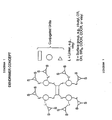
- Dendrimers are typically represented by a core (rectangle), dendritic branches including conjugated units (circles and triangles) and including branch links (L), and surface groups (S), of general structure shown in the accompanying Diagram 1.
- the branch links (L) can be a simple bond or bonds.
- the dendrimers according to the present invention which can be used for incorporation into light emitting devices have a core and/or branches comprising electroluminescent or charge-transporting chromophores (conjugated units).
- the conjugated units used for the core and/or the branches need not be the same. The importance of each component of the dendrimer will be discussed below.
- the dendrimers according to the invention may be synthesised by any convenient method, including both “convergent” and “divergent” methods (Z.Xu et al, J. Am. Chem. Soc., 1994, 116, 4537). In convergent methods the dendritic branches are first synthesised and then bonded to bonding sites on the core, whereas in divergent methods the dendritic branches are progressively built up from the core bonding sites.
- LEDs Light-emitting diodes
- acetylene (ethynyl) linkages to acetylene-linked 3,5-t-butylphenyl dendritic structures
- Those dendrimers are believed not to be very efficient for the present purposes.
- Bettenhausen and Strohriegel, in Macromol. Rapid Commun. 17, 623-631 (1996) describe dendrimers having 1,3,4-oxadiazole linking units for use as electron injection and transport layers (not the light-emitting element) in light emitting devices.
- the present invention provides dendrimers, ways of synthesising them, methods of processing them to make devices, and devices using them, which are believed to be superior to those previously known dendrimers, especially for use in light emitting devices. It is to be understood, for further avoidance of doubt, that the use of the specified dendrimers as a light-emitting element in a light-emitting device encompasses such use of the dendrimers either as the light-emitting element or in the light-emitting element in the event that the light-emitting element is regarded as including structures or materials in addition to the dendrimers themselves.
- One aspect of the invention accordingly provides a compound having the formula: CORE - [DENDRITE] n in which CORE represents an atom or group, n represents an integer of at least 1 and DENDRITE, which may be the same or different if n is greater than 1, represents an inherently at least partly conjugated dendritic molecular structure comprising aryl and/or heteroaryl groups and alkenyl groups connected to each other via a carbon atom of an alkenyl group to a ring carbon atom of an aryl and/or heteroaryl group, CORE terminating in the first single bond which is connected to a ring carbon atom of an (hetero)aryl group to which more than one at least partly conjugated dendritic chain is attached, said ring carbon atom forming part of DENDRITE, the CORE and/or DENDRITE being luminescent; usually the compound is luminescent, preferably in the solid states.
- the compound emits light in the visible region under electrical or optical excitation.
- the compounds typically have one or more end or surface groups such that the compounds will have the general structure CORE -- [DENDRITE -- ENDGROUPS] n or, more particularly, [CORE--]--- [-- ⁇ d -- ⁇ ARM--ENDGROUPS ⁇ m ] n in which ⁇ d is the said first aryl or heteroaryl moiety of the DENDRITE, typically a 1,3,5-bonded benzene ring, ARM is the dendritic arms extending therefrom, and m is an integer of value at least 2.
- the compound may have more than one luminescent moiety and the energy resulting from electrical or optical excitation is transferred to one of them for light emission.
- the dendrimer incorporates at least two inherently at-least-partly-conjugated luminescent moieties which moieties may or may not be conjugated with each other, wherein the or each said dendritic structure(s) include(s) at least one of the said luminescent moieties, the luminescent moiety or moieties further from the core of the dendrimer being of larger HOMO-LUMO energy gap than the luminescent moiety or moieties closer to or partly or wholly within the core of the dendrimer.
- the HOMO-LUMO energy gap is the same.
- the relative HOMO-LUMO energy gaps of the moieties can be measured by methods known per se using a UV-visible spectrophotometer. It appears that this graduation of HOMO-LUMO energy gap being lower in those luminescent moieties which are closer to the core is beneficial in encouraging inwards charge transfer and increased light-emitting activity within the dendrimer molecules, possibly by reducing migration of the excited states to quenching sites and giving rise to the possibility of charge build-up.
- One of the luminescent moieties may be, or (partly or wholly) within, the core itself, which will thus preferably have a smaller inherent HOMO-LUMO gap energy than the other luminescent moiety or moieties in the dendritic structures.
- the dendritic structures themselves may each contain more than one luminescent moiety, in which case those further form the core will again preferably have larger inherent HOMO-LUMO gap energies than those closer to the core.
- the core itself need not be luminescent, although luminescent cores are generally preferred.
- CORE - [DENDRITE] n in which CORE represents an atom or group, n represents an integer of at least 1 and DENDRITE, which may be the same or different if n is greater than 1, represents an inherently at least partly conjugated dendritic molecular structure comprising aryl and/or heteroaryl groups and alkenyl groups connected to each other via a carbon atom of an alkenyl group to a ring carbon atom of an aryl or heteroaryl group, CORE terminating in the first single bond which is connected to a ring carbon atom of an (hetero)aryl group to which more than one at least partly conjugated dendritic chain is attached, said ring carbon atom forming part of DENDRITE, the CORE and/or DENDRITE being luminescent.
- Emission Colour We envisage that at-least-partially alkylene conjugated units of specific length and substitution can be introduced as the core or branches of dendrimers to give good colour selection possibilities for light emitting devices.
- dendrimers which have units derived from trans,trans-distyryl benzene as the core and branches should have the good photoluminescence quantum efficiency and blue emission of the parent compound (Nakatsuji et al, J. Chem. Soc. Perkin Trans 2, 1991, 861).
- the surface groups may tend to assume a majority or substantially all of the molecular contact with the surrounding environment. Therefore, the outer surface controls the solubility and processibility of the molecule and thus changes to the internal electronic structure of the chromophore(s) should be possible without unacceptably affecting the processing properties and vice versa.
- the solubility and processibility of linear conjugated polymers can be dramatically affected by the attachment of substituents, e.g., electron-withdrawing groups which facilitate electron injection. Therefore, the dendrimers described here provide an opportunity of optimising the electronic and processing properties independently which should give improved manufacturablilty of electronically optimised materials.
- Some examples of the surface groups which would be suitable to incorporate onto the dendrimers include branched and unbranched alkyl, especially t-butyl, branched and unbranched alkoxy, hydroxy, alkylsilane, carboxy, carbalkoxy, and vinyl.
- a more comprehensive list include a further-reactable alkene, (meth)acrylate, sulphur-containing, or silicon-containing group; sulphonyl group; polyether group; C 1 -to-C 15 alkyl (preferably t-butyl) group; amine group; mono-, di- or tri-C 1 -to-C 15 alkyl amine group; -COOR group wherein R is hydrogen or C 2 -to-C 15 alkyl; -OR group wherein R is hydrogen, aryl, or C 1 -to-C 15 alkyl or alkenyl; -O 2 SR group wherein R is C 1 -to-C 15 alkyl or alkenyl; -SR group wherein R is aryl, or C 1 -to-C 15 alkyl or alkenyl; -SiR 3 groups wherein the R groups are the same or different and are hydrogen, C 1 -to-C 15 alkyl or alkenyl, or -SR' group
- the efficiency of light emission from light emitting devices based on dendrimers tends to be better than that of light emitting devices based on linear polymers. This is because exciton migration to quenching sites can be inhibited, optimised chromophores can be used, and intermolecular interactions controlled to avoid undesirable processes such as excimer formation. In linear conjugated polymers the exciton migrates through the sample to regions of low HOMO-LUMO gap energy and can often encounter defects which quench the luminescence. Dendrimers can be designed according to the present invention so that the innermost or central chromophores have a lower HOMO-LUMO energy gap than chromophores closer to the surface.
- Dendrimers tend to show improved chemical stability for two reasons. First, as the excited state can be located at the core of the molecule, it is more protected from the environment, and it is likely to give improved photochemical stability. Second, dendrimers generally have much higher glass transition temperatures than the chromophores they contain, generally giving improved thermal stability to the device and reducing problems of recrystallisation associated with smaller molecules.
- the types of dendrimer contemplated for the present purposes incorporate conjugated units which are preferably based on arylenes and heteroarylenes linked by alkenyl (preferably vinyl) groups.
- the conjugation of the core may be varied both in length, with the aim to have the HOMO-LUMO energy gap lower than that of the branches as aforesaid, and in substituent pattern. This allows control of the colour of emission, from blue to red, and of electron affinity.
- Surface groups may be chosen to afford solubility and processibility to the dendrimers in common solvents. If the need arises for multilayer LEDs to be prepared, then the surface groups may be selected to allow crosslinking.
- the core compound will often be a monomeric compound, but complex molecules, for example porphyrins, and dimers, trimers, and oligomers are not excluded.
- Specific examples include a moiety of benzene, pyridine, pyrimidine, triazine, thiophene, divinylbenzene,distyrylethylene, divinylpyridine, pyrimidine, triazine, divinylthiophene, oxadiazole, coronene, or a triarylamine or a fluorescent dye or marker compound, or a polyphenylene chain and especially a distyryl anthracene, porphyrin or distyrylbenzene moiety.
- These various rings may be substituted, for example by C 1 to C 15 alkyl or alkoxy groups. In one embodiment there are no halogen substituents.
- dendrimers groups that favour electron and hole transport into the dendrimers thus providing in a single molecule the electron and hole transporting agents which are provided as distinct layers in previously known devices, for example of structure ITO/hole tranport layer/emissive layer/electron transport layer/metal contact.
- Very large cores, e.g. a porphyrin or a multi-ring system with more than six reactive sites can be sterically possible.
- Oligomeric cores formed of units such as distyrylbenzene, phenylene, phenylene-vinylene, and terphenyl may be useful.
- the DENDRITE part of the molecules are formed of aryl and/or heteroaryl groups and alkenyl groups connected to each other via a carbon atom of an alkenyl group to a ring carbon atom of an aryl or heteroaryl group.
- DENDRITE is inherently at least partly conjugated; "inherently” means that there is conjugation within DENDRITE itself.
- the aryl groups are preferably benzene rings, preferably coupled at ring positions 1, 3 and 5, pyridyl or triazinyl rings, or polyphenylene chains. These groups may optionally be substituted, typically by C 1 to C 15 alkyl or alkoxy groups.
- DENDRITE is typically illustrated by groups coupled by conjugated linkages in 1st, 2nd or 3rd (or higher) generation structures of general formula in which x is 1, 2, or 3 and E is a surface group which may be the same or different if more than one.
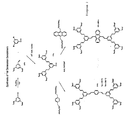
- Examples of dendrimers according to the invention are illustrated in the accompanying Diagram 2 and have all the chromophores linked by conjugated units and in particular alkylene moieties.
- n is 2 and the DENDRITE units are attached in the para position to an aromatic core as in It will be appreciated that CORE can comprise at least two aromatic rings which are not fused to one another as unit 6.
- the core can be considered independently from the branches when determining the required colour of light emission and the relative energy gaps or conjugation lengths.
- the core does not necessarily have to be conjugated or aromatic.
- the core could be a nitrogen or carbon atom to which aryl ring units of three or four dendritic structures could be bonded.
- the synthetic sequence developed for the preparation of 4 and 5 may be extended/repeated to form higher-generation and/or differently-substituted dendrimers (see Diagram 2). Initially, branches comprising stilbene units are preferred whilst varying the conjugation length and electron affinity of the core. Use of t-butyl groups as the surface groups is initially preferred, as they have afforded good films of 4 and 5. The use, as CORE groups, of 1,4-distrylbenzyl, 9,10-distyrylanthracenyl and 5,10,15,20-porphyrin is also preferred.
- the first step of the iterative synthetic sequence involves the coupling of 1 (N. Risch et al, Z.
- the first generation dendrimers will have a different HOMO-LUMO energy gap, giving rise to different emission colours, as well as different electron affinities.
- the links per se shown in Diagram 2 for the core may be produced by literature procedures.
- the invention includes increasing the generation number of the dendrimers and to this end 3 has been synthesised, which is a vinyl derivative of the first-generation branching reactant 2. It is further possible to react 3, as in the case of 1, with 1,3,5-tribromobenzene to give the second-generation branch 17, which can then be attached to the cores as before. We envisage that the second-generation branch can then be converted to its vinyl derivative for the next iteration to give subsequent (third and possibly higher) generations. It will be appreciated that, at every step, a brominated core is needed.
- the styrene 1 is linked to 3,5-dibromobenzaldehyde (L.S.Chen et al, J. Organomet. Chem., 1981, 215, 281) utilising a palladium-catalysed coupling.
- the aldehyde 9 can then be coupled with the required bis-phosponates to give 5, 6, 7, 8 and 18.
- 9 can be condensed with pyrrole to give the corresponding porphyrin dendrimer.
- the next stage in the iteration to form higher generations is to react the aldehyde 9 with triphenylmethylphosphonium iodide to give 3.
- the styrene moiety of 3 is then coupled to 3,5-dibromobenzaldehyde to give 19.
- the aldehyde 19 can then be coupled as before to give the next generation of dendrimers.
- the next generation aldehyde can be prepared in a similar manner.
- the present invention also provides a process for preparing a compound of the formula:- CORE - [DENDRITE] n in which CORE represents an atom or group, n represents an integer of at least 1 and DENDRITE, which may be the same or different if n is greater than 1, represents an inherently at least partly conjugated dendritic molecular structure comprising aryl and/or heteroaryl groups and alkenyl groups connected to each other via a carbon atom of an alkenyl group to a ring carbon atom or an aryl or heteroaryl group, CORE terminating in the first single bond which is connected to a ring carbon atom of an (hetero)aryl group to which more than one at least partly conjugated dendritic chain is attached, said ring carbon atom forming part of DENDRITE, the CORE and/or DENDRITE being luminescent, which comprises reacting a 3,5-di(halo, preferably bromo)benzaldehyde with a 3,5-di
- Dibromination may then afford primarily 2,5-dibromo-1,4-dimethylthiobenzene, which when coupled with 3 will give a substituted 5.
- the methylthio groups may then be oxidised with Oxone or other suitable reagent to give the corresponding sulfones, that is, 5 with two electron withdrawing groups attached to the core.
- the alternative route will allow the electron-withdrawing groups to be attached to the vinylene units or both parts of the core. This will involve the lithiation of 2 followed by reaction with N,N-dimethylformamide to give 9, which will then be condensed with a variety of bis-acetonitrile arylenes under Knoevegal conditions to give the corresponding alkenes with cyano groups attached.
- the branches and/or core may contain heteroaromatic units such as pyridine, pyrimidine, thiazole, triazine or fluorinated aryl or heteroaryl units to increase the electron affinity of the dendrimer.
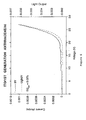
- single-dendrimer-layer light emitting devices may be made typically by spin-coating from solution onto, say, indium/tin oxide- (ITO) coated glass substrates followed by the evaporation of a suitable metal cathode such as Al, Mg/Ag or Ca. Devices may then be characterised by measuring their I-V curves, light output, emission spectra, and efficiency.
- Light emitting devices may be made as follows. Take an ITO-coated glass substrate and deposit a film of the dendrimer, preferably in a mixture with a film-forming polymeric material or binder, by spin-coating (although there are a number of related techniques which could be used).
- Electroluminescence (EL) efficiency can be expressed as the number of photons emitted by the device divided by the number of electrons passing through it. This is known as the external quantum efficiency. There is also a quantity known as the internal quantum efficiency, which is the number of photons generated in the device divided by the number of electrons passing through it. This number is a factor 5-8 higher than the external quantum efficiency because only some of the photons get out of the device.
- the dendrimers can be used in any semi-conducting device including a photodiode, solar Cell, FET or solid state triode.
- Dry tetrahydrofuran 80 ml was added to a mixture of potassium t-butoxide (6.740 g, 60.06 mmoles) and methyltriphenylphosphonium bromide (24.276 g, 60.06 mmoles) and stirred at room temperature for 30 minutes.
- Acetone 50 ml was then added and then all of the solvent was removed under vacuum. Pet.
- Dry tetrahydrofuran (375 mL) was added to a mixture of methyltriphenylphosphonium iodide (50.6 g, 125 mmoles) and potassium t-butoxide (14.0 g, 125 mmoles) and stirred at room temperature for 15 minutes.
- 3,5-bis(3',5'-di- t -butylstyryl)benzaldehyde (44.6 g, 83.4 mmoles) was then added and the reaction mixture was stirred at room temperature for 90 minutes.
- Dry tetrahydrofuran (1 ml) was added to a mixture of methyltriphenylphosphonium iodide (135 mg, 0.334 mmoles) and potassium t-butoxide (37 mg, 0.334 mmoles) and stirred at room temperature for 10 minutes.
- a solution of 3,5-bis(3',5'-di-t-butylstyryl)benzaldehyde (195 mg, 0.167 mmoles) in dry tetrahydrofuran (1 ml) was then added and the reaction mixture was stirred at room temperature for 1 hour.
- Dry tetrahydrofuran 250 mL was added to a mixture of methyltriphenylphosphonium iodide (9.87 g, 24.4 mmoles) and potassium t-butoxide (2.74 g, 24.4 mmoles) and stirred at room temperature for 25 minutes.
- reaction mixture was then heated in an oil-bath at 135°C under argon for 16 hours.
- the reaction mixture was then poured into a rapidly stirred mixture of water (30 ml) and pet. ether (60-80) (50 ml).
- the precipitate was filtered and the crude product (518 mg) was recrystallized from dichloromethane/pet. ether (60-80) to give a white powder of 3,5-bis[3',5-'bis(3'',5''-di-t-butylstyryl)styryl]benzaldehyde (407 mg, 48 %).
- reaction mixture was then heated under argon at 130 °C for 17 hours. After further addition of anhydrous N , N -dimethylacetamide (100 mL), the reaction mixture was degassed for a second time and then heated at 130°C for a further 5.5 hours. Further anhydrous N , N -dimethylacetamide (100 mL) was then added and the reaction was continued for a further 1 hour. The resulting sludge was washed with distilled water (3 x 250 mL) and dissolved in dichloromethane (1500 mL). The organic fraction was washed with distilled water (500 mL), dried over anhydrous sodium sulphate and evaporated to give a cream solid.
- C82H102 requires C, 90.55; H, 9.45 %); ⁇ max (CHCl3)/nm 315 ( ⁇ /dm3 mol-1 cm-1 108000); ⁇ H (500 MHz; CDCl3) 1.40 (72 H, s, tBu), 7.23 (4 H, d, J 16, 7"-H), 7.32 (4 H, d, J 16, 8"-H), 7.40 (4 H, t, J 1.7, 1"-H), 7.45 (8 H, d, J 1.7, 3",5"-H), 7.73 (4 H, s, 3',5'-H), 7.73 (2 H, s, 1'-H), 7.81 (4 H, s, 2,3,5,6-H).
- C86H106 requires C, 90.63; H, 9.37%); ⁇ max (CHCl3)/nm 325 ( ⁇ /dm3 mol-1 cm-1 117000), and 367 (75100); ⁇ H (500 MHz; CDCl3) 1.40 (72 H, s, tBu), 7.18 (4 H, d, J 16, 7"-H), 7.29 (4H, d, J 16, 8"-H), 7.22 (2H, d, J 16, 7'-H), 7.27 (2H, d, J 16, 8'-H), 7.40 (4H, t, J 1.7, 1"-H), 7.44 (8H, d, J 1.7, Ar 3'',5''-H), 7.60 (4H, s, 2,3,5,6-H), 7.62 (4H, m, 3',5'-H), 7.64 (2H, m, 1'-H).
- the crude product (107 mg) was isomerised with catalytic iodine in refluxing toluene for 17 hours.
- the solvent was removed under vacuum and the crude product was purified by chromatography on flash silica using dichloromethane-pet.ether (60-80)-triethylamine (20:180:1) as the eluent to give 1-DSB (58 mg,57%), m.p. 280°C with microanalysis i/r, u/v, NMR and mass spectrographic data substantially identical to that of the first example.
- C182H218 requires C, 90.87; H, 9.13%); ⁇ max (CHCl3)/nm 323 ( ⁇ /dm3 mol-1 cm-1 307000) and 367sh (95200); ⁇ H (500 MHz; CDCl3) 1.41 (144 H, s, tBu), 7.20 (8 H, d, J 16, 7"'-H), 7.22-7.33 (20 H, m, 8"',7",8",7',8'-H), 7.41 (8 H, t, J 1.6, 1"'-H), 7.46 (16 H, d, J 1.6, 3"',5"'-H), 7.63-7.72 (22 H, m, 1",3",5'',1',3',5',2,3,5,6-H).
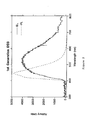
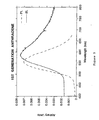
- 2-DSB (10 mg) in spectrophotometric grade chloroform (0.5 ml) was spin-coated at 1900 RPM for 60 seconds onto an ITO covered glass slide to give a thickness of 140 nm.
- the sample was immediately transferred to the evaporator.
- Calcium (100 nm) and aluminium (80 nm) were then sequentially deposited to complete the device.
- the external quantum efficiency was found to be 0.09%.
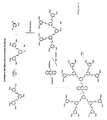
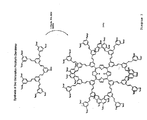
- dendrimers according to the present invention are further illustrated by the accompanying self-explanatory formula Diagrams 3 to 8.
- the dendrimers according to this invention are not necessarily pure compounds.
- Working light emitting device can be made using dendrimers containing impurities generated during the synthesis, which may in some cases be difficult to remove.
Landscapes
- Chemical & Material Sciences (AREA)
- Engineering & Computer Science (AREA)
- Materials Engineering (AREA)
- Physics & Mathematics (AREA)
- Organic Chemistry (AREA)
- Spectroscopy & Molecular Physics (AREA)
- Medicinal Chemistry (AREA)
- Polymers & Plastics (AREA)
- Health & Medical Sciences (AREA)
- Chemical Kinetics & Catalysis (AREA)
- Civil Engineering (AREA)
- Manufacturing & Machinery (AREA)
- Structural Engineering (AREA)
- Architecture (AREA)
- Optics & Photonics (AREA)
- Inorganic Chemistry (AREA)
- Electroluminescent Light Sources (AREA)
- Organic Low-Molecular-Weight Compounds And Preparation Thereof (AREA)
- Nitrogen Condensed Heterocyclic Rings (AREA)
- Pyridine Compounds (AREA)
- Indole Compounds (AREA)
Claims (35)
- Verbindung mit der Formel:ist, worin X Brom oder CHO ist, wenn n=2, der KERN nicht Brom oder CHO ist, wenn n=1, und geknüpft ist an
 und nicht die Struktur
- Verbindung nach Anspruch 1, welche im festen Zustand lumineszierend ist.
- Verbindung nach Anspruch 2, welche Licht im sichtbaren Bereich unter elektrischer oder optischer Anregung ausstrahlt.
- Verbindung nach einem der Ansprüche 1 bis 3, welche mehr als eine lumineszierende Komponente aufweist und wobei die Energie, die aus der elektrischen oder optischen Anregung resultiert, auf eine davon zur Lichtausstrahlung übertragen wird.
- Verbindung nach einem der Ansprüche 1 bis 4, welche mindestens zwei inhärent zumindest teilweise konjugierte lumineszierende Komponenten aufweist, wobei der oder jeder derartige DENDRIT mindestens eine der lumineszierenden Komponenten enthält, wobei die weiter vom KERN entfernte lumineszierende Komponente oder Komponenten eine größere HOMO-LUMO-Energielücke aufweisen als die näher am oder teilweise oder vollständig innerhalb des KERN befindliche lumineszierende Komponente oder Komponenten.
- Verbindung nach Anspruch 5, worin der oder jeder DENDRIT mehr als eine lumineszierende Komponente enthält.
- Verbindung nach Anspruch 5 oder 6, worin sich eine der lumineszierenden Komponenten teilweise oder vollständig innerhalb des KERN befindet oder den KERN selbst darstellt und eine geringere inhärente HOMO-LUMO-Lückenenergie aufweist als die andere lumineszierende Komponente oder Komponenten im DENDRIT.
- Verbindung nach einem der Ansprüche 1 bis 6, worin der KERN nicht lumineszierend ist.
- Verbindung nach Anspruch 8, worin der KERN nicht lumineszierend ist und die weiter vom KERN entfernte lumineszierende Komponente oder Komponenten größere HOMO-LUMO-Energielücken aufweisen als die näher am KERN befindlichen.
- Verbindung nach einem der vorangehenden Ansprüche, worin die erste Arylkomponente von DENDRIT ein 1,3,5-gebundener Benzolring ist.
- Verbindung nach einem der vorangehenden Ansprüche, worin n 2 ist und die DENDRIT-Einheiten in der para-Position an einen aromatischen KERN geknüpft sind.
- Verbindung nach einem der vorangehenden Ansprüche, worin KERN mindestens zwei aromatische Ringe umfasst, die nicht miteinander verschmolzen sind.
- Verbindung nach einem der vorangehenden Ansprüche, worin KERN kein an einen aromatischen Ring gebundenes Halogenatom besitzt.
- Verbindung nach einem der vorangehenden Ansprüche, worin KERN eine Distyrylanthracen-, Porphyrin- oder Distyrylbenzol-Komponente umfasst.
- Verbindung nach einem der Ansprüche 1 bis 13, worin KERN eine Komponente von Benzol, Pyridin, Pyrimidin, Triazin, Thiophen, Divinylbenzol, Distyrylethylen, Divinylpyridin, Pyrimidin, Triazin, Divinylthiophen, Oxadiazol, Coronen, oder ein Triarylamin oder einen Fluoreszenzfarbstoff oder eine Marker-Verbindung umfasst.
- Verbindung nach einem der vorangehenden Ansprüche, worin n zwei bis sechs ist.
- Verbindung nach einem der vorangehenden Ansprüche, worin der oder jeder DENDRIT zumindest teilweise mit KERN konjugiert ist.
- Verbindung nach einem der vorangehenden Ansprüche, worin die Arylkomponenten in DENDRIT Benzol-, Pyridyl-, Triazinyl- oder Thiophenyl-Ringe sind.
- Verbindung nach Anspurch 18, worin die Benzolringe an den Ringpositionen 1, 3 und 5 gekoppelt sind.
- Verbindung nach einem der vorangehenden Ansprüche, worin mindestens eine Oberflächengruppe an ein entferntes Arylring-Kohlenstoffatom von DENDRIT geknüpft ist, welche Gruppe eine weiter reagierbare Alken-, (Meth)acrylat-, Schwefel-haltige oder Siliziumdioxid-haltige Gruppe; Sulfonylgruppe;
Polyethergruppe; C1-C15-Alkylgruppe; Amingruppe; Mono-, Di- oder Tri-C1-C15-Alkylamingruppe; -COOR-Gruppe, worin R Wasserstoff oder C1-C15-Alkyl ist;
-OR-Gruppe, worin R Wasserstoff, Aryl oder C1-C15-Alkyl oder -Alkenyl ist; -O2SR-Gruppe, worin R C1-C15-Alkyl oder -Alkenyl ist; -SR-Gruppe, worin R Aryl oder C1-C15-Alkyl oder -Alkenyl ist; -SiR3-Gruppen, worin die R-Gruppen gleich oder verschieden sind und Wasserstoff, C1-C15-Alkyl oder -Alkenyl sind, oder -SR'-Gruppe (R' ist Aryl oder C1-C15-Alkyl oder -Alkenyl), Aryl oder Heteroaryl ist. - Verbindung nach Anspruch 20, worin die Oberflächengruppen t-Butylgruppen sind.
- Verbindung nach einem der vorangehenden Ansprüche, worin die DENDRIT-Strukturen aus den Alkenyl- und (Hetero)aryl-Einheiten bestehen, die aneinander gekoppelt sind durch konjugierte Bindungen in Strukturen der 1., 2. oder 3. Generation der allgemeinen Formelworin x 1, 2 oder 3 ist und E eine Oberflächengruppe ist, die gleich oder verschieden, wenn mehr als eins, sein kann.

- Verbindung nach einem der vorangehenden Ansprüche, welche eine oder mehrere elektronenentziehende Gruppen enthält, die ihre elektronentransportierenden Eigenschaften verstärkt.
- Verfahren zur Herstellung einer Verbindung der Formel:
- Verfahren nach Anspruch 24, worin die Oberflächengruppe t-Butyl ist.
- Verfahren nach Anspruch 24 oder 25, worin die Komponente, die zumindest den zentralen Teil des KERN umfasst, Pyrrol oder ein Phosphonat ist.
- Lichtemittierendes Bauteil, welches als sein oder in seinem lichtemittierenden Element eine Verbindung enthält mit der Formel:
- Bauteil nach Anspruch 27, worin die Verbindung eine solche ist, wie in einem der Ansprüche 1 bis 23 beansprucht.
- Bauteil nach Anspruch 27 oder 28, welches eine Schicht aus der Verbindung zusammen mit einer oder mehreren Schichten aus anderen Materialien umfasst, die vorzugsweise eine Ladungslöcher-transportierende oder Elektronentransportierende Schicht ist oder enthält.
- Verfahren zur Herstellung eines lichtemittierenden Bauteils, welches die Schritte des Bereitstellens eines Films aus mindestens einer Verbindung nach einem der Ansprüche 1 bis 23 und, wahlweise, einen oder mehrere weitere Filme zum Erhalt eines Laminats umfasst, des Anheftens an eine Oberfläche des Films oder Laminats einer im wesentlichen transparenten Elektrode (vorzugsweise ITO) und des Ablagerns auf der anderen Oberfläche des Films oder Laminats einer metallischen Kathode, vorzugsweise gewählt aus Al, Mg/Ag und Ca.
- Film, erzeugt aus einer Verbindung nach einem der Ansprüche 1 bis 23.
- Farbanzeige-Vorrichtung, welche Pixel enthält, die ein oder mehrere lichtemittierende Bauteile nach einem der Ansprüche 27 bis 29 umfassen.
- Farbanzeige-Vorrichtung nach Anspruch 32, worin ein im wesentlichen weißer oder neutraler Hintergrund durch eine oder mehrere der Verbindungen bereitgestellt wird, die diese Hintergrundfarbe inhärent emittieren.
- Verbindung nach einem der Ansprüche 1 bis 23, zur Verwendung als ein lichtemittierendes Element in einer elektrisch betriebenen lichtemittierenden Diode.
- Verwendung einer Verbindung nach einem der Ansprüche 1 bis 23, in einem anderen Halbleiter-Bauteil als einem lichtemittierenden Element.
Applications Claiming Priority (5)
| Application Number | Priority Date | Filing Date | Title |
|---|---|---|---|
| GB9722348 | 1997-10-23 | ||
| GBGB9722348.1A GB9722348D0 (en) | 1997-10-23 | 1997-10-23 | Light-emitting dendrimers & devices |
| GBGB9726929.4A GB9726929D0 (en) | 1997-12-19 | 1997-12-19 | Light emiting dendrimers and devices |
| GB9726929 | 1997-12-19 | ||
| PCT/GB1998/003172 WO1999021935A1 (en) | 1997-10-23 | 1998-10-23 | Light-emitting dendrimers and devices |
Publications (2)
| Publication Number | Publication Date |
|---|---|
| EP1027398A1 EP1027398A1 (de) | 2000-08-16 |
| EP1027398B1 true EP1027398B1 (de) | 2004-06-09 |
Family
ID=26312476
Family Applications (1)
| Application Number | Title | Priority Date | Filing Date |
|---|---|---|---|
| EP19980949141 Expired - Lifetime EP1027398B1 (de) | 1997-10-23 | 1998-10-23 | Lichtemittierende dendrimere |
Country Status (9)
| Country | Link |
|---|---|
| US (2) | US6558818B1 (de) |
| EP (1) | EP1027398B1 (de) |
| JP (2) | JP4963754B2 (de) |
| KR (1) | KR100806701B1 (de) |
| CN (1) | CN1208366C (de) |
| AT (1) | ATE268806T1 (de) |
| AU (1) | AU9551598A (de) |
| DE (1) | DE69824439T2 (de) |
| WO (1) | WO1999021935A1 (de) |
Cited By (1)
| Publication number | Priority date | Publication date | Assignee | Title |
|---|---|---|---|---|
| WO2014196891A1 (ru) | 2013-06-07 | 2014-12-11 | Общество с ограниченной ответственностью "Люминесцентные Инновационные Технологии" | Новые разветвленные олигоарилсиланы и способ их получения |
Families Citing this family (102)
| Publication number | Priority date | Publication date | Assignee | Title |
|---|---|---|---|---|
| GB0002936D0 (en) * | 2000-02-09 | 2000-03-29 | Isis Innovation | Improved dendrimers |
| US7083862B2 (en) | 2000-02-09 | 2006-08-01 | Isis Innovation Limited | Dendrimers |
| TWI288761B (en) | 2000-03-31 | 2007-10-21 | Sumitomo Chemical Co | Polymeric fluorescent substance, production method thereof, and polymer light-emitting device using the same |
| GB0104175D0 (en) * | 2001-02-20 | 2001-04-11 | Isis Innovation | Metal-containing dendrimers |
| ATE505514T1 (de) | 2001-02-20 | 2011-04-15 | Isis Innovation | Metall enthaltende dendrimere |
| GB0104177D0 (en) * | 2001-02-20 | 2001-04-11 | Isis Innovation | Aryl-aryl dendrimers |
| GB0104176D0 (en) | 2001-02-20 | 2001-04-11 | Isis Innovation | Asymmetric dendrimers |
| US6699597B2 (en) | 2001-08-16 | 2004-03-02 | 3M Innovative Properties Company | Method and materials for patterning of an amorphous, non-polymeric, organic matrix with electrically active material disposed therein |
| KR100454568B1 (ko) * | 2001-12-14 | 2004-11-05 | 주식회사 큐시스 | 덴드론으로 엔드캡핑된 아릴렌-비닐렌 및 아릴렌-아릴렌교대 공중합체, 및 이를 이용한 전계발광 소자 |
| AU2003215733A1 (en) | 2002-03-09 | 2003-09-22 | Cdt Oxford Limited | Polymerisable compositions and organic light-emitting devices containing them |
| GB0206169D0 (en) * | 2002-03-15 | 2002-04-24 | Isis Innovation | Rhenium compounds |
| US7641986B2 (en) | 2002-03-18 | 2010-01-05 | Isis Innovation Limited | Phosphorescent dendrimers for use in light-emitting devices |
| GB0220092D0 (en) | 2002-08-29 | 2002-10-09 | Isis Innovation | Reactive dendrimers |
| US7241512B2 (en) | 2002-04-19 | 2007-07-10 | 3M Innovative Properties Company | Electroluminescent materials and methods of manufacture and use |
| CN1298768C (zh) | 2002-07-18 | 2007-02-07 | 夏普株式会社 | 树枝状分子及使用该树枝状分子的电子装置组件 |
| GB0220080D0 (en) * | 2002-08-29 | 2002-10-09 | Isis Innovation | Blended dendrimers |
| DE50309671D1 (de) | 2002-09-13 | 2008-06-05 | Starck H C Gmbh | Organische Verbindungen mit Kern-Schale-Struktur |
| US7412121B2 (en) * | 2002-10-24 | 2008-08-12 | Applied Research And Photonics, Inc. | Nanophotonic integrated circuit and fabrication thereof |
| US7389029B2 (en) * | 2003-07-03 | 2008-06-17 | Applied Research And Photonics, Inc. | Photonic waveguide structures for chip-scale photonic integrated circuits |
| US7110627B2 (en) * | 2002-10-24 | 2006-09-19 | Applied Research & Photonics, Inc. | Reflective arrayed waveguide grating |
| US6982179B2 (en) | 2002-11-15 | 2006-01-03 | University Display Corporation | Structure and method of fabricating organic devices |
| ES2208125B1 (es) * | 2002-11-25 | 2005-05-01 | Universidad Politecnica De Valencia | Estructura macromolecular de naturaleza dendrimera que comprende un colorante encapsulado y aplicaciones. |
| GB0229653D0 (en) | 2002-12-20 | 2003-01-22 | Cambridge Display Tech Ltd | Electrical connection of optoelectronic devices |
| GB0306409D0 (en) | 2003-03-20 | 2003-04-23 | Cambridge Display Tech Ltd | Electroluminescent device |
| GB0321781D0 (en) | 2003-09-17 | 2003-10-15 | Toppan Printing Company Ltd | Electroluminescent device |
| WO2005032216A1 (ja) * | 2003-09-26 | 2005-04-07 | Konica Minolta Holdings, Inc. | 多重分岐構造化合物、有機エレクトロルミネッセンス素子、表示装置、照明装置及び多重分岐構造化合物の製造方法 |
| KR100612079B1 (ko) | 2003-10-09 | 2006-08-11 | 주식회사 엘지화학 | 방사형 다분지 고분자 및 이를 이용한 다공성 막 |
| JP2007517079A (ja) | 2003-10-22 | 2007-06-28 | メルク パテント ゲーエムベーハー | エレクトロルミネセンスのための新規材料、およびそれらの使用 |
| JP4390113B2 (ja) | 2003-11-10 | 2009-12-24 | ケンブリッジ ディスプレイ テクノロジー リミテッド | ジベンゾシロールポリマー及びその製造方法 |
| US20050123850A1 (en) * | 2003-12-09 | 2005-06-09 | 3M Innovative Properties Company | Thermal transfer of light-emitting dendrimers |
| US7365230B2 (en) * | 2004-02-20 | 2008-04-29 | E.I. Du Pont De Nemours And Company | Cross-linkable polymers and electronic devices made with such polymers |
| EP1752023A2 (de) | 2004-03-31 | 2007-02-14 | E.I.Du pont de nemours and company | Triarylaminzusammensetzungen zur verwendung als ladungstransportmaterialien |
| DE102004023277A1 (de) | 2004-05-11 | 2005-12-01 | Covion Organic Semiconductors Gmbh | Neue Materialmischungen für die Elektrolumineszenz |
| KR100601039B1 (ko) * | 2004-05-25 | 2006-07-14 | 학교법인 포항공과대학교 | 신규 형광 덴드리머 및 그의 제조방법 |
| US9136504B2 (en) | 2004-08-04 | 2015-09-15 | Cambridge Display Technology Limited | Organic electroluminescent device |
| JP5198861B2 (ja) | 2004-08-10 | 2013-05-15 | ケンブリッジ ディスプレイ テクノロジー リミテッド | 発光装置 |
| GB0421711D0 (en) * | 2004-09-30 | 2004-11-03 | Cambridge Display Tech Ltd | Multi-line addressing methods and apparatus |
| GB0421712D0 (en) * | 2004-09-30 | 2004-11-03 | Cambridge Display Tech Ltd | Multi-line addressing methods and apparatus |
| BRPI0516867A (pt) * | 2004-09-30 | 2008-09-23 | Cambridge Display Tech Ltd | métodos e aparelhos de endereçamento de linha múltipla |
| GB0421710D0 (en) * | 2004-09-30 | 2004-11-03 | Cambridge Display Tech Ltd | Multi-line addressing methods and apparatus |
| GB0428191D0 (en) | 2004-12-23 | 2005-01-26 | Cambridge Display Tech Ltd | Digital signal processing methods and apparatus |
| GB0422391D0 (en) | 2004-10-08 | 2004-11-10 | Cambridge Display Tech Ltd | Light emitting device |
| CN101048884B (zh) | 2004-10-28 | 2010-12-15 | 皇家飞利浦电子股份有限公司 | 用于光电子器件中电荷传输层的共聚物 |
| TWI385193B (zh) * | 2004-12-07 | 2013-02-11 | Sumitomo Chemical Co | 高分子材料及使用該高分子材料之元件 |
| GB0427965D0 (en) | 2004-12-22 | 2005-01-26 | Cambridge Display Technology O | Process for the synthesis of arylfluorenes and analogues thereof |
| WO2006097717A1 (en) | 2005-03-15 | 2006-09-21 | Isis Innovation Limited | Highly branched dendrimers |
| WO2006113205A2 (en) * | 2005-04-15 | 2006-10-26 | E. I. Du Pont De Nemours And Company | Aryl-ethylene substituted aromatic compounds and their use as organic semiconductors |
| TWI415920B (zh) | 2005-08-12 | 2013-11-21 | Sumitomo Chemical Co | 高分子材料及使用該高分子材料之元件 |
| JP5211448B2 (ja) * | 2005-08-12 | 2013-06-12 | 住友化学株式会社 | 高分子材料およびそれを用いた素子 |
| GB0517195D0 (en) | 2005-08-23 | 2005-09-28 | Cambridge Display Tech Ltd | Molecular electronic device structures and fabrication methods |
| WO2007023272A1 (en) | 2005-08-23 | 2007-03-01 | Cambridge Display Technology Limited | Organic electronic device structures and fabrication methods |
| KR101359194B1 (ko) * | 2005-08-31 | 2014-02-05 | 호도가야 가가쿠 고교 가부시키가이샤 | 피리딜기로 치환된 트리아졸환 구조를 갖는 화합물 및 유기전계 발광 소자 |
| GB2430069A (en) * | 2005-09-12 | 2007-03-14 | Cambridge Display Tech Ltd | Active matrix display drive control systems |
| GB2431276B (en) | 2005-10-14 | 2008-11-12 | Cambridge Display Tech Ltd | Display monitoring systems |
| GB2433638B (en) | 2005-12-22 | 2011-06-29 | Cambridge Display Tech Ltd | Passive matrix display drivers |
| GB0602347D0 (en) * | 2006-02-06 | 2006-03-15 | Isis Innovation | Image sensor |
| GB2437113B (en) | 2006-04-12 | 2008-11-26 | Cambridge Display Tech Ltd | Light-emissive display and method of manufacturing the same |
| TWI442563B (zh) | 2006-08-01 | 2014-06-21 | 劍橋顯示科技有限公司 | 製造光電裝置之方法 |
| GB2441354B (en) | 2006-08-31 | 2009-07-29 | Cambridge Display Tech Ltd | Display drive systems |
| GB2441355B (en) | 2006-08-31 | 2009-05-20 | Cambridge Display Tech Ltd | Organic electronic device |
| GB0618698D0 (en) | 2006-09-22 | 2006-11-01 | Cambridge Display Tech Ltd | Molecular electronic device fabrication methods and structures |
| US8519130B2 (en) | 2006-12-08 | 2013-08-27 | Universal Display Corporation | Method for synthesis of iriduim (III) complexes with sterically demanding ligands |
| US7718998B2 (en) * | 2006-12-14 | 2010-05-18 | Xerox Corporation | Thiophene electronic devices |
| WO2008109824A2 (en) | 2007-03-08 | 2008-09-12 | Universal Display Corporation | Phosphorescent materials |
| US9130177B2 (en) | 2011-01-13 | 2015-09-08 | Universal Display Corporation | 5-substituted 2 phenylquinoline complexes materials for light emitting diode |
| KR20080089949A (ko) * | 2007-04-03 | 2008-10-08 | 삼성전자주식회사 | 트리페닐아민 코어를 가지는 덴드리머, 이를 이용한 유기메모리 소자 및 그의 제조방법 |
| GB2453375A (en) | 2007-10-05 | 2009-04-08 | Cambridge Display Tech Ltd | Driving a display using an effective analogue drive signal generated from a modulated digital signal |
| GB2453374A (en) | 2007-10-05 | 2009-04-08 | Cambridge Display Tech Ltd | Matching multiple current sources/sinks |
| GB0721567D0 (en) | 2007-11-02 | 2007-12-12 | Cambridge Display Tech Ltd | Pixel driver circuits |
| GB2454867B (en) | 2007-11-09 | 2010-02-03 | Cambridge Display Tech Ltd | Electroluminescent devices comprising bus bar |
| JP5481385B2 (ja) | 2007-11-15 | 2014-04-23 | 日東電工株式会社 | 発光素子および発光組成物 |
| WO2009073245A1 (en) | 2007-12-06 | 2009-06-11 | Universal Display Corporation | Light-emitting organometallic complexes |
| GB2455747B (en) | 2007-12-19 | 2011-02-09 | Cambridge Display Tech Ltd | Electronic devices and methods of making the same using solution processing techniques |
| RU2348657C1 (ru) * | 2007-12-28 | 2009-03-10 | Институт синтетических полимерных материалов (ИСПМ) им. Н.С. Ениколопова РАН | Полиарилсилановые монодендроны и способ их получения |
| RU2353629C1 (ru) * | 2007-12-28 | 2009-04-27 | Институт синтетических полимерных материалов (ИСПМ) им. Н.С. Ениколопова РАН | Полиарилсилановые дендримеры и способ их получения |
| GB2458454B (en) | 2008-03-14 | 2011-03-16 | Cambridge Display Tech Ltd | Electronic devices and methods of making the same using solution processing techniques |
| GB2460018B (en) | 2008-05-07 | 2013-01-30 | Cambridge Display Tech Ltd | Active matrix displays |
| WO2009142763A1 (en) | 2008-05-23 | 2009-11-26 | Swaminathan Ramesh | Hybrid photovoltaic cell module |
| GB2462410B (en) | 2008-07-21 | 2011-04-27 | Cambridge Display Tech Ltd | Compositions and methods for manufacturing light-emissive devices |
| DE102008035559A1 (de) | 2008-07-30 | 2010-02-11 | Rupert Goihl | Elektrolumineszenz oder Photovoltaikquelle |
| GB2462296A (en) | 2008-08-01 | 2010-02-03 | Cambridge Display Tech Ltd | Pixel driver circuits |
| GB0814971D0 (en) | 2008-08-15 | 2008-09-24 | Cambridge Display Tech Ltd | Opto-electrical devices and methods of manufacturing the same |
| GB2462646B (en) | 2008-08-15 | 2011-05-11 | Cambridge Display Tech Ltd | Active matrix displays |
| GB2462688B (en) | 2008-08-22 | 2012-03-07 | Cambridge Display Tech Ltd | Opto-electrical devices and methods of manufacturing the same |
| GB2463493B (en) | 2008-09-15 | 2012-11-14 | Cambridge Display Tech Ltd | An improved method for ink jet printing organic electronic devices |
| RU2396290C1 (ru) * | 2008-11-10 | 2010-08-10 | Учреждение Российской академии наук Институт синтетических полимерных материалов им. Н.С. Ениколопова РАН (ИСПМ РАН) | Разветвленные олигоарилсиланы и способ их получения |
| GB2473240A (en) | 2009-09-04 | 2011-03-09 | Cambridge Display Tech Ltd | A touch screen device using correlated emitter-detector pairs |
| GB2473239B (en) | 2009-09-04 | 2014-07-09 | Cambridge Display Tech Ltd | Touch screen display device |
| KR20120086319A (ko) | 2009-10-19 | 2012-08-02 | 이 아이 듀폰 디 네모아 앤드 캄파니 | 전자적 응용을 위한 트라이아릴아민 화합물 |
| JP2013508380A (ja) | 2009-10-19 | 2013-03-07 | イー・アイ・デュポン・ドウ・ヌムール・アンド・カンパニー | 電子用途用のトリアリールアミン化合物 |
| US8288187B2 (en) | 2010-01-20 | 2012-10-16 | Universal Display Corporation | Electroluminescent devices for lighting applications |
| GB2479120A (en) | 2010-03-26 | 2011-10-05 | Cambridge Display Tech Ltd | Organic electrolumunescent device having conductive layer connecting metal over well defining layer and cathode |
| EP2586076B2 (de) | 2010-06-25 | 2019-10-23 | Cambridge Display Technology Limited | Organisches lichtemittierendes bauelement und verfahren |
| WO2012047224A1 (en) * | 2010-10-07 | 2012-04-12 | Hewlett-Packard Development Company, L.P. | Emissive dendrimer composition |
| US10008677B2 (en) | 2011-01-13 | 2018-06-26 | Universal Display Corporation | Materials for organic light emitting diode |
| JP2012041537A (ja) * | 2011-09-15 | 2012-03-01 | Sumitomo Chemical Co Ltd | 高分子発光素子及び有機トランジスタ並びにそれらに有用な組成物 |
| GB2495107A (en) | 2011-09-28 | 2013-04-03 | Cambridge Display Tech Ltd | Organic light emitting diode display device with further small-area sacrificial diodes |
| JP6056605B2 (ja) * | 2013-03-28 | 2017-01-11 | 富士通株式会社 | 有機色素、及び感光性素子 |
| CN103524655B (zh) * | 2013-09-04 | 2016-05-25 | 上海大学 | 柔性pled发光层用纯有机磷光高分子材料的制备方法 |
| GB201320881D0 (en) | 2013-11-26 | 2014-01-08 | Cambridge Display Tech Ltd | Organic light-emitting device and method |
| JP2018168257A (ja) * | 2017-03-29 | 2018-11-01 | 旭有機材株式会社 | 光アップコンバージョン組成物、フィルム及び光アップコンバージョン方法 |
| CN112898469B (zh) * | 2021-01-25 | 2023-04-18 | 三明学院 | 一种具有微孔结构的全芳基簇发光聚合物及其制备方法 |
Family Cites Families (8)
| Publication number | Priority date | Publication date | Assignee | Title |
|---|---|---|---|---|
| JP2651237B2 (ja) * | 1989-02-10 | 1997-09-10 | 出光興産株式会社 | 薄膜エレクトロルミネッセンス素子 |
| JP2731216B2 (ja) * | 1989-02-23 | 1998-03-25 | パイオニア株式会社 | 電界発光素子 |
| JPH03296595A (ja) * | 1990-04-13 | 1991-12-27 | Kao Corp | 有機薄膜エレクトロルミネッセンス素子 |
| JP2913116B2 (ja) * | 1990-11-20 | 1999-06-28 | 株式会社リコー | 電界発光素子 |
| EP0516409B1 (de) | 1991-05-30 | 1996-09-11 | MITSUI TOATSU CHEMICALS, Inc. | Tetravinylpyrazine-Verbindung, Verfahren zur Herstellung derselben und elektrolumineszentes Element und damit hergesteller nichtlinearer optischer Stoff |
| JPH06271848A (ja) * | 1993-03-24 | 1994-09-27 | Fuji Electric Co Ltd | 有機薄膜発光素子 |
| DE19541113B4 (de) * | 1995-10-25 | 2006-04-13 | Sensient Imaging Technologies Gmbh | Organische elektrolumineszente Vorrichtung |
| JP3564859B2 (ja) | 1996-04-01 | 2004-09-15 | 東洋インキ製造株式会社 | 有機エレクトロルミネッセンス素子用材料およびそれを使用した有機エレクトロルミネッセンス素子 |
-
1998
- 1998-10-23 CN CNB988104881A patent/CN1208366C/zh not_active Expired - Lifetime
- 1998-10-23 AU AU95515/98A patent/AU9551598A/en not_active Abandoned
- 1998-10-23 AT AT98949141T patent/ATE268806T1/de not_active IP Right Cessation
- 1998-10-23 WO PCT/GB1998/003172 patent/WO1999021935A1/en not_active Ceased
- 1998-10-23 EP EP19980949141 patent/EP1027398B1/de not_active Expired - Lifetime
- 1998-10-23 DE DE1998624439 patent/DE69824439T2/de not_active Expired - Lifetime
- 1998-10-23 KR KR1020007004384A patent/KR100806701B1/ko not_active Expired - Lifetime
- 1998-10-23 JP JP2000518030A patent/JP4963754B2/ja not_active Expired - Lifetime
- 1998-10-23 US US09/530,025 patent/US6558818B1/en not_active Expired - Lifetime
-
2003
- 2003-03-05 US US10/379,945 patent/US6720093B2/en not_active Expired - Lifetime
-
2008
- 2008-02-27 JP JP2008045356A patent/JP5068198B2/ja not_active Expired - Lifetime
Cited By (2)
| Publication number | Priority date | Publication date | Assignee | Title |
|---|---|---|---|---|
| WO2014196891A1 (ru) | 2013-06-07 | 2014-12-11 | Общество с ограниченной ответственностью "Люминесцентные Инновационные Технологии" | Новые разветвленные олигоарилсиланы и способ их получения |
| US10131678B2 (en) | 2013-06-07 | 2018-11-20 | Luminescent Innovation Technologies Llc | Method for producing branched oligoarylsilanes |
Also Published As
| Publication number | Publication date |
|---|---|
| AU9551598A (en) | 1999-05-17 |
| KR20010031376A (ko) | 2001-04-16 |
| ATE268806T1 (de) | 2004-06-15 |
| JP2001521053A (ja) | 2001-11-06 |
| DE69824439T2 (de) | 2005-06-16 |
| JP4963754B2 (ja) | 2012-06-27 |
| KR100806701B1 (ko) | 2008-02-27 |
| CN1277624A (zh) | 2000-12-20 |
| US20030165716A1 (en) | 2003-09-04 |
| US6720093B2 (en) | 2004-04-13 |
| EP1027398A1 (de) | 2000-08-16 |
| JP2008195723A (ja) | 2008-08-28 |
| WO1999021935A1 (en) | 1999-05-06 |
| DE69824439D1 (de) | 2004-07-15 |
| US6558818B1 (en) | 2003-05-06 |
| JP5068198B2 (ja) | 2012-11-07 |
| CN1208366C (zh) | 2005-06-29 |
Similar Documents
| Publication | Publication Date | Title |
|---|---|---|
| EP1027398B1 (de) | Lichtemittierende dendrimere | |
| EP1362382B1 (de) | Aryl-aryl-dendrimere mit einem metalloporphyrin - kern | |
| US5876864A (en) | Fluorene-based alternating polymers containing acetylene group and electroluminescence element using the same | |
| Li et al. | A new family of isophorone-based dopants for red organic electroluminescent devices | |
| KR100904606B1 (ko) | 신규한 발광 조성물 및 그의 용도 | |
| Justin Thomas et al. | New star-shaped luminescent triarylamines: Synthesis, thermal, photophysical, and electroluminescent characteristics | |
| Chen et al. | Photoluminescence spectral reliance on aggregation order of 1, 1-bis (2 ‘-thienyl)-2, 3, 4, 5-tetraphenylsilole | |
| JP5328070B2 (ja) | デンドリマー | |
| EP1373431B1 (de) | Asymmetrische dendriten | |
| KR100280707B1 (ko) | 발광 화합물 및 이를 발색재료로서 채용하고있는 표시소자 | |
| Kongsabay et al. | An efficient solution-processable hybridized local and charge-transfer (HLCT)-based deep-red fluorescent emitter for simple structured non-doped OLED | |
| CN115716842B (zh) | 基于膦配位的多核铜配合物发光材料 | |
| KR20070004641A (ko) | 조정할 수 있는 전기성 및 전계발광 특성을 가진 유기 재료 | |
| Lee et al. | Synthesis of 2, 6-diaryl-4, 4-diphenyldithienosiloles and their luminescent properties | |
| CN121202907A (zh) | 多元芳香杂环类化合物及其在制备电致发光器件中的应用 | |
| Li | Synthesis and investigation of novel π-conjugated oligomers for electroluminescent and nonlinear optical applications |
Legal Events
| Date | Code | Title | Description |
|---|---|---|---|
| PUAI | Public reference made under article 153(3) epc to a published international application that has entered the european phase |
Free format text: ORIGINAL CODE: 0009012 |
|
| 17P | Request for examination filed |
Effective date: 20000510 |
|
| AK | Designated contracting states |
Kind code of ref document: A1 Designated state(s): AT BE CH CY DE DK ES FI FR GB GR IE IT LI LU MC NL PT SE |
|
| RAP1 | Party data changed (applicant data changed or rights of an application transferred) |
Owner name: ISIS INNOVATION LIMITED |
|
| 17Q | First examination report despatched |
Effective date: 20030312 |
|
| GRAP | Despatch of communication of intention to grant a patent |
Free format text: ORIGINAL CODE: EPIDOSNIGR1 |
|
| GRAS | Grant fee paid |
Free format text: ORIGINAL CODE: EPIDOSNIGR3 |
|
| GRAA | (expected) grant |
Free format text: ORIGINAL CODE: 0009210 |
|
| AK | Designated contracting states |
Kind code of ref document: B1 Designated state(s): AT BE CH CY DE DK ES FI FR GB GR IE IT LI LU MC NL PT SE |
|
| PG25 | Lapsed in a contracting state [announced via postgrant information from national office to epo] |
Ref country code: NL Free format text: LAPSE BECAUSE OF FAILURE TO SUBMIT A TRANSLATION OF THE DESCRIPTION OR TO PAY THE FEE WITHIN THE PRESCRIBED TIME-LIMIT Effective date: 20040609 Ref country code: LI Free format text: LAPSE BECAUSE OF FAILURE TO SUBMIT A TRANSLATION OF THE DESCRIPTION OR TO PAY THE FEE WITHIN THE PRESCRIBED TIME-LIMIT Effective date: 20040609 Ref country code: IT Free format text: LAPSE BECAUSE OF FAILURE TO SUBMIT A TRANSLATION OF THE DESCRIPTION OR TO PAY THE FEE WITHIN THE PRE;WARNING: LAPSES OF ITALIAN PATENTS WITH EFFECTIVE DATE BEFORE 2007 MAY HAVE OCCURRED AT ANY TIME BEFORE 2007. THE CORRECT EFFECTIVE DATE MAY BE DIFFERENT FROM THE ONE RECORDED.SCRIBED TIME-LIMIT Effective date: 20040609 Ref country code: FI Free format text: LAPSE BECAUSE OF FAILURE TO SUBMIT A TRANSLATION OF THE DESCRIPTION OR TO PAY THE FEE WITHIN THE PRESCRIBED TIME-LIMIT Effective date: 20040609 Ref country code: CY Free format text: LAPSE BECAUSE OF FAILURE TO SUBMIT A TRANSLATION OF THE DESCRIPTION OR TO PAY THE FEE WITHIN THE PRESCRIBED TIME-LIMIT Effective date: 20040609 Ref country code: CH Free format text: LAPSE BECAUSE OF FAILURE TO SUBMIT A TRANSLATION OF THE DESCRIPTION OR TO PAY THE FEE WITHIN THE PRESCRIBED TIME-LIMIT Effective date: 20040609 Ref country code: BE Free format text: LAPSE BECAUSE OF FAILURE TO SUBMIT A TRANSLATION OF THE DESCRIPTION OR TO PAY THE FEE WITHIN THE PRESCRIBED TIME-LIMIT Effective date: 20040609 Ref country code: AT Free format text: LAPSE BECAUSE OF FAILURE TO SUBMIT A TRANSLATION OF THE DESCRIPTION OR TO PAY THE FEE WITHIN THE PRESCRIBED TIME-LIMIT Effective date: 20040609 |
|
| REG | Reference to a national code |
Ref country code: GB Ref legal event code: FG4D |
|
| REG | Reference to a national code |
Ref country code: CH Ref legal event code: EP |
|
| REF | Corresponds to: |
Ref document number: 69824439 Country of ref document: DE Date of ref document: 20040715 Kind code of ref document: P |
|
| REG | Reference to a national code |
Ref country code: IE Ref legal event code: FG4D |
|
| PG25 | Lapsed in a contracting state [announced via postgrant information from national office to epo] |
Ref country code: SE Free format text: LAPSE BECAUSE OF FAILURE TO SUBMIT A TRANSLATION OF THE DESCRIPTION OR TO PAY THE FEE WITHIN THE PRESCRIBED TIME-LIMIT Effective date: 20040909 Ref country code: GR Free format text: LAPSE BECAUSE OF FAILURE TO SUBMIT A TRANSLATION OF THE DESCRIPTION OR TO PAY THE FEE WITHIN THE PRESCRIBED TIME-LIMIT Effective date: 20040909 Ref country code: DK Free format text: LAPSE BECAUSE OF FAILURE TO SUBMIT A TRANSLATION OF THE DESCRIPTION OR TO PAY THE FEE WITHIN THE PRESCRIBED TIME-LIMIT Effective date: 20040909 |
|
| PG25 | Lapsed in a contracting state [announced via postgrant information from national office to epo] |
Ref country code: ES Free format text: LAPSE BECAUSE OF FAILURE TO SUBMIT A TRANSLATION OF THE DESCRIPTION OR TO PAY THE FEE WITHIN THE PRESCRIBED TIME-LIMIT Effective date: 20040920 |
|
| PG25 | Lapsed in a contracting state [announced via postgrant information from national office to epo] |
Ref country code: LU Free format text: LAPSE BECAUSE OF NON-PAYMENT OF DUE FEES Effective date: 20041023 |
|
| PG25 | Lapsed in a contracting state [announced via postgrant information from national office to epo] |
Ref country code: IE Free format text: LAPSE BECAUSE OF NON-PAYMENT OF DUE FEES Effective date: 20041026 |
|
| PG25 | Lapsed in a contracting state [announced via postgrant information from national office to epo] |
Ref country code: MC Free format text: LAPSE BECAUSE OF NON-PAYMENT OF DUE FEES Effective date: 20041031 |
|
| NLV1 | Nl: lapsed or annulled due to failure to fulfill the requirements of art. 29p and 29m of the patents act | ||
| REG | Reference to a national code |
Ref country code: CH Ref legal event code: PL |
|
| ET | Fr: translation filed | ||
| PLBE | No opposition filed within time limit |
Free format text: ORIGINAL CODE: 0009261 |
|
| STAA | Information on the status of an ep patent application or granted ep patent |
Free format text: STATUS: NO OPPOSITION FILED WITHIN TIME LIMIT |
|
| 26N | No opposition filed |
Effective date: 20050310 |
|
| REG | Reference to a national code |
Ref country code: IE Ref legal event code: MM4A |
|
| PG25 | Lapsed in a contracting state [announced via postgrant information from national office to epo] |
Ref country code: PT Free format text: LAPSE BECAUSE OF NON-PAYMENT OF DUE FEES Effective date: 20041109 |
|
| REG | Reference to a national code |
Ref country code: FR Ref legal event code: PLFP Year of fee payment: 18 |
|
| REG | Reference to a national code |
Ref country code: DE Ref legal event code: R082 Ref document number: 69824439 Country of ref document: DE Representative=s name: GRUENECKER PATENT- UND RECHTSANWAELTE PARTG MB, DE Ref country code: DE Ref legal event code: R082 Ref document number: 69824439 Country of ref document: DE Representative=s name: LORENZ SEIDLER GOSSEL RECHTSANWAELTE PATENTANW, DE Ref country code: DE Ref legal event code: R081 Ref document number: 69824439 Country of ref document: DE Owner name: CAMBRIDGE DISPLAY TECHNOLOGY LIMITED, GODMANCH, GB Free format text: FORMER OWNER: ISIS INNOVATION LTD., SUMMERTOWN, OXFORD, GB Ref country code: DE Ref legal event code: R081 Ref document number: 69824439 Country of ref document: DE Owner name: OXFORD UNIVERSITY INNOVATION LIMITED, GB Free format text: FORMER OWNER: ISIS INNOVATION LTD., SUMMERTOWN, OXFORD, GB |
|
| REG | Reference to a national code |
Ref country code: FR Ref legal event code: PLFP Year of fee payment: 19 |
|
| REG | Reference to a national code |
Ref country code: FR Ref legal event code: CD Owner name: ISIS INNOVATION LIMITED Effective date: 20170710 Ref country code: FR Ref legal event code: CA Effective date: 20170710 |
|
| REG | Reference to a national code |
Ref country code: FR Ref legal event code: PLFP Year of fee payment: 20 |
|
| PGFP | Annual fee paid to national office [announced via postgrant information from national office to epo] |
Ref country code: GB Payment date: 20170925 Year of fee payment: 20 Ref country code: FR Payment date: 20170922 Year of fee payment: 20 |
|
| PGFP | Annual fee paid to national office [announced via postgrant information from national office to epo] |
Ref country code: DE Payment date: 20171027 Year of fee payment: 20 |
|
| REG | Reference to a national code |
Ref country code: DE Ref legal event code: R082 Ref document number: 69824439 Country of ref document: DE Representative=s name: GRUENECKER PATENT- UND RECHTSANWAELTE PARTG MB, DE Ref country code: DE Ref legal event code: R081 Ref document number: 69824439 Country of ref document: DE Owner name: CAMBRIDGE DISPLAY TECHNOLOGY LIMITED, GODMANCH, GB Free format text: FORMER OWNER: OXFORD UNIVERSITY INNOVATION LIMITED, OXFORD, GB |
|
| REG | Reference to a national code |
Ref country code: DE Ref legal event code: R071 Ref document number: 69824439 Country of ref document: DE |
|
| REG | Reference to a national code |
Ref country code: GB Ref legal event code: PE20 Expiry date: 20181022 |
|
| PG25 | Lapsed in a contracting state [announced via postgrant information from national office to epo] |
Ref country code: GB Free format text: LAPSE BECAUSE OF EXPIRATION OF PROTECTION Effective date: 20181022 |