EP1032185A2 - Un radiotéléphone - Google Patents
Un radiotéléphone Download PDFInfo
- Publication number
- EP1032185A2 EP1032185A2 EP00301344A EP00301344A EP1032185A2 EP 1032185 A2 EP1032185 A2 EP 1032185A2 EP 00301344 A EP00301344 A EP 00301344A EP 00301344 A EP00301344 A EP 00301344A EP 1032185 A2 EP1032185 A2 EP 1032185A2
- Authority
- EP
- European Patent Office
- Prior art keywords
- display
- static
- items
- reactive
- handset
- Prior art date
- Legal status (The legal status is an assumption and is not a legal conclusion. Google has not performed a legal analysis and makes no representation as to the accuracy of the status listed.)
- Granted
Links
Images








Classifications
-
- H—ELECTRICITY
- H04—ELECTRIC COMMUNICATION TECHNIQUE
- H04L—TRANSMISSION OF DIGITAL INFORMATION, e.g. TELEGRAPHIC COMMUNICATION
- H04L67/00—Network arrangements or protocols for supporting network services or applications
- H04L67/01—Protocols
- H04L67/04—Protocols specially adapted for terminals or networks with limited capabilities; specially adapted for terminal portability
-
- G—PHYSICS
- G06—COMPUTING OR CALCULATING; COUNTING
- G06F—ELECTRIC DIGITAL DATA PROCESSING
- G06F16/00—Information retrieval; Database structures therefor; File system structures therefor
- G06F16/90—Details of database functions independent of the retrieved data types
- G06F16/95—Retrieval from the web
- G06F16/957—Browsing optimisation, e.g. caching or content distillation
- G06F16/9577—Optimising the visualization of content, e.g. distillation of HTML documents
-
- H—ELECTRICITY
- H04—ELECTRIC COMMUNICATION TECHNIQUE
- H04L—TRANSMISSION OF DIGITAL INFORMATION, e.g. TELEGRAPHIC COMMUNICATION
- H04L67/00—Network arrangements or protocols for supporting network services or applications
- H04L67/2866—Architectures; Arrangements
- H04L67/289—Intermediate processing functionally located close to the data consumer application, e.g. in same machine, in same home or in same sub-network
-
- H—ELECTRICITY
- H04—ELECTRIC COMMUNICATION TECHNIQUE
- H04L—TRANSMISSION OF DIGITAL INFORMATION, e.g. TELEGRAPHIC COMMUNICATION
- H04L67/00—Network arrangements or protocols for supporting network services or applications
- H04L67/50—Network services
- H04L67/56—Provisioning of proxy services
-
- H—ELECTRICITY
- H04—ELECTRIC COMMUNICATION TECHNIQUE
- H04L—TRANSMISSION OF DIGITAL INFORMATION, e.g. TELEGRAPHIC COMMUNICATION
- H04L67/00—Network arrangements or protocols for supporting network services or applications
- H04L67/50—Network services
- H04L67/56—Provisioning of proxy services
- H04L67/565—Conversion or adaptation of application format or content
- H04L67/5651—Reducing the amount or size of exchanged application data
-
- H—ELECTRICITY
- H04—ELECTRIC COMMUNICATION TECHNIQUE
- H04M—TELEPHONIC COMMUNICATION
- H04M1/00—Substation equipment, e.g. for use by subscribers
- H04M1/72—Mobile telephones; Cordless telephones, i.e. devices for establishing wireless links to base stations without route selection
- H04M1/724—User interfaces specially adapted for cordless or mobile telephones
- H04M1/72403—User interfaces specially adapted for cordless or mobile telephones with means for local support of applications that increase the functionality
- H04M1/72445—User interfaces specially adapted for cordless or mobile telephones with means for local support of applications that increase the functionality for supporting Internet browser applications
-
- H—ELECTRICITY
- H04—ELECTRIC COMMUNICATION TECHNIQUE
- H04M—TELEPHONIC COMMUNICATION
- H04M1/00—Substation equipment, e.g. for use by subscribers
- H04M1/72—Mobile telephones; Cordless telephones, i.e. devices for establishing wireless links to base stations without route selection
- H04M1/724—User interfaces specially adapted for cordless or mobile telephones
-
- H—ELECTRICITY
- H04—ELECTRIC COMMUNICATION TECHNIQUE
- H04M—TELEPHONIC COMMUNICATION
- H04M1/00—Substation equipment, e.g. for use by subscribers
- H04M1/72—Mobile telephones; Cordless telephones, i.e. devices for establishing wireless links to base stations without route selection
- H04M1/724—User interfaces specially adapted for cordless or mobile telephones
- H04M1/72469—User interfaces specially adapted for cordless or mobile telephones for operating the device by selecting functions from two or more displayed items, e.g. menus or icons
Definitions
- the present invention relates to the user interface of a handset. In particular, it relates to the control of the operation of a display of such a device.
- the displays of handportable devices such as radio communication devices present severe constraints on the amount of information that can usefully be presented to the user at any one time. These constraints have become increasingly problematic as users demand ever more information at their fingertips.
- a radio handset comprising a user interface comprising an input, a display, and selection means coupled to the input for selecting an item to be presented on the display; a radio receiver for receiving information having a first format for presenting static and reactive items simultaneously on a display; means for reformatting the received information into a second format having static terms defining static items, reactive terms defining reactive items and link items defining links between associated static and reactive items; and control means coupled to the selection means and reformatting means for controlling operation of the display to present either one of linked static and reactive items; wherein when a static item is presented on the display and selected by the selection means, the control means controls the display to replace the static item with a linked reactive item.
- Such a radio handset has improved user operability for a number of reasons. For example, the separation of the static and reactive items results in the user obtaining an overview of the service or information content available to him. He can then select the static item in which he wishes to delve into more detail, to link to the reactive item that provides such further detail.
- a radio handset may operate as a radiotelephone, and/or a user agent such as a browser.
- a user familiar with the menu structure of a manufacturer's radiotelephone will not need to learn a new structure in order to operate that manufacturer's browser device.
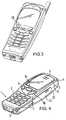
- FIG. 1 shows a preferred embodiment of a radio handset, according to the present invention.
- the handset which is generally designated by 1, comprises a user interface having a keypad 2, a display 3, an on/off button 4, a speaker 5, and a microphone 6.
- the handset 1 according to the preferred embodiment is adapted for communication via a wireless telecommunication network, e.g. a cellular network.
- a wireless telecommunication network e.g. a cellular network.
- the handset could also have been designed for a cordless network.
- the keypad 2 has a first group 7 of keys as alphanumeric keys, by means of which the user can enter a telephone number, write a text message (SMS), write a name (associated with the phone number), etc.
- SMS text message
- Each of the twelve alphanumeric keys 7 is provided with a figure “0-9” or a sign "#" or “*" respectively. In alpha mode each key is associated with a number of letters and special signs used in text editing.
- the keypad 2 additionally comprises two soft keys 8, two call handling keys 9, and a navigation key 10.
- the two soft keys 8 have functionality corresponding to what is known from the handsets Nokia 2110TM, and Nokia 8110TM.
- the functionality of the soft key depends on the state of the handset and the navigation in the menu by using a navigation key.
- the present functionality of the soft keys 8a and 8b is shown in separate fields in the display 3 just above the keys 8.
- the two call handling keys 9 are used for establishing a call or a conference call, terminating a call or rejecting an incoming call.
- the navigation key 10 is an up/down key and is placed centrally on the front surface of the handset between the display 3 and the group of alphanumeric keys 7.
- the user will be able to control this key by simply pressing the up/down key using his/her thumb. Since many experienced handset users are used to one-hand control, it is a very good solution to place an input key, requiring precise motor movements. Thus, the user may place the handset in the hand between the finger tips and the palm of the hand. Hereby, the thumb is free for inputting information.
- Figures 3 and 4 illustrate alternative handsets to that in Figure 1.
- the handset of Figure 3 differs in that the navigation key is a roller key.
- the roller key can be rolled for navigation and pressed for selection, and assists speedy movement through display pages.
- the handset of Figure 4 differs in that it has a single soft key 8c and no dedicated call handling keys 9.
- the single softkey operates as in the Nokia 3110TM.
- FIG. 2 is a block diagram of the most important parts of a preferred embodiment of the handset. These parts being essential to understand the invention.
- the preferred embodiment of the handset of the invention is adapted for use in connection with a GSM network, but, of course, the invention may also be applied in connection with other handset networks, such as other kinds of cellular networks and various forms of cordless handset systems or in dual band handsets accessing sets of these systems/networks.
- the microphone 6 records the user's speech, and the analogue signals formed thereby are A/D converted in an A/D converter (not shown) before the speech is encoded in an audio part 14.
- the encoded speech signal is transferred to control means 18.
- the control means 18 comprises a processor, which may support software in the handset.
- the control means 18 also forms the interface to the peripheral units of the apparatus, wherein the peripheral units can comprise a RAM memory 17a and a Flash ROM memory 17b, a SIM card 16, the display 3 and the keypad 2 (as well as data, power supply, etc.).
- the control means 18 communicates with a transmitter/receiver means 19, e.g. a circuit which is adopted to send/receive a request/respond to/from a telecommunication network.
- the audio part 14 speech-decodes the signal, which is transferred from the control means 18 to the earpiece 5 via a D/A converter (not shown).
- the control means 18 is connected to the user interface. Thus, it is the control means 18 which monitors the activity in the handset and controls the display 3 in response thereto. Therefore, it is the control means 18 which detects the occurrence of a state change event and changes the state of the handset and thus the display text.
- a state change event may be caused by the user when he activates the keypad including the navigation key 10, and these type of events are called entry events or user events.
- the network communicating with the handset may also cause a state change event. This type of event and other events beyond the user's control are called non user events.
- Non user events comprise status change during call set-up, change in battery voltage, change in antenna conditions, message on reception of SMS, etc.
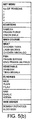
- Figure 5 illustrates the menu of a curry house.
- This menu could have been stored in memory 17a of the handset by the user (for example in the format shown in figure 5b).
- it could be provided by a restaurant as an Internet service.
- a typical Internet service might have a page looking like figure 5a on a conventional desktop PC monitor.
- the format shown in figure 5b is not suitable for a handset display which may typically have six lines for text, as it would require a large amount of scrolling by the user in order for him to see all the options available. Moreover, he would need to scroll through all the options of a certain meal type before arriving at a meal type that he desires. For example, if he only wishes to look at the main course and sundries, he would need to scroll through the set menu type and set menu options and the starters and starter options before reaching the main course options.
- Figure 5c illustrates a preferred display menu arrangement according to an embodiment of the present invention.
- the content which may appear on a display can be divided into two types, static items (e.g. plain text) and react-to or reactive items (e.g. input elements, select elements).
- static items e.g. plain text
- reactive items e.g. input elements, select elements
- FIG 5a the static and reactive items are shown together on the display.
- the headings set menu, starters, main course, sundries and side dishes are static items, and the selection lists under those headings e.g. Samosa, Prawn Puree, Onion Bhaji under the heading starters, are read-to items.
- the react-to items are each given a static instance on the display, which links to the corresponding react-to item.
- static instances can be identified by the user in this embodiment by the presence of square brackets [ ] on the display.
- display page 501 comprises a static instance 521 "starters [ ]” which links to a starters selection list on the starter page 502.
- the menu page 501 may be replaced by the starters page 502 when the user selects the "select function 522" by actuating the corresponding softkey (for example the softkey 8a of the handset shown in figure 1).
- the user gets to see all the meal types available on the menu on a single display page, without having to scroll through all the selection lists first (display page 501).
- This has the advantage of him being able to have a clear overview of the possible meal type options and also enables him to skip options not of interest to him (for example the set menu options in this case).
- the user has selected the starters static instance "starters [ ]" 521 by moving the cursor to that option and pressing the select softkey.
- the handsets processor 18 causes the display to show a new display page, namely the linked starters page 502.
- the user scrolls through the options (for example using scroll key 10 in the handset of figure 1) and presses the select softkey when the starter he desires is highlighted.
- the display then reverts to showing the main menu page, but with an indication of the starter choice selected (display page 503). This may occur automatically upon selection or in response to the user selecting the back function 523 by actuating the associated right softkey 8b.
- main course [ ] The static instance "main course [ ]" is highlighted and upon selection, the processor controls the display to show the linked page, namely the main course page 505.
- this main course page 505 displays further static instances corresponding to main courses of certain types, namely meat fish and vegetables. In this case, the user has highlighted the fish option, thus eliminating the need to plough through the meat and vegetable dishes unless he so desires.
- King Prawn Jalfrezi is selected (from display page 506) and the display reverts back to show the menu page 507, now with starter and main course options indicated.
- the sundries page comprises further static instances rice, [ ], nan [ ] which link to respective rice and nan selection lists (on display pages 510 and 513).
- the user in this example has selected from both lists as shown in the resultant sundries page 514 and the display reverts back to show the main menu page 515.
- the display reverts back to show the main menu page 515.
- a reduced version is shown.
- the text is not truncated this time. Instead, the term sundries has been contracted by an elision and displayed as "sund's" 584 and the rice and nan selections 582 and 583 have been displayed in reduced size font 585.
- the user selects his desired side dish in the same manner (via display pages 516 and 517) and his selection is finally complete as shown in the filled in menu page 518. If appropriate, by selecting the back function, the user may be able to go to another page in which he can order his selection over the Internet.
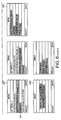
- Figure 6 illustrates different examples of how the terms 561 and 581-583, which are shown in reduced format 562, 584, 585 in figure 5c may be shown in their full format.
- Figure 6a illustrates how the term main course [King Prawn Jalfrezi] may be shown in full format on the handset display.
- the term is selected by the user, in this case by moving the cursor to the term shown in its reduced format.
- the processor may control operation of the display so that the full format of the item is shown if the cursor remains on the corresponding reduced format for a period (for example 3.5 seconds) or by the user actuating a specified key (e.g. star or hash).
- the processor may cause the display to show the item in its full format until it receives a further user input, or it may cause the display to revert back to the previous page after a predetermined period.
- Display pages 601 and 602 show alternative expanded formats.
- the expanded format obscures information relating to the sundries, but the other options remain in the view, whereas in display page 602, the previous page 603 is totally replaced by the full text main course [King Prawn Jalfrezi] which has also been increased in font size.
- Figure 6b illustrates the same alternatives for the reduced format of the sundries selections.
- Figure 6c illustrates another example, in which both the main course and sundries reduced format items are selected (display page 604) and their consequential expanded versions are displayed together on display page 605.
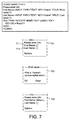
- Figures 7 and 8 show further examples of the present invention, figure 7 showing react-to items in the form of an input list and figure 8 showing react-to items in the form of a selection list.
- WAP wireless application protocol
- WAP wireless application protocol
- WML wireless mark up language
- XML extensible mark up language
- WML hypertext mark up language page
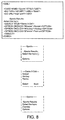
- the WML shown in figures 7 and 8 are examples of what a radio handset may receive from a radio network.
- WML does not specify how the handsets processor is to control operation of its display so as to provide the information transmitted to the user. This is defined by the user agent (for example the radio handset processor). As can be seen from figure 7, the WML contains both static and react-to items on the card entitled info. When this WML is received by a handset of the present invention, these terms are separated and linked as appropriate.
- the display page 701 comprises static terms including static instances [ ] 711 and 712. These static instances are linked to corresponding react-to items.
- the static instance 711 relating to the first name is linked to a first name display page 702 in which the user can add his name using the handset's data editor.
- the OK softkey to return to the info page, in which he will be able to view the item input (see 703).
- the input fields are not embedded to content as in HTML/WWW but are presented as links [ ].
- Figure 8 illustrates a selection list. It is arranged in a similar manner to that described with reference to figure 6, and will thus not be described further here..
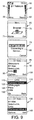
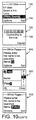
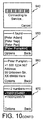
- Figures 9 and 10 relate to the browser of a radio handset, and exemplify its user interface for currency conversion and white pages services respectively.
- the user interface of the handset of this embodiment may comprise the same elements as shown in Figure 1, i.e. a keypad 2, a display 3, an on/off button 4, a speaker 5 and a microphone 6.
- the control means 18 in Figure 2 may control the user interface.
- a display page 30 is presented on a handset display, as shown in Figure 1 and 2, which indicates signal strength 35 from the wireless telecommunication network "D1Deutsch" 40, the battery power 45 and a clock showing the time 50 in hours and minutes.
- the display in the handset is an LCD (Liquid Crystal Display) display.
- the display can be controlled by the control means 18 as shown in Figure 2.
- the layout 30 presents an example of the handset in idle mode, i.e.
- One of the menus can be the next page 65 called "Browser" 70. If the user chooses to use this menu, he/she can access different telecom related information services, e.g. Internet, using WAP.
- telecom related information services e.g. Internet, using WAP.
- the full version "Currency Converter” is longer than the width of the active part of the display.
- the reduced version is displayed - a truncated version plus the aforementioned three dot indicator. If selected, the user could see the full text, for example in one of the manners shown in Figure 6.
- the user has selected to use the currency converter 115, and browses further to this application in the next page 135.
- a browser display is shown on this page with the selected item, which is indicated as a link to a service which provides a currency conversion.
- the user can select to send a request for the chosen item, by selecting the "Options" function 140.
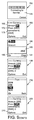
- FIG 10 is an alternative service, but the same handset can be used as in the embodiment of Figure 9.
- the first four display pages are the same as for the currency converter and will thus not be described further.
- the White Pages application provides a tool to search contact information on a specific person. Once selected, an access request is sent to the server, as indicated on the display page 155.
- the handset's processor interprets the incoming WML to provide a static instance 911 on the following display page 910. When selected this static instance links to an edit page 920.
- the user enters the search string, in this case Peter, and the main White Pages display page 930 is returned to, which indicates the search string.
- an access request is sent to the server and a corresponding display page 940 is presented on the display.
- the search results are received by the handset and listed.
- the user browses to the last item on page 950 and selects it (e.g. by rolling a roller key and then pressing it down to select it). Details of the person are displayed (pages 960 and 970). Details from these pages can be used in call handling as if they were stored in a conventional handset's phonebook (e.g. save, add to name, send message, call).
- FIG 11 illustrates a multipurpose browser display according to a preferred embodiment of the invention.
- a multipurpose browser display is a term for a user interface of a WML casrd. It can contain hotlinks, input elements, selection list items, static text areas and images.
- the display has been split into fields, so that information of a certain type will appear in a particular field. For example, information tagged as a header will appear in the field referenced B, and functions relating to the softkeys will appear in respective fields A1 and A2.
- the table (d) of Figure 11 defines the size and position of the fields on the display. This information is preferably stored in the handset and accessed by the processor when controlling operation of the display.
- the column headers refer to the following:
- Figure 11(b) is a useful arrangement for static instance lists and selection lists
- Figure 11(c) is useful for editing (e.g. input elements) and also for images.
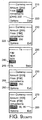
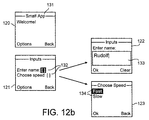
- Figure 12 illustrates some incoming WML, the resultant user interface according to the invention, and how a handset interpreted the WML to arrive at the desired user interface.
- the WML defines a deck of two cards.
- the first card has the title "Small App” and displays the static text "Welcome! That card also defines a function that upon an "accept signal", another card should be gone to, in this case the card named "eCard”.
- the eCard has a title "Inputs” and has both an input function (Enter name) and a selection function (Choose speed - fast or slow). This information is transmitted to all handsets on a network. However, how that information is presented to a user is dependent upon the user agent (e.g. browser) of the handset, which interprets the WML.
- the static and reactive items are separated and linked by [ ].
- the display is set such that the items tagged as "titles" appear in the header field B of the display, the listed items each appear in the single line fields C, D, E F, and the user input field appears in the field identified as G in Figure 11(c).
- the first card is displayed on a first page, as referenced 120 in Figure 12b. This page contains the title Small Apps 131 appearing in the header field, and the static text Welcome! It also contains the functions of the softkeys, options and back.
- the processor is arranged to move to the next card in response to the actuation of the option softkey.
- the processor controls the display to present page 121 which bears only static instances 132 corresponding to the two functions enter name and choose speed. These link to further display pages 122 and 123 respectively which enable the name to be input and speed chosen. Since the whole of the second WML card is unlikely to fit on a single display page, the interpretation given by the browser in this embodiment avoids the need for scrolling, and provides a clearer overall picture of the information required.
- Figure 12 (c) is a flow chart showing the interpretation of the WML to arrive at the display pages shown in Figure 12 (b) and how navigation through the pages takes place.
- the present invention includes any novel feature or combination of features disclosed herein either explicitly or any generalisation thereof irrespective of whether or not it relates to the claimed invention or mitigates any or all of the problems addressed.
Landscapes
- Engineering & Computer Science (AREA)
- Computer Networks & Wireless Communication (AREA)
- Signal Processing (AREA)
- Theoretical Computer Science (AREA)
- Databases & Information Systems (AREA)
- Data Mining & Analysis (AREA)
- General Engineering & Computer Science (AREA)
- General Physics & Mathematics (AREA)
- Physics & Mathematics (AREA)
- Human Computer Interaction (AREA)
- Mobile Radio Communication Systems (AREA)
- Transceivers (AREA)
- Telephone Function (AREA)
- Devices For Indicating Variable Information By Combining Individual Elements (AREA)
- Electroluminescent Light Sources (AREA)
- User Interface Of Digital Computer (AREA)
- Financial Or Insurance-Related Operations Such As Payment And Settlement (AREA)
- Circuits Of Receivers In General (AREA)
- Input From Keyboards Or The Like (AREA)
Priority Applications (1)
| Application Number | Priority Date | Filing Date | Title |
|---|---|---|---|
| EP07075624.2A EP1843261B1 (fr) | 1999-02-22 | 2000-02-21 | Contrôle d'affichages |
Applications Claiming Priority (2)
| Application Number | Priority Date | Filing Date | Title |
|---|---|---|---|
| GB9903947 | 1999-02-22 | ||
| GB9903947A GB2347822B (en) | 1999-02-22 | 1999-02-22 | Display function in a mobile telephone |
Related Child Applications (1)
| Application Number | Title | Priority Date | Filing Date |
|---|---|---|---|
| EP07075624.2A Division EP1843261B1 (fr) | 1999-02-22 | 2000-02-21 | Contrôle d'affichages |
Publications (3)
| Publication Number | Publication Date |
|---|---|
| EP1032185A2 true EP1032185A2 (fr) | 2000-08-30 |
| EP1032185A3 EP1032185A3 (fr) | 2003-11-19 |
| EP1032185B1 EP1032185B1 (fr) | 2007-09-12 |
Family
ID=10848197
Family Applications (2)
| Application Number | Title | Priority Date | Filing Date |
|---|---|---|---|
| EP07075624.2A Expired - Lifetime EP1843261B1 (fr) | 1999-02-22 | 2000-02-21 | Contrôle d'affichages |
| EP00301344A Expired - Lifetime EP1032185B1 (fr) | 1999-02-22 | 2000-02-21 | Affichage de contenus amélioré dans des dispositifs portables sans fil |
Family Applications Before (1)
| Application Number | Title | Priority Date | Filing Date |
|---|---|---|---|
| EP07075624.2A Expired - Lifetime EP1843261B1 (fr) | 1999-02-22 | 2000-02-21 | Contrôle d'affichages |
Country Status (6)
| Country | Link |
|---|---|
| EP (2) | EP1843261B1 (fr) |
| JP (1) | JP2000299728A (fr) |
| AT (1) | ATE373275T1 (fr) |
| DE (1) | DE60036316T2 (fr) |
| ES (1) | ES2292404T3 (fr) |
| GB (1) | GB2347822B (fr) |
Cited By (5)
| Publication number | Priority date | Publication date | Assignee | Title |
|---|---|---|---|---|
| DE10049146A1 (de) * | 2000-10-04 | 2002-04-11 | Orga Kartensysteme Gmbh | Informationsübertragung über den Signalisierungskanal eines Mobilfunknetzes |
| WO2002080031A3 (fr) * | 2001-03-28 | 2003-01-03 | Argo Interactive Ltd | Procede et appareil d'amelioration automatique de l'interactivite du navigateur |
| EP1486889A1 (fr) * | 2003-06-09 | 2004-12-15 | Microsoft Corporation | Services d'information mobiles |
| EP1770549A3 (fr) * | 2005-09-29 | 2008-08-06 | Seiko Epson Corporation | Editeur de contenus et procédé d'édition de contenus l'utilisant |
| CN101711063B (zh) * | 2009-07-17 | 2012-09-05 | 北京优势智汇信息技术有限责任公司 | Wap触发stk菜单的实现方法 |
Families Citing this family (1)
| Publication number | Priority date | Publication date | Assignee | Title |
|---|---|---|---|---|
| US6865171B1 (en) * | 1999-10-22 | 2005-03-08 | Telefonaktiebolaget Lm Ericsson (Publ) | Methods and apparatus for selectively providing user-specific information to origin servers in wireless application protocol applications |
Family Cites Families (3)
| Publication number | Priority date | Publication date | Assignee | Title |
|---|---|---|---|---|
| JP3490235B2 (ja) * | 1995-12-11 | 2004-01-26 | フォン・ドット・コム,インコーポレーテッド | 携帯電話機等の双方向データ通信デバイスとコンピュータとの間の通信のための双方向データ通信システム及びそこで使用される双方向通信デバイスとその使用方法 |
| FI19992746A7 (fi) * | 1998-12-28 | 2000-06-29 | Spyglass Inc | Menetelmä ja järjestelmä elektronisen datasisällön muuntamiseksi langattomille laitteille |
| EP1071024A3 (fr) * | 1999-07-23 | 2002-07-17 | Phone.Com Inc. | Méthode et appareil pour diviser des flux de balises de marquage en des pages-écran discrètes |
-
1999
- 1999-02-22 GB GB9903947A patent/GB2347822B/en not_active Expired - Fee Related
-
2000
- 2000-02-21 EP EP07075624.2A patent/EP1843261B1/fr not_active Expired - Lifetime
- 2000-02-21 ES ES00301344T patent/ES2292404T3/es not_active Expired - Lifetime
- 2000-02-21 AT AT00301344T patent/ATE373275T1/de not_active IP Right Cessation
- 2000-02-21 EP EP00301344A patent/EP1032185B1/fr not_active Expired - Lifetime
- 2000-02-21 DE DE60036316T patent/DE60036316T2/de not_active Expired - Lifetime
- 2000-02-22 JP JP2000050533A patent/JP2000299728A/ja not_active Withdrawn
Cited By (10)
| Publication number | Priority date | Publication date | Assignee | Title |
|---|---|---|---|---|
| DE10049146A1 (de) * | 2000-10-04 | 2002-04-11 | Orga Kartensysteme Gmbh | Informationsübertragung über den Signalisierungskanal eines Mobilfunknetzes |
| WO2002080031A3 (fr) * | 2001-03-28 | 2003-01-03 | Argo Interactive Ltd | Procede et appareil d'amelioration automatique de l'interactivite du navigateur |
| EP1486889A1 (fr) * | 2003-06-09 | 2004-12-15 | Microsoft Corporation | Services d'information mobiles |
| US7356332B2 (en) | 2003-06-09 | 2008-04-08 | Microsoft Corporation | Mobile information system for presenting information to mobile devices |
| US7565175B2 (en) | 2003-06-09 | 2009-07-21 | Microsoft Corporation | Mobile information services |
| US7761799B2 (en) | 2003-06-09 | 2010-07-20 | Microsoft Corporation | Mobile information services |
| US8612865B2 (en) | 2003-06-09 | 2013-12-17 | Microsoft Corporation | Mobile information services |
| EP1770549A3 (fr) * | 2005-09-29 | 2008-08-06 | Seiko Epson Corporation | Editeur de contenus et procédé d'édition de contenus l'utilisant |
| CN1940845B (zh) * | 2005-09-29 | 2011-05-25 | 精工爱普生株式会社 | 内容编辑器及使用该内容编辑器编辑内容的方法 |
| CN101711063B (zh) * | 2009-07-17 | 2012-09-05 | 北京优势智汇信息技术有限责任公司 | Wap触发stk菜单的实现方法 |
Also Published As
| Publication number | Publication date |
|---|---|
| DE60036316D1 (de) | 2007-10-25 |
| EP1843261A8 (fr) | 2008-05-14 |
| ATE373275T1 (de) | 2007-09-15 |
| EP1032185A3 (fr) | 2003-11-19 |
| ES2292404T3 (es) | 2008-03-16 |
| GB9903947D0 (en) | 1999-04-14 |
| GB2347822A (en) | 2000-09-13 |
| EP1843261B1 (fr) | 2017-05-03 |
| GB2347822B (en) | 2003-09-03 |
| JP2000299728A (ja) | 2000-10-24 |
| DE60036316T2 (de) | 2008-05-29 |
| EP1032185B1 (fr) | 2007-09-12 |
| EP1843261A1 (fr) | 2007-10-10 |
Similar Documents
| Publication | Publication Date | Title |
|---|---|---|
| US6865404B1 (en) | Handset | |
| US6839575B2 (en) | Displaying a table | |
| US5852783A (en) | Information tools with multi-functional information key | |
| KR100354780B1 (ko) | 이동통신 단말기의 메뉴 구현 방법 | |
| JP2005513920A (ja) | 通信端末 | |
| EP1289230B1 (fr) | Appareil de navigation mobile de télécommunication | |
| US20080108386A1 (en) | mobile communication terminal and method therefor | |
| EP1323021B1 (fr) | Dispositif a usage d'un client dans un systeme client-serveur | |
| JP2005513647A (ja) | ハイパーメディアにおけるアクセス機能 | |
| EP1843261B1 (fr) | Contrôle d'affichages | |
| US6975886B2 (en) | Telecommunication terminal and a method for communicating with a server by means of a telecommunication terminal | |
| US7877704B2 (en) | Radio terminal | |
| EP1032228A2 (fr) | Une méthode et un appareil de télécommunication cellulaire pour convertir des monnaies | |
| HK1110405B (en) | Controlling displays | |
| HK1110405A (en) | Controlling displays | |
| KR20040048495A (ko) | 이동통신 단말기에서의 인터넷 브라우징을 위한 즐겨찾기기능 운용방법 | |
| KR20060127466A (ko) | 가변 분할 화면을 갖는 이동 통신 단말기 및 그 제어방법 | |
| WO2005022938A1 (fr) | Informations vocales supplementaires relatives a des articles affiches | |
| EP0999681A1 (fr) | Dispositif terminal d'affichage | |
| WO2000028717A1 (fr) | Terminal d'affichage |
Legal Events
| Date | Code | Title | Description |
|---|---|---|---|
| PUAI | Public reference made under article 153(3) epc to a published international application that has entered the european phase |
Free format text: ORIGINAL CODE: 0009012 |
|
| AK | Designated contracting states |
Kind code of ref document: A2 Designated state(s): AT BE CH CY DE DK ES FI FR GB GR IE IT LI LU MC NL PT SE |
|
| AX | Request for extension of the european patent |
Free format text: AL;LT;LV;MK;RO;SI |
|
| RAP1 | Party data changed (applicant data changed or rights of an application transferred) |
Owner name: NOKIA CORPORATION |
|
| PUAL | Search report despatched |
Free format text: ORIGINAL CODE: 0009013 |
|
| AK | Designated contracting states |
Kind code of ref document: A3 Designated state(s): AT BE CH CY DE DK ES FI FR GB GR IE IT LI LU MC NL PT SE |
|
| AX | Request for extension of the european patent |
Extension state: AL LT LV MK RO SI |
|
| RIC1 | Information provided on ipc code assigned before grant |
Ipc: 7G 06F 17/30 A Ipc: 7H 04L 29/08 B Ipc: 7G 06F 17/21 B |
|
| 17P | Request for examination filed |
Effective date: 20040428 |
|
| 17Q | First examination report despatched |
Effective date: 20040527 |
|
| AKX | Designation fees paid |
Designated state(s): AT BE CH CY DE DK ES FI FR GB GR IE IT LI LU MC NL PT SE |
|
| GRAP | Despatch of communication of intention to grant a patent |
Free format text: ORIGINAL CODE: EPIDOSNIGR1 |
|
| RTI1 | Title (correction) |
Free format text: IMPROVED DISPLAY OF CONTENT IN HANDHELD WIRELESS DEVICES |
|
| GRAS | Grant fee paid |
Free format text: ORIGINAL CODE: EPIDOSNIGR3 |
|
| GRAA | (expected) grant |
Free format text: ORIGINAL CODE: 0009210 |
|
| RBV | Designated contracting states (corrected) |
Designated state(s): AT BE CH CY DE DK ES FI FR GR IE IT LI LU MC NL PT SE |
|
| AK | Designated contracting states |
Kind code of ref document: B1 Designated state(s): AT BE CH CY DE DK ES FI FR GR IE IT LI LU MC NL PT SE |
|
| REG | Reference to a national code |
Ref country code: CH Ref legal event code: EP |
|
| REF | Corresponds to: |
Ref document number: 60036316 Country of ref document: DE Date of ref document: 20071025 Kind code of ref document: P |
|
| REG | Reference to a national code |
Ref country code: IE Ref legal event code: FG4D |
|
| REG | Reference to a national code |
Ref country code: SE Ref legal event code: TRGR |
|
| PG25 | Lapsed in a contracting state [announced via postgrant information from national office to epo] |
Ref country code: FI Free format text: LAPSE BECAUSE OF FAILURE TO SUBMIT A TRANSLATION OF THE DESCRIPTION OR TO PAY THE FEE WITHIN THE PRESCRIBED TIME-LIMIT Effective date: 20070912 |
|
| ET | Fr: translation filed | ||
| PG25 | Lapsed in a contracting state [announced via postgrant information from national office to epo] |
Ref country code: LI Free format text: LAPSE BECAUSE OF FAILURE TO SUBMIT A TRANSLATION OF THE DESCRIPTION OR TO PAY THE FEE WITHIN THE PRESCRIBED TIME-LIMIT Effective date: 20070912 Ref country code: CH Free format text: LAPSE BECAUSE OF FAILURE TO SUBMIT A TRANSLATION OF THE DESCRIPTION OR TO PAY THE FEE WITHIN THE PRESCRIBED TIME-LIMIT Effective date: 20070912 Ref country code: AT Free format text: LAPSE BECAUSE OF FAILURE TO SUBMIT A TRANSLATION OF THE DESCRIPTION OR TO PAY THE FEE WITHIN THE PRESCRIBED TIME-LIMIT Effective date: 20070912 |
|
| REG | Reference to a national code |
Ref country code: ES Ref legal event code: FG2A Ref document number: 2292404 Country of ref document: ES Kind code of ref document: T3 |
|
| PG25 | Lapsed in a contracting state [announced via postgrant information from national office to epo] |
Ref country code: BE Free format text: LAPSE BECAUSE OF FAILURE TO SUBMIT A TRANSLATION OF THE DESCRIPTION OR TO PAY THE FEE WITHIN THE PRESCRIBED TIME-LIMIT Effective date: 20070912 |
|
| REG | Reference to a national code |
Ref country code: CH Ref legal event code: PL |
|
| PG25 | Lapsed in a contracting state [announced via postgrant information from national office to epo] |
Ref country code: GR Free format text: LAPSE BECAUSE OF FAILURE TO SUBMIT A TRANSLATION OF THE DESCRIPTION OR TO PAY THE FEE WITHIN THE PRESCRIBED TIME-LIMIT Effective date: 20071213 |
|
| PG25 | Lapsed in a contracting state [announced via postgrant information from national office to epo] |
Ref country code: PT Free format text: LAPSE BECAUSE OF FAILURE TO SUBMIT A TRANSLATION OF THE DESCRIPTION OR TO PAY THE FEE WITHIN THE PRESCRIBED TIME-LIMIT Effective date: 20080212 |
|
| PLBE | No opposition filed within time limit |
Free format text: ORIGINAL CODE: 0009261 |
|
| STAA | Information on the status of an ep patent application or granted ep patent |
Free format text: STATUS: NO OPPOSITION FILED WITHIN TIME LIMIT |
|
| PG25 | Lapsed in a contracting state [announced via postgrant information from national office to epo] |
Ref country code: DK Free format text: LAPSE BECAUSE OF FAILURE TO SUBMIT A TRANSLATION OF THE DESCRIPTION OR TO PAY THE FEE WITHIN THE PRESCRIBED TIME-LIMIT Effective date: 20070912 |
|
| 26N | No opposition filed |
Effective date: 20080613 |
|
| PG25 | Lapsed in a contracting state [announced via postgrant information from national office to epo] |
Ref country code: MC Free format text: LAPSE BECAUSE OF NON-PAYMENT OF DUE FEES Effective date: 20080228 |
|
| PG25 | Lapsed in a contracting state [announced via postgrant information from national office to epo] |
Ref country code: IE Free format text: LAPSE BECAUSE OF NON-PAYMENT OF DUE FEES Effective date: 20080221 |
|
| PG25 | Lapsed in a contracting state [announced via postgrant information from national office to epo] |
Ref country code: CY Free format text: LAPSE BECAUSE OF FAILURE TO SUBMIT A TRANSLATION OF THE DESCRIPTION OR TO PAY THE FEE WITHIN THE PRESCRIBED TIME-LIMIT Effective date: 20070912 |
|
| PG25 | Lapsed in a contracting state [announced via postgrant information from national office to epo] |
Ref country code: LU Free format text: LAPSE BECAUSE OF NON-PAYMENT OF DUE FEES Effective date: 20080221 |
|
| PGFP | Annual fee paid to national office [announced via postgrant information from national office to epo] |
Ref country code: SE Payment date: 20110211 Year of fee payment: 12 Ref country code: FR Payment date: 20110218 Year of fee payment: 12 |
|
| PGFP | Annual fee paid to national office [announced via postgrant information from national office to epo] |
Ref country code: ES Payment date: 20110315 Year of fee payment: 12 |
|
| PG25 | Lapsed in a contracting state [announced via postgrant information from national office to epo] |
Ref country code: SE Free format text: LAPSE BECAUSE OF NON-PAYMENT OF DUE FEES Effective date: 20120222 |
|
| REG | Reference to a national code |
Ref country code: FR Ref legal event code: ST Effective date: 20121031 |
|
| PG25 | Lapsed in a contracting state [announced via postgrant information from national office to epo] |
Ref country code: FR Free format text: LAPSE BECAUSE OF NON-PAYMENT OF DUE FEES Effective date: 20120229 |
|
| REG | Reference to a national code |
Ref country code: ES Ref legal event code: FD2A Effective date: 20130708 |
|
| PG25 | Lapsed in a contracting state [announced via postgrant information from national office to epo] |
Ref country code: ES Free format text: LAPSE BECAUSE OF NON-PAYMENT OF DUE FEES Effective date: 20120222 |
|
| REG | Reference to a national code |
Ref country code: DE Ref legal event code: R082 Ref document number: 60036316 Country of ref document: DE Representative=s name: BECKER, KURIG, STRAUS, DE Ref country code: DE Ref legal event code: R081 Ref document number: 60036316 Country of ref document: DE Owner name: NOKIA TECHNOLOGIES OY, FI Free format text: FORMER OWNER: NOKIA CORP., 02610 ESPOO, FI |
|
| REG | Reference to a national code |
Ref country code: NL Ref legal event code: PD Owner name: NOKIA TECHNOLOGIES OY; FI Free format text: DETAILS ASSIGNMENT: VERANDERING VAN EIGENAAR(S), OVERDRACHT; FORMER OWNER NAME: NOKIA CORPORATION Effective date: 20151111 |
|
| REG | Reference to a national code |
Ref country code: DE Ref legal event code: R079 Ref document number: 60036316 Country of ref document: DE Free format text: PREVIOUS MAIN CLASS: G06F0017300000 Ipc: G06F0016000000 |
|
| PGFP | Annual fee paid to national office [announced via postgrant information from national office to epo] |
Ref country code: NL Payment date: 20190214 Year of fee payment: 20 |
|
| PGFP | Annual fee paid to national office [announced via postgrant information from national office to epo] |
Ref country code: IT Payment date: 20190221 Year of fee payment: 20 Ref country code: DE Payment date: 20190205 Year of fee payment: 20 |
|
| REG | Reference to a national code |
Ref country code: DE Ref legal event code: R071 Ref document number: 60036316 Country of ref document: DE |
|
| REG | Reference to a national code |
Ref country code: NL Ref legal event code: MK Effective date: 20200220 |