EP1038980A2 - Agglomération de minérai de fer à émissions réduites de gaz toxiques par récirculation des effluents gazeux - Google Patents
Agglomération de minérai de fer à émissions réduites de gaz toxiques par récirculation des effluents gazeux Download PDFInfo
- Publication number
- EP1038980A2 EP1038980A2 EP00301900A EP00301900A EP1038980A2 EP 1038980 A2 EP1038980 A2 EP 1038980A2 EP 00301900 A EP00301900 A EP 00301900A EP 00301900 A EP00301900 A EP 00301900A EP 1038980 A2 EP1038980 A2 EP 1038980A2
- Authority
- EP
- European Patent Office
- Prior art keywords
- feedstock
- waste gases
- sinter
- strand
- temperature
- Prior art date
- Legal status (The legal status is an assumption and is not a legal conclusion. Google has not performed a legal analysis and makes no representation as to the accuracy of the status listed.)
- Granted
Links
Images


Classifications
-
- C—CHEMISTRY; METALLURGY
- C22—METALLURGY; FERROUS OR NON-FERROUS ALLOYS; TREATMENT OF ALLOYS OR NON-FERROUS METALS
- C22B—PRODUCTION AND REFINING OF METALS; PRETREATMENT OF RAW MATERIALS
- C22B1/00—Preliminary treatment of ores or scrap
- C22B1/14—Agglomerating; Briquetting; Binding; Granulating
- C22B1/16—Sintering; Agglomerating
- C22B1/20—Sintering; Agglomerating in sintering machines with movable grates
- C22B1/205—Sintering; Agglomerating in sintering machines with movable grates regulation of the sintering process
Definitions
- This invention relates to the suppression of toxic byproducts which are generated during sintering of iron ore.
- the invention concerns a method of and apparatus for suppressing the synthesis of chloro-organic pollutants, especially polychlorinated dioxins and furins (hereinafter referred to as PCDD/Fs), and the release of acidic gases during sintering.
- PCDD/Fs polychlorinated dioxins and furins
- the conversion of iron ore into for example iron rich agglomerates, for subsequent reduction in blast furnaces is a process known as sintering.
- the sinter process comprises heating a layer of iron ore until partial melting occurs to cause individual iron particles to become fused together.
- the heat necessary to achieve this is provided by forced combustion of fine coke (known as coke breeze) which is mixed inter alia with the iron ore to be reduced and fluxes prior to delivery to a sinter plant.
- coke breeze fine coke
- the process is continuous; a travelling grate transports the sinter mix as a bed to an ignition hood which ignites the coke in the upper surface of the sinter bed. Thereafter, the combustion of the coke lower down in the mix is maintained by air flowing through the bed.
- the air flow may be generated by a suction fan.
- the travelling grate carries the sinter mix over a series of "wind boxes" which draw air through the sinter mix.
- the waste gases pass from wind boxes through "wind legs" which link to a "wind main".
- These gases contain noxious emissions including inter alia PCDD/Fs, oxides of nitrogen and other acidic compounds such as hydrogen chloride and sulphur dioxide. Therefore, the waste gas is typically treated to clean the gas before being exhausted to the atmosphere.
- PCDD/Fs present two of the most potentially harmful combustion by-products of the sinter process.
- PCDD/Fs are a family of chlorinated organic compounds having a general formula (A) and (B) respectively:
- the degree of toxicity varies and depends on the number and position of chloride substitutions on the aromatic carbon ring.
- PCDD/F precursors are formed from the pyrolysis and chlorination of the organic material that represents the more primary combustion products such as hydrogen chloride, carbon monoxide, water, hydrogen, ethylene and acetylene.
- PCDD/Fs are thus synthesised de novo as a result of thermal reactions between precursor compounds.
- the precursor pentachlorophenol (C) can interact to produce the dioxin octachlorodioxin (D).
- D dioxin octachlorodioxin
- some of the PCDD/Fs may recombine downstream to produce a different set of compounds which may have higher or lower toxicity. Some of the non-toxic isomers may be converted to toxic isomers and vice versa.
- the 'fingerprint' of toxic isomers is specific to their formation mechanism; for example in combustion processes, furans are synthesised to a greater extent than dioxins and the pentachlorinated furan is the major contributor to total toxicity.
- EP-A-371945 Another method used in municipal waste disposal is exemplified in EP-A-371945.
- This document discloses a method for extracting dioxins from a gas which comprises contacting the gas with a liquid aerosol over a predetermined period of time.
- the particles present in the aerosol are electrically charged and subsequently separated from the gas with the aid of a wet electrostatic precipitator or electric field.
- Ammonia gas or ammonia releasing compounds such as alkanolamines, have demonstrated a potential to control simultaneously emissions of several pollutants of concern, such as dioxins, hydrogen chloride, sulphur dioxide and oxides of nitrogen.
- EP-A-0 875 587 an efficient and cost effective method of reducing toxic emissions, more especially PCDD/F formation, from a sinter strand, whilst keeping the quantity of ammonia gas released into the atmosphere at low levels and without the need to introduce complex modifications to existing strand equipment.
- Their method comprised the sequential steps of producing a sinter feedstock by substantially homogeneously mixing inter alia iron ore with 0.01 to 0.09% by weight of a solid compound which releases ammonia on thermal decomposition, depositing said feedstock onto moving grate and combusting the same to produce sintered products rich in iron.
- the present inventors have now discovered an alternative method of reducing toxic emissions with or without the addition of exogenous chemicals to the sinter strand.
- Dioxins are known to be formed in the approximate temperature range 200 to 400°C. Dioxin formation has been reduced in other industries by ensuring that waste gases which may produce dioxins are cooled to below 250°C as soon as possible to avoid prolonged reaction times in this critical temperature range.
- the gas passes through a packed bed of sinter mix and the gas temperature at the bottom of the sinter strand as it enters each wind box will be different depending on the position of the wind box along the strand.
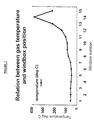
- the exit temperature is relatively stable at approximately 100°C. This rapidly rises towards the end of the strand, peaks at up to 400°C and then drops slightly at the end of the strand.
- Figure 1 illustrates the correlation between the temperature of the waste gases and the windleg number along the sinter strand.
- Figure 2 illustrates the correlation between the PCDD/F formation in the waste gases and the wind box number along the sinter strand.
- the invention provides a method of sintering iron ore in a sinter strand comprising providing a sinter feedstock and depositing said feedstock onto a travelling grate, igniting said feedstock using a sinter strand burner(s), and combusting said feedstock by drawing air through the feedstock with a plurality of wind boxes situated along the length of the strand, to produce sintered products rich in iron and waste gases, characterised in that waste gases from only those wind boxes whose temperature exceeds a predetermined level are recycled to provide combustion feed air for the feedstock or air for the sinter strand ignition burner(s), in order to substantially reduce or eliminate the production and/or emission of dioxins.
- waste gases of a temperature greater than 200°C are recycled.
- waste gases of a temperature greater than 250°C are recycled.
- figure 2 shows, it has been found that significant dioxin formation only occurs in the wind boxes wherein the temperature of the gases exceeds approximately 200°C.
- the waste gases are recycled from the final 25% of the wind boxes, preferably the final 20% of the wind boxes. Accordingly, the waste gases may only be recycled from a wind box if the temperature of the waste gases present within that wind box is greater than 200°C. Therefore, the advantage of the invention in suit is that the toxicity of waste gases produced during sintering can be minimalised by recycling only a fraction of the total waste gas.
- the waste gases which have a temperature of greater than about 200°C may be rapidly cooled to below about 200°C to substantially reduce or eliminate the production of dioxins.
- the invention provides a method of sintering iron ore in a sinter strand comprising providing a sinter feedstock and depositing said feedstock onto a travelling grate, igniting said feedstock using a sinter strand burner(s), and combusting said feedstock by drawing air through the feedstock with a plurality of wind boxes situated along the length of the strand, to produce sintered products rich in iron and waste gases, characterised in that waste gases from the sinter strand which have a temperature of greater than about 200°C are rapidly cooled to below about 200°C substantially to reduce or eliminate the production of dioxins.
- the invention may involve the cooling of the waste gases in one or more of the wind boxes.
- the temperature may be reduced by injecting a liquid or a gas (e.g. gaseous ammonia) into the waste gases in the or each wind box, and/or into the waste gases in their passage subsequent to the or each wind box.
- the liquid may be water for example, the water may be added in the form of steam.
- the liquid comprises ammonia which may further reduce the level of dioxins in the gas.
- the rate at which the liquid may be introduced may be determined by the rate at which air is drawn into the wind boxes.
- the external surface of the or each wind box and/or the external surface of any conduit leading from the or each wind box may be cooled by a supply of fluid, either liquid or gas, e.g. water, for example, in the form of steam.
- a supply of fluid either liquid or gas, e.g. water, for example, in the form of steam.
- the travelling grate of the sinter strand may be cooled, for example, with water, e.g. steam.
- a heat exchanger may be used to lower the temperature of the waste gases.
- the sinter feedstock may include 0.01 to 0.09% by weight of a solid compound which releases ammonia on thermal decomposition.
- the ammonia compound may be substantially homogeneously mixed with iron ore in the sinter feedstock.
- the invention provides a sinter strand which includes means for recycling waste gases from those wind boxes in the strand whose temperature exceeds a predetermined level, to provide combustion feed air for sinter feedstock for subsequent sintering, or air for a sinter strand ignition burner(s).
- the sinter strand may further comprise means to cool waste gases which have a temperature of greater than about 200°C to below about 200°C to substantially reduce or eliminate the production of dioxins.
- the invention provides a sinter strand which includes means to cool waste gases from the sinter strand which have a temperature of greater than about 200°C to below about 200°C to substantially reduce or eliminate the production of dioxins.
- the strand comprises a travelling grate 1, onto which pre-mixed constituents of a sinter bed are deposited via a hopper 2. Mixing of these constituents is effected in a blender 3.
- the mixed constituents include iron ore and iron ore fines, burnt lime, coke breeze and optionally measured quantities of ammonia releasing compounds in solid, e.g. pellet form.
- the deposited sinter bed feedstock passes below an ignition hood 4, which ignites the coke breeze, combustion being enhanced and continued by the flow of large quantities of air, drawn through the bed by a series of wind boxes (not shown) along the stack.
- Sintered ore leaves the bed at the end of the grate remote from the hopper 2 and passes through a series of treatment stages. Waste gases of combustion leave the furnace through more stacks 5.
- the illustrated strand is typical of many conventional strands, the essential difference being that the waste gases which contain levels of toxicity exceeding desired limits are specifically recycled or that the waste gases of a temperature suitable for the formation of toxic dioxins are rapidly cooled.
Landscapes
- Engineering & Computer Science (AREA)
- Chemical & Material Sciences (AREA)
- Manufacturing & Machinery (AREA)
- Geochemistry & Mineralogy (AREA)
- Geology (AREA)
- General Life Sciences & Earth Sciences (AREA)
- Life Sciences & Earth Sciences (AREA)
- Environmental & Geological Engineering (AREA)
- Materials Engineering (AREA)
- Mechanical Engineering (AREA)
- Metallurgy (AREA)
- Organic Chemistry (AREA)
- Manufacture And Refinement Of Metals (AREA)
Applications Claiming Priority (2)
| Application Number | Priority Date | Filing Date | Title |
|---|---|---|---|
| GB9906323A GB2347940A (en) | 1999-03-19 | 1999-03-19 | Iron ore sintering process with reduced emissions of toxic gases |
| GB9906323 | 1999-03-19 |
Publications (3)
| Publication Number | Publication Date |
|---|---|
| EP1038980A2 true EP1038980A2 (fr) | 2000-09-27 |
| EP1038980A3 EP1038980A3 (fr) | 2000-12-06 |
| EP1038980B1 EP1038980B1 (fr) | 2005-09-14 |
Family
ID=10849935
Family Applications (1)
| Application Number | Title | Priority Date | Filing Date |
|---|---|---|---|
| EP00301900A Expired - Lifetime EP1038980B1 (fr) | 1999-03-19 | 2000-03-08 | Agglomération de minérai de fer à émissions réduites de gaz toxiques par récirculation des effluents gazeux |
Country Status (5)
| Country | Link |
|---|---|
| EP (1) | EP1038980B1 (fr) |
| AT (1) | ATE304613T1 (fr) |
| DE (1) | DE60022566T2 (fr) |
| ES (1) | ES2248014T3 (fr) |
| GB (1) | GB2347940A (fr) |
Family Cites Families (9)
| Publication number | Priority date | Publication date | Assignee | Title |
|---|---|---|---|---|
| GB707583A (en) * | 1951-07-03 | 1954-04-21 | Metallgesellschaft Ag | Process of and apparatus for calcining, calcining and sintering, dehydration or drying |
| US3849115A (en) * | 1972-03-24 | 1974-11-19 | Mcdowell Wellman Eng Co | Sintering process |
| US4023960A (en) * | 1972-10-25 | 1977-05-17 | Metallgesellschaft Aktiengesellschaft | Process for cleaning waste gases from sintering plants |
| US3973762A (en) * | 1974-05-17 | 1976-08-10 | Dravo Corporation | Sintering process and apparatus |
| AT352408B (de) * | 1978-03-24 | 1979-09-25 | Voest Ag | Verfahren zum brennen von pellets auf einem wanderrost |
| FR2444720A1 (fr) * | 1978-12-22 | 1980-07-18 | Delattre Levivier | Procede d'utilisation des gaz aspires dans une installation d'agglomeration de minerais et installation d'agglomeration perfectionnee |
| BE877216A (fr) * | 1979-06-22 | 1979-12-24 | Centre Rech Metallurgique | Perfectionnements aux procedes de conduite d'une bande d'agglomeration de minerais |
| FR2540139A1 (fr) * | 1983-01-27 | 1984-08-03 | Lorraine Laminage | Procede d'agglomeration de minerai avec utilisation de combustible gazeux, et installation pour le mettre en oeuvre |
| WO1995027802A1 (fr) * | 1994-04-06 | 1995-10-19 | Steag Aktiengesellschaft | Procede et systeme de traitement thermique de materiaux |
-
1999
- 1999-03-19 GB GB9906323A patent/GB2347940A/en not_active Withdrawn
-
2000
- 2000-03-08 AT AT00301900T patent/ATE304613T1/de not_active IP Right Cessation
- 2000-03-08 DE DE60022566T patent/DE60022566T2/de not_active Expired - Fee Related
- 2000-03-08 ES ES00301900T patent/ES2248014T3/es not_active Expired - Lifetime
- 2000-03-08 EP EP00301900A patent/EP1038980B1/fr not_active Expired - Lifetime
Also Published As
| Publication number | Publication date |
|---|---|
| GB2347940A (en) | 2000-09-20 |
| ES2248014T3 (es) | 2006-03-16 |
| GB9906323D0 (en) | 1999-05-12 |
| EP1038980B1 (fr) | 2005-09-14 |
| EP1038980A3 (fr) | 2000-12-06 |
| DE60022566T2 (de) | 2006-06-14 |
| DE60022566D1 (de) | 2005-10-20 |
| ATE304613T1 (de) | 2005-09-15 |
Similar Documents
| Publication | Publication Date | Title |
|---|---|---|
| US5370067A (en) | Method of incinerating solid combustible materials, especially urban waste | |
| JP3820269B2 (ja) | 都市廃棄物その他廃棄物の処理 | |
| JPH02298717A (ja) | 有毒及び有害物質で汚染された状態の掘出し埋立材料の処理方法及びプラズマ燃焼式キュポラ | |
| EP1285210A1 (fr) | Gazeifieur a arc electrique, utilise en tant qu'eliminateur de dechets | |
| CN110470141A (zh) | 一种利用兰炭无害化处理垃圾飞灰装置与方法 | |
| US6952997B2 (en) | Incineration process using high oxygen concentrations | |
| EP2313179B1 (fr) | Combustion de co et combustibles dans les gaz de dégagement de fours à acier | |
| US6451250B1 (en) | Method for operating a sintering plant | |
| CN113310056A (zh) | 危险废物焚烧处理系统及方法 | |
| CA1324823C (fr) | Procede et dispositif de pyrolyse au plasma de dechets liquides | |
| EP0875587B1 (fr) | Agglomération des minerais de fer avec émissions réduites de gaz toxiques | |
| EP1038980B1 (fr) | Agglomération de minérai de fer à émissions réduites de gaz toxiques par récirculation des effluents gazeux | |
| JPH11142063A (ja) | 焼結設備 | |
| CN220531138U (zh) | 烟气、固废协同处理系统 | |
| US5481063A (en) | Treatment of process gases containing halogenous compounds | |
| JPH10249154A (ja) | ダイオキシン類の発生抑制方法 | |
| CA2109995C (fr) | Traitement thermique cyclonique et stabilisation des dechets industriels | |
| JP3077756B2 (ja) | 廃棄物処理装置 | |
| GB2324789A (en) | Sintering iron ore | |
| CN211012436U (zh) | 一种利用兰炭无害化处理垃圾飞灰装置 | |
| JP2005195228A (ja) | 廃棄物溶融処理システム | |
| CN212609596U (zh) | 一种含锌污泥处理系统 | |
| RU2133408C1 (ru) | Способ сжигания городских отходов и применение образующейся при сжигании золы | |
| KR100413817B1 (ko) | 소결광 제조 방법 | |
| JP2007045648A (ja) | セメント製造設備の排ガス中の有機塩素化合物低減方法 |
Legal Events
| Date | Code | Title | Description |
|---|---|---|---|
| PUAI | Public reference made under article 153(3) epc to a published international application that has entered the european phase |
Free format text: ORIGINAL CODE: 0009012 |
|
| AK | Designated contracting states |
Kind code of ref document: A2 Designated state(s): AT BE CH CY DE DK ES FI FR GB GR IE IT LI LU MC NL PT SE |
|
| AX | Request for extension of the european patent |
Free format text: AL;LT;LV;MK;RO;SI |
|
| PUAL | Search report despatched |
Free format text: ORIGINAL CODE: 0009013 |
|
| AK | Designated contracting states |
Kind code of ref document: A3 Designated state(s): AT BE CH CY DE DK ES FI FR GB GR IE IT LI LU MC NL PT SE |
|
| AX | Request for extension of the european patent |
Free format text: AL;LT;LV;MK;RO;SI |
|
| 17P | Request for examination filed |
Effective date: 20010523 |
|
| AKX | Designation fees paid |
Free format text: AT BE CH CY DE DK ES FI FR GB GR IE IT LI LU MC NL PT SE |
|
| RAP1 | Party data changed (applicant data changed or rights of an application transferred) |
Owner name: CORUS UK LIMITED |
|
| 17Q | First examination report despatched |
Effective date: 20020812 |
|
| GRAP | Despatch of communication of intention to grant a patent |
Free format text: ORIGINAL CODE: EPIDOSNIGR1 |
|
| GRAS | Grant fee paid |
Free format text: ORIGINAL CODE: EPIDOSNIGR3 |
|
| GRAA | (expected) grant |
Free format text: ORIGINAL CODE: 0009210 |
|
| AK | Designated contracting states |
Kind code of ref document: B1 Designated state(s): AT BE CH CY DE DK ES FI FR GB GR IE IT LI LU MC NL PT SE |
|
| PG25 | Lapsed in a contracting state [announced via postgrant information from national office to epo] |
Ref country code: CH Free format text: LAPSE BECAUSE OF FAILURE TO SUBMIT A TRANSLATION OF THE DESCRIPTION OR TO PAY THE FEE WITHIN THE PRESCRIBED TIME-LIMIT Effective date: 20050914 Ref country code: LI Free format text: LAPSE BECAUSE OF FAILURE TO SUBMIT A TRANSLATION OF THE DESCRIPTION OR TO PAY THE FEE WITHIN THE PRESCRIBED TIME-LIMIT Effective date: 20050914 Ref country code: NL Free format text: LAPSE BECAUSE OF FAILURE TO SUBMIT A TRANSLATION OF THE DESCRIPTION OR TO PAY THE FEE WITHIN THE PRESCRIBED TIME-LIMIT Effective date: 20050914 |
|
| REG | Reference to a national code |
Ref country code: GB Ref legal event code: FG4D |
|
| REG | Reference to a national code |
Ref country code: CH Ref legal event code: EP |
|
| REG | Reference to a national code |
Ref country code: IE Ref legal event code: FG4D |
|
| REF | Corresponds to: |
Ref document number: 60022566 Country of ref document: DE Date of ref document: 20051020 Kind code of ref document: P |
|
| PG25 | Lapsed in a contracting state [announced via postgrant information from national office to epo] |
Ref country code: GR Free format text: LAPSE BECAUSE OF FAILURE TO SUBMIT A TRANSLATION OF THE DESCRIPTION OR TO PAY THE FEE WITHIN THE PRESCRIBED TIME-LIMIT Effective date: 20051214 Ref country code: DK Free format text: LAPSE BECAUSE OF FAILURE TO SUBMIT A TRANSLATION OF THE DESCRIPTION OR TO PAY THE FEE WITHIN THE PRESCRIBED TIME-LIMIT Effective date: 20051214 |
|
| REG | Reference to a national code |
Ref country code: SE Ref legal event code: TRGR |
|
| PG25 | Lapsed in a contracting state [announced via postgrant information from national office to epo] |
Ref country code: PT Free format text: LAPSE BECAUSE OF FAILURE TO SUBMIT A TRANSLATION OF THE DESCRIPTION OR TO PAY THE FEE WITHIN THE PRESCRIBED TIME-LIMIT Effective date: 20060214 |
|
| NLV1 | Nl: lapsed or annulled due to failure to fulfill the requirements of art. 29p and 29m of the patents act | ||
| PG25 | Lapsed in a contracting state [announced via postgrant information from national office to epo] |
Ref country code: GB Free format text: LAPSE BECAUSE OF NON-PAYMENT OF DUE FEES Effective date: 20060308 Ref country code: IE Free format text: LAPSE BECAUSE OF NON-PAYMENT OF DUE FEES Effective date: 20060308 |
|
| REG | Reference to a national code |
Ref country code: ES Ref legal event code: FG2A Ref document number: 2248014 Country of ref document: ES Kind code of ref document: T3 |
|
| PG25 | Lapsed in a contracting state [announced via postgrant information from national office to epo] |
Ref country code: MC Free format text: LAPSE BECAUSE OF NON-PAYMENT OF DUE FEES Effective date: 20060331 |
|
| REG | Reference to a national code |
Ref country code: CH Ref legal event code: PL |
|
| ET | Fr: translation filed | ||
| PLBE | No opposition filed within time limit |
Free format text: ORIGINAL CODE: 0009261 |
|
| STAA | Information on the status of an ep patent application or granted ep patent |
Free format text: STATUS: NO OPPOSITION FILED WITHIN TIME LIMIT |
|
| 26N | No opposition filed |
Effective date: 20060615 |
|
| GBPC | Gb: european patent ceased through non-payment of renewal fee |
Effective date: 20060308 |
|
| REG | Reference to a national code |
Ref country code: GB Ref legal event code: 728V |
|
| REG | Reference to a national code |
Ref country code: IE Ref legal event code: MM4A |
|
| REG | Reference to a national code |
Ref country code: GB Ref legal event code: 7281 |
|
| PGFP | Annual fee paid to national office [announced via postgrant information from national office to epo] |
Ref country code: ES Payment date: 20080325 Year of fee payment: 9 |
|
| PGFP | Annual fee paid to national office [announced via postgrant information from national office to epo] |
Ref country code: FI Payment date: 20080214 Year of fee payment: 9 Ref country code: IT Payment date: 20080219 Year of fee payment: 9 Ref country code: LU Payment date: 20080221 Year of fee payment: 9 Ref country code: SE Payment date: 20080218 Year of fee payment: 9 |
|
| PGFP | Annual fee paid to national office [announced via postgrant information from national office to epo] |
Ref country code: AT Payment date: 20080207 Year of fee payment: 9 |
|
| PGFP | Annual fee paid to national office [announced via postgrant information from national office to epo] |
Ref country code: DE Payment date: 20080227 Year of fee payment: 9 Ref country code: FR Payment date: 20080211 Year of fee payment: 9 |
|
| PGFP | Annual fee paid to national office [announced via postgrant information from national office to epo] |
Ref country code: BE Payment date: 20080313 Year of fee payment: 9 |
|
| PG25 | Lapsed in a contracting state [announced via postgrant information from national office to epo] |
Ref country code: CY Free format text: LAPSE BECAUSE OF FAILURE TO SUBMIT A TRANSLATION OF THE DESCRIPTION OR TO PAY THE FEE WITHIN THE PRESCRIBED TIME-LIMIT Effective date: 20050914 |
|
| BERE | Be: lapsed |
Owner name: *CORUS UK LTD Effective date: 20090331 |
|
| PG25 | Lapsed in a contracting state [announced via postgrant information from national office to epo] |
Ref country code: AT Free format text: LAPSE BECAUSE OF NON-PAYMENT OF DUE FEES Effective date: 20090308 Ref country code: FI Free format text: LAPSE BECAUSE OF NON-PAYMENT OF DUE FEES Effective date: 20090308 |
|
| EUG | Se: european patent has lapsed | ||
| REG | Reference to a national code |
Ref country code: FR Ref legal event code: ST Effective date: 20091130 |
|
| PG25 | Lapsed in a contracting state [announced via postgrant information from national office to epo] |
Ref country code: DE Free format text: LAPSE BECAUSE OF NON-PAYMENT OF DUE FEES Effective date: 20091001 |
|
| PG25 | Lapsed in a contracting state [announced via postgrant information from national office to epo] |
Ref country code: BE Free format text: LAPSE BECAUSE OF NON-PAYMENT OF DUE FEES Effective date: 20090331 |
|
| PG25 | Lapsed in a contracting state [announced via postgrant information from national office to epo] |
Ref country code: FR Free format text: LAPSE BECAUSE OF NON-PAYMENT OF DUE FEES Effective date: 20091123 |
|
| REG | Reference to a national code |
Ref country code: ES Ref legal event code: FD2A Effective date: 20090309 |
|
| PG25 | Lapsed in a contracting state [announced via postgrant information from national office to epo] |
Ref country code: ES Free format text: LAPSE BECAUSE OF NON-PAYMENT OF DUE FEES Effective date: 20090309 |
|
| PG25 | Lapsed in a contracting state [announced via postgrant information from national office to epo] |
Ref country code: IT Free format text: LAPSE BECAUSE OF NON-PAYMENT OF DUE FEES Effective date: 20090308 |
|
| PG25 | Lapsed in a contracting state [announced via postgrant information from national office to epo] |
Ref country code: LU Free format text: LAPSE BECAUSE OF NON-PAYMENT OF DUE FEES Effective date: 20090308 |
|
| PG25 | Lapsed in a contracting state [announced via postgrant information from national office to epo] |
Ref country code: SE Free format text: LAPSE BECAUSE OF NON-PAYMENT OF DUE FEES Effective date: 20090309 |