EP1043421A2 - Objet en acier inoxydable austénitique ayant une couche superficielle passivée - Google Patents
Objet en acier inoxydable austénitique ayant une couche superficielle passivée Download PDFInfo
- Publication number
- EP1043421A2 EP1043421A2 EP00302895A EP00302895A EP1043421A2 EP 1043421 A2 EP1043421 A2 EP 1043421A2 EP 00302895 A EP00302895 A EP 00302895A EP 00302895 A EP00302895 A EP 00302895A EP 1043421 A2 EP1043421 A2 EP 1043421A2
- Authority
- EP
- European Patent Office
- Prior art keywords
- stainless steel
- surface layer
- passivated
- passivation
- ratio
- Prior art date
- Legal status (The legal status is an assumption and is not a legal conclusion. Google has not performed a legal analysis and makes no representation as to the accuracy of the status listed.)
- Granted
Links
Images




Classifications
-
- C—CHEMISTRY; METALLURGY
- C23—COATING METALLIC MATERIAL; COATING MATERIAL WITH METALLIC MATERIAL; CHEMICAL SURFACE TREATMENT; DIFFUSION TREATMENT OF METALLIC MATERIAL; COATING BY VACUUM EVAPORATION, BY SPUTTERING, BY ION IMPLANTATION OR BY CHEMICAL VAPOUR DEPOSITION, IN GENERAL; INHIBITING CORROSION OF METALLIC MATERIAL OR INCRUSTATION IN GENERAL
- C23C—COATING METALLIC MATERIAL; COATING MATERIAL WITH METALLIC MATERIAL; SURFACE TREATMENT OF METALLIC MATERIAL BY DIFFUSION INTO THE SURFACE, BY CHEMICAL CONVERSION OR SUBSTITUTION; COATING BY VACUUM EVAPORATION, BY SPUTTERING, BY ION IMPLANTATION OR BY CHEMICAL VAPOUR DEPOSITION, IN GENERAL
- C23C22/00—Chemical surface treatment of metallic material by reaction of the surface with a reactive liquid, leaving reaction products of surface material in the coating, e.g. conversion coatings, passivation of metals
- C23C22/05—Chemical surface treatment of metallic material by reaction of the surface with a reactive liquid, leaving reaction products of surface material in the coating, e.g. conversion coatings, passivation of metals using aqueous solutions
- C23C22/06—Chemical surface treatment of metallic material by reaction of the surface with a reactive liquid, leaving reaction products of surface material in the coating, e.g. conversion coatings, passivation of metals using aqueous solutions using aqueous acidic solutions with pH less than 6
- C23C22/48—Chemical surface treatment of metallic material by reaction of the surface with a reactive liquid, leaving reaction products of surface material in the coating, e.g. conversion coatings, passivation of metals using aqueous solutions using aqueous acidic solutions with pH less than 6 not containing phosphates, hexavalent chromium compounds, fluorides or complex fluorides, molybdates, tungstates, vanadates or oxalates
- C23C22/50—Treatment of iron or alloys based thereon
-
- Y—GENERAL TAGGING OF NEW TECHNOLOGICAL DEVELOPMENTS; GENERAL TAGGING OF CROSS-SECTIONAL TECHNOLOGIES SPANNING OVER SEVERAL SECTIONS OF THE IPC; TECHNICAL SUBJECTS COVERED BY FORMER USPC CROSS-REFERENCE ART COLLECTIONS [XRACs] AND DIGESTS
- Y10—TECHNICAL SUBJECTS COVERED BY FORMER USPC
- Y10T—TECHNICAL SUBJECTS COVERED BY FORMER US CLASSIFICATION
- Y10T428/00—Stock material or miscellaneous articles
- Y10T428/13—Hollow or container type article [e.g., tube, vase, etc.]
- Y10T428/131—Glass, ceramic, or sintered, fused, fired, or calcined metal oxide or metal carbide containing [e.g., porcelain, brick, cement, etc.]
Definitions
- the invention relates to an austenitic stainless steel article, particularly in the form of a tubing, having a passivated surface layer.
- austenitic stainless steel articles and particularly tubing of austenitic stainless steel
- the surface thereof be passivated so that during use the surface will not oxidize or otherwise react with environments to which it is subjected during use.
- austenitic stainless steel tubing specifically AISI type 316 stainless steel tubing as used in the pharmaceutical industry
- the interior surface develops a reaction product in the form of an oxide exhibiting a reddish color. This phenomenon is typically termed "rouging".
- This reaction product may constitute a source of contamination for product passing through the tubing during use thereof in various industrial applications.
- a stainless steel article which may be in the form of a tubing, has a passivated surface layer of Cr 2 O 3 and Fe 2 O 3 with a metal component of Cr with a valence of zero and Fe with a valence of zero.
- the ratio of the oxide component to the metal component is in excess of 8 to 1.
- the stainless steel is an austenitic stainless steel.
- the stainless steel is AISI type 316 austenitic stainless steel.
- the outside surface of the passivated surface layer will have a total Cr to Fe ratio of at least 1 to 1.
- the passivated surface layer may at a depth therein of a maximum oxygen concentration have a total Cr to Fe ratio of at least 1.5 to 1.
- the passivated surface layer preferably constitutes an electropolished surface but may also be a mechanically polished surface, produced for example by swirl or belt polishing.
- total Cr to Fe ratio includes the Fe and Cr present in the oxide component.
- electroshed means a metallic bright surface created through a combination of electrical action and an acid solution, one component of which is phosphoric acid, the other usually sulfuric acid.
- the desired passivated surface layer is achieved by an electropolishing operation, an electropolishing together with an oxidizing acid, or a mechanically polished surface treated with an oxidizing acid.
- the passivation process to produce the passivated surface layer in accordance with the invention is therefore achieved by exposure of the surface to an oxidizing acid after it has been preferably electropolished or otherwise abraded, such as by a grit polishing operation.
- the surface is specifically altered by increasing the chromium to iron ratio; removing surface roughness; providing for increased depth of oxygen penetration; removal of contamination, such as occluded iron, or removal of strain transformed martensite; removal of inclusions, especially manganese sulfides; and removal of visible manufacturing defects.
- the chromium combines with oxygen and forms an impervious chromium oxide barrier to further reaction of the material below this passive or barrier film. It has been determined that as the chromium content increases, the film becomes a better barrier.
- electropolishing the iron and other elements on the surface are preferentially removed to increase the chromium on the surface. Consequently, after electropolishing, the chromium to iron ratio is significantly increased on the passivated surface layer.
- the average depth of oxygen penetration is a measure of the depth of the passivated layer.
- the oxide components are substantially Cr 2 O 3 and Fe 2 O 3 in combination with the metal components Cr and Fe both having zero valence with Cr 2 O 3 to Fe 2 O 3 ratio being relatively high.
- This may be achieved by subjecting the polished surface to an oxidizing acid such as nitric acid (HNO 3 ) or citric acid for a period determined suitable to complete reaction to Cr 2 O 3 and Fe 2 O 3 .
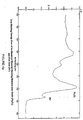
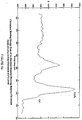
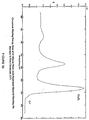
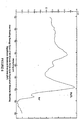
- the change in the composition may be seen as a function of the depth of the passivated layer from Figure 7.
- Type 316L stainless steel is the material of choice for most High Purity Water (HP) and Water for Injection (WFI) systems in the pharmaceutical industry.
- Two surface finish conditions are used for these systems: electropolished and mechanically polished.
- the tubing is usually ordered to specification ASTM A 270, which in its present format requires a mechanical polishing regardless of the existing surface smoothness.
- Mechanical polishing takes one of two forms, swirl polishing or longitudinal belt polishing.
- Swirl polishing uses a rotating flapper wheel which moves up and down the length of the tube removing only a thin surface layer of material, and creating a "smeared surface.”
- the longitudinal belt polish uses an abrasive belt that moves along the length of the tube, while the tube rotates and uses an air bladder to pressurize the belt to remove surface material.
- This technique removes a measurable amount of material, 0.0006-0.0008 inch (0.015-0.020 mm), and is a precursor to electropolishing to low Ra levels ( ⁇ 8 ⁇ -in or 0.2 ⁇ m). Both methods remove the normal deep passive layer that is developed during production of the stainless steel strip from which the tubing is made.
- Reagent grade nitric acid was diluted with deionized water to 20 volume percent (v/o) and heated to a constant 136°F (58°C).
- Five samples of mechanically polished tubing were immersed in this solution, one each for 1, 5, 15, 30, and 60 minutes, respectively.
- One sample was analyzed in the "as polished" condition. After rinsing and drying, each of the treated mechanically polished samples was evaluated using XPS. There was no visual difference among the six samples. All had identical surface lusters.
- X-ray photoelectron spectroscope is one of the newer analytical tools available and is also known as Electron Spectroscopy for Chemical Analysis, or ESCA.
- ESCA Electron Spectroscopy for Chemical Analysis
- XPS X-ray photoelectron spectroscopy
- the surface was bombarded ("sputtered") with ionized argon to remove about 25° ⁇ of material (or about 8 atoms in depth), then the new surface was again analyzed. This continued until the maximum depth of oxygen penetration was reached or until there were no further changes in composition.
- a survey scan was made in the energy range of 1200-0 eV to determine the elemental composition. Then, for each element of interest, a narrow window of about 20 eV around the central peak was analyzed in a high energy resolution mode to determine the binding energy of the surface species. Peak shifting in XPS may be considered a measure of covalency, and the more ionic compounds such as intermetallic compounds may or may not be shifted significantly from the pure element peak value.
- the binding energy obtained for each element is compared to either published literature values of known standards or to theoretical standards based on chemical bonding. The presence of overlapping, multiple binding energies can make identification difficult. Data from the Handbook of Photoelectron Spectroscopy , J.F.
- the XPS system used for the analyses was a Physical Electronics Model 5700.
- the binding energy values were calibrated with an internal standard, carbon from atmospheric exposure, set to 284.7 eV.
- Quantitative values for the data were obtained by the use of sensitivity factors set forth in the D. Briggs publication noted above, which are based on the calculated yields for pure elements.
- the analytical information should be taken as semi-quantitative at best and most properly be used for comparisons only.
- Table 1 summarizes the surface chemistry of the Type 316L Stainless Steel samples after the different times in hot nitric acid.
- the data represent the atomic percent composition of the elements above atomic number 3 within 40 ⁇ (12 atoms) of the surface.
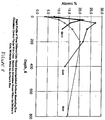
- Figures 1a and 1b are plots of the metals only atomic surface concentration as a function of passivation time.
- Elemental Surface Composition as a Function of Nitric Acid Passivation Time Passivation Time in Minutes C N O Na Mg Al Si P S Ca Cr Fe Ni Mo 0 41.8 2.4 39.9 0.4 - - 1.8 - 0.3 - 2.6 9.4 0.5 0.2 1 24.3 2.3 47.3 0.1 0.2 0.4 1.8 0.7 0.4 0.1 10.6 9.7 1.4 0.7 5 24.1 2.3 48.6 0.4 - 0.1 0.8 0.7 0.2 0.2 11.8 8.6 1.5 0.7 15 23.3 2.6 47.7 0.2 0.2 0.4 0.8 0.7 0.3 0.2 12.2 9.1 1.7 0.7 30 25.1 1.6 51.4 - - 0.3 0.9 0.8 - 0.1 13.0 5.7 0.7 0.3 60 28.8 1.8 49.9 - - - 1.1 0.4 - - 10.5 6.7 0.5 0.3
- the data illustrate that chromium and oxygen concentrations reach a maximum after 30 minutes of passivation and that iron has its lowest value.
- the maximum Cr/Fe ratio occurs after 30 minutes passivation.
- both 15 and 60 minute passivation show a decrease in the Cr/Fe ratio.
- Both the Ni/Fe and Mo/Fe ratios reached a maximum at 15 minutes and began to decrease after 30 minutes of passivation.
- the 0, 30, and 60 minute passivated specimens were sputtered with ionized argon and the elemental composition as a function of depth was determined. The data are summarized in Table 3 for the as-received specimen. Table 4 for the 30 minute passivated specimen and Table 5 for the 60 minute passivated specimen.
- a passivation treatment of mechanically polished Type 316L stainless steels appears necessary to enhance its corrosion resistance
- Mechanical polishing destroys the passive layer formed during manufacture of the strip and tube.
- the passive layer is quite thin, in the order of 50-400 ⁇ , or 12-150 atoms thick.
- swirl polishing does not remove a measurable amount of metal, the passive layer is destroyed as evidenced by surface oxidation.
- these oxidized surfaces are dipped in hot nitric acid the colors disappear, indicating removal of iron oxides.
- passivation following polishing is a necessary operation.
- the mechanism for passivation appears to be related to the progressive oxidation of chromium as the first step. Once the free chromium is essentially consumed, iron begins to form its oxide. The atmosphere formed iron oxide, which was dominant in the as-received material, rapidly dissolved in the hot nitric acid and metallic iron remains the dominant species up to 30 minutes where the amount of oxide finally exceeds that of the metallic iron. True passivation does not appear to occur until the metallic elements are essentially all converted to the oxide. For mechanically polished material this will be in excess of 60 minutes passivation in hot nitric acid.
- Electropolishing has not been recognized as a means of producing an enhanced finish except within a very limited area, namely the pharmaceutical and semiconductor industries. Electropolishing is acknowledged as a means of producing a surface that is free from adventitious iron contamination, extremely smooth, essentially free from surface blemishes, with a high glossy surface that approaches chromium plating. Also, electropolished surfaces are recognized as having improved corrosion resistance over mechanically polished surface.
- AES Auger Electron Spectroscopy
- EDS Energy Dispersive Spectroscopy
- Electron Spectroscopy for Chemical Analysis also known as X-ray Photoelectron Analysis or XPS
- EDS Electron Spectroscopy for Chemical Analysis
- XPS X-ray photoelectron spectroscopy
- Electropolishing is simply electroplating in reverse.
- the process involves pumping a solution of concentrated sulfuric and phosphoric acids through the interior of the tube, while direct current is applied.
- the metal is dissolved from the tube (anode) and the cathode would be plated if the solution chemistry was not balanced to dissolve the metals as fast as they are plated.
- the resulting passive layer has a high Cr 2 O 3 /Fe 2 O 3 ratio. This result is a very smooth surface with a high luster.
- a full description of this process is set forth in "Electropolished Stainless Steel Tubing," J.C. Tverberg, TPJ - The Tube and Pipe Journal , September/October 1998.
- surface finish is measured with a profilometer and normally expressed as Ra or average roughness. However roughness alone is not sufficient to describe the true nature of the surface. Use of a scanning electron microscope together with the profilometer gives the best surface analysis.
- passivation has the effect of introducing oxygen into the surface layer and dissolving other elements, leaving chromium and iron as the two primary surface metals. Both carbon and oxygen are in high concentration. Some of the carbon and oxygen are from occluded carbon dioxide. The carbon appears higher in mechanically polished surfaces than electropolished surfaces.
- the unpassivated weld has a very low Cr/Fe ratio.
- the Cr/Fe ratio should be 1.0 or higher to have reasonably good corrosion resistance.
- Depth profiles using XPS on these areas were not run, but based on EDS analyses, the chromium content increased with depth. Chromium was highly variable from sample to sample, probably dependent on whether the electron probe was analyzing delta ferrite or austenite. The results are consistent with other EDS analytical work where the weld surfaces usually showed high manganese and low chromium.
- the slag patch is consistent with other findings.
- the slag appeared to be an accumulation of the inclusions in the steel or incomplete gas coverage allowing oxidation of the weld pool.
- the slag spot appears to have come from the inclusions in the steel and that the steel was deoxidized with calcium and aluminum.
- the dark oxide area over the heat affected zone had the highest chromium level and the lowest iron of the analyses made.
- the dark oxide appears to remain intact, and acts as a crevice former with crevice corrosion occurring under the dark oxide. This suggests that the high chromium makes this dark oxide quite corrosion resistant, thus allowing galvanic corrosion to attach the surface under the oxide.
- the closest crystal form is chromite spinel, which has the general formula (Fe,Mg)O.(Cr,Fe) 2 O 3 .
- This crystal has the oxygen atoms arranged on a face centered cubic lattice (Dana et al., A Textbook of Mineralogy , John Wiley & Sons, New York, 1951), thus matching the crystal lattice of austenitic stainless steel.
- the resulting surface crystal will be either hematite (Fe 2 O 3 ) or magnetite (Fe 3 O 4 ), neither of which has corrosion resistance. Therefore, the surface must be acid passivated to first dissolve the excess iron, then to allow chromium to become the dominant element.
- the dark oxide over the heat-affected zone has the general composition of chromite, FeCr 2 O 4 , or FeO.Cr 2 O 3 .
- the composition may have considerable variation, but in all cases it is very high in chromium. This gives the crystal excellent corrosion resistance in oxidizing media, probably far more than the metal it covers. This will lead to conditions for galvanic corrosion (crevice corrosion) and explains the type of corrosion observed in those systems that have had poor gas coverage during welding.
- the only rectification is to chemically dissolve the oxide, usually with a nitric + hydrofluoric acid, which should passivate the entire system. However, this treatment may destroy an electropolished surface.
Landscapes
- Chemical & Material Sciences (AREA)
- Metallurgy (AREA)
- Chemical Kinetics & Catalysis (AREA)
- Engineering & Computer Science (AREA)
- Materials Engineering (AREA)
- Mechanical Engineering (AREA)
- General Chemical & Material Sciences (AREA)
- Organic Chemistry (AREA)
- Chemical Treatment Of Metals (AREA)
- Other Surface Treatments For Metallic Materials (AREA)
- Physical Vapour Deposition (AREA)
- Heat Treatment Of Articles (AREA)
- Electrical Discharge Machining, Electrochemical Machining, And Combined Machining (AREA)
- Rigid Pipes And Flexible Pipes (AREA)
Applications Claiming Priority (2)
| Application Number | Priority Date | Filing Date | Title |
|---|---|---|---|
| US286672 | 1999-04-06 | ||
| US09/286,672 US6228445B1 (en) | 1999-04-06 | 1999-04-06 | Austenitic stainless steel article having a passivated surface layer |
Publications (3)
| Publication Number | Publication Date |
|---|---|
| EP1043421A2 true EP1043421A2 (fr) | 2000-10-11 |
| EP1043421A3 EP1043421A3 (fr) | 2002-08-21 |
| EP1043421B1 EP1043421B1 (fr) | 2003-11-12 |
Family
ID=23099652
Family Applications (1)
| Application Number | Title | Priority Date | Filing Date |
|---|---|---|---|
| EP00302895A Expired - Lifetime EP1043421B1 (fr) | 1999-04-06 | 2000-04-06 | Objet en acier inoxydable austénitique ayant une couche superficielle passivée |
Country Status (11)
| Country | Link |
|---|---|
| US (1) | US6228445B1 (fr) |
| EP (1) | EP1043421B1 (fr) |
| JP (1) | JP2001032100A (fr) |
| KR (1) | KR100690508B1 (fr) |
| AT (1) | ATE254193T1 (fr) |
| CA (1) | CA2304436C (fr) |
| DE (1) | DE60006439T2 (fr) |
| DK (1) | DK1043421T3 (fr) |
| ES (1) | ES2209764T3 (fr) |
| PT (1) | PT1043421E (fr) |
| TW (1) | TWI223676B (fr) |
Cited By (3)
| Publication number | Priority date | Publication date | Assignee | Title |
|---|---|---|---|---|
| WO2009095475A1 (fr) * | 2008-02-01 | 2009-08-06 | Ateco Services Ag | Utilisation d'une solution aqueuse neutre de nettoyage et procédé d'élimination de couches rugueuses sur des aciers inoxydables |
| US8192550B2 (en) | 2008-02-01 | 2012-06-05 | Ateco Services Ag | Use of an aqueous neutral cleaning solution and method for removing rouging from stainless steel surfaces |
| CN102839364A (zh) * | 2012-09-11 | 2012-12-26 | 上海神洲阳光特种钢管有限公司 | 一种食品级不锈钢管的表面处理工艺 |
Families Citing this family (30)
| Publication number | Priority date | Publication date | Assignee | Title |
|---|---|---|---|---|
| US6488783B1 (en) * | 2001-03-30 | 2002-12-03 | Babcock & Wilcox Canada, Ltd. | High temperature gaseous oxidation for passivation of austenitic alloys |
| ATE470468T1 (de) * | 2003-08-04 | 2010-06-15 | Alexza Pharmaceuticals Inc | Substrate für eine medikamentenverabreichungsvorrichtung und verfahren zur bereitung |
| US20050234545A1 (en) * | 2004-04-19 | 2005-10-20 | Yea-Yang Su | Amorphous oxide surface film for metallic implantable devices and method for production thereof |
| JP4947907B2 (ja) * | 2005-02-14 | 2012-06-06 | 独立行政法人理化学研究所 | 被加工物の表面仕上げ方法および加工品 |
| US8840660B2 (en) | 2006-01-05 | 2014-09-23 | Boston Scientific Scimed, Inc. | Bioerodible endoprostheses and methods of making the same |
| WO2008034031A2 (fr) | 2006-09-15 | 2008-03-20 | Boston Scientific Limited | Endoprothèses biodégradables et procédés de fabrication |
| EP2125065B1 (fr) | 2006-12-28 | 2010-11-17 | Boston Scientific Limited | Endoprothèses bio-érodables et procédés de fabrication de celles-ci |
| WO2008096618A1 (fr) * | 2007-02-09 | 2008-08-14 | Konica Minolta Medical & Graphic, Inc. | Tête à jet d'encre, imprimante à jet d'encre et procédé d'impression à jet d'encre |
| EP2121088B1 (fr) | 2007-03-09 | 2016-07-13 | Alexza Pharmaceuticals, Inc. | Unité chauffante à utiliser dans un dispositif d'administration de médicament |
| US7744734B2 (en) * | 2007-08-24 | 2010-06-29 | Battelle Energy Alliance, Llc | High current density cathode for electrorefining in molten electrolyte |
| WO2011119573A1 (fr) | 2010-03-23 | 2011-09-29 | Boston Scientific Scimed, Inc. | Endoprothèses en métal bioérodable traitées en surface |
| US20110238150A1 (en) * | 2010-03-23 | 2011-09-29 | Boston Scientific Scimed, Inc. | Bioerodible Medical Implants |
| JP5724436B2 (ja) * | 2011-02-18 | 2015-05-27 | Jfeスチール株式会社 | 耐食性に優れたステンレス鋼 |
| JP6069928B2 (ja) * | 2012-07-25 | 2017-02-01 | 大日本印刷株式会社 | サスペンション用金属薄板、サスペンション用金属薄板フレーム、サスペンション、素子付サスペンション、ハードディスクドライブおよびサスペンション用金属薄板の製造方法 |
| US9804058B2 (en) * | 2014-02-27 | 2017-10-31 | Pratt & Whitney Canada Corp. | Method of facilitating visual detection of a crack in a component of a gas turbine engine |
| KR101422776B1 (ko) * | 2014-03-20 | 2014-07-28 | (주)한국마루이 | 오스테나이트계 스테인레스강의 용접부 부식방지방법 |
| DE102014111779A1 (de) | 2014-08-18 | 2016-02-18 | Iva Industrieöfen Gmbh | Verfahren zur Herstellung einer Retorte für einen Nitrierofen sowie Retorte |
| TWI552659B (zh) * | 2014-09-04 | 2016-10-01 | 啟碁科技股份有限公司 | 金屬圖案製造方法與具金屬圖案之基板結構 |
| WO2016130548A1 (fr) | 2015-02-10 | 2016-08-18 | Arcanum Alloy Design, Inc. | Procédés et systèmes de revêtement à base de boues |
| JP6615009B2 (ja) * | 2016-03-04 | 2019-12-04 | 東京エレクトロン株式会社 | 金属汚染防止方法及び金属汚染防止装置、並びにこれらを用いた基板処理方法及び基板処理装置 |
| JPWO2017188209A1 (ja) * | 2016-04-28 | 2019-02-14 | 富士フイルム株式会社 | 精製装置、精製方法、製造装置、薬液の製造方法、容器、及び薬液収容体 |
| WO2017201418A1 (fr) | 2016-05-20 | 2017-11-23 | Arcanum Alloys, Inc. | Procédés et systèmes de revêtement de substrat en acier |
| KR101788466B1 (ko) * | 2016-08-10 | 2017-10-19 | 현대비앤지스틸 주식회사 | 표면 광택성 및 내식성이 우수한 스테인리스 강 제조 방법 |
| US11161324B2 (en) * | 2017-09-13 | 2021-11-02 | Silcotek Corp. | Corrosion-resistant coated article and thermal chemical vapor deposition coating process |
| TWI645075B (zh) * | 2017-12-13 | 2018-12-21 | 蔡永芳 | 開發單晶異向性氧化物在合金醫療器材上之製備方法 |
| US12214118B2 (en) | 2018-02-02 | 2025-02-04 | Alexza Pharmaceuticals, Inc. | Electrical condensation aerosol device |
| WO2019167885A1 (fr) * | 2018-03-02 | 2019-09-06 | 株式会社トクヤマ | Élément en acier inoxydable et son procédé de production |
| JP6605066B2 (ja) * | 2018-03-30 | 2019-11-13 | 日鉄ステンレス株式会社 | Fe−Cr合金およびその製造方法 |
| JPWO2023106384A1 (fr) * | 2021-12-10 | 2023-06-15 | ||
| WO2023114498A1 (fr) | 2021-12-17 | 2023-06-22 | Carpenter Technology Corporation | Articles fabriqués à partir d'alliages d'acier inoxydable sensiblement exempts de co, écrouis à froid et cémentés, et procédés de fabrication associés |
Family Cites Families (16)
| Publication number | Priority date | Publication date | Assignee | Title |
|---|---|---|---|---|
| JP2976333B2 (ja) * | 1987-10-24 | 1999-11-10 | 忠弘 大見 | ステンレス鋼及びその製造方法並びに減圧装置 |
| US5789086A (en) * | 1990-03-05 | 1998-08-04 | Ohmi; Tadahiro | Stainless steel surface having passivation film |
| US5259935A (en) * | 1991-05-03 | 1993-11-09 | The Boc Group, Inc. | Stainless steel surface passivation treatment |
| JP3045576B2 (ja) * | 1991-05-28 | 2000-05-29 | 忠弘 大見 | ステンレス鋼の不動態膜形成方法及びステンレス鋼 |
| JPH05311455A (ja) * | 1992-05-13 | 1993-11-22 | Hitachi Metals Ltd | 半導体製造装置用ステンレス鋼部材およびその表面処理方法 |
| JP3379070B2 (ja) * | 1992-10-05 | 2003-02-17 | 忠弘 大見 | クロム酸化物層を表面に有する酸化不動態膜の形成方法 |
| JPH0711421A (ja) * | 1993-06-29 | 1995-01-13 | Hitachi Metals Ltd | 半導体製造装置用ステンレス鋼部材 |
| JP3558672B2 (ja) * | 1993-12-30 | 2004-08-25 | 忠弘 大見 | オーステナイト系ステンレス鋼、配管システム及び接流体部品 |
| JPH07197206A (ja) * | 1993-12-30 | 1995-08-01 | Tadahiro Omi | ステンレス鋼及び配管システム |
| JP3576598B2 (ja) * | 1993-12-30 | 2004-10-13 | 忠弘 大見 | 酸化不動態膜の形成方法及びフェライト系ステンレス鋼並びに流体供給システム及び接流体部品 |
| JPH07252631A (ja) * | 1994-03-16 | 1995-10-03 | Tadahiro Omi | 不動態膜形成用オーステナイト系ステンレス鋼および不動態膜形成方法 |
| JPH0892799A (ja) * | 1994-09-27 | 1996-04-09 | Tadahiro Omi | 電解研磨用電解液及び電解研磨法 |
| DE19513407C1 (de) * | 1995-04-08 | 1996-10-10 | Vsg En & Schmiedetechnik Gmbh | Verwendung einer austenitischen Stahllegierung für hautverträgliche Gegenstände |
| JP3566453B2 (ja) * | 1995-04-17 | 2004-09-15 | 株式会社荏原製作所 | オゾン発生装置 |
| JP3499418B2 (ja) * | 1996-11-27 | 2004-02-23 | ジャパン・エア・ガシズ株式会社 | 酸化不動態膜を有するステンレス鋼およびその形成方法 |
| IT1293934B1 (it) * | 1997-01-21 | 1999-03-11 | Orthofix Srl | Chiodo endomidollare per il trattamento delle fratture dell'anca |
-
1999
- 1999-04-06 US US09/286,672 patent/US6228445B1/en not_active Expired - Fee Related
-
2000
- 2000-04-05 CA CA002304436A patent/CA2304436C/fr not_active Expired - Fee Related
- 2000-04-06 DK DK00302895T patent/DK1043421T3/da active
- 2000-04-06 AT AT00302895T patent/ATE254193T1/de not_active IP Right Cessation
- 2000-04-06 DE DE60006439T patent/DE60006439T2/de not_active Expired - Fee Related
- 2000-04-06 ES ES00302895T patent/ES2209764T3/es not_active Expired - Lifetime
- 2000-04-06 JP JP2000104368A patent/JP2001032100A/ja active Pending
- 2000-04-06 EP EP00302895A patent/EP1043421B1/fr not_active Expired - Lifetime
- 2000-04-06 PT PT00302895T patent/PT1043421E/pt unknown
- 2000-04-06 KR KR1020000018026A patent/KR100690508B1/ko not_active Expired - Fee Related
- 2000-05-29 TW TW089106231A patent/TWI223676B/zh not_active IP Right Cessation
Cited By (4)
| Publication number | Priority date | Publication date | Assignee | Title |
|---|---|---|---|---|
| WO2009095475A1 (fr) * | 2008-02-01 | 2009-08-06 | Ateco Services Ag | Utilisation d'une solution aqueuse neutre de nettoyage et procédé d'élimination de couches rugueuses sur des aciers inoxydables |
| US8192550B2 (en) | 2008-02-01 | 2012-06-05 | Ateco Services Ag | Use of an aqueous neutral cleaning solution and method for removing rouging from stainless steel surfaces |
| CN102839364A (zh) * | 2012-09-11 | 2012-12-26 | 上海神洲阳光特种钢管有限公司 | 一种食品级不锈钢管的表面处理工艺 |
| CN102839364B (zh) * | 2012-09-11 | 2014-08-13 | 上海神洲阳光特种钢管有限公司 | 一种食品级不锈钢管的表面处理工艺 |
Also Published As
| Publication number | Publication date |
|---|---|
| DE60006439T2 (de) | 2004-08-26 |
| HK1032079A1 (en) | 2001-07-06 |
| EP1043421B1 (fr) | 2003-11-12 |
| JP2001032100A (ja) | 2001-02-06 |
| KR20000071581A (ko) | 2000-11-25 |
| EP1043421A3 (fr) | 2002-08-21 |
| CA2304436C (fr) | 2007-06-26 |
| US6228445B1 (en) | 2001-05-08 |
| CA2304436A1 (fr) | 2000-10-06 |
| DE60006439D1 (de) | 2003-12-18 |
| ATE254193T1 (de) | 2003-11-15 |
| KR100690508B1 (ko) | 2007-03-09 |
| ES2209764T3 (es) | 2004-07-01 |
| TWI223676B (en) | 2004-11-11 |
| DK1043421T3 (da) | 2004-03-08 |
| PT1043421E (pt) | 2004-04-30 |
Similar Documents
| Publication | Publication Date | Title |
|---|---|---|
| EP1043421B1 (fr) | Objet en acier inoxydable austénitique ayant une couche superficielle passivée | |
| Berneron et al. | Surface analysis by glow discharge | |
| Kerber et al. | STAINLESS STEEL. | |
| Lim et al. | ESCA studies of nitrogen-containing stainless steels | |
| EP1264913B1 (fr) | Titane moins prone a la decoloration dans l'atmosphere et procede de production associe | |
| EP0810295B1 (fr) | Utilisation d'un acier inoxydable pour ou contenant de l'eau ajoutée d'ozone | |
| EP4289988A1 (fr) | Tôle d'acier mince | |
| CN113316652A (zh) | 方向性电磁钢板及其制造方法 | |
| HK1032079B (en) | Austenitic stainless steel article having a passivated surface layer | |
| Fernando et al. | Some fundamental aspects of annealing and pickling stainless steels | |
| EP4506486A1 (fr) | Tôle d'acier électromagnétique orientée, et procédé de formation de film de revêtement isolant | |
| MXPA00003362A (en) | Austenitic stainless steel article having a passivated surface layer | |
| KR102700216B1 (ko) | 프리코트 강 블랭크 및 관련 블랭크의 레이저 절단 | |
| JP7836022B2 (ja) | めっき鋼板及びそれを含む部品 | |
| JP7836019B2 (ja) | めっき鋼板及びそれを含む部品 | |
| EP3354761A1 (fr) | Tôle d'acier | |
| JP7817659B1 (ja) | 鋼板及びそれを含む部品 | |
| JP7836021B2 (ja) | めっき鋼板及びそれを含む部品 | |
| Suresh Kumar Danadurai et al. | Surface characterisation and crevice corrosion behaviour of nickel-based alloys in the paper industry | |
| JP7817660B1 (ja) | 鋼板及びそれを含む部品 | |
| JP7813965B1 (ja) | 鋼板及びそれを含む部品 | |
| Kerber et al. | Steel Surface | |
| WO2026053977A1 (fr) | Tôle d'acier et composant la comprenant | |
| Danoix‐Souchet et al. | XPS Study of the Segregation of Minor Elements at the Surface of a Commercial Copper–10 wt.% Nickel Alloy | |
| Charbonnier et al. | Adhesive bonding of aerospace materials—surface characterization of metallic adherends |
Legal Events
| Date | Code | Title | Description |
|---|---|---|---|
| PUAI | Public reference made under article 153(3) epc to a published international application that has entered the european phase |
Free format text: ORIGINAL CODE: 0009012 |
|
| AK | Designated contracting states |
Kind code of ref document: A2 Designated state(s): AT BE CH CY DE DK ES FI FR GB GR IE IT LI LU MC NL PT SE |
|
| AX | Request for extension of the european patent |
Free format text: AL;LT;LV;MK;RO;SI |
|
| PUAL | Search report despatched |
Free format text: ORIGINAL CODE: 0009013 |
|
| AK | Designated contracting states |
Kind code of ref document: A3 Designated state(s): AT BE CH CY DE DK ES FI FR GB GR IE IT LI LU MC NL PT SE |
|
| AX | Request for extension of the european patent |
Free format text: AL;LT;LV;MK;RO;SI |
|
| 17P | Request for examination filed |
Effective date: 20021011 |
|
| GRAH | Despatch of communication of intention to grant a patent |
Free format text: ORIGINAL CODE: EPIDOS IGRA |
|
| AKX | Designation fees paid |
Designated state(s): AT BE CH CY DE DK ES FI FR GB GR IE IT LI LU MC NL PT SE |
|
| GRAS | Grant fee paid |
Free format text: ORIGINAL CODE: EPIDOSNIGR3 |
|
| GRAA | (expected) grant |
Free format text: ORIGINAL CODE: 0009210 |
|
| AK | Designated contracting states |
Kind code of ref document: B1 Designated state(s): AT BE CH CY DE DK ES FI FR GB GR IE IT LI LU MC NL PT SE |
|
| REG | Reference to a national code |
Ref country code: GB Ref legal event code: FG4D |
|
| REG | Reference to a national code |
Ref country code: CH Ref legal event code: EP |
|
| REG | Reference to a national code |
Ref country code: SE Ref legal event code: TRGR |
|
| REF | Corresponds to: |
Ref document number: 60006439 Country of ref document: DE Date of ref document: 20031218 Kind code of ref document: P |
|
| REG | Reference to a national code |
Ref country code: IE Ref legal event code: FG4D |
|
| REG | Reference to a national code |
Ref country code: CH Ref legal event code: NV Representative=s name: R. A. EGLI & CO. PATENTANWAELTE |
|
| REG | Reference to a national code |
Ref country code: DK Ref legal event code: T3 |
|
| REG | Reference to a national code |
Ref country code: GR Ref legal event code: EP Ref document number: 20040400497 Country of ref document: GR |
|
| PG25 | Lapsed in a contracting state [announced via postgrant information from national office to epo] |
Ref country code: CY Free format text: LAPSE BECAUSE OF NON-PAYMENT OF DUE FEES Effective date: 20040406 |
|
| REG | Reference to a national code |
Ref country code: PT Ref legal event code: SC4A Free format text: AVAILABILITY OF NATIONAL TRANSLATION Effective date: 20040210 |
|
| REG | Reference to a national code |
Ref country code: ES Ref legal event code: FG2A Ref document number: 2209764 Country of ref document: ES Kind code of ref document: T3 |
|
| ET | Fr: translation filed | ||
| PLBE | No opposition filed within time limit |
Free format text: ORIGINAL CODE: 0009261 |
|
| STAA | Information on the status of an ep patent application or granted ep patent |
Free format text: STATUS: NO OPPOSITION FILED WITHIN TIME LIMIT |
|
| REG | Reference to a national code |
Ref country code: HK Ref legal event code: GR Ref document number: 1032079 Country of ref document: HK |
|
| 26N | No opposition filed |
Effective date: 20040813 |
|
| PGFP | Annual fee paid to national office [announced via postgrant information from national office to epo] |
Ref country code: AT Payment date: 20070321 Year of fee payment: 8 Ref country code: MC Payment date: 20070321 Year of fee payment: 8 |
|
| PGFP | Annual fee paid to national office [announced via postgrant information from national office to epo] |
Ref country code: PT Payment date: 20070322 Year of fee payment: 8 |
|
| PGFP | Annual fee paid to national office [announced via postgrant information from national office to epo] |
Ref country code: NL Payment date: 20070424 Year of fee payment: 8 |
|
| PGFP | Annual fee paid to national office [announced via postgrant information from national office to epo] |
Ref country code: ES Payment date: 20070426 Year of fee payment: 8 Ref country code: IE Payment date: 20070426 Year of fee payment: 8 |
|
| PGFP | Annual fee paid to national office [announced via postgrant information from national office to epo] |
Ref country code: CH Payment date: 20070427 Year of fee payment: 8 Ref country code: SE Payment date: 20070427 Year of fee payment: 8 |
|
| PGFP | Annual fee paid to national office [announced via postgrant information from national office to epo] |
Ref country code: DK Payment date: 20070430 Year of fee payment: 8 Ref country code: FI Payment date: 20070430 Year of fee payment: 8 |
|
| PGFP | Annual fee paid to national office [announced via postgrant information from national office to epo] |
Ref country code: LU Payment date: 20070502 Year of fee payment: 8 |
|
| PGFP | Annual fee paid to national office [announced via postgrant information from national office to epo] |
Ref country code: BE Payment date: 20070515 Year of fee payment: 8 |
|
| PGFP | Annual fee paid to national office [announced via postgrant information from national office to epo] |
Ref country code: DE Payment date: 20070531 Year of fee payment: 8 |
|
| PGFP | Annual fee paid to national office [announced via postgrant information from national office to epo] |
Ref country code: GB Payment date: 20070425 Year of fee payment: 8 |
|
| PGFP | Annual fee paid to national office [announced via postgrant information from national office to epo] |
Ref country code: IT Payment date: 20070518 Year of fee payment: 8 |
|
| PGFP | Annual fee paid to national office [announced via postgrant information from national office to epo] |
Ref country code: FR Payment date: 20070417 Year of fee payment: 8 |
|
| PGFP | Annual fee paid to national office [announced via postgrant information from national office to epo] |
Ref country code: GR Payment date: 20070430 Year of fee payment: 8 |
|
| REG | Reference to a national code |
Ref country code: PT Ref legal event code: MM4A Free format text: LAPSE DUE TO NON-PAYMENT OF FEES Effective date: 20081006 |
|
| BERE | Be: lapsed |
Owner name: *CRUCIBLE MATERIALS CORP. Effective date: 20080430 |
|
| PG25 | Lapsed in a contracting state [announced via postgrant information from national office to epo] |
Ref country code: MC Free format text: LAPSE BECAUSE OF NON-PAYMENT OF DUE FEES Effective date: 20080430 |
|
| REG | Reference to a national code |
Ref country code: CH Ref legal event code: PL |
|
| REG | Reference to a national code |
Ref country code: DK Ref legal event code: EBP |
|
| EUG | Se: european patent has lapsed | ||
| GBPC | Gb: european patent ceased through non-payment of renewal fee |
Effective date: 20080406 |
|
| NLV4 | Nl: lapsed or anulled due to non-payment of the annual fee |
Effective date: 20081101 |
|
| REG | Reference to a national code |
Ref country code: IE Ref legal event code: MM4A |
|
| PG25 | Lapsed in a contracting state [announced via postgrant information from national office to epo] |
Ref country code: PT Free format text: LAPSE BECAUSE OF NON-PAYMENT OF DUE FEES Effective date: 20081006 Ref country code: NL Free format text: LAPSE BECAUSE OF NON-PAYMENT OF DUE FEES Effective date: 20081101 Ref country code: LI Free format text: LAPSE BECAUSE OF NON-PAYMENT OF DUE FEES Effective date: 20080430 Ref country code: DE Free format text: LAPSE BECAUSE OF NON-PAYMENT OF DUE FEES Effective date: 20081101 Ref country code: CH Free format text: LAPSE BECAUSE OF NON-PAYMENT OF DUE FEES Effective date: 20080430 |
|
| REG | Reference to a national code |
Ref country code: FR Ref legal event code: ST Effective date: 20081231 |
|
| PG25 | Lapsed in a contracting state [announced via postgrant information from national office to epo] |
Ref country code: AT Free format text: LAPSE BECAUSE OF NON-PAYMENT OF DUE FEES Effective date: 20080406 Ref country code: FI Free format text: LAPSE BECAUSE OF NON-PAYMENT OF DUE FEES Effective date: 20080406 |
|
| PG25 | Lapsed in a contracting state [announced via postgrant information from national office to epo] |
Ref country code: BE Free format text: LAPSE BECAUSE OF NON-PAYMENT OF DUE FEES Effective date: 20080430 |
|
| PG25 | Lapsed in a contracting state [announced via postgrant information from national office to epo] |
Ref country code: DK Free format text: LAPSE BECAUSE OF NON-PAYMENT OF DUE FEES Effective date: 20080430 Ref country code: IE Free format text: LAPSE BECAUSE OF NON-PAYMENT OF DUE FEES Effective date: 20080407 Ref country code: FR Free format text: LAPSE BECAUSE OF NON-PAYMENT OF DUE FEES Effective date: 20080430 |
|
| REG | Reference to a national code |
Ref country code: ES Ref legal event code: FD2A Effective date: 20080407 |
|
| PG25 | Lapsed in a contracting state [announced via postgrant information from national office to epo] |
Ref country code: GB Free format text: LAPSE BECAUSE OF NON-PAYMENT OF DUE FEES Effective date: 20080406 Ref country code: GR Free format text: LAPSE BECAUSE OF NON-PAYMENT OF DUE FEES Effective date: 20081104 |
|
| PG25 | Lapsed in a contracting state [announced via postgrant information from national office to epo] |
Ref country code: ES Free format text: LAPSE BECAUSE OF NON-PAYMENT OF DUE FEES Effective date: 20080407 |
|
| PG25 | Lapsed in a contracting state [announced via postgrant information from national office to epo] |
Ref country code: IT Free format text: LAPSE BECAUSE OF NON-PAYMENT OF DUE FEES Effective date: 20080406 |
|
| PG25 | Lapsed in a contracting state [announced via postgrant information from national office to epo] |
Ref country code: LU Free format text: LAPSE BECAUSE OF NON-PAYMENT OF DUE FEES Effective date: 20080406 |
|
| PG25 | Lapsed in a contracting state [announced via postgrant information from national office to epo] |
Ref country code: SE Free format text: LAPSE BECAUSE OF NON-PAYMENT OF DUE FEES Effective date: 20080407 |