EP1044682A1 - Procede de fabrication d'une capsule dure - Google Patents
Procede de fabrication d'une capsule dure Download PDFInfo
- Publication number
- EP1044682A1 EP1044682A1 EP99949395A EP99949395A EP1044682A1 EP 1044682 A1 EP1044682 A1 EP 1044682A1 EP 99949395 A EP99949395 A EP 99949395A EP 99949395 A EP99949395 A EP 99949395A EP 1044682 A1 EP1044682 A1 EP 1044682A1
- Authority
- EP
- European Patent Office
- Prior art keywords
- water
- capsule
- solution
- cellulose derivative
- soluble cellulose
- Prior art date
- Legal status (The legal status is an assumption and is not a legal conclusion. Google has not performed a legal analysis and makes no representation as to the accuracy of the status listed.)
- Withdrawn
Links
- 0 BCC(C(C)CC(*)C(C)CC)C(CC)C1C(*)C(CCCCI)(*CC)C(C)CC1 Chemical compound BCC(C(C)CC(*)C(C)CC)C(CC)C1C(*)C(CCCCI)(*CC)C(C)CC1 0.000 description 1
Images
Classifications
-
- A—HUMAN NECESSITIES
- A61—MEDICAL OR VETERINARY SCIENCE; HYGIENE
- A61K—PREPARATIONS FOR MEDICAL, DENTAL OR TOILETRY PURPOSES
- A61K9/00—Medicinal preparations characterised by special physical form
- A61K9/48—Preparations in capsules, e.g. of gelatin, of chocolate
-
- A—HUMAN NECESSITIES
- A61—MEDICAL OR VETERINARY SCIENCE; HYGIENE
- A61K—PREPARATIONS FOR MEDICAL, DENTAL OR TOILETRY PURPOSES
- A61K9/00—Medicinal preparations characterised by special physical form
- A61K9/48—Preparations in capsules, e.g. of gelatin, of chocolate
- A61K9/4816—Wall or shell material
Definitions
- the present invention relates to a method of manufacturing hard capsules based on a water-soluble cellulose derivative such as hydroxypropyl methyl cellulose (HPMC).
- HPMC hydroxypropyl methyl cellulose
- Hard capsules based on water-soluble cellulose derivatives such as HPMC are described in JP-A 3-279325. These hard capsules are obtained by the gelation of a water-soluble cellulose derivative such as HPMC using carrageenan as the gelling agent and using potassium ions or ammonium ions as gelling aids.
- the method of manufacture is comprised of preparing an aqueous capsule base solution containing the water-soluble cellulose derivative, the gelling agent and the gelling aid, dipping capsule-forming pins into the aqueous solution, then drawing the pins out of the solution and allowing the solution adhering to the outside surface of the pins to gel at room temperature so as to form a capsule film on the outside surface of the pin.
- a specific method that is used involves dissolution of the gelling agent and the gelling aid in purified water at approximately 70°C.
- the water-soluble cellulose derivative is dispersed in the solution, following which the dispersion is cooled to from 50 to 52°C.
- the pins are dipped into the resulting solution, then drawn out to form capsules. If the temperature of the dipping solution falls outside the range of 50 to 52°C, the jelly-like viscosity of the solution undergoes a subtle change that prevents good adherence of the solution to the capsule-forming pins during dipping and makes it difficult to obtain a uniform capsule film.
- the invention has been made under the above-described circumstances, and its object is to provide a method of manufacturing hard capsules which is capable of producing uniform hard capsules made of a water-soluble cellulose derivative such as HPMC without requiring strict temperature control; that is, a method which allows some play in the temperature control.
- the invention provides a method of manufacturing hard capsules, characterized by comprising the steps of dispersing a water-soluble cellulose derivative in hot water and cooling the dispersion to effect dissolution of the water-soluble cellulose derivative in the water, adding and dissolving a gelling agent in the water-soluble cellulose derivative solution to give a capsule-preparing solution, dipping a capsule-forming pin into the capsule-preparing solution at a predetermined temperature, then drawing out the pin and inducing gelation of the capsule-preparing solution adhering to the pin.
- the dispersion of a water-soluble cellulose derivative such as HPMC in hot water followed by cooling effects complete dissolution of the water-soluble cellulose derivative in the water.
- a gelling agent such as carrageenan
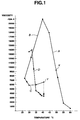
- FIG. 1 is a graph of the relationship between the cooling and heating state of the HPMC solution and the solution viscosity.
- HPMC when HPMC is dispersed in approximately 70°C hot water, it substantially does not dissolve in the hot water, and the resulting HPMC dispersion has a very low viscosity.
- the viscosity begins rising at a temperature of about 60 to 55°C and reaches a maximum at a temperature of about 45 to 40°C (line segment A in the graph).
- no particular pH adjustment is carried out in FIG. 1. Since it is well-known that the viscosity of HPMC and other water-soluble cellulose derivatives is affected by such factors as the pH and ionic strength, the plot in FIG. 1 serves as one model.
- Prior-art methods of manufacturing HPMC hard capsules involve adding and dispersing HPMC in approximately 70°C water in which a gelling agent such as carrageenan and a gelling aid have already been dissolved, cooling the dispersion, dipping capsule-forming pins therein at a temperature of 52 to 50°C during the rise in viscosity (indicated by "X" in the graph), and using both the gelling effect of the gelling agent brought about by subsequent cooling and the rise in viscosity of the HPMC to produce the capsules.
- a gelling agent such as carrageenan and a gelling aid
- the HPMC solution is cooled, whereupon the viscosity decreases as indicated by B in the diagram, generally resulting in complete dissolution in water at a temperature of 30 to 40°C or lower. If heating is then carried out from a state where the HPMC is thoroughly dissolved in water, as shown by C in the diagram, the viscosity remains substantially unchanged up to about 45°C. Although not shown in the diagram, the viscosity begins to rise sharply at or above about 45 to 50°C. Carrageenan is added and dissolved at a temperature preceding the sharp rise in viscosity (e.g., at a temperature close to 40°C indicated by "Y" in the diagram).
- the viscosity decreases with the addition of carrageenan. This is because the addition of a solution of carrageenan in water to the aqueous solution of HPMC dilutes the latter. When the aqueous HPMC solution containing a dissolved gelling agent is then cooled, the viscosity rises as shown by D in the diagram, with a particularly sharp rise in viscosity, namely gelation, occurring at about 35°C.
- the method of the present invention carries out capsule production by making use of, in a viscosity change pattern like that shown in FIG. 1, cooling after the solution has reached maximum viscosity and dissolution of a water-soluble cellulose derivative such as HPMC in water, subsequent addition and dissolution of a gelling agent and dipping of a capsule-forming pin at a predetermined temperature, then a rise in viscosity and gelation of the water-soluble cellulose derivative solution containing the dissolved gelling agent in a cooling or heating step.
- a water-soluble cellulose derivative such as HPMC in water
- dipping of the pin can be carried out in a temperature region where the change in viscosity of the water-soluble cellulose derivative solution (jelly) is small, even if the pin dipping temperature differs somewhat from a predetermined temperature setting, very little if any change in the jelly viscosity arises.
- a uniform capsule can be stably and reliably produced without strict temperature control of the jelly, and even with some degree of latitude in temperature control. As a result, high-quality capsules can be obtained with relatively loose control of the operation.
- both new and old cellulose derivative such as HPMC that has already been formed into capsules and fresh HPMC, can be uniformly dissolved and mixed. Because the capsule film produced from this type of jelly is uniform, capsules that have already been produced can be recycled and the water-soluble cellulose derivative re-used without compromising the quality of the resulting capsules.
- a water-soluble cellulose derivative and a gelling agent are used as the raw materials in the inventive method of manufacturing hard capsules.
- Appropriate water-soluble cellulose derivatives are cellulose ethers substituted with alkyl groups, especially C 1 to C 4 lower alkyl groups, and/or hydroxylalkyl groups, especially C 1 to C 4 hydroxy-lower alkyl groups.
- Specific examples include hydroxypropyl methyl cellulose (HPMC), hydroxyethyl cellulose, hydroxypropyl cellulose and hydroxyethyl methyl cellulose.
- HPMC hydroxypropyl methyl cellulose
- HPMC hydroxyethyl cellulose
- hydroxypropyl cellulose hydroxyethyl methyl cellulose
- Particularly effective use can be made of a water-soluble cellulose derivative such as HPMC having a behavior in solution like that shown in FIG. 1 in which little change in viscosity occurs up to about 45 to 50°C when the solution is reheated after having been cooled from an elevated temperature of at least 55°C down to a temperature of 40°C or less.
- the gelling agent used may be any substance that induces the gelation of the water-soluble cellulose derivative. Suitable examples include carrageenan, tamarind seed polysaccharide, pectin, curdlan, gelatin, furcellaran, agar and gellan gum. Preferred gelling agents include carrageenan and gellan gum. These gelling agents may be used alone or as combinations of two or more thereof.
- the carrageenan may be, for example, ⁇ -carrageenan or -carrageenan.
- a gelling aid may also be used.
- the gelling aid is selected according to the type of gelling agent.
- the gelling aid used may be a water-soluble compound that provides potassium ions, ammonium ions or calcium ions, illustrative examples of which include potassium chloride, ammonium chloride, ammonium acetate and calcium chloride.
- a water-soluble compound that provides calcium ions, such as calcium chloride may be employed as the gelling aid.
- the amount of water-soluble cellulose derivative used is preferably from 10 to 35% by weight, and especially 18 to 28% by weight.
- the concentration of the gelling agent in the capsule-preparing solution is preferably 0.01 to 0.5% by weight, and especially 0.05 to 0.3% by weight.
- the concentration of the gelling aid in the capsule-preparing solution is preferably 0.05 to 0.6% by weight, and especially 0.06 to 0.2% by weight.
- Additives ordinarily used in hard capsules such as dyes and pigments may be suitably added in the practice of the invention.
- first of all the water-soluble cellulose derivative is dispersed in hot water.
- the temperature of the hot water may be selected as appropriate for the type of water-soluble cellulose derivative, although the temperature is preferably at least 55°C, more preferably from 60 to 85°C, and most preferably from 65 to 80°C.
- the water-soluble cellulose derivative is preferably poured and dispersed into hot water of a predetermined temperature within the above range.
- the water-soluble cellulose derivative may be poured into water having a temperature lower than this predetermined temperature, followed by heating to the predetermined temperature.
- the dispersion is cooled under stirring. Cooling may be carried out by either natural cooling or forced cooling, the aim in either case being the substantially complete dissolution of the water-soluble cellulose derivative in the water.
- the cooling temperature also is selected with this in mind. In general, cooling is carried out to preferably 35°C or less, more preferably 30°C or less, and most preferably room temperature (15 to 25°C).
- the dipping temperature may be selected according to the type of water-soluble cellulose derivative, although heating to a temperature from higher than 35°C to 50°C is preferable, heating to a temperature from higher than 35°C to 45°C is more preferable, and heating to a temperature within a range of 38 to 43°C is most preferable. Heating to a temperature which is too high may result in a sharp rise in the viscosity of the water-soluble cellulose derivative solution. To keep this undesirable effect from arising, the upper limit in the dipping temperature is set to a temperature which precedes the sharp rise in viscosity.
- the gelling agent is added and dissolved in the water-soluble cellulose derivative solution after the above cooling step.
- the time of such addition so long as addition is carried out after cooling and before or during temperature elevation of the water-soluble cellulose derivative solution.
- addition just before the solution temperature is raised to the capsule-forming pin dipping temperature or just after this temperature has been reached is preferred.
- Addition of the gelling agent in the form of a solution thereof in water to the water-soluble cellulose derivative solution is preferable for achieving easy and uniform dissolution of the gelling agent, although in some cases the gelling agent may be added directly to the water-soluble cellulose derivative solution without first dissolving it in water.
- a capsule-forming pin is dipped at the above-indicated dipping temperature into the capsule-preparing solution (jelly solution) obtained as just described by adding and dissolving the gelling agent in the water-soluble cellulose derivative solution.
- the pin is then drawn out, and the capsule-preparing solution adhering to the pin is subjected to gelation and drying, giving a hard capsule.
- Gelation is preferably achieved by cooling on standing. However, in cases where the capsule-preparing solution attains a high viscosity and gels under heating, gelation may be effected by heating to a temperature of 50 to 80°C, for example, after the pin has been drawn out.
- the viscosity of the capsule-preparing solution is not subject to any particular limitation, although it is preferably set within a range of 100 to 10,000 mPa ⁇ s, and especially 1,000 to 8.000 mPa ⁇ s, at the capsule dipping temperature. This viscosity is the value obtained using a Brookfield-type rotational viscometer. Too low a viscosity results in the adherence of too little capsule-preparing solution to the pin, giving a capsule film of insufficient thickness. On the other hand, control of the capsule shape becomes difficult if the viscosity is too high.
- additives such as gelling aids, dyes and pigments may be incorporated into the capsule-preparing solution. These ingredients may be added at any stage. For example, they may be added to the hot water, or at the time of gelling agent addition.
- Capsules produced by the method of the invention may be used in drug and food products, and also in other applications including chemicals for use on animals and plants, and fertilizers.
- Drug applications include oral medications, containers for inhalants, and suppositories.
- the capsules can also be used as so-called quasi-pharmaceuticals for such purposes as disinfecting and cleaning dentures, eyeglasses and contact lenses.
- ingredients that may be filled into HPMC hard capsules include commonly known powders, granules and tablets, and also alcohols, including polyhydric alcohols such as stearyl alcohol, cetanol, and polyethylene glycol 600, 800, 1000, 1500, 2000, 3000, 4000, 6000, 8000 and 20000; fats and oils such as sesame oil, soybean oil, peanut oil, corn oil, hardened oil, paraffin oil and white beeswax; and fatty acids and fatty acid derivatives such as stearic acid, palmitic acid, myristic acid, triethyl citrate, triacetine and middle-chain fatty acid triglycerides.
- polyhydric alcohols such as stearyl alcohol, cetanol, and polyethylene glycol 600, 800, 1000, 1500, 2000, 3000, 4000, 6000, 8000 and 20000
- fats and oils such as sesame oil, soybean oil, peanut oil, corn oil, hardened oil, paraffin oil and white beeswax
- Physiologically active substances that may be used to fill capsules produced according to the inventive method for drug and food applications are not subject to any particular limitation so long as they are non-toxic.
- the capsules may be filled with a very broad range of drugs, including vitamins, antipyretics, analgesics, anti-inflammatory agents, antiulceratives, cardiotonics, anticoagulants, hemostatics, bone resorption inhibitors, vascularization inhibitors, antidepressants, antineoplastics, antitussive expectorants, muscle relaxants, anticonvulsants, antiallergics, antiarrhythmics, vasodilators, hypotensive diuretics, diabetes medications, antitubercular agents, hormones and narcotic antagonists.
- drugs including vitamins, antipyretics, analgesics, anti-inflammatory agents, antiulceratives, cardiotonics, anticoagulants, hemostatics, bone resorption inhibitors, vascularization inhibitors, antidepressants, antineoplastics, antitussive expector
- vitamins examples include vitamin A, vitamin B 1 , vitamin B 2 , vitamin B 6 , vitamin B 12 , nicotinamide, calcium pantothenate, vitamin C, vitamin D 2 , vitamin E and vitamin K.
- Suitable drug substances include ethyl eicosapentaenoate, actinomycin D, acyclovir, azimexon, aspirin, aztreonam, acetazolamide sodium, acetaminophen, acetohexamide, acetomenaphthon, adrenochrome monoaminoguanidine methanesulfonic acid, amikacin, ⁇ -aminocaproic acid, aminophylline, alprostadil, allylisopropylacetylurea, altretamine, amfenac, ampicillin, isoniazid, isopropylantipyrine, ibuprofen, ifosfamide, imipramine, indomethacin, urinastatin, ethosuximide, emedastine enanthate, estriol, erythromycin, ethambutol, tubocurarine chloride, alprenolol,
- neostigmin bromide pancuronium bromide, methscopolamine bromide, levorphanol tartrate, levallorphan tartrate, isosorbide nitrate, miconazole nitrate, cytosine arabinoside, cilostazol, cinnarizine, simvastatin, suprofen, sulpyrin, sulfanovan, sulfamethoxazole, sulfinpyrazone, sulindac, cefaclor, cefazolin, cephalexin, cephalothin, cephaloridine, defoxitin, cefotaxime, cefotiam, cefoperazone, cefsulodin, ceftizoxime, ceftibuten, cefmenoxime, cefmetazole, zotepine, thienamycin, thiotepa, ticarcillin, ticlopidine, til
- high-quality hard capsules based on a water-soluble cellulose derivative can be produced under simple operational control.
- Hydroxypropyl methyl cellulose (HPMC, 75 kg) and potassium chloride (230 g) were added to 285 L of hot water (80°C), following which the mixture was cooled and the viscosity at given temperatures was measured with a Brookfield-type viscometer (rotor No. 3, 6 rpm). After cooling to 27°C, the temperature was raised and the viscosity was similarly measured. When the temperature rose to 41°C, an aqueous solution obtained by adding 70 g of potassium chloride and 377 g of carrageenan to 39 kg of warm water was poured in and the viscosity was measured. The resulting mixture was allowed to cool, during which time the viscosity was similarly measured at predetermined temperatures. The results are shown in Table 1 and FIG. 1.
- Hydroxypropyl methyl cellulose 50 kg was dispersed in 170 L of 80°C water, then cooled to 25°C to effect dissolution. The resulting solution was warmed to 45°C, and a solution prepared by dissolving 200 g of carrageenan in 20 L of 45°C water was added thereto. Potassium chloride (276 g) was then added as a gelling aid, thereby giving a dipping solution.
- Capsules were produced by inserting capsule-forming pins into the dipping solution, then drawing out the pins and drying at room temperature or 60°C.
- Hydroxypropyl methyl cellulose 75 kg was dispersed in 170 L of 80°C water, then cooled to 19°C to effect dissolution. The resulting solution was waned to 41°C, and a solution prepared by dissolving 300 g of carrageenan in 30 L of 41°C water was added thereto. Potassium chloride (300 g) was then added as a gelling aid, thereby giving a dipping solution.
- Capsules were produced by inserting capsule-forming pins into the dipping solution, then drawing out the pins and drying at room temperature or 60°C.
- Hydroxypropyl methyl cellulose 75 kg was dispersed in 230 L of 80°C water, then cooled to 25°C to effect dissolution. The resulting solution was waned to 41°C, and a solution prepared by dissolving 377 g of carrageenan in 39 L of 41°C water was added thereto. Potassium chloride (300 g) was then added as a gelling aid, thereby giving a dipping solution.
- Capsules were produced by inserting capsule-forming pins into the dipping solution, then drawing out the pins and drying at room temperature or 60°C.
- Hydroxypropyl methyl cellulose 75 kg was dispersed in 240 L of 80°C water, then cooled to 25°C to effect dissolution. The resulting solution was warmed to 41°C, and a solution prepared by dissolving 377 g of carrageenan in 39 L of 41°C water was added thereto. Potassium chloride (300 g) was then added as a gelling aid, thereby giving a dipping solution.
- Capsules were produced by inserting capsule-forming pins into the dipping solution, then drawing out the pins and drying at room temperature.
- Hydroxypropyl methyl cellulose 75 g was dispersed in 240 ml of 80°C water, then cooled to 25°C to effect dissolution. The resulting solution was warmed to 50°C.
- Another solution was prepared by dissolving 0.4 g of agar in 50 ml of 95°C water and cooling to 50°C, after which it was added to the hydroxypropyl methyl cellulose solution, thereby giving a dipping solution.
- Capsules were produced by inserting capsule-forming pins into the dipping solution, then drawing out the pins and drying at room temperature or 60°C.
- Hydroxypropyl methyl cellulose (40 g) was dispersed in 130 ml of 80°C water, then cooled to 20°C to effect dissolution. The resulting solution was waned to 41°C, and a solution prepared by dissolving 0.2 g of carrageenan in 30 ml of 41°C water was added thereto. Potassium chloride (0.14 g) and ammonium acetate (0.2 g) were then added as gelling aids, thereby giving a dipping solution.
- Capsules were produced by inserting capsule-forming pins into the dipping solution, then drawing out the pins and drying at room temperature or 60°C.
- Hydroxypropyl methyl cellulose 75 kg was dispersed in 244 L of 80°C water, then cooled to 25°C to effect dissolution. The resulting solution was warmed to 41°C, and a solution prepared by dissolving 327 g of carrageenan in 30 L of 41°C water was added thereto. Potassium chloride (227 g) was then added as a gelling aid, thereby giving a dipping solution.
- Capsules were produced by inserting capsule-forming pins into the dipping solution, drawing out the pins and holding them at room temperature for several seconds, then dipping the pins once again into the solution, drawing them out and drying at room temperature or 60°C.
- Hydroxypropyl methyl cellulose (75 g) and potassium chloride (1.5 g) were dispersed in 230 ml of 80°C water, then cooled to 25°C to effect dissolution. The resulting solution was warmed to 45°C, and 1.6 g of carrageenan was added, thereby giving a dipping solution.
- Capsules were produced by inserting capsule-forming pins into the dipping solution, then drawing out the pins and drying at room temperature or 60°C.
Landscapes
- Health & Medical Sciences (AREA)
- Chemical & Material Sciences (AREA)
- Medicinal Chemistry (AREA)
- Pharmacology & Pharmacy (AREA)
- Epidemiology (AREA)
- Life Sciences & Earth Sciences (AREA)
- Animal Behavior & Ethology (AREA)
- General Health & Medical Sciences (AREA)
- Public Health (AREA)
- Veterinary Medicine (AREA)
- Medicinal Preparation (AREA)
- Medical Preparation Storing Or Oral Administration Devices (AREA)
- Manufacturing Of Micro-Capsules (AREA)
Applications Claiming Priority (3)
| Application Number | Priority Date | Filing Date | Title |
|---|---|---|---|
| JP30820498 | 1998-10-29 | ||
| JP30820498A JP3449253B2 (ja) | 1998-10-29 | 1998-10-29 | 硬質カプセルの製造方法 |
| PCT/JP1999/005874 WO2000025760A1 (fr) | 1998-10-29 | 1999-10-25 | Procede de fabrication d'une capsule dure |
Publications (2)
| Publication Number | Publication Date |
|---|---|
| EP1044682A1 true EP1044682A1 (fr) | 2000-10-18 |
| EP1044682A4 EP1044682A4 (fr) | 2006-01-04 |
Family
ID=17978177
Family Applications (1)
| Application Number | Title | Priority Date | Filing Date |
|---|---|---|---|
| EP99949395A Withdrawn EP1044682A4 (fr) | 1998-10-29 | 1999-10-25 | Procede de fabrication d'une capsule dure |
Country Status (7)
| Country | Link |
|---|---|
| US (1) | US6413463B1 (fr) |
| EP (1) | EP1044682A4 (fr) |
| JP (1) | JP3449253B2 (fr) |
| KR (1) | KR100580826B1 (fr) |
| CA (1) | CA2316947C (fr) |
| TW (1) | TW592731B (fr) |
| WO (1) | WO2000025760A1 (fr) |
Cited By (3)
| Publication number | Priority date | Publication date | Assignee | Title |
|---|---|---|---|---|
| WO2007093642A3 (fr) * | 2006-02-16 | 2007-10-04 | Flamel Tech Sa | Formes pharmaceutiques multimicroparticulaires qui resistent a la decharge immediate du principe actif en presence d'alcool |
| EP1849461A1 (fr) * | 2006-04-21 | 2007-10-31 | Pfizer Products Inc. | Methode de preparation des films |
| US9889152B2 (en) | 2004-06-16 | 2018-02-13 | Takeda Pharmaceuticals U.S.A., Inc. | Multiple PPI dosage form |
Families Citing this family (39)
| Publication number | Priority date | Publication date | Assignee | Title |
|---|---|---|---|---|
| ES2235380T3 (es) * | 1997-12-26 | 2005-07-01 | Warner-Lambert Company Llc | Composiciones de gelatina. |
| NZ532096A (en) * | 2001-09-28 | 2006-10-27 | Mcneil Ppc Inc | Dosage forms having an inner core and outer shell with different shapes |
| US20040202698A1 (en) * | 2003-04-02 | 2004-10-14 | The Procter & Gamble Company | Drug delivery systems comprising an encapsulated active ingredient |
| US8075910B2 (en) * | 2004-05-20 | 2011-12-13 | Pbm Pharmaceuticals, Inc. | Oral compositions comprising edible oils and vitamins and/or minerals and methods for making oral compositions |
| WO2005113010A1 (fr) * | 2004-05-24 | 2005-12-01 | Qualicaps Co., Ltd. | Capsule dure modifiée en surface et de solubilité renforcée |
| US20070161942A1 (en) * | 2006-01-06 | 2007-07-12 | Pharmaphil Inc. | Biodegradable tampon applicator and method of making |
| EP1983969A4 (fr) * | 2006-01-24 | 2012-10-31 | Qualicaps Co Ltd | Capsule dure à faible teneur en humidité et procédé de production |
| ES2593047T3 (es) | 2006-02-03 | 2016-12-05 | Opko Renal, Llc | Tratamiento de la insuficiencia y deficiencia de vitamina D con 25-hidroxivitamina D2 y 25-hidroxivitamina D3 |
| US20070264346A1 (en) * | 2006-02-16 | 2007-11-15 | Flamel Technologies | Multimicroparticulate pharmaceutical forms for oral administration |
| ES2670029T3 (es) | 2006-06-21 | 2018-05-29 | Opko Ireland Global Holdings, Ltd. | Terapia usando agente de repleción de la vitamina D y agente de reemplazo de la hormona de la vitamina D |
| JPWO2008081835A1 (ja) * | 2006-12-28 | 2010-04-30 | クオリカプス株式会社 | 水濡れインジケーターおよびタイムインジケーター |
| US11752158B2 (en) | 2007-04-25 | 2023-09-12 | Eirgen Pharma Ltd. | Method of treating vitamin D insufficiency and deficiency |
| HUE073014T2 (hu) | 2007-04-25 | 2025-12-28 | Opko Renal Llc | Eljárás a másodlagos hyperparathyreoidismus biztonságos és hatékony kezelésére és megelõzésére krónikus vesebetegség esetén |
| KR20190028822A (ko) | 2007-04-25 | 2019-03-19 | 사이토크로마 인코포레이티드 | 비타민 d 화합물과 밀랍성 담체를 포함하는 경구 조절성 방출 조성물 |
| WO2008156027A1 (fr) * | 2007-06-20 | 2008-12-24 | Qualicaps Co., Ltd. | Composition de revêtement non transparent |
| WO2009049160A1 (fr) | 2007-10-12 | 2009-04-16 | Takeda Pharmaceuticals North America | Procédés de traitement de troubles gastro-intestinaux indépendants de la prise alimentaire |
| KR100970665B1 (ko) * | 2008-02-04 | 2010-07-15 | 삼일제약주식회사 | 알푸조신 또는 그의 염을 함유하는 서방성 정제 |
| EP2281058B1 (fr) | 2008-04-02 | 2016-06-29 | Opko Ireland Global Holdings, Ltd. | Procédés, compositions, utilisations, et kits utiles pour la carence en vitamine d et des troubles associés |
| JP5253235B2 (ja) * | 2009-03-02 | 2013-07-31 | クオリカプス株式会社 | 腸溶性カプセル |
| JP2011068636A (ja) * | 2009-07-30 | 2011-04-07 | Kowa Co | 液体充填カプセル剤 |
| US8852631B2 (en) | 2009-09-24 | 2014-10-07 | Capsugel Belgium Nv | Acid resistant capsules |
| US8772242B2 (en) * | 2009-10-26 | 2014-07-08 | Thomas Julius Borody | Therapy for enteric infections |
| WO2011123476A1 (fr) | 2010-03-29 | 2011-10-06 | Cytochroma Inc. | Procédés et compositions pour réduction de taux d'hormone parathyroïde |
| KR101182827B1 (ko) * | 2010-06-11 | 2012-09-14 | 삼성정밀화학 주식회사 | 장용성 경질 캡슐의 제조방법 및 장용성 경질 캡슐 |
| KR102013296B1 (ko) * | 2012-07-23 | 2019-08-22 | 롯데정밀화학 주식회사 | 경질 캡슐용 수성 조성물과 그의 제조방법 및 상기 수성 조성물을 사용하여 제조된 경질 캡슐 |
| WO2014017756A1 (fr) * | 2012-07-23 | 2014-01-30 | 삼성정밀화학(주) | Composition aqueuse pour la préparation d'une capsule dure, son procédé de préparation, capsule dure et procédé de recyclage des déchets de capsule dure |
| KR102085330B1 (ko) | 2012-12-05 | 2020-03-05 | 롯데정밀화학 주식회사 | 두께 균일성이 개선된 경질 캡슐 |
| KR20140072715A (ko) * | 2012-12-05 | 2014-06-13 | 삼성정밀화학 주식회사 | 경질 캡슐 |
| KR101847947B1 (ko) | 2013-03-15 | 2018-05-28 | 옵코 아이피 홀딩스 Ⅱ 인코포레이티드 | 안정화되고 변형된 비타민 d 방출 제형 |
| KR102199595B1 (ko) * | 2013-12-31 | 2021-01-07 | 롯데정밀화학 주식회사 | 경질 캡슐용 수성 조성물 및 이를 사용하여 제조된 경질 캡슐 |
| KR102199596B1 (ko) * | 2013-12-31 | 2021-01-07 | 롯데정밀화학 주식회사 | 경질 캡슐용 수성 조성물 및 이를 사용하여 제조된 경질 캡슐 |
| KR102161001B1 (ko) * | 2013-12-31 | 2020-09-29 | 롯데정밀화학 주식회사 | 경질 캡슐용 수성 조성물 및 이를 사용하여 제조된 경질 캡슐 |
| US10220047B2 (en) | 2014-08-07 | 2019-03-05 | Opko Ireland Global Holdings, Ltd. | Adjunctive therapy with 25-hydroxyvitamin D and articles therefor |
| EA201791982A1 (ru) | 2015-03-09 | 2020-02-17 | Интекрин Терапьютикс, Инк. | Способы лечения неалкогольной жировой болезни печени и/или липодистрофии |
| JP6412853B2 (ja) * | 2015-12-16 | 2018-10-24 | 信越化学工業株式会社 | フィルム成型用組成物 |
| JP7032322B2 (ja) | 2016-03-28 | 2022-03-08 | オプコ アイルランド グローバル ホールディングス リミテッド | ビタミンd治療法 |
| JP2020515639A (ja) | 2017-04-03 | 2020-05-28 | コヒラス・バイオサイエンシズ・インコーポレイテッド | 進行性核上性麻痺の処置のためのPPARγアゴニスト |
| US20220273520A1 (en) | 2019-08-02 | 2022-09-01 | Qualicaps Co., Ltd. | Hard capsule formulation sealed with band seal containing tags |
| WO2022244713A1 (fr) * | 2021-05-18 | 2022-11-24 | ロンザ株式会社 | Capsule dure non gélatineuse et sa méthode de production |
Family Cites Families (11)
| Publication number | Priority date | Publication date | Assignee | Title |
|---|---|---|---|---|
| US3826666A (en) * | 1972-07-20 | 1974-07-30 | Parke Davis & Co | Enteric capsules |
| US4138013A (en) * | 1976-08-27 | 1979-02-06 | Parke, Davis & Company | Enteric capsules |
| JPS58138458A (ja) | 1982-02-10 | 1983-08-17 | 信越化学工業株式会社 | 腸溶性カプセルの製造方法 |
| KR900000254B1 (ko) * | 1986-05-12 | 1990-01-24 | 신에쯔까 가가꾸 고우교우 가부시끼가이샤 | 의약용 경질 캅셀의 제조방법과 그 제조장치 |
| JPH0634807B2 (ja) * | 1989-06-08 | 1994-05-11 | 信越化学工業株式会社 | 医薬用硬質カプセルの製造方法 |
| US5264223A (en) | 1990-03-29 | 1993-11-23 | Japan Elanco Company, Ltd. | Hard capsule for pharmaceutical drugs and method for producing the same |
| JP2552937B2 (ja) | 1990-03-29 | 1996-11-13 | 日本エランコ株式会社 | 医薬用硬質カプセルおよびその製造方法 |
| JP3116602B2 (ja) | 1992-10-06 | 2000-12-11 | シオノギクオリカプス株式会社 | 硬質カプセル |
| US5431917A (en) | 1992-10-08 | 1995-07-11 | Japan Elanco Company, Ltd. | Hard capsule for pharmaceutical drugs and method for producing the same |
| JP2959423B2 (ja) * | 1994-12-01 | 1999-10-06 | シオノギクオリカプス株式会社 | カプセル用皮膜組成物 |
| US5756123A (en) | 1994-12-01 | 1998-05-26 | Japan Elanco Co., Ltd. | Capsule shell |
-
1998
- 1998-10-29 JP JP30820498A patent/JP3449253B2/ja not_active Expired - Lifetime
-
1999
- 1999-10-25 CA CA002316947A patent/CA2316947C/fr not_active Expired - Fee Related
- 1999-10-25 WO PCT/JP1999/005874 patent/WO2000025760A1/fr not_active Ceased
- 1999-10-25 US US09/582,560 patent/US6413463B1/en not_active Expired - Fee Related
- 1999-10-25 KR KR1020007007216A patent/KR100580826B1/ko not_active Expired - Fee Related
- 1999-10-25 EP EP99949395A patent/EP1044682A4/fr not_active Withdrawn
- 1999-10-28 TW TW088118708A patent/TW592731B/zh not_active IP Right Cessation
Cited By (4)
| Publication number | Priority date | Publication date | Assignee | Title |
|---|---|---|---|---|
| US9889152B2 (en) | 2004-06-16 | 2018-02-13 | Takeda Pharmaceuticals U.S.A., Inc. | Multiple PPI dosage form |
| WO2007093642A3 (fr) * | 2006-02-16 | 2007-10-04 | Flamel Tech Sa | Formes pharmaceutiques multimicroparticulaires qui resistent a la decharge immediate du principe actif en presence d'alcool |
| EP1849461A1 (fr) * | 2006-04-21 | 2007-10-31 | Pfizer Products Inc. | Methode de preparation des films |
| WO2007122465A3 (fr) * | 2006-04-21 | 2009-07-30 | Pfizer Prod Inc | Procédé de production de films |
Also Published As
| Publication number | Publication date |
|---|---|
| JP2000136126A (ja) | 2000-05-16 |
| US6413463B1 (en) | 2002-07-02 |
| JP3449253B2 (ja) | 2003-09-22 |
| CA2316947A1 (fr) | 2000-05-11 |
| KR20010033693A (ko) | 2001-04-25 |
| TW592731B (en) | 2004-06-21 |
| WO2000025760A1 (fr) | 2000-05-11 |
| EP1044682A4 (fr) | 2006-01-04 |
| CA2316947C (fr) | 2008-04-01 |
| KR100580826B1 (ko) | 2006-05-16 |
Similar Documents
| Publication | Publication Date | Title |
|---|---|---|
| US6413463B1 (en) | Process for producing hard capsule | |
| JP4790220B2 (ja) | ポリサッカライドカプセル及びその製造方法 | |
| CA2500663C (fr) | Composition enterique pour la fabrication d'un enrobage de capsule molle | |
| AT398165B (de) | Verfahren zur herstellung einer pharmazeutischen kapsel zur oralen verabreichung mit verzögerter wirkstofffreisetzung bzw. kombinierter verzögerter/rascher wirkstofffreisetzung | |
| JP5406529B2 (ja) | カプセル充墳物としての親油性ベヒクルに基づく二重制御された放出マトリクスシステム | |
| DE69003347T2 (de) | Elemente mit protrahierter Wirkstoffabgabe. | |
| JP7703510B2 (ja) | プルランカプセル | |
| JPWO2003043609A1 (ja) | 非ゼラチン系カプセル皮膜組成物及びそれを用いたカプセル | |
| EP0077956A1 (fr) | Microcapsules entériques et procédé de préparation | |
| JP2013209416A (ja) | 胃の逆流抵抗性投薬形態 | |
| CA2556514C (fr) | Composition destinee a l'administration orale d'hydrochlorure de tamsulosine et formulation en granules a liberation controlee comprenant cette composition | |
| DE69103922T2 (de) | Verfahren zur Herstellung arzneistoffhaltiger Tabletten mit verzögerter Freigabe. | |
| US8900628B2 (en) | Hard capsule and method for producing same | |
| US20140154311A1 (en) | Enteric Soft Capsules | |
| KR20260049630A (ko) | 경구용 삼투성 의약품 전달 시스템의 제조 방법 및 이를 사용하여 제조된 의약품 배치 | |
| HK40016650A (en) | Pullulan capsules | |
| Sarode et al. | Preparation and Characterization of Sustained release Antidepressant tablet using combination of wax. | |
| RS52027B (sr) | Enterosolventne tablete sa acetilsalicilnom kiselinom | |
| MXPA06009141A (en) | Composition for oral administration of tamsulosin hydrochloride and controlled release granule formulation comprising same |
Legal Events
| Date | Code | Title | Description |
|---|---|---|---|
| PUAI | Public reference made under article 153(3) epc to a published international application that has entered the european phase |
Free format text: ORIGINAL CODE: 0009012 |
|
| 17P | Request for examination filed |
Effective date: 20000718 |
|
| AK | Designated contracting states |
Kind code of ref document: A1 Designated state(s): AT BE CH CY DE DK ES FI FR GB GR IE IT LI LU MC NL PT SE |
|
| AX | Request for extension of the european patent |
Free format text: AL;LT;LV;MK;RO;SI |
|
| RBV | Designated contracting states (corrected) |
Designated state(s): DE ES FR GB IT |
|
| A4 | Supplementary search report drawn up and despatched |
Effective date: 20051118 |
|
| GRAP | Despatch of communication of intention to grant a patent |
Free format text: ORIGINAL CODE: EPIDOSNIGR1 |
|
| STAA | Information on the status of an ep patent application or granted ep patent |
Free format text: STATUS: THE APPLICATION IS DEEMED TO BE WITHDRAWN |
|
| 18D | Application deemed to be withdrawn |
Effective date: 20080717 |