EP1045293A2 - Toner et procédé pour sa préparation - Google Patents
Toner et procédé pour sa préparation Download PDFInfo
- Publication number
- EP1045293A2 EP1045293A2 EP00108247A EP00108247A EP1045293A2 EP 1045293 A2 EP1045293 A2 EP 1045293A2 EP 00108247 A EP00108247 A EP 00108247A EP 00108247 A EP00108247 A EP 00108247A EP 1045293 A2 EP1045293 A2 EP 1045293A2
- Authority
- EP
- European Patent Office
- Prior art keywords
- toner
- process according
- weight
- hindered phenol
- range
- Prior art date
- Legal status (The legal status is an assumption and is not a legal conclusion. Google has not performed a legal analysis and makes no representation as to the accuracy of the status listed.)
- Granted
Links
Images

Classifications
-
- G—PHYSICS
- G03—PHOTOGRAPHY; CINEMATOGRAPHY; ANALOGOUS TECHNIQUES USING WAVES OTHER THAN OPTICAL WAVES; ELECTROGRAPHY; HOLOGRAPHY
- G03G—ELECTROGRAPHY; ELECTROPHOTOGRAPHY; MAGNETOGRAPHY
- G03G9/00—Developers
- G03G9/08—Developers with toner particles
- G03G9/087—Binders for toner particles
- G03G9/08742—Binders for toner particles comprising macromolecular compounds obtained otherwise than by reactions only involving carbon-to-carbon unsaturated bonds
- G03G9/08755—Polyesters
-
- G—PHYSICS
- G03—PHOTOGRAPHY; CINEMATOGRAPHY; ANALOGOUS TECHNIQUES USING WAVES OTHER THAN OPTICAL WAVES; ELECTROGRAPHY; HOLOGRAPHY
- G03G—ELECTROGRAPHY; ELECTROPHOTOGRAPHY; MAGNETOGRAPHY
- G03G9/00—Developers
- G03G9/08—Developers with toner particles
- G03G9/097—Plasticisers; Charge controlling agents
- G03G9/09733—Organic compounds
- G03G9/0975—Organic compounds anionic
-
- G—PHYSICS
- G03—PHOTOGRAPHY; CINEMATOGRAPHY; ANALOGOUS TECHNIQUES USING WAVES OTHER THAN OPTICAL WAVES; ELECTROGRAPHY; HOLOGRAPHY
- G03G—ELECTROGRAPHY; ELECTROPHOTOGRAPHY; MAGNETOGRAPHY
- G03G9/00—Developers
- G03G9/08—Developers with toner particles
- G03G9/097—Plasticisers; Charge controlling agents
- G03G9/09783—Organo-metallic compounds
Definitions
- the present invention relates to a toner used for developing an electrostatic latent image formed in an image forming method, such as an electrophotographic method, an electrostatic recording method or an electrostatic printing method, a toner used in an image forming method according to a toner jet recording method, and a process for producing a toner.
- an electrophotographic method is a method for forming an image by uniformly charging a photoconductive insulating layer, exposing the layer, forming an electrostatic latent image, developing the electrostatic latent image by a toner (a developing process), transferring the obtained toner image onto a transfer material, such as transfer paper, via an intermediate transfer member, or without using an intermediate transfer member (a transfer process), and fixing the toner image on the transfer material according to a heating fixing method, a pressing fixing method, or a heating/pressing fixing method (a fixing process).
- the toner for forming a toner image must have functions required in the developing process, the transfer process, and the fixing process.
- the toner since the toner receives a mechanical frictional force due to a shearing force and an impact force received during a mechanical operation within a developing device, it tends to be degraded during copying or printing operations for several to several tens of thousands of sheets.
- a tough binding resin having a large molecular weight capable of resisting a mechanical frictional force may be used.
- a binding resin having a large molecular weight has a high softening point.
- a heat roller in order to sufficiently fix a toner image in a heat-roller fixing method which is widely being used because of a contact fixing method and excellent thermal efficiency, a heat roller must be set to a high temperature. A high temperature of the heat roller will cause degradation of the fixing device itself, the generation of curl of paper after fixing, and an increase in energy consumption.
- such a binding resin also has poor grindability, the efficiency in manufacture of the toner decreases.
- the heat-roller fixing method has superior thermal efficiency because the surface of a heating roller is in pressure contact with the toner-image surface of a transfer material, and therefore is widely used in a wide range of machines from low-speed machines to high-speed machines.
- the heat-roller fixing method when the surface of the heating roller contacts the toner-image surface, an offset phenomenon tends to occur in which the toner adheres to the surface of the heating roller and the adhering toner is transferred onto the succeeding transfer material.
- toners which use a covalent cross-linking resin or a branching resin using a multifunctional monomer, called a cross-linking polymer, or a multifunctional initiator (described in Japanese Patents Laid-Open Application (Kokai) Nos. 3-203746 (1991) and 4-24648 (1992)), and toners which use an ionic cross-linking polymer obtained by strongly bonding a metal oxide and a polymer (described in Japanese Patents Laid-Open Application (Kokai) Nos. 61-213858 (1986) and 6-175395 (1994)).
- the usable temperature range is between the minimum fixing temperature and high-temperature offset.
- full-color image communication has been widely utilized as an information transmission mechanism using images.
- full-color approach has also been rapidly adopted in printers and copiers, serving as output apparatuses, particularly in low-grade apparatuses, so that color images are becoming familiar to ordinary users.
- toners of three colors i.e., yellow, magenta and cyan which are three primary colors, or toners of four colors including black in addition to the three colors.
- an electrostatic latent image for magenta is formed on a photoconductive layer by passing light from an original through a color-separation-light transmitting filter in a relationship of a complementary color with magenta (a latent-image forming process). Then, a magenta toner image is held on a supporting member after passing through a developing process and a transfer process using a magenta toner.
- These processes are sequentially performed also for a cyan toner, a yellow toner and a black toner.
- the color toners are superposed on the same supporting member by being subjected to registration, and a final full-color image is obtained by fixing the superposed images.
- the fixed color image is in a state of substantially complete fusion such that the shapes of toner particles can be hardly discriminated, so as not to hinder color reproduction due to irregular reflection of light, and that a color toner is transparent so as not to hinder the color tone of a layer of a color toner having a different color tone present below the first-cited color toner, and that each color toner has a hue and a spectral reflectance in good balance and a sufficient saturation.
- polyester-type resins are widely used in the concerned technical field as binding resins for color toners.
- Japanese Patent Laid-Open Application (Kokai) No. 57-124740 (1982) describes that, in order to suppress reaction of free radicals during synthesis of a binding resin, it is desirable to add a hindered-phenol-type antioxidant by a total amount of 0.1 ⁇ 3.0 weight % with respect to a high-molecular polymer.
- Japanese Patent Laid-Open Application (Kokai) No. 1-246560 (1989) describes that, in order to suppress the oxidation of both a toner using a binding resin, and a photosensitive member comprising an organic photoconductor, it is desirable to add a hindered-phenol-type antioxidant by a total amount of 0.01 ⁇ 10 weight % with respect to the toner during mixture of materials before manufacturing the toner by fusing and kneading the binding resin with other materials.
- the present invention which achieves these objectives relates to a toner comprising at least a polyester resin having carboxyl groups, a coloring agent, 0.1 ⁇ 10 weight % of a metal salicylate compound with respect to the weight of the toner, and 20 ⁇ 400 ppm of hindered phenol with respect to the total weight of the toner.
- the present invention which achieves these objectives relates to a process for producing a toner containing at least toner particles, comprising: a melt-kneading step for melt-kneading a mixture including at least a polyester resin having a carboxyl group and containing a hindered phenol, a coloring agent, and a metal salicylate compound to obtain a melt-kneaded product, wherein said polyester resin is synthesized under the presence of a hindered phenol; a cooling step for cooling the melt-kneaded product, and a pulverizing step for pulverizing the cooled product to obtain toner particles; wherein said toner comprises at least said polyester resin having a carboxyl group; and said coloring agent; 0.1 ⁇ 10 weight % of the metal salicylate compound with respect to the weight of the toner, and 20 ⁇ 400 ppm of the hindered phenol with respect to the weight of the toner.
- the present invention which achieves these objectives relates to a process for producing a toner containing at least toner particles, comprising: a melt-kneading step for melt-kneading a mixture including at least a hindered phenol, a polyester resin having a carboxyl group, a coloring agent and a metal salicylate compound to obtain a melt-kneaded product; a cooling step for cooling the melt-kneaded product; and a pulverizing step for pulverizing the cooled product to obtain toner particles; wherein said toner comprises at least said polyester resin having a carboxyl group; and said coloring agent; 0.1 ⁇ 10 weight % of the metal salicylate compound with respect to the weight of the toner; and 20 ⁇ 400 ppm of the hindered phenol with respect to the weight of the toner.
- the inventors of the present invention have obtained the knowledge that a toner having excellent fixability, long-term preservability, and charging stability can be obtained when the toner includes at least a polyester resin having a carboxyl group, a coloring agent, a metal salicylate compound and 20 ⁇ 400 ppm of a hindered phenol with respect to the mass of the toner, and have made the present invention.
- the present invention will now be described in detail.
- the binding resin for toner particles is a polyester resin having a carboxyl group.
- a polyester resin having a carboxyl group is used as the binding resin for the toner used in the present invention.
- a polyester resin having a molecular structure indicated by the following expression (A) is preferable.
- x and y represent integers equal to or more than 1, and the average value of x + y is within a range of 2 ⁇ 4).
- the polyester resin having the molecular structure indicated by expression (A) can easily form a metal-ion cross-linking structure when being melt/kneaded simultaneously with a metal salicylate compound (to be described in detail later), and can excellently form a toner having a distinct minimum value (G' min ) in the curve of the storage modulus of the toner.
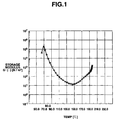
- FIG. 1 illustrates an example of the curve of the storage modulus of a toner according to the present invention.
- This curve has a minimum value (G' min ) at about 145° C, and the viscoelasticity of the toner again increases at temperatures higher than the minimum value (G' min ).
- a toner having such a characteristic of viscoelasticity is superior in the high-temperature-offset resisting property.
- the minimum value (G' min ) of the storage modulus of the toner is preferably within a range of 100 ⁇ 200°C, and more preferably within a range of 110 ⁇ 170°C.
- a toner similar to a comparative toner (to be described later) having viscoelasticity as shown in FIG. 2 does not have a distinct minimum value within a range of 100 ⁇ 200°C, and the storage modulus of the toner decreases at a high-temperature side higher than 100°C in accordance with temperature rise.
- Such a toner is inferior in the high-temperature-offset resisting property, and has a narrower fixable-temperature range than the toner of the present invention.
- Bivalent alcohol components for generating a polyester resin include, for example, ethylene glycol, propylene glycol, 1,3-butanediol, 1,4-butanediol, 2,3-butanediol, diethylene glycol, triethylene glycol, 1,5-pentanediol, 1,6-hexanediol, neopentyl glycol, 2-ethyl-1,3-hexanediol, bisphenol hydroxide A, and a bisphenol derivative expressed by the following expression (B): (in expression (B), R represents an ethylene or propylene group, x and y represent integers equal to or more than 1, and the average value of x + y is a value within a range of 2 ⁇ 10).
- Trivalent or higher-valent alcohol components for forming a nonlinear polyester resin include, for example, sorbitol, 1,2,3,6-hexanetetrol, 1,4-sorbitan, pentaerythrotol, dipentaerythrotol, tripentaerythrotol, 1,2,4-butanetriol, 1,2,5-pentanetriol, glycerol, 2-methylpropanetriol, 2-methyl-1,2,4-butanetriol, trimethylol ethane, trimethylol propane, and 1,3,5-trihydroxybenzene.
- the amount of use of triatomic or higher-order alcohol is preferably within a range of 0.1 ⁇ 1.8 mol % with reference to the entire monomer.
- Bivalent acid components for generating a polyester resin include, for example, aliphatic-acid-component monomers, such as fumaric acid, maleic acid, maleic anhydride, succinic acid, adipic acid, sebacic acid, malonic acid, and each monomer obtained by replacing one of these acids with saturated or unsaturated hydrocarbon radicals having a number of carbons within a range of 8 ⁇ 22, and aromatic-acid-component monomers, such as phthalic acid, isophthalic acid, phthalic anhydride, terephthalic acid, and each ester derivative of one of these acids.
- aliphatic-acid-component monomers such as fumaric acid, maleic acid, maleic anhydride, succinic acid, adipic acid, sebacic acid, malonic acid, and each monomer obtained by replacing one of these acids with saturated or unsaturated hydrocarbon radicals having a number of carbons within a range of 8 ⁇ 22, and aromatic-acid-component monomers, such as
- Trivalent or higher-valent carboxylic acid components for forming a nonlinear polyester resin include, for example, 1,2,4-benzenetricarboxylic acid, 1,2,5-benzenetricarboxylic acid, 1,2,4-naphthalenetricarboxylic acid, 2,5,7-naphthalenetricarboxylic acid, 1,2,4,5-benzenetetracarboxylic acid, and each anhydride and ester compound of one of these acids.
- the amount of use of a trivalent or higher-valent carboxylic acid is preferably within a range of 0.1 ⁇ 1.9 mol % with reference to the entire monomer.
- the glass transition temperature of the polyester resin is within a range of 47 ⁇ 64°C, and more preferably within a range of 49 ⁇ 62°C.
- the glass transition temperature of the toner is within a range of 50 ⁇ 67°C, and preferably within a range of 51 ⁇ 64°C.
- the glass transition temperature of the polyester resin is less than 47°C, or the glass transition temperature of the toner is less than 50°C, although fixability is excellent, the offset resisting property is degraded, thereby causing contamination of the fixing roller and winding of the sheet around the fixing roller may occur. Furthermore, the surface of the obtained image after fixing is too glossy, thereby degrading the quality of the image.
- the glass transition temperature of the polyester resin exceeds 64°C, or the glass transition temperature of the toner exceeds 67°C, fixability is degraded, so that the fixing temperature must be raised. As a result, the obtained image has generally poor glossiness, and a color mixing property of the toner as a full-color toner is degraded.
- the number average molecular weight (Mn) and the weight average molecular weight (Mw) of a THF(tetrahydrofuran)-soluble component of the polyester resin in GPC (gel permeation chromatography) measurement are within a range of 1,300 ⁇ 9,500 and within a range of 5,500 ⁇ 95,000, respectively, and the ratio of Mw to Mn (Mw/Mn) of the THF-soluble component of the polyester resin is within a range of 2 ⁇ 10.
- the number-average molecular weight (Mn) and the weight-average molecular weight (Mw) of a THF-soluble component of the toner including the polyester resin in GPC measurement are within a range of 1,500 ⁇ 10,000 and within a range of 6,000 ⁇ 100,000, respectively, and the ratio of Mw to Mn (Mw/Mn) of the THF-soluble component of the toner is within a range of 2 ⁇ 10.
- the toner may be fused within the developing device, or so-called carrier spend , in which toner components adhere to the surfaces of carrier particles, may be generated.
- the fixing temperature must be raised. Furthermore, even if the degree of dispersion of the pigment can be controlled, the smoothness of the surface at an image portion is degraded, and color reproducibity tends to be degraded.
- the ratio Mw/Mn of the THF-soluble component of the polyester resin or the toner is less than 2, since the molecular weight itself of the obtained polyester resin is generally small, the phenomenon of high-temperature offset after repeated image forming operations, degradation in stability during storage for a long time, fusion of the toner within the developing device, and carrier spent tend to occur, as in the above-described case of a small molecular weight. In addition, the amount of charging of the toner tends to vary.
- the fixing temperature must be high. Furthermore, even if the degree of dispersion of the pigment can be controlled, the smoothness of the surface at an image portion is degraded, and color reproducibility tends to be degraded.
- the polyester resin preferably includes the THF-insoluble component within a range of 0.1 ⁇ 10 weight %, and more preferably, within a range of 0.5 ⁇ 8 weight %.
- the toner preferably includes the THF-insoluble component within a range of 0.2 ⁇ 18 weight %, and more preferably within a range of 0.6 ⁇ 16 weight %.
- the polyester resin according to the present invention has carboxylic groups, and preferably has an acid value within a range of 5 ⁇ 60 mg KOH/g, and more preferably within a range of 7 ⁇ 50 mg KOH/g.
- the acid value of the polyester resin When the acid value of the polyester resin is less than 5 mg KOH/g, the amount of charging tends to increase during repeated image forming operations, thereby causing so-called charge-up. On the other hand, when the acid value of the polyester resin exceeds 60 mg KOH/g, so-called charge-down tends to occur when performing repeated image forming operations in a high-temperature/high-humidity environment.
- a trivalent or higher-valent metal is preferable as a metal for forming the metal salicylate compound used in the present invention.
- Bivalent metals include Mg 2+ , Ca 2+ , Sr 2+ , Pb 2+ , Fe 2+ , Co 2+ , Ni 2+ , Zn 2+ , and Cu 2+ .
- Zn 2+ , Ca 2+ , Mg 2+ , and Sr 2+ are preferable as bivalent metals.
- Trivalent of higher-valent metals include Al 3+ , Cr 3+ , Fe 3+ , and Ni 3+ . Al 3+ and Cr 3+ are preferable from among these metals, and Al 3+ is particularly preferable.
- an aluminum compound of di-tert-butylsalicylate acid is particularly preferable as an organometallic compound.
- the metal salicylate compound may be synthesized, for example, by dissolving salicylic acid in an aqueous solution of sodium hydroxide, dripping an aqueous solution fusing metallic atoms having a valence equal to or more than 2 into the aqueous solution of sodium hydroxide, heating and stirring the resultant solution, adjusting pH of the aqueous solution, cooling the solution to the room temperature, and filtering and washing the solution.
- the synthesizing method is not limited to the above-described one.
- a metal salicylate compound it is preferable to use to an amount within a range of 0.1 ⁇ 10 weight % (more preferably within a range of 0.5 ⁇ 9 weight %) with respect to the total weight of the toner, because initial variations in the amount of charging of the toner are small, and the absolute amount of charging necessary during development can be easily obtained, so that a decrease in the quality of the obtained image, such as fog, or a decrease in the density of the image, does not occur.
- the hindered phenol used in the present invention is a phenolic compound having a substitutional group at least at an ortho position for a hydroxyl group.
- Hindered phenols which can be used in the present invention include, for example, mono-t-butyl-p-cresol, mono-t-butyl-m-cresol, 4-t-butylcatechol, 2,5-di-t-butylhydroquinone, 2,5-di-t-amylhydroquinone, propyl gallate, 4,4'-methylenebis(2,6-t-butylphenol), 4,4'-isopropylidenebis(2,6-di-t-butylphenol), 4,4'-butylidenebis(3-methyl-6-t-butylphenol), butylhydroxyanisole, 2,6-di-t-butyl-p-cresol, 2,6-di-t-butylphenol, 2,6-di-t-butyl-4-ethylphenol, 2,4,6-tri-t-butylphenol, 4-hydroxymethyl-2,6-di-t-butyl, octadecil-3
- 4-t-butylcatechol and 2,5-di-t-butylhydroquinone are preferable from among these compounds.
- the hindered phenol is included within a range of 20 ⁇ 400 ppm with reference to the total weight of the toner, and preferably within a range of 50 ⁇ 380 ppm.
- the contained amount of the hindered phenol is less than 20 ppm with reference to the total weight of the toner, a polymerization inhibiting function during synthesis of the polyester resin, and an oxidation inhibiting function for the surfaces of toner particles and the organic photoconductor do not operate.
- the toner manufactured by utilizing cross-linking (loose ionic bond) during mixing/kneading the polyester resin having carboxylic groups and the metal salicylate compound when the contained amount of the hindered phenol exceeds 400 ppm with reference to the total weight of the toner, for example, in the curve of the storage modulus according to the present invention shown in FIG. 1, a distinct minimum value is not present within a temperature range of 100 ⁇ 200°C, and the storage modulus of the toner decreases as the temperature is raised at the high-temperature side.
- Pigments and/or dies may be used as the coloring agents.
- the dies include, for example, C.I. Direct Red 1, C.I. Direct Red 4, C.I. Acid Red 1, C.I. Basic Red 1, C.I. Mordant Red 30, C.I. Direct Blue 1, C.I. Direct Blue 2, C.I. Acid Blue 9, C.I. Acid Blue 15, C.I. Basic Blue 3, C.I. Basic Blue 5, C.I. Mordant Blue 7, C.I. Direct Green 6, C.I. Basic Green 4, and C.I. Basic Green 6.
- the pigments include, for example, Mineral Fast Yellow, Navel Yellow, Naphthol Yellow S, Hansa Yellow G, Permanent Yellow NCG, Tartrazine Lake, Molybdenum Orange, Permanent Orange GTR, Pyrazolone Orange, Benzidine Orange G, Cadmium Red, Permanent Red 4R, Watching Red Calcium Salt, Eosin Lake, Brilliant Carmine 3B, Manganese Purple, Fast Violet B, Methyl Violet Lake, Cobalt Blue, Alkali Blue Lake, Victoria Blue Lake, Phthalocyanine Blue, Fast Sky Blue, Indanthrene Blue BC, Pigment Green B, Malachite Green Lake, and Final Yellow Green G.
- coloring pigments for magenta include C.I. Pigment Reds, 1, 2, 3, 4, 5, 6, 7, 8, 9, 10, 11, 12, 13, 14, 15, 16, 17, 18, 19, 20, 21, 22, 23, 30, 31, 32, 37, 38, 39, 40, 41, 48, 49, 50, 51, 52, 53, 54, 55, 57, 58, 60, 63, 64, 68, 81, 83, 87, 88, 89, 90, 112, 114, 122, 123, 163, 202, 206, 207 and 209, C.I. Pigment Violet 19, and C.I. Vat Reds 1, 2, 10, 13, 15, 23, 29 and 35.
- Dyes for magenta include oil-soluble dyes, such as C.I. Solvent Reds 1, 3, 8, 23, 24, 25, 27, 30, 49, 81, 82, 83, 84, 100, 109 and 121, C.I. Disperse Red 9, C.I. Solvent Violets 8, 13, 14, 21 and 27, C.I. Disperse Violet 1, and basic dyes, such as C.I. Basic Reds, 1, 2, 9, 12, 13, 14, 15, 17, 18, 22, 23, 24, 27, 29, 32, 34, 35, 36, 37, 38, 39 and 40, C.I. Basic Violets 1, 3, 7, 10, 14, 15, 21, 25, 26, 27 and 28.
- oil-soluble dyes such as C.I. Solvent Reds 1, 3, 8, 23, 24, 25, 27, 30, 49, 81, 82, 83, 84, 100, 109 and 121
- basic dyes such as C.I. Basic Reds, 1, 2, 9, 12, 13, 14, 15, 17, 18, 22,
- Coloring pigments for cyan include C.I. Pigment Blues 2, 3, 15, 16 and 17, C.I. Vat Blue 6, C.I. Acid Blue 45, and copper phthalocyanine pigments obtained by replacing a phthalocyanine skeleton with 1 ⁇ 5 phthalimide groups.
- Coloring pigments for yellow include Pigment Yellows 1, 2, 3, 4, 5, 6, 7, 10, 11, 12, 13, 14, 15, 16, 17, 23, 65, 73 and 83, and C.I. Vat Yellows 1, 3 and 20.
- the amount of use of the coloring agent is within a range of 1 ⁇ 15 weight parts with respect to 100 weight parts of the binding resin, preferably within a range of 3 ⁇ 12 weight parts, and more preferably within a range of 4 ⁇ 10 weight parts.
- the contained amount of the coloring agent exceeds 15 weight parts, transparency decreases, the reproducibitity of an intermediate color represented by the skin color of the human being tends to be degraded, the stability of the charging property of the toner is degraded, and the target amount of charging cannot be easily obtained.
- the contained amount of the coloring agent is less than 1 weight part, the target tinting strength cannot be easily obtained, and a high-quality image having a high density cannot be easily obtained.
- magnetic toner particles include a magnetic material, which also operates as a coloring agent.
- the magnetic materials include iron oxides, such as magnetite, magnetic hematite, and ferrite, iron oxides including other metal oxides, metals, such as Fe, Co and Ni, alloys of at least one of these metals and at least one of other metals, such as Al, Co, Cu, Pb, Mg, Ni, Sn, Zn, Sb, Be, Bi, Cd, Ca, Mn, Se, Ti, W and V, and mixtures of these materials.
- the magnetic materials include triiron tetraoxide (Fe 3 O 4 ), diiron trioxide ( ⁇ -Fe 2 O 3 ), zinc iron oxide (ZnFe 2 O 4 ), yttrium iron oxide (Y 3 Fe 5 O 12 ), cadmium iron oxide (CdFe 2 O 4 ), gadolinium iron oxide (Gd 3 Fe 5 O 12 ), copper iron oxide (CuFe 2 O 4 ), lead iron oxide (PbFe 12 O 19 ), nickel iron oxide (NiFe 2 O 4 ), neodymium iron oxide (NdFe 2 O 3 ), barium iron oxide (BaFe 12 O 19 ), magnesium iron oxide (MgFe 2 O 4 ), manganese iron oxide (MnFe 2 O 4 ), lanthanum iron oxide (LaFeO 3 ), iron powder (Fe), cobalt powder (Co), and nickel powder (Ni).
- Particularly suitable magnetic materials are fine powders of
- these magnetic materials have a number average particle diameter within a range of 0.1 ⁇ 2 ⁇ m (more preferably within a range of 0.1 ⁇ 0.5 ⁇ m), and magnetic properties at a magnetic field of 796 kA/m (10 kOe), of a coercive force within a range of 1.59 ⁇ 11.9 kA/m (20 ⁇ 150 oersteds), a saturation magnetization within a range of 50 ⁇ 200 emu/g (more preferably within a range of 50 ⁇ 100 emu/g), and a residual magnetization within a range of 2 ⁇ 20 emu/g.
- 10 ⁇ 200 mass parts, preferably 20 ⁇ 150 mass parts, of the magnetic material may be used with respect to 100 mass parts of the binding resin.
- At least one type of releasing agent may be contained in the toner particles, if necessary.
- the releasing agents include aliphatic hydrocarbon waxes, such as low-molecular-weight polyethylene, low-molecular-weight polypropylene, microcrystalline wax, and paraffin wax, aliphatic hydrocarbon wax oxides, such as polyethylene oxide wax, and block copolymers of these compounds, waxes having fatty acid ester as a main component, such as carnauba wax, SASOL wax, and montanonic acid ester wax, and materials obtained by deoxidizing a part or the entirety of fatty acid esters, such as deoxidized carnauba wax.
- aliphatic hydrocarbon waxes such as low-molecular-weight polyethylene, low-molecular-weight polypropylene, microcrystalline wax, and paraffin wax
- aliphatic hydrocarbon wax oxides such as polyethylene oxide wax
- block copolymers of these compounds such as polyethylene oxide wax
- waxes having fatty acid ester as a main component such as carnauba wax, SASOL wax, and montanonic acid ester wax
- the releasing agents also include saturated straight-chain fatty acids, such as palmitic acid, stearic acid, montanic acid, and long-chain alkyl carboxylic acids having long-chain alkyl groups, unsaturated fatty acids, such as brassidic acid, eleostearic acid and parinaric acid, saturated alcohols, such as stearyl alcohol, aralkyl alcohol, behenyl alcohol, carnaubyl alcohol, ceryl alcohol, melissyl alcohol, and long-chain alkyl alcohols having long-chain alkyl groups, polyhydric alcohols, such as sorbitol, fatty acid amides, such as linoleic acid amide, oleic acid amide and lauric acid amide, saturated fatty acid bisamides, such as methylenebis stearic acid amide, ethylenebis caprylic acid amide, ethylenebis lauric acid amide, and hexamethylenebis stearic acid amide, unsaturated fatty acid
- aliphatic alcohol waxes and aliphatic hydrocarbon waxes are preferably used as releasing agents.
- a product obtained by fractionating a hydrocarbon wax by utilizing a press sweating method, a solvent method or vacuum distillation, or according to a fractional crystallization method is more preferably used.
- a hydrocarbon synthesized according to reaction between carbon monoxide and hydrogen using a metal-oxide-type catalyst in most cases, a multi-material type including at least two materials
- a metal-oxide-type catalyst in most cases, a multi-material type including at least two materials
- a hydrocarbon having several hundreds of carbon atoms at maximum obtained according to a synthol process a Hydrocol process (using a fluid catalyst bed, or the Arge process (using a fixed catalyst bed) in which many wax-like hydrocarbons are obtained, or a hydrocarbon obtained by polymerizing alkylene, such as ethylene, using a Ziegler catalyst
- the hydrocarbon as a mother material because such a hydrocarbon is a saturated straight-chain hydrocarbon having a small number of small branches.
- a wax synthesized from carbon monoxide and hydrogen is preferable because of a narrow molecular-weight distribution.
- a main peak in the molecular-weight distribution is present within a range of molecular weights of 400 ⁇ 2,400 (more preferably within a range of 450 ⁇ 2,000, and still more preferably within a range of 500 ⁇ 1,600).
- a wax having such a molecular-weight distribution can have thermal characteristics favorable for a toner.
- the amount of the releasing agent is preferably within a range of 0.1 ⁇ 20 weight parts with respect to 100 weight parts of the binding resin, and more preferably within a range of 0.5 ⁇ 10 weight parts.
- the releasing agent is contained in the bonding resin by dissolving the resin in a solvent, raising the temperature of the resin solution, and adding and mixing the releasing agent while being stirred, or by mixing the releasing agent during melt-kneading of the binding resin and the releasing agent.
- a fluidity improving agent is added to toner particles from the viewpoint of improving the picture quality.
- the fluidity of the toner particles is improved by adding the fluidity improving agent to the toner particles.
- fluorine-type-resin powder such as vinylidene-fluoride fine powder, or polytetrafluoroethylene fine powder
- silica fine powder such as silica fine powder according to a wet process, or silica fine powder according to a dry process
- processed-silica fine powder obtained by performing surface treatment of the above-described silica fine powder using a processing agent, such as a silane coupling agent, titanium coupling agent or silicone oil, titanium-oxide fine powder, alumina fine powder, processed-titanium-oxide fine powder, or processed aluminn oxide fine powder
- a processing agent such as a silane coupling agent, titanium coupling agent or silicone oil
- titanium-oxide fine powder alumina fine powder
- processed-titanium-oxide fine powder or processed aluminn oxide fine powder
- aluminn oxide fine powder may be used as the fluidity improving agent.
- the fluidity improving agent may be used within a range of 0.01 ⁇ 8 weight parts with respect to 100 weight parts of toner particles, and more preferably within a range of 0.1 ⁇ 4 weight parts.
- Toner particles having a predetermined average particle diameter can be formed by sufficiently mixing a binding resin, a coloring agent, a metal salicylate compound, and other additive agents having arbitrary components, using a mixing machine, such as a Henschel mixer or a ball mill, melting, kneading and milling the obtained mixture using a kneading machine, such as a kneader or an extruder, cooling and solidifying the fused mixture, pulverizing the solidified mixture, and classifying the pulverized mixture.
- a mixing machine such as a Henschel mixer or a ball mill
- the method of adding the hindered phenol is not limited to a specific method, it is preferable that the hindered phenol is contained in the binding resin during synthesis of the binding resin. It is also preferable to add the hindered phenol during mixture simultaneously with other components.
- toner having a fluidity improving agent on the surfaces of toner particles by sufficiently mixing the fuidity improving agent and the toner particles using a mixing machine, such as a Henschel mixer.
- the weight-average particle diameter (D 4 ) of the toner is within a range of 3.0 ⁇ 15.0 ⁇ m, and more preferably within a range of 4.0 ⁇ 12.0 ⁇ m.
- the volume-average particle diameter (D ⁇ ) of the toner of the present invention is preferably within a range of 2.5 ⁇ 6.0 ⁇ m in order to form a high-quality image.
- volume average particle diameter (D ⁇ ) of the toner When the volume average particle diameter (D ⁇ ) of the toner is less than 2.5 ⁇ m, stability in charging of the toner is degraded. When the volume average particle diameter (D ⁇ ) of the toner exceeds 6.0 ⁇ m, the picture quality tends to become coarse.
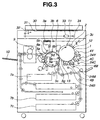
- FIG. 3 is a schematic diagram illustrating the configuration of an image forming apparatus for forming a full-color image according to an electrophotographic method.
- the image forming apparatus shown in FIG. 3 is used as a full-color copy machine or a full-color printer.
- a digital color-image reader unit and a digital color-image printer unit are provided at an upper portion and at a lower portion, respectively.
- a reflected-light image from the original 30 is focused onto a full-color sensor 34 by a lens 33, to obtain a color-separation image signal.
- the color-separation image signal is processed by a video processing unit (not shown) after passing through an amplification circuit (not shown), and is transmitted to the digital image printer unit.
- a photosensitive drum 1 serving as an image bearing member, includes a photosensitive layer made, for example, of an organic photoconductor, and is supported so as to be rotatable in the direction of an arrow.
- a pre-exposure lamp 11, a corona charger 2, a laser exposure optical system 3, a potential sensor 12, four developing units 4Y, 4C, 4M and 4B for four different colors, means 13 for detecting the amount of light on the photosensitive drum 1, a transfer device 5, and a cleaning unit 6 are disposed around the photosensitive drum 1.
- the image signal from the image leader unit is converted into an optical signal for image scanning exposure by a laser output unit (not shown).
- a laser beam representing the optical signal is reflected by a polygonal mirror 3a, and is projected onto the surface of the photosensitive drum 1 via a lens 3b and a mirror 3c.
- the image printer unit causes the photosensitive drum 1 to rotate in the direction of the arrow. After removing charges on the photosensitive drum 1 by the pre-exposure lamp 11, the photosensitive member 1 is uniformly charged to a negative potential by the charger 2. By projecting an optical image E for each separation color, an electrostatic latent image is formed on the photosensitive drum 1.
- the electrostatic latent image on the photosensitive drum 1 is developed by operating the corresponding developing unit, to form a toner image by the toner on the photosensitive drum 1.
- the developing units 4Y, 4C, 4M and 4B selectively approach the photosensitive drum 1 in accordance with respective separation colors by operations of eccentric cams 24Y, 24C, 24M and 24B, respectively, in order to perform development.
- the transfer device 5 includes a transfer drum 5a, a transfer charger 5b, an attraction charger 5c for electrostatically attracting a recording material, an attraction roller 5g facing the attracting charger 5c, an inside charger 5d, an outside charger 5e, and a separation charger 5h.
- the transfer drum 5a is supported so as to be rotatably driven.
- a transfer sheet 5f serving as a transfer-material carrying member for carrying a transfer material, is integrally provided around the circumferential surface of the transfer drum 5a.
- a resin film, such as a polycarbonate film, is used as the transfer sheet 5f.
- a transfer material is conveyed from a cassette 7a, 7b or 7c to the transfer drum 5a passing through a transfer-sheet conveying system, and is carried on the transfer drum 5a.
- the transfer material carried on the transfer drum 5a is conveyed to a transfer position facing the photosensitive drum 1 in accordance with the rotation of the transfer drum 5a.
- the toner image on the photosensitive drum 1 is transferred onto the transfer material by the operation of the transfer charger 5b while the transfer material passes through the transfer position. Toner particles remaining on the photosensitive drum 1 without being transferred during the image transfer are removed by the cleaning device 6.
- the toner image may be directly transferred from the photosensitive member to the transfer material, or may be first transferred onto an intermediate transfer member and then again transferred from the intermediate transfer member onto the transfer material.
- the transfer material on which the toner images of the four colors have been transferred in the above-described manner is separated from the transfer drum 5a by the operations of a separation pawl 8a, a separation raising roller 8b and the separation charger 5h, and is transferred to a heating/pressing fixing unit 9.
- Color mixture and coloring of the toner, and fixing of the toner on the transfer material are performed by performing heating/pressing fixing at the heating/pressing fixing unit 9, to provide a full-color fixed image.
- the transfer material having the full-color fixed image thereon is discharged onto a tray 10. Thus, the formation of a full-color image is terminated.
- the speed of the fixing operation at the heating/pressing fixing unit 9 is set to a value (for example, 90 mm/sec) lower than the process speed (for example, 160 mm/sec) of the main body of the apparatus.
- a value for example, 90 mm/sec
- the process speed for example, 160 mm/sec
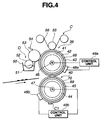
- a fixing roller 39 serving as fixing means, includes, for example, an RTV(room-temperature vulcanization)-type- silicone-rubber layer 42 having a thickness of 2 mm formed on an aluminum core 41 having a thickness of 5 mm, a fluorine-rubber layer 68 having a thickness of 50 ⁇ m formed on the layer 42, and an HTV(high-temperature vulcanization)-type-silicone-rubber layer 43 formed on the layer 68.
- the fixing roller 39 has a diameter of 60 mm.
- a pressing roller 40 serving as pressing means, includes, for example, an RTV-type-silicone-rubber layer 45 having a thickness of 2 mm formed on an aluminum core 44 having a thickness of 5 mm, a fluorine-rubber layer 69 having a thickness of 50 ⁇ m formed on the layer 45, and an HTV-type-silicone-rubber layer 70 having a thickness of 230 ⁇ m formed on the layer 45.
- the pressing roller 40 has a diameter of 60 mm.
- a halogen heater 46 serving as heating means, is disposed within the fixing roller 39, and a halogen heater 47 is disposed within the core of a pressing roller 40, in order to heat the transfer material from two sides.
- the temperatures of the fixing roller 39 and the pressing roller 40 are detected by thermistors 48a and 48b contacting the fixing roller 39 and the pressing roller 40, respectively.
- the halogen heaters 46 and 47 are controlled by control devices 49a and 49b, respectively, based on the detected temperatures, so that the temperatures of the fixing roller 39 and the pressing roller 40 are maintained to respective constant temperatures (for example, within a range of 160°C ⁇ 10°C).
- the fixing roller 39 and the pressing roller 40 are pressed by a pressing mechanism (not shown) with a total pressure of about 40 kg.
- FIG. 4 there are shown an oil coating device O, serving as releasing-agent coating means, a cleaning device C, and a cleaning blade C1 for removing oil and contamination adhering to the pressing roller 40.
- the oil coating device O coats dimethylsilicone oil 51 (for example, KF96 300 cSt made by Shin-Etsu Chemical Co., Ltd.) within an oil pan 50 onto the fixing roller 39 via an oil drawing roller 52 and an oil coating roller 53 by regulating the amount of coated oil by an oil-coating-amount adjusting blade 54.
- dimethylsilicone oil 51 for example, KF96 300 cSt made by Shin-Etsu Chemical Co., Ltd.
- the cleaning device C performs cleaning by pressing a nonwoven fabric clock web 56 made of Nomex (trade name) against the fixing roller 39 by a pressing roller 55.
- the web 56 is appropriately wound up by a winding device (not shown), in order to prevent accumulation of the toner, and the like, at a contact portion with the fixing roller 39.
- the toner of the present invention has excellent low-temperature fixability and high-temperature-offset resisting property, it is possible to reduce the amount of coating of the releasing agent. Accordingly, the amount of contamination of the cleaning device is small.
- the toner image using the toner of the present invention may be subjected to heating/pressing fixing under the condition of the surface temperature of the fixing roller within a range of 150°C ⁇ 30°C.
- GC-MS gas chromatograph mass spectrometer
- Thermal decomposition of a sample is performed using an apparatus TRACE 2000 series (made by Thermo Quest Corporation), and a type Rtx-5MS is used as a capillary.
- An apparatus VOYGER (made by Thermo Quest Corporation) is used for mass spectrometry column.
- a sample solution obtained by dissolving 0.5 mg of the hindered phenol to be determined in 100 ml of methanol, and a sample solution obtained by diluting the above-described solution by 10 times are prepared, and a working curve is formed from spectra obtained by performing thermal decomposition of 1.0 ⁇ l of each of the solutions at the following rate of temperature rise.
- the percentage content of the hindered phenol contained in the toner is calculated from the detected spectra peculiar to the sample and the previously formed working curve.
- the storage modulus G' within a temperature range of 60 ⁇ 210°C is measured under the following conditions using a viscoelasticity measuring apparatus (rheometer) RDA-II (made by Rheometrics Corporation).
- the molecular weight of chromatogram according to gel permeation chromatography is measured under the following conditions.
- the column is stabilized within a heat chamber maintained at 40°C.
- Tetrahydrofuran (THF) serving as a solvent, is flown in the column maintained at the above-described temperature at a flow rate of 1 ml per minute, and measurement is performed by injecting a THF sample solution of the resin adjusted to a sample density of 0.05 - 0.6 weight % into the THF.
- THF Tetrahydrofuran
- the molecular-weight distribution of the sample is calculated from the relationship between the logarithmic value of a working line formed using several types of monodisperse polystyrene reference samples and the count value.
- samples having molecular weights of 6 x 10 2 , 2.1 x 10 3 , 4 x 10 3 , 1.75 x 10 4 , 5.1 x 10 4 , 1.1 x 10 5 , 3.9 x 10 5 , 8.6 x 10 5 , 2 x 10 6 , and 4.48 x 10 6 made by Pressure Chemical Co. or Tosoh Corporation are used as the reference polystyrene sample for forming a working curve. It is adequate to use at least about ten reference polystyrene samples.
- An RI (refractive index) detector is used as a detector.
- a molecular-weight region within a range of 10 3 - 2 x 10 6 it is preferable to combine a plurality of commercially available polystyrene columns.
- a combination of ⁇ -styragels 500, 10 3 , 10 4 and 10 5 made by Waters Corporation, or a combination of shodex's KA-801, 802, 803, 804, 805, 806 and 807 made by Showa Denko K.K. is preferable.
- Measurement is performed according to ASTM D3418-82 using a differential-thermal-analysis measuring apparatus (DSC measuring apparatus) DSC-7 (made by Perkin Elmer Corporation).
- DSC measuring apparatus DSC-7 (made by Perkin Elmer Corporation).
- This sample is put into an aluminum pan.
- a vacant pan is used as a reference, and measurement is performed within a temperature range of 30 ⁇ 200°C at a rate of temperature rise of 10°C/min in an ordinary temperature/ordinary humidity environment.
- An endothermic peak, serving as a main peak, within a temperature range of 40 ⁇ 100°C is obtained in this temperature rise process.
- a cross point of a line at an intermediate point on the base line before and after the appearance of this endothermic peak and a differential thermal curve is made a glass transition temperature Tg.
- a Coulter counter TA-II or a Coulter multisizer II (made by Coulter Electronics Inc.) is used as the measuring apparatus.
- An aqueous solution of about 1 % of NaCl is prepared as the electrolytic solution, using a first-grade sodium chloride.
- ISOTON trade name
- ISOTON trade name
- a surface-active agent preferably alkyl benzene sulfonate salt
- the electrolytic solution in which the sample is suspended is dispersed for about 1 ⁇ 3 minutes using an ultrasonic dispersion apparatus.
- the volume distribution and the number distribution of the toner is calculated by measuring the volume and the number of toner particles for each channel by the above-described measuring apparatus using an aperture having a diameter of 100 ⁇ m.
- the weight-average particle diameter (D4) and the volume-average particle diameter (Dv) (a central value at each channel is made a representative value for the channel) of toner particles with reference to the weight are obtained from the volume distribution of the toner particles.
- TW1 2 g of a resin or a toner is precisely weighed (TW1), is placed on a cylindrical filter (for example, No. 86R made by Toyo Roshi Kabushiki Kaisha), and is put into a Soxlet extractor. 200 ml of THF is used. The sample is subjected to reflux for 10 hours using an oil bus adjusted to a temperature of about 120°C.
- a THF-soluble component (W1) can be determined by performing vacuum drying of the THF at 60°C for 24 hours after condensing an drying the THF.
- Acid value KOH (ml) x N x 5.61/the weight of the sample, where N is a factor of 0.1 mol/l KOH.
- nonlinear polyester resin No. 1 was obtained by performing polycondensation by mixing the linear pre-polymer and the following monomer.
- the 4-t-butylcatechol was provided so as to be 0.02 weight parts with respect to 100 weight parts of the entire monomer component.
- the obtained nonlinear polyester resin No. 1 had a Tg of 58 C, a contained amount of the THF-insoluble component of 7 weight %, and Mn of 3,100, Mw of 10,850 and Mw/Mn of 3.5 in GPC of the THF-soluble component.
- the acid value of the polyester resin was 15 mg KOH/g, and was confirmed to have carboxylic groups by means of IR.
- nonlinear polyester resin No. 8 Under the presence of 4-t-butylcatechol, nonlinear polyester resin No. 8 was obtained by performing polycondensation with the above-described monomer.
- the di-t-butylcatechol was provided so as to be 0.1 weight part with respect to 100 weight parts of the entire monomer component.
- the obtained nonlinear polyester resin No. 8 had a Tg of 56°C, a contained amount of the THF-insoluble component of 10 weight %, and Mn of 4,500, Mw of 47,250 and Mw/Mn of 10.5 in GPC of the THF-soluble component.
- the acid value of the polyester resin was 12 mg KOH/g, and was confirmed to have carboxylic groups by means of IR.
- nonlinear polyester resin No. 9 was obtained by performing polycondensation with the above-described monomer.
- the di-t-butylcatechol was provided so as to be 0.2 weight parts with respect to 100 weight parts of the entire monomer component.
- the obtained nonlinear polyester resin No. 9 had a Tg of 56°C, a contained amount of the THF-insoluble component of 5 weight %, and Mn of 1,250, Mw of 8,370 and Mw/Mn of 6.7 in GPC of the THF-soluble component.
- the acid value of the polyester resin was 13 mg KOH/g, and was confirmed to have carboxylic groups by means of IR.
- Binding resin polyester resin No. 1 100 weight parts
- Charge control agent Al di-tert-butylsalate compound 6 weight parts
- Pigment copper phthalocyanine 5 weight parts
- the above described materials were sufficiently subjected preliminary mixing using a Henschel mixer, and were melt-kneaded using a two-axle extruder. After cooling the mixture, the mixture was coarsely pulverized using a hammer mill to a size of about 1 ⁇ 2 mm, and then finely pulverized using a pulverizer according to an air-jet method. Both fine powder and coarse powder in the obtained finely pulverized matter were simultaneously removed strictly by classifying with a multisegment classifier, to obtain cyan color toner particles having a weight-average particle diameter of 7.8 ⁇ m.
- cyan toner 1 was manufactured.
- the physical properties of cyan toner 1 are shown in Table 1.
- Cyan toner 1 and magnetic ferrite carrier particles (having an average particle diameter of 50 ⁇ m) whose surfaces were coated with a silicone resin were mixed so that the toner density became 6 weight %, to provide two-component cyan developer 1.
- the evaluation items are as follows.
- Images were formed by setting the development contrast potentials of the copy machine to 350 V in the environment of a low temperature and low humidity (10°C and 10 % RH), 300 V in the environment of an ordinary temperature and an ordinary humidity (23°C and 60 % RH), and 250 V in the environment of a high temperature and a high humidity (30°C and 90 % RH), and the density of each of the obtained images was measured using a Macbeth reflection density meter (made by Macbeth Corporation). Fog was evaluated by calculating the fog density (%) from the difference between the whiteness of a white portion of the copied image and the whiteness of the transfer paper measured by a "reflectometer" (made by Tokyo Denshoku Kabushiki Kaisha).
- the dispersion of the toner was determined by visually checking the state of the inside of the apparatus after performing the durability test for 20,000 sheets.
- the evaluation standards for the dispersion of the toner are as follows:
- a test of fixing at a speed of 200 mm/sec was performed by taking out only the fixing unit from the main body of the apparatus, providing an external driving unit and a temperature control function. And long-term preservability was evaluated by leaving the sample toner for 3 months in an environment of 30°C and 90 % RH. The evaluation was performed by visually determining the level of coagulating property of the toner.
- Cyan toner 2 and developer 2 were prepared in the same manner as in Example 1, except that polyester resin No. 2, manufactured in the same manner as polyester resin No. 1 except for increasing the amount of di-t-butylcatechol added during the synthesis of the polyester resin to 0.04 mass part, was used. Evaluation was performed in the same manner as in Example 1. The results of evaluation are shown in Tables 1 ⁇ 3.
- Cyan toner 3 and developer 3 were prepared in the same manner as in Example 1, except that polyester resin No. 3, manufactured in the same manner as polyester resin No. 1 except for reducing the amount of 4-t-butylcatechol added during the synthesis of the polyester resin to 0.005 mass parts, was used. Evaluation was performed in the same manner as in Example 1. The results of evaluation are shown in Tables 1 ⁇ 3.
- Cyan toner 7 and developer 7 were prepared in the same manner as in Example 2, except that the amount of addition of the Al di-tert-butylsalycilate compound differed. Evaluation was performed in the same manner as in Example 1. The results of evaluation are shown in Tables 1 ⁇ 3.
- Cyan toner 8 and developer 8 were prepared in the same manner as in Example 2, except that the amount of addition of Al di-tert-butylsalycilate compound differed. Evaluation was performed in the same manner as in Example 1. The results of evaluation are shown in Tables 1 ⁇ 3.
- Cyan toner 9 and developer 9 were prepared in the same manner as in Example 1, except that polyester resin No. 6, manufactured in the same manner as polyester resin No. 1, except that 2,5-di-tert-butylhydroquinone (termed a "compound II") was used in stead of 4-t-butylcatechol added during the synthesis of the polyester resin, and that 4 weight parts of a Cr di-tert-butylsalicylate compound was added instead of the Al di-tert-butylsalicylate compound, was used. Evaluation was performed in the same manner as in Example 1. The results of the evaluation are shown in Tables 1 ⁇ 3.
- Cyan toner 15 and developer 15 were prepared in the same manner as in Example 1, except that polyester resin No. 10, manufactured in the same manner as polyester resin No. 1 except for not adding 4-t-butylcatechol during the synthesis of the resin, was used, and that the 4-t-butylcatechol was preliminarily mixed with the binding resin, the charge control agent and the pigment. Evaluation was performed in the same manner as in Example 1. The results of the evaluation are shown in Tables 1 ⁇ 3.
- Cyan toner 16 and developer 16 were prepared in the same manner as in Example 1, except that polyester resin No. 1 containing 4-t-butycatechol was used, and that 4-t-butylcatechol was added during preliminary mixture of the binding resin, the charge control agent and the pigment. Evaluation was performed in the same manner as in Example 1. The results of the evaluation are shown in Tables 1 ⁇ 3.
- Cyan toner 4 and developer 4 were prepared in the same manner as in Example 1, except that polyester resin No. 4, manufactured in the same manner except for increasing the amount of 4-t-butylcatechol added during the synthesis of polyester resin No. 1 to 0.05 weight parts, was used. Evaluation was performed in the same manner as in Example 1. The results of the evaluation are shown in Tables 1 ⁇ 3.
- Cyan toner 5 and developer 5 were prepared in the same manner as in Example 1, except that polyester resin No. 5, manufactured in the same manner except for reducing the amount of 4-t-butylcatechol added during the synthesis of polyester resin No. 1to 0.002 weight parts, was used. Evaluation was performed in the same manner as in Example 1. The results of the evaluation are shown in Tables 1 ⁇ 3.
- Cyan toner 6 and developer 6 were prepared in the same manner as in Example 2, except that the amount of addition of the Al di-tert-butylsalicylate compound differed. Evaluation was performed in the same manner as in Example 1. The results of the evaluation are shown in Tables 1 ⁇ 3.
- Cyan toner 10 and developer 10 were prepared in the same manner as in Example 4, except that polyester resin No. 7, manufactured in the same manner as polyester resin No. 1 except for using phenyl- ⁇ -naphthylamine (termed a "compound III"), serving as an amine-type antioxidant, instead of the 4-t-butylcatechol added during the synthesis of the polyester resin, was used. Evaluation was performed in the same manner as in Example 1. The results of the evaluation are shown in Table 1 ⁇ 3.
- Cyan toner 11 and developer 11 were prepared in the same manner as in Example 6, except that the charge control agent was not used at all. Evaluation was performed in the same manner as in Example 1. The results of the evaluation are shown in Table 1 ⁇ 3.
- Cyan toner 12 and developer 12 were prepared in the same manner as in Example 6, except that the amount of addition of Cr di-tert-butylsalicylate compound was increased. Evaluation was performed in the same manner as in Example 1. The results of the evaluation are shown in Tables 1 ⁇ 3.
- Cyan toner 13 and developer 13 were prepared in the same manner as in Example 6, except that polyester resin No. 8 manufactured in Example 2 of the manufacture of the resin was used, and that the amount of addition of the Cr di-tert-butylsalicylate compound differed. Evaluation was performed in the same manner as in Example 1. The results of the evaluation are shown in Tables 1 ⁇ 3.
- Cyan toner 14 and developer 14 were prepared in the same manner as in Example 6, except that polyester resin No. 9 manufactured in Example 3 of the manufacture of the resin was used, and that the amount of addition of the Cr di-tert-butylsalicylate compound differed. Evaluation was performed in the same manner as in Example 1. The results of the evaluation are shown in Tables 1 ⁇ 3.
- Example 1 105(1.69) > 210 105 1.68 0.8 A
- Example 2 105(1.72) > 210 105 1.71 0.9 A
- Example 3 105(1.72) > 210 105 1.65 0.9 A
- Example 4 105(1.73) >210 105 1.69 0.9 B
- Example 5 105(1.74) >210 105 1.65 0.7 A
- Example 6 105(1.65) >210 105 1.71 1.0 B
- Example 8 110(1.71) >210 100 1.65 0.9 B Comparative Example 1 120(1.65) 180 60 1.38 3.8 E Comparative Example 2 110(1.71) >210 100 1.61 1.2 B Comparative Example 3 125(1.75) 185 60 1.41 2.9 E Comparative Example 4
- a toner includes at least a polyester resin having a carboxyl group, a coloring agent, 0.1 ⁇ 10 weight % of a metal salicylate compound with respect to the weight of the toner and 20 ⁇ 400 ppm of a hindered phenol with respect to the total weight of the toner.
Landscapes
- Physics & Mathematics (AREA)
- General Physics & Mathematics (AREA)
- Chemical & Material Sciences (AREA)
- Chemical Kinetics & Catalysis (AREA)
- Spectroscopy & Molecular Physics (AREA)
- Developing Agents For Electrophotography (AREA)
Applications Claiming Priority (2)
| Application Number | Priority Date | Filing Date | Title |
|---|---|---|---|
| JP10606599 | 1999-04-14 | ||
| JP10606599 | 1999-04-14 |
Publications (3)
| Publication Number | Publication Date |
|---|---|
| EP1045293A2 true EP1045293A2 (fr) | 2000-10-18 |
| EP1045293A3 EP1045293A3 (fr) | 2000-12-27 |
| EP1045293B1 EP1045293B1 (fr) | 2007-01-10 |
Family
ID=14424216
Family Applications (1)
| Application Number | Title | Priority Date | Filing Date |
|---|---|---|---|
| EP00108247A Expired - Lifetime EP1045293B1 (fr) | 1999-04-14 | 2000-04-14 | Toner et procédé pour sa préparation |
Country Status (3)
| Country | Link |
|---|---|
| US (1) | US6326114B1 (fr) |
| EP (1) | EP1045293B1 (fr) |
| DE (1) | DE60032829T2 (fr) |
Families Citing this family (27)
| Publication number | Priority date | Publication date | Assignee | Title |
|---|---|---|---|---|
| US6808852B2 (en) * | 2001-09-06 | 2004-10-26 | Canon Kabushiki Kaisha | Toner and heat-fixing method |
| JP5476978B2 (ja) * | 2009-12-21 | 2014-04-23 | 株式会社リコー | トナーを用いた定着方法 |
| JP5540779B2 (ja) * | 2010-03-08 | 2014-07-02 | コニカミノルタ株式会社 | 画像形成方法及び画像形成装置 |
| CN103140806B (zh) | 2010-09-16 | 2015-11-25 | 佳能株式会社 | 调色剂 |
| JP5865032B2 (ja) | 2010-11-29 | 2016-02-17 | キヤノン株式会社 | トナー |
| US20120156608A1 (en) * | 2010-12-21 | 2012-06-21 | Konica Minolta Business Technologies, Inc. | Toner for electrostatic image development |
| WO2012086524A1 (fr) | 2010-12-24 | 2012-06-28 | Canon Kabushiki Kaisha | Toner |
| US9715188B2 (en) | 2013-07-31 | 2017-07-25 | Canon Kabushiki Kaisha | Toner |
| WO2015016384A1 (fr) | 2013-07-31 | 2015-02-05 | Canon Kabushiki Kaisha | Toner magnétique |
| KR20150050652A (ko) * | 2013-10-29 | 2015-05-11 | 삼성전자주식회사 | 정전 잠상 현상용 토너 |
| JP6409425B2 (ja) * | 2014-09-04 | 2018-10-24 | 富士ゼロックス株式会社 | 静電荷像現像用トナー、静電荷像現像剤、トナーカートリッジ、プロセスカートリッジ、画像形成装置、及び、画像形成方法 |
| JP6418992B2 (ja) | 2015-03-13 | 2018-11-07 | キヤノン株式会社 | 磁性キャリアおよびその製造方法 |
| JP6700909B2 (ja) | 2015-03-31 | 2020-05-27 | キヤノン株式会社 | 磁性キャリア |
| JP6584225B2 (ja) | 2015-08-25 | 2019-10-02 | キヤノン株式会社 | 磁性キャリア、二成分系現像剤、補給用現像剤、及び画像形成方法 |
| JP6403816B2 (ja) | 2016-02-08 | 2018-10-10 | キヤノン株式会社 | 磁性キャリア、二成分系現像剤、補給用現像剤、及び画像形成方法 |
| US10409188B2 (en) | 2017-02-10 | 2019-09-10 | Canon Kabushiki Kaisha | Magnetic carrier, two-component developer, replenishing developer, and image forming method |
| US10451985B2 (en) | 2017-02-28 | 2019-10-22 | Canon Kabushiki Kaisha | Toner |
| JP6938345B2 (ja) | 2017-11-17 | 2021-09-22 | キヤノン株式会社 | トナー |
| JP7293009B2 (ja) | 2018-08-08 | 2023-06-19 | キヤノン株式会社 | 磁性キャリア、二成分系現像剤、補給用現像剤、及び画像形成方法 |
| JP7293010B2 (ja) | 2018-08-08 | 2023-06-19 | キヤノン株式会社 | 磁性キャリア、二成分系現像剤、補給用現像剤、及び画像形成方法 |
| JP7171314B2 (ja) | 2018-08-28 | 2022-11-15 | キヤノン株式会社 | トナー |
| JP7130518B2 (ja) | 2018-09-28 | 2022-09-05 | キヤノン株式会社 | 磁性キャリア、二成分系現像剤、補給用現像剤、及び画像形成方法 |
| JP7210222B2 (ja) * | 2018-10-19 | 2023-01-23 | キヤノン株式会社 | トナー |
| US11249410B2 (en) | 2018-12-12 | 2022-02-15 | Canon Kabushiki Kaisha | Toner |
| JP7642340B2 (ja) | 2019-10-07 | 2025-03-10 | キヤノン株式会社 | トナー |
| US12099326B2 (en) | 2020-03-31 | 2024-09-24 | Canon Kabushiki Kaisha | Toner |
| JP7574015B2 (ja) | 2020-08-14 | 2024-10-28 | キヤノン株式会社 | トナーの製造方法 |
Family Cites Families (23)
| Publication number | Priority date | Publication date | Assignee | Title |
|---|---|---|---|---|
| US2297691A (en) | 1939-04-04 | 1942-10-06 | Chester F Carlson | Electrophotography |
| US2357809A (en) | 1940-11-16 | 1944-09-12 | Chester F Carlson | Electrophotographic apparatus |
| JPS57124740A (en) | 1981-01-27 | 1982-08-03 | Canon Inc | Toner |
| DE3271597D1 (en) * | 1982-01-19 | 1986-07-10 | Agfa Gevaert Nv | Fusible electrostatically attractable toner |
| JPS61213858A (ja) | 1985-03-20 | 1986-09-22 | Canon Inc | 静電荷像現像用トナ− |
| DE3752202T2 (de) | 1986-06-11 | 1999-03-11 | Kao Corp., Tokio/Tokyo | Elektrophotographischer Entwickler |
| JPS6368849A (ja) | 1986-09-10 | 1988-03-28 | Kao Corp | 電子写真用現像剤組成物 |
| JPH0778643B2 (ja) * | 1987-12-28 | 1995-08-23 | コニカ株式会社 | 静電潜像現像用トナー |
| JPH01172975A (ja) * | 1987-12-28 | 1989-07-07 | Konica Corp | トナーの製造方法 |
| JPH01172973A (ja) * | 1987-12-28 | 1989-07-07 | Konica Corp | 静電像現像剤 |
| JP2714803B2 (ja) | 1988-03-29 | 1998-02-16 | コニカ株式会社 | 画像形成方法 |
| JPH03185457A (ja) | 1989-12-15 | 1991-08-13 | Konica Corp | カラートナー |
| JP2932195B2 (ja) | 1989-12-29 | 1999-08-09 | キヤノン株式会社 | 電子写真用トナー |
| JPH0424648A (ja) | 1990-05-18 | 1992-01-28 | Fuji Xerox Co Ltd | 磁性トナー |
| US5346792A (en) | 1991-06-11 | 1994-09-13 | Canon Kabushiki Kaisha | Color toner |
| JP3119752B2 (ja) | 1992-12-09 | 2000-12-25 | コニカ株式会社 | カラートナー |
| JP3064816B2 (ja) * | 1994-07-18 | 2000-07-12 | 花王株式会社 | 電子写真用トナー及び現像剤組成物 |
| JP3154088B2 (ja) | 1995-05-02 | 2001-04-09 | キヤノン株式会社 | 静電荷像現像用トナー |
| DE69611585T2 (de) | 1995-08-30 | 2001-06-28 | Canon K.K., Tokio/Tokyo | Toner für die Entwicklung elektrostatischer Bilder |
| US5607804A (en) | 1995-10-12 | 1997-03-04 | Xerox Corporation | Combination, set, or gamut toners |
| US5700617A (en) | 1995-10-12 | 1997-12-23 | Canon Kabushiki Kaisha | Toner for developing electrostatic images and charge-controlling agent |
| JPH09218537A (ja) * | 1996-02-09 | 1997-08-19 | Fuji Xerox Co Ltd | 非磁性一成分現像剤及びそれを用いる画像形成方法 |
| US5851714A (en) * | 1996-04-02 | 1998-12-22 | Canon Kabushiki Kaisha | Toner for developing electrostatic image and fixing method |
-
2000
- 2000-04-13 US US09/549,193 patent/US6326114B1/en not_active Expired - Lifetime
- 2000-04-14 EP EP00108247A patent/EP1045293B1/fr not_active Expired - Lifetime
- 2000-04-14 DE DE60032829T patent/DE60032829T2/de not_active Expired - Lifetime
Also Published As
| Publication number | Publication date |
|---|---|
| EP1045293A3 (fr) | 2000-12-27 |
| US6326114B1 (en) | 2001-12-04 |
| DE60032829T2 (de) | 2007-08-16 |
| DE60032829D1 (de) | 2007-02-22 |
| EP1045293B1 (fr) | 2007-01-10 |
Similar Documents
| Publication | Publication Date | Title |
|---|---|---|
| EP1045293B1 (fr) | Toner et procédé pour sa préparation | |
| CN100409107C (zh) | 调色剂和热定影方法 | |
| EP0800117B1 (fr) | Révélateur pour le développement d'images électrostatiques et méthode de fixage | |
| US6528222B2 (en) | Toner | |
| JP3817348B2 (ja) | 静電荷像現像用トナー及び画像形成方法 | |
| JP3323775B2 (ja) | 静電荷像現像用トナー及び定着方法 | |
| JP4298120B2 (ja) | トナー及び加熱定着方法 | |
| JP3880347B2 (ja) | フルカラー画像形成用トナー | |
| JP3937776B2 (ja) | トナー及びトナーの製造方法 | |
| JP4343385B2 (ja) | トナー及び加熱定着方法 | |
| JP3780145B2 (ja) | トナー及びトナーの製造方法 | |
| JP4027188B2 (ja) | トナー及び加熱定着方法 | |
| JP2002055485A (ja) | トナー及び画像形成方法 | |
| JP4536945B2 (ja) | 画像形成方法 | |
| JP3796430B2 (ja) | トナー | |
| JP2002091087A (ja) | トナー及びフルカラー画像形成方法 | |
| JP3826000B2 (ja) | フルカラー画像形成用トナー | |
| JP2002372804A (ja) | 画像形成方法、定着方法及びトナー | |
| US5750298A (en) | Yellow toner for developing electrostatic image, two component developer, image sheet | |
| JP3191072B2 (ja) | フルカラートナー及び画像形成方法 | |
| JP2003107774A (ja) | トナー及び画像形成方法 | |
| JP2001117274A (ja) | カラートナー及びカラートナーの製造方法 | |
| JP2000284535A (ja) | トナー | |
| JP2001117284A (ja) | トナー | |
| JPH10254174A (ja) | 静電荷像現像用トナー |
Legal Events
| Date | Code | Title | Description |
|---|---|---|---|
| PUAI | Public reference made under article 153(3) epc to a published international application that has entered the european phase |
Free format text: ORIGINAL CODE: 0009012 |
|
| AK | Designated contracting states |
Kind code of ref document: A2 Designated state(s): DE FR GB IT |
|
| AX | Request for extension of the european patent |
Free format text: AL;LT;LV;MK;RO;SI |
|
| PUAL | Search report despatched |
Free format text: ORIGINAL CODE: 0009013 |
|
| AK | Designated contracting states |
Kind code of ref document: A3 Designated state(s): AT BE CH CY DE DK ES FI FR GB GR IE IT LI LU MC NL PT SE |
|
| AX | Request for extension of the european patent |
Free format text: AL;LT;LV;MK;RO;SI |
|
| 17P | Request for examination filed |
Effective date: 20010509 |
|
| AKX | Designation fees paid |
Free format text: DE FR GB IT |
|
| GRAP | Despatch of communication of intention to grant a patent |
Free format text: ORIGINAL CODE: EPIDOSNIGR1 |
|
| GRAS | Grant fee paid |
Free format text: ORIGINAL CODE: EPIDOSNIGR3 |
|
| GRAA | (expected) grant |
Free format text: ORIGINAL CODE: 0009210 |
|
| AK | Designated contracting states |
Kind code of ref document: B1 Designated state(s): DE FR GB IT |
|
| REG | Reference to a national code |
Ref country code: GB Ref legal event code: FG4D |
|
| REF | Corresponds to: |
Ref document number: 60032829 Country of ref document: DE Date of ref document: 20070222 Kind code of ref document: P |
|
| ET | Fr: translation filed | ||
| PLBE | No opposition filed within time limit |
Free format text: ORIGINAL CODE: 0009261 |
|
| STAA | Information on the status of an ep patent application or granted ep patent |
Free format text: STATUS: NO OPPOSITION FILED WITHIN TIME LIMIT |
|
| 26N | No opposition filed |
Effective date: 20071011 |
|
| PGFP | Annual fee paid to national office [announced via postgrant information from national office to epo] |
Ref country code: GB Payment date: 20150424 Year of fee payment: 16 |
|
| PGFP | Annual fee paid to national office [announced via postgrant information from national office to epo] |
Ref country code: IT Payment date: 20150424 Year of fee payment: 16 |
|
| REG | Reference to a national code |
Ref country code: FR Ref legal event code: PLFP Year of fee payment: 17 |
|
| PGFP | Annual fee paid to national office [announced via postgrant information from national office to epo] |
Ref country code: FR Payment date: 20160426 Year of fee payment: 17 |
|
| GBPC | Gb: european patent ceased through non-payment of renewal fee |
Effective date: 20160414 |
|
| PG25 | Lapsed in a contracting state [announced via postgrant information from national office to epo] |
Ref country code: GB Free format text: LAPSE BECAUSE OF NON-PAYMENT OF DUE FEES Effective date: 20160414 |
|
| PG25 | Lapsed in a contracting state [announced via postgrant information from national office to epo] |
Ref country code: IT Free format text: LAPSE BECAUSE OF NON-PAYMENT OF DUE FEES Effective date: 20160414 |
|
| REG | Reference to a national code |
Ref country code: FR Ref legal event code: ST Effective date: 20171229 |
|
| PG25 | Lapsed in a contracting state [announced via postgrant information from national office to epo] |
Ref country code: FR Free format text: LAPSE BECAUSE OF NON-PAYMENT OF DUE FEES Effective date: 20170502 |
|
| PGFP | Annual fee paid to national office [announced via postgrant information from national office to epo] |
Ref country code: DE Payment date: 20190621 Year of fee payment: 20 |
|
| REG | Reference to a national code |
Ref country code: DE Ref legal event code: R071 Ref document number: 60032829 Country of ref document: DE |