EP1051907A1 - Dilueur pour la cryoconservation de spermatozoides de bovins - Google Patents
Dilueur pour la cryoconservation de spermatozoides de bovins Download PDFInfo
- Publication number
- EP1051907A1 EP1051907A1 EP00401275A EP00401275A EP1051907A1 EP 1051907 A1 EP1051907 A1 EP 1051907A1 EP 00401275 A EP00401275 A EP 00401275A EP 00401275 A EP00401275 A EP 00401275A EP 1051907 A1 EP1051907 A1 EP 1051907A1
- Authority
- EP
- European Patent Office
- Prior art keywords
- preparation
- diluent
- diluter
- antioxidant
- polyol
- Prior art date
- Legal status (The legal status is an assumption and is not a legal conclusion. Google has not performed a legal analysis and makes no representation as to the accuracy of the status listed.)
- Granted
Links
Classifications
-
- A—HUMAN NECESSITIES
- A01—AGRICULTURE; FORESTRY; ANIMAL HUSBANDRY; HUNTING; TRAPPING; FISHING
- A01N—PRESERVATION OF BODIES OF HUMANS OR ANIMALS OR PLANTS OR PARTS THEREOF; BIOCIDES, e.g. AS DISINFECTANTS, AS PESTICIDES OR AS HERBICIDES; PEST REPELLANTS OR ATTRACTANTS; PLANT GROWTH REGULATORS
- A01N1/00—Preservation of bodies of humans or animals, or parts thereof
- A01N1/10—Preservation of living parts
-
- A—HUMAN NECESSITIES
- A01—AGRICULTURE; FORESTRY; ANIMAL HUSBANDRY; HUNTING; TRAPPING; FISHING
- A01N—PRESERVATION OF BODIES OF HUMANS OR ANIMALS OR PLANTS OR PARTS THEREOF; BIOCIDES, e.g. AS DISINFECTANTS, AS PESTICIDES OR AS HERBICIDES; PEST REPELLANTS OR ATTRACTANTS; PLANT GROWTH REGULATORS
- A01N1/00—Preservation of bodies of humans or animals, or parts thereof
- A01N1/10—Preservation of living parts
- A01N1/12—Chemical aspects of preservation
- A01N1/122—Preservation or perfusion media
- A01N1/125—Freeze protecting agents, e.g. cryoprotectants or osmolarity regulators
Definitions
- the invention relates to a diluent for the cryopreservation of sperm. of cattle. More specifically, the invention relates to an aqueous diluent medium containing no substances of animal origin and capable of being kept ready for use on extended periods.
- Diluers are known for the cryopreservation of bovine sperm.
- FR-B-2 720 407 of the Applicant describes such a diluent which contains nutrition, tampons and mineral salts as well as a protective product consisting of soy lecithin.
- the diluent described in the aforementioned patent is intended to dilute bovine semen and freeze it for later use. It is essentially an approach "sanitary". This diluter gives relative satisfaction.
- An object of the present invention is to provide a diluent for cryopreservation bovine sperm with improved in vivo results.
- Another object of the invention is to provide such a diluent leading to survival satisfactory sperm at low concentration.
- the present invention provides a diluter meeting the above objects.
- the diluter for cryopreservation of bovine sperm of the present invention includes at least one phospholipid, at least one fat-soluble vitamin accompanied by an emulsifier, at least one antioxidant and at least one polyol.
- the vitamin is for example vitamin A.
- the vitamin is accompanied by an emulsifier, for example monooleate sorbitan marketed under the name Tween 80.
- the antioxidant agent can be an amino acid having antioxidant properties, for example, taurine and glycine.
- the antioxidant agent can also be an antioxidant peptide, for example reduced glutation.
- the diluent of the present invention may also contain a sterol, in particular cholesterol.
- a sterol is present in the diluent, it will contain advantageously cyclodextrins which dissolve it in an aqueous medium.
- the diluent of the present invention may also further contain salts and carbohydrates.
- Carbohydrates are for example glucose, fructose, lactose.
- the salts are in particular buffers, for example trimethylolmethylamine, this buffer is usually called Tris buffer or, simply, Tris.
- the diluent of the invention contains an effective dose of at least one polyol capable of inhibit the formation of ice crystals.
- the polyol will advantageously be glycerol.
- the sterilization of step f) is performed by ionizing radiation in an irradiation dose range of approximately 5 at around 20 Kgy, preferably from around 15 to around 20 Kgy.
- step a it is possible to use mechanical dispersers and emulsifiers which act by pressure.
- step c To obtain a stable emulsion in step c), it is necessary to leave rest the dispersion for at least 12 hours.
- the diluent of the invention is formulated with an amount of water reduced, and diluted for use with sterile water.
- the diluent advantageously contains an agent antibiotic.
- the antibiotic agent is added to the diluent during its preparation, it may lose its effectiveness during the sterilization step.
- the antibiotic agent is added extra temporally at the time of use.
- the diluent without antibiotic is advantageously contained in a container closed by a stopper.
- the antibiotic agent under powder form is present in the stopper and is released in the dilutor by exerting a pressure on said plug.
- the antibiotic agent is for example gentamycin in the form of sulfate.
- the diluent of the invention will contain the following phospholipids in the weight proportions indicated below:
- Lecithin 130 is actually a lecithin enriched in phosphatidylcholine.
- the diluter of the invention is intended exclusively for the cryopreservation of bovine sperm. It is not suitable for cryopreservation of sperm from other animal or human species.
- a diluent according to the invention comprises per 100 ml of water: Tris 1 to 2g trisodium citrate dihydrate 5 to 10 g potassium chloride 0.2 to 0.5 g fructose 0.6 1.0g lactose monohydrate 0.18 to 0.30 g wisteria 2.0 to 3.0 g anhydrous glucose 0.25 to 0.40 g taurine 0.0030 to 0.0040 g gentamycin sulfate 0.20 g to 0.30 g tylosin tartrate 0.028 to 0.040 g lincospectin 100 0.30 to 0.35 g glycerol 30 to 45 g hydrated calcium lactate 0.03 to 0.05 g lecithin 100 2.0 to 3.0 g lecithin 130 0.80 to 1.10 g citric acid monohydrate 0.5 to 2 g ultra pure water qs
- a diluent according to the invention was formulated having the following composition: Tris 1.8490g trisodium citrate dihydrate 7.3965 g potassium chloride 0.2955 g fructose 0.8875 g lactose monohydrate 0.2220 g wisteria 2.7735 g anhydrous glucose 0.3695 g taurine 0.0037 g gentamycin sulfate 0.2400 g tylosin tartrate 0.0330 g lincospectin 100 0.3830 g glycerol 40.2240 g hydrated calcium lactate 0.0455 g lecithin 100 2.6000 g lecithin 130 1.0400 g citric acid monohydrate 1.0400 g ultra pure water 0.0650 l
- the above formulation is carried out to obtain 100 ml of concentrated diluent, the latter being diluted to 500 ml for use.
- Example 2 the inventive diluent of Example 1 is compared to the diluter of the prior art described in EP-A-685 556 with regard to the anomalies and the osmotic resistance in vitro.
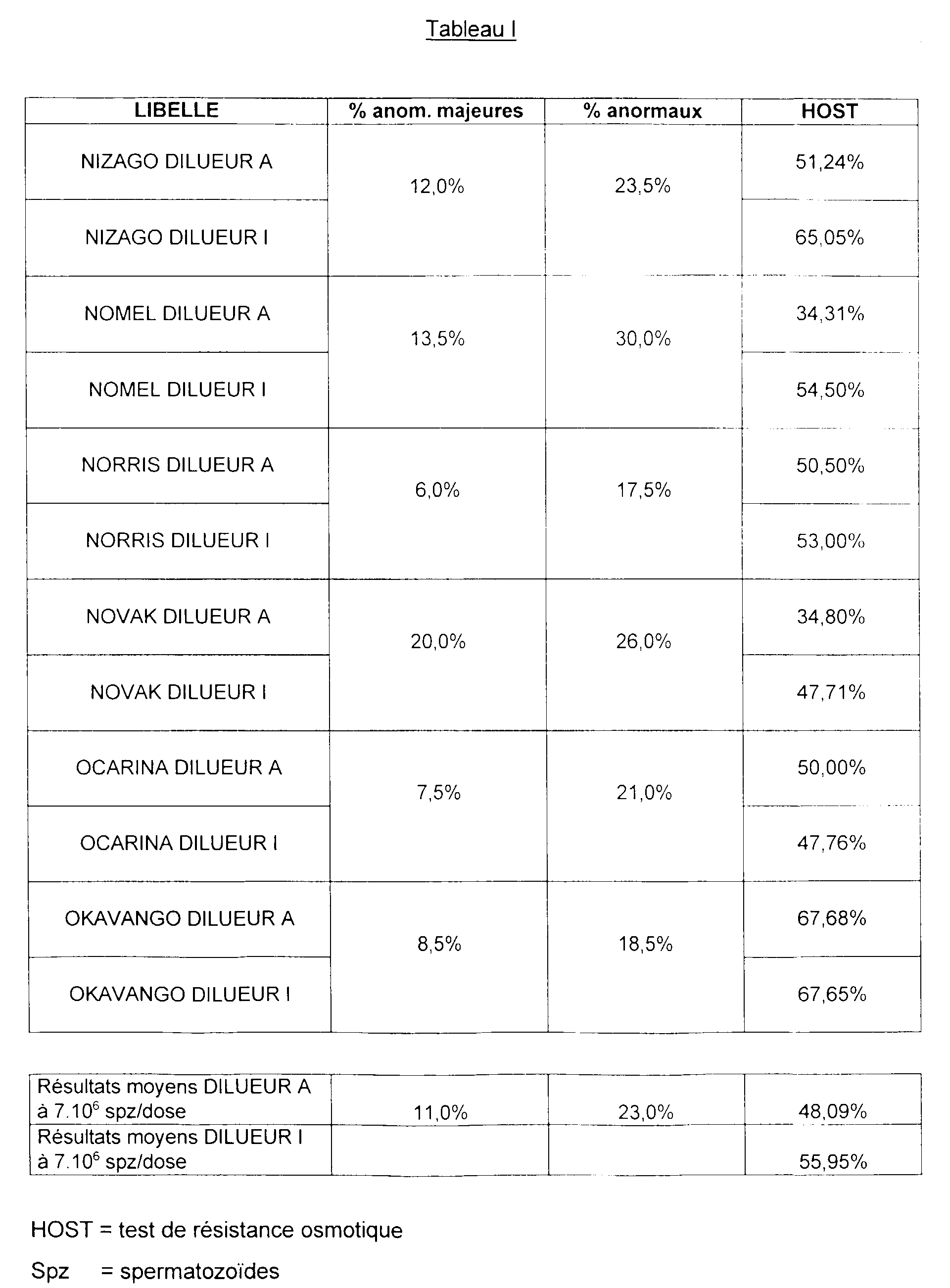
- Table I gives the comparative results of the diluter of the prior art, DILUTER A, and of the diluter of the invention, DILUTER I, with different bulls: NIZAGO, NOMEL, NORRIS, NOVAK, OCARINA and OKAVANGO.
- Table I clearly indicates the superiority of the diluent of the invention over the dilutor of the prior art because for 7.10 6 spermatozoa per dose, a percentage of osmotic resistance in vitro is very much higher for the diluent of the invention.
- Example 3 Comparative In Vitro Tests: Results After Thawing and Test thermo resistance.
- Example 2 the inventive diluent of Example 1 is compared to the diluter of the prior art described in EP-A-685 556 used in Example 2 with regard to the results after thawing and thermo resistance in vitro.
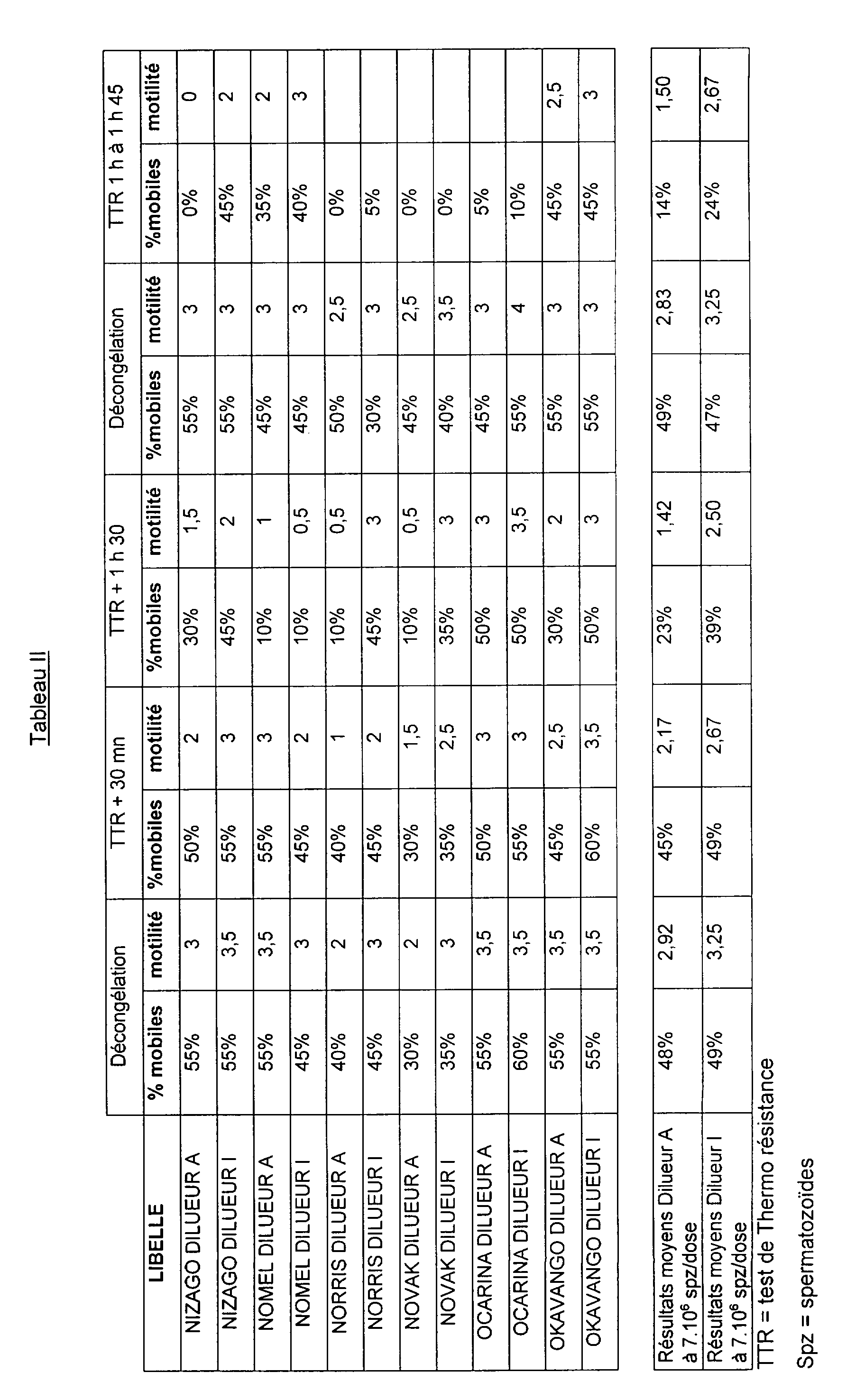
- Table II gives the comparative results of the diluter of the prior art, DILUTER A, and of the diluter of the invention, DILUTER I, with different bulls: NIZAGO, NOMEL, NORRIS, NOVAK, OCARINA and OKAVANGO.
- Table II clearly indicates the superiority of the diluent of the invention over the diluter of the prior art because for 7.10 6 sperm per dose, we obtain a higher percentage of motives and motility, except for the percentage of motives during thawing after 1:30 which is very slightly lower.
- Example 4 Comparative In Vivo Tests: In Vivo Results of Artificial Insemination for a 25-day non-return rate.
- Example 2 the inventive diluent of Example 1 is compared to the diluter of the prior art described in EP-A-685 556 used in Example 2 with regard to the in vivo results of primary artificial insemination (IPA), fertilization by insemination first artificial, IAP fec, and percentage of fertilization by artificial insemination first,% IAP fec, for a 25-day non-return rate (TNR).
- IPA primary artificial insemination
- IAP fec fertilization by insemination first artificial
- TNR 25-day non-return rate
- Table III gives the comparative results of the diluter of the prior art, DILUTER A, and of the diluter of the invention, DILUTER I, with different bulls: NIZAGO, NOMEL, NORRIS, NOVAK, OCARINA and OKAVANGO.
- Table III clearly indicates the superiority of the diluent of the invention over the diluter of the prior art because in all cases except one (for the OKAVANGO bull) a much higher percentage of IAP is obtained.
- the average results for 7.10 6 spermatozoa per dose reveal a percentage of IAP very clearly higher for the diluent of the invention.
- the diluent of the prior art even has 20.10 6 spermatozoa per dose with average results much lower than those of the diluent of the invention for only 7.10 6 sperm per dose.
- Example 5 Comparative In Vivo Tests: In Vivo Results of Artificial Insemination for a 60-day non-return rate.
- Example 2 the inventive diluent of Example 1 is compared to the diluter of the prior art described in EP-A-685 556 used in Example 2 with regard to the in vivo results of primary artificial insemination (IPA), fertilization by insemination first artificial, IAP fec, and percentage of fertilization by artificial insemination first,% IAP fec, for a 60-day non-return rate (TNR).
- IPA primary artificial insemination
- IAP fec fertilization by insemination first artificial
- TNR 60-day non-return rate
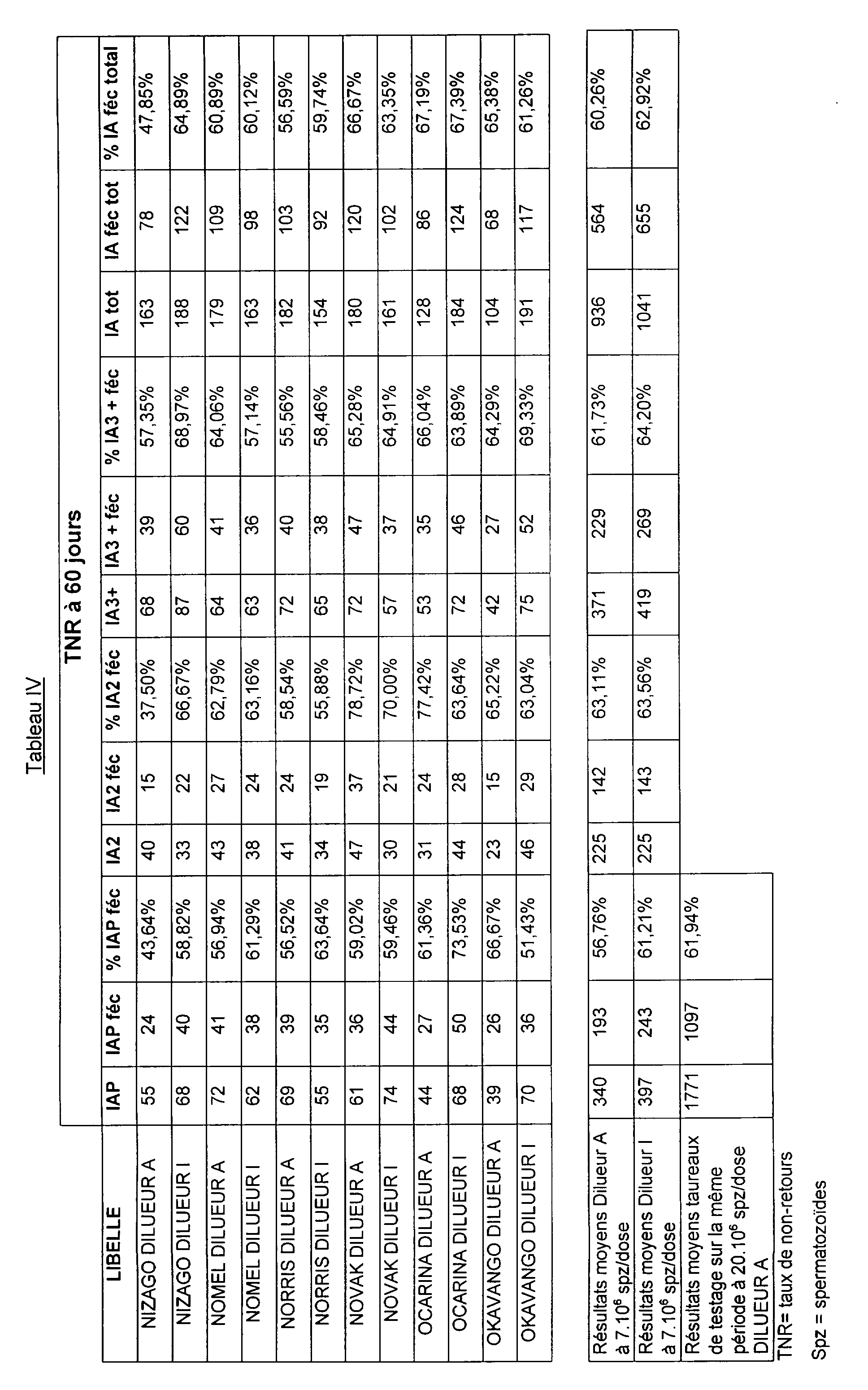
- Table IV gives the comparative results of the diluter of the prior art, DILUTER A, and of the diluter of the invention, DILUTER I, with different bulls: NIZAGO, NOMEL, NORRIS, NOVAK, OCARINA and OKAVANGO.
- Table IV clearly indicates the superiority of the diluent of the invention over the diluter of the prior art because in all cases except one (for the OKAVANGO bull) a higher percentage of API is obtained.
- the average results for 7.10 6 spermatozoa per dose reveal a much higher percentage of API for the diluent of the invention.
- the diluent of the invention even has, for only 7.10 6 spermatozoa per dose, better average results than those of the dilutor of the prior art for 20.10 6 spermatozoa per dose.
- Example 2 the inventive diluent of Example 1 is compared to the diluter of the prior art described in EP-A-685 556 used in Example 2 with regard to the in vivo results of primary artificial insemination (IPA), fertilization by insemination first artificial, IAP fec, and percentage of fertilization by artificial insemination first,% IAP fec, for a 90-day non-return rate (TNR).
- IPA primary artificial insemination
- IAP fec fertilization by insemination first artificial
- TNR 90-day non-return rate
- Table V below gives the comparative results of the diluter of the prior art, DILUTER A, and of the diluter of the invention, DILUTER I, with different bulls: NIZAGO, NOMEL, NORRIS, NOVAK, OCARINA and OKAVANGO.
- Table V clearly indicates the superiority of the diluent of the invention over the diluter of the prior art because in all cases except one (for the OKAVANGO bull) a higher percentage of API is obtained.
- the average results for 7.10 6 spermatozoa per dose reveal a much higher percentage of API for the diluent of the invention.
- the diluent of the invention even has, for only 7.10 6 spermatozoa per dose, better average results than those of the dilutor of the prior art for 20.10 6 spermatozoa per dose.
Landscapes
- Life Sciences & Earth Sciences (AREA)
- Zoology (AREA)
- Engineering & Computer Science (AREA)
- Dentistry (AREA)
- General Health & Medical Sciences (AREA)
- Wood Science & Technology (AREA)
- Health & Medical Sciences (AREA)
- Environmental Sciences (AREA)
- Medicinal Preparation (AREA)
- Acyclic And Carbocyclic Compounds In Medicinal Compositions (AREA)
- Pharmaceuticals Containing Other Organic And Inorganic Compounds (AREA)
- Medicines Containing Material From Animals Or Micro-Organisms (AREA)
- Agricultural Chemicals And Associated Chemicals (AREA)
- Micro-Organisms Or Cultivation Processes Thereof (AREA)
Abstract
Description
- phosphatidylcholine 20-24 %
- phosphadyléthanolamine 18-22 %
- phosphatidylinisitol 12-15 %
- phosphadyléthanolamine 14-20 %
- phosphatidylinisitol 7-13 %
- phosphatidylcholine 30-35 %
| Tris | 1 à 2g |
| citrate trisodique dihydraté | 5 à 10 g |
| chlorure de potassium | 0,2 à 0,5 g |
| fructose | 0,6 1,0g |
| lactose monohydraté | 0,18 à 0,30 g |
| glycine | 2,0 à 3,0 g |
| glucose anhydre | 0,25 à 0,40 g |
| taurine | 0,0030 à 0,0040 g |
| sulfate de gentamycine | 0,20 g à 0,30 g |
| tartrate de tylosine | 0,028 à 0,040 g |
| lincospectine 100 | 0,30 à 0,35 g |
| glycérol | 30 à 45 g |
| lactate de calcium hydraté | 0,03 à 0,05 g |
| lécithine 100 | 2,0 à 3,0 g |
| lécithine 130 | 0,80 à 1,10 g |
| acide citrique monohydraté | 0,5 à 2 g |
| eau ultra pure | qsp |
| Tris | 1,8490g |
| citrate trisodique dihydraté | 7,3965 g |
| chlorure de potassium | 0,2955 g |
| fructose | 0,8875 g |
| lactose monohydraté | 0,2220 g |
| glycine | 2,7735 g |
| glucose anhydre | 0,3695 g |
| taurine | 0,0037 g |
| sulfate de gentamycine | 0,2400 g |
| tartrate de tylosine | 0,0330 g |
| lincospectine 100 | 0,3830 g |
| glycérol | 40,2240 g |
| lactate de calcium hydraté | 0,0455 g |
| lécithine 100 | 2,6000 g |
| lécithine 130 | 1,0400 g |
| acide citrique monohydraté | 1,0400 g |
| eau ultra pure | 0,0650 l |
| Triméthylol-méthylamine | 3,4 g à 4,2 g |
| Citrate trisodique dihydraté | 13,7 g à 16,75 g |
| Chlorure de potassium | 0,55 g à 0,67 g |
| Fructose | 1,65 g à 2,0 g |
| Glucose | 0.68 g à 0,84 g |
| Lactose | 0.41 g à 0,50 g |
| Lactate de calcium | 0.09 g à 0,11g |
| Glycine | 5.15 g à 6,25 g |
| Glycérol | 64 ml à 78 ml |
| Lécithine de soja | 6.75 g à 8,25 g |


Claims (17)
- Dilueur pour la cryoconservation de spermatozoïdes de bovins comprenant au moins un phospholipide, au moins une vitamine liposoluble accompagnée d'un émulsifiant, au moins un agent antioxydant et au moins un polyol.
- Dilueur selon la revendication 1, caractérisé en ce que la vitamine est la vitamine A.
- Dilueur selon l'une des revendications 1 et 2, caractérisé en ce que l'agent antioxydant est un acide aminé ayant des propriétés antioxydantes.
- Dilueur selon la revendication 1, caractérisé en ce que l'agent antioxydant est un peptide antioxydant.
- Dilueur selon l'une des revendications 1 et 2, caractérisé en ce que l'acide aminé ayant des propriétés antioxydantes est la taurine.
- Dilueur selon la revendication 4, caractérisé en ce que le peptide antioxydant est du glutation réduit.
- Dilueur selon la revendication 2, caractérisé en ce qu'il contient en outre un stérol.
- Dilueur selon la revendication 7, caractérisé en ce que le stérol est le cholestérol.
- Dilueur selon la revendication 7, caractérisé en ce qu'il contient en outre des cyclodextrines pour solubiliser le stérol.
- Dilueur selon la revendication 1, caractérisé en ce que le polyol est du glycérol.
- Dilueur selon la revendication 1, caractérisé en ce qu'il contient en outre des sels et des carbohydrates.
- Dilueur selon la revendication 1, caractérisé en ce que le polyol est le glycérol.
- Procédé de préparation du dilueur selon la revendication 1, caractérisé en ce que l'on effectue les étapes suivantes :a) préparation d'une dispersion d'au moins un phospholipide sous forme de particules dans au moins un polyol à une température suffisante,b) agitation de la dispersion de l'étape a) de façon à microniser lesdites particules de phospholipide,c) repos de la dispersion obtenue dans l'étape b) pendant une durée d'au moins environ 12 heures de façon à atteindre une stabilité de l'émulsion obtenue, c'est-à-dire sans séparation de phases, conduisant à une préparation, dénommée préparation de l'étape c),d) préparation d'une phase aqueuse comprenant au moins un acide aminé ayant des propriétés antioxydantes, au moins un peptide antioxydant et au moins une vitamine, conduisant à une phase, dénommée phase aqueuse de l'étape d),e) réunion de la préparation de l'étape c) et de la phase aqueuse de l'étape d), conduisant à une préparation, dénommée préparation de l'étape e),f) stérilisation de la préparation de l'étape e).
- Procédé selon la revendication 7, caractérisé en ce que la stérilisation de l'étape f) est effectuée par rayonnement ionisant dans une fourchette de dose d'irradiation d'environ 5 à environ 20 Kgy.
- Procédé selon la revendication 14, caractérisé en ce que la fourchette de dose d'irradiation est d'environ 15 à environ 20 Kgy.
- Procédé selon la revendication 14 pour la préparation du dilueur selon la revendication 9, caractérisé en ce qu'un stérol est ajouté à la préparation de l'étape d).
- Procédé selon la revendication 14 pour la préparation du dilueur selon la revendication 11, caractérisé en ce que des carbohydrates sont ajoutés à la préparation de l'étape d).
Priority Applications (1)
| Application Number | Priority Date | Filing Date | Title |
|---|---|---|---|
| DK00401275T DK1051907T3 (da) | 1999-05-14 | 2000-05-10 | Fortyndingsmiddel til kryokonservering af oksespermatozoer |
Applications Claiming Priority (2)
| Application Number | Priority Date | Filing Date | Title |
|---|---|---|---|
| FR9906177A FR2793495B1 (fr) | 1999-05-14 | 1999-05-14 | Dilueur pour la cryoconservation de spermatozoides de bovins |
| FR9906177 | 1999-05-14 |
Publications (2)
| Publication Number | Publication Date |
|---|---|
| EP1051907A1 true EP1051907A1 (fr) | 2000-11-15 |
| EP1051907B1 EP1051907B1 (fr) | 2004-08-04 |
Family
ID=9545609
Family Applications (1)
| Application Number | Title | Priority Date | Filing Date |
|---|---|---|---|
| EP00401275A Expired - Lifetime EP1051907B1 (fr) | 1999-05-14 | 2000-05-10 | Dilueur pour la cryoconservation de spermatozoides de bovins |
Country Status (8)
| Country | Link |
|---|---|
| US (1) | US6368786B1 (fr) |
| EP (1) | EP1051907B1 (fr) |
| AT (1) | ATE272312T1 (fr) |
| CA (1) | CA2308892A1 (fr) |
| DE (1) | DE60012612T2 (fr) |
| DK (1) | DK1051907T3 (fr) |
| ES (1) | ES2225043T3 (fr) |
| FR (1) | FR2793495B1 (fr) |
Cited By (6)
| Publication number | Priority date | Publication date | Assignee | Title |
|---|---|---|---|---|
| WO2003022046A1 (fr) * | 2001-09-10 | 2003-03-20 | University Of Saskatchewan Technologies Inc. | Procede de cryopreservation de cellules et tissus mammaliens |
| FR2877575A1 (fr) * | 2004-11-05 | 2006-05-12 | Union Nationale Des Cooperativ | Milieu protecteur pour semence |
| WO2007146344A3 (fr) * | 2006-06-12 | 2008-11-13 | Jackson Lab | Milieux cryoprotecteurs pour le sperme |
| CN102986647A (zh) * | 2011-09-08 | 2013-03-27 | 辽宁省辽宁绒山羊原种场有限公司 | 无动物源冻精稀释液 |
| EP2443920A4 (fr) * | 2009-06-17 | 2013-08-14 | Univ Hiroshima | Solution diluante de sperme et procédé d'insémination artificielle l'utilisant |
| WO2013138239A1 (fr) | 2012-03-14 | 2013-09-19 | Membrane Protective Technologies, Inc. | Systèmes et substances pour la cryoconservation de cellules viables |
Families Citing this family (30)
| Publication number | Priority date | Publication date | Assignee | Title |
|---|---|---|---|---|
| EP2264427B1 (fr) | 1997-01-31 | 2017-05-03 | Xy, Llc | Dispositif optique avec réflecteur focalisant pour faire converger la radiation sur un débit de particule, et procédé d'analyse associé |
| US6149867A (en) | 1997-12-31 | 2000-11-21 | Xy, Inc. | Sheath fluids and collection systems for sex-specific cytometer sorting of sperm |
| US6071689A (en) | 1997-12-31 | 2000-06-06 | Xy, Inc. | System for improving yield of sexed embryos in mammals |
| US7208265B1 (en) | 1999-11-24 | 2007-04-24 | Xy, Inc. | Method of cryopreserving selected sperm cells |
| US7713687B2 (en) * | 2000-11-29 | 2010-05-11 | Xy, Inc. | System to separate frozen-thawed spermatozoa into x-chromosome bearing and y-chromosome bearing populations |
| WO2002043486A1 (fr) | 2000-11-29 | 2002-06-06 | Xy, Inc. | Systeme permettant de realiser une fecondation in vitro avec des spermatozoides separes en population porteuse de chromosome x et en population porteuse de chromosome y |
| WO2002054864A1 (fr) * | 2001-01-12 | 2002-07-18 | Abs Corporation | Dilueur de semence et ses procedes de fabrication et d'utilisation |
| CA2531176C (fr) * | 2002-07-22 | 2018-04-24 | Xy, Inc. | Systeme de traitement de cellule spermatique |
| JP4595067B2 (ja) * | 2002-08-01 | 2010-12-08 | エックスワイ,エルエルシー | 低圧精子細胞分離システム |
| US8486618B2 (en) | 2002-08-01 | 2013-07-16 | Xy, Llc | Heterogeneous inseminate system |
| CA2534394C (fr) | 2002-08-15 | 2013-01-08 | Xy, Inc. | Cytometre a flux haute resolution |
| US7169548B2 (en) | 2002-09-13 | 2007-01-30 | Xy, Inc. | Sperm cell processing and preservation systems |
| BRPI0408857B1 (pt) | 2003-03-28 | 2018-09-11 | Inguran Llc | aparelho, métodos e processos para separar partículas e para prover esperma de animal separado por sexo |
| WO2004087177A1 (fr) * | 2003-03-28 | 2004-10-14 | Monsanto Technology Llc | Procédé de coloration du sperme |
| EP1475434A1 (fr) * | 2003-05-09 | 2004-11-10 | Oncoscience AG | Procédé de stockage de cellules tumorales |
| ES2541121T3 (es) * | 2003-05-15 | 2015-07-16 | Xy, Llc | Clasificación eficiente de células haploides por sistemas de citometría de flujo |
| DK2801363T3 (en) | 2004-03-29 | 2018-05-28 | Inguran Llc | PROCEDURE FOR STORING SORTED SPERMATOZOES |
| CA2574499C (fr) | 2004-07-22 | 2016-11-29 | Monsanto Technology Llc | Procede pour enrichir une population de spermatozoides |
| US20100233295A1 (en) * | 2005-03-02 | 2010-09-16 | Vibha Gupta | Aqueous moisturizers and lubricants and uses thereof |
| US8703198B2 (en) * | 2005-03-02 | 2014-04-22 | Aquatrove Biosciences | Water-based personal moisturizers and lubricants, in particular vaginal lubricants, and uses thereof |
| US20080199846A1 (en) * | 2007-02-09 | 2008-08-21 | Julie Long | Poultry semen extender |
| US9433484B2 (en) | 2007-07-27 | 2016-09-06 | Brad K. Stroud | Artificial breeding techniques for bovines including semen diluents and AI apparatus |
| US8202210B2 (en) * | 2007-07-27 | 2012-06-19 | Stroud Brad K | Artificial breeding techniques for bovines including semen diluents and AI apparatus |
| FR2946885B1 (fr) | 2009-06-17 | 2011-08-26 | Phagexel | Composition de nacre destinee a corriger des defauts de nidation chez les mammiferes. |
| US11622844B2 (en) | 2010-08-10 | 2023-04-11 | Maximate, Llc | Method, apparatus and kit for artificial insemination of bovine |
| US10610343B2 (en) | 2013-07-03 | 2020-04-07 | Brad K. Stroud | Method, apparatus and kit for artificial insemination of bovine |
| JP5689968B2 (ja) | 2010-08-10 | 2015-03-25 | ストラウド,ブラツド・ケイ | 畜牛の人工授精において使用される精子の数を減少させるための方法および装置 |
| US20160281055A1 (en) * | 2015-03-20 | 2016-09-29 | Dow Agrosciences Llc | Incorporation of phosphatidylcholine in a media composition |
| US20170052173A1 (en) * | 2015-08-19 | 2017-02-23 | Streck, Inc. | Sperm count quality controls |
| US11819019B2 (en) | 2017-12-01 | 2023-11-21 | University Of Saskatchewan | Protein-free semen cryopreservation |
Citations (2)
| Publication number | Priority date | Publication date | Assignee | Title |
|---|---|---|---|---|
| SU1189448A1 (ru) * | 1984-04-13 | 1985-11-07 | Uk Nii Razvedeniya Iskusstvenn | Среда для криоконсервации спермы быков |
| EP0685556A1 (fr) * | 1994-05-31 | 1995-12-06 | Instruments De Medecine Veterinaire | Véhicule aqueux pour micro-organismes non autonomes du règne animal à maintenir vivants hors de leur milieu naturel, notamment spermatozoides de bovin |
Family Cites Families (2)
| Publication number | Priority date | Publication date | Assignee | Title |
|---|---|---|---|---|
| CA2235069C (fr) * | 1995-10-19 | 2010-12-14 | Advanced Reproduction Technologies, Inc. | Procedes et compositions permettant d'ameliorer la survie et les fonctions de cellules germinales et d'embryons |
| AU722176B2 (en) * | 1995-11-09 | 2000-07-27 | Medical Research Council | Use of CYB medium for the transportation and storage of sperm |
-
1999
- 1999-05-14 FR FR9906177A patent/FR2793495B1/fr not_active Expired - Fee Related
-
2000
- 2000-05-10 DK DK00401275T patent/DK1051907T3/da active
- 2000-05-10 ES ES00401275T patent/ES2225043T3/es not_active Expired - Lifetime
- 2000-05-10 DE DE60012612T patent/DE60012612T2/de not_active Expired - Fee Related
- 2000-05-10 AT AT00401275T patent/ATE272312T1/de not_active IP Right Cessation
- 2000-05-10 EP EP00401275A patent/EP1051907B1/fr not_active Expired - Lifetime
- 2000-05-11 US US09/568,761 patent/US6368786B1/en not_active Expired - Fee Related
- 2000-05-12 CA CA002308892A patent/CA2308892A1/fr not_active Abandoned
Patent Citations (2)
| Publication number | Priority date | Publication date | Assignee | Title |
|---|---|---|---|---|
| SU1189448A1 (ru) * | 1984-04-13 | 1985-11-07 | Uk Nii Razvedeniya Iskusstvenn | Среда для криоконсервации спермы быков |
| EP0685556A1 (fr) * | 1994-05-31 | 1995-12-06 | Instruments De Medecine Veterinaire | Véhicule aqueux pour micro-organismes non autonomes du règne animal à maintenir vivants hors de leur milieu naturel, notamment spermatozoides de bovin |
Non-Patent Citations (4)
| Title |
|---|
| CRYOBIOLOGY AUG., 1998, vol. 37, no. 1, August 1998 (1998-08-01), pages 1 - 12, ISSN: 0011-2240 * |
| DATABASE BIOSIS [online] BIOSCIENCES INFORMATION SERVICE, PHILADELPHIA, PA, US; August 1998 (1998-08-01), OLLERO M ET AL: "Improvement of ram sperm cryopreservation protocols assessed by sperm quality parameters and heterogeneity analysis.", XP002132084, Database accession no. PREV199800410537 * |
| DATABASE WPI Section Ch Week 198621, Derwent World Patents Index; Class B07, AN 1986-136551, XP002132085 * |
| L.G. SÁNCHEZ-PARTIDA ET AL.: "EPIDIDYMAL COMPOUNDS AND ANTIOXYDANTS IN DILUENTS FOR THE FROZEN STORAGE OF RAM SPERMATOZOA.", REPRODUCTION, FERTILITY AND DEVELOPMENT, vol. 9, no. 7, 1997, MELBOURNE, AU, pages 689 - 696, XP000877308 * |
Cited By (15)
| Publication number | Priority date | Publication date | Assignee | Title |
|---|---|---|---|---|
| WO2003022046A1 (fr) * | 2001-09-10 | 2003-03-20 | University Of Saskatchewan Technologies Inc. | Procede de cryopreservation de cellules et tissus mammaliens |
| FR2877575A1 (fr) * | 2004-11-05 | 2006-05-12 | Union Nationale Des Cooperativ | Milieu protecteur pour semence |
| WO2006051200A1 (fr) * | 2004-11-05 | 2006-05-18 | Union Nationale Des Cooperatives Agricoles D'elevage Et D'insemination Animale | Milieu protecteur pour semence |
| US8420307B2 (en) | 2006-06-12 | 2013-04-16 | The Jackson Laboratory | Sperm cryoprotective media |
| AU2007258289B2 (en) * | 2006-06-12 | 2013-01-10 | The Jackson Laboratory | Sperm cryoprotective media |
| WO2007146344A3 (fr) * | 2006-06-12 | 2008-11-13 | Jackson Lab | Milieux cryoprotecteurs pour le sperme |
| US8435729B2 (en) | 2006-06-12 | 2013-05-07 | The Jackson Laboratory | Sperm cryoprotective media |
| US8685637B2 (en) | 2006-06-12 | 2014-04-01 | The Jackson Laboratory | Kit for sperm cryoprotection |
| EP3420817A1 (fr) * | 2006-06-12 | 2019-01-02 | The Jackson Laboratory | Milieux cryoprotecteurs du sperme |
| EP2443920A4 (fr) * | 2009-06-17 | 2013-08-14 | Univ Hiroshima | Solution diluante de sperme et procédé d'insémination artificielle l'utilisant |
| CN102986647A (zh) * | 2011-09-08 | 2013-03-27 | 辽宁省辽宁绒山羊原种场有限公司 | 无动物源冻精稀释液 |
| CN102986647B (zh) * | 2011-09-08 | 2014-04-02 | 辽宁省辽宁绒山羊原种场有限公司 | 无动物源冻精稀释液 |
| WO2013138239A1 (fr) | 2012-03-14 | 2013-09-19 | Membrane Protective Technologies, Inc. | Systèmes et substances pour la cryoconservation de cellules viables |
| EP2825635A4 (fr) * | 2012-03-14 | 2015-09-23 | Membrane Protective Technologies Inc | Systèmes et substances pour la cryoconservation de cellules viables |
| US11028368B2 (en) | 2012-03-14 | 2021-06-08 | Membrane Protective Technologies, Inc. | System and substances for cryopreservation of viable cells |
Also Published As
| Publication number | Publication date |
|---|---|
| ES2225043T3 (es) | 2005-03-16 |
| EP1051907B1 (fr) | 2004-08-04 |
| DE60012612T2 (de) | 2005-08-11 |
| DE60012612D1 (de) | 2004-09-09 |
| DK1051907T3 (da) | 2004-12-06 |
| ATE272312T1 (de) | 2004-08-15 |
| FR2793495B1 (fr) | 2001-08-10 |
| FR2793495A1 (fr) | 2000-11-17 |
| US6368786B1 (en) | 2002-04-09 |
| CA2308892A1 (fr) | 2000-11-14 |
Similar Documents
| Publication | Publication Date | Title |
|---|---|---|
| EP1051907A1 (fr) | Dilueur pour la cryoconservation de spermatozoides de bovins | |
| US8569373B2 (en) | Compositions comprising A C2-C14 carboxylic acid and a surfactant for treating hoof diseases | |
| Trimeche et al. | Improvement of motility of post-thaw Poitou jackass sperm using glutamine | |
| TWI245628B (en) | Stabilized composition of reduced coenzyme Q10 aqueous solution | |
| JPH0768082B2 (ja) | 臓器保存用溶液 | |
| FR2462424A1 (fr) | Composition a base de peroxyde de benzyle, notamment pour le traitement de l'acne | |
| JPH0216730B2 (fr) | ||
| Abe et al. | Artificial insemination with canine spermatozoa frozen in a skim milk/glucose-based extender | |
| US20210368780A1 (en) | Compositions for maintaining the viability of living and static biological material, methods of making and the uses thereof | |
| WO2023060310A1 (fr) | Milieu d'extension de sperme | |
| Drobnis | Effect of several processing variables on motility and glutamic oxalacetic transaminase levels for frozen goat semen | |
| EP4033898B1 (fr) | Solution de préservation et/ou de rinçage d'organe á transplanter | |
| LU86518A1 (fr) | Procede d'obtention de produits genitaux de mammiferes convenant pour la fecondation naturelle et artificielle | |
| Sasaki et al. | Glutamine protects function and improves preservation of small bowel segments | |
| FR2561522A1 (fr) | Solution injectable, notamment pour le traitement de la cetose et son procede de preparation | |
| JP2002512974A (ja) | 受精能力を改善する組成物およびその応用 | |
| Kafi | Improving the quality of frozen-thawed ram semen | |
| RU2297197C2 (ru) | Способ повышения оплодотворяющей способности спермы баранов | |
| FR2739778A1 (fr) | Formulation topique destinee a traiter la maladie de la douve du foie chez l'animal | |
| Herrera-Barragán et al. | Effect of Viscosity in the Medium for Sperm Cryopreservation of Golden Eagle (Aquila Chrysaetos) | |
| EP0923369B1 (fr) | 1-o-alkylglycerols a usage pharmaceutique ou veterinaire pour conservation et/ou amelioration du sperme | |
| FR2697751A1 (fr) | Une composition vétérinaire soluble dans l'eau et stable et un procédé pour sa préparation. | |
| AU2420092A (en) | Defaunation method | |
| WO2019073071A1 (fr) | Polymere antimicrobien pour semences animales | |
| KR20210075278A (ko) | 신규한 염소정자 동결보존용 조성물 및 이의 용도 |
Legal Events
| Date | Code | Title | Description |
|---|---|---|---|
| PUAI | Public reference made under article 153(3) epc to a published international application that has entered the european phase |
Free format text: ORIGINAL CODE: 0009012 |
|
| AK | Designated contracting states |
Kind code of ref document: A1 Designated state(s): AT BE CH CY DE DK ES FI FR GB GR IE IT LI LU MC NL PT SE |
|
| AX | Request for extension of the european patent |
Free format text: AL;LT;LV;MK;RO;SI |
|
| 17P | Request for examination filed |
Effective date: 20010417 |
|
| AKX | Designation fees paid |
Free format text: AT BE CH CY DE DK ES FI FR GB GR IE IT LI LU MC NL PT SE |
|
| 17Q | First examination report despatched |
Effective date: 20020228 |
|
| GRAP | Despatch of communication of intention to grant a patent |
Free format text: ORIGINAL CODE: EPIDOSNIGR1 |
|
| GRAS | Grant fee paid |
Free format text: ORIGINAL CODE: EPIDOSNIGR3 |
|
| GRAA | (expected) grant |
Free format text: ORIGINAL CODE: 0009210 |
|
| AK | Designated contracting states |
Kind code of ref document: B1 Designated state(s): AT BE CH CY DE DK ES FI FR GB GR IE IT LI LU MC NL PT SE |
|
| PG25 | Lapsed in a contracting state [announced via postgrant information from national office to epo] |
Ref country code: AT Free format text: LAPSE BECAUSE OF FAILURE TO SUBMIT A TRANSLATION OF THE DESCRIPTION OR TO PAY THE FEE WITHIN THE PRESCRIBED TIME-LIMIT Effective date: 20040804 Ref country code: IE Free format text: LAPSE BECAUSE OF FAILURE TO SUBMIT A TRANSLATION OF THE DESCRIPTION OR TO PAY THE FEE WITHIN THE PRESCRIBED TIME-LIMIT Effective date: 20040804 Ref country code: FI Free format text: LAPSE BECAUSE OF FAILURE TO SUBMIT A TRANSLATION OF THE DESCRIPTION OR TO PAY THE FEE WITHIN THE PRESCRIBED TIME-LIMIT Effective date: 20040804 Ref country code: NL Free format text: LAPSE BECAUSE OF FAILURE TO SUBMIT A TRANSLATION OF THE DESCRIPTION OR TO PAY THE FEE WITHIN THE PRESCRIBED TIME-LIMIT Effective date: 20040804 |
|
| REG | Reference to a national code |
Ref country code: GB Ref legal event code: FG4D Free format text: NOT ENGLISH |
|
| REG | Reference to a national code |
Ref country code: CH Ref legal event code: EP |
|
| REG | Reference to a national code |
Ref country code: IE Ref legal event code: FG4D Free format text: FRENCH |
|
| REF | Corresponds to: |
Ref document number: 60012612 Country of ref document: DE Date of ref document: 20040909 Kind code of ref document: P |
|
| PG25 | Lapsed in a contracting state [announced via postgrant information from national office to epo] |
Ref country code: GR Free format text: LAPSE BECAUSE OF FAILURE TO SUBMIT A TRANSLATION OF THE DESCRIPTION OR TO PAY THE FEE WITHIN THE PRESCRIBED TIME-LIMIT Effective date: 20041104 Ref country code: SE Free format text: LAPSE BECAUSE OF FAILURE TO SUBMIT A TRANSLATION OF THE DESCRIPTION OR TO PAY THE FEE WITHIN THE PRESCRIBED TIME-LIMIT Effective date: 20041104 |
|
| GBT | Gb: translation of ep patent filed (gb section 77(6)(a)/1977) |
Effective date: 20041021 |
|
| REG | Reference to a national code |
Ref country code: DK Ref legal event code: T3 |
|
| NLV1 | Nl: lapsed or annulled due to failure to fulfill the requirements of art. 29p and 29m of the patents act | ||
| REG | Reference to a national code |
Ref country code: ES Ref legal event code: FG2A Ref document number: 2225043 Country of ref document: ES Kind code of ref document: T3 |
|
| REG | Reference to a national code |
Ref country code: IE Ref legal event code: FD4D |
|
| PG25 | Lapsed in a contracting state [announced via postgrant information from national office to epo] |
Ref country code: LU Free format text: LAPSE BECAUSE OF NON-PAYMENT OF DUE FEES Effective date: 20050510 Ref country code: CY Free format text: LAPSE BECAUSE OF FAILURE TO SUBMIT A TRANSLATION OF THE DESCRIPTION OR TO PAY THE FEE WITHIN THE PRESCRIBED TIME-LIMIT Effective date: 20050510 |
|
| PG25 | Lapsed in a contracting state [announced via postgrant information from national office to epo] |
Ref country code: BE Free format text: LAPSE BECAUSE OF NON-PAYMENT OF DUE FEES Effective date: 20050531 Ref country code: MC Free format text: LAPSE BECAUSE OF NON-PAYMENT OF DUE FEES Effective date: 20050531 Ref country code: LI Free format text: LAPSE BECAUSE OF NON-PAYMENT OF DUE FEES Effective date: 20050531 Ref country code: CH Free format text: LAPSE BECAUSE OF NON-PAYMENT OF DUE FEES Effective date: 20050531 |
|
| PLBE | No opposition filed within time limit |
Free format text: ORIGINAL CODE: 0009261 |
|
| STAA | Information on the status of an ep patent application or granted ep patent |
Free format text: STATUS: NO OPPOSITION FILED WITHIN TIME LIMIT |
|
| 26N | No opposition filed |
Effective date: 20050506 |
|
| BERE | Be: lapsed |
Owner name: *IMV TECHNOLOGIES Effective date: 20050531 |
|
| REG | Reference to a national code |
Ref country code: CH Ref legal event code: PL |
|
| BERE | Be: lapsed |
Owner name: *IMV TECHNOLOGIES Effective date: 20050531 |
|
| PG25 | Lapsed in a contracting state [announced via postgrant information from national office to epo] |
Ref country code: PT Free format text: LAPSE BECAUSE OF NON-PAYMENT OF DUE FEES Effective date: 20050104 |
|
| PGFP | Annual fee paid to national office [announced via postgrant information from national office to epo] |
Ref country code: DE Payment date: 20080514 Year of fee payment: 9 Ref country code: DK Payment date: 20080417 Year of fee payment: 9 Ref country code: ES Payment date: 20080522 Year of fee payment: 9 |
|
| PGFP | Annual fee paid to national office [announced via postgrant information from national office to epo] |
Ref country code: GB Payment date: 20080520 Year of fee payment: 9 |
|
| REG | Reference to a national code |
Ref country code: DK Ref legal event code: EBP |
|
| GBPC | Gb: european patent ceased through non-payment of renewal fee |
Effective date: 20090510 |
|
| PG25 | Lapsed in a contracting state [announced via postgrant information from national office to epo] |
Ref country code: DK Free format text: LAPSE BECAUSE OF NON-PAYMENT OF DUE FEES Effective date: 20090531 |
|
| PG25 | Lapsed in a contracting state [announced via postgrant information from national office to epo] |
Ref country code: GB Free format text: LAPSE BECAUSE OF NON-PAYMENT OF DUE FEES Effective date: 20090510 |
|
| PG25 | Lapsed in a contracting state [announced via postgrant information from national office to epo] |
Ref country code: DE Free format text: LAPSE BECAUSE OF NON-PAYMENT OF DUE FEES Effective date: 20091201 |
|
| REG | Reference to a national code |
Ref country code: ES Ref legal event code: FD2A Effective date: 20090511 |
|
| PG25 | Lapsed in a contracting state [announced via postgrant information from national office to epo] |
Ref country code: ES Free format text: LAPSE BECAUSE OF NON-PAYMENT OF DUE FEES Effective date: 20090511 |
|
| PGFP | Annual fee paid to national office [announced via postgrant information from national office to epo] |
Ref country code: IT Payment date: 20120522 Year of fee payment: 13 |
|
| PGFP | Annual fee paid to national office [announced via postgrant information from national office to epo] |
Ref country code: FR Payment date: 20130619 Year of fee payment: 14 |
|
| PG25 | Lapsed in a contracting state [announced via postgrant information from national office to epo] |
Ref country code: IT Free format text: LAPSE BECAUSE OF NON-PAYMENT OF DUE FEES Effective date: 20130510 |
|
| REG | Reference to a national code |
Ref country code: FR Ref legal event code: ST Effective date: 20150130 |
|
| PG25 | Lapsed in a contracting state [announced via postgrant information from national office to epo] |
Ref country code: FR Free format text: LAPSE BECAUSE OF NON-PAYMENT OF DUE FEES Effective date: 20140602 |