EP1053427B1 - Mehrschichtrohrleitung mit mindestens einer zwischenschicht aus einer polyamidmischung - Google Patents
Mehrschichtrohrleitung mit mindestens einer zwischenschicht aus einer polyamidmischung Download PDFInfo
- Publication number
- EP1053427B1 EP1053427B1 EP98960778A EP98960778A EP1053427B1 EP 1053427 B1 EP1053427 B1 EP 1053427B1 EP 98960778 A EP98960778 A EP 98960778A EP 98960778 A EP98960778 A EP 98960778A EP 1053427 B1 EP1053427 B1 EP 1053427B1
- Authority
- EP
- European Patent Office
- Prior art keywords
- layer
- tube
- nylon
- thermoplastic
- elongated multi
- Prior art date
- Legal status (The legal status is an assumption and is not a legal conclusion. Google has not performed a legal analysis and makes no representation as to the accuracy of the status listed.)
- Expired - Lifetime
Links
- 239000004952 Polyamide Substances 0.000 title claims description 42
- 229920002647 polyamide Polymers 0.000 title claims description 35
- 239000000956 alloy Substances 0.000 title claims 3
- 229910045601 alloy Inorganic materials 0.000 title claims 3
- 239000000463 material Substances 0.000 claims description 51
- 239000012815 thermoplastic material Substances 0.000 claims description 46
- 239000000203 mixture Substances 0.000 claims description 42
- 150000001875 compounds Chemical class 0.000 claims description 26
- 229920001169 thermoplastic Polymers 0.000 claims description 23
- 239000004416 thermosoftening plastic Substances 0.000 claims description 23
- 229920002725 thermoplastic elastomer Polymers 0.000 claims description 21
- JHWNWJKBPDFINM-UHFFFAOYSA-N Laurolactam Chemical compound O=C1CCCCCCCCCCCN1 JHWNWJKBPDFINM-UHFFFAOYSA-N 0.000 claims description 20
- 229920000299 Nylon 12 Polymers 0.000 claims description 20
- 229920002292 Nylon 6 Polymers 0.000 claims description 18
- 239000004677 Nylon Substances 0.000 claims description 16
- 229920000571 Nylon 11 Polymers 0.000 claims description 16
- 229920001778 nylon Polymers 0.000 claims description 16
- IQPQWNKOIGAROB-UHFFFAOYSA-N isocyanate group Chemical group [N-]=C=O IQPQWNKOIGAROB-UHFFFAOYSA-N 0.000 claims description 14
- 239000000470 constituent Substances 0.000 claims description 12
- 229930195733 hydrocarbon Natural products 0.000 claims description 12
- 150000002430 hydrocarbons Chemical class 0.000 claims description 12
- 229920002313 fluoropolymer Polymers 0.000 claims description 11
- 239000012948 isocyanate Substances 0.000 claims description 11
- 150000002513 isocyanates Chemical class 0.000 claims description 11
- 239000012530 fluid Substances 0.000 claims description 9
- 229920000728 polyester Polymers 0.000 claims description 9
- 229920002620 polyvinyl fluoride Polymers 0.000 claims description 8
- JOYRKODLDBILNP-UHFFFAOYSA-N Ethyl urethane Chemical compound CCOC(N)=O JOYRKODLDBILNP-UHFFFAOYSA-N 0.000 claims description 7
- KRHYYFGTRYWZRS-UHFFFAOYSA-M Fluoride anion Chemical compound [F-] KRHYYFGTRYWZRS-UHFFFAOYSA-M 0.000 claims description 7
- -1 Vichem Polymers 0.000 claims description 7
- 229920001577 copolymer Polymers 0.000 claims description 7
- 229920006345 thermoplastic polyamide Polymers 0.000 claims description 7
- 239000006229 carbon black Substances 0.000 claims description 6
- 239000005058 Isophorone diisocyanate Substances 0.000 claims description 5
- 230000001476 alcoholic effect Effects 0.000 claims description 5
- 125000003118 aryl group Chemical group 0.000 claims description 5
- 230000032798 delamination Effects 0.000 claims description 5
- NIMLQBUJDJZYEJ-UHFFFAOYSA-N isophorone diisocyanate Chemical compound CC1(C)CC(N=C=O)CC(C)(CN=C=O)C1 NIMLQBUJDJZYEJ-UHFFFAOYSA-N 0.000 claims description 5
- 230000002035 prolonged effect Effects 0.000 claims description 5
- PXHVJJICTQNCMI-UHFFFAOYSA-N Nickel Chemical compound [Ni] PXHVJJICTQNCMI-UHFFFAOYSA-N 0.000 claims description 4
- 150000001718 carbodiimides Chemical class 0.000 claims description 4
- OHJMTUPIZMNBFR-UHFFFAOYSA-N biuret Chemical compound NC(=O)NC(N)=O OHJMTUPIZMNBFR-UHFFFAOYSA-N 0.000 claims description 3
- 229920001971 elastomer Polymers 0.000 claims description 3
- 239000000806 elastomer Substances 0.000 claims description 3
- QHSJIZLJUFMIFP-UHFFFAOYSA-N ethene;1,1,2,2-tetrafluoroethene Chemical group C=C.FC(F)=C(F)F QHSJIZLJUFMIFP-UHFFFAOYSA-N 0.000 claims description 3
- 229920000840 ethylene tetrafluoroethylene copolymer Polymers 0.000 claims description 3
- ZFSLODLOARCGLH-UHFFFAOYSA-N isocyanuric acid Chemical compound OC1=NC(O)=NC(O)=N1 ZFSLODLOARCGLH-UHFFFAOYSA-N 0.000 claims description 3
- 239000011118 polyvinyl acetate Substances 0.000 claims description 3
- 229920002689 polyvinyl acetate Polymers 0.000 claims description 3
- 229920003031 santoprene Polymers 0.000 claims description 3
- RYGMFSIKBFXOCR-UHFFFAOYSA-N Copper Chemical compound [Cu] RYGMFSIKBFXOCR-UHFFFAOYSA-N 0.000 claims description 2
- XUIMIQQOPSSXEZ-UHFFFAOYSA-N Silicon Chemical compound [Si] XUIMIQQOPSSXEZ-UHFFFAOYSA-N 0.000 claims description 2
- BQCADISMDOOEFD-UHFFFAOYSA-N Silver Chemical compound [Ag] BQCADISMDOOEFD-UHFFFAOYSA-N 0.000 claims description 2
- 229910052802 copper Inorganic materials 0.000 claims description 2
- 239000010949 copper Substances 0.000 claims description 2
- PCHJSUWPFVWCPO-UHFFFAOYSA-N gold Chemical compound [Au] PCHJSUWPFVWCPO-UHFFFAOYSA-N 0.000 claims description 2
- 229910052737 gold Inorganic materials 0.000 claims description 2
- 239000010931 gold Substances 0.000 claims description 2
- 229910052759 nickel Inorganic materials 0.000 claims description 2
- 229910052710 silicon Inorganic materials 0.000 claims description 2
- 239000010703 silicon Substances 0.000 claims description 2
- 229910052709 silver Inorganic materials 0.000 claims description 2
- 239000004332 silver Substances 0.000 claims description 2
- XSQUKJJJFZCRTK-UHFFFAOYSA-N Urea Chemical compound NC(N)=O XSQUKJJJFZCRTK-UHFFFAOYSA-N 0.000 claims 2
- 239000004202 carbamide Substances 0.000 claims 2
- 150000002148 esters Chemical class 0.000 claims 2
- 125000000524 functional group Chemical group 0.000 claims 2
- 229920001470 polyketone Polymers 0.000 claims 2
- 229920002633 Kraton (polymer) Polymers 0.000 claims 1
- UUXQCTBXYMWCEF-UHFFFAOYSA-N ethene;1,1,1,2-tetrafluoroethane Chemical compound C=C.FCC(F)(F)F UUXQCTBXYMWCEF-UHFFFAOYSA-N 0.000 claims 1
- 239000010410 layer Substances 0.000 description 156
- 239000000446 fuel Substances 0.000 description 32
- JIAARYAFYJHUJI-UHFFFAOYSA-L zinc dichloride Chemical compound [Cl-].[Cl-].[Zn+2] JIAARYAFYJHUJI-UHFFFAOYSA-L 0.000 description 14
- 239000004215 Carbon black (E152) Substances 0.000 description 8
- 230000015556 catabolic process Effects 0.000 description 8
- 238000000034 method Methods 0.000 description 8
- 229960001939 zinc chloride Drugs 0.000 description 7
- 235000005074 zinc chloride Nutrition 0.000 description 7
- 239000011592 zinc chloride Substances 0.000 description 7
- 229910052799 carbon Inorganic materials 0.000 description 6
- 239000000126 substance Substances 0.000 description 6
- OKTJSMMVPCPJKN-UHFFFAOYSA-N Carbon Chemical compound [C] OKTJSMMVPCPJKN-UHFFFAOYSA-N 0.000 description 5
- LFQSCWFLJHTTHZ-UHFFFAOYSA-N Ethanol Chemical compound CCO LFQSCWFLJHTTHZ-UHFFFAOYSA-N 0.000 description 5
- 239000004020 conductor Substances 0.000 description 5
- 229920000642 polymer Polymers 0.000 description 5
- 125000001931 aliphatic group Chemical group 0.000 description 4
- 238000006731 degradation reaction Methods 0.000 description 4
- 238000001125 extrusion Methods 0.000 description 4
- VNWKTOKETHGBQD-UHFFFAOYSA-N methane Chemical compound C VNWKTOKETHGBQD-UHFFFAOYSA-N 0.000 description 4
- 230000008569 process Effects 0.000 description 4
- 229920013687 Carilon Polymers 0.000 description 3
- OKKJLVBELUTLKV-UHFFFAOYSA-N Methanol Chemical compound OC OKKJLVBELUTLKV-UHFFFAOYSA-N 0.000 description 3
- 230000003466 anti-cipated effect Effects 0.000 description 3
- 230000004888 barrier function Effects 0.000 description 3
- 230000033228 biological regulation Effects 0.000 description 3
- 230000008859 change Effects 0.000 description 3
- 239000003795 chemical substances by application Substances 0.000 description 3
- 238000010276 construction Methods 0.000 description 3
- 230000001419 dependent effect Effects 0.000 description 3
- 125000005442 diisocyanate group Chemical group 0.000 description 3
- 230000000694 effects Effects 0.000 description 3
- 239000003502 gasoline Substances 0.000 description 3
- 230000000670 limiting effect Effects 0.000 description 3
- 238000005259 measurement Methods 0.000 description 3
- 239000000178 monomer Substances 0.000 description 3
- 239000010705 motor oil Substances 0.000 description 3
- 239000004014 plasticizer Substances 0.000 description 3
- CDMDQYCEEKCBGR-UHFFFAOYSA-N 1,4-diisocyanatocyclohexane Chemical compound O=C=NC1CCC(N=C=O)CC1 CDMDQYCEEKCBGR-UHFFFAOYSA-N 0.000 description 2
- 229920000219 Ethylene vinyl alcohol Polymers 0.000 description 2
- 229920002302 Nylon 6,6 Polymers 0.000 description 2
- OFOBLEOULBTSOW-UHFFFAOYSA-N Propanedioic acid Natural products OC(=O)CC(O)=O OFOBLEOULBTSOW-UHFFFAOYSA-N 0.000 description 2
- KKEYFWRCBNTPAC-UHFFFAOYSA-N Terephthalic acid Chemical compound OC(=O)C1=CC=C(C(O)=O)C=C1 KKEYFWRCBNTPAC-UHFFFAOYSA-N 0.000 description 2
- 238000009825 accumulation Methods 0.000 description 2
- GJAYYEWRFJQMQK-UHFFFAOYSA-N acetic acid;ethyl carbamate Chemical compound CC(O)=O.CCOC(N)=O GJAYYEWRFJQMQK-UHFFFAOYSA-N 0.000 description 2
- 239000000654 additive Substances 0.000 description 2
- WNLRTRBMVRJNCN-UHFFFAOYSA-N adipic acid Chemical compound OC(=O)CCCCC(O)=O WNLRTRBMVRJNCN-UHFFFAOYSA-N 0.000 description 2
- 230000002411 adverse Effects 0.000 description 2
- 125000004432 carbon atom Chemical group C* 0.000 description 2
- 238000002485 combustion reaction Methods 0.000 description 2
- 230000003413 degradative effect Effects 0.000 description 2
- 125000004185 ester group Chemical group 0.000 description 2
- 239000000383 hazardous chemical Substances 0.000 description 2
- NAQMVNRVTILPCV-UHFFFAOYSA-N hexane-1,6-diamine Chemical compound NCCCCCCN NAQMVNRVTILPCV-UHFFFAOYSA-N 0.000 description 2
- QQVIHTHCMHWDBS-UHFFFAOYSA-N isophthalic acid Chemical compound OC(=O)C1=CC=CC(C(O)=O)=C1 QQVIHTHCMHWDBS-UHFFFAOYSA-N 0.000 description 2
- 239000007788 liquid Substances 0.000 description 2
- 239000003921 oil Substances 0.000 description 2
- 229920001748 polybutylene Polymers 0.000 description 2
- 238000011084 recovery Methods 0.000 description 2
- CXMXRPHRNRROMY-UHFFFAOYSA-N sebacic acid Chemical compound OC(=O)CCCCCCCCC(O)=O CXMXRPHRNRROMY-UHFFFAOYSA-N 0.000 description 2
- 239000002356 single layer Substances 0.000 description 2
- 229910001220 stainless steel Inorganic materials 0.000 description 2
- 239000010935 stainless steel Substances 0.000 description 2
- TYFQFVWCELRYAO-UHFFFAOYSA-N suberic acid Chemical compound OC(=O)CCCCCCC(O)=O TYFQFVWCELRYAO-UHFFFAOYSA-N 0.000 description 2
- 150000003672 ureas Chemical class 0.000 description 2
- 229920002554 vinyl polymer Polymers 0.000 description 2
- ULUZGMIUTMRARO-UHFFFAOYSA-N (carbamoylamino)urea Chemical compound NC(=O)NNC(N)=O ULUZGMIUTMRARO-UHFFFAOYSA-N 0.000 description 1
- RTTZISZSHSCFRH-UHFFFAOYSA-N 1,3-bis(isocyanatomethyl)benzene Chemical compound O=C=NCC1=CC=CC(CN=C=O)=C1 RTTZISZSHSCFRH-UHFFFAOYSA-N 0.000 description 1
- GNQKHBSIBXSFFD-UHFFFAOYSA-N 1,3-diisocyanatocyclohexane Chemical compound O=C=NC1CCCC(N=C=O)C1 GNQKHBSIBXSFFD-UHFFFAOYSA-N 0.000 description 1
- OHLKMGYGBHFODF-UHFFFAOYSA-N 1,4-bis(isocyanatomethyl)benzene Chemical compound O=C=NCC1=CC=C(CN=C=O)C=C1 OHLKMGYGBHFODF-UHFFFAOYSA-N 0.000 description 1
- ALQLPWJFHRMHIU-UHFFFAOYSA-N 1,4-diisocyanatobenzene Chemical compound O=C=NC1=CC=C(N=C=O)C=C1 ALQLPWJFHRMHIU-UHFFFAOYSA-N 0.000 description 1
- 229940008841 1,6-hexamethylene diisocyanate Drugs 0.000 description 1
- JIABEENURMZTTI-UHFFFAOYSA-N 1-isocyanato-2-[(2-isocyanatophenyl)methyl]benzene Chemical compound O=C=NC1=CC=CC=C1CC1=CC=CC=C1N=C=O JIABEENURMZTTI-UHFFFAOYSA-N 0.000 description 1
- LFSYUSUFCBOHGU-UHFFFAOYSA-N 1-isocyanato-2-[(4-isocyanatophenyl)methyl]benzene Chemical compound C1=CC(N=C=O)=CC=C1CC1=CC=CC=C1N=C=O LFSYUSUFCBOHGU-UHFFFAOYSA-N 0.000 description 1
- CYXIKYKBLDZZNW-UHFFFAOYSA-N 2-Chloro-1,1,1-trifluoroethane Chemical compound FC(F)(F)CCl CYXIKYKBLDZZNW-UHFFFAOYSA-N 0.000 description 1
- ATEBGNALLCMSGS-UHFFFAOYSA-N 2-chloro-1,1-difluoroethane Chemical compound FC(F)CCl ATEBGNALLCMSGS-UHFFFAOYSA-N 0.000 description 1
- UPMLOUAZCHDJJD-UHFFFAOYSA-N 4,4'-Diphenylmethane Diisocyanate Chemical compound C1=CC(N=C=O)=CC=C1CC1=CC=C(N=C=O)C=C1 UPMLOUAZCHDJJD-UHFFFAOYSA-N 0.000 description 1
- DZIHTWJGPDVSGE-UHFFFAOYSA-N 4-[(4-aminocyclohexyl)methyl]cyclohexan-1-amine Chemical compound C1CC(N)CCC1CC1CCC(N)CC1 DZIHTWJGPDVSGE-UHFFFAOYSA-N 0.000 description 1
- KXDHJXZQYSOELW-UHFFFAOYSA-N Carbamic acid Chemical compound NC(O)=O KXDHJXZQYSOELW-UHFFFAOYSA-N 0.000 description 1
- PMPVIKIVABFJJI-UHFFFAOYSA-N Cyclobutane Chemical compound C1CCC1 PMPVIKIVABFJJI-UHFFFAOYSA-N 0.000 description 1
- XDTMQSROBMDMFD-UHFFFAOYSA-N Cyclohexane Chemical compound C1CCCCC1 XDTMQSROBMDMFD-UHFFFAOYSA-N 0.000 description 1
- VGGSQFUCUMXWEO-UHFFFAOYSA-N Ethene Chemical compound C=C VGGSQFUCUMXWEO-UHFFFAOYSA-N 0.000 description 1
- 239000005977 Ethylene Substances 0.000 description 1
- YCKRFDGAMUMZLT-UHFFFAOYSA-N Fluorine atom Chemical compound [F] YCKRFDGAMUMZLT-UHFFFAOYSA-N 0.000 description 1
- 239000004609 Impact Modifier Substances 0.000 description 1
- SGXQOOUIOHVMEJ-UHFFFAOYSA-N N=C=O.N=C=O.CCCCCCCCCCCC Chemical compound N=C=O.N=C=O.CCCCCCCCCCCC SGXQOOUIOHVMEJ-UHFFFAOYSA-N 0.000 description 1
- 229920003189 Nylon 4,6 Polymers 0.000 description 1
- 239000002033 PVDF binder Substances 0.000 description 1
- 239000004743 Polypropylene Substances 0.000 description 1
- 239000002253 acid Substances 0.000 description 1
- 230000009471 action Effects 0.000 description 1
- 235000011037 adipic acid Nutrition 0.000 description 1
- 239000001361 adipic acid Substances 0.000 description 1
- 150000001298 alcohols Chemical class 0.000 description 1
- 150000001338 aliphatic hydrocarbons Chemical class 0.000 description 1
- 125000002947 alkylene group Chemical group 0.000 description 1
- 230000008901 benefit Effects 0.000 description 1
- 229920001400 block copolymer Polymers 0.000 description 1
- 230000000903 blocking effect Effects 0.000 description 1
- 238000007334 copolymerization reaction Methods 0.000 description 1
- 238000005336 cracking Methods 0.000 description 1
- 238000005695 dehalogenation reaction Methods 0.000 description 1
- 150000004985 diamines Chemical class 0.000 description 1
- 235000014113 dietary fatty acids Nutrition 0.000 description 1
- 238000009792 diffusion process Methods 0.000 description 1
- 230000005684 electric field Effects 0.000 description 1
- 238000013028 emission testing Methods 0.000 description 1
- 239000004715 ethylene vinyl alcohol Substances 0.000 description 1
- 238000004880 explosion Methods 0.000 description 1
- 229930195729 fatty acid Natural products 0.000 description 1
- 239000000194 fatty acid Substances 0.000 description 1
- 150000004665 fatty acids Chemical class 0.000 description 1
- 239000003063 flame retardant Substances 0.000 description 1
- 229910052731 fluorine Inorganic materials 0.000 description 1
- 239000011737 fluorine Substances 0.000 description 1
- NBVXSUQYWXRMNV-UHFFFAOYSA-N fluoromethane Chemical compound FC NBVXSUQYWXRMNV-UHFFFAOYSA-N 0.000 description 1
- 239000004811 fluoropolymer Substances 0.000 description 1
- 239000000295 fuel oil Substances 0.000 description 1
- 229920000578 graft copolymer Polymers 0.000 description 1
- RZXDTJIXPSCHCI-UHFFFAOYSA-N hexa-1,5-diene-2,5-diol Chemical compound OC(=C)CCC(O)=C RZXDTJIXPSCHCI-UHFFFAOYSA-N 0.000 description 1
- RRAMGCGOFNQTLD-UHFFFAOYSA-N hexamethylene diisocyanate Chemical compound O=C=NCCCCCCN=C=O RRAMGCGOFNQTLD-UHFFFAOYSA-N 0.000 description 1
- 238000007654 immersion Methods 0.000 description 1
- 230000003993 interaction Effects 0.000 description 1
- 150000003951 lactams Chemical class 0.000 description 1
- 238000003475 lamination Methods 0.000 description 1
- VZCYOOQTPOCHFL-UPHRSURJSA-N maleic acid Chemical compound OC(=O)\C=C/C(O)=O VZCYOOQTPOCHFL-UPHRSURJSA-N 0.000 description 1
- 239000011976 maleic acid Substances 0.000 description 1
- 230000007246 mechanism Effects 0.000 description 1
- 229910052751 metal Inorganic materials 0.000 description 1
- 239000002184 metal Substances 0.000 description 1
- 150000002739 metals Chemical class 0.000 description 1
- ZETYUTMSJWMKNQ-UHFFFAOYSA-N n,n',n'-trimethylhexane-1,6-diamine Chemical compound CNCCCCCCN(C)C ZETYUTMSJWMKNQ-UHFFFAOYSA-N 0.000 description 1
- 239000003345 natural gas Substances 0.000 description 1
- 239000012811 non-conductive material Substances 0.000 description 1
- JRZJOMJEPLMPRA-UHFFFAOYSA-N olefin Natural products CCCCCCCC=C JRZJOMJEPLMPRA-UHFFFAOYSA-N 0.000 description 1
- 239000011368 organic material Substances 0.000 description 1
- 230000001590 oxidative effect Effects 0.000 description 1
- 239000002245 particle Substances 0.000 description 1
- 150000002978 peroxides Chemical class 0.000 description 1
- 239000013047 polymeric layer Substances 0.000 description 1
- 238000006116 polymerization reaction Methods 0.000 description 1
- 229920000098 polyolefin Polymers 0.000 description 1
- 229920001155 polypropylene Polymers 0.000 description 1
- 229920005606 polypropylene copolymer Polymers 0.000 description 1
- 229920005996 polystyrene-poly(ethylene-butylene)-polystyrene Polymers 0.000 description 1
- 239000004800 polyvinyl chloride Substances 0.000 description 1
- 229920000915 polyvinyl chloride Polymers 0.000 description 1
- 229920002981 polyvinylidene fluoride Polymers 0.000 description 1
- 239000002244 precipitate Substances 0.000 description 1
- 230000002265 prevention Effects 0.000 description 1
- 238000011002 quantification Methods 0.000 description 1
- 230000009257 reactivity Effects 0.000 description 1
- 230000009467 reduction Effects 0.000 description 1
- 238000009877 rendering Methods 0.000 description 1
- 230000035939 shock Effects 0.000 description 1
- 238000005063 solubilization Methods 0.000 description 1
- 230000007928 solubilization Effects 0.000 description 1
- 239000002904 solvent Substances 0.000 description 1
- 239000004094 surface-active agent Substances 0.000 description 1
- 229920002994 synthetic fiber Polymers 0.000 description 1
- 229920001897 terpolymer Polymers 0.000 description 1
- DVKJHBMWWAPEIU-UHFFFAOYSA-N toluene 2,4-diisocyanate Chemical compound CC1=CC=C(N=C=O)C=C1N=C=O DVKJHBMWWAPEIU-UHFFFAOYSA-N 0.000 description 1
- RUELTTOHQODFPA-UHFFFAOYSA-N toluene 2,6-diisocyanate Chemical compound CC1=C(N=C=O)C=CC=C1N=C=O RUELTTOHQODFPA-UHFFFAOYSA-N 0.000 description 1
- VZCYOOQTPOCHFL-UHFFFAOYSA-N trans-butenedioic acid Natural products OC(=O)C=CC(O)=O VZCYOOQTPOCHFL-UHFFFAOYSA-N 0.000 description 1
- 230000007704 transition Effects 0.000 description 1
- AAAQKTZKLRYKHR-UHFFFAOYSA-N triphenylmethane Chemical compound C1=CC=CC=C1C(C=1C=CC=CC=1)C1=CC=CC=C1 AAAQKTZKLRYKHR-UHFFFAOYSA-N 0.000 description 1
- XLYOFNOQVPJJNP-UHFFFAOYSA-N water Substances O XLYOFNOQVPJJNP-UHFFFAOYSA-N 0.000 description 1
Images

Classifications
-
- F—MECHANICAL ENGINEERING; LIGHTING; HEATING; WEAPONS; BLASTING
- F16—ENGINEERING ELEMENTS AND UNITS; GENERAL MEASURES FOR PRODUCING AND MAINTAINING EFFECTIVE FUNCTIONING OF MACHINES OR INSTALLATIONS; THERMAL INSULATION IN GENERAL
- F16L—PIPES; JOINTS OR FITTINGS FOR PIPES; SUPPORTS FOR PIPES, CABLES OR PROTECTIVE TUBING; MEANS FOR THERMAL INSULATION IN GENERAL
- F16L9/00—Rigid pipes
- F16L9/12—Rigid pipes of plastics with or without reinforcement
-
- Y—GENERAL TAGGING OF NEW TECHNOLOGICAL DEVELOPMENTS; GENERAL TAGGING OF CROSS-SECTIONAL TECHNOLOGIES SPANNING OVER SEVERAL SECTIONS OF THE IPC; TECHNICAL SUBJECTS COVERED BY FORMER USPC CROSS-REFERENCE ART COLLECTIONS [XRACs] AND DIGESTS
- Y10—TECHNICAL SUBJECTS COVERED BY FORMER USPC
- Y10S—TECHNICAL SUBJECTS COVERED BY FORMER USPC CROSS-REFERENCE ART COLLECTIONS [XRACs] AND DIGESTS
- Y10S138/00—Pipes and tubular conduits
- Y10S138/07—Resins
Definitions
- the present invention relates to tubing for use in a motor vehicle. More particularly, the present invention relates to a multi-layer tube which can be employed for transporting hydrocarbon-containing fluids such as automotive fuel. Such tubes would be employed in a fuel line or a vapor recovery line of a motor vehicle.
- Fuel lines employing such materials generally have lengths of at least several meters.
- the tubing employed for an automotive fuel line must be inert to the medium flowing through it and resistant to both temperature extremes and to mechanical loads. It is important that the line, once installed, not materially change during the length of operation either by shrinkage or elongation or as a result of the stresses to which the line may be subject during use.
- Single layer tubes are not always capable of meeting the necessary requirements. Transport of materials containing aliphatic or aromatic chemicals can create undesirable disadvantages such as permeation, dimensional changes or insufficient mechanical load bearing capacity.
- Co-extruded multi-layer tubing generally employs a relatively thick outer layer composed of a material resistant to the exterior environment.
- the innermost layer is thinner and is composed of a material which is chosen for its ability to block diffusion of materials, such as aliphatic hydrocarbons, alcohols and other materials present in fuel blends, to the outer layer.
- Alcohol and aromatic components in the fuel conveyed through the tube tend to diffuse through the tubing wall at rates different from the aliphatic fuel components. It was feared that the resulting change in the composition of the liquid conveyed through the tubing would change the solubility thresholds of the tubing material to a degree sufficient to be able to crystalize monomers and oligomers of materials such as nylon 12 and nylon 11 into the liquid. It was feared that the crystallized precipitate would block fuel filters, fuel injectors and the like and would collect to limit the travel of the fuel pump or carburetor float as well as build up on critical control surfaces of the fuel pump.
- patents such as U.S. Patent No. 5,076,329 to Brunhoffer disclosed a five-layer fuel line in which the inner fluid-contacting surface was composed of nylon 6.
- U.S. Patent No. 5,038,833 to Brunhoffer a three layer fuel line was proposed in which a tube is formed having a co-extruded outer wall of nylon 11 or nylon 12, an intermediate alcohol barrier wall formed of ethylene vinyl alcohol copolymer and an inner water blocking wall formed of a polyamide such as nylon 11 or nylon 12.
- DE 40 06 870 a fuel line was proposed in which an intermediate solvent barrier layer is formed of unmodified nylon 6.6 either separately or in combination with polyamide elastomers.
- the innermost layer is also composed of polyamides such as modified or unmodified nylon 6 while the outer layer is composed of either nylon 6 or nylon 12.
- UK application number 2 204 376 A discloses a tube which has a thick outer layer composed of a polyamide such as nylon 6 or nylon 6.6 and/or nylon 11 or nylon 12 coextruded with an alcohol-resistant polyolefin, and a copolymer of propylene and maleic acid.
- multi-layer tube having an innermost layer composed of nylon 11 or nylon 12 can be employed without adverse effects.
- a multi-layer pipe which has an outer polyamide layer and an intermediate layer formed from a mixture of a thermoplastic polyester such as polybutylene terepthalate and a compound having at least two isocyanate groups.
- the innermost layer may, optionally, be composed of a polyamide.
- Electrostatic charge is defined as electric charge on the surface of a body such as the fuel tube which occurs when charges are created at a rate faster than they can be dissipated. A charge imbalance results which will continue to increase until a limiting effect such as a spark discharge occurs.
- electric charge is built up or derived from the passage of charged particles through the tubing which is made of essentially non-conductive materials.
- Discharges generally occur in one of three ways: (a) directly to ground (through air); (b) from one part of a component to another (through air); or (c) to ground through the walls of a component (by dielectric breakdown). If a dielectric breakdown spark discharge occurs, the energy released in the discharge event can melt, degrade or burn the thermoplastic material in the discharge path and produce a pinhole rupture. Once dielectric breakdown occurs, the insulative properties of the material are weakened and subsequent dielectric breakdown events will generally occur at lower electrical field strength. Any subsequent discharge or current flow will tend to occur along the more conductive path thereby enlarging the whole. If this occurs in multi-layer fuel tubing, the risk of tubing rupture is increased with associated increases in the danger of fire and/or explosion of flammable contents in the tubing.
- U.S. Patent No. 5,524,673 also to Noone et al, discloses various multi-layer tubing constructions having at least three layers in which an outer layer is composed of a thermoplastic material selected from the group consisting of thermoplastic elastomers, polyamides, and mixtures thereof in which one of the layers may optionally be capable of dissipating electrostatic charge.
- the inner fuel-contacting layer disclosed in this reference is composed of fluoropolymers selected from the group consisting of polyvinylidine fluoride, polyvinyl fluoride, polychlorotrifluoroethylene, ethylene tetrafluoroethylene copolymers, graft copolymers of the preceding fluoroplastic materials together with a fluorine-containing compound such as copolymers of vinylidine fluoride and chlorotrifluoroethane.
- the inner fuel-contacting layer can be composed of a thermoplastic material selected from the group consisting of thermoplastic elastomers, polyamides selected from the group consisting of nylon 12, nylon 11, nylon 6, and mixtures thereof.
- the materials specified for the intermediate bonding layer include certain fluoroplastic materials such as polyvinylidene fluoride; polyvinyl fluoride; non fluoroplastics such as ethylene vinyl alcohol, polyvinyl acetate-urethane blends, thermoplastic polyesters such as polybutylene terepthalate as well as the various blends discussed in regard to Noone '087.
- fluoroplastic materials such as polyvinylidene fluoride; polyvinyl fluoride; non fluoroplastics such as ethylene vinyl alcohol, polyvinyl acetate-urethane blends, thermoplastic polyesters such as polybutylene terepthalate as well as the various blends discussed in regard to Noone '087.
- U.S. Patent No. 5,678,611 also to Noone et al, discloses various multi-layer tubing constructions having at least three layers in which an outer layer is consiting essentially of an extrudable termoplastic 6-carbon block polyamide in which the inner layers may optionally be capable of dissipating electrostatic charge.
- the inner fuel-contacting, hydrocarbon barrier layer disclosed in this reference consists essentially of a fluorplastic selected from the group consisting of polychlorotrifluoroethylene, ethylene tetrafluoroethylene copolymers, and mixtures thereof.
- the thin intermediate bonding layer consits essentially of an extrudable melt processible thermoplastic.
- U.S. Patent No. 5,460,771 to Mitchell et al discloses a process for making corrugated multi-layer tubing in which the outer layer can be made from any number of thermoplastic materials while the inner fuel contacting layer is made either from a fluoroplastic material or a material which is chemically similar to the outer layer. Bonding layers are composed of the materials previously enumerated in connection with Noone '673.
- U.S. Patent No. 5,566,720 to Mitchell et al discloses a multi-layer tube in which the bonding layer is a terpolymer containing a fluorinated alkylene, an ⁇ -fluoro olefin and a fluorinated vinyl compound.
- a multi-layer tube suitable for use in motor vehicles which is durable and can prevent or reduce permeation of organic materials therethrough. It is also desirable to provide a multi-layer tube in which the various layers are uniformly connected to one another in a manner which will prevent or reduce the potential for delamination between layers during the life of the tubing. Finally, it would be desirable to provide a tubing material which would be capable of preventing build up of electrostatic charge within the tubing and would be capable of safely dissipating any electrostatic charge which may occur.
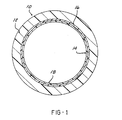
- the present invention is a multi-layer fuel line and vapor tube 10 which contains an inner or first layer 14, one intermediate or second layer 16 and may contain an outer or third layer 12.
- the tube 10 of the present invention is, preferably, fabricated by co-extruding the given thermoplastic materials in conventional co-extrusion processes.
- the tubing 10 may either be co-extruded to a suitable length or may be co-extruded in continuous lengths and cut to fit the given application subsequently.
- the tubing 10 of the present invention may have an outer diameter up to 50mm. In applications such as fuel lines and vapor recovery systems, outer diameters up to 63.5mm (2.5 inches) can be produced.
- the multi-layer tube of the present invention may have any suitable wall thickness as desired.
- wall thicknesses between 0.5mm and 2mm are generally employed; with wall thicknesses of approximately 0.8mm to approximately 1.5mm being preferred; and wall thicknesses between about 0.8mm and about 1.25mm being most preferred.
- tube 10 of the present invention generally has a maximum of five layers inclusive of bonding layers. However, additional layers can be included as desired and technically permitted. While five layers is considered the general maximum, tubing having three or four layers is also contemplated. Additional layers greater than five are not to be precluded from the purview of this invention if obtainable by co-extrusion methods.
- the tube 10 of the present invention is an article which is suitable for use in motor vehicles and may comprise a relatively thick outer or third layer 12 which is non-reactive with the external environment and can withstand various shocks, vibrational fatigue and changes in temperature as well as exposure to various corrosive or degradative compounds to which it would be exposed through the normal course of operation of the motor vehicle.
- Suitable materials for use in outer or third layer 12 of the present invention are generally defined as melt-processible extrudable thermoplastic materials which are sufficiently resistant to ultraviolet degradation, extreme changes in temperature and exposure to gasoline and its additives to permit use in the operational environment. Materials of choice may also exhibit resistance to environmental hazards such as exposure to zinc chloride and resistance to degradation upon contact with materials such as engine oil and brake fluid. It is to be understood that the relative importance of the various enumerated characteristics would depend upon the position of the thermoplastic material of the third layer 12 in the ultimate tube construction.
- the various layers of tube 10 are integrally laminated to one another to provide the resulting multi-layer unit.
- the various layers are resistant to delamination throughout the lifetime of the multi-layer tube 10.
- the multi-layer tube 10 of the present invention preferably, has a tensile strength of no less than 25 N/mm 2 and an elongation value at break of at least 150%.
- the multi-layer tube 10, preferably, has a burst strength at 23°C and 120°C of at least 20 bar.
- the multi-layer tube 10 is resistant to exposure to brake fluid, engine oil and peroxides such as those which may be found in gasoline.
- multi-layer tube 10 in general, and at least the thermoplastic material employed in the outer layer 12, in particular, exhibits appropriate impact resistance at service temperatures at least as low as -20°C with impact resistance service temperatures as low as -40°C being preferred.
- impact resistance is defined as the ability of a thermoplastic to withstand impacts.
- impact resistance is defined as the ability to withstand of at least 2 foot- pounds at temperatures below about -40°C according to the Method for Impact Resistance Determination defined in SAE J2260 (November 1, 1997).
- the elongated multi-layer tube 10 of the present invention includes an inner or first layer 14 disposed radially innermost.
- the inner or first layer has an inner surface 18 capable of prolonged exposure to a fluid containing hydrocarbons.
- the first layer 14 consists essentially of a melt-processible thermoplastic which has, as a major constituent, a thermoplastic material selected from the group consisting of polyamides, thermoplastic elastomers, and mixtures thereof.
- Suitable polyamides include aliphatic homopolycondensates and copolycondensates.
- the suitable polyamides include nylon 4,6, nylon 6,6, nylon 6,12, nylon 8,10, nylon 10,10, nylon 6, nylon 10,12, nylon 11, nylon 12 and nylon 12,12, and mixtures thereof.
- the preferred polyamide is a material selected from the group consisting of nylon 6, nylon 6,6, nylon 10,12, nylon 11, nylon 12,12, nylon 12 and mixtures thereof.
- the identification of polyamide materials above corresponds to international specifications in which the first numeral provides the number of carbon atoms in the starting diamine and the last numeral provides the number of carbon atoms in the dicarboxylic acid. In instances where only one number is quoted, the starting substance was an ⁇ ⁇ aminocarboxylic acid or the lactam derived therefrom.
- Copolyamides may be used and may be prepared from adipic acid, sebacic acid, suberic acid, isophthalic acid, terephthalic acid as coess acid or bis(4-aminocyclohexyl) -methane, trimethylhexamethylenediamine, hexamethylenediamine or similar codiamine selected from the group consisting of nylon 12, nylon 11, nylon 6, nylon 6.6 and mixtures thereof.
- Thermoplastic elastomers which can be employed in the present invention are melt-processible thermoplastics selected from the group consisting of SANTOPRENE, KRAYTON, SARLINK, VICHEM, CARILON and mixtures thereof.
- SANTOPRENETM is a thermoplastic rubber commercially available from Advanced Elastomer Systems of St. Louis, Missoruir
- KRAYTONTM is a thermoplastic rubber comprised of a styrene-ethylene/butylene-styrene block copolymer commercially available from Shell Chemical Company of Houston, Texas.
- SARLINK is an oil resistant thermoplastic commercially available from Novacore Chemicals of Leominster, Massachusetts.
- VICHEM designates a family of polyvinylchloride compounds commercially available from Vichem Corporation of Allendale, Michigan.
- CARILON is an aliphatic polykeytone commercially available from Shell Oil Company of Houston, Texas. Suitable CARILON polymers which can be employed in the present invention is designated as DP 1000.
- the inner layer consists essentially of a polyamide selected from the group consisting of nylon 11, nylon 12, nylon 6, nylon 6.6 and mixtures thereof; with nylon 12 being most preferred. Contrary to previously held belief, it has been found that polyamide materials can be employed successfully in the inner fuel contacting layer in most instances without the adverse effects of solubilization of monomers and aligomers.
- the multi-layer tube 10 of the present invention also includes a second layer 16 which is uniformly connected to the first layer 12.
- the second layer 16 consists essentially of an extrudable melt-processible non-polyester, non-alcoholic thermoplastic material which is capable of sufficiently permanent laminar connection with the first layer so as to prevent delamination from the first layer during the desired lifetime of the tube 10.
- the thermoplastic material employed in the second layer 16 has at least one constituent which is chemically dissimilar to the thermoplastic material employed in the first layer.
- the term "chemically dissimilar" as used herein is defined as meaning a polymeric material which is from a different chemical family from the major constituent of the polymeric material of the first layer 14.
- the major constituent of the first layer 14 is a thermoplastic material selected from the group consisting of polyamides
- at least one constituent material of the second layer is a non-polyamide thermoplastic.
- the second layer includes at least one constituent which is chemically dissimilar from the thermoplastic elastomer employed.
- the thermoplastic material employed in the second layer 16 is capable of establishing a suitable chemical bond between thermoplastic coextruded layers immediately interior and immediately exterior thereto.
- the thermoplastic material employed in the second layer 16 also exhibits resistance to permeation by components of the fluid to be conveyed through the tube 10; i.e. components of fuel.
- the thermoplastic material may or may not include various plasticizers or other modifying agents.
- the second layer 16 consists essentially of a thermoplastic material selected from the group consisting of polyvinylidine fluoride, polyvinyl fluoride, polyvinyl acetate-urethane blends, and mixtures thereof.
- a thermoplastic material selected from the group consisting of polyvinylidine fluoride, polyvinyl fluoride, polyvinyl acetate-urethane blends, and mixtures thereof.
- One preferred fluoroplastic material is a polyvinylidine derived from the thermal dehalogenation of chlorodifluoroethane.
- One preferred non-fluorocarbon material is a polyvinyl acetate/urethane blend.
- the materials of choice exhibit an affinity to polymers employed in the inner layer. Suitable thermoplastic materials are commercially available under the tradename "ADEFLON "; from Atochem Inc. elf Aquitaine Group of Philadelphia, Pennsylvania.
- the extrudable melt-processible non-polyester, non-alcoholic thermoplastic material employed in the second layer 16 may contain an isocyanate material as a first chemically dissimilar constituent and a polyamide as a second constituent thereof.
- the polyamide employed in this particular melt-processible thermoplastic material is selected from the group consisting of nylon 6, nylon 6.6, nylon 11, nylon 12 and mixtures thereof; with nylon 12 being most preferred.
- the isocyanate constituent employed in the melt-processible non-polyester, non-alcoholic thermoplastic material of the second layer 16 is a compound having at least two isocyanate groups.
- Suitable compounds include di-functional isocyanates and higher functional isocyanates, preferably aromatic and cycloaliphatic isocyanates such as 1,4 phenylene diisocyanate, 2,4-tolylene diisocyanate, 2,6-tolylene diisocyanate, 1,4-naphthalene diisocyanate, 1,6-hexamethylene diisocyanate, diphenylmethane 2,4-diisocyanate, diphenylmethane 4,4'-diisocyanate, diphenylmethane 2,2' diisocyanate, isophorone diisocyanate, 1,4-tetramethylene diisocyanate, 1,12 dodecane diisocyanate, triphenylmethane 4,4',4' triisocyanate, cyclohe
- isocyanates having isocyanurate, urethane, acylated urea, biurea, carbodiimide or ester groups as well as oligomeric fatty acid containing isocyanates and perchlorinated arylisocyanates.
- the isocyanate modified thermoplastic employed in the second layer 16 will preferably contain between about 60% and about 99% by weight polyamide and between about 1 and about 40% by weight of the compound containing at least two isocyanate groups such that the isocyanate groups originating from this compound provide a total isocyanate concentration between about 0.03 and about 3% by weight of the thermoplastic material.
- the thermoplastic material contains between about 70 and about 98% by weight polyamide and about 2 to 30% by weight of the compound having at least two isocyanate groups present in an amount between 2.5 and about 10% by weight being most preferred.
- the total isocyanate group concentration is between about 0.3 and about 1.8%.
- the compound containing the isocyanate group has at least one isocyanurate, urethane, acylated urea, biuret, carbodiimide or ester group.
- the materials of choice for the compound having at least two isocyanate groups is a compound selected from the group consisting of isophorone diisocyanate, isocyanurates derived from isophorone diisocyanate, and mixtures thereof.
- the third layer 12 is uniformly connected to the second layer and consists essentially of an extrudable melt-processible thermoplastic having as a major constituent a thermoplastic material selected from the group consisting of thermoplastic elastomers, polyamides, and mixtures thereof.
- Suitable thermoplastic elastomers are those which were previously enumerated in connection with the first layer.
- Suitable polyamides are generally those which were defined in connection with the first layer with the polyamide preferably being selected from the group consisting of nylon 12, nylon 11, zinc chloride resistant nylon 6, nylon 6.6, and mixtures thereof; with nylon 12 being most preferred. It is anticipated that the thermoplastic material employed in the outer layer may be either modified or unmodified to contain various plasticizers, impact modifiers, etc.
- thermoplastic material of choice will generally have an elongation at break of 150% and an ability to withstand impacts of at least 2 foot-pounds at temperatures below about -40°C.
- Suitable impact modifying polymers include but are not limited to, ethylene/orpoylene copolymers or ehtylene/orpoylene/diene copolymers.
- nylon 6 In instances in which nylon 6 is employed, it is anticipated that the nylon 6 would either exhibit zinc chloride resistance inherently or would contain sufficient quantities of modifying agents to impart a level of zinc chloride resistance greater than or equal to that required by performance requirement 7.5 outlined in SAE standard J2260; i.e. non-reactivity after 200 hour immersion in a 50% by weight zinc chloride solution.
- the nylon 6 which would be employed in the third layer 12 of the multi-layer tubing 10 of the present invention can also be modified with various plasticizers, flame retardants and the like in manners which would be known to those skilled in the art.
- the elongated multi-layer tube 10 of the present invention may also include at least one intermediate bonding layer 20 interposed between either the first layer 14 and second layer 16 or the third layer 14 and second layer 16. It is also within the purview of this invention that the multi-layer tube 10 of the present invention include at least one intermediate bonding layer interposed between both the first layer 14 and the second layer 16 and between the second layer 16 and the third layer 14. As depicted in Fig. 2, one intermediate bonding layer 20 is interposed between second layer 16 and third layer 12.
- the intermediate bonding layer 20 is composed of a suitable melt-processible thermoplastic material capable of suitable laminar adhesion with underlying and overlying layers.
- the intermediate bonding layer 20 or layers 20, 22 consists essentially of a melt-processible thermoplastic selected from the group consisting of polyvinylidine fluoride, polyvinyl fluoride, copolymers of ethylene tetrafluoroethylene, blends of urethane and polyvinyl acetate, and mixtures thereof.
- the tube 10 of the present invention may also, optionally, include an outer jacket 22 which surrounds the third or outer layer 12.
- the jacket 22 may either be coextruded with the other layers during the extrusion process or may be added in a subsequent process such as by cross head extrusion.
- the outer jacket 22 may be made of any material chosen for its structural or insulating characteristics and may be of any suitable wall thickness.
- the outer jacket 22 may be made of a thermoplastic material selected from the group consisting of zinc-chloride resistant nylon 6, nylon 6.6, nylon 11, nylon 12, polypropylene, thermoplastic elastomers and mixtures thereof. Suitable thermoplastic elastomers include SANTOPRENE, KRAYTON, VICHEM, and SARLINK.
- the multi-layer tube 10 of the present invention may be suitably provided so that at least one layer exhibits conductive characteristics rendering the multi-layer tube 10 capable of dissipating electrostatic charge which builds up in the tube during use.
- electrostatic dissipative characteristics it is preferred that one of the inner layers exhibit electrostatic dissipative characteristics. It is most preferred that the radially innermost fuel contacting layer exhibit electrostatic dissipative characteristics.
- electrostatic dissipative characteristics is the ability of the material to dissipate electrostatic charge which builds up in the multi-layer tube. This ability can be thought of as a quantification of the ease that electrical charges can move in a given material.
- the electrostatic dissipative characteristics of materials are differentiated on the basis of measured surface resistivity value (expressed as ohms per square).
- Surface resistance of a material is resistivity as measured multiplied by the ratio of specimen surface dimensions (width of electrodes defining the current path divided by the distance between electrodes) which transforms the measured resistance to that obtained if the electrodes formed the opposite sides of a square. The unit of measurement is defined generally as ohms per square (ohm/square).
- Rs R ⁇ d L where R is measured resistance; d is tube ID; and L is the distance between electrodes.
- the tubing 10 of the present invention will include at least one layer in which the polymeric material exhibits an electrostatic dissipation capacity of the polymeric layer is sufficient to leak electrical charge at a level approximately equal to or greater than the rate at which electrostatic charge builds up or accumulates in the tube.
- Electrostatic charge accumulation is the phenomenon during which charge accumulates in areas of flow transition causing localized charge imbalance. If unchecked, the imbalance continues to grow until the rate of dissipation equals the rate of accumulation or some limiting mechanism such as electrical discharge occurs to cause the level of charges to become balanced or, at the minimum, reduced. Electrostatic dissipation is the action of unbalanced charge being reduced through conduction to ground.
- the polymeric material employed is, preferably, one which can be defined as having electrical characteristics as moderately conductive or "sufficiently dissipative".
- moderately conductive is defined as a measurement of surface resistivity levels between about 1x10 4 ohms per square and about 1x10 6 ohms per square.
- sufficiently dissipative as having a measured surface resistivity level of greater than 1x10 6 ohms per square but less than about 1x10 10 ohms per square.
- the polymeric material employed in the layer capable of electrostatic dissipation may exhibit inherent qualities of electrostatic dissipation or, preferably, may include in its composition a conductive medium in sufficient quantity to permit electrostatic dissipation in the desired range.
- the conductive medium may be any suitable material of a composition in shape capable of effecting this electrostatic dissipation.
- the conductive material may be selected from the group consisting of elemental carbon, stainless steel, highly conductive metals such as copper, silver, gold, nickel and silicon, and mixtures thereof.
- the term “elemental carbon” as used herein is employed to describe and include materials commonly referred to as "carbon black”.
- Carbon black as defined herein is a finely divided form of carbon produced by burning vaporized heavy oil fraction with sufficient air for complete combustion. Carbon black can also be made from methane or natural gas by cracking or direct combustion. The carbon black can be present in the form of carbon fibrous, spheres and the like.
- the amount of conductive material contained in the thermoplastic is generally limited by considerations of low temperature durability and resistance to the degradative effects of the gasoline or fuel passing through the multi-layer tube 10.
- the thermoplastic material contains conductive material in an amount sufficient to effect electrostatic dissipation.
- the maximum amount of conductive material employed in the thermoplastic is less than about 7% by volume with a concentration between about 2% and about 4% by volume being preferred.
- the conductive material can be either blended into the melt-processible thermoplastic so as to be interstitially integrated into the crystalline structure of the polymer, or it can be incorporated during polymerization of the monomers that make up the thermoplastic material.
- the electrostatic dissipation capacity as measured in surface resistance is between 1x10 4 ohm per square and 1x10 9 ohms per square as determined by the method for measuring and calculating surface resistance is set forth in SAE J2260.
- electrostatic dissipation capacity can also be expressed in terms of volume resistance; a measurement which recognizes that conduction through the bulk of the material can contribute to reduction of charges that have built up as well as the surface dissipation. Volume resistance is relatable to surface resistance levels but is dependent upon geometry. It is also possible to quantify electrostatic dissipation in terms of rate of charge dissipation. This can be determined by following a procedure such as the one defined by MIL-B-81705 B. As with volume resistance, the actual time for charge to decay that is used to define the three terms is dependent upon geometry. Such correlations can be readily ascertained by the skilled artisan.
- the first layer 14 may be composed of first and second sublayers 24 and 26, respectively, preferably composed of thermoplastic materials which are chemically similar to one another.
- the first layer 14 comprises a first sublayer 24 disposed radially innermost having a predetermined first radial thickness and an inner surface capable of prolonged exposure to a fuel containing hydrocarbon.
- the first layer also includes a second sublayer 26 having a predetermined second radial thickness.
- the second predetermined radial thickness is at least equal to or greater than the predetermined radial thickness of the first sublayer 22.
- the second sublayer is uniformly connected to the first sublayer.
- at least one sublayer 29 is capable of dissipating electrostatic charge in the manner described previously; with the first sublayer 24 being preferred.
- the first and second sublayers are generally composed of the same or similar melt-processible extrudable thermoplastic materials with the significant difference being the electrostatic dissipation capacity.
Landscapes
- Engineering & Computer Science (AREA)
- General Engineering & Computer Science (AREA)
- Mechanical Engineering (AREA)
- Laminated Bodies (AREA)
- Rigid Pipes And Flexible Pipes (AREA)
Claims (25)
- Längliche mehrschichtige Rohrleitung (10) mit
einer ersten Schicht (14), die radial am weitesten innen angeordnet ist und eine Innenfläche (18) hat, die zu einem längeren Kontakt mit einem Kohlenwasserstoffe enthaltenden Fluid befähigt ist, welche erste Schicht (14) im wesentlichen aus einem schmelzverarbeitbaren thermoplastischen Kunststoff besteht, und einer zweiten Schicht (16), die mit der ersten Schicht in coextrudierter Beziehung zu dieser gleichmäßig verbunden ist, welche zweite Schicht zu einer ausreichend dauerhaften laminaren Verbindung mit der ersten Schicht (14) befähigt ist, um so eine Delaminierung von der ersten Schicht während einer gewünschten Lebensdauer der Rohrleitung zu verhindern, und einer dritten Schicht (12), die mit der zweiten Schicht (16) gleichmäßig verbunden ist, welche dritte Schicht im wesentlichen aus einem extrudierbaren, schmelzverarbeitbaren thermoplastischen Kunststoff besteht, dadurch gekennzeichnet, dass
die erste Schicht (14) aus mindestens einer der Gruppen zusammengesetzt ist, die Polyamide und thermoplastische Elastomere enthalten;
die dritte Schicht (12) als einen Hauptbestandteil ein thermoplastisches Material hat, das ausgewählt ist aus der Gruppe bestehend aus thermoplastischen Elastomeren, Polyamiden und Mischungen daraus;
die zweite Schicht (16) im wesentlichen aus
einer ersten schmelzverarbeitbaren Verbindung, welche erste schmelzverarbeitbare Verbindung mindestens zwei Isocyanatgruppen in ihrer Monomerverbindung hat; und
eine zweite schmelzverarbeitbare Verbindung enthält, welche zweite schmelzverarbeitbare Verbindung ausgewählt ist aus der Gruppe, die mindestens entweder thermoplastische Elastomere, Polyamide oder Mischungen daraus enthält, wobei das erste und das zweite schmelzverarbeitbare Material in einer legierten Beziehung zueinander stehen. - Längliche mehrschichtige Rohrleitung (10) nach Anspruch 1, bei welcher das in der zweiten Schicht (16) verwendete thermoplastische Material im wesentlichen aus einer Polymerlegierung besteht, die aus einem schmelzverarbeitbaren Polyamid und einem Fluorkunststoffmaterial besteht.
- Längliche mehrschichtige Rohrleitung (10) nach Anspruch 2, bei welcher das in der zweiten Schicht (16) verwendete Fluorcarbonkunststoffmaterial ausgewählt ist aus der Gruppe bestehend aus Polyvinylidinfluorid, Polyvinylfluorid, Copolymeren von Ethylentetrafluorethylen und Mischungen daraus.
- Längliche mehrschichtige Rohrleitung (10) nach Anspruch 3, bei welcher das in der zweiten Schicht (16) verwendete Polyamid ausgewählt ist aus der Gruppe bestehend aus Nylon 12, Nylon 11, Nylon 6, Nylon 10,12, und Mischungen daraus.
- Längliche mehrschichtige Rohrleitung (10) nach Anspruch 1, bei welcher die erste schmelzverarbeitbare Verbindung kein Polyester und kein Alkohol ist.
- Längliche mehrschichtige Rohrleitung (10) nach Anspruch 1 oder 5, bei welcher das in der zweiten Schicht (16) verwendete schmelzverarbeitbare thermoplastische Material zwischen etwa 50 bis 99 Gew.-% Polyamid und zwischen etwa 1 bis 40 Gew.-% einer Verbindung enthält, die mindestens zwei Isocyanatgruppen hat.
- Längliche mehrschichtige Rohrleitung (10) nach Anspruch 1, bei welcher die mindestens zwei Isocyanatgruppen enthaltende Verbindung mindestens eine funktionelle Gruppe hat, die ausgewählt ist aus der Gruppe bestehend aus Isocyanat, Urethan, Acrylharnstoff, Biuret, Carbodiimiden und Estern.
- Längliche mehrschichtige Rohrleitung (10) mit mindestens einer ersten Schicht (14), die radial am weitesten innen angeordnet ist und eine Innenfläche (18) hat, die zu einem längeren Kontakt mit einem Kohlenwasserstoffe enthaltenden Fluid befähigt ist, welche erste Schicht (14) im wesentlichen aus einem schmelzverarbeitbaren thermoplastischen Kunststoff besteht; einer zweiten Schicht (16), die mit der ersten Schicht in coextrudierter Beziehung zu dieser gleichmäßig verbunden ist, welche zweite Schicht zu einer ausreichend dauerhaften laminaren Verbindung mit der ersten Schicht (14) befähigt ist, um so eine Delaminierung von der ersten Schicht während einer gewünschten Lebensdauer der Rohrleitung zu verhindern, dadurch gekennzeichnet, dass
die erste Schicht (14) aus mindestens einer der Gruppen zusammengesetzt ist, die Polyamide und thermoplastische Elastomere und aromatische Polyketone enthalten;
die zweite Schicht im wesentlichen aus einem extrudierbaren, schmelzverarbeitbaren, thermoplastischen Material besteht, das kein Polyester und kein Alkohol ist;
wobei das thermoplastische Material eine schmelzverarbeitbare thermoplastische Legierung ist, die im wesentlichen besteht aus:a) von etwa 1 bis etwa 40 Gew.-% einer schmelzverarbeitbaren Verbindung, die mindestens zwei Isocyanatgruppen hat und mindestens eine funktionelle Gruppe, die ausgewählt ist aus der Gruppe bestehend aus Isocyanat, Urethan, Acrylharnstoff, Biuret, Carbodiimiden und Estem; undb) von etwa 50 bis etwa 99 % einer thermoplastischen Verbindung enthält, die ausgewählt ist aus der Gruppe bestehend aus thermoplastischen Elastomeren, Polyamiden oder Mischungen daraus. - Längliche mehrschichtige Rohrleitung (10) nach Anspruch 1 oder 8, bei welcher die Verbindung, die mindestens zwei Isocyanatgruppen hat, ausgewählt ist aus der Gruppe bestehend aus Isophorondiisocyanat, einem von Isophorondiisocyanat abgeleiteten Isocyanurat und einer Mischung daraus.
- Längliche mehrschichtige Rohrleitung (10) nach Anspruch 1 oder 8, bei welcher das in der zweiten Schicht (16) verwendete Polyamid ausgewählt ist aus der Gruppe bestehend aus Nylon 11, Nylon 12, Nylon 6 und Mischungen daraus.
- Längliche mehrschichtige Rohrleitung (10) nach mindestens einem der Ansprüche 8 bis 10, ferner enthaltend mindestens eine Zwischenverbindungsschicht (20), die im wesentlichen aus einem schmelzverarbeitbaren thermoplastischen Kunststoff besteht, der ausgewählt ist aus der Gruppe bestehend aus Polyvinylidinfluorid, Polyvinylfluorid, Copolymeren von Ethylentetrafluorethylen, Gemische von Urethan und Polyvinylacetat und Mischungen daraus, wobei die Zwischenverbindungsschicht zwischen mindestens zwei der Schichten (12, 14, 16) der mehrschichtigen Rohrleitung gelegt ist.
- Längliche mehrschichtige Rohrleitung (10) nach Anspruch 11, bei welcher das in der ersten Schicht (14) verwendete thermoplastische Material ausgewählt ist aus der Gruppe bestehend aus Fluorcarbonkunststoffen, thermoplastischen Elastomeren, Polyamiden und Mischungen daraus.
- Längliche mehrschichtige Rohrleitung (10) nach Anspruch 12, bei welcher das thermoplastische Material der ersten Schicht (14) ein Polyamid ist, das ausgewählt ist aus der Gruppe bestehend aus Nylon 11, Nylon 12, Nylon 6, Nylon 6,6 und Mischungen daraus.
- Längliche mehrschichtige Rohrleitung (10) nach Anspruch 12, bei welcher das thermoplastische Elastomermaterial der ersten Schicht (14) ein thermoplastisches Elastomer ist, das ausgewählt ist aus der Gruppe bestehend aus Sarlink, Kraton, Vichem, Santoprene und Mischungen daraus.
- Längliche mehrschichtige Rohrleitung (10) nach Anspruch 12, bei welcher das in der ersten Schicht (14) verwendete thermoplastische Material ein Fluorcarbonkunststoff ist, der ausgewählt ist aus der Gruppe bestehend aus Copolymeren von Ethylentetrafluorethan, Polyvinylfluorid, Polyvinylidinfluorid und Mischungen daraus.
- Längliche mehrschichtige Rohrleitung (10) nach mindestens einem der Ansprüche 1 bis 15, bei welcher mindestens eine Schicht (14, 16, 12) in der Lage ist, elektrostatische Ladung abzuleiten.
- Längliche mehrschichtige Rohrleitung (10) nach Anspruch 16, bei welcher mindestens eine Schicht in der Lage ist, elektrostatische Ladung in einem Bereich zwischen etwa 1x10⁴ Ohm/Quadrat und etwa 1x10⁶ Ohm/Quadrat abzuleiten.
- Längliche mehrschichtige Rohrleitung (10) nach Anspruch 16, bei welcher mindestens eine Schicht in der Lage ist, elektrostatische Ladung in einem Bereich zwischen etwa 1x10⁶ Ohm/Quadrat bis etwa 1x10⁹ Ohm/Quadrat abzuleiten.
- Längliche mehrschichtige Rohrleitung (10) nach Anspruch 16, bei welcher mindestens die erste Schicht (14) in der Lage ist, elektrostatische Ladung abzuleiten.
- Längliche mehrschichtige Rohrleitung (10) nach Anspruch 19, bei welcher die Ableitung von elektrostatischer Ladung, gemessen als spezifischer Oberflächenwiderstand, weniger als 1x10⁶ Ohm pro Quadrat ist.
- Längliche mehrschichtige Rohrleitung (10) nach mindestens einem der Ansprüche 16 bis 20, bei welcher mindestens eine Schicht leitfähige Medien in einer Menge enthält, um ausreichend elektrostatische Ladung abzuleiten, um ein Entladungsereignis zu verhindern.
- Längliche mehrschichtige Rohrleitung (10) nach Anspruch 21, bei welcher mindestens eine Schicht weniger als etwa 7 Vol.-% leitfähige Medien enthält, die ausgewählt sind aus der Gruppe bestehend aus Kupfer, Silber, Gold, Nickel, Silicium, Carbon Black und Mischungen daraus.
- Längliche mehrschichtige Rohrleitung (10) nach Anspruch 16, bei welcher die erste Schicht (14) enthält:wobei mindestens die erste Unterschicht (24) in der Lage ist, elektrostatische Ladung abzuleiten.eine erste Unterschicht (24), die radial am weitesten innen angeordnet ist und eine vorbestimmte erste radiale Dicke sowie eine Innenfläche hat, die für einen längeren Kontakt mit einem Kohlenwasserstoffe enthaltenden Fluid befähigt ist; undeine zweite Unterschicht (26), die eine vorbestimmte zweite radiale Dicke hat, welche zweite vorbestimmte Dicke mindestens gleich der ersten vorbestimmten radialen Dicke ist, wobei die zweite Unterschicht gleichmäßig mit der ersten Unterschicht verbunden ist;
- Längliche mehrschichtige Rohrleitung (10) nach Anspruch 23, bei welcher die erste Unterschicht (24) in der Lage ist, elektrostatische Ladung in einem Bereich zwischen etwa 1x10⁶ Ohm/Quadrat und etwa 1x10⁹ Ohm/Quadrat abzuleiten.
- Längliche mehrschichtige Rohrleitung (10) nach Anspruch 1, bei welcher das thermoplastische Material der ersten Schicht ferner aromatische Polyketone entweder alleine oder in Kombination mit mindestens entweder Polyamiden oder thermoplastischen Elastomeren enthält.
Applications Claiming Priority (3)
| Application Number | Priority Date | Filing Date | Title |
|---|---|---|---|
| US23593 | 1998-02-13 | ||
| US09/023,593 US6257281B1 (en) | 1998-02-13 | 1998-02-13 | Multi-layer tubing having at least one intermediate layer formed from a polyamide alloy |
| PCT/US1998/025910 WO1999041538A1 (en) | 1998-02-13 | 1998-12-07 | Multi-layer tubing having at least one intermediate layer formed from a polyamide alloy |
Publications (2)
| Publication Number | Publication Date |
|---|---|
| EP1053427A1 EP1053427A1 (de) | 2000-11-22 |
| EP1053427B1 true EP1053427B1 (de) | 2003-11-05 |
Family
ID=21816083
Family Applications (1)
| Application Number | Title | Priority Date | Filing Date |
|---|---|---|---|
| EP98960778A Expired - Lifetime EP1053427B1 (de) | 1998-02-13 | 1998-12-07 | Mehrschichtrohrleitung mit mindestens einer zwischenschicht aus einer polyamidmischung |
Country Status (5)
| Country | Link |
|---|---|
| US (1) | US6257281B1 (de) |
| EP (1) | EP1053427B1 (de) |
| JP (1) | JP3532856B2 (de) |
| DE (1) | DE69819561T2 (de) |
| WO (1) | WO1999041538A1 (de) |
Cited By (1)
| Publication number | Priority date | Publication date | Assignee | Title |
|---|---|---|---|---|
| US10625487B2 (en) | 2018-08-02 | 2020-04-21 | Martinrea International US Inc. | Tubing for brake and fuel systems incorporating graphene impregnated polyamides |
Families Citing this family (26)
| Publication number | Priority date | Publication date | Assignee | Title |
|---|---|---|---|---|
| US20040040607A1 (en) * | 2002-08-28 | 2004-03-04 | Wilson Reji Paul | Refrigerant hose |
| WO2000006934A1 (fr) * | 1998-07-29 | 2000-02-10 | Aisan Kogyo Kabushiki Kaisha | Tuyauterie d'alimentation en fluide |
| EP1217279B2 (de) * | 1999-09-30 | 2012-11-14 | Asahi Glass Company, Limited | Kraftstoffschlauch |
| KR100559668B1 (ko) * | 1999-12-29 | 2006-03-10 | 현대자동차주식회사 | 자동차용 플라스틱 연료 튜브 |
| US6626152B1 (en) * | 2000-09-19 | 2003-09-30 | Delphi Technologies, Inc. | Fuel rail |
| US6536479B2 (en) * | 2001-05-30 | 2003-03-25 | The Goodyear Tire & Rubber Company | Refrigerant hose |
| US20030106602A1 (en) * | 2001-12-07 | 2003-06-12 | Hsich Henry S. | Multi-layer assembly for fluid handling and containment systems |
| JP4024046B2 (ja) * | 2002-01-10 | 2007-12-19 | 宇部興産株式会社 | ナイロン樹脂パイプとナイロン樹脂継手の接着方法 |
| FR2838501B1 (fr) * | 2002-04-15 | 2005-07-01 | Nobel Plastiques | Tube de transport d'un fluide automobile |
| US6823898B1 (en) | 2002-06-03 | 2004-11-30 | Itt Manufacturing Enterprises, Inc. | Low cost, low permeation multi-layer tubing |
| US20050155662A1 (en) * | 2002-06-03 | 2005-07-21 | Tao Nie | Low-cost, low permeation multi-layer tubing having intermediate polymeric alloy layer |
| US7357968B2 (en) * | 2002-09-27 | 2008-04-15 | Itt Manufacturing Enterprises, Inc. | Reinforced, high pressure, low permeation multilayer hose |
| BRPI0402583A (pt) * | 2003-07-11 | 2005-05-31 | Goodyear Tire & Rubber | Mangueira para refrigerante |
| JP2005315362A (ja) * | 2004-04-30 | 2005-11-10 | Nitta Moore Co | 流体配管用チューブ |
| FR2874987B1 (fr) * | 2004-09-08 | 2006-12-01 | Nobel Plastiques Soc Par Actio | Conduite multicouche pa/po-pa/tpe-e |
| FR2879281B1 (fr) * | 2004-12-13 | 2007-02-16 | Nobel Plastiques Soc Par Actio | Tube fluoropolymere/evoh/pa modifie |
| DE202004019464U1 (de) * | 2004-12-15 | 2006-04-20 | Fränkische Rohrwerke Gebr. Kirchner Gmbh & Co. Kg | Kunststoffrohr, insbesondere Kunststoffwellrohr |
| JP5197615B2 (ja) * | 2006-11-01 | 2013-05-15 | アーケマ・インコーポレイテッド | ポリアミドおよびエチルビニルアルコールまたはポリビニルアルコールをベースとする流体移送多層管 |
| US20090017244A1 (en) * | 2007-07-10 | 2009-01-15 | Nicola Martino | Nylon tubing constructions |
| US8176943B2 (en) * | 2008-11-21 | 2012-05-15 | Parker-Hannifin Corporation | High temperature fire sleeve |
| US20130011595A1 (en) | 2010-04-29 | 2013-01-10 | Parker-Hannifin Corporation | Nylon airbrake tubing constructions |
| US8905083B2 (en) | 2012-01-27 | 2014-12-09 | Titeflex Corporation | Energy dissipative tubes and methods of fabricating and installing the same |
| US20180229407A1 (en) * | 2017-02-03 | 2018-08-16 | Marhaygue, Llc | Structural Composition and Method |
| US11796090B2 (en) * | 2020-09-04 | 2023-10-24 | Martinrea International US Inc. | Fluid transport tubing incorporating a graphene impregnated outer coating |
| US12169043B2 (en) | 2021-05-14 | 2024-12-17 | Saudi Arabian Oil Company | Extruded aliphatic polyketone permeation barrier for spoolable composite pipes |
| US20230264459A1 (en) * | 2022-01-10 | 2023-08-24 | Cooper-Standard Automotive Inc. | High temperature multi-layer coolant tube |
Family Cites Families (76)
| Publication number | Priority date | Publication date | Assignee | Title |
|---|---|---|---|---|
| US3070132A (en) | 1960-04-06 | 1962-12-25 | David S Sheridan | Non-sparking medico-surgical tubes |
| BE632328A (de) | 1962-05-22 | 1900-01-01 | ||
| DE1779905B2 (de) | 1962-05-22 | 1975-09-18 | Raybestos-Manhattan, Inc., Manheim, Pa. (V.St.A.) | Tetrafluoräthylenpolymerrohr |
| US3166688A (en) | 1962-11-14 | 1965-01-19 | Ronald P Rowand | Polytetrafluoroethylene tubing having electrically conductive properties |
| US3561493A (en) | 1965-04-21 | 1971-02-09 | Paul Maillard | Composite tubes and method of manufacturing same |
| NL6802285A (de) * | 1968-02-17 | 1969-08-19 | ||
| DE2057709A1 (de) | 1970-11-17 | 1972-05-31 | Mannesmann Ag | Behaelter oder Rohre aus Kunststoff zum Lagern bzw. zum Transport von Fluessigkeiten,Pasten oder rieselfaehigen Schuettguetern |
| FR2194545B1 (de) | 1972-08-01 | 1976-01-23 | Viennot Pierre Fr | |
| US3828112A (en) | 1973-03-14 | 1974-08-06 | Moore & Co Samuel | Composite hose for conductive fluid |
| US4303457A (en) | 1975-10-06 | 1981-12-01 | Eaton Corporation | Method of making a semi-conductive paint hose |
| NL189238C (nl) | 1976-02-18 | 1993-02-16 | Montedison Spa | Werkwijze voor het vervaardigen van een gelaagd, geextrudeerd, meerlagig voorwerp uit thermoplastisch materiaal en aldus verkregen voorwerp. |
| IT1073477B (it) | 1976-04-06 | 1985-04-17 | Ugine Kuhlmann | Procedimento per il trattamento del polifluoruro di vinilidene per au mentarne l aderenza ad un altro polimero |
| US4330017A (en) | 1977-04-22 | 1982-05-18 | Nissan Motor Company, Limited | Rubber hose for automotive fuel line |
| DE2724253B2 (de) | 1977-05-28 | 1980-07-03 | Hoechst Ag, 6000 Frankfurt | Thermoplastische Mehrschichtfolie |
| DE2830593C2 (de) | 1978-07-12 | 1980-09-25 | Metallgesellschaft Ag, 6000 Frankfurt | Verfahren und Vorrichtung zur Innen- und Außenbeschichtung von Metallrohren |
| DE3071454D1 (de) | 1979-11-28 | 1986-04-03 | Wirsbo Bruks Ab | Gaseous diffusion resistant article |
| AU544400B2 (en) | 1980-03-25 | 1985-05-23 | International Lead Zinc Research Organization Inc. | Zinc-aluminum alloys and coatings |
| SE449456B (sv) | 1983-11-15 | 1987-05-04 | Uponor Ab | Forfarande och anordning for framstellning av ror varvid formbacksdelarna er delade i formstreckans lengsriktning |
| JPH0723758B2 (ja) | 1983-11-22 | 1995-03-15 | 株式会社ブリヂストン | ゴム管状物 |
| FR2563156B1 (fr) | 1984-04-19 | 1987-01-30 | Solvay | Structures a couches polymeriques multiples comprenant une couche en polymere du fluorure de vinyle ou de vinylidene liee a une couche en polymere polaire |
| NO165612C (no) | 1984-06-20 | 1991-03-06 | Furukawa Electric Co Ltd | Fleksibelt, sammensatt roer for transport av et hoeytemperaturfluid. |
| FR2577168B1 (fr) | 1985-02-08 | 1987-02-27 | Atochem | Composite polyfluorure de vinylidene-copolymere (ethylene-oxyde de carbone), traitement du polyfluorure de vinylidene par ce copolymere en vue de son adhesion a un substrat |
| FR2577564B1 (fr) | 1985-02-14 | 1987-07-17 | Atochem | Procede de traitement de surface du polyfluorure de vinylidene en vue de son adhesion a un substrat. materiau obtenu a partir du polyfluorure de vinylidene traite |
| DE3510395A1 (de) | 1985-03-22 | 1986-09-25 | Technoform Caprano + Brunnhofer KG, 3501 Fuldabrück | Kraftstoffuehrende, mit vorgegebener laenge fest installierbare leitung fuer ein kraftfahrzeug |
| JPH0140391Y2 (de) * | 1985-06-05 | 1989-12-04 | ||
| US4675780A (en) | 1985-08-26 | 1987-06-23 | The Gates Rubber Company | Conductive fiber hose |
| US4685090A (en) | 1985-11-27 | 1987-08-04 | Raychem Corporation | Tubular article |
| JP2742579B2 (ja) | 1986-02-01 | 1998-04-22 | 臼井国際産業 株式会社 | 可撓性複合ホース |
| FI80853C (sv) | 1988-06-07 | 1990-08-10 | Neste Oy | Plastbelagt stålrör |
| JPS63125885A (ja) | 1986-11-13 | 1988-05-30 | 横浜ゴム株式会社 | 冷媒輸送用ホ−ス |
| JP2719698B2 (ja) | 1987-04-06 | 1998-02-25 | 臼井国際産業 株式会社 | 耐食性重層被覆金属管 |
| DE3715251A1 (de) | 1987-05-08 | 1988-12-01 | Caprano & Brunnhofer | Kraftfahrzeug-rohrleitung fuer die fuehrung eines alkoholischen mediums |
| JPS6414029A (en) | 1987-07-08 | 1989-01-18 | Tokai Rubber Ind Ltd | Hose |
| US4842024A (en) * | 1987-07-21 | 1989-06-27 | Harvard Industries, Inc. | Composite hose for conveying refrigerant fluids in automotive air-conditioned systems |
| GB8729316D0 (en) | 1987-12-16 | 1988-01-27 | Shrinemark Ltd | Improvements relating to tube formation |
| US4907625A (en) | 1987-12-28 | 1990-03-13 | Tokai Rubber Industries, Ltd. | Refregerant transporting hose |
| US4944972A (en) | 1987-12-31 | 1990-07-31 | American National Can Company | Coextrusion apparatus, methods, and related films and packages |
| JPH02190692A (ja) | 1989-01-18 | 1990-07-26 | Tokai Rubber Ind Ltd | ゴムホース |
| US4948643A (en) | 1989-01-23 | 1990-08-14 | W. R. Grace & Co.-Conn. | Flexible medical solution tubing |
| DE3901928C1 (de) | 1989-01-24 | 1990-03-08 | Technoform Caprano + Brunnhofer Kg, 3501 Fuldabrueck, De | |
| US5142782A (en) | 1989-02-02 | 1992-09-01 | Teleflex Incorporated | Coated braided hose method and assembly |
| DE4001125C1 (de) | 1989-11-20 | 1990-12-13 | Technoform Caprano + Brunnhofer Kg, 3501 Fuldabrueck, De | |
| DE9007303U1 (de) | 1989-11-20 | 1990-12-20 | Technoform Caprano + Brunnhofer KG, 3501 Fuldabrück | Durch Koextrusion hergestellte Kraftfahrzeugrohrleitung aus Kunststoff |
| DE4001126C1 (de) | 1989-11-20 | 1990-12-13 | Technoform Caprano + Brunnhofer Kg, 3501 Fuldabrueck, De | |
| DE3942354C2 (de) | 1989-12-21 | 1999-01-14 | Siebe Automotive Deutschland Gmbh | Mehrschichtiger Sicherheitsschlauch aus thermoplastischen Kunststoffen für brennbare Fluide |
| DE4000434C2 (de) | 1990-01-09 | 1997-07-24 | Inventa Ag | Mehrlagige flexible Kühlflüssigkeitsleitung |
| DE4001131C2 (de) | 1990-01-17 | 1999-04-08 | Hoechst Ag | Mehrschichtige künstliche Wursthülle auf Polyamidbasis |
| DE9001467U1 (de) | 1990-02-09 | 1990-04-19 | Unicor GmbH Rahn Plastmaschinen, 97437 Haßfurt | Kunststoffrohr |
| DE4006870C2 (de) | 1990-03-05 | 1998-04-23 | Inventa Ag | Kraftstoffleitung |
| US5143122A (en) | 1990-09-11 | 1992-09-01 | Bundy Corporation | Composite flexible conduit assembly |
| FR2674933B1 (fr) | 1991-04-05 | 1993-06-11 | Caoutchouc Manuf Plastique | Procede de realisation en continu d'une structure tubulaire souple comportant un feuil monocouche d'epaisseur micrometrique incorpore et structures tubulaires souples realisees selon ce procede. |
| FR2674934B1 (fr) | 1991-04-05 | 1993-08-20 | Caoutchouc Manuf Plastique | Procede de realisation en continu d'une structure tubulaire souple comportant un feuil multicouche d'epaisseur micrometrique incorpore et structures tubulaires souples realisees selon ce procede. |
| DE4112668A1 (de) | 1991-04-18 | 1992-10-22 | Huels Chemische Werke Ag | Thermoplastische mehrschichtverbunde |
| US5478620A (en) | 1991-04-18 | 1995-12-26 | Huels Aktiengesellschaft | Multilayer plastic pipe |
| US5170011A (en) | 1991-09-25 | 1992-12-08 | Teleflex Incorporated | Hose assembly |
| DE4137431A1 (de) | 1991-11-14 | 1993-05-19 | Huels Chemische Werke Ag | Mehrschichtiges kunststoffrohr |
| DE4137430A1 (de) | 1991-11-14 | 1993-05-19 | Huels Chemische Werke Ag | Mehrschichtiges kunststoffrohr |
| DE4137434A1 (de) | 1991-11-14 | 1993-05-19 | Huels Chemische Werke Ag | Thermoplastische mehrschichtverbunde |
| ES2098422T3 (es) | 1991-11-14 | 1997-05-01 | Huels Chemische Werke Ag | Compuestos termoplasticos de varias capas. |
| JPH085167B2 (ja) * | 1992-01-06 | 1996-01-24 | パイロット インダストリーズ、インコーポレイテッド | フルオロポリマー複合材料製チューブおよびその製造方法 |
| US5743304A (en) * | 1992-04-14 | 1998-04-28 | Itt Corporation | Multi-layer fuel and vapor tube |
| US5284184A (en) | 1992-04-14 | 1994-02-08 | Itt Corporation | Corrugated multi-layer tubing having at least one fluoroplastic layer |
| US5383087A (en) | 1992-04-14 | 1995-01-17 | Itt Corporation | Multi-layer fuel and vapor tube |
| US5884672A (en) * | 1992-04-14 | 1999-03-23 | Itt Industries, Inc. | Multi-layer fuel and vapor tube |
| US5678611A (en) | 1992-04-14 | 1997-10-21 | Itt Corporation | Multi-layer fuel and vapor tube |
| US5524673A (en) | 1992-04-14 | 1996-06-11 | Itt Corporation | Multi-layer tubing having electrostatic dissipation for handling hydrocarbon fluids |
| DE4215608A1 (de) | 1992-05-12 | 1993-11-18 | Huels Chemische Werke Ag | Mehrschichtiges Kunststoffrohr |
| DE4215609A1 (de) | 1992-05-12 | 1993-11-18 | Huels Chemische Werke Ag | Thermoplastische Mehrschichtverbunde |
| WO1993025835A1 (en) | 1992-06-11 | 1993-12-23 | Itt Industries, Inc. | Multi-layer fuel and vapor tube |
| DE4240658A1 (de) | 1992-12-03 | 1994-06-09 | Huels Chemische Werke Ag | Mehrschichtiges Kunststoffrohr |
| DE4310884A1 (de) | 1993-04-02 | 1994-10-06 | Huels Chemische Werke Ag | Mehrschichtiges Kunststoffrohr |
| DE4336291A1 (de) | 1993-10-25 | 1995-04-27 | Huels Chemische Werke Ag | Thermoplastische Mehrschichtverbunde |
| DE4336289A1 (de) | 1993-10-25 | 1995-04-27 | Huels Chemische Werke Ag | Mehrschichtiges Kunststoffrohr |
| DE9400522U1 (de) | 1994-01-13 | 1994-03-24 | Fulton-Rohr GmbH & Co. KG, 68766 Hockenheim | Rohrleitung für Systeme in Kraftfahrzeugen |
| US5656121A (en) * | 1994-08-19 | 1997-08-12 | Minnesota Mining And Manufacturing Company | Method of making multi-layer composites having a fluoropolymer layer |
| US5891373A (en) | 1996-05-23 | 1999-04-06 | Eagle-Picher Industries, Inc. | Process of making a multi-layer tube |
-
1998
- 1998-02-13 US US09/023,593 patent/US6257281B1/en not_active Expired - Lifetime
- 1998-12-07 WO PCT/US1998/025910 patent/WO1999041538A1/en not_active Ceased
- 1998-12-07 JP JP2000531685A patent/JP3532856B2/ja not_active Expired - Fee Related
- 1998-12-07 EP EP98960778A patent/EP1053427B1/de not_active Expired - Lifetime
- 1998-12-07 DE DE69819561T patent/DE69819561T2/de not_active Expired - Lifetime
Cited By (1)
| Publication number | Priority date | Publication date | Assignee | Title |
|---|---|---|---|---|
| US10625487B2 (en) | 2018-08-02 | 2020-04-21 | Martinrea International US Inc. | Tubing for brake and fuel systems incorporating graphene impregnated polyamides |
Also Published As
| Publication number | Publication date |
|---|---|
| JP3532856B2 (ja) | 2004-05-31 |
| WO1999041538A1 (en) | 1999-08-19 |
| JP2002510018A (ja) | 2002-04-02 |
| DE69819561T2 (de) | 2005-07-28 |
| EP1053427A1 (de) | 2000-11-22 |
| DE69819561D1 (de) | 2003-12-11 |
| US6257281B1 (en) | 2001-07-10 |
Similar Documents
| Publication | Publication Date | Title |
|---|---|---|
| US6257281B1 (en) | Multi-layer tubing having at least one intermediate layer formed from a polyamide alloy | |
| EP0636225B1 (de) | Mehrschichtiger kraftstoff- und dampfschlauch | |
| US5884671A (en) | Multi-layer fuel and vapor tube | |
| US5383087A (en) | Multi-layer fuel and vapor tube | |
| EP0788589B1 (de) | Mehrschichtige kraftstoff- und dampfleitung | |
| US6170534B1 (en) | Multi-layer fuel and vapor tube | |
| US6180197B1 (en) | Multi-layer tubing having at least one intermediate layer formed from a polyamide/polyketone alloy | |
| EP0804700B1 (de) | Langgestrecktes mehrschichtiges kraftstoff- und dampfrohr und verfahren zu dessen herstellung | |
| US5996642A (en) | Multi-layer tubing having electrostatic dissipation for handling hydrocarbon fluids | |
| US6378562B1 (en) | Multi-layer tubing having electrostatic dissipation for handling hydrocarbon fluids | |
| US5884672A (en) | Multi-layer fuel and vapor tube | |
| WO1993025835A1 (en) | Multi-layer fuel and vapor tube | |
| US6634389B2 (en) | Multi-layer fuel and vapor tube | |
| US6321795B1 (en) | Multi-layer fuel and vapor tube |
Legal Events
| Date | Code | Title | Description |
|---|---|---|---|
| PUAI | Public reference made under article 153(3) epc to a published international application that has entered the european phase |
Free format text: ORIGINAL CODE: 0009012 |
|
| 17P | Request for examination filed |
Effective date: 20000913 |
|
| AK | Designated contracting states |
Kind code of ref document: A1 Designated state(s): DE FR GB |
|
| 17Q | First examination report despatched |
Effective date: 20010905 |
|
| GRAH | Despatch of communication of intention to grant a patent |
Free format text: ORIGINAL CODE: EPIDOS IGRA |
|
| GRAS | Grant fee paid |
Free format text: ORIGINAL CODE: EPIDOSNIGR3 |
|
| GRAA | (expected) grant |
Free format text: ORIGINAL CODE: 0009210 |
|
| AK | Designated contracting states |
Kind code of ref document: B1 Designated state(s): DE FR GB |
|
| REG | Reference to a national code |
Ref country code: GB Ref legal event code: FG4D |
|
| REF | Corresponds to: |
Ref document number: 69819561 Country of ref document: DE Date of ref document: 20031211 Kind code of ref document: P |
|
| ET | Fr: translation filed | ||
| PLBE | No opposition filed within time limit |
Free format text: ORIGINAL CODE: 0009261 |
|
| STAA | Information on the status of an ep patent application or granted ep patent |
Free format text: STATUS: NO OPPOSITION FILED WITHIN TIME LIMIT |
|
| 26N | No opposition filed |
Effective date: 20040806 |
|
| REG | Reference to a national code |
Ref country code: FR Ref legal event code: PLFP Year of fee payment: 18 |
|
| REG | Reference to a national code |
Ref country code: FR Ref legal event code: PLFP Year of fee payment: 19 |
|
| REG | Reference to a national code |
Ref country code: FR Ref legal event code: PLFP Year of fee payment: 20 |
|
| PGFP | Annual fee paid to national office [announced via postgrant information from national office to epo] |
Ref country code: FR Payment date: 20171227 Year of fee payment: 20 |
|
| PGFP | Annual fee paid to national office [announced via postgrant information from national office to epo] |
Ref country code: GB Payment date: 20171227 Year of fee payment: 20 |
|
| PGFP | Annual fee paid to national office [announced via postgrant information from national office to epo] |
Ref country code: DE Payment date: 20171229 Year of fee payment: 20 |
|
| REG | Reference to a national code |
Ref country code: DE Ref legal event code: R071 Ref document number: 69819561 Country of ref document: DE |
|
| REG | Reference to a national code |
Ref country code: GB Ref legal event code: PE20 Expiry date: 20181206 |
|
| PG25 | Lapsed in a contracting state [announced via postgrant information from national office to epo] |
Ref country code: GB Free format text: LAPSE BECAUSE OF EXPIRATION OF PROTECTION Effective date: 20181206 |