EP1053875A1 - Tintenbehälter, Halter für den Tintenbehälter, Tintenstrahlaufzeichnungsgerät den Halter beinhaltend und Methode zum Einsetzen des Tintenbehälters in den Halter - Google Patents
Tintenbehälter, Halter für den Tintenbehälter, Tintenstrahlaufzeichnungsgerät den Halter beinhaltend und Methode zum Einsetzen des Tintenbehälters in den Halter Download PDFInfo
- Publication number
- EP1053875A1 EP1053875A1 EP00108943A EP00108943A EP1053875A1 EP 1053875 A1 EP1053875 A1 EP 1053875A1 EP 00108943 A EP00108943 A EP 00108943A EP 00108943 A EP00108943 A EP 00108943A EP 1053875 A1 EP1053875 A1 EP 1053875A1
- Authority
- EP
- European Patent Office
- Prior art keywords
- ink
- ink container
- holder
- container
- joint
- Prior art date
- Legal status (The legal status is an assumption and is not a legal conclusion. Google has not performed a legal analysis and makes no representation as to the accuracy of the status listed.)
- Withdrawn
Links
- 238000000034 method Methods 0.000 title claims abstract description 35
- 239000000463 material Substances 0.000 claims description 155
- 238000007789 sealing Methods 0.000 claims description 123
- 230000007246 mechanism Effects 0.000 claims description 99
- 230000002265 prevention Effects 0.000 claims description 15
- 238000000071 blow moulding Methods 0.000 claims description 5
- 230000004308 accommodation Effects 0.000 claims description 3
- 238000003825 pressing Methods 0.000 claims description 2
- 239000000976 ink Substances 0.000 description 1154
- 230000001276 controlling effect Effects 0.000 description 159
- 230000002745 absorbent Effects 0.000 description 135
- 239000002250 absorbent Substances 0.000 description 135
- 239000007788 liquid Substances 0.000 description 79
- 239000010410 layer Substances 0.000 description 52
- 229920001971 elastomer Polymers 0.000 description 47
- 238000009434 installation Methods 0.000 description 39
- 239000000806 elastomer Substances 0.000 description 34
- 239000000835 fiber Substances 0.000 description 32
- 230000033001 locomotion Effects 0.000 description 28
- 230000000694 effects Effects 0.000 description 25
- 238000003466 welding Methods 0.000 description 19
- 230000003139 buffering effect Effects 0.000 description 18
- 230000006870 function Effects 0.000 description 18
- 230000004913 activation Effects 0.000 description 17
- 230000001965 increasing effect Effects 0.000 description 17
- 230000008569 process Effects 0.000 description 17
- 238000001514 detection method Methods 0.000 description 14
- 230000007423 decrease Effects 0.000 description 13
- 230000008859 change Effects 0.000 description 12
- 230000000052 comparative effect Effects 0.000 description 10
- 230000002093 peripheral effect Effects 0.000 description 10
- 230000001105 regulatory effect Effects 0.000 description 10
- 230000004044 response Effects 0.000 description 10
- -1 polypropylene Polymers 0.000 description 9
- 230000002829 reductive effect Effects 0.000 description 9
- 238000004519 manufacturing process Methods 0.000 description 8
- 230000000717 retained effect Effects 0.000 description 7
- 239000004743 Polypropylene Substances 0.000 description 6
- 230000009471 action Effects 0.000 description 6
- 230000001186 cumulative effect Effects 0.000 description 6
- 239000000203 mixture Substances 0.000 description 6
- 229920001155 polypropylene Polymers 0.000 description 6
- 239000011358 absorbing material Substances 0.000 description 5
- 238000003780 insertion Methods 0.000 description 5
- 230000037431 insertion Effects 0.000 description 5
- 238000005304 joining Methods 0.000 description 5
- 238000007639 printing Methods 0.000 description 5
- 230000003068 static effect Effects 0.000 description 5
- 230000004888 barrier function Effects 0.000 description 4
- 239000003086 colorant Substances 0.000 description 4
- 238000011084 recovery Methods 0.000 description 4
- 238000004064 recycling Methods 0.000 description 4
- 230000002441 reversible effect Effects 0.000 description 4
- 230000000630 rising effect Effects 0.000 description 4
- 230000033228 biological regulation Effects 0.000 description 3
- 230000006835 compression Effects 0.000 description 3
- 238000007906 compression Methods 0.000 description 3
- 238000009826 distribution Methods 0.000 description 3
- 239000012530 fluid Substances 0.000 description 3
- 238000002156 mixing Methods 0.000 description 3
- 230000004048 modification Effects 0.000 description 3
- 238000012986 modification Methods 0.000 description 3
- 238000000465 moulding Methods 0.000 description 3
- 238000009877 rendering Methods 0.000 description 3
- 229920005989 resin Polymers 0.000 description 3
- 239000011347 resin Substances 0.000 description 3
- 238000007711 solidification Methods 0.000 description 3
- 230000008023 solidification Effects 0.000 description 3
- 239000004698 Polyethylene Substances 0.000 description 2
- 238000010521 absorption reaction Methods 0.000 description 2
- 230000008901 benefit Effects 0.000 description 2
- 238000009960 carding Methods 0.000 description 2
- 238000004891 communication Methods 0.000 description 2
- 238000002788 crimping Methods 0.000 description 2
- 230000007547 defect Effects 0.000 description 2
- 230000006866 deterioration Effects 0.000 description 2
- 238000006073 displacement reaction Methods 0.000 description 2
- 239000005038 ethylene vinyl acetate Substances 0.000 description 2
- 230000005484 gravity Effects 0.000 description 2
- 238000010438 heat treatment Methods 0.000 description 2
- 238000007373 indentation Methods 0.000 description 2
- 238000002347 injection Methods 0.000 description 2
- 239000007924 injection Substances 0.000 description 2
- 238000005259 measurement Methods 0.000 description 2
- 238000004806 packaging method and process Methods 0.000 description 2
- 229920001200 poly(ethylene-vinyl acetate) Polymers 0.000 description 2
- 229920000573 polyethylene Polymers 0.000 description 2
- 230000001846 repelling effect Effects 0.000 description 2
- 238000000926 separation method Methods 0.000 description 2
- 241000283153 Cetacea Species 0.000 description 1
- 229920000089 Cyclic olefin copolymer Polymers 0.000 description 1
- 239000004713 Cyclic olefin copolymer Substances 0.000 description 1
- 229920000219 Ethylene vinyl alcohol Polymers 0.000 description 1
- 230000005856 abnormality Effects 0.000 description 1
- 239000000853 adhesive Substances 0.000 description 1
- 230000001070 adhesive effect Effects 0.000 description 1
- 239000012790 adhesive layer Substances 0.000 description 1
- 239000004840 adhesive resin Substances 0.000 description 1
- 229920006223 adhesive resin Polymers 0.000 description 1
- 230000002411 adverse Effects 0.000 description 1
- 150000001450 anions Chemical class 0.000 description 1
- 230000009286 beneficial effect Effects 0.000 description 1
- 230000015572 biosynthetic process Effects 0.000 description 1
- 230000000903 blocking effect Effects 0.000 description 1
- 150000001768 cations Chemical class 0.000 description 1
- 238000006243 chemical reaction Methods 0.000 description 1
- 230000000295 complement effect Effects 0.000 description 1
- 150000001875 compounds Chemical class 0.000 description 1
- 238000007796 conventional method Methods 0.000 description 1
- 230000003247 decreasing effect Effects 0.000 description 1
- 230000003111 delayed effect Effects 0.000 description 1
- 230000001419 dependent effect Effects 0.000 description 1
- 230000002542 deteriorative effect Effects 0.000 description 1
- 238000007599 discharging Methods 0.000 description 1
- 230000005489 elastic deformation Effects 0.000 description 1
- 238000005516 engineering process Methods 0.000 description 1
- 230000002708 enhancing effect Effects 0.000 description 1
- UFRKOOWSQGXVKV-UHFFFAOYSA-N ethene;ethenol Chemical compound C=C.OC=C UFRKOOWSQGXVKV-UHFFFAOYSA-N 0.000 description 1
- 239000004715 ethylene vinyl alcohol Substances 0.000 description 1
- 239000002657 fibrous material Substances 0.000 description 1
- 238000009499 grossing Methods 0.000 description 1
- 238000005470 impregnation Methods 0.000 description 1
- 230000006872 improvement Effects 0.000 description 1
- 238000001746 injection moulding Methods 0.000 description 1
- 238000011900 installation process Methods 0.000 description 1
- 230000010354 integration Effects 0.000 description 1
- 230000002452 interceptive effect Effects 0.000 description 1
- 230000009545 invasion Effects 0.000 description 1
- 239000002346 layers by function Substances 0.000 description 1
- 230000007257 malfunction Effects 0.000 description 1
- 238000002844 melting Methods 0.000 description 1
- 230000008018 melting Effects 0.000 description 1
- 230000036961 partial effect Effects 0.000 description 1
- 230000035515 penetration Effects 0.000 description 1
- 238000001454 recorded image Methods 0.000 description 1
- 230000009467 reduction Effects 0.000 description 1
- 230000000284 resting effect Effects 0.000 description 1
- 238000007493 shaping process Methods 0.000 description 1
- 239000007787 solid Substances 0.000 description 1
- 230000006641 stabilisation Effects 0.000 description 1
- 238000011105 stabilization Methods 0.000 description 1
- 230000000087 stabilizing effect Effects 0.000 description 1
- 238000003860 storage Methods 0.000 description 1
- 229920005992 thermoplastic resin Polymers 0.000 description 1
- 230000001960 triggered effect Effects 0.000 description 1
Images












Classifications
-
- B—PERFORMING OPERATIONS; TRANSPORTING
- B41—PRINTING; LINING MACHINES; TYPEWRITERS; STAMPS
- B41J—TYPEWRITERS; SELECTIVE PRINTING MECHANISMS, i.e. MECHANISMS PRINTING OTHERWISE THAN FROM A FORME; CORRECTION OF TYPOGRAPHICAL ERRORS
- B41J2/00—Typewriters or selective printing mechanisms characterised by the printing or marking process for which they are designed
- B41J2/005—Typewriters or selective printing mechanisms characterised by the printing or marking process for which they are designed characterised by bringing liquid or particles selectively into contact with a printing material
- B41J2/01—Ink jet
- B41J2/17—Ink jet characterised by ink handling
- B41J2/175—Ink supply systems ; Circuit parts therefor
- B41J2/17503—Ink cartridges
- B41J2/1752—Mounting within the printer
- B41J2/17523—Ink connection
-
- E—FIXED CONSTRUCTIONS
- E01—CONSTRUCTION OF ROADS, RAILWAYS, OR BRIDGES
- E01B—PERMANENT WAY; PERMANENT-WAY TOOLS; MACHINES FOR MAKING RAILWAYS OF ALL KINDS
- E01B11/00—Rail joints
- E01B11/02—Dismountable rail joints
- E01B11/10—Fishplates with parts supporting or surrounding the rail foot
-
- B—PERFORMING OPERATIONS; TRANSPORTING
- B41—PRINTING; LINING MACHINES; TYPEWRITERS; STAMPS
- B41J—TYPEWRITERS; SELECTIVE PRINTING MECHANISMS, i.e. MECHANISMS PRINTING OTHERWISE THAN FROM A FORME; CORRECTION OF TYPOGRAPHICAL ERRORS
- B41J2/00—Typewriters or selective printing mechanisms characterised by the printing or marking process for which they are designed
- B41J2/005—Typewriters or selective printing mechanisms characterised by the printing or marking process for which they are designed characterised by bringing liquid or particles selectively into contact with a printing material
- B41J2/01—Ink jet
- B41J2/17—Ink jet characterised by ink handling
- B41J2/175—Ink supply systems ; Circuit parts therefor
- B41J2/17503—Ink cartridges
-
- B—PERFORMING OPERATIONS; TRANSPORTING
- B41—PRINTING; LINING MACHINES; TYPEWRITERS; STAMPS
- B41J—TYPEWRITERS; SELECTIVE PRINTING MECHANISMS, i.e. MECHANISMS PRINTING OTHERWISE THAN FROM A FORME; CORRECTION OF TYPOGRAPHICAL ERRORS
- B41J2/00—Typewriters or selective printing mechanisms characterised by the printing or marking process for which they are designed
- B41J2/005—Typewriters or selective printing mechanisms characterised by the printing or marking process for which they are designed characterised by bringing liquid or particles selectively into contact with a printing material
- B41J2/01—Ink jet
- B41J2/17—Ink jet characterised by ink handling
- B41J2/175—Ink supply systems ; Circuit parts therefor
- B41J2/17503—Ink cartridges
- B41J2/17513—Inner structure
-
- B—PERFORMING OPERATIONS; TRANSPORTING
- B41—PRINTING; LINING MACHINES; TYPEWRITERS; STAMPS
- B41J—TYPEWRITERS; SELECTIVE PRINTING MECHANISMS, i.e. MECHANISMS PRINTING OTHERWISE THAN FROM A FORME; CORRECTION OF TYPOGRAPHICAL ERRORS
- B41J2/00—Typewriters or selective printing mechanisms characterised by the printing or marking process for which they are designed
- B41J2/005—Typewriters or selective printing mechanisms characterised by the printing or marking process for which they are designed characterised by bringing liquid or particles selectively into contact with a printing material
- B41J2/01—Ink jet
- B41J2/17—Ink jet characterised by ink handling
- B41J2/175—Ink supply systems ; Circuit parts therefor
- B41J2/17503—Ink cartridges
- B41J2/1752—Mounting within the printer
-
- B—PERFORMING OPERATIONS; TRANSPORTING
- B41—PRINTING; LINING MACHINES; TYPEWRITERS; STAMPS
- B41J—TYPEWRITERS; SELECTIVE PRINTING MECHANISMS, i.e. MECHANISMS PRINTING OTHERWISE THAN FROM A FORME; CORRECTION OF TYPOGRAPHICAL ERRORS
- B41J2/00—Typewriters or selective printing mechanisms characterised by the printing or marking process for which they are designed
- B41J2/005—Typewriters or selective printing mechanisms characterised by the printing or marking process for which they are designed characterised by bringing liquid or particles selectively into contact with a printing material
- B41J2/01—Ink jet
- B41J2/17—Ink jet characterised by ink handling
- B41J2/175—Ink supply systems ; Circuit parts therefor
- B41J2/17503—Ink cartridges
- B41J2/17543—Cartridge presence detection or type identification
- B41J2/1755—Cartridge presence detection or type identification mechanically
-
- B—PERFORMING OPERATIONS; TRANSPORTING
- B41—PRINTING; LINING MACHINES; TYPEWRITERS; STAMPS
- B41J—TYPEWRITERS; SELECTIVE PRINTING MECHANISMS, i.e. MECHANISMS PRINTING OTHERWISE THAN FROM A FORME; CORRECTION OF TYPOGRAPHICAL ERRORS
- B41J2/00—Typewriters or selective printing mechanisms characterised by the printing or marking process for which they are designed
- B41J2/005—Typewriters or selective printing mechanisms characterised by the printing or marking process for which they are designed characterised by bringing liquid or particles selectively into contact with a printing material
- B41J2/01—Ink jet
- B41J2/17—Ink jet characterised by ink handling
- B41J2/175—Ink supply systems ; Circuit parts therefor
- B41J2/17503—Ink cartridges
- B41J2/17553—Outer structure
-
- B—PERFORMING OPERATIONS; TRANSPORTING
- B41—PRINTING; LINING MACHINES; TYPEWRITERS; STAMPS
- B41J—TYPEWRITERS; SELECTIVE PRINTING MECHANISMS, i.e. MECHANISMS PRINTING OTHERWISE THAN FROM A FORME; CORRECTION OF TYPOGRAPHICAL ERRORS
- B41J2/00—Typewriters or selective printing mechanisms characterised by the printing or marking process for which they are designed
- B41J2/005—Typewriters or selective printing mechanisms characterised by the printing or marking process for which they are designed characterised by bringing liquid or particles selectively into contact with a printing material
- B41J2/01—Ink jet
- B41J2/17—Ink jet characterised by ink handling
- B41J2/175—Ink supply systems ; Circuit parts therefor
- B41J2/17503—Ink cartridges
- B41J2/17556—Means for regulating the pressure in the cartridge
-
- B—PERFORMING OPERATIONS; TRANSPORTING
- B41—PRINTING; LINING MACHINES; TYPEWRITERS; STAMPS
- B41J—TYPEWRITERS; SELECTIVE PRINTING MECHANISMS, i.e. MECHANISMS PRINTING OTHERWISE THAN FROM A FORME; CORRECTION OF TYPOGRAPHICAL ERRORS
- B41J2/00—Typewriters or selective printing mechanisms characterised by the printing or marking process for which they are designed
- B41J2/005—Typewriters or selective printing mechanisms characterised by the printing or marking process for which they are designed characterised by bringing liquid or particles selectively into contact with a printing material
- B41J2/01—Ink jet
- B41J2/17—Ink jet characterised by ink handling
- B41J2/175—Ink supply systems ; Circuit parts therefor
- B41J2/17566—Ink level or ink residue control
-
- E—FIXED CONSTRUCTIONS
- E01—CONSTRUCTION OF ROADS, RAILWAYS, OR BRIDGES
- E01B—PERMANENT WAY; PERMANENT-WAY TOOLS; MACHINES FOR MAKING RAILWAYS OF ALL KINDS
- E01B11/00—Rail joints
- E01B11/02—Dismountable rail joints
- E01B11/04—Flat fishplates
-
- E—FIXED CONSTRUCTIONS
- E01—CONSTRUCTION OF ROADS, RAILWAYS, OR BRIDGES
- E01B—PERMANENT WAY; PERMANENT-WAY TOOLS; MACHINES FOR MAKING RAILWAYS OF ALL KINDS
- E01B11/00—Rail joints
- E01B11/02—Dismountable rail joints
- E01B11/16—Fishplates for joining rails of different sections
-
- E—FIXED CONSTRUCTIONS
- E01—CONSTRUCTION OF ROADS, RAILWAYS, OR BRIDGES
- E01B—PERMANENT WAY; PERMANENT-WAY TOOLS; MACHINES FOR MAKING RAILWAYS OF ALL KINDS
- E01B11/00—Rail joints
- E01B11/02—Dismountable rail joints
- E01B11/36—Fastening means for fishplates
- E01B11/38—Locking arrangements for fastening means
-
- E—FIXED CONSTRUCTIONS
- E01—CONSTRUCTION OF ROADS, RAILWAYS, OR BRIDGES
- E01B—PERMANENT WAY; PERMANENT-WAY TOOLS; MACHINES FOR MAKING RAILWAYS OF ALL KINDS
- E01B9/00—Fastening rails on sleepers, or the like
- E01B9/60—Rail fastenings making use of clamps or braces supporting the side of the rail
-
- E—FIXED CONSTRUCTIONS
- E01—CONSTRUCTION OF ROADS, RAILWAYS, OR BRIDGES
- E01B—PERMANENT WAY; PERMANENT-WAY TOOLS; MACHINES FOR MAKING RAILWAYS OF ALL KINDS
- E01B9/00—Fastening rails on sleepers, or the like
- E01B9/68—Pads or the like, e.g. of wood, rubber, placed under the rail, tie-plate, or chair
- E01B9/681—Pads or the like, e.g. of wood, rubber, placed under the rail, tie-plate, or chair characterised by the material
-
- B—PERFORMING OPERATIONS; TRANSPORTING
- B41—PRINTING; LINING MACHINES; TYPEWRITERS; STAMPS
- B41J—TYPEWRITERS; SELECTIVE PRINTING MECHANISMS, i.e. MECHANISMS PRINTING OTHERWISE THAN FROM A FORME; CORRECTION OF TYPOGRAPHICAL ERRORS
- B41J2/00—Typewriters or selective printing mechanisms characterised by the printing or marking process for which they are designed
- B41J2/005—Typewriters or selective printing mechanisms characterised by the printing or marking process for which they are designed characterised by bringing liquid or particles selectively into contact with a printing material
- B41J2/01—Ink jet
- B41J2/17—Ink jet characterised by ink handling
- B41J2/175—Ink supply systems ; Circuit parts therefor
- B41J2/17596—Ink pumps, ink valves
-
- E—FIXED CONSTRUCTIONS
- E01—CONSTRUCTION OF ROADS, RAILWAYS, OR BRIDGES
- E01B—PERMANENT WAY; PERMANENT-WAY TOOLS; MACHINES FOR MAKING RAILWAYS OF ALL KINDS
- E01B2201/00—Fastening or restraining methods
- E01B2201/10—Fastening or restraining methods in alternative ways, e.g. glueing, welding, form-fits
Definitions
- the present invention relates to a holder for containing ink to be supplied to recording means, a holder on which the ink container is mounted, an ink jet recording apparatus provided with the holder and a mounting method for mounting the ink container to the holder, wherein the mounting property is improved.
- An ink jet recording apparatus which comprises a recording head for effecting recording on a recording material by ejecting the ink, an ink container for accommodating the ink to be supplied to the recording head and a container holder for detachably mountably holding the ink container, the container holder having the recording head.
- a color printer capable of color printing has recording heads for magenta, yellow, cyan and black inks, and ink containers corresponding to recording head are exchangeable at specified positions in the holder.
- the position in the holder determined for the respective colors are recognized by a label; a warning display is effected in response to detection of an erroneous mounting of the container after the container mounting; or the erroneous mounting is detected on the basis of an abnormality in the image when the printing is effected.
- configurations of the joint portion of the ink container for connection with an ink supply port of a recording head portion are made different for the colors to prevent the erroneous mounting.
- a projection is provided outside the ink container, and the container holder is provided with a corresponding to the projection is provided, and such discrimination structure is made different for the respective colors.
- the ink jet printer has been improved in the image quality, and greater kinds of inks are used.
- two different inks are chemically reacted on the surface of the sheet of paper by which the ink is fixed thereon with improved water-resistance and wearing property, in such a case, if the ink container were erroneously mounted, the functions of the recording head per se and the quality of the recorded image are seriously damaged.
- the conventional erroneous mounting prevention function is not satisfactory.
- the erroneous mounting is detected after the mounting of the ink container, and therefore, the ink may be solidified and plug the ink ejection output with the result of an ejection failure, an image defect and the apparatus failure.
- an exchange of the recording exchange may be required.
- the ink container is not completely mounted, but it is required that joint portion has to be contacted before the detection of erroneous mounting, so that mixture of the ink occurs at the time of the contact, and therefore, the same troubles may result.
- unnecessary exchange of the recording heads is required in the case of the apparatus of the ink container exchangeable type.
- the erroneous mounting is prevented physically, and therefore, the liability of the ink mixing is low, and the erroneous mounting prevention structure is quite effective.
- the packaging type for the ink container to protect the projection extended from the ink container is complicated and bulky, with the result of high cost.
- the size of the apparatus is increased due to the increase of the number of IDs (the none of the types to be discriminated) resulting from increase of the number of inks with the tendency of demands for the high image quality and for the multi-function of the ink and due to the increase of the space required by the increased ID members.
- holder to which the ink container is mounted and the ink container per se have structures with which the users can easily and assuredly mounting the ink container.
- a cartridge is provided with a center shaft, around which the cartridge is rotated while it is mounted; the ink container or the cartridge is engaged with a hook or a lever, and is guided by the hook or the lever while it is mounted; the container is directly by the user and is pushed into the mounting petition; or the container is provided with an elastic lever which facilitates the mounting operation.
- the ink container or the cartridge having such a structure has a rectangular outer structure, and therefore, the space required for the mounting including the moving space therefor is relatively large with the result of bulkiness of the apparatus. It is particularly remarkable in the structure in which transitional motion is used for the mounting.
- an ink accommodating container in which the apparatus is downsized with respect to the discrimination structure for the prevention of the color mixture due to erroneous mounting, and the mounting is easy and assured, a holder assembly to which the ink accommodating container is mounted, an ink jet recording apparatus provided with the holder assembly, and a mounting method for mounting the ink accommodating container to the holder.
- an ink container for containing ink to be supplied to a recording head
- the ink container comprising: an ink container casing; an ink supplying portion provided in the ink container casing and constituting an opening for permitting supply of the ink to the recording head; and an inclined portion provided in a region of the casing which is above, in a use state of the ink container, the ink supplying portion on a side of the casing having the ink supplying portion, the inclined portion being inclined toward inside of the casing.
- an ink container for containing ink to be supplied to a recording head
- the ink container comprising: a first inclined portion which is provided above, in use sate of the ink container, an ink supplying portion constituting an opening for permitting supply of the ink to the recording head on a side having the ink supplying portion, the first inclined portion being inclined in a direction gradually reducing an outer shape of the ink container; and a second inclined portion provided on a bottom, in a use state of the ink container, portion of the ink container, the second inclined portion being inclined in a direction of gradually reducing the outer shape of the ink container.
- a holder for detachably mounting therein an ink container retaining ink to be supplied to a recording head, comprising: an ink supply tube for connecting with an ink supplying portion provided in the ink container and for receiving the ink; an engaging portion in the form of a recess or projection corresponding to a peculiar projection or recess of the ink container; a guiding member for guiding mounting of the ink container to guide the ink supply tube into an ink supplying portion of the ink container.
- a mounting method of mounting an ink container to a holder including an engaging portion in the form of a recess or projection for erroneous mounting prevention, an ink supply tube and a mounting guide, the ink container including an ink accommodating portion, a projection or recess for erroneous mounting prevention, an ink supply port and a valve mechanism disposed in the ink supply port, the method comprising: a step of adapting the projection or recess to the engaging portion of the holder; a step of establishing a state of a part of the ink supply tube of the holder being inserted into the ink supply port of the ink container; a step of contacting a crossing portion between a bottom side of the ink container and a side opposite from the ink supply port of the ink container to the mounting guide of the holder; a step of applying a force having a downward component to an upper surface of the ink container adjacent a side opposite from the ink supply
- an ink jet recording apparatus comprising a holder as defined in said third aspect, an ink container as defined in said first aspect, a carriage reciprocable along a surface of a recording material and means for controlling a recording signal for ejecting the ink from a recording head provided in the holder.
- an upper portion above the ink supply port at the front side with respect to the inserting direction of the ink container so that rotation is used in the mounting, in which the distance between the ink supply port and the ink supply tube can be shortened, so that holder structure is downsized.
- the ink container is urged toward the supply tube irrespective of the direction of the ink container mounting force so that assured mounting can be accomplished.
- the erroneous mounting can be avoided before the ink supply tube is connected to the ink container, so that deterioration of the print such as the color mixture can be avoided.
- the stable mounting operation can be accomplished with the small space required for the mounting, so that compact ink jet recording apparatus can be provided.
- the length of the ink supply tube can be reduced so that amount of the ink considered not for the printing but for a refreshing operation for the ink filling can be reduced, and therefore, the volume of the residual ink absorbing material can be minimized, so that ink jet recording apparatus can be further downsized.
- “hardness" of a capillary force generating portion means the “hardness” of the capillary force generating portion when the capillary force generating member is in the liquid container. It is defined by the inclination of the amount of resiliency of the capillary force generating member relative to the amount of deformation. As for the difference in hardness between two capillary force generating members, a capillary force generating member which is greater in the inclination in the amount of resiliency relative to the amount of deformation is considered to be “harder capillary force generating member".
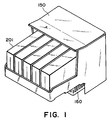
- Figure 1 is a perspective view of the ink jet head cartridge in the first of the embodiments of the present invention
- Figure 2 is a sectional view of the same ink jet head cartridge.
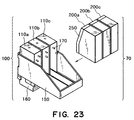
- the ink jet head cartridge in this embodiment comprises an ink jet head unit 160, a holder 150, a negative pressure controlling chamber unit 100, an ink container unit 200, and the like.
- the negative pressure controlling chamber unit 100 is fixed to the inward side of the holder 150.
- the ink jet head is attached to the outward side of the bottom wall portion of the holder 150.
- screws or interlocking structures, for ease of disassembly, to fix the negative pressure controlling chamber unit 100 and ink jet head unit 160 to the holder 150 is desirable in terms of recycling, and also is effective for reducing the cost increase which is incurred by the structural modification or the like.
- the negative pressure controlling chamber unit 100 comprises: a negative pressure controlling chamber shell 110, which is open at the top; a negative pressure controlling chamber cover 120 which is attached to the top portion of the negative pressure controlling chamber shell 110 to cover the opening of the negative pressure controlling chamber shell 110; two pieces of absorbent material 130 and 140 which are placed in the negative pressure controlling chamber shell 110 to hold ink by impregnation.
- the absorbent material pieces 130 and 140 are filled in vertical layers in the negative pressure controlling chamber shell 110, with the absorbent material piece 130 being on top of the absorbent material piece 140, so that when the ink jet head cartridge is in use, the absorbent material pieces 130 and 140 remain in contact with each other with no gap between them.
- the capillary force generated by the absorbent material piece 140, which is at the bottom, is greater than the capillary force generated by the absorbent material piece 130 which is at the top, and therefore, the absorbent material piece 140 which is at the bottom is greater in ink retainment.
- the ink within the negative pressure controlling chamber unit 100 is supplied through an ink supply tube 165.
- the ink container unit 200 is structured so that it can be removably mounted in the holder 150.
- the negative pressure controlling chamber unit 100 and ink container unit 200 are structured so that the ink within the ink container unit 200 is supplied into the negative pressure controlling chamber unit 100 through the joint portion between the joint pipe 180 and joint opening 230.
- the negative pressure controlling chamber cover 120 is provided with an air vent 115 through which the internal space of the negative pressure controlling chamber shell 110 is connected to the outside; more precisely, the absorbent material piece 130 filled in the negative pressure controlling chamber shell 110 is exposed to the outside air.
- a buffering space 116 which comprises an empty space formed by a plurality of ribs projecting inwardly from the inward surface of the negative pressure controlling chamber cover 120, on the absorbent material piece 130 side, and a portion of the absorbent material piece 130, in which no ink (liquid) is present.
- a valve mechanism which comprises a first valve body (or frame) 260a, a second valve body 260b, valve plug (or member) 261, a valve cover (or cap) 262, and a resilient member 263.
- the valve plug 261 is held within the second valve body 260b, being allowed to slide within the second valve body 260b and also being kept under the pressure generated toward the first valve body 260a by the resilient member 263.
- the ink container unit 200 remains airtightly sealed.
- the valve plug 261 is moved by the joint pipe 180 in the direction to separate it from the first valve body 260a.
- the internal space of the joint pipe 180 is connected to the internal space of the ink container unit 200 through the opening provided in the side wall of the second valve body 260b, breaking the airtightness of the ink container unit 200. Consequently, the ink container unit 200 begins to be supplied into the negative pressure controlling chamber unit 100 through the joint opening 230 and joint pipe 180.
- the provision of an ID member on each ink container makes it rare that an ink container for containing one type of ink is connected to a negative pressure controlling chamber for an ink container for containing another type of ink. Further, should the ID member provided on the negative pressure controlling chamber unit 100 be damaged, or should a user deliberately connect an ink container to a wrong negative pressure controlling chamber unit 100, all that is necessary is to replace only the negative pressure control chamber unit 100 as long as it is immediately after the incident. Further, if the holder 150 is damaged by falling or the like, it is possible to replace only the holder 150.
- the points, at which the ink container unit 200, negative pressure controlling chamber unit 100, holder 150, and ink jet head unit 160, are interlocked to each other, are chosen to prevent ink from leaking from any of these units when they are disassembled from each other.
- the ink container unit 200 is held to the negative pressure controlling chamber unit 100 by the ink container retaining portion 155 of the holder 150. Therefore, it does not occur that only the negative pressure controlling chamber unit 100 becomes disengaged from the other units, inclusive of the negative pressure controlling chamber unit 100, interlocked among them.
- the above components are structured so that unless at least the ink container unit 200 is removed from the holder 150, it is difficult to remove the negative pressure controlling chamber unit 100 from the holder 150.
- the negative pressure controlling chamber unit 100 is structured so that it can be easily removed only after the ink container unit 200 is removed from the holder 150. Therefore, there is no possibility that the ink container unit 200 will inadvertently separate from the negative pressure controlling chamber unit 100 and ink leak from the joint portion.
- the end portion of the ink supply tube 165 of the ink jet head unit 160 is provided with the filter 161, and therefore, even after the negative pressure controlling chamber unit 100 is removed, there is no possibility that the ink within the ink jet head unit 160 will leak out.
- the negative pressure controlling chamber unit 100 is provided with the buffering space 116 (inclusive of the portions of the absorbent material piece 130 and the portions of the absorbent material piece 140, in which no ink is present), and also, the negative pressure controlling chamber unit 100 is designed so that when the attitude of the negative pressure controlling chamber unit 100 is such an attitude that is assumed when the printer is being used, the interface 113c between the two absorbent material pieces 130 and 140, which are different in the amount of the capillary force, is positioned higher than the joint pipe 180 (preferably, the capillary force generated at the interface 113c and its adjacencies becomes greater than the capillary force in the other portions of the absorbent material pieces 130 and 140).
- the portion of the ink jet head unit 160, by which the ink jet head unit 160 is attached to the holder 150, is located on the bottom side, that is, the side where the electric terminals of the holder 150 are located, so that the ink jet head unit 160 can be easily removed even when the ink container unit 200 is in the holder 150.
- the negative pressure controlling chamber unit 100 or ink jet head unit 160 may be integral with, that is, inseparable from, the holder 150.
- they may be integrally formed from the beginning of manufacture, or may be separately formed, and integrated thereafter by thermal crimping or the like so that they become inseparable.
- the ink container unit 200 comprises an ink storing or accommodating container or reservoir 201, the valve mechanism comprising the first and second valve bodies 260a and 260b, and the ID member 250.
- the ID member 250 is a member for preventing installation mistakes which occur during the joining of ink container unit 200 to negative pressure controlling chamber unit 100.
- the valve mechanism is a mechanism for controlling the ink flow through the joint opening 230, and is opened, or closed, as it is engaged with, or disengaged from, the joint pipe 180 of the negative pressure controlling chamber unit 100, respectively.
- the misalignment, or twisting, of the valve plug which tends to occur during the installation or removal of the ink container unit 200, is prevented with the provision of an innovative valve structure, which will be described later, or the provision of an ID member 170 and an ID member slots 252, which limit the rotational range of the ink container unit 200.
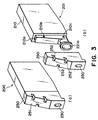
- Figure 3 is a perspective drawing for depicting the ink container unit 200 illustrated in Figure 2.
- Figure 3 (a) is a perspective view of the ink container unit 200 in the assembled form
- Figure 3 (b) is a perspective view of the ink container unit 200 in the disassembled form.
- the front side of the ID member 250 is slanted backward from the point slightly above the supply outlet hole 253, forming a slanted (or tapered) surface 251. More specifically, the bottom end, that is, the supply outlet hole 253 side, of the slanted surface 251 is the front side, and the top end, that is, the ink storing container 201 side, of the slanted surface 251 is the rear side.
- the slanted surface 251 is provided with a plurality of ID slots 252 (three in the case of Figure 3) for preventing the wrong installation of the ink container unit 200.
- the ID member 250 is positioned on the front surface (surface with the supply outlet), that is, the surface which faces the negative pressure controlling chamber unit 100, of the ink storing container 201.
- the ink storing container 201 is a hollow container in the form of an approximately polygonal prism, and is enabled to generate negative pressure. It comprises the external shell 210, or the outer layer, and the internal bladder 220, or the inner layer ( Figure 2), which are separable from each other.
- the internal bladder 220 is flexible, and is capable of changing in shape as the ink held therein is drawn out. Also, the internal bladder 220 is provided with a pinch-off portion (welding seam portion) 221, at which the internal bladder 220 is attached to the external shell 210; the internal bladder 220 is supported by the external shell 210. Adjacent to the pinch-off portion 221, the air vent 222 of the external shell 210 is located, through which the outside air can be introduced into the space between the internal bladder 220 and external shell 210.
- the internal bladder 220 is a laminar bladder, having three layers different in function: a liquid contact layer 220c, or the layer which makes contact with the liquid; an elastic modulus controlling layer 220b; and a gas barrier layer 220a superior in blocking gas permeation.
- the elastic modulus of the elastic modulus controlling layer 220b remains virtually stable within the temperature range in which the ink storing container 201 is used; in other words, the elastic modulus of the internal bladder 220 is kept virtually stable by the elastic modulus controlling layer 220b within the temperature range in which the ink storing container 201 is used.
- the middle and outermost layers of the internal bladder 220 may be switched in position; the elastic modulus controlling layer 220b and gas barrier layer 220a may be the outermost layer and middle layer, respectively.
- the internal bladder 220 Structuring the internal bladder 220 as described above makes it possible for the internal bladder 220 to synergistically display each of the individual functions of the ink-resistant layer 220c, elastic modulus controlling layer 220b, and gas barrier layer 220a, while using only a small number of layers.
- the temperature sensitive properties, for example, the elastic modulus, of the internal bladder 220 is less likely to be affected by the temperature change.
- the elastic modulus of the internal bladder 220 can be kept within the proper range for controlling the negative pressure in the ink storing container 201, within the temperature range in which the ink storing container 201 is used.
- the internal bladder 220 is enabled to function as the buffer for the ink within the ink storing container 201 and negative pressure controlling chamber shell 110 (details will be given later). Consequently, it becomes possible to reduce the size of the buffering chamber, that is, the portion of the internal space of the negative pressure controlling chamber shell 110, which is not filled with ink absorbing material, inclusive of the portion of the absorbent material piece 130, in which ink is not present, and the portion of the absorbent material piece 140, in which ink is not present. Therefore, it is possible to reduce the size of the negative pressure controlling chamber unit 100, which in turn makes it possible to realize an ink jet head cartridge 70 which is superior in operational efficiency.
- polypropylene is used as the material for the liquid contact layer 220c, or the innermost layer, of the internal bladder 220
- cyclic olefin copolymer is used as the material for the elastic modulus controlling layer 220b, or the middle layer.
- EVOH ethylene-vinyl acetate copolymer: EVA resin
- functional adhesive resin is mixed in the elastic modulus controlling layer 220b, because such a mixture eliminates the need for an adhesive layer between the adjacent functional layers, reducing the thickness of the wall of the internal bladder 220.
- polypropylene is used, as it is used for the material for the innermost layer of the internal bladder 220.
- Polypropylene is also used as the material for the first valve body 260a.
- the ID member 250 is provided with a plurality of ID member slots 252, which are arranged at the left and right edges of the front surface, corresponding to the plurality of ID members 170 for the prevention of the incorrect installation of the ink container unit 200.
- the installation mistake preventing function is provided by the installation mistake prevention mechanism, which comprises the plurality of ID members 170 provided on the negative pressure controlling chamber unit 100 side, and the ID member slots 252 provided by the ID member 250 corresponding to the positions of the ID members 170. Therefore, a large number of ink container unit installation areas can be made identifiable by changing the shapes and positions of the ID members 170 and ID member slots 252.
- the ID member slots 252 of the ID member 250, and the joint opening 230 of the first valve body 260a, are located in the front surface of the ink container unit 200, that is, the front side in terms of the direction in which the ink container unit 200 is installed or removed. They are parts of the ID member 250 and first valve body 260a, respectively.
- the ink storing container 201 is formed by blow molding, and the ID member 250 and first valve body 260a are formed by injection molding. Giving the ink container unit 200 a three piece structure makes it possible to precisely form the valve body and ID member slots 252.
- the ID member slots 252 are directly formed as the portions of the wall of the ink storing container 201 by blow molding, the shape of the internal space of the ink containing portion becomes complicated, affecting the separation of the internal bladder 100 wall, or the inner layer of the ink storing container 201, which sometimes affects the negative pressure generated by the ink container unit 200.
- the first valve body 260a is attached to at least the internal bladder 220 of the ink storing container 201. More specifically, the first valve body 260a is attached by welding the exposed portion 221a, that is, the ink outlet portion of the ink storing container 201, to the surface of the joint opening 230 corresponding to the exposed portion 221a. Since both the external shell 210 and the innermost layer of the internal bladder 220 are formed of the same material, that is, polypropylene, the first valve body 260a can be welded to the external shell 210 also at the periphery of the joint opening 230.
- the above described welding method increases accuracy in the positional relationship among the mutually welded components, while perfectly sealing the supply outlet portion of the ink storing container 201, and therefore, preventing ink leakage or the like which tends to occur at the seal portion between the first valve body 260a and the ink storing container 201 when the ink container unit 200 is installed, removed, or the like motion.
- the first valve body 260a is attached to the ink storing container 201 by welding as in the case of the ink container unit 200 in this embodiment, it is desired for the sake of better sealing that the material for the internal bladder 220 layer, which provides the bonding surface, is the same as the material for the first valve body 260a.
- the shell surface which faces the sealing surface 102 of the first valve body 260a, which is bonded to the ink containing portion 210 is joined, by interlocking, to the click portions 250a of the ID member 250, which is located at the bottom portion of the ID member 250, and the engagement portion 210a of the external shell 210, which is located on the side walls of the external shell 210, are interlocked with the other click portions 250a of the ID member 250.
- the mutually interlockable portions of these components are structured in the form of a projection or an indentation which fit with each other in an easily disengageable manner.
- Interlocking the ID member 250 with the ink storing container 201 allows both components to move slightly against each other. Therefore, the force generated by the contact between the ID members 170 and the ID member slots 252 during the installation or removal of these components can be absorbed to prevent the ink container unit 200 and negative pressure controlling chamber unit 100 from being damaged during the installation or removal of these components.
- interlocking the ID member 250 with the ink storing container 201 using only a limited number of the portions of the possible contact area makes it easier to disassemble the ink container unit 200, which is beneficial in consideration of its recycling.
- Providing indentations as the engagement portions 210a in the side walls of the external shell 210 makes the structure of the ink storing container 201 simpler to form by blow molding, and therefore, makes the mold pieces simpler. In addition, it makes it easier to control the film thickness.
- the ID member 250 is joined to the external shell 210 after the first valve body 260a is welded to the external shell 210. Since the click portions 250a are interlocked with the engagement portions 210a, in the state in which the peripheral portion of the first valve body 260a is tightly surrounded at the periphery of the joint opening 230 by the inward surface of the ID member 250, the joint portion becomes stronger against the force which applies to the joint portion when the ink container unit 200 is installed or removed.
- the shape of the ink storing container 201 is such that the portion to be covered by the ID member 250 is recessed, and the supply outlet portion protrudes. However, the protruding shape of the front side of the ink container unit 200 is hidden from view by the fixation of the ID member 250 to the ink storing container 201. Further, the welding seam between the first valve body 260a and ink storing portion 201 is covered by the ID member 250, being thereby protected.
- the relationship between the engagement portions 210a of the external shell 210 and the corresponding click portions 250a of the ID member 250, with regard to which side is projecting and which side is recessed, may be reversal to their relationship in this embodiment.
- a rubber joint portion 280 is fitted around the base portion of the joint pipe 180 of the negative pressure controlling chamber unit 100 to deal with unpredictable ink leakage.
- the rubber joint portion 280 seals between the ID member 250 and ink container unit 200, improving the degree of airtightness between the negative pressure controlling chamber unit 100 and ink container unit 200. When removing the ink container unit 200, this airtightness could function as resistance.
- the ID member 250 and ink storing container 201 are interlocked with the presence of a small amount of gap, allowing air to be introduced between the rubber joint portion 280 and ID member 250, and therefore, although ink is prevented from leaking, the force necessary to be applied for removing the ink container unit 200 is not as large as it otherwise would be, because of the provision of the rubber joint portion 280.
- the positions of the ink storing container 201 and IC member 250 can be controlled in terms of both the lengthwise and widthwise directions.
- the method for joining the ink storing container 201 with the ID member 250 does not need to be limited to a method such as the one described above; different joining points and different joining means may be employed.
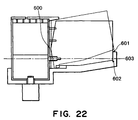
- the bottom wall of the ink storing container 201 is slanted upward toward the rear, and is engaged with the ink containing unit engagement portion 155 of the holder 150, by the bottom rear portion, that is, the portion opposite to the ink outlet side.
- the holder 150 and ink container unit 200 are structured so that when removing the ink container unit 200 from the holder 150, the portion of the ink storing container 201, which is in contact with the ink containing portion engagement portion 155, can be moved upward. In other words, when the ink container unit 200 is removed, the ink container unit 200 is rotated by a small angle. In this embodiment, the center of this rotation virtually coincides with the supply outlet opening (joint opening 230).
- the joint opening 230 of the ink jet head cartridge is located in the bottom portion of the sidewall of the ink storing container 201, on the negative pressure controlling chamber unit side, and the bottom portion of another wall of the ink storing container 201, that is, the wall opposite to the wall in which the joint opening 230 is located is engaged with the ink container engagement portion 155; in other words, the bottom rear portion of the ink storing container 201 is engaged with the ink storing container engagement portion 155.
- the ink storing container engagement portion 155 extends upward from the bottom wall of the holder 150, so that the position of the top portion of the ink storing container engagement portion 155 becomes approximately the same as the position 603 of the horizontal center line of the joint opening 230, in terms of the vertical direction. With this arrangement, it is assured that the horizontal movement of the joint opening 230 is regulated by the ink storing container engagement portion 155 to keep the joint opening 230 correctly connected with the joint pipe 180.
- the top end of the ink storing container engagement portion 155 is positioned at approximately the same height as the upper portion of the joint opening 230, and the ink container unit 200 is removably installed into the holder 150 by rotating the ink container unit 200 about a portion of the front surface of the ink container unit 200 on the joint opening 230 side.
- the portion of the ink container unit 200 which remains in contact with the negative pressure controlling chamber unit 100 functions as the rotational center for the ink container unit 200.
- making the bottom wall of the ink storing container 201 of the ink jet head cartridge slanted upward toward its bottom rear portion as described above reduces the difference between the distance from the rotational center 600 to the top end of the ink storing container engagement portion, and the distance from the rotational center 600 to the bottom end of the ink storing container engagement portion. Therefore, the portions of the ink container unit 200, which make contact with the holder 150, and the portions of the holder 150, which make contact with the ink container unit 200, are prevented from strongly rubbing against each other. Therefore, the ink container unit 200 can be smoothly installed or removed.
- the ink storing container 201 and holder 150 By shaping the ink storing container 201 and holder 150 as described above, it is possible to keep relatively small the size of the portion of the bottom rear portion of the ink storing container 201, which rubs against the ink storing container engagement portion 155 during the installation or removal of the ink container unit 200, and the size of the portion of the ink storing container engagement portion 155, which rubs against the bottom rear portion of the ink storing container 201, even if the joint opening 230 is enlarged to deliver ink at a greater volumetric rate.
- the ink container unit 200 is prevented from uselessly rubbing against the ink storing container engagement portion 155 during the installation of the ink container unit 200 into the holder 150, and yet, it is assured that the ink container unit 200 remains firmly attached to the holder 150.
- the difference between the distance from the rotational center 600, about which the ink container unit 200 rotates during its installation or removal, to the bottom end 602 of the ink container engagement portion, and the distance from the same rotational center 600 to the top end 601 of the ink container engagement portion, should be as small as possible within a range in which the ink container unit 200 is retained in the holder 150 with a proper degree of firmness while affording smooth installation or removal of the ink container unit 200.
- the position of the rotational center 600 of the ink container unit 200 is made lower than the position of the center of the joint opening 230, the distance from the rotational center 600, about which the ink container unit 200 rotates during its installation or removal, to the top end 601 of the ink container engagement portion, becomes longer than the distance from the same rotational center 600 to the bottom end 602 of the ink container engagement portion. Therefore, it becomes difficult to accurately hold the ink storing container 201 at a point which is at the same height as the center of the joint opening 230.
- it is desired that the position of the rotational center 600 of the ink container unit 200 is higher than the position of the vertical center of the joint opening 230.
- the portion of the ink container unit 200 which corresponds to the ink container engagement portion 155, becomes thicker, requiring the height of the ink storing container engagement portion 155 to be increased.
- the position of the rotational center 600 of the ink container unit 200 is close to the vertical center of the joint opening 230.
- the height of the ink container engagement portion 155 of the holder 150 has to be properly determined based only on the ease of the installation or removal of the ink container unit 200. However, if the height of the ink container engagement portion 155 is increased so that the position of its top end becomes higher than that of the rotational center 600, the length by which the ink container unit 200 contacts the ink container engagement portion 155 of the holder 150 becomes greater, which in turn increases the sizes of the portions on both sides, which rub against each other. Therefore, in consideration of the deterioration of the ink container unit 200 and holder 150, the height of the ink container engagement portion 155 is such that the position of its top end is lower than that of the rotational center 600.
- the elastic force for keeping the position of the ink storing container 201 fixed in terms of the horizontal direction is a combination of the force generated by the resilient member 263 for pressing the valve plug 261, and the force generated by the resiliency of the rubber joint portion 280 ( Figure 4).
- the configuration for generating the above resiliency does not need to be limited to the one in this embodiment; the bottom rear end, or the engagement portion, of the ink storing container 201, the surface of the ink storing container engagement portion 155, on the ink storing container side, the negative pressure controlling chamber unit 100, or the like, may be provided with an elastic force generating means for keeping the position of the ink storing container 201 fixed in terms of the horizontal direction.
- the rubber joint portion 280 When the ink storing container is in connection with the negative pressure controlling chamber, the rubber joint portion 280 remains compressed between the walls of the negative pressure controlling chamber and ink storing container, assuring that the joint portion (peripheral portion of the joint pipe) is airtightly sealed (it is not necessary to maintain perfect airtightness as long as the size of the area exposed to the outside air can be minimized). Also, the rubber joint portion 280 plays an auxiliary role in coordination with a sealing projection, which will be described later.
- the absorbent material pieces 130 and 140 are disposed in layers as members for generating negative pressure, the former being on top of the latter.
- the absorbent material piece 130 is exposed to the outside air through the air vent 115, whereas the absorbent material piece 140 is airtightly in contact with the absorbent material piece 130, at its top surface, and also is airtightly in contact with the filter 161 at its bottom surface.
- the position of the interface between the absorbent material pieces 130 and 140 is such that when the ink jet head cartridge is placed in the same attitude as the ink jet head cartridge is in use, it is higher than the position of the uppermost portion of the joint pipe 180 as a liquid passage.
- the absorbent material pieces 130 and 140 are formed of fibrous material, and are held in the negative pressure controlling chamber shell 110, so that in the state in which the ink jet head cartridge 70 has been properly installed into the printer, its fibers extend in substantially the same, or primary, direction, being angled (preferably, in the virtually horizontal direction as they are in this embodiment) relative to the vertical direction.
- thermoplastic resin polypropylene, polyethylene, and the like
- a wad of such strands is put through a carding machine to parallel the strands, is heated (heating temperature is desired to be set higher than the melting point of polyethylene, which is relatively low, and lower than the molding point of polypropylene, which is relatively high), and then, is cut to a desired length.
- the fiber strands of the absorbent material pieces in this embodiment are greater in the degree of alignment in the surface portion than in the center portion, and therefore, the capillary force generated by the absorbent members is greater in the surface portion than in the center portion.
- the surfaces of the absorbent material pieces are not as flat as a mirror surface. In other words, they have a certain amount of unevenness which results mainly when the slivers are bundled; they are three dimensional, and the intersections of the slivers, at which they are welded to each other, are exposed from the surfaces of the absorbent material pieces.
- the interface 113c between the absorbent material pieces 130 and 140 is an interface between the two uneven surfaces, allowing ink to flow by a proper amount in the horizontal direction along the interface 113c and also through the adjacencies of the interface 113c. In other words, it does not occur that ink is allowed to flow far more freely along the interface 113c than through its adjacencies, and therefore, an ink path is formed through the gaps between the walls of the negative pressure controlling chamber shell 110 and absorbent material pieces 130 and 140, and along the interface 113c.
- the interface 113c between the absorbent material pieces 130 and 140 is above the uppermost portion of the joint pipe 180, preferably, above and close to the uppermost portion of the joint pipe 180 as in this embodiment, when the ink jet head cartridge is positioned in the same attitude as it is when in use, the position of the interface between the ink and gas in the absorbent material pieces 130 and 140 during the gas-liquid exchange, which will be described later, can be made to coincide with the position of the interface 113c. As a result, the negative pressure in the head portion during the ink supplying operation can be stabilized.
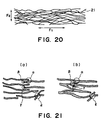
- the primary fiber direction that is, the fiber direction F1 is different from the fiber direction F2 perpendicular to the direction F1 in terms of how ink flows through the absorbent pieces, and also in terms of how ink is statically held therein.
- the 21tips of the short strands of crimped fiber are likely to three-dimensionally fuse with other strands like the tip ⁇ in Figure 21, (b), or remain unattached like the tip ⁇ in Figure 21, (b).
- all the strands do extend in the same direction.
- some strands extend in the nonconforming direction and intersect with the adjacent strands (region ⁇ in Figure 21, (a)) even before heat is applied, and as heat is applied, they fuse with the adjacent strands in the position they are in, (region ⁇ in Figure 21, (b)).
- the absorbent members in this embodiment are also far more difficult to split in the direction F2.
- the absorbent pieces 130 and 140 are disposed so that the primary fiber strand direction F1 in the absorbent pieces 130 and 140 becomes nearly parallel to the horizontal direction and the line which connects the joint portion and the ink supply outlet. Therefore, after the connection of ink storing container 201, the gas-liquid interface L (interface between ink and gas) in the absorbent piece 140 becomes nearly horizontal, that is, virtually parallel to the primary fiber strand direction F1, remaining virtually horizontal even if ambient changes occur, and as the ambience settles, the gas-liquid interface L returns to its original position. Thus, the position of the gas-liquid interface in terms of the gravitational direction is not affected by the number of the cycles of the ambient change.
- the gas-liquid interface remains virtually horizontal, and therefore, the size of the buffering space 116 does not decrease no matter how many times the ink container unit 200 is replaced.
- the fiber strands in the region immediately above the joint between the negative pressure controlling chamber unit 100 and ink container unit 200 are extended in the more or less horizontal direction.
- all that is necessary is that the above described region is between the ink delivery interface and the joint between the negative pressure controlling chamber unit 100 and ink container unit 200.
- all that is necessary is that the position of this region is above the gas-liquid interface while gas-liquid exchange is occurring.
- this region contributes to keeping horizontal the gas-liquid interface in the absorbent piece 140 while the liquid is supplied through the gas-liquid exchange; in other words, the region contributes to regulate the changes which occur in the vertical direction in the absorbent material piece 140 in response to the movement of the liquid into the absorbent material piece 140 from the ink storing container 201.
- the provision of the above described region or layer in the absorbent material piece 140 makes it possible to reduce the unevenness of the gas-liquid interface L in terms of the gravity direction. Further, it is desired that the fiber strands in the aforementioned region or layer be arranged so that they appear to extend in parallel in the aforementioned primary direction even when they are seen from the direction perpendicular to the horizontal direction of the absorbent material piece 140, because such an arrangement enhances the effect of the directional arrangement of the fiber strands in the more or less parallel manner in the primary direction.
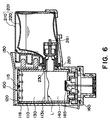
- the fiber strands in the absorbent material piece 140 are extended more or less in parallel in the primary direction also in the region below and adjacent to the joint portion, preventing therefore the gas-liquid interface L from becoming unpredictably uneven in the region below the uppermost portion of the joint portion, as shown in Figure 6, during the gas-liquid exchange. Therefore, it does not occur that the ink jet head cartridge fails to be supplied with a proper amount of ink due to the interruption of ink delivery.
- the outside air introduced through the air vent 115 reaches the gas-liquid interface L. As it reaches the interface L, it is dispersed along the fiber strands. As a result, the interface L is kept more or less horizontal during the gas-liquid exchange; it remains stable, assuring that the ink is supplied while a stable amount of negative pressure is maintained. Since the primary direction in which the fiber strands are extended in this embodiment is more or less horizontal, the ink is consumed through the gas-liquid exchange in such a manner that the top surface of the ink remains more or less horizontal, making it possible to provide an ink supplying system which minimizes the amount of the ink left unused, even the amount of the ink left unused in the negative pressure controlling chamber shell 110.
- an ink supplying system such as the system in this embodiment which allows the ink containing unit 200, in which liquid is directly stored, to be replaced, it is easier to provide the absorbent material pieces 130 and 140 with regions in which ink is not retained. In other words, it is easier to increase the buffering space ratio, to provide an ink supplying system which is substantially more resistant to the ambient changes than a conventional ink supplying system.
- the ink jet head cartridge in this embodiment is the type of cartridge mountable in a serial type printer, it is mounted on a carriage which is shuttled. As this carriage is shuttled, the ink in the ink jet head cartridge is subjected to the force generated by the movement of the carriage, more specifically, the component of the force in the direction of the carriage movement.
- the direction of the fiber strands in the absorbent material pieces 130 and 140 and the direction in which the ink container unit 200 and negative pressure controlling chamber unit 100 are connected are desired to coincide with the direction of the line which connects the joint opening 230 of the ink container unit 200 and the ink outlet 131 of the negative pressure controlling chamber shell 110.
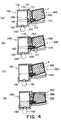
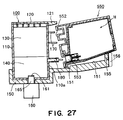
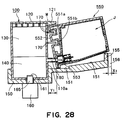
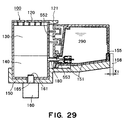
- Figure 4 is a sectional drawing for depicting the operation for installing the ink container unit 200 into the holder 150 to which the negative pressure controlling chamber unit 100 has been attached.
- the ink container unit 200 is installed into the holder 150 by being moved in the direction F as well as the direction G, while being slightly rotated by being guided by the unillustrated lateral guides, the bottom wall of the holder 150, the guiding portions 121 with which the negative pressure controlling chamber cover 120 of the negative pressure controlling chamber unit 100, the ink container engagement portion 155, that is, the rear end portion of the holder 150.
- the installation of the ink container unit 200 occurs as follows. First, the ink container unit 200 is moved to a point indicated in Figure 4, (a), that is, the point at which the slanted surface 251 of the ink container unit 200 comes into contact with the ID members 170 with which the negative pressure controlling chamber unit 100 is provided to prevent the wrong installation of the ink container unit 200.
- the holder 150 and ink container unit 200 are structured so that at the point in time when the above described contact occurs, the joint pipe 180 has yet to enter the joint opening 230. If a wrong ink container unit 200 is inserted, the slanted surface 251 of the wrong ink container unit 200 collides with the ID members 170 at this point in time, preventing the wrong ink container unit 200 from being inserted further.
- the joint opening 230 of the wrong ink container unit 200 does not make contact with joint pipe 180. Therefore, the problems which occur at the joint portion as a wrong ink container unit 200 is inserted, for example, the mixture of inks with different color, and the solidification of ink in the absorbent material pieces 130 and 140 (anions in one type of ink react with cations in another type of ink), which might cause the negative pressure controlling chamber unit 100 to stop functioning, can be prevented, and therefore, it will never occurs that the head and ink containing portion of an apparatus, the ink containing portions of which are replaceable, needs to be replaced due to the occurrence of such problems.
- the plurality of ID members 170 can be almost simultaneously fitted into the correspondent ID slots to confirm that a correct ink container unit 200 is being inserted; a reliable installation mistake prevention mechanism is provided.
- the ink container unit 200 is moved toward the negative pressure controlling chamber unit 100 so that the ID members 170 and joint pipe 180 are inserted into the ID member slots 252 and joint opening 230, respectively, at the same time, as shown in Figure 4, (b), until the leading end of the ink container unit 200 reaches the negative pressure controlling chamber unit 100 as shown in Figure 4, (c).
- the ink container unit 200 is rotationally moved in the direction indicated by an arrow mark G. During the rotational movement of the ink container unit 200, the tip of the joint pipe 180 comes into contact with the valve plug 261 and pushes it.
- valve mechanism opens, allowing the internal space of the ink container unit 200 to be connected to the internal space of the negative pressure controlling chamber unit 100, in other words, enabling the ink 300 in the ink container unit 200 to be supplied into the negative pressure controlling chamber unit 100.
- the detailed description of the opening or closing movement of this valve mechanism will be given later.
- the ink container unit 200 is further rotated in the direction of the arrow mark G, until the ink container unit 200 settles as shown in Figure 2.
- the bottom rear end portion of the ink container unit 200 becomes engaged with the ink container engagement portion 155 of the holder 150; in other words, the ink container unit 200 is correctly placed in the predetermined space for the ink container unit 200.
- the ID members 170 slightly come out of the ID member slots 252. The rearward force for correctly retaining the ink container unit 200 in the ink container unit space is generated toward the ink container engagement portion 155 of the holder 150 by the resilient member 263 in the ink container unit 200 and the rubber joint portion 280 fitted around the joint pipe 180.
- the ID member slots 252 are provided in the slanted front wall of the ink container unit 200 which is rotationally installed or removed, and also, the bottom wall of the ink container unit 200 is slanted, it is possible to minimize the space necessary to assure that the ink container unit 200 is installed or removed without making mistakes or mixing inks of different color.
- the valve mechanism provided in the joint opening 230 of the ink storing container 201 is opened by the installation of the ink container unit 200. Even after the opening of the valve mechanism, the ink holding portion of the ink storing container 201 remains virtually sealed except for the small passage through the joint pipe 230. As a result, the ink in the ink storing container 201 flows into the joint opening 230, forming an ink path between the internal space of the ink storing container 201 and the absorbent material piece 140 in the negative pressure controlling chamber unit 100. As the ink path is formed, the ink begins to move from the ink storing container 201 into the absorbent material piece 140 because of the capillary force of the absorbent material piece 140. As a result, the ink-gas interface in the absorbent material piece 140 rises. Meanwhile, the internal bladder 220 begins to deform, starting from the center portion of the largest wall, in the direction to reduce the internal volume.
- the external shell 210 functions to impede the displacement of the corner portions of the internal bladder 220, countering the deformation of the internal bladder 220 caused by the ink consumption. In other words, it works to preserve the pre-installation state of the internal bladder 220 (initial state illustrated in Figure 4, (a) - (c)). Therefore, the internal bladder 220 produces and maintains a proper amount of negative pressure correspondent to the amount of deformation, without suddenly deforming. Since the space between the external shell 210 and internal bladder 220 is connected to the outside through the air vent 222, air is introduced into the space between the external shell 210 and internal bladder 220 in response to the aforementioned deformation.
- the ink movement continues until the amount of the static negative pressure in the joint opening 230 of the ink storing container 201 becomes the same as the amount of the static negative pressure in the joint pipe 180 of the negative pressure controlling chamber unit 100.
- the ink movement from the ink storing container 201 into the negative pressure controlling chamber unit 100 which is triggered by the connection of the ink storing container 201 with the negative pressure controlling chamber unit 100, continues without the introduction of gas into the ink storing container 201 through the absorbent material pieces 130 and 140.
- What is important to this process is to configure the ink storing container 201 and negative pressure controlling chamber unit 100 according to the type of a liquid jet recording means to which the ink container unit 200 is connected, so that the static negative pressures in the ink storing container 201 and negative pressure controlling chamber unit 100 reach proper values for preventing ink from leaking from the liquid jet recording means such as the ink jet head unit 160 which is connected to the ink outlet of the negative pressure controlling chamber unit 100.
- the amount of the ink held in the absorbent material piece 130 prior to the connection varies. Therefore, some regions in the absorbent piece 140 remain unfilled with ink. These regions can be used as the buffering regions.
- the ink container unit 200 in this embodiment is installed into the holder 150 through a movement which involves a slight rotation; it is inserted at an angle while resting on the ink container engagement portion 155 of the holder 150, by its bottom wall, and after the bottom rear end of the ink container unit 200 goes over the ink container engagement portion 155, it is pushed downward into the holder 150.
- the ink container unit 200 is removed from the holder 150, the above described steps are reversely taken.
- the valve mechanism with which the ink container unit 200 is provided is opened or closed as the ink container unit 200 is installed or removed, respectively.
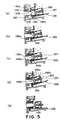
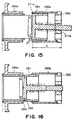
- Figure 5 shows the states of the joint pipe 180 and its adjacencies, and the joint opening 230 and its adjacencies, immediately before the joint pipe 180 is inserted into the joint opening 230, but after the ink container unit 200 was inserted into the holder 150 at an angle so that the joint opening 230 tilts slightly downward.
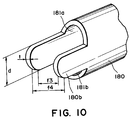
- the joint pipe 180 is provided with a sealing projection 180a, which is integrally formed with the joint pipe 180, and extends on the peripheral surface of the joint pipe 180, encircling the peripheral surface of the joint pipe 180. It is also provided with a valve activation projection 180b, which forms the tip of the joint pipe 180.
- the sealing projection 180a comes into contact with the joint sealing surface 260 of the joint opening 230 as the joint pipe 180 is inserted into the joint opening 230.
- the sealing projection 180a extends around the joint pipe 180 at an angle so that the distance from the uppermost portion of the sealing projection 180a to the joint sealing surface 260 becomes greater than the distance from the bottommost portion of the sealing projection 180a to the joint sealing surface 260.
- the material for the sealing projection 180a is desired to be such material that is slippery and yet capable of sealing between itself and an object it contacts.
- the configuration of the resilient member 263 for keeping the valve plug 26a pressed upon or toward the first valve body 260a does not need to be limited to a particular one; a springy member such as a coil spring or a plate spring, or a resilient member formed of rubber or the like, may be employed. However, in consideration of recycling, a resilient member formed of resin is preferable.
- valve activation projection 180b is yet to make contact with the valve plug 261, and the seal portion of the valve plug 261, provided at the periphery of the joint pipe 180, on the joint pipe side, is in contact with the seal portion of the first valve body 260a, with the valve plug 261 being under the pressure from the resilient member 263. Therefore, the ink container unit 200 remains airtightly sealed.
- the joint portion is sealed at the sealing surface 260 of the joint opening 230 by the sealing projection 180a.
- the sealing projection 180a comes into contact with the joint sealing surface 260, gradually increasing the size of the contact area toward the top side of the sealing projection 180a while sliding against the joint sealing surface 260.
- the top side of the sealing projecting 180a comes into contact with the joint sealing surface 260 as shown in Figure 5, (c).
- the sealing projection 180a makes contact with the joint sealing surface 260, by the entire peripheral surface, sealing the joint opening 230.
- valve activation projection 180b is not in contact with the valve plug 261, and therefore, the valve mechanism is not open.
- the gap between the joint pipe 180 and joint opening 230 is sealed, preventing ink from leaking from the joint opening 230 during the installation of the ink container unit 200.
- the joint opening 230 is gradually sealed from the bottom side of the joint sealing surface 260. Therefore, until the joint opening 230 is sealed by the sealing projection 180a, the air in the joint opening 230 is discharged through the gap between the sealing projection 180a and joint sealing surface 260. As the air in the joint opening 230 is discharged as described above, the amount of the air remaining in the joint opening 230 after the joint opening 230 is sealed is minimized, preventing the air in the joint opening 230 from being excessively compressed by the invasion of the joint pipe 180 into the joint opening 230, in other words, preventing the internal pressure of the joint opening 230 from rising excessively. Thus, it is possible to prevent the phenomenon that before the ink container unit 200 is completely installed into the holder 150, the valve mechanism is inadvertently opened by the increased internal pressure of the joint opening 230, and ink leaks into the joint opening 230.
- valve activation projection 180b pushes the valve plug 261 against the resiliency of the resilient member 263, with the joint opening 230 remaining sealed by the sealing projection 180a, as shown in Figure 5, (d).
- the internal space of the ink storing container 201 becomes connected to the internal space of the joint opening 230 through the opening 260c of the second valve body 26. Consequently, the air in the joint opening 230 is allowed to be drawn into the ink container unit 200 through the opening 260c, and the ink in the ink container unit 200 is supplied into the negative pressure controlling chamber shell 110 ( Figure 2).
- the negative pressure in the internal bladder 220 ( Figure 2) is reduced, for example, when an ink container unit 200 the ink in which has been partially consumed is re-installed. Therefore, the balance in the internal negative pressure between the negative pressure controlling chamber shell 110 and internal bladder 220 is improved, preventing the ink from being inefficiently supplied into the negative pressure controlling chamber shell 110 after the re-installation of the ink container unit 200.
- the ink container unit 200 is pushed down onto the bottom wall of the holder 150 to finish installing the ink container unit 200 into the holder 150 as shown in Figure 5, (e).
- the joint opening 230 is perfectly connected to the joint pipe 180, realizing the aforementioned state which assures that gas-liquid exchange occurs flawlessly.
- the opening 260c of the second valve body 260b is located adjacent to the valve body seal portion 264 and on the bottom side of the ink container unit 200.
- this opening 260 during the opening of the valve mechanism, more specifically, immediately after the valve plug 261 is moved toward the valve cover 262 by being pushed by the valve activation projection 180b, the ink in the ink container unit 200 begins to be supplied into the negative pressure controlling chamber unit 100. Also, it is possible to minimize the amount of the ink which remains in the ink container unit 200 when the ink container unit 200 needs to be discarded because the ink therein can no longer be drawn out.
- elastomer is used as the material for the joint sealing surface 260, that is, the seal portion, of the first valve body 260a.
- the flexibility of elastomer compensates for the effects of the misalignment, twisting, and/or rubbing, which occur at the contact point between the joint pipe 180 and valve plug 261 during the serial scanning movement of an ink jet head cartridge; it is doubly assured that the joint remains perfectly sealed.
- the joint sealing surface 260 the material for which is elastomer, can be integrally formed with the first valve body 260a, making it possible to provide the above described effects without increasing the number of components. Elastomer usage does not need to be limited to the above described structure; elastomer may also be used as the material for the sealing projection 180a of the joint pipe 180, the seal portion of the valve plug 261, and the like.
- valve plug 261 moves forward due to the resiliency of the resilient member 263, and presses on the seal portion of the first valve body 260a by its sealing surface to close the joint opening 230.
- the sealing projection 180a is disposed at an angle as described before, the unsealing of the joint opening 230 occurs from the top side of the sealing projection 180a.
- ink remains in the joint opening 230 and joint pipe 180.
- the bottom side remains sealed, preventing ink from leaking out of the joint opening 230.
- the internal pressure of the joint opening 230 and joint pipe 180 is negative, and therefore, as the joint is unsealed from the top side of the sealing projection 180a, the outside air enters into the joint opening 230, causing the ink remaining in the joint opening 230 and 180 to be drawn into the negative pressure controlling chamber shell 110.
- the joint opening 230 is sealed before the valve mechanism of the ink container unit 200 is activated, and therefore, ink is prevented from inadvertently leaking from the joint opening 230. Further, since a time lag is provided between the top and bottom sides of the sealing projection 180a in terms of the sealing and unsealing timing, the valve plug 261 is prevented from inadvertently moving during the connection, and the ink remaining in the joint opening 230 is prevented from leaking during the connection and during the removal.
- valve plug 261 is disposed in the joint opening 230, at a point deeper inside the joint opening 230, away from the outside opening of the joint opening 230, and the movement of the valve plug 261 is controlled by the valve activation projection 180b provided at the projecting end of the joint pipe 180. Therefore, a user is not required to touch the valve plug 261, being prevented from being contaminated by the ink adhering to the valve plug 261.
- Figures 4 and 5 are drawings for depicting the steps for installing the ink container unit 200 into the holder 150, wherein Figures 4, (a), (b), and (c), and Figure 5, (a), (b), and (c), correspondingly represent the same steps.
- Figures 4 and 5 show in detail the portion related to ID, and the joint portion, respectively.
- the ink container unit 200 is inserted up to the position illustrated in Figure 4, (a) and Figure 5, (a), at which the plurality of ID members 170 for preventing the ink container unit installation error make contact with the slanted wall 251 of the ink container.
- the holder 150 and ink container unit 200 are structured so that at this point in time, the joint opening 230 and joint pipe 180 do not make contact. If a wrong ink container unit 200 is inserted, the slanted surface 251 of the wrong ink container unit 200 collides with the ID members 170 at this point in time, preventing the wrong ink container unit 200 from being inserted further. With this structural arrangement, the joint opening 230 of the wrong ink container unit 200 never makes contact with joint pipe 180.
- the ink container unit 200 is a correct one, the positions of the ID members 170 match the positions of the ID member slots 252. Therefore, the ink container unit 200 is inserted a little deeper toward the negative pressure controlling chamber unit 100 to a position shown in Figure 4, (b). At this position, the joint sealing surface 260 of the joint opening 230 of the ink container unit 200 has come into contact with the bottom side of the sealing projection 180a of the joint pipe 180.
- the sealing projection 180a is an integral part of the joint pipe 180.
- the two components may be separately formed.
- the sealing projection 180a is fitted around the joint pipe 180, being loosely held by a projection formed on the peripheral surface of the joint pipe 180, or a groove provided in the peripheral surface of the joint pipe 180, so that the sealing projection 180a is allowed to move on the peripheral surface of the joint pipe 180.
- the joint portion is structured so that within the moving range of the independent sealing projection 180a, the valve action controlling projection 180b does not make contact with the valve plug 261 until the sealing projection 180a comes into contact with the joint sealing surface 260.
- the installation process may be such that, first, the top side of the sealing projection 180a comes into contact with the joint sealing surface 260, and as the ink container unit 200 is further inserted, the sealing projection 180a slides on the joint sealing surface 260, gradually expanding the contact range between the sealing projection 180a and the joint sealing surface 260, downward toward the bottom end of the sealing projection 180a, until the bottom end of the sealing projection 180a finally makes contact with the joint sealing surface 260a. Further, the contact between the sealing projection 180a and joint sealing surface 260 may occur simultaneously at both the top and bottom sides.
- the essential point of this invention is that the valve mechanism is opened only after the joint between the joint pipe 180 and joint opening 230 is completely sealed. According to this structure, it does not occur that the ink 300 within the ink container unit 200 leaks out during the installation of the ink container unit 200.
- the air pushed into the joint opening 230 enters the ink container unit 200, and pushes out the ink 300 in the ink storing container 201 into the joint opening 230, contributing to smoothly supplying ink from the ink storing container 201 into the absorbent material piece 140.
- Figure 6 is a sectional drawing for describing the ink supplying operation of the ink jet head cartridge illustrated in Figure 2.
- the absorbent material piece 130 remains pressed toward the absorbent material piece 140 by the ribs of the negative pressure controlling chamber cover 120, and therefore, the absorbent material piece 130 is kept in contact with the absorbent material piece 140, forming the interface 113c.
- the compression ratios of the absorbent material pieces 130 and 140 are higher adjacent to the interface 113c than those in the other portions, and therefore, the capillary force is greater adjacent to the interface 113c than that in the other portions.
- the hardness of the absorbent material pieces 130 and 140 is 0.69 kgf/mm.
- the method for measuring their hardness is such that, first, the resilient force generated as a pushing rod with a diameter of 15 mm is pushed against the absorbent material placed in the negative pressure controlling chamber shell 110 is measured, and then, the hardness is obtained from the relationship between the distance the pushing rod was inserted, and the measured amount of the resilient force correspondent to the distance.
- the same material as that for the absorbent material piece 140 that is, olefinic fiber, is used as the material for the absorbent material piece 130.
- the absorbent material piece 130 which is weaker in capillary force than the absorbent material piece 140, greater in hardness than the absorbent material piece 140, placing them in combination, and in contact, with each other, and keeping them pressed against each other, causes the absorbent material piece 140 to be kept more compressed than the absorbent material piece 130, adjacent to the interface 113c between the absorbent material pieces 130 and 140. Therefore, the aforementioned relationship in capillary force (P2 ⁇ P1 ⁇ PS) is established adjacent to the interface 113c, and also it is assured that the difference between the P2 and PS remains always greater than the difference between the P2 and P1.
- Figures 6 - 8 the outlines of the ink consuming process will be described from the time when the ink container unit 200 has been installed into the holder 150 and has become connected to the negative pressure controlling chamber unit 100, to the time when the ink in the ink storing container 201 begins to be consumed.
- Figure 7 is a drawing for describing the state of the ink during the ink consumption described with reference to Figure 6, and Figure 8 is a graph for depicting the effects of the deformation of the internal bladder 220 upon the prevention of the internal pressure change in the ink container unit 200.
- the ink in the ink storing container 201 moves into the negative pressure controlling chamber unit 100 until the internal pressure of the negative pressure controlling chamber unit 100 becomes equal to the internal pressure of the ink storing container 201, readying the ink jet head cartridge for a recording operation.
- the ink jet head unit 160 both the ink in the internal bladder 220 and the ink in the absorbent material piece 140 are consumed, maintaining such a balance that the value of the static negative pressure generated by the internal bladder 220 and absorbent material piece 140 increases (first state: range A in Figure 7, (a)).
- Figure 7, (a) is a graph for describing one of the examples of the rate at which the negative pressure in the ink delivery tube 165 varies.
- the axis of abscissa represents the rate at which the ink is drawn out of the negative pressure controlling chamber shell 110 through the ink delivery tube 160
- the axis of ordinates represents the value of the negative pressure (static negative pressure) in the ink delivery tube 160.
- gas is drawn into the internal bladder 220, allowing ink to be consumed, that is, drawn out, through gas-liquid exchange while the absorbent material pieces 130 and 140 keep the position of the gas-liquid interface L at about the same level, and keep the internal negative pressure substantially constant (second state: range B in Figure 7, (a)). Then, the ink remaining in the capillary pressure generating member holding chamber 110 is consumed (range C in Figure 7, (a)).
- the ink jet head cartridge in this embodiment goes through the stage (first stage) in which the ink in the internal bladder 220 is used without the introduction of the outside air into the internal bladder 220. Therefore, the only requirement to be considered regarding the internal volume of the ink storing container 201 is the amount of the air introduced into the internal bladder 220 during the connection. Therefore, the ink jet head cartridge in this embodiment has merit in that it can compensate for the ambient changes, for example, temperature change, even if the requirement regarding the internal volume of the ink storing container 201 is relaxed.
- the ink storing container 201 is replaced, it is assured that the proper amount of negative pressure is generated, and therefore, ink is reliably supplied. In other words, in the case of the ink jet head cartridge in this embodiment, the ink in the ink storing container 201 can be almost entirely consumed. In addition, air may be present in the joint pipe 180 and/or joint opening 230 when the ink container unit 200 is replaced, and the ink storing container 201 can be replaced regardless of the amounts of the ink retained in the absorbent material pieces 130 and 140.
- the ink jet head cartridge in this embodiment does not need to be provided with an ink remainder detection mechanism.
- Figure 7, (b) is a graph for describing the above described ink consumption sequence.
- the axis of abscissas represents the elapsed time
- the axis of ordinates represents the cumulative amount of the ink drawn out of the ink storing container, and the cumulative amount of the air drawn into the internal bladder 220. It is assumed that the rate at which the ink jet head unit 160 is provided with ink remains constant throughout the elapsed time.
- the ink consumption sequence will be described from the angles of the cumulative amount of the ink drawn out of the ink containing portion, and the cumulative amount of the air drawn into the internal bladder 220, shown in Figure 7, (b).
- the cumulative amount of the ink drawn out of the internal bladder 220 is represented by a solid line (1)
- the cumulative amount of the air drawn into the ink containing portion is represented by a solid line (2).
- a period from a time t0 to t1 corresponds to the period A, or the period before the gas-liquid exchange begins, in Figure 7, (a). In this period A, the ink from the absorbent material piece 140 and internal bladder 220 is drawn out of the head while balance is maintained between the absorbent material piece 140 and 220, as described above.
- the period from time t1 to time t2 corresponds to the gas-liquid exchange period (period B) in Figure 7, (b).
- the gas-liquid exchange continues according to the negative pressure balance, as described above.
- air is introduced into the internal bladder 220 (which corresponds to the stepped portions of the solid line (2)), as indicated by the solid line (1) in Figure 7, (b)
- ink is drawn out of the internal bladder 220.
- ink is drawn out of the internal bladder 220 a certain amount of time after the air introduction, by an amount equivalent to the amount of the introduced air.
- the period after the time t2 corresponds to the period (range C) after the gas-liquid exchange period in Figure 7, (a).
- this range C the internal pressure of the internal bladder 220 becomes substantially the same as the atmospheric pressure as stated before.
- the initial state pre-usage state
- the initial state is gradually restored by the resiliency of the internal bladder 220.
- the final amount Vc of the air drawn into the internal bladder 220 is smaller than the initial internal volume of the internal bladder 220 (V > Vc). Even in the state within the range C, the ink in the internal bladder 220 can be completely consumed.
- the structure of the ink jet head cartridge in this embodiment is characterized in that the pressure fluctuation (amplitude ⁇ in Figure 7, (a)) which occurs during the gas-liquid exchange in the ink jet head cartridge in this embodiment is greater compared to that in an ink jet head cartridge which employs a conventional ink container system in which gas-liquid exchange occurs.
- the reason for this characteristic is that before the gas-liquid exchange begins, the internal bladder 220 is deformed, and kept deformed, by the drawing of the ink from inside the internal bladder 220. Therefore, the resiliency of the internal bladder material continuously generates such force that works in the direction to move the wall of the internal bladder 220 outward. As a result, the amount of the air which enters the internal bladder 220 to reduce the internal pressure difference between the absorbent material piece 140 and internal bladder 220 during the gas-liquid exchange often exceeds the proper amount, as described, increasing the amount of the ink drawing out of the internal bladder 220 into the external shell 210.
- the ink container unit 200 is structured so that the wall of the ink containing portion does not deform as does the wall of the internal bladder 220, ink is immediately drawn out into the negative pressure controlling chamber unit 100 as soon as a certain amount of air enters the ink containing portion.
- a large amount of ink is ejected all at once from the ink jet head unit 160, causing ink to be rapidly drawn out of the negative pressure controlling chamber unit 100 and ink storing container 201.
- the amount of the ink drawn out through gas-liquid exchange is relative large, improving the reliability, that is, eliminating the concern regarding the interruption of ink flow.
- ink is drawn out with the internal bladder 220 remaining deformed inward, providing thereby an additional benefit in that the structure offers a higher degree of buffering effect against the vibration of the carriage, ambient changes, and the like.
- the slight changes in the negative pressure can be eased by the internal bladder 220, and even when air is present in the internal bladder 220, for example, during the second stage in the ink delivery, the ambient changes such as temperature change can be compensated for by a method different from the conventional methods.
- the absorbent material pieces 130 and 140 may be called a capillary force generating member.
- the walls or the like portions of the internal bladder 220, and the liquid surface in the internal bladder 220 are subjected to pressure.
- the internal volume of the internal bladder 220 increase, but also a portion of the ink in internal bladder 220 flows out into the negative pressure controlling chamber shell 110 from the internal bladder 220 through the joint pipe 180.
- the internal volume of the internal bladder 220 increases, the amount of the ink that flows out into the absorbent material piece 140 in the case of this embodiment is substantially smaller compared to a case in which the ink storage portion is undeformable.
- the aforementioned changes in the atmospheric pressure ease the negative pressure in the internal bladder 220 and increase the internal volume of the internal bladder 220. Therefore, initially, the amount of the ink which flows out into the negative pressure controlling chamber shell through the joint opening 230 and joint pipe 180 as the atmospheric pressure suddenly changes is substantially affected by the resistive force generated by the internal bladder wall as the inward deformation of the wall portion of the internal bladder 220 is eased, and by the resistive force for moving the ink so that the ink is absorbed by the capillary force generating member.
- the flow resistance of the capillary force generating members is greater than the resistance of the internal bladder 220 against the restoration of the original state. Therefore, as the air expands, initially, the internal volume of the internal bladder 220 increases. Then, as the amount of the air expansion exceeds the maximum amount of the increase in the internal volume of the internal bladder 220 afforded by the internal bladder 220, ink begins to flows from within the internal bladder 220 toward the negative pressure controlling chamber shell 110 through the joint opening 230 and joint pipe 180. In other words, the wall of the internal bladder 220 functions as the buffer against the ambient changes, and therefore, the ink movement in the capillary force generating member calms down, stabilizing the negative pressure adjacent to the ink delivery hole 165.
- the ink which flows out into the negative pressure controlling chamber shell 110 is retained by the capillary force generating members.
- the amount of the ink in the negative pressure controlling chamber shell 110 increases temporarily, causing the gas-liquid interface to rise, and therefore, in comparison to when the internal pressure is stable, the internal pressure temporarily becomes slightly positive, as it is initially.
- the effect of this slightly positive internal pressure upon the characteristics of a liquid ejection recording means such as the ink jet head unit 160, in terms of ejection creates no practical problem.
- the ink which leaked out into the negative pressure controlling chamber shell 110 and has been retained in the capillary force generating members returns to the internal bladder 220, and the internal bladder 220 restores its original internal volume.
- the amount of the ink which flows out of the internal bladder 220 under the worst conditions may be estimated based on the following assumption. For example, a situation in which the amount of the ink which flows out of the internal bladder 220 becomes the maximum when the lowest level to which the value of the atmospheric pressure decreases is 0.7, is when the volume of the ink remaining in the internal bladder 220 equals 30 % of the volumetric capacity VB of the internal bladder 220. Therefore, presuming that the ink below the bottom end of the wall of the internal bladder 220 is also absorbed by the capillary force generating members in the negative pressure controlling chamber shell 110, it may be expected that the entirety of the ink remaining in the internal bladder 220 (equals in volume to 30 % of the volumetric capacity VB) leaks out.
- the internal bladder 220 deforms in response to the expansion of the air.
- the internal volume of the internal bladder 220 is greater after the expansion, and the ink level in the negative pressure controlling chamber shell 110 changes to compensate for the fluctuation of the negative pressure in the internal bladder 220.
- the ink level in the negative pressure controlling chamber shell 110 changes to compensate for the decrease in the negative pressure in the capillary force generating members, in comparison to the negative pressure in the capillary force generating members before the change in the atmospheric pressure, caused by the ink from the internal bladder 220.
- the amount of the ink which flows out decreases in proportion to the amount of the expansion of the internal bladder 220, as depicted by a solid line (2).
- the amount of the ink which flows out of the internal bladder 220 may be estimated to be smaller compared to that in the case in which the internal bladder 220 does not deform at all in response to the expansion of the air.
- the above described phenomenon similarly occurs in the case of the change in the temperature of the ink container, except that even if the temperature increases approximately 50 degrees, the amount of the ink outflow is smaller than the aforementioned amount of the ink outflow in response to the atmospheric pressure decrease.
- the ink container in accordance with the present invention can compensate for the expansion of the air in the ink storing container 201 caused by the ambient changes not only because of the buffering effect provided by the negative pressure controlling chamber shell 110, but also because of the buffering effect provided by the ink storing container 201 which is enabled to increase in its volumetric capacity to the maximum value at which the shape of the ink storing container 201 becomes substantially the same as the shape of the internal space of the external shell 210. Therefore, it is possible to provide an ink supplying system which can compensate for the ambient changes even if the ink capacity of the ink storing container 201 is substantially increased.
- Figure 8 (b) schematically shows the amount of the ink drawn out of the internal bladder 220 and the internal volume of the internal bladder 220, in relation to the length of the elapsed time, when the ambient pressure is reduced from the normal atmospheric pressure to the pressure value of P (0 ⁇ P ⁇ 1).
- the initial volume of the air is VA1
- a time t0 is a point in time at which the ambient pressure is the normal atmospheric pressure, and from which the reduction in the ambient pressure begins.
- the axis of abscissas represents time (t) and the axis of ordinates represents the amount of the ink drawn out of the internal bladder 220 and the internal volume of the internal bladder 220.
- an ink supplying system capable of supplying ink under the stable negative pressure condition during the usage of the ink storing container 201, while compensating the expansion of the air introduced in the ink storing container 201 through gas-liquid exchange, under various usage conditions.
- the volumetric ratio between the negative pressure controlling chamber shell 110 and internal bladder 220 can be optimally set by optionally selecting the material for the capillary force generating members (ink absorbent pieces 130 and 140), and the material for the internal bladder 220; even if the ratio is greater than 1:2, practical usage is possible.
- the material for the capillary force generating members ink absorbent pieces 130 and 140
- the material for the internal bladder 220 even if the ratio is greater than 1:2, practical usage is possible.
- all that is necessary is to increase, within the range in which the elastic deformation is possible, the amount of the deformation of the internal bladder 220 during the gas-liquid exchange, relative to the initial state.
- the capillary force generating members occupies only a small portion of the internal volume of the negative pressure controlling chamber shell 110, it is still effective to compensate for the changes in the ambient condition, by synergistically working with the structure of the negative pressure controlling chamber shell 110.
- the joint pipe 180 is located adjacent to the bottom end of the negative pressure controlling chamber shell 110. This arrangement is effective to reduce the uneven distribution of the ink in the absorbent material pieces 130 and 140 in the negative pressure controlling chamber shell 110. This effect will be described below in detail.
- the ink from the ink container unit 200 is supplied to the ink jet head unit 160 through the joint opening 230, absorbent material piece 130, and absorbent material piece 140.
- the ink takes a different path depending on the situation.
- the shortest path that is, the path taken by the ink in a situation in which the ink is directly supplied, is substantially different from the path taken in a situation in which the ink goes, first, to the top of the absorbent material piece 140 due to the rise of the liquid surface of the absorbent material piece 140 caused by the aforementioned ambient changes. This difference creates the aforementioned uneven ink distribution, which sometimes affects recording performance.
- This variation in the ink path that is, the difference in the length of the ink path, can be reduced to reduce the unevenness of the ink distribution, by positioning the joint pipe 180 adjacent to the absorbent material piece 140, as it is according to the structure of the ink jet head cartridge in this embodiment, so that the unevenness in the recording performance is reduced.
- the joint pipe 180 and joint opening 230 are placed as close as possible to the top portion.
- the absorbent material piece 140 which generates a capillary force with a value of P1 and the absorbent material piece 130 which generates a capillary force with a value of P2 are placed in the negative pressure controlling chamber shell 110, in contact with each other, in a compressed state, generating a capillary force with a value of PS.
- the relationship in the strength among these capillary forces is: P2 ⁇ P1 ⁇ PS.
- the capillary force generated at the interface 113c is the strongest, and the capillary force generated in the absorbent material piece 130, or the absorbent material piece on the top side, is the weakest.
- the capillary force generated at the interface 113c is the strongest, and the capillary force generated in the absorbent material piece 130, or the absorbent material piece on the top side, is the weakest, even if the ink supplied through the joint opening 230 flows into the absorbent material piece 130 on the top side past the interface 113c, the ink is pulled with strong force toward the interface 113c, and moves back toward the interface 113c. With the presence of this interface 113c, it does not occur that the path J forms a line through both the absorbent material pieces 140 and 130. For this reason, in addition to the fact that the position of the joint opening 230 is higher than that of the supply opening 131, the difference in length between the path K and path J can be reduced. Therefore, it is possible to reduce the difference in the effect which ink receives from the absorbent material piece 140, which occurs as the ink path through the absorbent material pieces 140 varies.
- the ink absorbing member as the negative pressure generating member placed in the negative pressure controlling chamber shell 110 comprises two pieces 130 and 140 of absorbent material, which are different in capillary force.
- the piece with stronger capillary force is used as the piece for the bottom side.
- the positioning of the joint pipe 180 below, and adjacent to, the interface 113c between the absorbent material pieces 130 and 140 assures that the shifting of the ink path is controlled while providing a reliable buffering zone.
- the ink delivery port 131 located at the approximate center of the bottom wall of the negative pressure controlling chamber shell 110 is described as an example.
- the choice is not limited to the ink delivery port 131; if necessary, an ink delivery port may be moved away from the joint opening 230; in other words, it may be positioned at the left end of the bottom wall, or adjacent to the left sidewall.
- the position of the ink jet head unit 160, with which the holder 150 is provided, and the position of the ink delivery tube 165 may also be correspondingly altered to the left end of the bottom wall, or the adjacency of the left sidewall.
- Figure 9, (a) is a front view of the relationship between the second valve body 260b and valve plug 261;
- Figure 9, (d) is a lateral and vertically sectional view of the second valve body 260b and valve plug 260 illustrated in Figure 9, (c).
- the front end of the joint opening 230 is elongated in one direction, enlarging the cross-sectional area of the opening, to enhance the ink supplying performance of the ink storing container 201.
- the joint opening 230 is widened in the width direction perpendicular to the lengthwise direction of the joint opening 230, the space which the ink storing container 201 occupies increases, leading to increase in the apparatus size.
- This configuration is particularly effective when a plurality of ink containers are placed side by side in terms of the widthwise direction (direction of the scanning movement of the carriage), in parallel to each other, to accommodate the recent trends, that is, colorization and photographic printing. Therefore, in this embodiment, the shape of the cross section of the joint opening 230, that is, the ink outlet of the ink storing container 201 is made oblong.
- the joint opening 230 has two roles: the role of supplying the external shell 210 with ink, and the role of guiding the atmospheric air into the ink storing container 201.
- the fact that the shape of the cross section of the joint opening 230 is oblong in the direction parallel to the gravity direction makes it easier to give the top and bottom sides of the joint opening 230 different functions, that is, that is, to allow the top side to essentially function as the air introduction path, and the bottom side to essentially function as the ink supply path, assuring that gas-liquid exchange occurs flawlessly.
- the joint pipe 180 of the negative pressure controlling chamber unit 100 is inserted into the joint opening 230.
- the valve plug 261 is pushed by the valve activation projection 180b located at the end of the joint pipe 180. Consequently, the valve mechanism of the joint opening 230 opens, allowing the ink in the ink storing container 201 to be supplied into the negative pressure controlling chamber unit 100.
- valve activation projection 180b misses the exact center of the valve plug 261 as it comes into contact with the valve plug 261 to push it, because of the attitude of the ink container unit 200 when the ink container unit 200 is engaged with the joint opening 230, the twisting of the valve plug 261 can be avoided because the cross section of the end portion of the sealing projection 180a placed on the peripheral surface of the joint pipe 180 is semicircular.
- a clearance 266 is provided between the joint sealing surface 260 in the joint opening 230, and the circumference of the first valve body side of the valve plug 261.
- the top portion has an opening, and therefore, when the joint pipe 180 is inserted into the joint opening 230, there is no hindrance to the formation of the essential air introduction path through the top sides of the joint pipe 180 and joint opening 230. Therefore, an efficient gas-liquid exchange is possible.
- the valve plug 261 is slid forward, that is, toward the first valve body 260a, by the resilient force which it receives from the resilient member 263. As a result, the seal portion 264 of the first valve body 260a and the valve plug 261 engage with each other, closing the ink supply path, as shown in Figure 9, (d).
- Figure 10 is a perspective view of the end portion of the joint pipe 180, and depicts an example of the shape of the end portion.
- the top side of the end portion of the joint pipe 180 with the aforementioned oblong cross section is provided with an opening 181a
- the bottom side of the end portion of the joint pipe 180 is provided with an opening 181b.
- the bottom side opening 181b is an ink path
- the top side opening 181a is an air path, although ink is occasionally passed through the top side opening 181a.
- the value of the force applied to the valve plug 261 by the resilient member to keep the valve plug 261 in contact with the first valve body 260a is set so that it remains substantially the same even if a pressure difference occurs between the inside and outside of the ink storing container 201 due to the changes in the environment in which the ink storing container 201 is used. If the valve plug 261 is returned to the closed position after the above described ink container unit 200 is used at high altitude with an atmospheric pressure of 0.7, and then, the ink container unit 200 is carried to an environment with an atmospheric pressure of 1.0, the internal pressure of the ink storing container 201 becomes lower than the atmospheric pressure. As a result, the valve plug 261 is pressed in the direction to open the valve mechanism.
- This value applies to a situation in which the valve plug 261 is in contact with the first valve body 260a, under pressure.
- the valve plug 261 is apart from the first valve body 260a, that is, after the amount of the deformation of the deformation of the resilient member 26e for generating the force applied to the valve plug 261 has increased, the value of the force applied to the valve plug 261 by the resilient member 263 in the direction to push the valve plug 261 toward the first valve body 260a is greater, which is evident.
- valve plug 261 fails to slide on the surface of the valve activation projection 180b upon which it was intended to slide.
- the valve plug 261 strokes while being pushed, being thereby twisted, in the upward direction in the drawing by the valve activation projection 180b.
- Figure 11 shows an example of a valve mechanism, which is compared with the valve mechanism in this embodiment.
- Figures 12 and 13 show the twisting in the valve mechanism illustrated in Figure 11, and the state in which the joint is sealed.
- a clearance 506 provided between a valve plug 501 with an oblong cross section and a second valve body 500b to facilitate the stroking of the valve plug 501 is even.
- the valve plug 501 is pressed upon a first valve body 500a by a resilient member 503 to keep the sealing surface 501c of the valve plug 501, that is, the surface of the tapered, second valve body side of the valve plug 501, tightly in contact with the tapered seal portion 500c of the first valve body 500a, to seal a joint opening 530.
- the valve plug 501 makes contact with the second valve body 500b at two areas, that is, a contact surface 510a and a contact surface 511b.
- the second valve body 500b and a valve cover 502 are welded by ultrasonic waves.
- the valve cover in the comparative example is a simple flat one, raising the possibility that the ultrasonic waves causes misalignment, that is, the accuracy with which the center hole of the valve cover 502, though which the sliding axis 501a of the valve plug 501 is put, varies, making it necessary to enlarge the center hole of the valve cover 502 to prevent the wall of the hole of the valve cover 502 from contacting the sliding axis 501a of the valve plug 501. Consequently, it becomes difficult to reduce the size of the resilient member 503, and therefore, it becomes difficult to reduce the size of the entirety of the valve mechanism, because the minimum diameter of the resilient member 503 is dependent upon the diameter of the hole of the valve cover 502.
- valve mechanism in this embodiment has the following structure.
- Figure 14 shows the valve mechanism in this embodiment of the present invention
- Figures 15 and 16 show the twisting of the valve mechanism in Figure 14, and the state of the relationship between the two seal portions.
- the valve plug 261 is tapered in terms of the stroke direction (rightward direction in the drawing); the diameter (at least, length of the major axis) of the valve plug 261 gradually reduces in terms of the rightward direction.
- the interior wall of the second valve body 260b is tapered so that its diameter gradually increases in terms of the stroke (rightward) direction.
- the twist angle ⁇ is extremely small compared to the comparative example; the interfaces between the seal portion 265 of the valve plug 261 and the seal portion 264 of the first valve body 260a are better sealed.
- the valve cover 252 is provided with a valve cover welding guide 262a, which is a stepped portion (depth of penetration by the valve cover: 0.8 mm), and comes in contact with the edge of the second valve body 260b as the valve cover 252 is pushed into the second valve body 260b. Therefore, the hole of the valve cover 262, through which the sliding axis of the valve plug 261 is put, is rendered smaller than that in the comparative example.
- the provision of the valve cover 262 with the welding guide 262a reduces the amount of the misalignment between the second valve body 260b and the valve cover 262 which is caused by the vibrations occurring during the welding between the two components, and therefore, the accuracy with which the hole of the valve cover 262 is positioned is improved.
- valve cover 262 it becomes possible to reduce the diameter of the hole of the valve cover 262, which makes it possible to reduce the diameter of the resilient member 263. Consequently, it becomes possible to reduce the size of the valve mechanism. Further, even if force is applied by the valve plug 261 through the sliding axis of the valve plug 261 due to the twisting of the valve plug 261, the rigidity of the valve cover 262 is secured by the valve cover welding guide 262a.
- the ridge line portion of the hole of the valve cover 262 is provided with an R portion 262b.
- This R portion 262b is provided at only the ridge line on the non-welding surface side (right-hand side in the drawing).
- Flattening the seal portion of the valve plug 261 and first valve body 260a equalizes the contact radii of the valve plug 261 having the oblong cross section, with the R portion of the first valve body 260a; perfect contact is made between the valve plug 261 and first valve body 260a.
- the seal portion 264 of the first valve body 260a is shaped like a tongue sticking out of a mouth, assuring further that the interfaces between the two components are flawlessly sealed.
- valve plug 261 rotates about its axis, within the second valve body 260b, during the installation or removal of the ink container unit 200, as shown in Figure 9, (c).
- the contact between the valve plug 261 and first valve body 260a is by their seal portions 265 and 264, respectively; in other words, the contact is made surface to surface. Therefore, it is assured that the valve mechanism is airtightly sealed.
- the joint opening 230 and valve mechanism are shaped so that their cross sections become oblong, the rotational angle of the valve plug 261 during the sliding of the valve plug 261 can be minimized, and also, the valve response can be improved. Therefore, it is possible to assure that the valve mechanism of the joint opening 230 flawlessly functions in terms of sealing performance. Further, since the joint opening 230 and valve mechanism are shaped so that their cross sections become oblong, the projection 180a for sealing, provided on the peripheral surface of the joint opening 230, and the valve plug 261, swiftly slide through the joint opening 230 during the installation or removal of the ink container unit 200, assuring that the connecting operation ensues smoothly.
- the end portion of the joint opening 230 which makes contact with the valve plug 261, comprises two symmetrical absorbent material pieces180b.
- the opening 181a for gas-liquid exchange on the top side of the end portion of the joint opening 230, and the opening 181b for supplying liquid, on the bottom side. Therefore, a study was made regarding the idea of providing the valve plug 261 with a pair of contact ribs 310 as counterparts to the projection 180b, which are to be positioned on the areas excluding the sealing portion 265 which is placed tightly in contact with the sealing portion 264 of the first valve body 260a, as shown in Figure 17, (c) and (d).
- the rib portions are required to have a certain amount of rigidity, high enough to prevent the deformation of the rib portions.
- the positioning and shapes of the contact rib portions it is required, from the viewpoint of reliability, that even if the positions of the contact rib portions of the valve plug 261 shift in the radial direction of the sliding axis of the valve plug 261, relative to the two valve activation projections 180b of the joint pipe 180, the moments which generate at the two contact rib portions which oppose each other across the sliding axis 261a, cancel each other.
- the valve plug 261 is provided with a circular rib 311 (0.6 mm in width and 1.3 mm in height), which is similar in cross section to the joint pipe 180 which has the oblong cross section, as shown in Figure 17, (a) and (b).
- the surface of the valve plug 261, on the first valve body side, excluding the sealing portion 265 which is placed in contact with the sealing portion 264 of the first valve body 500a, is provided with an oblong recess 311a, the center of which coincides with the axial line of the valve plug 261.
- This structure provides the valve plug 261 with the strength and reliability required when the valve activation projection 180b makes contact with the valve plug 261.
- the ID member 250 is attached by welding and interlocking, after the valve mechanism comprising the first valve body 260a and second valve body 260b is inserted into the ink delivery opening of the ink storing container 201.
- the internal bladder 220 is exposed at the edge of the opening of the ink delivery opening of the ink storing container 201, and the flange 268 of the first valve body 260a of the valve mechanism is welded to this exposed portion 221a of the internal bladder 220.
- the ID member 250 is welded at the location of the flange 268, and is interlocked with the engagement portions 201a of the container external shell 210.
- the flange 508 of the first valve body, to which the ID member 550 is attached is flat as it is in the case of the comparative example illustrated in Figure 11; the elastomer layer 567 is not exposed at the edge of the ink delivery opening with which the ID member 550 is provided, and therefore, there is a possibility that seal leakage may occur during the process, illustrated in Figure 5, for connecting the joint pipe 180.
- the welding surface of the flange 508 of the first valve body, to which the ID member 550 is welded, and which was in the same plane as the plane of the opening of the joint opening 530, has been moved in the direction opposite to the container installation direction.
- the first valve body flange 268 is positioned so that when the ID member 250 is glued to the first valve body flange 268 as shown in Figures 2, 14, and the like, the plane of the external surface of the ID member 250 coincides with the plane of the opening of the joint opening 230.
- This structural arrangement assures the presence of the elastomer layer 267 inside the ink delivery hole with which the ID member 250 is provided, rendering the valve mechanism into a highly reliable one which allows no possibility of the aforementioned seal leakage.
- the opening portion of the joint opening 230 protrudes from the surface of the first valve body flange 268. Therefore, when the ID member 250 is attached, the position of the ID member is guided by the opening portion of the joint opening 230, making it easier to accurately position the ID member 250.
- Each ink storing container 201 of the ink container unit 200 in this embodiment is installed into the holder 150, and supplies the correspondent negative pressure controlling chamber shell 110 with ink through the joint pipe 180 and the valve mechanism of the joint opening 230 of the container 201.
- the holder 150 holding the ink storing containers201 as described above is mounted on the carriage of a serial scanning type recording apparatus ( Figure 24) and is moved back and forth in the direction parallel to the plane of recording paper.
- the thickness of the elastomer layer 267 in the first valve body 260a of the valve mechanism shown in Figure 2, 14, and the like is made greater than the minimum requirement for sealing between the first valve body 260a and joint pipe 180, so that the run out of the shaft and the twisting, which occur at the location of the joint pipe connection during the reciprocal movement of the carriage, can be neutralized by the elasticity of the elastomer layer, to ensure a high level of reliability in terms of sealing performance.
- the rigidity of the valve body into which the joint pipe 180 is inserted may be rendered greater than the rigidity of the joint pipe 180, so that the deformation of the valve body, which is caused by the run out of the shaft and the twisting, which occur at the location of the joint pipe connection during the reciprocal movement of the carriage, can be controlled, to ensure a high level of reliability in terms of sealing performance.
- the dimension e5 of the valve plug 261 in the longitudinal direction is 5.7 mm; the distance e3 from the sealing portion 265 of the valve plug 261 to the sliding axis 261a of the valve plug 261, 14.4 mm; distance e1 from the second valve body 260b to the inside surface of the valve cover 262, 8.7 mm; distance e2 from the second valve body 260b to the outside surface of the valve cover 262, 11.0 mm; length e4 of the opening between the first valve body 260a and second valve body 260b, 3.0 mm; the distance e6 the rib protrudes from the sealing portion 265 of the valve plug 261, 1.3 mm; the length l2 of the valve cover welding guide 262a, 0.8 mm; dimension b1 of the sealing portion 265 of the valve plug 261 in the longitudinal direction, 9.7 mm; dimension b2 of the valve plug 261, on the valve cover side, in the longitudinal direction, 9.6 mm; dimension a1 of the second valve body
- the length g1 of the sealing portion 264 of the first valve body is set at 0.8 mm; it is desired that the length g1 is sufficient to allow the sealing portion 264 of the first valve body to protrude far enough from the valve body so that the sealing portion 264 bends outward and perfectly seals the gap as it makes contact with the sealing portion 265 of the sealing portion 264 of the valve plug 261.
- the length g1 of the sealing portion of the first valve body has only to be within a range which satisfies the following inequality: (g3 - g2)/2 > g1 > (b1 - g2)/2.
- the thicknesses t of the joint pipe 180 and rib 211 are 0.75 mm; distance f3 between the inside surfaces of the opposing valve activation projection 180b, 1.7 mm; distance f4 between the outside surfaces of the opposing valve activation projection 180b, 3.2 mm; distance f1 between the outside surfaces of the oblong rib 311 of the valve plug 261 at the short axis of the oblong rib 311, 2.6 mm; distance f2 between the inside surfaces of the rib 311 at the short axis, 1.4 mm; and the length d of the rib 311 is 3.6 mm.
- the thickness u2 of the elastomer layer 267 on the inside surface of the first valve body 260a with the oblong cross section is even; the thickness at the curved portion and the thickness at the straight portion are the same.
- the exterior diameter g5 of the joint pipe 180 in the vertical direction is smaller than the internal diameter g2 of the elastomer layer 267: g5 ⁇ g2, and this relationship also applies to the horizontal direction: g5 ⁇ g2.
- the elastomer layer comes into contact with only the sealing projection 180a of the joint pipe 180, allowing the joint pipe 180 to be smoothly inserted, to perfectly seal the joint.
- the play in the horizontal direction between the ink storing container 201 and holder 150 has only to be in a range ( ⁇ 0.8 mm in this embodiment) in which the play can be absorbed by the thickness of the elastomer layer 267.
- the maximum tolerance of the play is set at ⁇ 0.4 mm.
- the external surface of the joint pipe 180 exclusive of the external surface of the sealing portion 180a, contacts the elastomer layer 267 across a wide range, and presses thereupon. Therefore, the resiliency of the elastomer generates centering force.
- the deformation of the internal bladder 220, adjacent to the joint opening 230 is regulated by the portion of the valve mechanism, which has been deeply inserted into the internal bladder 220, that is, the valve cover 262 and second valve body 260b.
- the ink container unit 200 comprising the internal bladder 220 deformable as described above, or the ink jet head cartridge equipped with the negative pressure controlling chamber unit 100
- the joint opening 230 of the ink container unit 200 may be enlarged. Obviously, it is desired that there is a large space in the region adjacent to the joint opening 230 of the internal bladder 220, and that ample ink supply path is secured in this region.
- the deformation of the internal bladder 220 is increased to secure the buffering space in the external shell 210 which contains the internal bladder 220, normally, the space adjacent to the joint opening 230 in the internal bladder 220 narrows as the internal bladder 220 deforms. If the space adjacent to the joint opening 230 in the internal bladder 220 narrows, the bubbles are prevented from rising in the internal bladder 220, and the ink supply path adjacent to the joint opening 230 is shrunk, raising the possibility that they will fail to compensate for the high speed ink delivery.
- the amount of the deformation of the internal bladder 220 must be kept within a range in which the deformation does not substantially affect the ink delivery, so that balance is maintained between the negative pressure in the internal bladder 220 and the negative pressure in the negative pressure controlling chamber shell 110, to compensate for the high speed ink delivery.
- the valve mechanism protrudes deeply into the internal bladder 220 as described above, and the deformation of the internal bladder 220, adjacent to the joint opening 230, is regulated by the valve mechanism. Therefore, even if the deformation of the internal bladder 220 is increased, the region adjacent to the joint opening 230, that is, the region through which the ink supply path leads to the joint opening 230, is secured by sufficient size, making it possible to accomplish both objects: securing a large buffering space in the external shell 210, and securing an ink delivery path capable of accommodating high speed ink delivery.
- an electrode 270 used as an ink remainder amount detecting means for detecting the amount of the ink remaining in the internal bladder 220, as will be described later, is positioned below the bottom portion of the ink container unit 200 of the above described ink jet head cartridge.
- the electrode 270 is fixed to the carriage of a printer into which the holder 150 is installed.
- the joint opening 230 to which the valve mechanism is attached is located in the bottom portion of the ink container unit 200, adjacent to the front wall, that is, the wall on the negative pressure controlling chamber unit side.
- the valve mechanism is inserted deep into the internal bladder 220 in the direction approximately parallel to the bottom surface of the ink container unit 200, and therefore, when the internal bladder 220 deforms, the deformation of the bottom portion of the internal bladder 220 is regulated by the deeply inserted portion of the valve mechanism.
- the deformation of the bottom portion of the internal bladder 220 during the deformation of the internal bladder 220 is regulated also by the slanting of a part of the bottom portion of the ink storing container 201 comprising the external shell 110 and internal bladder 220.
- the above described regulation of the deformation of the internal bladder 220, adjacent to the joint opening 230, by the valve mechanism makes it possible to obtain a liquid supplying system capable of more accurately detecting the ink remainder amount, in addition to accomplishing the two objectives of securing a large buffering space in the external shell 210 by increasing the deformation of the internal bladder 220, and supplying ink at a high rate.
- the valve mechanism is inserted deeper into the internal bladder 220 so that the deformation of the internal bladder 220, adjacent to the joint opening 230, is regulated as described above, but a member different from the valve mechanism may be inserted into the internal bladder 220 to regulate the deformation of the aforementioned portion of the internal bladder 220. Further, a piece of plate may be inserted into the internal bladder 220 through the joint opening 230 so that the piece of plate stretches along the bottom surface of the internal bladder 220. With this arrangement, more accurate ink remainder amount detection can be carried out when the ink remainder amount in the internal bladder 220 is detected with the use of the electrode 270.
- the structural components of the valve mechanism protrude far deeper into the internal bladder 220, beyond the opening 260c which is connected to the joint opening 230 to form an ink path.
- the exposed portion 221a of the internal bladder 220 of the ink storing container 201 is directed upward, and the ink 401 is injected into the ink storing container 201 with the use of an ink injection nozzle 402 through the ink delivery opening.
- ink injection can be performed under the atmospheric pressure.
- valve plug 261, valve cover 262, resilient member 263, first valve body 260a, and second valve body 260b are assembled together into a valve unit, and then, this valve unit is dropped into the ink delivery opening of the ink storing container 201.
- the periphery of the sealing surface 102 of the ink storing container 201 is surrounded by the stepped shape of the first valve body 260a, on the outward side of the welding surface, making it possible to improve the positional accuracy with which the ink storing container 201 and first valve body 260a are positioned relative to each other.
- the present invention is applicable to a production method which uses ultrasonic welding or vibration welding, as well as a production method which uses thermal welding, adhesive, or the like.
- the ID member 250 is placed on the ink storing container 201 to which the first valve body 260a has been welded, in a manner to cover the ink storing container 201.
- the engagement portions 210a formed in the side wall of the external shell of the ink storing container 201, and the click portions 250a of the ID member 250 engage, and at the same time, the click portions 250a located on the bottom surface side engage, with the external shell 210, on the side opposite to the sealing surface 102 of the ink storing container 201, with the first valve body 260a interposed (Figure 3).
- the electrode 270 in the form of a piece of plate with a width narrower than the width of the ink storing container 201 (depth direction of the drawing) is provided.
- This electrode 270 is fixed to the carriage (unillustrated) of the printer, to which the holder 150 is attached, and is connected to the electrical control system of the printer through the wiring 271.
- the ink jet head unit 160 comprises: an ink path 162 connected to the ink delivery tube 165; a plurality of nozzles (unillustrated) equipped with an energy generating element (unillustrated) for generating the ink ejection energy; and a common liquid chamber 164 for temporarily holding the ink supplied through the ink path 162, and then, supplying the ink to each nozzle.
- Each energy generating element is connected to a connection terminal 281 with which the holder 150 is provided, and as the holder 150 is mounted on the carriage, the connection terminal 281 is connected to the electrical control system of the printer.
- the recording signals from the printer are sent to the energy generating elements through the connection terminal 281, to give ejection energy to the ink in the nozzles by driving the energy generating elements.
- ink is ejected from the ejection orifices, or the opening ends of the nozzles.
- an electrode 290 is disposed, which is connected to the electrical control system of the printer through the same connection terminal 281.
- These two electrodes 270 and 290 constitute the ink remainder amount detecting means in the ink storing container 201.
- the joint opening 230 of the ink container unit 200 is located in the bottom portion, that is, the bottom portion when in use, in the wall of the ink storing container 201, between the largest walls of the ink storing container 201. Further, a part of the bottom wall of the ink supplying container 201 is slanted so that the bottom surface holds an angle relative to the horizontal plane when the ink storing container 201 is in use.
- the bottom wall is rendered parallel to the horizontal plane, whereas in the region therefrom to the rear end, the bottom wall is slanted upward toward the rear.
- this angle at which the bottom wall of the ink storing container 201 is obtuse relative to the rear sidewall of the ink container unit 200 it is set to be no less than 95 degrees.
- the electrode 270 is given a shape which conforms to the shape of the bottom wall of the ink storing container 201, and is positioned in the area correspondent to the slanted portion of the bottom wall of the ink storing container 201, in parallel to the slanted portion.
- the ink remainder amount detection is carried out by detecting the capacitance (electrostatic capacity) which changes in response to the size of the portion of the electrode 270 correspondent to where the body of the remaining ink is, while applying pulse voltage between the electrode 270 on the holder 150 side and the electrode 290 in the common liquid chamber 164.
- the presence or absence of ink in the ink storing container 201 can be detected by applying between the electrodes 270 and 290, such pulse voltage that has a peak value of 5V, a rectangular wave-form, and a pulse frequency of 1 kHz, and computing the time constant and gain of the circuit.
- the ink liquid surface descends toward the bottom wall of the ink storing container 201.
- the ink remainder amount further reduces, the ink liquid surface descends to a level correspondent to the slanted portion of the bottom wall of the ink storing container 201.
- the size of the portion of the electrode 270 correspondent to where the body of ink remains gradually reduces, and therefore, capacitance begins to reduce.
- the ink will disappear from the area which corresponds with the position of the electrode 270.
- the decrease of the gain, and the increase in electrical resistance caused by the ink can be detected by computing the time constant by changing the pulse width of the applied pulse or changing the pulse frequency. With this, it is determined that the amount of the ink in the ink storing container 201 is extremely small.
- the ink storing container 201 comprises the internal bladder 220 and external shell 210, and as the ink is consumed, the internal bladder 220 deforms inward, that is, in the direction to reduce its internal volume, while allowing gas-liquid exchange between the negative pressure controlling chamber shell 110 and ink storing container 201, and the introduction of air between the external shell 210 and internal bladder 220 through the air vent 222, so that balance is maintained between the negative pressure in the negative pressure controlling chamber shell 110 and the negative pressure in the ink storing container 201.
- the internal bladder 220 deforms while being controlled by the corner portions of the ink storing container 201.
- the amount of the deformation of the internal bladder 220, and resultant partial or complete separation of the walls of the internal bladder 220 from the external shell 210, are the largest at the two walls having the largest size (walls approximately parallel to the plane of the cross sectional in Figure 6), and is small at the bottom wall, or the wall adjacent to the above two walls. Nevertheless, with the increase in the deformation of the internal bladder 220, the distance between the body of the ink and the electrode 270, and the capacitance decreases in reverse proportion to the distance.
- the main area of the electrode 270 is in a plane approximately perpendicular to the deformational direction of the internal bladder 220, and therefore, even when the internal bladder 220 deforms, the electrode 270 and the wall of the bottom portion of the internal bladder 220 remain approximately parallel to each other.
- the surface area directly related to the electrostatic capacity is secured in terms of size, assuring accuracy in detection.
- the ink storing container 201 is structured so that the angle of the corner portion between the bottom wall and the rear sidewall becomes no less than 95 degrees. Therefore, it is easier for the internal bladder 220 to separate from the external shell 210 at this corner compared to the other corners. Thus, even when the internal bladder 220 deforms toward the joint opening 230, it is easier for the ink to be discharged toward the joint opening 230.
- combining the oblong structure of the joint portion with the above described valve structure stabilizes the sliding action during the installation or removal, assuring that the value is smoothly open or closed.
- Giving the joint portion the oblong cross section assures an increase in the rate at which ink is supplied.
- the location of the fulcrum shifts upward, but slanting the bottom wall of the ink container upward makes possible stable installation and removal, that is, the installation and removal during which the amount of twisting is small.
- Figure 23 is a perspective view of an ink jet head cartridge employing an ink container unit to which the present invention is applicable, and depicts the general structure of the ink jet head cartridge.
- An ink jet head cartridge 70 in this embodiment, illustrated in Figure 23, is provided with the negative pressure controlling chamber unit 100, which comprises the ink jet head unit 160 enabled to eject plural kinds of ink different in color (yellow (Y), magenta (M), and cyan (C), in this embodiment) and the negative pressure controlling chamber unit 100 integrally comprising the negative pressure controlling chamber shells 110a, 110b, and 110c.
- the ink container units 200a, 200b, and 200c, which contain liquid different in color are individually and removably connectible to the negative pressure controlling chamber unit 100.
- the ink jet head cartridge is provided with the ink holder 150, which partially covers the exterior surface of the ink container unit 200, and each ink container unit 200 is provided with the ID member 250.
- the ID member 250 is provided with the plurality of the recessed portions, or the slots, and is attached to the front surface of the ink container unit 200, in terms of the installation direction, whereas the negative pressure controlling chamber shell 110 is provided with the plurality of the ID members 170 in the form of a projection, which corresponds to the slot in position and shape. Therefore, it is assured that the installation error is prevented.
- the color of the liquid stored in the ink container units may be different from Y, M, and C, which is obvious. It is also obvious that the number of the liquid containers and the type of combination of the liquid containers (for example, a combination of a single black (Bk) ink container and a compound ink container containing inks of Y, M, and C colors), are optional.
- the recording apparatus shown in Figure 24 is provided with: a carriage 81 on which the ink container unit 200 and the ink jet head cartridge 70 are removably installable; a head recovery unit 82 assembled from a head cap for preventing ink from losing liquid components through the plurality of orifices of the head and a suction pump for sucking out ink from the plurality of orifices as the head malfunctions; and a sheet feeding surface 83 by which recording paper as recording medium is conveyed.
- the carriage 81 uses a position above the recovery unit 82 as its home position, and is scanned in the leftward direction as a belt 84 is driven by a motor or the like. Printing is performed by ejecting ink from the head toward the recording paper conveyed onto the sheet feeding surface 83.
- the above structure in this embodiment is a structure not found among the conventional recording apparatuses. Not only do the aforementioned substructures of this structure individually contribute to the effectiveness and efficiency, but also contribute cooperatively, rendering the entirety of the structure organic. In other words, the above described substructures are excellent inventions, whether they are viewed individually or in combination; disclosed above are examples of the preferable structure in accordance with the present invention. Further, although the valve mechanism in accordance with the present invention is most suitable for the usage in the above described liquid container, the configuration of the liquid container does not need to be limited to the above described one; it can be also applied to liquid containers of different types in which liquid is directly stored in the liquid delivery opening portion.
- Figure 26 (a) is a schematic perspective view of an ink container unit 550 as a comparison example. It is structurally different from the inclined surface structure at the front side having the ID recess according to the present invention shown in Figure 3, (a), in that no inclined surface is provided above the joint opening 553, and ID recesses 551a, 551b, 551c which are similar to those shown in Figure 3 are provided above the joint opening 553 formed in the same surface as the surface having the joint opening 553 of the ink container unit 550.
- the outer dimensions such as a height, a width, length or the like are the same as with Figure 3.
- Figure 26, (b) is a schematic perspective view of an ink container unit 560 for ink which is different from the ink used in the comparison example of Figure 26, (a). Only the position of the ID recess is different from Figure 26, (a).
- Figures 27, 28, 29 are schematic sectional view illustrating a process of mounting the ink container unit 550 to the holder unit 150. The states of the ink container unit 550 shown in Figures 27, 28, 29 are the same as the states shown in Figure 4(a), 4(c), 4(d) or 2.
- the ink container unit 550 is mounted in a direction of arrow H in Figure 27 substantially along an ink container locking portion 156 provided at the rear part of the holder, a guiding portion 121 provided in a cap member 120 of the negative pressure control chamber unit 100, the bottom portion 151 of the holder 150, and a guide (unshown) for the direction of the thickness. Investments, the mounting operation continues until the ID member 170 for erroneous insertion prevention of the ink container unit provided in the negative pressure control chamber unit 100 is abutted to the front side 552 of the ink container. At this time, the joint opening 553 having a joint pipe 180 are never contacted.
- the joint opening 553 and the joint pipe 180 are engaged with each other, so that inside of the ink container unit 200 and the inside of the negative pressure control chamber unit 100 are brought into fluid communication with each other to permit supply of an ink 290 from the ink container unit 200 into the negative pressure control chamber unit 100. Thereafter, it is substantially rotated in the direction indicated by an arrow in Figure 28 until the ink container unit 200 is pushed into the position indicated in Figure 28, and the lower portion of the rear side of the ink container unit 550 is engaged with an ink container locking portion 156 of the ink container by which the ink container unit 550 is substantially fixed at the predicament petition in the holder 150.
- the backward urging force for fixing an ink container unit 550 (the holder locking portion 156) is applied by a seal member (unshown) provided around the joint pipe 180 and the elastic valve member 263 provided in the ink container unit 200.
- Figure 39 is an enlarged view of the portion shown in Figure 4, (c).
- the processes of Figure 39 and Figure 28 are compared. They show the states in which the correct ink container units are mounted to the holders 150, and the ID members 170 provision provided in the negative pressure control chamber unit 100 are engaged into the corresponding ID recesses of the ink container unit.
- the distance Y2 between the joint opening 230 of the ink container unit 200 and the surface 110a of the negative pressure control chamber unit 100 having the joint pipe 180 and a distance Y1 between the joint opening 553 of the ink container unit 550 and the surface 110a having the joint pipe 180 of the negative pressure control chamber unit 100 in Figure 28, satisfies: Y1 >> Y2
- the interfering portion between the M portion and the negative pressure control chamber unit 100 may be cut away, but this would result in complicated configuration of the negative pressure control chamber unit 100, and therefore, the complicated configuration of the absorbing material 130 therein.
- the ID member 170 is shaped into a recess, and the ID recess of the ink container side is shaped into a projection, the similar problems arise.
- the provision of the ID ejection on the ink container side leads to the complication of the packaging type protecting the projection, and therefore, the bulkiness and the cost increase.
- the size of the entirety of the holder decreases with the decrease of the length of the ID member 170, and the depth of recess in the ink container side decreases therewith, and therefore, the ink accommodation efficiency of the ink container rises, which is desirable.
- all of the ID members 170 are required to interfere with the front side 552 before they are inserted, and therefore, the ID member 170 closer to the joint opening 553 is longer.
- the inclined surface 251 is substantially parallel with the wall 110a of the negative pressure control chamber unit 100 during the ink container mounting operation, according to the present invention, the plurality of the ID members 170 are shortest and are equal in length.
- the number of the ID parts it may be determined in accordance with the number of used inks.
- Figure 30, (a) is a schematic perspective view illustrating an ink container according to another embodiment of the present invention.
- a joint opening 573 for engagement with the joint pipe 180 of the negative pressure control chamber unit 100 and for supplying the ink to the negative pressure control chamber unit 100.
- the ink container unit 570 is provided with an inclined surface 571 inclined toward rear side above the joint opening 573, according to the present invention.
- the inclined surface 571 is provided with ID recesses572a, 572b, 572c, 572d for erroneous insertion prevention of the ink container unit 570.
- Figure 30, (b) is a schematic perspective view of an ink container unit 580 for ink different from that of Figure 30, (a).
- the ink container unit uses a rigid container, and the ID parts are integral with the container (one member).
- the inside of the ink container is filled with liquid ink.
- a plurality of ID recesses are provided at 4positions, and the usable number of different inks is the number of combinations of taking 4 out of 8 ( 8 C 4 ).
- the other structures are the same as with embodiments of Figure 3.
- the advantageous effects as with Figure 3 embodiment can be provided in addition to the above-described effects.
- the guide effect during the insertion of the container and the stabilization after the mounting can be provided.
- a portion above the ink supply port at the front side is inclined backwardly, so that ink container is mounted with rotation after the joint opening of the ink container is sufficiently brought close to the negative pressure control chamber container, and therefore, the distance between the ink container and the negative pressure control chamber container can be minimized.
- the size of the container holder can be minimized, and therefore, a compact ink jet recording apparatus can be provided.
- the ink container is sufficiently close to the negative pressure control chamber container before the rotation for the mounting, the length of the joint pipe provided in the negative pressure control chamber container unit can be minimized, and therefore, the amount of ink suction during the refreshing operation so that volume of the residual ink absorbing material can be reduced, thus accomplishing the downsizing of the ink jet recording apparatus.
- Figure 31 (a) the ink container unit 200 is inserted inclinedly into a holder 150 with the joint opening 230 directed inclined downward. It shows the situation immediately before the joint pipe 180 is inserted into the joint opening 230.
- the joint pipe 180 is provided with an integral annular seal projection 180a all over the outer surface, and is provided with a projection 180b for opening and closing the valve at a free end.
- the seal projection 180a is abutted to a joint seal surface 260 of the joint opening 230 when the joint pipe 180 is inserted into the joint opening 230, and in this embodiment, it is provided such that the distance from the free end of the joint pipe 180 is the same, and is extended in a direction perpendicular to the direction of the length along the entire circumference of the pipe.
- the seal projection 180a slides on the joint seal surface 260 during the mounting-and-demounting operation of the ink container unit 200, and therefore, the material thereof preferably has a high sliding property, adhesiveness relative to the joint seal surface 260.
- the type of the urging member 263 for urging the valve member 261 to the first valve frame 260a is not limited to a particular one, but may be a member having elongation and shrinkage properties such as a coil spring, leaf spring or other spring members or a rubber material. From the standpoint of recycling, an elastic member of resin material is preferable.
- valve opening and closing projection 180b is not contacted to the valve member 261, and a taper portion formed on the outer periphery of the valve member 261 is urged to the taper portion of the first valve frame 260a by the urging force of the urging member 263.
- the hermeticality of the inside of the ink container unit 200 is maintained.
- the joint seal surface 260 of the joint opening 230 is sealed by the projection 180a.
- the seal projection 180a is inclined as described hereinbefore, the upper end of the seal projection 180a is first brought into contact to the joint seal surface 260 (step 11 in Figure 32), and the contact range expands toward the lower portion of the seal projection 180a while sliding on the joint seal surface 260 with the inserting operation of the ink container unit 200.
- the lower end of the seal projection 180a is contacted to the joint seal surface 260.
- the entire circumference of the seal projection 180a is contacted to the joint seal surface 260, so that joint opening 230 is sealed by the seal projection 180a (step 12 in Figure 32).
- the seal of the joint opening 230 occurs at the upper side of the joint seal surface 260 and gradually advances, so that air in the joint opening 230 is allowed to discharge through the gap between the joint seal surface 260 and the projection 180a until the hermetical sealing is completed. Since the air in the joint opening 230 is discharged in this manner, the amount of the air remaining in the joint opening 230 is minimum when the joint opening 230 is sealed, so that air in the joint opening 230 is not compressed too much even by the entering of the joint pipe 180 into the joint opening 230, that is, the too much rising of the pressure in the joint opening 230 is prevented.
- valve opening and closing projected 180b presses the valve member 261 against the urging force of the urging member 263 whale the joint opening 230 is kept sealed by seal projection 180a, as shown in Figure 31, (d).
- an opening 260c of the second valve frame 260b is brought into fluid limitation with the joint opening 230 (step 13 in Figure 32), so that air in the joint opening 230 is introduced into the ink container unit 200 through the opened 260c, and simultaneously, the ink in the ink container unit 200 is supplied into the negative pressure control chamber container 110 ( Figure 1) to the opening 260c and the joint pipe 180.
- the air in the joint opening 230 is introduced into the ink container unit 200, by which when, for example, a not completely used ink container unit 200 is mounted back, the negative pressure in the inner bladder 220 ( Figure 1) is eased. Therefore, the balance between the negative pressure in the negative pressure control chamber container 110 and the negative pressure in the inner bladder 220 is improved, so that re- supply performance of the ink into the negative pressure control chamber container 110 can be maintained.
- the ink container unit 200 is pressed into the bottom surface of the holder 150, thus mounting the ink container unit 200 to the holder 150, as shown in Figure 31, (e), by which the joint opening 230 and the joint pipe 180 are completely connected, thus assuredly enabling the above-described gas-liquid exchange.
- the material of the joint seal surface 260 of the first valve frame 260a and the material of the valve frame taper portion are elastomer.
- the elastic force is effective to assure the sealing property between the joint seal surface 260 and the seal projection 180a of the joint pipe 180, and the sealing property between the valve frame taper portion of the first valve frame 260a and the valve member seal portion (valve member taper portion) of the valve member 261.
- the elastomer permits integral molding with the first valve frame 260a so that there are provided advantageous effects can be provided without increasing the number of parts of the device.
- the portion which can be made of elastomer is not limited to the portion described above, but the elastomer is usable for the seal projection 180a formed in the joint pipe 180, or the valve member seal portion of the valve member 261 (valve member taper portion).
- the elastomer is usable for the seal projection 180a formed in the joint pipe 180, or the valve member seal portion of the valve member 261 (valve member taper portion).
- the ink container unit 200 is pulled out of the holder 150 while being rotated in the direction opposite from that during the mounting operation, and then, the valve member 261 advances by the urging force of the urging member 263, so that taper portion of the valve member 261 is pressed against the taper portion of the first valve frame 260a, by which the joint opening 230 is closed by the valve member 261 (step 21 in Figure 33).
- the ink container unit 200 is pulled out, by which the seal projection 180a unseals the joint opening 230.
- the joint opening 230 is unsealed after the closing of the valve mechanism, so that wasteful ink supply into the joint opening 230 is prevented.
- the unsealing of the joint opening 230 permits introduction of the ambience into the joint opening 230 from the lower end of the projection at earlier timing than in the example in which the seal projection is disposed inclined ( Figure 5).
- the pressure of the inside of the joint opening 230 is negative similarly to the case of Figure 5, and therefore, the ink does not leak out of the joint opening 230.
- the joint opening 230 is completely opened (step 23 in Figure 33), so that dismounting of the ink container unit 200 from the holder 150 is permitted.
- Figure 34 is a schematic perspective view of the joint pipe 180 employed in this embodiment. As shown in Figure 34, the seal projection 180a is extended in the direction perpendicular to the direction of the length of the joint pipe so as to be equidistant from the free end of the joint pipe.
- Figure 35 is a schematic perspective view of the joint pipe 180 as a modified example of the structure shown in Figure 34.
- the lower side wall of the joint pipe 180 of the valve opening and closing projection 180b is omitted, and instead, the lower opening 181b is extended to an edge of the projection 180a.
- the lower opening 181b is open wide when the ambience is introduced at the time of dismounting the ink container unit 200, that is, when the lower end of the seal projection 180a is unsealed. Therefore, a larger amount of air can be introduced quickly into the joint opening 230. Together with this, the in the joint opening 230 is introduced into the negative pressure control chamber 110 more quickly, so that ink leakage is further prevented.
- the structure accomplishing the quicker introduction of a larger amount of the air into the joint opening 230.
- the position of the seal projection it may be provided at the free end of the opening of the joint pipe.
- Figure 36 (a) is a side view of an ink container unit 200, wherein a portion adjacent to the ID member 250 having the joint opening 230 functioning as the ink supply port and the ID recess 252 is partly cut away.
- Figure 36, (b) is an illustration as seen from the joint opening 230 side.
- the ink container unit 200 is a substantially flat and thin type and comprises an ink accommodating container 201 provided with a joint opening 230, an ID member 250 which is a separate member provided at a lateral side of the joint opening 230structure and a valve mechanism 260A disposed in the joint opening 230.
- the front side is a side having the joint opening 230; a rear side is a side opposite from the joint opening 230; a bottom side is a side taking a bottom position when it is mounted to the holder; a top side is a side opposite from the bottom side; a left-hand side is such one of maximum area (major) sides connecting the bottom surface and the top side which is at the left side as seen from the joint opening; and right-hand side is a right side of the major sides.
- the ID member 250 includes an inclined surface 251 which is inclined such that portion above the position of the joint opening 230 is toward the ink accommodating container away from the joint opening 230. As shown in Figure 36, (b), a plurality of ID recesses 252 are provided from the front side of the inclined surface toward the left and right sides. The ID recesses 252 function to identify the ink container unit depending on the positions thereof.
- the inclined surface 251 of the ID member 250 as has been described in conjunction with Figures 4, 28, is effective to save the space required for mounting the unit to the holder. When the unit is placed on a ground surface or the like with the joint opening facing downward, the joint opening does not contact directly to the ground surface since the ID member 250 is longer at the inclined surface 251 side than the joint opening 230 side.
- the bottom surface of the ink accommodating container 201 is inclined upwardly toward the rear side.
- the inclined surface as shown in Figure 2 is effective to prevent erroneous detection of the ink remaining amount due to stagnation of the ink at the detecting portion, and in addition, it is effective to direct the ink toward the joint opening so as to improve the ink usability.
- the inclination is effective to make the angle of the ink container unit 200 closer to the horizontal (the direction of the extension of the joint pipe 180), so that insertion into the joint pipe 180 is made easy and assured.
- the motion for the mounting of the ink container by which the joint pipe 180 opens the valve mechanism 260A provided in the joint opening is not simply a rotation but is an advancement action together with a rotation.
- the joint pipe 180 clogs with the joint opening 230 of the ink container unit with the result of difficulty or impossibility of the desired mounting.
- the bottom side of the ink container unit inclined upwardly toward the rear side, this problem can be solved, so that smooth mounting is accomplished with advancement movement together with the rotation.
- a projection 201a projected outwardly. The projection 201a engages with a recess provided at a base end of the member constituting an ink container locking portion 155 of the holder 150 which will be described hereinafter, by which the mounted state of the ink container unit 200 is assured.
- a finger grip portion 201b In the crossing region between the upper surface and the rear side of the ink container unit 200, there is provided a finger grip portion 201b extended outwardly.
- the portion 201b functions as a portion receiving a downward force to be applied to the ink container unit 200 when the ink container unit 200 is mounted to the holder 150.
- a finger or fingers When it is pulled out of the holder, a finger or fingers are contacted at least to the bottom side of the finger grip portion 201b to apply it an upward force.
- the lateral sides adjacent it is embossed to improve the handling property.
- the joint opening of the ink container unit has a cross-section of an elongated circle which is elongated in the vertical direction which is in conformity with the elongated outer shape of the elongated hole of the joint pipe when the ink container unit is in use.
- Figures 37, 38 the description will be made as to the mounting process.
- Figure 37 show a state at a certain stage of the mounting process when the ink container unit 200 is mounted relative to the holder 150 (corresponding to Figure 4, (b), for example), and
- Figure 38 shows a state after the completion of the mounting (corresponding to Figure 4(d), for example).
- the negative pressure control chamber unit with the holder 150 and the ink jet head unit 160 have the structure similar description to those described in conjunction with Figure 2, and therefore, the detailed description thereof are omitted for simplicity.
- the joint pipe 180 and the joint opening 230 are contacted to each other, and the neighborhood of the projection 201a provided in the crossing region between the rear side and the bottom side of the ink container unit 200 rides on a part of the upper portion 155 of the ink container engaging portion of the holder 150.
- the ink container locking portion 155 employed in this structure includes an inclined surface which is inclined backwardly, and a base end of the ink container locking portion 155 is provided with a recess 155a for engagement with the projection 201a of the ink container unit.
- the ink container locking portion 155 bent backwardly is effective to apply, when the ink container unit 200 is mounted, a downward force indicated by P1 in Figure 37 (the direction is not limited to the vertically downward force, but it may be any generally downward enough to mount the ink container unit), and therefore is effective to direct the ink container unit downwardly and toward the joint pipe along the inclined surface of the ink container engaging portion 155.
- the ink container locking portion 155 functions as a mounting guide for the ink container unit.
- the advancement movement is effective to insert the joint pipe 180 into the joint opening 230 to push the valve mechanism 260A to establish the fluid communication state of the ink.
- joint pipe 180 is provided with a seal projection 180a on the entire circumference extending in a direction perpendicular to the length of the joint pipe, and therefore, immediately after the insertion of the joint pipe into the joint opening, the sealing state is established.
- the base end of the joint pipe is provided with a rubber joint portion 280, and when the ink container unit is mounted, the rubber joint portion 280 is pressed by the neighborhood of the joint opening to assure the hermeticality.
- a sliding contact surface of the ink container locking portion 155 for the ink container unit may be provided with a guide groove 155b for smoothing the movement of the ink container unit.
- the mounting operation of the ink container unit is regulated by the two portions one of which is the engagement between the joint opening and the joint pipe, and the other of which is the engagement between the crossing region between the rear side and the bottom side of the ink container unit and the inclined surface of the ink container locking portion 155, so that engaging relation between the ID member 170 and the ID recess 252 is substantially released, and therefore, the mounting operation is not influenced.
- the mounting action of the ink container unit 200 pushed by the force P is completed when the projection 201a of the ink container unit is engaged with the recess 155a of the holder.
- the joint pipe 180 is in the joint opening 230 to push the joint pipe 180 to open the valve mechanism to enable the supply of the ink.
- the repelling force resulting from compression of the rubber joint portion 280 and the repelling force of the valve mechanism or the like act effectively to maintain the good engagement state between the projection 201a of the ink container unit and the recess 155a of the holder 150.
- an upward force is applied to the finger grip portion 201b, and the force P3 is applied in the removing direction.
- An ink container for containing ink to be supplied to a recording head includes an ink container casing; an ink supplying portion provided in the ink container casing and constituting an opening for permitting supply of the ink to the recording head; and an inclined portion provided in a region of the casing which is above, in a use state of the ink container, the ink supplying portion on a side of the casing having the ink supplying portion, the inclined portion being inclined toward inside of the casing.
Landscapes
- Engineering & Computer Science (AREA)
- Mechanical Engineering (AREA)
- Architecture (AREA)
- Civil Engineering (AREA)
- Structural Engineering (AREA)
- Ink Jet (AREA)
Applications Claiming Priority (6)
| Application Number | Priority Date | Filing Date | Title |
|---|---|---|---|
| JP12080299 | 1999-04-27 | ||
| JP12080299 | 1999-04-27 | ||
| JP12080199 | 1999-04-27 | ||
| JP12080199 | 1999-04-27 | ||
| JP2000112231 | 2000-04-13 | ||
| JP2000112231A JP2001010078A (ja) | 1999-04-27 | 2000-04-13 | インクタンク、該インクタンクが取り付けられるホルダー、該ホルダーを備えたインクジェット記録装置、インクタンクのホルダーへの装着方法 |
Publications (1)
| Publication Number | Publication Date |
|---|---|
| EP1053875A1 true EP1053875A1 (de) | 2000-11-22 |
Family
ID=27314118
Family Applications (1)
| Application Number | Title | Priority Date | Filing Date |
|---|---|---|---|
| EP00108943A Withdrawn EP1053875A1 (de) | 1999-04-27 | 2000-04-27 | Tintenbehälter, Halter für den Tintenbehälter, Tintenstrahlaufzeichnungsgerät den Halter beinhaltend und Methode zum Einsetzen des Tintenbehälters in den Halter |
Country Status (9)
| Country | Link |
|---|---|
| US (1) | US6511167B1 (de) |
| EP (1) | EP1053875A1 (de) |
| JP (1) | JP2001010078A (de) |
| KR (1) | KR100354099B1 (de) |
| CN (1) | CN1288818A (de) |
| AU (1) | AU750885B2 (de) |
| CA (1) | CA2306745A1 (de) |
| MX (1) | MXPA00004069A (de) |
| TW (1) | TW513350B (de) |
Cited By (12)
| Publication number | Priority date | Publication date | Assignee | Title |
|---|---|---|---|---|
| EP1281531A1 (de) * | 2001-07-31 | 2003-02-05 | Hewlett-Packard Company | Vorrichtung zur Sicherstellung einer fehlerfreien Installation einer abnehmbaren Druckerkomponente |
| EP1281528A1 (de) * | 2001-07-31 | 2003-02-05 | Hewlett-Packard Company | Abnehmbare Kodierungsvorrichtung zur Erstellung von Kompatibilität zwischen einer Druckerkomponente und einem Drucker |
| US6550898B2 (en) | 1999-04-27 | 2003-04-22 | Canon Kabushiki Kaisha | Liquid supply system, liquid supply container, capillary force generating member container, ink jet cartridge and ink jet recording apparatus |
| WO2007087971A3 (de) * | 2006-01-20 | 2008-01-17 | Phoenix Contact Gmbh & Co | Verfahren, flüssigkeitsversorgungseinheit und messvorrichtung für eine füllstandsanzeige |
| EP2095958A1 (de) * | 2008-02-28 | 2009-09-02 | Brother Kogyo Kabushiki Kaisha | Tintenpatrone und System mit einer solchen Tintenpatrone |
| EP2060398A3 (de) * | 2000-02-16 | 2010-08-11 | Seiko Epson Corporation | Tintenpatrone für Tintenstrahlaufnahmevorrichtung, Verbindungseinheit und Tintenstrahlaufnahmevorrichtung |
| US7944910B2 (en) | 2007-02-19 | 2011-05-17 | Brother Kogyo Kabushiki Kaisha | Ink cartridges and systems having such ink cartridges |
| CN105269972A (zh) * | 2014-06-12 | 2016-01-27 | 兄弟工业株式会社 | 液体消耗装置及复合机 |
| CN105291595A (zh) * | 2014-07-24 | 2016-02-03 | 兄弟工业株式会社 | 液体消耗装置 |
| EP4556241A1 (de) * | 2023-11-14 | 2025-05-21 | Brother Kogyo Kabushiki Kaisha | Tintenbehälter und system |
| EP4556240A1 (de) * | 2023-11-14 | 2025-05-21 | Brother Kogyo Kabushiki Kaisha | Tintenbehälter |
| US12611870B2 (en) | 2023-07-31 | 2026-04-28 | Brother Kogyo Kabushiki Kaisha | Ink container, ink container set and printing system |
Families Citing this family (48)
| Publication number | Priority date | Publication date | Assignee | Title |
|---|---|---|---|---|
| JP4576858B2 (ja) * | 2001-02-09 | 2010-11-10 | セイコーエプソン株式会社 | インクカートリッジ |
| US6666542B2 (en) * | 2001-03-30 | 2003-12-23 | Brother Kogyo Kabushiki Kaisha | Ink cartridge for printer or the like and ink cartridge positioning and locking mechanism |
| CA2386730C (en) * | 2001-05-17 | 2011-06-14 | Seiko Epson Corporation | Ink cartridge and method of ink injection thereinto |
| JP3667283B2 (ja) * | 2002-01-25 | 2005-07-06 | キヤノン株式会社 | 液体収納容器 |
| US7147310B2 (en) * | 2002-01-30 | 2006-12-12 | Hewlett-Packard Development Company, L.P. | Printing-fluid container |
| JP4250433B2 (ja) * | 2002-03-18 | 2009-04-08 | キヤノン株式会社 | 液体収納容器の包装構造およびその開封方法 |
| JP3754954B2 (ja) * | 2002-11-27 | 2006-03-15 | キヤノン株式会社 | 液体収容容器およびインクジェット記録装置 |
| JP2005111976A (ja) | 2003-09-18 | 2005-04-28 | Ricoh Co Ltd | 消耗部品、部品装着構造、及び画像形成装置 |
| DE102004001750B3 (de) * | 2004-01-12 | 2005-05-25 | Technotrans Ag | Farbkartuschen-Behälter |
| JP5016849B2 (ja) * | 2006-05-24 | 2012-09-05 | キヤノン株式会社 | インクジェット記録装置用インクタンク |
| CN100519203C (zh) * | 2006-11-21 | 2009-07-29 | 亚洲光学股份有限公司 | 墨盒匣 |
| JP5384211B2 (ja) * | 2009-06-12 | 2014-01-08 | 株式会社日立産機システム | フィルター、及びそれを備えたインクジェット記録装置 |
| JP5340240B2 (ja) | 2010-04-02 | 2013-11-13 | キヤノン株式会社 | タンクおよびこれを備えたプリンタ |
| CN102615983A (zh) * | 2011-02-01 | 2012-08-01 | 兄弟工业株式会社 | 液体盒 |
| US8529037B2 (en) * | 2011-02-03 | 2013-09-10 | Canon Kabushiki Kaisha | Ink tank and production process of ink tank |
| KR102095948B1 (ko) * | 2013-05-06 | 2020-04-02 | 삼성디스플레이 주식회사 | 유체토출장치의 리저버 |
| DE112014004272T5 (de) | 2013-09-18 | 2016-06-16 | Canon Kabushiki Kaisha | Tintenkartusche und Tintenstrahldrucker |
| EP3047975B1 (de) | 2013-09-18 | 2020-02-26 | Canon Kabushiki Kaisha | Tintenpatrone und tintenstrahldrucker |
| JP2015199261A (ja) * | 2014-04-08 | 2015-11-12 | ブラザー工業株式会社 | 液体吐出装置 |
| JP6415114B2 (ja) | 2014-05-30 | 2018-10-31 | キヤノン株式会社 | 液体貯留ユニットとそれを用いた液体吐出装置及び液体貯留ユニットからの気泡の除去方法 |
| US9987849B2 (en) | 2015-08-21 | 2018-06-05 | Canon Kabushiki Kaisha | Liquid ejecting device |
| JP6308989B2 (ja) | 2015-09-30 | 2018-04-11 | キヤノン株式会社 | 液体収納容器及び液体吐出装置 |
| JP6611564B2 (ja) | 2015-10-30 | 2019-11-27 | キヤノン株式会社 | 液体収納ボトルおよび液体収納ボトルのパッケージ |
| JP6452594B2 (ja) | 2015-10-30 | 2019-01-16 | キヤノン株式会社 | インクジェット記録装置 |
| JP6723729B2 (ja) | 2015-11-17 | 2020-07-15 | キヤノン株式会社 | 液体収容容器および液体収容容器の製造方法 |
| JP6624905B2 (ja) | 2015-11-26 | 2019-12-25 | キヤノン株式会社 | 液体容器および液体残量検出装置 |
| US10391776B2 (en) | 2015-11-30 | 2019-08-27 | Canon Kabushiki Kaisha | Liquid storage container and printing apparatus |
| WO2017115580A1 (ja) | 2015-12-28 | 2017-07-06 | セイコーエプソン株式会社 | 液体供給ユニット |
| JPWO2017115582A1 (ja) * | 2015-12-28 | 2018-10-18 | セイコーエプソン株式会社 | 液体供給ユニット |
| JP6763240B2 (ja) * | 2016-08-31 | 2020-09-30 | セイコーエプソン株式会社 | 弁機構及び弁機構の製造方法 |
| US10493765B2 (en) | 2017-03-27 | 2019-12-03 | Brother Kogyo Kabushiki Kaisha | Liquid cartridge capable of reducing leakage of liquid from liquid storage chamber |
| JP6950228B2 (ja) * | 2017-03-27 | 2021-10-13 | ブラザー工業株式会社 | 液体カートリッジ及びシステム |
| JP2019093669A (ja) | 2017-11-27 | 2019-06-20 | キヤノン株式会社 | 液体補充容器及び液体補充システム |
| JP7110038B2 (ja) | 2018-09-06 | 2022-08-01 | キヤノン株式会社 | 液体貯留容器および液体吐出装置 |
| JP7172465B2 (ja) * | 2018-11-07 | 2022-11-16 | 京セラドキュメントソリューションズ株式会社 | 画像形成装置及びインクコンテナ |
| CN110816084B (zh) * | 2019-12-18 | 2025-08-22 | 宁波得力科贝技术有限公司 | 一种字车装置 |
| JP7532055B2 (ja) | 2020-03-24 | 2024-08-13 | キヤノン株式会社 | 液体供給装置 |
| JP7504641B2 (ja) | 2020-03-27 | 2024-06-24 | キヤノン株式会社 | 液体吐出装置 |
| JP7520574B2 (ja) | 2020-05-22 | 2024-07-23 | キヤノン株式会社 | 液体カートリッジおよび液体吐出装置 |
| CN111959126B (zh) * | 2020-08-27 | 2022-03-22 | 珠海艾派克微电子有限公司 | 墨盒 |
| JP7646317B2 (ja) | 2020-09-28 | 2025-03-17 | キヤノン株式会社 | 液体容器および液体吐出装置 |
| CN114801496B (zh) * | 2021-01-19 | 2025-08-22 | 精工爱普生株式会社 | 油墨补给容器 |
| JP7775026B2 (ja) | 2021-10-28 | 2025-11-25 | キヤノン株式会社 | 液体吐出装置 |
| JP7799435B2 (ja) | 2021-10-28 | 2026-01-15 | キヤノン株式会社 | 液体吐出装置 |
| USD971316S1 (en) * | 2022-01-20 | 2022-11-29 | Mark Cuban | Ink cartridge holder |
| JP2023163664A (ja) * | 2022-04-28 | 2023-11-10 | ブラザー工業株式会社 | 容器 |
| JP2024033185A (ja) * | 2022-08-30 | 2024-03-13 | セイコーエプソン株式会社 | 印刷装置 |
| CN120171187B (zh) * | 2025-05-21 | 2025-08-05 | 珠海中润靖杰打印科技有限公司 | 一种具有新型锁定件的墨盒 |
Citations (7)
| Publication number | Priority date | Publication date | Assignee | Title |
|---|---|---|---|---|
| EP0698497A2 (de) * | 1994-08-24 | 1996-02-28 | Canon Kabushiki Kaisha | Tintenbehälter für Tintenstrahldrucker, Halter für den Behälter, Druckwagen für den Halter und Tintenstrahldrucker |
| EP0738605A2 (de) * | 1995-04-17 | 1996-10-23 | Canon Kabushiki Kaisha | Flüssigkeitsbehälter für negativen Druck, Herstellungsverfahren, Tintenstrahlkassette mit dem Flüssigkeitsbehälter und einem Tintenstrahl-Aufzeichnungskopf als Einheit und Tintenstrahl-Aufzeichnungsgerät |
| EP0756936A2 (de) * | 1995-08-01 | 1997-02-05 | Brother Kogyo Kabushiki Kaisha | Tintenpatrone |
| EP0778148A1 (de) * | 1995-12-04 | 1997-06-11 | Hewlett-Packard Company | Kodierungsvorrichtung für Tintenzufuhrbehälter |
| US5745138A (en) * | 1996-05-16 | 1998-04-28 | Ostermeier; Bruce H. | Ink chamber with pressure relief chamber having pressure relief aperture and microparticles to exert capilliary action on ink |
| US5861901A (en) * | 1988-12-28 | 1999-01-19 | Canon Kabushiki Kaisha | Ink jet cartridge and ink jet recording apparatus |
| US5886721A (en) * | 1984-08-23 | 1999-03-23 | Fuji Xerox Co., Ltd. | Method and device for supplying ink to a print head |
Family Cites Families (14)
| Publication number | Priority date | Publication date | Assignee | Title |
|---|---|---|---|---|
| US4183031A (en) * | 1976-06-07 | 1980-01-08 | Silonics, Inc. | Ink supply system |
| JPS60192643A (ja) | 1984-03-14 | 1985-10-01 | Canon Inc | インクジエツト記録装置 |
| JP2510083B2 (ja) * | 1984-07-09 | 1996-06-26 | キヤノン株式会社 | インクジエツト記録装置 |
| AU626457B2 (en) | 1989-09-18 | 1992-07-30 | Canon Kabushiki Kaisha | Ink jet recording head and ink jet recording apparatus having same |
| JP2840408B2 (ja) | 1989-09-18 | 1998-12-24 | キヤノン株式会社 | インクジェット記録ヘッド及びこれを備えたインクジェット記録装置 |
| CA2084708C (en) | 1991-12-11 | 1997-11-25 | Hiromitsu Hirabayashi | Ink jet recording apparatus and carriage mechanism therefor |
| EP0860285B1 (de) | 1991-12-11 | 2002-03-06 | Canon Kabushiki Kaisha | Tintenstrahlpatrone |
| JP3103177B2 (ja) | 1991-12-11 | 2000-10-23 | キヤノン株式会社 | インクタンク・ヘッド交換型インクジェット記録装置 |
| JPH05162323A (ja) | 1991-12-11 | 1993-06-29 | Canon Inc | インクジェット記録装置 |
| JP2962044B2 (ja) * | 1992-05-29 | 1999-10-12 | 富士ゼロックス株式会社 | インクタンク、インクジェットカートリッジ、及びインクジェット記録装置 |
| US5519422A (en) * | 1993-05-03 | 1996-05-21 | Hewlett-Packard Company | Method and device for preventing unintended use of print cartridges |
| EP0640482B1 (de) | 1993-08-23 | 2002-04-10 | Canon Kabushiki Kaisha | Auswechselbare Tintenpatrone |
| US5619239A (en) | 1993-11-29 | 1997-04-08 | Canon Kabushiki Kaisha | Replaceable ink tank |
| JP3450643B2 (ja) * | 1996-04-25 | 2003-09-29 | キヤノン株式会社 | 液体収容容器への液体補充方法、該補充方法を用いる液体吐出記録装置、液体補充容器、液体収容容器およびヘッドカートリッジ |
-
2000
- 2000-04-13 JP JP2000112231A patent/JP2001010078A/ja active Pending
- 2000-04-26 TW TW089107900A patent/TW513350B/zh not_active IP Right Cessation
- 2000-04-26 CA CA002306745A patent/CA2306745A1/en not_active Abandoned
- 2000-04-27 MX MXPA00004069A patent/MXPA00004069A/es unknown
- 2000-04-27 KR KR1020000022414A patent/KR100354099B1/ko not_active Expired - Fee Related
- 2000-04-27 AU AU30146/00A patent/AU750885B2/en not_active Ceased
- 2000-04-27 US US09/559,381 patent/US6511167B1/en not_active Expired - Fee Related
- 2000-04-27 EP EP00108943A patent/EP1053875A1/de not_active Withdrawn
- 2000-04-27 CN CN00118296A patent/CN1288818A/zh active Pending
Patent Citations (7)
| Publication number | Priority date | Publication date | Assignee | Title |
|---|---|---|---|---|
| US5886721A (en) * | 1984-08-23 | 1999-03-23 | Fuji Xerox Co., Ltd. | Method and device for supplying ink to a print head |
| US5861901A (en) * | 1988-12-28 | 1999-01-19 | Canon Kabushiki Kaisha | Ink jet cartridge and ink jet recording apparatus |
| EP0698497A2 (de) * | 1994-08-24 | 1996-02-28 | Canon Kabushiki Kaisha | Tintenbehälter für Tintenstrahldrucker, Halter für den Behälter, Druckwagen für den Halter und Tintenstrahldrucker |
| EP0738605A2 (de) * | 1995-04-17 | 1996-10-23 | Canon Kabushiki Kaisha | Flüssigkeitsbehälter für negativen Druck, Herstellungsverfahren, Tintenstrahlkassette mit dem Flüssigkeitsbehälter und einem Tintenstrahl-Aufzeichnungskopf als Einheit und Tintenstrahl-Aufzeichnungsgerät |
| EP0756936A2 (de) * | 1995-08-01 | 1997-02-05 | Brother Kogyo Kabushiki Kaisha | Tintenpatrone |
| EP0778148A1 (de) * | 1995-12-04 | 1997-06-11 | Hewlett-Packard Company | Kodierungsvorrichtung für Tintenzufuhrbehälter |
| US5745138A (en) * | 1996-05-16 | 1998-04-28 | Ostermeier; Bruce H. | Ink chamber with pressure relief chamber having pressure relief aperture and microparticles to exert capilliary action on ink |
Cited By (26)
| Publication number | Priority date | Publication date | Assignee | Title |
|---|---|---|---|---|
| US6550898B2 (en) | 1999-04-27 | 2003-04-22 | Canon Kabushiki Kaisha | Liquid supply system, liquid supply container, capillary force generating member container, ink jet cartridge and ink jet recording apparatus |
| US9475296B2 (en) | 2000-02-16 | 2016-10-25 | Seiko Epson Corporation | Ink cartridge for ink jet recording apparatus, connection unit and ink jet recording apparatus |
| US10093104B2 (en) | 2000-02-16 | 2018-10-09 | Seiko Epson Corporation | Ink cartridge for ink jet recording apparatus, connection unit and ink jet recording apparatus |
| US8882253B2 (en) | 2000-02-16 | 2014-11-11 | Seiko Epson Corporation | Ink cartridge for ink jet recording apparatus, connection unit and ink jet recording apparatus |
| US9199474B2 (en) | 2000-02-16 | 2015-12-01 | Seiko Epson Corporation | Ink cartridge for ink jet recording apparatus, connection unit and ink jet recording apparatus |
| US8585192B2 (en) | 2000-02-16 | 2013-11-19 | Seiko Epson Corporation | Ink cartridge for ink jet recording apparatus, connection unit and ink jet recording apparatus |
| US8061824B2 (en) | 2000-02-16 | 2011-11-22 | Seiko Epson Corporation | Ink cartridge for ink jet recording apparatus, connection unit and ink jet recording apparatus |
| EP2060398A3 (de) * | 2000-02-16 | 2010-08-11 | Seiko Epson Corporation | Tintenpatrone für Tintenstrahlaufnahmevorrichtung, Verbindungseinheit und Tintenstrahlaufnahmevorrichtung |
| US6779874B2 (en) | 2001-07-31 | 2004-08-24 | Hewlett-Packard Development Company, Lp. | Device for ensuring proper toe-heel installation of a detachable printer component |
| EP1281531A1 (de) * | 2001-07-31 | 2003-02-05 | Hewlett-Packard Company | Vorrichtung zur Sicherstellung einer fehlerfreien Installation einer abnehmbaren Druckerkomponente |
| US6729714B2 (en) | 2001-07-31 | 2004-05-04 | Hewlett-Packard Development Company, L.P. | Separable key for establishing detachable printer component compatibility with a printer |
| EP1281528A1 (de) * | 2001-07-31 | 2003-02-05 | Hewlett-Packard Company | Abnehmbare Kodierungsvorrichtung zur Erstellung von Kompatibilität zwischen einer Druckerkomponente und einem Drucker |
| US7156491B2 (en) | 2001-07-31 | 2007-01-02 | Hewlett-Packard Development Company, L.P. | Separable key for establishing detachable printer component compatibility with a printer |
| US8841926B2 (en) | 2006-01-20 | 2014-09-23 | Phoenix Contact Gmbh & Co. Kg | Method, liquid supply unit, and measurement device for a level indicator |
| WO2007087971A3 (de) * | 2006-01-20 | 2008-01-17 | Phoenix Contact Gmbh & Co | Verfahren, flüssigkeitsversorgungseinheit und messvorrichtung für eine füllstandsanzeige |
| CN101395005B (zh) * | 2006-01-20 | 2011-11-30 | 菲尼克斯电气公司 | 方法、液体供给单元和用于液面指示器的测量装置 |
| US7944910B2 (en) | 2007-02-19 | 2011-05-17 | Brother Kogyo Kabushiki Kaisha | Ink cartridges and systems having such ink cartridges |
| EP2095958A1 (de) * | 2008-02-28 | 2009-09-02 | Brother Kogyo Kabushiki Kaisha | Tintenpatrone und System mit einer solchen Tintenpatrone |
| CN105269972A (zh) * | 2014-06-12 | 2016-01-27 | 兄弟工业株式会社 | 液体消耗装置及复合机 |
| CN105269972B (zh) * | 2014-06-12 | 2019-07-23 | 兄弟工业株式会社 | 液体消耗装置及复合机 |
| CN105291595A (zh) * | 2014-07-24 | 2016-02-03 | 兄弟工业株式会社 | 液体消耗装置 |
| CN105291595B (zh) * | 2014-07-24 | 2018-09-18 | 兄弟工业株式会社 | 液体消耗装置 |
| US12611870B2 (en) | 2023-07-31 | 2026-04-28 | Brother Kogyo Kabushiki Kaisha | Ink container, ink container set and printing system |
| EP4684972A1 (de) * | 2023-11-14 | 2026-01-28 | Brother Kogyo Kabushiki Kaisha | Tintenbehälter |
| EP4556241A1 (de) * | 2023-11-14 | 2025-05-21 | Brother Kogyo Kabushiki Kaisha | Tintenbehälter und system |
| EP4556240A1 (de) * | 2023-11-14 | 2025-05-21 | Brother Kogyo Kabushiki Kaisha | Tintenbehälter |
Also Published As
| Publication number | Publication date |
|---|---|
| CN1288818A (zh) | 2001-03-28 |
| AU750885B2 (en) | 2002-08-01 |
| CA2306745A1 (en) | 2000-10-27 |
| KR100354099B1 (ko) | 2002-09-28 |
| KR20000071832A (ko) | 2000-11-25 |
| TW513350B (en) | 2002-12-11 |
| MXPA00004069A (es) | 2002-03-08 |
| JP2001010078A (ja) | 2001-01-16 |
| AU3014600A (en) | 2000-11-16 |
| US6511167B1 (en) | 2003-01-28 |
Similar Documents
| Publication | Publication Date | Title |
|---|---|---|
| US6511167B1 (en) | Ink container, holder for ink container, ink jet recording apparatus having holder and mounting method for mounting ink container to holder | |
| EP1053874B1 (de) | Tintenbehälter, Ventileinheit, Herstellungsverfahren für einen Tintenbehälter, Tintendruckkopfpatrone und Aufzeichnungsgerät | |
| EP1053876B1 (de) | Tintenbehälter, Ventileinheit für einen Tintenbehälter, Tintendruckkopf-Kartusche mit Tintenbehälter, sowie Tintenstrahlaufzeichnungsgerät | |
| US6443567B1 (en) | Liquid ejecting cartridge and recording device using same | |
| EP1048469B1 (de) | Flüssigkeitsversorgungsanordnung und -behälter | |
| US6550898B2 (en) | Liquid supply system, liquid supply container, capillary force generating member container, ink jet cartridge and ink jet recording apparatus | |
| EP1065061A2 (de) | Flüssigkeitszuführmethode, Flüssigkeitsvorratsbehälter, Behälter für unterdruckerzeugendes Teil und Flüssigkeitsbehälter | |
| JP2001001542A (ja) | 液体供給方法および該液体供給方法に用いられる毛管力発生部材収納容器および液体供給容器 | |
| JP2001001552A (ja) | 液体吐出ヘッドカートリッジ及び記録装置 | |
| JP2001001540A (ja) | 液体供給容器、液体吐出ヘッドカートリッジ及び液体吐出装置 | |
| JP2001001550A (ja) | 弁機構、液体収納容器、液体供給システム、液体吐出ヘッドカートリッジ、および液体吐出記録装置 | |
| JP2001001545A (ja) | インクジェットヘッドカートリッジの保管容器および保管方法 | |
| JP2001001538A (ja) | 液体収納容器 |
Legal Events
| Date | Code | Title | Description |
|---|---|---|---|
| PUAI | Public reference made under article 153(3) epc to a published international application that has entered the european phase |
Free format text: ORIGINAL CODE: 0009012 |
|
| 17P | Request for examination filed |
Effective date: 20000427 |
|
| AK | Designated contracting states |
Kind code of ref document: A1 Designated state(s): AT BE CH CY DE DK ES FI FR GB GR IE IT LI LU MC NL PT SE |
|
| AX | Request for extension of the european patent |
Free format text: AL;LT;LV;MK;RO;SI |
|
| AKX | Designation fees paid |
Free format text: AT BE CH CY DE DK ES FI FR GB GR IE IT LI LU MC NL PT SE |
|
| 17Q | First examination report despatched |
Effective date: 20020409 |
|
| STAA | Information on the status of an ep patent application or granted ep patent |
Free format text: STATUS: THE APPLICATION IS DEEMED TO BE WITHDRAWN |
|
| 18D | Application deemed to be withdrawn |
Effective date: 20031101 |