EP1054559A2 - Verfahren zur Tonwiedergabe mit Halbtonpunkten - Google Patents
Verfahren zur Tonwiedergabe mit Halbtonpunkten Download PDFInfo
- Publication number
- EP1054559A2 EP1054559A2 EP00110726A EP00110726A EP1054559A2 EP 1054559 A2 EP1054559 A2 EP 1054559A2 EP 00110726 A EP00110726 A EP 00110726A EP 00110726 A EP00110726 A EP 00110726A EP 1054559 A2 EP1054559 A2 EP 1054559A2
- Authority
- EP
- European Patent Office
- Prior art keywords
- percentage
- halftone
- highlight
- shadow
- halftone dots
- Prior art date
- Legal status (The legal status is an assumption and is not a legal conclusion. Google has not performed a legal analysis and makes no representation as to the accuracy of the status listed.)
- Withdrawn
Links
Images





Classifications
-
- H—ELECTRICITY
- H04—ELECTRIC COMMUNICATION TECHNIQUE
- H04N—PICTORIAL COMMUNICATION, e.g. TELEVISION
- H04N1/00—Scanning, transmission or reproduction of documents or the like, e.g. facsimile transmission; Details thereof
- H04N1/40—Picture signal circuits
- H04N1/405—Halftoning, i.e. converting the picture signal of a continuous-tone original into a corresponding signal showing only two levels
- H04N1/4055—Halftoning, i.e. converting the picture signal of a continuous-tone original into a corresponding signal showing only two levels producing a clustered dots or a size modulated halftone pattern
Definitions
- the present invention relates to a method of tone reproduction with halftone dots, an apparatus for outputting a halftone plate, a halftone plate, and a printed material, which are suitable for application to a printing press, a CTP (Computer To Plate) system, a CTC (Computer To Cylinder) system, a DDCP (Direct Digital Color Proofing) system, a film setter, etc. which are halftone dot image outputting apparatus for generating a multicolor-separated halftone dot image in the graphic arts fields, to prevent tone jumps in halftone dot images.
- a CTP Computer To Plate
- CTC Computer To Cylinder
- DDCP Direct Digital Color Proofing
- the image scanning reading and recording apparatus are basically constructed of an input section, a control section, and an output section.
- an image signal is captured from a subject by an illuminating optical system, a color-separating optical system, and a photometric system.
- the image signal which has been photoelectrically converted by the input section is then processed by the control section for tone correction, color correction, edge emphasis, and signal conversion from R (Red), G (Green), and Blue (B) signals into C (Cyan), M (Magenta), Y (Yellow), and K (Black) signals.
- the image signal which has been processed by the control section is converted by the output section into an optical signal such as a laser signal or the like, which is processed to record a signal on a recording medium that is made of a photosensitive or thermal material.
- the image recorded on the recording medium is developed, and the recording medium is then used for printing.
- a subject to be duplicated by printing represents a continuous-tone image such as a photograph, a painting, etc.
- a continuous-tone image such as a photograph, a painting, etc.
- the continuous-tone image of the subject is converted to a halftone dot image that is made up of a collection of halftone dots whose sizes depend on the highlight and shadow areas of the continuous-tone image.
- halftone dots of different shapes e.g., circular dots, quadrilateral (square or rhomboidal) dots, dots of geometrically mixed shapes, etc., as described in pages 68, 69, and 70 of "Postscript screening” 1st Edition, 1st Printing, written by Peter Fink, published by MDN Corporation, August 11, 1994.
- FIG. 9 of the accompanying drawings shows a gradation scale 2 of rhomboidal dots whose halftone percentage continuously grows from 0 % to 100 %.
- FIG. 10 of the accompanying drawings shows a gradation scale 4 of circular dots whose halftone percentage continuously grows from 0 % to 100 %.
- FIG. 11 of the accompanying drawings shows a gradation scale 6 of dots of geometrically mixed shapes whose halftone percentage continuously grows from 0 % to 100 %.
- halftone plates such as film plates capable of a smoother tone reproduction free of tone jumps.
- square halftone dots (including rhomboidal halftone dots) range from a highlight area which is a bright area of lower density through an intermediate tone area to a shadow area which is a dark area of high density. It is known in the art that the tone reproduction of the shapes of the respective dots in the gradation scale 2 cannot be accurately performed in both the highlight area and the shadow area.
- circular halftone dots range from a highlight area of lower density through an intermediate tone area to a shadow area of high density. It is known in the art that the tone reproduction of the shapes of the respective dots in the gradation scale 4 can be accurately performed in the highlight area, but it cannot be accurately performed in the shadow area, and a tone jump occurs at halftone dot junctions in the vicinity of the halftone percentage of 78.5 %.
- a highlight area is composed of circular halftone dots
- an intermediate tone area at the halftone percentage of 50 % is composed of square halftone dots
- a shadow area is composed of dots that are in symmetrically shaped relation to the dots in the highlight area across the halftone percentage of 50 %.
- the tone reproduction of the shapes of the respective dots can be accurately performed in both the highlight area and the shadow area, and the gradation changes smoothly up to the halftone percentage of 50 %.
- the gradation scale 6 made up of dots of geometrically mixed shapes is disadvantageous in that a large tone jump occurs in the vicinity of the halftone percentage of 50 %.
- the halftone dots are grown in a circular or elliptical shape in a first transformation zone from a halftone percentage of 0 % to a first highlight percentage, grown while changing from the circular or elliptical shape to a square or rhomboidal shape in a second transformation zone from the first highlight percentage to a second highlight percentage greater than the first highlight percentage, grown in a square or rhomboidal shape in a third transformation zone from the second highlight percentage to a second shadow percentage, grown while changing from the square or rhomboidal shape to a circular or elliptical shape in a fourth transformation zone from the second shadow percentage to a first shadow percentage greater than the second shadow percentage, and grown in a circular or elliptical shape in a fifth transformation zone from the first shadow percentage to a percentage of 100 %.
- the tone reproduction of the shapes of the dots can be accurately performed in the highlight area and the shadow area, and no tone jumps occur in the vicinity of the halftone percentages of 50 % and 78.5 %.
- the second highlight percentage may be at most 48 % and the second shadow percentage may be at least 52 %.
- the halftone dots are grown in the square or rhomboidal shape, they are preferably successively grown along each of the sides thereof while minimizing any displacement of the center of gravity of the halftone dots, for preventing tone jumps from occurring.
- the present invention is also applicable to an apparatus for outputting a halftone plate.
- the present invention is also applicable to a halftone plate expressing highlight and shadow areas of a subject with sizes of halftone dots.
- the present invention is also applicable to a printed material expressing highlight and shadow areas of a subject with sizes of halftone dots.
- FIG. 1 shows in block form a print platemaking system 10 based on the principles according to the present invention.
- the print platemaking system 10 basically comprises an image input section 12, a control section 14, a plate output section 16, and a printing section 18.
- the print platemaking system 10 is a system for outputting a film plate F and a presensitized plate M, each as a halftone plate having a halftone dot image representing a continuous-tone image read from a subject 20, and a printed material P.
- a film plate F and a presensitized plate M each as a halftone plate having a halftone dot image representing a continuous-tone image read from a subject 20, and a printed material P.
- Each of the film plate F, the presensitized plate M, and the printed material P functions as an image reproduction medium because it is a medium representing the halftone dot image representing the continuous-tone image read from the subject 20.
- the image input section 12 comprises a scanner 22 in the illustrated embodiment.
- the subject 20 which is irradiated with light from a light source while being fed in an auxiliary scanning direction reflects or passes the light, which is guided to a photoelectric transducer such as a CCD linear image sensor or the like.
- the photoelectric transducer electrically scans the subject 20 in a main scanning direction perpendicular to the auxiliary scanning direction, thereby scanning the subject 20 two-dimensionally.
- the light reflected by or passing through the subject 20 is converted into an electric analog image signal (pixel signal) by the photoelectric transducer.
- the analog image signal which represents the two-dimensional image of the subject 20, is converted by an A/D converter into digital image data (digital image signals) for R (Red), G (Green), and B (Blue), which are outputted from the image input section 12, i.e., the scanner 22.
- the image input section 12 is not limited to the scanner 22, but may comprise any medium for outputting digital image data, e.g., an image recording disk (image recording medium), such as a DVD (Digital Video Disk) or the like, a communication network, a digital still camera, or the like.
- an image recording disk image recording medium
- DVD Digital Video Disk
- the control section 14 comprises a computer 24 as an image processor and a RIP (Raster Image Processor) 26 for converting digital image data G outputted from the computer 24 into binary image data (binary scanning image data) H or multivalued image data (multivalued scanning image data), such as quarternary image data, for producing halftone dots.
- a computer 24 as an image processor and a RIP (Raster Image Processor) 26 for converting digital image data G outputted from the computer 24 into binary image data (binary scanning image data) H or multivalued image data (multivalued scanning image data), such as quarternary image data, for producing halftone dots.
- RIP Raster Image Processor
- the RIP 26 outputs binary image data H for turning on and off a laser beam to selectively blacken or unblacken the film plate F or the presensitized plate M, as described later on.
- a multivalued halftone dot image such as a quarternary halftone dot image, may be formed on the film plate F or the like by varying a laser drive current, for example.
- the computer 24 of the control section 14 processes R, G, B digital image data supplied from the scanner 22 for color correction and sharpness, converts the R, G, B digital image data into C, M, Y, K digital image data (simply referred to as "digital image data") and also converts their resolution, and outputs the processed and converted digital image data G.
- the digital image data G represent four color components of C, M, Y, K (plural color components). However, if the subject 20 comprises a monochromatic subject, then the digital image data G may represent a single color component of K.
- Each of the digital image data G of C, M, Y, K has 256 gradations of respective values 0, 1, 2, ⁇ , 255, where the value 0 is in a highlight area and the value 255 in a shadow area.
- the value 0 may be converted into a halftone percentage of 0 %, the value 255 a halftone percentage of 100 %, and the value 128 a halftone percentage of 50 %.
- the halftone percentages ranging from 0 to less than 50 % are in the highlight area
- the halftone percentages ranging from over 50 % to 100 % are in the shadow area
- the halftone percentage of 50 % is in the intermediate area.
- the digital image data G processed by the computer 24 is supplied to a comparison input terminal of a comparator 28 of the RIP 26, and also to an address calculator 30.
- the RIP 26 comprises, in addition of the comparator 28 and the address calculator 30, a supercell threshold template (also referred to as “threshold matrix” or “halftone dot threshold data”) 32 as a storage unit, and a halftone attribute input unit 34.
- a threshold value (either one of threshold data of the 256 gradations of respective values 0, 1, 2, ⁇ , 255) T stored in the designated address AD of the supercell threshold template 32 is read and supplied to a reference input terminal of the comparator 28.
- the supercell threshold template 32 that is used corresponds to halftone attributes (screen ruling, screen angle, and screen shape) designated by the halftone attribute input unit 34.
- a supercell comprises a plurality of dots (also referred to as "dot cells").
- a supercell is established on a pixel grid (which refers to a cluster of pixels, each as a unit to be blackened, that are arranged in a regular array of pixels in horizontal rows and vertical columns depending on the output resolution) determined by the output resolution), the established supercell is broken up into halftone dot cells, and a threshold value is assigned to each of the pixels in the divided halftone dot cells, so that halftone dot thresholds are generated.
- a supercell composed of plural halftone dot cells to which threshold values are assigned is referred to as the supercell threshold template 32.
- Each of the halftone dot cells to which threshold values are assigned is referred to as a threshold template or a threshold matrix.
- the present invention resides in the assignment of a threshold value to a threshold template, or stated otherwise, the manner in which halftone dots are grown.
- the comparator 28 compares the digital image data G and a threshold value T with each other to determine G ⁇ T ⁇ 1 (laser beam on for blackening a dot) or G ⁇ T ⁇ 0 (laser beam off for unblackening or blanking a dot), and outputs binary halftone dot image data (also referred to as "binary data”, “binary image data”, “halftone dot image data”, “halftone dot gradation data” or "digital halftone dot data”) H having a value 1 or a value 0 depending on the result of the comparison.
- the halftone dot image data H generated by the RIP 26 is supplied to a film setter 36 or a CTP system 38 of the plate output section (also referred to as "halftone plate output section") 16.
- the halftone dot image data H is also supplied to a printing press 42 which also functions as a CTC system.
- the plate output section 16 is constructed of the film setter 36, the CTP system 38, or an exposure/development device 40.
- the film setter 36 as a halftone plate output device scans and exposes an unexposed film to a laser beam that is selectively turned on and off, i.e., modulated, based on the halftone dot image data H, thereafter develops a halftone dot image on the film, and outputs the film as a film plate F as a halftone plate with the halftone dot image formed thereon.
- the exposure/development device 40 as a halftone plate output device includes an exposure unit in which a PS blank plate is superposed on the film plate F closely thereto and exposed to analog light emitted from a light source and passing through the film plate F, and a development unit in which a halftone dot image on the PS blank plate is developed to generate a presensitized plate M as a halftone plate with the developed halftone dot image formed thereon.
- the CTP system 38 generates a presensitized plate M directly from the halftone dot image data H outputted from the RIP 26.
- the presensitized plate M is mounted as a printing plate on the printing press 42 of the printing section 18 as an apparatus for producing a printed material.
- the printing press 42 comprises a digital printing press that functions as a CTC system for exposing a printing plate blank wound around an internal cylinder directly to a laser beam to produce a printing plate as a halftone plate, then the printing press 42 produces a printing plate as a halftone plate directly from the halftone dot image data H, as shown by a route indicated by CTC in FIG. 1.
- an ink is applied to the mounted printing plate, and then transferred from the printing plate to a sheet such as a print sheet, thus producing a desired printed material P with an image formed thereon.
- printing plates for the colors C, M, Y, K are produced, and mounted on respective cylinders. Inks of those colors are applied to the mounted printing plates, and then transferred from the printing plates to a sheet such as a print sheet, thus producing a desired printed material P with a color image formed thereon.
- FIG. 2 shows, by way of example, the manner in which the shape of a halftone dot grows on the film plate F, the presensitized plate M, or the printed material P, based on the halftone dot image data H as converted into halftone percentages, according to the embodiment of the present invention.
- first transformation zone 101 from a halftone percentage of 0 % to a first highlight percentage HL1, the halftone dot 50a changes to a halftone dot 50b where the dot grows in a circular (or elliptical) shape (first halftone dot generating means).
- the halftone dot 50b grows to a halftone dot 50c where the dot changes from the circular or elliptical shape to a quadrilateral (square or rhomboidal) shape (second halftone dot generating means).
- the halftone dot 50c changes to halftone dots 50d, 50e where the dot grows in a quadrilateral shape (third halftone dot generating means).
- the halftone dot 50e changes to a halftone dot 50f where the dot changes from the quadrilateral shape to a circular (or elliptical) shape (fourth halftone dot generating means).
- the halftone dot 50f changes to a halftone dot 50g where the dot grows in a circular (or elliptical) shape (fifth halftone dot generating means).
- Threshold values of each of the threshold templates of the supercell threshold template 32 may be arranged so as to achieve the halftone dot growth shapes shown in FIG. 2.
- the array of threshold values which determines a halftone dot shape may be described by the spot function of the postscript language.
- the supercell threshold template 32 and the spot function provide the first through fifth halftone dot generating means.
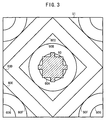
- FIG. 3 shows a combination of growth phases of the halftone dot shape shown in FIG. 2.
- a halftone dot 51 is grown in a successively blackened sequence from the circular halftone dot 60A in the highlight area to a circular halftone dot 60B in the highlight area to a quadrilateral halftone dot 60C in the highlight area to a quadrilateral halftone dot 60D (whose halftone percentage is 50 %) to a quadrilateral halftone dot 60E in the shadow area to a circular halftone dot 60F in the shadow area to a circular halftone dot 60G in the shadow area.
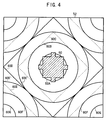
- FIG. 4 shows a halftone dot 52 of geometrically mixed shapes grows according to the prior art for comparison purposes.
- the halftone dot 52 is grown in a successively blackened sequence from the circular halftone dot 60A (more accurately, the halftone dot 60) in the highlight area to the circular halftone dot 60B in the highlight area to a circular halftone dot 60C' in the highlight area to the quadrilateral halftone dot 60D (whose halftone percentage is 50 %) to a circular halftone dot 60E' in the shadow area to the circular halftone dot 60F in the shadow area to the circular halftone dot 60G in the shadow area.
- the halftone dots 60C, 60E shown by the dotted lines are the same as the halftone dots 60C, 60E according to the present invention shown in FIG. 3.
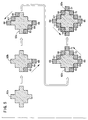
- FIG. 5 shows the manner in which, in the halftone dot 51 shown in FIG. 3, the quadrilateral halftone dot 60C in the highlight area is grown into the quadrilateral halftone dot 60D (whose halftone percentage is 50 %) and then into the quadrilateral halftone dot 60E in the shadow area, i.e., the halftone dot is grown from the second highlight percentage HL2 (see the quadrilateral halftone dot 50c in FIG. 2) via the intermediate halftone percentage of 50 % into the second shadow percentage SD2 (see the quadrilateral halftone dot 50e in FIG. 2) in the third transformation zone 103a, 103b.
- the number of dots is fewer than the number of dots in FIG. 3 for an easier understanding of the present invention.
- a substantially quadrilateral halftone dot 62a of point symmetry which is composed of 13 blackening dots is grown first into a halftone dot 62b by successively adding blackening dots 63, 64, 65 in the order indicated by the arrow along a side (lower left side in FIG. 5) of the halftone dot (threshold values of the supercell threshold template 32 for generating the blackening dots 63, 64, 65 are progressively greater in the sequence of the blackening dots 63, 64, 65), and then into a halftone dot 62c by successively adding blackening dots 66, 67, 68 in the order indicated by the arrow along an opposite side (upper right side in FIG. 5) of the halftone dot.
- the halftone dot 62c is grown into a halftone dot 62d by successively adding blackening dots 69, 70, 71 in the order indicated by the arrow along a remaining side (lower right side in FIG. 5) of the halftone dot, and then into a halftone dot 62e by successively adding blackening dots 72, 73, 74 in the order indicated by the arrow along a remaining opposite side (upper left side in FIG. 5) of the halftone dot.
- the halftone dot 62c and the quadrilateral halftone dot 62e are of a shape of point symmetry. When the halftone dot is grown in the manner shown in FIG. 5, any displacement of the center of gravity of the halftone dot is minimum. Since the halftone dot is grown along each side thereof, the tone reproduction of the shape of the dot can be accurately performed in the printing process.
- FIG. 6 shows the manner in which a halftone dot is grown in a quadrilateral (square or rhomboidal) shape successively along sides thereof with a minimum displacement of the center of gravity thereof, in another example.
- a quadrilateral (square) halftone dot 80a which is composed of 9 blackening dots is grown first into a halftone dot 80b by successively adding blackening dots from the left to the right in the order indicated by the arrow along a lower side of the halftone dot, then into a halftone dot 80c by successively adding blackening dots from the right to the left in the order indicated by the arrow along an upper side of the halftone dot, thereafter into a halftone dot 80d by successively adding blackening dots upwardly in the order indicated by the arrow along a right side of the halftone dot, and finally into a halftone dot 80e by successively adding blackening dots downwardly in the order indicated by the arrow along a left side of the halftone dot.
- the halftone dot 80e is of a square shape.
- the halftone dot can further be grown in the same manner as described above.
- the halftone dot is grown in the manner shown in FIG. 6, since the halftone dot is also grown along each side thereof, the tone reproduction of the shape of the dot can be accurately performed in the printing process.
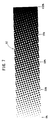
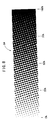
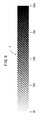
- FIGS. 7 and 8 show gradation scales 82, 84 according to different embodiments of the present invention.
- the gradation scale 82 is produced based on the halftone dot growth shown in FIG. 2, and the gradation scale 84 is produced based on the halftone dot growth shown in FIG. 2 except that those halftone dots grown in a circular shape in the gradation scale 82 are grown in an elliptical shape.
- the halftone dots of the gradation scales 82, 84 are grown in the following sequence (1) - (5):
- the tone reproduction of the shapes of the respective dots can be accurately performed in the highlight area and clearly define inter-dot spaces in the shadow area, and no tone jumps occur in the vicinity of the halftone percentages of 50 % and 78.5 % when the film plate F, the presensitized plate M, and the printed material P are produced.
- tone jumps are eliminated from all areas ranging from the highlight area through the intermediate tone area to the shadow area, making it possible to achieve a smoother tone reproduction.
Landscapes
- Engineering & Computer Science (AREA)
- Multimedia (AREA)
- Signal Processing (AREA)
- Facsimile Image Signal Circuits (AREA)
- Color, Gradation (AREA)
- Manufacture Or Reproduction Of Printing Formes (AREA)
Applications Claiming Priority (2)
| Application Number | Priority Date | Filing Date | Title |
|---|---|---|---|
| JP14192199A JP4324278B2 (ja) | 1999-05-21 | 1999-05-21 | 網点による階調再現方法、網目版出力装置、および網目版 |
| JP14192199 | 1999-05-21 |
Publications (2)
| Publication Number | Publication Date |
|---|---|
| EP1054559A2 true EP1054559A2 (de) | 2000-11-22 |
| EP1054559A3 EP1054559A3 (de) | 2004-07-14 |
Family
ID=15303266
Family Applications (1)
| Application Number | Title | Priority Date | Filing Date |
|---|---|---|---|
| EP00110726A Withdrawn EP1054559A3 (de) | 1999-05-21 | 2000-05-19 | Verfahren zur Tonwiedergabe mit Halbtonpunkten |
Country Status (3)
| Country | Link |
|---|---|
| US (1) | US6970273B1 (de) |
| EP (1) | EP1054559A3 (de) |
| JP (1) | JP4324278B2 (de) |
Cited By (4)
| Publication number | Priority date | Publication date | Assignee | Title |
|---|---|---|---|---|
| WO2004025364A3 (en) * | 2002-09-11 | 2005-01-27 | Day Int Inc | Four color digital printing process and color image element using color-sensitive photopolymers |
| WO2005109850A1 (en) * | 2004-05-05 | 2005-11-17 | Eastman Kodak Company | Color management of halftone prints |
| US6970273B1 (en) * | 1999-05-21 | 2005-11-29 | Fuji Photo Film Co., Ltd. | Method of tone reproduction with halftone dots, apparatus for outputting halftone plate, halftone plate, and printed material |
| CN1867033B (zh) * | 2005-03-07 | 2010-05-12 | 东芝公司 | 多配置网板色调系统 |
Families Citing this family (10)
| Publication number | Priority date | Publication date | Assignee | Title |
|---|---|---|---|---|
| WO2003028362A1 (en) * | 2001-09-21 | 2003-04-03 | Ricoh Company, Ltd. | Threshold value matrix creating method, image output system, storage medium, gradation reproducing method, threshold value matrix, image processing method, image processing apparatus, image forming apparatus and printer driver |
| JP2005167492A (ja) * | 2003-12-01 | 2005-06-23 | Fujitsu Ltd | 印刷方法,印刷システム,印刷装置,2値化ディザマトリクスパターン,印刷プログラムおよび同プログラムを記録したコンピュータ読取可能な記録媒体 |
| KR100753391B1 (ko) * | 2004-05-14 | 2007-08-30 | 매그나칩 반도체 유한회사 | 씨모스 이미지센서 |
| JP4678299B2 (ja) * | 2005-03-24 | 2011-04-27 | セイコーエプソン株式会社 | 印刷装置、印刷プログラム、印刷方法および画像処理装置、画像処理プログラム、画像処理方法、ならびに前記プログラムを記録した記録媒体 |
| JP4544109B2 (ja) * | 2005-09-16 | 2010-09-15 | 富士ゼロックス株式会社 | 画像処理装置およびプログラム |
| JP5219726B2 (ja) * | 2008-10-10 | 2013-06-26 | キヤノン株式会社 | 画像処理装置及びその制御方法 |
| JP5476874B2 (ja) * | 2009-09-09 | 2014-04-23 | 富士ゼロックス株式会社 | 色処理装置、画像形成装置及びプログラム |
| US9208418B2 (en) * | 2011-12-02 | 2015-12-08 | Megadot Systems Limited | Method and system for forming a halftone screen |
| TWI497443B (zh) * | 2013-06-06 | 2015-08-21 | Univ Nat Taiwan Normal | 浮水印圖像及其製造方法 |
| JP5512024B1 (ja) * | 2013-07-08 | 2014-06-04 | 有限会社岳南塗装デザイン | カッティングシート作成方法および描画方法 |
Family Cites Families (13)
| Publication number | Priority date | Publication date | Assignee | Title |
|---|---|---|---|---|
| DE1597773C3 (de) * | 1967-08-26 | 1974-09-19 | Dr.-Ing. Rudolf Hell Gmbh, 2300 Kiel | Verfahren zum Setzen gerasteter Halbtonbilder |
| US4196451A (en) * | 1976-05-21 | 1980-04-01 | Xerox Corporation | Electronic halftone generator |
| US4924301A (en) * | 1988-11-08 | 1990-05-08 | Seecolor Corporation | Apparatus and methods for digital halftoning |
| EP0454274B1 (de) * | 1990-04-25 | 1996-07-03 | Bayer Corporation | Verfahren zur Steuerung der Rasterpunktform während des Punktwachsens |
| US5264926A (en) * | 1990-09-14 | 1993-11-23 | Minnesota Mining And Manufacturing Company | Perpendicular, equal frequency non-conventional screen patterns for electronic halftone generation |
| US5583660A (en) * | 1990-09-14 | 1996-12-10 | Minnesota Mining And Manufacturing Company | Non-perpendicular, equal frequency non-conventional screen patterns for electronic halftone generation |
| US5448366A (en) * | 1992-10-05 | 1995-09-05 | Eastman Kodak Company | Apparatus and method for noise distorting the painting of a halftone dot |
| US5446558A (en) * | 1992-10-05 | 1995-08-29 | Eastman Kodak Company | Apparatus and associated method for representing elliptical halftone dots |
| US6198545B1 (en) * | 1994-03-30 | 2001-03-06 | Victor Ostromoukhov | Method and apparatus for generating halftone images by evolutionary screen dot contours |
| JP3077873B2 (ja) * | 1994-06-07 | 2000-08-21 | 大日本スクリーン製造株式会社 | 印刷版画像の作成方法および装置 |
| US5696604A (en) * | 1995-01-04 | 1997-12-09 | Xerox Corporation | Analytical halftone dot construction for a hyperacuity printer |
| US5884013A (en) * | 1995-11-17 | 1999-03-16 | Agfa-Gevaert | Autotypical screening with optimised dotshape |
| JP4324278B2 (ja) * | 1999-05-21 | 2009-09-02 | 富士フイルム株式会社 | 網点による階調再現方法、網目版出力装置、および網目版 |
-
1999
- 1999-05-21 JP JP14192199A patent/JP4324278B2/ja not_active Expired - Fee Related
-
2000
- 2000-05-19 EP EP00110726A patent/EP1054559A3/de not_active Withdrawn
- 2000-05-22 US US09/575,529 patent/US6970273B1/en not_active Expired - Fee Related
Cited By (4)
| Publication number | Priority date | Publication date | Assignee | Title |
|---|---|---|---|---|
| US6970273B1 (en) * | 1999-05-21 | 2005-11-29 | Fuji Photo Film Co., Ltd. | Method of tone reproduction with halftone dots, apparatus for outputting halftone plate, halftone plate, and printed material |
| WO2004025364A3 (en) * | 2002-09-11 | 2005-01-27 | Day Int Inc | Four color digital printing process and color image element using color-sensitive photopolymers |
| WO2005109850A1 (en) * | 2004-05-05 | 2005-11-17 | Eastman Kodak Company | Color management of halftone prints |
| CN1867033B (zh) * | 2005-03-07 | 2010-05-12 | 东芝公司 | 多配置网板色调系统 |
Also Published As
| Publication number | Publication date |
|---|---|
| JP2000326562A (ja) | 2000-11-28 |
| EP1054559A3 (de) | 2004-07-14 |
| JP4324278B2 (ja) | 2009-09-02 |
| US6970273B1 (en) | 2005-11-29 |
Similar Documents
| Publication | Publication Date | Title |
|---|---|---|
| US5541743A (en) | Method of and apparatus for generating halftone image with compensation for different dot gain characteristics | |
| US6970273B1 (en) | Method of tone reproduction with halftone dots, apparatus for outputting halftone plate, halftone plate, and printed material | |
| US7158264B2 (en) | Method of determining threshold array for generating gradation image | |
| EP0859506A1 (de) | Verfahren zur Korrektur von Halbtonpunktbilddaten und dieses anwendendes Bildvararbeitungsgerät | |
| US7224488B2 (en) | Method of correcting threshold array, dot pattern data structure, method of correcting pixel layout of image, and method of determining threshold array for generating image | |
| JPS6120042A (ja) | 画像走査記録方法及び装置 | |
| GB2133948A (en) | Generating screened half-tone images | |
| US6641241B2 (en) | Method of generating halftone threshold data | |
| US7400335B2 (en) | Method for printing a halftone digital image | |
| US20080186521A1 (en) | Method of and apparatus for generating proof image | |
| JPH06181525A (ja) | 1色又は多色の中間調原図を電子処理する方法 | |
| US5640254A (en) | Method for applying FM screening to a digital image | |
| US4642699A (en) | Method of scanning and recording images | |
| US20020051213A1 (en) | Halftone dot producing apparatus and halftone dot producing program storage medium | |
| US7088479B2 (en) | Image processing apparatus for electrophotography and electrophotographic apparatus utilizing the same | |
| EP1222615B1 (de) | System und verfahren zur verarbeitung mehrerer pegel mit pegelbeschraenkung | |
| IL98114A (en) | Device for making a copy of a character | |
| JPS6247029B2 (de) | ||
| US7280259B2 (en) | Method for printing a color proof using a spatial filter | |
| EP0359266B1 (de) | Rasterbildaufzeichnungsverfahren und -anordnung | |
| US20060221400A1 (en) | Dot pattern forming apparatus and set of FM screen threshold matrices | |
| JPH11168627A (ja) | 画像形成方法 | |
| JPH0720199B2 (ja) | 画像処理装置 | |
| US5526143A (en) | Apparatus and technique for generating a screened reproduction of an image | |
| EP0465558A1 (de) | Vorrichtung und verfahren zur herstellung von halbtontrennungen in farbbildformung |
Legal Events
| Date | Code | Title | Description |
|---|---|---|---|
| PUAI | Public reference made under article 153(3) epc to a published international application that has entered the european phase |
Free format text: ORIGINAL CODE: 0009012 |
|
| AK | Designated contracting states |
Kind code of ref document: A2 Designated state(s): AT BE CH CY DE DK ES FI FR GB GR IE IT LI LU MC NL PT SE |
|
| AX | Request for extension of the european patent |
Free format text: AL;LT;LV;MK;RO;SI |
|
| PUAL | Search report despatched |
Free format text: ORIGINAL CODE: 0009013 |
|
| AK | Designated contracting states |
Kind code of ref document: A3 Designated state(s): AT BE CH CY DE DK ES FI FR GB GR IE IT LI LU MC NL PT SE |
|
| AX | Request for extension of the european patent |
Extension state: AL LT LV MK RO SI |
|
| 17P | Request for examination filed |
Effective date: 20050104 |
|
| AKX | Designation fees paid |
Designated state(s): DE FR GB |
|
| RAP1 | Party data changed (applicant data changed or rights of an application transferred) |
Owner name: FUJIFILM CORPORATION |
|
| 17Q | First examination report despatched |
Effective date: 20080222 |
|
| STAA | Information on the status of an ep patent application or granted ep patent |
Free format text: STATUS: THE APPLICATION HAS BEEN WITHDRAWN |
|
| 18W | Application withdrawn |
Effective date: 20090212 |