EP1059523B1 - Automatisierte Echtzeit-Analyse von Nukleinsäureamplifikation - Google Patents
Automatisierte Echtzeit-Analyse von Nukleinsäureamplifikation Download PDFInfo
- Publication number
- EP1059523B1 EP1059523B1 EP00303519A EP00303519A EP1059523B1 EP 1059523 B1 EP1059523 B1 EP 1059523B1 EP 00303519 A EP00303519 A EP 00303519A EP 00303519 A EP00303519 A EP 00303519A EP 1059523 B1 EP1059523 B1 EP 1059523B1
- Authority
- EP
- European Patent Office
- Prior art keywords
- cycle
- amplification
- derivative
- fluorescence
- nucleic acid
- Prior art date
- Legal status (The legal status is an assumption and is not a legal conclusion. Google has not performed a legal analysis and makes no representation as to the accuracy of the status listed.)
- Expired - Lifetime
Links
- 230000003321 amplification Effects 0.000 title claims abstract description 91
- 238000003199 nucleic acid amplification method Methods 0.000 title claims abstract description 91
- 150000007523 nucleic acids Chemical class 0.000 title claims abstract description 50
- 108020004707 nucleic acids Proteins 0.000 title claims abstract description 48
- 102000039446 nucleic acids Human genes 0.000 title claims abstract description 48
- 238000010223 real-time analysis Methods 0.000 title 1
- 238000000034 method Methods 0.000 claims abstract description 33
- 238000005259 measurement Methods 0.000 claims abstract description 10
- 238000012360 testing method Methods 0.000 claims description 14
- 238000002866 fluorescence resonance energy transfer Methods 0.000 claims description 9
- 108091034117 Oligonucleotide Proteins 0.000 claims description 8
- 238000012417 linear regression Methods 0.000 claims description 4
- 108700028369 Alleles Proteins 0.000 claims description 3
- 239000000523 sample Substances 0.000 abstract description 47
- 239000007850 fluorescent dye Substances 0.000 abstract description 6
- 238000003752 polymerase chain reaction Methods 0.000 description 20
- 238000004458 analytical method Methods 0.000 description 17
- 108020004414 DNA Proteins 0.000 description 10
- 238000009396 hybridization Methods 0.000 description 9
- 230000001351 cycling effect Effects 0.000 description 8
- 238000001514 detection method Methods 0.000 description 8
- GNBHRKFJIUUOQI-UHFFFAOYSA-N fluorescein Chemical compound O1C(=O)C2=CC=CC=C2C21C1=CC=C(O)C=C1OC1=CC(O)=CC=C21 GNBHRKFJIUUOQI-UHFFFAOYSA-N 0.000 description 8
- 238000013461 design Methods 0.000 description 6
- 239000000975 dye Substances 0.000 description 6
- 238000012544 monitoring process Methods 0.000 description 6
- 238000003753 real-time PCR Methods 0.000 description 6
- 102000053602 DNA Human genes 0.000 description 5
- 108060002716 Exonuclease Proteins 0.000 description 5
- 238000006243 chemical reaction Methods 0.000 description 5
- 102000013165 exonuclease Human genes 0.000 description 5
- JLCPHMBAVCMARE-UHFFFAOYSA-N [3-[[3-[[3-[[3-[[3-[[3-[[3-[[3-[[3-[[3-[[3-[[5-(2-amino-6-oxo-1H-purin-9-yl)-3-[[3-[[3-[[3-[[3-[[3-[[5-(2-amino-6-oxo-1H-purin-9-yl)-3-[[5-(2-amino-6-oxo-1H-purin-9-yl)-3-hydroxyoxolan-2-yl]methoxy-hydroxyphosphoryl]oxyoxolan-2-yl]methoxy-hydroxyphosphoryl]oxy-5-(5-methyl-2,4-dioxopyrimidin-1-yl)oxolan-2-yl]methoxy-hydroxyphosphoryl]oxy-5-(6-aminopurin-9-yl)oxolan-2-yl]methoxy-hydroxyphosphoryl]oxy-5-(6-aminopurin-9-yl)oxolan-2-yl]methoxy-hydroxyphosphoryl]oxy-5-(6-aminopurin-9-yl)oxolan-2-yl]methoxy-hydroxyphosphoryl]oxy-5-(6-aminopurin-9-yl)oxolan-2-yl]methoxy-hydroxyphosphoryl]oxyoxolan-2-yl]methoxy-hydroxyphosphoryl]oxy-5-(5-methyl-2,4-dioxopyrimidin-1-yl)oxolan-2-yl]methoxy-hydroxyphosphoryl]oxy-5-(4-amino-2-oxopyrimidin-1-yl)oxolan-2-yl]methoxy-hydroxyphosphoryl]oxy-5-(5-methyl-2,4-dioxopyrimidin-1-yl)oxolan-2-yl]methoxy-hydroxyphosphoryl]oxy-5-(5-methyl-2,4-dioxopyrimidin-1-yl)oxolan-2-yl]methoxy-hydroxyphosphoryl]oxy-5-(6-aminopurin-9-yl)oxolan-2-yl]methoxy-hydroxyphosphoryl]oxy-5-(6-aminopurin-9-yl)oxolan-2-yl]methoxy-hydroxyphosphoryl]oxy-5-(4-amino-2-oxopyrimidin-1-yl)oxolan-2-yl]methoxy-hydroxyphosphoryl]oxy-5-(4-amino-2-oxopyrimidin-1-yl)oxolan-2-yl]methoxy-hydroxyphosphoryl]oxy-5-(4-amino-2-oxopyrimidin-1-yl)oxolan-2-yl]methoxy-hydroxyphosphoryl]oxy-5-(6-aminopurin-9-yl)oxolan-2-yl]methoxy-hydroxyphosphoryl]oxy-5-(4-amino-2-oxopyrimidin-1-yl)oxolan-2-yl]methyl [5-(6-aminopurin-9-yl)-2-(hydroxymethyl)oxolan-3-yl] hydrogen phosphate Polymers Cc1cn(C2CC(OP(O)(=O)OCC3OC(CC3OP(O)(=O)OCC3OC(CC3O)n3cnc4c3nc(N)[nH]c4=O)n3cnc4c3nc(N)[nH]c4=O)C(COP(O)(=O)OC3CC(OC3COP(O)(=O)OC3CC(OC3COP(O)(=O)OC3CC(OC3COP(O)(=O)OC3CC(OC3COP(O)(=O)OC3CC(OC3COP(O)(=O)OC3CC(OC3COP(O)(=O)OC3CC(OC3COP(O)(=O)OC3CC(OC3COP(O)(=O)OC3CC(OC3COP(O)(=O)OC3CC(OC3COP(O)(=O)OC3CC(OC3COP(O)(=O)OC3CC(OC3COP(O)(=O)OC3CC(OC3COP(O)(=O)OC3CC(OC3COP(O)(=O)OC3CC(OC3COP(O)(=O)OC3CC(OC3COP(O)(=O)OC3CC(OC3CO)n3cnc4c(N)ncnc34)n3ccc(N)nc3=O)n3cnc4c(N)ncnc34)n3ccc(N)nc3=O)n3ccc(N)nc3=O)n3ccc(N)nc3=O)n3cnc4c(N)ncnc34)n3cnc4c(N)ncnc34)n3cc(C)c(=O)[nH]c3=O)n3cc(C)c(=O)[nH]c3=O)n3ccc(N)nc3=O)n3cc(C)c(=O)[nH]c3=O)n3cnc4c3nc(N)[nH]c4=O)n3cnc4c(N)ncnc34)n3cnc4c(N)ncnc34)n3cnc4c(N)ncnc34)n3cnc4c(N)ncnc34)O2)c(=O)[nH]c1=O JLCPHMBAVCMARE-UHFFFAOYSA-N 0.000 description 4
- 230000007423 decrease Effects 0.000 description 4
- 238000011002 quantification Methods 0.000 description 4
- 238000012408 PCR amplification Methods 0.000 description 3
- 238000000862 absorption spectrum Methods 0.000 description 3
- 238000013459 approach Methods 0.000 description 3
- 238000004364 calculation method Methods 0.000 description 3
- 238000007405 data analysis Methods 0.000 description 3
- 238000004925 denaturation Methods 0.000 description 3
- 230000036425 denaturation Effects 0.000 description 3
- 230000009977 dual effect Effects 0.000 description 3
- 238000003205 genotyping method Methods 0.000 description 3
- 238000012163 sequencing technique Methods 0.000 description 3
- 238000005382 thermal cycling Methods 0.000 description 3
- 230000004544 DNA amplification Effects 0.000 description 2
- CGNLCCVKSWNSDG-UHFFFAOYSA-N SYBR Green I Chemical compound CN(C)CCCN(CCC)C1=CC(C=C2N(C3=CC=CC=C3S2)C)=C2C=CC=CC2=[N+]1C1=CC=CC=C1 CGNLCCVKSWNSDG-UHFFFAOYSA-N 0.000 description 2
- 238000000137 annealing Methods 0.000 description 2
- 230000000694 effects Effects 0.000 description 2
- ZMMJGEGLRURXTF-UHFFFAOYSA-N ethidium bromide Chemical compound [Br-].C12=CC(N)=CC=C2C2=CC=C(N)C=C2[N+](CC)=C1C1=CC=CC=C1 ZMMJGEGLRURXTF-UHFFFAOYSA-N 0.000 description 2
- 229960005542 ethidium bromide Drugs 0.000 description 2
- 238000001506 fluorescence spectroscopy Methods 0.000 description 2
- 230000006870 function Effects 0.000 description 2
- 238000002844 melting Methods 0.000 description 2
- 230000008018 melting Effects 0.000 description 2
- 239000013642 negative control Substances 0.000 description 2
- 238000012545 processing Methods 0.000 description 2
- PYWVYCXTNDRMGF-UHFFFAOYSA-N rhodamine B Chemical compound [Cl-].C=12C=CC(=[N+](CC)CC)C=C2OC2=CC(N(CC)CC)=CC=C2C=1C1=CC=CC=C1C(O)=O PYWVYCXTNDRMGF-UHFFFAOYSA-N 0.000 description 2
- 230000001960 triggered effect Effects 0.000 description 2
- 241000193738 Bacillus anthracis Species 0.000 description 1
- 201000003883 Cystic fibrosis Diseases 0.000 description 1
- 241001646719 Escherichia coli O157:H7 Species 0.000 description 1
- 208000005176 Hepatitis C Diseases 0.000 description 1
- 108091092878 Microsatellite Proteins 0.000 description 1
- 108091028043 Nucleic acid sequence Proteins 0.000 description 1
- 108020005187 Oligonucleotide Probes Proteins 0.000 description 1
- 238000002944 PCR assay Methods 0.000 description 1
- 108091093037 Peptide nucleic acid Proteins 0.000 description 1
- 108010010677 Phosphodiesterase I Proteins 0.000 description 1
- 108010004729 Phycoerythrin Proteins 0.000 description 1
- 208000034809 Product contamination Diseases 0.000 description 1
- 238000003491 array Methods 0.000 description 1
- 238000003556 assay Methods 0.000 description 1
- 239000012472 biological sample Substances 0.000 description 1
- 230000015572 biosynthetic process Effects 0.000 description 1
- 239000008280 blood Substances 0.000 description 1
- 210000004369 blood Anatomy 0.000 description 1
- 230000000295 complement effect Effects 0.000 description 1
- 230000001186 cumulative effect Effects 0.000 description 1
- 238000011161 development Methods 0.000 description 1
- 230000018109 developmental process Effects 0.000 description 1
- 230000004069 differentiation Effects 0.000 description 1
- 239000000539 dimer Substances 0.000 description 1
- 238000000295 emission spectrum Methods 0.000 description 1
- 238000005516 engineering process Methods 0.000 description 1
- 230000005284 excitation Effects 0.000 description 1
- 235000015220 hamburgers Nutrition 0.000 description 1
- 238000003505 heat denaturation Methods 0.000 description 1
- 238000010438 heat treatment Methods 0.000 description 1
- 230000007062 hydrolysis Effects 0.000 description 1
- 238000006460 hydrolysis reaction Methods 0.000 description 1
- 230000000977 initiatory effect Effects 0.000 description 1
- 238000007689 inspection Methods 0.000 description 1
- 108020004999 messenger RNA Proteins 0.000 description 1
- 239000000203 mixture Substances 0.000 description 1
- 239000002751 oligonucleotide probe Substances 0.000 description 1
- 244000052769 pathogen Species 0.000 description 1
- 230000001717 pathogenic effect Effects 0.000 description 1
- 150000004713 phosphodiesters Chemical group 0.000 description 1
- 239000013641 positive control Substances 0.000 description 1
- 238000002360 preparation method Methods 0.000 description 1
- 108090000623 proteins and genes Proteins 0.000 description 1
- 238000010791 quenching Methods 0.000 description 1
- 230000000171 quenching effect Effects 0.000 description 1
- 238000002165 resonance energy transfer Methods 0.000 description 1
- 238000012340 reverse transcriptase PCR Methods 0.000 description 1
- 239000007787 solid Substances 0.000 description 1
- 241000894007 species Species 0.000 description 1
- 238000003786 synthesis reaction Methods 0.000 description 1
- 238000012546 transfer Methods 0.000 description 1
Images




Classifications
-
- G—PHYSICS
- G01—MEASURING; TESTING
- G01N—INVESTIGATING OR ANALYSING MATERIALS BY DETERMINING THEIR CHEMICAL OR PHYSICAL PROPERTIES
- G01N21/00—Investigating or analysing materials by the use of optical means, i.e. using sub-millimetre waves, infrared, visible or ultraviolet light
- G01N21/62—Systems in which the material investigated is excited whereby it emits light or causes a change in wavelength of the incident light
- G01N21/63—Systems in which the material investigated is excited whereby it emits light or causes a change in wavelength of the incident light optically excited
- G01N21/64—Fluorescence; Phosphorescence
- G01N21/6428—Measuring fluorescence of fluorescent products of reactions or of fluorochrome labelled reactive substances, e.g. measuring quenching effects, using measuring "optrodes"
-
- C—CHEMISTRY; METALLURGY
- C12—BIOCHEMISTRY; BEER; SPIRITS; WINE; VINEGAR; MICROBIOLOGY; ENZYMOLOGY; MUTATION OR GENETIC ENGINEERING
- C12Q—MEASURING OR TESTING PROCESSES INVOLVING ENZYMES, NUCLEIC ACIDS OR MICROORGANISMS; COMPOSITIONS OR TEST PAPERS THEREFOR; PROCESSES OF PREPARING SUCH COMPOSITIONS; CONDITION-RESPONSIVE CONTROL IN MICROBIOLOGICAL OR ENZYMOLOGICAL PROCESSES
- C12Q1/00—Measuring or testing processes involving enzymes, nucleic acids or microorganisms; Compositions therefor; Processes of preparing such compositions
- C12Q1/68—Measuring or testing processes involving enzymes, nucleic acids or microorganisms; Compositions therefor; Processes of preparing such compositions involving nucleic acids
- C12Q1/6844—Nucleic acid amplification reactions
- C12Q1/686—Polymerase chain reaction [PCR]
Definitions
- the present invention relates to a method of analyzing a sample for the presence of a nucleic acid. More particularly, the present invention is directed to an automated method for detecting and reporting the presence of a predetermined nucleic acid in a sample using polymerase chain reaction and a fluorescent detecting entity.
- PCR polymerase chain reaction
- RT-PCR real-time PCR
- Gut M., et al. discloses a one-tube reverse transcription assay for feline corona virus using a fluorogenic probe which develops fluorescence when cleaved.
- the probe is an oligonucleotide designed to bind between two PCR primers to target cDNA and is labelled with a reporter and a quencher dye.
- Exonuclease activity of Termus flavus polymerase cleaves the probe, resulting in fluorescent emission of the reporter dye.
- Buchanan R.L. and Cygnarowicz M.L. Food Microbiology (1990), Vol. 7, pages 237-240 ) discloses a mathematic approach to define bacterial growth curves and calculate the duration of lag phase.
- Nath S.R. and More F.D. discloses the use of the Richards function as a tool for growth analysis of e.g. biological organisms.
- PCR is an invaluable molecular biology tool
- the practical implementation of real time PCR techniques has lagged behind the conceptual promise.
- Currently available instrumentation does not actually analyze data during PCR; it simply acquires the data for later analysis. After PCR has been completed, multiple manual steps are necessary to analyze the acquired data, and human judgment is typically required to provide the analysis result.
- What is needed is a system for automating data acquisition and analysis so that no user intervention is required for reporting the analytical results.
- the system software is automatically triggered and the results, for example, the presence or absence of a given pathogen, are immediately displayed on screen. Algorithms for detection, quantification, and genotyping are needed.
- initiation of the analysis algorithm can be implemented prior to completion of temperature cycling.
- Data processing can occur during amplification and concomitant analysis results can be used to modify temperature cycling and to acquire additional data during the latter stages of the amplification procedure to optimize amplification protocol and data quality.
- a major problem in automating PCR data analysis is identification of baseline fluorescence.
- Background fluorescence varies from reaction to reaction.
- baseline drift wherein fluorescence increases or decreases without relation to amplification of nucleic acids in the sample, is a common occurrence.
- Prior attempts to automate amplification data analysis involved setting the baseline fluorescence as that measured at one or more predetermined early cycle numbers. This technique accounts for the variation in background fluorescence, but it does not compensate for baseline drift. Without compensation for baseline drift, automated amplification data analysis can easily provide both false negative and false positive results.
- the present invention is directed to a method of determining the presence of a nucleic acid in a sample comprising the steps of:
- the baseline fluorescence region is determined and the fluorescence values are compared thereto after each amplification cycle.
- the presence of the nucleic acid sequence can be determined more quickly in samples containing higher copy number.
- the remaining cycles may be used to acquire other information concerning the nucleic acid sample, such as initial copy number and allelic data.
- the process is automated so that a user can prepare a biological sample and simply place it in a thermal cycler having a sensor for reporting fluorescence values as a function of cycle number and a processor programmed with an algorithm capable of processing the values and reporting a positive or negative result.
- a further aspect of the invention provides:
- nucleic acid As used herein, “nucleic acid,” “DNA,” and similar terms also include nucleic acid analogs, i.e., analogs having other than a phosphodiester backbone.
- nucleic acid analogs i.e., analogs having other than a phosphodiester backbone.
- peptide nucleic acids which are known in the art and have peptide bonds instead of phosphodiester bonds in the backbone, are considered within the scope of the present invention.
- fluorescence resonance energy transfer pair or “FRET pair” refers to a pair of fluorophores comprising a donor fluorophore and acceptor fluorophore, wherein the donor fluorophore is capable of transferring resonance energy to the acceptor fluorophore.
- the emission spectrum of the donor fluorophore overlaps the absorption spectrum of the acceptor fluorophore.
- the absorption spectrum of the donor fluorophore does not substantially overlap the absorption spectrum of the acceptor fluorophore.
- FRET oligonucleotide pair refers to a pair of oligonucleotides, each labeled with a member of a fluorescent resonance energy transfer pair, wherein hybridization to complementary target nucleic acid sequences brings the fluorescent entities into a fluorescence resonance energy transfer relationship.
- the present invention is directed to a method of analyzing a sample for the presence of a nucleic acid wherein the sample is amplified, preferably using PCR, in the presence of a fluorescent probe capable of detecting the presence of the nucleic acid sample.
- a baseline region is determined by comparing the fluorescence at various amplification cycles, and the fluorescence at each of various amplification cycles is compared to the baseline region to determine whether the fluorescence measurements fall outside of that baseline region.
- dsDNA double stranded DNA
- SYBR TM Green I SYBR TM Green I.
- product specificity can be increased by analysis of melting curves or by acquiring fluorescence at a high temperature where nonspecific products have melted.
- Oligonucleotide probes can also be covalently labeled with fluorescent molecules.
- Hairpin primers Stresspin TM primers
- hairpin probes Molecular Beacons TM
- exonuclease probes TaqMan TM
- These probes depend on fluorescence quenching of a fluorophore by a quencher on the same oligonucleotide. Fluorescence increases when hybridization or exonuclease hydrolysis occurs.
- a preferred design employs two oligonucleotides, each labeled with a fluorescent probe. Hybridization of these oligonucleotides to a target nucleic acid brings the two fluorescent probes close together to allow resonance energy transfer to occur.
- C. T. Wittwer, M. G. Herrmann, A. A. Moss and R. P. Rasmussen "Continuous fluorescence monitoring of rapid cycle DNA amplification," BioTechniques 22:130-138, 1997 .
- These hybridization probes require only a single fluorescent label per probe and are easier to design and synthesize than dual labeled probes.
- Acceptable fluorophore pairs for use as fluorescent resonance energy transfer pairs are well known to those skilled in the art and include, but are not limited to, fluorescein/rhodamine, phycoerythrin/Cy7, fluorescein/Cy5, fluorescein/Cy5.5, fluorescein/LC Red 640, and fluorescein/LC Red 705.
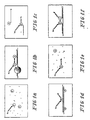
- SYBR TM Green I, exonuclease probe and hybridization probe designs are shown in Figs. 1A-L.
- Figs. 1A-L For each design, schematics both before (Figs. 1A-C) and after (Figs. 1D-F) amplification are shown, as well as cycle verses fluorescence amplification plots of positive and negative controls (Figs. 1G-I), and temperature verses fluorescence plots from continuous monitoring (Figs. 1J-L).
- SYBR Green I fluorescence increases as more dsDNA is made (Fig. 1A). Because the dye is not sequence specific, a negative control also increases in fluorescence during later cycles as primer dimers are formed (Fig. 1G). In Fig.
- Fig. 1B dual-labeled fluorescein/rhodamine probes are cleaved during polymerase extension by 5'-exonuclease activity, separating the fluorophores and increasing the fluorescein emission. The signal generated is cumulative and the fluorescence continues to increase even after the amount of product has reached a plateau (Fig. 1H).
- Fig. 1C shows use of a FRET oligonucleotide pair wherein two probes hybridize next to each other, one labeled 3' with fluorescein and the other labeled 5' with Cy5. As product accumulates during PCR, fluorescence energy transfer to Cy5 increases (Fig. 1I). The fluorescence of hybridization probes decreases at high cycle number because of probe/product competition.
- Standard instruments for PCR complete 30 cycles in about two to four hours.
- a preferred system is a rapid thermal cycling device using capillary tubes and hot, air temperature control. See, for example, United States Patent No. 5,455,175 , herein incorporated by reference. Because of the low heat capacity of air and the thin walls and high surface area of capillary tubes, small volume samples could be cycled quickly. The total amplification time for 30 cycles is reduced to 15 minutes with excellent results.
- capillaries with forced air heating allows precise control of sample temperature at a speed not possible with other designs.
- sample temperature verses time plots in capillaries show sharp spikes at denaturation and annealing temperatures, whereas several seconds are required for all of the sample to reach equilibrium in conical plastic tubes.
- C. T. Wittwer, G. B. Reed, and K. M. Ririe "Rapid cycle DNA amplification,” in K. Mullis, F. Ferre, and R. Gibbs (Eds.), "The polymerase chain reaction,” Springer-Verlag, Deerfield Beach, FL. pp. 174-181, 1994 ;
- the RapidCycler TM developed by Idaho Technology, is an example of a rapid thermal cycling device.
- the LightCycler TM is a rapid temperature cycler with a fluorimeter, wherein light emitting diodes are used for excitation and photodiodes are used for detection.
- the present invention is preferably directed to methods for automating detection of nucleic acids with real time PCR. While these algorithms may be applied to any amplification system, it is preferred to integrate these algorithms into the LightCycler TM platform. These analysis routines are triggered by the completion of rapid thermal cycling for "hands off' amplification, analysis, and final results presentation in a total of less than 15 min. The analysis routines take from ⁇ 1 second for detection and quantification to ⁇ 10 seconds for genotyping. LabView (National Instruments, Austin, TX), a graphical programming language, is preferred for LightCycler TM instrument control. The LightCycler TM is a PC-based instrument.
- the present invention is directed to a method that will: (1) automatically identify the baseline, (2) use the baseline variance to establish a confidence region, and (3) call each sample positive or negative based on the relationship of the confidence region to the fluorescence data.
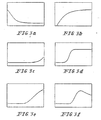
- Figs. 3A-F display various types of amplification curves, all of which have been observed in LightCycler TM runs.
- Figs. 3A and B show curves from samples that are negative with no template present.
- the fluorescence scales in Figs. 3A and B are magnified (compared to Figs. 3C-F) to demonstrate the baseline drift and to provide algorithms capable of being independent of the fluorescence intensity.
- This baseline drift of negative reactions must be distinguished from positive reactions of either low copy numbers (Fig. 3C) or high copy numbers (Fig. 3D) of starting template.
- the method needs to work with various probe designs, including exonuclease (Fig. 3E) and hybridization (Fig. 3F) probes.
- the baseline is determined as a function of measured fluorescence at a fixed range of cycles near the beginning of amplification.
- selection of a fixed range of cycles is not adequate because both downward drift (Fig. 3A) and high copy (Fig. 3D) amplifications may be incorrectly called.
- the background is identified by analyzing the fluorescent measurements over a wide range of amplification cycles.
- the background is identified by selecting the sliding window (Fig. 4) with the shallowest slope. That is, calculate the slope at each cycle by linear regression of the local neighborhood (for example, a 7 point sliding window).
- the window with the slope of lowest absolute value (least difference from zero) defines the background region.
- the variation of these background points about their regression line (the square root of the mean square error) is multiplied by a constant to determine a confidence band. This confidence band will have a slope near zero and is extrapolated across all cycles. If the fluorescence of the last cycle is within the confidence band it is negative, if it is outside the band it is positive.
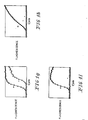
- Figs. 5A-B demonstrate both cases.
- Another method is to compare the cycle with the greatest fluorescence (which is not necessarily the last cycle) to the confidence band. This is especially suited for hybridization probes that may decrease in fluorescence with extensive cycling, such as seen in Fig. 3F.
- the cycle with the greatest fluorescence only should be used when the curve shape is well behaved, in order to prevent false positive calls with downward drifts, such as shown in Fig. 3A.
- the variables to optimize for automatic detection are: 1) the window size for the first derivative estimate, 2) the window size for the second derivative estimate, and 3) the confidence band factor.
- a reasonable value for the first derivative window size is 7, although 3, 5, 9, and 11 are also quite useful.
- the preferred window size is 3, but 5, and 7 have also proven to be useful values.
- a preferred confidence band factor is 20. As the first derivative window size increases the variance estimate is more accurate, but the edge cycles (beginning and ending) are lost.
- the first step is to calculate the first and second derivatives.
- a preferred method is to determine the first derivatives as the slope of a linear regression line through A points, and assigning the value to the central cycle number. Some cycles on either edge cannot be assigned first derivatives, but first derivatives can be provided for cycles (A + 1)/2 through N-(A - 1)/2.
- the second derivatives are calculated as the slope of the first derivative points and assigned to cycles (A + 1)/2 + (B - 1)/2 through [N - (A - 1)/2] - (B - 1)/2.
- Calculation of the first and second derivatives provide arrays Y'i and Y"i, with some edge values missing.
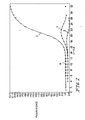
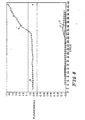
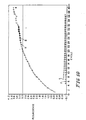
- the first and second derivatives are displayed as open black circles and closed black circles, respectively.
- the next step is to determine whether the fluorescence curve has a well-behaved shape.
- the well-behaved shape occurs when the cycles with minimum fluorescence, maximum second derivative, maximum first derivative, minimum second derivative, and maximum fluorescence occur in that order, from law to high cycle number.
- the baseline is then determined. If the fluorescence curve does not have the expected shape, the cycle whose first derivative is closest to zero is used. If the fluorescence curve has a well-behaved shape, the cycle whose first derivative is closest to zero chosen from among all cycles prior to the cycle with the maximum second derivative (again, any cycle between the maximum second derivative and the minimum second derivative may also be used as the cutoff cycle number).
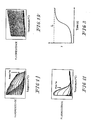
- the baseline is drawn through the fluorescence value of the chosen cycle with a slope of its first derivative. In Fig. 7, the A points contributing to the first derivative calculation for the baseline are displayed as large black dots connected by a line.
- the next step is to determine the test point cycle, that is, the cycle used to compare against the baseline for determining a positive or negative result. It the curve is not well-behaved, the test point is the last cycle. If the fluorescence curve is well-behaved, the test point is the cycle with fluorescence farthest from the baseline. The test point fluorescence of a negative sample can be predicted as the intersection of the baseline with the test point cycle.
- a confidence interval can be determined about the predicted negative test point. Preferably, this is done by finding the square root of the mean square error about the baseline of A points used to determine the baseline. This is multiplied by C. The product is added to the predicted negative test point to get the upper fluorescence limit of the confidence interval and is subtracted from the predicted negative test point to get the lower limit of the confidence interval. These limits are shown on Fig. 7 as two solid horizontal lines.
- the final step is to declare the sample positive or negative. If the test point fluorescence is outside of the confidence interval, the sample is positive. If it is within the interval, the sample is negative.
- Figs. 7 and 8 are samples which are positive, while Figs. 9-11 are negative samples.
Landscapes
- Chemical & Material Sciences (AREA)
- Health & Medical Sciences (AREA)
- Life Sciences & Earth Sciences (AREA)
- Chemical Kinetics & Catalysis (AREA)
- Physics & Mathematics (AREA)
- Organic Chemistry (AREA)
- Immunology (AREA)
- Wood Science & Technology (AREA)
- Analytical Chemistry (AREA)
- General Health & Medical Sciences (AREA)
- Proteomics, Peptides & Aminoacids (AREA)
- Engineering & Computer Science (AREA)
- Biochemistry (AREA)
- Zoology (AREA)
- General Engineering & Computer Science (AREA)
- Optics & Photonics (AREA)
- Molecular Biology (AREA)
- Bioinformatics & Cheminformatics (AREA)
- Microbiology (AREA)
- Biotechnology (AREA)
- Genetics & Genomics (AREA)
- Biophysics (AREA)
- Nuclear Medicine, Radiotherapy & Molecular Imaging (AREA)
- General Physics & Mathematics (AREA)
- Pathology (AREA)
- Measuring Or Testing Involving Enzymes Or Micro-Organisms (AREA)
- Investigating, Analyzing Materials By Fluorescence Or Luminescence (AREA)
- Investigating Or Analysing Biological Materials (AREA)
- Automatic Analysis And Handling Materials Therefor (AREA)
Claims (13)
- Verfahren zum Bestimmen des Vorliegens einer Nukleinsäure, umfassend die Schritte:Bereitstellen einer fluoreszierenden Einheit, die in der Lage ist, das Vorliegen der Nukleinsäure anzuzeigen, und in der Lage ist, ein Signal zu liefern, das mit der Menge der Nukleinsäure in Relation steht;Amplifizieren der Nukleinsäure über eine Vielzahl von Amplifikationszyklen in Gegenwart der fluoreszierenden Einheit;Messen der Fluoreszenz der fluoreszierenden Einheit bei jedem der Vielzahl von Amplifikationszyklen zur Bildung eines Fluoreszenzwerts für jeden Zyklus, der mit der bei jedem Zyklus vorliegenden Menge der Nukleinsäure in Relation steht;Erzeugen einer Messkurve, bei der die Fluoreszenzwerte für jeden Amplifikationszyklus aufgetragen sind;Berechnen von Werten für die ersten Ableitung einer Vielzahl von Zyklen der Messkurve unter Verwendung einer Vielzahl der Fluoreszenzwerte;
wobei man, wenn die Messkurve eine normal verlaufende Amplifikationskurve ist, bei der die Form der Amplifikationskurve durch die Zykluszahl bestimmt wird, wobei der Amplifikationszyklus, der minimaler Fluoreszenz entspricht, vor dem Amplifikationszyklus liegt, der einer maximalen zweiten Ableitung entspricht, welcher vor dem Amplifikationszyklus liegt, der einer maximalen ersten Ableitung entspricht, welcher vor dem Amplifikationszyklus liegt, der einer minimalen zweiten Ableitung entspricht, welcher vor dem Amplifikationszyklus liegt, der maximaler Fluoreszenz entspricht, einen Grenzzyklus bestimmt, wobei der Grenzzyklus ein Zyklus ist, der ausgewählt ist aus der maximalen zweiten Ableitung bis zur minimalen zweiten Ableitung oder ein Zyklus weniger als das Maximum der zweiten Ableitung oder ein Zyklus weniger als das Maximum der ersten Ableitung oder ein Zyklus weniger als das Minimum der zweiten Ableitung;Ermitteln eines Grundfluoreszenzbereichs mittels eines Intervalls von Zyklen vor dem Grenzzyklus, das den Zyklus beinhaltet, der einen Absolutwert für die erste Ableitung hat, der null am nächsten kommt; undFeststellen, ob ein positives Ergebnis angezeigt wird, indem man bestimmt, ob die Fluoreszenzmessung bei einem ausgewählten Amplifikationszyklus außerhalb des Grundfluoreszenzbereichs liegt, wobei der ausgewählte Amplifikationszyklus der Zyklus mit der maximalen Fluoreszenz ist. - Verfahren nach Anspruch 1, wobei die ersten Ableitungen durch lineare Regression jeder lokalen Nachbarschaft berechnet werden.
- Verfahren nach Anspruch 1, wobei der Amplifikationszyklus mit der ersten Ableitung, die den null am nächsten kommenden Absolutwert hat, einen zentralen Zyklus des Intervalls von Zyklen umfasst, das verwendet wurde, um den Grundfluoreszenzbereich zu ermitteln.
- Verfahren nach Anspruch 1, wobei die Grundfluoreszenz relativ zu einer Geraden zentriert ist, die durch die gemessene Fluoreszenz des Amplifikationszyklus mit der ersten Ableitung verläuft, die den null am nächsten kommenden Absolutwert hat, wobei die Gerade ferner eine Neigung umfasst, die gleich der des Zyklus mit der ersten Ableitung ist, die den null am nächsten kommenden Absolutwert hat, und wobei der Grundfluoreszenzbereich eine Fläche auf wenigstens einer Seite der Geraden beinhaltet, die durch ein Varianzmaß der Fluoreszenzwerte definiert wird, wobei das Varianzmaß aus den anfänglichen Amplifikationszyklen berechnet wird, die zur Ermittlung der Grundfluoreszenz verwendet wurden.
- Verfahren nach Anspruch 1, wobei die fluoreszierende Einheit ein FRET-Oligonukleotidpaar umfasst.
- Verfahren nach Anspruch 1, wobei der Grenzzyklus ausgewählt ist aus der Gruppe bestehend aus der maximalen zweiten Ableitung, der maximalen ersten Ableitung und der minimalen zweiten Ableitung.
- Verfahren zum Bestimmen des Vorliegens einer Nukleinsäure, umfassend die Schritte:Bereitstellen einer fluoreszierenden Einheit, die in der Lage ist, das Vorliegen der Nukleinsäure anzuzeigen, und in der Lage ist, ein Signal zu liefern, das mit der Menge der Nukleinsäure in Relation steht;Amplifizieren der Nukleinsäure über eine Vielzahl von Amplifikationszyklen in Gegenwart der fluoreszierenden Einheit;Messen der Fluoreszenz der fluoreszierenden Einheit bei jedem der Vielzahl von Amplifikationszyklen zur Bildung eines Fluoreszenzwerts für jeden Zyklus, der mit der bei jedem Zyklus vorliegenden Menge der Nukleinsäure in Relation steht;Erzeugen einer Messkurve, bei der die Fluoreszenzwerte für jeden Amplifikationszyklus aufgetragen sind;Berechnen von Werten für die ersten Ableitung einer Vielzahl von Zyklen der Messkurve unter Verwendung einer Vielzahl der Fluoreszenzwerte;wobei man, wenn die Messkurve keine normal verlaufende Amplifikationskurve ist, einen Grundfluoreszenzbereich ermittelt, indem man ein Intervall von Zyklen verwendet, das einen Zyklus beinhaltet, der einen Absolutwert für die erste Ableitung hat, der null am nächsten kommt, und feststellt, ob ein positives Ergebnis angezeigt wird, indem man bestimmt, ob die Fluoreszenzmessung bei einem Testamplifikationszyklus außerhalb des Grundfluoreszenzbereichs liegt, wobei der Testzyklus der letzte getestete Zyklus ist.
- Verfahren nach Anspruch 1, wobei der Schritt des Feststellens nach einer Vielzahl von Amplifikationszyklen durchgeführt wird, bis entweder das positive Ergebnis erhalten wird oder der Maximalzyklus erreicht ist.
- Verfahren nach Anspruch 8, ferner umfassend die Schritte:Durchführen einer zweiten Vielzahl weiterer Amplifikationszyklen, nachdem das positive Ergebnis erhalten wurde; undAnalysieren der Nukleinsäure auf weitere Information.
- Verfahren nach Anspruch 8, wobei die Nukleinsäure weiter analysiert wird, um das Vorliegen eines bestimmten Allels zu bestimmen.
- Verfahren nach Anspruch 8, wobei die gemessene Fluoreszenz weiter analysiert wird, um die Anfangskonzentration zu bestimmen.
- Automatisiertes Verfahren zum Bestimmen des Vorliegens einer Nukleinsäure, umfassend die Schritte:Platzieren einer Probe in einem Behälter, der eine fluoreszierende Einheit enthält, die in der Lage ist, das Vorliegen der Nukleinsäure anzuzeigen, und in der Lage ist, ein Signal zu liefern, das mit der Menge der Nukleinsäure in Relation steht;Platzieren des Behälters in einer Vorrichtung zum Amplifizieren der Nukleinsäure über eine Vielzahl von Amplifikationszyklen in Gegenwart der fluoreszierenden Einheit;Messen der Fluoreszenz der fluoreszierenden Einheit bei jedem der Vielzahl von Amplifikationszyklen zur Bildung eines Fluoreszenzwerts für jeden Zyklus, der mit der bei jedem Zyklus vorliegenden Menge der Nukleinsäure in Relation steht;Erzeugen einer Messkurve, bei der die Fluoreszenzwerte für jeden Amplifikationszyklus aufgetragen sind;Berechnen von Werten für die ersten Ableitung einer Vielzahl von Zyklen der Messkurve unter Verwendung einer Vielzahl der Fluoreszenzwerte;
wobei man, wenn die Messkurve eine normal verlaufende Amplifikationskurve ist, bei der die Form der Amplifikationskurve durch die Zykluszahl bestimmt wird, wobei der Amplifikationszyklus, der minimaler Fluoreszenz entspricht, vor dem Amplifikationszyklus liegt, der einer maximalen zweiten Ableitung entspricht, welcher vor dem Amplifikationszyklus liegt, der einer maximalen ersten Ableitung entspricht, welcher vor dem Amplifikationszyklus liegt, der einer minimalen zweiten Ableitung entspricht, welcher vor dem Amplifikationszyklus liegt, der maximaler Fluoreszenz entspricht, einen Grenzzyklus bestimmt, wobei der Grenzzyklus ein Zyklus ist, der ausgewählt ist aus der maximalen zweiten Ableitung bis zur minimalen zweiten Ableitung oder ein Zyklus weniger als das Maximum der zweiten Ableitung oder ein Zyklus weniger als das Maximum der ersten Ableitung oder ein Zyklus weniger als das Minimum der zweiten Ableitung;Ermitteln eines Grundfluoreszenzbereichs mittels eines Intervalls von Zyklen vor dem Grenzzyklus, das den Zyklus beinhaltet, der einen Absolutwert der ersten Ableitung hat, der null am nächsten kommt; undFeststellen, ob ein positives Ergebnis angezeigt wird, indem man bestimmt, ob die Fluoreszenzmessung bei einem ausgewählten Amplifikationszyklus außerhalb des Grundfluoreszenzbereichs liegt, wobei der ausgewählte Amplifikationszyklus der Zyklus mit der maximalen Fluoreszenz ist. - Automatisiertes Verfahren zum Bestimmen des Vorliegens einer Nukleinsäure, umfassend die Schritte:Platzieren einer Probe in einem Behälter, der eine fluoreszierende Einheit enthält, die in der Lage ist, das Vorliegen der Nukleinsäure anzuzeigen, und in der Lage ist, ein Signal zu liefern, das mit der Menge der Nukleinsäure in Relation steht;Platzieren des Behälters in einer Vorrichtung zum Amplifizieren der Nukleinsäure über eine Vielzahl von Amplifikationszyklen in Gegenwart der fluoreszierenden Einheit;Messen der Fluoreszenz der fluoreszierenden Einheit bei jedem der Vielzahl von Amplifikationszyklen zur Bildung eines Fluoreszenzwerts für jeden Zyklus, der mit der bei jedem Zyklus vorliegenden Menge der Nukleinsäure in Relation steht;Erzeugen einer Messkurve, bei der die Fluoreszenzwerte für jeden Amplifikationszyklus aufgetragen sind;Berechnen von Werten für die ersten Ableitung einer Vielzahl von Zyklen der Messkurve unter Verwendung einer Vielzahl der Fluoreszenzwerte;wobei man, wenn die Messkurve keine normal verlaufende Amplifikationskurve ist, einen Grundfluoreszenzbereich ermittelt, indem man ein Intervall von Zyklen verwendet, das einen Zyklus beinhaltet, der einen Absolutwert für die erste Ableitung hat, der null am nächsten kommt, und feststellt, ob ein positives Ergebnis angezeigt wird, indem man bestimmt, ob die Fluoreszenzmessung bei einem Testamplifikationszyklus außerhalb des Grundfluoreszenzbereichs liegt, wobei der Testzyklus der letzte getestete Zyklus ist.
Applications Claiming Priority (4)
| Application Number | Priority Date | Filing Date | Title |
|---|---|---|---|
| US13125699P | 1999-04-27 | 1999-04-27 | |
| US131256P | 1999-04-27 | ||
| US391811 | 1999-09-08 | ||
| US09/391,811 US6387621B1 (en) | 1999-04-27 | 1999-09-08 | Automated analysis of real-time nucleic acid amplification |
Publications (3)
| Publication Number | Publication Date |
|---|---|
| EP1059523A2 EP1059523A2 (de) | 2000-12-13 |
| EP1059523A3 EP1059523A3 (de) | 2003-05-21 |
| EP1059523B1 true EP1059523B1 (de) | 2007-07-11 |
Family
ID=26829286
Family Applications (1)
| Application Number | Title | Priority Date | Filing Date |
|---|---|---|---|
| EP00303519A Expired - Lifetime EP1059523B1 (de) | 1999-04-27 | 2000-04-26 | Automatisierte Echtzeit-Analyse von Nukleinsäureamplifikation |
Country Status (5)
| Country | Link |
|---|---|
| US (2) | US6387621B1 (de) |
| EP (1) | EP1059523B1 (de) |
| JP (1) | JP4689004B2 (de) |
| AT (1) | ATE366821T1 (de) |
| DE (1) | DE60035459T2 (de) |
Cited By (7)
| Publication number | Priority date | Publication date | Assignee | Title |
|---|---|---|---|---|
| US8386184B2 (en) | 2007-08-28 | 2013-02-26 | Becton, Dickinson And Company | Systems and methods for determining an amount of starting reagent using the polymerase chain reaction |
| WO2013113072A1 (en) * | 2012-02-03 | 2013-08-08 | Axxin Pty Ltd | Nucleic acid amplification and detection apparatus and method |
| US9932629B2 (en) | 2012-06-26 | 2018-04-03 | Axxin Pty Ltd | Nucleic acid amplification and detection kit |
| AU2015275310B2 (en) * | 2012-02-03 | 2018-10-18 | Axxin Pty Ltd | Nucleic acid amplification and detection apparatus and method |
| US10463290B2 (en) | 2014-11-14 | 2019-11-05 | Axxin Pty Ltd. | Biological sample collection and storage assembly |
| US11198122B2 (en) | 2015-07-17 | 2021-12-14 | Axxin Pty Ltd | Diagnostic test assembly, apparatus, method |
| US11709175B2 (en) | 2017-09-27 | 2023-07-25 | Axxin Pty Ltd | Diagnostic test system and method utilizing a closure/sample dispensing mechanism to dispense a sample subvolume for testing |
Families Citing this family (81)
| Publication number | Priority date | Publication date | Assignee | Title |
|---|---|---|---|---|
| US6387621B1 (en) * | 1999-04-27 | 2002-05-14 | University Of Utah Research Foundation | Automated analysis of real-time nucleic acid amplification |
| US6964848B2 (en) * | 2000-03-27 | 2005-11-15 | Applera Corporation | Invasion assay |
| WO2002089844A1 (en) * | 2001-05-07 | 2002-11-14 | Mayo Foundation For Medical Education And Research | Legionella detection with fluorescent resonance energy transfer |
| US6979541B1 (en) | 2001-07-26 | 2005-12-27 | University Of Utah Research Foundation | Methods for identifying chromosomal aneuploidy |
| US7188030B2 (en) * | 2001-08-21 | 2007-03-06 | Applera Corporation | Automatic threshold setting for quantitative polymerase chain reaction |
| ATE335850T1 (de) * | 2001-08-31 | 2006-09-15 | Univ Utah Res Found | Echtzeit-quantifizierung mit internen standards |
| US7373253B2 (en) * | 2002-02-12 | 2008-05-13 | Idaho Technology | Multi-test analysis of real-time nucleic acid amplification |
| ATE384139T1 (de) * | 2002-02-12 | 2008-02-15 | Univ Utah Res Found | Multi-test-analyse von echzeit- nukleinsäureamplifikationen |
| US7399590B2 (en) | 2002-02-21 | 2008-07-15 | Asm Scientific, Inc. | Recombinase polymerase amplification |
| DK1499738T3 (da) | 2002-02-21 | 2008-11-17 | Asm Scient Inc | Recombinase-polymerease-amplifikation |
| US8030000B2 (en) | 2002-02-21 | 2011-10-04 | Alere San Diego, Inc. | Recombinase polymerase amplification |
| US6977162B2 (en) * | 2002-03-01 | 2005-12-20 | Ravgen, Inc. | Rapid analysis of variations in a genome |
| BR0308161A (pt) * | 2002-03-01 | 2006-06-06 | Ravgen Inc | métodos para a detecção de distúrbios genéticos |
| US7442506B2 (en) * | 2002-05-08 | 2008-10-28 | Ravgen, Inc. | Methods for detection of genetic disorders |
| US7727720B2 (en) * | 2002-05-08 | 2010-06-01 | Ravgen, Inc. | Methods for detection of genetic disorders |
| US20070178478A1 (en) * | 2002-05-08 | 2007-08-02 | Dhallan Ravinder S | Methods for detection of genetic disorders |
| AUPS267802A0 (en) | 2002-05-30 | 2002-06-20 | Bio-Molecular Holdings Pty Limited | Improved dna amplification apparatus and method |
| US7083974B2 (en) * | 2002-07-12 | 2006-08-01 | Applera Corporation | Rotatable sample disk and method of loading a sample disk |
| US7153658B2 (en) * | 2002-09-19 | 2006-12-26 | Applera Corporation | Methods and compositions for detecting targets |
| US7074598B2 (en) * | 2002-09-25 | 2006-07-11 | Mayo Foundation For Medical Education And Research | Detection of vancomycin-resistant enterococcus spp. |
| WO2004070001A2 (en) * | 2002-11-15 | 2004-08-19 | Gen-Probe Incorporated | Assay and compositions for detection of bacillus anthracis nucleic acid |
| JP2006521086A (ja) * | 2003-02-28 | 2006-09-21 | ラブジェン, インコーポレイテッド | 遺伝子疾患の検出方法 |
| US20040185446A1 (en) * | 2003-03-18 | 2004-09-23 | Jones Alison M. | Cpn60 targets for quantification of microbial species |
| EP2390352A1 (de) | 2003-03-18 | 2011-11-30 | Quantum Genetics Ireland Limited | Systeme und Methoden zur Erhöhung der Milchproduktion bei Tieren |
| US20050053950A1 (en) * | 2003-09-08 | 2005-03-10 | Enrique Zudaire Ubani | Protocol and software for multiplex real-time PCR quantification based on the different melting temperatures of amplicons |
| CA2556911C (en) | 2004-02-19 | 2013-07-30 | The Governors Of The University Of Alberta | Leptin promoter polymorphisms and uses thereof |
| KR100738073B1 (ko) | 2004-09-01 | 2007-07-12 | 삼성전자주식회사 | 실시간 핵산 증폭 데이터로부터 초기 핵산 농도를정량화하는 방법 |
| US20060246423A1 (en) * | 2005-02-10 | 2006-11-02 | Adelson Martin E | Method and kit for the collection and maintenance of the detectability of a plurality of microbiological species in a single gynecological sample |
| US20060178838A1 (en) * | 2005-02-10 | 2006-08-10 | Adelson Martin E | Method of receiving and handling a plurality of clinical samples for reporting a sum of diagnostic results for each sample |
| US9464310B2 (en) * | 2005-02-10 | 2016-10-11 | Medical Diagnostic Laboratories, Llc | Integrated method for collection and maintenance of detectability of a plurality of microbiological agents in a single clinical sample and for handling a plurality of samples for reporting a sum of diagnostic results for each sample |
| US7794659B2 (en) | 2005-03-10 | 2010-09-14 | Gen-Probe Incorporated | Signal measuring system having a movable signal measuring device |
| US7739054B2 (en) * | 2005-06-22 | 2010-06-15 | Gen-Probe Incorporated | Method and algorithm for quantifying polynucleotides |
| EP2829615B1 (de) | 2005-07-25 | 2018-05-09 | Alere San Diego, Inc. | Kit zur Multiplexierung einer Rekombinase-Polymerase-Verstärkung |
| EP1798542A1 (de) * | 2005-12-19 | 2007-06-20 | Roche Diagnostics GmbH | Analytisches Verfahren und Gerät |
| RU2294532C1 (ru) * | 2006-02-14 | 2007-02-27 | Закрытое акционерное общество "Научно-производственная фирма ДНК-Технология" | Способ стандартизации данных полимерной цепной реакции с регистрацией накопления продуктов реакции по флуоресценции непосредственно во время реакции (пцр "в реальном времени") |
| US20070238095A1 (en) * | 2006-04-11 | 2007-10-11 | Mayo Foundation For Medical Education And Research , A Minnesota Corporation | Detection of Influenza A Virus |
| US20070238093A1 (en) * | 2006-04-11 | 2007-10-11 | Espy Mark J | Detection of influenza A virus |
| EP2029782B1 (de) | 2006-05-04 | 2014-11-26 | Alere San Diego, Inc. | Rekombinase-polymerase-verstärkung |
| JP4993260B2 (ja) * | 2006-05-15 | 2012-08-08 | 石川県 | 遺伝子定量装置及び定量方法 |
| US7802215B2 (en) * | 2006-06-06 | 2010-09-21 | Fujitsu Limited | System and method for providing an improved sliding window scheme for clock mesh analysis |
| US7629124B2 (en) | 2006-06-30 | 2009-12-08 | Canon U.S. Life Sciences, Inc. | Real-time PCR in micro-channels |
| US20080182263A1 (en) * | 2007-01-29 | 2008-07-31 | Applera Corporation | Systems and Methods for Calibration Using Dye Signal Amplification |
| CN101688841B (zh) * | 2007-06-29 | 2011-12-07 | 霍夫曼-拉罗奇有限公司 | 用于确定pcr和其他数据集中的串扰系数的系统和方法 |
| US20090055243A1 (en) | 2007-08-21 | 2009-02-26 | Jayson Lee Lusk | Systems and methods for predicting a livestock marketing method |
| US8380457B2 (en) * | 2007-08-29 | 2013-02-19 | Canon U.S. Life Sciences, Inc. | Microfluidic devices with integrated resistive heater electrodes including systems and methods for controlling and measuring the temperatures of such heater electrodes |
| ES2424759T3 (es) * | 2007-11-14 | 2013-10-08 | Grifols Therapeutics Inc. | Procedimiento de ajuste de resultados de un instrumento de reacción en cadena de la polimerasa (PCR) |
| KR101413659B1 (ko) | 2007-12-06 | 2014-07-01 | 삼성전자주식회사 | 실시간 핵산 증폭 데이터로부터 시료 중의 표적 핵산의초기 농도를 결정하는 방법 |
| KR101401783B1 (ko) * | 2007-12-26 | 2014-05-30 | 아크레이 가부시키가이샤 | 핵산 증폭 판정 방법 및 핵산 증폭 판정 장치 |
| US20100055733A1 (en) * | 2008-09-04 | 2010-03-04 | Lutolf Matthias P | Manufacture and uses of reactive microcontact printing of biomolecules on soft hydrogels |
| EP2166470A1 (de) * | 2008-09-19 | 2010-03-24 | Corbett Research Pty Ltd | Analyse von Schmelzkurven, insbesondere dsDNA- und Proteinschmelzkurven |
| US20100119454A1 (en) * | 2008-11-03 | 2010-05-13 | Ping Shen | Use of the conserved Drosophila NPFR1 system for uncovering interacting genes and pathways important in nociception and stress response |
| GB0905325D0 (en) | 2009-03-30 | 2009-05-13 | Selex Sensors & Airborne Sys | Detection system |
| JP5847076B2 (ja) * | 2009-05-20 | 2016-01-20 | バイオサイト インコーポレイテッド | Dnaグリコシラーゼ/リアーゼおよびapエンドヌクレアーゼ基質 |
| WO2010141940A1 (en) | 2009-06-05 | 2010-12-09 | Alere San Diego, Inc. | Recombinase polymerase amplification reagents and kits |
| WO2011017567A1 (en) | 2009-08-05 | 2011-02-10 | Life Technologies Corporation | Methods for the analysis of proximity binding assay data |
| US8023794B2 (en) * | 2009-08-10 | 2011-09-20 | The Boeing Company | Apparatus and method for establishing an optical path spanning a discontinuity in an optical channel |
| ES2743959T3 (es) * | 2009-10-21 | 2020-02-21 | Univ Brandeis | Kits para analizar secuencias de ácido nucleico monocatenario |
| RU2423685C1 (ru) * | 2010-05-20 | 2011-07-10 | Александр Иванович Заико | Способ стандартизации данных конвекционной полимерной цепной реакции с регистрацией накопления продуктов реакций по флуоресценции непосредственно во время реакции |
| US9046507B2 (en) | 2010-07-29 | 2015-06-02 | Gen-Probe Incorporated | Method, system and apparatus for incorporating capacitive proximity sensing in an automated fluid transfer procedure |
| EP2678664B1 (de) | 2011-02-24 | 2019-08-07 | Gen-Probe Incorporated | Systeme und verfahren zur unterscheidung optischer signale mit verschiedenen modulationsfrequenzen bei einem optischen signaldetektor |
| EP3978620A1 (de) | 2011-04-07 | 2022-04-06 | Abbott Diagnostics Scarborough, Inc. | Überwachung von rekombinase-polymerase-verstärkungsmischungen |
| DK2756101T3 (en) | 2011-09-15 | 2018-08-27 | David A Shafer | PROBLEMS: ANTISON DETAIL COMPOSITIONS FOR DETECTING HIGH OR SPECIFIC DNA OR RNA |
| US20130273547A1 (en) * | 2012-04-16 | 2013-10-17 | Samsung Techwin Co., Ltd. | Method to determine and correct baseline and to characterize pcr amplification kinetics |
| WO2014018885A2 (en) | 2012-07-27 | 2014-01-30 | Gen-Probe Incorporated | Dual reference calibration method and system for quantifying polynucleotides |
| AU2013312191C1 (en) | 2012-09-10 | 2017-10-19 | Biofire Diagnostics, Llc | Multiple amplification cycle detection |
| US9714447B2 (en) | 2013-08-19 | 2017-07-25 | General Electric Company | Detection of nucleic acid amplification in a porous substrate |
| US10328147B2 (en) | 2017-03-24 | 2019-06-25 | Board Of Supervisors Of Louisiana State University And Agricultural And Mechanical College | Herpes simplex virus type-1(HSV-1) vaccine strain VC2 generating an anti-EHV-1 immune response |
| US11398296B2 (en) | 2017-07-21 | 2022-07-26 | Biofire Diagnostics, Llc | Detection using concurrent melting curves |
| GB201812192D0 (en) | 2018-07-26 | 2018-09-12 | Ttp Plc | Variable temperature reactor, heater and control circuit for the same |
| US20220025449A1 (en) * | 2018-12-14 | 2022-01-27 | Seegene, Inc. | Method for detecting a target analyte in a sample using an s-shaped function for a slope data set |
| ES2969861T3 (es) | 2019-12-20 | 2024-05-23 | Euroimmun Medizinische Labordiagnostika Ag | Procedimiento y dispositivo para la evaluación cualitativa de datos de PCR en tiempo real |
| CN111426661B (zh) * | 2020-04-09 | 2022-10-18 | 基蛋生物科技股份有限公司 | 一种核酸扩增阶段的荧光数据采集及判别方法 |
| KR102407584B1 (ko) * | 2020-08-21 | 2022-06-10 | 한림대학교 산학협력단 | 인공지능을 이용한 중합효소 연쇄반응 양성 판단을 위한 검사 방법 |
| KR102407585B1 (ko) * | 2020-08-21 | 2022-06-10 | 한림대학교 산학협력단 | 인공지능을 이용한 중합효소 연쇄반응 음성 판단을 위한 검사 방법 |
| CN112816446B (zh) * | 2020-12-24 | 2022-02-01 | 四川长虹电器股份有限公司 | 一种基于荧光光谱检测荧光轮粉体衰变的方法 |
| CN112669910A (zh) * | 2020-12-30 | 2021-04-16 | 杭州博日科技股份有限公司 | 扩增曲线基线确定方法、装置以及电子设备 |
| US20240428891A1 (en) * | 2021-08-25 | 2024-12-26 | Hewlett-Packard Development Company, L.P. | Molecule detections |
| US20240355423A1 (en) * | 2021-08-25 | 2024-10-24 | Hewlett-Packard Development Company, L.P. | Nucleic acid strand detections |
| KR20250107910A (ko) | 2022-11-22 | 2025-07-14 | 비오메리으 | 신규 핵산 결합 화합물 및 용도 |
| WO2025141105A1 (en) | 2023-12-27 | 2025-07-03 | bioMérieux | Specific probes for the detection of nucleic acids, methods and uses |
| WO2025257150A1 (en) | 2024-06-11 | 2025-12-18 | Roche Diagnostics International Ag | Computer-implemented method for early-stage prediction of pcr result |
Family Cites Families (7)
| Publication number | Priority date | Publication date | Assignee | Title |
|---|---|---|---|---|
| US4592365A (en) * | 1981-08-10 | 1986-06-03 | Ivac Corporation | Electronic sphygmomanometer |
| US5455175A (en) | 1990-06-04 | 1995-10-03 | University Of Utah Research Foundation | Rapid thermal cycling device |
| US5736333A (en) * | 1996-06-04 | 1998-04-07 | The Perkin-Elmer Corporation | Passive internal references for the detection of nucleic acid amplification products |
| DE69739357D1 (de) | 1996-06-04 | 2009-05-28 | Univ Utah Res Found | Überwachung der hybridisierung während pcr |
| EP1442794B1 (de) | 1996-06-04 | 2006-03-29 | University Of Utah Research Foundation | Vorrichtung und Verfahren zur Durchführung und Überprüfung von biologischen Prozessen |
| US6303305B1 (en) * | 1999-03-30 | 2001-10-16 | Roche Diagnostics, Gmbh | Method for quantification of an analyte |
| US6387621B1 (en) * | 1999-04-27 | 2002-05-14 | University Of Utah Research Foundation | Automated analysis of real-time nucleic acid amplification |
-
1999
- 1999-09-08 US US09/391,811 patent/US6387621B1/en not_active Expired - Lifetime
-
2000
- 2000-04-26 EP EP00303519A patent/EP1059523B1/de not_active Expired - Lifetime
- 2000-04-26 DE DE60035459T patent/DE60035459T2/de not_active Expired - Lifetime
- 2000-04-26 AT AT00303519T patent/ATE366821T1/de not_active IP Right Cessation
- 2000-04-27 JP JP2000128560A patent/JP4689004B2/ja not_active Expired - Fee Related
-
2002
- 2002-02-12 US US10/074,169 patent/US20020123062A1/en not_active Abandoned
Non-Patent Citations (1)
| Title |
|---|
| None * |
Cited By (9)
| Publication number | Priority date | Publication date | Assignee | Title |
|---|---|---|---|---|
| US8386184B2 (en) | 2007-08-28 | 2013-02-26 | Becton, Dickinson And Company | Systems and methods for determining an amount of starting reagent using the polymerase chain reaction |
| WO2013113072A1 (en) * | 2012-02-03 | 2013-08-08 | Axxin Pty Ltd | Nucleic acid amplification and detection apparatus and method |
| AU2015275310B2 (en) * | 2012-02-03 | 2018-10-18 | Axxin Pty Ltd | Nucleic acid amplification and detection apparatus and method |
| US10428375B2 (en) | 2012-02-03 | 2019-10-01 | Axxin Pty Ltd | Nucleic acid amplification and detection apparatus and method |
| US11634758B2 (en) | 2012-02-03 | 2023-04-25 | Axxin Pty Ltd | Nucleic acid amplification and detection apparatus and method |
| US9932629B2 (en) | 2012-06-26 | 2018-04-03 | Axxin Pty Ltd | Nucleic acid amplification and detection kit |
| US10463290B2 (en) | 2014-11-14 | 2019-11-05 | Axxin Pty Ltd. | Biological sample collection and storage assembly |
| US11198122B2 (en) | 2015-07-17 | 2021-12-14 | Axxin Pty Ltd | Diagnostic test assembly, apparatus, method |
| US11709175B2 (en) | 2017-09-27 | 2023-07-25 | Axxin Pty Ltd | Diagnostic test system and method utilizing a closure/sample dispensing mechanism to dispense a sample subvolume for testing |
Also Published As
| Publication number | Publication date |
|---|---|
| US20020123062A1 (en) | 2002-09-05 |
| JP4689004B2 (ja) | 2011-05-25 |
| US6387621B1 (en) | 2002-05-14 |
| EP1059523A2 (de) | 2000-12-13 |
| DE60035459T2 (de) | 2008-03-20 |
| ATE366821T1 (de) | 2007-08-15 |
| DE60035459D1 (de) | 2007-08-23 |
| EP1059523A3 (de) | 2003-05-21 |
| JP2000333700A (ja) | 2000-12-05 |
| US20020042051A1 (en) | 2002-04-11 |
Similar Documents
| Publication | Publication Date | Title |
|---|---|---|
| US6387621B1 (en) | Automated analysis of real-time nucleic acid amplification | |
| US6730501B2 (en) | Multi-test analysis of real-time nucleic acid amplification | |
| US7630837B2 (en) | Real-time gene quantification with internal standards | |
| US6174670B1 (en) | Monitoring amplification of DNA during PCR | |
| EP0686699B1 (de) | Gerät und Verfahren zur Bestimmung der Konzentration der Zielnukleinsäure in PCR | |
| US7363168B2 (en) | Adaptive baseline algorithm for quantitative PCR | |
| US7081339B2 (en) | Methods for variation detection | |
| EP1335028B1 (de) | Multi-Test-Analyse von Echzeit-Nukleinsäureamplifikationen | |
| CN118451198A (zh) | 用于核酸序列的多重检测的装置和方法 |
Legal Events
| Date | Code | Title | Description |
|---|---|---|---|
| PUAI | Public reference made under article 153(3) epc to a published international application that has entered the european phase |
Free format text: ORIGINAL CODE: 0009012 |
|
| AK | Designated contracting states |
Kind code of ref document: A2 Designated state(s): AT BE CH CY DE DK ES FI FR GB GR IE IT LI LU MC NL PT SE |
|
| AX | Request for extension of the european patent |
Free format text: AL;LT;LV;MK;RO;SI |
|
| RIC1 | Information provided on ipc code assigned before grant |
Free format text: 7C 12Q 1/68 A |
|
| PUAL | Search report despatched |
Free format text: ORIGINAL CODE: 0009013 |
|
| AK | Designated contracting states |
Designated state(s): AT BE CH CY DE DK ES FI FR GB GR IE IT LI LU MC NL PT SE |
|
| AX | Request for extension of the european patent |
Extension state: AL LT LV MK RO SI |
|
| 17P | Request for examination filed |
Effective date: 20030627 |
|
| 17Q | First examination report despatched |
Effective date: 20031201 |
|
| AKX | Designation fees paid |
Designated state(s): AT BE CH CY DE DK ES FI FR GB GR IE IT LI LU MC NL PT SE |
|
| GRAP | Despatch of communication of intention to grant a patent |
Free format text: ORIGINAL CODE: EPIDOSNIGR1 |
|
| GRAS | Grant fee paid |
Free format text: ORIGINAL CODE: EPIDOSNIGR3 |
|
| GRAA | (expected) grant |
Free format text: ORIGINAL CODE: 0009210 |
|
| AK | Designated contracting states |
Kind code of ref document: B1 Designated state(s): AT BE CH CY DE DK ES FI FR GB GR IE IT LI LU MC NL PT SE |
|
| REG | Reference to a national code |
Ref country code: GB Ref legal event code: FG4D |
|
| REG | Reference to a national code |
Ref country code: CH Ref legal event code: EP |
|
| RAP2 | Party data changed (patent owner data changed or rights of a patent transferred) |
Owner name: UNIVERSITY OF UTAH RESEARCH FOUNDATION |
|
| REF | Corresponds to: |
Ref document number: 60035459 Country of ref document: DE Date of ref document: 20070823 Kind code of ref document: P |
|
| REG | Reference to a national code |
Ref country code: IE Ref legal event code: FG4D |
|
| NLT2 | Nl: modifications (of names), taken from the european patent patent bulletin |
Owner name: UNIVERSITY OF UTAH RESEARCH FOUNDATION Effective date: 20070822 |
|
| ET | Fr: translation filed | ||
| PG25 | Lapsed in a contracting state [announced via postgrant information from national office to epo] |
Ref country code: FI Free format text: LAPSE BECAUSE OF FAILURE TO SUBMIT A TRANSLATION OF THE DESCRIPTION OR TO PAY THE FEE WITHIN THE PRESCRIBED TIME-LIMIT Effective date: 20070711 Ref country code: PT Free format text: LAPSE BECAUSE OF FAILURE TO SUBMIT A TRANSLATION OF THE DESCRIPTION OR TO PAY THE FEE WITHIN THE PRESCRIBED TIME-LIMIT Effective date: 20071211 Ref country code: NL Free format text: LAPSE BECAUSE OF FAILURE TO SUBMIT A TRANSLATION OF THE DESCRIPTION OR TO PAY THE FEE WITHIN THE PRESCRIBED TIME-LIMIT Effective date: 20070711 Ref country code: ES Free format text: LAPSE BECAUSE OF FAILURE TO SUBMIT A TRANSLATION OF THE DESCRIPTION OR TO PAY THE FEE WITHIN THE PRESCRIBED TIME-LIMIT Effective date: 20071022 |
|
| REG | Reference to a national code |
Ref country code: CH Ref legal event code: PL |
|
| NLV1 | Nl: lapsed or annulled due to failure to fulfill the requirements of art. 29p and 29m of the patents act | ||
| PG25 | Lapsed in a contracting state [announced via postgrant information from national office to epo] |
Ref country code: CH Free format text: LAPSE BECAUSE OF FAILURE TO SUBMIT A TRANSLATION OF THE DESCRIPTION OR TO PAY THE FEE WITHIN THE PRESCRIBED TIME-LIMIT Effective date: 20070711 Ref country code: AT Free format text: LAPSE BECAUSE OF FAILURE TO SUBMIT A TRANSLATION OF THE DESCRIPTION OR TO PAY THE FEE WITHIN THE PRESCRIBED TIME-LIMIT Effective date: 20070711 Ref country code: LI Free format text: LAPSE BECAUSE OF FAILURE TO SUBMIT A TRANSLATION OF THE DESCRIPTION OR TO PAY THE FEE WITHIN THE PRESCRIBED TIME-LIMIT Effective date: 20070711 |
|
| PG25 | Lapsed in a contracting state [announced via postgrant information from national office to epo] |
Ref country code: BE Free format text: LAPSE BECAUSE OF FAILURE TO SUBMIT A TRANSLATION OF THE DESCRIPTION OR TO PAY THE FEE WITHIN THE PRESCRIBED TIME-LIMIT Effective date: 20070711 |
|
| PG25 | Lapsed in a contracting state [announced via postgrant information from national office to epo] |
Ref country code: DK Free format text: LAPSE BECAUSE OF FAILURE TO SUBMIT A TRANSLATION OF THE DESCRIPTION OR TO PAY THE FEE WITHIN THE PRESCRIBED TIME-LIMIT Effective date: 20070711 Ref country code: GR Free format text: LAPSE BECAUSE OF FAILURE TO SUBMIT A TRANSLATION OF THE DESCRIPTION OR TO PAY THE FEE WITHIN THE PRESCRIBED TIME-LIMIT Effective date: 20071012 |
|
| PLBE | No opposition filed within time limit |
Free format text: ORIGINAL CODE: 0009261 |
|
| STAA | Information on the status of an ep patent application or granted ep patent |
Free format text: STATUS: NO OPPOSITION FILED WITHIN TIME LIMIT |
|
| 26N | No opposition filed |
Effective date: 20080414 |
|
| PG25 | Lapsed in a contracting state [announced via postgrant information from national office to epo] |
Ref country code: SE Free format text: LAPSE BECAUSE OF FAILURE TO SUBMIT A TRANSLATION OF THE DESCRIPTION OR TO PAY THE FEE WITHIN THE PRESCRIBED TIME-LIMIT Effective date: 20071011 |
|
| PG25 | Lapsed in a contracting state [announced via postgrant information from national office to epo] |
Ref country code: MC Free format text: LAPSE BECAUSE OF NON-PAYMENT OF DUE FEES Effective date: 20080430 |
|
| PG25 | Lapsed in a contracting state [announced via postgrant information from national office to epo] |
Ref country code: IE Free format text: LAPSE BECAUSE OF NON-PAYMENT OF DUE FEES Effective date: 20080428 |
|
| PG25 | Lapsed in a contracting state [announced via postgrant information from national office to epo] |
Ref country code: CY Free format text: LAPSE BECAUSE OF FAILURE TO SUBMIT A TRANSLATION OF THE DESCRIPTION OR TO PAY THE FEE WITHIN THE PRESCRIBED TIME-LIMIT Effective date: 20070711 |
|
| PG25 | Lapsed in a contracting state [announced via postgrant information from national office to epo] |
Ref country code: LU Free format text: LAPSE BECAUSE OF NON-PAYMENT OF DUE FEES Effective date: 20080426 |
|
| PG25 | Lapsed in a contracting state [announced via postgrant information from national office to epo] |
Ref country code: IT Free format text: LAPSE BECAUSE OF NON-PAYMENT OF DUE FEES Effective date: 20080430 |
|
| REG | Reference to a national code |
Ref country code: FR Ref legal event code: PLFP Year of fee payment: 16 |
|
| REG | Reference to a national code |
Ref country code: FR Ref legal event code: PLFP Year of fee payment: 17 |
|
| REG | Reference to a national code |
Ref country code: FR Ref legal event code: PLFP Year of fee payment: 18 |
|
| REG | Reference to a national code |
Ref country code: FR Ref legal event code: PLFP Year of fee payment: 19 |
|
| PGFP | Annual fee paid to national office [announced via postgrant information from national office to epo] |
Ref country code: DE Payment date: 20190429 Year of fee payment: 20 |
|
| PGFP | Annual fee paid to national office [announced via postgrant information from national office to epo] |
Ref country code: FR Payment date: 20190425 Year of fee payment: 20 |
|
| PGFP | Annual fee paid to national office [announced via postgrant information from national office to epo] |
Ref country code: GB Payment date: 20190429 Year of fee payment: 20 |
|
| REG | Reference to a national code |
Ref country code: DE Ref legal event code: R071 Ref document number: 60035459 Country of ref document: DE |
|
| REG | Reference to a national code |
Ref country code: GB Ref legal event code: PE20 Expiry date: 20200425 |
|
| PG25 | Lapsed in a contracting state [announced via postgrant information from national office to epo] |
Ref country code: GB Free format text: LAPSE BECAUSE OF EXPIRATION OF PROTECTION Effective date: 20200425 |