EP1059793A2 - Serveur pour la connection à travers le réseau téléphonique commuté - Google Patents
Serveur pour la connection à travers le réseau téléphonique commuté Download PDFInfo
- Publication number
- EP1059793A2 EP1059793A2 EP00304782A EP00304782A EP1059793A2 EP 1059793 A2 EP1059793 A2 EP 1059793A2 EP 00304782 A EP00304782 A EP 00304782A EP 00304782 A EP00304782 A EP 00304782A EP 1059793 A2 EP1059793 A2 EP 1059793A2
- Authority
- EP
- European Patent Office
- Prior art keywords
- server
- telephone number
- password
- dialup connection
- coincident
- Prior art date
- Legal status (The legal status is an assumption and is not a legal conclusion. Google has not performed a legal analysis and makes no representation as to the accuracy of the status listed.)
- Withdrawn
Links
Images




Classifications
-
- H—ELECTRICITY
- H04—ELECTRIC COMMUNICATION TECHNIQUE
- H04M—TELEPHONIC COMMUNICATION
- H04M3/00—Automatic or semi-automatic exchanges
- H04M3/38—Graded-service arrangements, i.e. some subscribers prevented from establishing certain connections
-
- H—ELECTRICITY
- H04—ELECTRIC COMMUNICATION TECHNIQUE
- H04M—TELEPHONIC COMMUNICATION
- H04M3/00—Automatic or semi-automatic exchanges
- H04M3/42—Systems providing special services or facilities to subscribers
- H04M3/436—Arrangements for screening incoming calls, i.e. evaluating the characteristics of a call before deciding whether to answer it
-
- G—PHYSICS
- G06—COMPUTING OR CALCULATING; COUNTING
- G06F—ELECTRIC DIGITAL DATA PROCESSING
- G06F21/00—Security arrangements for protecting computers, components thereof, programs or data against unauthorised activity
- G06F21/30—Authentication, i.e. establishing the identity or authorisation of security principals
- G06F21/31—User authentication
- G06F21/313—User authentication using a call-back technique via a telephone network
-
- H—ELECTRICITY
- H04—ELECTRIC COMMUNICATION TECHNIQUE
- H04L—TRANSMISSION OF DIGITAL INFORMATION, e.g. TELEGRAPHIC COMMUNICATION
- H04L63/00—Network architectures or network communication protocols for network security
- H04L63/08—Network architectures or network communication protocols for network security for authentication of entities
Definitions
- the present invention relates to a server for dialup connection, and more particularly, to an improvement in authentication at the time of a dialup connection from a subscriber .
- Most Internet connections are executed by dialup connection from a public telephone network.
- the subscriber ID number and password for a call to be connected by dialup are received from a caller, after setting a line offhook, and an authentication whether or not the access is executed from a correct subscriber is executed according to the subscriber ID number and the password. If it is authenticated that the access is executed from the correct subscriber, then, in a game service employing a membership system through an Internet, the subscriber can play a battle game with other subscribers who join the same communication network, for example. As a result, the fee for using the game service is charged to the accessing subscribers.
- a server for dialup connection since a telephone number of a caller is informed from an exchange when a public telephone network is employed to execute a dialup connection, a higher security for authentication is given by employing the informed telephone number for the authentication.
- a server which executes predetermined processes in response to a dialup connection, obtains a client's telephone number in response to a call executed by a dialup connection from a client, receives an ID number and a password from the client, and executes an authentication of the subscriber according to the ID number, the password and the telephone number.
- the server may permit execution either of addition, change, deletion, or invalid setting of the telephone number.
- the telephone number may not be checked on the authentication.
- a server for dialup connection which executes predetermined processes in response to a dialup connection, obtains a client's telephone number, in response to a call executed by a dialup connection from the client, checks whether or not the client's telephone number coincides with the correct subscriber's number, after setting the line offhook when both telephone numbers are coincident, and receives the ID number and the password from the client so as to execute the authentication of the subscriber according to the ID number and the password.
- a server for dialup connection which executes predetermined processes in response to a dialup connection, includes a main authenticating server which obtains a client's telephone number in response to a call executed by a dialup connection from the client, checks whether or not the telephone number is coincident with a correct subscriber's number, receives an ID number and a password transmitted from the client, after setting the line offhook when both telephone numbers coincide with each other, and executes an authentication of the subscriber according to the ID number and the password.
- a sub authenticating server which sets the line offhook when the main authenticating server does not set the dialup connection offhook, receives the ID number and the password from the client and executes predetermined authenticating processes.
- Fig. 1 is a diagram showing a relationship between a server and a client according to an embodiment of the present invention.
- a structure where personal computers 22 owned by a plurality of subscribers are respectively connected to a modem or terminal adapter 12 from each of modems or terminal adapters 24 through a public telephone network 20 is shown in Fig. 1.
- the server 10 provides various game services to subscribers by connecting lines (hereinafter, it is called offhook), in response to a dialup connection from the subscribers, for example.
- the present invention is not restricted to a game service, and is applicable to provide other predetermined services.
- a game file 14 for presenting game services, a subscriber information file 16 where information for authenticating subscribers is stored, and a program file 17 for authentication are connected to the server 10.
- a client 22 which is a personal computer of the subscriber, employs the modem or terminal adapter 24 to try executing a dialup connection.
- an exchanger 18 informs the telephone number of the client, which is a caller to the server 10, according to one service of a communication provider and executes ringing.
- the server 10 executes the program 17 for authentication, employs the information stored in the subscriber information file 16 to execute the authentication whether or not the accessed client is owned by a correct subscriber according to the informed telephone number, and the subscriber ID number and the password, which are previously used for authentication.
- Various types of procedures of authentication program can be supposed. The procedures will be explained in reference to Figs. 2 to 4, as follows.
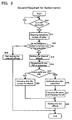
- Fig. 2 shows a first flowchart for authentication according to an embodiment of the present invention.
- the server 10 receives a call (S1)
- the server 10 obtains the telephone number of the caller informed from the communication provider according to the authenticating program 17 and connects the line (setting the line offhook) (S2).
- the server 10 requests the subscriber ID number and the password corresponding to the subscriber ID number, and receives them (S3).
- the server 10 executes the authentication whether or not the obtained telephone number is coincident with that registered to the subscriber ID number and the authentication whether or not the received password is coincident with that registered to the subscriber ID number in reference to the subscriber information file 16 (S4).
- Confirmation of the telephone number prevents an illegal access from another person who obtains the ID number and the password illegally with bad intent.
- the confirmation of password makes it possible to specify the person eventually for the access from any other subscriber who lives in the same house as the correct subscriber, for example, having the same telephone number.
- the authentication whether or not the subscriber is a correct person is completed (S5), and a predetermined game service is presented to the subscriber.
- a predetermined charging to the subscriber is executed.
- Various types of charging methods can be supposed, for example, a method employing credit cards, a charging method by the use of automatically paying from a bank account with a debit card, and a charging method with an electric money system.
- the telephone line is disconnected (the line is set offhook) (S7).
- the server informs to the client that the access is refused (S8) and the telephone line is disconnected (S7).
- the level of authentication whether or not the subscriber is correct becomes higher than that in the prior art. Moreover, there is no need to require more operations other than the conventional operations such as transmission of ID number and password against the subscriber. That makes it possible not to increase the operations of a subscriber and to increase the security level.
- a terminal equipment of a client should register a password for a predetermined ID number and a telephone number employed on a dialup connection in the server on the registration before the service presentation
- the ID number should be a unique number or symbol for all clients. Accordingly, a service provider generally gives the number. Alternatively, the unique number or symbol given to hardware of the terminal equipment on the client is employed. For example, a production number of the game machine when employing a game machine, an identification number of a CPU when employing a personal computer, an identification number of a LAN card attached to a computer,can be used as the ID number.
- the password is a combination of numbers and symbols, which can be optionally set by a user for these ID numbers.
- the telephone number is supplied to the called person, when an exchanger in a public telephone network receives a call from user's telephone.
- the password and telephone number are registered in the server on the registration of the ID number.
- the dialup connection is executed after that, only the above-described combination of the ID number and password is transmitted from the terminal equipment to the server, and the telephone number is further transmitted from the exchanger.
- the server When the production number of the game machine is employed as an ID number, the server registers the ID number in association to the password for the ID number.
- the user When executing the dialup connection from the game machine, the user may transmit only the password.
- the setting of the registered telephone number in the server should be changed and a memory card where the production number is recorded should be attached to the other game machine. Thereby, the other game machine recognizes the ID number in the memory card so that the ID number can be transmitted with the password to the server.
- Fig. 3 is a second flowchart for authentication according to an embodiment of the present invention.
- the server 10 when the server receives a call (S10), the server 10 obtains the telephone number of a caller informed from the communication provider according to the authenticating program 17 (S11).
- the server 10 executes the authentication whether or not the telephone number of the caller is a correct one of the registered regular subscriber according to the authenticating program 17 (S12), and when it is detected that the telephone number is not coincident with the registered one, the authenticating process is finished without connecting the telephone line (setting the line offhook). Therefore, there is no need to execute a process of checking the useless ID number with the password without connecting the access from the caller who accesses with a bad purpose.
- the telephone line is connected (the line is set offhook) (S13), and the server requests and receives the subscriber's ID number and password (S14).
- ID numbers and the passwords are coincident (S15)
- the caller is authenticated as a correct subscriber (S16)
- a service such as the game execution is presented with charging the fee
- the line is set offhook after finishing the service (S18).
- the server informs that the access is refused (S20) and the line is set offhook (S18).
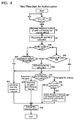
- Fig. 4 is a third flowchart for authentication according to an embodiment of the present invention.
- the authenticating procedure makes it possible that correct subscribers can execute dialup connection from a line other than the registered main telephone number. It is a feature of the authenticating procedure that the correct subscriber can select an option A where the authenticating procedure by the use of the telephone number becomes valid or an option B where the authenticating procedure becomes invalid. Secondly, the correct subscriber can add, registers, and delete the other telephone number as a line to be connected by dialup in addition to a main telephone umber. Alternatively, it becomes possible to change the main telephone number.
- the change of the above-described option, addition and deletion of the other telephone number or a registering procedure of changing the main telephone number can be always performed only when accessing from the registered main telephone number, the access from the person who illegally obtains ID number and password can be prevented, and the correct subscriber can access from one line other than the main telephone number, which is the subscriber's home telephone number.
- steps S1 to S3 are the same as those of the first flowchart shown in Fig. 2.
- the server 10 obtains the telephone number to be informed and sets the line offhook (S2), requests the subscriber ID number and the password, and obtains them. Since the telephone number is also set to an option A, which is used on the authenticating procedures, generally, the option A is detected on a step (S30) of selecting the option A or B. Then, it is checked whether or not the telephone number and the password are coincident with those registered for the ID number (S31), similar to the first flowchart. When those are coincident, the called person is authenticated as a correct subscriber (S33). When those are not coincident, then, the server informs that the access is refused against the dialup connection (S39) and sets the line onhook (S38).
- a menu of changing the setting other than a presentation menu such as a game execution service, as a menu after the authentication.
- the menu is a normally used game service presentation menu
- the fee is charged after the game is executed (S35)
- the server sets the line offhook and disconnects the telephone line, at last (S38).
- the server 10 checks whether or not the dialup connection is accessed from the main telephone number at first and permits setting an additional telephone number, setting deleting and changing the telephone number, or changing the option A to B (S37). Thereby, it becomes possible to prevent from changing the setting by a person who illegally obtains the ID number and the password.
- a procedure of changing into the option A or deleting the additional telephone number can be also executed, even when accessing from other telephone numbers other than the main telephone number, not shown in Fig. 4. These procedures of changing the setting are useless for the illegally accessing persons, there is no problem even if the procedure is executed when accessing from other telephone numbers than the main telephone number, and therefore, that gives correct subscribers degrees of freedom of changing the setting.
- the authenticating program 17 of the server 10 executes the above-described authenticating processes.
- the above-described authenticating processes can be employed from an Internet service provider, for example.
- Fig. 5 shows a structure of another authenticating server according to an embodiment of the present invention.
- the access is recognized as an illegal access and the response is returned to the line as if a dummy authenticating server, which does not present correct services, authorizes the access.
- Fig. 5 shows an example where the public telephone network 20 is ISDN.
- a main authenticating server 10A and a sub authenticating server 10B receive a call through a DSU and terminal adapters 12A, 12B.
- the main terminal adapter 10A informs the caller's telephone number to the main authenticating server 10A.
- the sub terminal adapter 10B also receives the call at the same time.
- the main authenticating server 10A refers the main authentication data 16A to check whether or not the caller's telephone number is a correct one of the registered correct subscriber.
- the authentication data 16A is same as the subscriber information file 16 which includes the telephone number, ID, and password.
- the main authenticating server 10A sets the line offhook, receives the subscriber ID number and the password, checks whether or not the password is the registered one referring to the main authentication data 16A, and connects the call to the network 30, which presents services, when both passwords are coincident. If not coincident, the server sets the line offhook and disconnects the line.
- the network 30 is, for example, a local network (LAN) where accesses to a database 32 for service or a predetermined closed intra network, and therefore, only when the caller's telephone number is the registered correct one and is authenticated according to the subscriber ID and the password, is access permitted. Then, the service is presented and the fee is charged.
- LAN local network
- the main authenticating server 10A does not set the line offhook, when the caller's telephone number is not coincident with the registered one. Then, the main server 10A informs that to the sub authenticating server 10B.
- the sub authenticating server 10B sets the line offhook, in response to information showing that the caller's telephone number is not coincident with the above-described registered one, receives the subscriber ID and the password, and executes the authentication in reference to the sub authentication data 16B.
- the authentication processes may be a dummy authentication, where a dummy authentication data 16B is employed. Additionally, normal authentication processes may be executed as this authentication process. In either case, it is an important point to make some authenticating processes look like real processes for the illegal caller.
- the sub authenticating server 10B sets the line onhook and acts as if it executes the authenticating processes. But, even when the ID number and the password are coincident, the sub authenticating server 10B also rejects the access.
- the sub authenticating server 10B does not connect the line to the network 30 where the services can be presented, even if the ID and the password are coincident, for example. Specifically, when the caller's telephone number is not coincident with the registered one, the access to the network 30 presenting a service with a condition of charging the fee is denied.
- the above-described sub authenticating server 10B may execute dummy authenticating processes by receiving the call and setting the line offhook after a constant time elapsed without replying the information showing that the telephone numbers are not coincident, transmitted from the main authenticating server 10A.
- the caller's telephone number when the caller's telephone number is not coincident with the registered one, the connection to the network 30 is denied, and therefore, a higher security level for the service can be provided.
- the sub authenticating server 10B executes dummy authenticating processes, instead of the main authenticating server 10A, and therefore, the caller can not check if the caller is connected to either the main authenticating server 10A or the sub authenticating server 10B, thus that makes it difficult for an illegal third person to know that the call is refused on the authentication process according to the telephone number, and makes it possible to prevent further hacking . Therefore, it becomes possible to keep a higher security level.
- the hacker since the hacker can connect only the sub authenticating server 10B when accessing the service, the hacker can hack and illegally obtain only the sub authenticating data 16B connecting to the sub authenticating server 10B. Because the sub authentication data 16B is different from the correct main authentication data 16A, it becomes possible to prevent illegal accessing after that.
- Fig. 6 further shows a structural diagram of another authenticating server according to an embodiment of the present invention.
- the structure of this example includes a main network 30A having a higher security level, and a sub network 30B having a lower security level.
- the server 10 permits connecting the line to the main network 30A.
- the server 10 permits connecting the line only to the sub network 30B and inhibits accessing the line to the main network 30A, which presents useful services from the caller. Thereby, it becomes possible to prevent hacking anymore by making the hacker who illegally obtains the ID number and the password, after making the hacker pass the authentication virtually.
- a firewall 34 is provided between the main network 30A and the sub network 30B to permit accessing from the main network 30A to the sub network 30B and not to permit accessing from the sub network 30B to the main network 30A.
- the firewall 34 prevents entering from one network to the other network to make it possible to access from the other network to the one network. Therefore, the firewall 34 is provided between the main network 30A and the sub network 30B to improve only one way access as described above.
- the authenticating server 10 receives a call from a public telephone network 20 through a DSU and a terminal adapter 12.
- the terminal adapter 12 informs the caller's telephone number to the authenticating server 10.
- the authenticating server 10 checks whether or not the caller's telephone number is the registered correct subscriber's one in reference to the authentication data 16. When both telephone numbers are coincident, the authenticating server 10 sets the line offhook, receives the subscriber ID number and the password, checks whether or not the password is the registered one, and connects the line to the main network 30A where services can be presented, when both passwords are coincident. When both passwords are not coincident, the server 10 sets the line onhook and disconnects the line.
- the main network 30A may be a local area network (LAN), which makes it possible to access a database 32 for service, or a predetermined closed intra-network. Only when the caller's telephone number is the registered correct one and is authenticated according to the subscriber ID and the password, can the caller access the network 30A. Then, the fee of the service presentation is also charged to the caller.
- LAN local area network
- the authenticating server 10 sets the line offhook, receives the subscriber ID number and the password, and checks whether or not the received password is coincident with the registered one in reference to the authentication data 16.
- the server 10 connects the line to the sub network 30B, and the server 10 sets the line offhook and disconnects the line when both passwords are not coincident.
- the sub network 30B does not present a service having a higher security level, for example; however, it is a network having a lower security level, for example, a commonly used Internet. Further, the sub network 30B may permit accessing the line to a database, such as free software, not shown. In contrast to the sub network 30B, the main network 30A having a higher security level presents useful services for subscribers when connecting to the Internet and down-loading game programs with charging the fee.
- the authenticating server it becomes possible to provide services having a higher security level by the authentication process employing telephone numbers. Additionally, the server makes the hacker who illegally obtains the ID number and password look as if the hacker is normally authenticated, thus more incentive is not given on hacking improvement.
- Fig. 7 further shows a structural diagram of another authenticating server according to an embodiment of the present invention.
- the structure is formed by combining the examples shown in Figs. 5 and 6.
- the main authenticating server 10A permits accessing the line to the main network 30A, when passwords are coincident.
- the sub authenticating server 10B sets the line offhook, instead of the main authenticating server 10A, and employs the sub authentication data 16B to execute the authentication processes according to the subscriber ID number and the password.
- the sub authenticating server 10B permits accessing the line to the sub network 30B.
- the sub network 30B is separated from the main network 30A by the firewall 34 to inhibit connecting the line to the main network 30A.
- serial authentication processes are the same as those in the case of Fig. 5.
- the different point is that the main network 30A presenting services having higher security level is separated by the firewall 34 from the sub network 30B where the access is permitted if both telephone numbers are not coincident.
- the illegal hacking is connected only to the sub authenticating server 10B, when the telephone number is different from the registered one, in the example of Fig. 7, similarly to the case of Fig. 5, the sub authentication data 16B is dummy data, which is different from the correct authentication data 16A, and therefore, the illegal access can be prevented after that, if the sub authentication data 16B is stolen by hacking.
- authenticating processes are executed for the illegal access and the security level is lower but some network accesses can be executed after executing the authentication processes according to the subscriber ID and the password, similarly to the case of Fig. 6, thus more incentive for doing more or improving the hacking is not given, thus making the security level higher.
- Fig. 8 is a diagram showing a structure of another authenticating server according to one embodiment of the present invention.
- a feature of this example is that an automatic answer device 36 or a customer service center 38 is provided, instead of the main authenticating server 10B of Fig. 5.
- the main authenticating server checks whether or not the caller's telephone number is coincident with the registered one, in reference to the authentication data 16A, sets the line offhook, and connects the call when both telephone numbers are coincident. When both the telephone numbers are not coincident, the server does not set the line offhook. After setting the line offhook, the server employs the subscriber ID number and the password to execute authentication processes, and permits connecting the line to the network 30, when both passwords are coincident. When both passwords are not coincident, the server sets the line offhook and disconnects the line.
- the automatic response device 36 sets the line offhook after the information is received or a constant time has elapsed and transmits a message showing that the caller is not registered by voice.
- the caller is connected to an operator in a customer center 38, instead of the automatic response device 36, to cope with the illegal access. It may be set that the connection to the customer center 38 is executed at first time, when the time of responses replied by the automatic response device 36 exceeds than a predetermined time.
- a telephone number obtained by a service of informing a caller's telephone number is employed to execute authentication of connection, when connecting a network by dialup, a higher security can be obtained without requesting additional operations to subscribers. Since a communication company performs the telephone number informing service, it is more difficult to illegally connect by a person who illegally obtains the ID number and the password.
Landscapes
- Engineering & Computer Science (AREA)
- Computer Security & Cryptography (AREA)
- Signal Processing (AREA)
- Theoretical Computer Science (AREA)
- General Physics & Mathematics (AREA)
- General Engineering & Computer Science (AREA)
- Physics & Mathematics (AREA)
- Software Systems (AREA)
- Computer Hardware Design (AREA)
- Telephonic Communication Services (AREA)
- Information Transfer Between Computers (AREA)
- Computer And Data Communications (AREA)
- Data Exchanges In Wide-Area Networks (AREA)
- Telephone Function (AREA)
Applications Claiming Priority (2)
| Application Number | Priority Date | Filing Date | Title |
|---|---|---|---|
| JP11160658A JP2000349926A (ja) | 1999-06-08 | 1999-06-08 | ダイヤルアップ接続用サーバ |
| JP16065899 | 1999-06-08 |
Publications (2)
| Publication Number | Publication Date |
|---|---|
| EP1059793A2 true EP1059793A2 (fr) | 2000-12-13 |
| EP1059793A3 EP1059793A3 (fr) | 2003-07-16 |
Family
ID=15719703
Family Applications (1)
| Application Number | Title | Priority Date | Filing Date |
|---|---|---|---|
| EP00304782A Withdrawn EP1059793A3 (fr) | 1999-06-08 | 2000-06-06 | Serveur pour la connection à travers le réseau téléphonique commuté |
Country Status (3)
| Country | Link |
|---|---|
| EP (1) | EP1059793A3 (fr) |
| JP (1) | JP2000349926A (fr) |
| KR (1) | KR20010007291A (fr) |
Cited By (1)
| Publication number | Priority date | Publication date | Assignee | Title |
|---|---|---|---|---|
| GB2514085A (en) * | 2013-03-07 | 2014-11-19 | Addresstrek Ltd | Method and apparatus for securely providing postal address data to client devices |
Families Citing this family (9)
| Publication number | Priority date | Publication date | Assignee | Title |
|---|---|---|---|---|
| KR100385860B1 (ko) * | 2000-12-23 | 2003-06-02 | 주식회사 케이티 | Pc 와 cid 기능을 가진 전화기간의 공인 인증기관을통한 발신자 식별 방법 |
| JP2002217996A (ja) * | 2001-01-19 | 2002-08-02 | Kozo Fujino | 通信ネットワーク上のセキュリティシステム及び方法 |
| KR20030064990A (ko) * | 2002-01-29 | 2003-08-06 | 주식회사 지맥스테크놀러지 | 방화벽 및 그 운용방법 |
| KR20040006596A (ko) * | 2002-07-12 | 2004-01-24 | 한광철 | 통신망 해킹 방어기술 |
| WO2005088952A1 (fr) * | 2004-03-12 | 2005-09-22 | Ionos Co., Ltd. | Systeme d'authentification de membres |
| CN103813035A (zh) * | 2012-11-14 | 2014-05-21 | 中兴通讯股份有限公司 | 会议接入方法及装置 |
| WO2017077865A1 (fr) * | 2015-11-05 | 2017-05-11 | コニカミノルタ株式会社 | Système de communication |
| JP7630849B2 (ja) * | 2023-04-27 | 2025-02-18 | 特定非営利活動法人創力Up | 電話端末を使用した業務処理方法 |
| JP7695435B1 (ja) | 2024-03-18 | 2025-06-18 | エヌ・ティ・ティ・コミュニケーションズ株式会社 | データ流通システム、コネクタ装置および利用者認証方法 |
Family Cites Families (3)
| Publication number | Priority date | Publication date | Assignee | Title |
|---|---|---|---|---|
| US5280581A (en) * | 1992-02-27 | 1994-01-18 | Hughes Aircraft Company | Enhanced call-back authentication method and apparatus for remotely accessing a host computer from a plurality of remote sites |
| US5721780A (en) * | 1995-05-31 | 1998-02-24 | Lucent Technologies, Inc. | User-transparent security method and apparatus for authenticating user terminal access to a network |
| KR100290510B1 (ko) * | 1997-02-28 | 2001-06-01 | 가시오 가즈오 | 네트워크를 이용한 인증시스템 |
-
1999
- 1999-06-08 JP JP11160658A patent/JP2000349926A/ja not_active Withdrawn
-
2000
- 2000-06-06 EP EP00304782A patent/EP1059793A3/fr not_active Withdrawn
- 2000-06-08 KR KR1020000031308A patent/KR20010007291A/ko not_active Ceased
Cited By (2)
| Publication number | Priority date | Publication date | Assignee | Title |
|---|---|---|---|---|
| GB2514085A (en) * | 2013-03-07 | 2014-11-19 | Addresstrek Ltd | Method and apparatus for securely providing postal address data to client devices |
| US8955156B2 (en) | 2013-03-07 | 2015-02-10 | Addresstrek Limited | Method and apparatus for securely providing postal address data to client devices |
Also Published As
| Publication number | Publication date |
|---|---|
| JP2000349926A (ja) | 2000-12-15 |
| EP1059793A3 (fr) | 2003-07-16 |
| KR20010007291A (ko) | 2001-01-26 |
Similar Documents
| Publication | Publication Date | Title |
|---|---|---|
| EP0534673B1 (fr) | Méthode de contrÔle d'accès protégé | |
| KR100392792B1 (ko) | 제 2접속경로를 이용한 사용자인증시스템 및 사용자인증방법 | |
| CA2078077C (fr) | Systeme centralise de controle de la securite | |
| RU2116008C1 (ru) | Система подвижной телефонной связи, способ оплаты с терминального оборудования подвижной телефонной станции и система для осуществления способа | |
| US6782080B2 (en) | Arrangement for authenticating user and authorizing use of secured system | |
| JP3479634B2 (ja) | 本人認証方法および本人認証システム | |
| EP1564619A1 (fr) | Contrôle d'accès biométrique utilisant un terminal de téléphonie mobile | |
| JP2009515403A (ja) | 電気通信ネットワークにおけるユーザアカウントの遠隔有効化 | |
| JPH11507451A (ja) | 許可されていないアカウントアクセスを検出するシステム | |
| US9137241B2 (en) | Method and system using a cyber ID to provide secure transactions | |
| EP1059793A2 (fr) | Serveur pour la connection à travers le réseau téléphonique commuté | |
| JP2002229951A (ja) | 本人認証システム | |
| US6256299B1 (en) | Automatic service provider notification of unauthorized terminal activity | |
| JP2002101091A (ja) | ユーザ認証方法およびユーザ認証プログラム | |
| WO2006038883A1 (fr) | Fourniture a un utilisateur d'une authentification multi-facteur | |
| US20070016527A1 (en) | Method and system for user-controlled, strong third-party-mediated authentication | |
| JP2000209284A (ja) | 認証装置、及び、認証方法 | |
| US20020181676A1 (en) | System for connecting first and second items of computer equipment through a telecommunication network | |
| JP2001244926A (ja) | 移動電話機およびその認証情報処理方法 | |
| JP2002236670A (ja) | セキュリティコンテンツの提供方法 | |
| KR20050019318A (ko) | 웹사이트 서비스 등록정보의 도용 방지 방법 및 그시스템 | |
| TW200911331A (en) | Anti-plug-in and anti-phishing system of online game | |
| JP2003198730A (ja) | サービス提供側装置、認証方法、プログラム、及び記憶媒体 | |
| KR20060034512A (ko) | 이동통신 단말기를 이용한 포탈 사이트 회원 인증 방법 | |
| JPH06197175A (ja) | クレジットカード・コールの許否判定方式 |
Legal Events
| Date | Code | Title | Description |
|---|---|---|---|
| PUAI | Public reference made under article 153(3) epc to a published international application that has entered the european phase |
Free format text: ORIGINAL CODE: 0009012 |
|
| AK | Designated contracting states |
Kind code of ref document: A2 Designated state(s): AT BE CH CY DE DK ES FI FR GB GR IE IT LI LU MC NL PT SE |
|
| AX | Request for extension of the european patent |
Free format text: AL;LT;LV;MK;RO;SI |
|
| RAP1 | Party data changed (applicant data changed or rights of an application transferred) |
Owner name: SEGA CORPORATION |
|
| PUAL | Search report despatched |
Free format text: ORIGINAL CODE: 0009013 |
|
| AK | Designated contracting states |
Designated state(s): AT BE CH CY DE DK ES FI FR GB GR IE IT LI LU MC NL PT SE |
|
| AX | Request for extension of the european patent |
Extension state: AL LT LV MK RO SI |
|
| AKX | Designation fees paid | ||
| REG | Reference to a national code |
Ref country code: DE Ref legal event code: 8566 |
|
| STAA | Information on the status of an ep patent application or granted ep patent |
Free format text: STATUS: THE APPLICATION IS DEEMED TO BE WITHDRAWN |
|
| 18D | Application deemed to be withdrawn |
Effective date: 20040102 |