EP1061957B1 - Mangan (ii) chelate mit hoher in-serum relaxivität - Google Patents
Mangan (ii) chelate mit hoher in-serum relaxivität Download PDFInfo
- Publication number
- EP1061957B1 EP1061957B1 EP99910336A EP99910336A EP1061957B1 EP 1061957 B1 EP1061957 B1 EP 1061957B1 EP 99910336 A EP99910336 A EP 99910336A EP 99910336 A EP99910336 A EP 99910336A EP 1061957 B1 EP1061957 B1 EP 1061957B1
- Authority
- EP
- European Patent Office
- Prior art keywords
- compounds
- formula
- chelated complexes
- cations
- diagnostic
- Prior art date
- Legal status (The legal status is an assumption and is not a legal conclusion. Google has not performed a legal analysis and makes no representation as to the accuracy of the status listed.)
- Expired - Lifetime
Links
- 0 *COCC(C(O)=O)N(CCN(CC(O)=O)C(COC*=C)C(O)=O)CC(O)=O Chemical compound *COCC(C(O)=O)N(CCN(CC(O)=O)C(COC*=C)C(O)=O)CC(O)=O 0.000 description 3
- JZRBXYOUQYUMOB-UHFFFAOYSA-N CC(C(O)=O)N(CCN(CC(O)=O)C(C)C(O)=O)CC(O)=O Chemical compound CC(C(O)=O)N(CCN(CC(O)=O)C(C)C(O)=O)CC(O)=O JZRBXYOUQYUMOB-UHFFFAOYSA-N 0.000 description 1
- FKGJQMQFECETKJ-UHFFFAOYSA-N Cc(cc1)cc(Oc(cc2)ccc2O)c1O Chemical compound Cc(cc1)cc(Oc(cc2)ccc2O)c1O FKGJQMQFECETKJ-UHFFFAOYSA-N 0.000 description 1
- NJESAXZANHETJV-UHFFFAOYSA-N Cc1ccc(C(O)=O)c(O)c1 Chemical compound Cc1ccc(C(O)=O)c(O)c1 NJESAXZANHETJV-UHFFFAOYSA-N 0.000 description 1
Classifications
-
- A—HUMAN NECESSITIES
- A61—MEDICAL OR VETERINARY SCIENCE; HYGIENE
- A61K—PREPARATIONS FOR MEDICAL, DENTAL OR TOILETRY PURPOSES
- A61K49/00—Preparations for testing in vivo
- A61K49/06—Nuclear magnetic resonance [NMR] contrast preparations; Magnetic resonance imaging [MRI] contrast preparations
-
- C—CHEMISTRY; METALLURGY
- C07—ORGANIC CHEMISTRY
- C07C—ACYCLIC OR CARBOCYCLIC COMPOUNDS
- C07C229/00—Compounds containing amino and carboxyl groups bound to the same carbon skeleton
- C07C229/02—Compounds containing amino and carboxyl groups bound to the same carbon skeleton having amino and carboxyl groups bound to acyclic carbon atoms of the same carbon skeleton
- C07C229/34—Compounds containing amino and carboxyl groups bound to the same carbon skeleton having amino and carboxyl groups bound to acyclic carbon atoms of the same carbon skeleton the carbon skeleton containing six-membered aromatic rings
- C07C229/36—Compounds containing amino and carboxyl groups bound to the same carbon skeleton having amino and carboxyl groups bound to acyclic carbon atoms of the same carbon skeleton the carbon skeleton containing six-membered aromatic rings with at least one amino group and one carboxyl group bound to the same carbon atom of the carbon skeleton
Definitions
- the present invention relates to the field of the diagnostic technique known as Magnetic Resonance Imaging (M.R.I.), a diagnostic procedure used in medical practice to detect anomalies in organs or tissues of the human or animal body (see: Rocklage S.M., Watson A.D. and Carvlin M.J., Magnetic Resonance Imaging, Chap. 14, Vol.1, Second Ed., 1992; Stark D.D. and Bradley W.G. Eds.).
- M.R.I. Magnetic Resonance Imaging
- the invention relates to manganese chelated complexes of ethylenediaminotetraacetic acid derivatives, the physiologically compatible salts thereof and the use of these compounds as M.R.I. contrast agents.
- Mn 2+ ion as an M.R.I. contrast agent has been taken in consideration since 1978 for myocardium imaging.
- MnCl 2 and Mn-PDTA (1,3-propylenediamino-N,N',N'',N'''-tetraacetate
- Manganese complexes of porphyrins and derivatives thereof were proposed as contrast agents specific for tumors (Investigative Radiology 1995, 30(10) , 611-620).
- M.R.I. contrast agents were evaluated consisting of Mn-EDTA lipohilic derivatives (for example, manganese-EDTA-bis(hydroxypropyldecylamine), Mn-EDTA-DDP) bound to the membranes of small unilamellar liposomes ("memsomes"), which are potentially valuable for hepatic and cardiac perfusion imaging (Journal of Liposome Research 1994, 4(2) , 811-834).
- Mn-EDTA lipohilic derivatives for example, manganese-EDTA-bis(hydroxypropyldecylamine), Mn-EDTA-DDP
- memsomes small unilamellar liposomes
- the same compounds are object of International Patent Application WO 92/21017 and of US 5,312,617, which disclose M.R.I.
- contrast agents based on manganese chelates (II) consisting of EDTA bis-amides where the amide nitrogens are substituted with long chain alkyl residues (C 7 -C 30 ).
- II manganese chelates
- M.R.I. contrast agents comprising manganese chelated complexes are also described in US patents 4,980,148 and 5,246,696.
- Said complexes, in which the ligand is an alkylenediaminotetraacetic acid in which the alkylene chain is interrupted by one or more substituents selected from O, S, CHOH, CHSH, are stated to be particularly useful for imaging of liver, kidneys, pancreas and gastrointestinal tract.
- Teslascan (R) mangafodipir trisodium
- R Teslascan
- This compound was considered useful for M.R.I. diagnosis of pancreas adenocarcinoma and pancreatitis (Investigative Radiology 1995, 30(10) , 611-620).
- manganese is an essential oligoelement present in all mammal cells: this is undoubtedly an advantage as for the tolerability of the corresponding complexes.
- the manganese ion can cause toxicity when released from the corresponding chelates in vivo; this mainly applies when the manganese ion is administered intravascularly, as in this case the natural regulation of its adsorption by the intestine fails. It is therefore necessary for it to be administered as stable complex, in order to prevent any toxicity due to the free metal and to improve its elimination.
- Mn-DPDP Some compounds of the above cited literature, for example Mn-DPDP, show some instability in vivo : a recent biodistribution study proved that this complex dissociates, releasing manganese which accumulates in liver, pancreas and kidneys, whereas the undissociated chelate is removed through glomerular filtration.
- the M.R.I, properties of Mn-DPDP would therefore be ascribable mainly to the manganese ion released by the complex, which accumulates in liver and pancreas (Investigative Radiology 1994, 29(2) , S249-S250).
- EP230893 discloses compounds suitable for NMR imaging based on a ethylenediaminotetraacetic acid nucleus differently substituted on the acetyl moieties, which form complexes with divalent ions such as manganese (2+).
- the complexes can be used as contrast agents in nuclear spin tomography and are particularly suited for the imaging of the gastro-intestinal tract.
- the compounds of the present invention solve this problem in the field of M.R.I, diagnostic imaging.
- a class of compounds selected from EP 230 893, more precisely a class of Mn(II) chelates, has, in fact, shown some unexpected properties which make them valuable for use in this field.
- the present invention relates to stable manganese chelated complexes in which said ion is in the oxidation state +2 (Mn(II)).
- the invention relates to Mn(II) chelates of compounds of formula (I): wherein:
- Suitable substances for salifying the chelates of the invention are, for example:
- N-methylglucamine salts are particularly preferred.
- Particularly preferred compounds within formula (I), are those of formula (II): wherein the R 4 groups, independently of one another, are phenyl, unsubstituted or substituted with one or more R 5 groups, which are the same or different, wherein R 5 is halogen, -OH, -NH 2 , -COOH, -CONH 2 , -SO 3 H, -SO 3 NH 2 , or a C 1 -C 4 alkyl chain.
- R 4 In compounds of formula (III), preferred meanings for R 4 are as follows:
- manganese chelates included within formula (I), particularly preferred is the following:
- the present invention also relates to the use of the Mn 2+ complex chelates of the chelating compounds of formulae (I) to (III) and to the salts thereof, for the preparation of pharmaceutical compositions for diagnostic use, as well as the formulations themselves.
- the compounds of the invention can conveniently be used as they are or they can be conjugated with macromolecules or incorporated in structures which carry them to specific body regions.
- the compounds of the invention can be formulated with additives conventionally used for the pharmaceutical or veterinary formulations, for example stabilizers, antioxidants, osmolality and pH adjusters, buffers and the like.
- parenteral administration they are preferably formulated as sterile aqueous solutions or suspensions, whose pH can range from 6.0 to 8.5.
- Said formulations can also be lyophilized and supplied as such for reconstitution before use.
- these agents can be formulated as a solution or suspension containing suitable additives in order to, for example, control viscosity.
- the oral administration they can be formulated according to preparation methods routinely used in the pharmaceutical technique, optionally also as coated formulations to gain extra protection from the acid pH of stomach, thereby inhibiting the release of the chelated metal ion, which usually occurs at the typical pH values of gastric juices.
- excipients such as sweeteners and/or flavours, can also be added according to known techniques of pharmaceutical technique.
- solutions or suspensions of the compounds of this invention can also be formulated as aerosol for use in aerosol-bronchography.
- the compounds of the invention have shown characteristics such as good tolerability, good stability both in vitro and in vivo and surprisingly high r 1 and, particularly, r 2 relaxivities in human serum.
- the relevant data are summarized in Tables 1, 2 and 3. These characteristics make the compounds of the invention particularly interesting as M.R.I. contrast agents of general use.
- the chelates of the invention have also shown a good applicability in the imaging of the liver (Table 4) and of the biliary tracts, which organs are reached by said chelates without significant losses of the chelated metal, thus confirming their characteristics of stability. This is a further aspect of the present invention.
- the chelates of the present invention thanks to their surprising relaxivity values in human serum, can advantageously improve the images obtainable using said compounds in formulations specific for the imaging of the cardiocirculatory system. This is a further aspect of the present invention.
- the chelated complexes of the present invention are characterized in having particularly high transversal relaxivity values (r 2 ) in human serum. This characteristic makes them unexpectedly unique compared with the general teaching of EP 230 893, that mainly focuses on the effects of the compounds on relaxation times T 1 . This makes them most suitable, and this is a further aspect of the present invention, for use in M.R.I. diagnostic imaging in recording images of organs or tissues, wherein said images are acquired by combinations of T 1 /T 2 sequences or by T 2 weighed sequences.
- said chelated complexes proved to be particularly suitable also in the preparation of pharmaceutical formulations for M.R.I. diagnostic imaging at low fields, i.e. fields ranging from 0.1 to 0.5 Tesla or, when measuring the intensity of the applied magnetic field in Hertz, fields below 20 MHz (An introduction to Magnetic Resonance in Medicine, Ed. Peter A. Rinck).
- the compounds of the invention thanks to their excellent relaxivity shown even at such low fields, can advantageously be used with apparatuses such as Artroscan (arthrographs which make use of the Magnetic resonance), open apparatuses, apparatuses intended for diagnostic of single regions of the human body (e.g. the shoulder), and generally apparatuses less expensive, easier to handle and increasingly diffused.
- the considerable increase in relaxivity in human serum shown by the compounds of the invention allows the use thereof in diagnostic formulations requiring a low dosage of the contrast agent. This can be attained:
- compositions provide images of good quality, while assuring a significant improvement from the toxicologic point of view.
- contrastographic formulations containing the chelated complexes of the invention can therefore be formulated with concentrations of contrast agent ranging from 0.001 to 1.0 mmol/mL, preferably from 0.01 to 0.5 mmol/mL; in particular, concentrations lower than 0.25 mmol/mL for the low-dosage formulations.
- Said formulations can be administered to the patient in doses ranging from 0.001 to 0.1 mmol/kg, preferably 0.1 mmol/kg; in particular, doses ranging from 5 to 50 ⁇ mol/kg when administered in low dosages.
- step (a2) a suitable ⁇ -amino acid (1B) is reacted with a 1,2-dihaloethane, such as 1,2-dibromoethane (2B) in a suitable solvent (e.g. water/ethanol, water/methanol mixtures), keeping pH at about 9 with a suitable buffer (preferably 2M borate buffer) at a temperature which can range from 60 to 90°C.
- a suitable solvent e.g. water/ethanol, water/methanol mixtures
- a suitable buffer preferably 2M borate buffer
- an ⁇ -haloacid (1B') can be reacted with 1,2-diaminoethane (2B') in aqueous solution at 20 to 60°C.
- the resulting intermediate (3B) is carboxymethylated in step (b2) with an ⁇ -haloacetic acid (e.g.
- Step (d1) comprises the protection of the alcoholic fraction of a 2-haloethanol (preferably 2-bromoethanol) with dihydropyran, to give intermediate (2D).
- the alcohol-protecting group can be, for example, benzyl and trityl.
- the reaction takes place in an organic solvent such as CH 2 Cl 2 , CHCl 3 , CH 2 ClCH 2 Cl, in the presence of 4-toluenesulfonic acid pyridinium salt or of another acid catalyst.
- the leaving group is preferably Br.
- step (d2) the ester (e.g. t-butyl ester) of a natural or synthetic ⁇ -amino acid (1D), either in the racemic or optically active form, is reacted with the intermediate (2D) in the presence of a base, such as diisopropylethylamine, in a solvent such as CH 3 CN, DMF or a chlorinated solvent, to give intermediate (3D).
- a base such as diisopropylethylamine
- step (d3) is reacted, in step (d3), with a bromoacetic acid ester (e.g. t-butyl-bromoacetate) in the presence of a base, such as diisopropylethylamine, to give intermediate (4D) which is reacted, in the subsequent step (d4), with 4-toluenesulfonic acid pyridinium salt or another acid catalyst, in an ethanol/water mixture, at 20-60°C, to give intermediate (5D).
- a bromoacetic acid ester e.g. t-butyl-bromoacetate
- a base such as diisopropylethylamine
- step (d5) intermediate (5D) is brominated with N-bromosuccinimide in the presence of triphenylphosphine, to give intermediate (6D), which is reacted, in step (d6) with the ester (e.g. t-butyl ester) of an ⁇ -amino acid (7D), in a suitable solvent (e.g. CH 3 CN/buffer phosphate pH 8), to give intermediate (8D).
- a bromoacetic acid ester e.g. t-butyl-bromoacetate
- a base such as diisopropylethylamine
- step (d8) is deprotected in step (d8) with known methods (e.g. hydrolysis with CF 3 COOH or (CH 3 ) 3 SiI, when the protective group is t -butyl) to give the free ligand (10D), which is subsequently complexed and salified according to the general procedure already described in the above schemes.
- known methods e.g. hydrolysis with CF 3 COOH or (CH 3 ) 3 SiI, when the protective group is t -butyl
- step (a6) the salt (preferably the potassium salt) of a 3-benzyloxy-2-halopropionic acid (1F), optionally substituted at the benzene ring, wherein the halogen at the 2- position is selected from Cl, Br, I, preferably Cl, is reacted in aqueous solution at basic pH (preferably pH 12) by addition of inorganic bases (preferably KOH) with 1,2-diaminoethane in the presence of KCl at a temperature from 50 to 80°C, preferably 65°C.
- inorganic bases preferably KOH
- the subsequent acidification yields intermediate (2F) which, in step (b6), is carboxymethylated with a 2-haloacetic acid (preferably 2-bromoacetic acid) at basic pH (about 10) and at 40 to 70°C, preferably 50°C.
- a 2-haloacetic acid preferably 2-bromoacetic acid
- the subsequent acidification gives the free ligand (3F) that is reacted, in the subsequent step, with the stoichiometric amount of manganese, according to the general procedure already described in the above schemes, to obtain the desired chelated complex (4F).
- the precipitate was again separated by decantation, powdered in a mortar, filtered, washed with H 2 O and dissolved in 1 N NaOH (1,85 L). After dilution with H 2 O (2.45 L), the solution was acidified (pH 3) with 2 N HCl, with strong stirring, filtered and then acidified to pH 1.5 with 2 N HCl. After 24 hours the precipitate was separated by filtration, powdered in a mortar, washed with H 2 O (0.5 L) and dried (P 2 O 5 ; 50°C; 2 kPa). The resulting solid was suspended in n -butanol saturated with water (3 L) and stirred at r.t. for 18 hours.
- the relaxivity of the compounds of the invention was measured both in saline solution and in human serum, reconstituted from Seronorm (R) Human (Nycomed Pharma), lyophilized human serum.
- the obtained data are summarised in the following Table 1.
- the high r 1 and, more specifically, r 2 relaxivity values measured in serum for the compounds of the invention clearly show the remarkable potential of these compounds in M.R.I. diagnostic imaging, both for general use and, more particularly, for use in combinations of T 1 /T 2 weighed or T 2 weighed sequences, as well as in the imaging of the cardiocirculatory system.
Landscapes
- Health & Medical Sciences (AREA)
- Organic Chemistry (AREA)
- Chemical & Material Sciences (AREA)
- Epidemiology (AREA)
- Life Sciences & Earth Sciences (AREA)
- Animal Behavior & Ethology (AREA)
- General Health & Medical Sciences (AREA)
- Public Health (AREA)
- Veterinary Medicine (AREA)
- Radiology & Medical Imaging (AREA)
- Nuclear Medicine, Radiotherapy & Molecular Imaging (AREA)
- Medicines Containing Antibodies Or Antigens For Use As Internal Diagnostic Agents (AREA)
- Organic Low-Molecular-Weight Compounds And Preparation Thereof (AREA)
- Indole Compounds (AREA)
- Investigating Or Analysing Biological Materials (AREA)
Claims (17)
- Verbindungen der Formel (I):worin:
 sowie die optisch aktiven Formen der Chelate davon mit Mn(II) und die Salze davon mit physiologisch verträglichen organischen Basen, ausgewählt aus primären, sekundären und tertiären Aminen oder basischen Aminosäuren oder mit anorganischen Basen, deren Kationen Natrium, Kalium, Magnesium, Calcium oder Gemische davon sind.R1 und R2, die gleich oder verschieden sind, eine -(CH2)m-O-(CH2)n-R3-Gruppe sind, worin R3 für einen Arylrest steht, m eine ganze Zahl von 1 bis 5 ist und n eine ganze Zahl von 1 bis 4 ist,
 - Verbindungen nach Anspruch 1, dadurch gekennzeichnet, dass sie mit Kationen, ausgewählt aus:ein Salz gebildet haben.Kationen von anorganischen Basen, insbesondere Ionen von Alkali- oder Erdalkalimetallen, ausgewählt aus Natrium, Kalium, Magnesium, Calcium oder Gemischen davon;Kationen von physiologisch verträglichen organischen Basen, ausgewählt aus primären, sekundären und tertiären Aminen, insbesondere Ethanolamin, Diethanolamin, Morpholin, Glucamin, N-Methylglucamin, N,N-Dimethylglucamin;Kationen von Aminosäuren, insbesondere Lysin, Arginin oder Ornithin
- Verbindungen nach Anspruch 2, dadurch gekennzeichnet, dass sie mit N-Methylglucamin ein Salz gebildet haben.
- Verbindungen nach einem der obigen Ansprüche, dadurch gekennzeichnet, dass R1 und R2 Reste der Formeln:


 sind, worin: x = 1, 2.
- Verbindungen nach Anspruch 1 der Formel (II):worin R4 für Phenyl steht, das unsubstituiert ist oder mit einer oder mehreren Gruppen R5, die gleich oder verschieden sind, substituiert ist, wobei R5 für Halogen, -OH, -NH2, -COOH, -CONH2, -SO3H, -SO3NH2 oder eine C1-C4-Alkylkette steht.
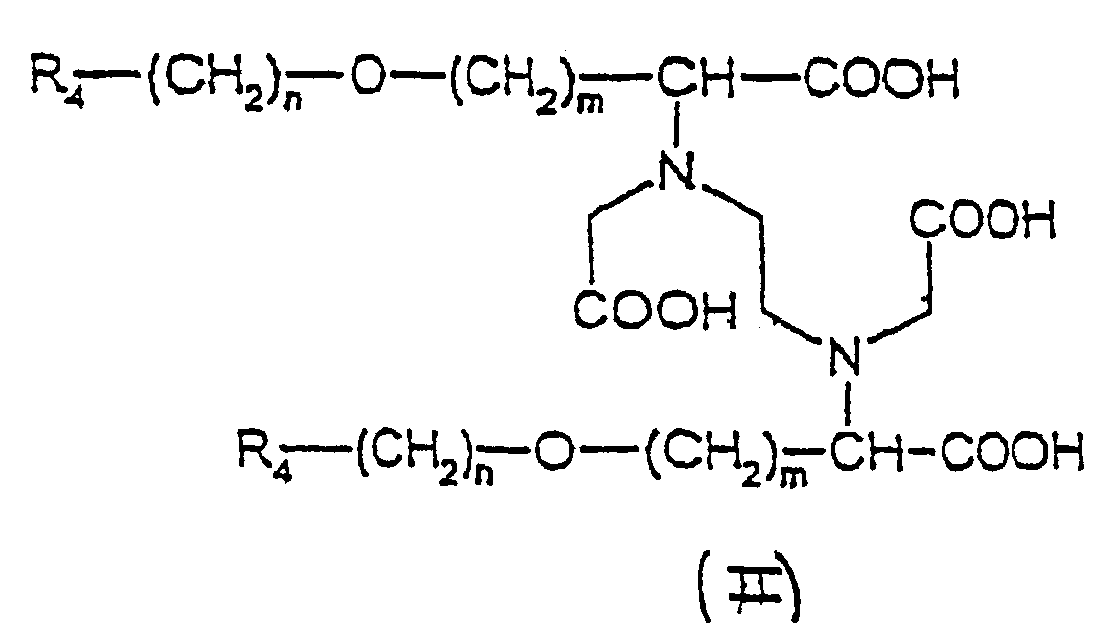
- Verbindungen nach Anspruch 5, dadurch gekennzeichnet, dass R4 einer der Reste der Formeln:
 ist, worin: x = 1, 2.
- Verbindungen nach Anspruch 1 der Formel (III),worin die Gruppen R4, die gleich oder verschieden sind, die gleichen Bedeutungen wie in Anspruch 4 haben.
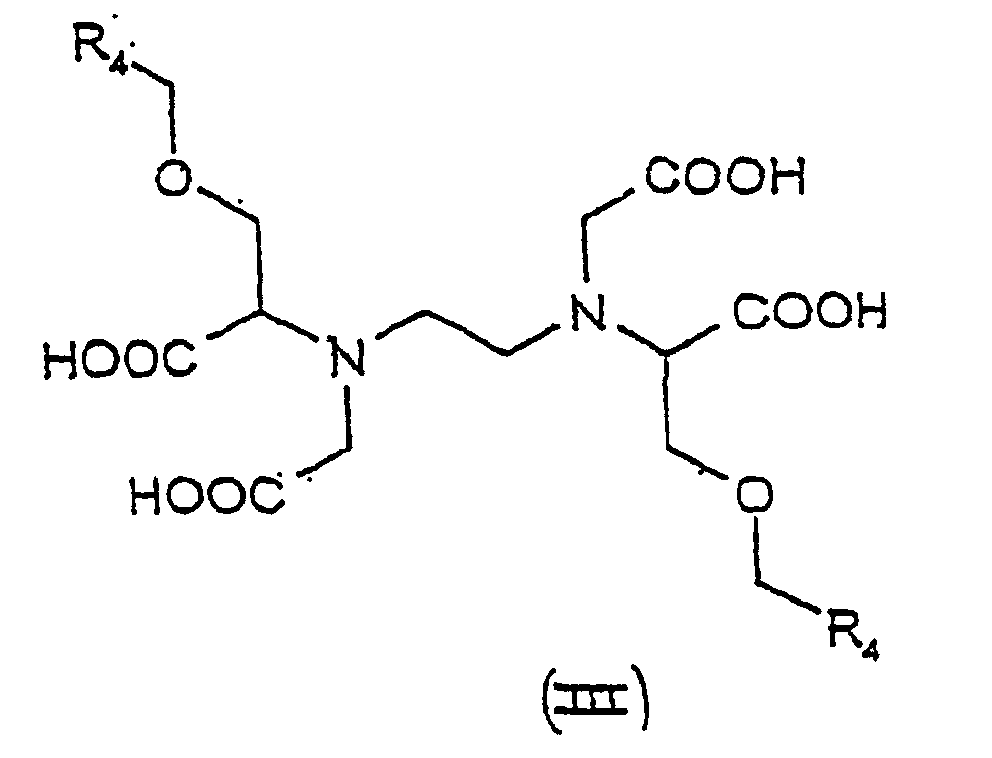
- Verbindungen nach Anspruch 7, dadurch gekennzeichnet, dass R4 eine der folgenden Gruppen ist:

- Verbindungen nach Anspruch 8, dadurch gekennzeichnet, dass R4 unsubstituiertes Phenyl ist.
- Verbindung nach Anspruch 1 der Formel:

- Kontrastographische Zubereitung für die diagnostische M.R.I.-Abbildung, umfassend mindestens einen der chelatisierten Komplexe nach den Ansprüchen 1 bis 10, oder ein physiologisch verträgliches Salz davon.
- Verbindungen nach den Ansprüchen 1 bis 10 für die diagnostische M.R.I.-Abbildung der Leber und des Gallentrakts.
- Verbindungen nach den Ansprüchen 1 bis 10 für die diagnostische M.R.I.-Abbildung des kardiovaskulären Systems.
- Verwendung der chelatisierten Komplexe nach einem der Ansprüche 1 bis 10 zur Herstellung von diagnostischen M.R.I.-Zubereitungen, wobei die genannten Zubereitungen für die Abbildung von Organen oder Geweben des menschlichen oder tierischen Körpers verwendet werden.
- Verwendung der chelatisierten Komplexe nach Anspruch 14, dadurch gekennzeichnet, dass die diagnostischen Zubereitungen die genannten chelatisierten Komplexe in Konzentrationen von 0,001 bis 1,0 mmol/ml enthalten.
- Verwendung von chelatisierten Komplexen nach Anspruch 15, dadurch gekennzeichnet, die diagnostischen Zubereitungen die genannten chelatisierten Komplexe in Konzentrationen von 0,01 bis 0,5 mmol/ml enthalten.
- Verwendung von chelatisierten Komplexen nach Anspruch 15, dadurch gekennzeichnet, dass die Zubereitungen dem Patienten in Dosen in Bereichen von 0,001 bis 0,1 mmol/kg verabreicht werden.
Applications Claiming Priority (3)
| Application Number | Priority Date | Filing Date | Title |
|---|---|---|---|
| ITMI980477 | 1998-03-10 | ||
| ITMI980477 IT1298614B1 (it) | 1998-03-10 | 1998-03-10 | Chelati complessi di manganese ad alta relassivita' in siero |
| PCT/EP1999/001500 WO1999045968A1 (en) | 1998-03-10 | 1999-03-09 | Manganese chelates with high relaxivity in serum |
Publications (2)
| Publication Number | Publication Date |
|---|---|
| EP1061957A1 EP1061957A1 (de) | 2000-12-27 |
| EP1061957B1 true EP1061957B1 (de) | 2002-10-30 |
Family
ID=11379243
Family Applications (1)
| Application Number | Title | Priority Date | Filing Date |
|---|---|---|---|
| EP99910336A Expired - Lifetime EP1061957B1 (de) | 1998-03-10 | 1999-03-09 | Mangan (ii) chelate mit hoher in-serum relaxivität |
Country Status (5)
| Country | Link |
|---|---|
| EP (1) | EP1061957B1 (de) |
| JP (1) | JP2002506050A (de) |
| DE (1) | DE69903717T2 (de) |
| IT (1) | IT1298614B1 (de) |
| WO (1) | WO1999045968A1 (de) |
Family Cites Families (5)
| Publication number | Priority date | Publication date | Assignee | Title |
|---|---|---|---|---|
| US4980148A (en) * | 1985-02-06 | 1990-12-25 | Mallinckrodt, Inc. | Methods for enhancing magnetic resonance imaging |
| IT1213029B (it) * | 1986-01-30 | 1989-12-07 | Bracco Ind Chimica Spa | Chelati di ioni metallici paramagnetici. |
| US5057302A (en) * | 1987-02-13 | 1991-10-15 | Abbott Laboratories | Bifunctional chelating agents |
| IT1290417B1 (it) * | 1996-08-02 | 1998-12-03 | Bracco Spa | Composti chelanti derivati di acidi poliamminopolicarbossilici, loro chelati con ioni metallici paramagnetici, loro preparazione ed |
| IT1283650B1 (it) * | 1996-08-02 | 1998-04-23 | Bracco Spa | Chelati paramagnetici ad alta relassivita' in siero |
-
1998
- 1998-03-10 IT ITMI980477 patent/IT1298614B1/it active IP Right Grant
-
1999
- 1999-03-09 WO PCT/EP1999/001500 patent/WO1999045968A1/en not_active Ceased
- 1999-03-09 EP EP99910336A patent/EP1061957B1/de not_active Expired - Lifetime
- 1999-03-09 DE DE69903717T patent/DE69903717T2/de not_active Expired - Lifetime
- 1999-03-09 JP JP2000535381A patent/JP2002506050A/ja active Pending
Also Published As
| Publication number | Publication date |
|---|---|
| JP2002506050A (ja) | 2002-02-26 |
| EP1061957A1 (de) | 2000-12-27 |
| WO1999045968A1 (en) | 1999-09-16 |
| DE69903717T2 (de) | 2003-03-20 |
| ITMI980477A1 (it) | 1999-09-10 |
| DE69903717D1 (de) | 2002-12-05 |
| IT1298614B1 (it) | 2000-01-12 |
Similar Documents
| Publication | Publication Date | Title |
|---|---|---|
| FI79026B (fi) | Diagnostiska medel foer anvaendning i ultraljud-, nmr- och roentgendiagnostik, foerfarande foer deras framstaellning, komplexsalter som innehaolls i dessa och deras anvaendning foer framstaellning av diagnostiska medel. | |
| JP3878208B2 (ja) | 芳香族アミド化合物およびそれらのキレート | |
| US5362475A (en) | Gadolinium chelates for magnetic resonance imaging | |
| AU607727B2 (en) | Improved metal complex-containing pharmaceutical agents | |
| US4647447A (en) | Diagnostic media | |
| US5419894A (en) | Complexing agents, complexes and complex salts | |
| JP3003940B2 (ja) | マンガン(▲ii▼)キレート | |
| JP2833766B2 (ja) | アミノポリカルボン酸およびその誘導体 | |
| KR102703336B1 (ko) | 다이머 조영제 | |
| AU656689B2 (en) | Multi-site metal chelating agents | |
| RU2743167C2 (ru) | Контрастные агенты | |
| SK177997A3 (en) | Cascade polymer complexes | |
| EP0325762B1 (de) | Makrocyclische Chelatisierungsmittel und daraus hergestellte Chelate | |
| HUT57180A (en) | Process for producing dtpa monoamides and pharmaceutical compositions comprising same | |
| US5132409A (en) | Macrocyclic chelating agents and chelates thereof | |
| US6303101B1 (en) | Bismuth compounds | |
| EP3551614B1 (de) | Dimere kontrastmittel | |
| US20080213187A1 (en) | Novel cascade polymer complexes, processes for their preparation and pharmaceutical compositions comprising them | |
| KR20030022381A (ko) | 극성 라디칼과의 퍼플루오로알킬 함유 착물, 이의 제조방법 및 용도 | |
| EP1061957B1 (de) | Mangan (ii) chelate mit hoher in-serum relaxivität | |
| US5858329A (en) | MRI diagnostic procedures using tripodal pyridinyl metal complexes | |
| EP0822180B1 (de) | Chelierende Verbindungen, ihre Chelate mit paramagnetischen Metallen, ihre Herstellung und Verwendung | |
| EP1061956B1 (de) | Mangan-chelat mit hoher relaxivität im serum | |
| US5824288A (en) | Thio-substituted pyridines as MRI ligand precursors | |
| US5820851A (en) | Tripodal pyridine ligands as MRI contrast agents |
Legal Events
| Date | Code | Title | Description |
|---|---|---|---|
| PUAI | Public reference made under article 153(3) epc to a published international application that has entered the european phase |
Free format text: ORIGINAL CODE: 0009012 |
|
| 17P | Request for examination filed |
Effective date: 20000830 |
|
| AK | Designated contracting states |
Kind code of ref document: A1 Designated state(s): DE FR GB IT |
|
| 17Q | First examination report despatched |
Effective date: 20010530 |
|
| RTI1 | Title (correction) |
Free format text: MANGANESE (II) CHELATES WITH HIGH RELAXIVITY IN SERUM |
|
| GRAG | Despatch of communication of intention to grant |
Free format text: ORIGINAL CODE: EPIDOS AGRA |
|
| RTI1 | Title (correction) |
Free format text: MANGANESE (II) CHELATES WITH HIGH RELAXIVITY IN SERUM |
|
| GRAG | Despatch of communication of intention to grant |
Free format text: ORIGINAL CODE: EPIDOS AGRA |
|
| GRAH | Despatch of communication of intention to grant a patent |
Free format text: ORIGINAL CODE: EPIDOS IGRA |
|
| GRAH | Despatch of communication of intention to grant a patent |
Free format text: ORIGINAL CODE: EPIDOS IGRA |
|
| RAP1 | Party data changed (applicant data changed or rights of an application transferred) |
Owner name: DIBRA S.P.A. Owner name: BRACCO S.P.A. |
|
| GRAA | (expected) grant |
Free format text: ORIGINAL CODE: 0009210 |
|
| RAP1 | Party data changed (applicant data changed or rights of an application transferred) |
Owner name: BRACCO IMAGING S.P.A. Owner name: BRACCO S.P.A. |
|
| AK | Designated contracting states |
Kind code of ref document: B1 Designated state(s): DE FR GB IT |
|
| REG | Reference to a national code |
Ref country code: GB Ref legal event code: FG4D |
|
| REF | Corresponds to: |
Ref document number: 69903717 Country of ref document: DE Date of ref document: 20021205 |
|
| ET | Fr: translation filed | ||
| PLBE | No opposition filed within time limit |
Free format text: ORIGINAL CODE: 0009261 |
|
| STAA | Information on the status of an ep patent application or granted ep patent |
Free format text: STATUS: NO OPPOSITION FILED WITHIN TIME LIMIT |
|
| 26N | No opposition filed |
Effective date: 20030731 |
|
| PGFP | Annual fee paid to national office [announced via postgrant information from national office to epo] |
Ref country code: IT Payment date: 20120327 Year of fee payment: 14 |
|
| PGFP | Annual fee paid to national office [announced via postgrant information from national office to epo] |
Ref country code: GB Payment date: 20130327 Year of fee payment: 15 Ref country code: DE Payment date: 20130327 Year of fee payment: 15 Ref country code: FR Payment date: 20130405 Year of fee payment: 15 |
|
| REG | Reference to a national code |
Ref country code: DE Ref legal event code: R119 Ref document number: 69903717 Country of ref document: DE |
|
| GBPC | Gb: european patent ceased through non-payment of renewal fee |
Effective date: 20140309 |
|
| REG | Reference to a national code |
Ref country code: FR Ref legal event code: ST Effective date: 20141128 |
|
| REG | Reference to a national code |
Ref country code: DE Ref legal event code: R119 Ref document number: 69903717 Country of ref document: DE Effective date: 20141001 |
|
| PG25 | Lapsed in a contracting state [announced via postgrant information from national office to epo] |
Ref country code: DE Free format text: LAPSE BECAUSE OF NON-PAYMENT OF DUE FEES Effective date: 20141001 Ref country code: GB Free format text: LAPSE BECAUSE OF NON-PAYMENT OF DUE FEES Effective date: 20140309 Ref country code: FR Free format text: LAPSE BECAUSE OF NON-PAYMENT OF DUE FEES Effective date: 20140331 |
|
| PG25 | Lapsed in a contracting state [announced via postgrant information from national office to epo] |
Ref country code: IT Free format text: LAPSE BECAUSE OF NON-PAYMENT OF DUE FEES Effective date: 20140309 |