EP1063669A2 - Kathode mit verbessertem Austrittspotential und Verfahren zur Herstellung derselben - Google Patents
Kathode mit verbessertem Austrittspotential und Verfahren zur Herstellung derselben Download PDFInfo
- Publication number
- EP1063669A2 EP1063669A2 EP00305015A EP00305015A EP1063669A2 EP 1063669 A2 EP1063669 A2 EP 1063669A2 EP 00305015 A EP00305015 A EP 00305015A EP 00305015 A EP00305015 A EP 00305015A EP 1063669 A2 EP1063669 A2 EP 1063669A2
- Authority
- EP
- European Patent Office
- Prior art keywords
- buffer
- substrate
- cathode
- thermoionic
- thermoionic cathode
- Prior art date
- Legal status (The legal status is an assumption and is not a legal conclusion. Google has not performed a legal analysis and makes no representation as to the accuracy of the status listed.)
- Granted
Links
Images


Classifications
-
- H—ELECTRICITY
- H01—ELECTRIC ELEMENTS
- H01J—ELECTRIC DISCHARGE TUBES OR DISCHARGE LAMPS
- H01J1/00—Details of electrodes, of magnetic control means, of screens, or of the mounting or spacing thereof, common to two or more basic types of discharge tubes or lamps
- H01J1/02—Main electrodes
- H01J1/13—Solid thermionic cathodes
- H01J1/15—Cathodes heated directly by an electric current
-
- H—ELECTRICITY
- H01—ELECTRIC ELEMENTS
- H01J—ELECTRIC DISCHARGE TUBES OR DISCHARGE LAMPS
- H01J9/00—Apparatus or processes specially adapted for the manufacture, installation, removal, maintenance of electric discharge tubes, discharge lamps, or parts thereof; Recovery of material from discharge tubes or lamps
- H01J9/02—Manufacture of electrodes or electrode systems
-
- H—ELECTRICITY
- H01—ELECTRIC ELEMENTS
- H01J—ELECTRIC DISCHARGE TUBES OR DISCHARGE LAMPS
- H01J37/00—Discharge tubes with provision for introducing objects or material to be exposed to the discharge, e.g. for the purpose of examination or processing thereof
- H01J37/02—Details
- H01J37/04—Arrangements of electrodes and associated parts for generating or controlling the discharge, e.g. electron-optical arrangement or ion-optical arrangement
- H01J37/06—Electron sources; Electron guns
-
- H—ELECTRICITY
- H01—ELECTRIC ELEMENTS
- H01J—ELECTRIC DISCHARGE TUBES OR DISCHARGE LAMPS
- H01J9/00—Apparatus or processes specially adapted for the manufacture, installation, removal, maintenance of electric discharge tubes, discharge lamps, or parts thereof; Recovery of material from discharge tubes or lamps
- H01J9/02—Manufacture of electrodes or electrode systems
- H01J9/04—Manufacture of electrodes or electrode systems of thermionic cathodes
- H01J9/042—Manufacture, activation of the emissive part
-
- H—ELECTRICITY
- H01—ELECTRIC ELEMENTS
- H01J—ELECTRIC DISCHARGE TUBES OR DISCHARGE LAMPS
- H01J2237/00—Discharge tubes exposing object to beam, e.g. for analysis treatment, etching, imaging
- H01J2237/30—Electron or ion beam tubes for processing objects
- H01J2237/317—Processing objects on a microscale
- H01J2237/3175—Lithography
Definitions
- the present invention relates to a cathode for use in electron beam projection lithography and a method for making the cathode, and more particularly, to a cathode with an improved work function and a method for making the improved work function cathode.
- Projection electron beam lithography such as Scattering Angular Limitation Projection Electron Beam Lithograph (SCALPELTM)
- SCALPELTM Scattering Angular Limitation Projection Electron Beam Lithograph
- the SCALPELTM mask has a membrane of a low atomic number material on which is formed a layer of high atomic number material.
- the layer of high atomic number material has a pattern delineated therein.
- Both the low atomic number membrane material and the high atomic number patterned layer of material are transparent to the electrons projected thereon (i.e., electrons with an energy of about 100 keV).
- the low atomic number membrane materials scatters the electrons weakly and at small angles.
- the high atomic number patterned layer of material scatters the electrons strongly and at large angles.
- the electrons transmitted through the high atomic number patterned material have a larger scattering angle than the electrons transmitted through the membrane. This difference in scattering angle provides a contrast between the electrons transmitted through the membrane alone and the electrons transmitted through the layer of patterned material formed on the membrane.
- the back focal pane filter has an aperture therein.
- the weakly scattered electrons are transmitted through the aperture while the strongly scattered electrons are blocked by the back focal plane filter.
- the image of the pattern defined in the weakly scattered electrons is transmitted through the aperture and into the layer of energy sensitive material.
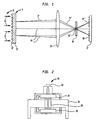
- FIG. 1 is a schematic diagram illustrating the concept of a conventional SCALPELTM system.
- a beam B of electrons 10 is directed towards a scattering mask 9 including a thin membrane 11 having a thickness between about 1,000 ⁇ and about 20,000 ⁇ (0.1 ⁇ m and about 2 ⁇ m thick.)
- the membrane 11 is composed of a material which is virtually transparent to the electron beam B composed of electrons 10. That is to say that electrons 10 in beam B pass through membrane 11 freely in the absence of any other object providing an obstruction to the path of electrons 10 in the beam B as they pass from the source of the beam through the membrane 11.
- a pattern of high density scattering elements 12 Formed on the side of the membrane 11 facing the beam 10, is a pattern of high density scattering elements 12 to provide a contrast mechanism that enables reproduction of the mask pattern at the target surface.
- the scattering elements 12 are patterned in the composite shape which is to be exposed upon a work piece 17 (usually a silicon wafer) which is coated with E-beam sensitive resist, which as shown in FIG. 1 has been processed into pattern elements 18.
- the electrons 10 from the E-beam B which pass through the mask 9 are shown by beams 14 which pass through electromagnetic lens 15 which focuses the beams 14 through an aperture 16' into an otherwise opaque back focal plane filter 16.
- the aperture 16' permits only electrons scattered at small angles to pass through to the work piece 17.
- the exposure tool 20 includes a source 22 (usually an electron gun), a mask stage 24, imaging optics 26, and a wafer stage 28.
- the mask stage 24 and the wafer stage 28 are mounted to the top and bottom of a block of aluminum, referred to as the metrology plate 30.
- the metrology plate 30, which is on the order of 3000 lbs., serves as a thermal and mechanical stabilizer for the entire exposure tool 20.
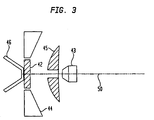
- FIG. 3 illustrates a prior art source 22 in more detail.
- the source 22 includes a cathode 42, an anode 43, a grid electrode 44, focusing plates 45, and a filament 46.
- Each of the cathode 42, anode 43, grid electrode 44, and focusing plates 45 exhibit substantial circular and radial symmetry about an imaginary line of focus 50.
- the cathode 42 is made of gallium arsenide (GaAs), bialkali cathode materials, cesium antimonide (Cs 3 Sb), or a pure material having a low work function, such as tantalum (Ta), samarium (Sm), or nickel (Ni).
- the material of photocathode 42 is made of a metal added to a semiconductor material by mixing or by depositing through sputtering or annealing.
- the metal is preferably tantalum (Ta), copper (Cu), silver (Ag), aluminum (Al), or gold (Au), or oxides or halides of these metals.
- tantalum (Ta) annealed on the surface of nickel (Ni).
- thermionic cathodes such as pure metal (tungsten or tantalum), lanthanum hexaboride (LaB 6 ), etc. cathodes are sufficient for these applications.
- thermoionic cathodes have work function variations across the emitting surface substantially greater than 2%, for example 5-10%.
- the SCALPELTM process requires a thermoionic cathode with a work function variation less than 2%.
- the conventional cathode which meets the SCALPELTM requirements for other parameters, such as emission uniformity, low work function, low evaporation rate, high voltage operating environment, and vacuum contamination resilience is a tantalum (Ta) cathode having a disk shape.
- the disk-shaped tantalum (Ta) cathode is made from cold or hot rolled tantalum (Ta) foils which are hot pressed into a micro-polycrystalline material. Because of its polycrystalline nature, the grains are substantially misoriented with each other (on the order of 5-20°).
- the conventional Ta cathode also has an uncontrolled grain size distribution between 5-400 ⁇ m.
- the conventional polycrystalline Ta cathode work function distribution is "patchy" (also on the order of 5-400 ⁇ m), varying from grain-to-grain (because of differing orientations) and resulting in an unacceptably patchy or non-uniform emission pattern.
- Patternchy also on the order of 5-400 ⁇ m
- grain-to-grain because of differing orientations
- resulting in an unacceptably patchy or non-uniform emission pattern Due to the sensitivity of tantalum's work function to the crystallographic orientation, the conventional polycrystalline Ta cathode work function distribution is "patchy" (also on the order of 5-400 ⁇ m), varying from grain-to-grain (because of differing orientations) and resulting in an unacceptably patchy or non-uniform emission pattern.
- Growth of the misoriented and differing sized grains at a high operating temperature further aggravates the patchiness problem.
- the conventional polycrystalline cathode materials When used as a SCALPELTM cathode, the conventional polycrystalline cathode materials experience grain growth and rough texture development (together termed “recrystallization") at the SCALPELTM high operating temperatures (1200-2000°C) and extended time period (greater than 1000 hours). Although the total emission current is satisfactory, structural developments at the cathode surface causes dark patches to appear on the cathode surface and make the cathode unacceptable for SCALPELTM. In addition, conventional cathode materials, such as LaB 6 , are easily contaminated by the SCALPELTM operating environment, as described in "Design of a low-brightness, highly uniform source for projection electron-beam lithography (SCALPEL)", W.K. Waskiewicz et al., Proc. SPIE, 3155 (1997).
- SCALPEL design of a low-brightness, highly uniform source for projection electron-beam lithography
- the present invention solves these problems with conventional cathodes used in SCALPELTM and similar systems by providing a cathode that has a buffer between a polycrystalline substrate and an emissive layer.
- the work function of the conventional polycrystalline substrate surface is non-uniform due to the non-uniform grain crystallography of the substrate material at the surface. These non-uniformities include grain misorientations on the order of 5-20° and grain size variations from 5-400 ⁇ m. Recrystallization over time also results in an increase in grain size and misorientation.
- the buffer alters, randomizes, miniaturizes (preferably to grain sizes less than 4 ⁇ m), and/or isolates the emissive layer, in a crystallographic sense, from the underlying substrate. The buffer also reduces the rate at which the substrate and emissive layer recrystallize over time.
- the buffer also includes a refractory metal or carbon.
- the substrate is tantalum
- the buffer is a dual layer of molybdenum and tungsten
- the emissive layer is tantalum.
- the molybdenum modifies the tantalum structure (lattice constant and orientation) in the underlying substrate by dissolving into the substrate, which reduces grain misorientation.
- the tungsten also dissolves into the substrate and, as a result of its high melting temperature, reduces the rate of recrystallization of both the underlying tantalum substrate and the overlying tantalum emissive layer.
- the buffer reduces the rate at which the substrate and emissive layer recrystallize over time by at least 30% and preferably by 50%.
- rhenium and tantalum are codeposited to form the buffer.
- the codeposit forms fine-grained (less than 4 ⁇ m) intermetallic phases and reduces subsequent recrystallization of the substrate and emissive layer.
- the codeposit does not adversely affect the electron transport from the substrate to the emissive layer, and has a coefficient of thermal expansion that approximates (within 35%, more preferably within 25%) that of the substrate and the emissive layer.
- the codeposit interacts with the substrate in a way that is different from the interaction between the substrate and the molybdenum.
- the codeposit does not dissolve and does not alter the original structure of the substrate but rather blocks and dominates the original substrate surface.
- the structure of the codeposit dominates the substrate, composed of randomly oriented fine grains of Re-Ta intermetallic phases (less than 4 ⁇ m) resulting in a uniformly distributed, averaged work function.
- the end result however, is the same; the emissive layer is effectively isolated from the substrate and not affected by the crystal structure of the substrate surface.
- the substrate is tantalum
- the buffer is rhenium
- the emissive layer is tantalum.
- the rhenium modifies the tantalum structure in the underlying substrate by reacting with the tantalum to form Re-Ta intermetallic phases, similar to those obtained with the Re-Ta codeposit and that minimizes the misorientation of the grains.
- Figure 4 illustrates a general embodiment of the method of making the cathode of the present invention.
- a surface of a substrate is prepared for deposition.
- a buffer is deposited on the substrate.
- an emissive layer is deposited on the buffer, in order to produce the cathode.
- the surface of the substrate is prepared by ion etching and vacuum annealing.
- the buffer and/or the emissive layer are deposited by magnetron sputter deposition.
- vacuum annealing is performed after deposition of both the buffer and the emissive layer.
- the buffer and layers may be deposited by a number of different methods, such as sputtering, evaporation, chemical vapor deposition (CVD), etc.
- the desired thickness of the buffer is typically in the range of 0.1 ⁇ m to 100 ⁇ m, or preferably in the range of 0.5-10 ⁇ m.
- Figure 5 illustrates a cathode of the present invention in one embodiment.
- the cathode 110 includes a substrate 112, a buffer 114, an emissive layer 116, arranged as illustrated in Figure 4.
- the buffer 114 is an altered grain structure at a surface of the substrate 112 to make the work function distribution more uniform. In another embodiment, the buffer 114 is itself a fine-grained, randomized structure that blocks the substrate 112, thereby improving the uniformity of the work function distribution of the resulting cathode 110.
- the buffer 114 alters the grain structure at the surface of the substrate by diffusion, alloying, precipitation, or new phase formation. Still further, the buffer 114 includes atoms from a chemical class similar to the chemical class of the substrate 112. For example, if the substrate 112 is a refractory metal or carbon, then the buffer 114 would also include refractory metal or carbon atoms.
- the cathode is part of a projection electron lithography system, such as the SCALPELTM system.
- the buffer 114 also provides thermal and electrical conductivities and good adhesion to withstand operating temperatures up to 2100° K.
- One additional advantage of the cathode 110 illustrated in Figure 5, is that such a layered cathode can be made in a curved shape (concave or convex), which is useful for electron beam focusing.
- Example 1 describes a first material combination that is effective in creating the desired structural uniformity and work function uniformity on the polycrystalline Ta cathode surface.
- Example 1 is a Ta/Mo/W/Ta arrangement, where Ta is the polycrystalline substrate surface, Mo/W are two sequentially applied buffer layers, and Ta is the emissive layer.
- both Mo and W have the same body centered cubic (bcc) structure as Ta, and form solid solutions. Because of the relatively small size of Mo atoms, the first buffer of Mo atoms diffuse into the Ta substrate upon annealing at 1600°C. This Mo diffusion alters the crystalline structure of the existing Ta grains. The subsequent W layer further alters the grain structure on the surface by diffusion to form a solid solution of Ta-Mo-W. The final Ta layer serves as the emissive layer because it has the lowest work function of the three.
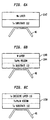
- an Mo layer 1142 is added to the Ta substrate 112. Because of the relatively small size of the Mo atoms, the Mo atoms diffuse into the Ta substrate 112 upon annealing at 1600°C. This Mo diffusion alters or distorts the crystalline structure of the existing Ta grains to form Ta/Mo region 1144, thereby randomizing the orientation of the Ta substrate. Then, a W layer 1148 is added, as illustrated in Figure 6B . The W layer 1148 further randomizes the grain structure on the surface by diffusion to form a solid solution of Ta/Mo/W at 1150. Finally, the Ta emissive layer 116 is added, as illustrated in Figure 6C. The final Ta layer serves as the emissive layer, because it has the lowest work function of the three. The grain structure of the Ta layer 116 is also randomized because of the underlying Ta/Mo/W region 150.
- the Mo layer 1142 and W layer 1148 are typically added at a thickness of 0.5-10 ⁇ m.
- both the Mo layer 1142 and the W layer 1148 may be selected from the group including Mo, W, Nb, V, Ir, Rh, or any combination thereof.
- Example 2 describes a second material combination that is effective in creating the desired structural uniformity and work function uniformity on the polycrystalline Ta cathode surface.
- Example 2 is a Ta/Re-Ta/Ta arrangement, where Ta is the polycrystalline substrate 112, Re-Ta is an alloyed buffer film 113, and Ta is the emissive layer 116, as illustrated in Figure 7.
- Re has a hexagonal close-packed (hcp) structure, it forms various intermetallic compounds with Ta.
- the co-sputtered Re-Ta alloy film 113 thus consists of fine-grained ( ⁇ 4 ⁇ m), randomly oriented surface structure, which blocks the original polycrystalline grain structure of the Ta substrate 112.
- the subsequent emissive Ta layer 116 also has the same fine grain structure because of the Re-Ta alloy film 113. Because of the formation of intermetallic compounds and the resultant multiphase structure, the grains in the substrate 112 are largely pinned by the new phases of the buffer film 113 at the boundaries and their growth is inhibited at the operating temperature (2100°K). Also Re has a close match with Ta in its thermal expansion coefficient, and as a result, the buildup of thermal stress which cause film delamination and cracking, is reduced.
- intermetallic compound of Example 2 is a Re-Ta alloy
- other combinations are also effective including C-Ta, Hf-Ta, Os-Ta, and Ru-Ta.
- Example 3 describes a third material combination that is effective in creating the desired structural uniformity and work function uniformity on the polycrystalline Ta cathode surface.
- Example 3 is a Ta/Re/Ta arrangement, where Ta is the polycrystalline substrate 112, Re is a buffer layer 1160, and Ta is the emissive layer 116, as illustrated in Figure 8.
- a Re layer 1160 is added to the Ta substrate 112.
- the Re reacts with Ta to form Re-Ta intermetallic compounds. Similar to Example 2, these Re-Ta intermetallic compounds have a fine grained ( ⁇ 4 ⁇ m) randomly oriented surface structure, which block the original polycrystalline grain structure of the Ta substrate 112.
- the Ta emissive layer 116 is added, as illustrated in Figure 8B.
- the final Ta layer serves as the emissive layer, because it has the lowest work function of the three.
- the grain structure of the Ta layer 116 is fine and randomized because of the underlying Re-Ta alloy 1162.
- Examples 1-3 have shown improved uniform emission characteristics in emission microscopes and SCALPELTM machines compared to the conventional Ta cathode.
Landscapes
- Engineering & Computer Science (AREA)
- Manufacturing & Machinery (AREA)
- Chemical & Material Sciences (AREA)
- Analytical Chemistry (AREA)
- Electron Beam Exposure (AREA)
- Cold Cathode And The Manufacture (AREA)
- Solid Thermionic Cathode (AREA)
- Electron Sources, Ion Sources (AREA)
- Crystals, And After-Treatments Of Crystals (AREA)
Applications Claiming Priority (2)
| Application Number | Priority Date | Filing Date | Title |
|---|---|---|---|
| US09/338,520 US6815876B1 (en) | 1999-06-23 | 1999-06-23 | Cathode with improved work function and method for making the same |
| US338520 | 2003-01-08 |
Publications (3)
| Publication Number | Publication Date |
|---|---|
| EP1063669A2 true EP1063669A2 (de) | 2000-12-27 |
| EP1063669A3 EP1063669A3 (de) | 2006-08-16 |
| EP1063669B1 EP1063669B1 (de) | 2010-04-14 |
Family
ID=23325134
Family Applications (1)
| Application Number | Title | Priority Date | Filing Date |
|---|---|---|---|
| EP00305015A Expired - Lifetime EP1063669B1 (de) | 1999-06-23 | 2000-06-13 | Kathode mit verbessertem Austrittspotential und Verfahren zur Herstellung derselben |
Country Status (6)
| Country | Link |
|---|---|
| US (2) | US6815876B1 (de) |
| EP (1) | EP1063669B1 (de) |
| JP (1) | JP3901915B2 (de) |
| KR (1) | KR100744896B1 (de) |
| DE (1) | DE60044167D1 (de) |
| TW (1) | TW454216B (de) |
Cited By (2)
| Publication number | Priority date | Publication date | Assignee | Title |
|---|---|---|---|---|
| DE102008020165A1 (de) * | 2008-04-22 | 2009-10-29 | Siemens Aktiengesellschaft | Kathode mit einem Flachemitter |
| DE102008020187A1 (de) * | 2008-04-22 | 2009-10-29 | Siemens Aktiengesellschaft | Kathode mit einem Flachemitter |
Family Cites Families (19)
| Publication number | Priority date | Publication date | Assignee | Title |
|---|---|---|---|---|
| US3290543A (en) * | 1963-06-03 | 1966-12-06 | Varian Associates | Grain oriented dispenser thermionic emitter for electron discharge device |
| US3488549A (en) * | 1968-01-15 | 1970-01-06 | Gen Electric | Dispenser cathode material and method of manufacture |
| CH582951A5 (de) * | 1973-07-09 | 1976-12-15 | Bbc Brown Boveri & Cie | |
| US4184100A (en) * | 1977-03-29 | 1980-01-15 | Tokyo Shibaura Electric Co., Ltd. | Indirectly-heated cathode device for electron tubes |
| US4168565A (en) * | 1977-05-18 | 1979-09-25 | Denki Kagaku Kogyo Kabushiki Kaisha | Method for manufacturing thermionic cathode |
| CH629033A5 (de) * | 1978-05-05 | 1982-03-31 | Bbc Brown Boveri & Cie | Gluehkathode. |
| US4272030A (en) * | 1979-07-30 | 1981-06-09 | Afanasiev Mikhail M | Device for adjusting an inertia cone crusher discharge gap |
| JPS57128436A (en) * | 1981-02-02 | 1982-08-10 | Koichi Kanetani | Manufacture of lanthanum-boride thermionic emission electrode |
| JPS57196443A (en) * | 1981-05-29 | 1982-12-02 | Denki Kagaku Kogyo Kk | Manufacture of hot cathode |
| DE3148441A1 (de) * | 1981-12-08 | 1983-07-21 | Philips Patentverwaltung Gmbh, 2000 Hamburg | Verfahren zur herstellung einer thermionischen kathode |
| DE3205746A1 (de) * | 1982-02-18 | 1983-08-25 | Philips Patentverwaltung Gmbh, 2000 Hamburg | Thermionische kathode und verfahren zu ihrer herstellung |
| US4528452A (en) | 1982-12-09 | 1985-07-09 | Electron Beam Corporation | Alignment and detection system for electron image projectors |
| JPS62213031A (ja) * | 1986-03-14 | 1987-09-18 | Hitachi Ltd | 含浸形陰極構体 |
| US5042058A (en) | 1989-03-22 | 1991-08-20 | University Of California | Ultrashort time-resolved x-ray source |
| JPH0757617A (ja) * | 1993-08-12 | 1995-03-03 | Ricoh Opt Ind Co Ltd | 熱電子発生源 |
| JP2937145B2 (ja) * | 1996-10-25 | 1999-08-23 | 三菱電機株式会社 | 電子管用陰極 |
| JP2876591B2 (ja) * | 1996-11-29 | 1999-03-31 | 三菱電機株式会社 | 電子管用陰極 |
| US5911919A (en) * | 1997-09-08 | 1999-06-15 | Integrated Thermal Sciences, Inc. | Electron emission materials and components |
| DE69913313T2 (de) * | 1998-09-09 | 2004-10-14 | Koninklijke Philips Electronics N.V. | Quadrupol-Vorrichtung für Projektionslithographie mittels geladener Teilchen |
-
1999
- 1999-06-23 US US09/338,520 patent/US6815876B1/en not_active Expired - Fee Related
-
2000
- 2000-06-13 DE DE60044167T patent/DE60044167D1/de not_active Expired - Lifetime
- 2000-06-13 EP EP00305015A patent/EP1063669B1/de not_active Expired - Lifetime
- 2000-06-19 TW TW089111997A patent/TW454216B/zh not_active IP Right Cessation
- 2000-06-22 KR KR1020000034530A patent/KR100744896B1/ko not_active Expired - Fee Related
- 2000-06-23 JP JP2000188555A patent/JP3901915B2/ja not_active Expired - Fee Related
-
2004
- 2004-10-12 US US10/963,156 patent/US7179148B2/en not_active Expired - Lifetime
Cited By (2)
| Publication number | Priority date | Publication date | Assignee | Title |
|---|---|---|---|---|
| DE102008020165A1 (de) * | 2008-04-22 | 2009-10-29 | Siemens Aktiengesellschaft | Kathode mit einem Flachemitter |
| DE102008020187A1 (de) * | 2008-04-22 | 2009-10-29 | Siemens Aktiengesellschaft | Kathode mit einem Flachemitter |
Also Published As
| Publication number | Publication date |
|---|---|
| US6815876B1 (en) | 2004-11-09 |
| KR100744896B1 (ko) | 2007-08-01 |
| US20050046326A1 (en) | 2005-03-03 |
| EP1063669A3 (de) | 2006-08-16 |
| DE60044167D1 (de) | 2010-05-27 |
| KR20010029829A (ko) | 2001-04-16 |
| US7179148B2 (en) | 2007-02-20 |
| JP2001052595A (ja) | 2001-02-23 |
| JP3901915B2 (ja) | 2007-04-04 |
| TW454216B (en) | 2001-09-11 |
| EP1063669B1 (de) | 2010-04-14 |
Similar Documents
| Publication | Publication Date | Title |
|---|---|---|
| Becker et al. | Materials processing using radio-frequency ion-sources: Ion-beam sputter-deposition and surface treatment | |
| JPH0673476A (ja) | 半導体基板の電気接点として使用するための合金 | |
| JPH0255934B2 (de) | ||
| EP0845797A2 (de) | Elektronenröhrenkathode | |
| Melngailis | Focused ion beam induced deposition: A review | |
| US7567379B2 (en) | Technique to prevent tin contamination of mirrors and electrodes in an EUV lithography system | |
| US6815876B1 (en) | Cathode with improved work function and method for making the same | |
| US12578635B2 (en) | Pellicle for an EUV lithography mask and a method of manufacturing thereof | |
| EP3336875A1 (de) | Halbleiterröntgentarget | |
| JP2000504487A (ja) | 反射防止コーティング及び積層配線ライン | |
| US6448569B1 (en) | Bonded article having improved crystalline structure and work function uniformity and method for making the same | |
| US5118952A (en) | Patterned photo cathode and its fabrication method for electron image projection | |
| Singh et al. | An x-ray spectromicroscopic study of the local structure of patterned titanium silicide | |
| Katsap et al. | Uniform large-area thermionic cathode for SCALPEL | |
| Taga et al. | Sputtering and secondary ion yields of metals subjected to oxygen ion bombardment | |
| Nason et al. | Room‐temperature epitaxial growth of Ag (110)/GaAs (100) films | |
| US20070144892A1 (en) | Method for forming metal film or stacked layer including metal film with reduced surface roughness | |
| JPH05140728A (ja) | 薄膜作製装置 | |
| JPH0770456B2 (ja) | 半導体装置の製造方法 | |
| US20090120785A1 (en) | Method for forming metal film or stacked layer including metal film with reduced surface roughness | |
| JPH0790564A (ja) | 高純度チタニウムスパッタリングターゲット | |
| Kearney et al. | Boron-based multilayers for soft x-ray optics | |
| KR100215218B1 (ko) | 이온빔 변형법을 이용한 금속팁 필드 에미터 제조방법 | |
| Dunn et al. | Preparation and detection of reconstructed plan-view surfaces | |
| Choi et al. | Formation and epitaxial growth of titanium-disilicide on Si (111) |
Legal Events
| Date | Code | Title | Description |
|---|---|---|---|
| PUAI | Public reference made under article 153(3) epc to a published international application that has entered the european phase |
Free format text: ORIGINAL CODE: 0009012 |
|
| AK | Designated contracting states |
Kind code of ref document: A2 Designated state(s): AT BE CH CY DE DK ES FI FR GB GR IE IT LI LU MC NL PT SE |
|
| AX | Request for extension of the european patent |
Free format text: AL;LT;LV;MK;RO;SI |
|
| PUAL | Search report despatched |
Free format text: ORIGINAL CODE: 0009013 |
|
| AK | Designated contracting states |
Kind code of ref document: A3 Designated state(s): AT BE CH CY DE DK ES FI FR GB GR IE IT LI LU MC NL PT SE |
|
| AX | Request for extension of the european patent |
Extension state: AL LT LV MK RO SI |
|
| 17P | Request for examination filed |
Effective date: 20061124 |
|
| 17Q | First examination report despatched |
Effective date: 20061222 |
|
| AKX | Designation fees paid |
Designated state(s): DE FR GB |
|
| RAP3 | Party data changed (applicant data changed or rights of an application transferred) |
Owner name: LUCENT TECHNOLOGIES INC. |
|
| GRAP | Despatch of communication of intention to grant a patent |
Free format text: ORIGINAL CODE: EPIDOSNIGR1 |
|
| GRAS | Grant fee paid |
Free format text: ORIGINAL CODE: EPIDOSNIGR3 |
|
| GRAA | (expected) grant |
Free format text: ORIGINAL CODE: 0009210 |
|
| AK | Designated contracting states |
Kind code of ref document: B1 Designated state(s): DE FR GB |
|
| REG | Reference to a national code |
Ref country code: GB Ref legal event code: FG4D |
|
| REF | Corresponds to: |
Ref document number: 60044167 Country of ref document: DE Date of ref document: 20100527 Kind code of ref document: P |
|
| PLBE | No opposition filed within time limit |
Free format text: ORIGINAL CODE: 0009261 |
|
| STAA | Information on the status of an ep patent application or granted ep patent |
Free format text: STATUS: NO OPPOSITION FILED WITHIN TIME LIMIT |
|
| 26N | No opposition filed |
Effective date: 20110117 |
|
| PGFP | Annual fee paid to national office [announced via postgrant information from national office to epo] |
Ref country code: FR Payment date: 20140609 Year of fee payment: 15 |
|
| PGFP | Annual fee paid to national office [announced via postgrant information from national office to epo] |
Ref country code: GB Payment date: 20150527 Year of fee payment: 16 |
|
| REG | Reference to a national code |
Ref country code: FR Ref legal event code: ST Effective date: 20160229 |
|
| PG25 | Lapsed in a contracting state [announced via postgrant information from national office to epo] |
Ref country code: FR Free format text: LAPSE BECAUSE OF NON-PAYMENT OF DUE FEES Effective date: 20150630 |
|
| GBPC | Gb: european patent ceased through non-payment of renewal fee |
Effective date: 20160613 |
|
| PG25 | Lapsed in a contracting state [announced via postgrant information from national office to epo] |
Ref country code: GB Free format text: LAPSE BECAUSE OF NON-PAYMENT OF DUE FEES Effective date: 20160613 |
|
| PGFP | Annual fee paid to national office [announced via postgrant information from national office to epo] |
Ref country code: DE Payment date: 20170522 Year of fee payment: 18 |
|
| REG | Reference to a national code |
Ref country code: DE Ref legal event code: R082 Ref document number: 60044167 Country of ref document: DE Representative=s name: DILG HAEUSLER SCHINDELMANN PATENTANWALTSGESELL, DE Ref country code: DE Ref legal event code: R081 Ref document number: 60044167 Country of ref document: DE Owner name: AVAGO TECHNOLOGIES GENERAL IP (SINGAPORE) PTE., SG Free format text: FORMER OWNER: LUCENT TECHNOLOGIES INC., MURRAY HILL, N.J., US |
|
| REG | Reference to a national code |
Ref country code: DE Ref legal event code: R119 Ref document number: 60044167 Country of ref document: DE |
|
| PG25 | Lapsed in a contracting state [announced via postgrant information from national office to epo] |
Ref country code: DE Free format text: LAPSE BECAUSE OF NON-PAYMENT OF DUE FEES Effective date: 20190101 |