EP1065802A1 - Procédé de commande de la puissance de transmission en mésurant l' Eb/No de la combinaison de signaux pondérés - Google Patents
Procédé de commande de la puissance de transmission en mésurant l' Eb/No de la combinaison de signaux pondérés Download PDFInfo
- Publication number
- EP1065802A1 EP1065802A1 EP20000113809 EP00113809A EP1065802A1 EP 1065802 A1 EP1065802 A1 EP 1065802A1 EP 20000113809 EP20000113809 EP 20000113809 EP 00113809 A EP00113809 A EP 00113809A EP 1065802 A1 EP1065802 A1 EP 1065802A1
- Authority
- EP
- European Patent Office
- Prior art keywords
- demodulated data
- rssi
- weighting
- measuring
- transmission power
- Prior art date
- Legal status (The legal status is an assumption and is not a legal conclusion. Google has not performed a legal analysis and makes no representation as to the accuracy of the status listed.)
- Granted
Links
- 230000005540 biological transmission Effects 0.000 title claims abstract description 76
- 238000000034 method Methods 0.000 title claims abstract description 17
- 238000001514 detection method Methods 0.000 claims abstract description 8
- 238000004891 communication Methods 0.000 claims description 63
- 230000003111 delayed effect Effects 0.000 claims description 4
- 238000005259 measurement Methods 0.000 description 11
- 230000001413 cellular effect Effects 0.000 description 10
- 238000010586 diagram Methods 0.000 description 8
- 238000012545 processing Methods 0.000 description 5
- 230000001276 controlling effect Effects 0.000 description 3
- 238000005562 fading Methods 0.000 description 3
- 238000012937 correction Methods 0.000 description 2
- 230000000694 effects Effects 0.000 description 2
- 238000006243 chemical reaction Methods 0.000 description 1
- 230000002596 correlated effect Effects 0.000 description 1
- 230000001934 delay Effects 0.000 description 1
- 230000006866 deterioration Effects 0.000 description 1
- 238000009432 framing Methods 0.000 description 1
- 238000010295 mobile communication Methods 0.000 description 1
Images


Classifications
-
- H—ELECTRICITY
- H04—ELECTRIC COMMUNICATION TECHNIQUE
- H04W—WIRELESS COMMUNICATION NETWORKS
- H04W52/00—Power management, e.g. Transmission Power Control [TPC] or power classes
- H04W52/04—Transmission power control [TPC]
- H04W52/18—TPC being performed according to specific parameters
- H04W52/24—TPC being performed according to specific parameters using SIR [Signal to Interference Ratio] or other wireless path parameters
- H04W52/248—TPC being performed according to specific parameters using SIR [Signal to Interference Ratio] or other wireless path parameters where transmission power control commands are generated based on a path parameter
-
- H—ELECTRICITY
- H04—ELECTRIC COMMUNICATION TECHNIQUE
- H04B—TRANSMISSION
- H04B1/00—Details of transmission systems, not covered by a single one of groups H04B3/00 - H04B13/00; Details of transmission systems not characterised by the medium used for transmission
- H04B1/69—Spread spectrum techniques
- H04B1/707—Spread spectrum techniques using direct sequence modulation
- H04B1/7097—Interference-related aspects
- H04B1/711—Interference-related aspects the interference being multi-path interference
- H04B1/7115—Constructive combining of multi-path signals, i.e. RAKE receivers
-
- H—ELECTRICITY
- H04—ELECTRIC COMMUNICATION TECHNIQUE
- H04B—TRANSMISSION
- H04B7/00—Radio transmission systems, i.e. using radiation field
- H04B7/02—Diversity systems; Multi-antenna system, i.e. transmission or reception using multiple antennas
- H04B7/04—Diversity systems; Multi-antenna system, i.e. transmission or reception using multiple antennas using two or more spaced independent antennas
- H04B7/08—Diversity systems; Multi-antenna system, i.e. transmission or reception using multiple antennas using two or more spaced independent antennas at the receiving station
- H04B7/0837—Diversity systems; Multi-antenna system, i.e. transmission or reception using multiple antennas using two or more spaced independent antennas at the receiving station using pre-detection combining
- H04B7/0842—Weighted combining
- H04B7/0865—Independent weighting, i.e. weights based on own antenna reception parameters
-
- H—ELECTRICITY
- H04—ELECTRIC COMMUNICATION TECHNIQUE
- H04W—WIRELESS COMMUNICATION NETWORKS
- H04W52/00—Power management, e.g. Transmission Power Control [TPC] or power classes
- H04W52/04—Transmission power control [TPC]
- H04W52/06—TPC algorithms
- H04W52/14—Separate analysis of uplink or downlink
- H04W52/143—Downlink power control
-
- H—ELECTRICITY
- H04—ELECTRIC COMMUNICATION TECHNIQUE
- H04W—WIRELESS COMMUNICATION NETWORKS
- H04W52/00—Power management, e.g. Transmission Power Control [TPC] or power classes
- H04W52/04—Transmission power control [TPC]
- H04W52/18—TPC being performed according to specific parameters
- H04W52/24—TPC being performed according to specific parameters using SIR [Signal to Interference Ratio] or other wireless path parameters
- H04W52/241—TPC being performed according to specific parameters using SIR [Signal to Interference Ratio] or other wireless path parameters taking into account channel quality metrics, e.g. SIR, SNR, CIR or Eb/lo
-
- H—ELECTRICITY
- H04—ELECTRIC COMMUNICATION TECHNIQUE
- H04W—WIRELESS COMMUNICATION NETWORKS
- H04W52/00—Power management, e.g. Transmission Power Control [TPC] or power classes
- H04W52/04—Transmission power control [TPC]
- H04W52/38—TPC being performed in particular situations
- H04W52/42—TPC being performed in particular situations in systems with time, space, frequency or polarisation diversity
-
- H—ELECTRICITY
- H04—ELECTRIC COMMUNICATION TECHNIQUE
- H04B—TRANSMISSION
- H04B1/00—Details of transmission systems, not covered by a single one of groups H04B3/00 - H04B13/00; Details of transmission systems not characterised by the medium used for transmission
- H04B1/69—Spread spectrum techniques
- H04B1/707—Spread spectrum techniques using direct sequence modulation
- H04B1/7097—Interference-related aspects
- H04B1/711—Interference-related aspects the interference being multi-path interference
- H04B1/7115—Constructive combining of multi-path signals, i.e. RAKE receivers
- H04B1/712—Weighting of fingers for combining, e.g. amplitude control or phase rotation using an inner loop
Definitions
- the present invention relates to a digital car telephone and cellular phone system (cellular system) using a CDMA (Code Division Multiple Access) communication scheme, and more particularly to a CDMA communication device and a transmission power control method.
- CDMA Code Division Multiple Access
- the CDMA communication scheme attracts attention as a communication method for use in mobile communication systems due to its resistance to interference and disturbance.
- the CDMA communication scheme refers to a communication scheme in which a transmitting side spreads a user signal to be transmitted with a spreading code and then transmits the signal, while a receiving side performs despread with the same code as that used by the transmitting side to obtain the original user signal.
- a plurality of transmitting sides perform spread with different spreading codes each having orthogonality, and a receiving side selects a spreading code for use in despread to allow each communication to be specified, thereby making it possible for a plurality of communications to use the same frequency band.
- the correlational component serves as an interference component for the communication associated with the one code and contributes to deterioration of communication quality. Since the interference component is produced from such a factor, the interference component is increased as the number of the communications is increased.
- a receiver In the transmission power control, a receiver has a preset Eb/N0 (desired wave power density to noise power density ratio) serving as a reference and the receiver controls transmission power from each transmitter such that an Eb/N0 obtained from a communication of each transmitter is equal to the Eb/N0 reference value.
- a downward channel for transmission from a base station to a mobile station includes a transmission power control signal for directing an increase or decrease in transmission power of the mobile station, which data is used by the base station to direct an increase or decrease in current transmission power to each mobile station.
- an upward channel for transmission from the mobile station to the base station includes a transmission power control signal for directing an increase or decrease in transmission power to the base station, which data is used by the mobile station to direct an increase or decrease in current transmission power to the base station.
- a rake/diversity reception technique is also essential to high-quality reception under a multipath fading environment.
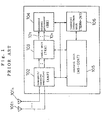
- Fig. 1 is a block diagram showing a configuration of a mobile station in such a cellular system.
- the mobile station comprises n antennas 101 1 to 101 n , transmit/receive amplifier (AMP) 102, radio unit (TRX) 103, baseband signal processor (BB) 104, control unit (MS-CONT) 105, and terminal interface unit (TERM-INT) 106.
- AMP transmit/receive amplifier
- TRX radio unit
- BB baseband signal processor
- MS-CONT control unit
- TX-INT terminal interface unit
- Antennas 101 1 to 101 n transmit an upward RF signal amplified at a transmission amplifier in transmit/receiver amplifier 102, and receives a downward RF signal from a base station and outputs the signal to transmit/receiver amplifier 102.
- Diversity reception is achieved by using n antennas 101 1 to 101 n .
- Transmit/receiver amplifier 102 is provided with a transmission amplifier for amplifying a transmission RF signal and a low noise amplifier for amplifying a reception RF signal, and demultiplexes the RF transmission signal and the RF reception signal for connection to antennas 101 1 to 101 n .
- Radio unit 103 converts a transmission signal which has been subjected to baseband spread from digital form to analog form and performs quadrature modulation for conversion to an RF signal, and performs quasi-synchronous detection and converts a signal received from transmit/receive amplifier 102 from analog form to digital form for transmission to baseband signal processing unit 104.
- Baseband signal processing unit 104 performs baseband signal processing such as error correction coding for transmission data, framing, data modulation, spread modulation, despread of a received signal, chip synchronization, error correction decoding, data demultiplexing, diversity handover combination function, reception level measuring function, and the like.
- Control unit 105 performs control of the entire mobile station.
- Terminal interface unit 106 has a function as an adapter for voice and various types of data, as well as a function as an interface to a handset and image/data terminals.
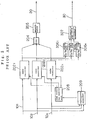
- Fig. 2 shows a configuration of a conventional CDMA communication device provided in baseband signal processing unit 104.
- the conventional CDMA communication device comprises n rake receivers 202 1 to 202 n , mixer 204, determinator 205, n Eb/N0 measuring units 306 1 to 306 n , transmission power control information generator 307, rake receiver control unit 208, and multipath searcher 209.
- rake receiver 202 1 includes m finger receivers 50 1 to 50 m and mixer 70. Since the configurations of rake receivers 202 2 to 202 n are similar to that of rake receiver 202 1 , the description thereof is omitted.
- Multipath searcher 209 acquires, from received signals 10 1 to 10 n , reception delay information which is information on delay times among respective paths contained in received signals 10 1 to 10 n .
- Rake receiver control unit 208 sets delay times for finger receivers 50 1 to 50 m in each of rake receivers 202 1 to 202 n based on the reception delay information acquired at multipath searcher 209.
- Rake receivers 202 1 to 202 n detects received signals 101 1 to 101 n , and output demodulated data which is the result of the detection. Specifically, finger receivers 50 1 to 50 m generate the demodulated data by individually demodulating received signal 10 1 for respective paths, delay the demodulated data using the delay time set by rake receiver control unit 208, and then output the data to mixer 70. Mixer 70 combines the demodulated data from finger receivers 50 1 to 50 m and outputs the combined data.
- Mixer 204 combines the demodulated data from rake receivers 202 1 to 202 n into one signal.
- Determinator 205 performs decoding with a determination of the signal combined by mixer 204 for output as decoded signal 20.
- Eb/N0 measuring units 306 1 to 306 n measure the Eb-N0s of the signals from rake receivers 202 1 to 202 n .
- Transmission power control information generator 307 sums the Eb/N0 measured at Eb/N0 measuring units 306 1 to 306 n to obtain the measurement result of the Eb/N0s, and generates transmission power control information 30 based on the measuring result of the Eb/N0s.
- Transmission power control information 30 is transmitted to the base station which is a transmitter through an upward channel, thereby performing transmission power control.
- received signals 10 1 to 10 n input thereto are sent to multipath searcher 209 which acquires reception delay information which is information on delay times among respective paths contained in received signals 10 1 to 10 n .
- Rake receiver control unit 208 sets delay times for finger receivers 50 1 to 50 m in each of rake receivers 202 1 to 202 n based on the reception delay information acquired at multipath searcher 209.
- Received signals 10 1 to 10 n demodulated and delayed by finger receivers 50 1 to 50 m are combined by mixer 70 as demodulated data after detection.
- Mixer 204 combines the demodulated data obtained at rake receivers 202 1 to 202 n into one signal.
- the demodulated data combined at mixer 204 is subjected to a determination at determinator 205, resulting in decoded signal 20.
- the demodulated data obtained at rake receivers 202 1 to 202 n are input to Eb/N0 measuring units 306 1 to 306 n for measuring the Eb/N0s of the respective demodulated data.
- Transmission power control information generator 307 derives the measuring result of the Eb/N0s by summing up the respective measured Eb/N0s, and generates transmission power control information 30 based on the obtained measuring result of the Eb/N0s.
- the measuring result of the Eb/N0s is obtained by measuring the Eb/N0s for respective rake receivers 202 1 to 202 n and summing up the measured Eb/N0s.
- the accuracy of the Eb/N0 measurement is deteriorated to cause the inability to perform stable transmission power control.
- the n demodulated data obtained from rake receivers 202 1 to 202 n are combined as they are. For this reason, in some reception states, the Eb/N0 of the demodulated data after the combination obtained by mixer 204 may not be higher than the Eb/N0 of the demodulated data before the combination.
- the CDMA communication device comprises means for weighting outputs from a plurality of rake receivers, respectively, and means for measuring the Eb/N0 after weighted signals are combined.
- the Eb/N0 of the demodulated data after combination is not deteriorated as compared with the Eb/N0 of the demodulated data before the combination.
- the Eb/N0 is measured using the demodulated data after the combination, the Eb/N0 can be measured with higher accuracy even under a deteriorated reception environment.
- the CDMA communication device further comprises means for weighting based on RSSI of an output from each rake receiver.
- the CDMA communication device further comprises means for controlling transmission power based on the measured Eb/N0.
- the CDMA communication device comprises means for weighting outputs from a plurality of rake receivers, and combines the weighted signals and controls transmission power based on the combined signal.
- the present invention performs transmission power control with the Eb/N0 derived using the demodulated data after the combination, more accurate transmission power control is possible to allow stable communication.
- the CDMA communication device comprises a plurality of rake receivers, a plurality of first weighting units, a first combining unit, and an Eb/N0 measuring unit.
- Each of the plurality of rake receivers demodulates a received signal for each path and combines the respective demodulated data after the respective data are delayed based on a delay time.
- the plurality of first weighting units weight the demodulated data after the combination output from the respective rake receivers.
- the first combining unit combines the signals weighted by the first weighting units.
- the Eb/N0 measuring unit measures an Eb/N0 of the demodulated data combined by the first combining unit.
- the CDMA communication device for decoding a plurality of received signals received at different antennas comprises a plurality of rake receivers, a multipath searcher, a rake receiver control unit, a plurality of first weighting units, a first combining unit, and an Eb/N0 measuring unit.
- Each of the receivers detects each of the received signals for each path, delays demodulated data which are the detection result based on a set delay time, and then combines and outputs the demodulated data.
- the multipath searcher acquires reception delay information which is information on delay times among respective paths contained in the received signals.
- the rake receiver control unit sets the delay time for the respective rake receivers based on the reception delay information acquired by the multipath searcher.
- the plurality of first weighting units weight the demodulated data output from the respective rake receivers.
- the first combining unit combines the signals weighted by the first weighting units into one signal.
- the Eb/N0 measuring unit measures an Eb/N0 of the demodulated data combined by the first combining unit.
- the present invention performs the Eb/N0 measurement with the demodulated data after the combination by the first combining unit, more accurate Eb/N0 measurement is possible even under a deteriorated reception environment.
- the present invention utilizes the first weighting units to weight the demodulated data from the respective rake receivers before the combination by the first combining unit.
- the Eb/N0 of the demodulated data after the combination is not deteriorated as compared with the Eb/N0 of the demodulated data before the combination.
- the Eb/N0 measurement with the demodulated data combined by the first combining unit requires only one Eb/N0 measuring unit, thereby allowing a simplified configuration of the CDMA communication device.
- each of the receivers includes a plurality of finger receivers, a plurality of second weighting units, and a second combining unit.
- the plurality of finger receivers generate demodulated data by individually demodulating a received signal for each path and then output the demodulated data after the demodulated data are delayed with delay time information contained in the received signal.
- the plurality of second weighting units weight the demodulated data output from the finger receivers, respectively.
- the second combining unit combines the demodulated data from the second weighting units and outputs the combined data.
- the second weighting units are provided between the respective finger receivers and the second combining unit, and weighting can also be performed individually for the demodulated data output from the respective finger receivers, thereby enabling estimation for each transmission path.
- the CDMA communication device further comprises means for controlling transmission power based on the Eb/N0 measured by the Eb/N0 measuring unit.
- the present invention controls transmission power with the Eb/N0 derived with the demodulated data after the combination, more accurate transmission power control is possible to allow stable communication.
- the CDMA communication device comprises a transmission power control information generator for generating transmission power control information which is information for controlling transmission power based on the Eb/N0 measured by the Eb/N0 measuring unit.
- the present invention generates the transmission power control information with the Eb/N0 derived using the demodulated data after the combination, thereby making it possible to perform more accurate transmission power control and stable communication.
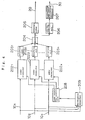
- a CDMA communication device of a first embodiment of the present invention is provided in baseband signal processing unit 104 of the CDMA cellular system shown in Fig. 1.
- the CDMA communication device comprises Eb/N0 measuring unit 206 and transmission power control information generator 207 instead of Eb/N0 measuring units 306 1 to 306 n and transmission power control information generator 307 in the conventional CDMA communication device shown in Fig. 2, and further comprises weighting units 203 1 to 203 n between rake receivers 202 1 to 202 n and mixer 204, respectively.
- Weighting units 203 1 to 203 n weight demodulated data output from rake receivers 202 1 to 202 n , respectively.
- a method of weighting is an optimal ratio combination method.
- the optimal ratio combination method determines weights for weighting units 203 1 to 203 n such that the demodulated data from respective rake receivers 202 1 to 202 n are combined at a ratio which leads to the maximum Eb/N0 of a signal after combination at mixer 204.
- Another weighting method is a method in which a weight is increased when an RSSI (Received Signal Strength Indicator) of demodulated data is high.
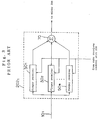
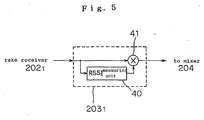
- Fig. 5 shows the configuration of weighting unit 203 1 when such weighting is performed.
- Weighting unit 203 1 comprises RSSI measuring unit 40 and multiplier 41 as shown in Fig. 5. Since the configurations of weighting units 203 2 to 203 n are similar to that of weighting unit 203 1 , the description thereof is omitted.
- RSSI measuring unit 40 measures the RSSI of the demodulated data from rake receiver 202 1 .
- Multiplier 41 multiplies the RSSI measured by RSSI measuring unit 40 by the demodulated data from rake receiver 202 1 .
- the RSSI is typically measured using a known symbol known to a receiver side. For example, a pilot symbol whose pattern can be known before reception at the receiver side is used.
- a pilot symbol whose pattern can be known before reception at the receiver side is used.
- W-CDMA Wide band CDMA
- four pilot symbols are included per slot.
- the RSSI can be obtained by deriving power per symbol from the total value of the power of the four symbols.
- Weighting units 203 1 to 203 n perform weighting such that a weight is increased when the RSSI of demodulated data from rake receivers 202 1 to 202 n is high, with the aforementioned operation.
- Eb/N0 measuring unit 206 measures the Eb/N0 of demodulated data after combination at mixer 204.
- Transmission power control information generator 207 generates transmission power control information 30 based on the measurement result of the Eb/N0 measured at Eb/N0 measuring unit 206.
- the operation to the generation of the demodulated data at respective rake receivers 202 1 to 202 n is similar to that of the conventional CDMA communication device shown in Fig. 2. The description thereof is thus omitted.
- the demodulated data from respective rake receivers 202 1 to 202 n are combined into one demodulated data by mixer 204 after the weighting at weighting units 203 1 to 203 n .
- Eb/N0 measuring unit 206 measures the Eb/N0 using the demodulated data after the combination.
- Transmission power control information generator 207 generates transmission power control information 30 using the result and sends the information.
- the demodulated data after the combination by mixer 204 exerts an Eb/N0 higher than those of the n demodulated data before the combination. Since the combination is performed after the weighting by weighting units 203 1 to 203 n , it is very unlikely that the Eb/N0 of the demodulated data after the combination is lower than the Eb/N0 of the demodulated data before the combination even in a deteriorated reception state such as fading.
- Transmission power control information 30 is generated with the Eb/N0 derived using the demodulated data after the combination to allow more accurate transmission power control, resulting in stable communication.
- Eb/N0 measuring units 306 1 to 306 n are required for respective rake receivers 202 1 to 202 n .
- only one Eb/N0 measuring unit 206 is required due to the Eb/N0 measurement of the demodulated data after the combination, thereby permitting a simplified configuration for a mobile station.
- the Eb/N0 can not be measured and the transmission power control information can not be obtained until after the rake/diversity combination.
- particular problems are not produced if a control delay is minimized by performing the rake/diversity combination, the Eb/N0 measurement, and the generation of the transmission power control information with the measured Eb/N0 in a period shorter than a transmission power control period.
- a CDMA communication device of a second embodiment of the present invention comprises rake receivers 302 1 to 302 n instead of rake receivers 202 1 to 202 n in the CDMA communication device shown in Fig. 4.
- rake receiver 302 1 differs from rake receiver 202 1 shown in Fig. 3 in that rake receiver 302 1 includes weighting units 60 1 to 60 m between finger receivers 50 1 to 50 m and adder 70, respectively. Since the configurations of rake receivers 302 2 to 302 n are similar to that of rake receiver 302 1 , the description thereof is omitted.
- Each of weighting units 60 1 to 60 m includes RSSI measuring unit 61 and multiplier 62.
- Weighting units 60 1 to 60 m have functions and operations similar to those of weighting units 203 1 to 203 n shown in Fig. 4, and the only difference between them is the position at which they are provided.
- the CDMA communication device of the embodiment has the effect of estimating each transmission path in addition to the effects in the aforementioned first embodiment since weighting units 60 1 to 60 m are provided for respective finger receivers 50 1 to 50 m .
- the aforementioned first and second embodiments perform the Eb/N0 measurement using the demodulated data after the combination to allow the Eb/N0 measurement with high accuracy even under a deteriorated reception environment, and the transmission power control is performed based on the measured Eb/N0.
- the present invention is not limited to the transmission power control and is similarly applicable to another control performed on the basis of the Eb/N0. With the aforementioned configuration, the control based on the Eb/N0 can be stably performed similarly to the transmission power control.
Landscapes
- Engineering & Computer Science (AREA)
- Computer Networks & Wireless Communication (AREA)
- Signal Processing (AREA)
- Quality & Reliability (AREA)
- Mobile Radio Communication Systems (AREA)
Applications Claiming Priority (2)
| Application Number | Priority Date | Filing Date | Title |
|---|---|---|---|
| JP18923899A JP2001024555A (ja) | 1999-07-02 | 1999-07-02 | Cdma通信装置および送信電力制御方法 |
| JP18923899 | 1999-07-02 |
Publications (2)
| Publication Number | Publication Date |
|---|---|
| EP1065802A1 true EP1065802A1 (fr) | 2001-01-03 |
| EP1065802B1 EP1065802B1 (fr) | 2005-08-31 |
Family
ID=16237932
Family Applications (1)
| Application Number | Title | Priority Date | Filing Date |
|---|---|---|---|
| EP00113809A Expired - Lifetime EP1065802B1 (fr) | 1999-07-02 | 2000-06-29 | Procédé et dispositif de commande de la puissance de transmission en mésurant l' Eb/No de la combinaison de signaux pondérés |
Country Status (6)
| Country | Link |
|---|---|
| US (1) | US6724808B1 (fr) |
| EP (1) | EP1065802B1 (fr) |
| JP (1) | JP2001024555A (fr) |
| CN (1) | CN1118978C (fr) |
| AU (1) | AU771784B2 (fr) |
| DE (1) | DE60022270T2 (fr) |
Cited By (1)
| Publication number | Priority date | Publication date | Assignee | Title |
|---|---|---|---|---|
| WO2005055467A1 (fr) * | 2003-12-05 | 2005-06-16 | Koninklijke Philips Electronics N.V. | Recepteur rake bidimensionnel utilise dans des systemes de communication sans fil |
Families Citing this family (8)
| Publication number | Priority date | Publication date | Assignee | Title |
|---|---|---|---|---|
| JP3308962B2 (ja) * | 2000-03-28 | 2002-07-29 | 松下電器産業株式会社 | 無線受信装置および無線受信方法 |
| US7313398B1 (en) * | 2002-08-06 | 2007-12-25 | Sprint Spectrum L.P. | System and method for handoff in a CDMA network |
| US7154938B2 (en) * | 2002-12-31 | 2006-12-26 | Itron, Inc. | RF communications system utilizing digital modulation to transmit and receive data |
| US20050281361A1 (en) * | 2004-06-16 | 2005-12-22 | Broadcom Corporation | Interference cancellation of STBC with multiple streams in OFDM for wlan |
| US9225386B2 (en) * | 2007-11-20 | 2015-12-29 | Sony Corporation | Method for placement of fingers with G-Rake advanced receiver |
| WO2014054170A1 (fr) * | 2012-10-05 | 2014-04-10 | 三菱電機株式会社 | Appareil de communication sans fil d'automobile et dispositif sans fil |
| US10707917B2 (en) * | 2017-11-08 | 2020-07-07 | Viavi Solutions, Inc. | Instrument, system, and method for locating a leakage source |
| EP4635930A1 (fr) | 2024-04-15 | 2025-10-22 | Holcim Technology Ltd | Composition a faible teneur en carbone et a proprietes mecaniques ameliorees |
Citations (3)
| Publication number | Priority date | Publication date | Assignee | Title |
|---|---|---|---|---|
| US5812542A (en) * | 1996-03-18 | 1998-09-22 | Motorola, Inc. | Method for determining weighting coefficients in a CDMA radio receiver |
| US5881057A (en) * | 1995-09-13 | 1999-03-09 | Nec Corporation | Synchronous detector with reduced error computation for maximal-ratio combining |
| WO1999017466A1 (fr) * | 1997-09-29 | 1999-04-08 | Qualcomm Incorporated | Utilisation de plusieurs antennes pour limiter la reflexion speculaire |
Family Cites Families (15)
| Publication number | Priority date | Publication date | Assignee | Title |
|---|---|---|---|---|
| JPH08265217A (ja) | 1995-03-20 | 1996-10-11 | Nippon Telegr & Teleph Corp <Ntt> | スペクトラム拡散通信用無線局装置 |
| JPH0918400A (ja) | 1995-06-30 | 1997-01-17 | Sanyo Electric Co Ltd | ダイバーシチ装置 |
| JP3212019B2 (ja) | 1996-05-20 | 2001-09-25 | 株式会社エヌ・ティ・ティ・ドコモ | Cdma移動通信システムにおける送信電力制御方法およびcdma移動通信システム |
| JP3001040B2 (ja) | 1996-09-20 | 2000-01-17 | 日本電気株式会社 | Cdmaセルラーシステム用閉ループ送信機電力制御ユニット |
| JPH10190526A (ja) | 1996-12-26 | 1998-07-21 | Sony Corp | 受信装置及び受信方法、並びに無線システムの端末装置 |
| JPH10256969A (ja) | 1997-03-11 | 1998-09-25 | Matsushita Electric Ind Co Ltd | 無線基地局装置 |
| JP2853705B2 (ja) | 1997-05-07 | 1999-02-03 | 日本電気株式会社 | スペクトラム拡散通信受信機 |
| JP2954086B2 (ja) | 1997-05-16 | 1999-09-27 | 埼玉日本電気株式会社 | 移動通信システム |
| US6067315A (en) * | 1997-12-04 | 2000-05-23 | Telefonaktiebolaget Lm Ericsson | Method and apparatus for coherently-averaged power estimation |
| JP3305639B2 (ja) * | 1997-12-24 | 2002-07-24 | 株式会社エヌ・ティ・ティ・ドコモ | 直接拡散cdma伝送方式におけるrake受信機 |
| US6125109A (en) * | 1998-02-24 | 2000-09-26 | Repeater Technologies | Delay combiner system for CDMA repeaters and low noise amplifiers |
| JPH11266180A (ja) * | 1998-03-18 | 1999-09-28 | Fujitsu Ltd | 無線基地局のアレーアンテナシステム |
| US6456849B1 (en) * | 1998-07-31 | 2002-09-24 | Nokia Corporation | Apparatus and associated method, for allocating resources in a radio communication system to perform a communication service |
| US6370183B1 (en) * | 1998-10-26 | 2002-04-09 | Nortel Networks Limited | Predictive rake receiver for CDMA mobile radio systems |
| US6470044B1 (en) * | 1999-01-15 | 2002-10-22 | Sharp Laboratories Of America, Inc. | Computationally parsimonious forward link receiver for DS-CDMA systems and method for same |
-
1999
- 1999-07-02 JP JP18923899A patent/JP2001024555A/ja active Pending
-
2000
- 2000-06-28 AU AU42738/00A patent/AU771784B2/en not_active Ceased
- 2000-06-29 EP EP00113809A patent/EP1065802B1/fr not_active Expired - Lifetime
- 2000-06-29 DE DE2000622270 patent/DE60022270T2/de not_active Expired - Lifetime
- 2000-06-29 US US09/607,145 patent/US6724808B1/en not_active Expired - Lifetime
- 2000-07-03 CN CN00109560A patent/CN1118978C/zh not_active Expired - Fee Related
Patent Citations (3)
| Publication number | Priority date | Publication date | Assignee | Title |
|---|---|---|---|---|
| US5881057A (en) * | 1995-09-13 | 1999-03-09 | Nec Corporation | Synchronous detector with reduced error computation for maximal-ratio combining |
| US5812542A (en) * | 1996-03-18 | 1998-09-22 | Motorola, Inc. | Method for determining weighting coefficients in a CDMA radio receiver |
| WO1999017466A1 (fr) * | 1997-09-29 | 1999-04-08 | Qualcomm Incorporated | Utilisation de plusieurs antennes pour limiter la reflexion speculaire |
Cited By (1)
| Publication number | Priority date | Publication date | Assignee | Title |
|---|---|---|---|---|
| WO2005055467A1 (fr) * | 2003-12-05 | 2005-06-16 | Koninklijke Philips Electronics N.V. | Recepteur rake bidimensionnel utilise dans des systemes de communication sans fil |
Also Published As
| Publication number | Publication date |
|---|---|
| AU4273800A (en) | 2001-01-04 |
| US6724808B1 (en) | 2004-04-20 |
| JP2001024555A (ja) | 2001-01-26 |
| CN1279546A (zh) | 2001-01-10 |
| EP1065802B1 (fr) | 2005-08-31 |
| CN1118978C (zh) | 2003-08-20 |
| AU771784B2 (en) | 2004-04-01 |
| DE60022270D1 (de) | 2005-10-06 |
| DE60022270T2 (de) | 2006-06-29 |
Similar Documents
| Publication | Publication Date | Title |
|---|---|---|
| US6414948B1 (en) | Electric power controlling system for variable bit rate CDMA transmission and mobile telephone system | |
| US5799005A (en) | System and method for determining received pilot power and path loss in a CDMA communication system | |
| EP1062742B1 (fr) | Correction de mesures du rapport signal-interférences | |
| JP2937994B1 (ja) | セルラーシステムと移動携帯機、基地局装置、及び最適パス検出方法とその装置 | |
| JP3967472B2 (ja) | Cdma受信機 | |
| EP1214809B1 (fr) | Procede et systeme de mesure et d'ajustage de la qualite d'un signal de diversite de transmission orthogonale | |
| JPH09252266A (ja) | Cdmaセルラ無線伝送装置 | |
| KR100934832B1 (ko) | 이동체 통신 시스템, 이동체 통신 시스템에 있어서의 이동단말, 그 제어 프로그램 및 이동체 통신 시스템에 있어서의동기 확립 판정 방법 | |
| KR100435795B1 (ko) | 무선 기지국 장치 및 무선 통신 방법 | |
| US6724808B1 (en) | Transmission power control method of measuring Eb/N0 after weighted signals are combined | |
| JP2003046422A (ja) | 基地局における移動通信方法、移動通信基地局装置および移動局装置 | |
| JP2001326586A (ja) | Cdma通信システム及びそれに用いるチャネル推定方法 | |
| EP1298814A2 (fr) | Récepteur AMRC et Procédé d'estimation de voie | |
| EP0924875B1 (fr) | Procédé et dispositif pour la réception en diversité dans un système AMDC | |
| JP3474826B2 (ja) | 受信レベル測定方法及び受信レベル測定回路 | |
| US6895038B2 (en) | Communication system | |
| JP3297654B2 (ja) | Cdma無線受信装置およびcdma無線受信方法 | |
| JP3628247B2 (ja) | 信号復調方法および受信装置 | |
| EP1146668A1 (fr) | Terminal de communication, systeme de station de base et procede de commande de la puissance de transmission | |
| JP4084058B2 (ja) | 受信レベル測定回路 | |
| JP2003304177A (ja) | 無線受信方法及び通信端末装置 | |
| JP4266826B2 (ja) | データ送信方法及び受信器 | |
| JPH112651A (ja) | 信号電力比推定装置 | |
| WO2005006595A1 (fr) | Procede de reception radio et terminal de telecommunication | |
| JP2005328355A (ja) | 通信装置 |
Legal Events
| Date | Code | Title | Description |
|---|---|---|---|
| PUAI | Public reference made under article 153(3) epc to a published international application that has entered the european phase |
Free format text: ORIGINAL CODE: 0009012 |
|
| 17P | Request for examination filed |
Effective date: 20001108 |
|
| AK | Designated contracting states |
Kind code of ref document: A1 Designated state(s): DE FR GB IT |
|
| AX | Request for extension of the european patent |
Free format text: AL;LT;LV;MK;RO;SI |
|
| AKX | Designation fees paid |
Free format text: DE FR GB IT |
|
| 17Q | First examination report despatched |
Effective date: 20030408 |
|
| RTI1 | Title (correction) |
Free format text: TRANSMISSION POWER CONTROL METHOD AND APPARATUS BY MEASURING THE EB/NO OF A WEIGHTED SIGNALS' COMBINATION |
|
| GRAP | Despatch of communication of intention to grant a patent |
Free format text: ORIGINAL CODE: EPIDOSNIGR1 |
|
| GRAS | Grant fee paid |
Free format text: ORIGINAL CODE: EPIDOSNIGR3 |
|
| GRAA | (expected) grant |
Free format text: ORIGINAL CODE: 0009210 |
|
| AK | Designated contracting states |
Kind code of ref document: B1 Designated state(s): DE FR GB IT |
|
| REG | Reference to a national code |
Ref country code: GB Ref legal event code: FG4D |
|
| REF | Corresponds to: |
Ref document number: 60022270 Country of ref document: DE Date of ref document: 20051006 Kind code of ref document: P |
|
| ET | Fr: translation filed | ||
| PLBE | No opposition filed within time limit |
Free format text: ORIGINAL CODE: 0009261 |
|
| STAA | Information on the status of an ep patent application or granted ep patent |
Free format text: STATUS: NO OPPOSITION FILED WITHIN TIME LIMIT |
|
| 26N | No opposition filed |
Effective date: 20060601 |
|
| REG | Reference to a national code |
Ref country code: GB Ref legal event code: 732E Free format text: REGISTERED BETWEEN 20141023 AND 20141029 |
|
| REG | Reference to a national code |
Ref country code: FR Ref legal event code: TP Owner name: LENOVO INNOVATIONS LIMITED (HONG KONG), HK Effective date: 20141119 |
|
| REG | Reference to a national code |
Ref country code: FR Ref legal event code: PLFP Year of fee payment: 17 |
|
| PGFP | Annual fee paid to national office [announced via postgrant information from national office to epo] |
Ref country code: FR Payment date: 20160516 Year of fee payment: 17 |
|
| PGFP | Annual fee paid to national office [announced via postgrant information from national office to epo] |
Ref country code: IT Payment date: 20160621 Year of fee payment: 17 |
|
| REG | Reference to a national code |
Ref country code: FR Ref legal event code: ST Effective date: 20180228 |
|
| REG | Reference to a national code |
Ref country code: DE Ref legal event code: R082 Ref document number: 60022270 Country of ref document: DE Representative=s name: SPLANEMANN BARONETZKY KNITTER PATENTANWAELTE R, DE Ref country code: DE Ref legal event code: R081 Ref document number: 60022270 Country of ref document: DE Owner name: LENOVO INNOVATIONS LIMITED, HK Free format text: FORMER OWNER: NEC CORP., TOKYO, JP |
|
| PG25 | Lapsed in a contracting state [announced via postgrant information from national office to epo] |
Ref country code: IT Free format text: LAPSE BECAUSE OF NON-PAYMENT OF DUE FEES Effective date: 20170629 Ref country code: FR Free format text: LAPSE BECAUSE OF NON-PAYMENT OF DUE FEES Effective date: 20170630 |
|
| PGFP | Annual fee paid to national office [announced via postgrant information from national office to epo] |
Ref country code: GB Payment date: 20190627 Year of fee payment: 20 Ref country code: DE Payment date: 20190628 Year of fee payment: 20 |
|
| REG | Reference to a national code |
Ref country code: DE Ref legal event code: R071 Ref document number: 60022270 Country of ref document: DE |
|
| REG | Reference to a national code |
Ref country code: GB Ref legal event code: PE20 Expiry date: 20200628 |
|
| PG25 | Lapsed in a contracting state [announced via postgrant information from national office to epo] |
Ref country code: GB Free format text: LAPSE BECAUSE OF EXPIRATION OF PROTECTION Effective date: 20200628 |