EP1067226A2 - Doppelseitiger Velourstoff - Google Patents
Doppelseitiger Velourstoff Download PDFInfo
- Publication number
- EP1067226A2 EP1067226A2 EP00305440A EP00305440A EP1067226A2 EP 1067226 A2 EP1067226 A2 EP 1067226A2 EP 00305440 A EP00305440 A EP 00305440A EP 00305440 A EP00305440 A EP 00305440A EP 1067226 A2 EP1067226 A2 EP 1067226A2
- Authority
- EP
- European Patent Office
- Prior art keywords
- fabric
- denier
- micro
- yarn
- face
- Prior art date
- Legal status (The legal status is an assumption and is not a legal conclusion. Google has not performed a legal analysis and makes no representation as to the accuracy of the status listed.)
- Withdrawn
Links
Images


Classifications
-
- D—TEXTILES; PAPER
- D04—BRAIDING; LACE-MAKING; KNITTING; TRIMMINGS; NON-WOVEN FABRICS
- D04B—KNITTING
- D04B1/00—Weft knitting processes for the production of fabrics or articles not dependent on the use of particular machines; Fabrics or articles defined by such processes
- D04B1/02—Pile fabrics or articles having similar surface features
- D04B1/04—Pile fabrics or articles having similar surface features characterised by thread material
-
- A—HUMAN NECESSITIES
- A41—WEARING APPAREL
- A41D—OUTERWEAR; PROTECTIVE GARMENTS; ACCESSORIES
- A41D13/00—Professional, industrial or sporting protective garments, e.g. surgeons' gowns or garments protecting against blows or punches
-
- A—HUMAN NECESSITIES
- A41—WEARING APPAREL
- A41D—OUTERWEAR; PROTECTIVE GARMENTS; ACCESSORIES
- A41D31/00—Materials specially adapted for outerwear
- A41D31/04—Materials specially adapted for outerwear characterised by special function or use
- A41D31/06—Thermally protective, e.g. insulating
- A41D31/065—Thermally protective, e.g. insulating using layered materials
-
- A—HUMAN NECESSITIES
- A41—WEARING APPAREL
- A41D—OUTERWEAR; PROTECTIVE GARMENTS; ACCESSORIES
- A41D31/00—Materials specially adapted for outerwear
- A41D31/04—Materials specially adapted for outerwear characterised by special function or use
- A41D31/08—Heat resistant; Fire retardant
-
- A—HUMAN NECESSITIES
- A41—WEARING APPAREL
- A41D—OUTERWEAR; PROTECTIVE GARMENTS; ACCESSORIES
- A41D31/00—Materials specially adapted for outerwear
- A41D31/04—Materials specially adapted for outerwear characterised by special function or use
- A41D31/08—Heat resistant; Fire retardant
- A41D31/085—Heat resistant; Fire retardant using layered materials
-
- D—TEXTILES; PAPER
- D10—INDEXING SCHEME ASSOCIATED WITH SUBLASSES OF SECTION D, RELATING TO TEXTILES
- D10B—INDEXING SCHEME ASSOCIATED WITH SUBLASSES OF SECTION D, RELATING TO TEXTILES
- D10B2331/00—Fibres made from polymers obtained otherwise than by reactions only involving carbon-to-carbon unsaturated bonds, e.g. polycondensation products
- D10B2331/02—Fibres made from polymers obtained otherwise than by reactions only involving carbon-to-carbon unsaturated bonds, e.g. polycondensation products polyamides
- D10B2331/021—Fibres made from polymers obtained otherwise than by reactions only involving carbon-to-carbon unsaturated bonds, e.g. polycondensation products polyamides aromatic polyamides, e.g. aramides
-
- Y—GENERAL TAGGING OF NEW TECHNOLOGICAL DEVELOPMENTS; GENERAL TAGGING OF CROSS-SECTIONAL TECHNOLOGIES SPANNING OVER SEVERAL SECTIONS OF THE IPC; TECHNICAL SUBJECTS COVERED BY FORMER USPC CROSS-REFERENCE ART COLLECTIONS [XRACs] AND DIGESTS
- Y10—TECHNICAL SUBJECTS COVERED BY FORMER USPC
- Y10T—TECHNICAL SUBJECTS COVERED BY FORMER US CLASSIFICATION
- Y10T428/00—Stock material or miscellaneous articles
- Y10T428/23907—Pile or nap type surface or component
- Y10T428/23957—Particular shape or structure of pile
-
- Y—GENERAL TAGGING OF NEW TECHNOLOGICAL DEVELOPMENTS; GENERAL TAGGING OF CROSS-SECTIONAL TECHNOLOGIES SPANNING OVER SEVERAL SECTIONS OF THE IPC; TECHNICAL SUBJECTS COVERED BY FORMER USPC CROSS-REFERENCE ART COLLECTIONS [XRACs] AND DIGESTS
- Y10—TECHNICAL SUBJECTS COVERED BY FORMER USPC
- Y10T—TECHNICAL SUBJECTS COVERED BY FORMER US CLASSIFICATION
- Y10T442/00—Fabric [woven, knitted, or nonwoven textile or cloth, etc.]
- Y10T442/40—Knit fabric [i.e., knit strand or strip material]
Definitions
- the invention relates to double-face velour fabric articles or piece goods.
- Double-face velour fabric articles having opposite raised surfaces are known to have good insulation performance under static conditions, i.e. in calm or still air with no wind blowing through the fabric.
- static conditions i.e. in calm or still air with no wind blowing through the fabric.
- the insulating performance of these fabric articles drops rapidly under dynamic conditions, i.e., in a chilling wind.
- consumers wearing a double-face velour fabric article find it necessary to also wear a shell, e.g., of woven nylon or other low permeability material, when conditions are likely to be windy.
- a double-face velour fabric article, or piece goods comprises a knitted fabric body having a technical face formed by a micro-denier filament stitch yarn and a technical back formed by a micro-denier filament loop yarn, the fabric body having a velour surface formed at both the technical back and the technical face, and the fabric body having a permeability of about 80 ft 3 /ft 2 /min, or less, under a pressure difference of 1 ⁇ 2 inch of water across the knitted fabric body.
- the terms “technical face” and “technical back” identify the opposing faces of the fabric body.
- the technical face is the fabric surface which is visible when the fabric is on the knitting machine.
- the other surface, referred to as the technical back, is not seen until the produced fabric articles or piece goods are slit open.
- the micro-denier filament loop yarn is textured; it has an overall denier in the range of about 70 denier to 300 denier, and preferably about 150 denier; and it has a filament count in the range of about 100 filaments to 300 filaments.
- the micro-denier filament loop yarn has a denier per filament (dpf) in the range of about 1.5 dpf to 0.5 dpf, and preferably about 1 dpf.
- the micro-denier filament stitch yarn is textured; it has an overall denier in the range of about 50 denier to 150 denier, and preferably about 100 denier; and it has a filament count in the range of about 34 filaments to 200 filaments.
- the micro-denier filament stitch yarn has a denier per filament (dpf) in the range of about 3 dpf to 0.5 dpf, and preferably about 0.7 dpf.
- the fabric body comprises a prebody formed by reverse plaiting, circular knitting, with the micro-denier filament loop yarn overlaying the micro-denier filament stitch yarn at the technical face and disposed in loops at the technical back of the fabric body.
- the knitted fabric body comprises hydrophobic material.
- the knitted fabric body e.g. at least one of the loop yarn and stitch yarn, comprises heat sensitive material.
- the heat sensitive material is selected from the group consisting of polyester, polypropylene, and nylon, and an elastomeric, e.g. spandex, may also be added.
- the heat sensitive material comprises hot melt material.
- the stitch yarn comprises hot melt material.
- the stitch yarn comprises a cored yarn comprising a core and a sheath, the sheath comprising the hot melt material.
- the core comprises a material selected from the group consisting of polyester and nylon, and/or the hot melt material is selected from the group consisting of polyethylene, polyester and polyamide.
- a method of forming a double-face velour knitted fabric body comprises the steps of: joining, by a knitting process, a micro-denier filament loop yarn and a micro-denier filament stitch yarn to form a fabric prebody, the micro-denier filament stitch yarn forming a technical face of the fabric prebody and the micro-denier filament loop yarn forming a technical back of the fabric prebody, and finishing the technical face and the technical back of the fabric prebody, thereby to form a double-face velour knitted fabric body having opposite velour surfaces and a permeability of about 80 ft 3 /ft 2 /min, or less, under a pressure difference of 1 ⁇ 2 inch of water across the knitted fabric body, according to the testing method of ASTM Designation: D 737-96, "Standard Test Method for Air Permeability of Textile Fabrics," the entire disclosure of which is incorporated herein by reference.
- the method comprises forming the fabric prebody by a reverse plaiting circular knitting process, with the micro-denier filament loop yarn overlaying the micro-denier filament stitch yarn at the technical face and forming in loops at the technical back of the fabric prebody.
- the method further comprises the step of treating at least one of the micro-denier filament stitch yarn and the micro-denier filament loop yarn of the fabric prebody to be hydrophobic.
- the method further comprises the steps of forming the fabric prebody with at least one of the loop yarn and the stitch yarn comprising heat sensitive material, and heat treating the fabric to increase tortuosity and dynamic insulation performance.
- the method comprises the step of forming the fabric prebody with the stitch yarn comprising hot melt material.
- the method comprises the step of forming the fabric prebody with the stitch yarn in the form of a cored yarn comprising a core and a sheath, the sheath comprising hot melt material.
- the method comprises the step of heat treating the fabric prebody during dyeing and/or during finishing.
- An objective of the invention is to provide double-face velour fabric articles or piece goods having improved dynamic insulation performance while avoiding increased weight and/or loss of stretch and/or loss of flexibility.
- a further objective is to provide double-face velour fabric articles or piece goods that may be worn in chilling, windy conditions without markedly diminished insulation performance.
- a double-face fabric prebody 12 e.g. for use in forming a double-face velour fabric article 10 of the invention (Fig. 2), is formed by joining a stitch yarn 14 and a loop yarn 16 in a standard reverse plaiting circular knitting (terry knitting) process (see Figs. 3-10), e.g. as described in Knitting Technology , by David J. Spencer (Woodhead Publishing Limited, 2nd edition, 1996), the entire disclosure of which is incorporated herein by reference.
- the stitch yarn 14 forms the technical face 18 of the resulting fabric prebody 12 and the loop yarn 16 forms the opposite technical back 20, where it is formed into loops 22.
- the loop yarn 16 extends outwardly to overlie and cover the stitch yarn 14 at the technical face 18.
- the loop yarn 16 forming the technical back 20 of the knit fabric body 12 can be made of any synthetic or natural material.
- the cross section and luster of the fibers or the filaments may be varied, e.g., as dictated by requirements of the intended end use.
- the loop yarn 16 can be a textured or flat micro-denier filament yarn, with a textured yarn being preferred for relatively greater dynamic insulating effect, as discussed below.
- the loop yarn overall denier is typically in the range of about 70 denier to 300 denier, with a preferred count of about 150 denier. At the preferred count, the filament count range is from about 100 filaments to 300 filaments, therefore providing a denier per filament (dpf) of from 1.5 to 0.5, respectively.
- a relatively smaller dpf e.g., 1 dpf, is preferred for relatively greater dynamic insulating effect, as will be discussed below.
- a preferred commercial loop yarn is a 150/132 denier textured polyester micro-denier filament with a dpf of 1.14, e.g., as available from UNIFI, Inc., of Greensboro, North Carolina.
- the stitch yarn 14 forming the technical face 16 of the knit fabric body 12 can be also made of any type of synthetic or natural material in a textured or flat micro-denier filament yarn, with a textured yarn being preferred for relatively greater dynamic insulating effect.
- the range of stitch yarn count denier is typically between about 50 denier to 150 denier. Where the loop yarn is 150/132 textured, the preferred stitch yarn count is about 100 denier, and the filament count ranges from about 34 filaments to 200 filaments, i.e. 100/34 to 100/200, resulting in dpf from about 3 dpf to 0.5 dpf, with relatively finer filaments being preferred, again, for relatively greater dynamic insulating performance.
- a preferred yarn is 100/136 denier textured polyester micro-denier filament yarn with about 0.7 dpf, e.g. as available commercially from UNIFI, Inc.
- a typical stitch yarn 102 is 70/34 denier filament textured polyester, with individual fiber fineness of greater than 2.0 dpf, e.g. as available commercially from UNIFI, Inc.
- the fabric prebody 12 is formed by reverse plaiting on a fine cut circular knitting machine (e.g., 28 cut). This is principally a terry knit construction, where segments 22 of the loop yarn 16 cover the stitch yarn 14 on the technical face 18 and loops 23 of the loop yarn 16 form loops 23 at the technical back 20 of the fabric prebody 12 (see Fig. 1).
- the fabric prebody 12 is next subjected to finishing.
- the technical face and technical back surfaces 18, 20, respectively, of the fabric prebody 12 with the segments 22 of loop yarn 16 overlying the stitch yarn 14 at the technical face surface 18 and the loops 23 formed at the technical back surface 20, go through finishing processes such as sanding, brushing or napping, to generate a velour 24, 26.
- the yarn fibers are raised at both faces of the fabric prebody 12 (Fig. 1), including the technical face 18 and the technical back 20, to form the velour 24, 26 of the double-face velour fabric article 10 (Fig. 2) of the invention.
- the fabric prebody 12 and/or fabric body 10 may also be treated, e.g., chemically, to make it hydrophobic.
- the fabric article 10 is heat set to stabilize the fabric article width.
- the overall density, i.e. weight per length, of the micro-denier filament stitch yarn 14 is closely comparable to stitch yarn 102 used in a comparable prior art fabric article 100 having velour 104, 106 at the opposite faces.
- the diameter of the micro-denier filament stitch yarn 14 is slightly greater than that of the prior art stitch yarn 102 (likely due to increased filament-to-filament engagement of the micro-denier filaments of the micro-denier filament yarn 14).
- the yarn count and gauge of the double-face velour fabric article 10 of the invention are also substantially the same as that of the comparable prior art fabric article 100.
- the weight and stretch performance of the double-face velour fabric article 10 of the invention is closely comparable to the weight and stretch of the prior art double-face velour fabric article 100 of the same gauge and yarn count.
- the weight density of the micro-denier filament stitch yarn 14 and the stitch yarn 102 are the same indicates that the ratios of yarn material to open volume of the respective articles are also approximately the same.
- the average cross sectional area of the individual filaments is considerably less that the average cross sectional area of filaments in the stitch yarn 102 employed in the comparable prior art fabric article 100, e.g. the denier per filament (dpf) of the preferred micro-denier filament stitch yarn 14 is about 0.7 dpf, as compared to 3.0 dpf for the stitch yarn 102 of comparable prior art fabric article 100.
- the paths for passage of air e.g.
- double-face velour fabric article 10 of the invention while relatively more numerous, are also considerably smaller and relatively more tortuous, as compared to a comparable prior art double-face velour fabric article 100.
- the enhanced performance of the fabric article of the invention is achieved by increasing the yarn count and the filament count to make the paths through the fabric more tortuous, thus making it more difficult for air, i.e., a chilling wind, to penetrate quickly through the double-face velour fabric article 10 of the invention.
- the dynamic insulation performance of the double-face velour fabric of the invention is dramatically increased over the prior art.
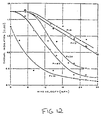
- Fig. 12 there is reproduced a plot of curves showing the relationship between change in effective thermal insulation and wind velocity for covers or fabrics of different permeabilities, as appeared in an article by P. Larose, entitled “The Effect of Wind on the Thermal Resistance of Clothing with Special Reference to the Protection Given by Coverall Fabrics of Various Permeabilities," which appeared in Canadian Journal of Research (Vol. 25, Sec. A, No. 4, (July, 1947), pp. 169-190).
- the permeabilities of the materials tested varied between 0 and 193 ft 3 /ft 2 /min under a pressure difference of 1 ⁇ 2 inch of water across the fabric.
- the word "tortuosity” is used to describe the fabric property enhanced according to the invention by increasing yarn count and filament count.
- the paths through the fabric are made more “tortuous” than those of prior art fabrics, and greater “tortuosity” results in greater dynamic insulating effect.
- a given fabric body is subjected to less than normal stretching, resulting in reduced final width of the fabric (i.e., the width resulting after heat setting of the fabric during the finishing process), the higher, still, the dynamic insulating performance of the resulting fabric article of the invention.
- a fabric article 10' of the invention formed by reverse plaiting on a fine cut circular knitting machine includes a stitch yarn 14' and a loop yarn 16' finished into a velour 24', 26' at the opposite surfaces.
- the stitch yarn 14' and/or the loop yarn 16' comprise micro-denier yarn or filaments of heat sensitive, i.e. heat shrinkable, material. Suitable materials include polyester, polypropylene, nylon and the like.
- An elastomeric yarn, e.g. such as spandex, may also be included, but typically only to the stitch yarn.
- a result of heating the fabric during dyeing and/or finishing is that the filaments of heat sensitive material shorten and thicken, and/or reduce in effective length, thus further reducing the paths for passage of chilling wind through the fabric to increase the tortuosity and the dynamic insulation performance of the fabric article 10' of the invention.
- the stitch yarn 14'' may include a cored yarn having a core formed of, e.g., polyester or nylon, and a sheath formed of a heat sensitive material, e.g., a hot melt material, such as polyethylene, polyester or polyamide, as available commercially from Engineered Yarn Company, of Fall River, Massachusetts.
- a hot melt material such as polyethylene, polyester or polyamide, as available commercially from Engineered Yarn Company, of Fall River, Massachusetts.
- the fabric article 10' formed with heat sensitive fibers and the fabric article 10'' formed with a cored yarn having a sheath of hot melt material have enhanced dynamic insulation performance, e.g. as compared to the fabric article 10 having the same weight.
- the fabric articles 10', 10'' are particularly suited for use, e.g., in light weight clothing and the like for use in extreme conditions of chilling wind and cold temperature.
- any type of yarn may be employed.
- other suitable methods of constructing a velour fabric article of the invention may be employed.
- the construction provided by reverse plaiting is employed in order to expose the loop yarn 16 for finishing at both surfaces of the fabric body, with segments 22 of the loop yarn 16 overlaying the stitch yarn 14 at the technical face 18 and formed into loops 23 at the technical back 20. This is preferred, for reasons of dynamic insulation performance, over a construction in which only the loop yarn is finished.
- a construction exposing the stitch yarn and the loop yarn side by side for finishing at one or both surfaces of a fabric body may be preferred.
Landscapes
- Engineering & Computer Science (AREA)
- Textile Engineering (AREA)
- Health & Medical Sciences (AREA)
- General Health & Medical Sciences (AREA)
- Physical Education & Sports Medicine (AREA)
- Physics & Mathematics (AREA)
- Thermal Sciences (AREA)
- Knitting Of Fabric (AREA)
Applications Claiming Priority (2)
| Application Number | Priority Date | Filing Date | Title |
|---|---|---|---|
| US34782599A | 1999-07-02 | 1999-07-02 | |
| US347825 | 1999-07-02 |
Publications (2)
| Publication Number | Publication Date |
|---|---|
| EP1067226A2 true EP1067226A2 (de) | 2001-01-10 |
| EP1067226A3 EP1067226A3 (de) | 2001-03-07 |
Family
ID=23365434
Family Applications (1)
| Application Number | Title | Priority Date | Filing Date |
|---|---|---|---|
| EP20000305440 Withdrawn EP1067226A3 (de) | 1999-07-02 | 2000-06-28 | Doppelseitiger Velourstoff |
Country Status (3)
| Country | Link |
|---|---|
| US (1) | US20010046580A1 (de) |
| EP (1) | EP1067226A3 (de) |
| JP (1) | JP2001020158A (de) |
Cited By (7)
| Publication number | Priority date | Publication date | Assignee | Title |
|---|---|---|---|---|
| EP1312710A1 (de) * | 2001-10-23 | 2003-05-21 | Malden Mills Industries, Inc. | Komposit Strickware mit gestrickten Kanälen, für Bekeidungsstücke wie Sweatshirts |
| US6828003B2 (en) * | 1999-07-02 | 2004-12-07 | Malden Mills Industries, Inc. | Velour fabric articles having flame retardance and improved dynamic insulation performance |
| US7560399B2 (en) | 1998-08-28 | 2009-07-14 | Mmi-Ipco, Llc | Multi-layer composite fabric garment |
| US7829172B2 (en) | 1999-07-02 | 2010-11-09 | Mmi-Ipco, Llc | Double-face velour fabric articles having improved dynamic insulation performance |
| US8298645B2 (en) | 2001-10-23 | 2012-10-30 | Mmi-Ipco, Llc. | Multi-layer flame retardant fabric |
| CN108930089A (zh) * | 2017-05-27 | 2018-12-04 | 连云港元丰机械制造有限公司 | 一种反包割圈绒双面纬编针织法 |
| CN115449944A (zh) * | 2022-09-24 | 2022-12-09 | 上海嘉麟杰纺织科技有限公司 | 一种长条豹纹面料生产方法 |
Families Citing this family (8)
| Publication number | Priority date | Publication date | Assignee | Title |
|---|---|---|---|---|
| US20050095940A1 (en) * | 2003-11-04 | 2005-05-05 | Moshe Rock | Composite fabric with engineered pattern |
| DE602004030975D1 (de) * | 2003-08-07 | 2011-02-24 | Mmi Ipco Llc | Aus Kompositstoff mit kontrolierter Luftdurchlässigkeit hergestellte Waren mit verbesserter Oberflächenhaltbarkeit |
| US20060068155A1 (en) * | 2003-08-07 | 2006-03-30 | Moshe Rock | Controlled air permeability composite fabric articles having enhanced surface durability |
| CN1804176A (zh) * | 2005-12-06 | 2006-07-19 | 维科控股集团股份有限公司 | 一种涤纶超细旦纬编珊瑚绒毛毯及其生产方法 |
| US7546853B2 (en) * | 2006-05-30 | 2009-06-16 | Mmi-Ipco, Llc | Advanced engineered garment |
| US20090077724A1 (en) * | 2007-09-26 | 2009-03-26 | Courtney Mark J | Protective Undergarment |
| US8176569B2 (en) * | 2009-06-24 | 2012-05-15 | Mmi-Ipco, Llc | Advanced engineered garment |
| EP3914760A4 (de) | 2019-01-22 | 2022-11-16 | Mpusa, LLC | Gewebtes frottierkühlhandtuch aus gesponnener und filamentfaser mit doppelfunktion |
Family Cites Families (5)
| Publication number | Priority date | Publication date | Assignee | Title |
|---|---|---|---|---|
| DE3615684A1 (de) * | 1986-05-09 | 1987-11-12 | Girmes Werke Ag | Velourtextilie |
| US4712281A (en) * | 1986-10-30 | 1987-12-15 | Guilford Mills, Inc. | Napped warp-knitted fabric and method of producing same |
| DE4200278C1 (en) * | 1992-01-08 | 1993-08-05 | Frottierweberei Vossen Gmbh, 4830 Guetersloh, De | Terry cloth or velour fabric - with pile on one side and microfibre threads to form pile-loops on other side |
| SE503414C2 (sv) * | 1994-10-07 | 1996-06-10 | Actuelle Tricot I Boras Ab | Rengöringstyg för avtorkning av smutsiga ytor och användning av detta rengöringstyg på en mopp för rengöring av smutsiga ytor |
| CA2156232C (en) * | 1995-07-26 | 2005-05-10 | Karl Lohmueller | Method for constructing a double face fabric |
-
2000
- 2000-03-22 JP JP2000080651A patent/JP2001020158A/ja active Pending
- 2000-06-28 EP EP20000305440 patent/EP1067226A3/de not_active Withdrawn
-
2001
- 2001-06-18 US US09/883,643 patent/US20010046580A1/en not_active Abandoned
Cited By (13)
| Publication number | Priority date | Publication date | Assignee | Title |
|---|---|---|---|---|
| US7560399B2 (en) | 1998-08-28 | 2009-07-14 | Mmi-Ipco, Llc | Multi-layer composite fabric garment |
| US7829172B2 (en) | 1999-07-02 | 2010-11-09 | Mmi-Ipco, Llc | Double-face velour fabric articles having improved dynamic insulation performance |
| USRE40314E1 (en) * | 1999-07-02 | 2008-05-13 | Mmi-Ipco, Llc | Velour fabric articles having flame retardance and improved dynamic insulation performance |
| US6828003B2 (en) * | 1999-07-02 | 2004-12-07 | Malden Mills Industries, Inc. | Velour fabric articles having flame retardance and improved dynamic insulation performance |
| USRE41574E1 (en) | 1999-07-02 | 2010-08-24 | Mmi-Ipco, Llc | Velour fabric articles having flame retardance and improved dynamic insulation performance |
| US6927182B2 (en) | 2001-10-23 | 2005-08-09 | Malden Mills Industries, Inc. | Enhanced composite sweatshirt fabric with knit constructed channels |
| EP1312710A1 (de) * | 2001-10-23 | 2003-05-21 | Malden Mills Industries, Inc. | Komposit Strickware mit gestrickten Kanälen, für Bekeidungsstücke wie Sweatshirts |
| US8298645B2 (en) | 2001-10-23 | 2012-10-30 | Mmi-Ipco, Llc. | Multi-layer flame retardant fabric |
| US8932966B2 (en) | 2001-10-23 | 2015-01-13 | Mmi-Ipco, Llc | Multi-layer flame retardant fabric |
| CN108930089A (zh) * | 2017-05-27 | 2018-12-04 | 连云港元丰机械制造有限公司 | 一种反包割圈绒双面纬编针织法 |
| CN108930089B (zh) * | 2017-05-27 | 2020-05-12 | 连云港元丰机械制造有限公司 | 一种反包割圈绒双面纬编针织法 |
| CN115449944A (zh) * | 2022-09-24 | 2022-12-09 | 上海嘉麟杰纺织科技有限公司 | 一种长条豹纹面料生产方法 |
| CN115449944B (zh) * | 2022-09-24 | 2024-03-15 | 上海嘉麟杰纺织科技有限公司 | 一种长条豹纹面料生产方法 |
Also Published As
| Publication number | Publication date |
|---|---|
| EP1067226A3 (de) | 2001-03-07 |
| JP2001020158A (ja) | 2001-01-23 |
| US20010046580A1 (en) | 2001-11-29 |
Similar Documents
| Publication | Publication Date | Title |
|---|---|---|
| US7829172B2 (en) | Double-face velour fabric articles having improved dynamic insulation performance | |
| USRE41574E1 (en) | Velour fabric articles having flame retardance and improved dynamic insulation performance | |
| EP1067226A2 (de) | Doppelseitiger Velourstoff | |
| US20180236748A1 (en) | Composite textile fabrics | |
| EP1803844B1 (de) | Durch benetzen mit wasser luftdurchlässigere web- oder maschenware aus gekräuselter verbundfaser sowie entsprechende bekleidung | |
| US8029862B2 (en) | Composite fabric with engineered pattern | |
| CN109640723B (zh) | 具有区域化的保温性和可变透气性的服装 | |
| CA2522075A1 (en) | Woven or knitted fabric containing two different yarns and clothing comprising the same | |
| EP1505184B1 (de) | Aus Kompositstoff mit kontrolierter Luftdurchlässigkeit hergestellte Waren mit verbesserter Oberflächenhaltbarkeit | |
| WO2020162624A1 (ja) | 織物及びその製造方法並びに該織物を含む繊維製品 | |
| JPWO2011152059A1 (ja) | 織物及び衣類 | |
| CA2099859C (en) | Textile base material for thermobonding interlining comprising in weft yarns texturized by air jet | |
| WO1995013413A1 (en) | Textile fabric | |
| EP4350060B1 (de) | Doppel raschelgewirk und dieses enthaltendes polstermaterial | |
| JPH08158115A (ja) | 衣 服 | |
| JPS632472Y2 (de) | ||
| JPS6319337Y2 (de) | ||
| HK40003649A (en) | Garment with zoned insulation and variable air permeability | |
| JPH0317953B2 (de) | ||
| JP2007291573A (ja) | 膝裏地用織物 | |
| JPH04126837A (ja) | 画面スエード調織物 | |
| JPS61113865A (ja) | ポリアミド繊維布帛の製造方法 | |
| JPS616348A (ja) | スエ−ド調高密度編織物およびその製造方法 | |
| JPH101838A (ja) | 被覆弾性糸 |
Legal Events
| Date | Code | Title | Description |
|---|---|---|---|
| PUAI | Public reference made under article 153(3) epc to a published international application that has entered the european phase |
Free format text: ORIGINAL CODE: 0009012 |
|
| AK | Designated contracting states |
Kind code of ref document: A2 Designated state(s): AT BE CH CY DE DK ES FI FR GB GR IE IT LI LU MC NL PT SE |
|
| AX | Request for extension of the european patent |
Free format text: AL;LT;LV;MK;RO;SI |
|
| PUAL | Search report despatched |
Free format text: ORIGINAL CODE: 0009013 |
|
| AK | Designated contracting states |
Kind code of ref document: A3 Designated state(s): AT BE CH CY DE DK ES FI FR GB GR IE IT LI LU MC NL PT SE |
|
| AX | Request for extension of the european patent |
Free format text: AL;LT;LV;MK;RO;SI |
|
| 17P | Request for examination filed |
Effective date: 20010808 |
|
| AKX | Designation fees paid |
Free format text: AT BE CH CY DE DK ES FI FR GB GR IE IT LI LU MC NL PT SE |
|
| STAA | Information on the status of an ep patent application or granted ep patent |
Free format text: STATUS: THE APPLICATION IS DEEMED TO BE WITHDRAWN |
|
| 18D | Application deemed to be withdrawn |
Effective date: 20021231 |