EP1074891A2 - Bilderzeugungsgerät und Verfahren - Google Patents
Bilderzeugungsgerät und Verfahren Download PDFInfo
- Publication number
- EP1074891A2 EP1074891A2 EP00306129A EP00306129A EP1074891A2 EP 1074891 A2 EP1074891 A2 EP 1074891A2 EP 00306129 A EP00306129 A EP 00306129A EP 00306129 A EP00306129 A EP 00306129A EP 1074891 A2 EP1074891 A2 EP 1074891A2
- Authority
- EP
- European Patent Office
- Prior art keywords
- bias
- image
- density
- electrifying
- image forming
- Prior art date
- Legal status (The legal status is an assumption and is not a legal conclusion. Google has not performed a legal analysis and makes no representation as to the accuracy of the status listed.)
- Granted
Links
- 238000000034 method Methods 0.000 title claims description 18
- 238000011161 development Methods 0.000 claims abstract description 290
- 238000012545 processing Methods 0.000 claims abstract description 127
- 230000008859 change Effects 0.000 claims description 70
- 239000000654 additive Substances 0.000 claims description 6
- 230000000996 additive effect Effects 0.000 claims description 6
- 239000004020 conductor Substances 0.000 claims 2
- 238000012546 transfer Methods 0.000 description 50
- 239000003086 colorant Substances 0.000 description 23
- 239000007787 solid Substances 0.000 description 17
- 230000002093 peripheral effect Effects 0.000 description 13
- 238000010586 diagram Methods 0.000 description 10
- 230000000694 effects Effects 0.000 description 10
- 238000007796 conventional method Methods 0.000 description 8
- 230000007613 environmental effect Effects 0.000 description 8
- 238000013461 design Methods 0.000 description 7
- 230000035945 sensitivity Effects 0.000 description 7
- 238000005259 measurement Methods 0.000 description 6
- 238000013459 approach Methods 0.000 description 5
- 238000012935 Averaging Methods 0.000 description 3
- 230000015556 catabolic process Effects 0.000 description 3
- 238000004140 cleaning Methods 0.000 description 3
- 238000006731 degradation reaction Methods 0.000 description 3
- 238000012986 modification Methods 0.000 description 3
- 230000004048 modification Effects 0.000 description 3
- 238000005513 bias potential Methods 0.000 description 2
- 230000000052 comparative effect Effects 0.000 description 2
- 230000003247 decreasing effect Effects 0.000 description 2
- 230000007246 mechanism Effects 0.000 description 2
- 230000000087 stabilizing effect Effects 0.000 description 2
- 230000005540 biological transmission Effects 0.000 description 1
- 230000007423 decrease Effects 0.000 description 1
- 238000001514 detection method Methods 0.000 description 1
- 238000002474 experimental method Methods 0.000 description 1
- 230000006872 improvement Effects 0.000 description 1
- 238000002360 preparation method Methods 0.000 description 1
- 230000008569 process Effects 0.000 description 1
- 230000009467 reduction Effects 0.000 description 1
- 230000004044 response Effects 0.000 description 1
- 230000006641 stabilisation Effects 0.000 description 1
- 238000011105 stabilization Methods 0.000 description 1
Images















Classifications
-
- G—PHYSICS
- G03—PHOTOGRAPHY; CINEMATOGRAPHY; ANALOGOUS TECHNIQUES USING WAVES OTHER THAN OPTICAL WAVES; ELECTROGRAPHY; HOLOGRAPHY
- G03G—ELECTROGRAPHY; ELECTROPHOTOGRAPHY; MAGNETOGRAPHY
- G03G15/00—Apparatus for electrographic processes using a charge pattern
- G03G15/50—Machine control of apparatus for electrographic processes using a charge pattern, e.g. regulating differents parts of the machine, multimode copiers, microprocessor control
- G03G15/5054—Machine control of apparatus for electrographic processes using a charge pattern, e.g. regulating differents parts of the machine, multimode copiers, microprocessor control by measuring the characteristics of an intermediate image carrying member or the characteristics of an image on an intermediate image carrying member, e.g. intermediate transfer belt or drum, conveyor belt
- G03G15/5058—Machine control of apparatus for electrographic processes using a charge pattern, e.g. regulating differents parts of the machine, multimode copiers, microprocessor control by measuring the characteristics of an intermediate image carrying member or the characteristics of an image on an intermediate image carrying member, e.g. intermediate transfer belt or drum, conveyor belt using a test patch
-
- G—PHYSICS
- G03—PHOTOGRAPHY; CINEMATOGRAPHY; ANALOGOUS TECHNIQUES USING WAVES OTHER THAN OPTICAL WAVES; ELECTROGRAPHY; HOLOGRAPHY
- G03G—ELECTROGRAPHY; ELECTROPHOTOGRAPHY; MAGNETOGRAPHY
- G03G15/00—Apparatus for electrographic processes using a charge pattern
- G03G15/06—Apparatus for electrographic processes using a charge pattern for developing
- G03G15/065—Arrangements for controlling the potential of the developing electrode
-
- G—PHYSICS
- G03—PHOTOGRAPHY; CINEMATOGRAPHY; ANALOGOUS TECHNIQUES USING WAVES OTHER THAN OPTICAL WAVES; ELECTROGRAPHY; HOLOGRAPHY
- G03G—ELECTROGRAPHY; ELECTROPHOTOGRAPHY; MAGNETOGRAPHY
- G03G2215/00—Apparatus for electrophotographic processes
- G03G2215/00025—Machine control, e.g. regulating different parts of the machine
- G03G2215/00029—Image density detection
- G03G2215/00033—Image density detection on recording member
- G03G2215/00037—Toner image detection
- G03G2215/00042—Optical detection
-
- G—PHYSICS
- G03—PHOTOGRAPHY; CINEMATOGRAPHY; ANALOGOUS TECHNIQUES USING WAVES OTHER THAN OPTICAL WAVES; ELECTROGRAPHY; HOLOGRAPHY
- G03G—ELECTROGRAPHY; ELECTROPHOTOGRAPHY; MAGNETOGRAPHY
- G03G2215/00—Apparatus for electrophotographic processes
- G03G2215/01—Apparatus for electrophotographic processes for producing multicoloured copies
- G03G2215/0167—Apparatus for electrophotographic processes for producing multicoloured copies single electrographic recording member
- G03G2215/0174—Apparatus for electrophotographic processes for producing multicoloured copies single electrographic recording member plural rotations of recording member to produce multicoloured copy
Definitions
- the present invention relates to an image forming apparatus and an image forming method, in which an image density of a toner image is adjusted based on detected image densities of patch images.
- This type of an image forming apparatus often sees a change in an image density due to the following factors: fatigue, degradation with age or the like of a photosensitive member and a toner; a change in a temperature, a humidity or the like around the apparatus; and other causes.
- a number of techniques have been proposed which aim at stabilizing an image density through appropriate adjustment of a density control factor which influences an image density of a toner image such as an electrifying bias, a development bias, a light exposure dose, etc.
- the invention described in the Japanese Patent Application Laid-Open Gazette No. 10-239924 requires to properly adjust an electrifying bias and a development bias in an effort to stabilize an image density.
- reference patch images are formed on a photosensitive member while changing an electrifying bias and/or a development bias and an image density of each reference patch is detected.
- An optimal electrifying bias and an optimal development bias are thereafter determined based on the detected image densities, and a density of a toner image is accordingly adjusted.
- a "processing mode" will refer to a series of processing in which a plurality of patch images are formed, densities of the patch images are detected, and an optimal value of a density controlling factor, which is necessary to adjust an image density of a toner image to a target density, is determined based on the detected image densities.
- the processing mode is executed at the following timing. Specifically, after turning on a main power source of the image forming apparatus, a density is adjusted upon arriving at a state where the apparatus is ready to form an image, which is when a fixing temperature reaches a predetermined temperature or immediately after that, for example. Where a timer is built within the image forming apparatus, the density adjustment is executed at regular intervals, e.g., for every two hours.
- a state of an engine part is largely different depending on an operation status of the apparatus. For instance, a change in a state of the engine part is relatively small while images are formed continuously, whereas it is relatively likely that a state of the engine part changes largely upon turning on of a power source.
- execution of a processing mode tuned to the state of the engine part makes it possible to adjust a density efficiently at a high accuracy. For instance, while an optimal electrifying bias and an optimal development bias change due to fatigue, degradation with age or the like of a photosensitive member and a toner, the changes possess a continuity to a certain extent.
- the density adjustment is accurate.
- the conventional technique described above requires to identify an electrifying bias/development bias characteristic before forming reference patch images, and to set an electrifying bias and a development bias for creation of reference patch images, such that the characteristic is satisfied.
- an electrifying bias/development bias characteristic does not always stay constant but may change with time. If the characteristic changes, it is difficult to accurately calculate an optimal electrifying bias or an optimal development bias. While appropriate updating of the electrifying bias/development bias characteristic solves this problem, the updating is bothersome and disadvantageous in terms of maintainability.
- a reference patch image which is a patch image obtained by outputting groups of three-dot lines for every three dots, is formed on a photosensitive drum, and a sensor reads patch images thus created, whereby a line width is detected.
- a laser power is controlled based on the detected line width, a light exposure dose is accordingly adjusted so that a desired line width will be obtained, and an ideal line image is obtained.
- a line image is basically a one-dot line which is drawn with one laser beam, and therefore, simply controlling a line width of a multi-dot line as in the conventional technique can not realize a precise adjustment of a line image.
- the present invention aims at providing an image forming apparatus and an image forming method with which it is possible to determine an optimal value of a density controlling factor, which is needed to adjust an image density of a toner image to a target density, efficiently at a high accuracy.
- Another object of the present invention is to provide an image forming apparatus and an image forming method with which it is possible to stabilize an image density of a line image.
- an image forming apparatus and method are provided and are particularly well suited to density adjustment of a toner image based on image densities of a plurality of patch images.
- control means has a plurality of processing modes which are different from each other.
- Each of the plurality of processing modes is a mode in which a plurality of patch images are formed by the image forming means while changing a density controlling factor which influences an image density of an image and an optimal value of a density controlling factor, which is necessary to adjust an image density of an image to the target density, is determined based on the densities of the patch images.
- One of the processing modes is selected as a processing mode in accordance with an operation status of the apparatus. Hence, it is possible to select and execute the most appropriate processing mode in accordance with an operation status to thereby efficiently and highly accurately determine an optimal value of the density controlling factor.
- Fig. 1 is a drawing showing a preferred embodiment of an image forming apparatus according to the present invention.
- Fig. 2 is a block diagram showing an electric structure of the image forming apparatus of Fig. 1.
- the image forming apparatus is an apparatus which overlaps toner images in four colors of yellow (Y), cyan (C), magenta (M) and black (K) to thereby form a full-color image or uses only a black (K) toner to thereby form a monochrome image.
- an engine controller 12 controls respective portions of an engine part E in accordance with an instruction from the main controller 11, whereby the image forming apparatus forms an image which corresponds to the image signal on a sheet S.
- the engine part E is capable of forming a toner image on a photosensitive member 21 of an image carrier unit 2. That is, the image carrier unit 2 comprises the photosensitive member 21 which is rotatable in the direction of an arrow in Fig. 1. Disposed around the photosensitive member 21 and in the rotation direction of the photosensitive member 21 in Fig. 1 are an electrifying roller 22 which serves as electrifying means, developers 23Y, 23C, 23M and 23K which serve as developing means, and a cleaning part 24. Applied with a high voltage from an electrifying bias generation part 121 and in contact with an outer peripheral surface of the photosensitive member 21, the electrifying roller 22 uniformly electrifies the outer peripheral surface of the photosensitive member 21.
- An exposure unit 3 irradiates laser light L toward the outer peripheral surface of the photosensitive member 21 which is electrified by the electrifying roller 22.
- the exposure unit 3, as shown in Fig. 2 is electrically connected with an image signal switching part 122.
- the laser light L scans over the photosensitive member 21 and consequently exposes the photosensitive member 21, whereby an electrostatic latent image corresponding to the image signal is formed on the photosensitive member 21.
- the image signal switching part 122 when the image signal switching part 122 is in conduction with a patch generation module 124, based on an instruction from a CPU 123 of the engine controller 12, a patch image signal outputted from the patch generation module 124 is fed to the exposure unit 3 so that a patch latent image is formed.
- the image signal switching part 122 when the image signal switching part 122 is in conduction with a CPU 111 of the main controller 11, the laser light L scans over and consequently exposes the photosensitive member 21 in accordance with an image signal which is supplied through an interface 112 from an external apparatus such as a host computer, so that an electrostatic latent image corresponding to the image signal is formed on the photosensitive member 21.
- the electrostatic latent image which is formed in this manner is developed by a developer part 23.
- disposed as the developer part 23 are the developer 23Y for yellow, the developer 23C for cyan, the developer 23M for magenta and the developer 23K for black which are arranged in this order around the photosensitive member 21.
- the developers 23Y, 23C, 23M and 23K are each structured so as to freely separate from and come close to the photosensitive member 21.
- one of the four developers 23Y, 23C, 23M and 23K selectively contacts the photosensitive member 21.
- a development bias generation part 125 thereafter applies a high voltage to the photosensitive member 21, and the toner in the selected color moves to the surface of the photosensitive member 21, thereby visualizing the electrostatic latent image on the photosensitive member 21.
- the voltages supplied to the respective developers may be simply D.C. voltages, or alternatively, A.C. voltages superimposed over D.C. voltages.
- the toner image developed by the developer part 23 is primarily transferred onto an intermediate transfer belt 41 of a transfer unit 4 in a primary transfer region R1 which is located between the black developer 23K and the cleaning part 24.
- a structure of the transfer unit 4 will be described in detail later.
- the cleaning part 24 is disposed at a position further ahead in a circumferential direction (the direction of the arrow in Fig. 1) from the primary transfer region R1, such that a toner remaining on the outer peripheral surface of the photosensitive member 21 after the primary transfer treatment is scraped off.
- the transfer unit 4 comprises rollers 42 through 47, the intermediate transfer belt 41 which is spun around the rollers 42 through 47, and a secondary transfer roller 48 which secondarily transfers an intermediate toner image transferred to the intermediate transfer belt 41 onto a sheet S.
- a transfer bias generation part 126 applies a primary transfer voltage upon the intermediate transfer belt 41. Toner images in the respective colors formed on the photosensitive member 21 are laid one atop the other on the intermediate transfer belt 41 into a color image, while the sheet S is taken out from a cassette 61, a hand-feeding tray 62 or an additional cassette (not shown) by a paper feed part 63 of a paper feed/discharge unit 6 and conveyed to a secondary transfer region R2.
- the color image is thereafter secondarily transferred onto the sheet S, thereby obtaining a full-color image.
- a monochrome image is to be transferred onto a sheet S
- only a black toner image on the photosensitive member 21 is formed on the intermediate transfer belt 41, and transferred onto a sheet S conveyed to the secondary transfer region R2 to thereby obtain a monochrome image, as in the case of forming a color image.
- a toner remaining on and sticking to an outer peripheral surface of the intermediate transfer belt 41 is removed by a belt cleaner 49.
- the belt cleaner 49 is disposed opposite to the roller 46 across the intermediate transfer belt 41, and a cleaner blade contacts the intermediate transfer belt 41 at appropriate timing and scrapes off a toner from the outer peripheral surface of the intermediate transfer belt 41.
- a patch sensor PS which detects a density of a patch image which is formed on the outer peripheral surface of the intermediate transfer belt 41 as described later, and so is a read sensor for synchronization RS which detects a reference position of the intermediate transfer belt 41.
- the sheet S now seating the toner image transferred by the transfer unit 4 is conveyed by the paper feed part 63 of the paper feed/discharge unit 6 to a fixing unit 5 which is disposed on the downstream side to the secondary transfer region R2 along a predetermined paper feed path (dot-dot-dash line), and the toner image on the conveyed sheet S is fixed on the sheet S.
- the sheet S is thereafter conveyed to a paper discharge part 64 along the paper feed path 630.
- the paper discharge part 64 has two paper discharge paths 641a and 641b.
- the paper discharge path 641a extends from the fixing unit 5 to a standard paper discharge tray, while the paper discharge path 641b extends approximately parallel to the paper discharge path 641a between a paper re-feed part 66 and a multi-bin unit.
- Three roller pairs 642 through 644 are disposed along the paper discharge paths 641a and 641b, so as to discharge the sheets S toward the standard paper discharge tray or the multi-bin unit and convey the sheets S toward the paper re-feed part 66 for the purpose of forming images on non-printing surfaces of the sheets S.
- the paper re-feed part 66 is formed of three paper re-feed roller pairs 661 through 663 which are disposed along the paper re-feed path 664 as shown in Fig. 1.
- the sheet S sent from the paper discharge part 64 is returned to the gate roller pair 637 along the paper re-feed path 664 and a non-printing surface of the sheet S is directed toward the intermediate transfer belt 41 within the paper feed part 63, which makes it possible to secondarily transfer the image onto the non-printing surface.
- denoted at 113 is an image memory which is disposed in the main controller 11 such that the image memory stores image data supplied from an external apparatus such as a host computer through the interface 112, denoted at 127 is a RAM which temporarily stores control data for controlling the engine part E, a calculation result obtained by the CPU 123, etc., and denoted at 128 is a ROM which stores a calculation program which is executed by the CPU 123.
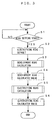
- Fig. 3 is a flow chart showing a density adjustment operation in the image forming apparatus of Fig. 1.
- the image forming apparatus may start setting the biases when the image forming apparatus becomes ready to form an image after a main power source of the image forming apparatus is turned on.
- the image forming apparatus may set the biases every few hours while a timer (not shown) disposed in the image forming apparatus measures hours of continuous use.
- steps S2 and S3 are executed to calculate an optimal development bias, and the calculated bias is set as the development bias (step S4).
- a step S5 is executed to calculate an optimal electrifying bias, and the calculated bias is set as the electrifying bias (step S6).
- the electrifying bias and the development bias are optimized in this manner. In the following, a detailed description will be given on an operation of each one of the development bias calculation (step S3) and the electrifying bias calculation (step S5).
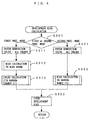
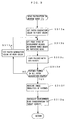
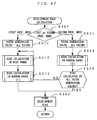
- Fig. 4 is a flow chart showing an operation of the development bias calculation shown in Fig. 3.
- the development bias calculation step S3
- either one of a first processing mode and a second processing mode is selected as a processing mode, in accordance with an operation status of the apparatus (step S301).
- the first processing mode a two-stage development bias calculation is carried out.
- the first stage step S312) is for calculating an interim value of an optimal development bias while changing a development bias within a wide range (which is the entire programmable range of development biases).
- the second stage (step S313) is for determining the optimal development bias while changing a development bias based on the interim value within a narrow range (which is approximately 1/3 of the programmable range), as described later.
- the first processing mode is suitable to where it is not possible to predict a state of the engine part E.
- a single-stage development bias calculation is carried out.
- the bias calculation (step S322) is for determining an optimal development bias while changing a development bias within the narrow range (which is approximately 1/3 of the programmable range) which contains a precedent optimal development bias, as described later. Therefore, the second processing mode is suitable to where a change in a state of the engine part E is small.
- selection at the step S301 is specifically executed in accordance with the following criteria.
- an optimal development bias is determined while changing a development bias within the entire programmable range of development biases.
- an optimal development bias is determined while changing a development bias within the entire programmable range of development biases.
- an optimal development bias is determined while changing a development bias within the narrow range (which is approximately 1/3 of the programmable range) which contains a precedent optimal development bias.
- first development bias calculation (steps S311 through S317 and S302) is executed to determine an optimal development bias.
- second development bias calculation steps S321, S322 and S302) is executed to determine an optimal development bias.
- step S311 After setting up such that patch images will be created in all colors (which are the four colors of yellow (Y), cyan (C), magenta (M) and black (K) in this preferred embodiment) (step S311), a plurality of patch images are formed while gradually changing the development bias at relatively long intervals within a relatively wide range at an immediately subsequent step S312. In this manner, a development bias, which is necessary to obtain an optimal image density, is tentatively calculated as an interim development bias based on densities of the respective patch images. Now, an operation of this processing will be described in detail with reference to Figs. 5 and 6A through 6D.
- Fig. 5 is a flow chart showing an operation of the bias calculation of Fig. 4 within a wide range.
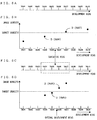
- Figs. 6A through 6D are schematic diagrams showing an operation of the processing of Fig. 5 and an operation of the bias calculation within narrow range which will be described later.
- a color in which patch images are to be generated is set as the first color, e.g., yellow (step S312a).
- the development bias is set to four different values which are apart at relatively long intervals (first intervals) within the wide range (step S312b).
- the wide range is the entirety of a programmable range (Vb01 - Vb10) of development bias which can be supplied to the developer part 23 from the development bias generation part 125, and four points Vb01, Vb04, Vb07 and Vb10 within the wide range (Vb01 - Vb10) are set as development biases.
- the first patch images PI1 are solid images in this preferred embodiment. The reason of this will be described in detail later.
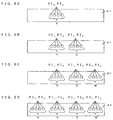
- step S312d whether patch images are formed in all of patch generation colors is determined. While a result of the judgement stays NO, the next color is set as a patch generation color (step S312e) and the steps S312b and S312c are repeated. This adds further first patch images PI1 on the outer peripheral surface of the intermediate transfer belt 41, in the order of cyan (C), magenta (M) and black (K), as shown in Figs. 8B through 8D.
- C cyan
- M magenta
- K black
- a development bias corresponding to a target density is calculated at a step S312g, and the calculated bias is stored temporarily in the RAM 127 as an interim bias.
- a measurement result (image density) matches with the target density
- a development bias corresponding to this image density may be used as the interim bias.
- the two density values fail to match, as shown in Fig. 6B, it is possible to calculate an interim bias through linear interpolation, averaging or other appropriate methodology in accordance with data D (Vb04) and data D (Vb07) which are on the both sides of the target density.
- Fig. 9 is a flow chart showing an operation of the bias calculation (1) of Fig. 4 in the narrow range.
- a color in which patch images are to be generated is set as the first color, e.g., yellow (step S313a), as in the earlier calculation (step S312).
- the development bias is set to four different values which are apart at narrower intervals (second intervals) than the first intervals W1 within a narrow range which includes the interim bias (step S313b).
- the narrow range is approximately 1/3 of the programmable range (Vb01 - Vb10) of development bias.
- Vb01 - Vb10 the interim bias
- the interim bias is between development biases Vb05 and Vb06 as shown in Fig. 6B
- four points Vb04, Vb05, Vb06 and Vb07 are set as development biases (Fig. 6C).
- first patch images PI1 are sequentially formed on the photosensitive member 21 with this bias setup, and the solid images are transferred onto the outer peripheral surface of the intermediate transfer belt 41 as shown in Fig. 8A to thereby form first patch images PI1 (step S313c).
- step S312 the next color is set as a patch generation color (step S313e) and the steps S313b and S313c are repeated until it is determined at a step S313d that patch images are formed in all of patch generation colors.
- first patch images PI1 are further formed on the outer peripheral surface of the intermediate transfer belt 41, in the order of cyan (C), magenta (M) and black (K).
- the patch sensor PS measures image densities of the patch images PI1 one by one starting with the patch image PI1 at the head position (which is a black (K) patch image in this preferred embodiment) (step S313f).
- a development bias corresponding to a target density is calculated.
- a measurement result (image density) matches with the target density a development bias corresponding to this image density may be used as an optimal development bias.
- the two density values fail to match, as shown in Fig. 6D, it is possible to calculate an optimal development bias through linear interpolation, averaging or other appropriate methodology in accordance with data D (Vb05) and data D (Vb06) which are on the both sides of the target density.
- the sequence proceeds to the step S302 to allow the RAM 127 to store the optimal development biases calculated in this manner. Thereafter, the stored bias is read out as the development bias during calculation of the electrifying bias which will be described later or while an image is formed in a normal manner.
- the first development bias calculation (first processing mode) carries out a two-stage bias calculation.
- patch images PI1 are formed at the first intervals W1 in the wide range to calculate a development bias, which is necessary to obtain an image having a target density, as an interim development bias.
- patch images PI1 are formed at the narrower intervals (i.e., the second intervals) W2 in the narrow range which includes the interim bias to calculate a development bias which is necessary to achieve the target density.
- the calculated bias is set as an optimal development bias. This realizes the following effects.
- the optimal development bias can be obtained by the following approach:
- the approach requires to divide the programmable range (Vb01 - Vb10) of development biases into a plurality of narrow ranges and to execute similar processing to the bias calculation (1) described above in each one of the narrow ranges.
- this comparative approach has a problem that the number of steps to be executed increases in proportion to the number of the divided ranges and calculation of an optimal development bias therefore takes time.
- a development bias is tentatively calculated through the bias calculation processing (step S312) in the wide range, and the development bias is changed at the narrower intervals (i.e., the second intervals) W2 in the narrow range in the vicinity of the interim bias, so that an optimal development bias is finally calculated.
- the narrower intervals i.e., the second intervals
- a quantity of a toner relative to a development bias namely, a development ⁇ -characteristic which expresses a change in an image density, largely changes depending on an environmental condition, a durability condition or the like and in addition, is non-linear.
- the first development bias calculation (first processing mode) described above achieves the following excellent effect.
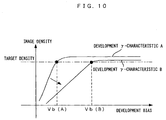
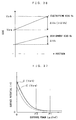
- Fig. 10 is a graph showing a typical example of a development ⁇ - characteristic.
- the development ⁇ -characteristic of the image forming apparatus accordingly changes from the initial development ⁇ - characteristic A to a development ⁇ -characteristic B.
- the gradient of the development ⁇ -characteristic is susceptive to an influence of the environmental condition or the like and tends to change largely.
- an optimal development bias of the image forming apparatus has a value Vb(A) when the development ⁇ -characteristic of the apparatus stays the development ⁇ -characteristic A, if the development ⁇ -characteristic changes to the development ⁇ - characteristic B due to even a slightest change in the environmental condition or the like, the optimal development bias largely changes into a value Vb(B).
- Vb(A) when the development ⁇ -characteristic of the apparatus stays the development ⁇ -characteristic A
- the optimal development bias largely changes into a value Vb(B).
- the effect of the first processing mode described above is more prominent in an image forming apparatus which uses a mono-component non-magnetic toner, for the following reason described in detail.
- a mono-component non-magnetic toner has come into a use considering controllability of a toner temperature against a carrier, etc.
- An image forming apparatus which uses such a mono-component toner is characterized in that a quantity of electrification of the toner is more inclined to change depending on an environmental condition and a durability condition as compared to an image forming apparatus which uses a two-component toner.
- a mono-component toner does not contain a carrier which controls a quantity of electrification, and therefore, is electrified only with an electrification mechanism which is disposed inside the developer. Due to this, a mono-component toner contacts in a dominantly smaller area with an electrification mechanism than a two-component toner contacts with a carrier. Thus, it is more preferable to apply the present invention to an image forming apparatus which uses a mono-component non-magnetic toner.
- an external additive is added in a larger quantity than usual to a toner, e.g., 1.5 % or more in some cases, in an effort to improve the transferability of the toner.
- the usefulness of the present invention is remarkable. This is because the external additive is also susceptible to an influence by an environment. When the quantity of the external additive is 1.5 % or more, due to an environmental influence, a development ⁇ -characteristic changes largely. Therefore, it is more preferable to apply the present invention to an image forming apparatus which uses such a toner.
- an image forming apparatus of the intermediate transfer method such as the image forming apparatus according to the preferred embodiment described above, an improved transferability is strongly demanded. This has led to a tendency to use more external additive than in an image forming apparatus of other methods, which makes the present invention even more useful.
- the present invention when applied to an image forming apparatus and an image forming method which use a mono-component non-magnetic toner which contains an external additive in the quantity of 1.5 % or more, the present invention more remarkably attains the excellent effect that it is possible to efficiently and highly accurately determine an optimal value of a density controlling factor which is needed to adjust an image density of a toner image to a target density.
- the preferred embodiment described above requires to execute the second development bias calculation to determine an optimal development bias when the second processing mode is selected at the step S301 in Fig. 4, on the ground that a change in a state of the engine part E is assumed to be small in a situation which meets the criterion (2), (3) or (5) described earlier.
- an optimal electrifying bias and an optimal development bias change due to fatigue, degradation with age or the like of a photosensitive member and a toner the changes possess a continuity to a certain extent.
- step S313f a result of immediately precedent measurement of an image density of electrifying biases
- step S322g which will be described later
- step S313f a result of immediately precedent measurement of an image density of electrifying biases
- step S321 After setting up such that patch images will be created in all colors (which are the four colors of yellow (Y), cyan (C), magenta (M) and black (K) in this preferred embodiment) (step S321), the sequence proceeds to the step S322 at which the bias calculation (2) within the narrow range is executed, whereby an optimal development bias is calculated without calculating an interim bias.
- the bias calculation (2) within the narrow range is executed, whereby an optimal development bias is calculated without calculating an interim bias.
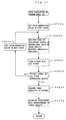
- Fig. 11 is a flow chart showing an operation of the bias calculation (2) of Fig. 4 within the narrow range.
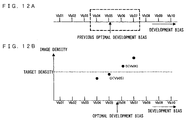
- Figs. 12A and 12B are schematic diagrams showing the operation of the processing shown in Fig. 11. This calculation processing is largely different from the bias calculation (1) within the narrow range described earlier in regard to the following.
- the electrifying bias set to the default value, and four different types of development biases are set based on an interim bias (step S313b).
- the electrifying bias is the optimal electrifying bias which is calculated through immediately preceding measurement and stored in the RAM 127, and four different types of development biases are set within the narrow range based on the optimal development bias which is stored in the RAM 127 (step S322b).
- the bias calculation (2) is structured otherwise the same as the bias calculation (1), and therefore, a redundant description will be simply omitted.
- step S322 the four different types of development biases are set.
- the four biases are apart at the second intervals within the narrow range using the development bias which is calculated immediately previously (preceding optimal development bias) without calculating an interim bias, the patch images are formed in the respective colors, and the optimal development bias is calculated.
- the first processing mode step S312 + step S313
- the present invention realizes a unique effect that it is possible to calculate an optimal development bias at a high accuracy.
- the conventional technique three pairs of an electrifying bias and a development bias are stored in advance, and patch images are formed using the three development biases, respectively.
- patch images are formed using the three development biases, respectively.
- the development bias is changed within the narrow range including the immediately preceding optimal development bias out of the programmable range (Vb01 - Vb10) of development bias. That is, this preferred embodiment requires only approximately 1/3 of the programmable range of development bias, and the intervals of the development biases according to this preferred embodiment (second intervals) are narrower than those used in the conventional technique. Due to this, the present invention allows to calculate an optimal development bias at a better accuracy. It is to be noted that a simple reduction of the range in which a development bias is to be changed causes an optimal development bias to be calculated to deviate from the reduced range and only makes it difficult to accurately calculate an optimal development bias. However, according to this preferred embodiment, since the narrow range is set around an immediately preceding optimal development bias, it is extremely unlikely to see such a problem.
- the engine controller 12 writes the optimal development bias which is calculated in this manner over the preceding optimal development bias which is already stored in the RAM 127, thereby updating the optimal development bias (step S302 in Fig. 4).
- the sequence thereafter returns to Fig. 3 which requires to read the optimal development bias from the RAM 127 and set the retrieved optimal development bias as the development bias.
- An optimal electrifying bias is thereafter calculated (step S5) and set as the electrifying bias (step S6).
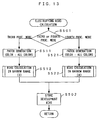
- Fig. 13 is a flow chart showing an operation of the electrifying bias calculation of Fig. 3.
- the electrifying bias calculation step S5
- a third processing mode and a fourth processing mode is selected as a processing mode, in accordance with an operation status of the apparatus (step S501).
- the third processing mode is for forming a plurality of patch images while changing an electrifying bias within the narrow range (which is approximately 1/3 of the programmable range) which contains a predetermined default value.
- the third processing mode is suitable to where it is not possible to predict a state of the engine part E.
- the fourth processing mode is for determining an optimal electrifying bias while changing an electrifying bias within the narrow range (which is approximately 1/3 of the programmable range) which contains a precedent optimal electrifying bias, as described later. Therefore, the fourth processing mode is suitable to where a change in a state of the engine part E is small.
- selection at the step S501 is specifically executed in accordance with the following criteria.
- an optimal electrifying bias is determined while changing an electrifying bias within the narrow range (which is approximately 1/3 of the programmable range) which contains the predetermined default value.
- an optimal electrifying bias is determined while changing an electrifying bias within the narrow range (which is approximately 1/3 of the programmable range) which contains a precedent optimal electrifying bias.
- an optimal electrifying bias is determined while changing an electrifying bias within the narrow range (which is approximately 1/3 of the programmable range) which contains a precedent optimal electrifying bias.
- an optimal electrifying bias is determined while changing an electrifying bias within the narrow range (which is approximately 1/3 of the programmable range) which contains the predetermined default value.
- an optimal electrifying bias is determined while changing an electrifying bias within the narrow range (which is approximately 1/3 of the programmable range) which contains a precedent optimal electrifying bias.
- first electrifying bias calculation steps S511, S512, S502 is executed to determine an optimal electrifying bias.
- second electrifying bias calculation steps S521, S522, S502 is executed to determine an optimal electrifying bias.
- step S512 In the first electrifying bias calculation, as shown in Fig. 13, after setting up such that patch images will be created in all colors (which are the four colors of yellow (Y), cyan (C), magenta (M) and black (K) in this preferred embodiment) (step S511), the sequence proceeds to the step S512.
- a plurality of patch images are formed while changing an electrifying bias to four different values which are apart at relatively short intervals within the narrow range containing the predetermined default value.
- an electrifying bias which is needed to obtain a target density, is calculated based on densities of the respective patch images.
- Fig. 14 is a flow chart showing the operation of the processing at the step S512, i.e., bias calculation (3) of Fig. 13 in the narrow range.
- Figs. 15A and 15B are schematic diagrams showing the operation of the processing shown in Fig. 14.
- a color in which patch images are to be generated is set as the first color, e.g., yellow (step S512a).
- the electrifying bias is set to four different values. The four biases are apart at relatively narrow intervals (third intervals) within the narrow range which includes the default value (step S512b). In this manner, unlike the development bias calculation, the electrifying bias calculation executes only narrow-range calculation without calculating within the wide range.
- the narrow range is approximately 1/3 of a programmable range (Va01 - Va10) of electrifying bias.
- Va01 - Va10 programmable range
- step S512d whether the second patch images are formed in all of patch generation colors is judged. While a result of the judgement stays NO, the next color is set as a patch generation color (step S512e) and the steps S512b through S512d are repeated. This adds further second patch images PI2 on the outer peripheral surface of the intermediate transfer belt 41, in the order of cyan (C), magenta (M) and black (K), as shown in Figs. 8B through 8D.
- C cyan
- M magenta
- K black
- step S512g an electrifying bias corresponding to a target density is calculated (step S512g).
- an electrifying bias corresponding to this image density may be used as an optimal electrifying bias.
- the two density values fail to match, as shown in Fig. 15B, it is possible to calculate an optimal electrifying bias through linear interpolation, averaging or other appropriate methodology in accordance with data D (Va05) and data D (Va06) which are on the both sides of the target density.
- the sequence proceeds to the step S502 at which the RAM 127 stores the optimal electrifying biases calculated in the manner described above.
- the RAM 127 reads out the optimal electrifying biases and set them as an electrifying bias while an image is formed in a normal manner.
- the second electrifying bias calculation is executed to determine an optimal electrifying bias.
- step S521 After setting up such that patch images will be created in all colors (which are the four colors of yellow (Y), cyan (C), magenta (M) and black (K) in this preferred embodiment) (step S521), the sequence proceeds to the step S522 to execute bias calculation (4) in the narrow range and calculate an optimal electrifying bias (step S522).
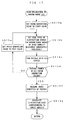
- Fig. 17 is a flow chart showing an operation of the bias calculation (4) of Fig. 13 in the narrow range.
- This calculation processing is largely different from the bias calculation (3) described earlier in that four types of electrifying biases are set in the narrow range based on electrifying biases found and stored in the RAM 127 (step S515b), unlike in the calculation (3) shown in Fig. 14 where four types of electrifying biases are set in the narrow range based on the default value (step S512b).
- the bias calculation (4) is otherwise the same in structure as the calculation (3), and therefore, the identical structure will not be described.
- the sequence proceeds to the step S502 at which the RAM 127 stores the optimal electrifying biases calculated as described above.
- the RAM 127 reads out the optimal electrifying biases and set them as an electrifying bias while an image is formed in a normal manner.
- the first and the second processing modes are prepared to determine an optimal development bias and either one of the first processing mode and the second processing mode is selected as a processing mode in accordance with an operation status of the apparatus, it is possible to select and execute the most appropriate processing mode in accordance with an operation status. Hence, it is possible to efficiently and highly accurately determine an optimal value of a development bias which is one density controlling factor.
- this preferred embodiment it is possible to calculate an optimal electrifying bias and an optimal development bias without using an electrifying bias/development bias characteristic which is essential in the conventional technique to adjust an image density. Hence, it is possible to adjust an image density to a target density and accordingly stabilize the image density in a simple manner. Further, even despite a change with time in an electrifying bias/development bias characteristic, this preferred embodiment allows to accurately calculate an optimal electrifying bias and an optimal development bias without an influence of the change.
- step S312 since calculation of an optimal development bias is achieved in the two stages of bias calculation in the wide range (step S312) and bias calculation in the narrow range (step S313), it is possible to calculate the optimal development bias at a high accuracy in a short period of time.
- each patch image PI2 is formed by a plurality of one-dot lines which are arranged apart from each other. Since an image density of each such patch image PI2 is detected and an image density of a toner image is adjusted to a target density based on the detected image densities of the patch images PI2, it is possible to stabilize an image density of not only a line image which is formed by a P-dot (P ⁇ 2) line but of a line image which is formed by a one-dot line, and hence, to stably form a fine image with an appropriate image density.
- P ⁇ 2 P-dot
- an optimal electrifying bias since the electrifying bias calculation is executed with an optimal development bias calculated through immediately preceding calculation set as a development bias, it is possible to accurately calculate an optimal electrifying bias.
- solid images are used as the first patch images for calculation of a development bias, while for calculation of an electrifying bias, used as the second patch images are halftone images in which a plurality of one-dot lines are arranged parallel to each other but apart from each other at intervals of n lines.
- an electrostatic latent image LI1 of a solid image (first patch image) PI1 (See Fig. 7) is formed on the surface of the photosensitive member 21 which is electrified uniformly at a surface potential V0, a surface potential corresponding to the electrostatic latent image LI1 largely drops down to a potential (exposed area potential) Von as shown in Figs. 18A and 18B, whereby a well potential is developed.
- the electrifying bias is increased to raise the surface potential of the photosensitive member 21 from the potential V0 up to a potential V0', the exposed area potential will not depart largely from the potential Von.
- a toner density is determined only in accordance with the development bias Vb despite any small change in the electrifying bias.
- a halftone image (second patch image) PI2 (See Fig. 16) contains one-dot lines DL formed at predetermined intervals.
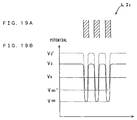
- an electrostatic latent image LI2 of the halftone image is formed on the surface of the photosensitive member 21 which is electrified uniformly at a surface potential V0, surface potentials corresponding to the positions of the lines largely drop down to the potential (exposed area potential) Von, as shown in Figs. 19A and 19B.
- a comb-shaped well potential is developed.
- the electrifying bias is increased in a similar manner to described above to raise the surface potential of the photosensitive member 21 from the potential V0 up to the potential V0', the exposed area potential corresponding to each line changes greatly from the potential Von to a potential Von'.
- a toner density corresponding to the development bias Vb changes with the change in the electrifying bias.
- a line image (second patch image PI2) is formed by a halftone image which is obtained by arranging a plurality of one-dot lines parallel to each other but apart from each other at intervals of n lines, for the following reason. That is, although one approach to adjust an image density of a one-dot line is to form the second patch image PI2 as a single one-dot line and detect a density of the one-dot line with the patch sensor PS, since an image density of a one-dot line is extremely low, it is difficult to detect an image density of a one-dot line with the patch sensor PS. Noting this, the present invention requires to form a patch image with a plurality of one-dot lines to solve this problem.
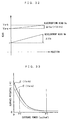
- Laser light L irradiated toward the photosensitive member 21 from the exposure unit 3 has a light intensity distribution of a Gaussian type as that shown in Fig. 20, for example.
- a design spot diameter is set which is needed to attain a design resolution.
- An apparatus is designed such that a spot diameter approximately at 50 % of a maximum light intensity matches a design resolution.
- an effective exposure spot diameter corresponding to 1/e 2 which is effective as an exposure power is larger than the design spot diameter.
- a line interval between adjacent one-dot lines DL is narrow, a toner adheres between the lines.
- the line interval n between the adjacent one-dot lines DL (Fig. 19A) is one line, adjacent effective exposure spots partially overlap with each other, a surface potential at the overlap position changes, and a toner adheres. Because of this, it is necessary that a line interval between adjacent one-dot lines DL is at least two lines or more.
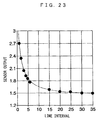
- a sensitivity of the patch sensor PS to detect an image density is closely related with the number of one-dot lines DL which are contained in a detect area of the patch sensor PS.
- a density change of each one-dot line DL is X and the number of lines covered by the detect area is m
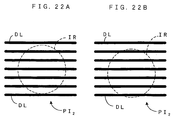
- images to be detected are patch images in which one-dot lines are arranged parallel to each other but apart from each other at predetermined intervals, due to positional differences between the detect area of the patch sensor PS and the patch images relative to each other, the number of one-dot lines contained in the detect area differs maximum one line.
- the detect area IR of the patch sensor PS and the patch image PI2 are positioned relative to each other as shown in Fig. 22A, for example, the number of one-dot lines DL contained in the detect area IR is five, whereas the relative positions are as shown in Fig. 22B, the number of the lines is six.
- the patch sensor PS reads the same patch image PI2
- m denotes the number of the lines contained in the detect area IR.
- the patch images PI2 are images which are obtained by arranging a plurality of one-dot lines DL parallel to each other but apart from each other at the predetermined intervals n in the preferred embodiment above, as shown in Fig. 24, for instance, perpendicular lattice images PI2' may be used which are obtained by arranging a plurality of one-dot lines DL in the configuration of a lattice.
- the detect area IR of the patch sensor PS covers more lines, and hence, the detect sensitivity is better and a larger improvement is made to the accuracy as compared to where the patch images PI2 are formed by one-dot lines which are arranged parallel to each other (See Fig. 16).
- a lattice structure of patch images is not limited to a perpendicular lattice, but may be various types of lattices in which case as well a similar effect is obtained.
- an exposed area potential (bright part potential) Von of a latent image sometimes largely changes as the electrifying bias changes.
- Fig. 25 is a graph showing attenuation of a surface potential as a photosensitive member is exposed at various exposure powers, in which curves C(Va-1), C(Va-2), C(Va-3) and C(Va-4) express attenuation of a surface potential caused by electrification at electrifying biases Va-1 through Va-4 which are different from each other.
- "EXPOSURE POWER” denotes a dose of exposure applied upon a photosensitive member 21 per unit area from the exposure unit 3.
- a surface potential in a surface area of the exposed photosensitive member 21, namely, the exposed area potential changes in accordance with the electrifying bias and the exposure power supplied to the exposed photosensitive member 21 from the exposure unit 3.
- the exposed area potential is approximately the same between the attenuation curves regardless of a value of the electrifying bias when the exposure power is relatively large.
- the exposed area potential is different in accordance with the electrifying bias when the exposure power is relatively small. Such a tendency is as already described with reference to Figs. 15A, 15B, 16A and 16B.
- the electrifying bias is changed in accordance with a change in the development bias during the development bias calculation processing, to thereby solve the problem above which occurs when the exposure power is relatively small.
- the electrifying bias is fixed at a bias Va-2 and latent images of first patch images are formed by exposing light at an exposure power P1
- the exposed area potential of the latent images become a potential Von1.
- a contrast potential Vcon1 changes in accordance with the change in the development bias Vb, thereby changing densities of the first patch images.
- the electrifying bias is set to various levels while fixing the development bias to the optimal development bias Vb, and latent images of second patch images are formed by exposing light at an exposure power P2.
- the exposed area potential of the latent images becomes largely different between the different electrifying bias levels.
- second patch images are halftone images as those shown in Fig. 16A.
- an effective exposure power for exposure with an isolated beam is smaller than the exposure power P1.
- the lowest potential level of a comb-shaped well potential is not as low as the lowest potential level that is observed during solid exposure.
- the exposed area potential of these latent images becomes largely different depending on the electrifying bias. For instance, the exposed area potential becomes a potential Von2-2 to generate the contrast potential Vcon2-2 when the electrifying bias has the level Va-2, whereas when the electrifying bias has the level Va-3, the exposed area potential becomes a potential Von2-3 to generate the contrast potential Vcon2-3.
- the contrast potential Vcon2 changes as the electrifying bias Va changes, and a density of the second patch image accordingly changes.
- the electrifying bias calculation according to the preferred embodiment described above requires to form a plurality of second patch images while changing only the electrifying bias Va in order to determine an optimal electrifying bias.
- the optimal electrifying bias resulting from such electrifying bias calculation processing is different from the electrifying bias set during the development bias calculation (i.e., the electrifying bias Va-2 in Fig. 26), the contrast potential Vcon1 determined through the development bias calculation is changed.
- an image density may deviate from a target density. The possibility of this is high particularly when the exposure power drops.
- Fig. 28 shows a relationship between the development bias Vb and the contrast potential that is identified based on the optimal attenuation curves C(Va-a) and C(Va-b).
- the horizontal axis denotes the development bias Vb while the vertical axis denotes the contrast potential.
- straight lines L(P1, Va-a), L(P1, Va-b), L(P2, Va-a) and L(P2, Va-b) respectively denote contrast potentials Vcon1-a, Vcon1-b, Vcon2-a and Vcon2-b which are shown in Fig. 29.
- a target contrast potential Vcon01 corresponds to the target density during the development bias calculation processing and a target contrast potential Vcon02 corresponds to the target density during the electrifying bias calculation processing.
- the development bias Vb is varied in its programmable range while at the same time changing the electrifying bias from the level Va-a to the level Va-b.
- the electrifying biases Va-a and Va-b are set so that the two target contrast potentials Vcon01 and Vcon02 are simultaneously satisfied with approximately the same development bias Vb0, the optimal development bias Vb and the optimal electrifying bias Va are set at a high accuracy.
- Fig. 31 is a drawing showing a first variation of the development bias and the electrifying bias during the development bias calculation processing.
- Fig. 37 is a drawing showing a second variation of the development bias and the electrifying bias during the development bias calculation processing.
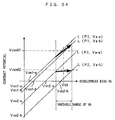
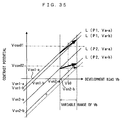
- Such setup is suitable to a situation where, as shown in Fig. 33, the exposure power P1 during the development bias calculation processing is relatively high thereby accompanying a small change in the exposed area potential Von1 with a change in the electrifying bias, whereas the exposure power P2 during the electrifying bias calculation processing is relatively low thereby accompanying a large change in the potential Von2 with a change in the electrifying bias. The reason of this will now be described with reference to Figs. 33 through 35.
- the straight line L(P2, Va-a) and the straight line L(P2, Va-b) shown in Fig. 34 are apart relatively far from each other. Because of this, even when the electrifying bias is changed from the level Va-a to the level Va-b, the contrast potential Vcon2 shows only a small change, thereby making it impossible sometimes to calculate appropriate values which are necessary to obtain the target contrast potential Vcon02.
- the second variation requires to set an electrifying bias change ⁇ Va smaller than a quantity of change ⁇ Vb in the development bias Vb.
- the straight line L(P2, Va-b) shifts closer to the straight line L(P2, Va-a) as shown in Fig. 35, accompanying a large change in the contrast potential Vcon2.
- Fig. 36 is a drawing showing a third variation of the development bias and the electrifying bias during the development bias calculation processing.
- Such setup is suitable to a situation where, as shown in Fig. 37, the exposure power P1 during the development bias calculation processing is relatively high thereby accompanying a small change in the exposed area potential Von1 with a change in the electrifying bias, and the exposure power P2 during the electrifying bias calculation processing is also relatively high thereby accompanying a small change in the potential Von2 with a change in the electrifying bias. The reason of this will now be described with reference to Figs. 37 through 39.
- the third variation requires to set the electrifying bias change ⁇ Va larger than a quantity of change ⁇ Vb in the development bias Vb (Fig. 36).
- the straight line L(P2, Va-b) is far from the straight line L(P2, Va-a) as shown in Fig. 39, thereby expanding a range of an optimal solution. This ensures consistency between the target contrast potential Vcon01 of first patch images and the target contrast potential Vcon02 of second patch images.
- the electrifying bias in accordance with a change in the development bias such that a development bias Vb01 satisfying the target contrast potential Vcon01 and a development bias Vb02 satisfying the target contrast potential Vcon02 become approximately equal to each other, as described above.
- a development bias Vb01 satisfying the target contrast potential Vcon01 and a development bias Vb02 satisfying the target contrast potential Vcon02 become approximately equal to each other, as described above.
- the development biases Vb01 and Vb02 it is difficult in some cases to match the development biases Vb01 and Vb02 with a linear change in the electrifying bias.
- the development bias Vb02 when the electrifying bias is changed according to the first variation (Fig. 31), the development bias Vb02 sometimes becomes smaller than the development bias Vb01 as shown in Fig. 40 to thereby create a deviation ⁇ Vb0 to the development bias.
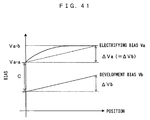
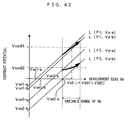
- the electrifying bias may be changed logarithmically as shown in Fig. 41, which moves the development bias Vb02 which satisfies the target contrast potential Vcon02 closer to the development bias Vb01 which satisfies the target contrast potential Vcon01 so that the two development biases Vb01 and Vb02 approximately match with each other (Fig. 42).
- the development bias Vb02 When the electrifying bias is changed according to the first variation (Fig. 31), the development bias Vb02 sometimes becomes larger than the development bias Vb01 as shown in Fig. 43, creating a deviation ⁇ Vb0 to the development bias.
- the electrifying bias may be changed exponentially as shown in Fig. 44, which moves the development bias Vb02 which satisfies the target contrast potential Vcon02 closer to the development bias Vb01 which satisfies the target contrast potential Vcon01 so that the two development biases Vb01 and Vb02 approximately match with each other (Fig. 45).
- the present invention is not limited to the preferred embodiment above, but can be modified in various manners other than those described above without departing from the essence of the present invention.
- an electrifying brush may be used.
- the present invention is also applicable to an image forming apparatus in which non-contact electrifying means electrifies the photosensitive member 21, instead of an image forming apparatus utilizing such contact electrification in which a conductive member, such as an electrifying roller and an electrifying brush, touches a surface of a photosensitive member 21 for electrification.
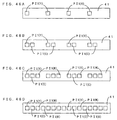
- the patch images PI1 are formed as clusters in each color as shown in Figs. 8A through 8D in the preferred embodiment described above, the patch images PI1 may be formed in each color in turn as shown in Fig. 46A through 46D. More specifically, first, yellow patch images PI1(Y) are formed on the intermediately transfer belt 41 at relatively wide intervals. Next, cyan patch images PI1(C) are formed one by one, starting at a position which is shifted by one patch image and a blank between the adjacent-patch images in the sub scanning direction (the right-hand side in Fig. 46A through 46D) as viewed from the yellow patch images PI1(Y).
- magenta patch images PI1(M) and black patch images PI1(K) are formed in a similar manner. Where the respective patch images are thus formed at relatively wide intervals, it is possible to ensure a stabilization time for switching of the biases, and hence, to form the respective patch images at the set biases without fail.
- first patch images the same directly applies to second patch images as well.
- the preferred embodiment above is related to an image forming apparatus which is capable of forming a color image using toners in four colors
- an application of the present invention is not limited to this.
- the present invention is naturally applicable to an image forming apparatus which forms only a monochrome image as well.
- the image forming apparatus according to the preferred embodiment above is a printer for forming an image supplied from an external apparatus such as a host computer through the interface 112 on a sheet such as a copying paper, a transfer paper, a form and a transparent sheet for an over-head projector
- the present invention is applicable to image forming apparatuses of the electrophotographic method in general such as a copier machine and a facsimile machine.
- toner images on the photosensitive member 21 are transferred onto the intermediate transfer belt 41, image densities of patch images formed by said toner images are detected, and an optimal development bias and an optimal electrifying bias are thereafter calculated based on the detected image densities.
- the present invention is also applicable to an image forming apparatus in which a toner image is transferred onto other transfer medium except for the intermediate transfer belt 41, to thereby form a patch image.
- the other transfer medium includes a transfer drum, a transfer belt, a transfer sheet, an intermediate transfer drum, an intermediate transfer sheet, a reflection-type recording sheet, a transmission memory sheet, etc.
- a patch sensor may be disposed so as to detect a density of a patch image which is formed on a photosensitive member.
- the patch sensor detects image densities of patch images on the photosensitive member and an optimal development bias and an optimal electrifying bias are calculated based on the detected image densities.
- the narrow range is defines as approximately 1/3 of the programmable range (Vb01 - Vb10) of development bias in the preferred embodiment above.
- the width of the narrow range is not limited to this, if the width of the narrow range is wide, the use of the narrow range becomes less meaningful and degrades the accuracy of calculation of an optimal development bias. For this reason, it is necessary to set the narrow range as approximately 1/2 of or narrower than the programmable range for development bias. This also applies to the narrow range for electrifying biases as well.
- the number of bias values (the number of patch images) in the range is not limited to this but may be optional to the extent that more than one types of bias values are used.
- the number of bias values may be different between the wide range and the narrow range such that the number of patch images is different between the wide range and the narrow range.
- first patch images are each a solid image whose area ration is 100% in the preferred embodiment above, an image whose area ratio is approximately 80% or more may be used instead of using a solid image. Even when such an image is used as the first patch images, a similar effect to that promised when solid images are used is obtained.
- area ratio refers to a ratio of dots to the area of a patch image as a whole.
- the preferred embodiment above requires to change an electrifying bias which is supplied to the electrifying roller 22 as a density controlling factor to sequentially form patch images PI2, PI2', other density controlling factor may be used, i.e., patch images of more than one one-dot lines may be formed while changing a development bias, an exposure dose, etc.
- patch images of more than one one-dot lines may be formed while changing a development bias, an exposure dose, etc.
- the electrifying bias calculation (step S5) is further executed, in order to calculate an optimal development bias and an optimal electrifying bias.
- the manner in which an optimal development bias and an optimal electrifying bias are calculated is not limited to this.
- a plurality of patch images may be formed while changing the development bias and the electrifying bias at the same time, so that an optimal development bias and an optimal electrifying bias are calculated based on image densities of the patch images and density adjustment is executed.
- memory means such as a RAM and a ROM stores the development bias and the electrifying bias for every density adjustment and the memory means reads out the most recent development bias and the most recent electrifying bias in preparation for the next density adjustment.
- the plurality of patch images are formed while changing the development bias and the electrifying bias at the same time based on the most recent development bias and the most recent electrifying bias.
- the second processing mode is selectively executed estimating that a change in a state of the engine part E is small when the criterion (2), (3) or (5) described earlier is met in the preferred embodiment above, it is possible that the change in the engine state is larger than expected and an optimal development bias can not be determined in the second processing mode.
- the sequence proceeds to the step S312 to further execute the first processing mode. In this manner, even when there is a large change in a state of the engine part E (image forming means), it is possible to flexibly deal with the situation and accurately determine an optimal development bias.
Landscapes
- Physics & Mathematics (AREA)
- General Physics & Mathematics (AREA)
- Engineering & Computer Science (AREA)
- Microelectronics & Electronic Packaging (AREA)
- Control Or Security For Electrophotography (AREA)
- Developing For Electrophotography (AREA)
- Display Devices Of Pinball Game Machines (AREA)
- Steering Control In Accordance With Driving Conditions (AREA)
- Transition And Organic Metals Composition Catalysts For Addition Polymerization (AREA)
- Dry Development In Electrophotography (AREA)
Applications Claiming Priority (10)
| Application Number | Priority Date | Filing Date | Title |
|---|---|---|---|
| JP21365399 | 1999-07-28 | ||
| JP21365499 | 1999-07-28 | ||
| JP21365399 | 1999-07-28 | ||
| JP21365599A JP3199062B2 (ja) | 1999-07-28 | 1999-07-28 | 画像形成装置および画像形成方法 |
| JP21365599 | 1999-07-28 | ||
| JP21365499A JP3250549B2 (ja) | 1999-07-28 | 1999-07-28 | 画像形成装置および画像形成方法 |
| JP25225999 | 1999-09-06 | ||
| JP25225999A JP3186747B2 (ja) | 1999-09-06 | 1999-09-06 | 画像形成装置および画像形成方法 |
| JP2000167282A JP3843701B2 (ja) | 1999-07-28 | 2000-06-05 | 画像形成装置および画像形成方法 |
| JP2000167282 | 2000-06-05 |
Publications (3)
| Publication Number | Publication Date |
|---|---|
| EP1074891A2 true EP1074891A2 (de) | 2001-02-07 |
| EP1074891A3 EP1074891A3 (de) | 2002-04-17 |
| EP1074891B1 EP1074891B1 (de) | 2004-12-01 |
Family
ID=27529558
Family Applications (1)
| Application Number | Title | Priority Date | Filing Date |
|---|---|---|---|
| EP00306129A Expired - Lifetime EP1074891B1 (de) | 1999-07-28 | 2000-07-19 | Bilderzeugungsgerät und Verfahren |
Country Status (4)
| Country | Link |
|---|---|
| US (2) | US6341203B1 (de) |
| EP (1) | EP1074891B1 (de) |
| AT (1) | ATE284050T1 (de) |
| DE (1) | DE60016328T2 (de) |
Cited By (1)
| Publication number | Priority date | Publication date | Assignee | Title |
|---|---|---|---|---|
| US7269362B2 (en) | 2003-05-29 | 2007-09-11 | Seiko Epson Corporation | Image forming apparatus, control method and toner consumption calculating apparatus and method |
Families Citing this family (17)
| Publication number | Priority date | Publication date | Assignee | Title |
|---|---|---|---|---|
| EP1229398A3 (de) | 2001-01-12 | 2002-10-16 | Seiko Epson Corporation | Verfahren und Vorrichtung zur Steuerung der Bilddichte eines Tonerbildes |
| US7072597B2 (en) * | 2002-02-20 | 2006-07-04 | Seiko Epson Corporation | Image forming apparatus and image method for forming toner images with optimized patch image density |
| JP4110003B2 (ja) * | 2003-01-31 | 2008-07-02 | キヤノン株式会社 | 画像形成装置 |
| JP2004271834A (ja) * | 2003-03-07 | 2004-09-30 | Canon Inc | 画像形成装置 |
| US7680425B2 (en) * | 2003-07-18 | 2010-03-16 | Seiko Epson Corporation | Image forming apparatus and method for controlling tone characteristics based on tone-control patch image |
| JP4642426B2 (ja) * | 2003-12-09 | 2011-03-02 | キヤノン株式会社 | 画像形成装置 |
| US7623801B2 (en) * | 2005-03-31 | 2009-11-24 | Seiko Epson Corporation | Image forming apparatus and control method thereof |
| JP5247058B2 (ja) * | 2007-04-09 | 2013-07-24 | キヤノン株式会社 | 画像形成装置 |
| JP5093143B2 (ja) * | 2008-03-07 | 2012-12-05 | ブラザー工業株式会社 | 画像形成装置、現像装置の制御方法およびコンピュータプログラム |
| JP4974035B2 (ja) * | 2009-06-22 | 2012-07-11 | 株式会社沖データ | 画像形成装置 |
| JP4858583B2 (ja) * | 2009-07-25 | 2012-01-18 | コニカミノルタビジネステクノロジーズ株式会社 | カラー画像形成装置 |
| JP4947130B2 (ja) * | 2009-11-30 | 2012-06-06 | ブラザー工業株式会社 | 印刷装置 |
| US9046850B2 (en) | 2011-02-04 | 2015-06-02 | Ricoh Company, Ltd. | Image forming apparatus capable of reducing image density irregularity |
| JP2013113989A (ja) * | 2011-11-28 | 2013-06-10 | Brother Ind Ltd | 画像形成装置、および画像形成補正方法 |
| JP5716726B2 (ja) | 2012-11-27 | 2015-05-13 | コニカミノルタ株式会社 | 画像形成装置、画像形成装置の制御方法、および画像形成装置の制御プログラム |
| DE102015101851B4 (de) | 2015-02-10 | 2016-10-13 | Océ Printing Systems GmbH & Co. KG | Verfahren zur Einstellung der Druckqualität von Druckbildern bei einem elektrophoretischen Digitaldrucker |
| JP2017097031A (ja) * | 2015-11-19 | 2017-06-01 | 京セラドキュメントソリューションズ株式会社 | 画像形成装置 |
Family Cites Families (45)
| Publication number | Priority date | Publication date | Assignee | Title |
|---|---|---|---|---|
| JP2532073B2 (ja) | 1986-12-05 | 1996-09-11 | 株式会社リコー | 残留電位補正方法 |
| JP2746942B2 (ja) | 1988-09-30 | 1998-05-06 | 株式会社リコー | 画像形成装置 |
| JPH03260667A (ja) * | 1990-03-12 | 1991-11-20 | Minolta Camera Co Ltd | 画像形成装置 |
| JPH03279971A (ja) | 1990-03-28 | 1991-12-11 | Ricoh Co Ltd | 画像形成装置の画像制御方法 |
| JP3124540B2 (ja) | 1990-08-10 | 2001-01-15 | 株式会社リコー | 画像形成装置 |
| JPH0430182A (ja) * | 1990-05-28 | 1992-02-03 | Ricoh Co Ltd | 電子写真方式の画像形成装置 |
| JP3013441B2 (ja) * | 1990-11-30 | 2000-02-28 | ミノルタ株式会社 | デジタル画像形成装置 |
| JP3002292B2 (ja) | 1991-06-10 | 2000-01-24 | シャープ株式会社 | 画像調整装置 |
| JPH0540397A (ja) | 1991-08-06 | 1993-02-19 | Fuji Xerox Co Ltd | コロトロン用高圧電源出力の自動調整方法 |
| JPH0594073A (ja) | 1991-10-03 | 1993-04-16 | Ricoh Co Ltd | 複写画像濃度安定化方法および装置 |
| JPH05257352A (ja) | 1992-03-11 | 1993-10-08 | Sharp Corp | 電子写真装置 |
| JPH05333648A (ja) | 1992-06-01 | 1993-12-17 | Sharp Corp | プロセスコントロール方法 |
| JPH0643734A (ja) | 1992-07-27 | 1994-02-18 | Sharp Corp | 電子写真装置の画質安定化装置 |
| JP3031070B2 (ja) | 1992-07-29 | 2000-04-10 | 松下電器産業株式会社 | 画質制御装置 |
| JP2956366B2 (ja) | 1992-08-04 | 1999-10-04 | 松下電器産業株式会社 | 線幅測定装置 |
| US5351107A (en) * | 1992-09-24 | 1994-09-27 | Kabushiki Kaisha Toshiba | Image forming apparatus and method having image density correcting function |
| JP3179936B2 (ja) | 1993-05-28 | 2001-06-25 | 松下電器産業株式会社 | 画像濃度制御装置 |
| JPH0720670A (ja) | 1993-06-30 | 1995-01-24 | Canon Inc | 画像形成装置 |
| JP3098138B2 (ja) | 1993-07-06 | 2000-10-16 | キヤノン株式会社 | 画像形成装置 |
| US5416564A (en) * | 1994-02-04 | 1995-05-16 | Xerox Corporatin | Xerographic process control using developer to photoreceptor current sensing for grid voltage adjust |
| US5436705A (en) | 1994-04-18 | 1995-07-25 | Xerox Corporation | Adaptive process controller for electrophotographic printing |
| JPH07333922A (ja) | 1994-06-08 | 1995-12-22 | Konica Corp | 画像形成装置 |
| JP3514398B2 (ja) * | 1994-12-07 | 2004-03-31 | 株式会社リコー | 画像形成装置 |
| JP3236751B2 (ja) * | 1995-02-02 | 2001-12-10 | 株式会社日立製作所 | 画像形成装置 |
| EP0736815B1 (de) * | 1995-04-03 | 2001-10-31 | Sharp Kabushiki Kaisha | Bilderzeugungsgerät |
| JPH08292615A (ja) | 1995-04-20 | 1996-11-05 | Fujitsu Ltd | 画像形成装置 |
| US6002903A (en) * | 1995-05-15 | 1999-12-14 | Canon Kabushiki Kaisha | Toner for developing electrostatic image, apparatus unit and image forming method |
| JPH0950155A (ja) | 1995-08-10 | 1997-02-18 | Konica Corp | 画像形成装置 |
| JP3498276B2 (ja) | 1995-11-28 | 2004-02-16 | コニカミノルタホールディングス株式会社 | 画像制御方法 |
| JPH09233235A (ja) | 1996-02-21 | 1997-09-05 | Fuji Xerox Co Ltd | 画像評価方法及びこれを用いた画像形成装置 |
| US5933680A (en) * | 1996-02-29 | 1999-08-03 | Canon Kabushiki Kaisha | Image processing apparatus and method for optimizing an image formation condition |
| JP3460432B2 (ja) | 1996-03-13 | 2003-10-27 | ミノルタ株式会社 | 画像形成装置 |
| JPH1055081A (ja) | 1996-08-08 | 1998-02-24 | Fuji Xerox Co Ltd | 画像形成装置 |
| JPH10142857A (ja) | 1996-11-08 | 1998-05-29 | Ricoh Co Ltd | 画像形成装置 |
| JPH10228142A (ja) | 1997-02-18 | 1998-08-25 | Sharp Corp | 画像形成装置及び方法 |
| JP3584142B2 (ja) | 1997-02-28 | 2004-11-04 | キヤノン株式会社 | 画像形成装置 |
| JP3991420B2 (ja) | 1997-03-27 | 2007-10-17 | 富士ゼロックス株式会社 | 画像形成装置およびその制御方法 |
| KR100223008B1 (ko) * | 1997-05-13 | 1999-10-01 | 윤종용 | 전자사진 장치의 농도제어 방법 및 장치 |
| JP3503732B2 (ja) | 1997-06-27 | 2004-03-08 | 富士ゼロックス株式会社 | 画像形成装置 |
| JP3674250B2 (ja) | 1997-07-14 | 2005-07-20 | コニカミノルタホールディングス株式会社 | 画像補正方法 |
| US6044234A (en) * | 1997-09-11 | 2000-03-28 | Canon Kabushiki Kaisha | Image processing apparatus and method for controlling a detection timing of a density sensor |
| JP3279971B2 (ja) | 1997-10-13 | 2002-04-30 | 昭和炭酸株式会社 | ドライアイスの製造装置 |
| JP3715758B2 (ja) | 1997-10-13 | 2005-11-16 | キヤノン株式会社 | 画像形成装置 |
| JPH11133682A (ja) | 1997-11-04 | 1999-05-21 | Matsushita Electric Ind Co Ltd | 電子写真複写装置 |
| JPH11258872A (ja) | 1998-03-11 | 1999-09-24 | Sharp Corp | 電子写真装置 |
-
2000
- 2000-07-19 AT AT00306129T patent/ATE284050T1/de not_active IP Right Cessation
- 2000-07-19 EP EP00306129A patent/EP1074891B1/de not_active Expired - Lifetime
- 2000-07-19 DE DE60016328T patent/DE60016328T2/de not_active Expired - Lifetime
- 2000-07-24 US US09/624,487 patent/US6341203B1/en not_active Expired - Fee Related
-
2001
- 2001-11-09 US US09/986,600 patent/US6415114B1/en not_active Expired - Fee Related
Cited By (1)
| Publication number | Priority date | Publication date | Assignee | Title |
|---|---|---|---|---|
| US7269362B2 (en) | 2003-05-29 | 2007-09-11 | Seiko Epson Corporation | Image forming apparatus, control method and toner consumption calculating apparatus and method |
Also Published As
| Publication number | Publication date |
|---|---|
| EP1074891A3 (de) | 2002-04-17 |
| DE60016328T2 (de) | 2005-12-01 |
| DE60016328D1 (de) | 2005-01-05 |
| US6415114B1 (en) | 2002-07-02 |
| US20020028085A1 (en) | 2002-03-07 |
| ATE284050T1 (de) | 2004-12-15 |
| EP1074891B1 (de) | 2004-12-01 |
| US6341203B1 (en) | 2002-01-22 |
Similar Documents
| Publication | Publication Date | Title |
|---|---|---|
| EP1074891B1 (de) | Bilderzeugungsgerät und Verfahren | |
| EP1074894B1 (de) | Bilderzeugungsgerät und Verfahren | |
| EP1074892B1 (de) | Bilderzeugungsgerät und Verfahren | |
| JP2008216776A (ja) | 画像形成装置、制御装置およびプログラム | |
| JP3186747B2 (ja) | 画像形成装置および画像形成方法 | |
| JP3250549B2 (ja) | 画像形成装置および画像形成方法 | |
| JP3674614B2 (ja) | 画像形成装置および画像形成方法 | |
| JP3843701B2 (ja) | 画像形成装置および画像形成方法 | |
| JP3446750B2 (ja) | 画像形成装置および画像形成方法 | |
| JP3729023B2 (ja) | 画像形成装置および画像形成方法 | |
| JP2002236405A (ja) | 画像形成装置および画像形成方法 | |
| JP2005326890A (ja) | 画像形成装置および画像形成方法 | |
| JP3767328B2 (ja) | 画像形成装置および画像形成方法 | |
| JP4453766B2 (ja) | 画像形成装置および画像形成方法 | |
| JP4165075B2 (ja) | 画像形成装置および画像形成方法 | |
| JP2002091100A (ja) | 画像形成装置および画像形成方法 | |
| JP3446727B2 (ja) | 画像形成装置および画像形成方法 | |
| JP4832150B2 (ja) | 画像補正方法及び画像形成装置 | |
| JP2003177637A (ja) | 画像形成装置および画像形成方法 | |
| JP3550650B2 (ja) | 画像形成方法および画像形成装置 | |
| JP2003015372A (ja) | 画像形成装置および画像形成方法 | |
| JP2003223023A (ja) | 画像形成装置および画像形成方法 | |
| JP3591706B2 (ja) | 画像形成方法および画像形成装置 | |
| JP2006047855A (ja) | 画像形成装置 | |
| JP2002214852A (ja) | 画像形成装置および画像形成方法 |
Legal Events
| Date | Code | Title | Description |
|---|---|---|---|
| PUAI | Public reference made under article 153(3) epc to a published international application that has entered the european phase |
Free format text: ORIGINAL CODE: 0009012 |
|
| AK | Designated contracting states |
Kind code of ref document: A2 Designated state(s): AT BE CH CY DE DK ES FI FR GB GR IE IT LI LU MC NL PT SE |
|
| AX | Request for extension of the european patent |
Free format text: AL;LT;LV;MK;RO;SI |
|
| PUAL | Search report despatched |
Free format text: ORIGINAL CODE: 0009013 |
|
| AK | Designated contracting states |
Kind code of ref document: A3 Designated state(s): AT BE CH CY DE DK ES FI FR GB GR IE IT LI LU MC NL PT SE |
|
| AX | Request for extension of the european patent |
Free format text: AL;LT;LV;MK;RO;SI |
|
| 17P | Request for examination filed |
Effective date: 20020701 |
|
| AKX | Designation fees paid |
Free format text: AT BE CH CY DE DK ES FI FR GB GR IE IT LI LU MC NL PT SE |
|
| 17Q | First examination report despatched |
Effective date: 20031204 |
|
| GRAP | Despatch of communication of intention to grant a patent |
Free format text: ORIGINAL CODE: EPIDOSNIGR1 |
|
| GRAS | Grant fee paid |
Free format text: ORIGINAL CODE: EPIDOSNIGR3 |
|
| GRAA | (expected) grant |
Free format text: ORIGINAL CODE: 0009210 |
|
| AK | Designated contracting states |
Kind code of ref document: B1 Designated state(s): AT BE CH CY DE DK ES FI FR GB GR IE IT LI LU MC NL PT SE |
|
| PG25 | Lapsed in a contracting state [announced via postgrant information from national office to epo] |
Ref country code: BE Free format text: LAPSE BECAUSE OF FAILURE TO SUBMIT A TRANSLATION OF THE DESCRIPTION OR TO PAY THE FEE WITHIN THE PRESCRIBED TIME-LIMIT Effective date: 20041201 Ref country code: IT Free format text: LAPSE BECAUSE OF FAILURE TO SUBMIT A TRANSLATION OF THE DESCRIPTION OR TO PAY THE FEE WITHIN THE PRESCRIBED TIME-LIMIT;WARNING: LAPSES OF ITALIAN PATENTS WITH EFFECTIVE DATE BEFORE 2007 MAY HAVE OCCURRED AT ANY TIME BEFORE 2007. THE CORRECT EFFECTIVE DATE MAY BE DIFFERENT FROM THE ONE RECORDED. Effective date: 20041201 Ref country code: CH Free format text: LAPSE BECAUSE OF FAILURE TO SUBMIT A TRANSLATION OF THE DESCRIPTION OR TO PAY THE FEE WITHIN THE PRESCRIBED TIME-LIMIT Effective date: 20041201 Ref country code: AT Free format text: LAPSE BECAUSE OF FAILURE TO SUBMIT A TRANSLATION OF THE DESCRIPTION OR TO PAY THE FEE WITHIN THE PRESCRIBED TIME-LIMIT Effective date: 20041201 Ref country code: LI Free format text: LAPSE BECAUSE OF FAILURE TO SUBMIT A TRANSLATION OF THE DESCRIPTION OR TO PAY THE FEE WITHIN THE PRESCRIBED TIME-LIMIT Effective date: 20041201 Ref country code: NL Free format text: LAPSE BECAUSE OF FAILURE TO SUBMIT A TRANSLATION OF THE DESCRIPTION OR TO PAY THE FEE WITHIN THE PRESCRIBED TIME-LIMIT Effective date: 20041201 Ref country code: FI Free format text: LAPSE BECAUSE OF FAILURE TO SUBMIT A TRANSLATION OF THE DESCRIPTION OR TO PAY THE FEE WITHIN THE PRESCRIBED TIME-LIMIT Effective date: 20041201 |
|
| REG | Reference to a national code |
Ref country code: GB Ref legal event code: FG4D |
|
| REG | Reference to a national code |
Ref country code: CH Ref legal event code: EP |
|
| REG | Reference to a national code |
Ref country code: IE Ref legal event code: FG4D |
|
| REF | Corresponds to: |
Ref document number: 60016328 Country of ref document: DE Date of ref document: 20050105 Kind code of ref document: P |
|
| PG25 | Lapsed in a contracting state [announced via postgrant information from national office to epo] |
Ref country code: SE Free format text: LAPSE BECAUSE OF FAILURE TO SUBMIT A TRANSLATION OF THE DESCRIPTION OR TO PAY THE FEE WITHIN THE PRESCRIBED TIME-LIMIT Effective date: 20050301 Ref country code: DK Free format text: LAPSE BECAUSE OF FAILURE TO SUBMIT A TRANSLATION OF THE DESCRIPTION OR TO PAY THE FEE WITHIN THE PRESCRIBED TIME-LIMIT Effective date: 20050301 Ref country code: GR Free format text: LAPSE BECAUSE OF FAILURE TO SUBMIT A TRANSLATION OF THE DESCRIPTION OR TO PAY THE FEE WITHIN THE PRESCRIBED TIME-LIMIT Effective date: 20050301 |
|
| PG25 | Lapsed in a contracting state [announced via postgrant information from national office to epo] |
Ref country code: ES Free format text: LAPSE BECAUSE OF FAILURE TO SUBMIT A TRANSLATION OF THE DESCRIPTION OR TO PAY THE FEE WITHIN THE PRESCRIBED TIME-LIMIT Effective date: 20050312 |
|
| NLV1 | Nl: lapsed or annulled due to failure to fulfill the requirements of art. 29p and 29m of the patents act | ||
| REG | Reference to a national code |
Ref country code: CH Ref legal event code: PL |
|
| PG25 | Lapsed in a contracting state [announced via postgrant information from national office to epo] |
Ref country code: IE Free format text: LAPSE BECAUSE OF NON-PAYMENT OF DUE FEES Effective date: 20050719 Ref country code: CY Free format text: LAPSE BECAUSE OF FAILURE TO SUBMIT A TRANSLATION OF THE DESCRIPTION OR TO PAY THE FEE WITHIN THE PRESCRIBED TIME-LIMIT Effective date: 20050719 Ref country code: LU Free format text: LAPSE BECAUSE OF NON-PAYMENT OF DUE FEES Effective date: 20050719 |
|
| PG25 | Lapsed in a contracting state [announced via postgrant information from national office to epo] |
Ref country code: MC Free format text: LAPSE BECAUSE OF NON-PAYMENT OF DUE FEES Effective date: 20050731 |
|
| ET | Fr: translation filed | ||
| PLBE | No opposition filed within time limit |
Free format text: ORIGINAL CODE: 0009261 |
|
| STAA | Information on the status of an ep patent application or granted ep patent |
Free format text: STATUS: NO OPPOSITION FILED WITHIN TIME LIMIT |
|
| 26N | No opposition filed |
Effective date: 20050902 |
|
| REG | Reference to a national code |
Ref country code: IE Ref legal event code: MM4A |
|
| PG25 | Lapsed in a contracting state [announced via postgrant information from national office to epo] |
Ref country code: PT Free format text: LAPSE BECAUSE OF NON-PAYMENT OF DUE FEES Effective date: 20050501 |
|
| PGFP | Annual fee paid to national office [announced via postgrant information from national office to epo] |
Ref country code: DE Payment date: 20100714 Year of fee payment: 11 Ref country code: FR Payment date: 20100805 Year of fee payment: 11 |
|
| PGFP | Annual fee paid to national office [announced via postgrant information from national office to epo] |
Ref country code: GB Payment date: 20100714 Year of fee payment: 11 |
|
| GBPC | Gb: european patent ceased through non-payment of renewal fee |
Effective date: 20110719 |
|
| REG | Reference to a national code |
Ref country code: FR Ref legal event code: ST Effective date: 20120330 |
|
| PG25 | Lapsed in a contracting state [announced via postgrant information from national office to epo] |
Ref country code: FR Free format text: LAPSE BECAUSE OF NON-PAYMENT OF DUE FEES Effective date: 20110801 Ref country code: DE Free format text: LAPSE BECAUSE OF NON-PAYMENT OF DUE FEES Effective date: 20120201 |
|
| REG | Reference to a national code |
Ref country code: DE Ref legal event code: R119 Ref document number: 60016328 Country of ref document: DE Effective date: 20120201 |
|
| PG25 | Lapsed in a contracting state [announced via postgrant information from national office to epo] |
Ref country code: GB Free format text: LAPSE BECAUSE OF NON-PAYMENT OF DUE FEES Effective date: 20110719 |