EP1075916A2 - Verfahren und Strangpressmundstück zum Herstellen von keramischen Rohren mit geschlossenem Ende - Google Patents
Verfahren und Strangpressmundstück zum Herstellen von keramischen Rohren mit geschlossenem Ende Download PDFInfo
- Publication number
- EP1075916A2 EP1075916A2 EP00117116A EP00117116A EP1075916A2 EP 1075916 A2 EP1075916 A2 EP 1075916A2 EP 00117116 A EP00117116 A EP 00117116A EP 00117116 A EP00117116 A EP 00117116A EP 1075916 A2 EP1075916 A2 EP 1075916A2
- Authority
- EP
- European Patent Office
- Prior art keywords
- end cap
- ceramic material
- tube
- cap forming
- reservoir
- Prior art date
- Legal status (The legal status is an assumption and is not a legal conclusion. Google has not performed a legal analysis and makes no representation as to the accuracy of the status listed.)
- Withdrawn
Links
Images
Classifications
-
- B—PERFORMING OPERATIONS; TRANSPORTING
- B28—WORKING CEMENT, CLAY, OR STONE
- B28B—SHAPING CLAY OR OTHER CERAMIC COMPOSITIONS; SHAPING SLAG; SHAPING MIXTURES CONTAINING CEMENTITIOUS MATERIAL, e.g. PLASTER
- B28B21/00—Methods or machines specially adapted for the production of tubular articles
- B28B21/02—Methods or machines specially adapted for the production of tubular articles by casting into moulds
- B28B21/08—Methods or machines specially adapted for the production of tubular articles by casting into moulds by slip-casting; Moulds therefor
-
- B—PERFORMING OPERATIONS; TRANSPORTING
- B28—WORKING CEMENT, CLAY, OR STONE
- B28B—SHAPING CLAY OR OTHER CERAMIC COMPOSITIONS; SHAPING SLAG; SHAPING MIXTURES CONTAINING CEMENTITIOUS MATERIAL, e.g. PLASTER
- B28B3/00—Producing shaped articles from the material by using presses; Presses specially adapted therefor
- B28B3/20—Producing shaped articles from the material by using presses; Presses specially adapted therefor wherein the material is extruded
- B28B3/26—Extrusion dies
- B28B3/2627—Extrusion dies using means for making hollow objects with transverse walls, e.g. hollow objects closed on all sides
Definitions
- the present invention relates to a process and die for forming an end cap in a ceramic tube in which the ceramic tube is extruded into an end cap forming cavity defined in the die. More particularly, the present invention relates to such a process and die in which ceramic material is backfilled into the end cap forming cavity to compact the ceramic material so that the ceramic material within the end cap has a substantially uniform density.
- closed-end tubes Due to the high failure rate of such open-ended tubes, the industry has sought to develop closed-end tubes. However, this has not been a simple task because for closed-end tubes to be of commercial value, it is important that the operational and performance characteristics remain the same throughout the length of the tube including the tube end. Such tube ends must, therefore, have a uniform thickness density and strength, in relation to the tube lengths.
- Ceramic tubes may be made by molding, casting, extrusion, as well as other methods known to those of skilled in the art. Commercial ceramic tubes are typically made by extrusion to provide tubes that have uniform thickness, density and strength throughout the tube length.
- the ceramic material usually comprises a ceramic oxide powder in a binder.
- the ceramic oxide powder/binder system is typically made into a formable paste, extruded through a die to form a tube in a "green" state, thermally treated to partially remove the binder to leave a bisque fired body, followed by sintering and densification by high temperature heat treatment. If the tubes are to be closed at one end, tube closure or capping is done prior to preparation of the bisque fired body.
- tube closure methods of the prior art have proven unsatisfactory for ceramic tubes.
- tube closure has been accomplished by plugging or capping.
- Plugging requires preparation of the plug in a separate operation from formation of the tube. Due to the fragility of the green body, plugging is typically done manually by moistening the plug, inserting it into an open end and molding the pieces together. Closure of tubes by plugging results in the production of tube ends having varying density and strength. Also due to the necessity to carefully control the jointing, tube closure by plugging does not represent a commercially viable means of production.
- extrusion of a tube requires that material be forced through a extrusion die that has an annulus at the center of which is a mandrel.
- the difference in diameters of the annulus and mandrel governs the tube wall thickness.
- the mandrel is located centrally in the annulus typically by an array of suspension lets, oriented in a circular pattern at regular intervals such as at a 90-degree spacing, commonly referred to as a "spider".
- the material is split into four sections as it passes over the mandrel and "spider”, and then is reunited as it passes beyond the annulus.
- Caps formed by this method typically exhibit “ghost” fissures from the 4-way division of material over the extrusion mandrel. The reason for this is the division of material produced discontinuities within the density of the ceramic material forming the end cap. Sintering of such caps do not appear to heal or the green body defects result in failure of the formed tubes at the end cap region.
- the present invention provides a method of capping an extruded tube by formation of an end cap having a uniform density to in turn provide a uniform strength through the tube length and end cap.
- the present invention provides a process for forming an end cap in an end of a ceramic tube.
- an end cap forming die is positioned against a extrusion die.
- the end cap forming die has an end cap forming cavity, a backfill reservoir, and a passageway communicating between the backfill reservoir and the end cap forming cavity.
- the ceramic tube is extruded so that ceramic material forming the end of the ceramic tube is forced into the end cap forming cavity, through the passageway, and into the backfill reservoir.
- the ceramic material is then forced from the backfill reservoir back through the passageway and into the end cap forming cavity to compact the ceramic material within the end cap forming cavity so that the ceramic material forming the end cap has a substantially uniform density.
- a portion of the ceramic material and air can preferably be discharged from the backfill reservoir prior to the ceramic material being forced back to the end cap forming cavity.
- the extruding of the tube can be suspended prior to the ceramic material being forced from the backfill reservoir.
- the back fill reservoir is elongated and is provided with ports for discharging the portion of the ceramic material and the air.
- the ceramic material is forced back into the end cap forming cavity by an elongated plunger projecting into the back fill reservoir.
- the elongated plunger covers the ports during the forcing of the ceramic material and is retracted so that the ports are uncovered during discharge of the portion of the ceramic material from the backfill reservoir.
- the present invention provides an end cap forming die for forming an end cap in an end of a ceramic tube.
- the die is provided with a body configured to be situated against a extrusion die.
- the body has an end cap forming cavity to form the end cap, a backfill reservoir to receive ceramic material forming the ceramic tube from the end cap forming cavity, and a passageway communicating between the end cap forming cavity and the backfill reservoir.
- the end cap forming cavity is positioned so that when the body is situated against the extrusion die, ceramic material forming the end of the ceramic tube is able to be forced into the end cap forming cavity, through the passageway, and into the backfill reservoir.
- a plunger projects into the backfill reservoir to force the ceramic material from the backfill reservoir back through the passageway and into the end cap forming cavity to compact the ceramic material within the end cap forming cavity so that the ceramic material forming the end cap has a substantially uniform density.
- the back fill reservoir can be of elongated configuration and can be provided with ports for discharging the ceramic material and air.
- the plunger can also be elongated and configured to cover the ports when the ceramic material is forced back into the end cap forming cavity. The plunger retracts to uncover the ports when the ceramic material and air is discharged.
- the back fill reservoir, the passageway, and the end cap forming cavity are coaxial.
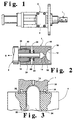
- End cap forming die 1 in accordance with the present invention is illustrated.
- End cap forming die 1 is connected to a hydraulic cylinder assembly 2 that is used to reciprocate a plunger in end cap forming die 1.
- end cap forming die is used in connection with an extrusion die (designated hereinafter by reference number 4).
- Hydraulic cylinder assembly 2 is moved in and out of a working position with respect to the extrusion die by a separate hydraulic cylinder assembly (not shown) that is connected to a mounting plate 3.
- end cap forming die is provided with a body 10 having an end cap forming cavity 12 of hemispherical shape to form the end cap.
- the tube during extrusion moves under the pressure of extrusion in a direction indicated by arrow head "A".
- ceramic material is thereby extruded or forced into end cap forming cavity 12 to assume the hemispherical shape thereof.
- Body 10 is also provided with a backfill reservoir 14 of cylindrical configuration and a passageway 16 communicating between backfill reservoir 14 and end cap forming cavity 12.
- a backfill reservoir 14 of cylindrical configuration and a passageway 16 communicating between backfill reservoir 14 and end cap forming cavity 12.
- the ceramic material is thereby also forced by the forward travel of the extrusion through passageway 16 and into backfill cavity 14.
- the ceramic material within backfill reservoir 14 is forced back through passageway 16 and into end cap forming cavity 12 to compact the ceramic material so that the ceramic material has a substantially uniform density.
- the substantially uniform density alleviates the type of defects that are caused by discontinuities within the extrusion produced by the spider support for the mandrel contained within the extrusion die.
- a plunger 18 in the form of an elongated cylinder projects into backfill reservoir 14 and is reciprocated by hydraulic cylinder assembly 2.
- Hydraulic cylinder assembly 2 is provided with a threaded fitting 20 that is threadably received within a threaded end bore 22 of body 10, thereby, to threadably connect body 10 to hydraulic cylinder assembly 2.
- a pair of nylon wipers 24 and 26 are preferably provided to prevent ceramic material from being drawn into hydraulic cylinder assembly 2 during reciprocation of plunger 18.
- end cap forming cavity 12, passageway 16, and backfill reservoir 14 are all coaxial to facilitate the action and connection of hydraulic cylinder assembly 2 to end cap forming die 1.
- end cap forming cavity 12, passageway 16, and backfill reservoir 14 are all coaxial to facilitate the action and connection of hydraulic cylinder assembly 2 to end cap forming die 1.
- other configurations are possible.
- ports 28 and 30 that communicate with the interior of backfill reservoir 14.
- plunger 18 is in a position that it would occupy after having forced ceramic material from backfill reservoir 14 into end cap forming, cavity 12.
- plunger 18 is retracted by moving in the direction indicated by arrowhead "A”.
- ports 28 and 30 are uncovered and ceramic material and air flows out of body 10.
- plunger 18 is reciprocated in a direction opposite to arrowhead "A" to also cover ports 28 and 30, thereby to prevent the escape of ceramic material from body 10.
- a potential alternative embodiment is to continue the extrusion during the backfill operation to further compact the material.
- ports 28 and 30 could be connected to a vacuum pump to remove the air within ceramic forming material located within backfill reservoir 14. In such case, provision could be made for discharging residual ceramic material within backfill reservoir 14.
- a still further embodiment, not preferred, would be to backfill the entire amount of ceramic material forced into backfill cavity 14 without any provision for the escape of ceramic material or air.
- end cap forming die 1 is illustrated in its operating position against an extrusion die 4 of known configuration.
- Extrusion die 4 has a central passageway 32 and a mandrel 34. During extrusion, ceramic material is forced between mandrel 34 and passageway 32 to assume a tubular shape.
- a locating rib 36 of annular configuration is provided in order to assure that end cap forming die 1 is positioned correctly with respect to extrusion die 4, a locating rib 36 of annular configuration is provided.
- Body portion 10 of extrusion die 1 is provided with an annular groove 38 that contacts the edge of rib 36 so as to be centered with respect to extrusion die 4.
- end cap forming die 1 is removed from extrusion die 4 and extrusion of the ceramic tube continues.
- mandrel 34 is provided with a poppet valve and an air passage to allow for the passage of air.
- passageway 16 can have a diameter from about 2/32 inches to 4/32 inches.
- the primary extrusion pressure assuming a formable ceramic piece with a moisture content from between about 10 and about 15 percent will be between about 1800 and about 2700 psi.
- plunger 18 will exert a pressure anywhere from between about 350 psi to about 850 psi with the actuation time of plunger 18 or the time in which ceramic material is forced from backfill reservoir 14 into end cap forming cavity 12 being from between about 1 and about 10 seconds.
- alternative parameters can be determined for larger tube sizes and for different ceramic materials.
Landscapes
- Engineering & Computer Science (AREA)
- Manufacturing & Machinery (AREA)
- Chemical & Material Sciences (AREA)
- Ceramic Engineering (AREA)
- Mechanical Engineering (AREA)
- Press-Shaping Or Shaping Using Conveyers (AREA)
- Moulds, Cores, Or Mandrels (AREA)
- Manufacturing Of Tubular Articles Or Embedded Moulded Articles (AREA)
Applications Claiming Priority (4)
| Application Number | Priority Date | Filing Date | Title |
|---|---|---|---|
| US597250 | 1984-04-05 | ||
| US14781899P | 1999-08-10 | 1999-08-10 | |
| US147818P | 1999-08-10 | ||
| US09/597,250 US6558597B1 (en) | 1999-08-10 | 2000-06-20 | Process for making closed-end ceramic tubes |
Publications (2)
| Publication Number | Publication Date |
|---|---|
| EP1075916A2 true EP1075916A2 (de) | 2001-02-14 |
| EP1075916A3 EP1075916A3 (de) | 2002-04-03 |
Family
ID=26845254
Family Applications (1)
| Application Number | Title | Priority Date | Filing Date |
|---|---|---|---|
| EP00117116A Withdrawn EP1075916A3 (de) | 1999-08-10 | 2000-08-09 | Verfahren und Strangpressmundstück zum Herstellen von keramischen Rohren mit geschlossenem Ende |
Country Status (9)
| Country | Link |
|---|---|
| US (1) | US6558597B1 (de) |
| EP (1) | EP1075916A3 (de) |
| JP (1) | JP2001079820A (de) |
| KR (1) | KR20010049894A (de) |
| CN (1) | CN1283541A (de) |
| AU (1) | AU5191200A (de) |
| BR (1) | BRPI0003465A8 (de) |
| CA (1) | CA2315860A1 (de) |
| MX (1) | MXPA00007748A (de) |
Cited By (6)
| Publication number | Priority date | Publication date | Assignee | Title |
|---|---|---|---|---|
| FR2929546A1 (fr) * | 2008-04-03 | 2009-10-09 | Air Liquide | Elaboration d'un support pour membrane ceramique a partir d'un tube extrude ceramique presentant un trou a travers sa paroi |
| WO2013079252A1 (de) * | 2011-11-30 | 2013-06-06 | Robert Bosch Gmbh | Herstellungsverfahren für eine tubulare brennstoffzelle mit zweischichtigem kappenbereich des trägerkörpers |
| WO2015130316A1 (en) * | 2014-02-28 | 2015-09-03 | General Electric Company | Method and system for manufacturing solid electrolyte tubes |
| WO2017152913A2 (de) | 2016-03-10 | 2017-09-14 | Fraunhofer-Gesellschaft zur Förderung der angewandten Forschung e.V. | Extrusionsverfahren und extrusionsvorrichtung zur herstellung eines mit einem boden verschlossenen keramikrohres |
| WO2019158164A1 (de) | 2018-02-19 | 2019-08-22 | Fraunhofer-Gesellschaft zur Förderung der angewandten Forschung e. V. | Zu belüftende extrusionsvorrichtung zur herstellung eines mit einem boden verschlossenen keramikrohres |
| EP4631615A1 (de) | 2023-12-15 | 2025-10-15 | Volkswagen Ag | Verfahren zur herstellung eines sorbentelements zur abtrennung von einem gas und/oder luftfeuchte aus einer fluiden phase |
Families Citing this family (6)
| Publication number | Priority date | Publication date | Assignee | Title |
|---|---|---|---|---|
| JP3945452B2 (ja) * | 2003-05-30 | 2007-07-18 | 株式会社デンソー | 排ガス浄化フィルタの製造方法 |
| KR100731594B1 (ko) * | 2005-12-09 | 2007-06-25 | 한국에너지기술연구원 | 일단 폐쇄형 세라믹 기체분리막 튜브용 몰드 및 이를이용한 기체분리막 튜브 제조방법 |
| CN102120341B (zh) * | 2010-12-30 | 2012-07-25 | 上海城建市政工程(集团)有限公司 | 用于大口径承插式钢筋砼管承口端的模具 |
| CN108081439B (zh) * | 2018-01-10 | 2019-12-13 | 李根芝 | 一种空心砖砖胚制备装置 |
| CN112827363B (zh) * | 2019-11-22 | 2023-04-18 | 中国科学院青岛生物能源与过程研究所 | 一种用于管状陶瓷透氧膜的高温密封方法 |
| CN113927700A (zh) * | 2021-12-03 | 2022-01-14 | 六安庆超建筑设计有限公司 | 一种装配式建筑的楼梯制造工艺 |
Family Cites Families (16)
| Publication number | Priority date | Publication date | Assignee | Title |
|---|---|---|---|---|
| US2599268A (en) * | 1948-01-31 | 1952-06-03 | Baumat A G | Method of producing hollow ceramic bodies |
| US2954588A (en) * | 1953-09-21 | 1960-10-04 | Owens Illinois Glass Co | Method of forming hollow plastic articles |
| US2944288A (en) * | 1957-01-28 | 1960-07-12 | Owens Illinois Glass Co | Combination plasticizer, extruder and injection cylinder with recirculation |
| US3670066A (en) * | 1969-11-10 | 1972-06-13 | Emery I Valyi | Method of compression molding a thermoplastic article with walls of variable thickness |
| DE2715852C3 (de) * | 1977-04-06 | 1980-03-13 | W. Haldenwanger Kg, 8264 Waldkraiburg | Verfahren und Vorrichtung zum Herstellen eines oxidkeramischen, mit einer Kuppe am Ende verschlossenen Rohres |
| US4364783A (en) * | 1981-09-08 | 1982-12-21 | Ford Motor Company | Ultrasonic end-capping of beta"-alumina tubes |
| US4540534A (en) * | 1983-10-11 | 1985-09-10 | American Optical Corporation | Apparatus and method for injection molding lenses |
| JPS6285906A (ja) * | 1985-10-09 | 1987-04-20 | 日本碍子株式会社 | 有底セラミツクパイプの成形方法及び成形装置 |
| JPS63312811A (ja) * | 1987-06-17 | 1988-12-21 | Ngk Insulators Ltd | セラミックチュ−ブの端面封じ方法 |
| JPH0631655B2 (ja) * | 1987-06-24 | 1994-04-27 | 日本碍子株式会社 | 一端を封じたセラミック2重構造チュ−ブ及びその製造法 |
| JPH01225506A (ja) * | 1988-03-04 | 1989-09-08 | Ngk Insulators Ltd | 袋筒管の製造方法及びそれに用いる芯金構造 |
| JPH03187710A (ja) * | 1989-12-18 | 1991-08-15 | Ngk Insulators Ltd | 袋筒管の製造方法及びその装置 |
| KR960007275B1 (ko) * | 1992-06-05 | 1996-05-30 | 폴리플라스틱스 가부시끼가이샤 | 사출성형방법. 사출성형용 주형 및 사출성형된 물건 |
| US5346659A (en) * | 1992-11-23 | 1994-09-13 | S. C. Johnson & Son, Inc. | Method for producing a weld-line free injection molded plastic container body portion |
| DE19531709A1 (de) * | 1995-08-30 | 1997-03-06 | Battenfeld Gmbh | Verfahren und Vorrichtung zum Herstellen von Kunststoffgegenständen |
| US5993985A (en) * | 1998-04-09 | 1999-11-30 | Siemens Westinghouse Power Corporation | Fuel cell tubes and method of making same |
-
2000
- 2000-06-20 US US09/597,250 patent/US6558597B1/en not_active Expired - Lifetime
- 2000-07-26 KR KR1020000043150A patent/KR20010049894A/ko not_active Withdrawn
- 2000-08-08 MX MXPA00007748A patent/MXPA00007748A/es unknown
- 2000-08-09 BR BRPI0003465A patent/BRPI0003465A8/pt unknown
- 2000-08-09 CN CN00122753A patent/CN1283541A/zh active Pending
- 2000-08-09 JP JP2000240899A patent/JP2001079820A/ja not_active Withdrawn
- 2000-08-09 AU AU51912/00A patent/AU5191200A/en not_active Abandoned
- 2000-08-09 CA CA002315860A patent/CA2315860A1/en not_active Abandoned
- 2000-08-09 EP EP00117116A patent/EP1075916A3/de not_active Withdrawn
Cited By (12)
| Publication number | Priority date | Publication date | Assignee | Title |
|---|---|---|---|---|
| FR2929546A1 (fr) * | 2008-04-03 | 2009-10-09 | Air Liquide | Elaboration d'un support pour membrane ceramique a partir d'un tube extrude ceramique presentant un trou a travers sa paroi |
| WO2009125146A1 (fr) * | 2008-04-03 | 2009-10-15 | L'air Liquide Societe Anonyme Pour L'etude Et L'exploitation Des Procedes Georges Claude | Elaboration d'un support pour membrane ceramique a partir d'un tube extrude ceramique presentant un trou a travers sa paroi |
| WO2013079252A1 (de) * | 2011-11-30 | 2013-06-06 | Robert Bosch Gmbh | Herstellungsverfahren für eine tubulare brennstoffzelle mit zweischichtigem kappenbereich des trägerkörpers |
| US9425466B2 (en) | 2011-11-30 | 2016-08-23 | Robert Bosch Gmbh | Production method for a tubular fuel cell having a two-layer cap region of the support body |
| WO2015130316A1 (en) * | 2014-02-28 | 2015-09-03 | General Electric Company | Method and system for manufacturing solid electrolyte tubes |
| WO2017152913A2 (de) | 2016-03-10 | 2017-09-14 | Fraunhofer-Gesellschaft zur Förderung der angewandten Forschung e.V. | Extrusionsverfahren und extrusionsvorrichtung zur herstellung eines mit einem boden verschlossenen keramikrohres |
| DE102016104387A1 (de) | 2016-03-10 | 2017-09-14 | Fraunhofer-Gesellschaft zur Förderung der angewandten Forschung e.V. | Extrusionsverfahren und Extrusionsvorrichtung zur Herstellung eines mit einem Boden verschlossenen Keramikrohres |
| DE102016104387B4 (de) * | 2016-03-10 | 2020-11-26 | Fraunhofer-Gesellschaft zur Förderung der angewandten Forschung e.V. | Extrusionsverfahren und Extrusionsvorrichtung zur Herstellung eines mit einem Boden verschlossenen Keramikrohres |
| WO2019158164A1 (de) | 2018-02-19 | 2019-08-22 | Fraunhofer-Gesellschaft zur Förderung der angewandten Forschung e. V. | Zu belüftende extrusionsvorrichtung zur herstellung eines mit einem boden verschlossenen keramikrohres |
| DE102018103594A1 (de) | 2018-02-19 | 2019-08-22 | Fraunhofer-Gesellschaft zur Förderung der angewandten Forschung e.V. | Zu belüftende Extrusionsvorrichtung zur Herstellung eines mit einem Boden verschlossenen Keramikrohres |
| DE102018103594B4 (de) | 2018-02-19 | 2019-10-24 | Fraunhofer-Gesellschaft zur Förderung der angewandten Forschung e.V. | Zu belüftende Extrusionsvorrichtung zur Herstellung eines mit einem Boden verschlossenen Keramikrohres |
| EP4631615A1 (de) | 2023-12-15 | 2025-10-15 | Volkswagen Ag | Verfahren zur herstellung eines sorbentelements zur abtrennung von einem gas und/oder luftfeuchte aus einer fluiden phase |
Also Published As
| Publication number | Publication date |
|---|---|
| EP1075916A3 (de) | 2002-04-03 |
| US6558597B1 (en) | 2003-05-06 |
| AU5191200A (en) | 2001-02-15 |
| CN1283541A (zh) | 2001-02-14 |
| MXPA00007748A (es) | 2002-04-24 |
| JP2001079820A (ja) | 2001-03-27 |
| BRPI0003465A8 (pt) | 2019-01-15 |
| KR20010049894A (ko) | 2001-06-15 |
| CA2315860A1 (en) | 2001-02-10 |
Similar Documents
| Publication | Publication Date | Title |
|---|---|---|
| US6558597B1 (en) | Process for making closed-end ceramic tubes | |
| US4097977A (en) | Method to attach the center electrode into a ceramic insulator body of spark plugs | |
| US5039296A (en) | Apparatus for producing pressings provided with channels from powdery moulding compound, especially ceramic molding compound(short title: honeycomb) | |
| DE69915422T2 (de) | Verfahren zur Herstellung von komplex geformten hohlen keramischen Körpern | |
| JPS6195903A (ja) | 微粒子材料から物体を平衡的に圧縮成形するための方法と装置 | |
| US3454997A (en) | Ceramic molding apparatus | |
| CA2531904A1 (en) | Apparatus, method and core for molding a ceramic discharge vessel and removing the core | |
| US4384840A (en) | Apparatus for molding tubular parts by isostatic compression | |
| US5236021A (en) | Powder filling apparatus | |
| FR2466269A1 (fr) | Support de barriere poreuse ceramique | |
| EP2570244A1 (de) | Maske zur abdichtung einer wabenstruktur sowie verfahren zur abdichtung einer wabenstruktur damit | |
| US6540852B1 (en) | Apparatus and method for manufacturing gaskets | |
| JPH0437762B2 (de) | ||
| US3608026A (en) | Method of manufacturing rods or tubes from powder | |
| JPH04351859A (ja) | 電解質保持器及びその製造方法 | |
| US3465075A (en) | Method for making a monolithic clay fitting | |
| US5178808A (en) | End seal manufacture for ceramic arc tubes | |
| JPS5939499A (ja) | 圧粉体の成形方法 | |
| EP0053140A1 (de) | Verfahren zur herstellung von röhren | |
| JPS5938080B2 (ja) | 底付筒体に収納した粉末固形リングの加圧装置 | |
| CN1369368A (zh) | 粉末压制工具 | |
| US4440706A (en) | Isostatic molding of two-terminal ceramic insulator | |
| US20040195735A1 (en) | Mandrel for forming inert anodes | |
| CN218314214U (zh) | 一种可快速脱模的陶瓷素坯压坯模具 | |
| Morris | Cold isostatic pressing |
Legal Events
| Date | Code | Title | Description |
|---|---|---|---|
| PUAI | Public reference made under article 153(3) epc to a published international application that has entered the european phase |
Free format text: ORIGINAL CODE: 0009012 |
|
| AK | Designated contracting states |
Kind code of ref document: A2 Designated state(s): AT BE CH CY DE DK ES FI FR GB GR IE IT LI LU MC NL PT SE |
|
| AX | Request for extension of the european patent |
Free format text: AL;LT;LV;MK;RO;SI |
|
| PUAL | Search report despatched |
Free format text: ORIGINAL CODE: 0009013 |
|
| AK | Designated contracting states |
Kind code of ref document: A3 Designated state(s): AT BE CH CY DE DK ES FI FR GB GR IE IT LI LU MC NL PT SE |
|
| AX | Request for extension of the european patent |
Free format text: AL;LT;LV;MK;RO;SI |
|
| STAA | Information on the status of an ep patent application or granted ep patent |
Free format text: STATUS: THE APPLICATION HAS BEEN WITHDRAWN |
|
| 17P | Request for examination filed |
Effective date: 20020422 |
|
| 18W | Application withdrawn |
Withdrawal date: 20020507 |