EP1076475A2 - Erwärmungsvorrichtung bestimmt für Kochen - Google Patents
Erwärmungsvorrichtung bestimmt für Kochen Download PDFInfo
- Publication number
- EP1076475A2 EP1076475A2 EP00306907A EP00306907A EP1076475A2 EP 1076475 A2 EP1076475 A2 EP 1076475A2 EP 00306907 A EP00306907 A EP 00306907A EP 00306907 A EP00306907 A EP 00306907A EP 1076475 A2 EP1076475 A2 EP 1076475A2
- Authority
- EP
- European Patent Office
- Prior art keywords
- temperature
- heating
- target food
- detection
- cooking
- Prior art date
- Legal status (The legal status is an assumption and is not a legal conclusion. Google has not performed a legal analysis and makes no representation as to the accuracy of the status listed.)
- Granted
Links
- 238000010438 heat treatment Methods 0.000 title claims abstract description 726
- 238000010411 cooking Methods 0.000 title claims abstract description 284
- 238000001514 detection method Methods 0.000 claims abstract description 442
- 235000013305 food Nutrition 0.000 claims abstract description 407
- 238000010257 thawing Methods 0.000 claims abstract description 130
- 238000000034 method Methods 0.000 claims description 46
- 230000008569 process Effects 0.000 claims description 28
- 230000001678 irradiating effect Effects 0.000 claims description 2
- 235000013611 frozen food Nutrition 0.000 description 18
- 238000010586 diagram Methods 0.000 description 12
- 230000003247 decreasing effect Effects 0.000 description 9
- 230000006870 function Effects 0.000 description 6
- 239000007788 liquid Substances 0.000 description 4
- 239000007787 solid Substances 0.000 description 3
- XLYOFNOQVPJJNP-UHFFFAOYSA-N water Substances O XLYOFNOQVPJJNP-UHFFFAOYSA-N 0.000 description 3
- 230000006978 adaptation Effects 0.000 description 2
- 230000008901 benefit Effects 0.000 description 2
- 230000006698 induction Effects 0.000 description 2
- 238000013021 overheating Methods 0.000 description 2
- 230000002093 peripheral effect Effects 0.000 description 2
- 230000005855 radiation Effects 0.000 description 2
- 238000010792 warming Methods 0.000 description 2
- 238000010521 absorption reaction Methods 0.000 description 1
- 238000004939 coking Methods 0.000 description 1
- 238000010276 construction Methods 0.000 description 1
- 238000007796 conventional method Methods 0.000 description 1
- 230000008014 freezing Effects 0.000 description 1
- 238000007710 freezing Methods 0.000 description 1
- 230000036039 immunity Effects 0.000 description 1
- 230000000977 initiatory effect Effects 0.000 description 1
- 230000007257 malfunction Effects 0.000 description 1
- 238000004519 manufacturing process Methods 0.000 description 1
- 238000012986 modification Methods 0.000 description 1
- 230000004048 modification Effects 0.000 description 1
- 239000004065 semiconductor Substances 0.000 description 1
- 230000035945 sensitivity Effects 0.000 description 1
- 229910052710 silicon Inorganic materials 0.000 description 1
- 239000010703 silicon Substances 0.000 description 1
- 230000007704 transition Effects 0.000 description 1
Images











Classifications
-
- F—MECHANICAL ENGINEERING; LIGHTING; HEATING; WEAPONS; BLASTING
- F24—HEATING; RANGES; VENTILATING
- F24C—DOMESTIC STOVES OR RANGES ; DETAILS OF DOMESTIC STOVES OR RANGES, OF GENERAL APPLICATION
- F24C7/00—Stoves or ranges heated by electric energy
-
- H—ELECTRICITY
- H05—ELECTRIC TECHNIQUES NOT OTHERWISE PROVIDED FOR
- H05B—ELECTRIC HEATING; ELECTRIC LIGHT SOURCES NOT OTHERWISE PROVIDED FOR; CIRCUIT ARRANGEMENTS FOR ELECTRIC LIGHT SOURCES, IN GENERAL
- H05B6/00—Heating by electric, magnetic or electromagnetic fields
- H05B6/64—Heating using microwaves
- H05B6/6447—Method of operation or details of the microwave heating apparatus related to the use of detectors or sensors
- H05B6/645—Method of operation or details of the microwave heating apparatus related to the use of detectors or sensors using temperature sensors
- H05B6/6455—Method of operation or details of the microwave heating apparatus related to the use of detectors or sensors using temperature sensors the sensors being infrared detectors
Definitions
- the present invention relates to a heating apparatus for cooking such as microwave ovens in which a frozen food (as a target food item to be cooked) placed on a turntable in a cavity as a heating chamber is thawed and heated by irradiating a microwave of a high frequency to the food item.
- a heating apparatus for cooking such as microwave ovens in which a frozen food (as a target food item to be cooked) placed on a turntable in a cavity as a heating chamber is thawed and heated by irradiating a microwave of a high frequency to the food item.
- the detection field of the IR sensor overlaps only with a boundary area (or the end part) of a target food to be detected, in other words, when a part in the detection field of the IR sensor overlaps with the boundary area of the food, the temperatures of both the target food and a background area in which there is no target food are averaged. In this case, it is impossible to obtain an accurate temperature of the food.
- the detection field of the IR sensor is set to narrow, the resolution of the IR sensor becomes high and the occurrence that the detection field of the IR sensor overlaps with the boundary area of the food can be small, but it is impossible to avoid any occurrence that the detection field of the IR sensor overlaps with the boundary area of the food completely.
- the detection field of the IR sensor is set to narrow, the detected temperature in the above case also has an inaccurate value.
- to narrow the detection field of the IR sensor greatly causes to decrease the sensitivity of the IR sensor and to decrease the function of noise immunity, so that the accuracy of the detection by the IR sensor becomes low.
- the number of IR elements forming the IR sensor is only one, it is impossible to set the detection field of the IR sensor into a narrow area because it is necessary to keep a widely detectable area in a heating chamber of the heating apparatus for cooking.
- the IR sensor comprises a plurality of the IR elements in order to detect a plurality of detection areas in the heating chamber in the heating apparatus for cooking, it is possible to set the detection field of each IR element to narrow, but, there still remains the drawback that it is impossible to detect the temperature of the boundary area (or the end part) of the target food accurately.
- the temperature of a localized area becomes increased by uneven cooking of the target food, uneven heating of the target food, and the like, the part of the target food becomes a half cooked state (namely, a half-boiled state) or a boiled state.
- This case often occurs at a boundary area of the target food.
- the conventional heating apparatus for cooking such as microwave ovens cannot solve this drawback because the conventional heating apparatus for cooking cannot detect accurately the increasing of the temperature of the boundary area of the target food, so that it cannot prevent to cause the half-cooking state or the uneven state of the target food.
- an object of the present invention is, with due consideration to the drawbacks of the conventional technique, to provide a heating apparatus for cooking such as microwave ovens that is capable of accurately detecting a temperature of a boundary area of (such as the end part of) a target food to be cooked placed on a turntable in a heating chamber (or a cavity). That is to say, an object of the present invention is to provide the heating apparatus for cooking that is capable of accurately detecting the temperature of the boundary area (such as the end part of the target food) of the target food even if one detection field of an IR sensor simultaneously covers both the boundary area of the target food and the background area where no target food is placed.
- an object of the present invention is to provide the heating apparatus for cooking that is capable of accurately calculating the temperature of the target food to be cooked by detecting the temperature of the background and the ratio between the target food and the background in a boundary detection field of the IR sensor.
- a heating apparatus for cooking comprises a heating chamber, heating means, infrared ray (IR) detection means. temperature calculation means, heating process control means, and detection target judgment means-
- a target food to be cooked is placed and then heated.
- the heating means irradiates a microwave on the target food.
- the infrared ray (IR) detection means having a plurality of detection elements for detecting a plurality of detection areas in the heating chamber by a non-contact manner-
- the temperature calculation means calculates temperatures of the plurality of detection areas based on the detection results obtained by the IR detection means.
- the heating process control means controls a heating process for the target food based on calculation results obtained by the temperature calculation means.
- the detection target judgment means judges a type of each detection area in the heating chamber corresponding to each of the plurality of detection elements based on a detected initial temperature distribution of the heating chamber. There. are following three types as the type of the detection areas a direct detection area where there is only a part or entire of the target food and the target food is directly detected; a boundary detection area where there are both a part or entire of the target food and a background simultaneously; and a background area where there is no target food.
- the heating process control means controls the heating process based on the detection results obtained by the detection target judgment means.
- the heating apparatus for cooking as another preferred embodiment of the present invention further comprises background temperature detection means for detecting a temperature of the background in the heating chamber during the cooking of the target food, and temperature calculation means for the target food for calculating a calculation temperature of the target food based on temperatures detected in the direct detection area where only the target food is directly detected and for calculating a calculation temperature of each part in the target food in the boundary detection field where both the part of the target food and the background are detected simultaneously.
- the detection target judgment means detects the initial temperature distribution of the heating chamber, and judges the type of the detection field detected by each detection element in the IR detection means.
- the type is selected in the three cases: The direct detection field where only the target food is detected; The boundary detection field where both the part of the target food and the background are detected simultaneously; and The background detection field where no target food is detected.
- the heating process control means then controls the heating process for the target food based on the result of the judgment transferred from the detection target judgment means.
- the background temperature detection means calculates the temperature of the background based on a detection result obtained by a self-temperature detection means for detecting a self-temperature incorporated in the IR detection means.
- the background temperature detection means calculates the temperature of the background based on a detection result of a temperature detection means for detecting an internal temperature of the heating chamber that is additionally incorporated in the heating chamber.
- the background temperature detection means sets one or more of the plurality of detection elements in the IR detection means as an element for detecting a temperature of an area other than a tray on which the target food is placed in the heating chamber, and calculates the temperature of the background based on the temperature obtained by the one or more of the plurality of detection elements.
- the background temperature detection means calculates the temperature of the background based on the maximum value in the temperature values detected at the most outer periphery of a tray, on which the target food is placed, in the detection ranges in the heating chamber detected by the plurality of detection elements.
- the background temperature detection means calculates the temperature of the background based on a detected internal temperature value of the heating chamber detected by the temperature detection means for detecting the internal temperature of the heating chamber when a door of the heating chamber is open.
- the temperature calculation means calculates an initial temperature distribution of the heating chamber and calculates an initial temperature of the target food based on a minimum temperature value in the initial temperature distribution in the heating chamber.
- the heating apparatus for cooking as another preferred embodiment of the present invention further comprises boundary detection area judgment means for judging the boundary detection area based on an intermediate value between the calculated temperature of the target food and the calculated temperature of the background according to the initial temperature distribution in the heating chamber calculated by the temperature calculation means.
- the heating apparatus for cooking as another preferred embodiment of the present invention further comprises detection rate judgment means for judging a ratio or a range of the target food in the boundary detection area, where both the target food and the background are detected simultaneously, based on the calculated temperature of the target food, the calculated temperature of the background, and the initial temperature distribution in the heating chamber calculated by the temperature calculation means.
- the detection rate judgment means performs the temperature detection and judgment operation plural times.
- the heating apparatus for cooking as another preferred embodiment of the present invention further comprises boundary target food temperature calculation means for compensating the calculated temperature value in a boundary detection area where both the target food and the background are detected simultaneously based on the judgment result of the detection rate judgment means, and for calculating the temperature of a part in the target food in the boundary detection area.
- the heating process control means judges a rank of the ratio or the range of the target food in the boundary detection area, where both the target food and the background are detected simultaneously, obtained by the detection rate judgment means, and wherein the rank is selected in a plurality of ranks that are classified and set in advance corresponding to different heating processes.
- the heating process control means prohibits to perform a natural (or normal) thawing process or outputs a warning when the internal temperature of the heating chamber is not less than a predetermined temperature value.
- the heating process control means provides a low heating power that is lower than a normal power of the natural thawing process when the internal temperature of the heating chamber is not less than a predetermined temperature value.
- the heating process control means controls so that the heating means forcedly heats the target food until a maximum value or a minimum value in the parts in the target food or a value obtained by multiplying the maximum value or the minimum value with a desired ratio is reached to a predetermined value at which the part of the target state is fallen into a boiled state, and then decrease the heating power.
- the heating process control means sets a temperature value or a desired temperature range, that is lower than a temperature value at which a boiled state of the target food occurs, during at least one cooking-time period in a thawing process, and controls so that the heating means heats the target food at a constant temperature so that a maximum value or a minimum value in the parts in the target food or a value obtained by multiplying the maximum value or the minimum value with a desired ratio is reached to a predetermined temperature value or within a predetermined temperature range.
- the heating process control means sets a plurality of temperature values or a plurality of temperature ranges, that are lower than a temperature value at which a boiled state of the target food occurs, during at least one cooking-time period in a thawing process, and controls so that the heating means heats the target food at a constant temperature during a desired time period so that a maximum value or a minimum value in the parts in the target food or a value obtained by multiplying the maximum value or the minimum value with a desired ratio is reached to a predetermined temperature value or within a predetermined temperature range.
- the heating process control means controls the power of the heating means so that a difference between the maximum temperature value and the minimum temperature value in the parts of the target food to be detected is within a desired value.
- the heating process control means halts the heating operation by the heating means until the temperature difference is not more than a desired value when a difference between the maximum temperature value and the minimum temperature value in the temperatures of the parts in the target food to be detected is not less than a desired value.
- the heating apparatus for cooking as another preferred embodiment of the present invention further comprises initial temperature detection means for detecting an initial temperature of the target food.
- the heating process control means performs a thawing process based on a different heating control manner corresponding to the initial temperature of the target food detected by the initial temperature detection means.
- the heating process control means stops the heating process or outputs a warning without performing any thawing process in order to finish the cooking process when the initial temperature of the target food detected by the initial temperature detection means is not less than a predetermined value.
- the heating process control means stops the heating process by the heating means when a maximum value in a calculated temperature value in the direct detection area, where only the target food is detected, and a calculated temperature value of a part in the target food in the boundary detection area, where both the part of the target food and the background are detected simultaneously, is reached to a set temperature value.
- the heating process control means stops the heating process by the heating means when a minimum value in a calculated temperature value in the direct detection area, where only the target food is detected, and a calculated temperature value of a part in the target food in the boundary detection area, where both the part of the target food and the background are detected simultaneously, is reached to a set temperature value.
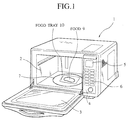
- FIG. 1 is a perspective view showing the external appearance of a heating apparatus for cooking such as microwave ovens according to preferred embodiments of the present invention.
- the reference number 1 designates the heating apparatus for cooking such as microwave ovens.
- FIG.2 is a block diagram showing a functional configuration of the heating apparatus 1 for cooking shown in FIG.1
- FIGs.3A and 3B are the front and bottom views of an IR sensor incorporated in the heating apparatus 1 for cooking of the present invention shown in FIG.1.
- the reference number 2 designates a cavity in which a target food 9 (see FIG.5) to be cooked is placed on a turntable 7.
- the reference number 3 indicates the door of the cavity 2
- 4 designates a control panel with a numerical display window 5 and operation buttons 6 through which the user selects and sets a cooking process, a cooking temperature, and a cooking time period, and the like-
- the reference number 7 indicates the turntable on which the target food 9 is placed and rotates during cooking according to the cooking process set by the user.
- the reference number 8 designates an infrared ray sensor (IR sensor) comprising a plurality of IR elements. The configuration of the IR sensor will be described later.
- the IR sensor 8 is placed at a position where a temperature of the target food 9 and its peripheral area can be detected.
- the target food 9 is placed on a food tray 10 in the cavity 2.
- a heating control section comprises the IR sensor 8, a temperature calculation section 11, a detection target decision section 12, a heating process control section 13, and a magnetron (in a case for an electric range) or a magnetron and a heater (in a case for an electric and oven range). All of or each of the above functions in the heating control section 11 are incorporated into one or more programs and these programs are also incorporated in microcomputer chips (semiconductor chips) of one or more. A memory to store various data items to be used for the above functions is also incorporated in the microcomputer chip.
- FIGs.3A and 3B show the configuration of the IR sensor 8.
- FIG.4 is a diagram showing a circuit configuration of the IR sensor 8 shown in FIGs.3A and 3B.
- the IR sensor 8 shown in both FIGs.3A and 3B comprises a lens 81 and a sensor circuit section 82.
- the sensor circuit section 82 is made up of electrical components.
- the lens 81 is a concave lens made up of silicon through which only infrared ray is transmitted.
- the sensor circuit section 82 comprises a thermopile 83 in which eight linear elements as sensor are arranged in linear and an amplifier circuit 84 for amplifying the output from the thermopile 83.
- the amplifier circuit 84 comprises: a multiplexer 85 for selecting the output from each linear element in the thermopile 83 and for outputting the selected one serially; an amplifier 86 for amplifying the output from the multiplexer 85; a self temperature sensor 87 for detecting a standard temperature; an amplifier 88 for amplifying the output from the self temperature sensor 87; a standard voltage unit 89; a multiplexer 810; output circuit 811; an oscillator 812; and a control unit 813.
- the output voltage V from the eight linear elements in the thermopile 83 in the sensor circuit 82 is as follows: where V is an output voltage, ⁇ is an adaptation coefficient, Tbb is an absolute temperature of the target food, and Tam is an absolute temperature of the IR sensor.
- Tbb 4 V ⁇ + T am 4 .
- FIG.5 is a diagram showing the detection fields i1 to i8 of the IR sensor 8 in the heating apparatus 1 for cooking according to the present invention.
- FIG.6 is a detailed diagram showing the direct detection fields i3 and i4, the boundary detection fields i2 and i5, and the background detection fields i1, i6, i7, and i8 of the IR sensor 8 in the heating apparatus 1 for cooking according to the present invention;
- the linear elements in the thermopile 83 in the IR sensor 8 are arranged in order to have the detection fields i1 to i8 (The reference characters i1 to i8 will be also used for designating the linear elements having the detection fields i1 to i8 briefly.) so that the entire linear elements cross the turntable 7 in the cavity 2 in diameter direction.
- the IR sensor 8 comprising the eight linear elements can detect the temperature of the entire area of the turntable 7 per rotation-
- the temperature calculation section 11 calculate a temperature value of each detection field based on each temperature detection signal transferred from each of the linear elements in the IR sensor 8 and then outputs the calculated temperature values to a memory (not shown). The contents stored in the memory are thereby updated.
- the detection target judgment section 12 judges the type of each of the detection fields i1 to i8, such as a direct detection field where any target food is placed, a boundary detection field in which there are both the target food and the background, or the background detection field where there is no target food, based on the calculated temperature value of each detection field and then outputs the information of the type of each detection field and the calculated temperature values to the heating process control section 13.
- the heating process control section 13 sets cooking processes such as a cooking temperature for the target food, a heating time period, and the like based on the instructions such as "thawing food”, or “thawing and warming food”, “warming food”, transferred form the operation panel 4, in order to control the cooking processes based on the calculated temperature values of the detection fields output from the detection target judgment section 12.
- the temperature calculation section 11 calculates the calculated temperature values based on the temperature detection signal output from each of the linear elements in the IR sensor 8 and then outputs the calculated temperature values to the detection target judgment section 12.
- the operation of the detection target judgment section 12 is as follows.
- the linear element corresponding to each of the detection fields i1, i6, i7, and i8 detects the temperature of the background detection field.
- the linear element corresponding to each of the detection fields i3 and i4 detects the temperature of the target food 9.
- the target food 9 There are both the target food 9 and the background detection field, for example, the detection fields i2 and i5 in the boundary detection field.
- the temperature of the target food 9 is necessary to control the heating.
- any conventional microwave oven detects the difference of the direct detection field and the background detection field to obtain the temperature of the target food to be cooked
- any conventional microwave oven detects no boundary detection field, so that it is difficult to detect the temperature of the target food preciously- That is, the conventional microwave ovens control the heating process based on a mean value of the temperatures of both the background detection field and the target food because the conventional microwave ovens cannot detect the temperature at the boundary detection field preciously.
- it often happens in the conventional microwave ovens that a part of the target food placed in the boundary detection field becomes a half-cooked state locally or enters a half-boiled state during thawing process.
- the conventional microwave ovens cannot detect preciously a part of the target food placed in the boundary detection field where it often happens a half-cooked state.
- the detection target judgment section 12 in the heating apparatus 1 for cooking of the present invention judges the type of the detection field, and then obtains the temperature of the part of the target food and outputs the calculated value to the heating process control section 13.
- the heating process control section 13 controls the operation of the heating unit 14 based on the calculated temperature value of each part of the target food 9 from the detection target judgment section 12 until the temperature of the target food 9 is reached to the set temperature according to the cooking process.
- the detection target judgment section 12 in the heating apparatus 1 for cooking of the first embodiment specifies a part of the target food that is placed in the boundary detection field and then calculates a ratio of the area of the target food and the area of the background in the boundary detection field based on the following process:
- the background temperature Tbk of the background is determined by using the temperature (as the background temperature) of the self-temperature sensor 87 incorporated in the IR sensor 8.
- each part in the heating apparatus 1 for cooking has a same temperature value during a stable state, it is possible to use the temperature, as the temperature of the background, detected by the self-temperature sensor 87 to be incorporated for temperature calibration in the IR sensor 8.
- theheatingprocess control section 13 inputs data corresponding to the initial temperature distribution in the cavity 2 transferred from the temperature calculation section 11 and then estimates the initial temperature Tfini of the target food 9 based on the minimum value of the detected temperatures in the initial temperature distribution. Because the target food 9 is usually in a frozen state and the temperature of the target food 9 is apparently lower than the temperature of the cavity (as the temperature of the background) in the heating apparatus 1 for cooking at the initial state of the thawing and heating process, the initial temperature of the target food 9 can be obtained simply and preciously.
- the ratio S5f of the target food 9 in the boundary detection field 15 can be obtained as follows when the calculated temperature value T5 in the boundary detection field i5 is 15°C, the temperature of the background is 25°C, and the initial temperature Tfini of the target food 9 is -5°C, for example:
- the ratio of the target food in the boundary detection field S5f is 1/3.
- the temperature Tjf of the part in the target food 9 in the boundary detection field can be obtained by the following equation during the heating control process, where the calculated temperature value is directly used as the temperature Tkbk of each background field ik, and the calculated values is also directly used as the temperature Tmf of the target food 9 in the direction detection field im.
- Tjf Tjwhl - Tbk + Sjf ⁇ Tbk Sjf , where, Tjwhl is the calculated value for the entire temperature of the boundary detection fields ij, Tbk is the temperature of the background field that is obtained by using a mean value of the background fields ik at the detection.
- the temperature Tjf of the target food 9 in the boundary detection field ij can be obtained as follows:
- the heating process control section 13 calculates the temperature value of the part of the target food 9 in the direction detection field and the temperature value of the part of the target food 9 in the boundary detection field by using the temperature detection signals transferred from the IR sensor 8 and controls the heating process of the heating unit 14 and controls the heating process for the cooking of the target food 9.
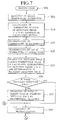
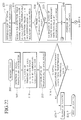
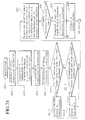
- FIG. 7 is the first half of the flowchart showing the control of the thawing and heating process in the heating apparatus for cooking of the first embodiment and FIG.8 is the latter half of the flowchart showing the control of the thawing and heating process in the heating apparatus for cooking of the first embodiment.
- Step S00 the induction heating by a magnetron as one of the heating processes is initiated (Step S00) during a predetermined time period that is set in advance in a timer, and the IR sensor 8 detects the initial temperature distribution and outputs it to the temperature calculation section 11. These operations are performed in parallel. In addition, a self-temperature detection signal is also transferred to the temperature calculation section 11 (Step S05).
- the temperature calculation section 11 performs the temperature calculation for the temperature detection signal transferred from each linear element corresponding to detection fields i1 to i8 in the IR sensor 8 in order to obtain the calculated temperature values for each of the detection fields i1 ⁇ 1 to i8 ⁇ 1, ..., and i1 ⁇ m to i8 ⁇ m. In addition, the temperature calculation section 11 also obtains the self-temperature based on the self-temperature detection signal from the IR sensor 8 (Step S10).
- the detection target judgment section 12 judges the direct detection field, the background detection field, and the boundary detection field (Steps S15 to S25) based on the calculated temperature values transferred form the temperature calculation section 11. That is to say, the detection target judgment section 12 determines the internal temperature (as the initial background temperature) of the cavity 2 by using the calculated temperature values based on the self-temperature detection signal from the IR sensor 8 (Step S15) and also obtains the initial temperature value of the target food 9 based on the minimum temperature value in the calculated temperature value (Step S20).
- the detection target judgment section 12 judges that the detection field whose temperature is approximately equal to the initial temperature value of the target food 9 is the direction detection field, the detection field whose temperature is approximately equal to an intermediate temperature value between the initial temperature value of the background and the initial temperature value of the target food 9 is the boundary detection field. Then, the detection target judgment section 12 connects each of the calculated temperature values corresponding the detection fields i1 ⁇ 1 to i8 ⁇ 1, ⁇ , and i1 ⁇ m to i8 ⁇ m to each type of the detection fields such as the direct detection field, the boundary detection field, and the background detection field. Then, the detection target judgment section 12 transfers the judgment results to the heating process control section 13 (Step S25).
- the heating process control section 13 estimates the ratio of the target food 9 in the boundary detection field based on the results transferred from the detection target judgment section 12 by a proportional allotment (Step S30 and Step S35). After this process, the heating process control section 13 continues to perform the control of the heating based on the indicated heating process (Step S40). During the heating in the thawing and heating process, the IR sensor 8 periodically detects the temperature of the internal cavity 2 (Step S45), and the heating process control section 13 observes the temperature of the target food 9 in both the direct detection field and the boundary detection field and estimates the temperature of the target food 9. The heating process control section 13 continues to perform these operations (Step S50).
- Step S55 even if the calculated temperature of any part in the target food 9 is not reached to the protection temperature, the heating is stopped when all of the calculated temperatures are reached to a predetermined temperature value that is set in advance (Steps S60 and S70). Further, even if the calculated temperature of any part in the target food is not reached to the predetermined temperature value, the heating is also stopped when the heating time is over the set value in the timer (Steps S55 and S75).
- the heating apparatus for cooking of the first embodiment can perform the thawing and heating process for a frozen food item to be cooked so that the half-boiled state does not occur in any part of the target frozen food item while the IR sensor detects the temperature of each part of the target frozen food item.
- the IR sensor 8 obtains the initial value of the internal temperature of the cavity 2 by using the temperature value detected and transferred from the self-temperature sensor 87 to be used for detecting a standard temperature incorporated in the IR sensor 8.
- the present invention is not limited by this, for example, it is also possible to use a temperature signal detected by a temperature sensor, instead of the self-temperature sensor 87, incorporated in the heating apparatus for cooking such as a thermister that directly detects the internal temperature of the cavity 2 during oven process.
- a temperature signal detected by a temperature sensor instead of the self-temperature sensor 87, incorporated in the heating apparatus for cooking such as a thermister that directly detects the internal temperature of the cavity 2 during oven process.
- FIG.9 is a diagram showing another detection fields of the IR sensor 8 in the heating apparatus 1 for cooking of the first embodiment.
- one of the linear elements having the detection fields i1 to i8 (These reference characters i1 to i8 will be also used for the detection fields i1 to i8 briefly.) in the IR sensor 8 is placed on a position where a temperature of a target food 9 of any size placed on the turntable 7 cannot be detected, and the temperature value of the background field can be obtained based on the calculated temperature values from the detection fields i1 ⁇ 1 to i8 ⁇ 1, ..., or i1 ⁇ m to i8 ⁇ m.
- the following detection manner may be used in order to obtain the temperature of the background field.
- the target food 9 placed on the turntable 7 is also turned.
- the absolute position of the detection field of each of the linear elements i1 to 18 in the IR sensor 8 is fixed in the cavity 2. Therefore while the turntable 7 and the target food 9 are turned per rotation, the linear element il detecting the most outer periphery of the turntable 7 or the linear element i8 detecting the most inner periphery has two detection fields, one detection field detects only the target food 9 and another detection field detects only the background field, because it does not occur in general cases that the size of the target food 9 is equal to or over the size of the turn table 7. Accordingly, the maximum value in the temperature values detected by the linear element i1 or i8 during one rotation is used as the initial temperature value of the background field.
- the configuration of the heating apparatus for cooking according to the second embodiment is the same as that of the heating apparatus for cooking of the first embodiment shown in FIGs.1 and 2. The difference between them is the detection function of the background field in the initial heating state.
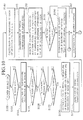
- FIG.10 is the first half of the flowchart showing the control of the thawing and heating process in the heating apparatus for cooking of the second embodiment
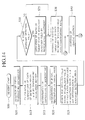
- FIG.11 is the latter half of the flowchart showing the control of the thawing and heating process in the heating apparatus for cooking of the second embodiment.
- Step S100 When the power supply of the heating apparatus 1 for cooking is ON (Step S100), the procedure shown in FIGs. 10 and 11 is started.
- the IR sensor 8 initiates the temperature detection operation and outputs the detection signals to the temperature calculation section 11.
- the temperature calculation section 11 inputs the temperature detection signals and then calculates the detected temperature values based on the temperature detection signals and stores the calculated results into the memory (Steps S105 and S110).
- the heating process control section 13 in the heating apparatus 1 for cooking sets the cooking process based on the user's selection, and initiates the control of the thawing and heating process during the time period that is set in advance in a timer according to an induction heating by a magnetron in the heating unit 14 shown in FIG.2 (Step S115 to Step S125).
- the temperature calculation section 11 calculates the mean value of the detected temperature values of the detection fields i1 ⁇ 1 to i8 ⁇ 1, ..., and i1 ⁇ m to i8 ⁇ m in order to obtain the initial background temperature (Step S130) based on the initial temperature distribution obtained when the user opens the door 3 for placing the target food 9 on the tray 10 on the turntable 7.
- the temperature calculation section 11 calculates the temperature calculation values for each of the detection fields i1 ⁇ 1 to i8 ⁇ 1, ⁇ , and i1 ⁇ m to i8 ⁇ m (Steps S135 and S140) based on following detected temperature signals detected by the IR sensor 8.
- the heating process control section 13 determines the initial temperature value for the target food 9 according to the minimum temperature value in the temperature calculated values for each detection field (Step S145).
- the detection target judgment section 12 judges the type of each detection field such as the direct detection field, the background field, and the boundary detection field based on the temperature calculated values, like the first embodiment (Step S150). That is, the detection target judgment section 12 determines that the detection field having the temperature near the initial temperature is the direct detection field, the detection field having an intermediate temperature value between the initial temperature of the target food 9 and the initial background temperature is the boundary detection field. Then, the detection target judgment section 11 performs to connect the temperature calculated value for each of the detection fields i1 to i8 to one of the types, the direct detection field, the background field, and the boundary detection field. Then the detection target judgment section 12 outputs the judgment results to the heating process control section 13 (Step S155).
- the heating process control section 13 estimates the ratio of the target food 9 in the detection field based on the judgment results from the detection target judgment section 12 by using the prescribed manner (Step ST160) when the type of the detection field is the boundary detection field. The heating process control section 13 continues to control the heating by the specified manner (Step S165).
- the IR sensor 8 continues to periodically detect the internal temperature of the cavity 2 during the thawing and heating process (Step S170), and the heating process control section 13 checks the temperature of the target food 9 in both the direct detection field and the boundary detection field, and the temperature of the target food 9 in the boundary detection field is estimated by the manner described above (Step S175).
- the heating is stopped when the estimated temperature of the target food 9 is reached to the protection temperature (for example, 28°C) at which the food becomes a half-boiled state (Steps S180 and S195).
- the protection temperature for example, 28°C
- Step S180 even if the temperatures of any part in the target food 9 obtained in the direct detection field and the boundary detection field are not reached to the protection temperature, the heating is stopped when all of the calculated temperatures are reached to the predetermined temperature value that is set in advance (Steps S185 and S195). Further, even if the calculated temperatures of any part in the target food are not reached to the predetermined temperature value, the heating is also stopped when the heating time is over the set value of the timer (Steps S190 and S195).
- the heating apparatus for cooking of the second embodiment can perform the thawing and heating process for a frozen food to be cooked so that the half-boiled state does not occur in any part of the target frozen food while the IR sensor detects the temperature of each part of the target frozen food. Furthermore, the IR sensor 8 also detects the internal temperature distribution of the cavity 2 where no target food is placed in order to get the temperature of the background when the power supply of the heating apparatus for cooking is ON, and the mean value of the initial temperature values is determined as the initial temperature of the background based on the initial temperature distribution of the cavity 2. Thus, the second embodiment of the present invention can obtain the initial temperature of the background preciously by using the temperature distribution when the user places the target food 9 on the turntable 7 in the cavity 2 in the heating apparatus for cooking.
- the heating apparatus for cooking of the third embodiment of the present invention will be explained.
- the configuration of the heating apparatus for cooking according to the third embodiment is the same as that of the heating apparatus for cooking of the first embodiment shown in FIGs.1 and 2. The difference between them is the function to determine the ratio of the target food in the boundary detection field.
- the heating apparatus for cooking of the third embodiment determines the positions of the boundary detection fields many times by using the temperature distribution based on the detection results which are obtained repeatedly by the IR sensor 8, and also determines the ratio of the target food in the boundary detection fields, and also determines the temperature of the target food in the boundary detection field in order to control the heating for avoiding an occurrence of the half-boiled state in the target food.
- the tray 10 (see FIG. 10) is rapidly increased toward the temperature of the background in the initial heating state.
- the temperature of the watery target food 9 in a frozen state is not changed, namely cannot be increased rapidly.
- the heating apparatus for cooking of the third embodiment performs many times the judgment of the detection fields by the IR sensor 8 in the initial heating process and the determination of the ratio of the target food in the boundary detection field, and then the final result is used for the following heating process.
- FIG.12 is the first half of the flowchart showing the control of the thawing and heating process in the heating apparatus for cooking of the third embodiment
- FIG.13 is the latter half of the flowchart showing the control of the thawing and heating process in the heating apparatus for cooking of the third embodiment.
- Step S05 to S35 After the power supply of the heating apparatus 1 for cooking is ON (Step S00) are the same as those of the first embodiment shown in FIGs.7 and 8.
- the heating apparatus for cooking of the third embodiment repeats predetermined times, for example five times, the operations of the Steps S95 to S35 during the initial heating process even if the ratio of the target food in the background detection field is calculated in order to obtain and a correct type of the detection field and the precious ratio of the target food in the boundary detection field (Step S37).
- the heating process control section 13 continues the heating process by the specified heating manner (Step S40).
- the heating apparatus for cooking of the third embodiment continues to periodically perform the temperature detection for the internal cavity 2 by the IR sensor 8, like the heating apparatus for cooking of the first embodiment (Step S45), the heating process control section 13 checks the temperature of the target food 9 in the direct detection field and the boundary detection field, and estimates the temperature of the target food 9 in the boundary detection field based on the prescribed manner (Step S50).
- the heating process control section 13 stops the heating process (Steps S55 and S70).
- the heating is stopped when the calculated temperature is reached to a predetermined temperature value that is lower than the protection temperature and set in advance (Steps S65 and S70). Further, even if the calculated temperature value of any part in the target food are not reached to the predetermined temperature value, the heating is also stopped when the heating time is over the set value of the timer (Steps S65 and S70).
- the heating apparatus for cooking of the third embodiment can perform the thawing and heating process for a frozen food to be cooked so that the half-boiled state does not occur in any part of the target frozen food while the IR sensor 8 detects the temperature of each part of the target frozen food.
- the calculation process of the ratio of the target food is repeated many times during the initial heating process in the first embodiment, it is possible to obtain the correct ratio of the target food where the target food 9 is distinguished from the tray 10 when the heating is initiated after the target food 9 is placed on the tray 10 and then placed into the cavity 2.
- the heating apparatus for cooking of the second embodiment can obtain the correct ratio of the target food 9 in the boundary detection field after the target food 9 is changed and fixed in position and performs the following heating control.
- the heating apparatus for cooking of the third embodiment to use the manner of the first embodiment or second embodiment to determine the temperature of the background field.
- the heating apparatus for cooking of the fourth embodiment of the present invention will be explained.
- the configuration of the heating apparatus for cooking according to the fourth embodiment is the same as that of the heating apparatus for cooking of the first embodiment shown in FIGs.1 and 2. The difference between them is that each boundary detection field is classified in ratio of the target food into three stages, the first lank where the ratio of the target food is zero to less than 30%, the second lank where the ratio of the target food is from 30% to 60%, and the third lank where the ratio of the target food is not less than 60%, and the temperature of the target food 9 is determined based on the temperature of the three stages.
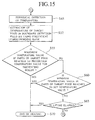
- FIG.14 is the first half of the flowchart showing the control of the thawing and heating process in the heating apparatus for cooking of the fourth embodiment
- FIG.15 is the latter half of the flowchart showing the control of the thawing and heating process in the heating apparatus for cooking of the fourth embodiment.
- Steps S05 to S35 in the fourth embodiment after the start button for heating is pushed by the user are the same as those of the heating apparatus for cooking of the first embodiment shown in FIGs.7 and 8.
- the heating apparatus for cooking of the fourth embodiment judges a rank of the ratio of the target food 9 in each boundary detection field, namely, the ratio belongs to one of the first to third ranks (Step S38).
- the heating process control section 13 continues to control the heating specified by the user (Step S40).
- the heating apparatus for cooking of the fourth embodiment periodically performs the detection of the internal temperature of the cavity 2 based on the detection by the IR sensor 8 during the thawing and heating process (Step S45), and the heating process control section 13 checks the temperature of the target food 9 in both the direct detection field and the boundary detection field and estimates the temperature of the target food 9 in the boundary detection field.
- the estimation of the temperature of the target food 9 in the boundary detection field performs by using a constant coefficient per rank.
- a boundary temperature is 20°C
- a temperature of the background field is 25°C
- the rank is the second rank
- the heating process control section 13 stops the heating process (Steps S55 and S70).
- the heating is stopped when the calculated temperature (namely, the estimated temperature) is reached to a predetermined temperature value that is lower than the protection temperature and set in advance (Steps S65 and S70). Further, even if the calculated temperature value of any part in the target food 9 are not reached to the predetermined temperature value, the heating is also stopped when the heating time is over the set value of the timer (Steps S65 and S70).
- the heating apparatus for cooking of the fourth embodiment can perform the thawing and heating process for a frozen food to be cooked so that the half-boiled state does not occur in any part of the target frozen food while the IR sensor detects the temperature of each part of the target frozen food.
- the boundary detection fields are divided into ranks according to the ratio of the target food in each boundary detection field and the temperature of the target food 9 can be estimated by using the coefficients corresponding to the ranks. It is therefore possible to reduce the calculation for the estimation temperature of the target food 9.
- the heating apparatus for cooking of the fourth embodiment it is possible in the heating apparatus for cooking of the fourth embodiment to use the method of the first embodiment to detect the background temperature and also to use the method of the heating apparatus for cooking of the second embodiment.
- the temperature of the target food 9 to be cooked is not more than 0°C or not.
- the target food 9 is still in a frozen state and absorbs a small amount of microwave radiation from a magnetron.
- the energy of the microwave radiation is used for the state transition of a solid to liquid, namely ice to water.
- the water part in the target food 9 When the temperature of the target food 9 is over 0°C, the water part in the target food 9 is in a liquid state and can absorbs a large amount of the microwave (approximately 80 times when compared with the amount of the absorption of the microwave in the solid state). Accordingly, if there is a half-boiled state in the target food 9, the part of the target food 9 in the half-boiled state absorbs a large amount of the microwave, so that the target food 9 is fallen into a half-boiled state or uneven cooking state.
- the heating apparatus for cooking of the fifth embodiment can preciously detect the temperature of the target food 9 in the boundary detection field in which there are both the background and the part of the target food 9, it is possible to control the heating around the temperature of 0°C efficiently while checking the temperature of each part of the target food 9.
- the configuration of the heating apparatus for cooking according to the fifth embodiment is the same as that of the heating apparatus for cooking of the first embodiment shown in FIGs.1 and 2.
- the difference between the fifth embodiment and the first embodiment is that the heating degree is changeable according to the temperature of the target food 9 during the thawing and heating process.
- FIG.16 is the first half of the flowchart showing the control of the thawing and heating process in the heating apparatus for cooking of the fifth embodiment
- FIG.17 is the latter half of the flowchart showing the control of the thawing and heating process in the heating apparatus for cooking of the fifth embodiment.
- Steps S05 to S35 after the heating start button is pushed at Step S00 are the same as those of the first embodiment shown in FIGs.7 and 8.
- the heating process control section 13 continues to control the heating to the target food 9 based on the specified heating type (Step S40). Like the heating apparatus for cooking of the first embodiment, the heating apparatus for cooking of the fifth embodiment continues to detect the internal temperature of the cavity 2 periodically (Step S45), the heating process control section 13 checks the temperature of the target food 9 in both the direct detection field and the boundary detection field and estimates the temperature of the target food 9 (Step S50).
- the heating process control section 13 stops the heating process (Steps S55 and S70).
- the heating is stopped when the calculated temperature (namely, the estimated temperature) is reached to a predetermined temperature value that is lower than the protection temperature and set in advance (Steps S60 and S70).
- the operation flow of the heating goes to Step S61-1.
- Step S61-1 it is checked whether one of the temperatures of the target food 9 detected in the direct detection field and the boundary detection field is reached to a forced limit of the heating temperature (for example, the heating temperature of the forced limit is 0°C, or within 1 to 5°C).
- a strong heating the power of the heating is strong
- Step S61-3 the type of the heating is switched from the forced heating (or a strong heating) to a weak heating (o ra low heating as the normal heating) (Step S61-3).
- Step S65 and S70 Even if the type of the heating is the strong heating or the weak heating, the operation flow is returned to the Steps S40 until the timer is elapsed in order to continues the operation of the strong heating shown in Steps S40 to S61-1 or S61-2. The heating is then stopped when the predetermined time that is set in advance in the timer is elapsed (Step S65 and S70).
- the heating apparatus for cooking of the fifth embodiment can perform the thawing and heating process while checking the increase of the temperature of any local part in the target food 9 so that the temperature of the target food is not reached to a half-boiled temperature by using the IR sensor 8 when it thaws a frozen food.
- the strong heating is performed until the temperature of the target food is reached to the forced limit of the heating temperature such as 0°C, and the type of the heating is switched from the strong heating to the weak heating when reached. Therefore it is possible to prevent occurrence of uneven heating state of the target food and to heat the target food as uniform as possible.
- the heating apparatus for cooking of the fifth embodiment uses the method of the first embodiment to detect the background temperature and also to use the method of the heating apparatus for cooking of the second embodiment. Further, it is possible in the heating apparatus for cooking of the fifth embodiment to use the estimation of the temperature of the target food in the first to fourth embodiment described above.
- the strong heating is stopped when the maximum value of the temperature of any part of the target food is reached to or over the forced limit value of the heating temperature that is set in advance
- the present invention is not limited by this limit, for example, it is also possible to use a mean value or the minimum value of the temperature of the target food or a mean value between the maximum value and the minimum value of the temperature of the target food instead of the maximum value of the temperature.
- the heating apparatus for cooking of the present invention it is possible for the heating apparatus for cooking of the present invention to set the pre-heating period to a higher value because the heating apparatus for cooking of the present invention can detect the parts of the target food including the boundary area of the target food preciously.
- the heating apparatus for cooking of the sixth embodiment is based on the feature described above.
- the configuration of the heating apparatus for cooking according to the sixth embodiment is the same as that of the heating apparatus for cooking of the first embodiment shown in FIGs.1 and 2.
- the sixth embodiment is different in heating control from the first embodiment.
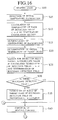
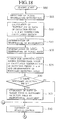
- FIG.18 is the first half of the flowchart showing the control of the thawing and heating process in the heating apparatus for cooking of the sixth embodiment
- FIG.19 is the latter half of the flowchart showing the control of the thawing and heating process in the heating apparatus for cooking of the sixth embodiment.
- Step S00 After the heating start button is pushed at Step S00 when the power supply of the heating apparatus 1 for cooking is ON (Step S00), the operations (such as the detection of the initial temperature distribution, the temperature calculation for each of the detection fields il to 18, the judgment of the type of the detection field, the determination of the boundary detection field, and the calculation of the ratio of the target food in the boundary detection field) shown in Steps S05 to S35 after the power supply of the heating apparatus 1 for cooking is ON (Step S00) are the same as those of the first embodiment shown in FIGs.7 and 8.
- the heating process control section 13 continues to control the specified heating manner(Step S40).
- the heating apparatus for cooking of the sixth embodiment continues to periodically perform the temperature detection for the internal cavity 2 by the IR sensor 8 (Step S45), like the heating apparatus for cooking of the first embodiment, the heating process control section 13 checks the temperature of the target food 9 in the direct detection field and the boundary detection field, and estimates the temperature of the target food 9 in the boundary detection field based on the prescribed manner (Step S50).
- the heating process control section 13 stops the heating process (Steps S55 and S70).
- the heating is stopped when the calculated temperature is reached to a predetermined temperature value that is lower than the protection temperature and0 set in advance (Steps S60 and S70). Further, when the calculated temperature values of any part in the target food are not reached to the predetermined temperature value, the operation flow goes to the Step S62-1.
- Step S62-1 it is checked that the maximum temperature of the target food 9 in the direct detection field and the boundary detection field is reached to the initial temperature Tst in pre-heating stages (for example, the value of the initial temperature Tst is 5°C, and the rate of increasing in following each stage is 5°C.).
- the normal heating to the target food 9 is continued (Steps S62-1 and S62-5).
- the output of the heating unit 14 is controlled by inverter in order to keep the temperature of the target food 9 at the initial temperature Tst for 1 to 5 minutes, for example (Steps S62-1 and S62-5).
- Step S65 The operation flow returns to the Step S40 in order to perform the heating control process from Step S40 to Step S65 unless the time period set in the timer is elapsed (Step S65).
- the heating apparatus for cooking of the sixth embodiment can perform the thawing and heating process while checking the increase of the temperature of any local part in the target food 9 so that the temperature of the target food is not reached to a half-boiled temperature by using the IR sensor when it thaws a frozen food.
- the heating apparatus for cooking of the sixth embodiment can perform the pre-heating by setting the temperature for the pre-heating as high as possible that is changeable in stages.
- the heating apparatus for cooking of the sixth embodiment is capable of thawing the internal parts the target food as uniform as possible without causing the half-boiled state.
- the heating apparatus for cooking of the sixth embodiment uses the method of the first embodiment to detect the background temperature and also to use the method of the heating apparatus for cooking of the second embodiment. Further, it is possible in the heating apparatus for cooking of the sixth embodiment to use the estimation of the temperature of the target food in the first to fifth embodiments described above.
- the pre-heating is performed for a predetermine time period in the sixth embodiment when the maximum value in the detected temperatures of the parts of the target food 9 is reached to the temperature value of the pre-heating
- the present invention is not limited by this embodiment, for example, it is possible to use the mean value or the minimum value of the temperature of the parts in the target food or to use the mean value of both the maximum value and the minimum value of the temperatures of the parts in the target food instead of the maximum value.
- the configuration of the heating apparatus for cooking according to the seventh embodiment is the same as that of the heating apparatus for cooking of the first embodiment shown in FIGs.1 and 2.
- the seventh embodiment is different in heating control from the first embodiment. That is, in the seventh embodiment, the power of the heating is decreased temporarily when the difference between the maximum value and the minimum value in the temperatures of the parts in the target food is over a predetermined value, and when the difference becomes zero, the normal heating is continued until the temperature of the target food is reached to a target temperature that is set in advance.
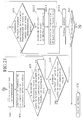
- FIG.20 is the first half of the flowchart showing the control of a thawing and heating process in the heating apparatus for cooking of the seventh embodiment
- FIG.21 is the latter half of the flowchart showing the control of the thawing and heating process in the heating apparatus for cooking of the seventh embodiment.
- Step S00 After the power supply of the heating apparatus 1 for cooking is ON (Step S00) and the heating start button is pushed by the user shown at Step S00, the operations (such as the detection of the initial temperature distribution, the temperature calculation for each of the detection fields i1 to i8 , the judgment of the type of the detection field, the determination of the boundary detection field, and the calculation of the ratio of the target food in the boundary detection field) shown in Steps S05 to S35 after the power supply of the heating apparatus 1 for cooking is ON (Step SOO) are the same as those of the first embodiment shown in FIGs.7 and 8.
- the heating process control section 13 continues to control the specified heating manner(Step S40).
- the heating apparatus for cooking of the seventh embodiment continues to periodically perform the temperature detection for the internal cavity 2 by the IR sensor 8 (Step S45), like the heating apparatus for cooking of the first embodiment, the heating process control section 13 checks the temperature of the target food 9 in the direct detection field and the boundary detection field, and estimates the temperature of the target food 9 in the boundary detection field based on the prescribed manner (Step S50).
- the heating process control section 13 stops the heating process (Steps S55 and S70).
- Step S60 and S70 the heating is stopped when the calculated temperature is reached to a predetermined temperature value that is lower than the protection temperature and set in advance. Further, the operation flow goes to Step S63-1 when the calculated temperature value is not reached to the predetermined temperature value.
- Step 63-1 the difference between the maximum value and the minimum value in the temperature of the parts in the target food 9 is calculated and it is checked whether or not the difference is within a temperature range of 3°C to 10°C in order to check whether the parts of the target food are heated uniformly.
- Step S63-4 When the difference is in the temperature range of 3°C to 5°C at Step S63-1, it may be recognized that the target food is heated uniformly and then the normal heating is performed (Step S63-4).
- Step S63-2 and S63-3 when the difference of the temperature enters the temperature range, the normal heating is restarted (Steps S60, S63-1, and S63-4).
- Step S65 the processes Steps S40 to S65 is repeated (Step S65) until the time period designated by the timer is elapsed.
- the heating apparatus for cooking of the seventh embodiment can perform the thawing and heating process while checking the increase of the temperature of any local part in the target food 9 so that the temperature of the target food is not reached to a half-boiled temperature by using the IR sensor when it thaws a frozen food.
- the heating apparatus for cooking of the seventh embodiment can perform the heating control in which the heating power is decreased or the heating is halted temporary until the difference enters the temperature range when the difference of the temperature of the parts in the target food is not within the temperature range while checking the temperatures of the parts in the target food. Then. the normal heating is performed after the difference enters the temperature range. Accordingly it is possible to thaw the internal parts in the target food uniformly.
- the heating apparatus for cooking of the seventh embodiment uses the method of the first embodiment to detect the background temperature and also to use the method of the heating apparatus for cooking of the second embodiment. Further, it is possible in the heating apparatus for cooking of the seventh embodiment to use the estimation of the temperature of the target food in the first to sixth embodiment described above.
- the configuration of the heating apparatus for cooking according to the eighth embodiment is the same as that of the heating apparatus for cooking of the first embodiment shown in FIGs.1 and 2.
- the eighth embodiment is different in heating control from the first embodiment. That is, in the eighth embodiment, the thawing process is halted according to the detection result of the initial temperature of the background and a warning is given to the user.
- FIG.22 is the flowchart showing the control of the thawing and heating process in the heating apparatus for cooking of the eighth embodiment.
- Step S00 After the heating start button is pushed at Step SOO when the power supply of the heating apparatus 1 for cooking is ON and the heating is started during the time period that is set in the timer in advance (Step S00).
- the IR sensor 8 detects the initial temperature distribution of the cavity 2 that is performed in parallel to the above heating and outputs the detection results to the temperature calculation section 11.
- the self-temperature detection signal is also output to the temperature calculation section 11 (Step S05). That is, the temperature calculation section 11 calculates the temperature calculation based on the temperature detection signals from the linear element in the IR sensor 8 corresponding to the detection fields i1 to i8.
- the temperature calculation section 11 also calculates the self-temperature (as a standard temperature) (Step S10) and calculates the background temperature based on the output signal from the self-temperature sensor (Step S15).
- the heating process control section 13 compares the initial temperature of the background with an upper limit value (for example 120°C that is determined based on a heat-resistance characteristic of the IR sensor 8) that is set in advance.
- an upper limit value for example 120°C that is determined based on a heat-resistance characteristic of the IR sensor 8
- the heating apparatus for cooking of the eighth embodiment sounds a beep as a warning to the user and informs or displays a warning information "The thawing can not be started because the temperature of the cavity is high. Please use it after the cavity is cold. on the operation panel 4 (Step S16-2) to the user, and the heating is forcefully stopped (Step S16-3).
- the heating apparatus for cooking continues the control of the thawing and heating process in order to perform the operations Steps S20 to S70, like the heating apparatus for cooking of the first embodiment shown in FIGs.7 and 8.
- the heating apparatus for cooking of the eighth embodiment can halt the thawing forcefully when the temperature of the cavity 2 is abnormally high in the case that the thawing is started after the heating apparatus for cooking was used as oven. Therefore it is possible to avoid the occurrence that a correct detection of the temperature cannot be performed by a malfunction of the IR sensor 8.
- the warning is given to the user for user-friendly when the thawing is halted
- the present invention is limited by this case, for example, it is possible to halt the thawing without the warning or to give the warning to the user without halting the thawing.
- the heating apparatus for cooking of the eighth embodiment uses the method of the first embodiment to detect the background temperature and also to use the method of the heating apparatus for cooking of the second embodiment.
- the configuration of the heating apparatus for cooking according to the ninth embodiment is the same as that of the heating apparatus for cooking of the first embodiment shown in FIGs.1 and 2.
- the feature of the ninth embodiment is that the power of the thawing and heating process is decreased according to the detection result of the initial temperature of the background.
- the thawing When the frozen target food to be cooked is placed on the tray 10 in the cavity 2 in the thawing and the temperature of the cavity 2 is sufficiently high, the thawing is proceeded spontaneously without any heating. In this case, there is a possibility to occur the over-heating when the normal heating is performed. In order to avoid this possibility, the power of the heating is decreased.
- FIG.23 is the flowchart showing the control of the thawing and heating process in the heating apparatus for cooking of the ninth embodiment.
- Step S00 the heating start button is pushed by the user shown at Step S00.
- the IR sensor 8 detects the initial temperature distribution of the cavity 2. The detection is performed in parallel to the above heating. The IR sensor 8 outputs the detection results to the temperature calculation section 11.
- the self-temperature detection signal is also output to the temperature calculation section 11 (Step S05). That is, the temperature calculation section 11 performs the temperature calculation based on the temperature detection signals from the linear elements in the IR sensor 8 corresponding to the detection fields i1 to i8.
- the temperature calculation section 11 also calculates the self-temperature (as a standard temperature) (Step S10) and calculates the background temperature based on the output signal from the self-temperature sensor (Step S15).
- the heating process control section 13 compares the initial temperature of the background with a predetermined value, for example 50°C. When the initial temperature of the background is over the predetermined value, the heating power is decreased to a low power such as 1/5 to 1/2 of the normal power for heating (Steps S17-1 and S17-2). When does not over, the normal power is used for heating without the decreasing the heating power.
- a predetermined value for example 50°C.
- Steps S20 to S70 are performed like the heating apparatus for cooking as the first embodiment shown in FIGs.7 and 8.
- the heating apparatus for cooking of the ninth embodiment the heating power can be decreased in the above case in order to perform the thawing and heating process without any occurrence of the half-boiled state.
- the heating apparatus for cooking of the ninth embodiment to use the method of the first embodiment to detect the background temperature and also to use the method of the heating apparatus for cooking of the second embodiment.
- the configuration of the heating apparatus for cooking according to the tenth embodiment is the same as that of the heating apparatus for cooking of the first embodiment shown in FIGs.1 and 2.
- the feature of the tenth embodiment is that the heating power of the thawing and heating process is switched according to the temperature of the target food detected at the start of the thawing and heating process. That is, when the target food in a frozen state whose temperature is not more than -20°C, it is necessary to use a high heating power that is higher than that of the normal heating in order to perform a rapid thawing. On the other hand, when the target food in the frozen state whose temperature is 0°C, it is better to use the normal heating power because a liquid or a water can absorbs a large amount of the microwave rather than a solid frozen state such as an ice and there is a possibility that the liquid part in the target food of 0°C becomes the half-boiled state.
- the heating apparatus for cooking of the tenth embodiment is capable of controlling the heating power according to the initial temperature of the target food 9.
- FIG.24 is the flowchart showing the control of the thawing and heating process in the heating apparatus for cooking of the ninth embodiment.
- Step S00 the heating start button is pushed by the user.
- the IR sensor 8 detects the initial temperature distribution of the cavity 2 which is performed in parallel to the above heating and outputs the detection results to the temperature calculation section 11.
- the self temperature detection signal is also output to the temperature calculation section 11 (Step S05).
- the temperature calculation section 11 performs the temperature calculation based on the temperature detection signals from the linear elements in the IR sensor 8 corresponding to the detection fields i1 to i8.
- the temperature calculation section 11 also calculates the self-temperature (as a standard temperature) (Step S10) and calculates the background temperature based on the output signal from the self-temperature sensor (Step S15), and obtains the initial temperature of the target food 9 based on the minimum temperature value in the calculated temperature values (Step S20).
- the heating process control section 13 sets the heating power to the strong heating power that is greater than that of the normal heating power based on the initial temperature of the target food 9 when the initial temperature of the target food 9 is lower than the first standard value T1 (for example, -20°C) (Steps S21-1 and S21-2).
- the heating process control section 13 sets the heating power to the low heating power that is lower than that of the normal heating power (Steps S21-3 and S21-4).
- the heating process control section 13 sets the heating power to the normal heating power.
- Step S25 The following control operations in the thawing and heating process after Step S25 are performed like the heating apparatus for cooking as the first embodiment shown in FIGs.7 and 8.
- the heating apparatus for cooking of the tenth embodiment is capable of reducing a time period that is necessary for the thawing and heating process by switching the heating power according to the initial temperature of the target food 9 detected at the start time of the thawing and heating process, and of performing the thawing of the target food uniformly without causing the half-boiled state in any part in the target food 9.
- the heating apparatus for cooking of the tenth embodiment uses the method of the first embodiment to detect the background temperature and also to use the method of the heating apparatus for cooking of the second embodiment.
- the heating power is switched in the strong heating power, the normal heating power, and the low heating power according to the initial temperature value of the target food 9 in the above description, it is also possible to switch the heating power according to the temperature of the target food during the thawing and heating process in addition to the switching of the heating power at the initial temperature of the target food 9.
- the feature of the eleventh embodiment is that no heating is performed and stops the heating and informs a warning to user or gives a voice information to the users when the initial temperature of the target food 9 is higher than a predetermined temperature value.
- the configuration of the heating apparatus for cooking according to the eleventh embodiment is the same as that of the heating apparatus for cooking of the first embodiment shown in FIGs.1 and 2.
- FIG.25 is the flowchart showing the control of the thawing and heating process in the heating apparatus for cooking of the eleventh embodiment.
- Step S00 the heating start button is pushed by the user shown at Step S00.
- the IR sensor B detects the initial temperature distribution of the cavity 2 which is performed in parallel to the above heating and outputs the detection results to the temperature calculation section 11.
- the self temperature detection signal is also output to the temperature calculation section 11 (Step S05).
- the temperature calculation section 11 performs the temperature calculation based on the temperature detection signals from the linear elements in the IR sensor 8 corresponding to the detection fields i1 to i8.
- the temperature calculation section 11 also calculates the self-temperature (as a standard temperature) (Step S10) and calculates the background temperature based on the output signal from the self-temperature sensor (Step S15), and obtains the initial temperature of the target food 9 based on the minimum temperature value in the calculated temperature values (Step S20).
- the heating process control section 13 compares the initial temperature of the target food 9 with a predetermined temperature value (for example 10°C that is set in advance). When the comparison result of Step S22-1 indicates that the initial temperature of the target food 9 is not less than the predetermined temperature value, theheatingprocess control section 13 informs to the user that the thawing for the target food is not performed or gives a voice information, and forcedly stops the heating (Steps S22-1 to S22-3).
- a predetermined temperature value for example 10°C that is set in advance
- Step S22-1 when the comparison result of Step S22-1 indicates that the initial temperature of the target food 9 is lower than the predetermined temperature value, the heating process control section 13 performs the normal thawing and heating process. In this case, the heating process control section 13 performs the operation of Steps S25 to S70, like the heating apparatus for cooking of the first embodiment shown in FIGs.7 and 8.
- the heating apparatus for cooking of the eleventh embodiment is capable of preventing to perform unnecessary thawing because the thawing, namely heating, is stopped and the heating process control section 13 gives the information to the user or gives the voice information to the user when the initial temperature of the target food 9 is higher than the predetermined temperature value during the thawing for the target food 9.
- the heating apparatus for cooking of the eleventh embodiment gives the warning when the heating is forcedly stopped for user-friendly
- the present invention is not limited by this, for example, it is possible to perform the stop of heating without any warning to the user, or to give only the warning without forcedly stopping the heating.
- the heating apparatus for cooking of the eleventh embodiment uses the method of the first embodiment to detect the background temperature and also to use the method of the heating apparatus for cooking of the second embodiment.
- the IR sensor 8 made up of the linear elements il to i8 is used in the first to eleventh embodiments described above.
- the present invention is not limited by this configuration.
- FIGs.26A and 26B are the diagrams showing the configurations of the IR sensor having different detection fields.
- the elements in the IR sensor are arranged in a circular shape so that the detection fields of the elements cover the entire of the turntable 7 (almost a circular shape) in the cavity 2, or, as shown in FIG.26B, the elements are placed in a square shape so that the elements cover the entire of the bottom (almost a square shape) of the cavity 2.
- These configurations of the elements in the IR sensor can be determined experimentally based on the performance and characteristic of inverter control or the specification of the heating apparatus for cooking.
- the heating apparatus for cooking is capable of detecting the direct detection field (area), the boundary detection field (area), and the background detection field (area) and heating a target food to be cooked based on the detected temperature values detected in the direct detection field, the boundary detection field, and the background detection field. Thereby, it is possible to preciously heat the heating for the target food according to the user's selection.
- the background temperature detection means detects the temperature of the background during heating process for the target food
- the target food temperature calculation means calculates the calculated temperature values of the target food in the direct detection field and the boundary detection field by the IR detection means. Therefore, it is possible to preciously heat the heating for the target food based on the detected temperature values according to the user's selection.
- the background temperature detection means calculates the temperature of the background based on a detection result of the self-temperature detection means incorporated in the IR detection means. It is possible to reduce a manufacture cost of the heating apparatus such as microwave ovens without any oven function where a temperature sensor to detect the internal temperature of the heating chamber is not necessary because any additional sensor for detecting the temperature of the background is not necessary.
- the background temperature detection means calculates the temperature of the background based on the detection value of a temperature detection means additionally incorporated in the heating chamber. It is thereby possible to preciously detect the temperature of the background by utilizing the temperature sensor which is always incorporated in the heating chamber in oven-ranges in addition to the IR detection means.
- the background temperature detection means specifies one or more detection elements in the IR detection means in order to detect the temperature of the detection area other than the tray on which the target food is placed in the heating chamber, and preciously calculates the temperature of the background based on the detection results of the specified detection elements. It is thereby possible to detect the temperature of the background previously.
- the background temperature detection means calculates the temperature of the background based on the maximum value in the values detected in the most outer peripheral of the tray on which the target food is placed by the plural detection elements in the IR detection means. Thereby, it is possible to detect the temperature of the background preciously.
- the background temperature detection means preciously calculates the temperature of the background based on the temperature value of the heating chamber detected by the temperature detection means incorporated in the heating chamber when the door of the heating chamber is open. Thereby, it is possible to use the temperature value in the heating chamber detected by the temperature detection means before the target food is placed into the heating chamber.
- the temperature calculation means calculates the initial temperature distribution in the heating chamber and estimates the initial temperature of the target food based on the minimum temperature value in the calculated temperature values in the initial temperature distribution. Thereby, it is possible to determine the initial temperature of the target food during the thawing process.
- the heating apparatus for cooking incorporates the boundary detection field judgment means to judge the detection field as the boundary detection field whose detected temperature is equal to an intermediate value between the calculated temperature value of the target food and the calculated temperature value of the background according to the initial temperature distribution calculated by the temperature calculation means. It is thereby possible to correctly judge the boundary detection field including both a part of the target food and the background.
- the heating apparatus for cooking further comprises detection ratio judgment means for judging a ratio or a range of the target food in the boundary detection field where both the part of the target food and the background are detected simultaneously based on the calculated temperature of the target food and the calculated background temperature and the initial temperature distribution of the heating chamber obtained by the temperature calculation means.
- the heating apparatus for cooking is capable of preciously determines the ratio of the target food in the boundary detection areas.
- the detection rate judgment means performs the temperature detection and the judgment operation many times. Therefore, it is possible to distinguish the target food from the tray which is rapidly heated when the target food on the tray is placed in the heating chamber and to determine the ratio of the target food in the boundary detection field preciously and also to calculate the temperature of the target food in the boundary detection field.
- the heating apparatus for cooking further comprises the boundary target food temperature calculation means for compensating the calculated temperature of the boundary detection field where the target food and the background are detected simultaneously based on the judgment result of the detection rate judgment means, and calculates the temperature of the target food in the boundary detection field.
- the boundary target food temperature calculation means for compensating the calculated temperature of the boundary detection field where the target food and the background are detected simultaneously based on the judgment result of the detection rate judgment means, and calculates the temperature of the target food in the boundary detection field.
- the heating process control means judges a rank of the ratio or the range of the target food in the boundary detection area, where both the target food and the background are detected simultaneously, obtained by the detection rate judgment means.
- the rank is selected in a plurality of ranks that are classified and set in advance corresponding to different heating processes.
- the heating process is performed according to the heating control manner that corresponds to the rank previously set.
- the heating process control means prohibits to perform a natural thawing process or outputs a warning when the internal temperature of the heating chamber is not less than a predetermined temperature value.
- the heating control by detecting the temperature within the detectable range of an IR sensor when the IR sensor is used as the IR detection means.
- the heating process control means provides a low heating power that is lower than a normal power of the natural thawing process when the internal temperature of the heating chamber is not less than a predetermined temperature value. It is possible to prevent any occurrence of the over-heating where the normal heating is performed when the initial temperature of the target food is high, and to perform the thawing process properly.
- the heating process control means controls so that the heating means forcedly heats the target food until a maximum value or a minimum value in the parts in the target food or a value obtained by multiplying the maximum value or the minimum value with a desired ratio is reached to a predetermined value at which the part of the target state is fallen into a boiled state, and then decrease the heating power.
- the heating process control means sets a temperature value or a desired temperature range, that is lower than a temperature value at which a boiled state of the target food occurs, during at least one cooking-time period in a thawing process, and controls so that the heating means heats the target food at a constant temperature so that a maximum value or a minimum value in the parts in the target food or a value obtained by multiplying the maximum value or the minimum value with a desired ratio is reached to a predetermined value or a predetermined range.
- the heating process control means sets a plurality of temperature values or a plurality of temperature ranges, that are lower than a temperature value at which a boiled state of the target food occurs, during at least one cooking-time period in a thawing process, and controls so that the heating means heats the target food at a constant temperature during a desired time period so that a maximum value or a minimum value in the parts in the target food or a value obtained by multiplying the maximum value or the minimum value with a desired ratio is reached to a predetermined temperature value or within a predetermined temperature range.
- the heating process control means controls the power of the heating means so that a difference between the maximum temperature value and the minimum temperature value in the parts of the target food to be detected is within a desired value. Thereby, it is possible to thaw the target food so that each part of the target food has a uniform temperature.
- the heating process control means halts the heating operation by the heating means until the temperature difference is not more than a desired value when a difference between the maximum temperature value and the minimum temperature value in the temperatures of the parts in the target food to be detected is not less than a desired value.
- the heating apparatus for cooking further comprises initial temperature detection means for detecting an initial temperature of the target food.
- the heating process control means performs a thawing process based on a different heating control manner corresponding to the initial temperature of the target food detected by the initial temperature detection means.
- the heating process control means stops the heating process or outputs a warning without performing any thawing process in order to finish the cooking process when the initial temperature of the target food detected by the initial temperature detection means is not less than a predetermined value. Thereby, it is possible to prevent the execution of unnecessary thawing.
- the heating process control means stops the heating process by the heating means when a maximum value in a calculated temperature value in the direct detection area, where only the target food is detected, and a calculated temperature value of a part in the target food in the boundary detection area, where both the part of the target food and the background are detected simultaneously, is reached to a set temperature value.
- the heating process control means stops the heating process by the heating means when a minimum value in a calculated temperature value in the direct detection area, where only the target food is detected, and a calculated temperature value of a part in the target food in the boundary detection area, where both the part of the target food and the background are detected simultaneously, is reached to a set temperature value.
Landscapes
- Physics & Mathematics (AREA)
- Electromagnetism (AREA)
- Engineering & Computer Science (AREA)
- Chemical & Material Sciences (AREA)
- Combustion & Propulsion (AREA)
- Mechanical Engineering (AREA)
- General Engineering & Computer Science (AREA)
- Electric Ovens (AREA)
- Control Of High-Frequency Heating Circuits (AREA)
Applications Claiming Priority (2)
| Application Number | Priority Date | Filing Date | Title |
|---|---|---|---|
| JP22884199A JP3762580B2 (ja) | 1999-08-12 | 1999-08-12 | 加熱調理器 |
| JP22884199 | 1999-08-12 |
Publications (3)
| Publication Number | Publication Date |
|---|---|
| EP1076475A2 true EP1076475A2 (de) | 2001-02-14 |
| EP1076475A3 EP1076475A3 (de) | 2003-01-02 |
| EP1076475B1 EP1076475B1 (de) | 2005-07-27 |
Family
ID=16882712
Family Applications (1)
| Application Number | Title | Priority Date | Filing Date |
|---|---|---|---|
| EP00306907A Expired - Lifetime EP1076475B1 (de) | 1999-08-12 | 2000-08-14 | Erwärmungsvorrichtung bestimmt für Kochen |
Country Status (6)
| Country | Link |
|---|---|
| US (1) | US6229130B1 (de) |
| EP (1) | EP1076475B1 (de) |
| JP (1) | JP3762580B2 (de) |
| KR (1) | KR100411683B1 (de) |
| CN (1) | CN1270127C (de) |
| DE (1) | DE60021488T2 (de) |
Cited By (22)
| Publication number | Priority date | Publication date | Assignee | Title |
|---|---|---|---|---|
| EP2618634A1 (de) * | 2012-01-23 | 2013-07-24 | Whirlpool Corporation | Mikrowellenwärmungsvorrichtung |
| US9420641B2 (en) | 2013-01-23 | 2016-08-16 | Whirlpool Corporation | Microwave oven multiview silhouette volume calculation for mass estimation |
| USD819386S1 (en) | 2016-02-11 | 2018-06-05 | Whirlpool Corporation | Oven |
| WO2018125146A1 (en) * | 2016-12-29 | 2018-07-05 | Whirlpool Corporation | Electromagnetic cooking device with automatic boiling detection and method of controlling cooking in the electromagnetic cooking device |
| USD827356S1 (en) | 2016-02-11 | 2018-09-04 | Whirlpool Corporation | Oven |
| USD909811S1 (en) | 2016-12-30 | 2021-02-09 | Whirlpool Corporation | Panel for an oven |
| US10993294B2 (en) | 2016-10-19 | 2021-04-27 | Whirlpool Corporation | Food load cooking time modulation |
| US11041629B2 (en) | 2016-10-19 | 2021-06-22 | Whirlpool Corporation | System and method for food preparation utilizing a multi-layer model |
| US11051371B2 (en) | 2016-10-19 | 2021-06-29 | Whirlpool Corporation | Method and device for electromagnetic cooking using closed loop control |
| US11102854B2 (en) | 2016-12-29 | 2021-08-24 | Whirlpool Corporation | System and method for controlling a heating distribution in an electromagnetic cooking device |
| US11184960B2 (en) | 2016-12-29 | 2021-11-23 | Whirlpool Corporation | System and method for controlling power for a cooking device |
| US11197355B2 (en) | 2016-12-22 | 2021-12-07 | Whirlpool Corporation | Method and device for electromagnetic cooking using non-centered loads |
| US11202348B2 (en) | 2016-12-22 | 2021-12-14 | Whirlpool Corporation | Method and device for electromagnetic cooking using non-centered loads management through spectromodal axis rotation |
| US11246191B2 (en) | 2016-09-22 | 2022-02-08 | Whirlpool Corporation | Method and system for radio frequency electromagnetic energy delivery |
| US11343883B2 (en) | 2016-12-29 | 2022-05-24 | Whirlpool Corporation | Detecting changes in food load characteristics using Q-factor |
| US11412585B2 (en) | 2016-12-29 | 2022-08-09 | Whirlpool Corporation | Electromagnetic cooking device with automatic anti-splatter operation |
| US11432379B2 (en) | 2016-12-29 | 2022-08-30 | Whirlpool Corporation | Electromagnetic cooking device with automatic liquid heating and method of controlling cooking in the electromagnetic cooking device |
| US11452182B2 (en) | 2016-12-29 | 2022-09-20 | Whirlpool Corporation | System and method for detecting changes in food load characteristics using coefficient of variation of efficiency |
| US11483906B2 (en) | 2016-12-29 | 2022-10-25 | Whirlpool Corporation | System and method for detecting cooking level of food load |
| US11503679B2 (en) | 2016-12-29 | 2022-11-15 | Whirlpool Corporation | Electromagnetic cooking device with automatic popcorn popping feature and method of controlling cooking in the electromagnetic device |
| US11638333B2 (en) | 2016-12-29 | 2023-04-25 | Whirlpool Corporation | System and method for analyzing a frequency response of an electromagnetic cooking device |
| US11917743B2 (en) | 2016-12-29 | 2024-02-27 | Whirlpool Corporation | Electromagnetic cooking device with automatic melt operation and method of controlling cooking in the electromagnetic cooking device |
Families Citing this family (36)
| Publication number | Priority date | Publication date | Assignee | Title |
|---|---|---|---|---|
| JP2002257351A (ja) * | 2001-02-28 | 2002-09-11 | Sanyo Electric Co Ltd | 電子レンジ |
| US6575084B2 (en) * | 2001-06-01 | 2003-06-10 | Surebeam Corporation, Inc. | System for, and method of, irradiating food products |
| US6862494B2 (en) * | 2001-12-13 | 2005-03-01 | General Electric Company | Automated cooking system for food accompanied by machine readable indicia |
| WO2008106571A2 (en) * | 2007-02-28 | 2008-09-04 | Abbott Laboratories | Sustained release parenteral formulations of buprenorphine |
| JP5065378B2 (ja) * | 2007-03-12 | 2012-10-31 | パナソニック株式会社 | 誘導加熱調理器 |
| ES2629443T3 (es) * | 2008-02-19 | 2017-08-09 | Panasonic Corporation | Dispositivos de cocción por calentamiento por inducción |
| JP5077289B2 (ja) * | 2009-01-28 | 2012-11-21 | パナソニック株式会社 | 誘導加熱調理器 |
| MD391Z (ro) * | 2009-08-04 | 2012-01-31 | Институт Химии Академии Наук Молдовы | Dispozitiv pentru măsurarea temperaturii în cuptorul cu microunde |
| US20110171355A1 (en) * | 2010-01-13 | 2011-07-14 | Prince Castle, Inc | Food warming cabinet |
| US20120111204A1 (en) * | 2010-11-05 | 2012-05-10 | Samsung Electronics Co., Ltd. | Heating cooker |
| KR101887054B1 (ko) * | 2012-03-23 | 2018-08-09 | 삼성전자주식회사 | 적외선 검출 장치 및 이를 포함하는 가열 조리 장치 |
| US9538880B2 (en) * | 2012-05-09 | 2017-01-10 | Convotherm Elektrogeraete Gmbh | Optical quality control system |
| US20190331342A1 (en) * | 2013-03-16 | 2019-10-31 | Lawrence Anderson | Method and Device for Cooking |
| US10344985B2 (en) * | 2013-03-16 | 2019-07-09 | Lawrence E Anderson | Oven time and temperature device and method of computing oven cookng time |
| JP6586274B2 (ja) * | 2014-01-24 | 2019-10-02 | パナソニック インテレクチュアル プロパティ コーポレーション オブ アメリカPanasonic Intellectual Property Corporation of America | 調理装置、調理方法、調理制御プログラム、および、調理情報提供方法 |
| CN104676679B (zh) * | 2014-02-14 | 2016-11-02 | 广东美的厨房电器制造有限公司 | 微波炉及用于微波炉的微波解冻方法 |
| CN104676680B (zh) * | 2014-02-14 | 2018-09-14 | 广东美的厨房电器制造有限公司 | 微波炉及用于微波炉的微波解冻方法 |
| WO2015141208A1 (ja) * | 2014-03-18 | 2015-09-24 | パナソニックIpマネジメント株式会社 | 高周波加熱装置 |
| CN104180406A (zh) * | 2014-09-10 | 2014-12-03 | 广东美的厨房电器制造有限公司 | 用于微波炉的解冻方法及解冻系统和微波炉 |
| CA2962660C (en) * | 2014-09-25 | 2019-06-11 | Guangdong Midea Kitchen Appliances Manufacturing Co., Ltd. | Microwave oven thawing control method, device and microwave oven |
| US10624353B1 (en) | 2015-03-12 | 2020-04-21 | John Langley | Pizza oven |
| JP6574617B2 (ja) * | 2015-06-03 | 2019-09-11 | シャープ株式会社 | 加熱調理器 |
| CN105222181B (zh) * | 2015-10-30 | 2017-09-19 | 广东美的厨房电器制造有限公司 | 用于微波炉的控制方法和微波炉 |
| CN105972650A (zh) * | 2016-05-05 | 2016-09-28 | 广东美的厨房电器制造有限公司 | 一种低温微波烹饪方法、烹饪系统及微波加热装置 |
| US10763814B2 (en) | 2016-08-09 | 2020-09-01 | John Bean Technologies Corporation | Radio frequency processing apparatus and method |
| US10219330B2 (en) * | 2017-01-04 | 2019-02-26 | The Markov Corporation | Electronic oven with splatter prevention |
| CN108644827A (zh) * | 2018-05-21 | 2018-10-12 | 广东美的厨房电器制造有限公司 | 微波炉解冻控制方法、微波炉、终端及计算机存储介质 |
| CN108679663A (zh) * | 2018-05-21 | 2018-10-19 | 广东美的厨房电器制造有限公司 | 微波炉解冻控制方法、微波炉、终端及计算机存储介质 |
| CN108614597B (zh) * | 2018-05-31 | 2020-11-24 | 广东美的厨房电器制造有限公司 | 用于烹饪器具的加热控制方法及设备、烹饪器具 |
| FR3101238B1 (fr) * | 2019-09-26 | 2021-10-01 | Seb Sa | Appareil de cuisson electrique muni de deux elements de mesure de temperature |
| US11224228B1 (en) * | 2020-06-18 | 2022-01-18 | John Langley | Three sensor oven |
| CN112754302B (zh) * | 2021-01-28 | 2024-07-02 | 宁波拓邦智能控制有限公司 | 一种厨师机加热方法、加热系统及厨师机 |
| JP7824766B2 (ja) * | 2021-12-24 | 2026-03-05 | 三星電子株式会社 | 加熱調理器 |
| IT202200006305A1 (it) * | 2022-03-30 | 2023-09-30 | Effeuno S R L | Forno per la cottura di prodotti alimentari e metodo per la cottura di prodotti alimentari con detto forno |
| DE102022204877A1 (de) | 2022-05-17 | 2023-11-23 | BSH Hausgeräte GmbH | Betreiben eines Haushalts-Mikrowellengeräts mit IR-Kamera |
| WO2025216032A1 (ja) * | 2024-04-12 | 2025-10-16 | パナソニックIpマネジメント株式会社 | 加熱調理器、加熱方法、および加熱プログラム |
Family Cites Families (12)
| Publication number | Priority date | Publication date | Assignee | Title |
|---|---|---|---|---|
| JPS5752724A (en) * | 1980-09-11 | 1982-03-29 | Toshiba Corp | High-frequency heating apparatus |
| JPS61250422A (ja) * | 1985-04-25 | 1986-11-07 | Matsushita Electric Ind Co Ltd | センサ付電子オ−ブンレンジ |
| DE4331574C2 (de) * | 1993-09-16 | 1997-07-10 | Heimann Optoelectronics Gmbh | Infrarot-Sensormodul |
| JP3184694B2 (ja) * | 1994-01-28 | 2001-07-09 | 株式会社東芝 | 電子レンジ |
| KR0129239B1 (ko) * | 1994-06-11 | 1998-04-09 | 구자홍 | 마이크로웨이브 오븐의 조리상태 검출장치 |
| KR0146131B1 (ko) * | 1994-10-27 | 1998-08-17 | 구자홍 | 마이크로웨이브오븐의 자동조리 장치 및 방법 |
| SE505555C2 (sv) * | 1995-12-21 | 1997-09-15 | Whirlpool Europ | Förfarande för styrning av ett uppvärmningsförlopp i en mikrovågsugn samt mikrovågsugn |
| KR100186390B1 (ko) * | 1996-06-11 | 1999-03-20 | 구자홍 | 전자레인지의 냉동식품 해동방법 |
| KR100198587B1 (ko) * | 1996-11-30 | 1999-06-15 | 구자홍 | 조리기의 재가열 제어방법 |
| KR100238824B1 (ko) * | 1997-03-12 | 2000-01-15 | 구자홍 | 전자레인지의 적외선감지장치 |
| KR19990042731A (ko) * | 1997-11-27 | 1999-06-15 | 전주범 | 가열 조리기의 전원 제어방법 |
| GB2337832B (en) * | 1998-05-29 | 2002-07-31 | Sanyo Electric Co | Cooking appliance that can detect temperature of foodstuff using infrared sensor |
-
1999
- 1999-08-12 JP JP22884199A patent/JP3762580B2/ja not_active Expired - Fee Related
-
2000
- 2000-05-19 KR KR10-2000-0027017A patent/KR100411683B1/ko not_active Expired - Fee Related
- 2000-08-04 CN CNB001226282A patent/CN1270127C/zh not_active Expired - Fee Related
- 2000-08-11 US US09/637,947 patent/US6229130B1/en not_active Expired - Fee Related
- 2000-08-14 EP EP00306907A patent/EP1076475B1/de not_active Expired - Lifetime
- 2000-08-14 DE DE60021488T patent/DE60021488T2/de not_active Expired - Fee Related
Cited By (28)
| Publication number | Priority date | Publication date | Assignee | Title |
|---|---|---|---|---|
| US10271388B2 (en) | 2012-01-23 | 2019-04-23 | Whirlpool Corporation | Microwave heating apparatus |
| US11395380B2 (en) | 2012-01-23 | 2022-07-19 | Whirlpool Corporation | Method of heating a load in a cavity using microwaves |
| EP2618634A1 (de) * | 2012-01-23 | 2013-07-24 | Whirlpool Corporation | Mikrowellenwärmungsvorrichtung |
| US10506671B2 (en) | 2013-01-23 | 2019-12-10 | Whirlpool Corporation | Microwave oven multiview silhouette volume calculation for mass estimation |
| US11490469B2 (en) | 2013-01-23 | 2022-11-01 | Whirlpool Corporation | Microwave oven multiview silhouette volume calculation for mass estimation |
| US9420641B2 (en) | 2013-01-23 | 2016-08-16 | Whirlpool Corporation | Microwave oven multiview silhouette volume calculation for mass estimation |
| USD827356S1 (en) | 2016-02-11 | 2018-09-04 | Whirlpool Corporation | Oven |
| USD819386S1 (en) | 2016-02-11 | 2018-06-05 | Whirlpool Corporation | Oven |
| US11246191B2 (en) | 2016-09-22 | 2022-02-08 | Whirlpool Corporation | Method and system for radio frequency electromagnetic energy delivery |
| US10993294B2 (en) | 2016-10-19 | 2021-04-27 | Whirlpool Corporation | Food load cooking time modulation |
| US11041629B2 (en) | 2016-10-19 | 2021-06-22 | Whirlpool Corporation | System and method for food preparation utilizing a multi-layer model |
| US11051371B2 (en) | 2016-10-19 | 2021-06-29 | Whirlpool Corporation | Method and device for electromagnetic cooking using closed loop control |
| US11197355B2 (en) | 2016-12-22 | 2021-12-07 | Whirlpool Corporation | Method and device for electromagnetic cooking using non-centered loads |
| US11202348B2 (en) | 2016-12-22 | 2021-12-14 | Whirlpool Corporation | Method and device for electromagnetic cooking using non-centered loads management through spectromodal axis rotation |
| US20200351993A1 (en) * | 2016-12-29 | 2020-11-05 | Whirlpool Corporation | Electromagnetic cooking device with automatic boiling detection and method of controlling cooking in the electromagnetic cooking device |
| US11503679B2 (en) | 2016-12-29 | 2022-11-15 | Whirlpool Corporation | Electromagnetic cooking device with automatic popcorn popping feature and method of controlling cooking in the electromagnetic device |
| US11102854B2 (en) | 2016-12-29 | 2021-08-24 | Whirlpool Corporation | System and method for controlling a heating distribution in an electromagnetic cooking device |
| US11343883B2 (en) | 2016-12-29 | 2022-05-24 | Whirlpool Corporation | Detecting changes in food load characteristics using Q-factor |
| US11917743B2 (en) | 2016-12-29 | 2024-02-27 | Whirlpool Corporation | Electromagnetic cooking device with automatic melt operation and method of controlling cooking in the electromagnetic cooking device |
| US11412585B2 (en) | 2016-12-29 | 2022-08-09 | Whirlpool Corporation | Electromagnetic cooking device with automatic anti-splatter operation |
| US11432379B2 (en) | 2016-12-29 | 2022-08-30 | Whirlpool Corporation | Electromagnetic cooking device with automatic liquid heating and method of controlling cooking in the electromagnetic cooking device |
| US11452182B2 (en) | 2016-12-29 | 2022-09-20 | Whirlpool Corporation | System and method for detecting changes in food load characteristics using coefficient of variation of efficiency |
| US11483906B2 (en) | 2016-12-29 | 2022-10-25 | Whirlpool Corporation | System and method for detecting cooking level of food load |
| WO2018125146A1 (en) * | 2016-12-29 | 2018-07-05 | Whirlpool Corporation | Electromagnetic cooking device with automatic boiling detection and method of controlling cooking in the electromagnetic cooking device |
| US11184960B2 (en) | 2016-12-29 | 2021-11-23 | Whirlpool Corporation | System and method for controlling power for a cooking device |
| US11638333B2 (en) | 2016-12-29 | 2023-04-25 | Whirlpool Corporation | System and method for analyzing a frequency response of an electromagnetic cooking device |
| US11690147B2 (en) * | 2016-12-29 | 2023-06-27 | Whirlpool Corporation | Electromagnetic cooking device with automatic boiling detection and method of controlling cooking in the electromagnetic cooking device |
| USD909811S1 (en) | 2016-12-30 | 2021-02-09 | Whirlpool Corporation | Panel for an oven |
Also Published As
| Publication number | Publication date |
|---|---|
| US6229130B1 (en) | 2001-05-08 |
| JP3762580B2 (ja) | 2006-04-05 |
| JP2001056125A (ja) | 2001-02-27 |
| DE60021488D1 (de) | 2005-09-01 |
| DE60021488T2 (de) | 2006-04-06 |
| KR100411683B1 (ko) | 2003-12-18 |
| KR20010020862A (ko) | 2001-03-15 |
| EP1076475A3 (de) | 2003-01-02 |
| CN1270127C (zh) | 2006-08-16 |
| EP1076475B1 (de) | 2005-07-27 |
| CN1284628A (zh) | 2001-02-21 |
Similar Documents
| Publication | Publication Date | Title |
|---|---|---|
| EP1076475B1 (de) | Erwärmungsvorrichtung bestimmt für Kochen | |
| JP2909399B2 (ja) | 電子レンジの自動調理制御方法 | |
| US6396035B2 (en) | Microwave oven and data obtaining method therefor | |
| JP2004340571A (ja) | 電子レンジの自動解凍制御方法 | |
| US5702626A (en) | Automatic cooking controlling apparatus and method employing a narrow viewing angle of an infrared absorptive thermopile sensor | |
| JP2856679B2 (ja) | 電子レンジの飲食物解凍方法 | |
| JP3615093B2 (ja) | 加熱調理器 | |
| JP3681931B2 (ja) | 電子レンジ | |
| JP3236972B2 (ja) | 調理器具 | |
| JP7538997B2 (ja) | 高周波加熱装置 | |
| KR100507039B1 (ko) | 전자레인지의 심머요리 제어방법 | |
| JP3402308B2 (ja) | 高周波加熱装置 | |
| EP0615400A2 (de) | Mikrowellenofen und Verfahren zur Bestimmung des Lebenmittelproduktes | |
| KR0146131B1 (ko) | 마이크로웨이브오븐의 자동조리 장치 및 방법 | |
| JP2516992B2 (ja) | 加熱装置 | |
| JP2678071B2 (ja) | 高周波加熱装置 | |
| JP3021083B2 (ja) | 調理器 | |
| JP3246202B2 (ja) | 高周波加熱器 | |
| KR100533272B1 (ko) | 전자레인지의 팝콘요리제어방법 | |
| JPH0355437A (ja) | 加熱調理装置 | |
| JPH0132414B2 (de) | ||
| JPH08210652A (ja) | 調理器 | |
| JP2002181332A (ja) | 電子レンジ及び電子レンジの制御方法 | |
| JPH05322179A (ja) | 加熱調理装置 | |
| JP2003074867A (ja) | 加熱調理装置 |
Legal Events
| Date | Code | Title | Description |
|---|---|---|---|
| PUAI | Public reference made under article 153(3) epc to a published international application that has entered the european phase |
Free format text: ORIGINAL CODE: 0009012 |
|
| AK | Designated contracting states |
Kind code of ref document: A2 Designated state(s): AT BE CH CY DE DK ES FI FR GB GR IE IT LI LU MC NL PT SE |
|
| AX | Request for extension of the european patent |
Free format text: AL;LT;LV;MK;RO;SI |
|
| PUAL | Search report despatched |
Free format text: ORIGINAL CODE: 0009013 |
|
| AK | Designated contracting states |
Kind code of ref document: A3 Designated state(s): AT BE CH CY DE DK ES FI FR GB GR IE IT LI LU MC NL PT SE |
|
| AX | Request for extension of the european patent |
Free format text: AL;LT;LV;MK;RO;SI |
|
| 17P | Request for examination filed |
Effective date: 20030508 |
|
| 17Q | First examination report despatched |
Effective date: 20030610 |
|
| AKX | Designation fees paid |
Designated state(s): DE FR GB IT |
|
| GRAP | Despatch of communication of intention to grant a patent |
Free format text: ORIGINAL CODE: EPIDOSNIGR1 |
|
| GRAS | Grant fee paid |
Free format text: ORIGINAL CODE: EPIDOSNIGR3 |
|
| GRAA | (expected) grant |
Free format text: ORIGINAL CODE: 0009210 |
|
| AK | Designated contracting states |
Kind code of ref document: B1 Designated state(s): DE FR GB IT |
|
| REG | Reference to a national code |
Ref country code: GB Ref legal event code: FG4D |
|
| REF | Corresponds to: |
Ref document number: 60021488 Country of ref document: DE Date of ref document: 20050901 Kind code of ref document: P |
|
| ET | Fr: translation filed | ||
| PLBE | No opposition filed within time limit |
Free format text: ORIGINAL CODE: 0009261 |
|
| STAA | Information on the status of an ep patent application or granted ep patent |
Free format text: STATUS: NO OPPOSITION FILED WITHIN TIME LIMIT |
|
| 26N | No opposition filed |
Effective date: 20060428 |
|
| REG | Reference to a national code |
Ref country code: GB Ref legal event code: 746 Effective date: 20070318 |
|
| PGFP | Annual fee paid to national office [announced via postgrant information from national office to epo] |
Ref country code: DE Payment date: 20080829 Year of fee payment: 9 |
|
| PGFP | Annual fee paid to national office [announced via postgrant information from national office to epo] |
Ref country code: FR Payment date: 20080818 Year of fee payment: 9 Ref country code: IT Payment date: 20080828 Year of fee payment: 9 |
|
| PGFP | Annual fee paid to national office [announced via postgrant information from national office to epo] |
Ref country code: GB Payment date: 20080827 Year of fee payment: 9 |
|
| GBPC | Gb: european patent ceased through non-payment of renewal fee |
Effective date: 20090814 |
|
| REG | Reference to a national code |
Ref country code: FR Ref legal event code: ST Effective date: 20100430 |
|
| PG25 | Lapsed in a contracting state [announced via postgrant information from national office to epo] |
Ref country code: DE Free format text: LAPSE BECAUSE OF NON-PAYMENT OF DUE FEES Effective date: 20100302 Ref country code: FR Free format text: LAPSE BECAUSE OF NON-PAYMENT OF DUE FEES Effective date: 20090831 |
|
| PG25 | Lapsed in a contracting state [announced via postgrant information from national office to epo] |
Ref country code: GB Free format text: LAPSE BECAUSE OF NON-PAYMENT OF DUE FEES Effective date: 20090814 |
|
| PG25 | Lapsed in a contracting state [announced via postgrant information from national office to epo] |
Ref country code: IT Free format text: LAPSE BECAUSE OF NON-PAYMENT OF DUE FEES Effective date: 20090814 |