EP1077433A1 - Saisie et transfer de données - Google Patents
Saisie et transfer de données Download PDFInfo
- Publication number
- EP1077433A1 EP1077433A1 EP00307044A EP00307044A EP1077433A1 EP 1077433 A1 EP1077433 A1 EP 1077433A1 EP 00307044 A EP00307044 A EP 00307044A EP 00307044 A EP00307044 A EP 00307044A EP 1077433 A1 EP1077433 A1 EP 1077433A1
- Authority
- EP
- European Patent Office
- Prior art keywords
- vehicle
- data
- service
- information
- source
- Prior art date
- Legal status (The legal status is an assumption and is not a legal conclusion. Google has not performed a legal analysis and makes no representation as to the accuracy of the status listed.)
- Withdrawn
Links
- 239000000446 fuel Substances 0.000 claims abstract description 45
- 230000008878 coupling Effects 0.000 claims description 12
- 238000010168 coupling process Methods 0.000 claims description 12
- 238000005859 coupling reaction Methods 0.000 claims description 12
- 239000012530 fluid Substances 0.000 claims description 7
- 230000005540 biological transmission Effects 0.000 description 14
- 239000000945 filler Substances 0.000 description 11
- 238000004891 communication Methods 0.000 description 10
- 238000010586 diagram Methods 0.000 description 8
- 239000002828 fuel tank Substances 0.000 description 5
- 230000006870 function Effects 0.000 description 5
- 238000012986 modification Methods 0.000 description 5
- 230000004048 modification Effects 0.000 description 5
- 238000012544 monitoring process Methods 0.000 description 5
- 238000012545 processing Methods 0.000 description 3
- 230000009471 action Effects 0.000 description 2
- 238000005516 engineering process Methods 0.000 description 2
- 238000009434 installation Methods 0.000 description 2
- 239000007788 liquid Substances 0.000 description 2
- 238000000034 method Methods 0.000 description 2
- TVMXDCGIABBOFY-UHFFFAOYSA-N octane Chemical compound CCCCCCCC TVMXDCGIABBOFY-UHFFFAOYSA-N 0.000 description 2
- 230000002265 prevention Effects 0.000 description 2
- 230000008439 repair process Effects 0.000 description 2
- 230000035945 sensitivity Effects 0.000 description 2
- 238000010897 surface acoustic wave method Methods 0.000 description 2
- 241000251468 Actinopterygii Species 0.000 description 1
- 235000011449 Rosa Nutrition 0.000 description 1
- 230000004913 activation Effects 0.000 description 1
- 238000013459 approach Methods 0.000 description 1
- 238000013475 authorization Methods 0.000 description 1
- 238000006243 chemical reaction Methods 0.000 description 1
- 238000012937 correction Methods 0.000 description 1
- 238000002788 crimping Methods 0.000 description 1
- 125000004122 cyclic group Chemical group 0.000 description 1
- 230000003247 decreasing effect Effects 0.000 description 1
- 230000007613 environmental effect Effects 0.000 description 1
- 238000004880 explosion Methods 0.000 description 1
- 230000006698 induction Effects 0.000 description 1
- 239000013307 optical fiber Substances 0.000 description 1
- 230000000737 periodic effect Effects 0.000 description 1
- 238000009428 plumbing Methods 0.000 description 1
- 230000008569 process Effects 0.000 description 1
- 238000005086 pumping Methods 0.000 description 1
- 230000011664 signaling Effects 0.000 description 1
- 238000002604 ultrasonography Methods 0.000 description 1
Images


Classifications
-
- G—PHYSICS
- G07—CHECKING-DEVICES
- G07C—TIME OR ATTENDANCE REGISTERS; REGISTERING OR INDICATING THE WORKING OF MACHINES; GENERATING RANDOM NUMBERS; VOTING OR LOTTERY APPARATUS; ARRANGEMENTS, SYSTEMS OR APPARATUS FOR CHECKING NOT PROVIDED FOR ELSEWHERE
- G07C5/00—Registering or indicating the working of vehicles
- G07C5/008—Registering or indicating the working of vehicles communicating information to a remotely located station
Definitions
- the present invention relates to a data system and to a dispenser system.
- An embodiment of the present invention relates to a vehicle information system.
- Another embodiment relates to a system for acquiring and transferring information from a vehicle.
- U.S. Patent No. 5,058,044 (the '044 patent) to Stewart et al. describes a system that includes a processing system on-board a vehicle for gathering data related to the operational history of the vehicle and transferring the data to a stationery processing system, such as for a mechanic regarding needed repairs and/or automated commercial transactions such as the billing of vehicle rentals or of repair work.
- the on-board system includes a processor for collecting data from sensors associated with selected operations systems of the vehicle (e.g., lights, drive train, tires, and fluid levels).
- the processor may continually update its condition (e.g., mileage and gas level) in a storage area or it may only store information when service is required (e.g., lights and drive train).
- the on-board system is interrogated for its stored information.
- the interrogation is executed by an annunciator system which first detects the physical presence of the vehicle and then transmits an RF interrogation signal to a receiver on-board the vehicle that is coupled to the on-board processor. If the interrogation signal is recognized by the on-board processor, a vehicle identification code along with the stored information is convened to an RF signal and transmitted from the vehicle.
- the vehicle may have to be substantially modified to accommodate the system of the '044 patent. Further, because the vehicle includes both a receiver and a transmitter, the complexity and cost of the '044 system is undesirably increased.
- U.S. Patent No. 5,974,368 (the '368 patent) to Schepps et al describes a remote vehicle data interface system in which vehicle-related data is transmitted by a low-cost RF tag system in the vehicle to an RF interrogator without the need for each to have both an RF transmitter and an RF receiver.
- the system of the '368 patent connects to a vehicle data bus to receive the vehicle-related data without need for substantial modification of the vehicle.
- a data system of one aspect of the present invention comprises at least one source of vehicle-related data, at least one source of external data not related to vehicle data, and a transmitter coupled to each of the sources for receiving the vehicle-related data and the external data therefrom, the transmitter transmitting the vehicle-related data and the external data.
- external data include a source of heading information, such as an electronic compass, and a service dispenser, such as a fuel dispenser.
- utilization systems include controls for traffic signals and service facilities.
- a data system for a vehicle comprises, in addition to sources of vehicle-related data and of external data not related to vehicle data, and a transmitter on the vehicle, an interrogator receiving the vehicle-related data and the external data from the transmitter, and a utilization system coupled to said interrogator and responsive to at least the external data.
- a vehicle service dispenser system comprises a service dispenser external to a vehicle including a source of service dispenser information and a transducer for transmitting and/or receiving service information including the service dispenser information.
- Coupling means couples the vehicle to the service dispenser for receiving service and for coupling service information.
- a sensor on the vehicle is adapted to receive and/or transmit service information with the service dispenser external to the vehicle via the coupling means, and means is coupled to at least one of the sensor and the transducer for utilizing the service information.
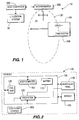
- FIGURE 1 shows a vehicle information system 10 including a tag system 120 mounted in a vehicle 100.
- the tag system 120 transmits vehicle-related data acquired from vehicle 100 and from external devices (shown in FIGURES 2, 3, 5 and 6) to interrogator 300.
- Vehicle information system 10 utilizes a data bus 110 (shown in FIGURES 2 and 5) in vehicle 100, which data bus 110 is typically part of vehicle 100 for control and monitoring of the operation thereof, with low-cost RF communications between tag system 120 and interrogator 300 to remotely access the vehicle-related data and data from the external device when the vehicle 100 is in a designated area 20.
- Interrogator 300 provides the data from vehicle 100 acquired through tag system 120 to host computer 320.
- the vehicle-related data includes, for example, temperature, fluid levels, oil pressure, odometer, and other data related to the vehicle 100.
- Data from an external device includes, for example, heading data from an electronic compass, pump data from a fueling pump and other data as may be acquired or generated by a device external to tag system 120 of vehicle 100.
- Tag system 120 may also be used to read the status of emissions-related and safety-related parameters without having to directly connect any equipment to the vehicle.
- the tag system 120 includes an RF transmitter 210 (shown in FIGURES 3 and 6) for transmitting the vehicle-related data and the data from an external device 500 and the interrogator 300 includes an RF receiver 305 (shown in FIGURES 3 and 6) for receiving the vehicle-related data and the data from an external device 500.
- the complexity and cost of the tag system 120 and the interrogator 300 are reduced because neither includes circuitry and software to both transmit and receive data.
- tag system 120 and interrogator 300 may each include both a transmitter and a receiver for each both transmitting and receiving data.
- Tag system 120 only monitors data transmitted on vehicle data bus 110 and, as a result, the control and operation of data bus 110 does not have to be modified to accommodate the tag system 120. In this way, the tag system 120 may be integrated into the vehicle 100 with minimal modification to the vehicle 100. Thus, the vehicle information system 10 is more likely to be accepted and incorporated into vehicles 100 by vehicle manufacturers. In an alternative embodiment, the tag system 120 may both receive data from data bus 110 and transmit data on data bus 110.
- Vehicle information system 10 may be utilized in a variety of environments to remotely monitor vehicles.
- the vehicle information system 10 may be used to determine the speed and/or direction of travel of a vehicle.
- the tag system 120 repeatedly transmits the speed and/or direction of travel along with the vehicle identification data of vehicle 100 as it travels along a road.
- An interrogator 300 positioned adjacent to the road or at an intersection receives the transmitted data for subsequent processing.
- vehicle information system 10 may be used to monitor cars and/or trucks as they leave and/or arrive at a vehicle rental facility, vehicle service facility, central terminal or other facility.
- interrogator 300 may be located at access points, e.g., entrance/ingress and exit/egress points, to the facility to acquire data transmitted from tag systems 120 coupled to the car and/or truck.
- the host computer 320 or host system 320 utilizes the data acquired from the interrogator 300 to determine which cars and/or trucks have entered and exited the facility or are located at particular locations or stations within the facility.
- FIGURE 1 shows a vehicle information system 10 including a tag system 120 mounted in an area of vehicle 100 not visible to the casual observer and not completely enclosed by metallic surfaces, for example, behind the dashboard in the passenger compartment, behind bumpers, or behind non-metallic body parts, or on the vehicle underside.
- Tag system 120 located in vehicle 100 intermittently transmits data, preferably in the form of message data packets 400 (shown in FIGURE 4).
- Interrogator 300 receives transmitted data message packets 400 when vehicle 100 is in the designated area 20 of interrogator 300.
- the size of designated area 20 may be adjusted by increasing or decreasing either the strength of the signal transmitted from tag system 120 or the sensitivity of the RF receiver 305 (shown in FIGURES 3 and 6) in interrogator 300, or by installing repeaters.
- Interrogator 300 has an antenna (not shown) that is oriented to define the orientation of area 20 with respect to interrogator 300 so that one or more message packets 400 transmitted from tag system 120 may be received by interrogator 300 when the vehicle 100 is in designated area 20.
- Interrogator 300 may be a hand held device or be permanently mounted.
- Interrogator 300 communicates with host computer 320 via a communication link, such as an RF link, electrical wires or cables, an optical fiber, or other convenient communication apparatus.
- Host computer 320 utilizes the data transmitted by tag system 120 to signal and/or control a utilization device or system 30.
- the utilizations of system 10 include controlling traffic signals to give preference to emergency vehicles, tracking the fueling or other service device which a particular vehicle is using, monitoring and/or controlling vehicles in a truck depot or auto rental facility, and the like.
- Host computer 320 determines whether the vehicle 100 "matches" predetermined criteria, for example, for purposes of setting traffic signals or authorizing vehicle fueling, based on the data transmitted from tag system 120 and information stored in host computer 320. Vehicle 100 matches if the stored data and the vehicle identification data are the same, such as by comparison to a stored look-up table. If there is a match, host computer 320 provides a signal to utilization system 30 to set the traffic signals or to allow vehicle 100 to receive fuel, as the case may be. If there is not a match, no action is taken or an attendant or supervisor may be alerted to investigate or otherwise take appropriate action.
- predetermined criteria for example, for purposes of setting traffic signals or authorizing vehicle fueling
- utilization system 30 is the traffic signal and controller which turns the signal "green” for the emergency vehicle and "red” for all other roads at the intersection.
- Interrogators 300 for such systems typically include antennas facing in particular directions, e.g., north, east, south and west, as indicated by compass indicia 22.
- area 20 might represent the reception pattern of a receiver connected to a south-facing antenna.
- microwave frequency and other RF communications are reflected by, buildings and other fixed and/or mobile objects, and so may appear to come from a direction other than the true direction. This can occur, for example, due to multiple reflected signals arriving out of phase at an intended receiver and in-phase at an unintended receiver.
- the RF signal from a vehicle approaching the intersection from a particular direction e.g., south
- an external device 500 is an electronic compass that determines the direction of travel (or heading, as in compass heading) of the emergency vehicle and provides that information to tag system 120 which transmits the heading information.
- Interrogator 300 receives the signal from tag system 300 including the heading information and communicates same to host computer 320 which utilizes the heading information to determine which state the traffic signal 30 should be put into to give priority to the direction from which the emergency vehicle is approaching.
- utilization device 30 might be a computer utilized for authorizing service, such as fueling, or for billing, inventory control or other function. Such arrangement might be utilized with commercial as well as privately-owned vehicles, for example, in a car rental facility, a truck depot, or a gas station.
- interrogator 300 detects its presence from its transmitted signal and signals same to host computer 320 which authorizes the dispensing of fuel or other service based on an appropriate approval protocol.
- dispenser identification information is coupled to vehicle 100 through the fueling hose of the pump being placed in a fuel filler opening in the vehicle. While such information coupling could be by electrical signals transmitted through wires in the fueling hose to contacts in the vehicle filler pipe, the danger of fire or explosion renders such approaches undesirable.
- Couplings in the vehicle other than contacts could include a pair of induction coils, one in nozzle 616 and the other in filler pipe 132 surrounding nozzle 616 when nozzle 616 is inserted in filler pipe 132, but that still requires electrical wires in fuel hose 614.
- a transmitting acoustic transducer in the fueling pump transmits the pump identification information acoustically through the fueling hose and/or the fuel therein to a sensor in the vehicle that includes a receiving acoustic transducer.
- acoustic transmission system is inherently safe because the acoustic transducers and signal pose no danger of fuel ignition, either at the transmitter in the fuel dispenser or at the receiver in the vehicle, and there are no electrical wires in the fuel hose or in other fuel passages.
- Such acoustic system also avoids the reliability issues where electrical wires are embedded in a flexible hose and must pass through or around swivels, couplings and other plumbing components.
- FIGURES 2, 3 and 4 An embodiment that inserts heading information as external data into the RF tag system 120 of an emergency vehicle 100, as for giving priority to such vehicle, is described in relation to FIGURES 2, 3 and 4. It is noted that while a wide variety of different RF tag systems and interrogators could be employed in embodiments of the present invention, the tag system and interrogator described in U.S. Patent No. 5,974,386, are thought to be well suited and the descriptions herein are based upon such system.
- vehicle 100 includes vehicle data bus 110 that is used to transmit data between various vehicle components, such as fuel tank system 130, instrument panel 140, and other vehicle modules 150, and vehicle computer 160.
- Module 150 is, for example, an interface with other vehicle components of vehicle 100, such as the engine (not shown).
- Vehicle computer 160 may be, for example, the body or engine computer in the vehicle 100.
- Data is provided to and retrieved from data bus 110 (as indicated by double-ended arrows) in accordance with a data standard, for example, a vehicle data bus standard such as the Society of Automotive Engineers (SAE) J1850 standard or the Controller Area Network (CAN) standard.
- SAE J1850 standard defines an electrical and data protocol for transmitting and receiving data via data bus 110 between and/or among the components coupled to data bus 110, such as fuel tank system 130, instrument panel 140, module 150, and vehicle computer 160.
- Data bus 110 and the vehicle components coupled thereto are designed to ensure the reliable transmission of vehicle data, and the addition of other components that transmit data on data bus 110 may require modification of the operation of the vehicle components or substantial modification of data bus 110, or both, to ensure reliable data transmission. Thus it may not be advantageous to provide additional components that transmit data via data bus 110.
- Tag system 120 avoids these problems because it only monitors the data (as indicated by a single-ended arrow from data bus 110) that is transmitted by the vehicle components on data bus 110, and may be coupled to data bus 110 by, for example, crimping a connector on the wire or wires forming data bus 110.
- Data bus 110 may be, for example, as simple as a single wire loop. Because neither the vehicle components nor data bus 110 need be modified, tag system 120 may be integrated with minimal modification of the vehicle 100, and so vehicle manufacturers may be more willing to incorporate tag system 120 into vehicle 100. As a result, the installation costs of tag system 120 are minimized. Alternatively, tag system 120 may transmit data via data bus 110.
- an external data source provides external data unrelated to vehicle data to tag system 120.
- An external data source is typically an external device, such as electronic compass 500.
- Electronic compass 500 is preferably a low-cost device that is mounted to vehicle 100 in a predetermined orientation so as to determine the vehicle's heading.
- One suitable such electronic compass is the model Vector 2X available from Precision Navigation, located in Santa Rosa, California.
- Electronic compass 500 preferably generates a serial data stream that contains calibrated heading information for vehicle 100. While an electronic compass is preferred because of its small size, low operating power and low cost, other external devices, such as a gyroscope, a magnetic compass, a GPS receiver and the like, could also be utilized to provide the same or similar heading information.
- Tag system 120 is powered by vehicle battery 170 and may also transmit battery voltage information.
- tag system 120 includes processor 205 that is coupled to receive data from interface 200, to control and receive data from A/D converter 215, and provide data to RF transmitter 210 for transmission.
- Interface 200 is coupled to receive external data from external device, such as heading data from electronic compass 500 and to couple such data to processor 205.
- interface 200 is, for example, compliant with the SAE J1850 standard to provide an interface between tag system 120 and vehicle data bus 110 to only retrieve data from bus 110.
- Data that is transmitted on data bus 110 by the vehicle components coupled thereto typically includes component identification data and parametric data related to the vehicle component and/or its operation, which data is often contained in one or more data packets.
- interface 200 may also provide data to data bus 110.
- the data acquired from electronic compass 500 and from data bus 110 is provided to processor 205 which is, for example, a microprocessor or microcontroller.
- Interface 200 and processor 205 may be separate components or may be combined as a single component.
- One such combined component is integrated circuit part number MC68HC05V7 available from Motorola, Inc. located in Scottsdale, Arizona, which circuit is compatible, for example, with General Motors automobiles compliant with the SAE J1850 standard.
- Operation of processor 205 is known, for example, as described in U.S. Patent No. 5,974,368, and includes providing data to RF transmitter 210 for modulation and transmission.
- Processor 205 may also receive data from analog-to-digital (A/D) converter 215 which is coupled directly to a component that produces analog data, such as an analog data output 502 of electronic compass 500 (data path indicated by dashed arrow), or to an analog component of vehicle 100 such as a fuel-level sensing potentiometer or a temperature-sensing resistance.
- processor 205 may receive digital data directly from digital components, such as a digital data output 504 of electronic compass 500 (data path indicated by dashed arrow), or from a digital component in vehicle 100, i.e. data not requiring conversion by AID converter 215.
- processor 205 may receive digital data at a data bus input 206 from data bus 110 via interface 200, at an "analog" input 207 from an analog source converted to digital format by AID converter 215, and at a digital input 208 from a source of digital data in suitable format.
- Processor 205 produces a message data packet 400, such as that shown in FIGURE 4, and controls and modulates RF transmitter 210 to transmit 225 message packet 400, such as by turning transmitter 210 on and off, as is known.
- RF transmitter 210 is, for example, an AM surface acoustic wave (SAW) transmitter.
- SAW surface acoustic wave
- the message packet 400 transmitted by tag system 120 via RF link 225 is received by interrogator 300 which includes an RF receiver 305 that receives transmitted message packet 400.
- the received message packet 400 from receiver 305 is provided to demodulator 310 which demodulates received message packet 400 and couples the demodulated data to processor 315.
- Processor 315 processes and converts the received message packet data to a form suitable for host computer 320.
- RF link 225 between tag system 120 and interrogator 300 may be implemented using either "active" or “semi-active" transmission technology.
- battery 170 powers all of tag system 120 continually to produce continuous, or at least periodic, transmissions.
- battery 170 powers all of tag system 120 except for transmitter 210, and message packets 400 are transmitted between transmitter 210 and interrogator 300 via "passive backscatter.”
- passive backscatter a continuous wave is transmitted by interrogator 300, which is passively modulated and reflected back to interrogator 300 by tag system 120, as is known.
- FIGURE 4 A format for a message packet or data packet 400 containing several different types of data is shown in FIGURE 4.
- Message packet 400 includes a data type field 405 that indicates what type of data is contained in the packet and a sequence data field 410 that indicates whether the message packet 400 is a single message packet or one of a sequence of related message packets. In the latter case, sequence data field 410 indicates the position of each message packet 400 in the sequence of related message packets.
- Related message packets 400 may be utilized to reduce the size of each message packet, thereby to reduce the likelihood of data packet transmission collisions and interference among transmissions from a number of different tag systems 120.
- Data packet 400 includes, for example, vehicle identification data (VID) field 415, such as a vehicle identification number (VIN), that uniquely identifies vehicle 100 so that interrogator 300 and/or host computer 320 can associate each message packet with other message packets from the same vehicle.
- VIN vehicle identification number
- the message packet 400 may also include vehicle-related data fields such as fuel data field 420 indicating the fuel level in the fuel tank and odometer data field 425 indicating the odometer reading.
- Extra data field 430 is contained in message packet 400 for providing data from the external data source, such as from electronic compass 500, to interrogator 300 and host computer 320 via tag system 120.
- Message packet 400 also includes an error correction code 435, which is, for example, a cyclic redundancy code (CRC).
- CRC cyclic redundancy code
- FIGURE 5 is a schematic block diagram of a vehicle 100 including a tag system 120 and an external device 510 for identifying a dispenser according to an embodiment of the present invention.
- Vehicle 100 includes vehicle data bus 110 that is used to transmit data between various vehicle components, such as fuel tank system 130, instrument panel 140, other vehicle modules 150, and vehicle computer 160, and data is provided to and retrieved from data bus 110 (as indicated by double-ended arrows) in accordance with a data standard, all as described above in relation to FIGURE 2.
- Dispenser 600 includes a fuel pump 610 that pumps fuel through outlet pipe 612 and hose 614 to fuel nozzle 616, as is conventional. Actuating a valve in nozzle 616 causes fuel to flow from nozzle 616 into fuel filler pipe 132 of vehicle 100 and thence into fuel tank 130, as is conventional. During fueling, fuel is present in outlet pipe 612, hose 614 and filler pipe 132.
- fuel dispenser 600 represents a service dispenser and filler pipe 132 represents a service receiver on vehicle 100.
- external data 510 provides external data unrelated to vehicle data, such as identification data or other data relating to fuel dispenser 600 or other service facility, to tag system 120.
- External data source 510 is, for example, a source of signals relating to such service facility or service device, such as the fuel dispenser 600 that is used to fuel vehicle 100.
- Dispenser 600 includes a source 620 of pump identification information, for example, a uniquely coded digital word contained in an electronic memory such as a read-only-memory or a set of switches.
- Tone encoder 630 receives the pump-identifying digital word and encodes the pump identification as a sequence of tones, for example, as a sequence of audio frequency tones. In addition, encoder 630 may modulate the sequence of tones on a carrier signal, thereby producing a uniquely-coded audio-frequency electrical signal containing the pump identifying information.
- the coded electrical signal is provided to transmitting acoustic transducer 640 which is coupled 642 to outlet pipe 612 or to another fuel passage of dispenser 600 to transmit into the fuel therein an audio-frequency acoustic signal containing the pump information.
- the acoustic signal propagates through the fuel, i.e. through the column of fuel in outlet pipe 612, hose 614 and nozzle 616, to fuel filler pipe 132 of vehicle 100.
- External device 510 includes receiving acoustic transducer 520 that is coupled 512 to vehicle fuel filler pipe 132 to receive the acoustic signal, i.e. the coded audio tones, from the fuel therein.
- Device 510 includes a sensor 520 that converts the sequence of audio tones to an electrical tone signal and a tone decoder 630 that decodes the sequence of electrical tones to a digital electronic signal, such as a serial digital word, that is applied to tag system 120.
- Tag system 120 transmits the serial digital word representing the pump identification information to interrogator 300.
- FIGURE 6 is a schematic block diagram of a portion of system 10 illustrating tag system 120, interrogator 300 and external device 510 for identifying dispenser 600 according to an embodiment of the present invention.
- Tag system 120 includes processor 205 that is coupled to receive data from interface 200, to control and receive data from A/D converter 215, and provide data to RF transmitter 210 for transmission, all as described above in relation to FIGURE 3.
- Interface 200 is coupled to receive external data from external device 510, such as pump identification data from dispenser 600 in the form of a digital word produced by sensor/tone decoder 510, and to couple such data to processor 205.
- sensor/tone decoder 510 may produce at an output 514 a digital word representative of dispenser 600 identification in a form compatible with a digital input to processor 205 an apply such digital word directly thereto.
- the message packet 400 transmitted by tag system 120 to interrogator 300 is processed by host computer 320 to relate the vehicle identification data and pump identification data from tag system 120, such as for confirming authorization of the sale, billing the correct customer, maintaining fueling and/or inventory records, and the like. It is noted that if nozzle 616 is removed from filler pipe 132 of vehicle 100, the pump identification information in the data packets 400 transmitted by tag system 120 will be interrupted, such interruption can be utilized to interrupt or stop the pumping of fuel by dispenser 600, thereby preventing fueling to be resumed in another vehicle (unauthorized fueling or theft) and/or limiting spillage and the fire hazard and potential environmental damage that could result.
- Acoustic transducers for transmitting acoustic signals into a liquid and for sensing acoustic signals from a liquid are widely available and are utilized in many commercial devices, such as "sonar" fish finders and depth gauges for baits, and for ultra-sound medical devices and the like. Such devices are attached to fuel outlet pipe 612 and fuel filler pipe 132 in convenient locations in accordance with standard attachment and/or mounting practices. While the coded signals are described as audio-frequency tones, coded signals in other frequency ranges, such as ultrasonic frequencies, and coding other than tone coding, may be employed.
- a vehicle service dispenser system may comprise, for example, a service dispenser 600 external to a vehicle 100 that includes a source 620 of service dispenser information and a transducer 640 for transmitting the service dispenser information, such as by an acoustic transducer 640 coupled to a fueling hose 614.
- the fueling hose 614 couples the vehicle 100 to the service dispenser 600 for receiving service therefrom.
- a sensor 510 such as an acoustic transducer 520 is adapted to receive the service dispenser information from the service dispenser 600 external to the vehicle 100 via a coupling means, e.g., the fuel hose 614.
- means coupled to the sensor 510 is responsive to at least the service dispenser information for utilizing the service dispenser information.
- the sensor 510 includes a first transducer of a given kind and the service dispenser 600 includes a second transducer of the same kind, for example, an acoustic transducer 520 in the sensor 510 coupled to a fluid system 130, 132 of the vehicle 100 and an acoustic transducer 640 in the service dispenser 600 coupled to a fluid passage 612 of the service dispenser 600.
- the service dispenser information may include identification information, and means in the vehicle 120, 140, 150, 160 may utilize the service dispenser information, for example, for at least one of authentication, billing, theft prevention, spill limiting, verifying proper service, and inventorying (i.e. making an inventory).
- the acoustic transducer 520 in the vehicle 100 may signal or communicate information to the acoustic transducer 640 in the service dispenser 600 and means in the service dispenser may utilize the received information, for example, for at least one of authentication, billing, theft prevention, spill limiting, verifying proper service, and inventorying.
- information exchanged between a vehicle and a fuel dispenser may relate to fuel type, octane rating, credit/billing data, vehicle fleet or ownership, various alarms or alerts, applicable discounts, and the like.
- system 120 may be embodied in a tag that is connected to vehicle 100, or be embodied in a part of vehicle 100, either as a separate vehicle component or as part of another vehicle component.
- additional data from one or more external data sources may be inserted on a rotating basis into any data field including data field 430.
- additional data regarding vehicle 100 for example, engine status data or air-bag activation of other collision data, may be transmitted on a rotating basis in fields 420, 425.
- RF link 225 may provide either one-way (only from tag system 120 to interrogator 300) or two-way communication.
- a one-way link 225 provides a monitoring function where the tag system 120 transmits current external data, e.g., heading or fueling station information, and current condition of all monitored parameters of vehicle 100, as described above.
- a two-way link 225 allows interrogator 300 to send messages to tag system 120 to either command or control tag system 120 to monitor certain parameters, or to pass parameters to external data source 500 or to systems in vehicle 100.
- link 225 may provide the means to remotely perform certain functions, such as to control the sensitivity of electronic compass 500 or to control fueling station 600, as well as to control vehicle 100 systems, such as to lock/unlock doors and monitor/adjust emission control sensors and other systems.
- the acoustic coupling link 510, 614, 640 may provide either one-way (only from dispenser 600 to tag system 120) or two-way communication.
- a one-way link provides a monitoring function where the tag system 120 receives current external data, e.g., pump identification or other fueling station information, and current condition of all monitored parameters of vehicle 100, as described above.
- a two-way link allows dispenser 600 to send messages to tag system 120 to either command or control tag system 120 to monitor certain parameters, or to pass parameters to vehicle 100 and/or to interrogator 300 and/or utilization system 30 or to systems in vehicle 100. In the latter case, a two-way link provides the means for tag system 120 to send vehicle information to dispenser 600, such as fuel type and octane requirements, credit card or billing information or other control or monitoring information.
- Vehicles as used herein may include not only cars and trucks, but also trains, boats, airplanes and any other movable object for which heading information or service facility information is desired.
- a service facility may be a fuel dispensing facility, such as a gas station, or any other facility or station that provides one or more fluids for a vehicle. Embodiments of the invention are thus useful with any service dispenser and a corresponding service receiver on a vehicle.
Landscapes
- Physics & Mathematics (AREA)
- General Physics & Mathematics (AREA)
- Loading And Unloading Of Fuel Tanks Or Ships (AREA)
Applications Claiming Priority (4)
| Application Number | Priority Date | Filing Date | Title |
|---|---|---|---|
| US14984799P | 1999-08-19 | 1999-08-19 | |
| US149847P | 1999-08-19 | ||
| US63884500A | 2000-08-14 | 2000-08-14 | |
| US638845 | 2000-08-14 |
Publications (1)
| Publication Number | Publication Date |
|---|---|
| EP1077433A1 true EP1077433A1 (fr) | 2001-02-21 |
Family
ID=26847089
Family Applications (1)
| Application Number | Title | Priority Date | Filing Date |
|---|---|---|---|
| EP00307044A Withdrawn EP1077433A1 (fr) | 1999-08-19 | 2000-08-17 | Saisie et transfer de données |
Country Status (1)
| Country | Link |
|---|---|
| EP (1) | EP1077433A1 (fr) |
Cited By (3)
| Publication number | Priority date | Publication date | Assignee | Title |
|---|---|---|---|---|
| WO2002040394A1 (fr) * | 2000-11-17 | 2002-05-23 | The Lubrizol Corporation | Systeme permettant de diagnostiquer, de maintenir et de rapporter la performance et les conditions de securite d'un appareil au cours de son ravitaillement |
| DE10351950A1 (de) * | 2003-11-07 | 2005-06-09 | Zf Friedrichshafen Ag | Verfahren zur Datenübertragung zwischen einem Kraftfahrzeug und einem externen Datenspeicher- und -steuermodul |
| EP2320385A1 (fr) * | 2009-10-21 | 2011-05-11 | Florian Matschnigg | Procédé et système d'identification explicite de véhicules et prestations de services réalisés à l'aide de celui-ci |
Citations (7)
| Publication number | Priority date | Publication date | Assignee | Title |
|---|---|---|---|---|
| US4831539A (en) * | 1984-04-27 | 1989-05-16 | Hagenbuch Roy George Le | Apparatus and method for locating a vehicle in a working area and for the on-board measuring of parameters indicative of vehicle performance |
| US5058044A (en) | 1989-03-30 | 1991-10-15 | Auto I.D. Inc. | Automated maintenance checking system |
| WO1997021626A1 (fr) * | 1995-12-08 | 1997-06-19 | Gilbarco Inc. | Ravitaillement intelligent |
| US5825283A (en) * | 1996-07-03 | 1998-10-20 | Camhi; Elie | System for the security and auditing of persons and property |
| DE19852814A1 (de) * | 1997-11-27 | 1999-06-02 | Continental Teves Ag & Co Ohg | Verfahren und Vorrichtung zum Versorgen von Kraftfahrzeugen mit Daten oder zum Datenaustausch |
| US5974368A (en) | 1997-08-29 | 1999-10-26 | Sarnoff Corporation | Remote vehicle data interface tag system |
| US5974386A (en) | 1995-09-22 | 1999-10-26 | Nikon Corporation | Timeline display of sound characteristics with thumbnail video |
-
2000
- 2000-08-17 EP EP00307044A patent/EP1077433A1/fr not_active Withdrawn
Patent Citations (7)
| Publication number | Priority date | Publication date | Assignee | Title |
|---|---|---|---|---|
| US4831539A (en) * | 1984-04-27 | 1989-05-16 | Hagenbuch Roy George Le | Apparatus and method for locating a vehicle in a working area and for the on-board measuring of parameters indicative of vehicle performance |
| US5058044A (en) | 1989-03-30 | 1991-10-15 | Auto I.D. Inc. | Automated maintenance checking system |
| US5974386A (en) | 1995-09-22 | 1999-10-26 | Nikon Corporation | Timeline display of sound characteristics with thumbnail video |
| WO1997021626A1 (fr) * | 1995-12-08 | 1997-06-19 | Gilbarco Inc. | Ravitaillement intelligent |
| US5825283A (en) * | 1996-07-03 | 1998-10-20 | Camhi; Elie | System for the security and auditing of persons and property |
| US5974368A (en) | 1997-08-29 | 1999-10-26 | Sarnoff Corporation | Remote vehicle data interface tag system |
| DE19852814A1 (de) * | 1997-11-27 | 1999-06-02 | Continental Teves Ag & Co Ohg | Verfahren und Vorrichtung zum Versorgen von Kraftfahrzeugen mit Daten oder zum Datenaustausch |
Cited By (3)
| Publication number | Priority date | Publication date | Assignee | Title |
|---|---|---|---|---|
| WO2002040394A1 (fr) * | 2000-11-17 | 2002-05-23 | The Lubrizol Corporation | Systeme permettant de diagnostiquer, de maintenir et de rapporter la performance et les conditions de securite d'un appareil au cours de son ravitaillement |
| DE10351950A1 (de) * | 2003-11-07 | 2005-06-09 | Zf Friedrichshafen Ag | Verfahren zur Datenübertragung zwischen einem Kraftfahrzeug und einem externen Datenspeicher- und -steuermodul |
| EP2320385A1 (fr) * | 2009-10-21 | 2011-05-11 | Florian Matschnigg | Procédé et système d'identification explicite de véhicules et prestations de services réalisés à l'aide de celui-ci |
Similar Documents
| Publication | Publication Date | Title |
|---|---|---|
| KR101752818B1 (ko) | 자동차용 전기 배터리 | |
| US5995898A (en) | RFID system in communication with vehicle on-board computer | |
| CA2309929C (fr) | Procede et appareil permettant de detecter automatiquement un evenement dans un systeme de communication sans fil | |
| US7904219B1 (en) | Peripheral access devices and sensors for use with vehicle telematics devices and systems | |
| US7561102B2 (en) | Method of and system for expanding localized missing customer-vehicle law enforcement-aided VHF recovery networks with location-on-demand supplemental service features via such networks for improved law enforcement-aided recovery, and via the internet for providing supplemental customer service features | |
| JP3721089B2 (ja) | 車両診断システム及び該システムを用いた自動車 | |
| US6847825B1 (en) | Method and system for portable cellular phone voice communication and positional location data communication | |
| EP0707704B1 (fr) | Procede et appareil de localisation differentielle d'un vehicule, commande par un changement d'etat interne | |
| US7098806B2 (en) | Traffic preemption system | |
| JP3903734B2 (ja) | 車両データアクセス方法および車載端末 | |
| US20060129290A1 (en) | Methods and systems for communicating vehicular data | |
| CN106097775A (zh) | 一种基于导航的预警方法、终端设备及服务器 | |
| WO2000030058A1 (fr) | Procede et appareil de collecte de donnees de trafic au moyen d'un dispositif gps et procede de traitement de donnees de vitesse, base sur des informations de trafic collectees par des vehicules | |
| JPH0886853A (ja) | 移動体間相対位置検知システム | |
| EP1077433A1 (fr) | Saisie et transfer de données | |
| JP2003511774A (ja) | 移動ルートモニター装置 | |
| EP2360059A1 (fr) | Unité embarquée pour appareil électrique d'un véhicule | |
| JPH027200A (ja) | 自動車の故障通信システム | |
| KR100658898B1 (ko) | 핸드프리장치를 이용한 차량사고발생 통보방법 및 장치 | |
| KR100563258B1 (ko) | 자동차 사고 통보 장치 | |
| JPH0843517A (ja) | 車載ナビゲーションシステム | |
| JP7725997B2 (ja) | タイヤ空気圧監視システム | |
| JPH0160880B2 (fr) | ||
| JPH03189800A (ja) | 駐車位置案内システム | |
| MXPA00004709A (en) | Method and apparatus for automatic event detection in a wireless communication system |
Legal Events
| Date | Code | Title | Description |
|---|---|---|---|
| PUAI | Public reference made under article 153(3) epc to a published international application that has entered the european phase |
Free format text: ORIGINAL CODE: 0009012 |
|
| AK | Designated contracting states |
Kind code of ref document: A1 Designated state(s): DE ES FR GB IE IT |
|
| AX | Request for extension of the european patent |
Free format text: AL;LT;LV;MK;RO;SI |
|
| RIN1 | Information on inventor provided before grant (corrected) |
Inventor name: KALOKITIS, DAVID Inventor name: JOHNSON, HENRY C. Inventor name: PAGLIONE, ROBERT WAYNE Inventor name: SCHEPPS, JONATHAN LLOYD |
|
| 17P | Request for examination filed |
Effective date: 20010802 |
|
| AKX | Designation fees paid |
Free format text: DE ES FR GB IE IT |
|
| STAA | Information on the status of an ep patent application or granted ep patent |
Free format text: STATUS: THE APPLICATION HAS BEEN WITHDRAWN |
|
| 18W | Application withdrawn |
Effective date: 20030522 |