EP1081619A2 - Dispositif et procédé pour courrier électronique - Google Patents
Dispositif et procédé pour courrier électronique Download PDFInfo
- Publication number
- EP1081619A2 EP1081619A2 EP00303005A EP00303005A EP1081619A2 EP 1081619 A2 EP1081619 A2 EP 1081619A2 EP 00303005 A EP00303005 A EP 00303005A EP 00303005 A EP00303005 A EP 00303005A EP 1081619 A2 EP1081619 A2 EP 1081619A2
- Authority
- EP
- European Patent Office
- Prior art keywords
- electronic mail
- image data
- destination
- sentence
- text
- Prior art date
- Legal status (The legal status is an assumption and is not a legal conclusion. Google has not performed a legal analysis and makes no representation as to the accuracy of the status listed.)
- Withdrawn
Links
Images




Classifications
-
- G—PHYSICS
- G06—COMPUTING OR CALCULATING; COUNTING
- G06Q—INFORMATION AND COMMUNICATION TECHNOLOGY [ICT] SPECIALLY ADAPTED FOR ADMINISTRATIVE, COMMERCIAL, FINANCIAL, MANAGERIAL OR SUPERVISORY PURPOSES; SYSTEMS OR METHODS SPECIALLY ADAPTED FOR ADMINISTRATIVE, COMMERCIAL, FINANCIAL, MANAGERIAL OR SUPERVISORY PURPOSES, NOT OTHERWISE PROVIDED FOR
- G06Q10/00—Administration; Management
- G06Q10/10—Office automation; Time management
- G06Q10/107—Computer-aided management of electronic mailing [e-mailing]
-
- H—ELECTRICITY
- H04—ELECTRIC COMMUNICATION TECHNIQUE
- H04L—TRANSMISSION OF DIGITAL INFORMATION, e.g. TELEGRAPHIC COMMUNICATION
- H04L51/00—User-to-user messaging in packet-switching networks, transmitted according to store-and-forward or real-time protocols, e.g. e-mail
- H04L51/06—Message adaptation to terminal or network requirements
- H04L51/063—Content adaptation, e.g. replacement of unsuitable content
-
- H—ELECTRICITY
- H04—ELECTRIC COMMUNICATION TECHNIQUE
- H04L—TRANSMISSION OF DIGITAL INFORMATION, e.g. TELEGRAPHIC COMMUNICATION
- H04L51/00—User-to-user messaging in packet-switching networks, transmitted according to store-and-forward or real-time protocols, e.g. e-mail
- H04L51/06—Message adaptation to terminal or network requirements
- H04L51/066—Format adaptation, e.g. format conversion or compression
Definitions
- the present invention relates to an electronic mail apparatus and method.
- An electronic mail can be transmitted to anyone in the world in an environment which can be connected to a network. For this reason, if the difficulties of communication caused by differences between languages can be overcome, it is supposed that the electronic mail can become a convenient tool which can be easily used by anyone.
- Japanese is expressed by hiragana, katakana, and kanji , where the number of types of characters to be expressed is several thousands to several tens of thousands. For this reason, in Japan, a 2-byte character code is used to express one character.
- German is expressed by roman letters and characters obtained by adding umlauts to the roman letters. For this reason, the number of types of used characters is larger than English. Therefore, in Germany, in order to express one character, a 1.5-byte character code is used.
- a character display device e.g., a personal computer, a work station, a mobile computer, a mobile telephone set, or the like
- a character display device for displaying text characters using character codes is operable to handle character codes (text data) which can express the language of the country in which the device is used.
- character codes which are handled by the character display device are different from each other, the following problem occurs.
- character codes which can be handled by the character display device are limited to character codes which can display text of the language of the country in which the device is used.
- the character display device cannot display text characters by using character codes other than the character codes which can be handled by the device. For this reason, since a character display device used in the U.S.A. can handle only 1-byte character codes, the character display device cannot handle 1.5-byte and 2-byte character codes. More specifically, Japanese and German text cannot be displayed.
- the character display device used by the friend can receive only 1-byte codes, and consequently the character display device cannot display the text contents of the electronic mail.
- character codes text data
- the text contents of the electronic mail cannot be displayed on the reception side.
- an electronic mail apparatus comprising: an image data forming unit using a sentence input as the contents of an electronic mail to form image data corresponding to the sentence; and a transmission unit transmitting the formed image data to a destination of the electronic mail.
- most computers used as terminal devices can handle image files (e.g., bit map files), and can display images based on the image files. More specifically, the image files can be handled in common in most computers around the whole world.
- image files e.g., bit map files
- the image data of a sentence constituting the contents of the electronic mail are transmitted. For this reason, for example, even when characters expressed in a language used by the transmission source cannot be text-displayed on the reception side, an image based on the image data can usually be displayed. Therefore, on the reception side, a sentence of the electronic mail based on the image data can usually be displayed.
- the receiver of the electronic mail can read the text of the electronic mail from the image of the sentence using characters expressed in the language used by the transmission source.
- An embodiment of the present invention preferably further comprises a check unit checking whether a sentence should be transmitted as text data or image data, and the image data forming unit may form image data corresponding to the sentence by using the sentence if it is determined by the check unit that the image data should be transmitted.
- the check unit preferably determines that the sentence should be transmitted as image data if it is determined that the text data of the sentence is not correctly displayed.
- An embodiment of the present invention preferably further comprises a display control unit displaying a sentence on a screen by using the text data of a sentence, and the image data forming unit may form image data corresponding to the sentence in a format of the sentence displayed on the screen by the display control unit.
- An embodiment of the present invention preferably further comprises a translation unit translating, when a sentence is expressed in a language different from a language used in a destination of the electronic mail, the sentence into the language used in the destination.
- the transmission unit may transmit translation results obtained by the translation unit to the destination of the electronic mail.
- the image data forming unit preferably forms the translation image data of the translation results expressed by characters written in the language used in the destination when the display control unit cannot text-display characters written in the language used in the destination of the electronic mail, and the display control unit may display the translation image data on a screen such that the translation image data can be edited.
- the image data forming unit when the display control unit cannot text-display characters written in the language used in the destination of the electronic mail, the image data forming unit preferably forms the translation image data of the translation results expressed by characters written in the language used in the destination.
- Such an embodiment of the present invention further comprises a synthesizing unit forming synthesized image data obtained by combining the image data corresponding to the input sentence formed by the image data forming unit to the translation image data, and the transmission unit may transmit the synthesized image data to the destination of the electronic mail.
- the transmission unit preferably transmits the image data as an attached file to the destination of the electronic mail.
- an electronic mail formed in the language used on the transmission side can be read on the reception side.
- Fig. 1 is a diagram for explaining an electronic mail system according to an embodiment of the present invention.
- the electronic mail system is constituted by a plurality of terminal devices connected to a network.
- Fig. 1 for example, an electronic mail system in which a plurality of terminal devices T1, T2, and T3 are connected to each other through a network NW is shown.
- the terminal devices T1, T2, and T3 are, for example, personal computers, work stations, mobile computers (mobile terminals), or mobile telephone sets.
- the terminal device T1 is arranged in Japan, and can text-display Japanese and English by using 2-byte character codes.
- the terminal device T2 is arranged in the U.S.A., and can text-display only English by using 1-byte character code.
- the terminal device T3 is arranged in Germany, and can text-display English and German by using 1.5-byte character codes.
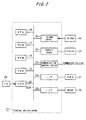
- Fig. 2 is a block diagram showing example hardware of the terminal devices T1, T2, and T3 shown in Fig. 1. Since the terminal devices T1, T2, and T3 have the same hardware configurations, the terminal device T1 will be described for example.
- the terminal device T1 comprises a CPU (Central Processing Unit) 16, a ROM (Read Only Memory) 17, a RAM (Random Access Memory) 18, a hard disk drive (HDD) 19, a floppy disk drive (FDD) 20, a CD-ROM driver 21, a graphic board 22, a communication control device 23, and interface circuits (I/Fs) 24 and 25 which are connected to each other through a bus BUS.
- a CPU Central Processing Unit
- ROM Read Only Memory
- RAM Random Access Memory
- HDD hard disk drive
- FDD floppy disk drive
- I/Fs interface circuits
- the graphic board 22 is connected to a display device 41 such as a cathode ray tube (CRT) or a liquid crystal display (LCD).
- the I/F 24 is connected to a keyboard (KBD) 27.
- the I/F 25 is connected to a mouse 28 or a pointing device such as a track ball, a flat space, or a joy stick.
- the ROM 17 stores a booting program therein.
- the booting program is executed by the CPU 16 when the terminal device T1 is powered on.
- an operating system (OS) stored in the HDD 19 and a single driver or a plurality of drivers for a display process or a communication process are loaded on the RAM 18 to make it possible to execute various processes and controls.
- OS operating system
- the RAM 18 a program for controlling the terminal device T1 is developed.
- the RAM 18 holds a process result obtained by a program, temporary data for a process, displaying data for displaying the process result or the like on the screen of the display 26, and the like.
- the RAM 18 is used as a work region for the CPU 16.
- the displaying data developed on the RAM 18 is transmitted to the display 26 through the graphic board 22.
- the display 26 displays display contents corresponding to the displaying data on the screen of the display 26.
- the HDD 19 is a device for recording or reading a program, control data, text data, image data, or the like on/from a hard disk in accordance with an instruction from the CPU 16.
- the FDD 20 is a device for recording or reading a program, control data, text data, image data, or the like on/from a floppy disk 29 in accordance with an instruction from the CPU 16.
- the CD-ROM driver 21 is a device for reading a program or data recorded on a CD-ROM (read only memory using a compact disk) 30 in accordance with an instruction from the CPU 16.
- the communication control device 23 executes transmission/reception of data to/from another device or downloading of a program or data by using a communication line connected to the terminal device T1 in accordance with an instruction from the CPU 16.
- the KBD 27 comprises a plurality of keys (character input keys, cursor keys, and the like).
- the KBD 27 is used to cause an operator to input data in the terminal device T1.
- the mouse 28 is used to input a selection instruction using a mouse cursor displayed on the display 26.
- the CPU 16 executes various types of programs stored in the ROM 17, the hard disk, the FD 29, and the CD-ROM 30 (they correspond to recording media).
- the terminal device T1 functions as an electronic mail apparatus embodying the present invention.
- the program and data held in the recording medium such as a hard disk may be manually recorded on the recording medium by the operator, and a program or data may be downloaded from another device to be recorded on the recording medium.
- the terminal device T1 functions as an electronic mail apparatus for performing the following operation such that the CPU 16 executes a program.
- Fig. 3 is a flow chart showing an operation in the terminal device T1.
- an environment for forming an electronic mail in a mother tongue is provided to a user of the terminal device T1 (step S01). More specifically, an environment for forming a sentence constituting the contents of an electronic mail is provided such that the CPU 16 executes an application program of a text editor.
- the user operates the KBD 27 in the provided environment to form the sentence of an electronic mail.
- the CPU 16 forms a text file corresponding to the formed sentence.
- the CPU 16 displays the sentence based on the formed text file on the screen of the display 26 in accordance with a predetermined format.
- An environment for specifying a destination of an electronic mail is provided to the user (step S02). More specifically, the CPU 16 reads address list 52 (see Fig. 7) of electronic mails recorded on the hard disk or the FD 29 in accordance with an instruction input from the user through the KBD 27 or the mouse 28, and the address list 52 is displayed on the screen of the display 26.
- the user refers to the address list 52 selects the address corresponding to the destination by using the KBD 27 or the mouse 28. At this reason, when the address corresponding to the destination is not in the address list 52, the user inputs the corresponding address to the terminal device T1 by using the KBD 27.
- step S03 It is checked whether a language identical to the language in the transmission source of the electronic mail is used in the destination or not (step S03). At this time, if it is determined that the languages is identical with each other, the operation shifts to step S11. If it is determined that the languages are different from each other, the operation shifts to step S04.
- the CPU 16 performs determination by using determination data prepared in advance. In place of this determination, a question whether the language (Japanese) used in the transmission source is identical to the language used in the destination may be provided to the user through the display 26, and the operation may shift to step S11 or step S04 depending on the answer, i.e., "identical” or “different” of the user. Also, the CPU 16 may analyze a language used in the destination on the basis of the address specified in step S02 to automatically checks whether the identical languages are used in the transmission source and in the destination.
- a question whether the language (Japanese) used in the transmission source is identical to the language used in the destination may be provided to the user through the display 26, and the operation may shift to step S11 or step S04 depending on the answer, i.e., "identical” or “different” of the user.
- the CPU 16 may analyze a language used in the destination on the basis of the address specified in step S02 to automatically checks whether the identical languages are used in the transmission source and in the destination.
- step S04 a language (mother tongue) used in the destination is specified, the sentence formed in step S01 is translated into the specific language.
- the language may be specified such that the user designates the language, and the CPU 16 may analyze the language on the basis of the address.
- step S05 it is checked whether characters expressed in the language used in the destination can be text-displayed by the terminal device T1 or not.
- the CPU 16 performs the determination by using the determination data. If it is determined that the characters can be text-displayed, the CPU 16 causes the operation to shift to step S06. If it is determined that the characters cannot be text-displayed, the CPU 16 causes the operation to shift to step S07.
- step S05 the CPU 16 may provide a question whether the characters expressed in the language in the destination can be text-displayed or not to the user through the display device 26 to cause the operation to shift to step S06 or S07 depending on an answer, i.e., "it is possible to perform text display” or "it is impossible to perform text display” from the user.
- the CPU 16 may automatically check whether the characters expressed in the language in the destination can be text-displayed or not on the basis of the address of the destination and character codes which can be handled by the terminal device T1.
- step S06 the CPU 16 forms the text file of results (translation results) of the translation process in step S04 in accordance with the determination result in step S05, and then causes the operation to shift to step S08.
- step S07 the CPU 16 forms the image file (bitmap file, JPEG file, GIF file, or the like) of the translation results in step S04 in accordance with the determination result in step S05.
- image file bitmap file, JPEG file, GIF file, or the like
- step S08 the CPU 16 displays an edition screen for an electronic mail on the display device 26.
- characters based on the text file of the sentence formed in step S01 and characters (translation results) based on the text file or the image file formed in step S06 or step S07 are displayed.
- the user refers to the contents displayed on the edition display to perform an editing operation such as correction of mistranslations by using the KBD 27 or the mouse 28.
- step S09 it is checked whether characters expressed in the language (Japanese) used in the transmission source can be text-displayed in the destination or not. If it is determined that the characters can be text-displayed, the operation shifts to step S11; otherwise, the operation shifts to step S10.
- Japanese Japanese
- This determination in CPU 16 is performed by referring to determination data which is preferred in advance. In place of the determination, the following operation may be performed. That is, the CPU 16 provides a question whether the characters expressed in the language in the transmission source can be text-displayed or not to the user through the display device 26. When the user inputs the answer, i.e., "it is possible to perform text display", the operation shifts to step S11; when the user inputs the answer, i.e., "it is impossible to perform text display", the operation shifts to step S10.
- step S10 the CPU 16 forms an image file corresponding to a text file (sentence formed by characters expressed in the language in the transmission source) formed in step S01, and a synthesized image file obtained by synthesizing the image file with the image file formed in step S07 is formed.
- a text file sentence formed by characters expressed in the language in the transmission source
- step S11 the electronic mail formed in steps S01 to S10 is transmitted to an address (terminal device T2 and/or terminal device T3) specified in step S02.
- the contents of the specified electronic mail are as follows.
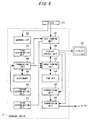
- Fig. 4 is a functional block diagram of a terminal device T1.
- the terminal device T1 functions as a device comprising the display device 41, a display control unit 42, an image forming unit (corresponding to an image data forming unit) 43, a font set (data set of font data) 44, a synthesizing unit 45, a transmission unit 46, a first determination unit 47, a translation unit 48, a dictionary 49, a second determination unit 50, a third determination unit 51, and the address list 52.
- Steps S01 to S11 shown in Fig. 3 will be described below by using Fig. 4 to Fig. 16.
- step S01 the display control unit 42 displays the screen (edition screen) of a text editor which copes with n languages used in the electronic mail apparatus on the display device 26.
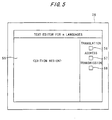
- Fig. 5 is a diagram showing a display example of the edition screen obtained by the text editor.
- the edition screen has a rectangular edition region 55, a translation button 56 arranged on the right side of the edition region 55, an address list button 57, and a transmission button 58.
- a user designates the position of a cursor (not shown) displayed on the address list button 57 with the KBD 27 or the mouse 28 to input a Japanese sentence constituting the contents of an electronic mail from the KBD 27.
- the display device 41 forms text data corresponding to the input characters. More specifically, the display device 41 has a data set (font set) of fonts corresponding to the JIS (Japan Industrial Standards) code. Font data corresponding to the character code of the characters input from the KBD 27 is extracted from the font set to form text data.
- JIS Japanese Industrial Standards
- the display control unit 42 displays the Japanese characters corresponding to the formed text data in the edition region 55 in accordance with the information of a predetermined format (document style). In this manner, the sentence constituting the contents of the electronic mail is formed in Japanese.
- the text file corresponding to this sentence is formed by the display device 41.
- Fig. 6 is a diagram showing a display example in which formed sentences are displayed in the edition region 55. As shown in Fig. 6, the formed sentences are text-displayed in the edition region 55 at intervals each corresponding to one line.
- the display device 41 is a function realized such that the CPU 16 executes the program of the text editor
- the display control unit 42 is a function realized such that the CPU 16 controls the graphic board 22 according to a predetermined control program.
- step S02 a user clicks the address list button 57 displayed on the edition screen with the mouse 28 (or presses the address list button 57 by operating the KBD 27). At this time, the address list 52 recorded on the hard disk or the FD 29 is read, and the contents of the address list 52 are displayed on the display device 26.
- Fig. 7 is a table for explaining an example of the address list 52.
- the address list 52 is constituted by a plurality of records including pieces information corresponding to the respective items, i.e., "transmission target”, "address list”, "mail address”, "mother tongue”, and "display in Japanese”.
- the user operates the KBD 27 or the mouse 28 to check records, so that the user can selects a transmission target (destination). At this time, the user can select a plurality of destinations.
- a formed electronic mail is multi-casted to the destinations. In this example, it is assumed that "Bob" and "Mizel" are selected as destinations.
- step S03 the first determination unit 47 checks whether the language in the transmission source is identical to the languages in the destinations selected in step S02 or not. More specifically, the first determination unit 47 holds information representing that the language in the transmission source is Japanese to check whether the "mother tongue" in the record checked in step S02 is Japanese or not.
- the first determination unit 47 automatically performs determination by using the language (Japanese) in the transmission source prepared as determination data and the information of "mother tongue" of the address list 52.
- the first determination unit 47 notifies the translation unit 48 that the languages are different from each other.
- the first determination unit 47 does not notify the translation unit 48.
- the first determination unit 47 determines that the languages of "Bob” and "Mizel” are not Japanese, and the first determination unit 47 notifies the translation unit 48 that the languages are not Japanese.
- the first determination unit 47 is a function realized such that the CPU 16 executes a program.
- step S04 the translation unit 48 is started by receiving the notification from the first determination unit 47 to perform the following processes. That is, the translation unit 48 specifies a language to be translated with reference to "mother tongue" in the record corresponding to the destination in which it is determined that the language is not Japanese.
- the translation unit 48 specifies the language (mother tongue) of the destination "Bob” as English, and specifies the language (mother tongue) of the destination "Mizel” as German.
- the first determination unit 47 may specifies the language to be translated to notify the translation unit 48 of the language.
- the translation unit 48 translates a sentence in Japanese (Japanese sentence) formed in step S01 into a specific language with reference to the dictionary (basic dictionary) 49.
- the dictionary 49 is constituted by dictionaries of n languages such as a Japanese-English dictionary or a Japanese-Germany dictionary for translating Japanese into a foreign language.
- the translation unit 48 extracts words or idioms of one sentence when the translation unit 48 translates a Japanese sentence, and translates the extracted words and idioms into the foreign language corresponding to the mother tongue in the destination.
- the words or the idioms are extracted, for example, decomposition of parts of speech is performed by explosion morpheme analysis, and a translation for a specific part of speech (e.g., noun or verb) is performed.
- the translation unit 48 allocates data representing an impossible translation to a word which is not described in the dictionary 49.
- the translation unit 48 may translate not only the words and idioms in one sentence but also the whole sentence in place of the process described above.
- Fig. 8 is a diagram for explaining a process performed by the translation unit 48.
- the translation unit 48 has a learning function, and words and idioms obtained by the learning function are registered on a learning dictionary 48a included in the translation unit 48. In this manner, the translation unit 48 reflects past translation results on the present translation process.
- the translation unit 48 translates Japanese into English as a translation corresponding to the destination "Bob", and translates Japanese into Germany as a translation corresponding to the destination "Mizel”.
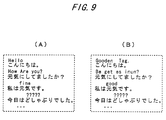
- Fig. 9 is a diagram for explaining an internal process in which the translation unit 48 translates the Japanese sentence shown in Fig. 6.
- Fig. 9A shows a translation from Japanese to English performed by the translation unit 48
- Fig. 9B shows a translation from Japanese to German performed by the translation unit 48.
- the translation unit 48 is a function realized such that the CPU 16 executes a translation program.
- the translation program any conventional translation programs may be used.
- step S05 the second determination unit 50 checks whether characters expressed in languages in destinations selected in step S02 can be displayed by the terminal device T1. More specifically, the second determination unit 50 holds the information of a character code which can be handled by the terminal device T1.
- the terminal device T1 can handle the JIS code, and can text-display hiragana, katakana, kanji, roman letters, and the like. However, the terminal device T1 cannot text-display characters obtained by adding umlauts to the roman letters.
- the second determination unit 50 determines that English translation results of the destination "Bob” can be text-displayed, and determines that German translation results of the destination "Mizel” cannot be text-displayed. If it is determined that it is possible to perform text display, the second determination unit 50 notifies the display device 41 that it is possible to perform text display. If it is determined that it is impossible to perform text display, the second determination unit 50 notifies the image forming unit 43 that it is impossible to perform text display.
- the second determination unit 50 is a function realized such that the CPU 16 executes a program.
- step S06 the display device 41 receives translation results from the translation unit 48 in accordance with a notification from the second determination unit 50.
- the display device 41 forms text data corresponding to words and idioms included in the translation results and translated into a foreign language which can be text-displayed in the terminal device T1 to holds the text data as a text file.
- step S07 the image forming unit 43 receives translation results from the translation unit 48 in accordance with a notification from the second determination unit 50.
- the image forming unit 43 forms image data corresponding to words and idioms included in the translation results and translated into a foreign language which can be text-displayed in the terminal device T1 by using the font set 44 to hold the image data as an image file.
- the font set 44 is stored in the ROM 17, the hard disk, or the FD 29, arid includes font (character image) data of characters for writing a foreign language, which cannot be text-displayed in the terminal device T1, of the n languages described above.
- the font set 44 includes the font data of characters for writing German.
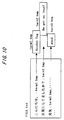
- Fig. 10 is a diagram for explaining image file formation performed by the image forming unit 43.
- Fig. 10 shows, for example, a case in which the image files of words translated into Germany is formed.
- the image files (bitmap files) of translated sentences are sequentially formed to an original pattern.
- the image forming unit 43 forms image data by using the font data included in the font set 44 on the basis of the font size of the text data formed in step S01.
- the font size of the image data may be made equal to the font size of the text data, or the font size of the image data may be expanded or reduced with respect to the font size of the text data.
- the image forming unit 43 forms the image file (e.g., bit map file) of translation results (words and idioms translated into German) with respect to the destination "Mizel".
- the image file e.g., bit map file
- the image forming unit 43 is a function realized such that the CPU 16 executes a program.
- step S08 the display control unit 42 displays the edition screen of each destination on the display device 26. More specifically, the display control unit 42 displays an edition screen in the edition region 55. In the edition screen, the text file formed in step S01 and the text file formed in step S06 are laid out in accordance with predetermined format information.
- the format information includes information of a position (left-end position of the sentences) representing a position at which the Japanese sentences are started, a line space of characters, and a width between lines (right-end position of the edition region 55).
- the display control unit 42 displays the text of a translated word or idiom at a corresponding position of an imaginary sheet (text display sheet) on which the Japanese sentences are arranged in the edition region 55.
- Japanese sentences are text-displayed at intervals each corresponding to one line.
- the words and idioms translated into a foreign language are text-displayed above the corresponding Japanese sentences such that the words and the idioms are adjusted to the left side.
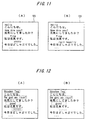
- Fig. 11A is a diagram showing a display example of an edition screen corresponding to the destination "Bob”
- Fig. 11B is a diagram showing a manner obtained after an edition operation is performed to the edition screen shown in Fig. 11A.
- the display control unit 42 displays an edition screen on which the text file formed in step S01 and the image file formed in step S07 are laid out in accordance with the predetermined format information on the edition region 55.
- Fig. 12A is a diagram showing a display example of an edition screen corresponding to the destination "Mizel”
- Fig. 12B is a diagram showing a manner obtained after an edition operation is performed to the edition screen shown in Fig. 12A
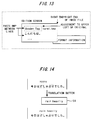
- Fig. 13 is a diagram for explaining display control performed by the display control unit 42.
- the format information includes information of a position (left-end position of the sentences) representing a position at which the Japanese sentences are started, a line space of characters, and a width between lines (right-end position of the edition region 55).
- the display control unit 42 pastes the image of a translated word or idiom at a corresponding position of an imaginary sheet (text display sheet) on which the Japanese sentences.
- Fig. 13 shows an example in which a document image "Gooden Tag.” (file name: terml.bmp) is pasted above a Japanese sentence " konnichiwa ".
- Japanese sentences are text-displayed as an edition screen at intervals each corresponding to one line in the edition region 55 shown in Fig. 12A.
- the document image (portion enclosed by a broken line in Fig. 12A) of the translated word or idiom is displayed above the Japanese sentence corresponding to the word or idiom such that the word or the idiom is adjusted to the left side.
- a user refers to the displayed translated sentence. If there is a mistranslation, the user operates the KBD 27 to correct the mistranslation.
- the display control unit 42 displays a symbol "?????" above a word which cannot be translated. The user operates the KBD 27 to input the equivalent of the word in place of the symbol "?????" (see Fig. 11B).
- Fig. 14 is a diagram for explaining an editing operation. As shown in Fig. 14, the user operates the KBD 27 to select a portion to be translated or corrected in the Japanese sentences displayed on the edition screen (edition region 55), and marks (inverts) the corresponding portion.
- the display control unit 42 displays a translated word display window 59 at a predetermined position of the edition region 55 such that the translated word display window 59 overlaps the text display sheet.
- the translated word display window 59 may be displayed at any position on the screen of the display device 26.
- the translation unit 48 translates the marked portion into a foreign language (English in an example in Fig. 14) corresponding to a destination, and gives the translation results to the display control unit 42.
- the display control unit 42 text-displays the translation results (translated words) on the translated word display window 59. At this time, when the translation results are not proper, the user can correct the translated words displayed on the translated word display window 59 by the operation of the KBD 27.
- the translated words are image-displayed on the translated word display window 59.
- the user designates the code of fonts for forming the translated words.
- the corresponding font data is read from the font set 44, the image file of desired translated words is formed by the image forming unit 43, and the image of the translated words is displayed on the translated word display window 59 by the display control unit 42.
- the translated words are image-displayed above the marked Japanese sentence.
- the user can edit the translated words or the translated sentence.
- the edition results (corrected contents) of the translation described above are reflected on the next translation by the learning function of the translation unit 48.
- step S09 the third determination unit 51 checks whether the language in the transmission source can be text-displayed in the destination. More specifically, the third determination unit 51 refers to "display in Japanese" in records corresponding to destinations included in the address list 52 (see Fig. 7). When “display in Japanese” is "OK”, the third determination unit 51 determines that it is possible to perform text display. When “display in Japanese” is “NG”, the third determination unit 51 determines that it is impossible to perform text display.
- the third determination unit 51 determines that it is impossible to perform text display in Japanese in the destination "Bob” (terminal device T2), and determines that it is possible to perform text display in Japanese in the destination "Mizel” (terminal device T3).
- the third determination unit 51 is a function realized such that the CPU 16 executes a program.
- step S10 the synthesizing unit 45 forms a synthesized image file obtained by synthesizing an original (Japanese sentence) and a translated sentence.
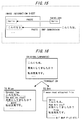
- Fig. 15 is a diagram for explaining a synthesizing process performed by the synthesizing unit 45.
- the synthesizing unit 45 pastes the edited image files at predetermined positions in accordance with predetermined format information.
- the synthesizing unit 45 converts the text file formed in step S01 into an image file (bitmap file), and pastes the image file at a predetermined position.
- image file bitmap file
- the image file of the translation results is not formed, the image file of the translation results is formed.
- a synthesized image file obtained by synthesizing an original and a translated sentence is formed.
- a synthesized image file corresponding to the destination "Bob" is formed.
- the synthesizing unit 45 is a function realized such that the CPU 16 executes a program.
- step S11 the electronic mail formed in steps S01 to S10 is transmitted to the destination. More specifically, the contents of the electronic mail subjected to the process in step S08 or step S10 are displayed in the edition region 55.
- the transmission unit 46 transmits the formed electronic mail in accordance with the mail address.
- the transmission unit 46 transmits the contents of these text files as the body of the electronic mail in accordance with the mail address of the destination.
- the transmission unit 46 transmits the formed file as an attached file.
- the Japanese sentence and the translated portion are formed as image files, the display contents (synthesized image file) obtained upon completion of step S10 are transmitted as an attached file to the destination.
- the transmission unit 46 is a function obtained such that the CPU 16 and/or the communication control device 23 is operated in accordance with a predetermined control program.
- the transmission unit 46 transmits the synthesized image file formed in step S10 as an attached file to the destination "Bob" (terminal device T2) (see Fig. 16).
- the electronic mail may be directly transmitted to each destination, or the electronic mail may be uploaded from the terminal device T1 to a server in a network NW, and the terminal devices T2 and T3 may download the electronic mail transmitted from the terminal device T1 from the server as needed.
- steps S01 to S11 the process related to the destination "Bob” and the process related to the destination “Mizel” are performed in the steps in parallel. However, in fact, the processes in steps S01 to S11 are performed every destination. Note that the processes may be executed in parallel.
- the above embodiment describes the example in which the present invention is applied to a terminal (terminal device T1) on a transmission side.
- the present invention is not limited to the terminal on the transmission side, and the present invention can also applied to another device in a network to which a terminal on a transmission side belongs or a device in a network to which a terminal on a reception side belongs.
- a mail server or a proxy server arranged on a network to which a terminal on a transmission side or a terminal on a reception side belongs, or the terminal on the reception side is known.
- a mail server for executing the processes in an embodiment of the present invention may be the same as that of the terminal device T1 described by using Fig. 2, a description thereof will be omitted. However, when operations embodying the present invention are executed by a mail server, several constituent elements such as the display 26, the keyboard 27, and the mouse 28 are not necessary.
- the mail server functions as an electronic mail apparatus which performs the following operations such that the CPU executes a program.
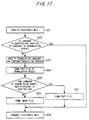
- Fig. 17 is a flow chart showing operations in the mail server.
- the mail server receives an electronic mail in which a sentence (body) is written in the mother tongue of a user of the terminal device T1 from the terminal device T1 (step S21). More specifically, the CPU executes a reception program for an electronic mail when it receives the electronic mail transmitted from the terminal device T1.
- step S22 It is checked whether the language identical to that in the terminal device T1 serving as the transmission source of the electronic mail is used in the destination or not (step S22). At this time, if it is determined the languages are identical to each other, the operation shifts to step S28. If it is determined that the languages are different from each other, the operation shifts to step S23.
- the above determination is performed by the CPU such that prepared determination data is used.
- the CPU may find a language used in the destination on the basis of country information included in the destination address of the electronic mail received in step S21 to automatically check whether the language used in the transmission source is identical to the language used in the destination.
- step S23 the language (mother tongue) in the destination is specified, and the contents (body) of the electronic mail received in step S21 are translated in the specified language.
- the CPU may find a language on the basis of the destination address.
- step S24 after the CPU forms the text file of results (translation results) of the translation process in step S23, the operation shifts to step S25.
- step S25 it is checked whether the characters written in the language (Japanese) of the transmission source can be text-displayed in the destination or not.
- step S26 the CPU forms image data corresponding to the text data of the body (sentence formed by characters written in the language in the transmission source) of the electronic mail received in step S21 and forms image data corresponding to the text data of the translation results on the basis of the text file of the translation results formed in step S24 to form a synthesized image file obtained by synthesizing these image data.
- step S27 the CPU forms text data obtained by synthesizing the body (sentence formed by characters written in the language in the transmission source) of the electronic mail received in step S21, the text data of the translation results, and the text data of the body of the electronic mail to form a text file.
- step S28 the CPU transmits the electronic mails formed in the above steps to a destination indicated by the header information of the electronic mail received in step S21.
- the transmitted electronic mail is as follows.
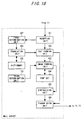
- Fig. 18 is a functional block diagram of the mail server.
- the CPU executes a program to perform the operations in steps S21 to S28 described above.
- the mail server functions as a device comprising a reception unit 61, a text forming unit 62, an image forming unit 63, a font set (data set of fonts) 64, a synthesizing unit 65, a transmission unit 66, a first determination unit 67, a translation unit 68, a dictionary 69, and a third determination unit 70 as shown in Fig. 18.
- step S21 an electronic mail, transmitted from the terminal device (transmission source terminal) T1 of the transmission source, in which a sentence (body) is written in a mother tongue by a user of the transmission source terminal T1 is received by the reception unit 61.
- step S22 the first determination unit 67 checks whether the language in the destination indicated by the header information of the electronic mail received in step S21 is identical to the language in the transmission source or not. More specifically, the first determination unit 67 holds a plurality of records including at least information representing that Japanese is used as the language in the transmission source and pieces of information corresponding to the items "mail address", "mother tongue", and "display in Japanese" of the address list 52 shown in Fig. 7 as determination data in advance. The first determination unit 67 checks whether the "mother tongue" in the records corresponding to the destination mail address is Japanese or not.
- the first determination unit 67 automatically performs determination by using the information of the language (Japanese) in the transmission source prepared as determination data and the information of the "mother tongue" corresponding to the destination mail address.
- the first determination unit 67 When the language in the transmission source is different from the language in the destination (when the language in the destination is not Japanese), the first determination unit 67 notifies the translation unit 68 that these languages are different from each other. In contrast to this, when the language in the destination is Japanese, the first determination unit 67 does not notify the translation unit 68.
- the first determination unit 67 is a function realized such that the CPU executes a program.
- step S23 the translation unit 68 is started by receiving a notification from the first determination unit 67, and performs the following processes. More specifically, the translation unit 68 refers to the "mother tongue" in the records corresponding to the destination in which it is determined that the language is not Japanese. In this manner, the translation unit 68 specifies a language to be translated. The first determination unit 67 may specify a language to be translated to notify the translation unit 68.
- the translation unit 68 refers to the dictionary (basic dictionary) 69.
- the translation unit 68 transmits the body (Japanese sentence) of the electronic mail received in step S21 into the specified language.
- the dictionary 69 is constituted by dictionaries for n languages such as a Japanese-English dictionary or a Japanese-German dictionary for translating Japanese into a foreign language.
- the translation unit 68 When the translation unit 68 translates the Japanese sentence, the translation unit 68 extracts words or idioms of one sentence to translate the extracted words or idioms into the corresponding foreign language.
- the words or the idioms are extracted, for example, decomposition of parts of speech is performed by explosion morpheme analysis, and a translation for a specific part of speech (e.g., noun or verb) is performed.
- the translation unit 68 does not output translation results to a word which is not described in the dictionary 69.
- the translation unit 68 may translate not only the words and idioms in one sentence but also the whole sentence.
- the translation unit 68 is a function realized such that the CPU executes a translation program, and any conventional translation program can also be used as the translation program.
- step S24 the text forming unit 62 receives translation results from the translation unit 68.
- the text forming unit 62 forms text data corresponding to a words and idioms included in the translation results and translated into a foreign language to hold the image data as a text file.
- the third determination unit 70 checks whether the language (the body of the received electronic mail) in the transmission source can be text-displayed in the destination or not. More specifically, the third determination unit 70 refers to the "display in Japanese" in the records corresponding to the destination and included in the held determination data. At this time, if the display in Japanese is "OK”, the third determination unit 70 determines that it is possible to perform text display. If the display in Japanese is "NG”, the third determination unit 70 determines that it is impossible to perform text display.
- the third determination unit 70 is a function realized such that the CPU executes a program.
- step S26 the image forming unit 63 forms image data corresponding to the text data of the body of the received electronic mail and the translation results (translated portions) by using the text data. More specifically, the image forming unit 63 forms image data on the basis of the text data of the body of the received electronic mail by using a Japanese font data included in the font set 64.
- the image forming unit 63 forms image data on the basis of the text data of the translation results by using the font data of the mother tongue included in the font set 64 and used in the destination of the electronic mail.
- a font size for forming the image data is set in advance.
- the synthesizing unit 65 synthesizes the image data of the formed Japanese sentence and the translated portion according to predetermined format information (line space, line width, and the like) such that the Japanese sentence and the translated portion are paired, thereby forming an image file.
- the image forming unit 63 and the synthesizing unit 65 are functions realized such that the CPU executes programs.
- step S27 the synthesizing unit 65 forms a text file which is synthesized by using the text data of the body of the received electronic mail and the text file of the translation results formed by the text forming unit 62 such that the Japanese sentence and the text data of the translated portion are paired.
- step S28 the transmission unit 66 transmits the electronic mails constituted by the contents formed by the above processes to a destination. More specifically, when the image file constituted by the Japanese sentence and the translated portion is formed in step S26, an electronic mail in which the image file is used as an attached file and a sentence (e.g., "Please read attached file.") attached with a file is used as a body is transmitted to the destination.
- a sentence e.g., "Please read attached file.
- step S27 When a text file constituted by a Japanese sentence and the translated portion thereof is formed in step S27, an electronic mail in which the text data of the text file is used as a body is transmitted to the destination.
- an embodiment of the present invention can also be used in a device other than a transmission source terminal (terminal device T1).
- the item "mail address” is set to be a transmission source mail address
- the item "mother tongue” is set to be the mother tongue of a user of the transmission source mail address
- the item "display in Japanese” is set to be information representing whether the mother tongue of the transmission source can be displayed or not.
- the body of the received electronic mail is translated.
- a test file constituted by the body of the received electronic mail and the translated portion of the body is formed; otherwise, an image file constituted by the body of the electronic mail and the translated portion of the body is formed.
- the image file is transmitted to the destination terminal by a predetermined method.
- an embodiment of the present invention can be applied to either one of the device on the transmission source side and the device on the destination side.
- the translated portion of the formed original Japanese sentence
- Japanese sentence Japanese sentence
- the electronic mail apparatus when characters (hiragana, katakana, and kanji) for writing Japanese cannot be text-displayed in a destination, the image of a sentence constituting the contents of an electronic mail formed in Japanese is formed, and the image is transmitted to the destination. In this manner, in the destination, a sentence formed in Japanese can be displayed on a display device. For this reason, a receiver of an electronic mail in the destination can read an electronic mail formed in Japanese.
- the embodiment has been described with respect to Japanese. However, the same operation as described above when the embodiment is made for another language.
- the translation results cannot be text-displayed in a transmission source.
- an image file corresponding to the translation results is formed, and a document image based on the image file is displayed on the display device 26.
- a person who forms an electronic mail refers to the translation results, and can edit (correct) the translation results.
- format information is held to lay out an image in a text sentence.
- a configuration may be formed such that a line space and the like are determined in accordance with the font size of the text.
- information (the position of the left end, a line space, and a line width (the position of the right end)) required to lay out an image can be calculated such that position information of Japanese sentences, line space information, and the position of the right end of the longest sentence in the sentences are calculated on the basis of the font size of the Japanese sentences.
- the Japanese sentence and the translated portion thereof may be displayed on different screens, respectively.
- the two screens may be displayed to be arrayed, and one of the two screens may be displayed by screen switching.
- a device and method for performing the following processes, and a recording medium on which a program is recorded for causing a computer to execute the processes also embody the present invention.
- the process contents are as follows. That is, when, by using a sentence input as the contents of an electronic mail, image data corresponding to the sentence is formed, and when the sentence is expressed in a language different from a language used in a destination of the mail, the sentence is translated into the language used in the destination.
- the text data of the translation results is editably displayed on a screen, and the formed image data and the translation results are transmitted to the destination of the electronic mail.
- the translated text data may be displayed such that the text data corresponds to the sentence. In this manner, the correspondence between the input sentence and the translated sentence thereof can be easily understood, and the correcting operation can be easily performed.
- the other process contents are as follows. That is, when, by using a sentence input as the contents of an electronic mail, image data corresponding to the sentence is formed, and when the sentence is expressed by characters written in a language different from a language used in a destination of the electronic mail, the sentence is translated into the language used in the destination. Translated image data corresponding to the translation results is formed by the characters written in the language used in the destination, the translated image data is editably displayed to correspond to the sentence, and the formed image data and the translation results are transmitted to the destination of the electronic mail.
- a computer program stored on a computer-readable (or device-readable) medium. It will be appreciated that such a computer program (or operating program) can be used to operate any suitable electronic mail device (such as a personal computer, a work station, a mobile computer or a mobile phone). It will also be appreciated that an operating program embodying the present invention need not be stored on a device-readable medium and could, for example, be embodied in a signal such as a downloadable data signal provided from an Internet website.
- the appended claims are to be interpreted as covering an operating program by itself, or as a record on a carrier, or as a signal, or in any other form.
Landscapes
- Engineering & Computer Science (AREA)
- Business, Economics & Management (AREA)
- Human Resources & Organizations (AREA)
- Entrepreneurship & Innovation (AREA)
- Strategic Management (AREA)
- Quality & Reliability (AREA)
- General Physics & Mathematics (AREA)
- Economics (AREA)
- Marketing (AREA)
- Operations Research (AREA)
- Computer Hardware Design (AREA)
- Tourism & Hospitality (AREA)
- Physics & Mathematics (AREA)
- General Business, Economics & Management (AREA)
- Data Mining & Analysis (AREA)
- Theoretical Computer Science (AREA)
- Computer Networks & Wireless Communication (AREA)
- Signal Processing (AREA)
- Information Transfer Between Computers (AREA)
- Data Exchanges In Wide-Area Networks (AREA)
- Computer And Data Communications (AREA)
- Machine Translation (AREA)
Applications Claiming Priority (2)
| Application Number | Priority Date | Filing Date | Title |
|---|---|---|---|
| JP24387299A JP4118470B2 (ja) | 1999-08-30 | 1999-08-30 | 電子メール装置,電子メール送信方法及び記録媒体 |
| JP24387299 | 1999-08-30 |
Publications (2)
| Publication Number | Publication Date |
|---|---|
| EP1081619A2 true EP1081619A2 (fr) | 2001-03-07 |
| EP1081619A3 EP1081619A3 (fr) | 2004-06-02 |
Family
ID=17110244
Family Applications (1)
| Application Number | Title | Priority Date | Filing Date |
|---|---|---|---|
| EP00303005A Withdrawn EP1081619A3 (fr) | 1999-08-30 | 2000-04-10 | Dispositif et procédé pour courrier électronique |
Country Status (4)
| Country | Link |
|---|---|
| US (1) | US7197705B1 (fr) |
| EP (1) | EP1081619A3 (fr) |
| JP (1) | JP4118470B2 (fr) |
| CN (2) | CN100444150C (fr) |
Cited By (5)
| Publication number | Priority date | Publication date | Assignee | Title |
|---|---|---|---|---|
| WO2002082775A1 (fr) * | 2001-04-09 | 2002-10-17 | Correocaliente.Com, Inc. | Systeme et procede de traduction pour courrier electronique |
| WO2002102022A1 (fr) * | 2001-06-08 | 2002-12-19 | Hewlett-Packard Company | Procede et appareil de traduction d'un message par courrier electronique |
| WO2004042603A3 (fr) * | 2002-11-06 | 2004-08-26 | Translution Holdings Plc | Traduction de messages transmis par voie electronique |
| US7647428B2 (en) | 2003-05-27 | 2010-01-12 | Fujifilm Corporation | Method and apparatus for email relay of moving image conversion and transmission, and programs therefor |
| CN102158819A (zh) * | 2011-01-25 | 2011-08-17 | 华为终端有限公司 | 用于移动设备显示电子邮件处理方法、服务器及移动设备 |
Families Citing this family (18)
| Publication number | Priority date | Publication date | Assignee | Title |
|---|---|---|---|---|
| JP2002312279A (ja) * | 2001-04-11 | 2002-10-25 | Kenwood Corp | 情報通信システム、ゲートウェイサーバ、その通信方法、及び情報通信端末 |
| JP2002342242A (ja) * | 2001-05-15 | 2002-11-29 | Riso Kagaku Corp | 電子メール書体加工装置 |
| JP2003101493A (ja) * | 2001-09-25 | 2003-04-04 | Mitsubishi Electric Corp | 情報端末、情報配信装置及び情報配信システム |
| KR100785384B1 (ko) * | 2001-11-12 | 2007-12-18 | 후지쯔 가부시끼가이샤 | 단말 장치 및 정보 처리 방법 |
| KR20040028159A (ko) * | 2002-09-30 | 2004-04-03 | 주식회사 써미트테크놀로지 | 이동단말에서 다양한 언어를 지원하는 전자메일 서버시스템 |
| JP2004179936A (ja) * | 2002-11-27 | 2004-06-24 | Mitsubishi Denki Information Technology Corp | 電子メール画像送信システム及び電子メール画像送信方法 |
| AU2003244292A1 (en) * | 2003-06-18 | 2005-01-04 | Impulse Japan Inc. | Electronic mail translation server, electronic mail translation method, and electronic male translation program |
| JP2005182554A (ja) * | 2003-12-22 | 2005-07-07 | Fuji Photo Film Co Ltd | 動画サーバおよびその制御方法 |
| JP4595448B2 (ja) * | 2004-08-31 | 2010-12-08 | オムロン株式会社 | メールデータ処理方法、メールサーバー、メールサーバー用のプログラム |
| KR100675153B1 (ko) * | 2004-12-03 | 2007-01-29 | 엘지전자 주식회사 | 이동통신 단말기의 유니코드 문자열 처리방법 |
| JP2011141750A (ja) * | 2010-01-07 | 2011-07-21 | Nec Corp | データ翻訳装置、データ翻訳システム、データ翻訳方法およびプログラム |
| KR20120092488A (ko) * | 2011-02-11 | 2012-08-21 | 삼성전자주식회사 | 메시지 처리 방법 및 시스템 |
| KR20130123251A (ko) * | 2012-05-02 | 2013-11-12 | 삼성전자주식회사 | 웹 브라우저를 위한 키 보드 구성 방법 및 장치와 그 방법에 대한 프로그램 소스를 저장한 기록 매체 |
| JP2015153408A (ja) * | 2014-02-19 | 2015-08-24 | 株式会社リコー | 翻訳システム、翻訳処理装置、及び翻訳処理プログラム |
| TWI718997B (zh) * | 2014-09-30 | 2021-02-21 | 日商咕嘟媽咪股份有限公司 | 菜單生成系統 |
| JP6243071B1 (ja) * | 2017-04-03 | 2017-12-06 | 旋造 田代 | 通信内容翻訳処理方法、通信内容翻訳処理プログラム、及び、記録媒体 |
| JP7497552B2 (ja) * | 2020-05-29 | 2024-06-11 | 株式会社クオリティア | 電子メッセージ翻訳分析システム |
| JP7612179B1 (ja) * | 2024-07-29 | 2025-01-14 | Wovn Technologies株式会社 | 翻訳支援方法及び翻訳システム |
Citations (1)
| Publication number | Priority date | Publication date | Assignee | Title |
|---|---|---|---|---|
| JPH1185757A (ja) * | 1997-09-04 | 1999-03-30 | Brother Ind Ltd | メール翻訳装置及び記録媒体 |
Family Cites Families (26)
| Publication number | Priority date | Publication date | Assignee | Title |
|---|---|---|---|---|
| JPS5752261A (en) * | 1980-09-11 | 1982-03-27 | Canon Inc | Character processor |
| JPS6441066U (fr) | 1987-08-28 | 1989-03-10 | ||
| JPS6399665A (ja) | 1987-09-11 | 1988-04-30 | Canon Inc | データ通信装置 |
| JPH0256172A (ja) | 1988-05-20 | 1990-02-26 | Mitsubishi Electric Corp | ミクストモード文書通信装置 |
| US6167439A (en) * | 1988-05-27 | 2000-12-26 | Kodak Limited | Data retrieval, manipulation and transmission with facsimile images |
| JPH02202143A (ja) | 1989-01-31 | 1990-08-10 | Toshiba Corp | 電子メールシステム |
| JPH0256148A (ja) | 1989-02-17 | 1990-02-26 | Matsushita Graphic Commun Syst Inc | データ伝送装置 |
| JPH04364630A (ja) | 1991-06-11 | 1992-12-17 | Oki Electric Ind Co Ltd | 電子メールシステム |
| JP3005101B2 (ja) * | 1992-01-22 | 2000-01-31 | キヤノン株式会社 | 画像通信装置 |
| DE69510403T2 (de) * | 1994-04-18 | 1999-11-25 | Canon K.K., Tokio/Tokyo | Datenübertragungsgerät, -verfahren und -system |
| US5781714A (en) * | 1994-05-27 | 1998-07-14 | Bitstream Inc. | Apparatus and methods for creating and using portable fonts |
| JP3066274B2 (ja) * | 1995-01-12 | 2000-07-17 | シャープ株式会社 | 機械翻訳装置 |
| US5715466A (en) * | 1995-02-14 | 1998-02-03 | Compuserve Incorporated | System for parallel foreign language communication over a computer network |
| US6651039B1 (en) * | 1995-08-08 | 2003-11-18 | Matsushita Electric Industrial Co., Ltd. | Mechanical translation apparatus and method |
| JPH09252393A (ja) * | 1996-01-12 | 1997-09-22 | Sanyo Electric Co Ltd | ファクシミリ機能装置 |
| CN1162134A (zh) * | 1996-01-22 | 1997-10-15 | 株式会社东芝 | 图像形成装置 |
| JPH09259127A (ja) * | 1996-03-21 | 1997-10-03 | Sharp Corp | 翻訳装置 |
| JPH1055356A (ja) | 1996-08-09 | 1998-02-24 | Matsushita Electric Ind Co Ltd | 機械翻訳機能付電子メール装置及び制御方法 |
| US6119137A (en) * | 1997-01-30 | 2000-09-12 | Tumbleweed Communications Corp. | Distributed dynamic document conversion server |
| JPH10149359A (ja) | 1996-11-18 | 1998-06-02 | Seiko Epson Corp | ネットワーク経由の情報の自動翻訳装置および自動翻訳方法、電子メールの処理装置および処理方法 |
| US5911776A (en) * | 1996-12-18 | 1999-06-15 | Unisys Corporation | Automatic format conversion system and publishing methodology for multi-user network |
| US6366698B1 (en) * | 1997-03-11 | 2002-04-02 | Casio Computer Co., Ltd. | Portable terminal device for transmitting image data via network and image processing device for performing an image processing based on recognition result of received image data |
| TW417378B (en) * | 1997-06-25 | 2001-01-01 | Murata Machinery Ltd | Communication terminal device with e-mail capability and the e-mail communication method |
| JP3813710B2 (ja) | 1997-08-26 | 2006-08-23 | 沖電気工業株式会社 | 電子メール機械翻訳システム |
| US6189045B1 (en) * | 1998-03-26 | 2001-02-13 | International Business Machines Corp. | Data type conversion for enhancement of network communication systems |
| JP2001018493A (ja) * | 1999-07-12 | 2001-01-23 | Seiko Epson Corp | プリンタ、プリンタの制御方法、及び、そのための処理を記録した記録媒体 |
-
1999
- 1999-08-30 JP JP24387299A patent/JP4118470B2/ja not_active Expired - Fee Related
-
2000
- 2000-03-10 US US09/522,686 patent/US7197705B1/en not_active Expired - Fee Related
- 2000-04-10 EP EP00303005A patent/EP1081619A3/fr not_active Withdrawn
- 2000-04-20 CN CNB00106777XA patent/CN100444150C/zh not_active Expired - Fee Related
- 2000-04-20 CN CN200710142436.4A patent/CN101106549A/zh active Pending
Patent Citations (1)
| Publication number | Priority date | Publication date | Assignee | Title |
|---|---|---|---|---|
| JPH1185757A (ja) * | 1997-09-04 | 1999-03-30 | Brother Ind Ltd | メール翻訳装置及び記録媒体 |
Non-Patent Citations (3)
| Title |
|---|
| KOK YONG L ET AL: "Multiple Language Support over the World Wide Web", PROCEEDINGS OF THE INET96 CONFERENCE, 24 June 1996 (1996-06-24) - 28 June 1996 (1996-06-28), Montreal, Canada, Retrieved from the Internet <URL:http://www.isoc.org/inet96/proceedings/a5/a5_2.htm> [retrieved on 20070821] * |
| ONLINE PUBLICATION, 19 July 1999 (1999-07-19), Retrieved from the Internet <URL:http://groups.google.co.uk/group/alt.comp.shareware/browse_thread/thread/d046e4685d1e59f0/611d9bcf084398cc?lnk=st&q=%22NJStar+Communicator%22+%22Express+Mail%22&rnum=7&fwc=1> [retrieved on 20070821] * |
| SAKAGUCHI T ET AL: "A Browsing Tool for multi-lingual documents for users without multi-lingual fonts", PROCEEDINGS OF THE ACM INTERNATIONAL CONFERENCE ON DIGITAL LIBRARIES, 20 March 1996 (1996-03-20), pages 63 - 71, XP002919648 * |
Cited By (12)
| Publication number | Priority date | Publication date | Assignee | Title |
|---|---|---|---|---|
| WO2002082775A1 (fr) * | 2001-04-09 | 2002-10-17 | Correocaliente.Com, Inc. | Systeme et procede de traduction pour courrier electronique |
| WO2002102022A1 (fr) * | 2001-06-08 | 2002-12-19 | Hewlett-Packard Company | Procede et appareil de traduction d'un message par courrier electronique |
| WO2004042603A3 (fr) * | 2002-11-06 | 2004-08-26 | Translution Holdings Plc | Traduction de messages transmis par voie electronique |
| GB2410107A (en) * | 2002-11-06 | 2005-07-20 | Translution Holdings Plc | Translation of electronically transmitted messages |
| JP2006505843A (ja) * | 2002-11-06 | 2006-02-16 | トランスルーション ホールディングス ピー・エル・シー | 電子送信メッセージの翻訳 |
| US7409333B2 (en) | 2002-11-06 | 2008-08-05 | Translution Holdings Plc | Translation of electronically transmitted messages |
| CN100476801C (zh) * | 2002-11-06 | 2009-04-08 | 特兰斯洛神控股公开有限公司 | 通信系统及发送和接收通信的方法 |
| US7647428B2 (en) | 2003-05-27 | 2010-01-12 | Fujifilm Corporation | Method and apparatus for email relay of moving image conversion and transmission, and programs therefor |
| CN102158819A (zh) * | 2011-01-25 | 2011-08-17 | 华为终端有限公司 | 用于移动设备显示电子邮件处理方法、服务器及移动设备 |
| EP2670095A4 (fr) * | 2011-01-25 | 2013-12-04 | Huawei Device Co Ltd | Procédé de traitement d'affichage de courrier électronique sur un dispositif mobile, serveur et dispositif mobile |
| US9438544B2 (en) | 2011-01-25 | 2016-09-06 | Huawei Device Co., Ltd. | Processing method for mobile device to display email, server, and mobile device |
| CN102158819B (zh) * | 2011-01-25 | 2016-12-07 | 华为终端有限公司 | 用于移动设备显示电子邮件处理方法、服务器及移动设备 |
Also Published As
| Publication number | Publication date |
|---|---|
| US7197705B1 (en) | 2007-03-27 |
| CN1286445A (zh) | 2001-03-07 |
| CN100444150C (zh) | 2008-12-17 |
| JP2001067287A (ja) | 2001-03-16 |
| CN101106549A (zh) | 2008-01-16 |
| JP4118470B2 (ja) | 2008-07-16 |
| EP1081619A3 (fr) | 2004-06-02 |
Similar Documents
| Publication | Publication Date | Title |
|---|---|---|
| US7197705B1 (en) | Electronic mail apparatus | |
| JP4888071B2 (ja) | プログラム、コピーアンドペースト処理方法、装置及び記録媒体 | |
| JP2831647B2 (ja) | 機械翻訳システム | |
| US6718519B1 (en) | System and method for outputting character sets in best available fonts | |
| US6813747B1 (en) | System and method for output of multipart documents | |
| US7937658B1 (en) | Methods and apparatus for retrieving font data | |
| US7272792B2 (en) | Kana-to-kanji conversion method, apparatus and storage medium | |
| KR20080044156A (ko) | 기록 매체 및 문자 입력 편집 방법 | |
| KR20060047421A (ko) | 테이블을 이용한 언어 로컬화 | |
| JPH11167532A (ja) | データ加工システムおよび装置、データ加工方法、記録媒体 | |
| JP2001318919A (ja) | 中継装置、サーバ装置、端末装置、及びこれを利用した翻訳サーバシステム | |
| US6760887B1 (en) | System and method for highlighting of multifont documents | |
| JP7027757B2 (ja) | 情報処理装置及び情報処理プログラム | |
| US7031002B1 (en) | System and method for using character set matching to enhance print quality | |
| KR20070093701A (ko) | 국가간 단문메시지 전달방법 | |
| JPH1027141A (ja) | 電子メールシステム | |
| JP2002521751A (ja) | モジュラ言語翻訳システム | |
| JPH11259477A (ja) | 文書処理システムおよび記録媒体 | |
| KR19990036447A (ko) | 다언어 통신 단말장치 | |
| JPH11353310A (ja) | 文書送信装置、文書送信方法および文書送信プログラムを記録した記録媒体 | |
| JP2000353132A (ja) | Eメールfaxサーバおよび情報記録媒体 | |
| JP4627910B2 (ja) | 第2言語テキスト入力支援方法及び装置、並びに第2言語テキスト入力支援プログラム及び当該プログラムを記録したコンピュータ読取可能な記録媒体 | |
| JP2001337894A (ja) | 電子メール処理装置およびそのプログラム記録媒体 | |
| JP2001282781A (ja) | データ入力方法、その方法を用いたデータ入力用の記録媒体ならびに演算処理装置 | |
| JPH10254864A (ja) | 文書変換装置および文書変換方法 |
Legal Events
| Date | Code | Title | Description |
|---|---|---|---|
| PUAI | Public reference made under article 153(3) epc to a published international application that has entered the european phase |
Free format text: ORIGINAL CODE: 0009012 |
|
| AK | Designated contracting states |
Kind code of ref document: A2 Designated state(s): AT BE CH CY DE DK ES FI FR GB GR IE IT LI LU MC NL PT SE |
|
| AX | Request for extension of the european patent |
Free format text: AL;LT;LV;MK;RO;SI |
|
| PUAL | Search report despatched |
Free format text: ORIGINAL CODE: 0009013 |
|
| AK | Designated contracting states |
Kind code of ref document: A3 Designated state(s): AT BE CH CY DE DK ES FI FR GB GR IE IT LI LU MC NL PT SE |
|
| AX | Request for extension of the european patent |
Extension state: AL LT LV MK RO SI |
|
| 17P | Request for examination filed |
Effective date: 20041124 |
|
| AKX | Designation fees paid |
Designated state(s): DE FR GB |
|
| 17Q | First examination report despatched |
Effective date: 20050616 |
|
| STAA | Information on the status of an ep patent application or granted ep patent |
Free format text: STATUS: THE APPLICATION IS DEEMED TO BE WITHDRAWN |
|
| 18D | Application deemed to be withdrawn |
Effective date: 20091103 |