EP1084126B1 - Neue vinca-alkaloidderivate und verfahren zur herstellung - Google Patents
Neue vinca-alkaloidderivate und verfahren zur herstellung Download PDFInfo
- Publication number
- EP1084126B1 EP1084126B1 EP99922250A EP99922250A EP1084126B1 EP 1084126 B1 EP1084126 B1 EP 1084126B1 EP 99922250 A EP99922250 A EP 99922250A EP 99922250 A EP99922250 A EP 99922250A EP 1084126 B1 EP1084126 B1 EP 1084126B1
- Authority
- EP
- European Patent Office
- Prior art keywords
- group
- hydrogen atom
- product
- hydroxyl
- alkanoyloxyl
- Prior art date
- Legal status (The legal status is an assumption and is not a legal conclusion. Google has not performed a legal analysis and makes no representation as to the accuracy of the status listed.)
- Expired - Lifetime
Links
- 238000002360 preparation method Methods 0.000 title description 10
- 229940122803 Vinca alkaloid Drugs 0.000 title description 4
- 125000004435 hydrogen atom Chemical group [H]* 0.000 claims description 58
- GKWYINOZGDHWRA-UHFFFAOYSA-N catharanthine Natural products C1C(CC)(O)CC(CC2C(=O)OC)CN1CCC1=C2NC2=CC=CC=C12 GKWYINOZGDHWRA-UHFFFAOYSA-N 0.000 claims description 43
- -1 alkanoyloxyl Chemical group 0.000 claims description 40
- 238000000034 method Methods 0.000 claims description 36
- FFRFGVHNKJYNOV-DOVUUNBWSA-N 3',4'-Anhydrovinblastine Chemical compound C([C@@H](C[C@]1(C(=O)OC)C=2C(=CC3=C([C@]45[C@H]([C@@]([C@H](OC(C)=O)[C@]6(CC)C=CCN([C@H]56)CC4)(O)C(=O)OC)N3C)C=2)OC)C=C(C2)CC)N2CCC2=C1NC1=CC=CC=C21 FFRFGVHNKJYNOV-DOVUUNBWSA-N 0.000 claims description 30
- 230000008569 process Effects 0.000 claims description 29
- 229950001104 anhydrovinblastine Drugs 0.000 claims description 28
- WVTGEXAIVZDLCR-UHFFFAOYSA-N Vindoline Natural products CC1C2CN3CCCC14CCC5Nc6ccccc6C25C34 WVTGEXAIVZDLCR-UHFFFAOYSA-N 0.000 claims description 27
- CXBGOBGJHGGWIE-IYJDUVQVSA-N vindoline Chemical compound CN([C@H]1[C@](O)([C@@H]2OC(C)=O)C(=O)OC)C3=CC(OC)=CC=C3[C@]11CCN3CC=C[C@]2(CC)[C@@H]13 CXBGOBGJHGGWIE-IYJDUVQVSA-N 0.000 claims description 27
- CMKFQVZJOWHHDV-DYHNYNMBSA-N catharanthine Chemical compound C([C@@H]1C=C([C@@H]2[C@@]3(C1)C(=O)OC)CC)N2CCC1=C3NC2=CC=CC=C12 CMKFQVZJOWHHDV-DYHNYNMBSA-N 0.000 claims description 20
- 238000006243 chemical reaction Methods 0.000 claims description 20
- 125000002887 hydroxy group Chemical group [H]O* 0.000 claims description 18
- 239000004593 Epoxy Substances 0.000 claims description 13
- 229910000033 sodium borohydride Inorganic materials 0.000 claims description 12
- 239000012279 sodium borohydride Substances 0.000 claims description 12
- 125000000954 2-hydroxyethyl group Chemical group [H]C([*])([H])C([H])([H])O[H] 0.000 claims description 10
- 125000001495 ethyl group Chemical group [H]C([H])([H])C([H])([H])* 0.000 claims description 10
- 125000002485 formyl group Chemical group [H]C(*)=O 0.000 claims description 10
- 238000007333 cyanation reaction Methods 0.000 claims description 8
- 230000003647 oxidation Effects 0.000 claims description 8
- 238000007254 oxidation reaction Methods 0.000 claims description 8
- 125000002252 acyl group Chemical group 0.000 claims description 7
- 125000003545 alkoxy group Chemical group 0.000 claims description 7
- XFXPMWWXUTWYJX-UHFFFAOYSA-N Cyanide Chemical group N#[C-] XFXPMWWXUTWYJX-UHFFFAOYSA-N 0.000 claims description 6
- 239000002253 acid Substances 0.000 claims description 5
- 125000002915 carbonyl group Chemical group [*:2]C([*:1])=O 0.000 claims description 5
- 125000004029 hydroxymethyl group Chemical group [H]OC([H])([H])* 0.000 claims description 5
- 150000003839 salts Chemical class 0.000 claims description 5
- LEIMLDGFXIOXMT-UHFFFAOYSA-N trimethylsilyl cyanide Chemical compound C[Si](C)(C)C#N LEIMLDGFXIOXMT-UHFFFAOYSA-N 0.000 claims description 5
- UFHFLCQGNIYNRP-UHFFFAOYSA-N Hydrogen Chemical compound [H][H] UFHFLCQGNIYNRP-UHFFFAOYSA-N 0.000 claims description 4
- 229910052739 hydrogen Inorganic materials 0.000 claims description 4
- 239000001257 hydrogen Substances 0.000 claims description 4
- 238000004519 manufacturing process Methods 0.000 claims description 4
- 230000009467 reduction Effects 0.000 claims description 4
- 150000007513 acids Chemical class 0.000 claims description 3
- GNBHRKFJIUUOQI-UHFFFAOYSA-N fluorescein Chemical compound O1C(=O)C2=CC=CC=C2C21C1=CC=C(O)C=C1OC1=CC(O)=CC=C21 GNBHRKFJIUUOQI-UHFFFAOYSA-N 0.000 claims description 3
- 150000003242 quaternary ammonium salts Chemical class 0.000 claims description 3
- GWEVSGVZZGPLCZ-UHFFFAOYSA-N Titan oxide Chemical compound O=[Ti]=O GWEVSGVZZGPLCZ-UHFFFAOYSA-N 0.000 claims description 2
- 239000003086 colorant Substances 0.000 claims description 2
- 150000002576 ketones Chemical class 0.000 claims description 2
- 150000004053 quinones Chemical class 0.000 claims description 2
- 239000004065 semiconductor Substances 0.000 claims description 2
- OGIDPMRJRNCKJF-UHFFFAOYSA-N titanium oxide Inorganic materials [Ti]=O OGIDPMRJRNCKJF-UHFFFAOYSA-N 0.000 claims description 2
- 238000002371 ultraviolet--visible spectrum Methods 0.000 claims description 2
- 239000012991 xanthate Substances 0.000 claims description 2
- 125000005042 acyloxymethyl group Chemical group 0.000 claims 4
- 125000002777 acetyl group Chemical group [H]C([H])([H])C(*)=O 0.000 claims 2
- 239000012327 Ruthenium complex Substances 0.000 claims 1
- 150000001491 aromatic compounds Chemical class 0.000 claims 1
- 125000004072 flavinyl group Chemical group 0.000 claims 1
- 229910052723 transition metal Inorganic materials 0.000 claims 1
- 150000003624 transition metals Chemical group 0.000 claims 1
- YMWUJEATGCHHMB-UHFFFAOYSA-N Dichloromethane Chemical compound ClCCl YMWUJEATGCHHMB-UHFFFAOYSA-N 0.000 description 54
- 150000003254 radicals Chemical class 0.000 description 41
- 239000000047 product Substances 0.000 description 29
- CDBYLPFSWZWCQE-UHFFFAOYSA-L Sodium Carbonate Chemical compound [Na+].[Na+].[O-]C([O-])=O CDBYLPFSWZWCQE-UHFFFAOYSA-L 0.000 description 20
- VEXZGXHMUGYJMC-UHFFFAOYSA-N Hydrochloric acid Chemical compound Cl VEXZGXHMUGYJMC-UHFFFAOYSA-N 0.000 description 18
- 239000008346 aqueous phase Substances 0.000 description 14
- QVGXLLKOCUKJST-UHFFFAOYSA-N atomic oxygen Chemical compound [O] QVGXLLKOCUKJST-UHFFFAOYSA-N 0.000 description 12
- 229910052760 oxygen Inorganic materials 0.000 description 12
- 239000001301 oxygen Substances 0.000 description 12
- 239000000243 solution Substances 0.000 description 12
- AVBOKMGDTOZFMW-GYMDHWDQSA-N 2645-61-6 Chemical compound [Cl-].C([C@H]1C=C([C@@H]2[C@@]3(C1)C(=O)OC)CC)[NH+]2CCC1=C3NC2=CC=CC=C12 AVBOKMGDTOZFMW-GYMDHWDQSA-N 0.000 description 11
- RZVAJINKPMORJF-UHFFFAOYSA-N Acetaminophen Chemical compound CC(=O)NC1=CC=C(O)C=C1 RZVAJINKPMORJF-UHFFFAOYSA-N 0.000 description 11
- 239000005297 pyrex Substances 0.000 description 11
- QAOWNCQODCNURD-UHFFFAOYSA-N Sulfuric acid Chemical compound OS(O)(=O)=O QAOWNCQODCNURD-UHFFFAOYSA-N 0.000 description 10
- 239000013078 crystal Substances 0.000 description 10
- 239000000543 intermediate Substances 0.000 description 10
- 239000011541 reaction mixture Substances 0.000 description 10
- 229910000029 sodium carbonate Inorganic materials 0.000 description 10
- JXLYSJRDGCGARV-XQKSVPLYSA-N vincaleukoblastine Chemical compound C([C@@H](C[C@]1(C(=O)OC)C=2C(=CC3=C([C@]45[C@H]([C@@]([C@H](OC(C)=O)[C@]6(CC)C=CCN([C@H]56)CC4)(O)C(=O)OC)N3C)C=2)OC)C[C@@](C2)(O)CC)N2CCC2=C1NC1=CC=CC=C21 JXLYSJRDGCGARV-XQKSVPLYSA-N 0.000 description 10
- RTZKZFJDLAIYFH-UHFFFAOYSA-N Diethyl ether Chemical compound CCOCC RTZKZFJDLAIYFH-UHFFFAOYSA-N 0.000 description 9
- JXLYSJRDGCGARV-WWYNWVTFSA-N Vinblastine Natural products O=C(O[C@H]1[C@](O)(C(=O)OC)[C@@H]2N(C)c3c(cc(c(OC)c3)[C@]3(C(=O)OC)c4[nH]c5c(c4CCN4C[C@](O)(CC)C[C@H](C3)C4)cccc5)[C@@]32[C@H]2[C@@]1(CC)C=CCN2CC3)C JXLYSJRDGCGARV-WWYNWVTFSA-N 0.000 description 9
- 229960003048 vinblastine Drugs 0.000 description 9
- LFQSCWFLJHTTHZ-UHFFFAOYSA-N Ethanol Chemical compound CCO LFQSCWFLJHTTHZ-UHFFFAOYSA-N 0.000 description 8
- 229960004528 vincristine Drugs 0.000 description 8
- OGWKCGZFUXNPDA-XQKSVPLYSA-N vincristine Chemical compound C([N@]1C[C@@H](C[C@]2(C(=O)OC)C=3C(=CC4=C([C@]56[C@H]([C@@]([C@H](OC(C)=O)[C@]7(CC)C=CCN([C@H]67)CC5)(O)C(=O)OC)N4C=O)C=3)OC)C[C@@](C1)(O)CC)CC1=C2NC2=CC=CC=C12 OGWKCGZFUXNPDA-XQKSVPLYSA-N 0.000 description 8
- OGWKCGZFUXNPDA-UHFFFAOYSA-N vincristine Natural products C1C(CC)(O)CC(CC2(C(=O)OC)C=3C(=CC4=C(C56C(C(C(OC(C)=O)C7(CC)C=CCN(C67)CC5)(O)C(=O)OC)N4C=O)C=3)OC)CN1CCC1=C2NC2=CC=CC=C12 OGWKCGZFUXNPDA-UHFFFAOYSA-N 0.000 description 8
- TUJKJAMUKRIRHC-UHFFFAOYSA-N hydroxyl Chemical compound [OH] TUJKJAMUKRIRHC-UHFFFAOYSA-N 0.000 description 7
- QGZKDVFQNNGYKY-UHFFFAOYSA-N Ammonia Chemical compound N QGZKDVFQNNGYKY-UHFFFAOYSA-N 0.000 description 6
- HEDRZPFGACZZDS-MICDWDOJSA-N Trichloro(2H)methane Chemical compound [2H]C(Cl)(Cl)Cl HEDRZPFGACZZDS-MICDWDOJSA-N 0.000 description 6
- 125000004453 alkoxycarbonyl group Chemical group 0.000 description 6
- 241000196324 Embryophyta Species 0.000 description 5
- 125000000217 alkyl group Chemical group 0.000 description 5
- 230000015572 biosynthetic process Effects 0.000 description 5
- 150000001875 compounds Chemical class 0.000 description 5
- 125000004172 4-methoxyphenyl group Chemical group [H]C1=C([H])C(OC([H])([H])[H])=C([H])C([H])=C1* 0.000 description 4
- KFZMGEQAYNKOFK-UHFFFAOYSA-N Isopropanol Chemical compound CC(C)O KFZMGEQAYNKOFK-UHFFFAOYSA-N 0.000 description 4
- 238000005859 coupling reaction Methods 0.000 description 4
- QAOWNCQODCNURD-UHFFFAOYSA-M hydrogensulfate Chemical compound OS([O-])(=O)=O QAOWNCQODCNURD-UHFFFAOYSA-M 0.000 description 4
- 239000011261 inert gas Substances 0.000 description 4
- 125000001160 methoxycarbonyl group Chemical group [H]C([H])([H])OC(*)=O 0.000 description 4
- 238000000746 purification Methods 0.000 description 4
- 239000000126 substance Substances 0.000 description 4
- 238000011282 treatment Methods 0.000 description 4
- VYPSYNLAJGMNEJ-UHFFFAOYSA-N Silicium dioxide Chemical group O=[Si]=O VYPSYNLAJGMNEJ-UHFFFAOYSA-N 0.000 description 3
- TUCNEACPLKLKNU-UHFFFAOYSA-N acetyl Chemical compound C[C]=O TUCNEACPLKLKNU-UHFFFAOYSA-N 0.000 description 3
- 229930013930 alkaloid Natural products 0.000 description 3
- 229910021529 ammonia Inorganic materials 0.000 description 3
- 230000008878 coupling Effects 0.000 description 3
- 238000010168 coupling process Methods 0.000 description 3
- 238000003818 flash chromatography Methods 0.000 description 3
- INFDPOAKFNIJBF-UHFFFAOYSA-N paraquat Chemical compound C1=C[N+](C)=CC=C1C1=CC=[N+](C)C=C1 INFDPOAKFNIJBF-UHFFFAOYSA-N 0.000 description 3
- 239000012429 reaction media Substances 0.000 description 3
- GBABOYUKABKIAF-GHYRFKGUSA-N vinorelbine Chemical compound C1N(CC=2C3=CC=CC=C3NC=22)CC(CC)=C[C@H]1C[C@]2(C(=O)OC)C1=CC([C@]23[C@H]([C@]([C@H](OC(C)=O)[C@]4(CC)C=CCN([C@H]34)CC2)(O)C(=O)OC)N2C)=C2C=C1OC GBABOYUKABKIAF-GHYRFKGUSA-N 0.000 description 3
- 229960002066 vinorelbine Drugs 0.000 description 3
- QGZKDVFQNNGYKY-UHFFFAOYSA-O Ammonium Chemical compound [NH4+] QGZKDVFQNNGYKY-UHFFFAOYSA-O 0.000 description 2
- VTLYFUHAOXGGBS-UHFFFAOYSA-N Fe3+ Chemical compound [Fe+3] VTLYFUHAOXGGBS-UHFFFAOYSA-N 0.000 description 2
- 206010028980 Neoplasm Diseases 0.000 description 2
- 241000863480 Vinca Species 0.000 description 2
- 230000000259 anti-tumor effect Effects 0.000 description 2
- 230000008901 benefit Effects 0.000 description 2
- 229910052799 carbon Inorganic materials 0.000 description 2
- 239000003153 chemical reaction reagent Substances 0.000 description 2
- 238000000605 extraction Methods 0.000 description 2
- 229910001447 ferric ion Inorganic materials 0.000 description 2
- 239000011768 flavin mononucleotide Substances 0.000 description 2
- NKCCODPFBDGPRJ-UHFFFAOYSA-N nitridocarbon(1+) Chemical compound N#[C+] NKCCODPFBDGPRJ-UHFFFAOYSA-N 0.000 description 2
- 230000000269 nucleophilic effect Effects 0.000 description 2
- 230000037361 pathway Effects 0.000 description 2
- 239000002243 precursor Substances 0.000 description 2
- 238000001953 recrystallisation Methods 0.000 description 2
- 235000019231 riboflavin-5'-phosphate Nutrition 0.000 description 2
- 239000000741 silica gel Substances 0.000 description 2
- 229910002027 silica gel Inorganic materials 0.000 description 2
- 239000011734 sodium Substances 0.000 description 2
- 238000003786 synthesis reaction Methods 0.000 description 2
- QAEDZJGFFMLHHQ-UHFFFAOYSA-N trifluoroacetic anhydride Chemical compound FC(F)(F)C(=O)OC(=O)C(F)(F)F QAEDZJGFFMLHHQ-UHFFFAOYSA-N 0.000 description 2
- 0 CCC12*(*)C(*)(*C)C3I(*)c4cc(N)ccc4C3(CI3)C1N3IC(*)C2N Chemical compound CCC12*(*)C(*)(*C)C3I(*)c4cc(N)ccc4C3(CI3)C1N3IC(*)C2N 0.000 description 1
- OKTJSMMVPCPJKN-UHFFFAOYSA-N Carbon Chemical group [C] OKTJSMMVPCPJKN-UHFFFAOYSA-N 0.000 description 1
- BVKZGUZCCUSVTD-UHFFFAOYSA-L Carbonate Chemical compound [O-]C([O-])=O BVKZGUZCCUSVTD-UHFFFAOYSA-L 0.000 description 1
- 240000001829 Catharanthus roseus Species 0.000 description 1
- 208000017604 Hodgkin disease Diseases 0.000 description 1
- 208000010747 Hodgkins lymphoma Diseases 0.000 description 1
- DGAQECJNVWCQMB-PUAWFVPOSA-M Ilexoside XXIX Chemical compound C[C@@H]1CC[C@@]2(CC[C@@]3(C(=CC[C@H]4[C@]3(CC[C@@H]5[C@@]4(CC[C@@H](C5(C)C)OS(=O)(=O)[O-])C)C)[C@@H]2[C@]1(C)O)C)C(=O)O[C@H]6[C@@H]([C@H]([C@@H]([C@H](O6)CO)O)O)O.[Na+] DGAQECJNVWCQMB-PUAWFVPOSA-M 0.000 description 1
- WHXSMMKQMYFTQS-UHFFFAOYSA-N Lithium Chemical compound [Li] WHXSMMKQMYFTQS-UHFFFAOYSA-N 0.000 description 1
- 206010058467 Lung neoplasm malignant Diseases 0.000 description 1
- 208000015914 Non-Hodgkin lymphomas Diseases 0.000 description 1
- 238000006972 Polonovski rearrangement reaction Methods 0.000 description 1
- 239000004228 Riboflavin-5'-Phosphate Substances 0.000 description 1
- KJTLSVCANCCWHF-UHFFFAOYSA-N Ruthenium Chemical compound [Ru] KJTLSVCANCCWHF-UHFFFAOYSA-N 0.000 description 1
- 231100000632 Spindle poison Toxicity 0.000 description 1
- 241001080024 Telles Species 0.000 description 1
- 229910010413 TiO 2 Inorganic materials 0.000 description 1
- 239000007983 Tris buffer Substances 0.000 description 1
- 230000004913 activation Effects 0.000 description 1
- 238000011394 anticancer treatment Methods 0.000 description 1
- 239000002246 antineoplastic agent Substances 0.000 description 1
- 229940041181 antineoplastic drug Drugs 0.000 description 1
- 238000013459 approach Methods 0.000 description 1
- 239000007864 aqueous solution Substances 0.000 description 1
- 210000000481 breast Anatomy 0.000 description 1
- 150000001721 carbon Chemical group 0.000 description 1
- 230000003197 catalytic effect Effects 0.000 description 1
- 230000032823 cell division Effects 0.000 description 1
- 230000001413 cellular effect Effects 0.000 description 1
- VYXSBFYARXAAKO-WTKGSRSZSA-N chembl402140 Chemical compound Cl.C1=2C=C(C)C(NCC)=CC=2OC2=C\C(=N/CC)C(C)=CC2=C1C1=CC=CC=C1C(=O)OCC VYXSBFYARXAAKO-WTKGSRSZSA-N 0.000 description 1
- 239000003795 chemical substances by application Substances 0.000 description 1
- 239000000470 constituent Substances 0.000 description 1
- 238000011109 contamination Methods 0.000 description 1
- 231100000433 cytotoxic Toxicity 0.000 description 1
- 230000001472 cytotoxic effect Effects 0.000 description 1
- 239000003792 electrolyte Substances 0.000 description 1
- 239000012039 electrophile Substances 0.000 description 1
- FVTCRASFADXXNN-SCRDCRAPSA-N flavin mononucleotide Chemical compound OP(=O)(O)OC[C@@H](O)[C@@H](O)[C@@H](O)CN1C=2C=C(C)C(C)=CC=2N=C2C1=NC(=O)NC2=O FVTCRASFADXXNN-SCRDCRAPSA-N 0.000 description 1
- 150000002211 flavins Chemical class 0.000 description 1
- 238000007306 functionalization reaction Methods 0.000 description 1
- 230000006872 improvement Effects 0.000 description 1
- 239000012535 impurity Substances 0.000 description 1
- 239000013067 intermediate product Substances 0.000 description 1
- 150000002500 ions Chemical class 0.000 description 1
- 208000032839 leukemia Diseases 0.000 description 1
- 229910052744 lithium Inorganic materials 0.000 description 1
- 201000005202 lung cancer Diseases 0.000 description 1
- 208000020816 lung neoplasm Diseases 0.000 description 1
- 229910052751 metal Inorganic materials 0.000 description 1
- 239000002184 metal Substances 0.000 description 1
- 230000001394 metastastic effect Effects 0.000 description 1
- 206010061289 metastatic neoplasm Diseases 0.000 description 1
- 125000000956 methoxy group Chemical group [H]C([H])([H])O* 0.000 description 1
- 230000000394 mitotic effect Effects 0.000 description 1
- 208000002154 non-small cell lung carcinoma Diseases 0.000 description 1
- 239000012074 organic phase Substances 0.000 description 1
- 125000002524 organometallic group Chemical group 0.000 description 1
- 238000005691 oxidative coupling reaction Methods 0.000 description 1
- 230000003071 parasitic effect Effects 0.000 description 1
- 230000035755 proliferation Effects 0.000 description 1
- 238000011403 purification operation Methods 0.000 description 1
- 238000011160 research Methods 0.000 description 1
- 238000012552 review Methods 0.000 description 1
- 229910001925 ruthenium oxide Inorganic materials 0.000 description 1
- 229920006395 saturated elastomer Polymers 0.000 description 1
- 229910052708 sodium Inorganic materials 0.000 description 1
- 239000002904 solvent Substances 0.000 description 1
- 230000001988 toxicity Effects 0.000 description 1
- 231100000419 toxicity Toxicity 0.000 description 1
- 230000007704 transition Effects 0.000 description 1
- 208000029729 tumor suppressor gene on chromosome 11 Diseases 0.000 description 1
Classifications
-
- C—CHEMISTRY; METALLURGY
- C07—ORGANIC CHEMISTRY
- C07D—HETEROCYCLIC COMPOUNDS
- C07D519/00—Heterocyclic compounds containing more than one system of two or more relevant hetero rings condensed among themselves or condensed with a common carbocyclic ring system not provided for in groups C07D453/00 or C07D455/00
- C07D519/04—Dimeric indole alkaloids, e.g. vincaleucoblastine
-
- A—HUMAN NECESSITIES
- A61—MEDICAL OR VETERINARY SCIENCE; HYGIENE
- A61P—SPECIFIC THERAPEUTIC ACTIVITY OF CHEMICAL COMPOUNDS OR MEDICINAL PREPARATIONS
- A61P35/00—Antineoplastic agents
Definitions
- Certain derivatives of the formula (I) are known to be intermediates in the preparation of anti-tumor drugs such as vinblastine, vincristine and vinorelbine.
- Vincristine and vinblastine are agents active in the treatment of leukemias, lymphosarcomas and solid tumors. Vinblastine is also used in the treatment of Hodgkin's disease.
- Vinorelbine is currently used in the. treatment of the most common form of lung cancer namely, non-small cell lung cancer. It is also used in the treatment of cancers metastatic breast.
- the methods currently used for the preparation vinblastine and vincristine imply the extraction of these molecules from the plants. These can be ground and dried before these substances can be extracted. The extraction process is long and expensive since the extract obtained is very complex, containing at least 200 different alkaloids. Yields are also very low, we get 5 to 10 g of vinblastine per ton of dried plants, and 0.5 to 1 g of vincristine per tonne of plants dried.
- the patent FI 882 755 filed by the company HUATAN-MAKI It concerns the formation of vinblastine and vincristine by irradiation of catharanthine and vindoline, with UV rays in an aqueous solution acid, under an atmosphere of oxygen or inert gas. The yields obtained in these reactions are extremely low.
- anhydrovinblastine which is an intermediate synthesis for vinblastine, vincristine, as well as vinorelbine.
- Anhydrovinblastine is therefore a key chemical intermediate that provides access to all vinblastine alkaloids. This intermediate is synthesized by a coupling of catharanthine and vindoline.
- the method according to the present invention allows to obtain the vinca-alkaloids of general formula (I) and particularly anhydrovinblastine, by implementing operating conditions that are not very restrictive, with excellent yields and high purity.
- the process according to the present invention makes it possible to obtain anhydrovinblastine in its naturally active form, with no trace of the 16'-R epimer of anhydrovinblastine.
- the oxidation of the product (v) can be carried out by all known means. Examples are the pathways photochemical, organo-metallic and electrochemical. Of preferably, the oxidation of the product (v) is carried out by photochemical pathway in the presence of light and possibly an organic or inorganic sensitizer.
- the inorganic sensitizer can be a metal transition or a semiconductor, preferably a complex of ruthenium or titanium oxide.
- the organic sensitizer is a chosen colorant preferably in the group comprising xanthates, pyriliums, pyridiniums, flavins, aromatics, ketones and quinones and their salts, and more preferably still selected from fluorescein, triphenylpyrilium, 4- (4-methoxyphenyl) -2,6-diphenylpyrilium, 2,6-bis (4-methoxyphenyl) -4-phenylpyrilium and 2,4,6-tris (4-methoxyphenyl) pyrilium.
- the oxidation step is carried out in an acid medium, preferably at a pH of between 0 and 7, more preferably still between 0.5 and 3.
- the step of reducing the product [i] can be performed by any known means.
- the cyanation step of the product [i] can be carried out by any known means.
- this step is carried out in an organic medium in the presence of a source of cyanide ions with little or no alkalinity, and more particularly in the presence of trimethylsilyl cyanide.
- the invention also relates to a process for the preparation of anhydrovinblastine by reaction of catharanthine with vindoline, which process is characterized in that the reaction conditions are chosen such that the vindoline is oxidized to obtain an intermediate [i '] of formula (V): and in that intermediate [i '] of formula (V) is subjected to reduction in order to obtain anhydrovinblastine.
- the invention further relates to a novel product [D] of formula VII:
- 21' ⁇ -cyanoanhydrovinblastine It is a derivative of anhydrovinblastine, know the 21' ⁇ -cyanoanhydrovinblastine. Indeed the Company Applicant has developed a manufacturing process of 21' ⁇ -cyanoanhydrovinblastine, a molecule can be easily functionalized thus allowing obtaining new and potentially interesting derivatives cytotoxically.
- 21' ⁇ -cyanoanhydrovinblastine can be functionalized as well by nucleophilic compounds as by electrophilic compounds. Thus, the range of derivatives potentially accessible is very broad.
- This new compound [Dj is also very interesting because it is relatively stable, which allows isolate it and get it pure in crystalline form.
- the advantage of obtaining crystals of a precursor of derivatives is to allow functionalization reactions of this precursor in a clean, free reaction medium any traces of reagent residue.
- the 21' ⁇ -cyanoanhydrovinblastine can make it possible to obtain mono or poly substituted derivatives on the C 15 ' , C 20 and C 21' positions of anhydrovinblastine or of these derivatives.
- the invention also relates to a method for preparation of 21' ⁇ -cyanoanhydrovinblastine by reaction catharanthine with vindoline, this process being characterized by the fact that we choose the conditions such as vindoline is oxidized in order to obtain an intermediate [i '] of formula (V) and what one submits the intermediary [i '] to a cyanation in order to obtain the product [D].
- Cyanation is preferably carried out in medium organic in the presence of a source of cyanide ions, or not very alkaline, such as trimethylsilyl cyanide.
- the aqueous phase is then reduced to 0 ° C. by a excess sodium borohydride (2 eq) in solution in 3 ml of molar sodium carbonate added dropwise.
- the reaction mixture is then extracted with dichloromethane, dried and evaporated under reduced pressure at 20 ° C. The residue is solubilized in hydrochloric acid 0.5N and washed with diethyl ether.
- the aqueous phase is alkalinized with ammonia and extracted with dichloromethane.
- the aqueous phase is then reduced to 0 ° C. by a excess of sodium borohydride (2 eq) in solution in 10 ml of molar sodium carbonate added dropwise.
- the reaction mixture is then extracted with dichloromethane, dried and evaporated under reduced pressure at 20 ° C. The residue is solubilized in hydrochloric acid 0.5N and washed with diethyl ether.
- the aqueous phase is alkalinized with ammonia and extracted with dichloromethane.
- the aqueous phase is then reduced to 0 ° C. by a excess of sodium borohydride (2 eq) in solution in 10 ml of molar sodium carbonate added dropwise.
- the reaction mixture 1 is then extracted with dichloromethane, dried and evaporated under reduced pressure at 20 ° C. The residue is solubilized in hydrochloric acid 0.5N and washed with diethyl ether.
- the aqueous phase is alkanized with ammonia and extracted with dichloromethane.
- the aqueous phase is then reduced to 0 ° C. by a excess sodium borohydride (2 eq) in solution in 3 ml of molar sodium carbonate added dropwise.
- the reaction mixture is then extracted with dichloromethane, dried and evaporated under reduced pressure at 20 ° C.
- the aqueous phase is then reduced to 0 ° C. by a excess sodium borohydride (2 eq) in solution in 3 ml of molar sodium carbonate added dropwise.
- the reaction mixture is then extracted with dichloromethane, dried and evaporated under reduced pressure at 20 ° C.
- the aqueous phase is then reduced to 0 ° C. by a excess sodium borohydride (2 eq) in solution in 3ml of molar sodium carbonate added dropwise.
- the reaction mixture is then extracted with dichloromethane, dried and evaporated under reduced pressure at 20 ° C.
- the aqueous phase is then reduced to 0 ° C. by a excess sodium borohydride (2 eq) in solution in 3 ml of molar sodium carbonate added dropwise.
- the reaction mixture is then extracted with dichloromethane, dried and evaporated under reduced pressure at 20 ° C.
- the aqueous phase is then reduced to 0 ° C. by a excess sodium borohydride (2 eq) in solution in 3 ml of molar sodium carbonate added dropwise.
- the reaction mixture is then extracted with dichloromethane, dried and evaporated under reduced pressure at 20 ° C.
- the aqueous phase is then reduced to 0 ° C. by a excess sodium borohydride (2 eq) in solution in 3 ml of molar sodium carbonate added dropwise.
- the reaction mixture is then extracted with dichloromethane, dried and evaporated under reduced pressure at 20 ° C.
- the aqueous phase is then reduced to 0 ° C. by a excess sodium borohydride (2 eq) in solution in 3 ml of molar sodium carbonate added dropwise.
- the reaction mixture is then extracted with dichloromethane, dried and evaporated under reduced pressure at 20 ° C.
- aqueous phase is then saturated with tetrafluorobrate of lithium then extracted with dichloromethane.
- the organic phase is washed with 0.1M carbonate solution of sodium, dried and evaporated under reduced pressure at 20 ° C.
Landscapes
- Chemical & Material Sciences (AREA)
- Organic Chemistry (AREA)
- Health & Medical Sciences (AREA)
- Life Sciences & Earth Sciences (AREA)
- General Health & Medical Sciences (AREA)
- Medicinal Chemistry (AREA)
- Nuclear Medicine, Radiotherapy & Molecular Imaging (AREA)
- Pharmacology & Pharmacy (AREA)
- Chemical Kinetics & Catalysis (AREA)
- Animal Behavior & Ethology (AREA)
- General Chemical & Material Sciences (AREA)
- Public Health (AREA)
- Veterinary Medicine (AREA)
- Pharmaceuticals Containing Other Organic And Inorganic Compounds (AREA)
- Nitrogen Condensed Heterocyclic Rings (AREA)
- Nitrogen And Oxygen Or Sulfur-Condensed Heterocyclic Ring Systems (AREA)
- Organic Low-Molecular-Weight Compounds And Preparation Thereof (AREA)
Claims (14)
- Verfahren zur Herstellung eines Produktes (A) entsprechend der allgemeinen Formel (I)bei welcher.
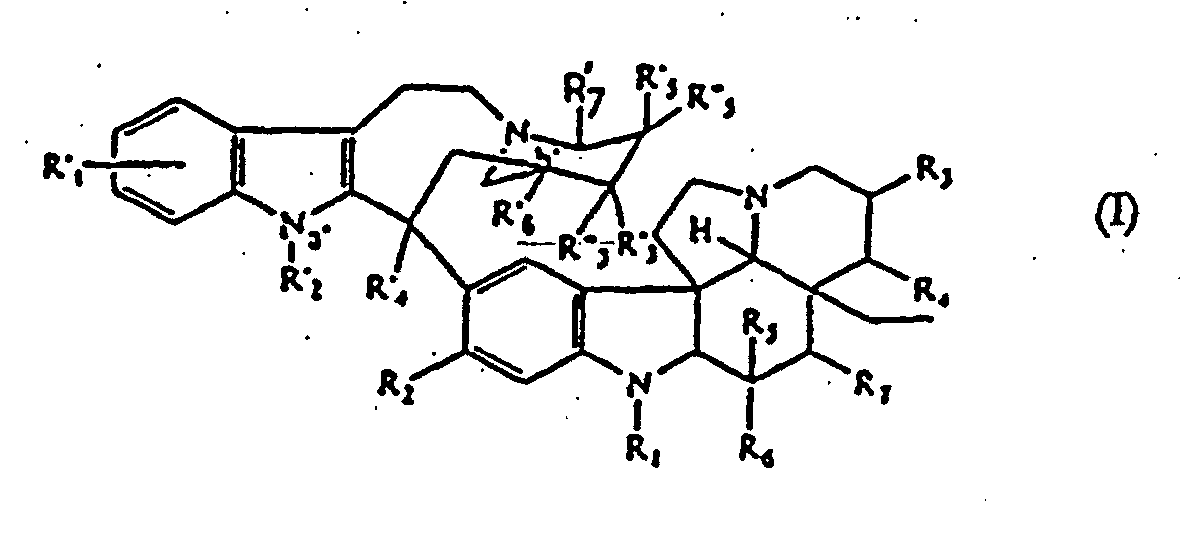 ebenso wie ihre Additionssalze mit Säuren oder ihrer quaternären Ammoniumsalze, durch Reaktion von einem Produkt (c), entsprechend der allgemeinen Formel (II):R'1 ein Wasserstoffatom oder einen Alkoxy-, Acyl-, Formyl- oder Halogenacylrest darstellt,R'2 ein Wasserstoffatom oder einen Alkylrest darstellt,R'3 und R"3 identisch oder voneinander verschieden sind und jedes unabhängig ein Wasserstoffatom oder einen Hydroxyl-, Alkanoyloxyl-Rest darstellt oder auch R'3 oder R"3 zusammen eine Carbonylgruppe bilden oder auch R'3 und R'5 gemeinsam eine Epoxybrücke oder eine Doppelbindung bilden,R'4 ein Wasserstoffatom oder einen Alkyloxycarbonyl-Rest, ein Hydroxymethyl - oder ein Alkanoyloxymethyl-Rest, vorzugsweise einen Alkyloxycarbonyl-Rest darstellt,R'5 und R"5 identisch oder voneinander verschieden sind und jedes unabhängig ein Wasserstoffatom oder einen Hydroxyl-, ein Alkanoyloxyl-, Ethyl- oder Hydroxy-2-Ethyl-Rest darstellt,R'6 ein Wasserstoffatom oder ein Ethyl-, Hydroxy-2-Ethyl- oder Acetyl-Rest darstellt,R'7 ein Wasserstoffatom oder einen Cyanidrest darstellt,R1 ein Wasserstoffatom oder einen Alkyl-, Formyl-, Aryl-Rest, vorzugsweise Wasserstoff oder Alkyl-Rest, darstellt,R2 ein Wasserstoffatom oder einen Alkoxy-Rest darstellt,R3 ein Wasserstoffatom oder einen Hydroxyl-, Alkanoyloxyl-Rest darstellt oder auch R3 und R4 gemeinsam eine Epoxybrücke oder eine Doppelbindung bilden,R4 ein Wasserstoffatom oder einen Hydroxyl-, Alkanoyloxyl-Rest darstellt oder auch R4 und R5 gemeinsam eine Epoxybrücke bilden,R6 einen Alkyloxycarbonyl-, Hydrazido-, Acetamido-, Hydroxymethyl- oder Alkanoyloxymethyl-Rest darstellt,R5 und R7 ein Wasserstoffatom oder einen Hydroxyl- oder Alkanoyloxyl-Rest darstellen,wobei R'1, R'2, R'3, R"3, R'4, R'5, R"5 und R'6 wie vorstehend definiert sind,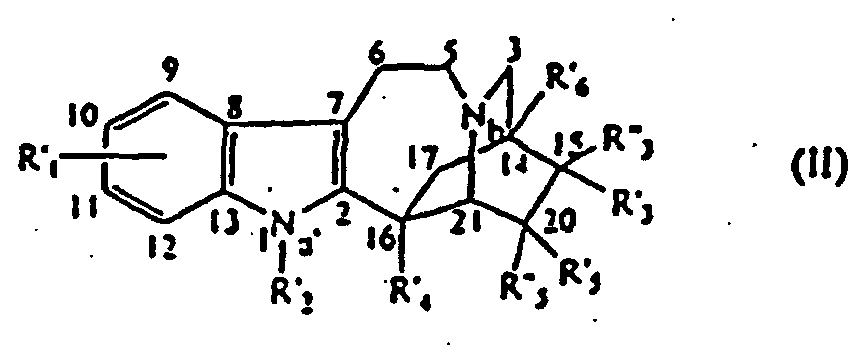
mit einem Produkt (v), entsprechend der allgemeinen Formel (III):wobei R1, R2, R3, R'4, R5, R6 und R7 wie vorstehend definiert sind;
wobei dieses Verfahren dadurch gekennzeichnet ist, dass man das Produkt (V) mit allen bekannten Mitteln, besonders auf photochemischen, organometallischen und elektrochemischen Wegen oxidiert, um ein Intermediat (i) der allgemeinen Formel (IV) zu erhalten:wobei R1, R2, R3, R4, R5, R6, R7, und R'1, R'2, R'3 R"3, R'4, R'5, R"5 und R'6 wie oben definiert sind, und in welchem man das Produkt (i) der Formel (IV) entweder einer Reduktion oder einer Cyanierung unterzieht, um das Produkt (A) zu erhalten.
- Verfahren nach Anspruch 1, dadurch gekennzeichnet, dass das Produkt (v) auf photochemischem Weg oxidiert wird.
- Verfahren nach Anspruch 1, dadurch gekennzeichnet, dass das Produkt (v) auf organometallischem Weg oxidiert wird.
- Verfahren nach Anspruch 1, dadurch gekennzeichnet, dass das Produkt (v) auf elektrochemischem Weg oxidiert wird.
- Verfahren nach Anspruch 1 oder 2, dadurch gekennzeichnet, dass die Oxidation auf photochemischem Weg in Gegenwart von Licht und gegebenenfalls eines organischen oder anorganischen Sensibilisators bewirkt wird.
- Verfahren nach Anspruch 5, dadurch gekennzeichnet, dass der anorganische Sensibilisator ein Übergangsmetall oder ein Halbleiter ist, vorzugsweise ein Ruthenium- oder Titanoxid-Komplex.
- Verfahren nach Anspruch 5, dadurch gekennzeichnet, dass der organische Sensibilisator ein Farbstoff ist, vorzugsweise ausgewählt aus der Gruppe, umfassend die Xanthongenate, Pyridiniume, Pyriliume Flavine, Aromaten, Ketone und Chinone sowie ihre Salze, und noch stärker bevorzugt ausgewählt ist unter Fluoreszin, Triphenylpyrilium, 4-(4-Methoxyphenyl)-2,6-diphenylpyrilium, 2,6-Triphenylpyrilium, 4-(4-Methoxyphenyl)-2,6-diphenylpyrilium, 2,6-bis(4-Methoxyphenyl)-4-phenylpyrilium und 2,4,6-tris(4-Methoxyphenyl)pyrilium.
- Verfahren nach Anspruch 5, dadurch gekennzeichnet, dass das Licht eine Wellenlänge innerhalb des im UV-sichtbaren Spektrums, vorzugsweise oberhalb von 254 nm und stärker bevorzugt oberhalb von 400 nm hat.
- Verfahren nach einem der Ansprüche 1 bis 8, dadurch gekennzeichnet, dass der Reduktionsschritt mit Hilfe eines Alkaliborhydrids, vorzugsweise Natriumborhydrid, ausgeführt wird.
- Verfahren nach einem der Ansprüche 1 bis 9, dadurch gekennzeichnet, dass das Produkt (A) Anhydrovinblastin ist,
(c) Catharanthin ist,
(v) Vindolin ist,
und das Produkt (i) der Formel (V) entspricht
- Neues Produkt (B) der allgemeinen Formel (VI):wobei:
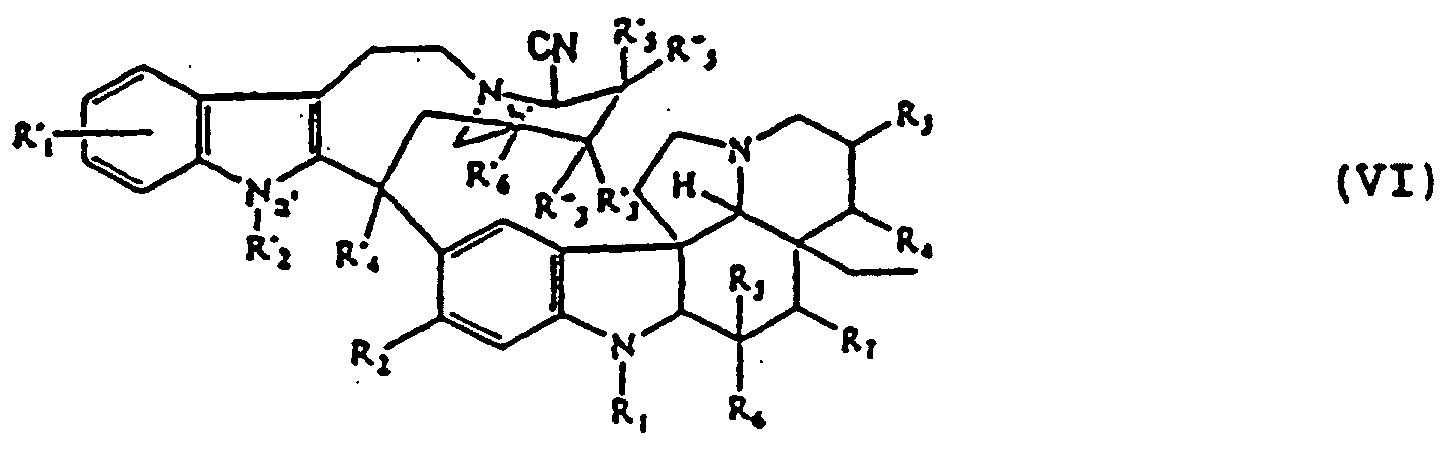 R1, ein Wasserstoffatom oder ein Alkoxy-, Acyl-, Formyl- oder Halogenacyl-Rest darstellt,R'2 ein Wasserstoffatom oder einen Alkylrest darstellt,R'3 und R"3 identisch oder voneinander verschieden sind und jedes unabhängig ein Wasserstoffatom oder ein Hydroxyl-, Alkanoyloxyl-Rest darstellt oder auch R'3 und R"3 gemeinsam eine Cabonylgruppe bilden oder auch R'3 und R'5 gemeinsam eine Doppelbindung bilden,R'4 ein Wasserstoffatom oder einen Alkyloxycarbonyl-, Hydroxymethyl- oder Alcanoyloxymethyl-Rest, vorzugsweise Alkyloxycarbonyl-Rest, darstellt,R'5 und R"5 identisch oder voneinander verschieden sind und jedes unabhängig ein Wasserstoffatom oder einen Hydroxyl-, Alkanoyloxyl-, Ethyl- oder Hydroxy-2-Ethyl-Rest darstellt,R'6 ein Wasserstoffatom oder einen Ethyl-, Hydroxy-2-Ethyl- oder Acetyl-Rest darstellt,R1 ein Wasserstoffatom oder einen Alkyl-, Formyl- oder Acyl-Rest darstellt, vorzugsweise ein Wasserstoff oder Alkyl-Rest,R2 ein Wasserstoffatom oder einen Alkoxy-Rest darstellt,R3 ein Wasserstoffatom oder einen Hydroxyl-, Alkanoylozcyl-Rest darstellt, oder auch R3 und R4 gemeinsam eine Epoxybrücke oder eine Doppelbindung bilden,R4 ein Wasserstoffatom oder einen Hydroxyl-, Alkanoyloxyl-Rest darstellt oder auch R4 oder R5 gemeinsam eine Epoxybrücke bilden,R6 einen Allryloxycarbonyl-, Hydrazido-, Acetamido-, Hydroxymethyl- oder Alkanoyloxymethyl-Rest darstellt,R5 und R7 ein Wasserstoffatom oder einen Hydroxyl- oder Alkanoyloxyl-Rest darstellen.
 - Neues Produkt (D) der Formel (VII)

- Verfahren zur Herstellung eines neuen Produkts (D), wie nach Anspruch 12 definiert, durch Reaktion von Catharanthin mit Vindolin, wobei dieses Verfahren dadurch gekennzeichnet ist, dass man die Reaktionsbedingungen so auswählt, dass Vindolin oxidiert wird, um ein Intermediat (i') der Formel (V) zu erhalten, und bei welchem man das Intermediat (i') einer Cyanierung unterzieht, um das Produkt (D) zu erhalten.
- Verfahren nach einem der Ansprüche 1 bis 8 und 13, dadurch gekennzeichnet, dass der Cyanierungsschritt vorzugsweise in organischem Milieu in Gegenwart einer nicht oder wenig alkalischen Cyanidionen-Quelle durchgeführt wird, und noch stärker bevorzugt in Gegenwart von Trimethylsilylcyanid.
Applications Claiming Priority (3)
| Application Number | Priority Date | Filing Date | Title |
|---|---|---|---|
| FR9806895A FR2779146B1 (fr) | 1998-06-02 | 1998-06-02 | Nouveaux derives de vinca-alcaloides et procedes de preparation |
| FR9806895 | 1998-06-02 | ||
| PCT/FR1999/001289 WO1999062912A1 (fr) | 1998-06-02 | 1999-06-02 | Nouveaux derives de vinca-alcaloides et procedes de preparation |
Publications (2)
| Publication Number | Publication Date |
|---|---|
| EP1084126A1 EP1084126A1 (de) | 2001-03-21 |
| EP1084126B1 true EP1084126B1 (de) | 2004-11-17 |
Family
ID=9526926
Family Applications (1)
| Application Number | Title | Priority Date | Filing Date |
|---|---|---|---|
| EP99922250A Expired - Lifetime EP1084126B1 (de) | 1998-06-02 | 1999-06-02 | Neue vinca-alkaloidderivate und verfahren zur herstellung |
Country Status (10)
| Country | Link |
|---|---|
| US (1) | US6365735B1 (de) |
| EP (1) | EP1084126B1 (de) |
| JP (2) | JP5154720B2 (de) |
| AU (1) | AU3936699A (de) |
| CA (1) | CA2335947C (de) |
| DE (1) | DE69921996T2 (de) |
| ES (1) | ES2233048T3 (de) |
| FR (1) | FR2779146B1 (de) |
| PT (1) | PT1084126E (de) |
| WO (1) | WO1999062912A1 (de) |
Families Citing this family (9)
| Publication number | Priority date | Publication date | Assignee | Title |
|---|---|---|---|---|
| FR2779146B1 (fr) * | 1998-06-02 | 2002-01-18 | Roowin | Nouveaux derives de vinca-alcaloides et procedes de preparation |
| WO2003018018A2 (en) * | 2001-08-24 | 2003-03-06 | Neopharm, Inc. | Vinorelbine compositions and methods of use |
| NZ547370A (en) * | 2003-12-04 | 2010-09-30 | Amr Technology Inc | Vinca derivatives |
| EP1694330A4 (de) * | 2003-12-04 | 2009-06-24 | Amr Technology Inc | Vinorelbin-derivate |
| WO2007098091A2 (en) | 2006-02-17 | 2007-08-30 | Novacea, Inc. | Treatment of hyperproliferative diseases with vinca alkaloid n-oxide and analogs |
| US8039453B2 (en) * | 2006-09-12 | 2011-10-18 | Albany Molecular Research, Inc. | Vinca derivatives |
| WO2008033935A2 (en) * | 2006-09-12 | 2008-03-20 | Amr Technology, Inc. | Vinorelbine derivatives |
| FR2905949B1 (fr) * | 2006-09-20 | 2008-11-21 | Pierre Fabre Medicament Sa | Derives fluores de catharanthine, leur preparation et leur utilisation comme precurseurs d'alcaloides dimeres de vinca |
| CN101235046B (zh) * | 2007-01-29 | 2010-09-08 | 中国科学院上海药物研究所 | 长春碱衍生物、其制备方法和用途、以及包含该衍生物的药物组合物 |
Family Cites Families (7)
| Publication number | Priority date | Publication date | Assignee | Title |
|---|---|---|---|---|
| FR2296418B1 (de) | 1974-12-30 | 1978-07-21 | Anvar | |
| CA1341261C (en) * | 1987-01-22 | 2001-06-26 | James P. Kutney | Process for the synthesis of 3',4'-anhydrovinblastine, vinblastine and vincristine |
| CA1341262C (en) * | 1987-08-06 | 2001-06-26 | Camille A. Boulet | A new process of the synthesis of 3',4'-anhydrovinblastine, vinblastine and vincristine |
| FI80462C (fi) * | 1988-06-10 | 1990-06-11 | Huhtamaeki Oy | Foerfarande foer framstaellning av dimera catharanthus-alkaloider. |
| US5037977A (en) * | 1988-08-11 | 1991-08-06 | Mitsui Petrochemical Industries Ltd. | Method for production of dimeric alkaloids |
| JPH0341081A (ja) * | 1989-07-10 | 1991-02-21 | Mitsui Petrochem Ind Ltd | 二量体アルカロイド類の製造方法 |
| FR2779146B1 (fr) * | 1998-06-02 | 2002-01-18 | Roowin | Nouveaux derives de vinca-alcaloides et procedes de preparation |
-
1998
- 1998-06-02 FR FR9806895A patent/FR2779146B1/fr not_active Expired - Lifetime
-
1999
- 1999-06-02 ES ES99922250T patent/ES2233048T3/es not_active Expired - Lifetime
- 1999-06-02 DE DE69921996T patent/DE69921996T2/de not_active Expired - Lifetime
- 1999-06-02 AU AU39366/99A patent/AU3936699A/en not_active Abandoned
- 1999-06-02 PT PT99922250T patent/PT1084126E/pt unknown
- 1999-06-02 EP EP99922250A patent/EP1084126B1/de not_active Expired - Lifetime
- 1999-06-02 WO PCT/FR1999/001289 patent/WO1999062912A1/fr not_active Ceased
- 1999-06-02 US US09/701,502 patent/US6365735B1/en not_active Expired - Lifetime
- 1999-06-02 JP JP2000552123A patent/JP5154720B2/ja not_active Expired - Fee Related
- 1999-06-02 CA CA2335947A patent/CA2335947C/fr not_active Expired - Fee Related
-
2011
- 2011-02-10 JP JP2011027226A patent/JP2011140494A/ja active Pending
Also Published As
| Publication number | Publication date |
|---|---|
| CA2335947A1 (fr) | 1999-12-09 |
| JP2011140494A (ja) | 2011-07-21 |
| ES2233048T3 (es) | 2005-06-01 |
| AU3936699A (en) | 1999-12-20 |
| FR2779146A1 (fr) | 1999-12-03 |
| WO1999062912A1 (fr) | 1999-12-09 |
| DE69921996D1 (de) | 2004-12-23 |
| JP2002517399A (ja) | 2002-06-18 |
| US6365735B1 (en) | 2002-04-02 |
| CA2335947C (fr) | 2010-02-16 |
| PT1084126E (pt) | 2005-03-31 |
| DE69921996T2 (de) | 2005-11-24 |
| FR2779146B1 (fr) | 2002-01-18 |
| EP1084126A1 (de) | 2001-03-21 |
| JP5154720B2 (ja) | 2013-02-27 |
Similar Documents
| Publication | Publication Date | Title |
|---|---|---|
| EP0010458B1 (de) | Bis-Indole-Verbindungen, sie enthaltende pharmazeutische Zusammensetzungen, Verfahren zu ihrer Herstellung | |
| FR2586683A1 (fr) | Nouveaux derives de neothramycine, leur procede de preparation et leur application en tant que medicaments | |
| JP2011140494A (ja) | 新規なビンカアルカロイド誘導体及びその調製方法 | |
| Scheer | Synthesis and stereochemistry of hydroporphyrins. | |
| Kuehne et al. | Syntheses and biological evaluation of vinblastine congeners | |
| JP5091760B2 (ja) | フラーレン誘導体及びその製造方法 | |
| Gros et al. | Approaches to β-fused porphyrinoporphyrins: pyrrolo-and dipyrromethaneporphyrins | |
| Wrona et al. | Electrochemical oxidation of 5-hydroxytryptamine in acidic aqueous solution | |
| CA2148943C (en) | Oxidation of glycoside substituted taxanes to taxol or taxol precursors and new taxane compounds formed as intermediates | |
| CA2253912C (en) | Taxane derivatives, the preparation thereof and formulations containing them | |
| WO2001021617A1 (en) | Process for preparing sulfoxide compounds | |
| RU2448957C2 (ru) | Фторированные производные катарантина, их получение и применение в качестве прекурсоров димерных алкалоидов vinca | |
| Antkowiak et al. | Solvent effect on the reactivity of 1, 10-phenanthroline-5, 6-dione towards diazomethane | |
| Bonazzi et al. | Synthetic studies on the sporolides: Exploration of the enediyne route | |
| JP3171400B2 (ja) | ヒドロキシカルボニル誘導体およびその製造方法 | |
| SCOLA‐NAGELSCHNEIDER et al. | 4a‐Alkyldihydroflavin Coenzyme Synthesis and Modification of Flavodoxin | |
| EP0117861B1 (de) | Verfahren zur Herstellung von Vincristin | |
| EP0360820B1 (de) | Oligopyridinliganden, verfahren zu ihrer herstellung und ihre verwendung als komplexbildnermittel | |
| EP0165225B1 (de) | Verfahren zur Herstellung von 5-Azaindol und Zwischenprodukte | |
| KR100679115B1 (ko) | 1-알파-히드록시콜레칼시페롤 유도체의 제조방법 | |
| CA1210762A (fr) | Methode de preparation de vincristine | |
| CH630387A5 (fr) | Procede de preparation de leurosine et de ses derives. | |
| Mironova et al. | A convenient synthesis of retinal derivatives with modified trimethylcyclohexene ring | |
| Ferroud et al. | A singlet oxygen mediated new access to hydroxyindolenine-catharanthine derivatives by two sequential oxidations | |
| FR2551057A1 (fr) | Nouveaux aglycones utiles pour la preparation des antibiotiques et des antitumoraux de la serie des anthracyclines et leurs procedes de preparation |
Legal Events
| Date | Code | Title | Description |
|---|---|---|---|
| PUAI | Public reference made under article 153(3) epc to a published international application that has entered the european phase |
Free format text: ORIGINAL CODE: 0009012 |
|
| 17P | Request for examination filed |
Effective date: 20001205 |
|
| AK | Designated contracting states |
Kind code of ref document: A1 Designated state(s): DE ES FR GB IT NL PT |
|
| 17Q | First examination report despatched |
Effective date: 20021204 |
|
| GRAP | Despatch of communication of intention to grant a patent |
Free format text: ORIGINAL CODE: EPIDOSNIGR1 |
|
| GRAS | Grant fee paid |
Free format text: ORIGINAL CODE: EPIDOSNIGR3 |
|
| GRAA | (expected) grant |
Free format text: ORIGINAL CODE: 0009210 |
|
| AK | Designated contracting states |
Kind code of ref document: B1 Designated state(s): DE ES FR GB IT NL PT |
|
| REG | Reference to a national code |
Ref country code: GB Ref legal event code: FG4D Free format text: NOT ENGLISH |
|
| REF | Corresponds to: |
Ref document number: 69921996 Country of ref document: DE Date of ref document: 20041223 Kind code of ref document: P |
|
| GBT | Gb: translation of ep patent filed (gb section 77(6)(a)/1977) |
Effective date: 20050301 |
|
| REG | Reference to a national code |
Ref country code: PT Ref legal event code: SC4A Free format text: AVAILABILITY OF NATIONAL TRANSLATION Effective date: 20050204 |
|
| REG | Reference to a national code |
Ref country code: ES Ref legal event code: FG2A Ref document number: 2233048 Country of ref document: ES Kind code of ref document: T3 |
|
| PLBE | No opposition filed within time limit |
Free format text: ORIGINAL CODE: 0009261 |
|
| STAA | Information on the status of an ep patent application or granted ep patent |
Free format text: STATUS: NO OPPOSITION FILED WITHIN TIME LIMIT |
|
| 26N | No opposition filed |
Effective date: 20050818 |
|
| REG | Reference to a national code |
Ref country code: FR Ref legal event code: PLFP Year of fee payment: 17 |
|
| PG25 | Lapsed in a contracting state [announced via postgrant information from national office to epo] |
Ref country code: IT Free format text: LAPSE BECAUSE OF NON-PAYMENT OF DUE FEES Effective date: 20150602 |
|
| PGRI | Patent reinstated in contracting state [announced from national office to epo] |
Ref country code: IT Effective date: 20160412 |
|
| REG | Reference to a national code |
Ref country code: FR Ref legal event code: PLFP Year of fee payment: 18 |
|
| REG | Reference to a national code |
Ref country code: FR Ref legal event code: PLFP Year of fee payment: 19 |
|
| PGFP | Annual fee paid to national office [announced via postgrant information from national office to epo] |
Ref country code: FR Payment date: 20171219 Year of fee payment: 19 Ref country code: NL Payment date: 20171221 Year of fee payment: 19 |
|
| PGFP | Annual fee paid to national office [announced via postgrant information from national office to epo] |
Ref country code: PT Payment date: 20171129 Year of fee payment: 19 Ref country code: GB Payment date: 20171221 Year of fee payment: 19 |
|
| PGFP | Annual fee paid to national office [announced via postgrant information from national office to epo] |
Ref country code: ES Payment date: 20171228 Year of fee payment: 19 Ref country code: DE Payment date: 20171229 Year of fee payment: 19 |
|
| PGFP | Annual fee paid to national office [announced via postgrant information from national office to epo] |
Ref country code: IT Payment date: 20171227 Year of fee payment: 19 |
|
| REG | Reference to a national code |
Ref country code: DE Ref legal event code: R119 Ref document number: 69921996 Country of ref document: DE |
|
| PG25 | Lapsed in a contracting state [announced via postgrant information from national office to epo] |
Ref country code: PT Free format text: LAPSE BECAUSE OF NON-PAYMENT OF DUE FEES Effective date: 20181203 |
|
| REG | Reference to a national code |
Ref country code: NL Ref legal event code: MM Effective date: 20180701 |
|
| GBPC | Gb: european patent ceased through non-payment of renewal fee |
Effective date: 20180602 |
|
| PG25 | Lapsed in a contracting state [announced via postgrant information from national office to epo] |
Ref country code: NL Free format text: LAPSE BECAUSE OF NON-PAYMENT OF DUE FEES Effective date: 20180701 |
|
| PG25 | Lapsed in a contracting state [announced via postgrant information from national office to epo] |
Ref country code: FR Free format text: LAPSE BECAUSE OF NON-PAYMENT OF DUE FEES Effective date: 20180630 Ref country code: DE Free format text: LAPSE BECAUSE OF NON-PAYMENT OF DUE FEES Effective date: 20190101 Ref country code: GB Free format text: LAPSE BECAUSE OF NON-PAYMENT OF DUE FEES Effective date: 20180602 Ref country code: IT Free format text: LAPSE BECAUSE OF NON-PAYMENT OF DUE FEES Effective date: 20180602 |
|
| PG25 | Lapsed in a contracting state [announced via postgrant information from national office to epo] |
Ref country code: PT Free format text: LAPSE BECAUSE OF EXPIRATION OF PROTECTION Effective date: 20190611 |
|
| REG | Reference to a national code |
Ref country code: ES Ref legal event code: FD2A Effective date: 20190916 |
|
| PG25 | Lapsed in a contracting state [announced via postgrant information from national office to epo] |
Ref country code: ES Free format text: LAPSE BECAUSE OF NON-PAYMENT OF DUE FEES Effective date: 20180603 |