EP1087971B1 - COMPOSES DE PYRROLO 2,3-d]PYRIMIDINE - Google Patents
COMPOSES DE PYRROLO 2,3-d]PYRIMIDINE Download PDFInfo
- Publication number
- EP1087971B1 EP1087971B1 EP99923800A EP99923800A EP1087971B1 EP 1087971 B1 EP1087971 B1 EP 1087971B1 EP 99923800 A EP99923800 A EP 99923800A EP 99923800 A EP99923800 A EP 99923800A EP 1087971 B1 EP1087971 B1 EP 1087971B1
- Authority
- EP
- European Patent Office
- Prior art keywords
- alkyl
- aryl
- pyrrolo
- alkoxy
- heteroaryl
- Prior art date
- Legal status (The legal status is an assumption and is not a legal conclusion. Google has not performed a legal analysis and makes no representation as to the accuracy of the status listed.)
- Expired - Lifetime
Links
- 0 CCCC*(C1C23C1CCCC2)C3=C Chemical compound CCCC*(C1C23C1CCCC2)C3=C 0.000 description 4
Classifications
-
- C—CHEMISTRY; METALLURGY
- C07—ORGANIC CHEMISTRY
- C07D—HETEROCYCLIC COMPOUNDS
- C07D487/00—Heterocyclic compounds containing nitrogen atoms as the only ring hetero atoms in the condensed system, not provided for by groups C07D451/00 - C07D477/00
- C07D487/02—Heterocyclic compounds containing nitrogen atoms as the only ring hetero atoms in the condensed system, not provided for by groups C07D451/00 - C07D477/00 in which the condensed system contains two hetero rings
- C07D487/04—Ortho-condensed systems
-
- A—HUMAN NECESSITIES
- A61—MEDICAL OR VETERINARY SCIENCE; HYGIENE
- A61P—SPECIFIC THERAPEUTIC ACTIVITY OF CHEMICAL COMPOUNDS OR MEDICINAL PREPARATIONS
- A61P1/00—Drugs for disorders of the alimentary tract or the digestive system
- A61P1/04—Drugs for disorders of the alimentary tract or the digestive system for ulcers, gastritis or reflux esophagitis, e.g. antacids, inhibitors of acid secretion, mucosal protectants
-
- A—HUMAN NECESSITIES
- A61—MEDICAL OR VETERINARY SCIENCE; HYGIENE
- A61P—SPECIFIC THERAPEUTIC ACTIVITY OF CHEMICAL COMPOUNDS OR MEDICINAL PREPARATIONS
- A61P11/00—Drugs for disorders of the respiratory system
- A61P11/06—Antiasthmatics
-
- A—HUMAN NECESSITIES
- A61—MEDICAL OR VETERINARY SCIENCE; HYGIENE
- A61P—SPECIFIC THERAPEUTIC ACTIVITY OF CHEMICAL COMPOUNDS OR MEDICINAL PREPARATIONS
- A61P17/00—Drugs for dermatological disorders
- A61P17/04—Antipruritics
-
- A—HUMAN NECESSITIES
- A61—MEDICAL OR VETERINARY SCIENCE; HYGIENE
- A61P—SPECIFIC THERAPEUTIC ACTIVITY OF CHEMICAL COMPOUNDS OR MEDICINAL PREPARATIONS
- A61P19/00—Drugs for skeletal disorders
- A61P19/02—Drugs for skeletal disorders for joint disorders, e.g. arthritis, arthrosis
-
- A—HUMAN NECESSITIES
- A61—MEDICAL OR VETERINARY SCIENCE; HYGIENE
- A61P—SPECIFIC THERAPEUTIC ACTIVITY OF CHEMICAL COMPOUNDS OR MEDICINAL PREPARATIONS
- A61P25/00—Drugs for disorders of the nervous system
-
- A—HUMAN NECESSITIES
- A61—MEDICAL OR VETERINARY SCIENCE; HYGIENE
- A61P—SPECIFIC THERAPEUTIC ACTIVITY OF CHEMICAL COMPOUNDS OR MEDICINAL PREPARATIONS
- A61P25/00—Drugs for disorders of the nervous system
- A61P25/18—Antipsychotics, i.e. neuroleptics; Drugs for mania or schizophrenia
-
- A—HUMAN NECESSITIES
- A61—MEDICAL OR VETERINARY SCIENCE; HYGIENE
- A61P—SPECIFIC THERAPEUTIC ACTIVITY OF CHEMICAL COMPOUNDS OR MEDICINAL PREPARATIONS
- A61P25/00—Drugs for disorders of the nervous system
- A61P25/28—Drugs for disorders of the nervous system for treating neurodegenerative disorders of the central nervous system, e.g. nootropic agents, cognition enhancers, drugs for treating Alzheimer's disease or other forms of dementia
-
- A—HUMAN NECESSITIES
- A61—MEDICAL OR VETERINARY SCIENCE; HYGIENE
- A61P—SPECIFIC THERAPEUTIC ACTIVITY OF CHEMICAL COMPOUNDS OR MEDICINAL PREPARATIONS
- A61P29/00—Non-central analgesic, antipyretic or antiinflammatory agents, e.g. antirheumatic agents; Non-steroidal antiinflammatory drugs [NSAID]
-
- A—HUMAN NECESSITIES
- A61—MEDICAL OR VETERINARY SCIENCE; HYGIENE
- A61P—SPECIFIC THERAPEUTIC ACTIVITY OF CHEMICAL COMPOUNDS OR MEDICINAL PREPARATIONS
- A61P3/00—Drugs for disorders of the metabolism
- A61P3/08—Drugs for disorders of the metabolism for glucose homeostasis
- A61P3/10—Drugs for disorders of the metabolism for glucose homeostasis for hyperglycaemia, e.g. antidiabetics
-
- A—HUMAN NECESSITIES
- A61—MEDICAL OR VETERINARY SCIENCE; HYGIENE
- A61P—SPECIFIC THERAPEUTIC ACTIVITY OF CHEMICAL COMPOUNDS OR MEDICINAL PREPARATIONS
- A61P35/00—Antineoplastic agents
-
- A—HUMAN NECESSITIES
- A61—MEDICAL OR VETERINARY SCIENCE; HYGIENE
- A61P—SPECIFIC THERAPEUTIC ACTIVITY OF CHEMICAL COMPOUNDS OR MEDICINAL PREPARATIONS
- A61P35/00—Antineoplastic agents
- A61P35/02—Antineoplastic agents specific for leukemia
-
- A—HUMAN NECESSITIES
- A61—MEDICAL OR VETERINARY SCIENCE; HYGIENE
- A61P—SPECIFIC THERAPEUTIC ACTIVITY OF CHEMICAL COMPOUNDS OR MEDICINAL PREPARATIONS
- A61P37/00—Drugs for immunological or allergic disorders
-
- A—HUMAN NECESSITIES
- A61—MEDICAL OR VETERINARY SCIENCE; HYGIENE
- A61P—SPECIFIC THERAPEUTIC ACTIVITY OF CHEMICAL COMPOUNDS OR MEDICINAL PREPARATIONS
- A61P37/00—Drugs for immunological or allergic disorders
- A61P37/02—Immunomodulators
- A61P37/06—Immunosuppressants, e.g. drugs for graft rejection
-
- A—HUMAN NECESSITIES
- A61—MEDICAL OR VETERINARY SCIENCE; HYGIENE
- A61P—SPECIFIC THERAPEUTIC ACTIVITY OF CHEMICAL COMPOUNDS OR MEDICINAL PREPARATIONS
- A61P5/00—Drugs for disorders of the endocrine system
- A61P5/14—Drugs for disorders of the endocrine system of the thyroid hormones, e.g. T3, T4
-
- A—HUMAN NECESSITIES
- A61—MEDICAL OR VETERINARY SCIENCE; HYGIENE
- A61P—SPECIFIC THERAPEUTIC ACTIVITY OF CHEMICAL COMPOUNDS OR MEDICINAL PREPARATIONS
- A61P5/00—Drugs for disorders of the endocrine system
- A61P5/14—Drugs for disorders of the endocrine system of the thyroid hormones, e.g. T3, T4
- A61P5/16—Drugs for disorders of the endocrine system of the thyroid hormones, e.g. T3, T4 for decreasing, blocking or antagonising the activity of the thyroid hormones
Definitions
- the present invention relates to pyrrolo[2,3-d]pyrimidine compounds which are inhibitors of protein tyrosine kinases, such as the enzyme Janus Kinase 3 (hereinafter also referred to as JAK3) and as such are useful therapy as immunosuppressive agents for organ transplants, lupus, multiple sclerosis, rheumatoid arthritis, psoriasis, Type I diabetes and complications from diabetes, cancer, asthma, atopic dermatitis, autoimmune thyroid disorders, ulcerative colitis, Crohn's disease, Alzheimer's disease, Leukemia and other indications where immunosuppression would be desirable.
- protein tyrosine kinases such as the enzyme Janus Kinase 3 (hereinafter also referred to as JAK3)
- JAK3 Janus Kinase 3
- This invention also relates to the use of such compounds in the manufacture of a medicament for the treatment of the above indications in mammals, especially humans, and the pharmaceutical compositions useful therefor.
- JAK3 is a member of the Janus family of protein tyrosine kinases. Although the other members of this family are expressed by essentially all tissues, JAK3 expression is limited to hematopoetic cells. This is consistent with its essential role in signalling through the receptors for IL-2, IL-4, IL-7, IL-9 and IL-15 by non-covalent association of JAK3 with the gamma chain common to these multi-chain receptors. XSCID patient populations have been identified with severely reduced levels of JAK3 protein or with genetic defects to the common gamma chain, suggesting that immunosuppression should result from blocking signalling through the JAK3 pathway.
- JAK3 not only plays a critical role in B and T lymphocyte maturation, but that JAK3 is constitutively required to maintain T cell function. Modulation of immune activity through this novel mechanism can prove useful in the treatment of T cell proliferative disorders such as transplant rejection and autoimmune diseases.
- WO-A-97/27199 describes pyrrolopyrimidine compounds which are inhibitors of protein kinases and have, for example, anti-tumour activity.
- WO-A-96/40142 and WO-A-98/23613 describe heterocyclic ring-fused pyrimidine derivatives useful in the treatment of hyperproliferative diseases, such as cancers and acnes, in mammals.
- the present invention relates to a compound of the formula or the pharmaceutically acceptable salt thereof; wherein
- the present invention also relates to the pharmaceutically acceptable acid addition salts of compounds of the formula I.
- the acids which are used to prepare the pharmaceutically acceptable acid addition salts of the aforementioned base compounds of this invention are those which form non-toxic acid addition salts, i.e. , salts containing pharmacologically acceptable anions, such as the hydrochloride, hydrobromide, hydroiodide, nitrate, sulfate, bisulfate.
- phosphate acid phosphate, acetate, lactate, citrate, acid citrate, tartrate, bitartrate, succinate, maleate, fumarate, gluconate, saccharate, benzoate, methanesulfonate, ethanesulfonate, benzenesulfonate, p-toluenesulfonate and pamoate [i.e. , 1,1'-methylene-bis-(2-hydroxy-3-naphthoate)]salts.
- the invention also relates to base addition salts of formula I.
- the chemical bases that may be used as reagents to prepare pharmaceutically acceptable base salts of those compounds of formula I that are acidic in nature are those that form non-toxic base salts with such compounds.
- Such non-toxic base salts include, but are not limited to those derived from such pharmacologically acceptable cations such as alkali metal cations (e.g ., potassium and sodium) and alkaline earth metal cations ( e.g. , calcium and magnesium), ammonium or watersoluble amine addition salts such as N-methylglucamine-(meglumine), and the lower alkanolammonium and other base salts of pharmaceutically acceptable organic amines.
- alkyl as used herein, unless otherwise indicated, includes saturated monovalent hydrocarbon radicals having straight, branched or cyclic moieties or combinations thereof.
- alkoxy includes O-alkyl groups wherein “alkyl” is defined above.
- halo as used herein, unless otherwise indicated, includes fluoro, chloro, bromo or iodo.
- the compounds of this invention may contain double bonds. When such bonds are present, the compounds of the invention exist as cis and trans configurations and as mixtures thereof.
- alkyl and alkenyl groups referred to herein, as well as the alkyl moieties of other groups referred to herein (e.g ., alkoxy), may be linear or branched, and they may also be cyclic ( e.g. , cyclopropyl, cyclobutyl, cyclopentyl, cyclohexyl or cycloheptyl) or be linear or branched and contain cyclic moieties.
- halogen includes fluorine, chlorine, bromine, and iodine.
- (C 3 -C 10 )Cycloalkyl when used herein refers to cycloalkyl groups containing zero to two levels of unsaturation such as cyclopropyl, cyclobutyl, cyclopentyl, cyclopentenyl, cyclohexyl, cyclohexenyl, 1,3-cyclohexadiene, cycloheptyl, cycloheptenyl, bicyclo[3.2.1]octane, norbornanyl etc. .
- Heterocycloalkyl when used herein refers to pyrrolidinyl, tetrahydrofuranyl, dihydrofuranyl, tetrahydropyranyl, pyranyl, thiopyranyl, aziridinyl, oxiranyl, methylenedioxyl, chromenyl, isoxazolidinyl, 1,3-oxazolidin-3-yl, isothiazolidinyl, 1,3-thiazolidin-3-yl, 1,2-pyrazolidin-2-yl, 1,3-pyrazolidin-1-yl, piperidinyl, thiomorpholinyl, 1,2-tetrahydrothiazin-2-yl, 1,3-tetrahydrothiazin-3-yl, tetrahydrothiadiazinyl, morpholinyl, 1,2-tetrahydrodiazin-2-yl, 1,3-tetrahydrodiazin-1-yl, tetra
- Heteroaryl when used herein refers to furyl, thienyl, thiazolyl, pyrazolyl, isothiazolyl, oxazolyl, isoxazolyl, pyrrolyl, triazolyl, tetrazolyl, imidazolyl, 1,3,5-oxadiazolyl, 1,2,4-oxadiazolyl, 1,2,3-oxadiazolyl, 1,3,5-thiadiazolyl, 1,2,3-thiadiazolyl, 1,2,4-thiadiazolyl, pyridyl, pyrimidyl, pyrazinyl, pyridazinyl, 1,2,4-triazinyl, 1,2,3-triazinyl, 1,3,5-triazinyl, pyrazolo[3,4-b]pyridinyl, cinnolinyl, pteridinyl, purinyl, 6,7-dihydr
- (C 6 -C 10 )aryl when used herein refers to phenyl or naphthyl.
- Compounds of formula (I) may be administered in a pharmaceutically acceptable form either alone or in combination with one or more additional agents which modulate a mammalian immune system or with antiinflammatory agents.
- agents may include but are not limited to cyclosporin A (e.g. Sandimmune® or Neoral®, rapamycin, FK-506 (tacrolimus), leflunomide. deoxyspergualin, mycophenolate (e.g. Cellcept®), azathioprine (e.g. Imuran®), daclizumab (e.g. Zenapax®. OKT3 (e.g.
- Orthoclone® Orthoclone®
- AtGam Aspirin
- acetaminophen e.g., aspirin
- ibuprofen e.g., aspirin
- naproxen e.g., piroxicam
- antiinflammatory steroids e.g. prednisolone or dexamethasone
- the compounds of this invention include all configurational isomers (e.g ., cis and trans isomers) and all optical isomers of compounds of the formula I (e.g. , enantiomers and diastereomers), as well as racemic, diastereomeric and other mixtures of such isomers.
- This invention also includes all rotamers of compounds of formula I as well as scelemic mixtures.
- Preferred compounds of formula I include those wherein R 1 is is a group of the formula wherein the dashed line represents optional double bonds;
- R 2 and R 3 are each independently selected from the group consisting of hydrogen, (C 1 -C 6 )alkyl, (C 1 -C 6 )alkoxy, (C 3 -C 10 )cycloalkyl, (C 3 -C 10 )cycloalkoxy, (C 2 -C 9 )heterocycloalkyl, (C 5 -C 9 )heteroaryl or (C 6 -C 10 )aryl.
- the present invention also relates to a pharmaceutical composition for (a) treating, or preventing, a disorder or condition selected from organ transplant rejection, lupus, multiple sclerosis, rheumatoid arthritis, psoriasis, Type I diabetes and complications from diabetes, cancer, asthma, atopic dermatitis, autoimmune thyroid disorders, ulcerative colitis, Crohn's disease, Alzheimer's disease, Leukemia, and other autoimmune diseases or (b) the inhibition of protein tyrosine kinases or Janus Kinase 3 (JAK3) in a mammal, including a human, comprising an amount of a compound of formula I or a pharmaceutically acceptable salt thereof, effective in such disorders or conditions, and a pharmaceutically acceptable carrier.
- a disorder or condition selected from organ transplant rejection, lupus, multiple sclerosis, rheumatoid arthritis, psoriasis, Type I diabetes and complications from diabetes, cancer, asthma, atopic dermatitis, autoimmune thyroid disorders, ulcerative
- the present invention also relates to a pharmaceutical composition for (a) treating, or preventing, a disorder or condition selected from organ transplant rejection, lupus, multiple sclerosis, rheumatoid arthritis, psoriasis, Type I diabetes and complications from diabetes, cancer, asthma, atopic dermatitis, autoimmune thyroid disorders, ulcerative colitis, Crohn's disease, Alzheimer's disease, Leukemia, and other autoimmune diseases or (b) the inhibition of protein tyrosine kinases or Janus Kinase 3 (JAK3) in a mammal, including a human, comprising an amount of a compound of formula I or a pharmaceutically acceptable salt thereof, alone or in combination with T-cell immunosuppressant or anti-inflammatory agents, effective in such disorders or conditions, and a pharmaceutically acceptable carrier.
- a disorder or condition selected from organ transplant rejection, lupus, multiple sclerosis, rheumatoid arthritis, psoriasis, Type I diabetes and complications from diabetes,
- the present invention also relates to the use of an effective amount of a compound of formula I, or a pharmaceutically acceptable salt thereof, for the manufacture of a medicament for the inhibition of protein tyrosine kinases or Janus Kinase 3 (JAK3) in a mammal, including a human.
- a compound of formula I or a pharmaceutically acceptable salt thereof, for the manufacture of a medicament for the inhibition of protein tyrosine kinases or Janus Kinase 3 (JAK3) in a mammal, including a human.
- the present invention also relates to the use of an effective amount of a compound of formula I, or a pharmaceutically acceptable salt thereof, for the manufacture of a medicament for the treatment of, or prevention of, a disorder or condition selected from organ transplant rejection, lupus, multiple sclerosis, rheumatoid arthritis, psoriasis, Type I diabetes and complications from diabetes, cancer, asthma, atopic dermatitis, autoimmune thyroid disorders, ulcerative colitis, Crohn's disease, Alzheimer's disease, Leukemia and other autoimmune diseases in a mammal, including a human.
- a disorder or condition selected from organ transplant rejection, lupus, multiple sclerosis, rheumatoid arthritis, psoriasis, Type I diabetes and complications from diabetes, cancer, asthma, atopic dermatitis, autoimmune thyroid disorders, ulcerative colitis, Crohn's disease, Alzheimer's disease, Leukemia and other autoimmune diseases in a mammal, including a human.
- the present invention also relates to the use of an effective amount of a compound of formula I or a pharmaceutically acceptable salt thereof, alone or in combination with T-cell immunosuppressant or anti-inflammatory agents, for the manufacture of a medicament for the treatment of, or prevention of, a disorder or condition selected from organ transplant rejection, lupus, multiple sclerosis, rheumatoid arthritis, psoriasis, Type I diabetes and complications from diabetes, cancer, asthma, atopic dermatitis, autoimmune thyroid disorders, ulcerative colitis, Crohn's disease, Alzheimer's disease, Leukemia and other autoimmune diseases in a mammal, including a human.
- a disorder or condition selected from organ transplant rejection, lupus, multiple sclerosis, rheumatoid arthritis, psoriasis, Type I diabetes and complications from diabetes, cancer, asthma, atopic dermatitis, autoimmune thyroid disorders, ulcerative colitis, Crohn's disease, Alzheimer's disease, Leukemia and other autoimmune diseases
- reaction 1 of Scheme 1 the 4-chloropyrrolo[2,3-d]pyrimidine compound of formula XVII is converted to the corresponding compound of formula XVI , wherein R is benzenesulfonyl or benzyl, by treating XVII with benzenesulfonyl chloride, benzylchloride or benzylbromide in the presence of a base, such as sodium hydride or potassium carbonate, and a polar aprotic solvent, such as dimethylformamide or tetrahydrofuran.
- the reaction mixture is stirred at a temperature between about 0°C to about 70°C, preferably about 30°C, for a time period between about 1 hour to about 3 hours, preferably about 2 hours.
- reaction 2 of Scheme 1 the 4-chloropyrrolo[2,3-d]pyrimidine compound of formula XVI is converted to the corresponding 4-aminopyrrolo[2,3-d]pyrimidine compound of formula XV by coupling XVI with a compound of the formula R 1 H.
- the reaction is carried out in an alcohol solvent, such as tert-butanol, methanol or ethanol, or other high boiling organic solvents, such as dimethylformamide, 1,4-dioxane or 1,2-dichloroethane, at a temperature between about 60°C to about 120°C, preferably about 80°C.
- Typical reaction times are between about 2 hours to about 48 hours, preferably about 16 hours.
- reaction 3 of Scheme 1 removal of the protecting group from the compound of formula XV , wherein R is benzenesulfonyl, to give the corresponding compound of formula I , is carried out by treating XV with an alkali base, such as sodium hydroxide or potassium hydroxide, in an alcohol solvent, such as methanol or ethanol, or mixed solvents, such as alcohol/tetrahydrofuran or alcohol/water.
- an alkali base such as sodium hydroxide or potassium hydroxide
- alcohol solvent such as methanol or ethanol
- mixed solvents such as alcohol/tetrahydrofuran or alcohol/water.
- the reaction is carried out at room temperature for a time period between about 15 minutes to about 1 hour, preferably 30 minutes.
- Removal of the protecting group from the compound of formula XV , wherein R is benzyl is conducted by treating XV with sodium in ammonia at a temperature of about -78°C for a time period between about 15 minutes to about 1 hour.
- reaction 1 of Scheme 2 the 4-chloropyrrolo[2,3-d]pyrimidine compound of formula XXI , wherein R is hydrogen or benzenesulfonate, is converted to the 4-chloro-5-halopyrrolo[2,3-d]pyrimidine compound of formula XX, wherein Y is chloro, bromo or iodo, by reacting XXI with N-chlorosuccinimide, N-bromosuccinimide or N-iodosuccinimide. The reaction mixture is heated to reflux, in chloroform, for a time period between about 1 hour to about 3 hours, preferably about 1 hour.
- reaction 1 of Scheme 2 the 4-chloropyrrolo(2,3-d]pyrimidine of formula XXI , wherein R is hydrogen, is converted to the corresponding 4-chloro-5-nitropyrrolo[2,3-d]pyrimidine of formula XX , wherein Y is nitro, by reacting XXI with nitric acid in sulfuric acid at a temperature between about -10°C to about 10°C, preferably about 0°C, for a time period between about 5 minutes to about 15 minutes, preferably about 10 minutes.
- the dianion so formed is reacted with molecular oxygen to form the corresponding 4-chloro-5-hydroxypyrrolo[2,3-d]pyrimidine compound of formula XIX, wherein R 2 is hydroxy.
- the compound of formula XX, wherein Y is bromine or iodine and R is benzenesulfonate, is converted to the compound of formula XIX , wherein R 2 is (C 6 -C 12 )aryl or vinyl, by treating XX with N-butyllithium, at a temperature of about -78°C, followed by the addition of zinc chloride, at a temperature of about -78°C.
- the corresponding organo zinc intermediate so formed is then reacted with aryliodide or vinyl iodide in the presence of a catalytic quantity of palladium.
- the reaction mixture is stirred at a temperature between about 50°C to about 80°C, preferably about 70°C, for a time period between about 1 hour to about 3 hours, preferably about 1 hour.
- the compound of formula XIX is converted to the corresponding compound of formula XVI by treating XIX with N-butyllithium, lithium diisopropylamine or sodium hydride, at a temperature of about -78°C, in the presence of a polar aprotic solvent, such as tetrahydrofuran.
- a polar aprotic solvent such as tetrahydrofuran.
- the anionic intermediate so formed is further reacted with (a) alkylhalide or benzylhalide, at a temperature between about -78°C to room temperature, preferably -78 °C, when R 3 is alkyl or benzyl; (b) an aldehyde or ketone, at a temperature between about -78°C to room temperature, preferably -78°C, when R 3 is alkoxy; and (c) zinc chloride, at a temperature between about -78°C to room temperature, preferably -78°C, and the corresponding organozinc intermediate so formed is then reacted with aryliodide or vinyl iodide in the presence of a catalytic quantity of palladium.
- the resulting reaction mixture is stirred at a temperature between about 50°C to about 80°C, preferably about 70°C, for a time period between about 1 hour to about 3 hours, preferably about 1 hour.
- the anion so formed is reacted with molecular oxygen to form the corresponding 4-chloro-6-hydroxypyrrolo[2,3-d]pyrimidine compound of formula XVI , wherein R 3 is hydroxy.
- reaction 2 of Scheme 3 the compound of formula XXII is converted to the corresponding compound of formula XVI , according to the procedures described above in reactions 1 and 2 of Scheme 3 .
- reaction 3 of Scheme 4 the compound of formula XXIII is converted to the corresponding compound of formula XV , according to the procedure described above in reaction 3 of Scheme 2 .
- the compounds of the present invention that are basic in nature are capable of forming a wide variety of different salts with various inorganic and organic acids. Although such salts must be pharmaceutically acceptable for administration to animals, it is often desirable in practice to initially isolate the compound of the present invention from the reaction mixture as a pharmaceutically unacceptable salt and then simply convert the latter back to the free base compound by treatment with an alkaline reagent and subsequently convert the latter free base to a pharmaceutically acceptable acid addition salt.
- the acid addition salts of the base compounds of this invention are readily prepared by treating the base compound with a substantially equivalent amount of the chosen mineral or organic acid in an aqueous solvent medium or in a suitable organic solvent, such as methanol or ethanol. Upon careful evaporation of the solvent, the desired solid salt is readily obtained.
- the desired acid salt can also be precipitated from a solution of the free base in an organic solvent by adding to the solution an appropriate mineral or organic acid.
- Those compounds of the present invention that are acidic in nature are capable of forming base salts with various pharmacologically acceptable cations.
- such salts include the alkali metal or alkaline-earth metal salts and particularly, the sodium and potassium salts. These salts are all prepared by conventional techniques.
- the chemical bases which are used as reagents to prepare the pharmaceutically acceptable base salts of this invention are those which form non-toxic base salts with the acidic compounds of the present invention.
- Such non-toxic base salts include those derived from such pharmacologically acceptable cations as sodium, potassium calcium and magnesium, etc.
- salts can easily be prepared by treating the corresponding acidic compounds with an aqueous solution containing the desired pharmacologically acceptable cations, and then evaporating the resulting solution to dryness, preferably under reduced pressure.
- they may also be prepared by mixing lower alkanolic solutions of the acidic compounds and the desired alkali metal alkoxide together, and then evaporating the resulting solution to dryness in the same manner as before.
- stoichiometric quantities of reagents are preferably employed in order to ensure completeness of reaction and maximum yields of the desired final product
- compositions of the present invention may be formulated in a conventional manner using one or more pharmaceutically acceptable carriers.
- the active compounds of the invention may be formulated for oral, buccal, intranasal, parenteral (e.g ., intravenous, intramuscular or subcutaneous) or rectal administration or in a form suitable for administration by inhalation or insufflation.
- the active compounds of the invention may also be formulated for sustained delivery.
- the pharmaceutical compositions may take the form of, for example, tablets or capsules prepared by conventional means with pharmaceutically acceptable excipients such as binding agents (e.g. , pregelatinized maize starch, polyvinylpyrrolidone or hydroxypropyl methylcellulose); fillers ( e.g. , lactose, microcrystalline cellulose or calcium phosphate); lubricants ( e.g. , magnesium stearate, talc or silica); disintegrants ( e.g. , potato starch or sodium starch glycolate); or wetting agents (e.g. , sodium lauryl sulphate).
- binding agents e.g. , pregelatinized maize starch, polyvinylpyrrolidone or hydroxypropyl methylcellulose
- fillers e.g. , lactose, microcrystalline cellulose or calcium phosphate
- lubricants e.g. , magnesium stearate, talc or silica
- disintegrants
- Liquid preparations for oral administration may take the form of, for example, solutions, syrups or suspensions, or they may be presented as a dry product for constitution with water or other suitable vehicle before use.
- Such liquid preparations may be prepared by conventional means with pharmaceutically acceptable additives such as suspending agents (e.g. , sorbitol syrup, methyl cellulose or hydrogenated edible fats); emulsifying agents (e.g. , lecithin or acacia); non-aqueous vehicles (e.g. , almond oil, oily esters or ethyl alcohol); and preservatives ( e.g. , methyl or propyl p-hydroxybenzoates or sorbic acid).
- suspending agents e.g. , sorbitol syrup, methyl cellulose or hydrogenated edible fats
- emulsifying agents e.g. , lecithin or acacia
- non-aqueous vehicles e.g. , almond oil, oily esters or
- the composition may take the form of tablets or lozenges formulated in conventional manner.
- the active compounds of the invention may be formulated for parenteral administration by injection, including using conventional catheterization techniques or infusion.
- Formulations for injection may be presented in unit dosage form, e.g. , in ampules or in multi-dose containers, with an added preservative.
- the compositions may take such forms as suspensions, solutions or emulsions in oily or aqueous vehicles, and may contain formulating agents such as suspending, stabilizing and/or dispersing agents.
- the active ingredient may be in powder form for reconstitution with a suitable vehicle, e.g. , sterile pyrogen-free water, before use.
- the active compounds of the invention may also be formulated in rectal compositions such as suppositories or retention enemas, e.g. , containing conventional suppository bases such as cocoa butter or other glycerides.
- the active compounds of the invention are conveniently delivered in the form of a solution or suspension from a pump spray container that is squeezed or pumped by the patient or as an aerosol spray presentation from a pressurized .container or a nebulizer, with the use of a suitable propellant, e.g. , dichlorodifluoromethane, trichlorofluoromethane, dichlorotetrafluoroethane, carbon dioxide or other suitable gas.
- a suitable propellant e.g. , dichlorodifluoromethane, trichlorofluoromethane, dichlorotetrafluoroethane, carbon dioxide or other suitable gas.
- the dosage unit may be determined by providing a valve to deliver a metered amount.
- the pressurized container or nebulizer may contain a solution or suspension of the active compound.
- Capsules and cartridges for use in an inhaler or insufflator may be formulated containing a powder mix of a compound of the invention and a suitable powder base such as lactose or starch.
- a proposed dose of the active compounds of the invention for oral, parenteral or buccal administration to the average adult human for the treatment of the conditions referred to above is 0.1 to 1000 mg of the active ingredient per unit dose which could be administered, for example, 1 to 4 times per day.
- Aerosol formulations for treatment of the conditions referred to above are preferably arranged so that each metered dose or "puff" of aerosol contains 20 ⁇ g to 1000 ⁇ g of the compound of the invention.
- the overall daily dose with an aerosol will be within the range 0.1 mg to 1000 mg.
- Administration may be several times daily, for example 2, 3, 4 or 8 times, giving for example, 1, 2 or 3 doses each time.
- a compound of formula (I) administered in a pharmaceutically acceptable form either alone or in combination with one or more additional agents which modulate a mammlian immune system or with antiinflammatory agents agents which may include but are not limited to cyclosporin A (e.g. Sandimmune® or Neoral®, rapamycin, FK-506 (tacrolimus), leflunomide, deoxyspergualin, mycophenolate (e.g. Celicept®, azathioprine (e.g. Imuran®), daclizumab (e.g. Zenapax®), OKT3 (e.g.
- Orthocolone® Orthocolone®
- AtGam Aspirin, acctaminophen, ibuprofen, naproxen, piroxicam, and antiinflmmatory steroids (e.g. prednisolone or dexamethasone); and such agents may be administered as part of the same or separate dosage forms, via the same or different routes of administration, and on the same or different administration schedules according to standard pharmaceutical practice.
- antiinflmmatory steroids e.g. prednisolone or dexamethasone
- FK506 (Tacrolimus) is given orally at 0.10-0.15 mg/kg body weight, every 12 hours, within first 48 hours postoperative. Does is monitored by serum Tacrolimus trough levels.
- Cyclosporin A (Sandimmune oral or intravenous formulation, or Neoral®, oral solution or capsules) is given orally at 5 mg/kg body weight, every 12 hours within 48 hours postoperative. Dose is monitored by blood Cyclosporin A trough levels.
- the active agents can be formulated for sustained delivery according to methods well known to those of ordinary skill in the art. Examples of such formulations can be found in United States Patents 3,538,214, 4,060,598, 4,173,626, 3,119,742, and 3,492,397.
- the JAK3 kinase assay utilizes a protein expressed in baculovirus-infected SF9 cells (a fusion protein of GST and the catalytic domain of human JAK3) purified by affinity chromatography on glutathione-Sepaharose.
- the substrate for the reaction is poly-Glutamic acid-Tyrosine (PGT (4:1), Sigma catalog # P0275), coated onto Nunc Maxi Sorp plates at 100 ⁇ g/ml overnight at 37°C.
- the DND 39/IL-4 assay is designed to find inhibitors of JAK3 kinase activity which would be prime candidates for immunosupressive and/or allergy.
- the assay uses a B-cell line called DND39 which has had the luciferase gene driven by the germ line IgE promoter stably integrated into one of the chromosomes.
- the kinase JAK3 which is associated with the IL-4 receptor, phosphorylates the signal transducer STAT6.
- STAT6 then blinds to the germline IgE promoter and starts transcription of the luciferase gene. Luciferase is measured in a lysate of these cells using the Promega luciferase assay reagent system.
- DND39 cells are grown in RPMI 1640 supplemented with 10% heat inactivated FCS, 2 mM L-Glutamine, and 100 units/ml Pen./Strep. The cells are maintained from 1x10 5 to 1x10 6 cells/ml. Split to 1x10 5 on Friday, cells will be at about 1x10 6 on Monday. Then split 1:2 during the week keeping 200 ml in a flask as needed.
- 3x10 5 DND39 cells are plated in 100 ⁇ l of RPMI 1640 supplemented with 1% heat inactivated FCS, 2 mM L-glutamine, and 100 units/ml Pen/Step in a 96 well Vee bottom plate (Nunc).
- Compounds are diluted serially 1:2 in DMSO starting at 4mM to 1.9 ⁇ M.
- DMSO dimethyl methacrylate
- 5 ⁇ l of each dilution are added to 500 ⁇ l of RPMI/1% serum in a 96 tube rack.
- 125 ⁇ L of the compound dilutions are added to the cells and incubated at 37°C, 5% CO 2 for one hour.
- IL-4 25 ⁇ l of 25 ng/ml IL-4 is added to the cells and mixed. Final concentration of IL-4 is 2.5 ng/ml and final concentration of compound is from 20 ⁇ M to 156 nM.
- the cells are then incubated overnight 16-18 hours. The plate is then centrifuged at 2500-3000 RPM in a table top centrifuge for 5 minutes. The culture supernatant is carefully removed by aspiration with an 8 well maifold. 100 ⁇ l of PBS with calcium and magnesium is added to the pelletted cells. The cells are resuspended in the PBS and transferred to a Packard white OptiPlate. 100 ⁇ l of Packard's LucLite reagent is added to the wells of the OptiPlate.
- LRMS Low Resolution Mass Spectra
- LRMS Low Resolution Mass Spectra
- APCI Atmospheric Pressure Chemical Ionization
- the reaction mixture was stirred for 1 hour at -78 °C, at which time, 8.2 mL (4.10 mmol) of a 0.5 M solution of zinc chloride in THF was added, the reaction mixture was brought to room temperature and stirred for 1 hour.
- lodobenzene (0.46 mL/4.11 mmol) and a suspension of 197 mg of tetrakis(triphenylphosphine) palladium in 2 mL of THF were added.
- the resulting mixture was stirred at reflux for 3 hours, cooled to room temperature, and partitioned between dichloromethane and water. The aqueous layer was acidified with 1 N HCl and extracted twice with dichloromethane.
- the product from Method C was dissolved in 10 mL of THF and to this solution was added 5.0 mL of methanol and 1.0 grams of NaOH. The reaction mixture was stirred for 15 minutes, concentrated in vacuo and partitioned between a saturated aqueous solution of ammonium chloride (NH 4 Cl) and ethyl acetate. The resulting aqueous layer was extracted twice with ethyl acetate. The ethylacetate layers were combined, washed with brine, dried over MgSO 4 , filtered and concentrated in vacuo.
- NH 4 Cl ammonium chloride
- Example 60 The title compound of Example 60 was prepared by a method analogous to that described in Example 59.
- the product from Method I (57 mg, 0.3 mmol) was suspended in 3.0 mL of tert-butanol and to this solution was added piperidine (90 ⁇ L, 0.9 mmol) and the resulting system heated at reflux for 1 hour.
- the reaction mixture was cooled to room temperature and water was added (4.0 mL).
- the solution was adjusted to pH 1 with 1 N HCl and then washed with ether.
- the aqueous layer was removed and adjusted to pH 12 with 2 N NaOH.
- the solution was then extracted 2 x 15 mL with dichloromethane and the combined organics washed with water then brine and dried over MgSO 4 .
- Example 65-77 The title compounds of Examples 65-77 were prepared by a method analogous to that described in Example 64.
Landscapes
- Health & Medical Sciences (AREA)
- Organic Chemistry (AREA)
- Chemical & Material Sciences (AREA)
- Life Sciences & Earth Sciences (AREA)
- General Health & Medical Sciences (AREA)
- Chemical Kinetics & Catalysis (AREA)
- General Chemical & Material Sciences (AREA)
- Medicinal Chemistry (AREA)
- Nuclear Medicine, Radiotherapy & Molecular Imaging (AREA)
- Pharmacology & Pharmacy (AREA)
- Engineering & Computer Science (AREA)
- Animal Behavior & Ethology (AREA)
- Bioinformatics & Cheminformatics (AREA)
- Public Health (AREA)
- Veterinary Medicine (AREA)
- Diabetes (AREA)
- Immunology (AREA)
- Biomedical Technology (AREA)
- Neurosurgery (AREA)
- Neurology (AREA)
- Endocrinology (AREA)
- Hematology (AREA)
- Pulmonology (AREA)
- Rheumatology (AREA)
- Psychiatry (AREA)
- Hospice & Palliative Care (AREA)
- Pain & Pain Management (AREA)
- Orthopedic Medicine & Surgery (AREA)
- Oncology (AREA)
- Transplantation (AREA)
- Dermatology (AREA)
- Physical Education & Sports Medicine (AREA)
- Emergency Medicine (AREA)
- Obesity (AREA)
- Pharmaceuticals Containing Other Organic And Inorganic Compounds (AREA)
- Nitrogen Condensed Heterocyclic Rings (AREA)
- Nitrogen And Oxygen Or Sulfur-Condensed Heterocyclic Ring Systems (AREA)
Abstract
Claims (11)
- Composé de formuleou ses sels pharmaceutiquement acceptables ; formule dans laquelle
 R1 représente un groupe de formuledans laquelle la ligne discontinue représente des doubles liaisons facultatives ;
 m est égal à 0, 1, 2 ou 3 ;n est égal à 0, 1, 2 ou 3 ;X, B et D représentent chacun indépendamment l'oxygène, un groupe S(O)d dans lequel d est égal à 0, 1 ou 2, un groupe NR6 ou un groupe CR7R8 ;A et E représentent chacun un groupe CR7R8 ; etR6 est choisi dans le groupe consistant en l'hydrogène, des groupes alkyle en C1 à C6, trifluorométhyle, trifluorométhyl-(alkyle en C1 à C6), (alkyle en C1 à C6)-(difluorométhylène), (alkyle en C1 à C3)-(difluorométhylène)-(alkyle en C1 à C3), (alkoxy en C1 à C6)-(acyle en C1 à C6), (alkyle en C1 à C6) amino- (acyle en C1 à C6), (alkyle en C1 à C6)2amino- (acyle en C1 à C6), aryle en C6 à C10, hétéroaryle en C5 à C9, (aryle en C6 à C10)-(alkyle en C1 à C6), (hétéroaryle en C5 à C9)-(alkyle en C1 à C6), (aryle en C6 à C10) - (aryle en C6 à C10), (aryle en C6 à C10)-(aryle en C6 à C10)-(alkyle en C1 à C6), cycloalkyle en C3 à C6, (cycloalkyle en C3 à C6) - (alkyle en C1 à C6), hydroxyalkyle en C2 à C6, (acyle en C1 à C6)oxy(alkyle en C2 à C6), (alkoxy en C1 à C6) - (alkyle en C2 à C6), pipérazinyl- (alkyle en C1 à C6), (acyle en C1 à C6) amino(alkyle en C1 à C6), (aryle en C6 à C10)-(alkoxyen C1 à C6)(alkyle en C1 à C6), (hétéroaryle en C5 à C9) - (alkoxy en C1 à C6) - (alkyle en C1 à C6), (alkyle en C1 à C6) thio- (alkyle en C1 à C6), (aryle en C6 à C10)-thio-(alkyle en C1 à C6), (alkyle en C1 à C6) sulfinyl-(alkyle en C1 à C6), (aryle en C6 à C10)-sulfinyl-(alkyle en C1 à C6), (alkyle en C1 à C6)sulfonyl(alkyle en C1 à C6), (aryle en C6 à C10) sulfonyl- (alkyle en C1 à C6), aminoalkyle en C1 à C6, (alkyle en C1 à C6) amino- (alkyle en C1 à C6), (alkyle en C1 à C6)2amino- (alkyle en C1 à C6), R13CO- (alkyle en C1 à C6) dans lequel le groupe R13 représente un groupe R20O ou R20R21N dans lequel R20 et R21 sont choisis chacun indépendamment dans le groupe consistant en l'hydrogène, des groupes alkyle en C1 à C6, (aryle en C6 à C10)-(alkyle en C1 à C6) et (hétéroaryle en C5 à C9) - (alkyle en C1 à C6) ; ou un groupe R14(alkyle en C2 à C6) dans lequel R14 représente un groupe (acyle en C1 à C6)pipérazino, (aryle en C6 à C10) pipérazino, (hétéroaryle en C5 à C9)pipérazino, (alkyle en C1 à C6) pipérazino, (aryle en C6 à C10)-(alkyle en C1 à C6)pipérazino, (hétéroaryle en C5 à C9) - (alkyle en C1 à C6)pipérazino, morpholino, thiomorpholino, pipéridino, pyrrolidino, pipéridyle, (alkyle en C1 à C6)pipéridyle, (aryle en C6 à C10) pipéridyle, (hétéroaryle en C5 à C9) pipéridyle, (aryle en C6 à C10) - (alkyle en C1 à C6) pipéridyle, (hétéroaryle en C5 à C9) - (alkyle en C1 à C6) pipéridyle, (alkoxy en C1 à C6)acyle, (alkyle en C1 à C6)aminoaryle, (alkyle en C1 à C6)2aminoacyle ou (acyle en C1 à C6) pipéridyle ;R7 et R8 sont choisis chacun indépendamment dans le groupe consistant en l'hydrogène, le deutérium, des groupes alkyle en C1 à C6, amino, hydroxy, alkoxy en C1 à C6, alkylamino en C1 à C6, (alkyle en C1 à C6)2amino, acylamino en C1 à C6, (acyle en C1 à C6) - (alkyle en C1 à C6) amino, carboxy, (alkoxy en C1 à C6) acyle, (alkyle en C1 à C6) aminoacyle, (alkyle en C1 à C6)2aminoacyle, aminoacyle, trifluorométhyle, trifluorométhyl-(alkyle en C1 à C6), (alkyle en C1 à C6)-(difluorométhylène), (alkyle en C1 à C3)-(difluorométhylène)-(alkyle en C1 à C3), aryle en C6 à C10, hétéroaryle en C5 à C9, (aryle en C6 à C10) - (alkyle en C1 à C6), (hétéroaryle en C5 à C9) - (alkyle en C1 à C6), (aryle en C6 à C10) - (aryle en C6 à C10), (aryle en C6 à C10) - (aryle en C6 à C10) - (alkyle en C1 à C6), cycloalkyle en C3 à C6, (cycloalkyle en C3 à C6) - (alkyle en C1 à C6), hydroxyalkyle en C1 à C6, (acyle en C1 à C6) oxy-(alkyle en C1 à C6), (alkoxy en C1 à C6) - (alkyle en C1 à C6), pipérazinyl- (alkyle en C1 à C6), (acyle en C1 à C6) amino-(alkyle en C1 à C6), pipéridyle, (alkyle en C1 à C6) pipéridyle, (aryle en C6 à C10) - (alkoxy en C1 à C6) - (alkyle en C1 à C6), (hétéroaryle en C5 à C9) - (alkoxy en C1 à C6) - (alkyle en C1 à C6), (alkyle en C1 à C6) thio-(alkyle en C1 à C6), (aryle en C6 à C10) thio-(alkyle en C1 à C6), (alkyle en C1 à C6) sulfinyl(alkyle en C1 à C6), (aryle en C6 à C10) sulfinyl- (alkyle en C1 à C6), (alkyle en C1 à C6) sulfonyl - (alkyle en C1 à C6), (aryle en C6 à C10) sulfonyl - (alkyle en C1 à C6), aminoalkyle en C1 à C6, (alkyle en C1 à C6) amino - (alkyle en C1 à C6), (alkyle en C1 à C6)2amino- (alkyle en C1 à C6), R13CO-(alkyle en C1 à C6) et R13CO (cycloalkyle en C3 à C10) dans lesquels R13 représente un groupe R20O ou R20R21N dans lequel R20 et R21 sont choisis chacun indépendamment dans le groupe consistant en l'hydrogène, des groupes alkyle en C1 à C6, (aryle en C6 à C10) - (alkyle en C1 à C6) et (hétéroaryle en C5 à C9) - (alkyle en C1 à C6) ; R14, R14 (alkyle en C1 à C6) et R14(cycloalkyle en C3 à C10) dans lesquels R14 représente un groupe (acyle en C1 à C6)-pipérazino, (aryle en C6 à C10)pipérazino, (hétéroaryle en C5 à C9) pipérazino, (alkyle en C1 à C6) pipérazino, (aryle en C6 à C10) - (alkyle en C1 à C6)pipérazino, (hétéroaryle en C5 à C9)-(alkyle en C1 à C6)pipérazino, morpholino, thiomorpholino, pipéridino, pyrrolidino, pipéridyle, (alkyle en C1 à C6)-pipéridyle, (aryle en C6 à C10)pipéridyle, (hétéroaryle en C5 à C9)pipéridyle, (aryle en C6 à C10)-(alkyle en C1 à C6)pipéridyle, (hétéroaryle en C5 à C9)-(alkyle en C1 à C6)pipéridyle, ou (acyle en C1 à C6)pipéridyle ; ou un groupe de formuledans laquelle p est égal à 0, 1, 2 ou 3 ; et
 Z représente un groupe hydroxy, alkoxy en C1 à C6 ou NR1R2 dans lequel R1 et R2 sont choisis chacun indépendamment dans le groupe consistant en l'hydrogène, des groupes alkyle en C1 à C6, pipéridyle, (alkyle en C1 à C6)pipéridyle, (aryle en C6 à C10)pipéridyle, (hétéroaryle en C5 à C9)-pipéridyle, (aryle en C6 à C10)-(alkyle en C1 à C6) pipéridyle, (hétéroaryle en C5 à C9) - (alkyle en C1 à C6) pipéridyle, (acyle en C1 à C6)pipéridyle, aryle en C6 à C10, hétéroaryle en C5 à C9, (aryle en C6 à C10) - (alkyle en C1 à C6), (hétéroaryle en C5 à C9) - (alkyle en C1 à C6), (aryle en C6 à C10) - (aryle en C6 à C10), (aryle en C6 à C10)-(aryle en C6 à C10)-(alkyle en C1 à C6), cycloalkyle en C3 à C6, (cycloalkyle en C3 à C6)-(alkyle en C1 à C6), R5(alkyle en C1 à C6), (alkyle en C1 à C5)-(CHR5)-(alkyle en C1 à C6) dans lequel R5 représente un groupe hydroxy, acyloxy en C1 à C6, alkoxy en C1 à C6, pipérazino, acylamino en C1 à C6, alkylthio en C1 à C6, arylthio en C6 à C10, alkylsulfinyle en C1 à C6, arylsulfinyle en C6 à C10, alkylsulfoxyle en C1 à C6, arylsulfoxyle en C6 à C10, amino, alkylamino en C1 à C6, (alkyle en C1 à C6)2amino, (acyle en C1 à C6)pipérazino, (alkyle en C1 à C6)pipérazino, (aryle en C6 à C10)-(alkyle en C1 à C6) pipérazino, (hétéroaryle en C5 à C9)-(alkyle en C1 à C6)pipérazino, morpholino, thiomorpholino, pipéridino ou pyrrolidino ; R6(alkyle en C1 à C6), (alkyle en C1 à C5) - (CHR6) - (alkyle en C1 à C6) dans lequel R6 représente un groupe pipéridyle, (alkyle en C1 à C6)pipéridyle, (aryle en C6 à C10) pipéridyle, (aryle en C6 à C10)-(alkyle en C1 à C6)pipéridyle, (hétéroaryle en C5 à C9) pipéridyle ou (hétéroaryle en C5 à C9) - (alkyle en C1 à C6)pipéridyle ;ou, lorsque n est égal à au moins 1, D et E ou D et X représentent chacun un groupe CR7R8, les groupes R7 adjacents peuvent être pris conjointement, avec les atomes de carbone auxquels ils sont fixés, pour former des groupes de formuledans laquelle les lignes discontinues représentent des doubles liaisons facultatives ;
 a est égal à 0, 1 ou 2 ;m, A, B et X répondent aux définitions précitées ; etG, J, L et M représentent chacun indépendamment l'oxygène, un groupe S(O)d dans lequel d est égal à 0, 1 ou 2, un groupe NR6 ou un groupe CR7R8 dans lequel R6, R7 et R8 répondent aux définitions précitées ;ou, lorsque n est égal à 1, D et E représentent chacun un groupe CR7R8 et m est égal à 1, A et B représentent chacun un groupe CR7R8, les groupes R7 adjacents respectifs peuvent être pris conjointement, avec les atomes de carbone auxquels ils sont fixés, pour former un groupe de formuledans laquelle les lignes discontinues représentent des doubles liaisons facultatives ;
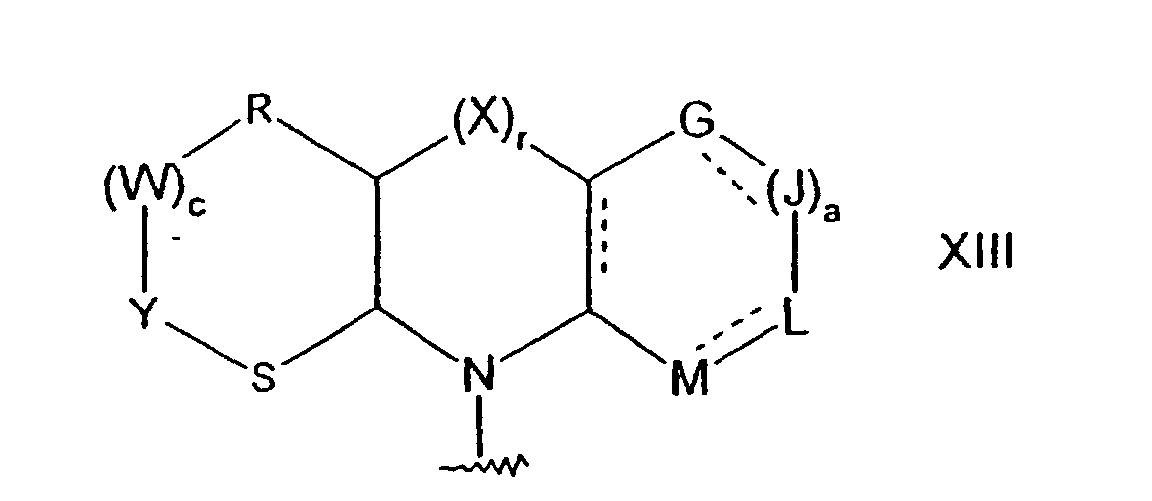 a, G, J, L et M répondent aux définitions précitées ;r est égal à 0 ou 1 ;c est égal à 0, 1 ou 2 ; etR, W, Y et S représentent chacun indépendamment l'oxygène, un groupe S(O)d dans lequel d est égal à 0, 1 ou 2, un groupe NR6 ou un groupe CR7R8 dans lequel R6, R7 et R8 répondent aux définitions précitées ;R2 et R3 sont choisis chacun indépendamment dans le groupe consistant en l'hydrogène, le deutérium, des groupes amino, halogéno, hydroxy, nitro, carboxy, alcényle en C2 à C6, alcynyle en C2 à C6, trifluorométhyle, trifluorométhoxy, alkyle en C1 à C6, alkoxy en C1 à C6, les groupes alkyle ou alkoxy étant facultativement substitués avec un à trois groupes choisis entre des groupes halogéno, hydroxy, carboxy, amino-(alkyle en C1 à C6) thio, alkylamino en C1 à C6, (alkyle en C1 à C6)2amino, hétéroaryle en C5 à C9, hétérocycloalkyle en C2 à C9, cycloalkyle en C3 à C9 et aryle en C6 à C10 ; ou bien R2 et R3 représentent chacun indépendamment un groupe cycloalkyle en C3 à C10, cycloalkoxy en C3 à C10, alkylamino en C1 à C6, (alkyle en C1 à C6)2amino, arylamino en C6 à C10, alkylthio en C1 à C6, arylthio en C6 à C10, alkylsulfinyle en C1 à C6, arylsulfinyle en C6 à C10, alkylsulfonyle en C1 à C6, arylsulfonyle en C6 à C10, acyle en C1 à C6, (alkoxy en C1 à C6) -CO-NH-, (alkyle en C1 à C6) amino-CO-, hétéroaryle en C5 à C9, hétérocycloalkyle en C2 à C9 ou aryle en C6 à C10, les groupes hétéroaryle, hétérocycloalkyle et aryle étant facultativement substitués avec un à trois groupes halogéno, alkyle en C1 à C6, (alkyle en C1 à C6) -CO-NH-, (alkoxy en C1 à C6)-CO-NH-, (alkyle en C1 à C6) -CO-NH- (alkyle en C1 à C6), (alkoxy en C1 à C6) -CO-NH- (alkyle en C1 à C6), (alkoxy en C1 à C6) -CO-NH- (alkoxy en C1 à C6), carboxy, carboxy- (alkyle en C1 à C6), carboxy- (alkoxy en C1 à C6), benzyloxycarbonyl- (alkoxy en C1 à C6), (alkoxy en C1 à C6) carbonyl- (alkoxy en C1 à C6), aryle en C6 à C10, amino, aminoalkyle en C1 à C6, (alkoxy en C1 à C6) carbonylamino, (aryle en C6 à C10) - (alkoxy en C1 à C6) carbonylamino, alkylamino en C1 à C6, (alkyle en C1 à C6)2amino, (alkyle en C1 à C6) amino- (alkyle en C1 à C6), (alkyle en C1 à C6)2amino- (alkyle en C1 à C6), hydroxy, alkoxy en C1 à C6, carboxy, carboxy- (alkyle en C1 à C6), (alkoxy en C1 à C6) carbonyle, (alkoxy en C1 à C6) carbonyl- (alkyle en C1 à C6), (alkoxy en C1 à C6)-CO-NH-, (alkyle en C1 à C6)-CO-NH-, cyano, hétérocycloalkyle en C5 à C9, amino-CO-NH-, (alkyle en C1 à C6) amina-CO-NH-, (alkyle en C1 à C6)2amino-CO-NH-, (aryle en C6 à C10) amino-CO-NH-, (hétéroaryle en C5 à C9) amino-CO-NH-, (alkyle en C1 à C6) amino-CO-NH- (alkyle en C1 à C6), (alkyle en C1 à C6)2amino-CO-NH- (alkyle en C1 à C6), (aryle en C6 à C10) amino-CO-NH- (alkyle en C1 à C6), (hétéroaryle en C5 à C9) amino-CO-NH- (alkyle en C1 à C6), alkylsulfonyle en C1 à C6, alkylsulfonylamino en C1 à C6, (alkyle en C1 à C6) sulfonylamino-(alkyleen C1 à C6), arylsulfonyle en C6 à C10, arylsulfonylamino en C6 à C10, (aryle en C6 à C10)sulfonylamino(alkyle en C1 à C6), alkylsulfonylamino en C1 à C6, (alkyle en C1 à C6) sulfonylamino- (alkyle en C1 à C6), hétéroaryle en C5 à C9 ou hétérocycloalkyle en C2 à C9 ;sous réserve que, lorsque A, B ou X, dans la formule V ou VI, représente un groupe NR6 ou CR7R8, R2 et/ou R3 représentent alors des groupes halogène ;sous réserve que, lorsque R2 et R3 représentent chacun indépendamment l'hydrogène ou un groupe alkyle en C1 à C6, alors R1 ne puisse représenter un groupe pipéridinyle non substitué ;sous réserve que, lorsque R2 et R3 représentent chacun l'hydrogène, alors R1 ne puisse représenter un groupe morpholinyle ou pyrrolidinyle non substitué ;sous réserve que, lorsque R2 et R3 représentent chacun l'hydrogène, alors R1 ne puisse représenter un groupe pipérazinyle ; etsous réserve que les groupes de formule IV, V, VI ou XIII ne contiennent pas deux ou plus de deux atomes d'oxygène, atomes de soufre ou leurs associations à des positions adjacentes.
 - Composé suivant la revendication 1, dans lequel R1 représente un groupe de formuledans laquelle la ligne discontinue représente des doubles liaisons facultatives ;
 ou, lorsque n est égal à 1, D et E représentent chacun un groupe CR7R8 et m est égal à 1, A et B représentent chacun un groupe CR7R8, les groupes R7 adjacents respectifs peuvent être pris conjointement, avec les atomes de carbone auxquels ils sont fixés, pour former un groupe de formulem est égal à 0, 1, 2 ou 3 ;n est égal à 0, 1, 2 ou 3 ;X, B et D représentent chacun indépendamment l'oxygène, un groupe S(O)d dans lequel d est égal à 0, 1 ou 2, un groupe NR6 ou un groupe CR7R8 ;A et E représentent chacun indépendamment un groupe CR7R8 ou NR6 ;dans laquelle la ligne discontinue représente des doubles liaisons facultatives ;
 a, G, J, L et M répondent aux définitions précitées ;r est égal à 0 ou 1 ;c est égal à 0, 1 ou 2 ; etR, W, Y et S représentent chacun indépendamment l'oxygène, un groupe S(O)d dans lequel d est égal à 0, 1 ou 2, un groupe NR6 ou un groupe CR7R8 dans lequel R6, R7 et R8 répondent aux définitions précitées.
 - Composé suivant la revendication 1 ou la revendication 2, dans lequel R2 et R3 sont choisis chacun indépendamment dans le groupe consistant en l'hydrogène, des groupes alkyle en C1 à C6, alkoxy en C1 à C6, cycloalkyle en C3 à C10, cycloalkoxy en C3 à C10, hétérocycloalkyle en C2 à C9, hétéroaryle en C5 à C9 et aryle en C6 à C10.
- Composé suivant l'une quelconque des revendications 1 à 3, qui est choisi dans le groupe consistant en les composés suivants :5-fluoro-4-pipéridine-1-yl-7H-pyrrolo[2,3-d]-pyrimidine ;4-pipéridine-1-yl-5-trifluorométhyl-7H-pyrrolo[2,3-d]pyrimidine ;N,N-diméthyl-N'-[3-(4-pipéridine-1-yl-7H-pyrrolo[2,3-d]pyrimidine-5-yl)-benzyl]-éthane-1,2-diamine ;2-[1-(5-m-tolyl-7H-pyrrolo[2,3-d]pyrimidine-4-yl)-pipéridine-4-yl]-éthanol ;5-(3-isopropylphényl)-4-pipéridine-1-yl-7H-pyrrolo[2,3-d]pyrimidine ;5-(3-méthyl-3H-imidazole-4-yl)-4-pipéridine-1-yl-7H-pyrrolo[2,3-d]pyrimidine ;5-(1-méthyl-1H-imidazole-4-yl)-4-pipéridine-1-yl-7H-pyrrolo[2,3-d]pyrimidine ;5-(2-méthylpyridine-4-yl)-4-pipéridine-1-yl-7H-pyrrolo[2,3-d]pyrimidine ;5-chloro-4-pipéridine-1-yl-7H-pyrrolo[2,3-d]-pyrimidine ;5-éthynyl-4-pipéridine-1-yl-7H-pyrrolo[2,3-d]-pyrimidine ;4-pipéridine-1-yl-5-m-tolyl-7H-pyrrolo[2,3-d]-pyrimidine ; et4-(3,3-diméthylpipéridine-1-yl)-7H-pyrrolo[2,3-d]pyrimidine.
- Composé suivant l'une quelconque des revendications 1 à 4, destiné à être utilisé comme médicament.
- Composition pharmaceutique pour (a) le traitement ou la prévention d'un trouble ou état faisant partie du groupe consistant en un rejet de transplant d'organe, le lupus, la sclérose en plaques, l'arthrite rhumatoïde, le psoriasis, le diabète de type I et les complications du diabète, un cancer, l'asthme, la dermatite atopique, des troubles thyroïdiens auto-immuns, la colite ulcérative, la maladie de Crohn, la maladie d'Alzheimer, la leucémie et d'autres maladies auto-immunes, ou (b) l'inhibition de protéine-tyrosine-kinases ou de la Janus Kinase 3 (JAK3) chez un mammifère, y compris l'homme, comprenant une quantité d'un composé suivant l'une quelconque des revendications 1 à 4, ou d'un de ses sels pharmaceutiquement acceptables, efficace dans de tels troubles ou états, et un support pharmaceutiquement acceptable.
- Composition pharmaceutique pour (a) le traitement ou la prévention d'un trouble ou état faisant partie du groupe consistant en un rejet de transplant d'organe, le lupus, la sclérose en plaques, l'arthrite rhumatoïde, le psoriasis, le diabète de type I et les complications du diabète, un cancer, l'asthme, la dermatite atopique, des troubles thyroïdiens auto-immuns, la colite ulcérative, la maladie de Crohn, la maladie d'Alzheimer, la leucémie et d'autres maladies auto-immunes, ou (b) l'inhibition de protéine-tyrosine-kinases ou de la Janus Kinase 3 (JAK3) chez un mammifère, y compris l'homme, comprenant une quantité d'un composé suivant l'une quelconque des revendications 1 à 4, ou d'un de ses sels pharmaceutiquement acceptables, seul ou en association avec un ou plusieurs agents supplémentaires qui modulent le système immunitaire d'un mammifère ou avec des agents anti-inflammatoires, efficace dans ces troubles ou états, et un support pharmaceutiquement acceptable.
- Utilisation d'une quantité efficace d'un composé suivant l'une quelconque des revendications 1 à 4,
ou d'un de ses sels pharmaceutiquement acceptables, pour la préparation d'un médicament pour l'inhibition de protéine-tyrosine-kinases ou de la Janus Kinase 3 (JAK3) chez un mammifère, y compris l'homme. - Utilisation d'une quantité efficace d'un composé suivant l'une quelconque des revendications 1 à 4, ou d'un de ses sels pharmaceutiquement acceptables, pour la préparation d'un médicament pour le traitement ou la prévention d'un trouble ou état faisant partie du groupe consistant en un rejet de transplant d'organe, le lupus, la sclérose en plaques, l'arthrite rhumatoïde, le psoriasis, le diabète de type I et les complications du diabète, un cancer, l'asthme, la dermatite atopique, des troubles thyroïdiens auto-immuns, la colite ulcérative, la maladie de Crohn, la maladie d'Alzheimer, la leucémie et d'autres maladies auto-immunes chez un mammifère, y compris l'homme.
- Utilisation d'une quantité efficace d'un composé suivant l'une quelconque des revendications 1 à 4 ou d'un de ses sels pharmaceutiquement acceptables, seul ou en association avec un ou plusieurs agents supplémentaires qui modulent le système immunitaire d'un mammifère ou avec des agents anti-inflammatoires, pour la préparation d'un médicament pour l'inhibition de protéine-tyrosine-kinases ou de la Janus Kinase 3 (JAK3) chez un mammifère, y compris l'homme.
- Utilisation d'une quantité efficace d'un composé suivant l'une quelconque des revendications 1 à 4 ou d'un de ses sels pharmaceutiquement acceptables, seul ou en association avec un ou plusieurs agents supplémentaires qui modulent le système immunitaire d'un mammifère ou avec des agents anti-inflammatoires, pour la préparation d'un médicament pour le traitement ou la prévention d'un trouble ou état faisant partie du groupe consistant en un rejet de transplant d'organe, le lups, la sclérose en plaques, l'arthrite rhumatoïde, le psoriasis, le diabète de type I et les complications du diabète, un cancer, l'asthme, la dermatite atopique, des troubles thyroïdiens auto-immuns, la colite ulcérative, la maladie de Crohn, la maladie d'Alzheimer, la leucémie et d'autres maladies auto-immunes chez un mammifère, y compris l'homme.
Priority Applications (1)
| Application Number | Priority Date | Filing Date | Title |
|---|---|---|---|
| SI9930604T SI1087971T1 (en) | 1998-06-19 | 1999-06-14 | PYRROLO 2,3-d)PYRIMIDINE COMPOUNDS |
Applications Claiming Priority (3)
| Application Number | Priority Date | Filing Date | Title |
|---|---|---|---|
| US8988698P | 1998-06-19 | 1998-06-19 | |
| US89886P | 1998-06-19 | ||
| PCT/IB1999/001110 WO1999065909A1 (fr) | 1998-06-19 | 1999-06-14 | COMPOSES DE PYRROLO[2,3-d]PYRIMIDINE |
Publications (2)
| Publication Number | Publication Date |
|---|---|
| EP1087971A1 EP1087971A1 (fr) | 2001-04-04 |
| EP1087971B1 true EP1087971B1 (fr) | 2004-07-07 |
Family
ID=22220084
Family Applications (1)
| Application Number | Title | Priority Date | Filing Date |
|---|---|---|---|
| EP99923800A Expired - Lifetime EP1087971B1 (fr) | 1998-06-19 | 1999-06-14 | COMPOSES DE PYRROLO 2,3-d]PYRIMIDINE |
Country Status (46)
Families Citing this family (169)
| Publication number | Priority date | Publication date | Assignee | Title |
|---|---|---|---|---|
| PA8474101A1 (es) | 1998-06-19 | 2000-09-29 | Pfizer Prod Inc | Compuestos de pirrolo [2,3-d] pirimidina |
| EP1065207A1 (fr) * | 1999-07-02 | 2001-01-03 | Aventis Pharma Deutschland GmbH | Dérivées de la naphthyridine, procédés pour leur preparation, leur utilisation, et compositions pharmaceutique les contenant |
| JP2003511378A (ja) * | 1999-10-07 | 2003-03-25 | アムジエン・インコーポレーテツド | トリアジン系キナーゼ阻害薬 |
| DE19948417A1 (de) * | 1999-10-07 | 2001-04-19 | Morphochem Ag | Imidazol-Derivate und ihre Verwendung als Arzneimittel |
| EA006227B1 (ru) | 1999-12-10 | 2005-10-27 | Пфайзер Продактс Инк. | СОЕДИНЕНИЯ ПИРРОЛО[2,3-d]ПИРИМИДИНА |
| EP1875900A3 (fr) * | 2000-01-24 | 2010-07-21 | Genzyme Corporation | Inhibiteurs du trajet de JAK/STAT et leur utilisation pour le traitement de l'ostéoarthrite |
| ATE369844T1 (de) * | 2000-01-24 | 2007-09-15 | Genzyme Corp | Inhibitoren des jak/stat-weges und deren verwendung zur behandlung von allgemeiner primärer osteoarthritis |
| MY137020A (en) * | 2000-04-27 | 2008-12-31 | Abbott Lab | Diazabicyclic central nervous system active agents |
| EA006153B1 (ru) | 2000-06-26 | 2005-10-27 | Пфайзер Продактс Инк. | СОЕДИНЕНИЯ ПИРРОЛО[2,3-d]ПИРИМИДИНА В КАЧЕСТВЕ ИММУНОДЕПРЕССАНТОВ |
| US6864255B2 (en) | 2001-04-11 | 2005-03-08 | Amgen Inc. | Substituted triazinyl amide derivatives and methods of use |
| US6881737B2 (en) | 2001-04-11 | 2005-04-19 | Amgen Inc. | Substituted triazinyl acrylamide derivatives and methods of use |
| US7301023B2 (en) * | 2001-05-31 | 2007-11-27 | Pfizer Inc. | Chiral salt resolution |
| GB0115393D0 (en) * | 2001-06-23 | 2001-08-15 | Aventis Pharma Ltd | Chemical compounds |
| AP2003002929A0 (en) * | 2001-06-23 | 2003-12-31 | Aventis Pharma Inc | Pyrrolopyrimidines as protein kinase inhibitors |
| US7323469B2 (en) | 2001-08-07 | 2008-01-29 | Novartis Ag | 7H-pyrrolo[2,3-d]pyrimidine derivatives |
| GB0119249D0 (en) | 2001-08-07 | 2001-10-03 | Novartis Ag | Organic compounds |
| PY0228255A (es) | 2001-12-06 | 2004-06-01 | Pfizer Prod Inc | Compuestos cristalinos novedosos |
| US6642381B2 (en) * | 2001-12-27 | 2003-11-04 | Hoffman-La Roche Inc. | Pyrimido[5,4-e][1,2,4]triazine-5,7-diamine compounds as protein tyrosine phosphatase inhibitors |
| EP1474425B9 (fr) | 2002-01-07 | 2008-07-02 | Eisai Co., Ltd. | Deazapurines et leurs utilisations |
| GB0202679D0 (en) * | 2002-02-05 | 2002-03-20 | Glaxo Group Ltd | Novel compounds |
| EP1388541A1 (fr) * | 2002-08-09 | 2004-02-11 | Centre National De La Recherche Scientifique (Cnrs) | Pyrrolopyrazines utilisées comme inhibiteurs de kinases |
| AU2003276591A1 (en) | 2002-11-26 | 2004-06-18 | Pfizer Products Inc. | Method of treatment of transplant rejection |
| US7253166B2 (en) * | 2003-04-22 | 2007-08-07 | Irm Llc | 6-phenyl-7H-pyrrolo[2,3-d]pyrimidine compounds that induce neuronal differentiation in embryonic stem cells |
| WO2005044835A1 (fr) * | 2003-10-27 | 2005-05-19 | Genelabs Technologies, Inc. | Procedes de preparation de derives 7-(2'-$g(b)-d-ribofuranosyl substitue)-4-(nr2r3)-5-(ethyn-1-yl substitue)-pyrrolo[2,3-d]pyrimidine |
| US20050187389A1 (en) * | 2004-01-13 | 2005-08-25 | Ambit Biosciences Corporation | Pyrrolopyrimidine derivatives and analogs and their use in the treatment and prevention of diseases |
| GB0403606D0 (en) | 2004-02-18 | 2004-03-24 | Novartis Ag | Organic compounds |
| WO2005117909A2 (fr) * | 2004-04-23 | 2005-12-15 | Exelixis, Inc. | Modulateurs des proteines kinases et leurs methodes d'utilisation |
| WO2006115509A2 (fr) | 2004-06-24 | 2006-11-02 | Novartis Vaccines And Diagnostics Inc. | Immuno-potentialisateurs a petites molecules et analyses visant a detecter leur presence |
| MXPA06015237A (es) | 2004-06-29 | 2007-12-10 | Amgen Inc | Pirrolo[2-3-d]pirimidinas que modulan la actividad de ack1 y lck. |
| US7465726B2 (en) | 2004-08-02 | 2008-12-16 | Osi Pharmaceuticals, Inc. | Substituted pyrrolo[2.3-B]pyridines |
| MY179032A (en) | 2004-10-25 | 2020-10-26 | Cancer Research Tech Ltd | Ortho-condensed pyridine and pyrimidine derivatives (e.g.purines) as protein kinase inhibitors |
| UY29177A1 (es) | 2004-10-25 | 2006-05-31 | Astex Therapeutics Ltd | Derivados sustituidos de purina, purinona y deazapurina, composiciones que los contienen métodos para su preparación y sus usos |
| AR054416A1 (es) | 2004-12-22 | 2007-06-27 | Incyte Corp | Pirrolo [2,3-b]piridin-4-il-aminas y pirrolo [2,3-b]pirimidin-4-il-aminas como inhibidores de las quinasas janus. composiciones farmaceuticas. |
| FR2880626B1 (fr) * | 2005-01-13 | 2008-04-18 | Aventis Pharma Sa | Derives de la purine, compositions les contenant et utilisation |
| WO2006091450A1 (fr) * | 2005-02-18 | 2006-08-31 | Lexicon Genetics Incorporated | Composes 4-piperidin-1-yl-7h-pyrrolo[2,3-d]pyrimidine |
| DE602006019088D1 (de) | 2005-05-13 | 2011-02-03 | Irm Llc | Verbindungen und zusammensetzungen als proteinkinase-hemmer |
| KR20080026654A (ko) | 2005-07-14 | 2008-03-25 | 아스텔라스세이야쿠 가부시키가이샤 | 헤테로시클릭 야누스 키나제 3 억제제 |
| CN102127078A (zh) | 2005-07-14 | 2011-07-20 | 安斯泰来制药株式会社 | Janus激酶3的杂环类抑制剂 |
| EP2270014A1 (fr) | 2005-09-22 | 2011-01-05 | Incyte Corporation | Inhibiteurs de l'azépine de janus kinases |
| JP2009513571A (ja) * | 2005-09-30 | 2009-04-02 | バーテックス ファーマシューティカルズ インコーポレイテッド | ヤヌスキナーゼ阻害剤として有用なデアザプリン |
| AU2015201850B2 (en) * | 2005-12-13 | 2017-03-02 | Incyte Holdings Corporation | Heteroaryl substituted pyrrolo[2,3-b]pyridines and pyrrolo[2,3-b]pyrimidines as Janus kinase inhibitors |
| CN103214484B (zh) | 2005-12-13 | 2016-07-06 | 因塞特控股公司 | 作为两面神激酶抑制剂的杂芳基取代的吡咯并[2,3-b]吡啶和吡咯并[2,3-b]嘧啶 |
| JP2009533323A (ja) * | 2006-03-11 | 2009-09-17 | ヴァーナリス アールアンドディー リミテッド | Hsp90阻害剤として用いられるピロロピリミジン誘導体 |
| CA2648250A1 (fr) * | 2006-04-05 | 2007-10-18 | Vertex Pharmaceuticals Incorporated | Desazapurines utiles comme inhibiteurs des kinases janus |
| JP5606734B2 (ja) * | 2006-04-25 | 2014-10-15 | アステックス、セラピューティックス、リミテッド | 医薬化合物 |
| GB0608176D0 (en) * | 2006-04-25 | 2006-06-07 | Astex Therapeutics Ltd | Pharmaceutical Compounds |
| WO2008012635A2 (fr) * | 2006-07-26 | 2008-01-31 | Pfizer Products Inc. | Dérivés d'amines utiles en tant qu'agents anticancéreux |
| US20080221132A1 (en) * | 2006-09-11 | 2008-09-11 | Xiong Cai | Multi-Functional Small Molecules as Anti-Proliferative Agents |
| WO2008033745A2 (fr) * | 2006-09-11 | 2008-03-20 | Curis, Inc. | Pyrimidines bicycliques fusionnées servant d'inhibiteurs de ptk contenant un groupe de liaison au zinc |
| AR064416A1 (es) * | 2006-12-21 | 2009-04-01 | Cancer Rec Tech Ltd | Derivados de purina, piridina y pirimidina condensadas con heterociclos, moduladores de pka y/o pkb, composiciones farmaceuticas que los contienen, y usos para el tratamiento de enfermedades hiperproliferativas. |
| WO2008075007A1 (fr) * | 2006-12-21 | 2008-06-26 | Cancer Research Technology Limited | Composé bicyclohétéroarylés substitué par morpholino et leur utilisation en tant qu'agents anti-cancer |
| ES2415863T3 (es) | 2006-12-22 | 2013-07-29 | Incyte Corporation | Heterociclos sustituidos como inhibidores de Janus Quinasas |
| TW200900061A (en) | 2007-01-12 | 2009-01-01 | Astellas Pharma Inc | Condensed pyridine compound |
| PE20090996A1 (es) * | 2007-04-02 | 2009-07-15 | Palau Pharma Sa | Derivados de pirrolopirimidina como inhibidores de cinasa jak3 |
| UA99284C2 (ru) | 2007-05-11 | 2012-08-10 | Елі Ліллі Енд Компані | ИНГИБИТОРЫ р70 S6-КИНАЗЫ |
| HUE029236T2 (en) | 2007-06-13 | 2017-02-28 | Incyte Holdings Corp | (R) -3- (4- (7H-Pyrrolo [2,3-d] pyrimidin-4-yl) -1H-pyrazol-1-yl) -3-cyclopentylpropanenitrile Crystalline salts of Janus kinase inhibitor |
| CL2008001709A1 (es) | 2007-06-13 | 2008-11-03 | Incyte Corp | Compuestos derivados de pirrolo [2,3-b]pirimidina, moduladores de quinasas jak; composicion farmaceutica; y uso en el tratamiento de enfermedades tales como cancer, psoriasis, artritis reumatoide, entre otras. |
| GB0713602D0 (en) * | 2007-07-12 | 2007-08-22 | Syngenta Participations Ag | Chemical compounds |
| DK2185562T3 (en) * | 2007-07-27 | 2016-02-22 | Janssen Pharmaceutica Nv | PYRROLOPYRIMIDINES SUITABLE FOR TREATING PROLIFERATIVE DISEASES |
| PT2188289E (pt) | 2007-08-08 | 2015-12-21 | Lexicon Pharmaceuticals Inc | (7h-pirrolo[2,3-d]pirimidin-4-il)piperazinas como inibidores de quinases para o tratamento de cancro e de inflamação |
| WO2009030871A1 (fr) * | 2007-09-07 | 2009-03-12 | Vernalis R & D Ltd | Dérivés de pyrrolopyrimidine présentant une activité inhibitrice d'hsp90 |
| BRPI0818533B8 (pt) | 2007-10-11 | 2021-05-25 | Astrazeneca Ab | composto, composição farmacêutica, uso de um composto, e, processo para a preparação de um composto |
| MX2010005300A (es) | 2007-11-16 | 2010-06-25 | Incyte Corp | 4-pirazolil-n-arilpirimidin-2-aminas y 4-pirazolil-n-heteroarilpir imidin-2-aminas como inhibidores de cinasas janus. |
| TWI444382B (zh) | 2008-03-11 | 2014-07-11 | Incyte Corp | 作為jak抑制劑之氮雜環丁烷及環丁烷衍生物 |
| EP2297153B1 (fr) | 2008-04-21 | 2015-05-27 | Lexicon Pharmaceuticals, Inc. | Inhibiteurs de limk2, compositions les comprenant et leurs procédés d'utilisation |
| CA2722326A1 (fr) | 2008-04-24 | 2009-10-29 | Incyte Corporation | Composes macrocycliques et leur utilisation a titre d'inhibiteurs de kinase |
| HRP20140395T1 (hr) | 2008-08-20 | 2014-06-06 | Zoetis Llc | SPOJEVI PIROLO[2,3-d]PIRIMIDINA |
| US8385364B2 (en) * | 2008-09-24 | 2013-02-26 | Nec Laboratories America, Inc. | Distributed message-passing based resource allocation in wireless systems |
| CL2009001884A1 (es) * | 2008-10-02 | 2010-05-14 | Incyte Holdings Corp | Uso de 3-ciclopentil-3-[4-(7h-pirrolo[2,3-d]pirimidin-4-il)-1h-pirazol-1-il)propanonitrilo, inhibidor de janus quinasa, y uso de una composición que lo comprende para el tratamiento del ojo seco. |
| PE20211639A1 (es) | 2009-01-15 | 2021-08-24 | Incyte Holdings Corp | Procesos para preparar inhibidores de jak y compuestos intermediarios relacionado |
| DE102009005193A1 (de) * | 2009-01-20 | 2010-07-22 | Merck Patent Gmbh | Neue heterocyclische Verbindungen als MetAP-2 Inhibitoren |
| US8765727B2 (en) | 2009-01-23 | 2014-07-01 | Incyte Corporation | Macrocyclic compounds and their use as kinase inhibitors |
| JP2012517448A (ja) | 2009-02-11 | 2012-08-02 | リアクション バイオロジー コープ. | 選択的キナーゼ阻害剤 |
| EP3026052A1 (fr) | 2009-04-20 | 2016-06-01 | Auspex Pharmaceuticals, Inc. | Preparation des inhibiteurs pipéridiniques deuteriés de la janus kinase3 |
| MY156727A (en) | 2009-05-22 | 2016-03-15 | Incyte Corp | N-(hetero)aryl-pyrrolidine derivatives of pyrazol-4-yl-pyrrolo[2,3-d]pyrimidines and pyrrol-3-yl-pyrrolo[2,3-d]pyrimidines as janus kinase inhibitors |
| EP2432472B1 (fr) | 2009-05-22 | 2019-10-02 | Incyte Holdings Corporation | 3-[4-(7h-pyrrolo[2,3-d]pyrimidin-4-yl)-1h-pyrazol-1-yl]octane- ou heptane-nitrile en tant qu'inhibiteurs de jak |
| BR112012000422A2 (pt) | 2009-07-08 | 2017-05-09 | Leo Pharma As | composto, composição farmacêutica, uso de um composto, e, método para a prevenir tratar ou melhorar doenças do sistema imune |
| TWI466885B (zh) | 2009-07-31 | 2015-01-01 | Japan Tobacco Inc | 含氮螺環化合物及其醫藥用途 |
| TW201111385A (en) * | 2009-08-27 | 2011-04-01 | Biocryst Pharm Inc | Heterocyclic compounds as janus kinase inhibitors |
| TW201113285A (en) | 2009-09-01 | 2011-04-16 | Incyte Corp | Heterocyclic derivatives of pyrazol-4-yl-pyrrolo[2,3-d]pyrimidines as janus kinase inhibitors |
| US8993552B2 (en) * | 2009-09-04 | 2015-03-31 | The Regents Of The University Of Michigan | Compositions and methods for treatment of leukemia |
| CA2771822C (fr) | 2009-09-04 | 2020-08-11 | Daniel A. Erlanson | Inhibiteurs de tyrosine kinase de bruton |
| MX2012004180A (es) | 2009-10-09 | 2012-07-17 | Incyte Corp | Derivados de hidroxil, ceto y glucuronido de 3-(4-7h-pirrolo[2,3-d ]pirimidin-a-il)-1h-pirazol-1-il)-3-ciclopentilpropanonitrilo. |
| IN2012DN02577A (fr) * | 2009-10-15 | 2015-08-28 | Pfizer | |
| US9074143B2 (en) * | 2009-12-11 | 2015-07-07 | Uop Llc | Process for producing hydrocarbon fuel |
| ES2461967T3 (es) | 2009-12-18 | 2014-05-21 | Pfizer Inc. | Compuestos de pirrolo[2,3-d]pirimidina |
| EP2531508A1 (fr) | 2010-02-05 | 2012-12-12 | Pfizer Inc. | Composés d'urée à base de pyrrolo[2,3-d]pyrimidine à titre d'inhibiteurs de jak |
| CA2790070C (fr) * | 2010-02-18 | 2018-03-06 | Incyte Corporation | Derives de cyclobutane et de methylcyclobutane comme inhibiteurs de janus kinases |
| EP3354652B1 (fr) | 2010-03-10 | 2020-05-06 | Incyte Holdings Corporation | Dérivés de pipéridine-4-yl azétidine utilisés en tant qu'inhibiteurs de jak1 |
| AR084691A1 (es) | 2010-05-21 | 2013-06-05 | Incyte Corp | Formulacion de uso topico para un inhibidor de jak y metodo para tratar trastorno de la piel |
| TW201204732A (en) * | 2010-07-09 | 2012-02-01 | Leo Pharma As | Novel homopiperazine derivatives as protein tyrosine kinase inhibitors and pharmaceutical use thereof |
| JP5749341B2 (ja) * | 2010-08-20 | 2015-07-15 | ハチソン メディファーマ リミテッド | ピロロピリミジン化合物およびその使用 |
| WO2012022045A1 (fr) * | 2010-08-20 | 2012-02-23 | Hutchison Medipharma Limited | Composés pyrrolopyrimidiniques et leurs utilisations |
| CN102372717B (zh) * | 2010-08-20 | 2014-06-18 | 和记黄埔医药(上海)有限公司 | 吡咯并嘧啶类化合物及其用途 |
| TWI401258B (zh) * | 2010-09-08 | 2013-07-11 | Hutchison Medipharma Ltd | 吡咯並嘧啶類化合物及其用途 |
| WO2012068440A1 (fr) | 2010-11-19 | 2012-05-24 | Incyte Corporation | Pyrrolopyridines et pyrrolopyrimidines à substitution hétérocyclique utilisées en tant qu'inhibiteurs des jak |
| CA2818542A1 (fr) | 2010-11-19 | 2012-05-24 | Incyte Corporation | Derives pyrrolopyridine et pyrrolopyrimidine a substitution cyclobutyle utilises comme inhibiteurs des jak |
| JP5927201B2 (ja) | 2010-12-16 | 2016-06-01 | カルチャン リミテッド | Ask1阻害ピロロピリミジン誘導体 |
| WO2012088682A1 (fr) * | 2010-12-29 | 2012-07-05 | Shanghai Fochon Pharmaceutical Co Ltd. | Dérivés de la 2-(3-aminopipéridin-1-yle)-[1,2,4] triazolo [1,5-c] pyrimidine-5,7 (3h,6h)-dione en tant qu'inhibiteurs de la dipeptidylpeptidase iv(dpp-iv) |
| KR20140058402A (ko) | 2011-01-07 | 2014-05-14 | 레오 파마 에이/에스 | 단백질 티로신 키나제 억제제로서의 신규한 설파미드 피페라진 유도체 및 이의 약제학적 용도 |
| DE102011008352A1 (de) * | 2011-01-12 | 2012-07-12 | Merck Patent Gmbh | 5-([1,2,3]Triazol-4-yl)-7H-pyrrolo-[2,3-d]pyrimidinderivate |
| US9139590B2 (en) | 2011-02-04 | 2015-09-22 | Duquesne University Of The Holy Spirit | Bicyclic and tricyclic pyrimidine tyrosine kinase inhibitors with antitubulin activity and methods of treating a patient |
| WO2012112847A1 (fr) | 2011-02-18 | 2012-08-23 | Novartis Pharma Ag | Plurithérapie impliquant un inhibiteur de mtor et un inhibiteur de jak |
| CN103547580B (zh) | 2011-03-22 | 2016-12-07 | 阿迪维纳斯疗法有限公司 | 取代的稠合三环化合物、其组合物及医药用途 |
| WO2012131399A1 (fr) | 2011-04-01 | 2012-10-04 | Astrazeneca Ab | Traitement thérapeutique |
| MY165963A (en) | 2011-06-20 | 2018-05-18 | Incyte Holdings Corp | Azetidinyl phenyl, pyridyl or pyrazinyl carboxamide derivatives as jak inhibitors |
| EP2726075A4 (fr) * | 2011-06-29 | 2014-11-19 | Merck Sharp & Dohme | Nouvelles formes cristallines d'un inhibiteur de peptidase-iv |
| KR20140058543A (ko) | 2011-07-08 | 2014-05-14 | 노파르티스 아게 | 신규 피롤로 피리미딘 유도체 |
| CA2844507A1 (fr) | 2011-08-10 | 2013-02-14 | Novartis Pharma Ag | Polytherapie par jak pi3k/mtor |
| TW201313721A (zh) | 2011-08-18 | 2013-04-01 | Incyte Corp | 作為jak抑制劑之環己基氮雜環丁烷衍生物 |
| UA111854C2 (uk) | 2011-09-07 | 2016-06-24 | Інсайт Холдінгс Корпорейшн | Способи і проміжні сполуки для отримання інгібіторів jak |
| PT2785349T (pt) | 2011-11-30 | 2019-12-11 | Astrazeneca Ab | Tratamento combinado de cancro |
| CA3131037A1 (fr) | 2011-11-30 | 2013-06-06 | Emory University | Inhibiteurs de jak antiviraux utiles dans le traitement ou la prevention d'infections retrovirales et autres infections virales |
| WO2013085802A1 (fr) * | 2011-12-06 | 2013-06-13 | Merck Sharp & Dohme Corp. | Pyrrolopyrimidines en tant qu'inhibiteurs de kinase janus |
| AU2013204533B2 (en) | 2012-04-17 | 2017-02-02 | Astrazeneca Ab | Crystalline forms |
| TW201406761A (zh) | 2012-05-18 | 2014-02-16 | Incyte Corp | 做爲jak抑制劑之哌啶基環丁基取代之吡咯并吡啶及吡咯并嘧啶衍生物 |
| AR091273A1 (es) | 2012-06-08 | 2015-01-21 | Biogen Idec Inc | Inhibidores de pirimidinil tirosina quinasa |
| MD20140130A2 (ro) * | 2012-06-29 | 2015-04-30 | Pfizer Inc. | 4-(amino-substituite)-7H-pirolo[2,3-d]pirimidine noi ca inhibitori de LRRK2 |
| CN104981247A (zh) | 2012-09-06 | 2015-10-14 | 普莱希科公司 | 用于激酶调节的化合物和方法及其适应症 |
| IN2015DN02008A (fr) | 2012-09-21 | 2015-08-14 | Advinus Therapeutics Ltd | |
| JP6139690B2 (ja) * | 2012-10-26 | 2017-05-31 | エフ.ホフマン−ラ ロシュ アーゲーF. Hoffmann−La Roche Aktiengesellschaft | ブルートンチロシンキナーゼの阻害剤 |
| CN102936251A (zh) * | 2012-11-05 | 2013-02-20 | 上海毕得医药科技有限公司 | 一种吡咯并[2,3-d]嘧啶衍生物的制备方法 |
| TWI761825B (zh) | 2012-11-15 | 2022-04-21 | 美商英塞特控股公司 | 盧梭利替尼之緩釋性劑型 |
| EP3290421B1 (fr) | 2013-02-22 | 2019-01-02 | Pfizer Inc | Combinaison de dérivés de pyrrolo-[2,3-d]pyrimidine et un ou plusieurs principes supplémentaires en tant qu'inhibiteurs des janus kinases (jak) |
| MX384910B (es) | 2013-03-06 | 2025-03-14 | Incyte Holdings Corp | Procesos e intermedios para hacer un inhibidor de jak. |
| WO2014139388A1 (fr) * | 2013-03-14 | 2014-09-18 | Merck Sharp & Dohme Corp. | Nouveaux dérivés d'indole utiles en tant qu'agents antidiabétiques |
| SG11201600815WA (en) | 2013-08-07 | 2016-03-30 | Incyte Corp | Sustained release dosage forms for a jak1 inhibitor |
| ES2654051T3 (es) * | 2013-12-05 | 2018-02-12 | Pfizer Inc. | Pirrolo[2,3-d]pirimidinilo, pirrolo[2,3-b]pirazinilo y pirrolo[2,3-d]piridinil acrilamidas |
| WO2015092592A1 (fr) | 2013-12-17 | 2015-06-25 | Pfizer Inc. | Nouvelles 1h-pyrrolo[2,3- b]pyridines 3,4-disubstituées et 7h-pyrrolo[2,3-c]pyridazines 4,5-disubstituées en tant qu'inhibiteurs de la lrrk2 |
| WO2015184305A1 (fr) | 2014-05-30 | 2015-12-03 | Incyte Corporation | Traitement de la leucémie neutrophile chronique (cnl) et de la leucémie myéloïde chronique atypique (acml) par des inhibiteurs de jak1 |
| EP3180344B1 (fr) | 2014-08-12 | 2019-09-18 | Pfizer Inc | Dérivés de pyrrolo[2,3-d]pyrimidine utiles pour inhiber la janus kinase |
| WO2016040330A1 (fr) | 2014-09-09 | 2016-03-17 | The Regents Of The University Of Michigan | Composés de thiénopyrimidine et de thiénopyridine et leurs procédés d'utilisation |
| CN105524067A (zh) * | 2014-09-28 | 2016-04-27 | 江苏柯菲平医药股份有限公司 | 4-取代吡咯并[2,3-d]嘧啶化合物及其用途 |
| ES2928757T3 (es) | 2015-05-01 | 2022-11-22 | Pfizer | Acrilamidas de pirrolo[2,3-b]pirazinilo y epóxidos de las mismas como inhibidores de la Janus Quinasa |
| HK1246593A1 (zh) | 2015-06-04 | 2018-09-14 | Kura Oncology, Inc. | 用於抑制menin蛋白与mll蛋白的相互作用的方法及组合物 |
| AR104020A1 (es) | 2015-06-04 | 2017-06-21 | Kura Oncology Inc | Métodos y composiciones para inhibir la interacción de menina con proteínas mill |
| AU2016302302B2 (en) | 2015-07-31 | 2019-12-19 | Taiho Pharmaceutical Co., Ltd. | Pyrrolo[2,3-d]pyrimidine compound or salt thereof |
| KR101771219B1 (ko) * | 2015-08-21 | 2017-09-05 | 양지화학 주식회사 | 야누스 키나제 1 선택적 억제제 및 그 의약 용도 |
| CN108137586B (zh) | 2015-09-14 | 2021-04-13 | 辉瑞大药厂 | 作为LRRK2抑制剂的新颖咪唑并[4,5-c]喹啉和咪唑并[4,5-c][1,5]萘啶衍生物 |
| US10045981B2 (en) | 2015-11-24 | 2018-08-14 | Jakpharm, Llc | Selective kinase inhibitors |
| CN107098908B (zh) | 2016-02-23 | 2021-01-08 | 欣凯医药科技(上海)有限公司 | 一种吡咯并嘧啶类化合物的制备方法和应用 |
| MX387806B (es) | 2016-03-16 | 2025-03-19 | Kura Oncology Inc | Inhibidores biciclicos con puente sustituidos de menina-mll y metodos de uso |
| EP3429591B1 (fr) | 2016-03-16 | 2023-03-15 | Kura Oncology, Inc. | Composés thiéno[2,3-d]pyrimidiniques substitués en tant qu'inhibiteurs de ménine-mll et méthodes d'utilisation |
| CN107513067A (zh) | 2016-06-16 | 2017-12-26 | 北京赛林泰医药技术有限公司 | 含有取代环戊基的吡咯并嘧啶化合物 |
| CN107513069A (zh) * | 2016-06-16 | 2017-12-26 | 正大天晴药业集团股份有限公司 | 手性吡咯并嘧啶化合物的制备方法 |
| SG11201900515PA (en) | 2016-07-21 | 2019-02-27 | Biogen Ma Inc | Succinate forms and compositions of bruton's tyrosine kinase inhibitors |
| US10316038B2 (en) | 2017-01-25 | 2019-06-11 | Aclaris Therapeutics, Inc. | Pyrrolopyrimidine ITK inhibitors for treating inflammation and cancer |
| JP7101176B2 (ja) * | 2017-02-03 | 2022-07-14 | レオ ファーマ アクティーゼルスカブ | 新規JAKキナーゼ阻害剤としての5-(7H-ピロロ[2,3-d]ピリミジン-4-イル)-5-アザスピロ[2.5]オクタン-8-カルボン酸誘導体 |
| EP3601249A4 (fr) | 2017-03-24 | 2020-12-16 | Kura Oncology, Inc. | Méthodes de traitement d'hémopathies malignes et du sarcome d'ewing |
| CN108794480A (zh) * | 2017-04-28 | 2018-11-13 | 天津药物研究院有限公司 | 吡咯并嘧啶类化合物、其制备方法和用途 |
| US11542248B2 (en) | 2017-06-08 | 2023-01-03 | Kura Oncology, Inc. | Methods and compositions for inhibiting the interaction of menin with MLL proteins |
| TW201920170A (zh) | 2017-09-20 | 2019-06-01 | 美商庫拉腫瘤技術股份有限公司 | 經取代之menin-mll 抑制劑及使用方法 |
| KR102821964B1 (ko) | 2017-11-03 | 2025-06-19 | 어클라리스 쎄라퓨틱스, 인코포레이티드 | 치환된 피롤로피리미딘 jak 억제제 및 이의 제조 및 사용 방법 |
| US10800775B2 (en) | 2017-11-03 | 2020-10-13 | Aclaris Therapeutics, Inc. | Pyrazolyl pyrrolo[2,3-b]pyrmidine-5-carboxylate analogs and methods of making the same |
| US10596161B2 (en) | 2017-12-08 | 2020-03-24 | Incyte Corporation | Low dose combination therapy for treatment of myeloproliferative neoplasms |
| JP7393348B2 (ja) | 2018-01-30 | 2023-12-06 | インサイト・コーポレイション | (1-(3-フルオロ-2(トリフルオロメチル)イソニコチニル)ピぺリジン―4-オン)を作製するためのプロセス及び中間体 |
| CN113768934A (zh) | 2018-03-30 | 2021-12-10 | 因赛特公司 | 使用jak抑制剂治疗化脓性汗腺炎 |
| EP3833350A4 (fr) | 2018-08-10 | 2022-05-18 | Aclaris Therapeutics, Inc. | Inhibiteurs de pyrrolopyrimidine itk |
| GB201818750D0 (en) * | 2018-11-16 | 2019-01-02 | Institute Of Cancer Res Royal Cancer Hospital | Lox inhibitors |
| CN109394768B (zh) * | 2018-12-10 | 2019-08-23 | 牡丹江医学院 | 一种治疗湿疹的药物及其制备方法 |
| NL2022471B1 (en) | 2019-01-29 | 2020-08-18 | Vationpharma B V | Solid state forms of oclacitinib |
| WO2020198583A1 (fr) | 2019-03-27 | 2020-10-01 | Insilico Medicine Ip Limited | Inhibiteurs de jak bicycliques et leurs utilisations |
| US11420966B2 (en) | 2019-05-02 | 2022-08-23 | Aclaris Therapeutics, Inc. | Substituted pyrrolopyridines as JAK inhibitors |
| BR112021022682A2 (pt) | 2019-05-14 | 2022-02-22 | Provention Bio Inc | Métodos e composições para prevenir diabetes do tipo 1 |
| BR112022009710A2 (pt) | 2019-11-22 | 2022-08-09 | Incyte Corp | Terapia de combinação compreendendo um inibidor de alk2 e um inibidor de jak2 |
| US11833155B2 (en) | 2020-06-03 | 2023-12-05 | Incyte Corporation | Combination therapy for treatment of myeloproliferative neoplasms |
| US12006366B2 (en) | 2020-06-11 | 2024-06-11 | Provention Bio, Inc. | Methods and compositions for preventing type 1 diabetes |
| WO2022251253A1 (fr) | 2021-05-24 | 2022-12-01 | Provention Bio, Inc. | Méthodes de traitement du diabète de type 1 |
| WO2023055731A1 (fr) * | 2021-09-28 | 2023-04-06 | Sanford Burnham Prebys Medical Discovery Institute | Inhibiteurs de la sérine/thréonine protéine kinase stk3 ou stk4 et leurs utilisations |
Family Cites Families (41)
| Publication number | Priority date | Publication date | Assignee | Title |
|---|---|---|---|---|
| US3037980A (en) * | 1955-08-18 | 1962-06-05 | Burroughs Wellcome Co | Pyrrolopyrimidine vasodilators and method of making them |
| GB915303A (en) | 1958-03-13 | 1963-01-09 | Wellcome Found | Pyrrolo[2,3-d]pyrimidine derivatives and the manufacture thereof |
| NO169490C (no) | 1988-03-24 | 1992-07-01 | Takeda Chemical Industries Ltd | Analogifremgangsmaate for fremstilling av terapeutisk aktive pyrrolopyrimidinderivater |
| JP2983254B2 (ja) * | 1989-06-14 | 1999-11-29 | 武田薬品工業株式会社 | ピロロ〔2,3―d〕ピリミジン誘導体の製造法およびその中間体 |
| PT633886E (pt) * | 1992-04-03 | 2001-03-30 | Upjohn Co | Aminas biciclicas-heterociclicas farmaceuticamente activas |
| US6136595A (en) | 1993-07-29 | 2000-10-24 | St. Jude Children's Research Hospital | Jak kinases and regulations of cytokine signal transduction |
| US5389509A (en) | 1993-10-04 | 1995-02-14 | Eastman Kodak Company | Ultrathin high chloride tabular grain emulsions |
| IL112249A (en) | 1994-01-25 | 2001-11-25 | Warner Lambert Co | Pharmaceutical compositions containing di and tricyclic pyrimidine derivatives for inhibiting tyrosine kinases of the epidermal growth factor receptor family and some new such compounds |
| DE59500788D1 (de) | 1994-05-03 | 1997-11-20 | Ciba Geigy Ag | Pyrrolopyrimidinderivate mit antiproliferativer Wirkung |
| EP0831829B1 (fr) * | 1995-06-07 | 2003-08-20 | Pfizer Inc. | Derives de pyrimidine heterocycliques a noyaux condenses |
| DE69618959T2 (de) | 1995-07-05 | 2002-08-29 | E.I. Du Pont De Nemours And Co., Wilmington | Pyrimidone und ihre verwendug als fungizide |
| EP0836605B1 (fr) * | 1995-07-06 | 2002-02-06 | Novartis AG | Pyrrolopyrimidines et leurs procedes de preparation |
| AR004010A1 (es) | 1995-10-11 | 1998-09-30 | Glaxo Group Ltd | Compuestos heterociclicos |
| JPH10512896A (ja) | 1995-11-14 | 1998-12-08 | フアルマシア・エ・アツプジヨン・エツセ・ピー・アー | アリールおよびヘテロアリールプリン化合物 |
| AU1441497A (en) * | 1996-01-23 | 1997-08-20 | Novartis Ag | Pyrrolopyrimidines and processes for their preparation |
| CH690773A5 (de) | 1996-02-01 | 2001-01-15 | Novartis Ag | Pyrrolo(2,3-d)pyrimide und ihre Verwendung. |
| GB9604361D0 (en) * | 1996-02-29 | 1996-05-01 | Pharmacia Spa | 4-Substituted pyrrolopyrimidine compounds as tyrosine kinase inhibitors |
| AU1794697A (en) | 1996-03-06 | 1997-09-22 | Novartis Ag | 7-alkyl-pyrrolo{2,3-d}pyrimidines |
| AU3176297A (en) | 1996-06-25 | 1998-01-14 | Novartis Ag | Substituted 7-amino-pyrrolo{3,2-d}pyrimidines and the use thereof |
| HRP970371A2 (en) | 1996-07-13 | 1998-08-31 | Kathryn Jane Smith | Heterocyclic compounds |
| EA199900021A1 (ru) | 1996-07-13 | 1999-08-26 | Глаксо, Груп Лимитед | Бициклические гетероароматические соединения в качестве ингибиторов протеинтирозинкиназы |
| AU720429B2 (en) * | 1996-08-23 | 2000-06-01 | Novartis Ag | Substituted pyrrolopyrimidines and processes for their preparation |
| CA2272705C (fr) * | 1996-11-27 | 2003-03-18 | Pfizer Inc. | Derives de pyrimidines bicycliques fusionnes |
| KR20000070751A (ko) | 1997-02-05 | 2000-11-25 | 로즈 암스트롱, 크리스틴 에이. 트러트웨인 | 세포 증식 억제제로서의 피리도[2,3-d]피리미딘 및 4-아미노피리미딘 |
| JP2001520748A (ja) | 1997-03-24 | 2001-10-30 | ファルマシア・アンド・アップジョン・カンパニー | Jak2/サイトカイン受容体結合の阻害剤を同定する方法 |
| CA2326383A1 (fr) * | 1998-04-02 | 1999-10-14 | Neurogen Corporation | Derives aminoalkyle substitues de pyrrolo[2,3-b]pyridine et pyrrolo[2,3-d]pyrimidine: modulateurs de recepteurs de crf1 |
| AU4317399A (en) | 1998-05-28 | 1999-12-13 | Parker Hughes Institute | Quinazolines for treating brain tumor |
| PL198640B1 (pl) * | 1998-06-19 | 2008-07-31 | Pfizer Prod Inc | Związki pirolo[2,3-d]pirymidynowe, środek farmaceutyczny i zastosowanie tych związków |
| PA8474101A1 (es) * | 1998-06-19 | 2000-09-29 | Pfizer Prod Inc | Compuestos de pirrolo [2,3-d] pirimidina |
| EP1091739A1 (fr) | 1998-06-30 | 2001-04-18 | Parker Hughes Institute | Procede pour inhiber l'expression de c-jun en utilisant les inhibiteurs de jak-3 |
| EP1105378B1 (fr) | 1998-08-21 | 2005-03-30 | Parker Hughes Institute | Derives de quinazoline |
| HK1039326A1 (zh) | 1998-09-18 | 2002-04-19 | Abbott Gmbh & Co. Kg | 4氨基吡咯并嘧啶作为激酶抑制剂 |
| US6080747A (en) | 1999-03-05 | 2000-06-27 | Hughes Institute | JAK-3 inhibitors for treating allergic disorders |
| US6664252B2 (en) * | 1999-12-02 | 2003-12-16 | Osi Pharmaceuticals, Inc. | 4-aminopyrrolo[2,3-d]pyrimidine compounds specific to adenosine A2a receptor and uses thereof |
| EA006227B1 (ru) | 1999-12-10 | 2005-10-27 | Пфайзер Продактс Инк. | СОЕДИНЕНИЯ ПИРРОЛО[2,3-d]ПИРИМИДИНА |
| EA006153B1 (ru) * | 2000-06-26 | 2005-10-27 | Пфайзер Продактс Инк. | СОЕДИНЕНИЯ ПИРРОЛО[2,3-d]ПИРИМИДИНА В КАЧЕСТВЕ ИММУНОДЕПРЕССАНТОВ |
| US6680324B2 (en) * | 2000-12-01 | 2004-01-20 | Osi Pharmaceuticals, Inc. | Compounds specific to adenosine A1 receptors and uses thereof |
| US6673802B2 (en) * | 2000-12-01 | 2004-01-06 | Osi Pharmaceuticals, Inc. | Compounds specific to adenosine A3 receptor and uses thereof |
| US7301023B2 (en) | 2001-05-31 | 2007-11-27 | Pfizer Inc. | Chiral salt resolution |
| PY0228255A (es) * | 2001-12-06 | 2004-06-01 | Pfizer Prod Inc | Compuestos cristalinos novedosos |
| KR20040006555A (ko) * | 2002-07-12 | 2004-01-24 | 삼성전자주식회사 | 액정 표시 장치 |
-
1999
- 1999-05-26 PA PA19998474101A patent/PA8474101A1/es unknown
- 1999-05-27 HN HN1999000083A patent/HN1999000083A/es unknown
- 1999-06-14 EP EP99923800A patent/EP1087971B1/fr not_active Expired - Lifetime
- 1999-06-14 SK SK1899-2000A patent/SK286685B6/sk not_active IP Right Cessation
- 1999-06-14 AU AU40545/99A patent/AU758427B2/en not_active Ceased
- 1999-06-14 SI SI9930604T patent/SI1087971T1/xx unknown
- 1999-06-14 HR HR20000886A patent/HRP20000886B1/xx not_active IP Right Cessation
- 1999-06-14 EA EA200001188A patent/EA006034B1/ru not_active IP Right Cessation
- 1999-06-14 TR TR2000/03720T patent/TR200003720T2/xx unknown
- 1999-06-14 NZ NZ508034A patent/NZ508034A/en unknown
- 1999-06-14 OA OA1200000348A patent/OA11571A/en unknown
- 1999-06-14 BR BR9912171-9A patent/BR9912171A/pt not_active Application Discontinuation
- 1999-06-14 CA CA002335186A patent/CA2335186C/fr not_active Expired - Fee Related
- 1999-06-14 DE DE69918552T patent/DE69918552T2/de not_active Expired - Lifetime
- 1999-06-14 PL PL345118A patent/PL198639B1/pl unknown
- 1999-06-14 AT AT99923800T patent/ATE270673T1/de not_active IP Right Cessation
- 1999-06-14 PT PT99923800T patent/PT1087971E/pt unknown
- 1999-06-14 ID IDW20002642A patent/ID27595A/id unknown
- 1999-06-14 HU HU0103472A patent/HUP0103472A3/hu unknown
- 1999-06-14 EA EA200500614A patent/EA010377B1/ru not_active IP Right Cessation
- 1999-06-14 CN CN99807519A patent/CN1125070C/zh not_active Expired - Fee Related
- 1999-06-14 DK DK99923800T patent/DK1087971T3/da active
- 1999-06-14 WO PCT/IB1999/001110 patent/WO1999065909A1/fr not_active Ceased
- 1999-06-14 TW TW088109933A patent/TW542834B/zh not_active IP Right Cessation
- 1999-06-14 KR KR10-2000-7014403A patent/KR100452054B1/ko not_active Expired - Fee Related
- 1999-06-14 IL IL13959899A patent/IL139598A0/xx active IP Right Grant
- 1999-06-14 ES ES99923800T patent/ES2223172T3/es not_active Expired - Lifetime
- 1999-06-14 UA UA2000127301A patent/UA63013C2/uk unknown
- 1999-06-14 CZ CZ20004726A patent/CZ20004726A3/cs unknown
- 1999-06-14 YU YU79700A patent/YU79700A/sh unknown
- 1999-06-14 JP JP2000554734A patent/JP3497823B2/ja not_active Expired - Fee Related
- 1999-06-16 TN TNTNSN99125A patent/TNSN99125A1/fr unknown
- 1999-06-16 EG EG72599A patent/EG23758A/xx active
- 1999-06-16 PE PE1999000530A patent/PE20000639A1/es not_active Application Discontinuation
- 1999-06-16 MA MA25629A patent/MA26653A1/fr unknown
- 1999-06-17 US US09/335,030 patent/US6635762B1/en not_active Expired - Fee Related
- 1999-06-17 MY MYPI99002503A patent/MY125802A/en unknown
- 1999-06-17 AR ARP990102915A patent/AR016498A1/es active IP Right Grant
- 1999-06-17 ZA ZA9904003A patent/ZA994003B/xx unknown
- 1999-06-17 AP APAP/P/1999/001583A patent/AP1157A/en active
- 1999-06-18 CO CO99038335A patent/CO5320601A1/es not_active Application Discontinuation
- 1999-06-18 GT GT199900091A patent/GT199900091A/es unknown
- 1999-06-28 SA SA99200285A patent/SA99200285B1/ar unknown
-
2000
- 2000-11-09 IL IL139598A patent/IL139598A/en not_active IP Right Cessation
- 2000-11-21 IS IS5722A patent/IS2461B/is unknown
- 2000-11-21 IS IS5721A patent/IS2395B/is unknown
- 2000-12-18 NO NO20006454A patent/NO318786B1/no not_active IP Right Cessation
-
2001
- 2001-01-08 BG BG105122A patent/BG65063B1/bg unknown
-
2003
- 2003-08-13 US US10/640,079 patent/US7569569B2/en not_active Expired - Fee Related
-
2005
- 2005-01-13 NO NO20050201A patent/NO20050201L/no unknown
-
2007
- 2007-07-02 GE GEAP200710158A patent/GEP20084336B/en unknown
Also Published As
Similar Documents
| Publication | Publication Date | Title |
|---|---|---|
| US6635762B1 (en) | Monocyclic-7H-pyrrolo[2,3-d]pyrimidine compounds, compositions, and methods of use | |
| EP1087970B1 (fr) | COMPOSES DE PYRROLO 2,3d]PYRIMIDINE | |
| EP1666481B9 (fr) | 3-((3R,4R)-4-Méthyl-3-[méthyl-(7H-pyrrolo[2,3-d]pyrimidin-4-yl)-amino]-piperidinyl)-3-oxo-propionitrile comme inhibiteur de la kinase protéinique | |
| MXPA00012853A (en) | PYRROLO[2,3-d]PYRIMIDINE COMPOUNDS | |
| AU2003234874B2 (en) | Pyrrolo[2,3-d]pyrimidine Compounds | |
| MXPA00012622A (en) | PYRROLO[2,3-d]PYRIMIDINE COMPOUNDS |
Legal Events
| Date | Code | Title | Description |
|---|---|---|---|
| PUAI | Public reference made under article 153(3) epc to a published international application that has entered the european phase |
Free format text: ORIGINAL CODE: 0009012 |
|
| 17P | Request for examination filed |
Effective date: 20001122 |
|
| AK | Designated contracting states |
Kind code of ref document: A1 Designated state(s): AT BE CH CY DE DK ES FI FR GB GR IE IT LI LU NL PT SE |
|
| AX | Request for extension of the european patent |
Free format text: AL PAYMENT 20001122;LT PAYMENT 20001122;LV PAYMENT 20001122;MK PAYMENT 20001122;RO PAYMENT 20001122;SI PAYMENT 20001122 |
|
| 17Q | First examination report despatched |
Effective date: 20030227 |
|
| GRAP | Despatch of communication of intention to grant a patent |
Free format text: ORIGINAL CODE: EPIDOSNIGR1 |
|
| GRAS | Grant fee paid |
Free format text: ORIGINAL CODE: EPIDOSNIGR3 |
|
| GRAA | (expected) grant |
Free format text: ORIGINAL CODE: 0009210 |
|
| AK | Designated contracting states |
Kind code of ref document: B1 Designated state(s): AT BE CH CY DE DK ES FI FR GB GR IE IT LI LU NL PT SE |
|
| AX | Request for extension of the european patent |
Extension state: AL LT LV MK RO SI |
|
| REG | Reference to a national code |
Ref country code: GB Ref legal event code: FG4D |
|
| REG | Reference to a national code |
Ref country code: CH Ref legal event code: EP |
|
| REG | Reference to a national code |
Ref country code: CH Ref legal event code: NV Representative=s name: E. BLUM & CO. PATENTANWAELTE |
|
| REG | Reference to a national code |
Ref country code: IE Ref legal event code: FG4D |
|
| REF | Corresponds to: |
Ref document number: 69918552 Country of ref document: DE Date of ref document: 20040812 Kind code of ref document: P |
|
| REG | Reference to a national code |
Ref country code: GR Ref legal event code: EP Ref document number: 20040402223 Country of ref document: GR |
|
| REG | Reference to a national code |
Ref country code: SE Ref legal event code: TRGR |
|
| REG | Reference to a national code |
Ref country code: DK Ref legal event code: T3 |
|
| REG | Reference to a national code |
Ref country code: PT Ref legal event code: SC4A Free format text: AVAILABILITY OF NATIONAL TRANSLATION Effective date: 20040818 |
|
| REG | Reference to a national code |
Ref country code: SI Ref legal event code: IF |
|
| ET | Fr: translation filed | ||
| REG | Reference to a national code |
Ref country code: ES Ref legal event code: FG2A Ref document number: 2223172 Country of ref document: ES Kind code of ref document: T3 |
|
| PLBE | No opposition filed within time limit |
Free format text: ORIGINAL CODE: 0009261 |
|
| STAA | Information on the status of an ep patent application or granted ep patent |
Free format text: STATUS: NO OPPOSITION FILED WITHIN TIME LIMIT |
|
| 26N | No opposition filed |
Effective date: 20050408 |
|
| REG | Reference to a national code |
Ref country code: CH Ref legal event code: PFA Owner name: PFIZER PRODUCTS INC. Free format text: PFIZER PRODUCTS INC.#EASTERN POINT ROAD#GROTON, CONNECTICUT 06340 (US) -TRANSFER TO- PFIZER PRODUCTS INC.#EASTERN POINT ROAD#GROTON, CONNECTICUT 06340 (US) |
|
| PGFP | Annual fee paid to national office [announced via postgrant information from national office to epo] |
Ref country code: LU Payment date: 20080508 Year of fee payment: 10 Ref country code: CH Payment date: 20080425 Year of fee payment: 10 |
|
| PGFP | Annual fee paid to national office [announced via postgrant information from national office to epo] |
Ref country code: AT Payment date: 20080507 Year of fee payment: 10 |
|
| PGFP | Annual fee paid to national office [announced via postgrant information from national office to epo] |
Ref country code: PT Payment date: 20080414 Year of fee payment: 10 Ref country code: BE Payment date: 20080630 Year of fee payment: 10 |
|
| PGFP | Annual fee paid to national office [announced via postgrant information from national office to epo] |
Ref country code: GR Payment date: 20080411 Year of fee payment: 10 |
|
| PGFP | Annual fee paid to national office [announced via postgrant information from national office to epo] |
Ref country code: CY Payment date: 20080512 Year of fee payment: 10 |
|
| REG | Reference to a national code |
Ref country code: PT Ref legal event code: MM4A Free format text: LAPSE DUE TO NON-PAYMENT OF FEES Effective date: 20091214 |
|
| BERE | Be: lapsed |
Owner name: *PFIZER PRODUCTS INC. Effective date: 20090630 |
|
| LTLA | Lt: lapse of european patent or patent extension |
Effective date: 20090614 |
|
| REG | Reference to a national code |
Ref country code: CH Ref legal event code: PL |
|
| PG25 | Lapsed in a contracting state [announced via postgrant information from national office to epo] |
Ref country code: PT Free format text: LAPSE BECAUSE OF NON-PAYMENT OF DUE FEES Effective date: 20091214 Ref country code: CY Free format text: LAPSE BECAUSE OF NON-PAYMENT OF DUE FEES Effective date: 20090614 |
|
| REG | Reference to a national code |
Ref country code: SI Ref legal event code: KO00 Effective date: 20100212 |
|
| PG25 | Lapsed in a contracting state [announced via postgrant information from national office to epo] |
Ref country code: LI Free format text: LAPSE BECAUSE OF NON-PAYMENT OF DUE FEES Effective date: 20090630 Ref country code: CH Free format text: LAPSE BECAUSE OF NON-PAYMENT OF DUE FEES Effective date: 20090630 |
|
| PG25 | Lapsed in a contracting state [announced via postgrant information from national office to epo] |
Ref country code: BE Free format text: LAPSE BECAUSE OF NON-PAYMENT OF DUE FEES Effective date: 20090630 Ref country code: AT Free format text: LAPSE BECAUSE OF NON-PAYMENT OF DUE FEES Effective date: 20090614 |
|
| PG25 | Lapsed in a contracting state [announced via postgrant information from national office to epo] |
Ref country code: GR Free format text: LAPSE BECAUSE OF NON-PAYMENT OF DUE FEES Effective date: 20100107 |
|
| PG25 | Lapsed in a contracting state [announced via postgrant information from national office to epo] |
Ref country code: LU Free format text: LAPSE BECAUSE OF NON-PAYMENT OF DUE FEES Effective date: 20090614 |
|
| PGFP | Annual fee paid to national office [announced via postgrant information from national office to epo] |
Ref country code: IE Payment date: 20110525 Year of fee payment: 13 Ref country code: SE Payment date: 20110610 Year of fee payment: 13 Ref country code: FR Payment date: 20110603 Year of fee payment: 13 Ref country code: ES Payment date: 20110613 Year of fee payment: 13 |
|
| PGFP | Annual fee paid to national office [announced via postgrant information from national office to epo] |
Ref country code: NL Payment date: 20110615 Year of fee payment: 13 Ref country code: DK Payment date: 20110524 Year of fee payment: 13 Ref country code: FI Payment date: 20110609 Year of fee payment: 13 Ref country code: GB Payment date: 20110523 Year of fee payment: 13 |
|
| PGFP | Annual fee paid to national office [announced via postgrant information from national office to epo] |
Ref country code: IT Payment date: 20110620 Year of fee payment: 13 |
|
| PGFP | Annual fee paid to national office [announced via postgrant information from national office to epo] |
Ref country code: DE Payment date: 20110630 Year of fee payment: 13 |
|
| REG | Reference to a national code |
Ref country code: NL Ref legal event code: V1 Effective date: 20130101 |
|
| REG | Reference to a national code |
Ref country code: DK Ref legal event code: EBP |
|
| REG | Reference to a national code |
Ref country code: SE Ref legal event code: EUG |
|
| PG25 | Lapsed in a contracting state [announced via postgrant information from national office to epo] |
Ref country code: FI Free format text: LAPSE BECAUSE OF NON-PAYMENT OF DUE FEES Effective date: 20120614 |
|
| GBPC | Gb: european patent ceased through non-payment of renewal fee |
Effective date: 20120614 |
|
| PG25 | Lapsed in a contracting state [announced via postgrant information from national office to epo] |
Ref country code: IT Free format text: LAPSE BECAUSE OF NON-PAYMENT OF DUE FEES Effective date: 20120614 Ref country code: SE Free format text: LAPSE BECAUSE OF NON-PAYMENT OF DUE FEES Effective date: 20120615 |
|
| REG | Reference to a national code |
Ref country code: IE Ref legal event code: MM4A |
|
| REG | Reference to a national code |
Ref country code: FR Ref legal event code: ST Effective date: 20130228 |
|
| REG | Reference to a national code |
Ref country code: DE Ref legal event code: R119 Ref document number: 69918552 Country of ref document: DE Effective date: 20130101 |
|
| PG25 | Lapsed in a contracting state [announced via postgrant information from national office to epo] |
Ref country code: DE Free format text: LAPSE BECAUSE OF NON-PAYMENT OF DUE FEES Effective date: 20130101 Ref country code: GB Free format text: LAPSE BECAUSE OF NON-PAYMENT OF DUE FEES Effective date: 20120614 Ref country code: IE Free format text: LAPSE BECAUSE OF NON-PAYMENT OF DUE FEES Effective date: 20120614 Ref country code: FR Free format text: LAPSE BECAUSE OF NON-PAYMENT OF DUE FEES Effective date: 20120702 Ref country code: NL Free format text: LAPSE BECAUSE OF NON-PAYMENT OF DUE FEES Effective date: 20130101 |
|
| PG25 | Lapsed in a contracting state [announced via postgrant information from national office to epo] |
Ref country code: DK Free format text: LAPSE BECAUSE OF NON-PAYMENT OF DUE FEES Effective date: 20120702 |
|
| REG | Reference to a national code |
Ref country code: ES Ref legal event code: FD2A Effective date: 20131018 |
|
| PG25 | Lapsed in a contracting state [announced via postgrant information from national office to epo] |
Ref country code: ES Free format text: LAPSE BECAUSE OF NON-PAYMENT OF DUE FEES Effective date: 20120615 |