EP1093105A1 - Leucht- und anzeigevorrichtung - Google Patents
Leucht- und anzeigevorrichtung Download PDFInfo
- Publication number
- EP1093105A1 EP1093105A1 EP00905396A EP00905396A EP1093105A1 EP 1093105 A1 EP1093105 A1 EP 1093105A1 EP 00905396 A EP00905396 A EP 00905396A EP 00905396 A EP00905396 A EP 00905396A EP 1093105 A1 EP1093105 A1 EP 1093105A1
- Authority
- EP
- European Patent Office
- Prior art keywords
- reflecting plate
- light source
- reflecting
- illumination
- illuminating unit
- Prior art date
- Legal status (The legal status is an assumption and is not a legal conclusion. Google has not performed a legal analysis and makes no representation as to the accuracy of the status listed.)
- Withdrawn
Links
Images










Classifications
-
- G—PHYSICS
- G02—OPTICS
- G02B—OPTICAL ELEMENTS, SYSTEMS OR APPARATUS
- G02B6/00—Light guides; Structural details of arrangements comprising light guides and other optical elements, e.g. couplings
- G02B6/0001—Light guides; Structural details of arrangements comprising light guides and other optical elements, e.g. couplings specially adapted for lighting devices or systems
- G02B6/0011—Light guides; Structural details of arrangements comprising light guides and other optical elements, e.g. couplings specially adapted for lighting devices or systems the light guides being planar or of plate-like form
- G02B6/0013—Means for improving the coupling-in of light from the light source into the light guide
- G02B6/0023—Means for improving the coupling-in of light from the light source into the light guide provided by one optical element, or plurality thereof, placed between the light guide and the light source, or around the light source
- G02B6/0026—Wavelength selective element, sheet or layer, e.g. filter or grating
-
- G—PHYSICS
- G02—OPTICS
- G02B—OPTICAL ELEMENTS, SYSTEMS OR APPARATUS
- G02B6/00—Light guides; Structural details of arrangements comprising light guides and other optical elements, e.g. couplings
- G02B6/0001—Light guides; Structural details of arrangements comprising light guides and other optical elements, e.g. couplings specially adapted for lighting devices or systems
- G02B6/0011—Light guides; Structural details of arrangements comprising light guides and other optical elements, e.g. couplings specially adapted for lighting devices or systems the light guides being planar or of plate-like form
- G02B6/0013—Means for improving the coupling-in of light from the light source into the light guide
- G02B6/0023—Means for improving the coupling-in of light from the light source into the light guide provided by one optical element, or plurality thereof, placed between the light guide and the light source, or around the light source
- G02B6/0031—Reflecting element, sheet or layer
-
- G—PHYSICS
- G02—OPTICS
- G02B—OPTICAL ELEMENTS, SYSTEMS OR APPARATUS
- G02B6/00—Light guides; Structural details of arrangements comprising light guides and other optical elements, e.g. couplings
- G02B6/0001—Light guides; Structural details of arrangements comprising light guides and other optical elements, e.g. couplings specially adapted for lighting devices or systems
- G02B6/0011—Light guides; Structural details of arrangements comprising light guides and other optical elements, e.g. couplings specially adapted for lighting devices or systems the light guides being planar or of plate-like form
- G02B6/0033—Means for improving the coupling-out of light from the light guide
- G02B6/005—Means for improving the coupling-out of light from the light guide provided by one optical element, or plurality thereof, placed on the light output side of the light guide
- G02B6/0055—Reflecting element, sheet or layer
-
- G—PHYSICS
- G02—OPTICS
- G02F—OPTICAL DEVICES OR ARRANGEMENTS FOR THE CONTROL OF LIGHT BY MODIFICATION OF THE OPTICAL PROPERTIES OF THE MEDIA OF THE ELEMENTS INVOLVED THEREIN; NON-LINEAR OPTICS; FREQUENCY-CHANGING OF LIGHT; OPTICAL LOGIC ELEMENTS; OPTICAL ANALOGUE/DIGITAL CONVERTERS
- G02F1/00—Devices or arrangements for the control of the intensity, colour, phase, polarisation or direction of light arriving from an independent light source, e.g. switching, gating or modulating; Non-linear optics
- G02F1/01—Devices or arrangements for the control of the intensity, colour, phase, polarisation or direction of light arriving from an independent light source, e.g. switching, gating or modulating; Non-linear optics for the control of the intensity, phase, polarisation or colour
- G02F1/13—Devices or arrangements for the control of the intensity, colour, phase, polarisation or direction of light arriving from an independent light source, e.g. switching, gating or modulating; Non-linear optics for the control of the intensity, phase, polarisation or colour based on liquid crystals, e.g. single liquid crystal display cells
- G02F1/133—Constructional arrangements; Operation of liquid crystal cells; Circuit arrangements
- G02F1/1333—Constructional arrangements; Manufacturing methods
- G02F1/1335—Structural association of cells with optical devices, e.g. polarisers or reflectors
- G02F1/1336—Illuminating devices
- G02F1/133615—Edge-illuminating devices, i.e. illuminating from the side
-
- G—PHYSICS
- G02—OPTICS
- G02B—OPTICAL ELEMENTS, SYSTEMS OR APPARATUS
- G02B6/00—Light guides; Structural details of arrangements comprising light guides and other optical elements, e.g. couplings
- G02B6/0001—Light guides; Structural details of arrangements comprising light guides and other optical elements, e.g. couplings specially adapted for lighting devices or systems
- G02B6/0011—Light guides; Structural details of arrangements comprising light guides and other optical elements, e.g. couplings specially adapted for lighting devices or systems the light guides being planar or of plate-like form
- G02B6/0033—Means for improving the coupling-out of light from the light guide
- G02B6/0035—Means for improving the coupling-out of light from the light guide provided on the surface of the light guide or in the bulk of it
- G02B6/0038—Linear indentations or grooves, e.g. arc-shaped grooves or meandering grooves, extending over the full length or width of the light guide
Definitions
- the present invention relates to a backlight-type or Front-type illuminating unit and a display unit having such an illuminating unit.
- a liquid crystal display unit built with a transmissive-type liquid crystal display panel it is the conventional practice to adopt an illuminating method known as the backlight type, i.e., an illuminating method of causing panel display by the light irradiated from an illuminating unit provided on the back side of the liquid crystal display panel.
- Backlight-type illuminating unites are broadly divided into the direct backlight-type and the edge light-backlight type ones.
- the direct backlight-type illuminating unit has a configuration in which a plurality of fluorescent tubes arranged in parallel on the back side of a liquid crystal display panel are used as light sources, and the back side of these fluorescent tubes is further covered with a translucent reflecting plate.
- the edge-light backlight-type illuminating unit is therefore proposed to solve the above-mentioned problems.
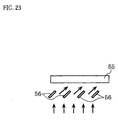
- fluorescent tubes 50 are provided along the edge of a light guide plate 51, and a diffuser 52 is printed on the light guide plate 51 in response to the distance from the fluorescent tubes 50 so as to achieve uniform illuminating beams to the display panel 53.
- a reflecting plate 54 is provided under the light guide plate 51 to improve the utilization rate of light.
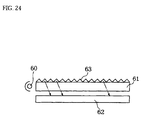
- an illuminating method known as the front light method i.e., the illuminating method of causing panel display with the light irradiated from an irradiating unit provided in front of the liquid crystal display panel is commonly adopted. More specifically, as shown in Fig. 24, the fluorescent lamps 60 are provided along an edge of the light guide plate 61, and the concave notches 63 are cut on the light guide plate 61 in response to the distance from the fluorescent lamps 60 so as to achieve uniformity of the illuminating light beams to the liquid crystal display panel 62.
- the present invention has an object to provide an illuminating unit which permits achievement of a smaller thickness and a reduced weight by eliminating a light guide plate, and to provide a display unit provided with such an illuminating unit.
- the invention of the claim 1 of the present invention provides an illuminating unit to illuminate an object of illumination, comprising a light source and a reflecting plate, which reflects an incident light from the light source, and directs the reflected light to the object of illumination, wherein the light source is arranged in the proximity of an end of the reflecting plate.
- an illuminating unit is composed achieving a smaller thickness and a reduced weight by eliminating a light guide plate.
- the illuminating unit of this invention is applicable to both the front light type and the backlight type.
- the illuminating unit of this invention is applicable, not only limited, for example, to an illuminating unit of a liquid crystal display unit, but also to the illuminating unites in a wide range including an illuminating unit for the purpose of illuminating the exhibits in a show window.
- the invention of the claim 2 provides an illuminating unit according to the claim 1, wherein the light source is arranged in the proximity of an end of the reflecting plate.
- the invention of the claim 3 provides an illuminating unit according to the claim 1, wherein the above said light sources are arranged in the proximity of both ends of the reflecting plate.
- the light source may be arranged on the reflecting surface of the reflecting plate.
- the invention of the claim 5 provides an illuminating unit according to the claim 4, wherein the light source is arranged in- the proximity of the center of the reflecting surface, and bends in a direction in which the more distant the said reflecting plate is from the light source, the more nearer it approaches the object of illumination.
- the aforementioned configuration of the illuminating unit in which the reflecting plate bends requires only a slight extent of bending of the reflecting plate even for the same area of the object of illumination, and the reflecting plate suffices to have a thickness of about a half. This permits reduction of the thickness of the illuminating unit in this invention.
- the invention of the claim 6 provides an illuminating unit of the backlight type, arranged behind an object of illumination, comprising a light source, and a reflecting plate, arranged opposite to the back surfaces of the object of illumination, which reflects an incident light from the light source and directs the reflected light to the object of illumination, wherein the light source is arranged in the proximity of an end of the reflecting plate.
- the invention of the claim 7 provides an illuminating unit according to the claim 6, wherein the reflecting plate is subjected to a reflecting angle adjusting treatment so that the incident angle of the reflected light entering the object of illumination becomes smaller accordingly as it becomes more distant from the light source so as to uniformly illuminate the object of illumination.
- the above-mentioned configuration makes it possible to cause gradual increase in the degree of condensation of the light directed toward the object of illumination accordingly as the distance from the light source becomes longer.
- the light has a high light intensity but a small degree of condensation at the portions of the object of illumination near the light source, whereas at the portions distant from the light source, the light has a low light intensity but a large degree of condensation. Consequently, this averages the illuminating light as a whole, thus permitting illumination of the object of illumination substantially to be uniform. It is thus possible to prevent the occurrence of display non-uniformity caused by attenuation of the light to be irradiated onto the object of illumination accordingly as the distance from the light source becomes longer.
- the invention of the claim 8 provides an illuminating unit according to the claim 7, wherein the reflecting angle adjusting treatment is to cause the reflecting plate to bend in a direction in which the more distant the said reflecting plate is from the light source, the more nearer it approaches the object of illumination.
- the reflecting angle on the reflecting plate becomes larger accordingly as the distance from the light source becomes longer. It is therefore become possible to ensure uniform illumination of the object of illumination.
- the uniformity of illumination is further improved than that in the invention of the claim 8.
- the reflecting angle on the reflecting plate becomes larger accordingly as the distance from the light source becomes longer. It is therefore possible to ensure uniform illumination of the object of illumination.
- the reflecting angle on the reflecting plate becomes larger accordingly as the distance from the light source becomes longer. It is therefore become possible to ensure uniform illumination of the object of illumination.
- the invention of the claim 13 provides an illuminating unit according to the claim 7, wherein the reflecting angle adjusting treatment is such that the reflecting plate bends in a direction in which the more distant the said reflecting plate is from the light source, the more nearer it approaches the object of illumination, and a number of the micro-projections each having a slant surface reflecting the incident light from the light source are formed on the reflecting plate, and these micro-projections are arranged so that the distribution density thereof becomes gradually larger accordingly as the distance from the light source becomes longer.
- the invention of the claim 14 provides an illuminating unit according to the claim 6, wherein the illuminating unit has optical means which directs the light from the light source substantially in parallel to the reflecting plate.
- the aforementioned configuration improves parallelism of the irradiation light onto the reflecting plate, and thereby improves the uniformity of illumination.
- the invention of the claim 15 provides an illuminating unit according to the claim 14, wherein a diffusing plate is provided between the reflecting plate and the object of illumination.
- the light reflected from the reflecting plate is diffused upon passing through the diffusing plate, thus achieving uniform distribution of the light. As the result, it improves the uniformity of illumination.
- the invention of the claim 17 provides a display unit built by use of the illuminating unit according to the claim 6, wherein a transmissive-type liquid crystal display panel is arranged as an object of illumination on the surface side of the reflecting plate of the illuminating unit, and the liquid crystal display panel is a liquid crystal display panel of the diffusion display mode in which the mode is switched over between a transmissive state and a diffusion state on the basis of the presence or absence of impression of a voltage.
- the above-mentioned configuration permits the configuration of a display unit of a diffusion display mode that has achieved the reduction of thickness and weight.
- the invention of the claim 18 provides a display unit built by use of the illuminating unit according to the claim 7, wherein a transmissive-type liquid crystal display panel is arranged as an object of illumination on the surface side of the reflecting plate of the illuminating unit, and the liquid crystal display panel is a liquid crystal display panel of the diffusion display mode in which the mode is switched over between a transmissive state and a diffusion state on the basis of the presence or absence of impression of a voltage; and the reflecting angle adjusting treatment of the reflecting plate is suitable for irradiating a diagonal light of a high parallelism to the liquid crystal display panel, in addition to the uniformity of illumination.
- the invention of the claim 20 provides a display unit according to the claim 18, wherein the display unit has optical means which converts the diffusing light from the light source substantially into a parallel light and directs the same to the reflecting plate.
- the invention of the claim 21 provides a front-light-type illuminating unit arranged on the front side of an object of illumination, comprising a light source and a reflecting plate reflecting an incident light from the light source and directing the reflected light to an object of illumination; and supporting means that supports a base end of the reflecting plate in a rotatable manner so as to make the angle between the reflecting plate and the object of illumination adjustable, wherein the light source is provided on the leading end side of the reflecting plate.
- the difference in optical path length between the reflected light beams irradiated onto the object of illumination via the reflecting plate, and further, the difference in optical path length between the light irradiated onto the object of illumination directly from the light source and the reflected light will largely be reduced as compared with the conventional cases. This improves the uniformity of illumination.
- the optical path length of the light irradiated onto the object of illumination from the light source via the reflecting plate is increased from that in the configuration in which the light source is provided on the reflecting plate side.
- the invention of the claim 23 provide an illuminating unit according to the claim 21, wherein, when the reflecting plate is at a position opposite to the object of illumination so as to ensure uniform illumination of the object of illumination, the reflecting plate is subjected to a reflecting angle adjusting treatment so that the incident angle of the reflected light entering the object of illumination becomes smaller as it moves toward the base end of the reflecting plate from the leading end.
- uniformity of the illumination is improved not only through adjustment of the angle of the reflecting plate, but also through a change in the reflecting angle.
- the invention of the claim 24 provides an illuminating unit according to the claim 22, wherein, when the reflecting plate is at a position opposite to the object of illumination so as to ensure the uniform illumination of the object of illumination, the reflecting plate is subjected to a reflecting angle adjusting treatment so that the incident angle of the reflected light entering the object of illumination becomes smaller as it moves toward the base end of the reflecting plate from the leading end.
- uniformity of the illumination is improved not only through adjustment of the angle of the reflecting plate, but also through a change in the reflecting angle.
- the invention of the claim 25 provides an illuminating unit according to the claim 23, wherein the reflecting angle adjusting treatment is such that the reflecting plate bends in a direction in which the nearer the said reflecting plate approaches the base end, the nearer it approaches the light source.
- the reflecting angle on the reflecting plate becomes larger according as the distance from the light source becomes longer. This makes it possible to uniformly illuminate the object of illumination.
- the invention of the claim 26 provides an illuminating unit according to the claim 24, wherein the reflecting angle adjusting treatment is such that the reflecting plate bends in a direction in which the nearer the said reflecting plate approaches the base end, the nearer it approaches the light source.
- the reflecting angle on the reflecting plate becomes larger accordingly as the distance from the light source becomes longer. This makes it possible to uniformly illuminate the object of illumination.
- the invention of the claim 27 provides an illuminating unit according to the claim 25, wherein the reflecting plate bends in a parabola shape.
- the invention of the claim 28 provides an illuminating unit according to the claim 26, wherein the reflecting plate bends in a parabola shape.
- the invention of the claim 29 provides an illuminating unit according to the claim 23, wherein the reflecting angle adjusting treatment is such that a number of the micro-projections each having a slant surface reflecting the incident light from the light source are formed on the reflecting plate, and these micro-projections are arranged so that the inclination angle of the slant surface becomes gradually larger accordingly as it becomes more distant from the light source.
- the reflecting angle on the reflecting plate becomes larger accordingly as the distance from the light source becomes longer. This makes it possible to uniformly illuminate the object of illumination.
- the invention of the claim 30 provides an illuminating unit according to the claim 24, wherein the reflecting angle adjusting treatment is such that a number of the micro-projections each having a slant surface reflecting the incident light from the light source are formed on the reflecting plate, and these micro-projections are arranged so that the inclination angle of the slant surface becomes gradually larger accordingly as it becomes more distant from the light source.
- the reflecting angle on the reflecting plate becomes larger accordingly as the distance from the light source becomes longer. This makes it possible to uniformly illuminate the object of illumination.
- the invention of the claim 31 provides an illuminating unit according to the claim 23, wherein the reflecting angle adjusting treatment is such that a number of the micro-projections each having a slant surface reflecting the incident light from the light source are formed on the reflecting plate, and said micro-projections are arranged so that the distribution density becomes gradually larger accordingly as the distance from the light source becomes longer.
- the reflecting angle on the reflecting plate becomes larger according as the distance from the light source becomes longer. This makes it possible to uniformly illuminate the object of illumination.
- the invention of the claim 32 provides an illuminating unit according to the claim 24, wherein the reflecting angle adjusting treatment is such that a number of the micro-projections each having a slant surface reflecting the incident light from the light source are formed on the reflecting plate, and these micro-projections are arranged so that the distribution density becomes gradually larger accordingly as the distance from the light source becomes longer.
- the invention of the claim 33 provides an illuminating unit according to the claim 23, wherein the reflecting angle adjusting treatment is such that the reflecting plate bends in a direction in which the more distant the said reflecting plate is from the light source, the nearer it approaches the object of illumination; and a number of the micro-projections each having a slant surface reflecting the incident light from the light source are formed on the reflecting plate; and these micro-projections are arranged so that the inclination angle of the slant surface becomes gradually larger accordingly as the distance from the light source becomes longer.
- uniformity of illumination is further improved by bending of the reflecting plate as well as by a change in angle of the micro-projections.
- the invention of the claim 34 provides an illuminating unit according to the claim 24, wherein the reflecting angle adjusting treatment is such that the reflecting plate bends in a direction in which the more distant the said reflecting plate is from the light source, the nearer it approaches the object of illumination; and a number of the micro-projections each having a slant surface reflecting the incident light from the light source are formed on the reflecting plate; and these micro-projections are arranged so that the inclination angle of the slant surface becomes gradually larger accordingly as the distance from the light source becomes longer.
- uniformity of illumination is further improved by bending of the reflecting plate as well as by a change in angle of the micro-projections.
- the invention of the claim 35 provides an illuminating unit according to the claim 23, wherein the reflecting angle adjusting treatment is such that the reflecting plate bends in a direction in which the more distant the said reflecting plate is from the light source, the nearer it approaches the object of illumination and a number of the micro-projections each having a slant surface reflecting the incident light from the light source are formed on the reflecting plate; and these micro-projections are arranged so that the distribution density thereof becomes gradually larger accordingly as the distance from the light source becomes longer.
- the invention of the claim 36 provides an illuminating unit according to the claim 24, wherein the reflecting angle adjusting treatment is such that the reflecting plate bends in a direction in which the more distant the said reflecting plate is from the light source, the nearer it approaches the object of illumination; and a number of the micro-projections each having a slant surface reflecting the incident light from the light source are formed on the reflecting plate; and these micro-projections are arranged so that the distribution density thereof becomes gradually larger accordingly as the distance from the light source becomes longer.
- uniformity of illumination is further improved by bending of the reflecting plate as well as by a change in distribution density of the micro-projections.
- the invention of the claim 37 provides an illuminating unit according to the claim 21, wherein the illuminating unit has optical means which directs the light from the light source substantially in parallel to the reflecting plate.
- the invention of the claim 38 provides an illuminating unit according to the claim 22, wherein the illuminating unit has optical means which directs the light from the light source substantially in parallel to the reflecting plate.
- the invention of the claim 39 provides an illuminating unit according to the claim 37, wherein a diffusing plate is provided in front of the object of illumination.
- the light reflected from the reflecting plate is diffused during passage through the diffusing plate, thus achieving uniformity of distribution of the light, resulting in uniformity of the illumination.
- the invention of the claim 40 provides an illuminating unit according to the claim 38, wherein a diffusing plate is provided in front of the said object of illumination.
- the light reflected from the reflecting plate is diffused during passage through the diffusing plate, thus achieving uniformity of distribution of the light, resulting in uniformity of the illumination.
- the invention of the claim 41 provides a display unit built by use of an illuminating unit according to the claim 21, wherein a reflecting type liquid crystal display panel is arranged as an object of illumination.
- the invention of the claim 42 provides a display unit built by use of the illuminating unit according to the claim 22, wherein a reflecting type liquid crystal display panel is arranged as an object of illumination.
- the invention of the claim 43 provides a display unit built by use of the illuminating unit according to the claim 21, wherein a reflecting-type liquid crystal display panel is arranged as an object of illumination on the surface side of the reflecting plate of the illuminating unit; and the liquid crystal display panel is a liquid crystal display panel of the diffusion display mode in which the mode is switched over between a transmissive state and a diffusion state on the basis of the presence or absence of impression of a voltage.
- the invention of the claim 44 provides a display unit using the illuminating unit according to the claim 22, wherein a reflecting-type liquid crystal display panel is arranged as an object of illumination on the surface side of the reflecting plate of the illuminating unit; and the liquid crystal display panel is a liquid crystal display panel of the diffusion display mode in which the mode is switched over between a transmissive state and a diffusion state on the basis of the presence or absence of impression of a voltage.
- Fig. 1 is a simplified configuration diagram of an embodiment 1 of the present invention
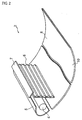
- Fig. 2 is a perspective view of an illuminating unit provided in a display unit.
- This embodiment 1 is a case where the invention is applied to a transmissive-type display unit.
- the display unit 1 comprises a backlight-type illuminating unit 2 and a liquid crystal display panel 3 serving as an object of illumination.
- the liquid crystal display panel 3 is a TN (twisted nematic) type or STN (super-twisted nematic) type liquid crystal display panel.
- the illuminating unit 2 comprises a linear light source 4 such as a fluorescent tube, a condensing cover 5 which surrounds the rear portion of the light source 4 (the left side portion of Fig.
- the prism sheet 6 functions to convert the light from the light source 4 into a parallel light.
- a micro-lens sheet may therefore be used in place of the prism sheet 6.
- the auxiliary reflecting plate 7 shields the light irradiated from the light source 4 directly to the liquid crystal display panel 3, and directs it to the reflecting plate 8 to shield irradiation of the light having a high optical intensity onto the liquid crystal display panel 3, thus serving to improve uniformity of the light onto the liquid crystal display panel 3.
- the reflecting plate 8 is bent in a parabola shape so as to approach the liquid crystal display panel 3 substantially according as the distance from the light source 4 becomes longer.
- the reflecting plate 8 By bending the reflecting plate 8 into a parabola shape as described above, it is possible to irradiate the liquid crystal display panel 3 substantially uniformly.
- light attenuates according as the distance from the light source 4 becomes longer.
- the optical intensity is higher at an end (left side end in Fig. 1) of the liquid crystal display panel 3 on the light source 4 side, whereas the optical intensity is lower at the other end (right side end in Fig.
- the parabolic shape of the reflecting plate 8 suffices to be at least a shape approaching the liquid crystal display panel 3 according as the distance from the light source 4 becomes longer. However, it should preferably be bent so that the incident angle of the incident light from the Light source 4 onto the reflecting surface is substantially constant over the entire reflecting surface 10.
- the reflecting plate 8 has a curved shape satisfying ⁇ 1 ⁇ ⁇ 2 at an arbitrary position on the reflecting surface 10. Since a better balance between the optical intensity and the degree of condensation is available for the illuminating light onto the liquid crystal display panel 3, it is possible to improve uniformity of the illumination.
- the illuminating unit of this embodiment As compared with use of a conventional case using a light guide plate, it is possible to achieve a reduced weight and a smaller size of the unit as a whole. This is useful particularly in a display unit using a large-sized display panel.
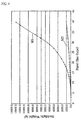
- the abscissa represents the panel size (shown by diagonal inches), and the ordinate, the backlight weight.
- the line M1 represents the case of a conventional illuminating unit using a light guide plate
- the line M2 shows the case of the illuminating unit of the present invention.
- the weight of the light guide plate is calculated on the basis of the following formula.
- the specific gravity 1.1 of acrylic resin commonly employed is used as that of the light guide plate.
- Light guide plate (light guide plate thickness) x (area of light guide plate) x (specific gravity of light guide plate)
- a larger panel size corresponds to an increased weight in the conventional art.
- an increased size leads to almost no increase in weight.
- the reason is as follows.
- the emitted luminous flux is proportional to a square of the tube diameter, and therefore, also to a square of the distance from the fluorescent tube.
- the panel size is in a linear proportional relationship with the tube diameter.
- a larger tube diameter leads to a larger light guide plate and an increased weight.
- the weight increase depending upon the panel size is slight, because an air layer occupies the most part. This effect becomes apparent for a panel size of at least type 10, and becomes more remarkable for a panel size of over type 15.
- the present inventor prepared a display unit having a backlight as described above to observe display property.
- aluminum was vapor-deposited on an acryl plate by sputtering to manufacture an ordinary thin flat sheet-shaped reflecting plate not subjected to a micro-processing.
- the resultant flat sheet-shaped reflecting plate was bent into a parabolic-shaped reflecting plate 8.
- an illuminating unit was prepared by assembling the reflecting plate 8, a light source 4, a condensing cover 5, a prism sheet 6, and an auxiliary reflecting plate 7.
- a display unit 1 was manufactured by mounting an illuminating unit 2 and a liquid crystal display panel 3.
- the display status of the thus manufactured display unit 1 was observed: luminance non-uniformity was not observed and uniform display was obtained.
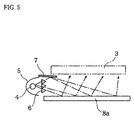
- Fig. 5 is a partial configuration diagram of a display unit of an embodiment 2 of the invention
- Fig. 6 is a side view of a reflecting plate used in the embodiment 2
- Fig. 7 is a plan view of the reflecting plate used in the embodiment 2.
- the embodiment 2 is similar to the embodiment 1, and corresponding component parts are represented by the same reference numerals, omitting a detailed description thereof.
- the micro-projections 15 are omitted to facilitate explanation with the drawing.
- a flat sheet-shaped reflecting plate 8a not bent is used in place of the reflecting plate 8 in the embodiment 1.
- Many micro-projections 15 for adjusting the reflecting angle are formed on the reflecting surface 10 of this reflecting plate 8a.
- Each of the micro-projections 15 has slant surface 16 reflecting an incident light from the light source.
- These micro-projections 15 are arranged so that the inclination angle ⁇ of the slant surface 16 becomes larger according as the distance from the light source 4 becomes longer.
- a reflecting plate 8b on which micro-projections 15 are arranged as shown in Fig. 8 so that the distribution density on the reflecting plate surface becomes gradually larger according as the distance from the light source 4 becomes longer may be used. It is particularly desirable to arrange the micro-projections 15 so as to obtain a quantity of light as represented by a distribution density corresponding to a square of the distance from the light source 4.
- the distribution density of the micro-projections with a distance L1 from the light source 4 is S1
- the distribution density of the micro-projections 15 with a distance L2 from the light source 4 is S2
- it is desirable to arrange the micro-projections 15 so as to satisfy (L1/L2) 2 S1/S2 .
- the micro-projections 15 may be scattered points as shown in Fig.7, or may be linear shape extending in parallel with the light source 4 as shown in Fig. 10.
- the micro-projections 15 are not limited to the rectangular shape as shown in Figs.7 and 10, but may also be triangular or circular in horizontal cross-section.
- the present inventor prepared the aforementioned display unit having a backlight as follows, and observed the display property.
- micro-projections were formed by subjecting an acryl plate to a micro-processing.
- the inclination angle ⁇ of the micro-projections 15 at the position the closest to the light source 4 was set to 0°;
- the inclination angle ⁇ of the micro-projections 15 at the most distant position was set to 30°;
- the inclination angle ⁇ of the micro-projections 15 located therebetween were set so as to achieve an angle distribution giving the quantities of light proportional to a square of the distance from the light source 4.
- the size of a micro-projections 15 was set at 100 ⁇ pitch smaller than a pixel.
- a reflecting plate 8a was prepared by vapor-depositing aluminum by sputtering onto the acryl plate having the micro-projections 15 formed thereon.
- an illuminating unit was manufactured by assembling the reflecting plate 8a, a light source 4, a condensing cover 5, a prism sheet 6, and an auxiliary reflecting plate 7.
- a display unit 1 was manufactured by mounting an illuminating unit 2 and a liquid crystal display panel 3. The display status of the thus manufactured display unit 1 was observed: no luminance non-uniformity was observed and uniform display was obtained. More uniform display was obtained by providing a diffusing plate 9 behind the liquid crystal display panel 3.
- the manufacturing method of the reflecting plate 8a is not limited to the above, but acryl resin may be pressed, or subjected to mold injection. Aluminum may be press-processed, or a photosensitive resin may be photo-etched.
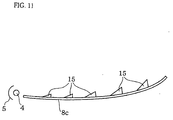
- a reflecting plate 8c shown in Fig. 11 may be used. More specifically, the reflecting plate 8c bent into a parabolic shape and having micro-projections 15 formed thereon may be used. Use of such a reflecting plate 8c permits improvement of uniformity of the illuminating light onto the liquid crystal display panel through reflection at an appropriate angle by the simultaneous use of the curved state of the reflecting plate and the micro-projections 15.
- the present inventor manufactured a display unit 1 in the same manner as in the experiment example 2 except that the reflecting plate 8a prepared in the above-mentioned experiment example 2 was bent into a parabolic shape which was used as a reflecting plate 8c.
- the display property of the thus manufactured display unit 1 was observed: no luminance non-uniformity was observed, and uniform display was obtained. More uniform display was obtained by providing a diffusing plate 9 behind the liquid crystal display panel 3.
- the degree of parallelism was reduced by removing the prism sheet 6: uniformity was somewhat deteriorated and luminance non-uniformity was observed.
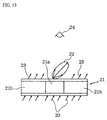
- the diffusing type liquid crystal display panel means a panel conducting display by switching the mode between a transmissive (transparent) state and a diffusion (white muddy) state on the basis of presence or absence of impression of a voltage, including, for example, a liquid crystal display panel using a polymer dispersing type liquid crystal in which liquid crystal drops are dispersed in a polymer, a dynamic type liquid crystal, or a smectic liquid crystal of a heat write diffusion mode.
- the principle of display upon diagonal incidence is as follows.
- the light 20 entering a diffusing plate 21 from the light source becomes a diffused light 22 in a diffused state portion 21a, and becomes a transmitting light 23 without being diffused in a transmissive state portion 21b.
- the observer 24 is in a bright state during diffusion as a result of arrival of the light at the transmissive state portion 21b, and in a dark state during transmission when the light leaves there, thus permitting display of a bright or dark state.
- the light from the light source is originally a diffused light, it keeps the state of diffused light during transmission, and the light reaches in the direction of observation, resulting in a lower contrast between bright and dark states. It is desirable that the light from the light source is a parallel light to some extent.
- any of the reflecting plate 8a, the reflecting plate 8b and the reflecting plate 8c may be used in place of the reflecting plate 8. In this embodiment, however, it is necessary to set an inclination angle ⁇ or a distribution density of the micro-projections 15 from the point of view of irradiating a diagonal light having a high parallelism, in addition to improving uniformity of illumination.
- ultraviolet rays were irradiated from a high-pressure mercury lamp at an intensity of 20 mW/cm 2 (around 360 nm) for 120 seconds onto the panel containing the liquid crystal sealed therein, thereby preparing a liquid crystal display panel 3a of a polymer network structure.
- the display status of the thus manufactured display unit 1 was observed under conditions including a main visual angle of 30° from a perpendicular line of the liquid crystal display panel 3a: there was only a little luminance non-uniformity, and a contrast over 20 was obtained.
- the scattering liquid crystal is not limited to the liquid crystal of the polymer structure, but may be a polymer dispersion liquid crystal, and similar effects was obtained.
- a liquid crystal display unit was manufactured in the same manner as in the Experiment Example 4 by use of a micro-processed reflecting plate 8a as in the Experiment Example 2.
- the shape of the micro-projections 15 was set so that the incident angle of the light to the scattering liquid crystal display panel is at least 30°.
- the main visual angle was set to 30° from the perpendicular line of the liquid crystal display panel 3. Display was tested for the thus manufactured liquid crystal display unit: there was only a little luminance non-uniformity, and a contrast of over 20 was obtained.
- the reflecting plate 8a prepared in the Experiment Example 5 was bent into a parabolic shape (corresponding to the reflecting plate 8c).
- An illuminating unit was manufactured by the same method as in the Experiment Example 5, except for the above. Luminance uniformity was observed for this liquid crystal display unit: a more uniform display was obtained. A contrast of at least 20 was obtained.
- Fig. 14 is a partial configuration diagram of a display unit of the embodiment 5.
- a light source 4 is arranged near the center of a reflecting plate 8d and above the reflecting surface, and is bent into a parabolic shape so as to be closer to the liquid crystal display panel 3 according as the distance from the light source 4 becomes longer.
- micro-projections 15 are not formed on the reflecting surface as in the embodiment 1.
- the area occupied by the reflecting plate is a half that in the case where the reflecting plate is bent, even with the same panel area, thus bringing about the effect of reducing the thickness of the display unit as a whole. This coincides with the case of the embodiments 6 and 7 described later.
- the light shield 17 may be provided to prevent the light from the light source 4 from entering directly into the liquid crystal display panel 3. This permits improvement of the uniformity of illumination.
- liquid crystal panel 3 has been used in the above-mentioned case, the scattering type liquid crystal display panel 3a may be used.
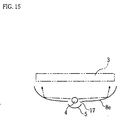
- Fig.15 is a partial configuration diagram of a display unit of the embodiment 6 of the invention.
- the reflecting plate 8e is used.
- the transmission hole 17 of a rectangular shape is formed near the center of the reflecting surface, and the light source 4 is provided in this transmission hole 17.
- the condensing cover 5 is provided behind (bottom side in Fig. 15) the light source 4.
- the micro-projections 15 are not formed on the reflecting surface as in the reflecting plate 8 in the Embodiment 1.
- the reflecting plate 8d is bent into a parabolic shape so that it comes closer to the liquid crystal display panel 3 accordingly as the distance from the light source 4 substantially becomes longer. This configuration permits achievement of a smaller thickness of the display unit as in the Embodiment 5.
- the transmission hole 17 is circular, and point-shaped light sources may be used in place of the linear light source 4. Further, a configuration in which the light source 4 is arranged between two reflecting plates may be used in place of the configuration in which the transmission hole 17 is formed in a single reflecting plate.
- the light shield 17 may be provided directly above the light source 4 in the Embodiment 5.
- liquid crystal display panel 3 While a liquid crystal display panel 3 has been used in the case described above, the scattering type liquid crystal display panel 3a may be used.
- the reflecting plate 8e has been bent into a parabolic shape in the above-mentioned case.
- the present invention is not however limited to this, but the reflecting plate 8e suffices to be bent in a direction, approaching the liquid crystal display panel 3 accordingly as the distance from the light source 4 becomes longer. While the reflecting plate 8e has been used in the above-mentioned case, a reflecting plate having the following configuration may be used in place of the reflecting plate 8e:
- the reflecting plate 8f shown in Fig. 16 is employed in an Embodiment 7 of the invention.
- This reflecting plate 8f is formed into a bowl shape and has point light sources 4a arranged on the bottom thereof. With the reflecting plate 8f having the above-mentioned configuration, it is possible to achieve a smaller thickness of the display unit as in the aforementioned Embodiments 5 and 6.
- liquid crystal display panel 3 has been used in the case mentioned above, the scattering type liquid crystal display panel 3a may be used.
- the reflecting plate 8f not micro-processed has been used in the above-mentioned case, but a reflecting plate having micro-projections 15 formed on the reflecting surface may be used. Arrangement of the micro-projections 15 in this case suffices to comply with the inclination angle ⁇ or the distribution density as in the above-mentioned reflecting plate 8a or 8b.
- the illuminating unit using the bowl-shaped reflecting plate 8f as described above is applicable not only to an illuminating unit for a liquid crystal display panel, but also to the other illuminating unites, and particularly to a case where the surface to be illuminated of the object of illumination is circular.
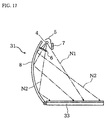
- Fig.17 is a partial configuration diagram of a display unit of an embodiment 8 of the invention
- Fig. 18 is a perspective view illustrating a whole view of the display unit.
- the invention is applied to a reflection type display unit.
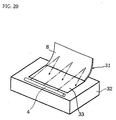
- This display unit 30 comprises the front type illuminating unit 31, and the display unit body 32 having a reflection type liquid crystal display panel 33.
- the illuminating unit 31 has basically the same configuration as that of the Backlight-type illuminating unit 2, and the same reference numerals are assigned to corresponding component parts.
- a base end of the reflecting plate 8 is attached to the display unit body 32 so as to permit adjustment of the angle, and the light source 4 is integrally provided at a leading end of the reflecting plate 8.
- the reflecting plate 8 As a result, by setting the reflecting plate 8 to a wide-open state, it is possible to take a long distance between the light source 4 and the reflection type liquid crystal display panel 33. This causes a marked decrease in the difference in the optical path length between the light Nl irradiated from the light source 4 directly onto the reflection type liquid crystal display panel 33 and the light N2 irradiated onto the reflection type liquid crystal display panel 33 via the reflecting plate. Furthermore, the reflecting plate 8 is formed into a parabolic shape. Therefore, making the reflecting plate 8 angle-adjustable and forming it into a parabolic shape make it possible to achieve uniform illumination.
- the reflecting plate 8 can serve as an opening/closing cover, thus permitting prevention of a damage to the display surface of the reflection-type liquid crystal display panel 33.
- any of the reflecting plates 8a, 8b, 8g, and 8c having the aforementioned micro-projections 15 may be used in place of the reflecting plate 8.
- the configuration, in which the light source is arranged near the center of the reflecting plate as in the Embodiments 5, 6, and 7, is applicable to this Embodiment 8 as well.
- the reflection type liquid crystal display panel 33 may be an ordinary TN reflection-type liquid crystal display panel or a scattering-type liquid crystal display panel.
- the diffusing plate 9 may be provided in front of the reflection-type liquid crystal display panel 33. In this configuration, there is available a more uniform display.
- the diffusing plate 9 is not provided. It is because installation of the diffusing plate 9 results in decrease in the contrast.
- the present inventor manufactured a reflection type display unit 30 having the above-mentioned front type illuminating unit as follows, and observed the display property.
- an ordinary TN reflection-type liquid crystal display panel was used as the reflection-type liquid crystal display panel 33, and the reflecting plate 8a was used as the reflecting plate.
- the micro-projections 15 were formed by micro-processing an acryl plate.
- the set angular distribution included an inclination angle ⁇ of the micro-projection 15 at the position the closest to the light source 4 of 0°, an inclination angle ⁇ of the micro-projection 15 at the farthest distant position of 30°, and each inclination angle ⁇ of the micro-projections 15 in the midway to give an amount of light proportional to substantially a square of the distance from the light source 4.
- the size of the micro-projections 15 was set, to 100 ⁇ m pitch, which is a smaller size than the size of a pixel.
- the reflecting plate 8a was manufactured by vapor-depositing aluminum by sputtering on an acryl plate having the micro-projections 15 formed thereon.
- an illuminating unit 31 was manufactured by assembling the reflecting plate 8a, the light source 4, the condensing cover 5, the prism sheet 6, and the auxiliary reflecting plate 7. Then, the display unit 30 shown in Fig. 19 was manufactured by mounting the illuminating unit 31 onto the display unit body 32 having the reflection type liquid crystal display panel 33. To simplify illustration, the micro-projections 15 are omitted in Fig.19.
- the display status of the thus manufactured display unit 30 was observed: no luminance non-uniformity was observed, and a uniform display was obtained.
- a more uniform display was obtained.
- a display unit 30 was manufactured in the same manner as in the Experiment Example 7 except that the reflecting plate 8a manufactured in the Experiment Example 7 was bent into a parabolic shape (corresponding to the reflecting plate 8c). The display status was observed on the display unit 30 of this Experiment Example 8: luminance non-uniformity was not observed, and a uniform display was obtained. By providing the diffusing plate 9 in front of the reflection type liquid crystal display panel 33, a more uniform display was obtained.
- the display unit 30 was manufactured in the same manner as in the Experiment Example 8 except that an ordinary flat sheet-shaped reflecting plate not fine-processed was prepared, and the thus prepared flat sheet-shaped reflecting plate was bent into a parabolic shape (corresponding to the reflecting plate 8).
- the display status was observed on this display unit 30 of this Experiment Example 9: no luminance non-uniformity was observed, and a uniform display was obtained.
- a TFT scattering liquid crystal display panel was used as the reflection type liquid crystal display panel 33, and the reflecting plate 8 was used as the reflecting plate.
- the TFT scattering liquid crystal display panel was manufactured in the same manner as in the above-mentioned Experiment Example 4. Curvature of the reflecting plate 8 was set to a parabolic shape so that the incident angle of the light to the scattering liquid crystal display panel is at least 30° as in the Experiment Example 4. The main visual angle was set to 30° from the perpendicular line of the scattering liquid crystal display panel.
- the display unit 30 was manufactured in the same manner as in the Experiment Example 7 for the other conditions of manufacture. The display status was observed on the display unit 30 of the Experiment Example 10: luminance non-uniformity was not observed, and a contrast of 20 or more was obtained.
- the liquid crystal display unit 30 was manufactured in the same manner as in the Experiment Example 10 by use of the reflecting plate 8a micro-processed in the same manner as in the Experiment Example 7. A shape of micro-projections was set so as to give an incident angle of the light to the scattering liquid crystal display panel of at least 30°. The display status of the display unit 30 of the Experiment Example 11 was observed: only a little luminance non-uniformity was observed, and a contrast of 20 or more was obtained.
- the reflecting plate 8a manufactured in the Experiment Example 11 was bent into a parabolic shape (corresponding to the reflecting plate 8c).
- the liquid crystal display unit 30 was manufactured in the same manner as in the Experiment Example 11 except for the above.
- the display status was observed for the display unit 30 of this Experiment Example 12, including observation of the luminance uniformity of this liquid crystal display unit: there was observed only a little luminance non-uniformity, and contrast of 20 or more was obtained.
- the diffusing plate 9 was inserted in front of the reflection-type liquid crystal display panel (scattering type liquid crystal display panel) 33 in each of the scattering type liquid crystal display units of the above-mentioned Experiment Examples 10, 11, and 12: there was a large decrease in contrast to 2, and the display quality has decreased. By reducing the parallelism of the light from the light source 4 by removing the prism sheet 6, the contrast partially decreased to about 8.
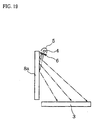
- Fig.20 is a perspective view illustrating a whole exterior configuration of a display unit of the Embodiment 9.
- the light source 4 is provided on the display unit body 32 side.
- the optical path length of the light irradiated from the light source 4 via the reflecting plate 8 onto the liquid crystal display panel 33 is longer than in the Embodiment 5, resulting in a further smaller difference in the optical path length between the irradiated light beams.
- This brings about an advantage of improving the uniformity of illumination.
- provision of the light source 4 on the unit body side facilitates wiring, thus permitting simplification of the configuration of the reflecting plate serving as an opening/closing cover.
- any of the aforementioned reflecting plates 8a, 8b, 8g, and 8c having the micro-projections 15 provided thereon may be used in place of the reflecting plate 8.
- the reflection type liquid crystal display panel 33 may be an ordinary TN reflection-type liquid crystal display panel, or a scattering-type liquid crystal display panel.
- the diffusing plate 9 may be provided in front of the reflection type liquid crystal display panel 33. This gives a more uniform display.
- the diffusing plate 9 is not provided. Installation of the diffusing plate 9 will lead to decrease in the contrast.
- the display unit having a liquid crystal display panel has been described in the above-mentioned Embodiments 1 to 10.
- the present invention is not however limited to this, but also applicable even to a display unit having a display panel built with, for example, an electrophoresis element.
- the illuminating unit of the present invention is applicable not only to a display unit, but also applicable for illuminating a sign, a poster, a photo, or the exhibits in a show window.
- the objects of the invention can sufficiently be achieved. More specifically, they are as follows:
Landscapes
- Physics & Mathematics (AREA)
- General Physics & Mathematics (AREA)
- Optics & Photonics (AREA)
- Nonlinear Science (AREA)
- Mathematical Physics (AREA)
- Chemical & Material Sciences (AREA)
- Crystallography & Structural Chemistry (AREA)
- Planar Illumination Modules (AREA)
- Liquid Crystal (AREA)
Applications Claiming Priority (3)
| Application Number | Priority Date | Filing Date | Title |
|---|---|---|---|
| JP5440599 | 1999-03-02 | ||
| JP5440599 | 1999-03-02 | ||
| PCT/JP2000/001159 WO2000052667A1 (en) | 1999-03-02 | 2000-02-28 | Illuminating device and display device provided with the device |
Publications (2)
| Publication Number | Publication Date |
|---|---|
| EP1093105A1 true EP1093105A1 (de) | 2001-04-18 |
| EP1093105A4 EP1093105A4 (de) | 2002-06-12 |
Family
ID=12969801
Family Applications (1)
| Application Number | Title | Priority Date | Filing Date |
|---|---|---|---|
| EP00905396A Withdrawn EP1093105A4 (de) | 1999-03-02 | 2000-02-28 | Leuchtvorrichtung und anzeigevorrichtung mit derselben |
Country Status (4)
| Country | Link |
|---|---|
| EP (1) | EP1093105A4 (de) |
| KR (1) | KR20010043176A (de) |
| CN (1) | CN1296604A (de) |
| WO (1) | WO2000052667A1 (de) |
Cited By (9)
| Publication number | Priority date | Publication date | Assignee | Title |
|---|---|---|---|---|
| US7948672B2 (en) | 2008-03-07 | 2011-05-24 | Qualcomm Mems Technologies, Inc. | System and methods for tiling display panels |
| US8045252B2 (en) | 2004-02-03 | 2011-10-25 | Qualcomm Mems Technologies, Inc. | Spatial light modulator with integrated optical compensation structure |
| JP2012043772A (ja) * | 2010-08-18 | 2012-03-01 | Lg Innotek Co Ltd | バックライトユニット及びそれを用いたディスプレイ装置 |
| US8798425B2 (en) | 2007-12-07 | 2014-08-05 | Qualcomm Mems Technologies, Inc. | Decoupled holographic film and diffuser |
| US8848294B2 (en) | 2010-05-20 | 2014-09-30 | Qualcomm Mems Technologies, Inc. | Method and structure capable of changing color saturation |
| US8872085B2 (en) | 2006-10-06 | 2014-10-28 | Qualcomm Mems Technologies, Inc. | Display device having front illuminator with turning features |
| US8902484B2 (en) | 2010-12-15 | 2014-12-02 | Qualcomm Mems Technologies, Inc. | Holographic brightness enhancement film |
| US9019183B2 (en) | 2006-10-06 | 2015-04-28 | Qualcomm Mems Technologies, Inc. | Optical loss structure integrated in an illumination apparatus |
| US9025235B2 (en) | 2002-12-25 | 2015-05-05 | Qualcomm Mems Technologies, Inc. | Optical interference type of color display having optical diffusion layer between substrate and electrode |
Families Citing this family (32)
| Publication number | Priority date | Publication date | Assignee | Title |
|---|---|---|---|---|
| KR100455465B1 (ko) * | 2002-02-27 | 2004-11-06 | 강한석 | 다양한 색상의 빛을 발산하는 발광부테가 형성된 테이블. |
| CN100426010C (zh) * | 2002-12-02 | 2008-10-15 | 鸿富锦精密工业(深圳)有限公司 | 导光板及使用该导光板的背光模块 |
| CN100390638C (zh) * | 2003-09-25 | 2008-05-28 | 友达光电股份有限公司 | 光源模块 |
| US7508571B2 (en) | 2004-09-27 | 2009-03-24 | Idc, Llc | Optical films for controlling angular characteristics of displays |
| US7807488B2 (en) | 2004-09-27 | 2010-10-05 | Qualcomm Mems Technologies, Inc. | Display element having filter material diffused in a substrate of the display element |
| KR100712107B1 (ko) * | 2004-12-09 | 2007-04-27 | 삼성에스디아이 주식회사 | 액정 표시 장치 |
| CN100559065C (zh) * | 2005-02-07 | 2009-11-11 | 徐佳义 | 透明照明模块 |
| TWI263098B (en) | 2005-02-16 | 2006-10-01 | Au Optronics Corp | Backlight module |
| CN100386680C (zh) * | 2005-02-23 | 2008-05-07 | 友达光电股份有限公司 | 背光模块 |
| US7845841B2 (en) | 2006-08-28 | 2010-12-07 | Qualcomm Mems Technologies, Inc. | Angle sweeping holographic illuminator |
| EP2069838A2 (de) | 2006-10-06 | 2009-06-17 | Qualcomm Mems Technologies, Inc. | Beleuchtungsvorrichtung mit eingebautem lichtkoppler |
| US8107155B2 (en) | 2006-10-06 | 2012-01-31 | Qualcomm Mems Technologies, Inc. | System and method for reducing visual artifacts in displays |
| US7855827B2 (en) | 2006-10-06 | 2010-12-21 | Qualcomm Mems Technologies, Inc. | Internal optical isolation structure for integrated front or back lighting |
| CN100510524C (zh) * | 2006-10-25 | 2009-07-08 | 徐佳义 | 展示柜照明装置防尘防雾装置 |
| US7864395B2 (en) | 2006-10-27 | 2011-01-04 | Qualcomm Mems Technologies, Inc. | Light guide including optical scattering elements and a method of manufacture |
| WO2008049377A1 (fr) * | 2006-10-27 | 2008-05-02 | Shaohua Ren | Source de lumière de surface ayant une surface réfléchissante incurvée pour l'éclairage |
| US7949213B2 (en) | 2007-12-07 | 2011-05-24 | Qualcomm Mems Technologies, Inc. | Light illumination of displays with front light guide and coupling elements |
| US8654061B2 (en) | 2008-02-12 | 2014-02-18 | Qualcomm Mems Technologies, Inc. | Integrated front light solution |
| WO2009102731A2 (en) | 2008-02-12 | 2009-08-20 | Qualcomm Mems Technologies, Inc. | Devices and methods for enhancing brightness of displays using angle conversion layers |
| KR101268960B1 (ko) | 2008-02-22 | 2013-05-29 | 엘지디스플레이 주식회사 | 백라이트 유닛 |
| WO2009129264A1 (en) | 2008-04-15 | 2009-10-22 | Qualcomm Mems Technologies, Inc. | Light with bi-directional propagation |
| JP5355261B2 (ja) * | 2009-07-07 | 2013-11-27 | 株式会社日立ハイテクノロジーズ | プロキシミティ露光装置、プロキシミティ露光装置の露光光形成方法、及び表示用パネル基板の製造方法 |
| CN101858566B (zh) * | 2010-04-21 | 2012-02-08 | 刘姝 | 用于背光源组件中的光源反射器及其背光源组件 |
| KR101335791B1 (ko) * | 2011-11-16 | 2013-12-02 | 엘지전자 주식회사 | 디스플레이 장치의 백라이트 유닛 및 그를 이용한 디스플레이 장치 |
| WO2013127249A1 (zh) * | 2012-02-28 | 2013-09-06 | 天地融科技股份有限公司 | 一种电子设备 |
| CN203013179U (zh) * | 2012-02-28 | 2013-06-19 | 天地融科技股份有限公司 | 一种电子设备 |
| KR102404722B1 (ko) | 2015-02-02 | 2022-06-02 | 삼성디스플레이 주식회사 | 액정 표시 장치 |
| KR102493918B1 (ko) * | 2016-03-09 | 2023-02-01 | 삼성전자주식회사 | 디스플레이 장치 |
| CN105759328B (zh) * | 2016-05-17 | 2019-07-30 | 京东方科技集团股份有限公司 | 一种光线发散机构、背光模组及显示装置 |
| CN106019709A (zh) * | 2016-07-25 | 2016-10-12 | 广州创维平面显示科技有限公司 | 一种液晶模组及液晶显示屏 |
| CN108873129A (zh) * | 2018-06-25 | 2018-11-23 | 深圳市华星光电技术有限公司 | 反射片、侧入式背光模组及液晶显示器 |
| WO2024080077A1 (ja) * | 2022-10-14 | 2024-04-18 | アルプスアルパイン株式会社 | 表示装置 |
Family Cites Families (19)
| Publication number | Priority date | Publication date | Assignee | Title |
|---|---|---|---|---|
| JPS5453998A (en) * | 1977-10-07 | 1979-04-27 | Nichiden Varian Kk | Indicator |
| DE3123369A1 (de) * | 1981-06-12 | 1983-02-03 | Vdo Schindling | Lichtleiter |
| JPS58166379A (ja) * | 1982-03-29 | 1983-10-01 | 芝浦メカトロニクス株式会社 | 液晶表示器の照明装置 |
| JPS59212876A (ja) * | 1983-05-17 | 1984-12-01 | 三菱電機株式会社 | 表示装置 |
| JPS62204289A (ja) * | 1986-03-04 | 1987-09-08 | 三洋電機株式会社 | 液晶表示装置 |
| JPS62262023A (ja) * | 1986-05-09 | 1987-11-14 | Hitachi Ltd | 液晶表示装置 |
| JPS63228188A (ja) * | 1987-03-17 | 1988-09-22 | ソニー株式会社 | 液晶表示装置 |
| JPH0232320A (ja) * | 1988-07-21 | 1990-02-02 | Tama Electric Co Ltd | 背面照光装置 |
| JPH0624857Y2 (ja) * | 1988-08-25 | 1994-06-29 | ソニー株式会社 | バックライト装置 |
| JPH02165373A (ja) * | 1988-12-20 | 1990-06-26 | Sharp Corp | ワードプロセッサの照明装置 |
| JPH03109590A (ja) * | 1989-09-25 | 1991-05-09 | Matsushita Electric Ind Co Ltd | 照明装置 |
| JPH0428623U (de) * | 1990-07-02 | 1992-03-06 | ||
| JPH05281540A (ja) * | 1992-03-31 | 1993-10-29 | Toshiba Lighting & Technol Corp | 照明装置および液晶表示装置 |
| US5339179A (en) * | 1992-10-01 | 1994-08-16 | International Business Machines Corp. | Edge-lit transflective non-emissive display with angled interface means on both sides of light conducting panel |
| JPH10115829A (ja) * | 1996-10-14 | 1998-05-06 | Seiko Epson Corp | 液晶表示装置 |
| JPH10246886A (ja) * | 1997-03-03 | 1998-09-14 | Omron Corp | 反射型液晶表示パネルを備えた機器 |
| JPH10268787A (ja) * | 1997-03-21 | 1998-10-09 | Sony Corp | 反射型表示装置 |
| JP3215346B2 (ja) * | 1997-03-28 | 2001-10-02 | シャープ株式会社 | 前方照明装置およびこれを備えた反射型液晶表示装置 |
| JPH11212084A (ja) * | 1998-01-23 | 1999-08-06 | Sharp Corp | 電子機器 |
-
2000
- 2000-02-28 EP EP00905396A patent/EP1093105A4/de not_active Withdrawn
- 2000-02-28 WO PCT/JP2000/001159 patent/WO2000052667A1/ja not_active Ceased
- 2000-02-28 CN CN00800250A patent/CN1296604A/zh active Pending
- 2000-02-28 KR KR1020007012097A patent/KR20010043176A/ko not_active Abandoned
Non-Patent Citations (2)
| Title |
|---|
| No further relevant documents disclosed * |
| See also references of WO0052667A1 * |
Cited By (10)
| Publication number | Priority date | Publication date | Assignee | Title |
|---|---|---|---|---|
| US9025235B2 (en) | 2002-12-25 | 2015-05-05 | Qualcomm Mems Technologies, Inc. | Optical interference type of color display having optical diffusion layer between substrate and electrode |
| US8045252B2 (en) | 2004-02-03 | 2011-10-25 | Qualcomm Mems Technologies, Inc. | Spatial light modulator with integrated optical compensation structure |
| US9019590B2 (en) | 2004-02-03 | 2015-04-28 | Qualcomm Mems Technologies, Inc. | Spatial light modulator with integrated optical compensation structure |
| US8872085B2 (en) | 2006-10-06 | 2014-10-28 | Qualcomm Mems Technologies, Inc. | Display device having front illuminator with turning features |
| US9019183B2 (en) | 2006-10-06 | 2015-04-28 | Qualcomm Mems Technologies, Inc. | Optical loss structure integrated in an illumination apparatus |
| US8798425B2 (en) | 2007-12-07 | 2014-08-05 | Qualcomm Mems Technologies, Inc. | Decoupled holographic film and diffuser |
| US7948672B2 (en) | 2008-03-07 | 2011-05-24 | Qualcomm Mems Technologies, Inc. | System and methods for tiling display panels |
| US8848294B2 (en) | 2010-05-20 | 2014-09-30 | Qualcomm Mems Technologies, Inc. | Method and structure capable of changing color saturation |
| JP2012043772A (ja) * | 2010-08-18 | 2012-03-01 | Lg Innotek Co Ltd | バックライトユニット及びそれを用いたディスプレイ装置 |
| US8902484B2 (en) | 2010-12-15 | 2014-12-02 | Qualcomm Mems Technologies, Inc. | Holographic brightness enhancement film |
Also Published As
| Publication number | Publication date |
|---|---|
| EP1093105A4 (de) | 2002-06-12 |
| CN1296604A (zh) | 2001-05-23 |
| KR20010043176A (ko) | 2001-05-25 |
| WO2000052667A1 (en) | 2000-09-08 |
Similar Documents
| Publication | Publication Date | Title |
|---|---|---|
| JP4042829B2 (ja) | 液晶表示装置 | |
| KR20010043176A (ko) | 조명장치 및 그 조명장치를 구비한 표시장치 | |
| KR101332317B1 (ko) | 백라이트 유닛 및 이를 이용한 액정 표시 장치 | |
| JP2000030515A (ja) | 面状照明装置 | |
| JP2000315056A (ja) | 照明装置及びその照明装置を備えた表示装置 | |
| US7854526B2 (en) | Lamp holder | |
| JP3098297U (ja) | 直下式バックライトユニット | |
| US20040109314A1 (en) | Backlight module | |
| KR101327852B1 (ko) | 백라이트 유닛 | |
| JP2004198725A (ja) | 液晶表示装置、直下型バックライト、及び拡散板 | |
| JP4147824B2 (ja) | 液晶表示装置 | |
| JPH08166586A (ja) | 表示装置 | |
| US7494242B2 (en) | Backlight assembly including a diffuser plate having indented portions and a reflective plate having lamp insertion portions | |
| JP4394497B2 (ja) | 照明装置 | |
| US20090096955A1 (en) | Liquid Crystal Display Appliance and Lighting System | |
| US7524099B2 (en) | Liquid crystal display | |
| JP2001291413A (ja) | 面光源装置及びこれを用いた液晶ディスプレイ装置 | |
| KR100877411B1 (ko) | 휘도 향상 시트, 이를 포함하는 백라이트 장치, 액정 표시장치 및 그 제조 방법 | |
| KR20070021378A (ko) | 백라이트 어셈블리 및 이를 갖는 액정표시장치 | |
| KR20070040957A (ko) | 반사 입자를 포함하는 프리즘 시트 및 이를 포함하는백라이트 유닛 | |
| KR100834125B1 (ko) | 백라이트 유닛 | |
| KR101104259B1 (ko) | 백라이트 장치에 사용되는 프리즘시트 | |
| JP3455042B2 (ja) | 液晶表示装置 | |
| KR101296456B1 (ko) | 백라이트 유닛과 이를 이용한 액정표시장치 | |
| KR20060127609A (ko) | 백라이트 장치에 사용되는 프리즘시트 |
Legal Events
| Date | Code | Title | Description |
|---|---|---|---|
| PUAI | Public reference made under article 153(3) epc to a published international application that has entered the european phase |
Free format text: ORIGINAL CODE: 0009012 |
|
| 17P | Request for examination filed |
Effective date: 20001204 |
|
| AK | Designated contracting states |
Kind code of ref document: A1 Designated state(s): DE NL |
|
| A4 | Supplementary search report drawn up and despatched |
Effective date: 20020426 |
|
| AK | Designated contracting states |
Kind code of ref document: A4 Designated state(s): DE NL |
|
| RIC1 | Information provided on ipc code assigned before grant |
Free format text: 7F 21V 8/00 A, 7G 02F 1/13357B |
|
| STAA | Information on the status of an ep patent application or granted ep patent |
Free format text: STATUS: THE APPLICATION IS DEEMED TO BE WITHDRAWN |
|
| 18D | Application deemed to be withdrawn |
Effective date: 20030902 |
|
| RBV | Designated contracting states (corrected) |
Designated state(s): DE |