EP1100971B1 - Wellenlängen verschiebende proben und primer - Google Patents
Wellenlängen verschiebende proben und primer Download PDFInfo
- Publication number
- EP1100971B1 EP1100971B1 EP99937602A EP99937602A EP1100971B1 EP 1100971 B1 EP1100971 B1 EP 1100971B1 EP 99937602 A EP99937602 A EP 99937602A EP 99937602 A EP99937602 A EP 99937602A EP 1100971 B1 EP1100971 B1 EP 1100971B1
- Authority
- EP
- European Patent Office
- Prior art keywords
- oligonucleotide
- probe
- moiety
- harvester
- emitter
- Prior art date
- Legal status (The legal status is an assumption and is not a legal conclusion. Google has not performed a legal analysis and makes no representation as to the accuracy of the status listed.)
- Expired - Lifetime
Links
- 239000000523 sample Substances 0.000 title claims abstract description 313
- 230000003321 amplification Effects 0.000 claims abstract description 35
- 238000003199 nucleic acid amplification method Methods 0.000 claims abstract description 35
- 238000003556 assay Methods 0.000 claims abstract description 22
- 238000001514 detection method Methods 0.000 claims abstract description 16
- 150000007523 nucleic acids Chemical class 0.000 claims abstract description 12
- 108020004707 nucleic acids Proteins 0.000 claims abstract description 9
- 102000039446 nucleic acids Human genes 0.000 claims abstract description 9
- 108091034117 Oligonucleotide Proteins 0.000 claims description 49
- 125000003729 nucleotide group Chemical group 0.000 claims description 40
- 239000002773 nucleotide Substances 0.000 claims description 37
- 230000005284 excitation Effects 0.000 claims description 36
- 238000010791 quenching Methods 0.000 claims description 27
- 230000000171 quenching effect Effects 0.000 claims description 26
- 238000000295 emission spectrum Methods 0.000 claims description 25
- 230000000295 complement effect Effects 0.000 claims description 22
- WCKQPPQRFNHPRJ-UHFFFAOYSA-N 4-[[4-(dimethylamino)phenyl]diazenyl]benzoic acid Chemical compound C1=CC(N(C)C)=CC=C1N=NC1=CC=C(C(O)=O)C=C1 WCKQPPQRFNHPRJ-UHFFFAOYSA-N 0.000 claims description 16
- 238000003752 polymerase chain reaction Methods 0.000 claims description 15
- 238000006243 chemical reaction Methods 0.000 claims description 13
- 238000000695 excitation spectrum Methods 0.000 claims description 12
- 238000007834 ligase chain reaction Methods 0.000 claims description 6
- 102000016928 DNA-directed DNA polymerase Human genes 0.000 claims description 5
- 108010014303 DNA-directed DNA polymerase Proteins 0.000 claims description 5
- 108091028043 Nucleic acid sequence Proteins 0.000 claims description 4
- 238000009396 hybridization Methods 0.000 claims description 4
- 239000003153 chemical reaction reagent Substances 0.000 claims description 3
- 238000006073 displacement reaction Methods 0.000 claims description 3
- 230000001404 mediated effect Effects 0.000 claims description 3
- 238000005096 rolling process Methods 0.000 claims description 3
- 238000013518 transcription Methods 0.000 claims description 3
- 230000035897 transcription Effects 0.000 claims description 3
- 238000011065 in-situ storage Methods 0.000 claims description 2
- 230000037452 priming Effects 0.000 claims description 2
- 108010026228 mRNA guanylyltransferase Proteins 0.000 claims 2
- 238000005462 in vivo assay Methods 0.000 claims 1
- 239000004615 ingredient Substances 0.000 claims 1
- 108090000765 processed proteins & peptides Proteins 0.000 claims 1
- 108020005187 Oligonucleotide Probes Proteins 0.000 abstract description 2
- 238000003149 assay kit Methods 0.000 abstract description 2
- 239000002751 oligonucleotide probe Substances 0.000 abstract description 2
- 239000013615 primer Substances 0.000 abstract 2
- 239000002987 primer (paints) Substances 0.000 abstract 2
- 239000003155 DNA primer Substances 0.000 abstract 1
- GNBHRKFJIUUOQI-UHFFFAOYSA-N fluorescein Chemical compound O1C(=O)C2=CC=CC=C2C21C1=CC=C(O)C=C1OC1=CC(O)=CC=C21 GNBHRKFJIUUOQI-UHFFFAOYSA-N 0.000 description 70
- MPLHNVLQVRSVEE-UHFFFAOYSA-N texas red Chemical compound [O-]S(=O)(=O)C1=CC(S(Cl)(=O)=O)=CC=C1C(C1=CC=2CCCN3CCCC(C=23)=C1O1)=C2C1=C(CCC1)C3=[N+]1CCCC3=C2 MPLHNVLQVRSVEE-UHFFFAOYSA-N 0.000 description 46
- ABZLKHKQJHEPAX-UHFFFAOYSA-N tetramethylrhodamine Chemical compound C=12C=CC(N(C)C)=CC2=[O+]C2=CC(N(C)C)=CC=C2C=1C1=CC=CC=C1C([O-])=O ABZLKHKQJHEPAX-UHFFFAOYSA-N 0.000 description 35
- 238000002866 fluorescence resonance energy transfer Methods 0.000 description 18
- QCPFFGGFHNZBEP-UHFFFAOYSA-N 4,5,6,7-tetrachloro-3',6'-dihydroxyspiro[2-benzofuran-3,9'-xanthene]-1-one Chemical compound O1C(=O)C(C(=C(Cl)C(Cl)=C2Cl)Cl)=C2C21C1=CC=C(O)C=C1OC1=CC(O)=CC=C21 QCPFFGGFHNZBEP-UHFFFAOYSA-N 0.000 description 12
- 238000012546 transfer Methods 0.000 description 12
- 238000000926 separation method Methods 0.000 description 10
- 230000015572 biosynthetic process Effects 0.000 description 9
- 238000001228 spectrum Methods 0.000 description 8
- 230000001629 suppression Effects 0.000 description 8
- 238000012408 PCR amplification Methods 0.000 description 7
- 238000010276 construction Methods 0.000 description 7
- 238000007837 multiplex assay Methods 0.000 description 7
- 125000006850 spacer group Chemical group 0.000 description 7
- 230000000638 stimulation Effects 0.000 description 7
- XKRFYHLGVUSROY-UHFFFAOYSA-N Argon Chemical compound [Ar] XKRFYHLGVUSROY-UHFFFAOYSA-N 0.000 description 6
- JLCPHMBAVCMARE-UHFFFAOYSA-N [3-[[3-[[3-[[3-[[3-[[3-[[3-[[3-[[3-[[3-[[3-[[5-(2-amino-6-oxo-1H-purin-9-yl)-3-[[3-[[3-[[3-[[3-[[3-[[5-(2-amino-6-oxo-1H-purin-9-yl)-3-[[5-(2-amino-6-oxo-1H-purin-9-yl)-3-hydroxyoxolan-2-yl]methoxy-hydroxyphosphoryl]oxyoxolan-2-yl]methoxy-hydroxyphosphoryl]oxy-5-(5-methyl-2,4-dioxopyrimidin-1-yl)oxolan-2-yl]methoxy-hydroxyphosphoryl]oxy-5-(6-aminopurin-9-yl)oxolan-2-yl]methoxy-hydroxyphosphoryl]oxy-5-(6-aminopurin-9-yl)oxolan-2-yl]methoxy-hydroxyphosphoryl]oxy-5-(6-aminopurin-9-yl)oxolan-2-yl]methoxy-hydroxyphosphoryl]oxy-5-(6-aminopurin-9-yl)oxolan-2-yl]methoxy-hydroxyphosphoryl]oxyoxolan-2-yl]methoxy-hydroxyphosphoryl]oxy-5-(5-methyl-2,4-dioxopyrimidin-1-yl)oxolan-2-yl]methoxy-hydroxyphosphoryl]oxy-5-(4-amino-2-oxopyrimidin-1-yl)oxolan-2-yl]methoxy-hydroxyphosphoryl]oxy-5-(5-methyl-2,4-dioxopyrimidin-1-yl)oxolan-2-yl]methoxy-hydroxyphosphoryl]oxy-5-(5-methyl-2,4-dioxopyrimidin-1-yl)oxolan-2-yl]methoxy-hydroxyphosphoryl]oxy-5-(6-aminopurin-9-yl)oxolan-2-yl]methoxy-hydroxyphosphoryl]oxy-5-(6-aminopurin-9-yl)oxolan-2-yl]methoxy-hydroxyphosphoryl]oxy-5-(4-amino-2-oxopyrimidin-1-yl)oxolan-2-yl]methoxy-hydroxyphosphoryl]oxy-5-(4-amino-2-oxopyrimidin-1-yl)oxolan-2-yl]methoxy-hydroxyphosphoryl]oxy-5-(4-amino-2-oxopyrimidin-1-yl)oxolan-2-yl]methoxy-hydroxyphosphoryl]oxy-5-(6-aminopurin-9-yl)oxolan-2-yl]methoxy-hydroxyphosphoryl]oxy-5-(4-amino-2-oxopyrimidin-1-yl)oxolan-2-yl]methyl [5-(6-aminopurin-9-yl)-2-(hydroxymethyl)oxolan-3-yl] hydrogen phosphate Polymers Cc1cn(C2CC(OP(O)(=O)OCC3OC(CC3OP(O)(=O)OCC3OC(CC3O)n3cnc4c3nc(N)[nH]c4=O)n3cnc4c3nc(N)[nH]c4=O)C(COP(O)(=O)OC3CC(OC3COP(O)(=O)OC3CC(OC3COP(O)(=O)OC3CC(OC3COP(O)(=O)OC3CC(OC3COP(O)(=O)OC3CC(OC3COP(O)(=O)OC3CC(OC3COP(O)(=O)OC3CC(OC3COP(O)(=O)OC3CC(OC3COP(O)(=O)OC3CC(OC3COP(O)(=O)OC3CC(OC3COP(O)(=O)OC3CC(OC3COP(O)(=O)OC3CC(OC3COP(O)(=O)OC3CC(OC3COP(O)(=O)OC3CC(OC3COP(O)(=O)OC3CC(OC3COP(O)(=O)OC3CC(OC3COP(O)(=O)OC3CC(OC3CO)n3cnc4c(N)ncnc34)n3ccc(N)nc3=O)n3cnc4c(N)ncnc34)n3ccc(N)nc3=O)n3ccc(N)nc3=O)n3ccc(N)nc3=O)n3cnc4c(N)ncnc34)n3cnc4c(N)ncnc34)n3cc(C)c(=O)[nH]c3=O)n3cc(C)c(=O)[nH]c3=O)n3ccc(N)nc3=O)n3cc(C)c(=O)[nH]c3=O)n3cnc4c3nc(N)[nH]c4=O)n3cnc4c(N)ncnc34)n3cnc4c(N)ncnc34)n3cnc4c(N)ncnc34)n3cnc4c(N)ncnc34)O2)c(=O)[nH]c1=O JLCPHMBAVCMARE-UHFFFAOYSA-N 0.000 description 6
- VYXSBFYARXAAKO-WTKGSRSZSA-N chembl402140 Chemical compound Cl.C1=2C=C(C)C(NCC)=CC=2OC2=C\C(=N/CC)C(C)=CC2=C1C1=CC=CC=C1C(=O)OCC VYXSBFYARXAAKO-WTKGSRSZSA-N 0.000 description 6
- 238000003776 cleavage reaction Methods 0.000 description 6
- 238000011160 research Methods 0.000 description 6
- 230000007017 scission Effects 0.000 description 6
- 230000004936 stimulating effect Effects 0.000 description 6
- 238000003786 synthesis reaction Methods 0.000 description 6
- -1 BODIPY Chemical compound 0.000 description 5
- 108020004414 DNA Proteins 0.000 description 5
- IQFYYKKMVGJFEH-XLPZGREQSA-N Thymidine Chemical group O=C1NC(=O)C(C)=CN1[C@@H]1O[C@H](CO)[C@@H](O)C1 IQFYYKKMVGJFEH-XLPZGREQSA-N 0.000 description 5
- 238000000862 absorption spectrum Methods 0.000 description 5
- 238000000034 method Methods 0.000 description 5
- 238000012360 testing method Methods 0.000 description 5
- 125000003396 thiol group Chemical group [H]S* 0.000 description 5
- 108091093037 Peptide nucleic acid Proteins 0.000 description 4
- 230000008859 change Effects 0.000 description 4
- 230000000694 effects Effects 0.000 description 4
- 238000002474 experimental method Methods 0.000 description 4
- 238000005382 thermal cycling Methods 0.000 description 4
- 108091032973 (ribonucleotides)n+m Proteins 0.000 description 3
- RGNHAWFQWRAADF-UHFFFAOYSA-N 1-[4-[[4-(dimethylamino)phenyl]diazenyl]phenyl]pyrrole-2,5-dione Chemical compound C1=CC(N(C)C)=CC=C1N=NC1=CC=C(N2C(C=CC2=O)=O)C=C1 RGNHAWFQWRAADF-UHFFFAOYSA-N 0.000 description 3
- 229910052786 argon Inorganic materials 0.000 description 3
- 238000013461 design Methods 0.000 description 3
- 239000000463 material Substances 0.000 description 3
- 230000007246 mechanism Effects 0.000 description 3
- 230000003595 spectral effect Effects 0.000 description 3
- 101710163270 Nuclease Proteins 0.000 description 2
- 238000010521 absorption reaction Methods 0.000 description 2
- 125000003277 amino group Chemical group 0.000 description 2
- 239000012472 biological sample Substances 0.000 description 2
- 230000015556 catabolic process Effects 0.000 description 2
- 238000006731 degradation reaction Methods 0.000 description 2
- 230000006872 improvement Effects 0.000 description 2
- 238000011534 incubation Methods 0.000 description 2
- 238000005259 measurement Methods 0.000 description 2
- 239000002777 nucleoside Substances 0.000 description 2
- 150000008300 phosphoramidites Chemical class 0.000 description 2
- 125000002924 primary amino group Chemical group [H]N([H])* 0.000 description 2
- 239000007787 solid Substances 0.000 description 2
- 238000006467 substitution reaction Methods 0.000 description 2
- 238000001429 visible spectrum Methods 0.000 description 2
- CZWUESRDTYLNDE-UHFFFAOYSA-N (2z)-2-[(2e,4e,6e)-7-[1-(5-carboxypentyl)-3,3-dimethyl-5-sulfoindol-1-ium-2-yl]hepta-2,4,6-trienylidene]-1-ethyl-3,3-dimethylindole-5-sulfonate Chemical compound CC1(C)C2=CC(S([O-])(=O)=O)=CC=C2N(CC)\C1=C/C=C/C=C/C=C/C1=[N+](CCCCCC(O)=O)C2=CC=C(S(O)(=O)=O)C=C2C1(C)C CZWUESRDTYLNDE-UHFFFAOYSA-N 0.000 description 1
- GOLORTLGFDVFDW-UHFFFAOYSA-N 3-(1h-benzimidazol-2-yl)-7-(diethylamino)chromen-2-one Chemical compound C1=CC=C2NC(C3=CC4=CC=C(C=C4OC3=O)N(CC)CC)=NC2=C1 GOLORTLGFDVFDW-UHFFFAOYSA-N 0.000 description 1
- WQZIDRAQTRIQDX-UHFFFAOYSA-N 6-carboxy-x-rhodamine Chemical compound OC(=O)C1=CC=C(C([O-])=O)C=C1C(C1=CC=2CCCN3CCCC(C=23)=C1O1)=C2C1=C(CCC1)C3=[N+]1CCCC3=C2 WQZIDRAQTRIQDX-UHFFFAOYSA-N 0.000 description 1
- 108700028369 Alleles Proteins 0.000 description 1
- 108091093088 Amplicon Proteins 0.000 description 1
- 102000053602 DNA Human genes 0.000 description 1
- 230000006820 DNA synthesis Effects 0.000 description 1
- 108090000790 Enzymes Proteins 0.000 description 1
- 102000004190 Enzymes Human genes 0.000 description 1
- KWYHDKDOAIKMQN-UHFFFAOYSA-N N,N,N',N'-tetramethylethylenediamine Chemical compound CN(C)CCN(C)C KWYHDKDOAIKMQN-UHFFFAOYSA-N 0.000 description 1
- 238000002944 PCR assay Methods 0.000 description 1
- 108010066717 Q beta Replicase Proteins 0.000 description 1
- RYYWUUFWQRZTIU-UHFFFAOYSA-N Thiophosphoric acid Chemical class OP(O)(S)=O RYYWUUFWQRZTIU-UHFFFAOYSA-N 0.000 description 1
- MGPYJVWEJNTXLC-UHFFFAOYSA-N [6-[6-[2-cyanoethoxy-[di(propan-2-yl)amino]phosphanyl]oxyhexylcarbamoyl]-6'-(2,2-dimethylpropanoyloxy)-3-oxospiro[2-benzofuran-1,9'-xanthene]-3'-yl] 2,2-dimethylpropanoate Chemical compound C12=CC=C(OC(=O)C(C)(C)C)C=C2OC2=CC(OC(=O)C(C)(C)C)=CC=C2C11OC(=O)C2=CC=C(C(=O)NCCCCCCOP(N(C(C)C)C(C)C)OCCC#N)C=C21 MGPYJVWEJNTXLC-UHFFFAOYSA-N 0.000 description 1
- 125000000217 alkyl group Chemical group 0.000 description 1
- 238000000137 annealing Methods 0.000 description 1
- 230000008901 benefit Effects 0.000 description 1
- 239000003086 colorant Substances 0.000 description 1
- 230000000052 comparative effect Effects 0.000 description 1
- 239000002299 complementary DNA Substances 0.000 description 1
- 238000003271 compound fluorescence assay Methods 0.000 description 1
- 150000001875 compounds Chemical class 0.000 description 1
- 239000005289 controlled pore glass Substances 0.000 description 1
- 230000008878 coupling Effects 0.000 description 1
- 238000010168 coupling process Methods 0.000 description 1
- 238000005859 coupling reaction Methods 0.000 description 1
- 230000003247 decreasing effect Effects 0.000 description 1
- 230000000593 degrading effect Effects 0.000 description 1
- 239000005547 deoxyribonucleotide Substances 0.000 description 1
- 125000002637 deoxyribonucleotide group Chemical group 0.000 description 1
- 230000000368 destabilizing effect Effects 0.000 description 1
- 239000000975 dye Substances 0.000 description 1
- 238000003366 endpoint assay Methods 0.000 description 1
- 238000005516 engineering process Methods 0.000 description 1
- SEACYXSIPDVVMV-UHFFFAOYSA-L eosin Y Chemical compound [Na+].[Na+].[O-]C(=O)C1=CC=CC=C1C1=C2C=C(Br)C(=O)C(Br)=C2OC2=C(Br)C([O-])=C(Br)C=C21 SEACYXSIPDVVMV-UHFFFAOYSA-L 0.000 description 1
- 238000007667 floating Methods 0.000 description 1
- 239000007850 fluorescent dye Substances 0.000 description 1
- 238000007306 functionalization reaction Methods 0.000 description 1
- 230000036541 health Effects 0.000 description 1
- 238000004128 high performance liquid chromatography Methods 0.000 description 1
- 102000007579 human kallikrein-related peptidase 3 Human genes 0.000 description 1
- 108010071652 human kallikrein-related peptidase 3 Proteins 0.000 description 1
- 238000001727 in vivo Methods 0.000 description 1
- 238000003780 insertion Methods 0.000 description 1
- 230000037431 insertion Effects 0.000 description 1
- 230000003993 interaction Effects 0.000 description 1
- 230000002452 interceptive effect Effects 0.000 description 1
- PGLTVOMIXTUURA-UHFFFAOYSA-N iodoacetamide Chemical compound NC(=O)CI PGLTVOMIXTUURA-UHFFFAOYSA-N 0.000 description 1
- 150000002540 isothiocyanates Chemical class 0.000 description 1
- DLBFLQKQABVKGT-UHFFFAOYSA-L lucifer yellow dye Chemical compound [Li+].[Li+].[O-]S(=O)(=O)C1=CC(C(N(C(=O)NN)C2=O)=O)=C3C2=CC(S([O-])(=O)=O)=CC3=C1N DLBFLQKQABVKGT-UHFFFAOYSA-L 0.000 description 1
- FDZZZRQASAIRJF-UHFFFAOYSA-M malachite green Chemical compound [Cl-].C1=CC(N(C)C)=CC=C1C(C=1C=CC=CC=1)=C1C=CC(=[N+](C)C)C=C1 FDZZZRQASAIRJF-UHFFFAOYSA-M 0.000 description 1
- 229940107698 malachite green Drugs 0.000 description 1
- CEQFOVLGLXCDCX-WUKNDPDISA-N methyl red Chemical compound C1=CC(N(C)C)=CC=C1\N=N\C1=CC=CC=C1C(O)=O CEQFOVLGLXCDCX-WUKNDPDISA-N 0.000 description 1
- 239000000203 mixture Substances 0.000 description 1
- 239000013642 negative control Substances 0.000 description 1
- 150000003833 nucleoside derivatives Chemical class 0.000 description 1
- 238000009877 rendering Methods 0.000 description 1
- PYWVYCXTNDRMGF-UHFFFAOYSA-N rhodamine B Chemical compound [Cl-].C=12C=CC(=[N+](CC)CC)C=C2OC2=CC(N(CC)CC)=CC=C2C=1C1=CC=CC=C1C(O)=O PYWVYCXTNDRMGF-UHFFFAOYSA-N 0.000 description 1
- 229940035637 spectrum-4 Drugs 0.000 description 1
- YBBRCQOCSYXUOC-UHFFFAOYSA-N sulfuryl dichloride Chemical compound ClS(Cl)(=O)=O YBBRCQOCSYXUOC-UHFFFAOYSA-N 0.000 description 1
- 238000001308 synthesis method Methods 0.000 description 1
- 230000002194 synthesizing effect Effects 0.000 description 1
- ANRHNWWPFJCPAZ-UHFFFAOYSA-M thionine Chemical compound [Cl-].C1=CC(N)=CC2=[S+]C3=CC(N)=CC=C3N=C21 ANRHNWWPFJCPAZ-UHFFFAOYSA-M 0.000 description 1
Images




Classifications
-
- C—CHEMISTRY; METALLURGY
- C12—BIOCHEMISTRY; BEER; SPIRITS; WINE; VINEGAR; MICROBIOLOGY; ENZYMOLOGY; MUTATION OR GENETIC ENGINEERING
- C12Q—MEASURING OR TESTING PROCESSES INVOLVING ENZYMES, NUCLEIC ACIDS OR MICROORGANISMS; COMPOSITIONS OR TEST PAPERS THEREFOR; PROCESSES OF PREPARING SUCH COMPOSITIONS; CONDITION-RESPONSIVE CONTROL IN MICROBIOLOGICAL OR ENZYMOLOGICAL PROCESSES
- C12Q1/00—Measuring or testing processes involving enzymes, nucleic acids or microorganisms; Compositions therefor; Processes of preparing such compositions
- C12Q1/68—Measuring or testing processes involving enzymes, nucleic acids or microorganisms; Compositions therefor; Processes of preparing such compositions involving nucleic acids
- C12Q1/6813—Hybridisation assays
- C12Q1/6816—Hybridisation assays characterised by the detection means
- C12Q1/6818—Hybridisation assays characterised by the detection means involving interaction of two or more labels, e.g. resonant energy transfer
Definitions
- This invention relates to oligonucleotides, kits and amplification assays as defined in the claims.
- Hairpin-forming oligonucleotide hybridization probes with interactive label pairs, particularly fluorescent label pairs and fluorescer-quencher label pairs, that open when the hairpin's single-stranded loop hybridizes to a target are known.
- Preferred embodiments of these probes, labeled with a fluorophore and a quencher are "dark", that is, have relatively little or no fluorescence, when free in solution but fluoresce when hybridized to their nucleic acid targets.
- molecular beacon probes bring the fluorophore very close to a quencher when the probe is closed. Quenching is not constrained by the FRET rule of spectral overlap. They are constructed with a variety of fluorophores and are utilized in both end-point and real-time homogeneous assays, including multiplex assays. Tyagi et al PCT application No. WO98/10096 ; Tyagi et al. (1998) Nature Biotechnology 16:49 ; Kostrikis et al. (1998) Science 279:1228 ; Piatek et al. (1998) Nature Biotechnology 16:359 . Hairpin-containing primers similarly labeled with a fluorophore and a quencher are also known. Nazarenko et al. (1997) Nucleic Acids Research 25:2516 .
- hairpin probes of a different structure and mode of operation namely, short loops flaked by a first arm complementary to the target and a second arm that is partially complementary to the first and competes with the target to bind to it; and which open when the target-complementary arm hybridizes to a target and lead to FRET-based detection ( Bagwell U.S. Patent No. 5,607,834 ).
- Fluorescence assay instruments that operate with a single stimulation wavelength are much less complicated and much less expensive than instruments that operate with multiple stimulation wavelengths. Almost all assay instruments, including sophisticated instruments costing many tens of thousands of dollars (U.S.) operate with single wavelength stimulation, even if the wavelength is selectable. Because every fluorophore has an optimal excitation wavelength, the choice of fluorophores to be used with a detection instrument having such a light source is limited. Certain fluorophores will be excited poorly or essentially not at all by the source. Red fluorophores such as tetramethylrhodamine (TMR) and Texas red are only minimally excited by a blue light source.
- TMR tetramethylrhodamine
- Texas red are only minimally excited by a blue light source.
- a sophisticated, expensive instrument such as the Applied BioSystems 7700 PRISM, can detect fluorescence from TMR stimulated by a blue light source, but not Texas red. Less sophisticated, less expensive instruments can detect neither one.
- multiplex assays for multiple targets using multiple hairpin probes or primers having differently colored fluorophores it is desirable to be able to use four or even more fluorophores whose emission spectra have limited overlap, but the choice of fluorophores is limited by the use of single wavelength stimulation.
- multiplex assays suffer from the drawback that the emission intensities of some of the fluorophores are very small both in absolute terms and also relative to other fluorophores in the assay.
- the present invention allows for the provision of probes and primers whose conformational change produces a detectable fluorescent signal having a greater Stokes shift than conventional hairpin probes and primers.
- the present invention provides a wider range of hairpin-forming probes and primers that are effectively quenched ("dark") in the absence of target but are better excited in the presence of target by a monochromatic light source.
- the present invention also allows for the provision of a group, or series, of hairpin-forming probes or primers containing differently colored fluorophores, all of which can be reasonably well excited by a single monochromatic light source.
- the present invention provides probes and primers suitable for use with single-wavelength stimulation instruments, including unsophisticated instruments for which the current choices are extremely limited.
- the present invention allows for the provision of hairpin-forming probes and primers having reduced background signal as a consequence of the source itself not being detected.
- the present invention allows for probes that fluoresce in one color if hybridized to target but change color if digested by a nuclease.
- hairpin-forming probes and primers may be constructed such that their fluorescence when closed is suppressed, but when open, they are well excited by a monochromatic light source and emit strongly at a wavelength distanced from the wavelength of the source. Certain preferred embodiments are "dark" when closed, by which we mean that their total fluorescence when closed is less than twenty percent of their total fluorescence when open and that they do not change color upon opening.
- Probes according to this invention are suitable for use In end-point detection assays, and probes and primers according to this invention are suitable for use in real-time amplification assays such as, for example, polymerase chain reaction (PCR) assays.
- the end-point assays and real-time assays may be multiplex assays.
- Assay kits containing the probes and primers are also provided.
- a fluorescently labeled hairpin-forming oligonucleotide having a closed conformation including a single-stranded loop and a stem duplex and an open conformation not including said stem duplex, wherein hybridization of said loop to a target sequence causes the oligonucleotide to assume its open conformation, said oligonucleotide containing:
- hybridization of the probes to target strands causes the probes to shift from their closed conformation to their open conformation.
- Hairpin-forming oligonucleotide probes including molecular beacon probes, that may be modified according to this invention are interactively labeled, hairpin-forming oligonucleotides comprising a stem-and-loop structure.
- the loop contains a probe sequence complementary to the probe's target.
- Nucleotide sequences ("arms") flank the probe sequence, and a sequence in one arm is complementary to a sequence in the other arm.
- the arms hybridize with one another to form a stem hybrid, which is sometimes referred to as the "stem duplex". This is the closed conformation.
- the probe hybridizes to its target the longer and stronger probe-target hybrid overcomes the stem hybrid and separates the arm sequences.
- Molecular beacon probes may be free in solution, or they may be tethered to a solid surface. For some molecular beacon probes, which we refer to as "allele-discriminating," only perfectly complementary strands are targets that cause this change under assay conditions; for other embodiments the probe will open despite the presence of one or a few internal mismatches with the target.
- Molecular beacon probes have a fluorophore attached to one arm and a quencher attached to the other arm. When the arms form a stem, the quencher is very close to the fluorophore and effectively quenches or suppresses its fluorescence, rendering the probe dark.
- fluorophore and quencher for example, tetramethylrhodamine and DABCYL, need not be a FRET pair.
- oligonucleotide sequences of molecular beacon probes modified according to this invention may be DNA, RNA, peptide nucleic acid (PNA) or combinations thereof.
- Modified nucleotides may be included, for example nitropyrole-based nucleotides or 2'-O-methylribonucleotides.
- Modified linkages also may be included, for example phosphorothioates.
- Modified nucleotides and modified linkages may also be incorporated in wavelength-shifting primers according to this invention, subject, as will be recognized, to the requirement that one arm be able to serve a primer for a nucleic acid polymerase.
- the length of the loop sequence that is target complementary, the length of the stem hybrid and the relation of the two is designed according to the assay conditions for which the probe is to be utilized. Lengths of target-complement sequence and stem hybrid for particular assay conditions can be estimated by known means, tried and adjusted, if necessary. Typical probe sequences for use in PCR assays are in the range of 16 to 25 nucleotides. Typical stem lengths are in the range of 3 to 8, more commonly 4 to 7 nucleotides. The strength of the stem hybrid is adjusted by routine experimentation to achieve proper functioning. In addition to length, the strength of the stem hybrid can be adjusted by altering the G-C content and insertion of destabilizing mismatches, as will be appreciated.
- One arm can be designed to be partially or completely complementary to the target. If the 3' arm is complementary to the target the probe can serve as a primer for a DNA polymerase. Also, wavelength-shifting molecular beacon probes can be immobilized to solid surfaces, as by tethering, as well as being free-floating.
- fluorophores may be used in probes and primers according to this invention.
- Available fluorophores include coumarin, fluorescein, tetrachlorofluorescein, hexachlorofluorescein, Lucifer yellow, rhodamine, BODIPY, tetramethylrhodamine, Cy3, Cy5, Cy7, eosine, Texas red and ROX.
- Combination fluorophores such as fluorescein-rhodamine dimers, described, for example, by Lee et al. (1997), Nucleic Acids Research 25:2816 , are also suitable.
- Fluorophores may be chosen to absorb and emit in the visible spectrum or outside the visible spectrum, such as in the ultraviolet or infrared ranges.
- a quencher is a moiety that, when placed very close to an excited fluorophore, causes there to be little or no fluorescence.
- Suitable quenchers described in the art include particularly DABCYL and variants thereof, such as DABSYL, DABMI and Methyl Red.
- Fluorophores can also be used as quenchers, because they tend to quench fluorescence when touching certain other fluorophores.
- Our preferred quenchers are either chromophores such as DABCYL or malachite green, or fluorophores that do not fluoresce in the detection range when the probe is in the open conformation.
- Hairpin-forming probes according to this invention may be utilized in detection assays. They may also be used as detectors in amplifications assays, and may be added prior to amplification, in which case quantitative results as to the initial concentration of target may be obtained.
- Amplification reactions include the polymerase chain reaction (PCR), strand displacement amplification (SDA), nucleic acid sequence based amplification (NASBA), transcription mediated amplification (TMA), the ligase chain reaction (LCR), rolling circle amplification, and RNA-directed RNA amplification catalyzed by an enzyme such as Q-beta replicase.
- PCR polymerase chain reaction
- SDA strand displacement amplification
- NASBA nucleic acid sequence based amplification
- TMA transcription mediated amplification
- LCR ligase chain reaction
- rolling circle amplification RNA-directed RNA amplification catalyzed by an enzyme such as Q-beta replicase.
- Multiple probes for multiple targets
- Hairpin-forming primers are used in those of the amplification reactions identified above that include one or more primers. They may be modified according to the present invention have an arm sequence that binds to a nucleic acid target, such that the hairpin-containing primer can be extended by incubation with a nucleic acid polymerase. The loop portion may, but need not be, complementary to the original target strand. Hairpin-containing primers have a stem labeled with a fluorophore on one arm and a quencher on the other arm, similarly to molecular beacon detection probes. Embodiments of the instant invention will be described primarily in connection with molecular beacon detection probes. Workers in the art will understand that the concepts and teachings apply to hairpin primers as well, and will understand how to apply the concepts and particular teachings to hairpin-containing primers.
- Fig. 1 shows the excitation and emission spectra of two fluorophores, fluorescein and tetramethylrhodamine (TMR).
- Fluorescein has an absorption spectrum 1 with a maximum at 490 nm and an emission spectrum 2 with a maximum at 515 nm.
- Fluorescein has a Stokes Shift, the difference between the two maxima, of 25 nm.
- TMR has an excitation spectrum 3 with a maximum at 555 nm and an emission spectrum 4 with a maximum at 575 nm. It has a Stokes shift of 20 nm.
- Fig. 1 shows the relatively small Stokes shift typical of most fluorophores.
- An instrument producing a stimulation light at a nominal wavelength of, for example, 488 nm may in fact have an excitation spectrum that includes longer wavelengths, and a detector set for 515 nm may in fact respond to light that includes shorter wavelengths.
- the fluorescent signal measured by such an instrument would include a background reading from the stimulating light.
- Fig. 1 also shows why there is a serious practical limitation of an instrument having a single stimulating wavelength. If the stimulating wavelength is 490 nm, which is optimum for the excitation of fluorescein, a molecular beacon probe having TMR as the fluorophore would be stimulated only ten percent as well as it would have been by a source at 560 nm. The intensity of its emission would be correspondingly lower. If the excitation source were changed to 560 nm, which is appropriate for TMR, fluorescein would not be excited at all. Thus, the number of different fluorophores that work well is restricted no matter which excitation wavelength is utilized. These effects are illustrated in Fig. 2 and Fig.
- Fig. 3 which present the results of using a conventional molecular beacon probe design as a detector for amplicons in a PCR amplification reaction.
- the probe design includes a stem-and-loop hairpin structure that is terminally labeled with a fluorophore and the quencher DABCYL oppositely positioned across the stem duplex.
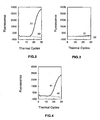
- Fig. 2 shows what happens when the fluorophore is fluorescein, the excitation source is a blue argon laser (488 nm), and the detector measures fluorescence in the emission range of fluorescein. Fluorescence intensities reported in Fig. 2 , and also in Fig. 3 and Fig.
- Fig. 3 shows what happens in a parallel experiment in which the only differences are that the fluorophore of the molecular beacon probe is Texas red instead of fluorescein, and the detector measures fluorescence in the emission range of Texas red.
- Fig. 4 shows the results of a third parallel experiment in which the only difference from the second experiment was that the Texas red probe of Fig. 3 was changed to a construction according to the instant invention.
- the fluorescence intensity 41 of the sample containing target began to deviate from the reading 42 of the targetless control at approximately cycle 15, but by cycle 30 the difference was approximately 3000 units, about seventy-five percent of the magnitude of the fluorescence intensity of the fluorescein-labeled conventional molecular beacon probe utilized in the experiment shown in Fig. 2 and about fifteen times as great as the magnitude of the fluorescence intensity of the conventional molecular beacon probe labeled with Texas red, shown in Fig. 3 .
- an excitation source at 488 nm is an acceptable source for a Texas red probe according to this invention and, conversely, Texas Red is an acceptable fluorophore for probes and primers according to this invention for use with an excitation source at 488 nm.
- the emission intensity achieved by the probe according to this invention makes the probe suitable for use not only with sophisticated detection such as the Applied Biosystems PRISM, but also for use with less expensive instruments that have unsophisticated fluorescence measurement.
- Probe 51 includes a molecular beacon probe hairpin oligonucleotide structure, namely, a loop 52, stem duplex 53, a DABCYL quencher 55 on one end and a fluorescein fluorophore 54 opposite the quencher in a close, quenching relationship across the stem hybrid when the probe is in the closed conformation.
- the probe includes an extension 57 of several nucleotides past the fluorescein. Extension 57 terminates in a nucleotide that is linked to a Texas red fluorophore 56.
- loop 52 forms hybrid 59 with the target strand, unwinding stem 53 and separating the quencher 55 from the fluorescein 54 and Texas red 56.
- the fluorescein acts as a "harvester” moiety that absorbs energy from the excitation source but transfers a significant portion of the energy, in some constructions the great majority of the energy, to the Texas red fluorophore, which acts as an "emitter” moiety by receiving the transferred energy and emitting it at its characteristic, longer wavelength.
- probe 51 in the open conformation appears to obey the rules of FRET, which require that the two fluorophores be separated by an appropriate distance and that the emission spectrum of the harvester moiety significantly overlaps the absorption spectrum of the emitter moiety.
- the shaded area 5 depicts such a spectral overlap for the two fluorophores whose spectra are presented there.
- probe 51 is essentially dark in its closed conformation despite the presence of a second fluorophore that makes a FRET pair with fluorescein. Possibly the combination of fluorescein and DABCYL does not make a FRET pair with Texas red. Whatever the mechanism may be, there is little to no fluorescence at 610 nm when the probe is closed. Similarly, there is little to no fluorescence at 515 nm when the probe is closed.
- Probes and primers according to this invention which we refer to as "wavelength-shifting" molecular beacon probes and “wavelength-shifting” hairpin primers, like their unmodified counterparts, can be made from DNA, RNA, PNA (peptide nucleic acid), or combinations of the foregoing. Modified nucleotides and modified nucleotide linkages may be used in place of naturally occurring nucleotides and linkages. Fluorophores and quenchers can be inserted into the strand in place of a nucleotide.
- the loop of a wavelength-shifting molecular beacon probe is complementary to the target and has a length of at least seven nucleotides, with a preferred range being from about twelve to about thirty nucleotides, although longer loops can be used.
- Wavelength-shifting primers may have similar loops; however, their loops need not be complementary to the target, and their loops can be as short as three nucleotides.
- the arms form a stem duplex of at least three nucleotides with a preferred range being from three to about eight nucleotides, although longer stems are suitable in some applications.
- a first arm of the probe or primer is labeled with a quencher.
- the probe or primer is labeled with a pair of fluorophores capable of interacting by energy transfer when the quencher is relocated distantly by the opening of the probe or primer.
- One of the pair is attached to the second arm in a close, quenching relationship with the quencher when the probe is closed.
- the other fluorophore may be placed farther away from the quencher.
- the quencher may be positioned opposite a point on the other arm that is intermediate to the two fluorophores.
- the harvester and the emitter are separated by a distance appropriate for fluorescence energy transfer.
- the fluorophore that is not in a close, quenching relationship to the quencher across the stem duplex may be attached to the second arm in the region of the stem or an extension outside the stem, or in some cases it may be attached to the loop.
- the quencher and one of the harvester and emitter fluorophores is in a close, quenching relationship, by which we mean that they are sufficiently close to one another that quenching predominates over fluorescence resonance energy transfer. Most preferably the two moieties touch each other. However, separation by a single base pair along the stem duplex is almost always satisfactory.
- the harvester and emitter fluorophore must be at an appropriate FRET distance.
- the transfer of energy from the harvester fluorophore to the emitter fluorophore is governed by the rules of fluorescence resonance energy transfer [ Stryer (1979) Ann. Rev. Biochem. 47:819 ], which we use to aid in the design of probes and primers according to this invention.
- two rules are considered in order to maximize the efficiency of energy transfer.
- the absorption spectrum of the emitter and the emission spectrum of the harvester must overlap.
- the two fluorophores must be spaced relative to one another such that they can undergo fluorescence resonance energy transfer (FRET).
- FRET fluorescence resonance energy transfer
- R is the distance between the two fluorophores.
- the distance between the two fluorophores as determined by the number of atoms in the chain separating the two fluorophores can be varied in accordance with the nature of the backbone to which they are attached. They should be sufficiently separated so that there is substantial FRET, and preferably they are sufficiently separated that FRET predominates over quenching.
- probes and primers according to this invention have suppressed emission when closed.
- suppression occurs when the quencher is in a quenching relationship with the harvester.
- suppression occurs when the quencher is in a quenching relationship with the emitter.
- the mechanism or mechanisms by which suppression occurs are not understood. Nonetheless, as we show in the Examples below, fluorescence of the harvester is suppressed substantially in both cases, and at the same time fluorescence of the emitter is maintained at a low level, so that, when the probe or primer opens, fluorescence of the emitter increases detectably.
- any fluorophore that has strong absorption in the wavelength range of the available monochromatic light source can be used as the harvester fluorophore.
- fluorescein can serve as an excellent harvester fluorophore.
- Another harvester fluorophore that is efficient in the blue range is 3-( ⁇ -carboxy-pentyl)-3'-ethyl-5,5'-dimethyloxacarbocyanine (CYA) [ Hung et al. (1996) Anal. Biochem. 243:15 ].
- the emitter fluorophores can be 2',7'-dimethoxy-4',5'-dichloro-6-carboxy-fluorescein (JOE), tetrachlorofluorescein (TET), N,N,N',N'-tetramethyl-6-carboxyrhodamine (TAMRA), 6-carboxy-X-rhodamine (ROX), Texas red, and a number of cyanine dyes whose absorption spectra share substantial spectral overlap with the emission spectrum of fluorescein and CYA.
- fluorphores may be selected to absorb and emit anywhere along the spectrum from ultraviolet to infrared.
- Compound fluorophores such as those described in Lee et al. (1997) can be used as a fluorophore.
- Fluorophores and the quencher can be added to the probe by functionalization of the appropriate building blocks (e.g., deoxyribonucleotides) such that the fluorophores will be present on the building blocks prior to the formation of the probe, or they may be conjugated to the probe after formation, as appropriate.
- appropriate building blocks e.g., deoxyribonucleotides
- Various chemistries known to those of average skill in the art can be used to ensure that the appropriate spacing between the two fluorophores is obtained.
- fluorophore phosphoramidites for example a fluorescein phoshoramidite, can be used in place of a nucleoside phosphoramidite.
- a nucleotide sequence that contains such a substitution is considered to be an "oligonucleotide" as that term is used in this disclosure and in the appended claims, despite the substitution.
- the fluorophores and the quencher can be attached via alkyl spacers to different positions on a nucleotide.
- the labels can be placed at internal or terminal locations in the oligonucleotide, using commonly available DNA synthesis reagents.
- the labels can also be placed at internal positions in oligonucleotides by substituting a nucleotide linked to a fluorophore moiety during synthesis.
- commonly available spacers that employ alkyl chains of several carbons can be used successfully, the degree of quenching and the extent of energy transfer can be further optimized by varying the length of the spacers.
- Wavelength-shifting molecular beacon probes and hairpin primers according to this invention can be characterized by comparing their fluorescence to corresponding open conventional molecular beacon probes or hairpin primers having only the harvester fluorophore or only the emitter fluorophore.
- Wavelength-shifting probes and primers when closed, (a) have harvester emission substantially suppressed as compared to corresponding open, harvester-only probes or primers similarly excited, and (b) have emitter emission substantially lower than emitter-only probes or primers excited at the emitter's excitation maximum.
- Wavelength-shifting probes and primers when open, (c) still have harvester emission substantially suppressed as compared to corresponding open, harvester-only probes or primers similarly excited, and (d) have emitter emission both substantially higher than the emitter emission when closed and substantially higher than corresponding open, emitter-only probes or primers excited at the harvester's excitation maximum.
- Harvester emission suppression is measured against emission from the open conformation of a corresponding conventional molecular beacon probe or hairpin primer labeled only with the harvester and quencher.
- a wavelength-shifting probe or primer according to this invention may be digested by incubation with DNAse I, which separates the label moieties and permits the harvester to fluoresce unhindered. Either of the foregoing can be used to obtain the magnitude, or intensity, of the harvester moiety against which harvester suppression is measured.
- substantially suppressed we mean that the intensity of fluorescence of the harvester at its emission maximum is at least forty percent, preferably at least fifty percent, and more preferably at least sixty percent lower than either above standard against which it is measured.
- Emitter emission when the probe or primer is in the closed conformation can be measured against emission from the open conformation of a corresponding conventional molecular beacon probe or hairpin primer that is emitter-quencher labeled and excited at the excitation maximum of the emitter. It should be substantially lower.
- substantially lower we mean the intensity of fluorescence of the emitter at its emission maximum is at least forty percent, preferably at least fifty percent and more preferably at least sixty percent lower than the standard against which it is measured. This ensures that the emitter is not fluorescing maximally or close to maximally when the probe or primer is closed, permitting a detectable increase when the probe opens.
- wavelength-shifting molecular beacon probes of varying constructions were prepared and tested. The following synthesis methods apply to the probes described in these Examples.
- Fluorescein was introduced at internal locations in the DNA, either using a fluorescein phosphoramadite that replaces a nucleoside with fluorescein, or by using a fluorescein dT phosphoramadite that introduces a fluorescein moiety at a thymidine ring via a spacer.
- fluorescein dT phosphoramadite that introduces a fluorescein moiety at a thymidine ring via a spacer.
- iodoacetoamidofluorescein was coupled to a sulphydryl group.
- Tetrachlorofluorescein (TET) was introduced during automated synthesis using a 5'-tetrachlorofluorescein phosphoramadite.
- DABSYL was utilized as the quencher, fluorescein as the harvester and TMR as the emitter.
- the oligonucleotide sequences of the probes are shown below. The sequences that participate in the formation of a stem duplex are underlined. Internally placed fluorophores are indicated by name only. For example, "fluorescein” refers to a fluorophore moiety that substitutes for a nucleotide in the oligonucleotide.
- T-names for example, "(T-fluorescein)" refer to a thymidine nucleotide having the fluorophore attached to the thymidine ring via an alkyl spacer.
- the probes were tested by subjecting them to an excitation source having a wavelength of 491 nm, in a Photon Technology International QuantaMaster spectrofluorometer, both in the absence of target (closed configuration) and in the presence of excess target (open configuration). Emission spectra were obtained from 500 to 650 nm, that is, across a range that includes the emission of both fluorescein and TMR. Results for probes 1-9 are presented in Figs. 6-14 , respectively. Each figure includes fluorescence intensities for open and closed probes. Spectra of samples without target are labeled 61, 71, ..., 141, and spectra of samples with target are labeled 62, 72, nowadays, 142.
- Probe 1 is a preferred embodiment of this invention. It has a quencher, in this case DABSYL, terminally attached to one arm, namely, the 3'-terminus of the probe. It has a harvester, in this case fluorescein, in the 5' arm positioned opposite, in this case directly opposite, the quencher when the probe is closed. It has an emitter, in this case TMR, at the terminus of the 5' arm, five nucleotides beyond the fluorescein. Those five nucleotides are an extension of the 5' arm beyond the stem duplex. In this embodiment the harvester and quencher are in the most preferred quenching relationship, that is, they touch.
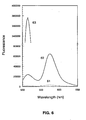
- Fig. 6 shows emission spectra for Probe 1.
- trace 61 there was almost no fluorescence at the fluorescein maximum (515 nm) and very little fluorescence at the TMR maximum (575 nm); that is, the probe was quite dark when closed.
- trace 62 In the presence of target, trace 62, there was an 18-fold increase in fluorescence at 575 nm.
- Fig. 6 also includes trace 63, the emission spectrum of the open, corresponding molecular beacon Probe 11. Because fluorescein emits so strongly as compared to other fluorophores, the vertical scale of Fig. 6 is broken.
- Figs. 7-14 unlike Fig. 6 , are normalized. The maximum emission when the probe is open is set at 1.0 on the vertical axis. The remaining peaks are fractions of that emission. Figs. 7-14 do not include a trace for a corresponding fluorescein-labeled molecular beacon probe. However, by reference to Fig. 6 it can be appreciated that a fluorescein-labeled molecular beacon probe, when open, has an emission intensity that would be from 3.0 to 6.0 on the vertical scale of Figs. 7-14 . Substantial harvester suppression can be discerned from the fact that no fluorescein peak is even twice the intensity of the emitter peak when any of the probes is open.
- Fig. 7 shows the emission spectra of Probe 2.
- Probe 2 differs from Probe 1 in the position of DABSYL when the Probe is closed.
- the 3' end of the probe was extended three nucleotides beyond the stem, moving the quencher to a point intermediate the two fluorophores on the other arm.
- trace 72 the spectrum is essentially the same as for Probe 1, as expected.
- trace 71 there was very little fluorescence at either 515 nm or 575 nm, although slightly more then for Probe 1.
- Probe 2 was quenched quite effectively and was nearly dark when closed. Effective quenching of Probe 2 is not due to FRET.
- Fig. 8 shows the emission spectra of Probe 3.
- Probe 3 is somewhat reversed from Probe 1 in that a 5' terminal TMR, the emitter, is directly opposite from DABSYL across the stem duplex when the probe is closed.
- the fluorescein is located inboard from the stem duplex. There is a six-nucleotide separation between the two fluorophores.
- Spectra 81 and 82 show that Probe 3 exhibited a reversal of color when it opened, which may be useful in particular applications. In the absence of target there was appreciable fluorescence at 515 nm (albeit substantially suppressed), more than double the fluorescence at 575 nm.
- Fig. 9 shows the emission spectra of Probe 4, which is similar to Probe 3 in the placement of the TMR and DABSYL moieties at the end of the stem.
- Fluorescein is located inboard from TMR, but is located in the stem and attached to a thymidine nucleotide.
- Probe 4 was better quenched than Probe 3 at 515 nm and had a lower fluorescence at 575 nm.
- the fluorescence intensity of Probe 4 did not decrease at 515 nm when it opened. It continued to have a modest, suppressed fluorescein emission. Because of its lower fluorescence at 575 nm when closed, as compared to Probe 3, its increase at 575 nm upon opening was three-fold better, namely, a factor of 16.0.
- Figs. 10-13 show the emission spectra of Probes 5-8, respectively. These constructions, when closed, all showed substantial quenching at 515 nm and low signal at 575 nm. When open each had an intensity increase at 575 nm greater than a factor of eight. When open, each had a fluorescein emission that, while appreciable, was substantially suppressed. All were dark when closed.
- Fig. 14 shows the emission spectra for Probe 9.
- Probe 9 was closed, fluorescein emission was very substantially suppressed.
- fluorescence at 575 nm increased by more than a factor of eight, but suppression of fluorescein was only marginally substantial.
- Probe 9 might be expected to have an emission spectrum when open that is very similar to the emission spectrum of Probe 8 when open, a difference was found in the relative intensities of the fluorescein and TMR peaks. Probe 9 had a smaller TMR peak relative to the fluorescein peak. This indicates that the efficiency of FRET between fluorescein and TMR was lower in Probe 9. Why then Probe 9 was better quenched is not clear. Perhaps the nature of the TMR was altered by its association with DABSYL in the closed configuration.
- Probe 12 was a conventional molecular beacon probe terminally labeled with Texas red and DABSYL. It had the same nucleotide sequence as Probe 11, a conventional molecular beacon probe terminally labeled with fluorescein and DABSYL.
- Probe 13 is a wavelength-shifting molecular beacon probe according to a preferred construction (similar to Probe 1). Either Probe 11, Probe 12 or Probe 13 was added at the beginning of a PCR reaction to a test sample and to a control. The test samples were initiated with target. A reaction initiated with no target served as the control in each case. Each amplification included cycles of PCR in an Applied Biosystems 7700 PRISM spectrofluorometric thermal cycler.
- the light source in the instrument was an argon laser having a wavelength of 488 nm. Emission of each conventional molecular beacon probe was measured during the annealing phase of each cycle in the emission range of its fluorophore, fluorescein (Probe 11) or Texas red (Probe 12). Emission of the wavelength-shifting molecular beacon probe, Probe 13, was measured in the emission range of the emitter fluorophore, Texas red. The results are presented in Figs. 2-4 and have been discussed earlier in this application.
- Wavelength-shifting probes according to this invention may be used for detection in situ and in vivo, that is, in living cells.
- the difference in wavelength between the excitation maximum of the harvester and the emission maximum of the emitter, the Stokes shift of the probes, is larger than conventional probes. This is particularly advantageous detection when a microscope is used to monitor nucleic acids in biological samples.
- microscopes typically utilize a broad wavelength light source rather than a precise, single-wavelength light source.
- biological samples have natural autofluorescence characterized by a small Stokes shift. Both of the foregoing characteristics contribute to background, which is avoided by wavelength-shifting probes. In certain assays probes may encounter degrading nucleases.
- Probe 1 illustrates a particular benefit of wavelength-shifting probes in such circumstances. If Probe 1 binds to target, red fluorescence results. However, if Probe 1 is degraded, green fluorescence results. One can see from Fig. 6 that degradation, by separating the harvester from the emitter, will restore fluorescein peak 63, which is stronger than TMR peak 62. Thus, one can see from the fluorescence whether or not degradation is occurring.
- Probe 13 for example, are cleaved by the polymerase during amplification, so long as cleavage does not occur between the harvester and the emitter. Where cleavage is found to occur during amplification, one could avoid using an embodiment in which either or both of the harvester and emitter moieties are in the probe-target hybrid, if that is found to lead to significant cleavage between the two of them.
- a multiplex assay is an assay utilizing at least two probes to test for at least two possible targets in the same sample. Multiple probes according to this invention for different targets can be used, and they can be used in a mixture with other probes.
- This example demonstrates the principle and also demonstrates allele discrimination.
- Wavelength-shifting molecular beacon Probe 13 was utilized as one probe.
- Probe 14 was synthesized for use as a second probe:
- Probe 14 is a conventional molecular beacon probe terminally labeled with fluorescein and DABSYL.
- the nucleotide sequence of Probe 14 differed from the nucleotide sequence of Probe 13 by a single nucleotide in the target complement sequence in the loop. A perfectly complementary target was synthesized for each probe.
- the perfect target for Probe 14 differed from the perfect target for Probe 13 by a single nucleotide.
- Both probes were added to four PCR reaction mixes: a negative control containing no target, a sample containing the target perfectly complementary to Probe 14, a sample containing the target perfectly complementary to Probe 13, and a sample containing both of the targets in equal amounts. In each instance where any target was present, the total amount of target or targets was the same, about 200,000 copies.
- Fig. 15 shows that there was no fluorescence in the absence of target: both probes were dark when not hybridized to target.
- Fig. 16 shows high fluorescence in the fluorescein range caused by perfectly matched target for Probe 14, the fluorescein-labeled conventional molecular beacon probe.
- Fig. 16 also shows no fluorescence in the Texas red range, demonstrating that Probe 13 was an allele-discriminating probe that was sensitive to a single base-pair mismatch.
- Fig. 17 shows moderately high fluorescence in the Texas red range caused by perfectly matched target for Probe 13, a wavelength-shifting molecular beacon probe.
- Fig. 16 shows high fluorescence in the fluorescein range caused by perfectly matched target for Probe 14, the fluorescein-labeled conventional molecular beacon probe.
- Fig. 16 also shows no fluorescence in the Texas red range, demonstrating that Probe 13 was an allele-discriminating probe that was sensitive to a single base-pair mismatch.
- FIG. 17 also shows no fluorescence in the fluorescein range, demonstrating that Probe 14 was an allele-discriminating probe that was sensitive to a single base-pair mismatch.
- Fig. 18 shows moderately high fluorescence in both ranges, which should occur because the amount of each target was one-half the total amount.
- the emission level in the Texas red range was 76% of the emission level in the fluorescein range. This is greatly improved compared to what would have occurred with a Texas red-labeled conventional molecular beacon probe stimulated at 488 nm, as Fig. 3 demonstrates, because the signal in the Texas red range would have been only 3% of the emission in the fluorescein range.
- a Texas red conventional molecular beacon is not generally suitable for multiplexing with a fluorescein-labeled conventional molecular beacon
- a wavelength-shifting molecular beacon with a Texas red emitter is quite satisfactory for such multiplexing.
- Probe 1 which is wavelength-shifting molecular beacon probe according to this invention having TMR as the emitter, was compared to several probes that were identical except for the emitter fluorophore. Three other fluorophores, tetrachlorfluorescein (TET), rhodamine 6G (RHD) and Texas red were utilized.
- TET tetrachlorfluorescein
- RHD rhodamine 6G
- Texas red were utilized.
- the fluorescence of the wavelength-shifting probes in the open conformation was a much higher percentage of the maximum achievable fluorescence intensity than the corresponding conventional molecular beacon probe would have achieved in the open conformation, if it has been stimulated at its maximum excitation wavelength. Whereas the conventional molecular beacon probes stimulated at 488 nm achieved one-third or less of that maximum, the wavelength-shifting probes achieved two-thirds or more.
- Fig. 19 Emission spectra for these probes are shown in Fig. 19 , which illustrates the impact of the instant invention as the fluorescence color of the emitter flurophore departs more and more from the stimulation wavelength of the instrument.
- the fluorescence intensities are normalized, that is, presented as a fraction of the fluorescence achieved by stimulating the emitter directly at its maximum excitation wavelength.
- Curves 191 and 192 are the normalized emission spectra for a TET-labeled conventional molecular beacon probe and a corresponding wavelength-shifting molecular beacon probe having TET as the emitter, respectively.
- Curves 193 and 194 are the normalized emission spectra for an RHD-labeled conventional molecular beacon probe and a corresponding wavelength-shifting molecular beacon probe having RHD as the emitter, respectively.
- Curves 195 and 196 are analogous curves using TMR, and curves 197 and 198 are analogous curves using Texas red. Fluorescein is the harvester in all cases.
- Curves for the conventional molecular beacon probes show several things.
- the emission maxima shift to progressively longer wavelengths as the label is changed from TET to RHD to TMR to Texas red.
- the shortest wavelength fluorophore, excitation at 488 nm produces only about one-third of the emission achievable by excitation at the maximum absorption wavelength for TET, which is 522 nm.
- the relative emission intensity falls off from one-third as the color of the fluorophore's fluorescence moves toward red, that is to longer wavelengths.
- TMR which has an emission maximum at 575 nm, only ten percent of the maximum achievable fluorescence intensity results.
- Curves for the wavelength-shifting probes according to this invention show several things.
- Each of these probes is suitable for use with unsophisticated, less expensive instruments.
- Third, the amount of improvement over the corresponding conventional molecular beacon probe is greatest for the longest wavelength emitters, TMR and, especially, Texas red. Such marked improvement is significant even for use with an expensive instrument having sophisticated detection.
- fluorescein is perhaps the brightest fluorophore, roughly five times as bright as Probe 1, a wavelength shifting probe according to this invention.
- the emission of a corresponding conventional fluorescein molecular beacon probe would be off the scale of Fig. 19 . Its intensity would be at least triple the maximum, "1.0", of the vertical axis.
- Fig. 20 compares the excitation spectrum of the Texas-red wavelength-shifting molecular beacon described above in this example and the corresponding Texas-red conventional molecular beacon probe.
- the spectrofluorometer was set to read emission at 610 nm, the maximum for Texas red, as the excitation wavelength was increased progressively from 400 to 600 nm.
- Curve 201 for the conventional probe shows strong emission when the excitation wavelength reached 590 nm, the excitation maximum for Texas red. At 488 nm excitation almost no emission occurs.
- curve 202 for the wavelength-shifting shows not only the peak at 590 nm, but also a second strong peak at 488 nm.
- the probe has twin excitation ranges, both of which lead to emission at the wavelength of 610 nm.
- a wavelength-shifting molecular beacon probe whose 3'arm sequence is Complementary to the target can serve as a primer.
- the loop of a hairpin primer it is not required that the loop of a hairpin primer be complementary to the target, because specificity can be obtained via an extension of the 3'arm, which creates a priming region.
- Conventional hairpin primers for PCR amplification can be synthesized and utilized, for example, according to the methods of Nazarenko et al. (1997). They can be modified according to the instant invention.
- Primer F described by Nazarenko et al. has the following sequence:
- 6-fluorescein was incorporated by using a 6-fluorescein phosphoramidite during synthesis.
- the T-DABCYL nucleotide was obtained by synthesizing with AminoModifier C6dT (Glen Research) and attaching DABCYL to the primary amino group. At least the first eighteen nucleotides from the 3' end were complementary to a target, a 172 base-pair segment of human prostate-specific antigen cDNA.
- a primer embodiment according to this invention is made by modifying the sequence of Primer F in several respects.
- a phosphoramidite of fluorescein that can be inserted in the middle of a DNA chain (Glen Research) is utilized to introduce the harvester moiety.
- Second, six thymidine residues are added past the harvester toward the 5' end.
- Third, a Texas red moiety is introduced via a sulphydryl functionality.
- the primer according to this invention has the following sequence, with portions forming a stem duplex underlined):
- this primer In the closed conformation, this primer has DABCYL opposite (with a single nucleotide offset) fluorescein across the stem duplex, with the Texas red on an extension.
- the construction is analogous to Probe 1 in Example 1.
- the DABCYL In the open conformation, the DABCYL is displaced from the fluorophores, and the two fluorophores (the harvester fluorescein and the emitter Texas red) are separated by seven nucleotides, a workable FRET separation.
- a PCR amplification of 30 cycles is carried out using this primer as one of the amplification primers.
- This construction functions as a wavelength-shifting hairpin primer. Wavelength-shifting hairpin primers of different colors can be multiplexed in amplification reactions. Nazarenko et al.
Landscapes
- Chemical & Material Sciences (AREA)
- Organic Chemistry (AREA)
- Life Sciences & Earth Sciences (AREA)
- Health & Medical Sciences (AREA)
- Wood Science & Technology (AREA)
- Proteomics, Peptides & Aminoacids (AREA)
- Zoology (AREA)
- Engineering & Computer Science (AREA)
- Immunology (AREA)
- General Engineering & Computer Science (AREA)
- Microbiology (AREA)
- Molecular Biology (AREA)
- Analytical Chemistry (AREA)
- Biotechnology (AREA)
- Physics & Mathematics (AREA)
- Biochemistry (AREA)
- Bioinformatics & Cheminformatics (AREA)
- Biophysics (AREA)
- General Health & Medical Sciences (AREA)
- Genetics & Genomics (AREA)
- Measuring Or Testing Involving Enzymes Or Micro-Organisms (AREA)
- Investigating, Analyzing Materials By Fluorescence Or Luminescence (AREA)
- Investigating Or Analysing Biological Materials (AREA)
- Investigating Or Analysing Materials By The Use Of Chemical Reactions (AREA)
- Sampling And Sample Adjustment (AREA)
- Electrochromic Elements, Electrophoresis, Or Variable Reflection Or Absorption Elements (AREA)
- Analysing Materials By The Use Of Radiation (AREA)
Claims (11)
- Ein fluoreszierend markiertes Haarnadel bildendes Oligonukleotid mit einer geschlossenen Konformation, welche eine einzelsträngige Schleife und einen Stammduplex einschließt, und einer offenen Konformation, welche den Stammduplex nicht einschließt, wobei die Hybridisierung der Schleife mit einer Zielsequenz bewirkt, dass das Oligonukleotid seine offene Konformation annimmt, wobei das Oligonukleotid enthält:a) einen fluoreszierenden Emitteranteil mit einem Anregungsspektrum und einem Emissionsspektrum, das eine maximale Emissionswellenlänge einschließt;b) einen fluoreszierenden Harvesteranteil mit einem Anregungsspektrum, das eine maximale Anregungswellenlänge einschließt, mit einem Emissionsspektrum, das mit dem Anregungsspektrum des Emitteranteils überlappt und eine maximale Emissionswellenlänge einschließt, wobei die Emission des Harvesteranteils an seiner maximalen Emissionswellenlänge eine erste Größe aufweist, wenn der Harvesteranteil nicht gequencht wird und an seiner maximalen Anregungswellenlänge angeregt wird; undc) einen Quencheranteil, welcher in der Lage ist, die Fluoreszenz von wenigstens einem von dem Emitteranteil und dem Harvesteranteil zu quenchen, z.B. DABCYL oder eine Variante von DABCYL,wobei, wenn das Oligonukleotid in der geschlossenen Konformation vorliegt, sich der Quencheranteil in einer quenchenden Beziehung zu wenigstens einem der Harvester- und Emitteranteile befindet und wobei, wenn bei der maximalen Anregungswellenlänge des Harvesteranteils angeregt wird, die Emission bei der maximalen Emissionswellenlänge des Harvesteranteils in Bezug auf die erste Größe im Wesentlichen unterdrückt wird und die Emission bei der maximalen Emissionswellenlänge des Emitteranteils eine zweite Größe aufweist, und wenn das Oligonukleotid in der offenen Konformation vorliegt, sich der Quencheranteil nicht in einer quenchenden Beziehung zu dem Harvester- oder dem Emitteranteil befindet, wobei, wenn bei der maximalen Anregungswellenlänge des Harvesteranteils angeregt wird, die Emission bei der maximalen Emissionswellenlänge des Harvesteranteils in Bezug auf die erste Größe im Wesentlichen unterdrückt wird, Energie von dem Harvesteranteil auf den Emitteranteil übertragen wird und die Emission bei der maximalen Emissionswellenlänge des Emitteranteils nachweisbar größer ist als die zweite Größe.
- Ein Oligonukleotid nach Anspruch 1, wobei, wenn das Oligonukleotid in der geschlossenen Konformation vorliegt, entweder:a) der Emitteranteil auf dem Oligonukleotid terminal zu dem Stammduplex lokalisiert ist, die Quencher- und Harvesteranteile auf dem Oligonukleotid in dem Stammduplex lokalisiert sind und die Harvester- und Quencheranteile sich in einer quenchenden Beziehung befinden; oderb) die Quencher- und Emitteranteile auf dem Oligonukleotid in dem Stammduplex in einer quenchenden Beziehung lokalisiert sind.
- Ein Oligonukleotid nach Anspruch 1, wobei, wenn das Oligonukleotid in seiner offenen Konformation vorliegt, die Emission bei der maximalen Emissionswellenlänge des Emitters wenigstens viermal so groß ist wie die zweite Größe.
- Ein Oligonukleotid nach irgendeinem der Ansprüche 1 bis 3, wobei entweder:a) ein Strang des Stammduplex zu dem Zielstrang komplementär ist,
wobei das Oligonukleotid in der Lage ist, als ein Primer für eine DNA-Polymerase zu dienen; oderb) das Oligonukleotid eine terminale Extension einschließt, die in der Lage ist, als eine Primingregion für eine DNA-Polymerase zu dienen, wenn das Oligonukleotid in seiner geschlossenen Konformation vorliegt; wobei gegebenenfalls der Emitteranteil auf der terminalen Extension lokalisiert ist und der Quencher- und Harvesteranteil auf dem Oligonukleotid in dem Stammduplex lokalisiert sind. - Ein Oligonukleotid nach irgendeinem der Ansprüche 1 bis 4, wobei wenigstens einer der Harvester- und Emitteranteile einen Teil der Nukleotidkette des Oligonukleotids bildet oder wenigstens einer der Harvester-, Emitter- und Quencheranteile über einen Alkyl-Linker an dem Oligonukleotid befestigt ist.
- Ein Oligonukleotid nach irgendeinem der Ansprüche 1 bis 5, wobei das Oligonukleotid wenigstens eines/eine aus der Gruppe von modifizierten Nukleotiden und modifizierten Verknüpfungen einschließt, wobei gegebenenfalls das Oligonukleotid Peptidnukleinsäure (PNA) umfasst oder 2'-O-Methylribonukleotide einschließt.
- Ein Reagenskit, umfassend Zutaten für eine Nukleinsäureamplifikation und einen Nachweis des amplifizierten Produkts, welches ein Oligonukleotid gemäß irgendeinem der Ansprüche 1 bis 6 und Anleitungen zur Durchführung der Amplifikationsreaktion einschließt;
wobei die Amplifikation gegebenenfalls ausgewählt wird aus der Gruppe, bestehend aus der Polymerasekettenreaktion (PCR), der Strangverdrängungsamplifikation (SDA), der transkriptionsvermittelten Amplifikation (TMA), der Ligasekettenreaktion (LCR), der Nukleinsäuresequenz-basierenden Amplifikation (NASBA), der Rolling Circle Amplifikation und der Amplifikation von RNA durch eine RNA-gesteuerte RNA-Polymerase. - Ein Kit gemäß Anspruch 7, wobei das Oligonukleotid so gestaltet ist, dass es mit einer perfekt komplementären Zielsequenz hybridisiert, aber nicht wesentlich mit einer Sequenz hybridisiert, welche sich davon durch wenigstens ein Nukleotid unterscheidet.
- Ein Amplifikationsassay, z.B. ein in situ- oder in vivo-Assay, umfassend das Zugeben zu einer Probe, welche einen Zielstrang enthalten könnte, der Reagenzien, um eine Amplifikationsreaktion und einen Nachweis durchzuführen, einschließlich eines Oligonukleotids gemäß irgendeinem der Ansprüche 1 bis 6, wobei die Amplifikationsreaktion ausgewählt wird aus der Gruppe, bestehend aus der Polymerasekettenreaktion (PCR), der Strangverdrängungsamplifikation (SDA), der transkriptionsvermittelten Amplifikation (TMA), der Ligasekettenreaktion (LCR), der Nukleinsäuresequenz-basierenden Amplifikation (NASBA), der Rolling Circle Amplifikation und der Amplifikation von RNA durch eine RNA-gesteuerte RNA-Polymerase, und das Nachweisen von Fluoreszenzemission von dem Emitteranteil des Oligonukleotids;
wobei der Assay gegebenenfalls weiterhin das Zugeben des Oligonukleotids zu einer Probe, welche den Zielstrang nicht enthält, und das Nachweisen einer Fluoreszenzemission von dem Emitteranteil des Oligonukleotids umfasst. - Ein Assay gemäß Anspruch 9, welcher weiterhin das Nachweisen einer Fluoreszenzemission von dem Harvesteranteil des Oligonukleotids umfasst.
- Ein Assay gemäß Anspruch 9 oder Anspruch 10, wobei das Oligonukleotid eine Sonde ist, welche 2'-O-Methylribonukleotide einschließt.
Applications Claiming Priority (3)
| Application Number | Priority Date | Filing Date | Title |
|---|---|---|---|
| US09/123,764 US6037130A (en) | 1998-07-28 | 1998-07-28 | Wavelength-shifting probes and primers and their use in assays and kits |
| US123764 | 1998-07-28 | ||
| PCT/US1999/017145 WO2000006778A1 (en) | 1998-07-28 | 1999-07-28 | Wavelength-shifting probes and primers |
Publications (3)
| Publication Number | Publication Date |
|---|---|
| EP1100971A1 EP1100971A1 (de) | 2001-05-23 |
| EP1100971A4 EP1100971A4 (de) | 2004-11-24 |
| EP1100971B1 true EP1100971B1 (de) | 2008-11-12 |
Family
ID=22410742
Family Applications (1)
| Application Number | Title | Priority Date | Filing Date |
|---|---|---|---|
| EP99937602A Expired - Lifetime EP1100971B1 (de) | 1998-07-28 | 1999-07-28 | Wellenlängen verschiebende proben und primer |
Country Status (8)
| Country | Link |
|---|---|
| US (1) | US6037130A (de) |
| EP (1) | EP1100971B1 (de) |
| JP (1) | JP3851088B2 (de) |
| AT (1) | ATE414170T1 (de) |
| AU (1) | AU763106B2 (de) |
| CA (1) | CA2336489C (de) |
| DE (1) | DE69939902D1 (de) |
| WO (1) | WO2000006778A1 (de) |
Families Citing this family (153)
| Publication number | Priority date | Publication date | Assignee | Title |
|---|---|---|---|---|
| US6576419B1 (en) * | 1993-07-23 | 2003-06-10 | University Of Utah Research Foundation | Assay procedure using fluorogenic tracers |
| US20070269799A9 (en) * | 1994-06-22 | 2007-11-22 | Zhang David Y | Nucleic acid amplification methods |
| US20020055101A1 (en) * | 1995-09-11 | 2002-05-09 | Michel G. Bergeron | Specific and universal probes and amplification primers to rapidly detect and identify common bacterial pathogens and antibiotic resistance genes from clinical specimens for routine diagnosis in microbiology laboratories |
| US5854033A (en) * | 1995-11-21 | 1998-12-29 | Yale University | Rolling circle replication reporter systems |
| DE69734576T2 (de) * | 1996-03-01 | 2006-08-03 | E.I. Dupont De Nemours And Co., Wilmington | Methode zur vervielfältigung und zum nachweis eines gewünschten nukleinsäurefragments |
| US20030049636A1 (en) * | 1999-05-03 | 2003-03-13 | Bergeron Michel G. | Species-specific, genus-specific and universal DNA probes and amplification primers to rapidly detect and identify common bacterial and fungal pathogens and associated antibiotic resistance genes from clinical specimens for diagnosis in microbiology laboratories |
| US20100267012A1 (en) * | 1997-11-04 | 2010-10-21 | Bergeron Michel G | Highly conserved genes and their use to generate probes and primers for detection of microorganisms |
| US7312302B2 (en) | 1997-02-20 | 2007-12-25 | Oncolmmunin, Inc. | Compositions for the detection of enzyme activity in biological samples and methods of use thereof |
| US6893868B2 (en) * | 1997-02-20 | 2005-05-17 | Onco Immunin, Inc. | Homo-doubly labeled compositions for the detection of enzyme activity in biological samples |
| US6037137A (en) | 1997-02-20 | 2000-03-14 | Oncoimmunin, Inc. | Fluorogenic peptides for the detection of protease activity |
| JP3981416B2 (ja) * | 1997-04-10 | 2007-09-26 | ユニバーシティ メディカル センター ナイメーヘン | Pca3タンパク質、pca3遺伝子、及びこれらの用途 |
| US20030165888A1 (en) * | 2001-07-18 | 2003-09-04 | Brown Bob D. | Oligonucleotide probes and primers comprising universal bases for diagnostic purposes |
| US6518017B1 (en) * | 1997-10-02 | 2003-02-11 | Oasis Biosciences Incorporated | Combinatorial antisense library |
| US7595189B2 (en) * | 1999-01-08 | 2009-09-29 | Applied Biosystems, Llc | Integrated optics fiber array |
| WO2000042222A2 (en) * | 1999-01-15 | 2000-07-20 | Gene Logic Inc. | Immobilized nucleic acid hybridization reagent and method |
| US6951722B2 (en) * | 1999-03-19 | 2005-10-04 | Takara Bio Inc. | Method for amplifying nucleic acid sequence |
| CA2365984A1 (en) * | 1999-04-08 | 2000-10-19 | Oasis Biosciences, Inc. | Antisense oligonucleotides comprising universal and/or degenerate bases |
| AU775563B2 (en) * | 1999-05-14 | 2004-08-05 | Brandeis University | Nucleic acid-based detection |
| US6680377B1 (en) * | 1999-05-14 | 2004-01-20 | Brandeis University | Nucleic acid-based detection |
| US6277607B1 (en) | 1999-05-24 | 2001-08-21 | Sanjay Tyagi | High specificity primers, amplification methods and kits |
| EP1190097A2 (de) * | 1999-06-22 | 2002-03-27 | Invitrogen Corporation | Verbesserte primer und methoden zum nachweis und zur unterscheidung von nukleinsäuren |
| US6830902B1 (en) * | 1999-07-02 | 2004-12-14 | Invitrogen Corporation | Compositions and methods for enhanced sensitivity and specificity of nucleic acid synthesis |
| US6613580B1 (en) | 1999-07-06 | 2003-09-02 | Caliper Technologies Corp. | Microfluidic systems and methods for determining modulator kinetics |
| US6692915B1 (en) * | 1999-07-22 | 2004-02-17 | Girish N. Nallur | Sequencing a polynucleotide on a generic chip |
| US6440706B1 (en) * | 1999-08-02 | 2002-08-27 | Johns Hopkins University | Digital amplification |
| JP2003527087A (ja) * | 1999-08-13 | 2003-09-16 | イェール・ユニバーシティ | バイナリーコード化配列タグ |
| US6586177B1 (en) * | 1999-09-08 | 2003-07-01 | Exact Sciences Corporation | Methods for disease detection |
| EP1246935B1 (de) * | 1999-09-28 | 2013-08-14 | Geneohm Sciences Canada Inc. | Konservierte gene und dessen benutzung für die herstellung von sonden und primern für mikroorganismen nachweis |
| PT1222266E (pt) * | 1999-09-29 | 2006-07-31 | Diagnocure Inc | Arn mensageiro de pca3 em tecidos benignos e malignos da prostata |
| WO2001031062A1 (en) * | 1999-10-22 | 2001-05-03 | The Public Health Research Institute Of The City Of New York, Inc. | Assays for short sequence variants |
| US6692965B1 (en) * | 1999-11-23 | 2004-02-17 | Chromocell Corporation | Isolation of living cells and preparation of cell lines based on detection and quantification of preselected cellular ribonucleic acid sequences |
| US6919174B1 (en) * | 1999-12-07 | 2005-07-19 | Exact Sciences Corporation | Methods for disease detection |
| DE60141205D1 (de) * | 2000-04-03 | 2010-03-18 | Cytyc Corp | Nachweis und typisierung des papillomavirus mittels pna-sonden |
| US6936443B2 (en) * | 2000-04-03 | 2005-08-30 | Cytyc Corporation | Detection and typing of human papillomavirus using PNA probes |
| US6548254B2 (en) | 2000-04-28 | 2003-04-15 | Gorilla Genomics, Inc. | Methods and compositions for the manufacture of molecular beacons |
| US7019129B1 (en) * | 2000-05-09 | 2006-03-28 | Biosearch Technologies, Inc. | Dark quenchers for donor-acceptor energy transfer |
| US6887664B2 (en) | 2000-06-06 | 2005-05-03 | Applera Corporation | Asynchronous primed PCR |
| US6323009B1 (en) * | 2000-06-28 | 2001-11-27 | Molecular Staging, Inc. | Multiply-primed amplification of nucleic acid sequences |
| GB2368809B (en) | 2000-09-15 | 2004-09-29 | Norchip As | Microfabricated reaction chamber system |
| CA2423729A1 (en) * | 2000-10-06 | 2002-04-11 | Nugen Technologies, Inc. | Methods and probes for detection and/or quantification of nucleic acid sequences |
| US20030152924A1 (en) * | 2000-12-19 | 2003-08-14 | Ullman Edwin F. | Strand displacement detection of target nucleic acid |
| US6573051B2 (en) * | 2001-03-09 | 2003-06-03 | Molecular Staging, Inc. | Open circle probes with intramolecular stem structures |
| FR2822234B1 (fr) * | 2001-03-14 | 2003-06-13 | Univ Pasteur | Procede de determination locale de parametres structuraux de molecules, notamment biochimiques ou pharmacologiques et utilisations dudit procede |
| ATE346958T1 (de) * | 2001-04-17 | 2006-12-15 | New York Blood Ct Inc | Universelles nachweissystem für mehrere varianten |
| US20040137458A1 (en) * | 2001-05-03 | 2004-07-15 | Christian Archambault | Molecular tag code for monitoring a product and process using same |
| US7291457B2 (en) | 2001-06-21 | 2007-11-06 | The Regents Of The University Of California | Electrochemical detection of mismatch nucleic acids |
| WO2003000933A1 (en) * | 2001-06-25 | 2003-01-03 | Georgia Tech Research Corporation | Dual resonance energy transfer nucleic acid probes |
| US7297494B2 (en) * | 2001-06-25 | 2007-11-20 | Georgia Tech Research Corporation | Activatable probes and methods for in vivo gene detection |
| GB2378245A (en) | 2001-08-03 | 2003-02-05 | Mats Nilsson | Nucleic acid amplification method |
| US20030082547A1 (en) | 2001-08-27 | 2003-05-01 | Ewing Gregory J. | Non-fluorescent quencher compounds and biomolecular assays |
| AU2002331777A1 (en) * | 2001-08-30 | 2003-03-18 | Spectral Genomics, Inc. | Arrays comprising pre-labeled biological molecules and methods for making and using these arrays |
| ATE420351T1 (de) * | 2001-08-31 | 2009-01-15 | Gen Probe Inc | Sonden mit affinitätsverschiebung zur quantifizierung von analytenpolynukleotiden |
| US7070933B2 (en) * | 2001-09-28 | 2006-07-04 | Gen-Probe Incorporated | Inversion probes |
| EP1442027A1 (de) * | 2001-10-09 | 2004-08-04 | 3-Dimensional Pharmaceuticals, Inc. | Substituierte diphenyloxazole, deren synthese und deren verwendung als fluoreszenzsonden |
| US20030165859A1 (en) * | 2001-10-23 | 2003-09-04 | Invitrogen Corporation | Primers and methods for the detection and discrimination of nucleic acids |
| CA2462505A1 (en) * | 2001-10-25 | 2003-05-15 | Gorilla Genomics, Inc. | Asymmetric pcr with nuclease-free polymerase or nuclease-resistant molecular beacons |
| GB0200526D0 (en) * | 2002-01-11 | 2002-02-27 | Science And Technology The | Methods |
| US7553619B2 (en) * | 2002-02-08 | 2009-06-30 | Qiagen Gmbh | Detection method using dissociated rolling circle amplification |
| WO2003089670A2 (en) * | 2002-04-22 | 2003-10-30 | Lawler Joseph F Jr | Reagents for monitoring nuclei acid amplification and methods of using same |
| US20050222403A1 (en) * | 2002-05-13 | 2005-10-06 | Lyles Frank E | Oligonucleotide probes for in vitro, in vivo and intra-cellular detection |
| WO2004000995A2 (en) * | 2002-05-22 | 2003-12-31 | Marshall University | Methods, probes, and accessory molecules for detecting single nucleotide polymorphisms |
| EP1509624A2 (de) * | 2002-05-31 | 2005-03-02 | Secretary, Department Of Atomic Energy | Methode für den nukleinsäurenachweis basierend auf met/fret wobei sich die fluorophoren gruppen auf komplementären strängen befinden |
| CA2433473A1 (en) * | 2002-07-23 | 2004-01-23 | F. Hoffmann-La Roche Ag | Fluorescent hybridization probes with reduced background |
| EP1546346A4 (de) * | 2002-07-23 | 2006-02-08 | Nanodiagnostics Inc | Embryonale stammzellen-marker und verwendungen davon |
| WO2007116408A2 (en) * | 2006-04-11 | 2007-10-18 | Nanodiagnostics Israel Ltd. | Pluripotent stem cells characterized by expression of germline specific genes |
| US7582470B2 (en) * | 2002-07-31 | 2009-09-01 | Gen-Probe Incorporated | Device for amplifying and detecting a target nucleic acid |
| CA2505603A1 (en) * | 2002-11-18 | 2004-06-03 | Genospectra, Inc. | Caged sensors, regulators and compounds and uses thereof |
| US20040121338A1 (en) * | 2002-12-19 | 2004-06-24 | Alsmadi Osama A. | Real-time detection of rolling circle amplification products |
| US9487823B2 (en) * | 2002-12-20 | 2016-11-08 | Qiagen Gmbh | Nucleic acid amplification |
| ATE386141T1 (de) * | 2002-12-20 | 2008-03-15 | Stratagene Inc | Zusammensetzungen und verfahren für den nachweis von polynukleotiden |
| US20040224325A1 (en) | 2002-12-20 | 2004-11-11 | Caliper Life Sciences, Inc. | Single molecule amplification and detection of DNA |
| US20050042639A1 (en) * | 2002-12-20 | 2005-02-24 | Caliper Life Sciences, Inc. | Single molecule amplification and detection of DNA length |
| US8275554B2 (en) * | 2002-12-20 | 2012-09-25 | Caliper Life Sciences, Inc. | System for differentiating the lengths of nucleic acids of interest in a sample |
| WO2004068112A2 (en) * | 2003-01-28 | 2004-08-12 | Gorilla Genomics, Inc. | Hairpin primer amplification |
| AU2004209578A1 (en) * | 2003-02-07 | 2004-08-19 | Diagnocure Inc. | Method to detect prostate cancer in a sample |
| CN100439515C (zh) * | 2003-03-03 | 2008-12-03 | 清华大学 | 一种核酸分析芯片实验室系统与应用 |
| US7238792B2 (en) | 2003-03-18 | 2007-07-03 | Washington State University Research Foundation | Foldable polymers as probes |
| US8043834B2 (en) * | 2003-03-31 | 2011-10-25 | Qiagen Gmbh | Universal reagents for rolling circle amplification and methods of use |
| US20040248103A1 (en) * | 2003-06-04 | 2004-12-09 | Feaver William John | Proximity-mediated rolling circle amplification |
| CN103898207B (zh) * | 2003-08-01 | 2016-09-14 | 戴诺生物技术有限公司 | 自杂交多重靶核酸探针及其使用方法 |
| KR20130082179A (ko) * | 2004-02-18 | 2013-07-18 | 크로모셀 코포레이션 | 신호 프로브를 이용하는 방법 및 물질 |
| CN101056991A (zh) * | 2004-04-20 | 2007-10-17 | 基因耐克生物医学制品有限公司 | 检测ncRNA的方法 |
| US7575863B2 (en) * | 2004-05-28 | 2009-08-18 | Applied Biosystems, Llc | Methods, compositions, and kits comprising linker probes for quantifying polynucleotides |
| WO2006010038A2 (en) * | 2004-07-08 | 2006-01-26 | Biosearch Technologies, Inc. | Inducible fluorescence assay |
| US7361469B2 (en) * | 2004-08-13 | 2008-04-22 | Stratagene California | Dual labeled fluorescent probes |
| WO2006034387A1 (en) * | 2004-09-21 | 2006-03-30 | Applera Corporation | TWO-COLOR REAL-TIME/END-POINT QUANTITATION OF MICRORNAS (miRNAs) |
| WO2006045009A2 (en) * | 2004-10-20 | 2006-04-27 | Stratagene California | Triplex probe compositions and methods for polynucleotide detection |
| US20060275792A1 (en) * | 2004-11-15 | 2006-12-07 | Lee Jun E | Enhancement of nucleic acid amplification using double-stranded DNA binding proteins |
| US20060105348A1 (en) * | 2004-11-15 | 2006-05-18 | Lee Jun E | Compositions and methods for the detection and discrimination of nucleic acids |
| US7842794B2 (en) | 2004-12-17 | 2010-11-30 | Roche Molecular Systems, Inc. | Reagents and methods for detecting Neisseria gonorrhoeae |
| CA2491067A1 (en) | 2004-12-24 | 2006-06-24 | Stichting Katholieke Universiteit | Mrna rations in urinary sediments and/or urine as a prognostic marker for prostate cancer |
| CA2597330A1 (en) * | 2005-02-09 | 2006-08-17 | Stratagene California | Key probe compositions and methods for polynucleotide detection |
| US8309303B2 (en) * | 2005-04-01 | 2012-11-13 | Qiagen Gmbh | Reverse transcription and amplification of RNA with simultaneous degradation of DNA |
| GB2424886A (en) * | 2005-04-04 | 2006-10-11 | Dxs Ltd | Polynucleotide primers against epidermal growth factor receptor and method of detecting gene mutations |
| US20070213293A1 (en) * | 2005-04-08 | 2007-09-13 | Nastech Pharmaceutical Company Inc. | Rnai therapeutic for respiratory virus infection |
| CA2603842A1 (en) | 2005-04-08 | 2006-10-19 | Nastech Pharmaceutical Company Inc. | Rnai therapeutic for respiratory virus infection |
| JP2008539730A (ja) * | 2005-05-02 | 2008-11-20 | ストラタジーン カリフォルニア | オリゴヌクレオチドのプローブ/プライマー組成物、及びポリヌクレオチドの検出方法 |
| US20070048758A1 (en) * | 2005-06-09 | 2007-03-01 | Epoch Biosciences, Inc. | Improved primer-based amplification methods |
| EP1762627A1 (de) | 2005-09-09 | 2007-03-14 | Qiagen GmbH | Verfahren zur Aktivierung einer Nukleinsäure für eine Polymerase-Reaktion |
| WO2007039301A2 (en) * | 2005-10-05 | 2007-04-12 | Roche Diagnostics Gmbh | Non-fluorescent energy transfer |
| KR20080084809A (ko) * | 2005-11-15 | 2008-09-19 | 게노이드 케이에프티. | 병원체를 검출하는 방법 |
| DE602006015227D1 (de) * | 2005-11-25 | 2010-08-12 | Hidex Oy | Homogener lumineszenz-bioassay |
| CA2631621C (en) | 2005-11-29 | 2019-08-06 | Cambridge Enterprise Limited | Markers for breast cancer including rs2981582 |
| MX2008011185A (es) * | 2006-03-01 | 2008-09-10 | Perlegen Sciences Inc | Marcadores para adiccion. |
| US20110143344A1 (en) * | 2006-03-01 | 2011-06-16 | The Washington University | Genetic polymorphisms and substance dependence |
| US8133984B2 (en) * | 2006-03-16 | 2012-03-13 | Pentabase Aps | Oligonucleotides comprising signalling pairs and hydrophobic nucleotides, stemless beacons, for detection of nucleic acids, methylation status and mutants of nucleic acids |
| RU2394915C2 (ru) * | 2006-03-24 | 2010-07-20 | Александр Борисович Четверин | Бесконтактные способы обнаружения молекулярных колоний, наборы реагентов и устройство для их осуществления |
| EP2511383B1 (de) | 2006-03-31 | 2013-12-25 | Columbia University | Binäre Sonden für Fluoreszenzanalyse von Nukleinsäuren |
| FR2900158A1 (fr) * | 2006-04-25 | 2007-10-26 | Biomerieux Sa | Nouvelle sonde de detection agissant par reconnaissance moleculaire |
| ES2641272T3 (es) | 2006-04-28 | 2017-11-08 | Children's Hospital Medical Center | Composiciones que comprenden proteínas o polipéptidos fusogénicos derivados de la prosaposina para aplicación en sistemas de suministro de fármacos transmembrana |
| DE102006020885A1 (de) * | 2006-05-05 | 2007-11-08 | Qiagen Gmbh | Einführung von Sequenzelementen in Nukleinsäuren |
| JP2009537152A (ja) | 2006-05-17 | 2009-10-29 | カリフォルニア インスティテュート オブ テクノロジー | 温度サイクルシステム |
| US7833716B2 (en) | 2006-06-06 | 2010-11-16 | Gen-Probe Incorporated | Tagged oligonucleotides and their use in nucleic acid amplification methods |
| US7972786B2 (en) * | 2006-07-07 | 2011-07-05 | Brandeis University | Detection and analysis of influenza virus |
| CN106566855B (zh) * | 2006-07-31 | 2021-11-09 | 苏州新海生物科技股份有限公司 | 使用可逆修饰寡核苷酸扩增核酸 |
| US9045522B2 (en) | 2006-07-31 | 2015-06-02 | Wanli Bi | Nucleic acid amplification using a reversibly modified oligonucleotide |
| EP3305915B1 (de) * | 2006-08-01 | 2022-01-26 | Applied Biosystems, LLC | Nachweis von analyten und nukleinsäuren |
| EP2056709A4 (de) | 2006-08-11 | 2013-05-01 | Univ New Jersey Med | Zweifachsensibilisator mit lumineszenzverbindungen, konjugaten und verwendung |
| FR2906532B1 (fr) * | 2006-09-28 | 2008-12-12 | Biomerieux Sa | Nouvel oligonucleotide marque |
| US9938641B2 (en) * | 2006-12-18 | 2018-04-10 | Fluidigm Corporation | Selection of aptamers based on geometry |
| FI20070163A0 (fi) | 2007-02-27 | 2007-02-27 | Hidex Oy | Parannettu homogeeninen luminesenssibiotesti |
| US8367899B2 (en) | 2007-12-31 | 2013-02-05 | E I Du Pont De Neumours And Company | Gray leaf spot tolerant maize and methods of production |
| WO2009148651A1 (en) * | 2008-02-28 | 2009-12-10 | Board Of Regents, The University Of Texas System | Compositions and methods for detection of small molecules using dyes derivatized with analyte responsive receptors in a chemiluminescent assay |
| EP2268608A4 (de) | 2008-04-01 | 2012-01-11 | Biosearch Technologies Inc | Sonden für stabilisierte nukleinsäure-dark-quencher-fluorophore |
| US20090270269A1 (en) * | 2008-04-28 | 2009-10-29 | Ashok Kumar | Nano-scale fluoro-biosensors exhibiting a low false alarm rate for rapid detection of biological contaminants |
| AU2009246363B2 (en) | 2008-05-13 | 2013-10-24 | Gen-Probe Incorporated | Inactivatable target capture oligomers for use in the selective hybridization and capture of target nucleic acid sequences |
| FR2933410B1 (fr) * | 2008-07-04 | 2010-08-20 | Biomerieux Sa | Nouvelle sonde de detection |
| WO2010011884A2 (en) * | 2008-07-25 | 2010-01-28 | University Of Florida Research Foundation, Inc. | Novel nucleic acid-based molecular probes |
| GB0912509D0 (en) | 2009-07-17 | 2009-08-26 | Norchip As | A microfabricated device for metering an analyte |
| WO2011011426A2 (en) | 2009-07-20 | 2011-01-27 | Bar Harbor Biotechnology, Inc. | Methods for assessing disease risk |
| CA2768391C (en) | 2009-07-21 | 2016-09-06 | Gen-Probe Incorporated | Methods and compositions for quantitative detection of nucleic acid sequences over an extended dynamic range |
| US8815515B1 (en) | 2009-09-24 | 2014-08-26 | University Of Utah Research Foundation | Methods, compositions, and kits for rare allele detection |
| US9221759B2 (en) | 2010-01-13 | 2015-12-29 | Rutgers, The State University Of New Jersey | Fluorophore chelated lanthanide luminescent probes with improved quantum efficiency |
| BR112012018616A2 (pt) | 2010-01-26 | 2017-01-10 | Pioneer Hi Bred Int | marcador de polinucleotídeo, polinucleotídeo isolado, polipeptídeo transportador abc isolado, planta, célula, semente, método para seleção de uma planta ou germoplasma de soja, método de introgressão de um alelo de resistência a herbicida em uma planta de soja, método para conferir tolerância ou tolerância melhorada a um ou mais herbicidas, método para controlar de modo seletivo plantas daninhas em um campo contendo uma cultura |
| JP5803923B2 (ja) * | 2010-09-01 | 2015-11-04 | 日本電気株式会社 | 標的物質の検出方法、それに用いるアプタマーセット並びにセンサ及び装置 |
| CA2822955A1 (en) | 2010-12-30 | 2012-07-05 | Pioneer Hi-Bred International, Inc. | Methods of identifying aphid resistant soybeans |
| EP3567121B1 (de) | 2011-01-17 | 2023-08-30 | Life Technologies Corporation | Arbeitsablauf zum nachweis von liganden mit nukleinsäuren |
| EP3733867A1 (de) * | 2011-01-17 | 2020-11-04 | Life Technologies Corporation | Enzymatische ligation von nukleinsäuren |
| JP6088487B2 (ja) | 2011-04-15 | 2017-03-01 | ベクトン・ディキンソン・アンド・カンパニーBecton, Dickinson And Company | 走査リアルタイムマイクロ流体熱サイクラーと同期熱サイクリング及び走査光学検出の方法 |
| WO2013067202A1 (en) | 2011-11-04 | 2013-05-10 | Handylab, Inc. | Polynucleotide sample preparation device |
| WO2013101750A1 (en) | 2011-12-29 | 2013-07-04 | Pioneer Hi-Bred International, Inc. | Methods of improving aphid resistance in soybeans |
| US9347105B2 (en) | 2012-06-15 | 2016-05-24 | Pioneer Hi Bred International Inc | Genetic loci associated with resistance of soybean to cyst nematode and methods of use |
| WO2014205127A2 (en) | 2013-06-18 | 2014-12-24 | New York University | Cellular factors involved in the cytotoxicity of staphylococcus aureus leukocidins: novel therapeutic targets |
| WO2015061548A1 (en) | 2013-10-25 | 2015-04-30 | Pioneer Hi-Bred International, Inc. | Stem canker tolerant soybeans and methods of use |
| WO2015066027A2 (en) * | 2013-10-28 | 2015-05-07 | Dots Devices, Inc. | Allergen detection |
| US10555467B2 (en) | 2015-01-29 | 2020-02-11 | Pioneer Hi-Bred International, Inc. | Polynucleotides and kits associated with soybean iron deficiency tolerance and methods of detection and breeding |
| US20160289734A1 (en) | 2015-04-03 | 2016-10-06 | University Of Massachusetts | Methods of using oligonucleotide-guided argonaute proteins |
| WO2017106447A1 (en) | 2015-12-18 | 2017-06-22 | Pioneer Hi-Bred International, Inc. | Genetic loci associated with reproductive growth phenotypes in soybean and methods of use |
| US11096344B2 (en) | 2016-02-05 | 2021-08-24 | Pioneer Hi-Bred International, Inc. | Genetic loci associated with brown stem rot resistance in soybean and methods of use |
| AR107591A1 (es) | 2016-02-11 | 2018-05-16 | Pioneer Hi Bred Int | Qtl asociados con la resistencia al vuelco del poroto de soja y métodos para identificarla |
| WO2017173279A1 (en) * | 2016-03-31 | 2017-10-05 | Arizona Board Of Regents On Behalf Of Arizona State University | Probes and methods for measuring tandem repeats |
| BR112018073236A2 (pt) | 2016-05-12 | 2019-02-19 | Pioneer Hi Bred Int | métodos para genotipagem agrupada simultânea |
| US11242568B2 (en) | 2017-12-29 | 2022-02-08 | City Of Hope | DNA methylation diagnostic test for breast cancer |
Family Cites Families (39)
| Publication number | Priority date | Publication date | Assignee | Title |
|---|---|---|---|---|
| US4261968A (en) * | 1979-05-10 | 1981-04-14 | Syva Company | Fluorescence quenching with immunological pairs in immunoassays |
| CA1190838A (en) * | 1981-07-17 | 1985-07-23 | Cavit Akin | Homogeneous nucleic acid hybridization diagnostics by non-radiative energy transfer |
| US5241060A (en) * | 1982-06-23 | 1993-08-31 | Enzo Diagnostics, Inc. | Base moiety-labeled detectable nucleatide |
| CA1223831A (en) * | 1982-06-23 | 1987-07-07 | Dean Engelhardt | Modified nucleotides, methods of preparing and utilizing and compositions containing the same |
| US5260433A (en) * | 1982-06-23 | 1993-11-09 | Enzo Diagnostics, Inc. | Saccharide specific binding system labeled nucleotides |
| US4766062A (en) * | 1984-05-07 | 1988-08-23 | Allied Corporation | Displacement polynucleotide assay method and polynucleotide complex reagent therefor |
| AU600900B2 (en) * | 1985-05-02 | 1990-08-30 | Genetics Institute Inc. | Process and nucleic acid construct for producing reagent complexes useful in determining target nucleotide sequences |
| US4822733A (en) * | 1985-05-28 | 1989-04-18 | Amoco Corporation | Lifetime-resolved assay procedures |
| US4725537A (en) * | 1985-09-19 | 1988-02-16 | Allied Corporation | Assay, reagent and kit employing nucleic acid strand displacement and restriction endonuclease cleavage |
| US4725536A (en) * | 1985-09-19 | 1988-02-16 | Genetics Institute, Inc. | Reagent polynucleotide complex with multiple target binding regions, and kit and methods |
| US4752566A (en) * | 1985-12-17 | 1988-06-21 | Genetics Institute, Inc. | Displacement polynucleotide method and reagent complex employing labeled probe polynucleotide |
| EP0232967B1 (de) * | 1986-01-10 | 1993-04-28 | Amoco Corporation | Kompetitiver homogener Test |
| US5082830A (en) * | 1988-02-26 | 1992-01-21 | Enzo Biochem, Inc. | End labeled nucleotide probe |
| US5118801A (en) * | 1988-09-30 | 1992-06-02 | The Public Health Research Institute | Nucleic acid process containing improved molecular switch |
| CA1339731C (en) * | 1988-10-12 | 1998-03-17 | Charles T. Caskey | Multiplex genomic dna amplification for deletion detection |
| US5312921A (en) * | 1990-03-14 | 1994-05-17 | Regents Of The University Of California | Dyes designed for high sensitivity detection of double-stranded DNA |
| US5401847A (en) * | 1990-03-14 | 1995-03-28 | Regents Of The University Of California | DNA complexes with dyes designed for energy transfer as fluorescent markers |
| DE69132535T2 (de) * | 1990-03-14 | 2001-06-07 | The Regents Of The University Of California, Oakland | Multichromophore fluoreszierende sonden |
| US5210015A (en) * | 1990-08-06 | 1993-05-11 | Hoffman-La Roche Inc. | Homogeneous assay system using the nuclease activity of a nucleic acid polymerase |
| JP3085756B2 (ja) * | 1991-10-30 | 2000-09-11 | 株式会社日立製作所 | 核酸の検出方法 |
| US5411875A (en) * | 1991-11-01 | 1995-05-02 | University Of Iowa Research Foundation | Method for retrieval of unknown flanking DNA sequence |
| EP1067134B1 (de) * | 1991-11-07 | 2004-07-28 | Nanotronics, Inc. | Hybridisierung von mit Chromophoren und Fluorophoren konjugierten Polynukleotiden zur Erzeugung eines Donor-Donor Energietransfersystems |
| US5348853A (en) * | 1991-12-16 | 1994-09-20 | Biotronics Corporation | Method for reducing non-specific priming in DNA amplification |
| US5332659A (en) * | 1992-04-09 | 1994-07-26 | The United States Of America As Represented By The Secretary Of The Navy | Light emission-or absorbance-based binding assays for polynucleic acids |
| EP0601889A2 (de) * | 1992-12-10 | 1994-06-15 | Maine Medical Center Research Institute | Nukleinsäure-Sonden |
| CA2129787A1 (en) * | 1993-08-27 | 1995-02-28 | Russell G. Higuchi | Monitoring multiple amplification reactions simultaneously and analyzing same |
| US5925517A (en) * | 1993-11-12 | 1999-07-20 | The Public Health Research Institute Of The City Of New York, Inc. | Detectably labeled dual conformation oligonucleotide probes, assays and kits |
| JP4071277B2 (ja) * | 1993-11-12 | 2008-04-02 | ピーエイチアールアイ・プロパティーズ・インコーポレーテッド | 核酸検出用ハイブリダイゼーションプローブ、共通ステム、方法およびキット |
| US5538848A (en) * | 1994-11-16 | 1996-07-23 | Applied Biosystems Division, Perkin-Elmer Corp. | Method for detecting nucleic acid amplification using self-quenching fluorescence probe |
| US5654419A (en) * | 1994-02-01 | 1997-08-05 | The Regents Of The University Of California | Fluorescent labels and their use in separations |
| US5622821A (en) * | 1994-06-29 | 1997-04-22 | The Regents Of The University Of California | Luminescent lanthanide chelates and methods of use |
| US5565554A (en) * | 1994-07-29 | 1996-10-15 | The Regents Of The University Of California | Dimeric fluorescent energy transfer dyes comprising asymmetric cyanine azole-indolenine chromophores |
| US5491063A (en) * | 1994-09-01 | 1996-02-13 | Hoffmann-La Roche Inc. | Methods for in-solution quenching of fluorescently labeled oligonucleotide probes |
| US5571673A (en) * | 1994-11-23 | 1996-11-05 | Hoffmann-La Roche Inc. | Methods for in-solution quenching of fluorescently labeled oligonucleotide probes |
| US5863504A (en) * | 1995-03-16 | 1999-01-26 | Bio-Rad Laboratories, Inc. | Fluorescence imaging instrument utilizing fish |
| US5728528A (en) * | 1995-09-20 | 1998-03-17 | The Regents Of The University Of California | Universal spacer/energy transfer dyes |
| WO1998010096A1 (en) * | 1996-04-12 | 1998-03-12 | The Public Health Research Institute Of The City Of New York, Inc. | Detection probes, kits and assays |
| EP0892808B1 (de) * | 1996-04-12 | 2008-05-14 | PHRI Properties, Inc. | Sonden, kits und assays |
| JP2002517506A (ja) * | 1998-06-12 | 2002-06-18 | インタージェン カンパニー | マルチ蛍光ヘアピンエネルギー転移オリゴヌクレオチド |
-
1998
- 1998-07-28 US US09/123,764 patent/US6037130A/en not_active Expired - Lifetime
-
1999
- 1999-07-28 DE DE69939902T patent/DE69939902D1/de not_active Expired - Lifetime
- 1999-07-28 CA CA2336489A patent/CA2336489C/en not_active Expired - Lifetime
- 1999-07-28 JP JP2000562560A patent/JP3851088B2/ja not_active Expired - Lifetime
- 1999-07-28 WO PCT/US1999/017145 patent/WO2000006778A1/en not_active Ceased
- 1999-07-28 AU AU52402/99A patent/AU763106B2/en not_active Expired
- 1999-07-28 AT AT99937602T patent/ATE414170T1/de not_active IP Right Cessation
- 1999-07-28 EP EP99937602A patent/EP1100971B1/de not_active Expired - Lifetime
Also Published As
| Publication number | Publication date |
|---|---|
| DE69939902D1 (de) | 2008-12-24 |
| WO2000006778A1 (en) | 2000-02-10 |
| EP1100971A1 (de) | 2001-05-23 |
| AU5240299A (en) | 2000-02-21 |
| CA2336489C (en) | 2011-05-03 |
| US6037130A (en) | 2000-03-14 |
| CA2336489A1 (en) | 2000-02-10 |
| ATE414170T1 (de) | 2008-11-15 |
| JP3851088B2 (ja) | 2006-11-29 |
| EP1100971A4 (de) | 2004-11-24 |
| JP2002521069A (ja) | 2002-07-16 |
| AU763106B2 (en) | 2003-07-10 |
Similar Documents
| Publication | Publication Date | Title |
|---|---|---|
| EP1100971B1 (de) | Wellenlängen verschiebende proben und primer | |
| CA2157200C (en) | Methods for in-solution quenching of fluorescently labeled oligonucleotide probes | |
| EP0878554B2 (de) | Nachweis von Nukleinsäuren durch Aufhebung der Fluoreszenz | |
| US5958700A (en) | Detection of nucleic acids by fluorescence quenching | |
| EP0892808B1 (de) | Sonden, kits und assays | |
| Tyagi et al. | Wavelength-shifting molecular beacons | |
| Lee et al. | Allelic discrimination by nick-translation PCR with fluorgenic probes | |
| US6130047A (en) | Detection of nucleic acids by fluorescence quenching | |
| US8940882B2 (en) | Multiple fluorophore detector system | |
| WO2005051967A2 (en) | Oligonucleotides labeled with a plurality of fluorophores | |
| US20160258001A1 (en) | Kits and Reaction Mixtures for Analyzing Single-Stranded Nucleic Acid Sequences | |
| WO1997029210A2 (en) | Fluorescence detection assay for homogeneous pcr hybridization systems | |
| Johansson | Choosing Reporter–Quencher Pairs for Efficient Quenching Through Formation of Intramolecular |
Legal Events
| Date | Code | Title | Description |
|---|---|---|---|
| PUAI | Public reference made under article 153(3) epc to a published international application that has entered the european phase |
Free format text: ORIGINAL CODE: 0009012 |
|
| 17P | Request for examination filed |
Effective date: 20010226 |
|
| AK | Designated contracting states |
Kind code of ref document: A1 Designated state(s): AT BE CH CY DE DK ES FI FR GB GR IE IT LI LU MC NL PT SE |
|
| A4 | Supplementary search report drawn up and despatched |
Effective date: 20041012 |
|
| 16A | New documents despatched to applicant after publication of the search report |
Effective date: 20041015 |
|
| 111Z | Information provided on other rights and legal means of execution |
Free format text: ATBECHCYDEDKESFIFRGBGRIEITLUMCNLPTSE Effective date: 20070105 |
|
| RAP1 | Party data changed (applicant data changed or rights of an application transferred) |
Owner name: PHRI PROPERTIES, INC. |
|
| GRAP | Despatch of communication of intention to grant a patent |
Free format text: ORIGINAL CODE: EPIDOSNIGR1 |
|
| GRAS | Grant fee paid |
Free format text: ORIGINAL CODE: EPIDOSNIGR3 |
|
| GRAA | (expected) grant |
Free format text: ORIGINAL CODE: 0009210 |
|
| AK | Designated contracting states |
Kind code of ref document: B1 Designated state(s): AT BE CH CY DE DK ES FI FR GB GR IE IT LI LU MC NL PT SE |
|
| REG | Reference to a national code |
Ref country code: GB Ref legal event code: FG4D |
|
| REG | Reference to a national code |
Ref country code: CH Ref legal event code: EP |
|
| REG | Reference to a national code |
Ref country code: IE Ref legal event code: FG4D |
|
| REF | Corresponds to: |
Ref document number: 69939902 Country of ref document: DE Date of ref document: 20081224 Kind code of ref document: P |
|
| PG25 | Lapsed in a contracting state [announced via postgrant information from national office to epo] |
Ref country code: ES Free format text: LAPSE BECAUSE OF FAILURE TO SUBMIT A TRANSLATION OF THE DESCRIPTION OR TO PAY THE FEE WITHIN THE PRESCRIBED TIME-LIMIT Effective date: 20090223 Ref country code: AT Free format text: LAPSE BECAUSE OF FAILURE TO SUBMIT A TRANSLATION OF THE DESCRIPTION OR TO PAY THE FEE WITHIN THE PRESCRIBED TIME-LIMIT Effective date: 20081112 |
|
| NLV1 | Nl: lapsed or annulled due to failure to fulfill the requirements of art. 29p and 29m of the patents act | ||
| PG25 | Lapsed in a contracting state [announced via postgrant information from national office to epo] |
Ref country code: NL Free format text: LAPSE BECAUSE OF FAILURE TO SUBMIT A TRANSLATION OF THE DESCRIPTION OR TO PAY THE FEE WITHIN THE PRESCRIBED TIME-LIMIT Effective date: 20081112 Ref country code: FI Free format text: LAPSE BECAUSE OF FAILURE TO SUBMIT A TRANSLATION OF THE DESCRIPTION OR TO PAY THE FEE WITHIN THE PRESCRIBED TIME-LIMIT Effective date: 20081112 |
|
| PG25 | Lapsed in a contracting state [announced via postgrant information from national office to epo] |
Ref country code: DK Free format text: LAPSE BECAUSE OF FAILURE TO SUBMIT A TRANSLATION OF THE DESCRIPTION OR TO PAY THE FEE WITHIN THE PRESCRIBED TIME-LIMIT Effective date: 20081112 Ref country code: BE Free format text: LAPSE BECAUSE OF FAILURE TO SUBMIT A TRANSLATION OF THE DESCRIPTION OR TO PAY THE FEE WITHIN THE PRESCRIBED TIME-LIMIT Effective date: 20081112 |
|
| PG25 | Lapsed in a contracting state [announced via postgrant information from national office to epo] |
Ref country code: SE Free format text: LAPSE BECAUSE OF FAILURE TO SUBMIT A TRANSLATION OF THE DESCRIPTION OR TO PAY THE FEE WITHIN THE PRESCRIBED TIME-LIMIT Effective date: 20090212 Ref country code: PT Free format text: LAPSE BECAUSE OF FAILURE TO SUBMIT A TRANSLATION OF THE DESCRIPTION OR TO PAY THE FEE WITHIN THE PRESCRIBED TIME-LIMIT Effective date: 20090413 |
|
| PLBE | No opposition filed within time limit |
Free format text: ORIGINAL CODE: 0009261 |
|
| STAA | Information on the status of an ep patent application or granted ep patent |
Free format text: STATUS: NO OPPOSITION FILED WITHIN TIME LIMIT |
|
| 26N | No opposition filed |
Effective date: 20090813 |
|
| PG25 | Lapsed in a contracting state [announced via postgrant information from national office to epo] |
Ref country code: MC Free format text: LAPSE BECAUSE OF NON-PAYMENT OF DUE FEES Effective date: 20090731 |
|
| REG | Reference to a national code |
Ref country code: CH Ref legal event code: PL |
|
| PG25 | Lapsed in a contracting state [announced via postgrant information from national office to epo] |
Ref country code: LI Free format text: LAPSE BECAUSE OF NON-PAYMENT OF DUE FEES Effective date: 20090731 Ref country code: CH Free format text: LAPSE BECAUSE OF NON-PAYMENT OF DUE FEES Effective date: 20090731 |
|
| PG25 | Lapsed in a contracting state [announced via postgrant information from national office to epo] |
Ref country code: IE Free format text: LAPSE BECAUSE OF NON-PAYMENT OF DUE FEES Effective date: 20090728 |
|
| PG25 | Lapsed in a contracting state [announced via postgrant information from national office to epo] |
Ref country code: GR Free format text: LAPSE BECAUSE OF FAILURE TO SUBMIT A TRANSLATION OF THE DESCRIPTION OR TO PAY THE FEE WITHIN THE PRESCRIBED TIME-LIMIT Effective date: 20090213 |
|
| PG25 | Lapsed in a contracting state [announced via postgrant information from national office to epo] |
Ref country code: LU Free format text: LAPSE BECAUSE OF NON-PAYMENT OF DUE FEES Effective date: 20090728 |
|
| PG25 | Lapsed in a contracting state [announced via postgrant information from national office to epo] |
Ref country code: CY Free format text: LAPSE BECAUSE OF FAILURE TO SUBMIT A TRANSLATION OF THE DESCRIPTION OR TO PAY THE FEE WITHIN THE PRESCRIBED TIME-LIMIT Effective date: 20081112 |
|
| REG | Reference to a national code |
Ref country code: FR Ref legal event code: PLFP Year of fee payment: 18 |
|
| REG | Reference to a national code |
Ref country code: FR Ref legal event code: PLFP Year of fee payment: 19 |
|
| REG | Reference to a national code |
Ref country code: FR Ref legal event code: PLFP Year of fee payment: 20 |
|
| PGFP | Annual fee paid to national office [announced via postgrant information from national office to epo] |
Ref country code: IT Payment date: 20180719 Year of fee payment: 20 Ref country code: FR Payment date: 20180726 Year of fee payment: 20 Ref country code: DE Payment date: 20180727 Year of fee payment: 20 |
|
| PGFP | Annual fee paid to national office [announced via postgrant information from national office to epo] |
Ref country code: GB Payment date: 20180727 Year of fee payment: 20 |
|
| REG | Reference to a national code |
Ref country code: DE Ref legal event code: R071 Ref document number: 69939902 Country of ref document: DE |
|
| REG | Reference to a national code |
Ref country code: GB Ref legal event code: PE20 Expiry date: 20190727 |
|
| PG25 | Lapsed in a contracting state [announced via postgrant information from national office to epo] |
Ref country code: GB Free format text: LAPSE BECAUSE OF EXPIRATION OF PROTECTION Effective date: 20190727 |