EP1104097A2 - Méthode d'ajustement de la fréquence centrale d'un filtre équilibré et de plusieurs filtres équilibrés - Google Patents
Méthode d'ajustement de la fréquence centrale d'un filtre équilibré et de plusieurs filtres équilibrés Download PDFInfo
- Publication number
- EP1104097A2 EP1104097A2 EP00660210A EP00660210A EP1104097A2 EP 1104097 A2 EP1104097 A2 EP 1104097A2 EP 00660210 A EP00660210 A EP 00660210A EP 00660210 A EP00660210 A EP 00660210A EP 1104097 A2 EP1104097 A2 EP 1104097A2
- Authority
- EP
- European Patent Office
- Prior art keywords
- balanced
- center frequency
- balanced filter
- impedance
- filter
- Prior art date
- Legal status (The legal status is an assumption and is not a legal conclusion. Google has not performed a legal analysis and makes no representation as to the accuracy of the status listed.)
- Withdrawn
Links
- 238000000034 method Methods 0.000 title claims abstract description 43
- 239000000758 substrate Substances 0.000 claims abstract description 50
- 239000003990 capacitor Substances 0.000 claims description 5
- 238000000151 deposition Methods 0.000 claims description 5
- 238000012545 processing Methods 0.000 claims description 2
- 230000004044 response Effects 0.000 description 46
- XLOMVQKBTHCTTD-UHFFFAOYSA-N Zinc monoxide Chemical compound [Zn]=O XLOMVQKBTHCTTD-UHFFFAOYSA-N 0.000 description 23
- 239000000463 material Substances 0.000 description 23
- 235000012431 wafers Nutrition 0.000 description 19
- 230000008859 change Effects 0.000 description 14
- 239000011787 zinc oxide Substances 0.000 description 11
- 238000010897 surface acoustic wave method Methods 0.000 description 10
- 238000004519 manufacturing process Methods 0.000 description 9
- 230000007423 decrease Effects 0.000 description 8
- 230000000694 effects Effects 0.000 description 8
- 239000012528 membrane Substances 0.000 description 7
- 239000010409 thin film Substances 0.000 description 7
- VYPSYNLAJGMNEJ-UHFFFAOYSA-N Silicium dioxide Chemical compound O=[Si]=O VYPSYNLAJGMNEJ-UHFFFAOYSA-N 0.000 description 6
- 238000013461 design Methods 0.000 description 6
- 230000003247 decreasing effect Effects 0.000 description 5
- 238000004088 simulation Methods 0.000 description 5
- JBRZTFJDHDCESZ-UHFFFAOYSA-N AsGa Chemical compound [As]#[Ga] JBRZTFJDHDCESZ-UHFFFAOYSA-N 0.000 description 4
- XUIMIQQOPSSXEZ-UHFFFAOYSA-N Silicon Chemical compound [Si] XUIMIQQOPSSXEZ-UHFFFAOYSA-N 0.000 description 4
- 230000008901 benefit Effects 0.000 description 4
- 239000000919 ceramic Substances 0.000 description 4
- 239000010931 gold Substances 0.000 description 4
- 229920000642 polymer Polymers 0.000 description 4
- 229910052710 silicon Inorganic materials 0.000 description 4
- 239000010703 silicon Substances 0.000 description 4
- 238000004544 sputter deposition Methods 0.000 description 4
- PXHVJJICTQNCMI-UHFFFAOYSA-N Nickel Chemical compound [Ni] PXHVJJICTQNCMI-UHFFFAOYSA-N 0.000 description 3
- 230000008021 deposition Effects 0.000 description 3
- 238000011161 development Methods 0.000 description 3
- 238000005530 etching Methods 0.000 description 3
- 238000002955 isolation Methods 0.000 description 3
- 229910052751 metal Inorganic materials 0.000 description 3
- 239000002184 metal Substances 0.000 description 3
- 238000012986 modification Methods 0.000 description 3
- 230000004048 modification Effects 0.000 description 3
- 239000000377 silicon dioxide Substances 0.000 description 3
- CFAKWWQIUFSQFU-UHFFFAOYSA-N 2-hydroxy-3-methylcyclopent-2-en-1-one Chemical compound CC1=C(O)C(=O)CC1 CFAKWWQIUFSQFU-UHFFFAOYSA-N 0.000 description 2
- 229910001218 Gallium arsenide Inorganic materials 0.000 description 2
- ZOKXTWBITQBERF-UHFFFAOYSA-N Molybdenum Chemical compound [Mo] ZOKXTWBITQBERF-UHFFFAOYSA-N 0.000 description 2
- RTAQQCXQSZGOHL-UHFFFAOYSA-N Titanium Chemical compound [Ti] RTAQQCXQSZGOHL-UHFFFAOYSA-N 0.000 description 2
- 229910052782 aluminium Inorganic materials 0.000 description 2
- XAGFODPZIPBFFR-UHFFFAOYSA-N aluminium Chemical compound [Al] XAGFODPZIPBFFR-UHFFFAOYSA-N 0.000 description 2
- 239000002131 composite material Substances 0.000 description 2
- 239000010949 copper Substances 0.000 description 2
- 230000001419 dependent effect Effects 0.000 description 2
- 239000011521 glass Substances 0.000 description 2
- PCHJSUWPFVWCPO-UHFFFAOYSA-N gold Chemical compound [Au] PCHJSUWPFVWCPO-UHFFFAOYSA-N 0.000 description 2
- 229910052737 gold Inorganic materials 0.000 description 2
- 238000005259 measurement Methods 0.000 description 2
- 229910052750 molybdenum Inorganic materials 0.000 description 2
- 239000011733 molybdenum Substances 0.000 description 2
- 239000010955 niobium Substances 0.000 description 2
- 229910021420 polycrystalline silicon Inorganic materials 0.000 description 2
- 239000002861 polymer material Substances 0.000 description 2
- 239000007787 solid Substances 0.000 description 2
- 230000002277 temperature effect Effects 0.000 description 2
- 239000010936 titanium Substances 0.000 description 2
- WFKWXMTUELFFGS-UHFFFAOYSA-N tungsten Chemical compound [W] WFKWXMTUELFFGS-UHFFFAOYSA-N 0.000 description 2
- 229910052721 tungsten Inorganic materials 0.000 description 2
- 239000010937 tungsten Substances 0.000 description 2
- 239000001837 2-hydroxy-3-methylcyclopent-2-en-1-one Substances 0.000 description 1
- RYGMFSIKBFXOCR-UHFFFAOYSA-N Copper Chemical compound [Cu] RYGMFSIKBFXOCR-UHFFFAOYSA-N 0.000 description 1
- 229910020289 Pb(ZrxTi1-x)O3 Inorganic materials 0.000 description 1
- 229910020273 Pb(ZrxTi1−x)O3 Inorganic materials 0.000 description 1
- 229910003781 PbTiO3 Inorganic materials 0.000 description 1
- 239000004642 Polyimide Substances 0.000 description 1
- BQCADISMDOOEFD-UHFFFAOYSA-N Silver Chemical compound [Ag] BQCADISMDOOEFD-UHFFFAOYSA-N 0.000 description 1
- 230000001154 acute effect Effects 0.000 description 1
- PNEYBMLMFCGWSK-UHFFFAOYSA-N aluminium oxide Inorganic materials [O-2].[O-2].[O-2].[Al+3].[Al+3] PNEYBMLMFCGWSK-UHFFFAOYSA-N 0.000 description 1
- 239000003575 carbonaceous material Substances 0.000 description 1
- 230000015556 catabolic process Effects 0.000 description 1
- 229910010293 ceramic material Inorganic materials 0.000 description 1
- 238000005229 chemical vapour deposition Methods 0.000 description 1
- 238000004891 communication Methods 0.000 description 1
- 239000004020 conductor Substances 0.000 description 1
- 229910052802 copper Inorganic materials 0.000 description 1
- 239000013078 crystal Substances 0.000 description 1
- 238000006731 degradation reaction Methods 0.000 description 1
- 230000000593 degrading effect Effects 0.000 description 1
- 238000005137 deposition process Methods 0.000 description 1
- 238000012938 design process Methods 0.000 description 1
- 238000010586 diagram Methods 0.000 description 1
- 239000010432 diamond Substances 0.000 description 1
- 238000005516 engineering process Methods 0.000 description 1
- 238000003780 insertion Methods 0.000 description 1
- 230000037431 insertion Effects 0.000 description 1
- 229910052746 lanthanum Inorganic materials 0.000 description 1
- FZLIPJUXYLNCLC-UHFFFAOYSA-N lanthanum atom Chemical compound [La] FZLIPJUXYLNCLC-UHFFFAOYSA-N 0.000 description 1
- 238000010295 mobile communication Methods 0.000 description 1
- 229910052759 nickel Inorganic materials 0.000 description 1
- 229910052758 niobium Inorganic materials 0.000 description 1
- GUCVJGMIXFAOAE-UHFFFAOYSA-N niobium atom Chemical compound [Nb] GUCVJGMIXFAOAE-UHFFFAOYSA-N 0.000 description 1
- 238000005457 optimization Methods 0.000 description 1
- 229920001721 polyimide Polymers 0.000 description 1
- 229920005591 polysilicon Polymers 0.000 description 1
- 239000004065 semiconductor Substances 0.000 description 1
- 235000012239 silicon dioxide Nutrition 0.000 description 1
- 239000002210 silicon-based material Substances 0.000 description 1
- 229910052709 silver Inorganic materials 0.000 description 1
- 239000004332 silver Substances 0.000 description 1
- 230000003068 static effect Effects 0.000 description 1
- 230000002459 sustained effect Effects 0.000 description 1
- 229910052715 tantalum Inorganic materials 0.000 description 1
- GUVRBAGPIYLISA-UHFFFAOYSA-N tantalum atom Chemical compound [Ta] GUVRBAGPIYLISA-UHFFFAOYSA-N 0.000 description 1
- 229910052719 titanium Inorganic materials 0.000 description 1
- 238000007738 vacuum evaporation Methods 0.000 description 1
Images





Classifications
-
- H—ELECTRICITY
- H03—ELECTRONIC CIRCUITRY
- H03H—IMPEDANCE NETWORKS, e.g. RESONANT CIRCUITS; RESONATORS
- H03H3/00—Apparatus or processes specially adapted for the manufacture of impedance networks, resonating circuits, resonators
- H03H3/007—Apparatus or processes specially adapted for the manufacture of impedance networks, resonating circuits, resonators for the manufacture of electromechanical resonators or networks
- H03H3/02—Apparatus or processes specially adapted for the manufacture of impedance networks, resonating circuits, resonators for the manufacture of electromechanical resonators or networks for the manufacture of piezoelectric or electrostrictive resonators or networks
- H03H3/04—Apparatus or processes specially adapted for the manufacture of impedance networks, resonating circuits, resonators for the manufacture of electromechanical resonators or networks for the manufacture of piezoelectric or electrostrictive resonators or networks for obtaining desired frequency or temperature coefficient
-
- H—ELECTRICITY
- H03—ELECTRONIC CIRCUITRY
- H03H—IMPEDANCE NETWORKS, e.g. RESONANT CIRCUITS; RESONATORS
- H03H9/00—Networks comprising electromechanical or electro-acoustic elements; Electromechanical resonators
- H03H9/0023—Networks for transforming balanced signals into unbalanced signals and vice versa, e.g. baluns, or networks having balanced input and output
- H03H9/0095—Networks for transforming balanced signals into unbalanced signals and vice versa, e.g. baluns, or networks having balanced input and output using bulk acoustic wave devices
Definitions
- the invention relates in general to resonator structures of radio communication apparatus, especially bulk acoustic wave filter structures.
- the invention is directed to balanced radio frequency filter structures.
- SAW surface acoustic wave
- Ceramic filters typically have a structure similar to that shown in Figure 1.
- SAW resonators utilize surface acoustic vibration modes of a solid surface, in which modes the vibration is confined to the surface of the solid, decaying quickly away from the surface.
- a SAW resonator typically comprises a piezoelectric layer 100, and two electrodes 122, 124.
- Various resonator structures such as filters are produced with SAW resonators.
- a SAW resonator has the advantage of having a very small size, but unfortunately cannot withstand high power levels.
- thin film bulk acoustic wave resonators on semiconductor wafers, such as silicon (Si) or gallium arsenide (GaAs) wafers.
- semiconductor wafers such as silicon (Si) or gallium arsenide (GaAs) wafers.
- Si silicon
- GaAs gallium arsenide
- Figure 2 shows one example of a bulk acoustic wave resonator having a bridge structure.
- the structure comprises a membrane 130 deposited on a substrate 200.
- the resonator further comprises a bottom electrode 110 on the membrane, a piezoelectric layer 100, and a top electrode 120.
- a gap 210 is created between the membrane and the substrate by etching away some of the substrate from the top side.
- the gap serves as an acoustic isolator, essentially isolating the vibrating resonator structure from the substrate.
- BAW resonators have some advantages as compared to SAW resonators. For example, BAW structures have a better tolerance of high power levels.
- Bulk acoustic wave resonators are typically fabricated on silicon (Si), gallium arsenide (GaAs), glass, or ceramic substrates.
- One further ceramic substrate type used is alumina.
- the BAW devices are typically manufactured using various thin film manufacturing techniques, such as for example sputtering, vacuum evaporation or chemical vapor deposition.
- BAW devices utilize a piezoelectric thin film layer for generating the acoustic bulk waves.
- the resonance frequencies of typical BAW devices range from 0.5 GHz to 5 GHz, depending on the size and materials of the device.
- BAW resonators exhibit the typical series and parallel resonances of crystal resonators. The resonance frequencies are determined mainly by the material of the resonator and the dimensions of the layers of the resonator.
- a typical BAW resonator consists of three basic elements:
- the piezoelectric layer may be for example, ZnO, AlN, ZnS or any other piezoelectric material that can be fabricated as a thin film.
- ferroelectric ceramics can be used as the piezoelectric material.
- PbTiO 3 and Pb(Zr x Ti 1-x )O 3 and other members of the so called lead lanthanum zirconate titanate family can be used.
- the material used to form the electrode layers is an electrically conductive material having a high acoustic impedance.
- the electrodes may be comprised of for example any suitable metal, such as tungsten (W), aluminum (Al), copper (Cu), molybdenum (Mo), nickel (Ni), titanium (Ti), niobium (Nb), silver (Ag), gold (Au), and tantalum (Ta).
- the substrate is typically composed of for example Si, SiO 2 , GaAs, glass, or ceramic materials.
- the acoustical isolation can be produced with for example the following techniques:
- the acoustically reflecting surfaces are the air interfaces below and above the devices.
- the bridge structure is typically manufactured using a sacrificial layer, which is etched away to produce a free-standing structure. Use of a sacrificial layer makes it possible to use a wide variety of substrate materials, since the substrate does not need to be modified very much, as in the via-hole structure.
- a bridge structure can also be produced using an etch pit structure, in which case a pit has to be etched in the substrate or the material layer below the BAW resonator in order to produce the free standing bridge structure.
- Figure 3 illustrates one example of various ways of producing a bridge structure.
- a sacrificial layer 135 is deposited and patterned first.
- the rest of the BAW structure is deposited and patterned partly on top of the sacrificial layer 135.
- the sacrificial layer 135 is etched away.
- Figure 3 shows also the substrate 200, a membrane layer 130, the bottom electrode 110, the piezoelectric layer 100, and the top electrode 120.
- the sacrificial layer can be realized using for example a metal or a polymer as the material.
- the resonator is acoustically isolated from the substrate by etching away the substrate from under a major portion of the BAW resonator structure.
- Figure 4 illustrates a via-hole structure of a BAW resonator.
- Figure 4 shows the substrate 200, a membrane layer 130, the bottom electrode 110, the piezoelectric layer 100, and the top electrode 120.
- a via-hole 211 has been etched through the whole substrate. Due to the etching required, via-hole structures are commonly realized only with Si or GaAs substrates.
- a further way to isolate a BAW resonator from the substrate is by using an acoustical mirror structure.
- the acoustical mirror structure performs the isolation by reflecting the acoustic wave back to the resonator structure.
- An acoustical mirror typically comprise several layers having a thickness of one quarter wavelength at the center frequency, alternating layers having differing acoustical impedances.
- the number of layers in an acoustic mirror is typically an odd integer, typically ranging from three to nine.
- the ratio of acoustic impedance of two consecutive layers should be large in order to present as low acoustic impedance as possible to the BAW resonator, instead of the relatively high impedance of the substrate material.
- the mirror layers are chosen so that as high acoustic impedance as possible is presented to the resonator.
- the material of the high impedance layers can be for example gold (Au), molybdenum (Mo), or tungsten (W)
- the material of the low impedance layers can be for example silicon (Si), polysilicon (poly-Si), silicon dioxide (SiO 2 ), aluminum (Al), or a polymer. Since in structures utilizing an acoustical mirror structure, the resonator is isolated from the substrate and the substrate is not modified very much, a wide variety of materials can be used as a substrate.
- the polymer layer may be comprised of any polymer material having a low loss characteristic and a low acoustic impedance.
- the polymer material is such that it can withstand temperatures of at least 350 °C, since relatively high temperatures may be achieved during deposition of other layers of the acoustical mirror structure and other structures.
- the polymer layer may be comprised of, by example, polyimide, cyclotene, a carbon-based material, a silicon-based material or any other suitable material.
- Figure 5 shows an example of a BAW resonator on top of an acoustical mirror structure.
- Figure 5 shows the substrate 200, the bottom electrode 110, the piezoelectric layer 100, and the top electrode 120.
- the acoustical mirror structure 150 comprises in this example three layers 150a, 150b. Two of the layers 150a are formed of a first material, and the third layer 150b in between the two layers is formed from a second material.
- the first and second materials have different acoustical impedances as described previously. The order of the materials can be varied. For example, the material with a high acoustical impedance can be in the middle and the material with a low acoustical impedance on both sides of the middle material, or vice versa.
- the bottom electrode may also be used as one layer of the acoustical mirror.
- FIG. 6 shows a further example of a BAW resonator structure.
- the BAW resonator illustrated in Figure 6 is a stacked resonator structure having two piezoelectric layers 100.
- a stacked structure requires a middle electrode 115, which is connected to ground potential.
- Figure 6 further shows the membrane layer 130, the substrate 200 and the etch pit 210 isolating the structure from the substrate.
- FIG. 7a shows a schematic diagram of a lattice filter structure constructed using bulk acoustic wave resonators.
- a lattice filter consisting of BAW resonators is usually designed so that two of the four resonators i.e. resonators A have higher resonance frequencies than the resonators B.
- the series resonance of resonators A is at or close to the parallel resonance frequency of the resonators B, which is the center frequency of the filter.
- the difference in the resonance frequencies can be achieved for example in the same way as typically done in BAW filters having a ladder structure, namely by increasing the thickness of one of the layers of the B resonators or depositing an additional layer on top of the B resonators.
- the additional layer can be either a metal or a dielectric layer.
- An example of the layout of such a lattice structure is shown in Figure 7b.
- the size of the resonators is determined by the desired impedance level of the filter.
- the impedance level is determined mainly by the inherent shunt capacitance C 0 of the resonators, i.e. the capacitance between the top and bottom electrodes.
- two of the four resonators of the lattice structure may have a larger area than the other two.
- the resonators having a large area can be either the resonators marked with B in Figure 7a or the resonators marked with A in Figure 7a.
- the frequency response of such a balanced filter has a very steep attenuation slope outside the passband. This is in many applications a very desirable property of a band pass filter.
- the term area of a resonator refers to the cross sectional area of the resonator, the cross section being taken in a plane substantially parallel to the substrate surface and the area being covered by both the top and the bottom electrodes.
- the piezoelectric layers of the four resonators are separate, the piezoelectric layers of the resonators may form a single continuous layer.
- the area of the resonator is defined substantially by the overlapping area of the top and the bottom electrodes at the location, where the overlapping occurs.
- Balanced filters are typically band pass filters.
- the frequency response of a balanced filter is substantially symmetric around a certain frequency which is called the center frequency.
- Balanced filters are typically designed so that their impedance level at the center frequency gives optimal matching to the surrounding circuitry or, in other words, to the terminating impedances.
- the resonators marked with A and B in Figure 7a have equal impedance levels, but it is also possible to design the balanced filter structure so that the geometric mean of the impedances of the resonators A and B is equal to the terminating impedances.
- a balanced filter has a certain specified frequency response and a certain specified impedance.
- the frequency response defines, for example, the radio frequencies where the filter can be used.
- the impedance level is typically determined by the surrounding circuitry, and it is usually 50 ⁇ . If the impedance of the filter and the surrounding circuitry do not match, the frequency response of the filter may change drastically. Typically in the passband frequencies the filter may attenuate too much and the frequency response may not retain its shape.
- the difficulty in producing balanced filters employing BAW resonators is that when the piezoelectric layer of the BAW filters is sputter deposited on a substrate wafer, the thickness of the piezoelectric layer is not uniform throughout the wafer.
- the resonance frequencies of a BAW resonator are determined mainly by the acoustical properties of the piezoelectric material and the thickness of the piezoelectric layer. The resonance frequencies increase as the thickness of the piezoelectric layer decreases.
- the frequency response and the center frequency of a balanced filter depend on the resonance frequencies of the resonators in the filter structure. Consequently, on a wafer only a small portion of the manufactured balanced filters may thus exhibit the desired center frequency and frequency response.
- the non-uniformity of the piezoelectric layer may cause about 8 MHz change in the center frequency of the balanced filters, when the center frequencies are of the order of 1 GHz. 8 MHz shift in the center frequency may be too much in some applications.
- This variation in the center frequency causes that when manufacturing balanced filters employing BAW resonators the yield can be very low. It is possible to deposit additional layers to or remove some material from some of the resonators on a wafer. The layer structure of the BAW resonators at some parts of the wafer may be modified this way, but it is very tedious and involves extra processing steps.
- the resonance frequencies of a BAW resonator utilizing ZnO exhibit a temperature coefficient of, typically, - 45 ppm/°C (parts per million). This means that the resonance frequencies of the BAW resonator decrease as the temperature increases.
- the temperature dependence is at least partly a result of the thermal expansion of the ZnO piezoelectric layer. Consequently, the frequency response of a balanced filter employing BAW resonators is temperature dependent. This may be very inconvenient especially in applications where a large operating temperature range is desirable.
- the object of the invention is to present a method for adjusting the center frequency of a balanced filter.
- a further object is to present an adjusting method that can be applied to dynamic changes of the center frequency.
- the method for adjusting the center frequency of balanced filters can be applied when manufacturing balanced filters.
- Method according to the invention is a method for adjusting the center frequency of a balanced filter comprising at least four resonators, and the method comprises the step of:
- the invention relates also to a plurality of balanced filters on a certain substrate, each of which balanced filters has a certain number, which is at least four, of resonators connected to each other in a certain way, and which plurality of balanced filters is characterized in that
- the center frequency of a balanced filter is changed by adjusting the ratio of the impedance of the surrounding circuitry and the impedance of the balanced filter.
- the frequency response of the balanced filter is designed usually so that the frequency response is centered at a certain nominal center frequency when the impedance of the balanced filter and the impedance of the surrounding circuitry have a same, predetermined value.
- the center frequency shifts towards higher (when impedance ratio increases) or lower frequencies (when impedance ratio decreases) from the nominal center frequency.
- the shape of the frequency response stays practically unchanged.
- the impedance ratio can be modified by changing the impedance of the balanced filter, the impedance of the surrounding circuitry or both impedances. If the ratio of the impedance of the surrounding circuitry and the impedance of the balanced filter is too large or too small, then the frequency response of the filter does not retain its shape. Therefore the impedance ratio can be adjusted within certain limits only.
- One advantage of the invention is that it is possible to compensate dynamic changes, for example due to temperature variations, in the center frequency of a balanced filter by adjusting, for example, the termination impedance in the input and/or output ports of the balanced filter.
- a further advantages of the invention is that it is possible to compensate changes in the center frequency of a balanced filter, when the changes are static and due to, for example, structural imperfections of the resonators in the balanced filter.
- it is advantageous to modify the impedance of the balanced filter for example the impedance of a specific resonator in the balanced filter. If the balanced filter comprises bulk acoustic wave resonators, their impedance can be adjusted by modifying the area of the resonator. If the balanced filter comprises surface acoustic wave resonators, their impedance can be adjusted by modifying the number of fingers and/or the area of the fingers.
- the center frequency of any balanced filter based on resonator elements and having a lattice topology shown in Figure 7a may be tuned according to the invention by modifying the impedance of the surrounding circuitry.
- the compensation of unidealities in manufacturing by modifying the impedance of the resonators is probably most efficient for balanced filters employing BAW resonators. There the area of the resonators can be easily adjusted.
- FIG 8 presents a flowchart of a method 800 according to the first preferred embodiment of the invention.
- the nominal center frequency f C ' of a balanced filter is determined or specified in step 801. This is a typical step, for example, in the design process of a balanced filter.
- the nominal impedance for the balanced filter is usually specified together with the nominal center frequency.
- the nominal impedance for the balanced filter is usually the same as the nominal impedance of the surrounding circuitry.
- step 802 the actual center frequency of a balanced filter f c is determined, for example, when the balanced filter having a certain actual impedance Z F is connected to a surrounding circuit having a certain actual impedance Z IO . It is possible that not the actual impedance of the surrounding circuitry Z IO nor the actual impedance of the balanced filter Z F is exactly equal to the nominal impedance. If the method 800 is used in the design phase of a balanced filter, the determination of the actual center frequency of a balanced filter in step 802 may be done by simulation. It may also be based on measurements of the frequency response of a balanced filter physically connected to a certain surrounding circuitry.
- step 803 it is checked if the actual center frequency f C differs from the nominal center frequency f C '. There may be margin, which may depend on the application, around the nominal center frequency within which the actual center frequency of the balanced filter should fall.
- the actual center frequency may differ from the nominal value, for example, due to temperature variations or due to changes in the actual structure of the balanced filter compared to the designed structure.
- the ratio of the impedance of the surrounding circuitry Z IO and the impedance of the balanced filter Z F is increased in step 805.
- the actual center frequency of a balanced filter depends on this ratio Z IO / Z F . If the actual center frequency of the balanced filter is too large, then the ratio Z IO / Z F is decreased in step 806.
- the ratio Z IO / Z F can be modified by adjusting the impedance of the surrounding circuitry, by adjusting the impedance of the balanced filter or by adjusting both impedances.
- the increase or decrease of ratio Z IO / Z F in steps 805 and 806 may then be based on the previously measured results. It is also possible to change the ratio Z IO / Z F iteratively so that after each change in either step 805 or 805, the step 802 is carried out. This is relatively easy when the effect of the ratio Z IO / Z F to the center frequency of a balanced filter is studied by simulations.
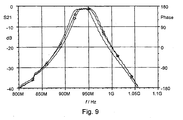
- Figure 9 shows the effect of changing the ratio Z IO / Z F by changing the value of the impedance Z IO of the surrounding circuitry.
- Figure 9 presents the frequency response of a filter in a typical way: the attenuation (S21) of the signal is presented as a function of the frequency.
- the studied balanced filter employs four BAW resonators, where the piezoelectric layer is made of ZnO and the area of each BAW resonator is 108000 ⁇ m 2 .
- the filter is designed to be operated with nominal impedance of 50 ⁇ , i.e. the impedance of the balanced filter is designed to be 50 ⁇ and the impedance of the surrounding circuitry is designed to be 50 ⁇ (i.e. 50 ⁇ termination impedance).
- the center frequency is about 943 MHz.
- the frequency response measured at 50 ⁇ is marked in Figure 9 using a solid line and triangles. It is the rightmost frequency response curve in Figure 9.
- the two other curves in Figure 9 correspond to two smaller Z IO values: 20 ⁇ and 35 ⁇ .
- the decrease of the termination impedance Z IO decreases the center frequency but substantially retains the original shape of the frequency response of the studied balanced filter.
- the value of attenuation at the passband is substantially the same for all termination impedances 20, 35 and 50 ⁇ .
- the center frequency of a balanced filter having a center frequency about 945 MHz can thus be decreased about 10 MHz without substantially changing the shape of the frequency response by adjusting the termination impedance Z IO .
- a balanced filter is driven single-ended from one side, i.e. one of the input and output ports is grounded.
- the change of the termination impedance of the coupled port affects the center frequency also in this case if the node between the loads at the balanced side is not grounded.
- Figure 10 shows a method 1000 for compensating temperature effects of a balanced filter according to a second preferred embodiment of the invention.
- the nominal center frequency f C ' of a balanced filter and the nominal impedance of the balanced filter (and that of the surrounding circuitry) are specified.
- the center frequency of the balanced filter is a function of temperature as is the case, for example, for balanced filters employing BAW resonators using ZnO piezoelectric layer.
- the ambient temperature or, for example, directly the temperature of the balanced filter (or the circuitry board where the filter is attached to) is measured.
- the actual center frequency f C of the balanced filter is determined in the measured temperature.
- the temperature dependence of the center frequency of the balanced filter may be, for example, measured in advance, before a system employing the balanced filter is taken into operation. In this case, there may be, for example, a table of temperatures and for each temperature, an entry corresponding to the previously measured center frequency of the balanced filter.
- steps 1001 and 1002 the temperature may thus be measured and the corresponding actual center frequency may be looked up in the table.
- steps 803 and 804 of the method 1000 the actual center frequency f C is compared to the nominal center frequency f C ', and if the impedance ratio Z IO / Z F needs to be adjusted, it may be done in steps 1003 and 1004 by changing the impedance Z IO of the surrounding circuitry.
- the shift of 10 MHz in the center frequency corresponds to a temperature change of 200 C° with the temperature coefficient - 45 ppm/C°. It may not, however, be practical to compensate such a vast temperature change. Increase in temperature, for example, may increase the insertion loss of the balanced filter, thus degrading its performance.
- FIG 11 shows simulated frequency responses of various balanced filters.
- the balanced filter comprises four BAW resonators.
- the balanced filters may be, for example, such as presented in Figure 7b.
- BAW resonators the resonance frequencies depend mainly on the thickness of the layers in the resonator and on the acoustic velocities in the layer materials.
- the five frequency response curves in Figure 11 have substantially the same shape.
- the frequency response curve in the middle in Figure 11 corresponds to a balanced filter having the piezoelectric layer thickness of 2680 nm in the BAW resonators.
- the two left-most frequency response curves correspond to balanced filters where the piezoelectric layer is 1% (leftmost curve) and 0.5% thicker than in the balanced filter corresponding to the middle curve.
- the two right-most frequency response curves correspond to balanced filters having the piezoelectric layer 0.5% and 1% (rightmost curve) thinner than in the balanced filter corresponding to the middle curve.
- Figure 12 shows an enlarged view of the same frequency response curves.
- the 0.5% change in the piezoelectric layer thickness of BAW resonators belonging, for example, to a such balanced filter as specified in Figure 7b causes about 4 MHz shift to the center frequency of about 943 MHz.
- the shape of the frequency response curves is very uniform.
- Figure 13 shows the simulated frequency response curves of other five balanced filters. These five balanced filters are slightly modified compared to those balanced filters studied above. The difference is that the impedances Z F of the four balanced filters which have too thick or thin piezoelectric layer have been modified. The ratio Z IO / Z F has thus been modified to compensate for the thickness variations in the piezoelectric layer. In the simulation, the impedance Z IO is 50 ⁇ . The areas of the BAW resonators and corresponding the impedance of the resonators are presented in Table 1.
- Balanced filters employing BAW resonators are usually produced using thin film technology.
- the various layers are deposited on top of each other, and the piezoelectric layer, which is usually the thickest layer in the BAW resonator structure, is generally sputter deposited.
- the deposition process is not ideal and therefore small thickness variations may occurs across the wafer.
- the resonance frequencies affect the frequency response, and specifically the center frequency, of the balanced filters as can be seen, for example, in Figures 11 and 12.
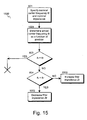
- Figure 15 presents a flowchart of a method 1500 according to a third preferred embodiment of the invention. Using this method it is possible to compensate variations in the center frequency of balanced filters already when designing the filters.
- Method 1500 begins with the design step 801, where the nominal center frequency and nominal impedance of the balanced filter are specified. Thereafter the actual center frequency f C of the balanced filters as a function of position on a wafer, for example, is determined in step 1501. If the balanced filters employ BAW resonators, then the thickness variations of the piezoelectric layer (when the aim was to produce a uniformly thick piezoelectric layer) may be studied using, for example, wafers where a piezoelectric layer has been deposited using the same equipment as is to be used in the manufacturing of the new balanced filters. The thickness of the piezoelectric layer may be studied, for example, directly by investigating the thickness of a deposited piezoelectric layer or, for example, by measuring the center frequencies of balanced filters processed in a conventional way on a wafer.
- step 803 the actual center frequency of a balanced filter, which is a function of the position on a wafer, is compared to the nominal center frequency.
- the piezoelectric layer thickness and the resulting actual center frequency may be correct without any adjustment of the filter impedance Z F .
- the change in ratio Z IO / Z F results in a change in the center frequency of a balanced filter. Decreasing the impedance Z F of the balanced filter while keeping the impedance of the surrounding circuitry constant causes the actual center frequency to increase. Similarly, increasing the impedance Z F of the balanced filter causes the actual center frequency to decrease.
- the impedance of a balanced filter depends on the impedance of the resonators belonging to the balanced filter.
- the impedance Z F of the balanced filter can be thus changed by changing the impedance of the resonators.
- the impedance of a resonator mainly depends on the thickness of the piezoelectric layer and on the area of the resonator.
- the thickness of the resonator is something that the sputter deposition, for example, produces, but the area of the resonator can be easily controlled by varying the area where the top and bottom electrodes overlap.
- the area of the resonator is increased.
- the thickness of the piezoelectric layer is too small, this can be compensated by decreasing the area of the resonator.
- the area of a resonator is easy to control by designing properly the pattern masks which are used in producing the top and bottom electrodes of a BAW resonator.
- there is a nominal value for the BAW resonator area which corresponds to the nominal thickness of the piezoelectric layer. If both the thickness of the piezoelectric layer and the area of the BAW resonator have the nominal values, the actual center frequency of the balanced filter employing BAW filters is the nominal center frequency.
- the areas where the piezoelectric layer is thicker or thinner than the nominal value due to, for example, the properties of the sputter deposition equipment can vary from equipment to equipment.
- the piezoelectric layer may be, for example, thickest at the center of the wafer or there may be a circle where the layer is thickest.
- the variations in the thickness of the piezoelectric layer are usually the same for piezoelectric layers produced with certain equipment when the sputter deposition conditions are not altered. By studying the piezoelectric layers deposited on a wafer or other substrate using certain equipment, the variations in the piezoelectric layer thickness can be found out and then compensated by using the method 1500 according to the invention in the design of new balanced filters.
- the BAW resonators in the balanced filters may have different areas.
- the resonators marked with A in Figure 7a may have a certain area, and the resonators marked with B another area.
- the ratio of the areas of resonators A and resonators B may be, for example, 1.2.
- the frequency response of such a balanced filter has a very steep attenuation slope outside the passband. It is also possible that all four BAW resonators of a balanced filter have different areas. This may be the case, for example, when the substrate on which the balanced filters are produced is not electrically insulating.
- the ratio of the areas of BAW resonators of a certain balanced filter affect the frequency response of the balanced filter. Therefore it is advantageous that the ratio of the areas is sustained when the areas are changed in order to adjust the impedance of the balanced filter.
- steps 1502, 1503 of the method 1500 it is advantageous in the design phase to multiply the areas of the BAW resonators of a certain balanced filter with a certain constant that depends on the location of the balanced filter on a substrate.
- Proper values for the BAW resonator areas can be found, for example, by simulations after the thickness variations of the piezoelectric layer or the variations in the center frequency of the balanced filters have been estimated.
- each balanced filter forms a part of larger circuitries deposited on the same substrate.
- the substrate is sawn to suitable pieces where each piece comprises typically one balanced filter or one circuitry comprising the balanced filter.
- balanced filters 1610, 1620, 1630 whose impedances are adjusted according to the invention.
- a balanced filter having a certain number of resonators having certain resonator frequencies is specified to obtain a desired frequency response.
- the structure specified is that the four BAW resonators have equal areas.
- the balanced filter 1620 whose distance from the center of the wafer is about half the radius of the wafer, comprises four BAW resonators (1621, 1622, 1623, 1624) each having a certain area.
- the balanced filter 1610 located at the center of the wafer, comprises similarly four BAW resonators (1611, 1612, 1613, 1614) having equal areas, but the areas are larger than those of the BAW resonators in the balanced filter 1620.
- the decreased impedance of the balanced filter compensates (at least partly) the too low center frequency caused by the too thick piezoelectric layer.
- the balanced filter 1630 located near the edge of the wafer has four BAW resonators having equal areas, but the areas are smaller than those of the resonators in the balanced filters 1620 and 1610.
- the increased impedance of the balanced filter compensates the too high center frequency of the balanced filter caused by the too thin piezoelectric layer.
- a balanced filter not all or any resonators are bulk acoustic wave resonators.
- the impedance of at least one resonator of the balanced filters may be varied. If the balanced filters comprise a bulk acoustic resonator, its area may be varied in a suitable manner. Further, if the balanced filters comprise more than one bulk acoustic wave resonator, the total area of bulk acoustic wave resonators belonging to the balanced resonators may depend, for example, on the position of the balanced filter on the substrate. In these cases, where the impedance ratios between the resonators belonging to a balanced filter vary from one balanced filter to another, the shape of the frequency response may also vary from one balanced filter to another.
Landscapes
- Engineering & Computer Science (AREA)
- Manufacturing & Machinery (AREA)
- Physics & Mathematics (AREA)
- Acoustics & Sound (AREA)
- Piezo-Electric Or Mechanical Vibrators, Or Delay Or Filter Circuits (AREA)
Applications Claiming Priority (2)
| Application Number | Priority Date | Filing Date | Title |
|---|---|---|---|
| FI992547A FI107661B (fi) | 1999-11-29 | 1999-11-29 | Menetelmä balansoidun suotimen keskitaajuuden säätämiseksi ja joukko balansoituja suotimia |
| FI992547 | 1999-11-29 |
Publications (1)
| Publication Number | Publication Date |
|---|---|
| EP1104097A2 true EP1104097A2 (fr) | 2001-05-30 |
Family
ID=8555659
Family Applications (1)
| Application Number | Title | Priority Date | Filing Date |
|---|---|---|---|
| EP00660210A Withdrawn EP1104097A2 (fr) | 1999-11-29 | 2000-11-21 | Méthode d'ajustement de la fréquence centrale d'un filtre équilibré et de plusieurs filtres équilibrés |
Country Status (5)
| Country | Link |
|---|---|
| US (1) | US6388544B1 (fr) |
| EP (1) | EP1104097A2 (fr) |
| JP (1) | JP2001177365A (fr) |
| CN (1) | CN1298271A (fr) |
| FI (1) | FI107661B (fr) |
Cited By (6)
| Publication number | Priority date | Publication date | Assignee | Title |
|---|---|---|---|---|
| GB2392329A (en) * | 2002-08-08 | 2004-02-25 | Intel Corp | Manufacturing film bulk acoustic resonator filters |
| WO2004066495A1 (fr) * | 2003-01-20 | 2004-08-05 | Koninklijke Philips Electronics N.V. | Agencement de circuit permettant une transformation d'impedance |
| FR2853796A1 (fr) * | 2003-04-11 | 2004-10-15 | St Microelectronics Sa | Composant electronique permettant le decodage de signaux de television numerique terrestre ou par cable. |
| WO2004066490A3 (fr) * | 2003-01-20 | 2004-12-02 | Koninkl Philips Electronics Nv | Structure de filtre resonant a frequences de resonance egales |
| WO2005034344A1 (fr) * | 2003-09-29 | 2005-04-14 | Intel Corporation | Procede de fabrication d'une couche de compensation/reglage de poids sur un substrat |
| US7643634B2 (en) | 2003-04-01 | 2010-01-05 | Stmicroelectronics S.A. | Electronic component allowing the decoding of satellite digital television signals |
Families Citing this family (13)
| Publication number | Priority date | Publication date | Assignee | Title |
|---|---|---|---|---|
| JP2000209063A (ja) * | 1998-11-12 | 2000-07-28 | Mitsubishi Electric Corp | 薄膜圧電素子 |
| GB0012439D0 (en) * | 2000-05-24 | 2000-07-12 | Univ Cranfield | Improvements to filters |
| WO2002093740A1 (fr) * | 2001-05-11 | 2002-11-21 | Ube Electronics, Ltd. | Resonateur d'onde acoustique en volume a couche mince |
| US6937118B2 (en) * | 2002-04-01 | 2005-08-30 | Murata Manufacturing Co., Ltd. | High-frequency circuit device, resonator, filter, duplexer, and high-frequency circuit apparatus |
| US6894360B2 (en) * | 2002-07-30 | 2005-05-17 | Agilent Technologies, Inc. | Electrostatic discharge protection of thin-film resonators |
| US7362198B2 (en) * | 2003-10-30 | 2008-04-22 | Avago Technologies Wireless Ip (Singapore) Pte. Ltd | Pass bandwidth control in decoupled stacked bulk acoustic resonator devices |
| JP2005311568A (ja) * | 2004-04-20 | 2005-11-04 | Sony Corp | フィルタ装置及び送受信機 |
| US7639103B2 (en) * | 2006-06-26 | 2009-12-29 | Panasonic Corporation | Piezoelectric filter, antenna duplexer, and communications apparatus employing piezoelectric resonator |
| US20090088106A1 (en) * | 2007-09-27 | 2009-04-02 | Nanoamp Solutions Inc. (Cayman) | Radio frequency filtering |
| FR2962613B1 (fr) * | 2010-07-06 | 2013-08-16 | Commissariat Energie Atomique | Dispositif d'adaptation d'impedance d'un composant comportant un filtre a impedance adaptable a base de materiau de type perovskite |
| FR2973970B1 (fr) * | 2011-04-07 | 2013-04-12 | Commissariat Energie Atomique | Dispositif utilisant un filtre a base de resonateurs |
| US10547281B1 (en) * | 2018-07-13 | 2020-01-28 | Qualcomm Incorporated | Source impedance tuning circuit for a receive path |
| CN115580257A (zh) * | 2022-10-26 | 2023-01-06 | 见闻录(浙江)半导体有限公司 | 一种声学谐振器及其制造方法、滤波器和电子设备 |
Family Cites Families (13)
| Publication number | Priority date | Publication date | Assignee | Title |
|---|---|---|---|---|
| JP2644855B2 (ja) * | 1988-10-24 | 1997-08-25 | 株式会社日立製作所 | 弾性波フィルタ、及びそれを用いたアンテナ分波器 |
| JP3068140B2 (ja) * | 1989-09-07 | 2000-07-24 | 株式会社東芝 | 圧電薄膜共振子 |
| US5373268A (en) | 1993-02-01 | 1994-12-13 | Motorola, Inc. | Thin film resonator having stacked acoustic reflecting impedance matching layers and method |
| US5692279A (en) * | 1995-08-17 | 1997-12-02 | Motorola | Method of making a monolithic thin film resonator lattice filter |
| JPH0964682A (ja) * | 1995-08-29 | 1997-03-07 | Murata Mfg Co Ltd | 共振子装置およびその周波数調整方法 |
| US5760663A (en) | 1996-08-23 | 1998-06-02 | Motorola, Inc. | Elliptic baw resonator filter and method of making the same |
| US5714917A (en) | 1996-10-02 | 1998-02-03 | Nokia Mobile Phones Limited | Device incorporating a tunable thin film bulk acoustic resonator for performing amplitude and phase modulation |
| US5825263A (en) * | 1996-10-11 | 1998-10-20 | Northern Telecom Limited | Low radiation balanced microstrip bandpass filter |
| US5872493A (en) | 1997-03-13 | 1999-02-16 | Nokia Mobile Phones, Ltd. | Bulk acoustic wave (BAW) filter having a top portion that includes a protective acoustic mirror |
| KR20010073196A (ko) * | 1997-04-24 | 2001-07-31 | 다니구찌 이찌로오, 기타오카 다카시 | 박막 압전 소자 및 박막 압전 소자의 제조 방법 및 회로소자 |
| US5910756A (en) * | 1997-05-21 | 1999-06-08 | Nokia Mobile Phones Limited | Filters and duplexers utilizing thin film stacked crystal filter structures and thin film bulk acoustic wave resonators |
| US6081171A (en) | 1998-04-08 | 2000-06-27 | Nokia Mobile Phones Limited | Monolithic filters utilizing thin film bulk acoustic wave devices and minimum passive components for controlling the shape and width of a passband response |
| FI113211B (fi) * | 1998-12-30 | 2004-03-15 | Nokia Corp | Balansoitu suodatinrakenne ja matkaviestinlaite |
-
1999
- 1999-11-29 FI FI992547A patent/FI107661B/fi active
-
2000
- 2000-11-21 EP EP00660210A patent/EP1104097A2/fr not_active Withdrawn
- 2000-11-22 US US09/718,919 patent/US6388544B1/en not_active Expired - Fee Related
- 2000-11-29 JP JP2000363147A patent/JP2001177365A/ja active Pending
- 2000-11-29 CN CN00134294A patent/CN1298271A/zh active Pending
Cited By (10)
| Publication number | Priority date | Publication date | Assignee | Title |
|---|---|---|---|---|
| GB2392329A (en) * | 2002-08-08 | 2004-02-25 | Intel Corp | Manufacturing film bulk acoustic resonator filters |
| GB2392329B (en) * | 2002-08-08 | 2005-03-16 | Intel Corp | Manufacturing film bulk acoustic resonator filters |
| WO2004066495A1 (fr) * | 2003-01-20 | 2004-08-05 | Koninklijke Philips Electronics N.V. | Agencement de circuit permettant une transformation d'impedance |
| WO2004066490A3 (fr) * | 2003-01-20 | 2004-12-02 | Koninkl Philips Electronics Nv | Structure de filtre resonant a frequences de resonance egales |
| CN1739237B (zh) * | 2003-01-20 | 2010-06-16 | Nxp股份有限公司 | 具有等谐振频率的谐振滤波器结构 |
| US7643634B2 (en) | 2003-04-01 | 2010-01-05 | Stmicroelectronics S.A. | Electronic component allowing the decoding of satellite digital television signals |
| FR2853796A1 (fr) * | 2003-04-11 | 2004-10-15 | St Microelectronics Sa | Composant electronique permettant le decodage de signaux de television numerique terrestre ou par cable. |
| US7796197B2 (en) | 2003-04-11 | 2010-09-14 | Stmicroelectronics S.A. | Electronic component allowing the decoding of digital terrestrial or cable television signals |
| WO2005034344A1 (fr) * | 2003-09-29 | 2005-04-14 | Intel Corporation | Procede de fabrication d'une couche de compensation/reglage de poids sur un substrat |
| US7262070B2 (en) | 2003-09-29 | 2007-08-28 | Intel Corporation | Method to make a weight compensating/tuning layer on a substrate |
Also Published As
| Publication number | Publication date |
|---|---|
| CN1298271A (zh) | 2001-06-06 |
| FI19992547L (fi) | 2001-05-30 |
| JP2001177365A (ja) | 2001-06-29 |
| FI107661B (fi) | 2001-09-14 |
| US6388544B1 (en) | 2002-05-14 |
Similar Documents
| Publication | Publication Date | Title |
|---|---|---|
| US6388544B1 (en) | Method for adjusting the center frequency of a balanced filter and a plurality of balanced filters | |
| US6741145B2 (en) | Filter structure and arrangement comprising piezoelectric resonators | |
| JP4455817B2 (ja) | 離調層配列を備える圧電性薄層共振器装置 | |
| US6278342B1 (en) | Balanced filter structure utilizing bulk acoustic wave resonators having different areas | |
| EP1196989B1 (fr) | Structure resonnante et filtre comportant cette structure resonnante | |
| KR100489828B1 (ko) | Fbar 소자 및 그 제조방법 | |
| US7128941B2 (en) | Method for fabricating film bulk acoustic resonator (FBAR) device | |
| JP4903636B2 (ja) | 共振器、それを備えた装置、および共振器の製造方法 | |
| KR101945723B1 (ko) | 박막 벌크 음향 공진기 및 박막 벌크 음향 공진기의 제조방법 | |
| US20110121916A1 (en) | Hybrid bulk acoustic wave resonator | |
| CN1739237A (zh) | 具有等谐振频率的谐振滤波器结构 | |
| JP3839492B2 (ja) | 薄膜圧電素子 | |
| US6867667B2 (en) | Piezoelectric filter, communication device, and method for manufacturing communication device | |
| HK1036529A (en) | Method for adjusting the center frequency of a balanced filter and a plurality of balanced filters | |
| Yun-Kwon et al. | Fabrication of monolithic 1-Chip FBAR duplexer for W-CDMA handsets | |
| KR20010029007A (ko) | 탄성파 소자의 제조방법 및 그에 따라 제조된 탄성파 소자 | |
| JP2003060478A (ja) | 圧電薄膜共振子、その製造方法、および、その圧電薄膜共振子を用いたフィルタならびに電子機器 | |
| KR100437491B1 (ko) | 벌크 탄성파 필터 | |
| HK1037299A (en) | Method for adjusting the center frequency of a balanced filter and a plurality of balanced filters |
Legal Events
| Date | Code | Title | Description |
|---|---|---|---|
| PUAI | Public reference made under article 153(3) epc to a published international application that has entered the european phase |
Free format text: ORIGINAL CODE: 0009012 |
|
| AK | Designated contracting states |
Kind code of ref document: A2 Designated state(s): AT BE CH CY DE DK ES FI FR GB GR IE IT LI LU MC NL PT SE TR |
|
| AX | Request for extension of the european patent |
Free format text: AL;LT;LV;MK;RO;SI |
|
| RAP1 | Party data changed (applicant data changed or rights of an application transferred) |
Owner name: NOKIA CORPORATION |
|
| STAA | Information on the status of an ep patent application or granted ep patent |
Free format text: STATUS: THE APPLICATION HAS BEEN WITHDRAWN |
|
| 18W | Application withdrawn |
Effective date: 20030127 |
|
| REG | Reference to a national code |
Ref country code: HK Ref legal event code: WD Ref document number: 1036529 Country of ref document: HK |