EP1110698A2 - Appareil et méthode pour la production de produits creux en trois dimensions en utilisant le moulage par soufflage - Google Patents
Appareil et méthode pour la production de produits creux en trois dimensions en utilisant le moulage par soufflage Download PDFInfo
- Publication number
- EP1110698A2 EP1110698A2 EP00123627A EP00123627A EP1110698A2 EP 1110698 A2 EP1110698 A2 EP 1110698A2 EP 00123627 A EP00123627 A EP 00123627A EP 00123627 A EP00123627 A EP 00123627A EP 1110698 A2 EP1110698 A2 EP 1110698A2
- Authority
- EP
- European Patent Office
- Prior art keywords
- mould
- parison
- blow
- cavity
- extrusion
- Prior art date
- Legal status (The legal status is an assumption and is not a legal conclusion. Google has not performed a legal analysis and makes no representation as to the accuracy of the status listed.)
- Withdrawn
Links
Images

Classifications
-
- B—PERFORMING OPERATIONS; TRANSPORTING
- B29—WORKING OF PLASTICS; WORKING OF SUBSTANCES IN A PLASTIC STATE IN GENERAL
- B29C—SHAPING OR JOINING OF PLASTICS; SHAPING OF MATERIAL IN A PLASTIC STATE, NOT OTHERWISE PROVIDED FOR; AFTER-TREATMENT OF THE SHAPED PRODUCTS, e.g. REPAIRING
- B29C49/00—Blow-moulding, i.e. blowing a preform or parison to a desired shape within a mould; Apparatus therefor
- B29C49/28—Blow-moulding apparatus
- B29C49/30—Blow-moulding apparatus having movable moulds or mould parts
- B29C49/32—Blow-moulding apparatus having movable moulds or mould parts moving "to and fro"
-
- B—PERFORMING OPERATIONS; TRANSPORTING
- B29—WORKING OF PLASTICS; WORKING OF SUBSTANCES IN A PLASTIC STATE IN GENERAL
- B29C—SHAPING OR JOINING OF PLASTICS; SHAPING OF MATERIAL IN A PLASTIC STATE, NOT OTHERWISE PROVIDED FOR; AFTER-TREATMENT OF THE SHAPED PRODUCTS, e.g. REPAIRING
- B29C49/00—Blow-moulding, i.e. blowing a preform or parison to a desired shape within a mould; Apparatus therefor
- B29C49/02—Combined blow-moulding and manufacture of the preform or the parison
- B29C49/04—Extrusion blow-moulding
- B29C49/04102—Extrusion blow-moulding extruding the material continuously
-
- B—PERFORMING OPERATIONS; TRANSPORTING
- B29—WORKING OF PLASTICS; WORKING OF SUBSTANCES IN A PLASTIC STATE IN GENERAL
- B29C—SHAPING OR JOINING OF PLASTICS; SHAPING OF MATERIAL IN A PLASTIC STATE, NOT OTHERWISE PROVIDED FOR; AFTER-TREATMENT OF THE SHAPED PRODUCTS, e.g. REPAIRING
- B29C49/00—Blow-moulding, i.e. blowing a preform or parison to a desired shape within a mould; Apparatus therefor
- B29C49/42—Component parts, details or accessories; Auxiliary operations
- B29C49/4242—Means for deforming the parison prior to the blowing operation
-
- B—PERFORMING OPERATIONS; TRANSPORTING
- B29—WORKING OF PLASTICS; WORKING OF SUBSTANCES IN A PLASTIC STATE IN GENERAL
- B29C—SHAPING OR JOINING OF PLASTICS; SHAPING OF MATERIAL IN A PLASTIC STATE, NOT OTHERWISE PROVIDED FOR; AFTER-TREATMENT OF THE SHAPED PRODUCTS, e.g. REPAIRING
- B29C33/00—Moulds or cores; Details thereof or accessories therefor
- B29C33/20—Opening, closing or clamping
- B29C33/26—Opening, closing or clamping by pivotal movement
-
- B—PERFORMING OPERATIONS; TRANSPORTING
- B29—WORKING OF PLASTICS; WORKING OF SUBSTANCES IN A PLASTIC STATE IN GENERAL
- B29C—SHAPING OR JOINING OF PLASTICS; SHAPING OF MATERIAL IN A PLASTIC STATE, NOT OTHERWISE PROVIDED FOR; AFTER-TREATMENT OF THE SHAPED PRODUCTS, e.g. REPAIRING
- B29C49/00—Blow-moulding, i.e. blowing a preform or parison to a desired shape within a mould; Apparatus therefor
- B29C49/02—Combined blow-moulding and manufacture of the preform or the parison
- B29C49/04—Extrusion blow-moulding
- B29C49/041—Extrusion blow-moulding using an accumulator head
-
- B—PERFORMING OPERATIONS; TRANSPORTING
- B29—WORKING OF PLASTICS; WORKING OF SUBSTANCES IN A PLASTIC STATE IN GENERAL
- B29C—SHAPING OR JOINING OF PLASTICS; SHAPING OF MATERIAL IN A PLASTIC STATE, NOT OTHERWISE PROVIDED FOR; AFTER-TREATMENT OF THE SHAPED PRODUCTS, e.g. REPAIRING
- B29C49/00—Blow-moulding, i.e. blowing a preform or parison to a desired shape within a mould; Apparatus therefor
- B29C49/42—Component parts, details or accessories; Auxiliary operations
- B29C49/4242—Means for deforming the parison prior to the blowing operation
- B29C49/4244—Means for deforming the parison prior to the blowing operation during or after laying preform into the final mould
- B29C49/42444—Means for deforming the parison prior to the blowing operation during or after laying preform into the final mould by moving the transport means
-
- B—PERFORMING OPERATIONS; TRANSPORTING
- B29—WORKING OF PLASTICS; WORKING OF SUBSTANCES IN A PLASTIC STATE IN GENERAL
- B29C—SHAPING OR JOINING OF PLASTICS; SHAPING OF MATERIAL IN A PLASTIC STATE, NOT OTHERWISE PROVIDED FOR; AFTER-TREATMENT OF THE SHAPED PRODUCTS, e.g. REPAIRING
- B29C49/00—Blow-moulding, i.e. blowing a preform or parison to a desired shape within a mould; Apparatus therefor
- B29C49/42—Component parts, details or accessories; Auxiliary operations
- B29C49/4242—Means for deforming the parison prior to the blowing operation
- B29C49/4244—Means for deforming the parison prior to the blowing operation during or after laying preform into the final mould
- B29C49/42446—Means for deforming the parison prior to the blowing operation during or after laying preform into the final mould by using a robot arm or similar actuator
-
- B—PERFORMING OPERATIONS; TRANSPORTING
- B29—WORKING OF PLASTICS; WORKING OF SUBSTANCES IN A PLASTIC STATE IN GENERAL
- B29C—SHAPING OR JOINING OF PLASTICS; SHAPING OF MATERIAL IN A PLASTIC STATE, NOT OTHERWISE PROVIDED FOR; AFTER-TREATMENT OF THE SHAPED PRODUCTS, e.g. REPAIRING
- B29C49/00—Blow-moulding, i.e. blowing a preform or parison to a desired shape within a mould; Apparatus therefor
- B29C49/42—Component parts, details or accessories; Auxiliary operations
- B29C49/4242—Means for deforming the parison prior to the blowing operation
- B29C49/4244—Means for deforming the parison prior to the blowing operation during or after laying preform into the final mould
- B29C49/42452—The mould opening plane being horizontal
Definitions
- the present invention refers to a device and method for producing three-dimensional hollow bodies starting from a parison extruded by a plastication/extrusion unit, and positioned into the cavity of a mould mounted on the platen of a press. Within the mould cavity the parison is blown to form the three-dimensional hollow body.
- one relevant drawback is presence of excessive flash due to the fact that the extruded parison has a different shape as the mould cavity; consequently, when the parison is positioned between the mould-halves and the mould is closed, a lot of scrap material remains out of the mould cavity.
- the first devices for blow-moulding three-dimensional bodies in order to remove this drawback, had the possibility to move the mould, so as to follow the mould-cavity contour during parison deposition.
- Other devices had the possibility to move the extrusion head to follow the shape of the mould cavity. In both devices, fast movement of heavy masses was required, with consequent problems of high cost and high cycle time.
- Another device of the prior art made use of a conventional blow-moulding machine with a sectored mould closing sequentially. In this case, mould cost was excessive and the machine was not convenient in all cases in which frequent production-changes and, consequently, mould changes were needed.
- a drawback of the device described is production cycle time too long. Indeed, between the end of parison positioning and the start of the blowing phase a certain time elapses, during which the mould moves and the press closes. This delay increases cycle time and, above all, causes inhomogeneous parison cooling, since the part of the parison in contact with the mould wall cools down more rapidly because of the greater thermal exchange; consequence are problems in the production process.
- Patent application Fischer EP0893230 solves partially this drawback, by eliminating the press totally and realising the closing system of the mould cavity by means of sliding sectors. This way, as soon as the parison is positioned, the sliding sectors close the mould and blowing starts, reducing the time between parison deposition and blowing.
- Patent application EP0893230 takes moreover into account the possibility to use two or more moulds which co-operate with a single plastication/extrusion unit, exploiting the difference between the actual time for parison extrusion and positioning and blowing time, which can be five or six times longer.
- Patent application EP0893230 shows however some defects, due to the fact that subdividing the mould into sectors can be very complicated with articles of complex shape, and consequently very expensive. Moreover, each different body requires an apposite mould with all sector closing devices, and obviously pre-existing moulds cannot be used; therefore this system does not appear to be very versatile.
- An aim of the present invention is to provide a device for producing three-dimensional hollow bodies by blow moulding which is practical, versatile, of small dimensions, cheap and simply realisable.
- Another aim of the present invention is to provide a method for production of three-dimensional hollow bodies by blow-moulding which allows to minimise cycle time.
- the device for producing three-dimensional hollow bodies by blow-moulding comprises at least one mould, consisting of a lower mould-half containing a cavity in which the parison is positioned, and an upper mould-half which can be closed 'book-style' over the lower mould-half, so as to create a hollow cavity in which the parison can be blown.
- the upper mould-half is hinged on a side of the lower mould-half. In this way, the upper mould-half can pivot around the hinge axis for closing/opening the mould cavity, moved by actuator means.
- This system is very simple and fast and allows to reduce cycle time, because the parison blowing phase can start as soon as the mould has closed.
- Device 100 comprises a plastication unit or group 1 comprising two injection units 2.
- Each injection unit 2 includes a hopper 3, through which plastic material at the solid state is loaded.
- a plunger 5 pushes the plasticated material within the injection unit 2 into an extrusion head 6 from which a parison 7, which is a tubular body of plastic material, comes out.
- two injection units 2 connected to a single extrusion head 6 are shown, so as to obtain a coextruded parison; in this case the head 6 is a radial/sequential coextrusion head; however, a single injection unit or extruder or a normal continuous-extrusion or accumulator head can be employed as well.
- the plastication/extrusion group 1 lies on platform 30 mounted on frame 8.
- a manipulator 9 is mounted on frame 8 .
- the manipulator 9 is able to grab the parison 7 and position it into a cavity 10 of a mould 11.
- the manipulator 9 is located under the extrusion head 6, and has an operating range such that it is able to grab the parison 7 and position it into the cavity 10 of the mould.
- manipulator 9 is a robot with a mechanical arm.
- the mechanical arm comprises a connecting rod 12 hinged at its extremities 13 and 14 at frame 8 and to a lever 15, respectively.
- the lever 15, at its free extremity, has a grabbing means 16 rotating around the axis of lever 15.
- rotation of connecting rod 12 around pin 13 supplies two degrees of freedom
- rotation of lever 15 around pin 14 supplies other two degrees of freedom
- rotation of the grabbing means 16 around the axis of lever 15 supplies two more degrees of freedom.
- the mechanical arrangement of the robot 9 possesses therefore six degrees of freedom.
- Mould 11 comprises a lower mould-half 17, in which the cavity 10 which will contain the parison 7 is machined, and the upper mould-half 18 with a cover 19 which, positioned over the cavity 10, creates the shape of the article to be blown.
- the lower mould-half 17 and the upper mould-half 18 are hinged at a pin 20, so that the upper mould-half 18 can pivot around the pin 20 to close or open the cavity 10 of the lower mould-half 17 with a 'book-style' movement. This 'book-style' movement is performed by appropriate actuators 21.
- clamping means (not shown) is provided, which act when the mould 11 is completely closed. These clamping means supplies the clamping force necessary to contrast internal pressure developed by the blown parison within the mould and so avoid mould opening.
- a blowing device comprising a blow-pin 22 getting into the cavity 10, so as to blow the parison located within.
- the blowing device starts blowing immediately after closure of mould 11.
- the mould 11 is located under the extrusion head 6 and it is mounted on a shuttle carriage 23 which can slide on rails (not shown), so as to move forwards and backwards along a horizontal axis denoted with Z.
- a further eighth degree of freedom is given by the possibility of the mould to move along a horizontal axis X (Fig. 3), orthogonal to Z axis. This can be done by mounting the lower mould-half 17 on a plate 24, which is mounted on sliding blocks 25 sliding on the shuttle carriage 23 along the X axis.
- the whole plastication/extrusion group 1 can move along the X axis, by mounting it on a frame moving on sliding blocks on platform 30 supporting the plastication/extrusion group 1.
- a further ninth degree of freedom can be obtained with a translation along a vertical axis Y (Fig. 3). This can be done by raising and lowering the mould 11 with appropriate actuators, for example hydraulically actuated cylinders. Otherwise platform 30, whereon the plastication group lies, can be moved vertically, by means of the known device commonly named 'bobbing'.
- the translation movement along the vertical Y axis allows to decrease further the time lapse from parison extrusion to its positioning into the cavity 10 of mould 11.
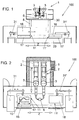
- Figs. 1 and 2 an embodiment of the invention with two moulds is shown, wherein mould 11 at left is open and mould 11' at right is closed. For clarity parts of the closed mould 11' are indicated with the same numbers of those of the open mould 11.
- translation along the Z axis of the shuttle carriage 23, on which the mould is mounted has not only the function to give an additional degree of freedom to the operation of positioning the parison into the mould.
- the translation allows to carry the closed mould 11' away from the parison positioning zone (under extrusion head 6), while parison blowing within mould 11' is already taking place, and carry the open mould 11 in the parison positioning zone, so as to be ready to position the next parison.
- body extraction from the mould is not performed by six freedom degree robot 9, but by dedicated devices, for example apposite manipulators 31 and 31', located on the machine frame at right and left of the extrusion head 6.
- apposite manipulators 31 and 31' located on the machine frame at right and left of the extrusion head 6.
Landscapes
- Engineering & Computer Science (AREA)
- Manufacturing & Machinery (AREA)
- Mechanical Engineering (AREA)
- Blow-Moulding Or Thermoforming Of Plastics Or The Like (AREA)
- Moulds For Moulding Plastics Or The Like (AREA)
- Moulding By Coating Moulds (AREA)
- Manufacturing Of Electric Cables (AREA)
Applications Claiming Priority (2)
| Application Number | Priority Date | Filing Date | Title |
|---|---|---|---|
| IT1999MI002664A IT1314152B1 (it) | 1999-12-21 | 1999-12-21 | Apparecchiatura e metodo per la produzione di corpi cavi in tredimensioni soffiati in stampo |
| ITMI992664 | 1999-12-21 |
Publications (2)
| Publication Number | Publication Date |
|---|---|
| EP1110698A2 true EP1110698A2 (fr) | 2001-06-27 |
| EP1110698A3 EP1110698A3 (fr) | 2001-11-28 |
Family
ID=11384160
Family Applications (1)
| Application Number | Title | Priority Date | Filing Date |
|---|---|---|---|
| EP00123627A Withdrawn EP1110698A3 (fr) | 1999-12-21 | 2000-10-30 | Appareil et méthode pour la production de produits creux en trois dimensions en utilisant le moulage par soufflage |
Country Status (2)
| Country | Link |
|---|---|
| EP (1) | EP1110698A3 (fr) |
| IT (1) | IT1314152B1 (fr) |
Cited By (1)
| Publication number | Priority date | Publication date | Assignee | Title |
|---|---|---|---|---|
| EP1614524A1 (fr) * | 2004-07-08 | 2006-01-11 | Thermo- Technik-Systeme GmbH | Appareil de souflage |
Family Cites Families (4)
| Publication number | Priority date | Publication date | Assignee | Title |
|---|---|---|---|---|
| FR2174732B1 (fr) * | 1972-03-09 | 1974-08-30 | Saint Gobain Pont A Mousson | |
| US4362688A (en) * | 1979-06-29 | 1982-12-07 | Excell Corporation | Method for molding a plastic pipe |
| JPH082579B2 (ja) * | 1990-09-27 | 1996-01-17 | タイガースポリマー株式会社 | 中空合成樹脂製品の製造方法 |
| US5225216A (en) * | 1991-06-13 | 1993-07-06 | Nrm Corporation | Mold opening apparatus for blow molding machine |
-
1999
- 1999-12-21 IT IT1999MI002664A patent/IT1314152B1/it active
-
2000
- 2000-10-30 EP EP00123627A patent/EP1110698A3/fr not_active Withdrawn
Cited By (2)
| Publication number | Priority date | Publication date | Assignee | Title |
|---|---|---|---|---|
| EP1614524A1 (fr) * | 2004-07-08 | 2006-01-11 | Thermo- Technik-Systeme GmbH | Appareil de souflage |
| US7300273B2 (en) | 2004-07-08 | 2007-11-27 | Thermo-Technik-Systeme Gmbh | System for forming a hollow body |
Also Published As
| Publication number | Publication date |
|---|---|
| IT1314152B1 (it) | 2002-12-04 |
| ITMI992664A0 (it) | 1999-12-21 |
| EP1110698A3 (fr) | 2001-11-28 |
| ITMI992664A1 (it) | 2001-06-21 |
Similar Documents
| Publication | Publication Date | Title |
|---|---|---|
| US4105391A (en) | Injection blow molding machine | |
| EP0001626B1 (fr) | Machine et procédé d'injection-soufflage | |
| US4801260A (en) | Rotary blow molding machine | |
| US5840349A (en) | Rotary blow molding machine | |
| EP0472126B1 (fr) | Machine pour l'extrusion-soufflage | |
| US5951936A (en) | Compact and torque free side entry trolley robot | |
| JPH10323873A (ja) | 射出成形機 | |
| US4861542A (en) | Rotary blow molding method | |
| US6059557A (en) | Cooling device attached to index machine | |
| JPH01105724A (ja) | 回転式成形機 | |
| US6488884B1 (en) | Process and apparatus for producing hollow bodies from thermoplastic material | |
| EP0284242A2 (fr) | Machine rotative de moulage par soufflage | |
| JPH11501876A (ja) | 多次元寸法を有するブロー成形体を製作する方法とその方法を行う装置 | |
| JP3722671B2 (ja) | 射出延伸ブロー成形装置 | |
| JP3649631B2 (ja) | 冷却装置 | |
| JPH0270421A (ja) | ブロー成形装置 | |
| JP3927856B2 (ja) | 延伸ブロー成形ユニット | |
| EP0549823B1 (fr) | Dispositif de changement des moules pour appareils de moulage par soufflage | |
| CN214294410U (zh) | 一种具有剪浇口机构的瓶坯调温预吹成型装置 | |
| CA2254622C (fr) | Methode et appareil de realisation de corps creux | |
| JP3916167B2 (ja) | 射出延伸ブロー成形機 | |
| CN216098911U (zh) | 一种异型管件自动抓取装置 | |
| CN222987543U (zh) | 注吹成型模具 | |
| RU2087312C1 (ru) | Устройство для смыкания и размыкания полуформ экструзионно-выдувного автомата | |
| ITMI992664A1 (it) | Apparecchiatura e metodo per la produzione di corpi cavi in tre dimensioni soffiati in stampo |
Legal Events
| Date | Code | Title | Description |
|---|---|---|---|
| PUAI | Public reference made under article 153(3) epc to a published international application that has entered the european phase |
Free format text: ORIGINAL CODE: 0009012 |
|
| AK | Designated contracting states |
Kind code of ref document: A2 Designated state(s): AT BE CH CY DE DK ES FI FR GB GR IE IT LI LU MC NL PT SE |
|
| AX | Request for extension of the european patent |
Free format text: AL;LT;LV;MK;RO;SI |
|
| PUAL | Search report despatched |
Free format text: ORIGINAL CODE: 0009013 |
|
| AK | Designated contracting states |
Kind code of ref document: A3 Designated state(s): AT BE CH CY DE DK ES FI FR GB GR IE IT LI LU MC NL PT SE |
|
| AX | Request for extension of the european patent |
Free format text: AL;LT;LV;MK;RO;SI |
|
| AKX | Designation fees paid | ||
| REG | Reference to a national code |
Ref country code: DE Ref legal event code: 8566 |
|
| STAA | Information on the status of an ep patent application or granted ep patent |
Free format text: STATUS: THE APPLICATION IS DEEMED TO BE WITHDRAWN |
|
| 18D | Application deemed to be withdrawn |
Effective date: 20020529 |