EP1111112A1 - Medizintechnisches Produkt, Verfahren zu seiner Herstellung und Verwendung - Google Patents
Medizintechnisches Produkt, Verfahren zu seiner Herstellung und Verwendung Download PDFInfo
- Publication number
- EP1111112A1 EP1111112A1 EP00125543A EP00125543A EP1111112A1 EP 1111112 A1 EP1111112 A1 EP 1111112A1 EP 00125543 A EP00125543 A EP 00125543A EP 00125543 A EP00125543 A EP 00125543A EP 1111112 A1 EP1111112 A1 EP 1111112A1
- Authority
- EP
- European Patent Office
- Prior art keywords
- medical device
- melt
- blown fiber
- blown
- layer
- Prior art date
- Legal status (The legal status is an assumption and is not a legal conclusion. Google has not performed a legal analysis and makes no representation as to the accuracy of the status listed.)
- Granted
Links
- 238000000034 method Methods 0.000 title claims abstract description 26
- 238000004519 manufacturing process Methods 0.000 title claims description 8
- 239000000835 fiber Substances 0.000 claims abstract description 45
- 239000011148 porous material Substances 0.000 claims abstract description 33
- 230000008569 process Effects 0.000 claims abstract description 16
- 230000010261 cell growth Effects 0.000 claims abstract description 9
- 238000005516 engineering process Methods 0.000 claims description 32
- 239000002657 fibrous material Substances 0.000 claims description 16
- 239000002861 polymer material Substances 0.000 claims description 15
- 239000007943 implant Substances 0.000 claims description 13
- 229920000249 biocompatible polymer Polymers 0.000 claims description 8
- 239000003814 drug Substances 0.000 claims description 8
- 230000003014 reinforcing effect Effects 0.000 claims description 8
- 210000000056 organ Anatomy 0.000 claims description 4
- 230000004962 physiological condition Effects 0.000 claims description 4
- 229920000642 polymer Polymers 0.000 abstract description 14
- 239000000463 material Substances 0.000 abstract description 6
- 239000000155 melt Substances 0.000 abstract description 6
- 238000007664 blowing Methods 0.000 abstract description 5
- 238000000465 moulding Methods 0.000 abstract 2
- 239000012567 medical material Substances 0.000 abstract 1
- 239000004814 polyurethane Substances 0.000 description 13
- 210000004027 cell Anatomy 0.000 description 12
- 230000002787 reinforcement Effects 0.000 description 12
- 229920002635 polyurethane Polymers 0.000 description 11
- -1 polyethylene terephthalate Polymers 0.000 description 8
- 210000004185 liver Anatomy 0.000 description 7
- 229940127554 medical product Drugs 0.000 description 6
- 210000003437 trachea Anatomy 0.000 description 5
- 229920000954 Polyglycolide Polymers 0.000 description 4
- 239000004743 Polypropylene Substances 0.000 description 4
- 230000008901 benefit Effects 0.000 description 4
- 239000007789 gas Substances 0.000 description 4
- 238000000338 in vitro Methods 0.000 description 4
- 235000015097 nutrients Nutrition 0.000 description 4
- 229920000139 polyethylene terephthalate Polymers 0.000 description 4
- 239000005020 polyethylene terephthalate Substances 0.000 description 4
- 229920001155 polypropylene Polymers 0.000 description 4
- 229920001169 thermoplastic Polymers 0.000 description 4
- 210000001519 tissue Anatomy 0.000 description 4
- 210000001601 blood-air barrier Anatomy 0.000 description 3
- 230000015556 catabolic process Effects 0.000 description 3
- 238000006731 degradation reaction Methods 0.000 description 3
- 239000004744 fabric Substances 0.000 description 3
- 239000012528 membrane Substances 0.000 description 3
- 239000000203 mixture Substances 0.000 description 3
- 239000004753 textile Substances 0.000 description 3
- CURLTUGMZLYLDI-UHFFFAOYSA-N Carbon dioxide Chemical compound O=C=O CURLTUGMZLYLDI-UHFFFAOYSA-N 0.000 description 2
- 239000004698 Polyethylene Substances 0.000 description 2
- 238000010521 absorption reaction Methods 0.000 description 2
- 239000000654 additive Substances 0.000 description 2
- QVGXLLKOCUKJST-UHFFFAOYSA-N atomic oxygen Chemical compound [O] QVGXLLKOCUKJST-UHFFFAOYSA-N 0.000 description 2
- 230000015572 biosynthetic process Effects 0.000 description 2
- 210000003321 cartilage cell Anatomy 0.000 description 2
- 239000002131 composite material Substances 0.000 description 2
- 238000010276 construction Methods 0.000 description 2
- 229920001577 copolymer Polymers 0.000 description 2
- 210000003238 esophagus Anatomy 0.000 description 2
- 210000003494 hepatocyte Anatomy 0.000 description 2
- 230000002503 metabolic effect Effects 0.000 description 2
- 239000002184 metal Substances 0.000 description 2
- 229910052751 metal Inorganic materials 0.000 description 2
- 229910052760 oxygen Inorganic materials 0.000 description 2
- 239000001301 oxygen Substances 0.000 description 2
- 229920003023 plastic Polymers 0.000 description 2
- 239000004033 plastic Substances 0.000 description 2
- 229920001643 poly(ether ketone) Polymers 0.000 description 2
- 229920002492 poly(sulfone) Polymers 0.000 description 2
- 229920001707 polybutylene terephthalate Polymers 0.000 description 2
- 229920000573 polyethylene Polymers 0.000 description 2
- 239000000126 substance Substances 0.000 description 2
- 229920001897 terpolymer Polymers 0.000 description 2
- 241000894006 Bacteria Species 0.000 description 1
- 206010010356 Congenital anomaly Diseases 0.000 description 1
- AEMRFAOFKBGASW-UHFFFAOYSA-N Glycolic acid Polymers OCC(O)=O AEMRFAOFKBGASW-UHFFFAOYSA-N 0.000 description 1
- 241001465754 Metazoa Species 0.000 description 1
- 229920002396 Polyurea Polymers 0.000 description 1
- 239000000853 adhesive Substances 0.000 description 1
- 238000004026 adhesive bonding Methods 0.000 description 1
- 230000001070 adhesive effect Effects 0.000 description 1
- 239000004599 antimicrobial Substances 0.000 description 1
- 230000001580 bacterial effect Effects 0.000 description 1
- 244000052616 bacterial pathogen Species 0.000 description 1
- 230000004888 barrier function Effects 0.000 description 1
- 210000000013 bile duct Anatomy 0.000 description 1
- 239000011230 binding agent Substances 0.000 description 1
- 239000000560 biocompatible material Substances 0.000 description 1
- 239000008280 blood Substances 0.000 description 1
- 210000004369 blood Anatomy 0.000 description 1
- 210000001124 body fluid Anatomy 0.000 description 1
- 239000010839 body fluid Substances 0.000 description 1
- 229910052799 carbon Inorganic materials 0.000 description 1
- 229910002092 carbon dioxide Inorganic materials 0.000 description 1
- 239000001569 carbon dioxide Substances 0.000 description 1
- 210000000845 cartilage Anatomy 0.000 description 1
- 239000000919 ceramic Substances 0.000 description 1
- 239000003795 chemical substances by application Substances 0.000 description 1
- 230000002301 combined effect Effects 0.000 description 1
- 229940039231 contrast media Drugs 0.000 description 1
- 239000002872 contrast media Substances 0.000 description 1
- QTCANKDTWWSCMR-UHFFFAOYSA-N costic aldehyde Natural products C1CCC(=C)C2CC(C(=C)C=O)CCC21C QTCANKDTWWSCMR-UHFFFAOYSA-N 0.000 description 1
- 230000007547 defect Effects 0.000 description 1
- 208000037265 diseases, disorders, signs and symptoms Diseases 0.000 description 1
- 229920006240 drawn fiber Polymers 0.000 description 1
- 229940079593 drug Drugs 0.000 description 1
- 210000000981 epithelium Anatomy 0.000 description 1
- 238000003958 fumigation Methods 0.000 description 1
- 230000004927 fusion Effects 0.000 description 1
- 239000003102 growth factor Substances 0.000 description 1
- 230000035876 healing Effects 0.000 description 1
- 239000000017 hydrogel Substances 0.000 description 1
- 230000002209 hydrophobic effect Effects 0.000 description 1
- 230000001900 immune effect Effects 0.000 description 1
- 238000002513 implantation Methods 0.000 description 1
- 238000001727 in vivo Methods 0.000 description 1
- 238000011534 incubation Methods 0.000 description 1
- ISTFUJWTQAMRGA-UHFFFAOYSA-N iso-beta-costal Natural products C1C(C(=C)C=O)CCC2(C)CCCC(C)=C21 ISTFUJWTQAMRGA-UHFFFAOYSA-N 0.000 description 1
- 238000009940 knitting Methods 0.000 description 1
- 150000002739 metals Chemical class 0.000 description 1
- 239000004745 nonwoven fabric Substances 0.000 description 1
- 239000002245 particle Substances 0.000 description 1
- 230000001717 pathogenic effect Effects 0.000 description 1
- 230000035515 penetration Effects 0.000 description 1
- 229920000747 poly(lactic acid) Polymers 0.000 description 1
- 229920001610 polycaprolactone Polymers 0.000 description 1
- 239000004632 polycaprolactone Substances 0.000 description 1
- 239000004633 polyglycolic acid Substances 0.000 description 1
- 229920005594 polymer fiber Polymers 0.000 description 1
- 230000001107 psychogenic effect Effects 0.000 description 1
- 239000005871 repellent Substances 0.000 description 1
- 238000000926 separation method Methods 0.000 description 1
- 238000007493 shaping process Methods 0.000 description 1
- 150000003384 small molecules Chemical class 0.000 description 1
- 239000002904 solvent Substances 0.000 description 1
- 238000009987 spinning Methods 0.000 description 1
- 230000009747 swallowing Effects 0.000 description 1
- 238000002560 therapeutic procedure Methods 0.000 description 1
- 239000004416 thermosoftening plastic Substances 0.000 description 1
- YFHICDDUDORKJB-UHFFFAOYSA-N trimethylene carbonate Chemical compound O=C1OCCCO1 YFHICDDUDORKJB-UHFFFAOYSA-N 0.000 description 1
- 230000002792 vascular Effects 0.000 description 1
- 238000009941 weaving Methods 0.000 description 1
Images

Classifications
-
- D—TEXTILES; PAPER
- D04—BRAIDING; LACE-MAKING; KNITTING; TRIMMINGS; NON-WOVEN FABRICS
- D04H—MAKING TEXTILE FABRICS, e.g. FROM FIBRES OR FILAMENTARY MATERIAL; FABRICS MADE BY SUCH PROCESSES OR APPARATUS, e.g. FELTS, NON-WOVEN FABRICS; COTTON-WOOL; WADDING ; NON-WOVEN FABRICS FROM STAPLE FIBRES, FILAMENTS OR YARNS, BONDED WITH AT LEAST ONE WEB-LIKE MATERIAL DURING THEIR CONSOLIDATION
- D04H1/00—Non-woven fabrics formed wholly or mainly of staple fibres or like relatively short fibres
- D04H1/70—Non-woven fabrics formed wholly or mainly of staple fibres or like relatively short fibres characterised by the method of forming fleeces or layers, e.g. reorientation of fibres
- D04H1/72—Non-woven fabrics formed wholly or mainly of staple fibres or like relatively short fibres characterised by the method of forming fleeces or layers, e.g. reorientation of fibres the fibres being randomly arranged
- D04H1/724—Non-woven fabrics formed wholly or mainly of staple fibres or like relatively short fibres characterised by the method of forming fleeces or layers, e.g. reorientation of fibres the fibres being randomly arranged forming webs during fibre formation, e.g. flash-spinning
-
- A—HUMAN NECESSITIES
- A61—MEDICAL OR VETERINARY SCIENCE; HYGIENE
- A61L—METHODS OR APPARATUS FOR STERILISING MATERIALS OR OBJECTS IN GENERAL; DISINFECTION, STERILISATION OR DEODORISATION OF AIR; CHEMICAL ASPECTS OF BANDAGES, DRESSINGS, ABSORBENT PADS OR SURGICAL ARTICLES; MATERIALS FOR BANDAGES, DRESSINGS, ABSORBENT PADS OR SURGICAL ARTICLES
- A61L27/00—Materials for grafts or prostheses or for coating grafts or prostheses
- A61L27/40—Composite materials, i.e. containing one material dispersed in a matrix of the same or different material
-
- A—HUMAN NECESSITIES
- A61—MEDICAL OR VETERINARY SCIENCE; HYGIENE
- A61L—METHODS OR APPARATUS FOR STERILISING MATERIALS OR OBJECTS IN GENERAL; DISINFECTION, STERILISATION OR DEODORISATION OF AIR; CHEMICAL ASPECTS OF BANDAGES, DRESSINGS, ABSORBENT PADS OR SURGICAL ARTICLES; MATERIALS FOR BANDAGES, DRESSINGS, ABSORBENT PADS OR SURGICAL ARTICLES
- A61L27/00—Materials for grafts or prostheses or for coating grafts or prostheses
- A61L27/50—Materials characterised by their function or physical properties, e.g. injectable or lubricating compositions, shape-memory materials, surface modified materials
- A61L27/56—Porous materials, e.g. foams or sponges
-
- D—TEXTILES; PAPER
- D04—BRAIDING; LACE-MAKING; KNITTING; TRIMMINGS; NON-WOVEN FABRICS
- D04H—MAKING TEXTILE FABRICS, e.g. FROM FIBRES OR FILAMENTARY MATERIAL; FABRICS MADE BY SUCH PROCESSES OR APPARATUS, e.g. FELTS, NON-WOVEN FABRICS; COTTON-WOOL; WADDING ; NON-WOVEN FABRICS FROM STAPLE FIBRES, FILAMENTS OR YARNS, BONDED WITH AT LEAST ONE WEB-LIKE MATERIAL DURING THEIR CONSOLIDATION
- D04H1/00—Non-woven fabrics formed wholly or mainly of staple fibres or like relatively short fibres
-
- D—TEXTILES; PAPER
- D04—BRAIDING; LACE-MAKING; KNITTING; TRIMMINGS; NON-WOVEN FABRICS
- D04H—MAKING TEXTILE FABRICS, e.g. FROM FIBRES OR FILAMENTARY MATERIAL; FABRICS MADE BY SUCH PROCESSES OR APPARATUS, e.g. FELTS, NON-WOVEN FABRICS; COTTON-WOOL; WADDING ; NON-WOVEN FABRICS FROM STAPLE FIBRES, FILAMENTS OR YARNS, BONDED WITH AT LEAST ONE WEB-LIKE MATERIAL DURING THEIR CONSOLIDATION
- D04H1/00—Non-woven fabrics formed wholly or mainly of staple fibres or like relatively short fibres
- D04H1/40—Non-woven fabrics formed wholly or mainly of staple fibres or like relatively short fibres from fleeces or layers composed of fibres without existing or potential cohesive properties
- D04H1/42—Non-woven fabrics formed wholly or mainly of staple fibres or like relatively short fibres from fleeces or layers composed of fibres without existing or potential cohesive properties characterised by the use of certain kinds of fibres insofar as this use has no preponderant influence on the consolidation of the fleece
- D04H1/4326—Condensation or reaction polymers
- D04H1/4358—Polyurethanes
-
- D—TEXTILES; PAPER
- D04—BRAIDING; LACE-MAKING; KNITTING; TRIMMINGS; NON-WOVEN FABRICS
- D04H—MAKING TEXTILE FABRICS, e.g. FROM FIBRES OR FILAMENTARY MATERIAL; FABRICS MADE BY SUCH PROCESSES OR APPARATUS, e.g. FELTS, NON-WOVEN FABRICS; COTTON-WOOL; WADDING ; NON-WOVEN FABRICS FROM STAPLE FIBRES, FILAMENTS OR YARNS, BONDED WITH AT LEAST ONE WEB-LIKE MATERIAL DURING THEIR CONSOLIDATION
- D04H1/00—Non-woven fabrics formed wholly or mainly of staple fibres or like relatively short fibres
- D04H1/40—Non-woven fabrics formed wholly or mainly of staple fibres or like relatively short fibres from fleeces or layers composed of fibres without existing or potential cohesive properties
- D04H1/42—Non-woven fabrics formed wholly or mainly of staple fibres or like relatively short fibres from fleeces or layers composed of fibres without existing or potential cohesive properties characterised by the use of certain kinds of fibres insofar as this use has no preponderant influence on the consolidation of the fleece
- D04H1/4374—Non-woven fabrics formed wholly or mainly of staple fibres or like relatively short fibres from fleeces or layers composed of fibres without existing or potential cohesive properties characterised by the use of certain kinds of fibres insofar as this use has no preponderant influence on the consolidation of the fleece using different kinds of webs, e.g. by layering webs
-
- D—TEXTILES; PAPER
- D04—BRAIDING; LACE-MAKING; KNITTING; TRIMMINGS; NON-WOVEN FABRICS
- D04H—MAKING TEXTILE FABRICS, e.g. FROM FIBRES OR FILAMENTARY MATERIAL; FABRICS MADE BY SUCH PROCESSES OR APPARATUS, e.g. FELTS, NON-WOVEN FABRICS; COTTON-WOOL; WADDING ; NON-WOVEN FABRICS FROM STAPLE FIBRES, FILAMENTS OR YARNS, BONDED WITH AT LEAST ONE WEB-LIKE MATERIAL DURING THEIR CONSOLIDATION
- D04H13/00—Other non-woven fabrics
-
- D—TEXTILES; PAPER
- D04—BRAIDING; LACE-MAKING; KNITTING; TRIMMINGS; NON-WOVEN FABRICS
- D04H—MAKING TEXTILE FABRICS, e.g. FROM FIBRES OR FILAMENTARY MATERIAL; FABRICS MADE BY SUCH PROCESSES OR APPARATUS, e.g. FELTS, NON-WOVEN FABRICS; COTTON-WOOL; WADDING ; NON-WOVEN FABRICS FROM STAPLE FIBRES, FILAMENTS OR YARNS, BONDED WITH AT LEAST ONE WEB-LIKE MATERIAL DURING THEIR CONSOLIDATION
- D04H3/00—Non-woven fabrics formed wholly or mainly of yarns or like filamentary material of substantial length
- D04H3/08—Non-woven fabrics formed wholly or mainly of yarns or like filamentary material of substantial length characterised by the method of strengthening or consolidating
- D04H3/16—Non-woven fabrics formed wholly or mainly of yarns or like filamentary material of substantial length characterised by the method of strengthening or consolidating with bonds between thermoplastic filaments produced in association with filament formation, e.g. immediately following extrusion
Definitions
- the present invention relates to a medical technology Product, a process for its manufacture as well as its Use in medicine.
- implant materials In medical technology are used to manufacture implants and organ replacement required biocompatible materials. For special applications such as vascular prostheses or cartilage replacement should the implant materials in a desired shape, for example a hollow body his. So that the implant functions optimally in the body the implant must wax well and best be completely colonized by body cells.
- implants can be in a desired shape are produced, but have a non-structured Surface on and are therefore in the environment of a living Body rather cell-repellent, so that an ingrowth of body cells is hindered.
- Implants in the form of fabrics, knitwear or nonwovens have a surface structure and porosity.
- the shaping through the manufacturing technique like Weaving, knitting, needling, etc. restricted.
- Further kick with hollow bodies, such as tubular products often problems with of stiffness so that the lumen collapses if the Internal pressure drops.
- the present invention has as its object a medical technology To provide product that is made from biocompatible Polymer material is made with little Effort and inexpensive training in any shape can be and when used in medicine Promotes cell growth.
- This task is solved by a medical technology product with a melt blown fiber structure made of biocompatible Polymer material in the form of a three-dimensional shaped body with a pore structure that favors cell growth.
- the melt-blown process uses a thermoplastic Polymer suitable for fiber formation is pressed through a nozzle head, the very many, usually several hundred small openings of typically about 0.4 mm in diameter.
- a thermoplastic Polymer suitable for fiber formation is pressed through a nozzle head, the very many, usually several hundred small openings of typically about 0.4 mm in diameter.
- Around hot gas flows emerging and converging at the nozzle head from about 100 to 360 ° C, depending on the polymer used, take the fibrous extruded polymer with it so that it is stretched at the same time. It will be very fine Obtain fibers of a few micrometers in diameter.
- the spun fresh drawn fibers become a strong gas stream a collecting device, where there is a fine fiber layer forms as air-entangled, adhesive fleece.
- the liability of the staple fibers in the fiber composite is based on a combined effect of intertwining and gluing the still warm, not completely solidified fibers.
- the medical technology product according to the invention can be in one Embodiment present in the form of a hollow body.
- Prefers can the medical device in the form of a tubular Body.
- one tubular bodies are implants as a replacement for vessels for the transport of body fluids as well as tubular To call body organs such as esophagus or trachea.
- the medical technology product according to the invention can be in one another embodiment in the form of a free form.
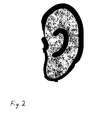
- a free form is the replica of a Ear cup as a replacement for a missing body's own ear call.
- the medical product according to the invention can be used with advantage formed in the form of several superimposed layers his. That is, one designed according to the invention
- Shaped body has a layer structure in the cross section of a material made of melt-blown fibers.
- different polymers can be used.
- the individual layers in porosity, pore size and / or differentiate pore volume can be varied, such as degradability or blood compatibility.
- the material can also be cross-sectionally have a layer structure.
- Layers of a melt-blown fiber structure into a three-dimensional one Structure can be arranged one above the other. Training A layer structure is special with melt-blown fibers simply because further melt-blow steps lead to more Fiber layers can be applied in the heat of fusion form a bond with the underlying layer.
- the medical technology product with melt-blown fiber structure can advantageously have functional elements.
- the medical technology product can have reinforcing elements exhibit.
- reinforcing elements for example Reinforcement bars, reinforcement rings, reinforcement clips, Reinforcement spirals, reinforcement fibers, textile structures, etc. be provided alone or in combination.
- Prefers can be used as materials for the reinforcement elements biocompatible polymers, biocompatible metals, biocompatible Ceramic and / or biocompatible composites be selected.
- reinforcing elements can be introduced radially his. Furthermore, such reinforcing elements be introduced axially extending in the circumferential direction.
- the medical product according to the invention can deal with special advantage in that it is self-supporting is.
- reinforcement elements easily and reliably be introduced into the medical device product. It will initially one or more base layers made of melt-blown fiber material formed, then one or more reinforcing elements put on and again in one or more Steps according to the melt-blown process polymer fiber material applied.
- the reinforcing elements can thus be used in medical technology Product attached and in the biocompatible Polymer material can be embedded.
- Membranes e.g. B. incorporated capillary membranes his. Such a medical product can Benefit as an immunological separation membrane. At the same time is the transport of small molecules like that is advantageous for example for the transport of nutrients. Furthermore, a membrane for fumigation, for example with Serve oxygen or carbon dioxide.
- the medical device product according to the invention draws is particularly characterized in that the pore size of the melt-blown fiber structure be more than 3 micrometers (> 3 ⁇ m) can.
- the pore size in medical technology Product of the invention be 10 to 300 microns.
- the pore size in medical technology Product of the invention be 20 to 100 microns.
- the melt-blown fiber structure can have a porosity have from 50 to 99%.
- the medical product according to the invention can be used for the chosen polymer and the chosen construction usual Have strength per basis weight. If the invention medical technology product intended for cell colonization strength only plays a subordinate role.
- Product can be the polymer material under physiological Conditions at least partially, preferably in be essentially non-absorbable.
- the polymer material for the medical technology according to the invention Product can be selected from the group of thermoplastic Polymers e.g. B. polyurethane (PU), polyethylene terephthalate (PET), polybutylene terephthalate (PBT), polyether ketones (PEK), polysulfones (PSU), polypropylene (PP), polyethylene (PE), copolymers, terpolymers and / or mixtures from that. Elastomeric polymers can also be used.
- PU polyurethane
- PET polyethylene terephthalate
- PBT polybutylene terephthalate
- PEK polyether ketones
- PSU polysulfones
- PP polypropylene
- PE polyethylene
- copolymers terpolymers and / or mixtures from that.
- Elastomeric polymers can also be used.
- Product can be the polymer material under physiological Conditions at least partially absorbable his.
- differently absorbable can be selected Polymers a variation of the degradation behavior or Absorption behavior can be achieved.
- the structure of the medical device product according to the invention a variation of the degradation behavior or absorption behavior can be achieved.
- the polymer material for the medical technology according to the invention Product can be selected from the group absorbable thermoplastic polymers comprising polyglycolide, Polylactide, polycaprolactone, trimethylene carbonate, absorbable Polyurethanes, copolymers, terpolymers and / or mixtures from that.
- the medical technology Characterize the product in that the melt-blown fiber material at least partially, preferably essentially is absorbable, introduced functional elements and / or reinforcing elements only partially absorbable are.
- the use can be used to achieve specific properties of two or more different polymer materials to be required.
- fibers or particles in the Airflow be blown.
- different polymers in the extruder to a so-called Blend can be mixed.
- a bicomponent or multicomponent melt-blow spinning head used in the two or several polymer melts can be processed simultaneously.
- the melt streams can exit the nozzle (Capillary bore) are merged.
- Polymers can preferably be different here Degradation behavior are processed together. It can also different surface properties in common can be achieved, such as hydrophobic and hydrophilic.
- a polymer component can also be designed as a binder.
- Products according to the invention can essentially all layers are made of melt-blown fiber material.
- a layer has a different structure.
- the layers can differ in degree Differentiate porosity and / or the pore diameter.
- the accessibility of the fiber layer structure for cells to be affected So enable highly porous Layers of 30 to 300 ⁇ m pore size have a streak of Body tissue, macroporous layers from 3 to 30 ⁇ m pore size an ingrowth of body tissue, microporous Layers of ⁇ 3 ⁇ m are used for cell selection and nanoporous Layers of ⁇ 0.2 ⁇ m pore size are bacterial filters. On this way a layer can be permeable to cells,
- the medical technology product with melt-blown fiber structure for nutrients and possibly low-molecular metabolic products is permeable, but penetration of pathogenic germs on a, exposed to contaminated conditions, Side is not possible.
- a multi-layer medical device can at least a layer not formed from melt blown fiber material his.
- a layer not formed from melt blown fiber material his For example, one can use other textile techniques manufactured fabric, such as a woven or knitted fabric or a film layer, also semipermeable, like one Polymer or metal layer can be introduced.
- Such a differently structured layer can be used for example the reinforcement and / or provided as a barrier.
- the medical product according to the invention can advantageously comprise melt-blown fiber material with fibers with a diameter of 0.1 to 100 ⁇ m, in particular 5 to 50 ⁇ m. Such fibers are characterized by a cross-sectional area of less than 1 ⁇ m 2 to more than 200 ⁇ m 2 .
- the medical technology Product medicinal agents.
- medicinal substances are: Medicines, diagnostics, antimicrobial agents, growth factors, X-ray contrast media, hemostats, hydrogels or super adsorber.
- the present invention further provides a method for Available to manufacture a medical device using a melt-blown process made of biocompatible polymer material to a three-dimensional shaped body with a Pore structure that promotes cell growth.
- a three-dimensional body can be constructed Process shaped.
- This can be an advantage Characterized method according to the invention in that for the manufacture of the medical device a form in particular a die is used that at least is partially filled by melt-blown fibers.
- the invention can The process is characterized in that for medical technology Product a coarse-porous support structure, for example a lattice structure, at least partially with melt-blown fibers is filled out.
- the invention can Process characterized in that the medical technology Product on a preformed mold, for example a tube shape, at least partially with melt-blown fibers is built up.
- All process variants can be made using the melt-blown technique produced fibers in one layer or in several Layers are applied. Here the individual Layers of the same or different thickness are formed become. Layers can also be arranged in different ways be applied.
- melt blown process is used to manufacture medical technology
- Products according to the invention are particularly advantageous, because practically all thermoplastics can be processed. Underneath also poorly soluble polymers such as polyethylene terephthalate, Polypropylene or polyglycolic acid. Furthermore, there are no solvents Additives or other chemical additives required, which when using the product in medicine as could prove harmful to the patient.
- a medical technology product made of biocompatible is used Polymer material formed from melt-blown fiber material, formed in the form of a three-dimensional shaped body and has a pore structure called cell growth favored in human medicine and / or veterinary medicine.
- the medical technology according to the invention Product can be used as an implant.
- As special preferred example of use as an implant is one Tracheal prosthesis to replace the trachea in the patient too call.
- the prefabricated medical technology Product colonized in vitro with the patient's cells become.
- the implant is then inserted into the patient. This way a better ingrowth, faster healing and achieve with fewer complications.
- the invention medical product as an extracorporeal organ replacement be used.
- one Use here is for use in a liver reactor Replacement of a malfunctioning liver outside the body of the patient.
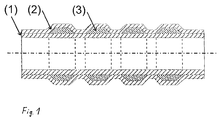
- a tubular hollow structure with horseshoe-shaped reinforcement clips using a multi-stage melt-blown process manufactured.
- reference numeral 1 shows an inner Layer of melt-blown fiber material, 2 an outer layer Made of melt-blown fiber material and 3 built-in reinforcement clips.
- polyurethane is pressed through the capillaries of the nozzle at a melt temperature of 180 ° C. at a volume flow of 9.6 cm 3 / min.
- the blowing air is heated to 250 ° C and a volume flow of 45 Nm 3 / h is generated at 5.5 bar.
- the fiber structure has a porosity of 83% with pores in the size of 11 ⁇ m to 87 ⁇ m (average value 30 ⁇ m).
- polyurethane is melted at 180 ° C. and pressed through the capillaries of a nozzle at a volume flow of 9.6 cm 3 / min.
- the blowing air is heated to 230 ° C and at 4.75 bar a volume flow of 38 Nm 3 / h is generated.
- the melt-blown structure obtained has a porosity of 84% with pores in the size of 16 ⁇ m to 300 ⁇ m (average value 82 ⁇ m).
- the clips are such that they are only 270 degrees of the circumference of the Reinforce the prosthesis and leave the remaining part free. This lies in the patient facing the esophagus and enables due to its flexibility, it has a better swallowing function.
- the fine-pored inner layer enables nutrient exchange with the environment, here the air we breathe, is impermeable to Bacteria with which the air could be contaminated.
- On the large-pore side is on the side facing the body Outer layer of the trachea porthesis, which is a slight ingrowth favored by body tissue.
- the inner layer can be designed for colonization with ciliated epithelium his.
- Such a scaffold construction can be made using the melt-blow technique can be designed particularly advantageous because the fibers be blown directly into or onto an appropriate shape can.
- the impinging airflow is sucked off like this is common in the melt-blow process.
- Cartilage cells are applied during incubation in vitro fully populate the ear structure made of melt-blown fibers. It This results in the most natural and possible body Cells are used, particularly compatible implant.
- the ear prosthesis is then inserted into the patient.
- a temporary liver replacement to be used as extracorporeal Liver reactor is made of non-absorbable polyurethane a multilayer structure made of melt-blown fiber material educated. On a flat fleece initially formed a capillary membrane is put on and then again melt-blown fiber material sprayed on.
- reference numeral 1 shows a large pore Fiber layer, 2 a fine-pored fiber layer and 3 built-in capillaries for gas exchange.
- polyurethane is melted at 180 ° C. and pressed through the capillaries of a nozzle at a volume flow of 9.6 cm 3 / min.
- the blowing air is heated to 230 ° C and a volume flow of 38 Nm 3 / h is generated at 4.75 bar.
- the melt-blown structure obtained has a porosity of 84% with pores in the size of 16 ⁇ m to 300 ⁇ m (average value 82 ⁇ m).
- polyurethane is pressed through the capillaries of the nozzle at the same melt temperature with a volume flow of 9.6 cm 3 / min.
- the blowing air is heated to 250 ° C and a volume flow of 45 Nm 3 / h is generated at 5.5 bar.
- the fiber structure has a porosity of 83% with pores in the size of 11 ⁇ m to 87 ⁇ m (average value 30 ⁇ m).
- the liver reactor comprises two melt-blown fiber structure layers, one with large pores for taking up hepatocytes and one with fine pores for the supply of nutrients through which cells cannot pass. Capillary membranes are also provided in the coarse-pore layer, which can be used for the supply of oxygen, for the removal of CO 2 or as bile ducts.
- the porous melt-blown fiber layer structure is located in a closed vessel, where the patient's plasma to be treated flows through it.
Landscapes
- Engineering & Computer Science (AREA)
- Health & Medical Sciences (AREA)
- Textile Engineering (AREA)
- Chemical & Material Sciences (AREA)
- Animal Behavior & Ethology (AREA)
- Veterinary Medicine (AREA)
- Dermatology (AREA)
- Medicinal Chemistry (AREA)
- Oral & Maxillofacial Surgery (AREA)
- Transplantation (AREA)
- Epidemiology (AREA)
- Life Sciences & Earth Sciences (AREA)
- Public Health (AREA)
- General Health & Medical Sciences (AREA)
- Composite Materials (AREA)
- Materials Engineering (AREA)
- Chemical Kinetics & Catalysis (AREA)
- Dispersion Chemistry (AREA)
- Materials For Medical Uses (AREA)
- Prostheses (AREA)
- Beans For Foods Or Fodder (AREA)
- Spinning Methods And Devices For Manufacturing Artificial Fibers (AREA)
- Manufacture Of Porous Articles, And Recovery And Treatment Of Waste Products (AREA)
- Acyclic And Carbocyclic Compounds In Medicinal Compositions (AREA)
- Preparation Of Compounds By Using Micro-Organisms (AREA)
- Organic Low-Molecular-Weight Compounds And Preparation Thereof (AREA)
Abstract
Description
- Figur 1
- einen Längsschnitt durch eine Tracheaprothese mit erfindungsgemäßer Melt-Blown-Faserstruktur als innere und äußere Fasermaterialschicht mit eingebauten Verstärkungsspangen,
- Figur 2
- eine schematische Darstellung einer menschlichen Ohrmuschel, die aus erfindungsgemäßer Melt-Blown-Faserstruktur nachgebildet ist, und
- Figur 3
- eine schematische Darstellung eines Leberreaktor-Inlays mit erfindungsgemäßer Melt-Blown-Faserstruktur mit eingebauten Kapillaren für den Gasaustausch, einer großporigen Struktur zur Aufnahme von Hepatozyten und einer feinporigen Struktur für die Stoffwechselunterstützung.
| Material | Reißspannung [N/mm2] | Standardabw. | Reißdehnung [%] | Reiß-Spannung / Dichte [N*cm/g] | Porenvolumen [%] | Mittlere Porengröße [µm] |
| Polyurethan | 1,27 | 0,17 | 351 | 482,9 | 77,0 | 19,0 |
| Polyurethan | 1,01 | 0,21 | 368 | 289,9 | 69 | 30 |
| Polyurethan | 0,53 | 0,05 | 300 | 212,2 | 78 | 44 |
| Polyurethan | 0,48 | 0,15 | 267 | 202,6 | 79 | 55 |
| Polyurethan | 0,57 | 0,07 | 323 | 172,2 | 71 | 79 |
| PGA | 0,06 | 0,00 | 43 | 60,4 | 94 | 27 |
| PGA | 0,07 | 0,01 | 53 | 79,4 | 94 | 43 |
| P-L-LA | 0,24 | 0,02 | 47 | 378,0 | 95 | 28 |
Claims (19)
- Medizintechnisches Produkt mit einer Melt-Blown-Faserstruktur aus bioverträglichem Polymermaterial in Form eines dreidimensionalen Formkörpers mit einer Porenstruktur, die Zellwachstum begünstigt.
- Medizintechnisches Produkt nach Anspruch 1, dadurch gekennzeichnet, daß es in Form eines Hohlkörpers vorliegt.
- Medizintechnisches Produkt nach Anspruch 1, dadurch gekennzeichnet, daß es in Form einer Freiform vorliegt.
- Medizintechnisches Produkt nach einem der vorhergehenden Ansprüche, dadurch gekennzeichnet, daß es in Form mehrerer übereinanderliegender Schichten ausgebildet ist.
- Medizintechnisches Produkt nach einem der vorhergehenden Ansprüche, dadurch gekennzeichnet, daß es Funktionselemente aufweist.
- Medizintechnisches Produkt nach einem der vorhergehenden Ansprüche, dadurch gekennzeichnet, daß es Verstärkungselemente aufweist.
- Medizintechnisches Produkt nach einem der vorhergehenden Ansprüche, dadurch gekennzeichnet, daß es selbsttragend ist.
- Medizintechnisches Produkt nach einem der vorhergehenden Ansprüche, dadurch gekennzeichnet, daß die Porengröße der Melt-Blown-Faserstruktur > 3 µm, bevorzugt 10 bis 300 µm beträgt.
- Medizintechnisches Produkt nach einem der vorhergehenden Ansprüche, dadurch gekennzeichnet, daß die Melt-Blown-Faserstruktur eine Porosität von 50 bis 99 % aufweist.
- Medizintechnisches Produkt nach einem der vorhergehenden Ansprüche, dadurch gekennzeichnet, daß das Polymermaterial unter physiologischen Bedingungen mindestens teilweise, vorzugsweise im wesentlichen nicht resorbierbar ist.
- Medizintechnisches Produkt nach einem der Ansprüche 1 bis 11, dadurch gekennzeichent, daß das Polymermaterial unter physiologischen Bedingungen mindestens teilweise resorbierbar ist.
- Medizintechnisches Produkt nach einem der vorhergehenden Ansprüche, dadurch gekennzeichnet, daß im mehrschichtigen Produkt im wesentlichen alle Schichten aus Melt-Blown-Fasermaterial gebildet sind.
- Medizintechnisches Produkt nach einem der vorhergehenden Ansprüche, dadurch gekennzeichnet, daß im mehrschichtigen Produkt mindestens eine Schicht eine unterschiedliche Struktur aufweist.
- Medizintechnisches Produkt nach einem der vorhergehenden Ansprüche, dadurch gekennzeichnet, daß im mehrschichtigen Produkt mindestens eine Schicht nicht aus Melt-Blown-Fasermaterial gebildet ist.
- Medizintechnisches Produkt nach einem der vorhergehenden Ansprüche, dadurch gekennzeichnet, daß das Melt-Blown-Fasermaterial Fasern mit einem Durchmesser von 0,1 bis 100 µm, insbesondere 5 bis 50 µm umfaßt.
- Verfahren zur Herstellung eines medizintechnischen Produkts nach einem Melt-Blow-Verfahren aus bioverträglichem Polymermaterial zu einem dreidimensionalen Formkörper mit einer Porenstruktur, die Zellwachstum begünstigt.
- Verwendung eines medizintechnischen Produkts aus bioverträglichem Polymermaterial gebildet aus Melt-Blown-Fasermaterial, das in Form eines dreidimensionalen Formkörpers ausgebildet ist und eine Porenstruktur aufweist, die Zellwachstum begünstigt, in der Humanmedizin und/oder Veterinärmedizin.
- Verwendung nach Anspruch 17 als Implantat.
- Verwendung nach Anspruch 17 als extrakorporaler Organersatz.
Applications Claiming Priority (2)
| Application Number | Priority Date | Filing Date | Title |
|---|---|---|---|
| DE19959088A DE19959088A1 (de) | 1999-12-08 | 1999-12-08 | Medizintechnisches Produkt, Verfahren zu seiner Herstellung und Verwendung |
| DE19959088 | 1999-12-08 |
Publications (2)
| Publication Number | Publication Date |
|---|---|
| EP1111112A1 true EP1111112A1 (de) | 2001-06-27 |
| EP1111112B1 EP1111112B1 (de) | 2008-03-05 |
Family
ID=7931805
Family Applications (1)
| Application Number | Title | Priority Date | Filing Date |
|---|---|---|---|
| EP00125543A Expired - Lifetime EP1111112B1 (de) | 1999-12-08 | 2000-11-22 | Medizintechnisches Produkt sowie Verfahren zu seiner Herstellung |
Country Status (8)
| Country | Link |
|---|---|
| US (1) | US20010010022A1 (de) |
| EP (1) | EP1111112B1 (de) |
| JP (1) | JP2001198210A (de) |
| AT (1) | ATE388258T1 (de) |
| DE (2) | DE19959088A1 (de) |
| DK (1) | DK1111112T3 (de) |
| ES (1) | ES2302678T3 (de) |
| PT (1) | PT1111112E (de) |
Cited By (1)
| Publication number | Priority date | Publication date | Assignee | Title |
|---|---|---|---|---|
| EP2684588A1 (de) * | 2012-07-13 | 2014-01-15 | Polyor SARL | Makro/Mikroporöser Filter für die Inkubation und Diagnose der mikrobiologischen Aktivitäten von Umweltproben |
Families Citing this family (14)
| Publication number | Priority date | Publication date | Assignee | Title |
|---|---|---|---|---|
| DE10220368A1 (de) * | 2002-05-07 | 2003-12-04 | Biotissue Technologies Ag | Versteiftes Implantat |
| WO2004075855A2 (en) * | 2003-02-26 | 2004-09-10 | Biomed Solutions, Llc | Process for in vivo treatment of specific biological targets in bodily fluid |
| DE10312144B4 (de) * | 2003-03-13 | 2006-12-14 | Technische Universität Dresden | Trägermaterial für die Gewebe- und Zellkultur und die Herstellung von Implantatmaterialien |
| DE102004047568A1 (de) * | 2004-09-24 | 2006-04-13 | Aesculap Ag & Co. Kg | Antimikrobielles Implantat mit einer flexiblen porösen Struktur |
| US20070004035A1 (en) * | 2005-06-30 | 2007-01-04 | James Sitzmann | Gene therapy methods and cell growth and cell transplant devices for use therein |
| DE102005050560A1 (de) * | 2005-10-17 | 2007-04-19 | Technische Universität Dresden | Trägermaterial aus Fasern und Verfahren zu seiner Herstellung |
| US20080081323A1 (en) * | 2006-09-29 | 2008-04-03 | Daniel Keeley | Regenerative Medicine Devices and Melt-Blown Methods of Manufacture |
| US8734829B2 (en) * | 2009-02-13 | 2014-05-27 | Boston Scientific Scimed, Inc. | Medical devices having polymeric nanoporous coatings for controlled therapeutic agent delivery and a nonpolymeric macroporous protective layer |
| DE102009015791B4 (de) | 2009-03-23 | 2015-09-24 | Technische Universität Dresden | Trägermaterial für die rekonstruktive Chirurgie und Verfahren zu seiner Herstellung |
| KR101799930B1 (ko) * | 2010-01-25 | 2017-11-21 | 루브리졸 어드밴스드 머티어리얼스, 인코포레이티드 | 고강도 탄성 부직포 |
| DE102010048710B4 (de) * | 2010-03-30 | 2013-05-23 | 3T Textiltechnologietransfer Gmbh | Implantat mit einer Sandwich-Struktur |
| CN101972175B (zh) * | 2010-11-04 | 2012-11-07 | 东华大学 | 一种机织人工气管的制备方法 |
| PL231639B1 (pl) * | 2012-04-17 | 2019-03-29 | Politechnika Lodzka | Materiał medyczny do rekonstrukcji naczyń krwionośnych oraz sposób wytwarzania materiału medycznego |
| EP3437589B1 (de) | 2014-07-17 | 2023-03-01 | Poriferous, LLC | Orbitale bodenfolie |
Citations (2)
| Publication number | Priority date | Publication date | Assignee | Title |
|---|---|---|---|---|
| US4043331A (en) * | 1974-08-05 | 1977-08-23 | Imperial Chemical Industries Limited | Fibrillar product of electrostatically spun organic material |
| WO1999017817A1 (en) * | 1997-10-02 | 1999-04-15 | Gore Enterprise Holdings, Inc. | Self-cohering, continuous filament non-woven webs |
Family Cites Families (12)
| Publication number | Priority date | Publication date | Assignee | Title |
|---|---|---|---|---|
| DE3209044C2 (de) * | 1982-03-12 | 1986-02-13 | Ontario Research Foundation, Mississauga, Ontario | Verfahren zur Herstellung eines porösen, rohrförmigen Produkts und dessen Verwendung als Gefäßimplantat |
| US5041138A (en) * | 1986-11-20 | 1991-08-20 | Massachusetts Institute Of Technology | Neomorphogenesis of cartilage in vivo from cell culture |
| DE3801426A1 (de) * | 1988-01-20 | 1989-08-03 | Ethicon Gmbh | Filzartiges implantat |
| DE3830005C1 (en) * | 1988-08-31 | 1989-11-02 | Ethicon Gmbh & Co Kg, 2000 Norderstedt, De | Sheet-like implant |
| DE3830481A1 (de) * | 1988-09-08 | 1990-03-22 | Ethicon Gmbh | Schlauchfoermiges implantat, sowie verfahren zu dessen herstellung |
| JPH02255139A (ja) * | 1989-02-28 | 1990-10-15 | David C Macgregor | 成形手術用デバイス |
| DE4108772A1 (de) * | 1991-03-18 | 1992-09-24 | Inst Textil & Faserforschung | Implantierbares biohybrides organ |
| DE4226465C2 (de) * | 1991-08-10 | 2003-12-04 | Gunze Kk | Kieferknochen-reproduzierendes Material |
| DE4306661C2 (de) * | 1993-03-03 | 1995-04-20 | Michael Dipl Biol Sittinger | Verfahren zum Herstellen eines Implantates aus Zellkulturen |
| DE19613730C2 (de) * | 1996-03-26 | 2002-08-14 | Ethicon Gmbh | Flächiges Implantat zum Verstärken oder Verschließen von Körpergewebe |
| DE19721876A1 (de) * | 1997-05-16 | 1998-11-19 | Ethicon Gmbh | Implantat und Verfahren zum Herstellen eines Implantats |
| US6319264B1 (en) * | 1998-04-03 | 2001-11-20 | Bionx Implants Oy | Hernia mesh |
-
1999
- 1999-12-08 DE DE19959088A patent/DE19959088A1/de not_active Withdrawn
-
2000
- 2000-11-22 EP EP00125543A patent/EP1111112B1/de not_active Expired - Lifetime
- 2000-11-22 DK DK00125543T patent/DK1111112T3/da active
- 2000-11-22 PT PT00125543T patent/PT1111112E/pt unknown
- 2000-11-22 DE DE50015017T patent/DE50015017D1/de not_active Expired - Lifetime
- 2000-11-22 ES ES00125543T patent/ES2302678T3/es not_active Expired - Lifetime
- 2000-11-22 AT AT00125543T patent/ATE388258T1/de active
- 2000-12-04 US US09/728,483 patent/US20010010022A1/en not_active Abandoned
- 2000-12-05 JP JP2000370166A patent/JP2001198210A/ja active Pending
Patent Citations (2)
| Publication number | Priority date | Publication date | Assignee | Title |
|---|---|---|---|---|
| US4043331A (en) * | 1974-08-05 | 1977-08-23 | Imperial Chemical Industries Limited | Fibrillar product of electrostatically spun organic material |
| WO1999017817A1 (en) * | 1997-10-02 | 1999-04-15 | Gore Enterprise Holdings, Inc. | Self-cohering, continuous filament non-woven webs |
Cited By (2)
| Publication number | Priority date | Publication date | Assignee | Title |
|---|---|---|---|---|
| EP2684588A1 (de) * | 2012-07-13 | 2014-01-15 | Polyor SARL | Makro/Mikroporöser Filter für die Inkubation und Diagnose der mikrobiologischen Aktivitäten von Umweltproben |
| FR2993186A1 (fr) * | 2012-07-13 | 2014-01-17 | Polyor Sarl | Filtres macro/microporeux pour l'incubation et le diagnostique de l'activite microbiologique d'echantillons environnementaux |
Also Published As
| Publication number | Publication date |
|---|---|
| EP1111112B1 (de) | 2008-03-05 |
| ES2302678T3 (es) | 2008-08-01 |
| DE19959088A1 (de) | 2001-06-13 |
| PT1111112E (pt) | 2008-05-23 |
| US20010010022A1 (en) | 2001-07-26 |
| DK1111112T3 (da) | 2008-06-30 |
| JP2001198210A (ja) | 2001-07-24 |
| DE50015017D1 (de) | 2008-04-17 |
| ATE388258T1 (de) | 2008-03-15 |
Similar Documents
| Publication | Publication Date | Title |
|---|---|---|
| EP1111112B1 (de) | Medizintechnisches Produkt sowie Verfahren zu seiner Herstellung | |
| EP0248246B1 (de) | Künstliche Gefässwand | |
| AT502795B1 (de) | Nervenregenerationsröhrchen | |
| EP2126166B2 (de) | Faser- wirrgelege | |
| DE69527042T2 (de) | Biokompatible poröse matrix aus bioabsorbierendem material | |
| DE60211176T2 (de) | Film mit hochporösen Gefäßtransplantatprothesen | |
| EP0248247B1 (de) | Künstliche Gefässwand | |
| EP1570806B1 (de) | Flächiges Implantat, Verfahren zu seiner Herstellung und Verwendung in der Chirurgie | |
| DE3830481C2 (de) | ||
| EP1457552B1 (de) | Trägermaterial für die Gewebe- und Zellkultur, zur Herstellung von Implantaten oder Implantatmaterialien, und ein mit dem Trägermaterial hergestelltes Implantat | |
| DE102004051487A1 (de) | Chirurgisches Implantat | |
| EP1796750A1 (de) | Antimikrobielles implantat mit einer flexiblen porösen struktur | |
| DE102009037134A1 (de) | Tubuläres Implantat zum Ersatz von natürlichen Blutgefäßen | |
| DE3783401T2 (de) | Medizinische roehre und herstellungsverfahren. | |
| WO2015091357A1 (de) | Herstellung von resorbierbaren polymerrohren aus fäden | |
| EP1100561B1 (de) | Harnstofferzeugender organersatz | |
| DE102006028221A1 (de) | Schlauchförmige Gefäßprothese, Verfahren zu ihrer Herstellung und Verwendung in der Chirurgie | |
| EP1412564B1 (de) | Zweischicht-hohlmembran für bioreaktoranwendungen | |
| WO2013113515A1 (de) | Implantat-matrix aus einem polymergemisch | |
| DE102017101804B4 (de) | Verfahren zur Herstellung eines Knochenersatzmaterialkörpers | |
| EP3159017A1 (de) | Resorbierbare matrix zur wundabdeckung | |
| DD293046A5 (de) | Kuenstlicher peritoneum | |
| DE102024106304A1 (de) | Gefäßprothese; Verfahren zur Herstellung einer Gefäßprothese | |
| WO2018138260A1 (de) | Herstellung von resorbierbaren polymerrohren aus mehrkomponentenfäden | |
| DE202013006004U1 (de) | Schlauchförmiges Kunststoff-Hohlprofil |
Legal Events
| Date | Code | Title | Description |
|---|---|---|---|
| PUAI | Public reference made under article 153(3) epc to a published international application that has entered the european phase |
Free format text: ORIGINAL CODE: 0009012 |
|
| AK | Designated contracting states |
Kind code of ref document: A1 Designated state(s): AT BE CH CY DE DK ES FI FR GB GR IE IT LI LU MC NL PT SE TR |
|
| AX | Request for extension of the european patent |
Free format text: AL;LT;LV;MK;RO;SI |
|
| 17P | Request for examination filed |
Effective date: 20011113 |
|
| AKX | Designation fees paid |
Free format text: AT BE CH CY DE DK ES FI FR GB GR IE IT LI LU MC NL PT SE TR |
|
| 17Q | First examination report despatched |
Effective date: 20061218 |
|
| GRAP | Despatch of communication of intention to grant a patent |
Free format text: ORIGINAL CODE: EPIDOSNIGR1 |
|
| RTI1 | Title (correction) |
Free format text: MEDICO-TECHNICAL PRODUCT AND METHOD OF ITS PRODUCTION |
|
| GRAS | Grant fee paid |
Free format text: ORIGINAL CODE: EPIDOSNIGR3 |
|
| GRAA | (expected) grant |
Free format text: ORIGINAL CODE: 0009210 |
|
| RAP1 | Party data changed (applicant data changed or rights of an application transferred) |
Owner name: DEUTSCHE INSTITUTE FUER TEXTIL- UND FASERFORSCHUNG |
|
| AK | Designated contracting states |
Kind code of ref document: B1 Designated state(s): AT BE CH CY DE DK ES FI FR GB GR IE IT LI LU MC NL PT SE TR |
|
| REG | Reference to a national code |
Ref country code: GB Ref legal event code: FG4D Free format text: NOT ENGLISH |
|
| REG | Reference to a national code |
Ref country code: CH Ref legal event code: EP |
|
| REG | Reference to a national code |
Ref country code: IE Ref legal event code: FG4D Free format text: LANGUAGE OF EP DOCUMENT: GERMAN |
|
| REF | Corresponds to: |
Ref document number: 50015017 Country of ref document: DE Date of ref document: 20080417 Kind code of ref document: P |
|
| REG | Reference to a national code |
Ref country code: PT Ref legal event code: SC4A Free format text: AVAILABILITY OF NATIONAL TRANSLATION Effective date: 20080509 |
|
| REG | Reference to a national code |
Ref country code: CH Ref legal event code: NV Representative=s name: ZIMMERLI, WAGNER & PARTNER AG |
|
| REG | Reference to a national code |
Ref country code: DK Ref legal event code: T3 |
|
| REG | Reference to a national code |
Ref country code: GR Ref legal event code: EP Ref document number: 20080401420 Country of ref document: GR |
|
| REG | Reference to a national code |
Ref country code: ES Ref legal event code: FG2A Ref document number: 2302678 Country of ref document: ES Kind code of ref document: T3 |
|
| ET3 | Fr: translation filed ** decision concerning opposition | ||
| PLBE | No opposition filed within time limit |
Free format text: ORIGINAL CODE: 0009261 |
|
| STAA | Information on the status of an ep patent application or granted ep patent |
Free format text: STATUS: NO OPPOSITION FILED WITHIN TIME LIMIT |
|
| 26N | No opposition filed |
Effective date: 20081208 |
|
| PG25 | Lapsed in a contracting state [announced via postgrant information from national office to epo] |
Ref country code: MC Free format text: LAPSE BECAUSE OF NON-PAYMENT OF DUE FEES Effective date: 20081130 |
|
| PG25 | Lapsed in a contracting state [announced via postgrant information from national office to epo] |
Ref country code: CY Free format text: LAPSE BECAUSE OF FAILURE TO SUBMIT A TRANSLATION OF THE DESCRIPTION OR TO PAY THE FEE WITHIN THE PRESCRIBED TIME-LIMIT Effective date: 20080305 |
|
| REG | Reference to a national code |
Ref country code: CH Ref legal event code: PFA Owner name: DEUTSCHE INSTITUTE FUER TEXTIL- UND FASERFORSCHUN Free format text: DEUTSCHE INSTITUTE FUER TEXTIL- UND FASERFORSCHUNG DENKENDORF STIFTUNG DES OEFFENTLICHEN RECHTS#KOERSCHTALSTRASSE 26#73770 DENKENDORF (DE) -TRANSFER TO- DEUTSCHE INSTITUTE FUER TEXTIL- UND FASERFORSCHUNG DENKENDORF STIFTUNG DES OEFFENTLICHEN RECHTS#KOERSCHTALSTRASSE 26#73770 DENKENDORF (DE) |
|
| PGFP | Annual fee paid to national office [announced via postgrant information from national office to epo] |
Ref country code: AT Payment date: 20101119 Year of fee payment: 11 |
|
| PGFP | Annual fee paid to national office [announced via postgrant information from national office to epo] |
Ref country code: DE Payment date: 20101119 Year of fee payment: 11 |
|
| PGFP | Annual fee paid to national office [announced via postgrant information from national office to epo] |
Ref country code: IT Payment date: 20101126 Year of fee payment: 11 Ref country code: GR Payment date: 20101123 Year of fee payment: 11 Ref country code: GB Payment date: 20101123 Year of fee payment: 11 Ref country code: TR Payment date: 20101111 Year of fee payment: 11 |
|
| PGFP | Annual fee paid to national office [announced via postgrant information from national office to epo] |
Ref country code: IE Payment date: 20111121 Year of fee payment: 12 Ref country code: CH Payment date: 20111124 Year of fee payment: 12 Ref country code: LU Payment date: 20111123 Year of fee payment: 12 Ref country code: ES Payment date: 20111123 Year of fee payment: 12 Ref country code: FI Payment date: 20111121 Year of fee payment: 12 Ref country code: FR Payment date: 20111125 Year of fee payment: 12 Ref country code: DK Payment date: 20111124 Year of fee payment: 12 Ref country code: PT Payment date: 20111114 Year of fee payment: 12 Ref country code: SE Payment date: 20111122 Year of fee payment: 12 Ref country code: NL Payment date: 20111123 Year of fee payment: 12 |
|
| PGFP | Annual fee paid to national office [announced via postgrant information from national office to epo] |
Ref country code: BE Payment date: 20111122 Year of fee payment: 12 |
|
| REG | Reference to a national code |
Ref country code: PT Ref legal event code: MM4A Free format text: LAPSE DUE TO NON-PAYMENT OF FEES Effective date: 20130522 |
|
| BERE | Be: lapsed |
Owner name: DEUTSCHE INSTITUTE FUR TEXTIL- UND FASERFORSCHUNG Effective date: 20121130 |
|
| REG | Reference to a national code |
Ref country code: NL Ref legal event code: V1 Effective date: 20130601 |
|
| REG | Reference to a national code |
Ref country code: CH Ref legal event code: PL |
|
| REG | Reference to a national code |
Ref country code: DK Ref legal event code: EBP |
|
| REG | Reference to a national code |
Ref country code: AT Ref legal event code: MM01 Ref document number: 388258 Country of ref document: AT Kind code of ref document: T Effective date: 20121122 |
|
| GBPC | Gb: european patent ceased through non-payment of renewal fee |
Effective date: 20121122 |
|
| PG25 | Lapsed in a contracting state [announced via postgrant information from national office to epo] |
Ref country code: AT Free format text: LAPSE BECAUSE OF NON-PAYMENT OF DUE FEES Effective date: 20121122 Ref country code: SE Free format text: LAPSE BECAUSE OF NON-PAYMENT OF DUE FEES Effective date: 20121123 Ref country code: LI Free format text: LAPSE BECAUSE OF NON-PAYMENT OF DUE FEES Effective date: 20121130 Ref country code: CH Free format text: LAPSE BECAUSE OF NON-PAYMENT OF DUE FEES Effective date: 20121130 |
|
| REG | Reference to a national code |
Ref country code: IE Ref legal event code: MM4A |
|
| REG | Reference to a national code |
Ref country code: FR Ref legal event code: ST Effective date: 20130731 |
|
| PG25 | Lapsed in a contracting state [announced via postgrant information from national office to epo] |
Ref country code: BE Free format text: LAPSE BECAUSE OF NON-PAYMENT OF DUE FEES Effective date: 20121130 Ref country code: GR Free format text: LAPSE BECAUSE OF NON-PAYMENT OF DUE FEES Effective date: 20130604 Ref country code: NL Free format text: LAPSE BECAUSE OF NON-PAYMENT OF DUE FEES Effective date: 20130601 Ref country code: FI Free format text: LAPSE BECAUSE OF NON-PAYMENT OF DUE FEES Effective date: 20121122 Ref country code: IT Free format text: LAPSE BECAUSE OF NON-PAYMENT OF DUE FEES Effective date: 20121122 Ref country code: PT Free format text: LAPSE BECAUSE OF NON-PAYMENT OF DUE FEES Effective date: 20130522 |
|
| REG | Reference to a national code |
Ref country code: GR Ref legal event code: ML Ref document number: 20080401420 Country of ref document: GR Effective date: 20130604 |
|
| REG | Reference to a national code |
Ref country code: DE Ref legal event code: R119 Ref document number: 50015017 Country of ref document: DE Effective date: 20130601 |
|
| PG25 | Lapsed in a contracting state [announced via postgrant information from national office to epo] |
Ref country code: DK Free format text: LAPSE BECAUSE OF NON-PAYMENT OF DUE FEES Effective date: 20121130 Ref country code: IE Free format text: LAPSE BECAUSE OF NON-PAYMENT OF DUE FEES Effective date: 20121122 Ref country code: DE Free format text: LAPSE BECAUSE OF NON-PAYMENT OF DUE FEES Effective date: 20130601 |
|
| PG25 | Lapsed in a contracting state [announced via postgrant information from national office to epo] |
Ref country code: FR Free format text: LAPSE BECAUSE OF NON-PAYMENT OF DUE FEES Effective date: 20121130 Ref country code: GB Free format text: LAPSE BECAUSE OF NON-PAYMENT OF DUE FEES Effective date: 20121122 |
|
| REG | Reference to a national code |
Ref country code: ES Ref legal event code: FD2A Effective date: 20140304 |
|
| PG25 | Lapsed in a contracting state [announced via postgrant information from national office to epo] |
Ref country code: LU Free format text: LAPSE BECAUSE OF NON-PAYMENT OF DUE FEES Effective date: 20121122 Ref country code: TR Free format text: LAPSE BECAUSE OF NON-PAYMENT OF DUE FEES Effective date: 20121122 Ref country code: ES Free format text: LAPSE BECAUSE OF NON-PAYMENT OF DUE FEES Effective date: 20121123 |