EP1112960A1 - Zusammengesetztes mehrbasiges salz, verfahren zur herstellung desselben undverwendung - Google Patents
Zusammengesetztes mehrbasiges salz, verfahren zur herstellung desselben undverwendung Download PDFInfo
- Publication number
- EP1112960A1 EP1112960A1 EP00944340A EP00944340A EP1112960A1 EP 1112960 A1 EP1112960 A1 EP 1112960A1 EP 00944340 A EP00944340 A EP 00944340A EP 00944340 A EP00944340 A EP 00944340A EP 1112960 A1 EP1112960 A1 EP 1112960A1
- Authority
- EP
- European Patent Office
- Prior art keywords
- composite metal
- polybasic salt
- metal polybasic
- peak
- salt
- Prior art date
- Legal status (The legal status is an assumption and is not a legal conclusion. Google has not performed a legal analysis and makes no representation as to the accuracy of the status listed.)
- Withdrawn
Links
Images


Classifications
-
- C—CHEMISTRY; METALLURGY
- C09—DYES; PAINTS; POLISHES; NATURAL RESINS; ADHESIVES; COMPOSITIONS NOT OTHERWISE PROVIDED FOR; APPLICATIONS OF MATERIALS NOT OTHERWISE PROVIDED FOR
- C09K—MATERIALS FOR MISCELLANEOUS APPLICATIONS, NOT PROVIDED FOR ELSEWHERE
- C09K21/00—Fireproofing materials
- C09K21/02—Inorganic materials
-
- C—CHEMISTRY; METALLURGY
- C01—INORGANIC CHEMISTRY
- C01F—COMPOUNDS OF THE METALS BERYLLIUM, MAGNESIUM, ALUMINIUM, CALCIUM, STRONTIUM, BARIUM, RADIUM, THORIUM, OR OF THE RARE-EARTH METALS
- C01F7/00—Compounds of aluminium
- C01F7/78—Compounds containing aluminium, with or without oxygen or hydrogen, and containing two or more other elements
-
- B—PERFORMING OPERATIONS; TRANSPORTING
- B01—PHYSICAL OR CHEMICAL PROCESSES OR APPARATUS IN GENERAL
- B01J—CHEMICAL OR PHYSICAL PROCESSES, e.g. CATALYSIS OR COLLOID CHEMISTRY; THEIR RELEVANT APPARATUS
- B01J41/00—Anion exchange; Use of material as anion exchangers; Treatment of material for improving the anion exchange properties
- B01J41/08—Use of material as anion exchangers; Treatment of material for improving the anion exchange properties
- B01J41/10—Inorganic material
-
- C—CHEMISTRY; METALLURGY
- C01—INORGANIC CHEMISTRY
- C01B—NON-METALLIC ELEMENTS; COMPOUNDS THEREOF; METALLOIDS OR COMPOUNDS THEREOF NOT COVERED BY SUBCLASS C01C
- C01B13/00—Oxygen; Ozone; Oxides or hydroxides in general
- C01B13/14—Methods for preparing oxides or hydroxides in general
- C01B13/36—Methods for preparing oxides or hydroxides in general by precipitation reactions in aqueous solutions
- C01B13/363—Mixtures of oxides or hydroxides by precipitation
-
- C—CHEMISTRY; METALLURGY
- C01—INORGANIC CHEMISTRY
- C01F—COMPOUNDS OF THE METALS BERYLLIUM, MAGNESIUM, ALUMINIUM, CALCIUM, STRONTIUM, BARIUM, RADIUM, THORIUM, OR OF THE RARE-EARTH METALS
- C01F7/00—Compounds of aluminium
- C01F7/78—Compounds containing aluminium, with or without oxygen or hydrogen, and containing two or more other elements
- C01F7/784—Layered double hydroxide, e.g. comprising nitrate, sulfate or carbonate ions as intercalating anions
- C01F7/785—Hydrotalcite
-
- C—CHEMISTRY; METALLURGY
- C01—INORGANIC CHEMISTRY
- C01G—COMPOUNDS CONTAINING METALS NOT COVERED BY SUBCLASSES C01D OR C01F
- C01G1/00—Methods of preparing compounds of metals not covered by subclasses C01B, C01C, C01D, or C01F, in general
-
- C—CHEMISTRY; METALLURGY
- C08—ORGANIC MACROMOLECULAR COMPOUNDS; THEIR PREPARATION OR CHEMICAL WORKING-UP; COMPOSITIONS BASED THEREON
- C08K—Use of inorganic or non-macromolecular organic substances as compounding ingredients
- C08K3/00—Use of inorganic substances as compounding ingredients
- C08K3/18—Oxygen-containing compounds, e.g. metal carbonyls
- C08K3/20—Oxides; Hydroxides
- C08K3/22—Oxides; Hydroxides of metals
-
- C—CHEMISTRY; METALLURGY
- C01—INORGANIC CHEMISTRY
- C01F—COMPOUNDS OF THE METALS BERYLLIUM, MAGNESIUM, ALUMINIUM, CALCIUM, STRONTIUM, BARIUM, RADIUM, THORIUM, OR OF THE RARE-EARTH METALS
- C01F5/00—Compounds of magnesium
-
- C—CHEMISTRY; METALLURGY
- C01—INORGANIC CHEMISTRY
- C01P—INDEXING SCHEME RELATING TO STRUCTURAL AND PHYSICAL ASPECTS OF SOLID INORGANIC COMPOUNDS
- C01P2002/00—Crystal-structural characteristics
- C01P2002/01—Crystal-structural characteristics depicted by a TEM-image
-
- C—CHEMISTRY; METALLURGY
- C01—INORGANIC CHEMISTRY
- C01P—INDEXING SCHEME RELATING TO STRUCTURAL AND PHYSICAL ASPECTS OF SOLID INORGANIC COMPOUNDS
- C01P2002/00—Crystal-structural characteristics
- C01P2002/20—Two-dimensional structures
- C01P2002/22—Two-dimensional structures layered hydroxide-type, e.g. of the hydrotalcite-type
-
- C—CHEMISTRY; METALLURGY
- C01—INORGANIC CHEMISTRY
- C01P—INDEXING SCHEME RELATING TO STRUCTURAL AND PHYSICAL ASPECTS OF SOLID INORGANIC COMPOUNDS
- C01P2002/00—Crystal-structural characteristics
- C01P2002/70—Crystal-structural characteristics defined by measured X-ray, neutron or electron diffraction data
-
- C—CHEMISTRY; METALLURGY
- C01—INORGANIC CHEMISTRY
- C01P—INDEXING SCHEME RELATING TO STRUCTURAL AND PHYSICAL ASPECTS OF SOLID INORGANIC COMPOUNDS
- C01P2002/00—Crystal-structural characteristics
- C01P2002/70—Crystal-structural characteristics defined by measured X-ray, neutron or electron diffraction data
- C01P2002/72—Crystal-structural characteristics defined by measured X-ray, neutron or electron diffraction data by d-values or two theta-values, e.g. as X-ray diagram
-
- C—CHEMISTRY; METALLURGY
- C01—INORGANIC CHEMISTRY
- C01P—INDEXING SCHEME RELATING TO STRUCTURAL AND PHYSICAL ASPECTS OF SOLID INORGANIC COMPOUNDS
- C01P2002/00—Crystal-structural characteristics
- C01P2002/80—Crystal-structural characteristics defined by measured data other than those specified in group C01P2002/70
-
- C—CHEMISTRY; METALLURGY
- C01—INORGANIC CHEMISTRY
- C01P—INDEXING SCHEME RELATING TO STRUCTURAL AND PHYSICAL ASPECTS OF SOLID INORGANIC COMPOUNDS
- C01P2002/00—Crystal-structural characteristics
- C01P2002/80—Crystal-structural characteristics defined by measured data other than those specified in group C01P2002/70
- C01P2002/82—Crystal-structural characteristics defined by measured data other than those specified in group C01P2002/70 by IR- or Raman-data
-
- C—CHEMISTRY; METALLURGY
- C01—INORGANIC CHEMISTRY
- C01P—INDEXING SCHEME RELATING TO STRUCTURAL AND PHYSICAL ASPECTS OF SOLID INORGANIC COMPOUNDS
- C01P2002/00—Crystal-structural characteristics
- C01P2002/80—Crystal-structural characteristics defined by measured data other than those specified in group C01P2002/70
- C01P2002/88—Crystal-structural characteristics defined by measured data other than those specified in group C01P2002/70 by thermal analysis data, e.g. TGA, DTA, DSC
-
- C—CHEMISTRY; METALLURGY
- C01—INORGANIC CHEMISTRY
- C01P—INDEXING SCHEME RELATING TO STRUCTURAL AND PHYSICAL ASPECTS OF SOLID INORGANIC COMPOUNDS
- C01P2004/00—Particle morphology
- C01P2004/01—Particle morphology depicted by an image
- C01P2004/03—Particle morphology depicted by an image obtained by SEM
Definitions
- the present invention relates to a composite metal polybasic salt having a novel crystalline structure, a method of preparing the same and use thereof.
- hydrotalcite-type synthetic mineral e.g., Japanese Examined Patent Publication (Kokoku) No. 32198/1972
- salt of lithium aluminum composite hydroxide e.g., Japanese Examined Patent Publication (Kokoku) No. 2858/1995
- the polybasic aluminum magnesium salt can be effectively used as an antacid.
- Japanese Unexamined Patent Publication (Kokai) No. 204617/1985 teaches a method of preparing a magaldrate expressed by the formula Al 5 Mg 10 (OH) 31 (SO 4 ) 2 ⁇ xH 2 O by reacting an active aluminum hydroxide with a stoichiometric amount of water-soluble sulfate-containing compound, active magnesium oxide and(or) magnesium hydroxide in the presence of water and, if necessary, drying the resulting magaldrate paste.
- Japanese Examined Patent Publication (Kokoku) No. 59977/1989 discloses a crystalline basic aluminum magnesium carbonate represented by the formula Al 2 Mg 6 (OH) 12 (CO 3 ) 2 ⁇ xH 2 O [wherein x ⁇ 4].
- Japanese Examined Patent Publication (Kokoku) No. 52409/1991 discloses a method of producing a hydroxyaluminum magnesium sulfate by reacting a solid magnesium hydroxide and/or magnesium oxide with an aqueous solution of aluminum sulfate at an atomic ratio of magnesium:aluminum of from 1:1 to 3:1 until the pH of the reaction mixture becomes 4.0 to 8.0, removing the water-soluble component from the reaction mixture by a known method, followed, if necessary, by drying.
- the composite metal polybasic salt can be effectively used as an additive for resins, as a heat insulator and as an anion-exchanger.
- the object of the present invention is to provide a composite metal polybasic salt containing a trivalent metal and magnesium as metal components and having a novel crystal structure, and a method of preparing the same.
- Another object of the present invention is to provide a composite metal polybasic salt which has anion-exchanging property, which by itself is useful as an anion-exchanger, capable of introducing anions suited for the use upon anion-exchange, and finds a wide range of applications, and a method of preparing the same.
- a composite metal polybasic salt having a chemical composition represented by the following general formula (1), M 3+ p Mg q (OH) y (A) z ⁇ nH 2 O wherein M 3+ is a trivalent metal, A is an inorganic or organic anion, and p, q, y and z are numbers satisfying the following formulas,
- the trivalent metal (M 3+ ) in the above formula is aluminum.
- q/p can be not larger than 2.0.
- the anions (A) in the above formula are sulfuric acid ions.
- the sulfuric acid ions have anion-exchanging property, and can be exchanged with carbonic acid ions, organocarboxylic acid ions, phosphoric acid ions, silicic acid ions, perchloric acid ions, aluminic acid ions or sulfonic acid ions.
- the composite metal polybasic salt of the present invention exhibits X-ray diffraction peaks at the above-mentioned Bragg angle.
- the Al-Mg-SO 4 composite metal polybasic salt which is a product of the invention generally, has the following X-ray diffraction image: 2 ⁇ Relative intensity 10 to 12° 100% 20 to 22° 20 to 80% 33 to 50° 10 to 60% 60 to 63° 5 to 50%
- the degree of orientation (I 0 ) is from 2 to 20.
- the composite metal polybasic salt of the present invention When photographed by using a scanning-type electron microscope, the composite metal polybasic salt of the present invention has a pleat-like thin-piece texture with a honeycomb-type or pumice-type internal structure.
- a method of preparing a composite metal polybasic salt by reacting a water-soluble salt of a trivalent metal with an oxide, a hydroxide or a water-soluble salt of magnesium under the conditions of a pH of from 6.0 to 9.0 and a temperature of not lower than 50°C and, preferably, not lower than 80°C and, if necessary, executing the ion exchange in the presence of an acid or a soluble salt of acid.
- an additive for resins, a heat insulator and an anion-exchanger comprising the composite metal polybasic salt.
- the anions of the composite metal polybasic salt are sulfuric acid ions.
- a first feature of the composite metal polybasic salt (hereinafter often referred to as PBS) of the present invention is that it has a chemical composition expressed by the above-mentioned formula (1). That is, the number p of mols of the trivalent metal, the number q of mols of magnesium metal, the number y of mols of hydroxyl groups and the number z of mols of anions all lie within ranges satisfying the above formulas (i) to (iv).
- a hydrotalcite which is a representative example of the known composite metal polybasic salt or of the composite metal hydroxide salt, typically, has a chemical composition expressed by the following formula (4), Mg 6 Al 2 (OH) 16 CO 3 ⁇ nH 2 O and q/p in the above-mentioned formula (ii) corresponds to 3.0.
- q/p is not larger than 2.5 and, particularly, not larger than 2.0, and has a chemical composition different from that of the hydrotalcite.
- the composite metal polybasic salt of the present invention has the following chemical structure.
- a Mg(OH) 6 octahedral layer of which Mg is isomorphous-substituted by M 3+ serves as a basic layer, and anions such as sulfuric acid radicals are incorporated among the basic layers in a form to be balanced with excess of cations due to the substitution.
- the layered crystal structure is formed by a stack of many basic structures.
- Anions such as sulfuric acid radicals present in the composite metal polybasic salt have anion-exchanging property and can be substituted with carbonic acid ions, organocarboxylic acid ions, phosphoric acid ions, silicic acid ions (including condensed silicic acid ions), and the like ions.
- the content Qo (milliequivalent/100 g) of sulfuric acid radicals in the composite metal polybasic salt is from 240 to 420 milliequivalent/100 g.
- the trivalent metal M 3+ constituting the composite metal polybasic salt there can be exemplified Al, Sc, Ti, V, Cr, Mn, Fe, Co, Ni, Ga, Y, Ru, Rh, In, Sb, La, Ce, Nd, Pm, Sm, Eu, Gd, Tb, Dy, Ho, Er, Tm, Yb, Lu, Os, Ir, Au, Bi, Ac and Th.
- Al is preferred.
- anions A constituting the composite metal polybasic salt there can be exemplified inorganic anions and organic anions.
- inorganic anions there can be exemplified oxygen acid anions such as of S, P, Al, Si, N, B, V, Mn, Mo, W, Cr, Te and Sn, as well as carbonic acid anions.
- carboxylic acid anions such as of acetic acid, propionic acid, butyric acid, palmitic acid, stearic acid, myristic acid, oleic acid, linolic acid, adipic acid, fumaric acid, maleic acid, citric acid, tartaric acid, malic acid, cyclohexanecarboxylic acid, benzoic acid, salicylic acid, phthalic acid and terephthalic acid; sulfonic acid anions such as of methane sulfonic acid, toluene sulfonic acid, lignin sulfonic acid and dodecylbenzene sulfonic acid; aromatic primary amines such as sulfanilic acid, aniline, o-toluidine, m-toluidine, metanilic acid and benzylamine as well as of hydrochloric acid, nitric acid, sulfuric acid, phosphoric acid, sodium stearic acid, sodium phosphat
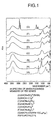
- Fig. 1 in the accompanying drawings shows infrared-ray absorption spectra of the composite metal polybasic salts of the present invention in comparison with the infrared-ray absorption spectrum of a hydrotalcite.
- Fig. 1(A) is an infrared-ray absorption spectrum of an Al-Mg-type composite metal polybasic salt in which the anions are sulfuric acid ions
- Fig. 1(B) is an infrared-ray absorption spectrum of an Al-Mg-type composite metal polybasic salt in which the anions are carbonic acid ions
- Fig. 1(C) is an infrared-ray absorption spectrum of an Al-Mg-type composite metal polybasic salt in which the anions are dihydrogen phosphoric acid ions
- Fig. 1(D) is an infrared-ray absorption spectrum of an Al-Mg-type composite metal polybasic salt in which the anions are monohydrogen phosphoric acid ions
- Fig. 1(D) is an infrared-ray absorption spectrum of an Al-Mg-type composite metal polybasic salt in which the anions are monohydrogen phosphoric acid ions
- Fig. 1(D) is an infrared-ray absorption
- Fig. 1(E) is an infrared-ray absorption spectrum of an Al-Mg-type composite metal polybasic salt in which the anions are phosphoric acid ions
- Fig. 1(F) is an infrared-ray absorption spectrum of an Al-Mg-type composite metal polybasic salt in which the anions are silicic acid ions
- Fig. 1(G) is an infrared-ray absorption spectrum of an Al-Mg-type composite metal polybasic salt in which the anions are stearic acid ions
- Fig. 1(H) is an infrared-ray absorption spectrum of a hydrotalcite in which the anions are carbonic acid ions.
- the composite metal polybasic salts of the present invention exhibit characteristic absorptions due to the hydroxyl group at wave numbers of from 3800 to 2700 cm -1 and characteristic absorptions due to the incorporated anions at wave numbers of from 900 to 1500 cm -1 .
- the composite metal polybasic salts of the invention exhibit sharp absorption peaks in the far infrared regions of a wave number of not larger than 2000 cm -1 , and are useful as a heat insulator for absorbing heat rays.
- the Al-Mg-type composite metal polybasic salt in which the anions are stearic acid ions exhibits characteristic absorptions due to the methylene group at wave numbers of from 3000 to 2800 cm -1 and characteristic absorptions due to carboxylate ions at wave numbers of from 1650 to 1500 cm -1 .
- the composite metal polybasic salt (PBS) of the present invention has a novel crystal structure which is quite different from those of the known magaldrate, hydrotalcite and a salt of lithium aluminum composite hydroxide.
- Fig. 2 in the attached drawings shows an X-ray diffraction image of the PBS of the Al-Mg type according to the present invention.
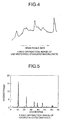
- Figs. 3 and 4 are diagrams of X-ray diffraction images of known magaldrates
- Fig. 5 is a diagram of an X-ray diffraction image of a hydrotalcite
- Fig. 6 is a diagram of an X-ray diffraction image of a salt of lithium aluminum composite hydroxide.
- the above two compounds exhibit quite different X-ray diffraction images.
- the two compounds exhibit quite different X-ray diffraction images.
- the composite metal polybasic salt which is a product of the invention has primary particles that are expanding in the direction of AB-axis in the basic layer. Accordingly, the product of the present invention disperses well in the resin making it possible to strikingly improve transparency of the blended resin, chlorine-trapping property, resistance against acid and heat resistance.
- the composite metal polybasic salt of the present invention has a feature in the X-ray diffractive fine structure called laminate asymmetry.
- the asymmetric peak rises relatively sharply on the narrow angle side (side on where 2 ⁇ is small) and is mildly inclined on the wide angle side (side on where 2 ⁇ is large).
- the laminate asymmetric index (Is) is 1.0 when the peak is completely symmetrical, and increases as the breaking angle becomes larger than the rising angle.
- the laminate asymmetric index (Is) has the following meaning.
- the PBS of the present invention has a laminar crystal structure in which basic layers of M 3+ p Mg q (OH) y are stacked one upon the other.
- the sizes (lengths and areas) of the basic layers are not uniform but are varying over wide ranges and, besides, the basic layers are twisted or curved forming a structure which is not plane.
- the anions easily exchange ions offering a large ion-exchange capacity and a large ion-exchange rate.
- this is used as an additive for a resin, for trapping, for example, chlorine ions, then, an excellent ability is exhibited.
- the composite metal polybasic salt of the present invention When heated from room temperature up to a temperature of 200°C, the composite metal polybasic salt of the present invention exhibits a weight reduction ratio of not larger than 15% by weight and, particularly, not larger than 5% by weight, and offers a distinguished advantage that it does not develop foaming at a resin-working temperature when it is mixed into the resin.
- the hydrotalcite has a defect of developing foaming as the water separates at the resin-working temperature.
- the composite metal polybasic salt of the present invention is free from this problem.
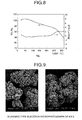
- Fig. 8 shows the results of differential thermal analysis (DTA) of the composite metal polybasic salt of the invention and of the hydrotalcite.
- the hydrotalcite exhibits a very large endothermic peak due to the vaporization of water in a temperature range of from 190 to 240°C, whereas the PBS does not exhibit such a large endothermic peak proving its excellent resistance against the foaming.
- the composite metal polybasic salt of the present invention varies the surface area to a large extent depending upon the kind of anions to be exchanged, and possesses a relative specific surface area and a small porous volume when the anions are sulfuric acid ions.
- the PBS of the present invention has a BET specific surface area of not larger than 20 m 2 /g and, particularly, in a range of from 0.3 to 10 m 2 /g, and a porous volume of those pores having diameters of from 17 to 3000 angstroms as found by the CI method of from 0.0005 to 0.05 ml/g and, particularly, from 0.02 to 0.035 ml/g.
- the PBS of the present invention has a large specific surface area and a large porous volume.
- the BET specific surface area is about 147 m 2 /g and the porous volume of those pores having diameters of from 17 to 3000 angstroms is about 0.425 ml/g as found by the CI method.
- the composite metal polybasic salt of the present invention has a volume based median diameter (D 50 ) of, generally, from 0.1 to 20 ⁇ m and, particularly, from 2 to 10 ⁇ m as measured by the laser diffraction method.
- Fig. 9 is a scanning-type electron microphotograph showing the granular structure of an Al-Mg-type composite metal polybasic salt in which the anions are sulfuric acid ions
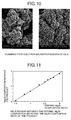
- Fig. 10 is a scanning-type electron microphotograph showing the granular structure of an Al-Mg-type composite metal polybasic salt in which the anions are stearic acid ions.
- the PBS of the present invention has a small porous volume as measured above despite of its honeycomb-type or pumice-type internal structure with pleat-like thin-piece texture, probably because the holes that are formed have diameters considerably larger than the above-mentioned fine pore diameters.
- the composite metal polybasic salt is prepared by reacting a water-soluble salt of a trivalent metal with an oxide, a hydroxide or a water-soluble salt of magnesium under the conditions of a pH of from 6.0 to 9.0 and a temperature of not lower than 50°C and, preferably, not lower than 80°C and, if necessary, executing the ion exchange in the presence of an acid or a soluble salt of acid.
- the water-soluble salt of a trivalent metal such as Al or the like
- a chloride, a nitrate or a sulfate that is soluble in water. From the standpoint of easy synthesis, however, it is desired in the present invention to synthesize the composite metal polybasic salt in the form of a sulfate. It is therefore most desired to use the composite metal polybasic salt in the form of a sulfate.
- the starting divalent Mg metal can be used in any form of an oxide, a hydroxide or a water-soluble salt. From the standpoint of synthesis, however, it is most convenient to use an oxide such as magnesium oxide or a hydroxide such as magnesium hydroxide. Even when a water-soluble salt such as a chloride, a nitrate or a sulfate of a divalent metal is used, it is possible to synthesize a composite metal polybasic salt according to the present invention by controlling the pH in the control system to lie within the above-mentioned range, as a matter of course.
- the composite metal polybasic salt has a feature in that it possesses both the hydroxyl group and the anionic group that are bonded to each other.
- the pH becomes larger than the above range it becomes difficult to introduce the anionic group.
- the pH becomes smaller than the above range on the other hand, it becomes difficult to introduce the hydroxyl group.
- the reacting and mixing ratio of the trivalent metal compound and the magnesium metal compound is so set that the composition ratio of the above-mentioned general formula (1) is satisfied.
- the molar ratio of Mg/M 3+ in the product tends to become smaller than the feeding molar ratio of Mg/M 3+ in the starting material.
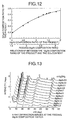
- Fig. 11 in the accompanying drawing illustrates a relationship between the feeding molar ratio of Mg/M 3+ in the starting material and the molar ratio of Mg/M 3+ in the product in relation to the Al-Mg-type composite metal polybasic salt.
- the relationship between the two is almost linear, from which it will be understood that the molar ratio of Mg/M 3+ in the final product can be determined by determining the feeding molar ratio.
- the feeding molar ratio of Mg/M 3+ is in a range of from 1.3 to 3.5 and, particularly, from 1.6 to 3.1.
- Fig. 12 illustrates a relationship between the above two, from which it will be learned that the molar ratio of SO 3 /Al in the product monotonously increases with a increase in the molar ratio of Mg/Al.
- a Mg(OH) 6 octahedral layer of which Mg is isomorphous-substituted by M 3+ serves as a basic layer, and anions such as sulfuric acid radicals are incorporated among the basic layers in a form to be balanced with excess of cations due to the substitution.
- the sulfuric acid radicals are all incorporated in a form to be balanced by excess of cations, the molar ratio of SO 3 /Al becomes 0.5.
- Fig. 13 shows an X-ray diffraction image of a product of when the feeding molar ratio Mg/Al of the starting material is changed in relation to the Al-Mg composite metal polybasic salt.
- a solution of an oxide of magnesium metal, of a slurry of a hydroxide thereof or of water-soluble salts thereof may be added to an aqueous solution of trivalent metal salts.
- an aqueous solution of trivalent metal salts may be added to an aqueous solution of an oxide of a divalent metal, of a slurry of a hydroxide thereof or of water-soluble salts thereof, or they may be simultaneously added together.
- the reaction can be completed by maintaining the reaction mixture at the above-mentioned temperature for about 2 to 72 hours with stirring. Though not generally required, the reaction may be conducted under the hydrothermal conditions by using a pressurized container.
- reaction product is washed with water, subjected to the solid-liquid separation operation such as filtration, dried at 60 to 150°C, and, if necessary, is heat-treated at 150 to 230°C to obtain a product.
- the composite metal polybasic salt of the present invention a variety of anions can be introduced by the ion-exchange method.
- the starting composite metal polybasic salt to be used for the anion-exchange it is desired to use the composite metal polybasic salt of the sulfuric acid type.
- an alkali metal salt such as sodium salts of the above-mentioned anions.
- a sodium bicarbonate or a sodium carbonate is used for introducing carboxylic acid radicals
- a sodium carboxylate or sodium sulfonate is used for introducing organic acid anions
- a sodium phosphate, a monohydrogen sodium phosphate or a dihydrogen sodium phosphate is used for introducing phosphoric acid radicals
- a sodium silicate is used for introducing silicic acid radicals, to which only, however, the invention is in no way limited.
- Anions based on the ion exchange can be introduced by bringing a composite metal polybasic salt of the sulfuric acid type in the form of a powder or a wet cake into uniform contact with an aqueous solution of a salt of the above-mentioned anions at a temperature of from 0 to 100°C.
- the ion-exchange processing is completed by executing the contact for from about 5 minutes to about 3 hours.
- the obtained product is subjected to the filtration, washing with water, drying and, if necessary, to the pulverization and classification to obtain a product.
- the composite metal polybasic salt of the present invention can be used in its own form as an additive for resins, as an anion-exchanger or as a heat insulator. If necessary, however, it may be coated with an organic assistant or an inorganic assistant and can, then, be used for a variety of applications.
- organic assistant there can be exemplified such coating agents as metal soaps such as calcium salt, zinc salt, magnesium salt and barium salt of stearic acid, palmitic acid or lauric acid; silane coupling agent, aluminum coupling agent, titanium coupling agent, zirconium coupling agent, various waxes, and unmodified or modified resins (e.g., rosin, petroleum resin, etc.).
- the composite metal polybasic salt of the present invention can be treated for its surfaces with the above coating agent and can be used for a variety of applications.
- the coating agent in an amount of from 0.5 to 10% by weight and, particularly, from 1 to 5% by weight with respect to the PBS.
- silica such as aerosil and hydrophobically treated aerosil
- silicates such as calcium silicate and magnesium silicate
- metal oxides such as calcia, magnesia and titania
- metal hydroxide such as magnesium hydroxide and aluminum hydroxide
- metal carbonates such as calcium carbonate
- inorganic assistants in an amount of from 0.01 to 200% by weight and, particularly, from 0.1 to 200% by weight per the PBS.
- urea ethyleneurea, propyleneurea, 5-hydroxypropyleneurea, 5-methoxypropyleneurea, 5-methylpropyleneurea, parabanic acid, 4,5-dimethoxyethyleneurea, pyrrolidene, piperidine, morpholine, dicyandiamide, 2-hydrazobenzothiazole, potassium permanganate, benzalkonium chloride, iodophor, hydrazine, hydrazine sulfate, aluminum sulfate hydrazine sulfate complex salt, organic/inorganic antibacterial agent (iodophor and silver-exchanged zeolite), and optical catalyst (titanium oxide, etc.).
- the PBS of the present invention has excellent properties as described above. By utilizing these properties, the PBS can be used in such applications as an additive for resins, an ion (anion)-exchanger, a heat insulator, a base member for cosmetics, a deodoring/antibacterial agent, a flame retardant, an ultraviolet ray-absorbing agent, a nanocomposite starting material, etc.
- the composite metal polybasic salt of the present invention is useful as an additive for thermoplastic resins, thermosetting resins and various rubbers.
- the composite metal polybasic salt of the present invention does not develop foaming that is caused when the water separates at the resin-working temperature, can be easily blended in the resin, and exhibits excellent heat stability since it contains components such as magnesium metal, trivalent metal components and hydroxyl groups that impart heat-stabilizing property to the resins.
- the composite metal polybasic salt has anion-exchanging property and exhibits excellent property for trapping chlorine ions.
- the composite metal polybasic salt absorbs far infrared rays and exhibits excellent heat-retaining property.
- the composite metal polybasic salt of the invention can be blended in the resins as a heat stabilizer, a halogen catcher, a heat-retaining agent (a heat insulator) or as an anti-blocking agent.
- thermoplastic resin to be blended with the composite metal polybasic salt of the present invention there can be preferably exemplified an olefin resin and, particularly, a low-, an intermediate- or a high-density polyethylene, an isotactic polypropylene, a syndiotactic polypropylene, or a polypropylene polymer which is a copolymer thereof with an ethylene or an ⁇ -olefin, a linear low-density polyethylene, an ethylene/propylene copolymer, a polybutene-1, an ethylene/butene-1 copolymer, a propylene/butene-1 copolymer, an ethylene/propylene/butene-1 copolymer, an ethylene/vinyl acetate copolymer, an ionically crosslinked olefin copolymer (ionomer), or an ethylene/acrylic acid ester copolymer, which may be used in a single kind
- the additive for resins of the present invention can also be used for other known resin films, fibers and resin-molded articles, such as polyamides like nylon 6, nylon 6-6, nylon 6-10, nylon 11 and nylon 12, thermoplastic polyesters such as polyethylene terephthalate and polybutylene terephthalate, as well as polycarbonate, polysulfone, vinyl chloride resin, vinylidene chloride resin and vinyl fluoride resin.
- the composite metal polybasic salt is used in an amount of from 0.01 to 200 parts by weight and, particularly, in an amount of from 0.1 to 100 parts by weight per 100 parts by weight of the thermoplastic resin.
- thermoplastic resins, various rubbers and thermosetting resins can be blended with the composite metal polybasic salt of the present invention as an additive for reforming the resins.
- a nitrile-butadiene rubber NBR
- SBR styrenebutadiene rubber
- CR chloroprene rubber
- BR polybutadiene
- IIPI polyisoprene
- a butyl rubber a natural rubber, an ethylene-propylene rubber (EPR), an ethylene-propylene-diene rubber (EPDM), a polyurethane, a silicone rubber and an acrylic rubber.
- thermoplastic elastomer there can be exemplified a styrene-butadiene-stylene block copolymer, a styreneisoprene-styrene block copolymer, a hydrogenated styrenebutadiene-styrene block copolymer, a hydrogenated styrene-isoprene-stylene block copolymer, a partially crosslinked olefinic thermoplastic elastomer.
- thermosetting resin there can be exemplified a phenol-formaldehyde resin, a furan-formaldehyde resin, a xylene-formaldehyde resin, a ketone-formaldehyde resin, a urea-formaldehyde resin, a melamine-formaldehyde resin, an alkyd resin, an unsaturated polyester resin, an epoxy resin, a bismaleimide resin, a triallylcyanulate resin, a thermosetting acrylic resin and a silicone resin, which may be used in a combination of two or more kinds.
- the composite metal polybasic salt of the present invention is used in an amount of from 0.01 to 200 parts by weight and, particularly, in an amount of from 0.1 to 100 parts by weight per 100 parts by weight of the thermoplastic resin, thermosetting resin or elastomer.
- MgO magnesium hydroxide
- reaction product was filtered, washed with 3000 ml of hot water, dried at 110°C and was pulverized to obtain a white powder.
- composition of the obtained fine powder was analyzed to be as follows. Properties were as shown in Table 1. Al 1.00 Mg 1.23 (OH) 4.71 (SO 4 ) 0.37 ⁇ 1.6H 2 O 2 ⁇ Relative intensity 10.30° 100% 22.40° 55% 37.10° 40% 63.20° 27%
- MgO magnesium hydroxide
- reaction product was filtered, washed with 1800 ml of hot water, dried at 110°C and was pulverized to obtain a white powder.
- composition of the obtained fine powder was analyzed to be as follows. Properties were as shown in Table 1. Al 1.00 Mg 1.23 (OH) 4.50 (SO 4 ) 0.35 ⁇ 1.6H 2 O 2 ⁇ Relative intensity 10.30° 100% 20.33° 54% 35.33° 19% 61.13° 24%
- MgO magnesium hydroxide
- reaction product was filtered, washed with 3000 ml of hot water, dried at 110°C and was pulverized to obtain a white powder.
- composition of the obtained fine powder was analyzed to be as follows. Properties were as shown in Table 1. Al 1.00 Mg 1.29 (OH) 4.81 (SO 4 ) 0.39 ⁇ 1.5H 2 O 2 ⁇ Relative intensity 10.17° 100% 20.21° 66% 35.85° 23% 61.33° 29%
- the polybasic salt EX-3 possessed a BET specific surface area of 4.15 m 2 /g and a porous volume of 0.032 cc/g.
- An X-ray diffraction image of the polybasic salt EX-3 is shown in Fig. 2 and a scanning electron microphotograph thereof is shown in Fig. 9.
- Example 3 10 g of the fine white powder obtained in Example 3 was dispersed in 200 ml of ion-exchanged water, and to which the above NaHCO 3 solution was added. The mixture was heated at 90°C and was stirred for two hours. After the reaction, the reaction product was filtered, washed with hot water, dried at 110°C for 12 hours and was pulverized to obtain a white powder.
- composition of the obtained fine powder was analyzed to be as follows. Properties were as shown in Table 1. Al 1.00 Mg 1.30 (OH) 4.81 (SO 4 ) 0.11 (CO 3 ) 0.28 ⁇ 1.7H 2 O 2 ⁇ Relative intensity 11.67° 100% 23.47° 33% 35.03° 31% 39.50° 12% 46.67° 9% 61.27° 29%
- magnesium hydroxide 64.2%) and ion-exchanged water were added into a 1000-ml beaker so that the total amount was 400 ml, followed by stirring and dispersion to prepare an Mg(OH) 2 slurry.
- the reaction product was filtered, washed with 1800 ml of hot water, dried at 110°C and was pulverized to obtain a white powder. 10 Grams of the fine white powder was dispersed in 200 ml of ion-exchanged water, which was, then, added to the above sodium stearate solution. The mixture was then heated at 90°C and was stirred for two hours. After the reaction, the reaction product was filtered, washed with 1000 ml of hot water, and was dried at 110°C using a blower-drier overnight.
- composition of the obtained fine powder was analyzed to be as follows. Properties were as shown in Table 1. Al 1.00 Mg 1.10 (OH) 4.50 (C 18 H 35 O 2 ) 0.35 ⁇ 0.8H 2 O 2 ⁇ Relative intensity 2.26° 23% 5.20° 53% 8.34° 12% 21.14° 100% 35.48° 13% 61.46° 9%
- composition of the obtained fine powder was analyzed to be as follows. Properties were as shown in Table 1. Al 1.00 Mg 1.29 (OH) 4.81 (C 18 H 35 O 2 ) 0.39 ⁇ 0.7H 2 O 2 ⁇ Relative intensity 2.26° 20% 5.03° 44% 8.17° 5% 21.27° 100% 35.43° 15% 61.20° 12%
- Example 3 10 Grams of the fine white powder obtained in Example 3 was added to the above Na 2 HPO 4 solution, and the mixture was messed-up to 300 ml and was heated at 90°C and was stirred for two hours. After the reaction, the reaction product was filtered, washed with 1000 ml of hot water, dried at 110°C for 12 hours and was pulverized to obtain a fine white powder.
- the composition of the obtained fine powder was analyzed to be as follows. Properties were as shown in Table 1. Al 1.00 Mg 1.32 (OH) 5.18 (HPO 4 ) 0.23 ⁇ 1.7H 2 O 2 ⁇ Relative intensity 11.27° 100% 21.98° 42% 35.85° 37% 61.70° 38%
- a white powder was obtained through the same operation as in Example 7 but using 9.53 g of NaH 2 PO 4 ⁇ 2H 2 O (purity of 99%) instead of Na 2 HPO 4 ⁇ 12H 2 O.
- composition of the obtained fine powder was analyzed to be as follows. Properties were as shown in Table 1. Al 1.00 Mg 1.25 (OH) 5.14 (H 2 PO 4 ) 0.36 ⁇ 1.9H 2 O 2 ⁇ Relative intensity 10.13° 75% 21.30° 100% 36.30° 38% 61.66° 51%
- a white powder was obtained through the same operation as in Example 7 but using 7.74 g of Na 3 PO 4 ⁇ 12H 2 O (purity of 99%) instead of Na 2 HPO 4 ⁇ 12H 2 O.
- composition of the obtained fine powder was analyzed to be as follows. Properties were as shown in Table 1. Al 1.00 Mg 1.57 (OH) 5.49 (PO 4 ) 0.22 ⁇ 1.7H 2 O 2 ⁇ Relative intensity 11.71° 100% 23.24° 34% 35.55° 32% 61.30° 33%
- composition of the obtained fine powder was analyzed to be as follows. Properties were as shown in Table 1. Al 1.00 Mg 1.30 (OH) 4.81 (SO 4 ) 0.06 (Si 3 O 7 ) 0.34 ⁇ 1.3H 2 O 2 ⁇ Relative intensity 8.03° 31% 14.57° 30% 22.60° 100% 35.53° 46% 61.37° 50%
- the paste after the reaction was dried at 110°C and was pulverized to obtain a white powder.
- the obtained fine powder was a mixture of a magaldrate disclosed in Japanese Examined Patent Publication (Kokoku) No. 58210/1990 and an aluminum hydroxide (gibbsite), and the magaldrate only could not be obtained.
- Fig. 3 shows an X-ray diffraction image of the magaldrate disclosed in Japanese Examined Patent Publication (Kokoku) No. 58210/1990 and Fig. 4 shows an X-ray diffraction image of a USP-referred standard magaldrate. Since these drawings do not show a scale of angles, the angles refer to values of the Journal of Pharmaceutical Science, Vol. 1.6, p. 325, 1978. 2 ⁇ Relative intensity 11.42° 57% 23.22° 44% 34.91° 78% 39.16° 30% 46.07° 37% 60.95° 100% 62.32° 85%
- the mixture was stirred to prepare a slurry which was then hydrothermally reacted at 170°C for 24 hours.
- reaction product was filtered, washed with 6000 ml of hot water, dried at 110°C and was pulverized to obtain a white powder.
- composition of the obtained fine powder was analyzed to be as follows. Al 6 Mg 2 (OH) 16 (CO 3 ) ⁇ nH 2 O 2 ⁇ Relative intensity 11.63° 100% 23.38° 42% 34.79° 21% 39.35° 16% 46.81° 17% 60.59° 6% 61.96° 7%
- composition of the obtained fine powder was analyzed to be as follows. Li 2 Al 4 (OH) 12 CO 3 ⁇ nH 2 O 2 ⁇ Relative intensity 11.77° 100% 20.20° 11% 23.61° 59% 36.07° 29% 40.63° 14% 48.03° 18% 63.24° 11% 64.54° 9%
- the present invention provides a composite metal polybasic salt containing a trivalent metal and magnesium as metal components and having a novel crystal structure, and a method of preparing the same.
- the invention further provides a composite metal polybasic salt which has anion-exchanging property, which by itself is useful as an anion-exchanger, capable of introducing anions suited for the use upon anion-exchange, and finds a wide range of applications, and a method of preparing the same.
Landscapes
- Chemical & Material Sciences (AREA)
- Organic Chemistry (AREA)
- Inorganic Chemistry (AREA)
- Chemical Kinetics & Catalysis (AREA)
- Life Sciences & Earth Sciences (AREA)
- Geology (AREA)
- Polymers & Plastics (AREA)
- Medicinal Chemistry (AREA)
- Engineering & Computer Science (AREA)
- Materials Engineering (AREA)
- Health & Medical Sciences (AREA)
- Compounds Of Alkaline-Earth Elements, Aluminum Or Rare-Earth Metals (AREA)
- Compositions Of Macromolecular Compounds (AREA)
- Silicates, Zeolites, And Molecular Sieves (AREA)
Applications Claiming Priority (3)
| Application Number | Priority Date | Filing Date | Title |
|---|---|---|---|
| JP19511799 | 1999-07-08 | ||
| JP19511799 | 1999-07-08 | ||
| PCT/JP2000/004554 WO2001004053A1 (fr) | 1999-07-08 | 2000-07-07 | Sel polybasique composite, procede de production de ce sel, et utilisation |
Publications (2)
| Publication Number | Publication Date |
|---|---|
| EP1112960A1 true EP1112960A1 (de) | 2001-07-04 |
| EP1112960A4 EP1112960A4 (de) | 2003-08-27 |
Family
ID=16335789
Family Applications (1)
| Application Number | Title | Priority Date | Filing Date |
|---|---|---|---|
| EP00944340A Withdrawn EP1112960A4 (de) | 1999-07-08 | 2000-07-07 | Zusammengesetztes mehrbasiges salz, verfahren zur herstellung desselben undverwendung |
Country Status (6)
| Country | Link |
|---|---|
| US (1) | US6706249B1 (de) |
| EP (1) | EP1112960A4 (de) |
| KR (1) | KR20010086374A (de) |
| CN (1) | CN1321138A (de) |
| CA (1) | CA2343730A1 (de) |
| WO (1) | WO2001004053A1 (de) |
Families Citing this family (14)
| Publication number | Priority date | Publication date | Assignee | Title |
|---|---|---|---|---|
| JP2002129141A (ja) * | 2000-10-25 | 2002-05-09 | Fuji Chem Ind Co Ltd | 赤外線吸収剤および農業用フィルム |
| EP1731497B1 (de) * | 2004-03-05 | 2016-04-27 | Kyowa Chemical Industry Co., Ltd. | Partikel eines anionen einer organischen säure enthaltenden aluminumsalzhydroxids und deren anwendung |
| JP4709498B2 (ja) * | 2004-04-21 | 2011-06-22 | 学校法人早稲田大学 | 結晶質層状複水酸化物粉末とその製造方法並びに成型体及び有害物質の固定化方法 |
| JP2005335965A (ja) * | 2004-05-24 | 2005-12-08 | National Institute For Materials Science | ヘキサメチレンテトラミンを用いた均一沈殿法による良質な層状複水酸化物の製造方法およびその用途 |
| JP4863192B2 (ja) * | 2005-05-31 | 2012-01-25 | 学校法人早稲田大学 | 高い陰イオン交換能を有する炭酸汚染し難い安定性に優れた層状複水酸化物とその合成方法 |
| WO2007065859A1 (en) * | 2005-12-06 | 2007-06-14 | Akzo Nobel N.V. | Process for preparing organically modified layered double hydroxide |
| ES2385672T3 (es) * | 2005-12-06 | 2012-07-30 | Akzo Nobel N.V. | Proceso para preparación de hidróxido doble estratificado modificado orgánicamente |
| EP2017224A1 (de) * | 2006-04-20 | 2009-01-21 | Mizusawa Industrial Chemicals Ltd. | Neues komplexes aluminiumhydroxidsalz und herstellungsverfahren dafür |
| HRP20080015A9 (hr) * | 2008-01-11 | 2010-05-31 | NOVATECH ISTRA�IVANJE d.o.o. | Formulacija na temelju mikroniziranog prirodnog kalcitnog minerala kao biljni pojačivač i mineralno gnojivo |
| JP5336932B2 (ja) * | 2009-05-29 | 2013-11-06 | 株式会社東芝 | 水質浄化材料、水質浄化方法、リン酸肥料前駆体及びリン酸肥料前駆体の製造方法 |
| CN106975437A (zh) * | 2017-03-28 | 2017-07-25 | 同济大学 | 一种过硫酸根插层层状复合金属氢氧化物的制备与应用 |
| CN106984258B (zh) * | 2017-03-28 | 2020-06-02 | 同济大学 | 一种次氯酸根插层层状复合金属氢氧化物的制备与应用 |
| CN107021526A (zh) * | 2017-03-28 | 2017-08-08 | 同济大学 | 一种高锰酸根插层层状复合金属氢氧化物的制备与应用 |
| CN114204114B (zh) * | 2021-11-12 | 2024-01-30 | 北京化工大学 | 一种用于室温下的锂铝水滑石基固态电解质膜、其制备及包含其的锂电池 |
Family Cites Families (21)
| Publication number | Priority date | Publication date | Assignee | Title |
|---|---|---|---|---|
| JPS493760B1 (de) * | 1970-07-31 | 1974-01-28 | ||
| JPS4829477B1 (de) * | 1970-12-29 | 1973-09-10 | ||
| JPS4829478B1 (de) * | 1970-12-30 | 1973-09-10 | ||
| US4904457A (en) * | 1974-03-30 | 1990-02-27 | Aluminum Company Of America | Synthetic hydrotalcite |
| GB1598375A (en) * | 1978-02-17 | 1981-09-16 | Anphar Sa | Aluminium magnesium carbonate |
| DE3306822C2 (de) * | 1983-02-26 | 1985-01-03 | Giulini Chemie Gmbh, 6700 Ludwigshafen | Kristallines, basisches Aluminium-Magnesium-Carbonat |
| JPS606619A (ja) * | 1983-06-27 | 1985-01-14 | Kyowa Chem Ind Co Ltd | 鉄分欠乏症処置剤及びその製法 |
| US5250279A (en) * | 1991-12-20 | 1993-10-05 | J. M. Huber Corporation | Method for the manufacture of hydrotalcite |
| WO1993022237A1 (en) * | 1992-04-30 | 1993-11-11 | J.M. Huber Corporation | Method for production of synthetic hydrotalcite |
| US5362457A (en) * | 1992-08-13 | 1994-11-08 | Aluminum Company Of America | Direct synthesis of anion substituted hydrotalcite |
| JP2925857B2 (ja) * | 1992-10-13 | 1999-07-28 | 水澤化学工業株式会社 | 樹脂用配合剤 |
| US5364828A (en) * | 1992-10-21 | 1994-11-15 | Minerals Technologies | Spheroidal aggregate of platy synthetic hydrotalcite |
| US5507980A (en) * | 1993-07-06 | 1996-04-16 | Aristech Chemical Corporation | Basic inorganic binders |
| US5776424A (en) * | 1994-04-29 | 1998-07-07 | Aluminum Company Of America | Two powder synthesis of hydrotalcite and hydrotalcite-like compounds with monovalen inorganic anions |
| US5728366A (en) * | 1994-04-29 | 1998-03-17 | Aluminum Company Of America | Two powder synthesis of hydrotalcite and hydrotalcite-like compounds with monovalent organic anions |
| US5730951A (en) * | 1994-04-29 | 1998-03-24 | Aluminum Company Of America | Two powder synthesis of hydrotalcite and hydrotalcite-like compounds with polyvalent inorganic anions |
| US5578286A (en) * | 1994-04-29 | 1996-11-26 | Aluminum Company Of America | Two powder synthesis of hydrotalcite-like compounds with divalent or polyvalent organic anions |
| DE19503522A1 (de) * | 1995-02-03 | 1996-08-08 | Rwe Dea Ag | Herstellung gemischter schichtförmig aufgebauter Metallhydroxide sowie deren Metalloxide |
| US5814291A (en) * | 1996-07-19 | 1998-09-29 | Aristech Chemical Corporation | Simplified synthesis of anion intercalated hydrotalcites |
| JP4004160B2 (ja) * | 1998-09-21 | 2007-11-07 | 協和化学工業株式会社 | ウラン(u)含量の少ないハイドロタルサイト類化合物およびその製造法 |
| DE60007351T2 (de) * | 1999-08-11 | 2004-10-28 | Akzo Nobel N.V. | Verfahren zur herstellung einer al-haltigen, nicht mg-haltigen, anionischen tonerde |
-
2000
- 2000-07-07 WO PCT/JP2000/004554 patent/WO2001004053A1/ja not_active Ceased
- 2000-07-07 US US09/786,423 patent/US6706249B1/en not_active Expired - Fee Related
- 2000-07-07 CA CA002343730A patent/CA2343730A1/en not_active Abandoned
- 2000-07-07 CN CN00801890A patent/CN1321138A/zh active Pending
- 2000-07-07 EP EP00944340A patent/EP1112960A4/de not_active Withdrawn
- 2000-07-07 KR KR1020017002987A patent/KR20010086374A/ko not_active Withdrawn
Also Published As
| Publication number | Publication date |
|---|---|
| WO2001004053A9 (fr) | 2001-06-21 |
| WO2001004053A1 (fr) | 2001-01-18 |
| CN1321138A (zh) | 2001-11-07 |
| KR20010086374A (ko) | 2001-09-10 |
| CA2343730A1 (en) | 2001-01-18 |
| US6706249B1 (en) | 2004-03-16 |
| EP1112960A4 (de) | 2003-08-27 |
Similar Documents
| Publication | Publication Date | Title |
|---|---|---|
| US6706249B1 (en) | Composite polybasic salt, process for producing the same, and use | |
| Ehlsissen et al. | Preparation and characterization of turbostratic Ni/Al layered double hydroxides for nickel hydroxide electrode applications | |
| Oriakhi et al. | Incorporation of poly (acrylic acid), poly (vinylsulfonate) and poly (styrenesulfonate) within layered double hydroxides | |
| JP4004160B2 (ja) | ウラン(u)含量の少ないハイドロタルサイト類化合物およびその製造法 | |
| EP0549340B1 (de) | Stabilisator für Harze | |
| EP0776317B1 (de) | Zwei-pulver-verfahren zur herstellung von hydrotalcit und hydrotalcitähnlichen verbindungen | |
| JP5046389B2 (ja) | アルナイト型化合物粒子、その製造方法およびその利用 | |
| US5730951A (en) | Two powder synthesis of hydrotalcite and hydrotalcite-like compounds with polyvalent inorganic anions | |
| US5419883A (en) | Lithium aluminum complex hydroxide salt and process for preparation thereof | |
| US5728363A (en) | Two powder synthesis of hydrotalcite and hydrotalcite-like compounds | |
| EP0654447A1 (de) | Elektroleitende Oxidteilchen und Verfahren zu deren Herstellung | |
| JPH06136179A (ja) | 樹脂用配合剤 | |
| US6835320B1 (en) | Zinc-modified composite polybasic salt, process for producing the same, and use | |
| RU2136593C1 (ru) | Аморфное производное каолина и способ его получения | |
| US6652828B2 (en) | Process for producing Mg-containing non-Al anionic clay | |
| JPH0579602B2 (de) | ||
| JP4916601B2 (ja) | 板状Mg−Al系ハイドロタルサイト型粒子粉末及びその製造法 | |
| JP4729213B2 (ja) | Li−Al系層状複水酸化物粒子粉末及びその製造法 | |
| CA2568555A1 (en) | Gibbsite type aluminum hydroxide patricles | |
| JP4638996B2 (ja) | イオン交換による複合金属多塩基性塩の製造方法 | |
| JP2833827B2 (ja) | 樹脂用配合剤 | |
| JPWO2001004054A1 (ja) | 亜鉛変性複合多塩基性塩、その製法及び用途 | |
| JP3684297B2 (ja) | 紡錘形塩基性炭酸アルミニウム塩粒子及びその製造方法、紡錘形非晶質アルミナ粒子、紡錘形γ−アルミナ粒子及び用途 | |
| JPH11228936A (ja) | 極遠赤外乃至遠赤外線吸収体 | |
| JPWO2001004053A1 (ja) | 複合多塩基性塩、その製法及び用途 |
Legal Events
| Date | Code | Title | Description |
|---|---|---|---|
| PUAI | Public reference made under article 153(3) epc to a published international application that has entered the european phase |
Free format text: ORIGINAL CODE: 0009012 |
|
| 17P | Request for examination filed |
Effective date: 20010319 |
|
| AK | Designated contracting states |
Kind code of ref document: A1 Designated state(s): AT BE CH CY DE DK ES FI FR GB GR IE IT LI LU MC NL PT SE |
|
| AX | Request for extension of the european patent |
Free format text: AL;LT;LV;MK;RO;SI |
|
| RIC1 | Information provided on ipc code assigned before grant |
Ipc: 7C 01B 25/45 B Ipc: 7C 01B 33/38 B Ipc: 7C 07C 53/126 B Ipc: 7C 08K 5/098 B Ipc: 7C 01B 13/36 B Ipc: 7C 09K 5/14 B Ipc: 7B 01J 41/08 B Ipc: 7B 01J 41/10 B Ipc: 7C 08K 3/18 B Ipc: 7C 01F 7/00 A Ipc: 7C 07C 51/41 B Ipc: 7C 08K 3/22 B Ipc: 7C 09K 21/02 B |
|
| A4 | Supplementary search report drawn up and despatched |
Effective date: 20030710 |
|
| STAA | Information on the status of an ep patent application or granted ep patent |
Free format text: STATUS: THE APPLICATION IS DEEMED TO BE WITHDRAWN |
|
| 18D | Application deemed to be withdrawn |
Effective date: 20060201 |