EP1113647A2 - Contrôle de services IP simplifié - Google Patents
Contrôle de services IP simplifié Download PDFInfo
- Publication number
- EP1113647A2 EP1113647A2 EP00128204A EP00128204A EP1113647A2 EP 1113647 A2 EP1113647 A2 EP 1113647A2 EP 00128204 A EP00128204 A EP 00128204A EP 00128204 A EP00128204 A EP 00128204A EP 1113647 A2 EP1113647 A2 EP 1113647A2
- Authority
- EP
- European Patent Office
- Prior art keywords
- network
- call
- broadband
- media access
- access control
- Prior art date
- Legal status (The legal status is an assumption and is not a legal conclusion. Google has not performed a legal analysis and makes no representation as to the accuracy of the status listed.)
- Withdrawn
Links
Images


Classifications
-
- H—ELECTRICITY
- H04—ELECTRIC COMMUNICATION TECHNIQUE
- H04N—PICTORIAL COMMUNICATION, e.g. TELEVISION
- H04N21/00—Selective content distribution, e.g. interactive television or video on demand [VOD]
- H04N21/40—Client devices specifically adapted for the reception of or interaction with content, e.g. set-top-box [STB]; Operations thereof
- H04N21/45—Management operations performed by the client for facilitating the reception of or the interaction with the content or administrating data related to the end-user or to the client device itself, e.g. learning user preferences for recommending movies, resolving scheduling conflicts
- H04N21/462—Content or additional data management e.g. creating a master electronic programme guide from data received from the Internet and a Head-end or controlling the complexity of a video stream by scaling the resolution or bit-rate based on the client capabilities
- H04N21/4622—Retrieving content or additional data from different sources, e.g. from a broadcast channel and the Internet
-
- H—ELECTRICITY
- H04—ELECTRIC COMMUNICATION TECHNIQUE
- H04L—TRANSMISSION OF DIGITAL INFORMATION, e.g. TELEGRAPHIC COMMUNICATION
- H04L61/00—Network arrangements, protocols or services for addressing or naming
- H04L61/45—Network directories; Name-to-address mapping
- H04L61/4557—Directories for hybrid networks, e.g. including telephone numbers
-
- H—ELECTRICITY
- H04—ELECTRIC COMMUNICATION TECHNIQUE
- H04L—TRANSMISSION OF DIGITAL INFORMATION, e.g. TELEGRAPHIC COMMUNICATION
- H04L65/00—Network arrangements, protocols or services for supporting real-time applications in data packet communication
- H04L65/10—Architectures or entities
- H04L65/102—Gateways
- H04L65/1043—Gateway controllers, e.g. media gateway control protocol [MGCP] controllers
-
- H—ELECTRICITY
- H04—ELECTRIC COMMUNICATION TECHNIQUE
- H04L—TRANSMISSION OF DIGITAL INFORMATION, e.g. TELEGRAPHIC COMMUNICATION
- H04L9/00—Cryptographic mechanisms or cryptographic arrangements for secret or secure communications; Network security protocols
- H04L9/40—Network security protocols
-
- H—ELECTRICITY
- H04—ELECTRIC COMMUNICATION TECHNIQUE
- H04N—PICTORIAL COMMUNICATION, e.g. TELEVISION
- H04N21/00—Selective content distribution, e.g. interactive television or video on demand [VOD]
- H04N21/40—Client devices specifically adapted for the reception of or interaction with content, e.g. set-top-box [STB]; Operations thereof
- H04N21/47—End-user applications
- H04N21/478—Supplemental services, e.g. displaying phone caller identification, shopping application
- H04N21/4782—Web browsing, e.g. WebTV
-
- H—ELECTRICITY
- H04—ELECTRIC COMMUNICATION TECHNIQUE
- H04L—TRANSMISSION OF DIGITAL INFORMATION, e.g. TELEGRAPHIC COMMUNICATION
- H04L61/00—Network arrangements, protocols or services for addressing or naming
- H04L61/50—Address allocation
-
- H—ELECTRICITY
- H04—ELECTRIC COMMUNICATION TECHNIQUE
- H04L—TRANSMISSION OF DIGITAL INFORMATION, e.g. TELEGRAPHIC COMMUNICATION
- H04L65/00—Network arrangements, protocols or services for supporting real-time applications in data packet communication
- H04L65/1066—Session management
- H04L65/1101—Session protocols
Definitions
- the present invention relates to communication between users in diverse communication systems, and more particularly, to providing simplified service control for a broadband communication system including an Internet Protocol Telephony Network and public switched telephone network.
- PSTN public switched telephone network
- POTS plain old telephone service
- PC personal computers
- TV television
- this new architecture gives rise to new methods for provisioning telephone service and managing the association of directory numbers with telephone equipment so that the broadband communications network can, for example, properly route telephone or multimedia call traffic throughout the broadband communication network and legacy telephone networks (e.g., public switched telephone network (PSTN)).
- PSTN public switched telephone network
- aspects of the invention include to providing broadband access capabilities or enhanced services for use in conjunction with a packetized network such as an Internet Protocol (IP) based system infrastructure.
- IP Internet Protocol
- the present invention provides systems and techniques for service control useful in a powerful, facilities-based, broadband communications system that guarantees voice, data and video communication reliability and security to users for a multimedia system including integrated telephone, television and data network.
- One manner of providing service control includes using a server, for example a dynamic host protocol server (DHCP), that may be provided to, among other things, dynamically assign system addresses to various pieces of equipment throughout the broadband communication system.
- the DHCP may, for example, dynamically assign an IP address to a broadband residential gateway (BRG) based on a media access control (MAC) address of the BRG.
- BRG broadband residential gateway
- MAC media access control
- the BRG may then store that IP address in, for example, memory, and will insert that IP address into all packets sent by the BRG into the broadband communication system. Further, all information packets directed to the BRG will include the IP address so that the information packets can be successfully routed to the correct BRG.
- communication traffic may be successfully routed throughout the broadband communication system using the IP address assigned by the DHCP.
- the broadband communication system may create and assign a directory number for one or more telephones connected to the system (particularly for off-network telephone calls).
- This directory number is cross-correlated to one or more system addresses, for example, an IP address which have been assigned by the DHCP.
- the cross-correlation may be created and maintained by a server, for example the call manager (CM) server.
- CM call manager
- the CM may receive voice and signaling information from a voice gateway (VG) connected to a public switched telephone network (PSTN) and/or a signaling gateway (SG) connected to an SS7 network.
- VG voice gateway
- PSTN public switched telephone network
- SG signaling gateway
- This information will be directed to a directory number of, for example, one or more telephones of the subscriber.
- the CM may then identify what system address (e.g., IP address) that DN has been assigned to and direct the call traffic to that system address.
- the CM may then insert the call information into packets (e.g., packetized voice) and direct it to the correct subscriber equipment, for example one or more telephone(s) connected to a BRG.
- packets e.g., packetized voice
- the CM is able to properly establish a directory number with one or more telephones in the system and provide proper traffic routing between a telephone in the broadband communication system and a legacy telephone system that uses directory numbers for traffic routing.
- the relationship between the media access control (MAC) address of various pieces of equipment may be directly correlated to one or more directory numbers (DN).
- DN directory numbers
- a DHCP is not needed to assign a system address (e.g., IP address) to each piece of equipment in the system.
- the call manager (CM) will assign when necessary (for example when telephone calls will be made to a legacy telephone network using the particular piece of equipment (e.g., a POTS telephone)) a directory number (DN) to the equipment MAC address.
- Traffic routing of information packets in this broadband communication network will be enabled using the MAC addresses of the various pieces of equipment, rather than using IP addresses.
- packetized information for a telephone call directed to a system subscriber which is originated off-network, for example in a PSTN may be routed to the call manager (CM) through the voice gateway and signaling gateway and contain a directory number associate with one or more of the system subscriber's telephones.
- the CM will then directly relate the DN with the MAC address for the subscriber's BRG and/or telephony port card.
- the CM will then communicate with the subscriber's BRG and/or telephony port card using the MAC address associated with the assigned directory number (DN).
- the CM may insert the DN information into the packetized information if the subscriber has more than one DN associated with a single MAC address.
- the MAC address of other equipment for example a personal computer (PC), may also have a cross referenced assigned DN.
- PC personal computer
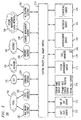
- Fig. 1 shows a schematic representation of a broadband network (e.g., broadband IP based network) in accordance with a preferred embodiment of aspects of the present invention.
- broadband network e.g., broadband IP based network
- Fig. 2 shows a block diagram of a preferred embodiment of a centralized control (IP central station) in accordance with aspects of the present invention.
- Fig. 3 shows a block diagram of a preferred embodiment of a local control apparatus (broadband residential gateway) in accordance with aspects of the present invention.
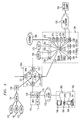
- Fig. 4 shows a detailed schematic representation of an exemplary embodiment of the broadband network shown in Fig. 1.
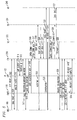
- Fig. 5 is a signal flow diagram illustrating a typical on-network to off-network call according to one preferred method of operating the broadband network shown in Fig. 1.
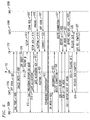
- Fig. 6 is a signal flow diagram illustrating a typical on-network to on-network call according to one preferred method of operating the broadband network shown in Fig. 1.
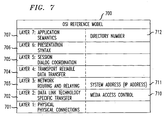
- Fig. 7 is a diagram illustrating an open system interconnection (OSI) model useful in a broadband communications network.
- OSI open system interconnection
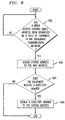
- Fig. 8 is a process flow diagram for service control according to one embodiment of operating a broadband communication network.
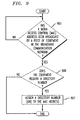
- Fig. 9 is a process flow diagram for service control according to another embodiment of operating a broadband communication network.
- the present invention includes a number of systems and techniques for service control in a broadband communications system that includes voice, data and multimedia audio and video communication.
- One variation includes service control based on multiple relationships between equipment specific unique media access control (MAC) addresses, system addresses and directory numbers to enable the properly route traffic between the broadband communication system and legacy telephone systems.
- Another variation of the present invention includes service control based on multiple relationships between equipment specific unique media access control (MAC) addresses and directory numbers (DNs) to enable the properly route traffic between the broadband communication system and legacy telephone systems.
- MAC equipment specific unique media access control
- DNs directory numbers
- the broadband network generally provides interconnection between a plurality of customer locations utilizing various interconnection architectures including Internet Protocol (IP) based network, various existing systems (legacy systems) such as the public switched telephone network (PSTN), ATM networks, the Internet, signaling networks, as well as other systems.
- IP Internet Protocol
- PSTN public switched telephone network
- ATM networks such as the public switched telephone network (PSTN)
- PSTN public switched telephone network
- signaling networks such as the public switched telephone network (PSTN), ATM networks, the Internet, signaling networks, as well as other systems.
- IP Internet Protocol
- IP Internet Protocol
- the broadband network 1 may include one or more customer premises equipment (CPE) units 102.
- the customer premise equipment 102 may be variously configured.
- the customer premise equipment 102 may include one or more local control devices such as a broadband residential gateway (BRG) 300.
- BRG broadband residential gateway
- the broadband residential gateway is preferably disposed in a residence for many aspects of the invention, in exemplary embodiments, it may also be disposed in a business or other location.
- the broadband residential gateway 300 may be variously configured to provide one or more integrated communication interfaces to other devices within the customer premise equipment 102 such as televisions (TV), personal computers (PC), plain old telephone system (POTS) phone(s), video phones, IP enabled phones, and other devices.
- TV televisions
- PC personal computers
- POTS plain old telephone system
- the broadband residential gateway 300 may provide one or more telephone port connections (e.g., plain old telephone system), Ethernet connections, coaxial connections, fiber distributed data interface (FDDI) connections, wireless local area network (LAN) connections, firewire connections, and/or other connections to a plurality of devices such as plain old telephones, IP based phones, television converters, e.g., cable television (CATV) set top devices, televisions, digital televisions, high definition televisions (HDTV), video phones, and other devices.
- the broadband residential gateway 300 may support communications between any of the aforementioned devices in intra-premises calling and/or extra-premises calling. Further, when the broadband residential gateway 300 is used in a business environment, it can function as a private branch exchange or key type telephone system.
- broadband residential gateway 300 is illustrated as a single physical device. This configuration is appropriate where centralization of maintenance and control is desirable. Alternatively, the broadband residential gateway 300 may be separated into more than one physical device allowing functionality to be distributed to a plurality of different physical locations in the customer premise and/or broadband network 1. However, in many embodiments, having a centralized broadband residential gateway 300 located in a single location provides ease of maintenance, control, and re-configuration as well as a reduction in cost due to shared functionality. For example, the broadband residential gateway may be configured to provide the intelligence needed to allow each of the customer premises equipment devices to operate within the broadband network 1. For example, analog voice may be converted to digital data and packetized for transmission in an appropriate output protocol such as an Internet protocol (IP).
- IP Internet protocol
- the broadband residential gateway 300 may function to couple devices within the customer premise equipment 102 to the rest of the broadband network 1 using any suitable broadband communication mechanism.
- the broadband residential gateway 300 utilizes a hybrid fiber-coaxial plant 112 to couple the broadband residential gateway 300 to the rest of the broadband network 1.
- the hybrid fiber-coaxial plant 112 may be preferred in many embodiments over other broadband communication mechanisms because of the large number of homes currently connected to cable networks, the capacity for shared access, and the ability for asymmetric data access speeds which allow high quantities of data to be distributed to the various devices in the customer premises equipment 112.
- the hybrid fiber-coaxial plant 112 may include coaxial cable and/or optical fiber networks in any suitable combination.
- the hybrid fiber-coaxial plant 112 may provide an intelligent broadband conduit between the broadband residential gateway 300 and a gateway such as the head-end hub (HEH) 115.
- the head-end hub 115 may be variously configured to provide various services and/or interconnections with the rest of the broadband network 1.
- the head-end hub 115 may provide an interconnection point to gather and aggregate external services (e.g., off air and satellite video, public switched telephone network voice, multimedia messages, and Internet data) for distribution to and from the hybrid fiber-coaxial plant 112.
- external services e.g., off air and satellite video, public switched telephone network voice, multimedia messages, and Internet data
- the head-end hub 115 may function as intelligent conduit for connection and communication between the hybrid fiber-coaxial plant 112 and external networks such as an IP network 120 and/or an ATM/frame relay/cell relay network 185.
- the broadband network 1 may include any number of interconnected head-end hubs 115, IP networks 120, and/or ATM networks 185. Further, the IP network 120 and/or ATM network 185 may be connected to one or more other networks and devices such as:
- the IP network 120 and/or ATM network 185 may include one or more routers and/or other devices to route, for example, telephony calls, multimedia calls, signaling messages, administrative messages, programming messages and/or computer data between the various devices in the broadband network 1 such as the head-end hub 115, the public switched telephone network 160, the private branch exchange (PBX) 146, as well as the other devices discussed above.
- the information traveling in the IP network 120 may be packetized and formatted in accordance with one of the Internet protocols.
- the IP network 120 may also include gateways to interface with the various other networks and/or devices. For example, the gateways may be distributed at the edge of the IP network where the IP network interfaces with one of the other devices or networks.
- the gateways interfacing the IP central station 200 to, for example, the Internet 180, public switched telephone network (PSTN) 160, signaling system 7 (SS7) 170, wireless networks 144, ATM/frame/cell relay networks 185 may be provided in the IP central station 200, or in both the IP network 120 and the IP central station 200, and/or partially distributed between the IP network 120 and the IP central station 200.
- PSTN public switched telephone network
- SS7 signaling system 7
- wireless networks 144 wireless networks 144
- ATM/frame/cell relay networks 185 may be provided in the IP central station 200, or in both the IP network 120 and the IP central station 200, and/or partially distributed between the IP network 120 and the IP central station 200.
- an appropriate transport protocol may be utilized to logically connect the IP central station 200 to the particular gateway.
- the IP central station(s) 200 may be connected to, for example, one or more IP networks 120, ATM networks 185, secure management data networks 190, and/or administration centers 155.
- the IP central station 200 may be variously configured to include one or more servers and/or one or more gateways.
- the servers and gateways provide the necessary intelligence and traffic management capabilities to enable information, e.g., IP telephony signals, to travel through the broadband network 1.
- the IP central station 200 may be configured to manage voice information transfer from the public switched telephone network 160, through the IP network 120, and into and out of one or more devices such as those connected to a broadband residential gateway 300.
- the IP central station may be configured to store various control and system information such as location, address, and/or configurations of one or more broadband residential gateways 300, as well as other routing and call set-up information.
- one or more administration centers 155 may be connected to the IP network 120 and provide billing and local directory number portability administration.
- the local number portability may be handled by one or more Local Service Management System (LSMS) which may be included in the administration center 155 and/or in the IP central station 200.
- LSMS Local Service Management System
- the Secure Management Data Network 190 may also include a mechanism for transferring various information such as billing, call tracking, and/or customer service provisioning.
- Various existing systems may be utilized to provide this information such as existing billing systems (OSS) 195 and/or one or more network operations center (NOC).
- the network operations centers may be included in the administration center 155, the IP central station 200, and/or the billing system 195.
- the network operations center (NOC) may be variously configured to include a translation server to allow communications with the various disparate entities (e.g., legacy systems) in the broadband network 1.
- the IP network 120 and/or the ATM network 185 illustrated in Fig. 1 may include one or a plurality of sub-networks.
- Each of the sub-networks may include its own IP central station 200 in a distributed configuration, with certain routing data replicated across all IP central stations or each sub-network may be connected to a single centralized IP central station 200.
- each sub-network may be connected to multiple head-end hubs 115.
- each head-end hub 115 may be connected to multiple hybrid fiber-coaxial plants 112, and each hybrid fiber-coaxial plant 112 may be connected to multiple pieces of customer premises equipment 102 and/or broadband residential gateways 300.
- the IP network 120 provides an interconnected broadband network which may be utilized to transport and route packetized information to and from diverse geographic locations and may be used on a national or international basis. Further, the IP network 120 and/or ATM network 185 may utilize private network facilities and/or may be provisioned over a shared network such as the Internet.
- the IP central station 200 may be configured to provide connectivity for the broadband residential gateway 300 to the Internet 180 (e.g., World Wide Web (www)), as well as connectivity to other external networks such as public switched telephone network 160 and signaling system 7 (SS7) 170 for end-to-end voice, multimedia, and data applications, for example voice over IP telephony.
- IP packets traveling through the IP network provide for priority so that, for example, voice packets are given priority over data packets to maintain certain VoIP telephony QoS requirements and a leased line concept for packet traffic which may have an even higher priority.
- the system is sufficiently flexible so that the priority can be dynamically altered according to customer preferences, variable billing rates, traffic patterns, and/or congestion.
- the IP central station 200 may be variously configured. In preferred embodiments, it may be configured to ensure seamless integration of IP based communication system including the IP network 120 with the public switched telephone network 160, signaling system 7 (SS7) network 170, and the Internet 180 so that packetized data, for example, voice calls and information data, is properly transferred between the broadband residential gateway 300, the public switched telephone network 160 and/or the Internet 180.
- the hybrid fiber-coaxial plant 112, head-end hub 115, and IP network 120 provide a virtual signaling conduit for packetized voice and data which may, with the coordination of the IP central station 200, be provided in the appropriate format between the broadband residential gateway 300 and the public switched telephone network 160 and/or Internet 180.
- the IP central station 200 may include a central router 200, for example, a gigabit switch, which may be utilized to interconnect various servers and gateways contained in the IP central station 200.
- the central router 210 provides for example Ethernet switching and aggregate traffic between servers, gateways and the IP network 120 and/or ATM network 185 backbone.
- the central router 210 provides high-speed, non-blocking IP and IP multicast Layer 3 switching and routing.
- the IP central station 200 may include one or more of the following servers: the least cost server (LCS) 255, the time of day (TOD) server 212, the dynamic host control protocol (DHCP) server, the trivial file transfer protocol (TFTP) server, and the domain name service (DNS) server 214, the system management (SM) server 216, the call manager (CM) server 218, the announcement server (AS) 220, the multimedia server (MS) 222, and/or the conference server (CS) 224.
- the servers may be separate servers, for example the call manager server 218, or may be incorporated into a single server.
- the dynamic host control protocol server 131, trivial file transfer protocol server 132, and the domain name service server 214 are each incorporated in a single server facility.
- Each server in the IP central station 200 may include computer(s), storage device(s), and specialized software for implementing particular predefined functions associated with each server.
- the servers in the IP central station may be provisioned as a main server and one or more back-up servers to provide redundant processing capabilities.
- the router may be implemented as a main router and a back-up router with similar routing functionality.
- the IP central station 200 may also include, for example, one or more of the following gateways: a element management gateway (EMG) 238, an accounting gateway (AG) 240, an Internet (Boarder) gateway (IG) 236, a signaling system 7 (SS7)) gateway (SG) 234, a voice gateway (VG) 232, and/or a multimedia gateway (MG) 230.
- the IP central station 200 may utilize one or more of these gateways to provide centralized system intelligence and control of voice and/or data IP packets.
- the dynamic host control protocol server and domain name service server 214 may operate to dynamically assign IP addresses devices in the customer premise equipment 102.
- the customer premises equipment may be provided with one or a plurality of dynamic IP assignment when activated initially, and/or at the initiation of each active secession.
- an IP address is assigned when the device is initially activated, it may be desirable to assign a single IP address to a single broadband residential gateway and assign a port address to devices connected to the broadband residential gateway 300.
- an individual IP address may be assigned to each device coupled to the broadband residential gateway 300.
- the broadband residential gateway may include and/or be coupled to one or more cable modems, IP phones, plain old telephone system phones, computers, wireless devices, CATV converters, video phones, and/or other devices which each may be assigned a unique static and/or dynamic IP address and/or a port of a one of these IP addresses.
- the particular protocol for allocating IP addresses and/or ports may be specified using protocols defined in the dynamic host control protocol server 214.
- the dynamic host control protocol and DN server 214 may be configured to assign available IP addresses from address pools based, for example, on the identity or type of requesting device, the amount of use expected for the requesting device, and/or predefined assignment protocols defined in the dynamic host control protocol and DN server 214.
- CM call manager
- the trivial file transfer protocol (TFTP) server 214 may be configured to transfer certain information to/from one or more broadband residential gateways 300.
- the trivial file transfer protocol server provides Data Over Cable Service Interface Specifications (DOCSIS) configuration information containing QoS parameters and other information required for the broadband residential gateway 300 to operate optimally.
- DOCSIS Data Over Cable Service Interface Specifications
- the time-of-day (TOD) server 212 may include a suitable facility for maintaining a real time clock such as an RFC 868-compliant time server.
- the time-of-day server 212 provides system messages and/or responses to system inquiries containing a coordinated time, e.g., universal coordinated time (UCT).
- the universal coordinated time may be used by any of the servers and/or devices in the broadband network 1.
- the broadband residential gateway 300 may use the universal coordinated time to calculate the local time for time-stamping error logs.
- the system management (SM) server 216 may include responsibility for the overall operational state and functioning of components the broadband network 1, either alone, or in combination with other system management servers 216.
- the system management (SM) server 216 may be variously configured to provide monitoring and administrative functions for devices within the broadband network 1.
- the system management server 216 may be configured to provide management of various database functions, memory buffer functions, and software utility functions within the broadband network 1.
- Software management includes, for example, version control, generic control, and/or module control.
- the least cost server (LCS) 255 may be variously configured to enable the system to determine the least cost routing of telephone and data transmission throughout the network.
- the least cost server 255 may also provide one or more broadband residential gateway users capability to select between, for example, cost and Quality of Service (QoS).
- QoS Quality of Service
- the announcement service (AS) server 220 may be variously configured. In exemplary embodiments, it may store and send announcements to specified destinations and/or all destinations based on instructions received by, for example, the call manager (CM) server 218.
- the announcement server 220 receives, for example, Media Gateway Control Protocol (MGCP) or later signaling (e.g., H.GCP - an ITU standard Gateway Control Protocol ) control messages from the call manager 218, and sends announcements to one or more voice gateways (VG) 232 and/or the one or more broadband residential gateway 300 (e.g., using Real Time Protocol (RTP) packets).
- MGCP Media Gateway Control Protocol
- H.GCP - an ITU standard Gateway Control Protocol
- the announcement server 220 may send an announcement once, a predetermined number of times, or in a continuous loop.
- the announcement server 220 may detect when a phone or other device has been taken off-hook and play an advertisement or other announcement to the user. Where a user has signed-up for an advertising plan whereby phone rates are reduced in return for advertising revenue generated by the advertisements, the announcement server 220 may be utilized to track the number of individuals with a particular income, age, or other profile which hear the advertisement. The announcement server 220 may respond to requests from individual system devices such as one of the broadband residential gateways 300 and/or under control of, for example, the call manager 218. Where the announcement server is under control of the call manager 218, the call manager may be configured to control various operating parameters of the announcement server. For example, the call manager 218 may request that certain announcements are sent once, a specified number of times, or in a continuous loop.
- announcements may be generated elsewhere in the broadband network 1, stored as files, and distributed to one or more announcement servers via a file transfer protocol or resource such as the trivial file server 214 using one or more file transfer protocols.
- the announcement may have an audio component and/or a audio/video component.
- the audio/video component may be stored using a combination of an encoding format (e.g., G.711) and/or a standard file format such as wave (WAV), MPEG, and other suitable formats.
- a user picks up a telephone which sends a signal to the call manager 218.
- the call manager 218 may established a connection to the announcement server 220 and play one or more pre-recorded and/or predetermined announcement (hypertext and/or audio).
- Signaling tones such as a busy signal may be played by the broadband residential gateway 300 or the call manager 218, but Special Information Tones (SIT) and/or messages may also be included as part of an announcement file.
- SIT Special Information Tones
- the announcement server 220 may have information entered by a user using, for example, a broadband residential gateway to provide additional information to the called party.
- the additional information may include the ability to leave a message, type-in a chat note, page the called party, barge-in on the call, and/or other user or system defined call handling capabilities.
- the announcement server 220 may also be programmed with various system messages such as an announcement indicating that a number dialed is incorrect or that the call did not go through as dialed, that the lines are busy, that all lines between two countries are currently busy, that the called party has changed numbers, that the called parties phone has been disconnected, that one or more system errors have occurred, and/or other announcement messages.
- system messages such as an announcement indicating that a number dialed is incorrect or that the call did not go through as dialed, that the lines are busy, that all lines between two countries are currently busy, that the called party has changed numbers, that the called parties phone has been disconnected, that one or more system errors have occurred, and/or other announcement messages.
- the call manager (CM) 218 may be variously configured.
- the call manager 218 provides a centralized call control center for supporting call set-up and tear-down in the broadband network 1.
- the call manager 218 may be configured to include trunk and line information maintenance, call state maintenance for the duration of a call, and/or user service features execution.
- the call manager 218 may also provide for call processing functions such as a standardized call model for processing the various voice connections such as voice over IP calls.
- a standardized "open" call model may be utilized which supports standardized application programming interfaces (APIs) to provide transport services and other user functions such as calling cards.
- APIs application programming interfaces
- An open application programming interface and call set-up interface in the call manager will enable third party applications to be loaded into the call manager 218 and broadband residential gateway 300. This will facilitate the development of third party applications for enhancing the functionality of components in the broadband network 1.
- third parties and other equipment vendors may manufacture various broadband residential gateways 300 for use in the broadband network 1 by writing applications to support the open call model of the call manager 218.
- the call manager 218 and/or broadband residential gateway 300 may also be configured to execute and/or accept commands form a standardized scripting language which may generate instructions for the call manager 218 and/or broadband residential gateway 300 to execute various functions.
- the scripting functionality may include the ability to execute an entire call model including interfaces to the signaling system 7 (SS7) 170, public switched telephone network 160, IP network 120, ATM/frame/cell relay network 185, and/or other functions within, for example, IP central station 200 such as the multimedia server 222, announcement server 220, system management server 216, conference server 224, time of day server 212, least cost server 255, and/or domain name server 214.
- SS7 signaling system 7
- the call manager 218 may also be configured to maintain the call states for each call it handles (e.g., a voice over IP call) and respond to system events created by, for example, the multimedia gateway control protocol (MGCP) messages and/or integrated services digital network user part (ISUP) messages for signaling system 7 (SS7) protocol that may occur during the processing of a call.
- MGCP multimedia gateway control protocol
- ISUP integrated services digital network user part
- SS7 signaling system 7
- Exemplary events handled by the call manager 218 include call state changes, call feature changes/call feature triggering events, changes in the status of lines and trunks, and/or error conditions.
- the call manager 218 may interact with devices connected to a single circuit on the public switched telephone network 160 and/or a device connected to a port of the broadband residential gateway 300. In this manner, new devices may be added to the infrastructure and operate using the open call model contained in the call manager 218.
- the call manager 218 may also include storage for subscriber and network configuration, a cache server for faster access to frequently used data, a routing engine for selecting an appropriate routing algorithm (e.g., least cost routing), and/or a service broker which provides the data and logic for specific services.
- the call manager 218 may include an authentication (AC) server 245 that provides authentication of various devices, objects, packets and users in the integrated multimedia system. In this manner, a user may verify the identity of the calling or called party.
- AC authentication
- the call manager 218 may interact with the signaling gateway (SG) 234, the accounting gateway (AG) 240, the element management gateway (EMG) 238, the voice gateway (VG) 232, and the multimedia gateway (MG) 230 using any suitable protocol such as IP and an interconnection mechanism such as the central router 210.
- the call manager 218 may be configured to utilize signaling messages such as: a) ISUP messages over Common Object Broker Architecture (COBRA) interface to and/or from signaling gateway 234, b) MGCP, SIP - simple internet protocol, H.GCP, and/or other suitable control messages to and/or from the announcement server 220, c) call event records in modified Radius format to the accounting gateway 240, d) Radius (or Enhanced Radius or compatible protocol) control messages to and/or from the voice gateway 232 and/or the broadband residential gateways 300, and e) signaling network management protocol (SNMP) messages to and/or from the element management gateway 238.
- signaling messages such as: a) ISUP messages over Common Object Broker Architecture (COBRA) interface to and/or from signaling gateway 234, b) MGCP, SIP - simple internet protocol, H.GCP, and/or other suitable control messages to and/or from the announcement server 220, c) call event records in modified Radius format to the accounting gateway 240,
- the call manager 218 may incorporate one or more databases.
- the call manager 218 may include database information such as (1) a resources database that provides an identification of what resources are connected to the broadband network 1 and their current state; (2) a trunk/gateway database that indicates which gateway serves what circuits in a trunk; (3) a customer database which indicates whether a call is authorized, identifies what services a line supports and determines whether a telephone number is on or off the integrated IP communication network; (4) a numbering plan / least cost routing database which provides routing information that enables the IP central station 200 to choose the correct trunk as a function of the call number; and (5) a local number portability (LNP) database that indicates the North American Numbering Plan (NANP) and associated prefixes which are open for association with the number portability service; and (6) an address of the service control point (SCP) towards which requests for translating these local portability numbers should be routed.
- database information such as (1) a resources database that provides an identification of what resources are connected to the broadband network 1 and their current state; (2)
- the broadband network 1 includes equipment compatible with the COBRA standard.
- COBRA may be utilized to allow applications from a plurality of vendors to operate with each other.
- the COBRA standard allows a company, such as AT&T, to build its network using multi-vendor equipment and yet ensure seamless integration and operation.
- Some of the major areas covered by COBRA v. 2.2 includes: Inter-ORB Bridge Support, General Inter-ORB Protocol (GIOP) support, Internet Inter-ORB Protocol (IIOP) support, and Environment Specific Inter-ORB Protocol (ESIOP) support.
- GIOP General Inter-ORB Protocol
- IIOP Internet Inter-ORB Protocol
- ESIOP Environment Specific Inter-ORB Protocol
- the call manager 218 may integrate these protocols to facilitate call set-up with diverse equipment. This is advantageous in that equipment from a plurality of vendors may inter-operate over the broadband network 1 without modification.
- the multimedia server (MS) 222 may be variously configured.
- one or more multimedia servers may provide support for multimedia messaging service and/or the overall management of multimedia voice and mail messages transmitted across the broadband network 1.
- the multimedia server may be configured to support e-mail (e.g., html) messages, voice mail (audio) messages, and/or video mail (audio and video) messages.
- the multimedia messages may include standard pre-configured system messages, advertising messages, and/or user defined messages. In either event, where the messages are stored in a centralized location, the multimedia server may provide such storage.
- a database may be utilized for indexing, storage, and retrieval of such messages.
- the user may access predetermined ones of these messages.
- the multimedia server 222 may utilize IP as a method of communicating with other devices across the broadband network 1.
- the conference server (CS) 224 may be configured to provide for multiparty conference calls using, for example, IP voice packets during an IP telephony or multimedia session call.
- the conference server 224 may include specialized software that runs on a computing platform having associated multiplexing and demultiplexing capability for segregating and aggregating user information packets. For example, the conference server may log several calls into a conference session. When information packets are sent from one or more phones, they are aggregated and sent to the other phones on the conference call.
- the conference server 224 may use any suitable communication protocol such as H.GCP or SIP.
- the conference server 224 may function to aggregate user information from two or more users onto a single call path.
- the conference server 224 may include one or more "call-in numbers" and be controlled from any location, e.g., a centralized operator location and/or one or more broadband residential gateways 300. It may be desirable to have the conference server 224 configured such that some callers simply monitor the call without voice interruption while other callers have both voice transmit and receive capabilities. Where a caller is not given the privileges associated with active participation in the call, voice packets from these users are discarded. For example, a CEO may have a conference call with a plurality of financial advisors and invite the press to listen on the call without interruption capabilities.
- the gateways in the IP central station 200 may be configured to provide translation of signals to and/or from the various servers in the IP central station 200, the IP network 120, the public switched telephone network 160, the signaling system 7 (SS7) network 170, the Internet 180, and/or the secured management data (SMD) network 190.
- the gateways typically support one or more of the following group of functions: call processing; signaling system 7 (SS7) connectivity; billing support; OAM&P support; connection to public switched telephone network; control CoS / QoS parameters; and enhanced services.
- the voice gateway (VG) 232 may be connected to the public switched telephone network 160 and operate to convert between IP based voice packets and standard public switched telephone network 160 voice traffic.
- Voice gateway 232 may be configured as multi-frequency (MF) or ISUP gateways on a per-T1 basis. Where multi-frequency (MF) trunks are used, one embodiment utilizes signaling between the call manager 218 and the voice gateway 232 using MGCP, SIP, H.GCP and/or other compatible protocol. Multi-frequency trunks may be compatible with Feature Group D (FGD), Operator Service (OS) Signaling protocol and/or Termination Protocol (TP).
- FGD Feature Group D
- OS Operator Service
- TP Termination Protocol
- the IP central station 200 may be variously connected to the public switched telephone network.
- the IP central station 200 may be connected directly to the public switched telephone network using, for example a bearer channel (e.g., a T1 or T3 carrier) and/or interconnected using one or more networks such as an IP network and/or ATM/frame/cell relay network 185.
- a bearer channel e.g., a T1 or T3 carrier
- the service bureau in the public switched telephone network 160 may be interconnected using an alternative network arrangement such as an IP network 120 and/or a ATM/frame/cell relay network 185.
- the service bureau may coordinate with the IP central station 200 in providing operator services, directory services and provisioning for 311, 611, and 711 services.
- Emergency 911 services may be routed to an E911 tandem switch that has the appropriate databases and interfaces with a Public Safety Answering Position (PSAP).
- PSAP Public Safety Answering Position
- Emergency 911 services may be coordinated by the call manager 218 and/or public switched telephone network based service bureau.
- Voice gateway 232 may be router-based and include one or more voice feature cards and/or DSP Module cards to perform voice processing.
- the voice gateway 232 may optionally include host processors, LAN/WAN ports, Ethernet ports, T1 or E1 telephony interface cards, Voice Feature Cards with DSP Modules providing voice compression transcoding (G.711 and G.729), carrier-quality echo cancellation with 8 ms-32 ms tail length, a de-jitter buffer which adapts to delay variations in the network in order to minimize the delay, packet loss concealment that generates concealment frames for lost packets using information from previously received data, and/or tone detection and generation.
- This function detects Multi-Frequency (MF) tones and generates MF and call processing tones (e.g. dial tone, call-waiting tone etc.).
- MF Multi-Frequency
- the voice gateway 232 may include T1/E1 interfaces with internal Channel Service Units (CSUs). It may also be desirable to configure the voice gateway 232 such that ISUP, MF and Centralized Attendant Services (CAS) trunks are supported with a configuration done on a per T1 basis. Additionally, multi-frequency tones and Centralized Attendant Services may utilize a "robbed bits" communication scheme where bits are "robbed” from sub-frames to transmit in-band signaling. The multi-frequency tones may be converted to and/or from, for example, simple gateway control protocol (SGCP) signal requests and events by the voice gateway 232.
- SGCP simple gateway control protocol
- multi-frequency tones and/or lower level signaling and timing functions may be translated to and/or from any of the following indications: simple gateway control protocol Notify functions, simple gateway control protocol Notification Requests, Connection requests, Modify Connection requests, off-hook and/or on-hook indications.
- An Ethernet interface with a RJ-45 connector may be used to connect the voice gateway 232 to the central router 210 (e.g., Gigabit Switch or High Speed Router (HSR)).
- the multimedia gateway control protocol may be used as the interface between the voice gateway 232 and the call manager 218.
- call control, signaling, and multimedia data stream, real time protocol (RTP) connections, IP addresses, UDP ports, codec choice etc may be configured in any suitable manner such as by using a multimedia gateway control protocol.
- audio streams may be passed directly between customer premises equipment 102 using real time protocol connections over, for example, a user datagram protocol (UDP).
- UDP user datagram protocol
- the multimedia gateway control protocol may be utilized to request the voice gateway 232 to initiate, cancel, and/or otherwise modify connections in order to set up and tear down RTP media streams.
- a similar procedure may also be utilized to request continuity tests and results.
- the IP network 120 and/or ATM/frame/cell relay network may be utilized to interconnect a plurality of ESS switches to transport signaling information, voice, and/or data.
- the signaling gateway (SG) 234 is configured to support signaling system 7 (SS7) signaling transport using transaction capabilities application part (TCAP) messages
- SS7 signaling system 7
- TCAP transaction capabilities application part
- MGCP multimedia gateway control protocol
- TCAP transaction capabilities application part
- ISUP ISDN User Part
- the point where ISUP and TCAP messages are terminated at a signaling system 7 (SS7) signaling gateway is defined as a Service Switching Point (SSP) to the signaling system 7 (SS7) network 170.
- the call manager 218 may be configured with a standardized Application Programming Interface (API) to allow interaction with the signaling system 7 (SS7) by, for example, sending and/or receiving ISUP and TCAP messages from a service switching point (SSP).
- Full class 5 signaling system 7 (SS7) functionality may be included in the call manager 218 including the ability to provide all of the information necessary for billing as defined in the GR-246-Bellcore standard.
- the signaling gateway 234 may be arranged to perform: signaling system 7 (SS7) message handling (message discrimination, message distribution, and message routing); signaling link management (e.g., link activation, deactivation); signaling route management (managing Point Code [PC] route status based on route received management messages such as Transfer Prohibited, Transfer Allowed, Transfer Restricted, etc.); and signaling traffic management (diversion of traffic based on unavailability, availability, restriction of signaling link, route, and Point Code.)
- the signaling system 7 (SS7) architecture supports the necessary redundancy component scheme for system reliability and availability during scheduled maintenance and/or software/hardware upgrades.
- the signaling gateway 234 may be configured to directly provide for lower level signaling system 7 (SS7) processing.
- the signaling gateway 234 interacts with the call manager 218 using an appropriate open interface (e.g., Common Object Request Broker Architecture (COBRA)).
- COBRA Common Object Request Broker Architecture
- MTP Message Transfer Part
- the complete signaling system 7 message may then be sent to the Signaling Transfer Point (STP) in the external signaling system 7 (SS7) network 170.
- STP Signaling Transfer Point
- the signaling gateway 234 may be configured to remove ISUP or TCAP application layer data from the signaling system 7 (SS7) messages received from the STP prior to converting the information to an appropriate open interface (e.g., COBRA) and forwarding the information to the call manager 218 via the central router 210.
- SS7 signaling system 7
- the accounting gateway (AG) 240 may be configured to receive messages representing events from the call manager 218 via a suitable transport mechanism such as the central router 210. Typically, two messages are received for each call, the first when the call is established, and second when the call terminates. In the case of unsuccessful calls, only the failure message will be logged. The messages provide details about the calling and called parties, the timing of the call set-up, the duration and the quality of the call. Accounting gateway 240 may be duplicated using a redundant computer, with each gateway having dual-mirrored disks. The accounting gateway 240 stores usage records and may then distribute them to linked destinations (e.g., billing centers) for processing. Billing centers typically include bill processors that receive accounting information from the accounting gateway 240 and generate appropriate on-line or paper billing to customers.
- linked destinations e.g., billing centers
- the accounting gateway may be configured to accommodate multiple days worth of accounting records such as the records for one day, two days, three days, four days, a week, or a month.
- the period in which the data is retained in the accounting gateway may be dependent on business needs, hardware restrictions, and/or the billing cycle. For example, as the end of the billing cycle nears, it may be desirable to shorten the period the accounting gateway holds the data such that calls placed the day the bills are printed are included on the bills. Further, the accounting gateway may both retain and forward data to the billing centers. In this manner, if the equipment at the billing center fails, the accounting gateway 240 may serve as a backup. Similarly, the billing center may act as a backup where the accounting gateway 240 fails.
- An Automatic Message Accounting (AMA) format is typically used by circuit-switching systems, packet-switching systems, and other network elements to provide billing usage measurements data (e.g., the Bellcore® Automatic Message Accounting Format (BAF)). This data may be utilized either to permit charging the customer for use of network resources or to permit charging other carriers (e.g., InterExchange Carrier (IEC) and other Local Exchange Carrier (LEC)) for assistance in placing call connections.
- the accounting gateway 240 may be configured to convert this information into an Automatic Message Accounting Format (AMA) Format (e.g., BAF) records and send these records to the external billing systems using, for example, a TFTP (trivial file transfer protocol).
- AMA Automatic Message Accounting Format
- Time-stamp accuracy is typically based on the accuracy of the call manager 218 clock which may be derived from the TOD 212 server.
- the event information produced by the call manager 218 preferably has appropriate information for the telephone service specified such as phone number of the calling party (customer), phone number of the called party (customer), time of call, duration of the phone call, and use of any discretionary features.
- Different AMA structures may be generated between On-Net calls (defined as within a network service provider IP network 120) vs. Off-Net calls (defined as outside of service provider IP network - e.g. public switched telephone network) for billing purposes.
- the element management gateway (EMG) 238 may provide system management functionality that includes, for example: a) status and performance monitoring for the Operation Administration, Maintenance, and Provisioning center, to gauge the ongoing operation of applications; b) extensive information exchange with a network operations center responsible for ongoing maintenance of one or more applications; c) customizable operations interface to allow the network operations center to view only information required, thus reducing the time spent filtering information; d) centralize distributed application configuration allowing for the centralized configuration of objects residing on a plurality machines; e) proactive network management capabilities to remove the need for constant operator intervention making the day-to-day operations more efficient; and/or f) intelligent display of status information to separate critical issues from low-priority problems allowing the operation center to assign resources to the right problems at the right time.
- EMG element management gateway
- the multimedia gateway (MG) 230 may be configured to connect to the public switched telephone network 160 and to convert IP based multimedia packets into standard public switched telephone network 160 traffic.
- the multimedia gateway 230 may include an intelligent trunking interface that communicates with the call manager 218 for automatic trunk sizing and allocation between the IP network 120 and the public switched telephone network 160. For example, when an system user at the customer premises is using a PC and/or a multimedia phone to communicate with a traditional public switched telephone network 160 user, the communication session involves the transmission of video and audio data. The bandwidth that is required for this type of communication is much greater than that required for a PSTN-to-PSTN voice call or an IP-to-PSTN voice call.
- the multimedia gateway 230 may negotiate a larger bandwidth to facilitate the call if the called party is also video enabled. This bandwidth negotiation process typically occurs with a 5ESS or a Local Digital Switch within the public switched telephone network 160. Typically, a multimedia call, including live video, audio and data, will require bandwidth ranging from 56K to 1.544 Mbps. However, as the number of users sharing the same link grows, the quality of the transmission deteriorates significantly. The multimedia gateway 230 must be able to monitor bandwidth usage and make appropriate adjustments so as to maintain an acceptable quality of service. Further, it may be desirable for the call manager 218 and the multimedia gateway 230 to communicate between themselves and/or the customer premises equipment 102 to determine whether the user has authorized the additional bandwidth and hence expense of the call. For example, even where a called and/or calling party is video enabled, it may nonetheless refuse to authorize payment for the increased bandwidth necessary for video.
- the Internet gateway (IG) 236 may be connected to the Internet (e.g., World Wide Web (www)) and provide a means for IP based data packets to be routed between the IP network 120 and the Internet 180. Alternatively, IP based voice packets may be routed via the Internet 180. In exemplary embodiments, the Internet gateway 236 routes data-only packets which share the same priority level with other lower priority, non-real-time traffic consistent with computer data communications presently experienced with the Internet 180. Consequently, low priority and low latency data traffic on the IP network 120 utilize the Internet gateway 236 to communicate with other IP data networks such as the www. Voice packets may be routed through another network such as the ATM/frame/cell relay network 185, a private IP network 120, and/or the public switched telephone network 160 where committed information rates may be easily obtained.
- the Internet gateway 236 may be connected to the Internet (e.g., World Wide Web (www)) and provide a means for IP based data packets to be routed between the IP network 120 and the Internet 180. Alternatively
- the broadband network 1 includes the interfaces which enable connections to existing Operation, Maintenance and Provisioning (OAM&P) 195 systems that support, billing, accounting, provisioning and/or configuration management functions.
- a Secured Management Data (SMD) Network 190 may be utilized to connect the OAM&P 195 to the accounting gateway 240 and element management gateway 238.
- the Secure Management Data network 190 may include a Network Service Division's NSD Net.
- the Secure Management Data network 190 helps ensure that only secure communication can occur between the IP central station 200 and the OAM&P 195. This eliminates one potential means of tampering with the billing and provisioning functions in the OAM&P.
- the billing systems (OSS) 195 may include the Network Operations Center (NOC).
- NOC Network Operations Center
- the NOC may include a translation server which includes functions for allowing communications and control of diverse networks.
- BRG Broadband Residential Gateway
- the broadband residential gateway 300 may be configured as the interface unit between the remainder of the customer premise equipment 102 devices and the external network.
- the broadband residential gateway 300 may be connected to the remainder of the broadband network 1 using any suitable mechanism such as a gateway directly into an IP network and/or a cable connection.
- a hybrid fiber-coaxial plant connection is utilized such as hybrid fiber-coaxial (HFC) plant 112.
- the hybrid fiber-coaxial plant 112 allows numerous broadband residential gateways 300 to be included on an existing hybrid fiber-coaxial plant 112 without modification to the plants infrastructure.
- the broadband residential gateway 300 may be variously configured to, for example, provide high-speed cable modem capabilities to interconnect one or more associated PCs with each other and with the remainder of the broadband network 1, provide functionality to one or more TVs (using, for example, either an integrated or separate decoder functionality, e.g., set top box 350), one or more telephone connections such as plain old telephone service (POTS) phones and/or digital telephones, displays, wireless interfaces, voice processing, remote control interface, display interface, and/or administrative functions.
- POTS plain old telephone service
- the broadband residential gateway 300 may a) providing conversion between analog voice and IP voice packets, b) multiplexing/demultiplexing streams of IP voice packets, c) supporting multiplexing/demultiplexing of multiple incoming and outgoing signals including multiple voice, multimedia, data, system administration, and/or TV information signals.
- the interconnection may be provided by one or more data buses, for example, a high speed bus (HSB) 360, processor bus 380, and/or other interconnection system.
- HSA high speed bus
- the high speed bus 360, 380 may be configured to provide a flexible conduit for transferring information between the internal hardware, processors and ports.
- the high speed bus 360 may include one or more of the following functional units a) a universal remote control receiver module 365 for receiving wireless (e.g., infrared, and/or RF) signals (e.g., keyboard signals and/or remote control signals) for control of the broadband residential gateway 300 and/or any connected devices, b) a display, display driver, touch screen logic module for driving one or more local and/or remote displays for interfacing with the broadband residential gateway 300 and/or one or more connected devices, c) one or more TV port modules 336 for interconnecting televisions, set-top devices, and/or other audiovisual devices to the broadband residential gateway 300, d) one or more data port modules 334 for connecting/interconnecting data enabled devices (e.g., personal computers, palm top devices, etc.), e) one or more telephony port modules 332 for interconnecting one or more analog and/or digital telephones, f) one or more peripheral port modules 342 for interconnecting one or more peripheral devices
- wireless e.g., inf
- the modules may include a telephony processing module (P1) 308, data processing module (P23) 310, video processing module (P3) 312, auxiliary processing module (P4) 314, IP processing module (P5) 316, and/or an operations administration maintenance and provisioning processing module (P6) 318 interconnected through one or more busses such as processor bus 380.
- the processor bus 380 and/or high speed bus 360 may include any suitable interconnect bus including intelligent bus configurations incorporating smart buffer logic (not shown in Fig. 3) to facilitate data transfer between interconnected processors and/or modules.
- the various modules and/or processing components of the broadband residential gateway 300 may be powered by , for example, a power supply unit (not shown). Each of the individual modules of the broadband residential gateway will now be described in more detail.
- the transceiver 302 may include circuits for converting digital signals to and from RF signals suitable for transmission across a broadband network such as the hybrid fiber-coaxial plant 112.
- the transceiver 302 may include one or more input/output ports such as a cable interface (e.g., an F connector cable connection) and/or a fiber optic interface connected to a communication media (e.g., hybrid fiber-coaxial Plant 112).
- the transceiver 302 may be compatible with the DOCSIS 1.0 or later specifications.
- the broadband residential gateway 300 may be compatible with the Media Gateway Control Protocol (MGCP) or other compatible signaling protocol (e.g., SIP or H.GCP) to support telephony applications.
- MGCP Media Gateway Control Protocol
- SIP Session Initiation Protocol
- H.GCP H.GCP
- the transceiver 302 may serve as a modem, a translator and/or a multiplexer/demultiplexer. Data received from the network may be de-multiplexed and placed on the data bus for dispatch to the appropriate peripherals and/or ports. Data from the various ports and peripherals may be multiplexed together for distribution over one or more broadband networks (e.g., the hybrid fiber-coaxial (HFC) plant 112). Where a hybrid fiber-coaxial plant 112 is utilized, the data may be multiplexed onto various frequency bands of the hybrid fiber-coaxial plant 112 in a continuous data stream(s) and/or packetized data stream(s). To facilitate data transfer for various networks, the transceiver 302 may be include one or more registers for data queuing and/or IP tunneling of data packets across the broadband network.
- HFC hybrid fiber-coaxial
- a display is integral to the broadband residential gateway 300
- alternative embodiments of the broadband residential gateway 300 may provide a user interface via the TV screen, PC screen, video telephone, and/or other display device in addition to, or in lieu of, a display integral to the broadband residential gateway 300.
- the peripheral ports module 342 may include a plurality of ports providing connectivity to external peripherals.
- Exemplary interfaces include, PCI, Firewire, USB, DB25, etc. Devices which incorporate one or more of these interfaces may utilize the broadband residential gateway 300 to interconnect to the remainder of the broadband network 1.
- the external/internal Intercom Module (IM) 344 may include one or more microphones/speakers, voice CODECs, telephony processors, and/or interface ports. Where an intercom module 344 is utilized, the built-in circuitry may be configured to detect, for example, unused plain old telephone system telephone(s) and generates a special intercom tone on these unused telephones. In this manner, existing plain old telephone system telephones, digital phones, and/or other devices may serve as an intercom throughout the residence.
- the controller 306 e.g., such as the P1 telephony processor 308 may function to command the intercom module 344 to determine an appropriate intercom path to select an intercom connection between various locations.
- the CODEC may be configured to convert the analog voice signal into IP packets for transmission over one or more data ports 334, TV ports 336, display modules 338, telephony ports 332, peripheral ports 342, external/internal intercom ports 344, wireless interface ports 345, and/or set-top boxes 350.
- multiple broadband residential gateways 300 may be configured through, for example, IP tunneling, to set-up an intercom connection between multiple remote broadband residential gateways 300.
- an administrative assistant at the office may be contacted via an intercom connection present at the users home.
- one or more individuals disposed at either local and/or remote locations with diverse types of equipment may communicate as an intercom group without the need to communicate via normal dialing procedures.
- the intercom module 344 may also configure intercom services for other telephony services (e.g., extension transfer, call conferencing, internal caller ID), high speed data services (e.g., LAN connections), facsimile transmission/reception, e-mail transmission/reception, video conferencing, and/or CATV/HDTV (Cable Television/High Definition Television) using standard industry protocols such as DOCSIS 1.0 or higher and IP tunneling transmissions.
- telephony services e.g., extension transfer, call conferencing, internal caller ID
- high speed data services e.g., LAN connections
- facsimile transmission/reception e.g., LAN connections
- facsimile transmission/reception e.g., LAN connections
- e-mail transmission/reception e.g., video conferencing
- CATV/HDTV Code Television/High Definition Television
- processing may be accomplished by a single processor performing all functions (e.g., processing controller 306), in the preferred embodiment shown in Fig. 3, the architecture employs a distributed processing controller 306, and a plurality of processors P1-P6 308-318.
- each of the plurality of processors P1-P6 may be configured to have a dedicated function to provide predetermined services or applications.
- the processors may be coupled together via any suitable mechanism such as the processor bus 380 and/or high speed bus (HSB) 360.
- HSA high speed bus
- the first processor P1 308 may include telephony applications such as call set-up, call tear down, and call functions; the second processor P2 310 may include management functions such as distribution and coordination of data within the various devices of the broadband residential gateway 300; the third processor P3 312 may include video processing functions for configuring control panels, screen displays of attached devices, video conference calls, MPEG decoding functions and other video processing functions; the fourth processor P4 314 may include an auxiliary processor for off loading special processing functions such as numeric processing; the fifth processor P5 316 may include interface input/output processing (e.g., text to voice and vise versa) and/or Internet protocol (IP) processing functions for configuring data to communicate with the remainder of the broadband network 1 and/or devices attached to the broadband residential gateway 300 such as IP telephones or IP enable PCs; and the sixth processor P6 318 may include processing functions for Operation, Maintenance and Provisioning (OAM&P) processing.
- OAM&P Operation, Maintenance and Provisioning
- Each of the above processors may be an entirely separate processing unit with included RAM, ROM, Flash memory, or may share RAM, ROM, and/or Flash memory. Where shared RAM, ROM, and/or Flash memory is utilized, the memory may be located within the distributed processor controller 306 and/or on the processor bus 380. Alternatively, the memory may be integrated into the operating program store 330 and/or into memory 322.
- the Distributed Processing Controller 306 with its associated processors may be coupled to the various elements of the broadband residential gateway 300 so as to enable proper operation of each of the individual components.
- the distributed processing controller 306 (with any associated processors (P1-P6)) may also coupled to the security processor, smart card / credit card, and interface module 340, the peripheral port(s) module 342, and/or the External/Internal Intercom Module 344 for providing control and coordination among devices coupled to the high speed bus 360.
- the display 338 may include, for example, an interactive LED/LCD module positioned in a suitable location such as within or attached to the broadband residential gateway 300.
- the display 338 may include an interface to notify, display and receive user inputs and processing status.
- the display 338 may be configured to display various informational status such as multimedia mail, called ID, call logs, call in progress and associated information, call waiting information, call conferencing, and/or other call related information.
- the display 338 may provide a display of real time status of the various devices connected to the broadband residential gateway 300 as well as any current connections, calls, and/or data transfers.
- the display 338 may also include touch screen capabilities that allow information to be input via a plurality of interrelated on-screen prompts, on-screen icons, and/or a keypad (e.g., an alphanumeric keyboard).
- the keypad may be a remote control, numeric keyboard, and/or alphanumeric keyboard.
- a user may touch an icon representing a pending voicemail and/or multimedia mail message.
- the panel may be configured to send an electronic signal to the processing controller 306 and/or an attached processor such as the telephony processor.
- the P1 telephony processor 308 may be configured to generate an IP packet via the transceiver 302 across portions of the broadband network 1 to the multimedia server 222 in IP central station 200.
- the multimedia server 222 may authenticate the request by, for example, verifying location of the request and/or the identity of the requesting party. Where identity of the calling party is being verified, the user enter an access password by an audio and/or keyboard request.
- the user may utilize the external / internal intercom module 344 of the broadband residential gateway 300, or via a text message entered into the display 338.
- the user may then enter the appropriate access code via the onscreen soft keypad, microphone, and/or keyboard.
- the message could be stored locally in the broadband residential gateways 300 memory 322 and depending on whether there is a password lock on the broadband residential gateway 300, the user may not have to enter a password to access the message.
- the display 338 simply recalls the message from memory and presents to the user to provide one-touch instant message retrieval.
- the icons on the LCD/LED may be personalized to show the identity of the owner of the message.
- Each user may have a different password to ensure privacy of access.
- An activity log which tracks past and present messages and/or archives multimedia messages may be presented on display 338.
- the archive may be stored locally, or at a remote location such as IP central.
- the archive may be utilized by the user to recall messages which have long since been erased from local storage but may be retrieved from IP central on tape and/or disk storage. This is preferably an optional feature for those users who are less security conscious.
- the multimedia messages need not be displayed only on display 338. In alternate embodiments, any of the peripheral devices attached to the broadband residential gateway 300 are capable of receiving the multimedia messages.
- the memory 322 may be variously configured to include one or more field-upgradeable card slots for permitting memory expansion. Certain users may wish to enable higher end applications such as near video on demand (e.g., pausing of shows via buffering in memory), video conferencing of multiple users, multi-party conferences, call waiting for multiple parties, etc. Accordingly, the use of a broadband residential gateway 300 allows the user to upgrade memory via inserting additional cards. Alternatively, the user may use system memory in IP central and buffer data remotely.
- Operating program store 330 may be configured to receive updates. This may be accomplished by having the user replace one or more memory cards or automatically by the IP central station downloading new operating code into one or more residential gateways 300.
- smart buffer logic may be coupled to the telephony port(s) 332, data port(s) 334, TV port(s) 336, peripheral port(s) 342, and/or the distributed processing controller (DPC) 306. Where the smart buffer logic is utilized, it may function to buffer the IP packets for delivery over the communication network such as the hybrid fiber-coaxial plant 112.
- the smart buffer logic may include selectable switching and routing algorithms based on services and applications associated with each port. Depending on the destination of the IP traffic, the smart buffer logic may multiplex signal from various devices to effect faster information transfer.
- the smart buffer logic may also allow direct memory access between memory 322 and one or more of the devices and/or ports coupled to the high speed bus 360.
- the telephony port(s) 332 may include various interface circuitry (e.g., analog interface, logic and firmware for interfacing with the Plain Old Telephone (POTs) telephones). Also the telephony port(s) 332 may also be configured to include user interface logic, voice processing logic, voice activity detector logic, voice CODECs, and DTMF (dual tone multi-frequency) tone sensing logic. Echo cancellation and automatic gain control may also be utilized in the telephony port(s) 332 circuitry. In one embodiment, RJ-11 connectors for a plurality of lines (e.g., 4) are provided for connection to one or more existing plain old telephone system 110 telephone units. However, the broadband residential gateway 300 may contain any number of telephone connection ports.
- POTs Plain Old Telephone
- the broadband residential gateway 300 can be configured to support, in addition to or as alternative to the plain old telephone system telephone units, ISDN telephones and/or other digital phones (e.g., IP telephones) using an appropriate interface.
- the data port(s) 334 interface may be variously configured.
- the data ports include high speed data service connections to, for example, a personal computer (PC) using a LAN connection.
- the data ports 334 may include an Ethernet 802.3 connection compatible with category 5 unshielded twisted pair (UTP) cable and a RJ-45 connector.
- the data port(s) 334 may include the necessary interface circuitry for coupling to remote computers.
- the TV port(s) 336 may include an interface for conventional television, HDTV and/or CATV services.
- the TV port(s) 336 typically have one or more F-connectors used for coaxial cable connection to a TV set(s).
- the TV ports may be configured to connect to a set top box (STB) via the F-connector or directly to a remote television.
- STB set top box
- the data supplied over the TV ports may be either analog and/or digital information.
- the set top box is integrated into and/or comprises the broadband residential gateway 300, the TV ports may be analog or compatible with HDTV signals.
- the broadband residential gateway 300 need not necessarily be limited to home use and is intended to also be utilized in business applications.
- the broadband residential gateway 300 may serve the same functions and operate as a private branch exchange (PBX).
- PBX private branch exchange
- one or more broadband residential gateways 300 may be disposed on a PC card and combined in a PC, rack mount, and/or server to create an expandable private branch exchange type system that enables intra-premises calling between telephones connected to various telephone connectors on the broadband residential gateway 300.
- Fig. 4 shows an exemplary embodiment of the broadband network 1 shown in Figs. 1-3, with like components identified with identical numbers.
- the customer premises equipment unit (CPE) 102 e.g., one or more customer premise equipment 102 at each customer location.
- the customer premise equipment 102 may be configured to include an integrated communication interface device such as the broadband residential gateway 300.
- Other customer premise equipment 102 devices such as one or more televisions (TV) 106, personal computers (PC) 108, and telephones 110, etc., may be connected to the broadband residential gateway 300 via various ports as discussed above.
- the customer premise equipment 102 could include multiple TVs 106, telephones 110, and PCs 108 connected to a single and/or multiple broadband residential gateway 300.
- the broadband residential gateway 300 is coupled to the hybrid fiber-coaxial plant 112 in accordance with a preferred embodiment of the present invention, it may be configured to provide the user with both information data (e.g., through an Ethernet interface), telephony access, and TV service (e.g., HDTV, Digital TV and/or CATV services).
- the hybrid fiber-coaxial plant 112 typically includes both coaxial cable and optical fiber networks, though, where desired, the network may include only coaxial cable or optical fiber.
- the hybrid fiber-coaxial plant 112 may be coupled to a head-end hub (HEH) 115.
- HH head-end hub
- the head end hub 115 may provide an interconnection point to gather and/or transform external services (e.g., off air and satellite video, public switched telephone network voice, and Internet data) into a format suitable for distribution on the hybrid fiber-coaxial plant 112 for use with the customer premise equipment 102.
- the head-end hub 115 may include one or more cable modem termination systems (CMTS) 116 coupled between the hybrid fiber-coaxial plant 112, a Head-end (HE) 117 and/or an Edge Router (ER) 118.
- CMTS cable modem termination systems
- HE Head-end
- ER Edge Router
- the edge router 118 may be coupled to the cable modem termination system 116 and to one or more ultra high speed routers (UHR) 121.
- UHR ultra high speed routers
- One or more ultra high speed routers 121 may be interconnected to each other and/or through a centralized mechanism such as an IP network database to form a high speed network.
- the high speed packet network 120n is one example of the network 120 (e.g., IP network) shown in Fig. 1.
- the high speed network 120n includes the ultra high-speed routers (UHR) 121 configured in a ring configuration.
- UHR ultra high-speed routers
- IP network database IND
- IP network database 122 it may be desirable to incorporate one or more data sets such as: a IP local number portability database (IP LNP) 122a which may be utilized for transferring local DN among service providers when a user changes their service provider; an IP caller name database (IP CNAME) 122b which may be utilized to provide a database of names relating to IP addresses and/or domain names; an IP line information database (IP LIDB) 122c which may provide alternative billing and allow flexibility in determining who pays for a call; and an IP 1-800 Database (IP 8YY) 122d which may provide a database of 1-800 numbers relating to the IP network 120a.
- IP LNP IP local number portability database
- IP CNAME IP caller name database
- IP LIDB IP line information database
- IP 8YY IP 1-800 Database
- the IP local number portability database may be located at another location, such as at an IP central station (IP Central) 130.
- IP Central IP central station
- a local service management system (LSMS) 150 may be arranged to provide management of the IP local number portability database.
- LSOA local service order administration
- NPAC number portability administration center
- directory numbers may be transported among different service providers.
- a NPAC 151 is generally coupled to the LSMS 150 and uses the LSMS 150 to synchronize the numbering databases and to coordinate the porting process.
- the broadband network 1 may include a plurality of interconnected high performance networks 120n.
- Each high performance network 120n may include a separate IP central station 200 and/or share a single IP central station. Having distributed IP central stations located throughout the broadband network 1 provides improved performance and quicker response time for an individual user.
- each high performance network 120, 120n may be connected to multiple head-end hubs 115, each head-end hub 115 may be connected to multiple hybrid fiber-coaxial plants 112, and each hybrid fiber-coaxial plant 112 may be connected to a plurality of customer premises equipment 102, each containing one or more broadband residential gateways 300.
- the plurality of high performance networks 120n may be configured as an interconnected network for routing packetized information from point-to-point in accordance with a desired destination.
- the high performance network 120n may be configured to provide connectivity for and between a plurality of head-end hubs 115 and/or a plurality of broadband residential gateways 300 and other networks such as the Internet, e.g., www 180, the public switched telephone network (PSTN) 160 and/or various signaling systems such as the SS7 network 170 for end-to-end voice over IP applications.
- the IP central station 200 may be configured to provide seamless integration and control of the high performance network 120 (e.g., an IP based communication system) interface with the public switched telephone networks (PSTN) 160, signaling system seven (SS7) 170, and/or the Internet 180 so that packetized data, voice calls, and other signaling information is properly transferred between the broadband residential gateway 300 and the public switched telephone network 160 and Internet 180.
- PSTN public switched telephone network
- SS7 signaling system seven
- the hybrid fiber-coaxial 112, head-end hub 115, and high performance network 120 provide a signal conduit for packetized voice and data which may, with the coordination of the IP central station 200, be provided in the appropriate format between the broadband residential gateway 300, the public switched telephone network 160, and/or the www 180.
- the typical home user is currently required to purchase multiple intelligent data conduits such as multiple set-top boxes, a plurality of conventional, DSL and/or ISDN phones, cable modems, HDTV receivers, satellite receivers, home PC LANs, etc.
- the integrated communication system of the present invention provides a user friendly versatile communication system that enables voice over IP telephony, information data (e.g., PC and Internet), and television services in a system with one intelligent customer premise equipment 102 interface, the broadband residential gateway 300.
- the broadband residential gateway 300 in conjunction with the IP central station 200 provides a flexible communication system that can provide any number of integrated communication service features and functions without requiring the user to become familiar with numerous, diverse types of equipment.
- the broadband residential gateway 300 digitizes the analog telephony signal using, for example, G.711 ⁇ law coding (64 Kbps Pulse Code Modulation). The digital samples may then be packetized in, for example, the broadband residential gateway 300 into IP packets.
- the broadband residential gateway 300 may be configured to encapsulate the IP packets into, for example, DOCSIS (Data Over Cable Service Interface Specifications) frames for transmission back to the head-end hub (HEH) 115 over the hybrid fiber-coaxial plant 112.
- the hybrid fiber-coaxial plant 112 may then be configured to transport signals for both upstream (to head-end hub 202) and downstream (to the broadband residential gateway 300 and customer premise equipment 102) directions.
- DOCSIS Data Over Cable Service Interface Specifications
- any future protocol may also be used for the digitizing and packeting of data.
- the protocol changes it may be desirable to download new operating code from, for example, IP central station 200 to the individual broadband residential gateways 300, to update the communication protocols dynamically.
- the IP central station may utilize, for example, the system management server 216 to download new protocol data into, for example, the protocol manager in the call manager 218 and the program store 330 in the broadband residential gateway 300.
- additional packet data channels may be used to support signaling messages (e.g., SGCP, Simple Gateway Control Protocol), high-speed cable modem service and/or other upstream packet data services.
- the upstream packet data services may be sent using available bit rate (ABR) channels such that the voice channels not impacted by data traffic.
- ABR available bit rate
- the head-end 117 may originate CATV signals for transmission over the distribution network. However, in alternate embodiments, signals may be inserted at other points in the distribution network, such as at various hubs or may arise at remote locations in the network such as IP central. Down stream channels may be utilized to facilitate the transmission of signals from the head-end or other input distribution point to the subscriber premise.
- analog RF signals arrive at the broadband residential gateway 300 of the customer premise equipment 102, typically, the transceiver circuitry 302 will detect if the signal is addressed to this broadband residential gateway 300. If so, the transceiver will allow reception of the RF signal. Upon conversion to a digital format, the signal is typically output over the high speed bus (HSB) 360 to one or more associated devices for processing.
- HSA high speed bus
- the signal may be output directly to the TV port 336 and/or processed by the set top box 350 prior to outputting to the TV ports 336 and/or display 338.
- channel selection may be preformed by remote control receiver 365 using an external device such as a remote control.
- the remote control receiver may receive a plurality of individually coded remote control commands from different receivers and process the signals for only one associated device in accordance with the received commands.
- Alternative channel inputs include the display 338 and/or any associated keypad.
- Authorization to certain channels may be controlled by security processor 340.
- the box may be coupled directly to the HFC for individual frequency tuning and/or receive a digital feed from the broadband residential gateway 300 after decoding the digital signal.
- the box may be coupled directly to the HFC for individual frequency tuning and/or receive a digital feed from the broadband residential gateway 300 after decoding the digital signal.
- hybrid fiber-coaxial plant 112 contains fiber connections to locations near the individual homes, it may be desirable to download one or more simultaneous individually requested programming stream(s) and/or digital data stream(s) to the broadband residential gateway 300.
- the number of channels, movie selections, and/or entertainment options available to the user are unlimited. Cost is minimized since only a single intelligent user interface is used in the home and all televisions, phones, computers, and/or other user interface devices use the same intelligent user interface to the broadband network 1.
- the broadband network 1 may offer premium television, voice and/or data services to multiple conventional televisions, phones, and PCs without the use of multiple set boxes, modems, and external connections.
- the users are provided a single unified interface to satisfy their external data needs.
- Fig. 5 illustrates an exemplary call processing sequence for an on-net call (e.g., an IP based call) to an off-net call (e.g., a public switched telephone network based call), in which the off-net party initiates the drop call sequence.
- the exemplary call processing sequence operates as follows:
- Fig. 6 illustrates an exemplary call flow of an on-network call to another on-network user, with the call being handled by a single call manager (CM) 218.
- CM call manager
- different portions of the call set-up sequence may be handled by more than one call manager 218 in the IP network 120.
- the exemplary "on-network" call processing sequence operates as follows:
- the present invention includes a number of systems and techniques for service control for a broadband communications system that includes voice, data and multimedia audio and video communication.
- One variation of the present invention includes service control based on multiple relationships between equipment specific unique media access control (MAC) addresses, system addresses and directory numbers to enable the properly route traffic between the broadband communication system and legacy telephone systems.
- one server for example a dynamic host control protocol (DHCP) server is used to assign system addresses to equipment unique MAC addresses and another server, for example a call manager (CM) server is used to assign directory numbers to the system addresses.
- DHCP dynamic host control protocol
- CM call manager
- Another variation of the present invention includes service control based on multiple relationships between equipment specific unique media access control (MAC) addresses and directory numbers (DNs) to enable the properly route traffic between the broadband communication system and legacy telephone systems.
- the DHCP server is not needed to assign system addresses to MAC addresses.
- the broadband communication system of the present invention may use the open system interconnection (OSI) model to ensure that equipment from a wide range of vendors may be used and cooperate with one another in the system.
- OSI open system interconnection
- the OSI model has seven layers which build one on another to enable seamless operation of an integrated communication system that uses equipment from many different vendors.
- Layer 1 (701) is the Physical layer of the system and deals with providing functional physical connections and systems of, for example, electrical and mechanical components, which enable sending information throughout the network.
- Layer 2 (702) is the Data Link layer and provides the procedures and protocols for operating the physical layer communication lines.
- Layer 2 (702) may include recognition and utilization of the MAC addresses (710) for the various pieces of equipment throughout the broadband communication system.
- Layer 3 (703) is the Network layer and determines how data will be transferred between various computers within the network and with other networks.
- Layer 3 (703) may include utilization of system addresses 711, for example IP addresses, for the various pieces of equipment and/or locations throughout the broadband communication system.
- Layer 4 (704) is the Transport layer manages the end-to-end delivery of information within the system.
- Layer 5 (705) is the Session layer and controls the basic communications that occur in the Transport layer 704.
- Layer 6 (706) is the Presentation layer provides conversion facilities so that different system component types may have coordinated activity even though they operate with different data formats.
- Layer 7 (707) is the Application layer and enables functions of particular applications. For example, Layer 7 (707) may include utilization of directory numbers (712) to enable, for example, off-network telephone calls in a broadband communications system.
- a server for example a dynamic host protocol server (DHCP) 214, may be provided in the IP Central Station 200 to, among other things, dynamically assign system addresses to various pieces of equipment (e.g., broadband residential gateway (BRG) 300, telephony ports 332, data ports 334, etc.) throughout the broadband communication system.
- This assignment of a system address enables the system to send and receive messages or information with each particular piece of equipment, regardless of when the equipment is added to the system.
- each piece of equipment in the system may contain a unique media access control (MAC) address 710.
- the MAC address 710 is a 48 bit number that is unique for each piece of equipment (e.g., a network card in a server or BRG 300).
- the DHCP 214 may then dynamically assign one or more system address(es) 711, for example an IP address, to various portions of a broadband residential gateway (BRG) 300 based on a media access control (MAC) address 710 of the BRG 300 transceiver 302.
- the BRG 300 may then store that IP address 711 in, for example, memory 322 or operating program store 330 (preferable in non-volatile memory), and may insert that IP address 711 into all information packets sent by the BRG 300 into the broadband communication system. Further, all information packets directed to the BRG 300 will include the IP address 711 so that the information packets can be successfully routed to the correct BRG 300. As a result, communication traffic may be successfully routed throughout the broadband communication system using the IP address 711 assigned by the DHCP 214.
- legacy telephone networks for example public switched telephone networks (PSTN) 160 and SS7 networks 170 direct traffic using directory numbers (DN) 712.
- DN directory numbers
- the broadband communication system may create a directory number 712 for one or more telephones connected to the system (particularly for communication in an off-network telephone or multimedia call).
- This directory number 712 is cross-correlated to one or more system addresses 711, for example, an IP address which have been assigned by the DHCP 214.
- the cross-correlation may be created and maintained by a server, for example the call manager (CM) 218 server.
- CM call manager
- the CM 218 may receive voice and signaling information from a voice gateway (VG) 232 or multimedia video and audio from the multimedia gateway 230 coupled to a public switched telephone network (PSTN) 160 and/or a signaling gateway (SG) 234 coupled to an SS7 network 170.
- VG voice gateway
- PSTN public switched telephone network
- SG signaling gateway
- Each of these ports contain cards with their own MAC addresses 710 and assigned IP addresses 711, and thus may have their own directory numbers.
- the CM 218 may then identify what system address 711 (e.g., IP address) and the DN 712 that has been assigned to that port, and direct the call traffic to that system address 711.
- the CM 218 may then insert the call information into packets (e.g., packetized voice) and direct it to the correct subscriber equipment, for example a telephone 110 or PC 108 connected to a BRG 300.
- packets e.g., packetized voice
- the CM 218 is able to properly establish a directory number 712 with one or more telephones 110 in the system and provide proper traffic routing between a telephone 110 in the broadband communication system and a legacy telephone system (e.g., PSTN 160) that uses directory numbers 712 for traffic routing.
- a legacy telephone system e.g., PSTN 160
- the service control first starts with the system, at decision step 805, deciding if a media access control (MAC) address 710 has been broadcast by some piece of equipment in the broadband communication system. If so, the system, for example the DHCP 214, assigns a system address to the MAC address, at step 806. The relationship between the MAC address and the system address may be stored in, for example, the DHCP 214. The CM 218, and/or the BRG 300, etc.
- the system determines if the equipment requires a directory number (DN) 712. For example, a BRG 300 which will receive and make telephone calls with legacy telephone systems such as the PSTN 160, may require at least one associated DN 712.
- DN directory number
- a DN 712 is needed the system, for example the CM 218, assigns a DN 712 to the system address 711.
- the relationship between the system address 711 and the DN 712 may be stored in, for example, the CM 218 and/or the piece of equipment needing the associated DN 712 (e.g., the BRG 300).
- the service control can be simplified by directly correlating the relationship between the media access control (MAC) address 710 of various pieces of equipment to one or more directory numbers (DN) 712.
- a system address 711 is not needed and thus, a server is not needed (e.g., DHCP 214) to assign a system address (e.g., IP address) 711 to each piece of equipment in the broadband communication system.
- the system for example the call manager (CM) 218, will assign when necessary (for example when telephone calls will be made to a legacy telephone network using the particular piece of equipment (e.g., a POTS telephone)) one or more directory numbers (DN) 712 to the equipment's MAC addresses 710.
- the system may assign one DN 712 for multiple MAC addresses 710.
- the MAC address 710 of a transceiver 302 and the MAC address 710 of a telephony port card 332 in a BRG 300 may be assigned one DN 712.
- traffic routing of information packets in this broadband communication network will be enabled using the MAC addresses 710 of the various pieces of equipment, rather than using IP addresses 711.
- packetized information for a telephone call directed to a system subscriber which is originated off-network, for example, in a PSTN 160 may be routed to the call manager (CM) 218 through the voice gateway (VG) 232 and signaling gateway (SG) 234 and contain a directory number (DN) 712 associate with one or more of the system subscriber's customer premises equipment (e.g., a telephone 110).
- the CM 218 will then directly relate the DN 712 with the MAC address 710 for the subscriber's BRG 300 and/or telephony port card 332.
- the CM 218 will then communicate with the subscriber's BRG 300 and/or telephony port card 332 using the MAC address 710 associated with the assigned directory number (DN) 712.
- DN directory number
- the system routes packetized information using MAC addresses 710 rather than system addresses 711, and any DN 712 is directly related to a MAC address 710. This simplifies the service control process as indicated by the process flow illustrated in figure 9.
- the service control first starts with the system, at decision step 905, deciding if a media access control (MAC) address 710 has been broadcast by some piece of equipment in the broadband communication system. Then, at decision step 906 the system determines if a directory number 712 is needed for the piece of equipment that had broadcast the MAC address 710. For example, a BRG 300 which will receive and make telephone calls with legacy telephone systems such as the PSTN 160, may require at least one associated DN 712. If a DN 712 is needed, the a DN 712 is assigned to equipment by the system at step 907. For example, the CM 218 may assign a DN 712 to directly relate to one or more MAC addresses 710.
- MAC media access control
- the relationship between the MAC address 710 and the DN 712 may be stored in, for example, the CM 218 and/or the piece of equipment needing the associated DN 712 (e.g., the BRG 300).
- no system address 711 e.g., IP address
- all service control is directed using MAC addresses 710 and/or directory numbers 712.
- the processing time is reduced because the protocol stack in each piece of the system equipment (e.g., BRG 300, ultra high speed router (UHR) 121, etc.) is simplified. Processing the protocol stack takes up central processing unit (CPU) time in each piece of system equipment. Therefore, eliminating the IP address eliminates one layer in the protocol stack and improves processing time throughout the system.
- the protocol stack in each piece of the system equipment e.g., BRG 300, ultra high speed router (UHR) 121, etc.
- CPU central processing unit
- the CM 218 may insert the DN 712 information into the packetized information if the subscriber has more than one DN 712 associated with a single MAC address 710.
- the MAC address 710 of other equipment for example a personal computer (PC) 108 or the TV 106 and their related data port card 334 and TV port card 336, may also be assigned one or more DN 710.
- the system may access a local number portability (IP LNP) 122a database in the IP IND 122 to determine the appropriate DN's 712 to assign to respective pieces of equipment.
- IP LNP local number portability
- the system management server 216 may establish the system service control.
- the assigned DN 712 may be forwarded to various administration centers 155 and billing centers 195 to provision administration and billing for the DN 712.
- the MAC address 710 may be truncated where the full 48 digits are not needed to provide the unique equipment identification necessary to operate the system.
- the MAC address 710 may be appended to include a prefix or suffix (with or without truncation) where this will add to proper equipment identification.
Landscapes
- Engineering & Computer Science (AREA)
- Signal Processing (AREA)
- Multimedia (AREA)
- Computer Networks & Wireless Communication (AREA)
- Databases & Information Systems (AREA)
- Computer Security & Cryptography (AREA)
- Data Exchanges In Wide-Area Networks (AREA)
- Telephonic Communication Services (AREA)
Applications Claiming Priority (2)
| Application Number | Priority Date | Filing Date | Title |
|---|---|---|---|
| US475667 | 1995-06-07 | ||
| US09/475,667 US6775273B1 (en) | 1999-12-30 | 1999-12-30 | Simplified IP service control |
Publications (2)
| Publication Number | Publication Date |
|---|---|
| EP1113647A2 true EP1113647A2 (fr) | 2001-07-04 |
| EP1113647A3 EP1113647A3 (fr) | 2003-07-23 |
Family
ID=23888588
Family Applications (1)
| Application Number | Title | Priority Date | Filing Date |
|---|---|---|---|
| EP00128204A Withdrawn EP1113647A3 (fr) | 1999-12-30 | 2000-12-22 | Contrôle de services IP simplifié |
Country Status (4)
| Country | Link |
|---|---|
| US (1) | US6775273B1 (fr) |
| EP (1) | EP1113647A3 (fr) |
| CA (1) | CA2325792C (fr) |
| MX (1) | MXPA00012900A (fr) |
Cited By (4)
| Publication number | Priority date | Publication date | Assignee | Title |
|---|---|---|---|---|
| WO2003061243A1 (fr) * | 2002-01-15 | 2003-07-24 | Cisco Technology, Inc. | Affectation dynamique d'un point extremite de reseau a une region de reseau, et appareil a cet effet |
| EP1438664A4 (fr) * | 2001-10-05 | 2005-07-13 | Adc Broadband Access Sys Inc | Regroupement de sous-reseaux |
| CN105393499A (zh) * | 2014-06-30 | 2016-03-09 | Nec平台株式会社 | 网关设备、通信系统、通信方法和通信程序 |
| KR20210078718A (ko) * | 2019-12-19 | 2021-06-29 | 에릭슨엘지엔터프라이즈 주식회사 | Lcm 등록 시스템 및 lcm 등록 방법 |
Families Citing this family (76)
| Publication number | Priority date | Publication date | Assignee | Title |
|---|---|---|---|---|
| US6389010B1 (en) * | 1995-10-05 | 2002-05-14 | Intermec Ip Corp. | Hierarchical data collection network supporting packetized voice communications among wireless terminals and telephones |
| US6804232B1 (en) | 2000-03-27 | 2004-10-12 | Bbnt Solutions Llc | Personal area network with automatic attachment and detachment |
| JP2001285476A (ja) * | 2000-03-28 | 2001-10-12 | Fujitsu Ltd | Ip端末収容方法及びそのゲートウェイ装置及びゲートキーパー装置及びip端末 |
| US6778528B1 (en) * | 2000-05-17 | 2004-08-17 | Cisco Technology, Inc. | Dial-out with dynamic IP address assignment |
| US7218613B1 (en) * | 2000-06-30 | 2007-05-15 | Verizon Services Corp | Method and apparatus for in context mediating common channel signaling messages between networks |
| US7360090B1 (en) | 2000-06-30 | 2008-04-15 | Verizon Services Corp. | Method of and apparatus for authenticating control messages in a signaling network |
| US7184538B1 (en) | 2000-06-30 | 2007-02-27 | Verizon Services Corp. | Method of and apparatus for mediating common channel signaling message between networks using control message templates |
| US7224686B1 (en) | 2000-06-30 | 2007-05-29 | Verizon Services Corp. | Method of and apparatus for mediating common channel signaling messages between networks using a pseudo-switch |
| US7418427B1 (en) * | 2000-10-04 | 2008-08-26 | Diebold, Incorporated | Automated banking machine system and method |
| JP2002204268A (ja) * | 2000-12-28 | 2002-07-19 | Fujitsu Ltd | 通信制御装置及び方法並びにこの通信制御装置を用いたシステム |
| US6958992B2 (en) * | 2001-03-16 | 2005-10-25 | Mitel Corporation | Registering an IP phone with an IP phone switch |
| US6975621B2 (en) * | 2001-03-20 | 2005-12-13 | Motorola, Inc | Method to optimally select bandwidth and priority for voice message packets in a voice over IP network |
| US20040213155A1 (en) * | 2001-03-29 | 2004-10-28 | Mitel Semiconductor V.N. Inc. | Multi-processor data traffic shaping and forwarding |
| US8363647B2 (en) | 2001-04-03 | 2013-01-29 | Voxpath Networks, Inc. | System and method for configuring an IP telephony device |
| JP2003008585A (ja) * | 2001-04-20 | 2003-01-10 | Toshiba Corp | 通信制御装置及び通信制御方法並びに通信装置及び通信方法 |
| JP3980413B2 (ja) * | 2001-06-05 | 2007-09-26 | インターナショナル・ビジネス・マシーンズ・コーポレーション | 接続選択方法および通信エンドポイント装置 |
| US7010002B2 (en) * | 2001-06-14 | 2006-03-07 | At&T Corp. | Broadband network with enterprise wireless communication method for residential and business environment |
| US20020196776A1 (en) * | 2001-06-26 | 2002-12-26 | Hsiang-Yu Chiang | Communication system of automatically setting basic data of voice over IP devices |
| US20030005358A1 (en) * | 2001-06-29 | 2003-01-02 | International Business Machines Corporation | Decentralized, self-regulating system for automatically discovering optimal configurations in a failure-rich environment |
| US7477638B1 (en) * | 2001-07-03 | 2009-01-13 | Cisco Technology, Inc. | Interworking of IP voice with ATM voice using server-based control |
| US7046659B1 (en) * | 2001-07-03 | 2006-05-16 | Cisco Technology, Inc. | Call signaling approach to user self-provisioning on VoIP using a touch-tone interface |
| US7099457B2 (en) * | 2001-07-17 | 2006-08-29 | Comverse Ltd. | Personal ring tone message indicator |
| JP2003218873A (ja) * | 2002-01-24 | 2003-07-31 | Fujitsu Ltd | 通信監視装置及び監視方法 |
| US20030156577A1 (en) * | 2002-02-19 | 2003-08-21 | Mitel Knowledge Corporation | Solution to enhanced emergency services (e.g. 911) for IP telephony systems |
| US8880639B2 (en) * | 2002-02-22 | 2014-11-04 | Nokia Solutions And Networks Oy | Method and system for provisioning services to a terminal |
| US7298708B2 (en) * | 2002-08-28 | 2007-11-20 | Mitel Knowledge Corporation | IP device registration |
| US7620154B2 (en) | 2002-12-23 | 2009-11-17 | Cambron G Keith | Equivalent working length determinative system for digital subscriber line circuits |
| US6961413B2 (en) * | 2003-02-19 | 2005-11-01 | Sarakas Stephen T | Residential telephone system and method |
| US7912001B2 (en) * | 2003-05-15 | 2011-03-22 | At&T Intellectual Property I, L.P. | Methods, systems, and products for a metering application |
| US8599779B2 (en) * | 2003-05-15 | 2013-12-03 | At&T Intellectual Property I, L.P. | Methods, systems, and products for a metering application |
| DE10330596A1 (de) * | 2003-07-07 | 2005-02-03 | Siemens Ag | Zuordnung von Stationsadressen zu Kommunikationsteilnehmern in einem Bussystem |
| KR100560744B1 (ko) * | 2003-09-25 | 2006-03-13 | 삼성전자주식회사 | 디에이치씨피 환경에서의 아이피 관리 시스템 및 그 방법 |
| US7577150B2 (en) * | 2003-11-12 | 2009-08-18 | Avaya, Inc. | Peer discovery |
| US7356475B2 (en) * | 2004-01-05 | 2008-04-08 | Sbc Knowledge Ventures, L.P. | System and method for providing access to an interactive service offering |
| US7272209B2 (en) * | 2004-01-20 | 2007-09-18 | Sbc Knowledge Ventures, L.P. | Automated DSL performance adjustment |
| US7362713B2 (en) * | 2004-01-20 | 2008-04-22 | Sbc Knowledge Ventures, Lp. | System and method for accessing digital subscriber line data |
| US7342920B2 (en) * | 2004-01-28 | 2008-03-11 | Sbc Knowledge Ventures, L.P. | Voice over internet protocol (VoIP) telephone apparatus and communications systems for carrying VoIP traffic |
| US7126914B2 (en) * | 2004-01-28 | 2006-10-24 | Sbc Knowledge Ventures, Lp | Digital subscriber line user capacity estimation |
| US7123584B2 (en) * | 2004-01-28 | 2006-10-17 | Sbc Knowledge Ventures, L.P. | Digital subscriber line user capacity estimation |
| US20060285496A1 (en) * | 2004-01-28 | 2006-12-21 | Sbc Knowledge Ventures, L.P. | Digital subscriber line user capacity estimation |
| US7876775B2 (en) * | 2004-02-12 | 2011-01-25 | At&T Intellectual Property I, L.P. | Connection management for data networks |
| US7907615B2 (en) * | 2004-03-12 | 2011-03-15 | At&T Intellectual Property Ii, L.P. | Method and apparatus to manage network addresses for private voice communications |
| US7570599B2 (en) * | 2004-04-21 | 2009-08-04 | At&T Intellectual Property I, Llp. | Adaptively applying a target noise margin to a digital subscriber line (DSL) loop for DSL data rate establishment |
| US7388906B2 (en) * | 2004-05-03 | 2008-06-17 | Sbc Knowledge Ventures, L.P. | Method for detecting bridged taps on telephony cable |
| US7586902B2 (en) * | 2004-05-10 | 2009-09-08 | At&T Intellectual Property I, L.P. | Methods, apparatus and computer program products for associating local telephone numbers with emergency phone calls in a packet switched telephone system |
| US7925265B2 (en) * | 2004-10-14 | 2011-04-12 | Novatel Wireless, Inc. | Method and apparatus for routing voice traffic over a residential gateway |
| US20060101495A1 (en) * | 2004-11-05 | 2006-05-11 | William Yoshida | Device evaluation using media access control emulator |
| US7830862B2 (en) * | 2005-01-07 | 2010-11-09 | At&T Intellectual Property Ii, L.P. | System and method for modifying speech playout to compensate for transmission delay jitter in a voice over internet protocol (VoIP) network |
| EP1729477B1 (fr) * | 2005-05-30 | 2011-08-03 | Siemens Enterprise Communications GmbH & Co. KG | Procédé pour initier une connection de communication à un terminal par la voie d'un dispositif de communication, terminal et dispositif de communication pour mettre en oeuvre ledit procédé |
| US7558213B2 (en) | 2005-06-15 | 2009-07-07 | AT&T Intellectual Property I, LLP | Methods and apparatus to determine digital subscriber line configuration parameters |
| US7633888B1 (en) | 2005-11-15 | 2009-12-15 | S2 Security Corporation | System and method to configure a network node |
| US20070133521A1 (en) * | 2005-12-14 | 2007-06-14 | Mcmaster John P | System and method for managing telecommunications |
| CN101390432B (zh) * | 2006-01-04 | 2013-01-02 | 思达伦特网络有限责任公司 | 基于简档信息选择应用会话服务以处理包数据流 |
| US9166883B2 (en) | 2006-04-05 | 2015-10-20 | Joseph Robert Marchese | Network device detection, identification, and management |
| US8107460B1 (en) | 2006-08-14 | 2012-01-31 | Voxpath Networks, Inc. | System and method for IP telephony paging |
| US8929360B2 (en) * | 2006-12-07 | 2015-01-06 | Cisco Technology, Inc. | Systems, methods, media, and means for hiding network topology |
| KR100825115B1 (ko) * | 2006-12-26 | 2008-04-25 | 모다정보통신 주식회사 | 모바일 아이피티브이 환경에서 휴대단말기의 저장 공간을고려한 피브이알 서비스 제공 방법 |
| US8041331B2 (en) | 2007-01-05 | 2011-10-18 | Research In Motion Limited | System and method for conditionally attempting an emergency call setup |
| US20080174283A1 (en) * | 2007-01-23 | 2008-07-24 | Michel Ivgi | Robust Ground Start Detection |
| US20080177868A1 (en) | 2007-01-23 | 2008-07-24 | Itai Ephraim Zilbershtein | Address Provisioning |
| US7774438B2 (en) * | 2007-01-26 | 2010-08-10 | Avaya Communication Israel Ltd. | Parameter provisioning |
| KR100930518B1 (ko) | 2007-03-21 | 2009-12-09 | 삼성전자주식회사 | 광대역 무선통신 시스템에서 다중 에프에이를 사용하는단말의 아이피 주소 획득 장치 및 방법 |
| US7855982B2 (en) * | 2007-11-19 | 2010-12-21 | Rajesh Ramankutty | Providing services to packet flows in a network |
| US8706862B2 (en) * | 2007-12-21 | 2014-04-22 | At&T Intellectual Property I, L.P. | Methods and apparatus for performing non-intrusive data link layer performance measurement in communication networks |
| US8527663B2 (en) * | 2007-12-21 | 2013-09-03 | At&T Intellectual Property I, L.P. | Methods and apparatus for performing non-intrusive network layer performance measurement in communication networks |
| US9160753B2 (en) * | 2009-05-22 | 2015-10-13 | Raytheon Company | Analog voice bridge |
| ES2376443B1 (es) * | 2010-06-11 | 2012-09-27 | Telefónica, S.A. | Sistema de copia de seguridad automático. |
| US9241190B2 (en) | 2010-08-24 | 2016-01-19 | Cisco Technology, Inc. | Generating a response to video content request including dynamically processed video content |
| US8724620B2 (en) * | 2011-05-20 | 2014-05-13 | At&T Intellectual Property I, L.P. | Method and apparatus for managing calls |
| US9521439B1 (en) | 2011-10-04 | 2016-12-13 | Cisco Technology, Inc. | Systems and methods for correlating multiple TCP sessions for a video transfer |
| US8755342B2 (en) | 2011-10-05 | 2014-06-17 | Cisco Technology, Inc. | System and method for dynamic bearer selection for immersive video collaboration in mobile wireless networks |
| US8903955B2 (en) | 2011-12-02 | 2014-12-02 | Cisco Technology, Inc. | Systems and methods for intelligent video delivery and cache management |
| CN103166914B (zh) * | 2011-12-09 | 2017-02-08 | 中兴通讯股份有限公司 | 多媒体呼叫的实现方法及系统 |
| EP2672736B1 (fr) | 2012-06-07 | 2021-03-31 | Samsung Electronics Co., Ltd | Appareil et procédé permettant de réduire la consommation d'énergie dans un dispositif électronique |
| CN112243135B (zh) * | 2019-07-16 | 2023-04-11 | 腾讯科技(北京)有限公司 | 一种多媒体播放的方法和装置 |
| CN117459765B (zh) * | 2023-12-20 | 2024-03-12 | 杭州海康威视数字技术股份有限公司 | 一种基于存储服务的多媒体安全保护方法、装置和系统 |
Family Cites Families (171)
| Publication number | Priority date | Publication date | Assignee | Title |
|---|---|---|---|---|
| US5375161A (en) | 1984-09-14 | 1994-12-20 | Accessline Technologies, Inc. | Telephone control system with branch routing |
| US4922529A (en) | 1988-12-06 | 1990-05-01 | Kiel David J | Automatic hangup apparatus for restoring service to off-hook telephones |
| US4995074A (en) | 1989-04-03 | 1991-02-19 | Goldman Bruce J | Switched line modem interface system |
| US5274700A (en) | 1989-11-27 | 1993-12-28 | Unifi Communications Corporation | Methods of automatically rerouting an incoming telephone call placed over a network |
| US5187710A (en) | 1990-12-19 | 1993-02-16 | At&T Bell Laboratories | Method and apparatus for the billing of value-added communications calls |
| AU661988B2 (en) * | 1991-01-31 | 1995-08-17 | Fujitsu Limited | Connectionless communication system |
| US5253341A (en) | 1991-03-04 | 1993-10-12 | Rozmanith Anthony I | Remote query communication system |
| US6115393A (en) | 1991-04-12 | 2000-09-05 | Concord Communications, Inc. | Network monitoring |
| US5276731A (en) | 1991-04-26 | 1994-01-04 | Rolm Company | Method and apparatus for handling incoming telephone calls |
| US5805677A (en) | 1991-07-11 | 1998-09-08 | Sbc Technology Resources, Inc. | Apparatus for facilitating the display of information relating to the origin of a third source caller |
| US5449970A (en) | 1992-03-16 | 1995-09-12 | Microelectronics And Computer Technology Corporation | Diode structure flat panel display |
| US5341425A (en) | 1992-12-02 | 1994-08-23 | Scientific Atlanta, Inc. | Methods and apparatus for uniquely encrypting data at a plurality of data transmission sites for transmission to a reception site |
| US5363431A (en) | 1992-12-22 | 1994-11-08 | Bell South Corporation | Visual message waiting indication in a telephone voice message system |
| US5349638A (en) | 1993-01-25 | 1994-09-20 | Micro-Technology Inc.-Wisconsin | Universal calling/originating number identification |
| US5406557A (en) | 1993-02-01 | 1995-04-11 | National Semiconductor Corporation | Interenterprise electronic mail hub |
| US5479411A (en) | 1993-03-10 | 1995-12-26 | At&T Corp. | Multi-media integrated message arrangement |
| US5450140A (en) | 1993-04-21 | 1995-09-12 | Washino; Kinya | Personal-computer-based video production system |
| US5428608A (en) | 1993-12-30 | 1995-06-27 | At&T Corp. | Call connection technique |
| US5559800A (en) | 1994-01-19 | 1996-09-24 | Research In Motion Limited | Remote control of gateway functions in a wireless data communication network |
| US5594782A (en) | 1994-02-24 | 1997-01-14 | Gte Mobile Communications Service Corporation | Multiple mode personal wireless communications system |
| EP0669748A2 (fr) | 1994-02-28 | 1995-08-30 | US WEST Technologies, Inc. | Délivrance de service utilisant une large bande |
| US5546447A (en) | 1994-06-29 | 1996-08-13 | Intel Corporation | Displaying caller identification information in a computer system |
| US5740231A (en) | 1994-09-16 | 1998-04-14 | Octel Communications Corporation | Network-based multimedia communications and directory system and method of operation |
| US5742905A (en) | 1994-09-19 | 1998-04-21 | Bell Communications Research, Inc. | Personal communications internetworking |
| US5592529A (en) | 1994-09-29 | 1997-01-07 | International Business Machines Corporation | Telephone inadvertent off-hook condition detector |
| US5652789A (en) | 1994-09-30 | 1997-07-29 | Wildfire Communications, Inc. | Network based knowledgeable assistant |
| US6188756B1 (en) | 1994-10-11 | 2001-02-13 | Alexander Mashinsky | Efficient communication through networks |
| CA2159384C (fr) | 1994-10-18 | 1998-09-22 | Barry H. Freedman | Methode de traitement d'appels factures au demande |
| US5533110A (en) | 1994-11-29 | 1996-07-02 | Mitel Corporation | Human machine interface for telephone feature invocation |
| US6243388B1 (en) | 1994-11-30 | 2001-06-05 | Verizon Laboratories Inc. | Broadband video switch that performs program merging and method therefor |
| US5784444A (en) | 1994-12-01 | 1998-07-21 | Lucent Technologies Inc. | Method and apparatus for providing personal calling identification at remote locations |
| US5483588A (en) | 1994-12-23 | 1996-01-09 | Latitute Communications | Voice processing interface for a teleconference system |
| US5642348A (en) | 1994-12-30 | 1997-06-24 | Lucent Technologies Inc. | Access director interface for narrowband/broadband information distribution network |
| US5615252A (en) | 1995-01-05 | 1997-03-25 | Lucent Technologies Inc. | System and apparatus for recording and displaying received information at a remote location |
| WO1996021308A1 (fr) | 1995-01-05 | 1996-07-11 | Ntt Mobile Communications Network Inc. | Systeme et procede de commutation de communication |
| US5612997A (en) | 1995-02-02 | 1997-03-18 | Vallelonga, Sr.; Kenneth M. | Off-hook disconnect and reconnect ringer device |
| JPH08314979A (ja) | 1995-03-13 | 1996-11-29 | Matsushita Electric Ind Co Ltd | プログラム情報を表示装置に示す方法および装置 |
| US5724411A (en) | 1995-03-22 | 1998-03-03 | At&T Corp. | Method for selectively alerting multiple telephones of an incoming call |
| US5793413A (en) | 1995-05-01 | 1998-08-11 | Bell Atlantic Network Services, Inc. | Wireless video distribution |
| US5796424A (en) | 1995-05-01 | 1998-08-18 | Bell Communications Research, Inc. | System and method for providing videoconferencing services |
| US5696815A (en) | 1995-05-01 | 1997-12-09 | Bell Communications Research, Inc. | Method and apparatus for delivering caller identification information and services |
| US5708961A (en) | 1995-05-01 | 1998-01-13 | Bell Atlantic Network Services, Inc. | Wireless on-premises video distribution using digital multiplexing |
| US5628005A (en) | 1995-06-07 | 1997-05-06 | Microsoft Corporation | System and method for providing opportunistic file access in a network environment |
| US5737333A (en) * | 1995-06-23 | 1998-04-07 | Lucent Technologies Inc. | Method and apparatus for interconnecting ATM-attached hosts with telephone-network attached hosts |
| US5689555A (en) | 1995-06-30 | 1997-11-18 | Siemens Stromberg-Carlson | Method for transferring a subscriber to a new local service provider |
| US5825829A (en) | 1995-06-30 | 1998-10-20 | Scientific-Atlanta, Inc. | Modulator for a broadband communications system |
| US5610910A (en) | 1995-08-17 | 1997-03-11 | Northern Telecom Limited | Access to telecommunications networks in multi-service environment |
| US5712907A (en) | 1995-09-18 | 1998-01-27 | Open Port Technology, Inc. | Pro-active message delivery system and method |
| US5754775A (en) | 1995-09-27 | 1998-05-19 | Intel Corporation | Method and apparatus for formulating connection addresses on a PC conferencing system supporting multiple transport type |
| JPH09134319A (ja) | 1995-10-03 | 1997-05-20 | Sony Electron Inc | パーソナル通信ルーティングシステムのユーザインターフェース及びルール処理 |
| US5790806A (en) * | 1996-04-03 | 1998-08-04 | Scientific-Atlanta, Inc. | Cable data network architecture |
| US5706342A (en) | 1995-10-27 | 1998-01-06 | Business Link International | Method and apparatus for off-hook detection |
| IL115967A (en) | 1995-11-12 | 1999-05-09 | Phonet Communication Ltd | Network based distributed pbx system |
| US6005861A (en) | 1995-11-22 | 1999-12-21 | Samsung Electronics Co., Ltd. | Home multimedia network architecture |
| US5805587A (en) | 1995-11-27 | 1998-09-08 | At&T Corp. | Call notification feature for a telephone line connected to the internet |
| US5825862A (en) | 1995-11-30 | 1998-10-20 | Bell Atlantic Network Services, Inc. | Method of altering the destination telephone number of an incoming call |
| US5862134A (en) | 1995-12-29 | 1999-01-19 | Gte Laboratories Incorporated | Single-wiring network for integrated voice and data communications |
| US5809128A (en) | 1996-11-01 | 1998-09-15 | Interactive Telecom Inc. | Method and apparatus permitting notification and control of blocked incoming calls over a data network |
| US5802160A (en) | 1996-01-19 | 1998-09-01 | Pilgrim Telephone, Inc. | Multi-ring telephone method and system |
| AU734747B2 (en) | 1996-01-31 | 2001-06-21 | Ipsilon Networks, Inc. | Improved method and apparatus for dynamically shifting between routing and switching packets in a transmission network |
| US5912962A (en) | 1996-02-06 | 1999-06-15 | Northern Telecom Limited | Method of porting for use with local number portability |
| US6343115B1 (en) | 1996-02-13 | 2002-01-29 | At&T Corp | Method of announcing an internet call |
| US6137870A (en) | 1996-03-06 | 2000-10-24 | Convergys Customer Management Group, Inc. | System for providing caller information to called party via call standard data field |
| US5946386A (en) | 1996-03-11 | 1999-08-31 | Xantel Corporation | Call management system with call control from user workstation computers |
| US5764752A (en) | 1996-03-15 | 1998-06-09 | South Tech Instruments, Inc. | Off-hook telephone clearing system |
| US5926464A (en) | 1996-04-04 | 1999-07-20 | Lucent Technologies Inc. | Customer telecommunication interface device with built-in network features |
| US5850340A (en) | 1996-04-05 | 1998-12-15 | York; Matthew | Integrated remote controlled computer and television system |
| US5802045A (en) * | 1996-04-30 | 1998-09-01 | Lucent Technologies Inc. | Method of using a narrowband server to provide service features to broadband subscribers |
| US5870565A (en) | 1996-05-06 | 1999-02-09 | Telefonaktiebolaget L M Ericsson (Publ) | Telecommunications management network connected to a common channel signaling network |
| US5898780A (en) | 1996-05-21 | 1999-04-27 | Gric Communications, Inc. | Method and apparatus for authorizing remote internet access |
| US5969748A (en) | 1996-05-29 | 1999-10-19 | Starsight Telecast, Inc. | Television schedule system with access control |
| US5740230A (en) | 1996-05-31 | 1998-04-14 | Octel Communications Corporation | Directory management system and method |
| US5896444A (en) | 1996-06-03 | 1999-04-20 | Webtv Networks, Inc. | Method and apparatus for managing communications between a client and a server in a network |
| US5751706A (en) | 1996-06-05 | 1998-05-12 | Cignal Global Communications, Inc. | System and method for establishing a call telecommunications path |
| US5768513A (en) | 1996-06-27 | 1998-06-16 | At&T Corp. | Multimedia messaging using the internet |
| JP3531367B2 (ja) | 1996-07-04 | 2004-05-31 | 株式会社日立製作所 | トランスレータ |
| US5917624A (en) | 1996-08-07 | 1999-06-29 | Bell Communications Research, Inc. | Method and system for applying fiber to the curb architecture using a broadband gateway at service locations, including homes |
| US6061434A (en) | 1996-08-14 | 2000-05-09 | Joseph C. Corbett | Video caller identification systems and methods |
| WO1998011704A2 (fr) | 1996-09-12 | 1998-03-19 | Dialnet, Inc. | Systeme specialise et procede pour communication repartie sur un reseau commute par paquets |
| US5894504A (en) | 1996-10-02 | 1999-04-13 | At&T | Advanced call waiting and messaging system |
| US5724412A (en) | 1996-10-07 | 1998-03-03 | U S West, Inc. | Method and system for displaying internet identification on customer premises equipment |
| US5956717A (en) | 1996-10-07 | 1999-09-21 | Kraay; Thomas A. | Database origami |
| JP2002503404A (ja) | 1996-10-18 | 2002-01-29 | テレフオンアクチーボラゲツト エル エム エリクソン | 移動加入者番号のポータビリティを有する電気通信網 |
| US6031899A (en) | 1996-10-28 | 2000-02-29 | Ericsson Inc | Method and apparatus for identifying type of call |
| JP4330665B2 (ja) | 1996-10-30 | 2009-09-16 | 株式会社リコー | クライアントサーバシステムおよび画像処理装置 |
| DE69737645T2 (de) | 1996-11-01 | 2007-11-22 | Hitachi, Ltd. | Kommunikationsverfahren zwischen einem IPv4-Endgerät und einem IPv6-Endgerät und IPv4-IPv6-Umwandlungsvorrichtung |
| CA2217838C (fr) | 1996-11-07 | 2003-07-29 | At&T Corp. | Passerelle telephonique pour grand reseau (wan) |
| US6104800A (en) | 1996-11-12 | 2000-08-15 | Mediaone Group, Inc. | Method for providing call waiting notification to a party engaged in a data call |
| US5867495A (en) | 1996-11-18 | 1999-02-02 | Mci Communications Corporations | System, method and article of manufacture for communications utilizing calling, plans in a hybrid network |
| US5999525A (en) | 1996-11-18 | 1999-12-07 | Mci Communications Corporation | Method for video telephony over a hybrid network |
| US5883942A (en) | 1996-11-20 | 1999-03-16 | Cybiotronics, Ltd. | Voice caller I.D. apparatus |
| US5916302A (en) | 1996-12-06 | 1999-06-29 | International Business Machines Corporation | Multimedia conferencing using parallel networks |
| US5850429A (en) | 1996-12-11 | 1998-12-15 | Lucent Technologies Inc. | Method and system for remotely controlling an interactive voice response system |
| US5898668A (en) | 1996-12-13 | 1999-04-27 | Siemens Information And Communication Networks, Inc. | Method and system for increasing quality of service at or below a threshold cost |
| US6011909A (en) | 1997-01-06 | 2000-01-04 | Motorola, Inc. | Alerting user engaged in a first communications session on a first network to a request to establish a second communications session on a second network |
| CA2228324A1 (fr) | 1997-01-31 | 1998-07-31 | Donald F. Picard | Systeme telephonique integrant un reseau telephonique public, un reseau a commutation de paquets et un systeme de reponse telephonique |
| US6118432A (en) | 1997-02-03 | 2000-09-12 | Kotorov; Radoslav P. | Backtype |
| US6317884B1 (en) | 1997-02-19 | 2001-11-13 | Next Level Communications | Video, data and telephony gateway |
| US5907598A (en) | 1997-02-20 | 1999-05-25 | International Business Machines Corporation | Multimedia web page applications for AIN telephony |
| US6501740B1 (en) | 1997-03-07 | 2002-12-31 | At&T Corp. | System and method for teleconferencing on an internetwork comprising connection-oriented and connectionless networks |
| US6263065B1 (en) | 1997-03-18 | 2001-07-17 | At&T Corp. | Method and apparatus for simulating central queue for distributing call in distributed arrangement of automatic call distributors |
| US6104704A (en) | 1997-03-20 | 2000-08-15 | At&T Corp. | Methods and apparatus for gathering and processing billing information for internet telephony |
| US5796952A (en) | 1997-03-21 | 1998-08-18 | Dot Com Development, Inc. | Method and apparatus for tracking client interaction with a network resource and creating client profiles and resource database |
| US5907604A (en) | 1997-03-25 | 1999-05-25 | Sony Corporation | Image icon associated with caller ID |
| US6122357A (en) | 1997-03-28 | 2000-09-19 | Bell Atlantic Network Services, Inc. | Providing enhanced services through double SIV and personal dial tone |
| US6295298B1 (en) | 1997-04-11 | 2001-09-25 | Scientific-Atlanta, Inc. | Method of dynamically assigning a logical network address and a link address |
| US5987100A (en) | 1997-04-23 | 1999-11-16 | Northern Telecom Limited | Universal mailbox |
| US5978470A (en) | 1997-05-14 | 1999-11-02 | Siemens Information And Communications Networks, Inc. | Signal-processing method and system for off-hook notification |
| US5999612A (en) * | 1997-05-27 | 1999-12-07 | International Business Machines Corporation | Integrated telephony and data services over cable networks |
| CA2262737A1 (fr) | 1997-06-18 | 1998-12-23 | Shinichi Shishino | Systeme de communication d'informations multimedia |
| US6304566B1 (en) | 1997-06-30 | 2001-10-16 | Siemens Telecom Networks | Telecommunication system |
| US5923731A (en) | 1997-06-30 | 1999-07-13 | Command Communications, Inc. | Telephone monitoring and alarm device |
| IL125571A0 (en) | 1997-08-01 | 1999-03-12 | Comverse Network Syst Inc | A packet-switched-network telephone system |
| US5987508A (en) | 1997-08-13 | 1999-11-16 | At&T Corp | Method of providing seamless cross-service connectivity in telecommunications network |
| JPH1168006A (ja) | 1997-08-19 | 1999-03-09 | Mitsubishi Electric Corp | リードフレーム及びこれを用いた半導体装置及びこれらの製造方法 |
| US6442266B1 (en) | 1997-09-10 | 2002-08-27 | Ericsson Inc. | Telephone system with call forwarding apparatus and method |
| US6023724A (en) | 1997-09-26 | 2000-02-08 | 3Com Corporation | Apparatus and methods for use therein for an ISDN LAN modem that displays fault information to local hosts through interception of host DNS request messages |
| US6118768A (en) | 1997-09-26 | 2000-09-12 | 3Com Corporation | Apparatus and methods for use therein for an ISDN LAN modem utilizing browser-based configuration with adaptation of network parameters |
| US6108330A (en) | 1997-09-26 | 2000-08-22 | 3Com Corporation | Apparatus and methods for use therein for an ISDN LAN modem that selects among a plurality of DNS servers for responding to a DNS query |
| US6028848A (en) | 1997-09-26 | 2000-02-22 | 3Com Corporation | Apparatus and methods for use therein for an ISDN LAN modem utilizing internal DNS and DHCP servers for transparent translation of local host names to IP addresses |
| US5970072A (en) | 1997-10-02 | 1999-10-19 | Alcatel Usa Sourcing, L.P. | System and apparatus for telecommunications bus control |
| US6363411B1 (en) | 1998-08-05 | 2002-03-26 | Mci Worldcom, Inc. | Intelligent network |
| US6163531A (en) | 1997-10-31 | 2000-12-19 | Intel Corporation | Method and apparatus to throttle connections to a H.323 multipoint controller by receiver terminals in a loosely-coupled conference |
| US6006253A (en) | 1997-10-31 | 1999-12-21 | Intel Corporation | Method and apparatus to provide a backchannel for receiver terminals in a loosely-coupled conference |
| US6310889B1 (en) | 1998-03-12 | 2001-10-30 | Nortel Networks Limited | Method of servicing data access requests from users |
| US6185288B1 (en) | 1997-12-18 | 2001-02-06 | Nortel Networks Limited | Multimedia call signalling system and method |
| US5946381A (en) | 1997-12-19 | 1999-08-31 | Telefonaktiebolaget L M Ericsson (Publ) | Controlling incoming calls via the world-wide web |
| US6374124B1 (en) | 1997-12-24 | 2002-04-16 | Transcept, Inc. | Dynamic reallocation of transceivers used to interconnect wireless telephones to a broadband network |
| KR100252120B1 (ko) | 1997-12-29 | 2000-04-15 | 윤종용 | Ip가 지원되는 케이블망에서의 인터넷 텔리포니 서비스 장치및 방법 |
| US6359881B1 (en) | 1997-12-31 | 2002-03-19 | At&T Corp. | Hybrid fiber twisted pair local loop network service architecture |
| US6167043A (en) | 1998-02-17 | 2000-12-26 | Intelect Communications, Inc. | Method and system for small office and home office telephone private branch exchange allowing simultaneous data and voice communications |
| US6418146B1 (en) | 1999-12-10 | 2002-07-09 | Genesys Telecommunications Laboratories, Inc. | Integrated communication center functionality for WAP devices |
| US6233313B1 (en) | 1998-03-26 | 2001-05-15 | Bell Atlantic Network Services | Call detail reporting for lawful surveillance |
| US6160880A (en) | 1998-04-02 | 2000-12-12 | Bell Atlantic Network Services, Inc. | Local number portability service saver |
| US6154465A (en) | 1998-10-06 | 2000-11-28 | Vertical Networks, Inc. | Systems and methods for multiple mode voice and data communications using intelligenty bridged TDM and packet buses and methods for performing telephony and data functions using the same |
| US6404735B1 (en) | 1998-04-30 | 2002-06-11 | Nortel Networks Limited | Methods and apparatus for distributed control of a multi-class network |
| US20020013941A1 (en) | 1998-05-13 | 2002-01-31 | Thomas E. Ward | V-chip plus +: in-guide user interface apparatus and method |
| US6292553B1 (en) | 1998-05-20 | 2001-09-18 | At&T Corp. | Method and apparatus for IP network call delivery |
| US6437692B1 (en) | 1998-06-22 | 2002-08-20 | Statsignal Systems, Inc. | System and method for monitoring and controlling remote devices |
| US6052725A (en) | 1998-07-02 | 2000-04-18 | Lucent Technologies, Inc. | Non-local dynamic internet protocol addressing system and method |
| US6300947B1 (en) | 1998-07-06 | 2001-10-09 | International Business Machines Corporation | Display screen and window size related web page adaptation system |
| US6229887B1 (en) | 1998-07-09 | 2001-05-08 | Bell Atlantic Network Services, Inc. | Advanced intelligent network (AIN) functionality for electronic surveillance |
| US6467090B1 (en) | 1998-07-15 | 2002-10-15 | Qwest Communications International Inc. | Method and system for provisioning a single physical broadband drop to accommodate multiple devices |
| US6505348B1 (en) | 1998-07-29 | 2003-01-07 | Starsight Telecast, Inc. | Multiple interactive electronic program guide system and methods |
| WO2000008812A1 (fr) | 1998-08-04 | 2000-02-17 | At & T Corp. | Procede d'attribution de ressources reseau |
| US6356546B1 (en) | 1998-08-11 | 2002-03-12 | Nortel Networks Limited | Universal transfer method and network with distributed switch |
| US6192116B1 (en) | 1998-08-31 | 2001-02-20 | Lucent Technologies Inc. | System and method for generating CID/CIDCW information with a user inputted message |
| US6101246A (en) | 1998-09-16 | 2000-08-08 | Ameritech | Method of providing caller identification for calls placed over an internet |
| US6128304A (en) | 1998-10-23 | 2000-10-03 | Gte Laboratories Incorporated | Network presence for a communications system operating over a computer network |
| US6031896A (en) | 1998-10-23 | 2000-02-29 | Gte Laboratories Incorporated | Real-time voicemail monitoring and call control over the internet |
| US6332139B1 (en) | 1998-11-09 | 2001-12-18 | Mega Chips Corporation | Information communication system |
| US6154531A (en) | 1998-11-13 | 2000-11-28 | Intel Corporation | Telephone caller identification system |
| US6418139B1 (en) | 1998-11-25 | 2002-07-09 | Nortel Networks Limited | Mechanism to guarantee quality of service to real-time traffic on IP networks |
| US6262979B1 (en) | 1998-12-01 | 2001-07-17 | 3Com Corporation | Telecommunication conferencing system and method |
| US6285750B1 (en) | 1998-12-03 | 2001-09-04 | At&T Corp. | Method and apparatus for remotely controlling telephone call-forwarding |
| GB2344960A (en) | 1998-12-14 | 2000-06-21 | Inventec Corp | Telephone with television interface |
| US6519249B1 (en) | 1998-12-23 | 2003-02-11 | Nortel Networks Ltd | Scalable gatekeepers in an internet telephony system and a method of operation |
| US6438222B1 (en) | 1998-12-23 | 2002-08-20 | At&T Corp. | Method and system for processing a telephone call while on-line |
| US6266405B1 (en) | 1998-12-28 | 2001-07-24 | Telefonaktiebolaget Lm Ericsson (Publ) | Extended number portability database services |
| US6333931B1 (en) | 1998-12-28 | 2001-12-25 | Cisco Technology, Inc. | Method and apparatus for interconnecting a circuit-switched telephony network and a packet-switched data network, and applications thereof |
| US6425131B2 (en) | 1998-12-30 | 2002-07-23 | At&T Corp. | Method and apparatus for internet co-browsing over cable television and controlled through computer telephony |
| US6522628B1 (en) | 1999-03-01 | 2003-02-18 | Cisco Technology, Inc. | Method and system for managing transmission resources in a wireless communication network |
| US6438223B1 (en) | 1999-03-03 | 2002-08-20 | Open Telephone Network, Inc. | System and method for local number portability for telecommunication networks |
| US6493324B1 (en) | 1999-03-29 | 2002-12-10 | Worldcom, Inc. | Multimedia interface for IP telephony |
| US6459913B2 (en) | 1999-05-03 | 2002-10-01 | At&T Corp. | Unified alerting device and method for alerting a subscriber in a communication network based upon the result of logical functions |
| US6263503B1 (en) | 1999-05-26 | 2001-07-17 | Neal Margulis | Method for effectively implementing a wireless television system |
| US20020056112A1 (en) | 1999-06-03 | 2002-05-09 | Vincent Dureau | Home digital assistant |
| US6351464B1 (en) | 1999-09-20 | 2002-02-26 | Mci Worldcom, Inc. | Virtual second line hybrid network communication system |
| US6233235B1 (en) | 1999-11-01 | 2001-05-15 | Motorola, Inc. | Packet telephony power management |
| US6393017B1 (en) | 1999-11-17 | 2002-05-21 | Worldcom, Inc. | Virtual PBX system |
| US6449766B1 (en) | 1999-12-23 | 2002-09-10 | Webtv Networks, Inc. | System and method for consolidating television rating systems |
-
1999
- 1999-12-30 US US09/475,667 patent/US6775273B1/en not_active Expired - Lifetime
-
2000
- 2000-11-14 CA CA002325792A patent/CA2325792C/fr not_active Expired - Fee Related
- 2000-12-20 MX MXPA00012900A patent/MXPA00012900A/es active IP Right Grant
- 2000-12-22 EP EP00128204A patent/EP1113647A3/fr not_active Withdrawn
Cited By (10)
| Publication number | Priority date | Publication date | Assignee | Title |
|---|---|---|---|---|
| EP1438664A4 (fr) * | 2001-10-05 | 2005-07-13 | Adc Broadband Access Sys Inc | Regroupement de sous-reseaux |
| WO2003061243A1 (fr) * | 2002-01-15 | 2003-07-24 | Cisco Technology, Inc. | Affectation dynamique d'un point extremite de reseau a une region de reseau, et appareil a cet effet |
| US7072959B2 (en) | 2002-01-15 | 2006-07-04 | Cisco Technology, Inc. | Method and apparatus for dynamically assigning a network endpoint to a network region for selecting a proper codec |
| CN100375483C (zh) * | 2002-01-15 | 2008-03-12 | 思科技术公司 | 将网络端点动态分配到网络区域的方法和装置 |
| CN105393499A (zh) * | 2014-06-30 | 2016-03-09 | Nec平台株式会社 | 网关设备、通信系统、通信方法和通信程序 |
| EP2999166A4 (fr) * | 2014-06-30 | 2017-04-12 | NEC Platforms, Ltd. | Dispositif de passerelle, système de communication, procédé de communication et programme de communication |
| CN105393499B (zh) * | 2014-06-30 | 2018-04-10 | Nec平台株式会社 | 网关设备、通信系统和通信方法 |
| US10375250B2 (en) | 2014-06-30 | 2019-08-06 | Nec Platforms, Ltd. | Gate way device, communication system, communication method, and communication program |
| KR20210078718A (ko) * | 2019-12-19 | 2021-06-29 | 에릭슨엘지엔터프라이즈 주식회사 | Lcm 등록 시스템 및 lcm 등록 방법 |
| KR102608629B1 (ko) | 2019-12-19 | 2023-12-04 | 에릭슨엘지엔터프라이즈 주식회사 | Lcm 등록 시스템 및 lcm 등록 방법 |
Also Published As
| Publication number | Publication date |
|---|---|
| MXPA00012900A (es) | 2002-05-23 |
| US6775273B1 (en) | 2004-08-10 |
| CA2325792C (fr) | 2006-07-11 |
| CA2325792A1 (fr) | 2001-06-30 |
| EP1113647A3 (fr) | 2003-07-23 |
Similar Documents
| Publication | Publication Date | Title |
|---|---|---|
| CA2325792C (fr) | Controle simplifie de service ip | |
| US9300699B2 (en) | System with call forward profile | |
| US6678265B1 (en) | Local number portability database for on-net IP call | |
| US7564839B1 (en) | Personal control of address assignment and greeting options for multiple BRG ports | |
| US6687360B2 (en) | Personal IP follow-me service | |
| CA2326011C (fr) | Passerelle residentielle a large bande permettant les fonctions pbx | |
| US6570855B1 (en) | Automatic call manager traffic gate feature | |
| US6728239B1 (en) | Scaleable network server for low cost PBX | |
| US6680935B1 (en) | Anonymous call rejection | |
| US6633635B2 (en) | Multiple call waiting in a packetized communication system | |
| US8711735B2 (en) | Personal IP toll-free number | |
| CA2326267C (fr) | Reseau d'utlisateurs ferme | |
| US6816469B1 (en) | IP conference call waiting | |
| US7558251B1 (en) | Call hold with reminder and information push | |
| US6671262B1 (en) | Conference server for automatic x-way call port expansion feature | |
| CA2326754C (fr) | Modele de reference pour architecture de reseau nti ip de telephonie par cable a large bande | |
| US7760711B1 (en) | Method for billing IP broadband subscribers | |
| EP1115264A2 (fr) | Surveillance à distance utilisant une passerelle résidentielle à large bande | |
| CA2326070C (fr) | Dispositif ip integre portatif | |
| EP1113640B1 (fr) | Procédé d'exécution d'itinérance entre plusieurs réseaux IP | |
| EP1113677A2 (fr) | Service d'appels gratuits dans un système de téléfonie par Internet | |
| EP1122915A2 (fr) | Liaison louée à protocole internet |
Legal Events
| Date | Code | Title | Description |
|---|---|---|---|
| PUAI | Public reference made under article 153(3) epc to a published international application that has entered the european phase |
Free format text: ORIGINAL CODE: 0009012 |
|
| AK | Designated contracting states |
Kind code of ref document: A2 Designated state(s): AT BE CH CY DE DK ES FI FR GB GR IE IT LI LU MC NL PT SE TR |
|
| AX | Request for extension of the european patent |
Free format text: AL;LT;LV;MK;RO;SI |
|
| PUAL | Search report despatched |
Free format text: ORIGINAL CODE: 0009013 |
|
| AK | Designated contracting states |
Designated state(s): AT BE CH CY DE DK ES FI FR GB GR IE IT LI LU MC NL PT SE TR |
|
| AX | Request for extension of the european patent |
Extension state: AL LT LV MK RO SI |
|
| STAA | Information on the status of an ep patent application or granted ep patent |
Free format text: STATUS: THE APPLICATION IS DEEMED TO BE WITHDRAWN |
|
| 18D | Application deemed to be withdrawn |
Effective date: 20030701 |