EP1114708A1 - Verfahren zur beladung mit materialkügelchen, kunststoffschäumgiessmethode, die dieses verfahren benutzt, und durch die kunststoffschäumgiessmethode erhaltenes produkt - Google Patents
Verfahren zur beladung mit materialkügelchen, kunststoffschäumgiessmethode, die dieses verfahren benutzt, und durch die kunststoffschäumgiessmethode erhaltenes produkt Download PDFInfo
- Publication number
- EP1114708A1 EP1114708A1 EP99910797A EP99910797A EP1114708A1 EP 1114708 A1 EP1114708 A1 EP 1114708A1 EP 99910797 A EP99910797 A EP 99910797A EP 99910797 A EP99910797 A EP 99910797A EP 1114708 A1 EP1114708 A1 EP 1114708A1
- Authority
- EP
- European Patent Office
- Prior art keywords
- cavity
- die
- pressure
- material beads
- heating
- Prior art date
- Legal status (The legal status is an assumption and is not a legal conclusion. Google has not performed a legal analysis and makes no representation as to the accuracy of the status listed.)
- Withdrawn
Links
Images







Classifications
-
- B—PERFORMING OPERATIONS; TRANSPORTING
- B29—WORKING OF PLASTICS; WORKING OF SUBSTANCES IN A PLASTIC STATE IN GENERAL
- B29C—SHAPING OR JOINING OF PLASTICS; SHAPING OF MATERIAL IN A PLASTIC STATE, NOT OTHERWISE PROVIDED FOR; AFTER-TREATMENT OF THE SHAPED PRODUCTS, e.g. REPAIRING
- B29C44/00—Shaping by internal pressure generated in the material, e.g. swelling or foaming ; Producing porous or cellular expanded plastics articles
- B29C44/34—Auxiliary operations
- B29C44/36—Feeding the material to be shaped
- B29C44/38—Feeding the material to be shaped into a closed space, i.e. to make articles of definite length
- B29C44/44—Feeding the material to be shaped into a closed space, i.e. to make articles of definite length in solid form
- B29C44/445—Feeding the material to be shaped into a closed space, i.e. to make articles of definite length in solid form in the form of expandable granules, particles or beads
-
- B—PERFORMING OPERATIONS; TRANSPORTING
- B29—WORKING OF PLASTICS; WORKING OF SUBSTANCES IN A PLASTIC STATE IN GENERAL
- B29C—SHAPING OR JOINING OF PLASTICS; SHAPING OF MATERIAL IN A PLASTIC STATE, NOT OTHERWISE PROVIDED FOR; AFTER-TREATMENT OF THE SHAPED PRODUCTS, e.g. REPAIRING
- B29C44/00—Shaping by internal pressure generated in the material, e.g. swelling or foaming ; Producing porous or cellular expanded plastics articles
- B29C44/34—Auxiliary operations
- B29C44/3415—Heating or cooling
- B29C44/3426—Heating by introducing steam in the mould
Definitions
- the present invention relates to a method for filling material beads, a method for die-expanded molded foaming of synthetic resin using the above method, and a die-expanded molded foam product obtained thereby, in a die-expanded molded foaming apparatus which molds molded foam products using material beads made of thermoplastic synthetic resin, such as polyolefine and polystyrene.
- a die-expanded molded foaming apparatus for manufacturing molded foam products using material beads made of thermoplastic synthetic resin
- an apparatus shown in Fig. 11 has been commercialized, wherein a set of dies 100 and 101 are disposed opposite each other, chambers 102 and 103 are disposed at the rear side of the dies 100 and 101 respectively, many vent holes 105 and 106 connecting the chambers 102 and 103 and a cavity 104 are formed in both of the dies 100 and 101, and utility fluid, such as the later mentioned heating steam, is supplied to the cavity 104 or is exhausted from the cavity 104 through the vent holes 105 and 106.
- utility fluid such as the later mentioned heating steam
- upper utility ports 107 and 108 for supplying heating steam are disposed at the upper part of the respective chambers 102 and 103, and lower utility ports 109 and 110 connected to a pressure reducing pump or a drain pipe are disposed at the lower part of the respective chambers 102 and 103 so that steam is supplied to the cavity 104.
- a core vent 111 which is a cylindrical body with a cap having an outer diameter of 7 - 12mm where a plurality of vent holes 105 and 106, which are approximately 0.5mm ⁇ round holes or approximately 0.5mm width slits, are opened, is embedded in the respective core vent attachment holes 112, which are opened at a 20 - 50mm pitch in the dies 100 and 101, as illustrated in Fig. 12 and Fig. 13.
- preexpanded material beads made of thermoplastic synthetic resin such as polyolefine and polystyrene, are supplied from a material tank (not illustrated) and filled into the cavity 1 via a filling unit 113, are heated with the heating steam for foaming and fusing, are cooled and solidified, and then are taken out as a molded foam body.
- a method for heating, expanding and fusing the material beads, which are filled in the cavity as mentioned above, will be examined.
- a heating expansion method for the material beads a method stated in the Japanese Patent Laid-Open No. 57-174223 has been generally used.
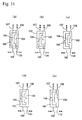
- the process drawing shown in Fig. 14 is included, wherein (a) ⁇ (d) depict the preheat exhausting process for substituting air in the dies and air among the material beads with steam, and the concrete content of each process will be explained below.
- a black valve symbol indicates that the valve is closed, and a white valve symbol indicates that the valve is open.
- vent holes are indispensable, but forming vent holes will cause the following problems.
- the fusion rate of beads of a molded foam product is set to e.g. 40 ⁇ 80% so as to improve surface property to insure beauty in appearance and to insure mechanical strength by setting a sufficiently high fusion rate, however the fusion rate must be set high enough to insure beauty in appearance even for a molded foam product which does not demand high mechanical strength, therefore cycle time for molding increases and productivity decreases.
- the fusion rate here is based on an evaluation of the state of beads in a cross-section when the molded foam product is split, and more concretely, the ratio of broken beads determined by measurement, regarding a bead as not fused when the bead itself is not broken but has a crack along its surface, and regarding a bead as fused when the bead itself is broken.
- vent holes cause the many problems mentioned above.
- the present inventors examined practical methods for molded foaming using dies without the vent holes, and conducted various tests. Even if the vent holes are not formed in the dies, passages which substitute for the vent holes are indispensable for supplying or exhausting such utility fluid as steam and air to/from the cavity, so there are many problems including where and how such passages are to be formed and at which timing and under what conditions the utility fluid is to be supplied to these passages.
- One of such problems is a problem concerning a method for filling the material beads to the cavity.
- material beads can be supplied up to a point by leaving some space open in the set of the dies without being completely closed, but filling is so uneven that it is impossible to apply this method for practical use.
- the pressure filling method which can maintain the inside of the cavity to atmospheric pressure by leaving some space open in the set of the dies, filling operation is possible up to a point, but the filled material beads are compressed for the closing dimensions corresponding to cracking after the filling operation, so when a box shaped molded foam product which top face is open is manufactured, for example, compressibility differs between the plane portion to be the bottom of the molded foam product and the portion to be the side wall, where the filling factor is greater in the plane portion than in the side wall portion, still causing filling density unevenness.
- the inside of the cavity must be maintained to be a predetermined pressure, which is atmospheric pressure or higher, however we cannot compare and examine this method since there is no means for supplying the material beads with dies which have no vent holes while maintaining pressurization.
- a method for filling material beads according to a first aspect of the present invention is a method for filling the material beads from a material tank to a cavity comprised of a set of dies, wherein the cavity is formed enclosed with a pair of dies with chambers disposed on the rear side respectively, and is air tightly isolated from the chambers, then the material beads are supplied to the cavity while maintaining the pressure in the cavity at a predetermined minus pressure with respect to the pressure in the material tank.
- the chambers and the cavity are air tightly isolated, that is, the molded foaming apparatus to be used does not have vent holes for connecting the chambers and the cavity in the dies, therefore the above mentioned problems caused when forming vent holes can be fundamentally solved.
- Filling the material beads, which utilizes differential pressure between the material tank and the cavity, can be easily carried out by adjusting the pressure of the material tank and the cavity.
- the filling method according to the second aspect is that the material beads are supplied to the cavity while maintaining the pressure in the above mentioned material tank in an atmospheric pressure ⁇ 5.0 kg/cm 2 range.
- This configuration is preferable since filling density becomes relatively uniform in the plane portions, the side face portions or even in the narrow portions of the cavity, by compressing and decreasing the capacity of the material beads in the cavity to be an optimum outer diameter (capacity).
- a filling method is that the pressure in the cavity is maintained to be a pressurized state which is less than minus 0.5 kg/cm 2 with respect to the pressure in the material tank and the atmospheric temperature or more. It is preferable to set to this range because in a pressure state outside this range, the flow velocity of the carrier air flow becomes excessive, and clogging of the material beads occurs in the cavity or in a narrow portion of the filling passage.
- a filling method is that the pressure in the cavity is maintained to be a reduced pressure state which is from atmospheric pressure to a minus 1.0 kg/cm 2 range.
- the pressure in only the cavity is reduced for the material beads which do not need compression and decreasing capacity, which is preferable because a negative pressure state is easily maintained during filling, and filling density becomes uniform in the plane portions or the side face portions or even in the narrow portions of the cavity.
- a method for die-expanded molded foaming of synthetic resin according to a sixth aspect is a method for die-expanded molded foaming of synthetic resin comprising the steps of: filling material beads in a cavity for molded foaming enclosed with a pair of dies with chambers disposed on the rear side respectively; heating, expanding and fusing the material beads to be a molded foam body; and cooling, releasing and taking out the molded foam body from the dies, wherein the following processes are included.
- the chambers and the cavity are air tightly isolated, that is, the molded foaming apparatus to be used does not have vent holes for connecting the chambers and the cavity in the dies, and steam and air are supplied to or exhausted from the cavity, not through vent holes but through utility passages directly connected to the cavity, therefore the above mentioned problems caused when forming the vent holes can be fundamentally solved by the setting of the utility passages.
- filling can easily be uniform by adjusting the pressure of the material tank and the cavity.
- the utility fluid can be supplied to the cavity and the chambers independently, therefore preheating of the dies can be operated by supplying heating steam to the chambers separately from the filling operation.
- preheating of the dies can be operated by supplying heating steam to the chambers separately from the filling operation.
- a method for die-expanded molded foaming according to a seventh aspect is that in the die closing process, a die-expanded molded foaming apparatus is used, where slit shaped openings opening to the cavity and/or openings opening to the cavity near an accessory part to be attached at least to one of the dies are formed along the joint of the dies to be the opening width which is an outer diameter size or less of a material bead to be filled, and at the same time, connecting passages connecting the openings to external utility pipes are disposed.
- core vent attachment holes can be completely eliminated, manufacturing cost can be decreased by constituting the dies thin, and control accuracy of such utility fluid as steam can be controlled. Since operation for forming the core vent attachment holes and operation for attaching the core vents are decreased or eliminated, productivity of the dies can be improved, and maintenance operation required for clogging of the vent holes by scales can be decreased or eliminated.
- the openings formed at such positions do not drop beauty in appearance of the molded foam product, and such utility fluid as steam can be evenly supplied to the cavity.
- the method for die-expanded molded foaming according to an eighth aspect is that the above mentioned accessory part is a filling unit of material beads. Since traces of the end face of the filling unit always remain on the surface of the molded foam product, the openings are formed near the filing unit so that traces of the openings are not outstanding, and a drop in appearance of the molded foam product is prevented.
- the method for die-expanded molded foaming according to a ninth aspect is that a returning-to-atmosphere process for releasing the inside of the cavity from the pressurized state to an atmospheric pressure state or an exhaust process for reducing the pressure inside the cavity to exhaust internal air is added between the filling process and the internal heating process.
- the material bead particles which have been pressurized and compressed expand as pressure is reduced and fill the mutual spaces, therefore the percentage of void decreases from 40% to 5 ⁇ 20%, decreasing the residual air content in voids among particles which will be a problem during fusion in the after process, and as a result uniformity inside the molded foam body improves.
- the exhaust process is added, the pressure inside the cavity is reduced by actively exhausting air inside, and the percentage of void and residual air content can be decreased, and as a result uniformity inside the molded foam body improves, just like the returning-to-atmosphere process.
- a method for die-expanded molded foaming according to a tenth aspect is that heating conditions for a pair of chambers and a cavity are controlled in a state where material beads made of thermoplastic synthetic resin are filled in the cavity by the filling method according to one of the first to fifth aspects, and the material beads filled in the cavity are heated, expanded and fused while controlling the internal fusion rate at will with maintaining the surface property of the molded foam product.
- the surface property of the material beads filled in the cavity contacting the dies can be adjusted respectively using the steam to be supplied to the pair of chambers, and the fusion rate of the material beads can be adjusted independently from the surface property by heating, expanding and fusing the material beads filled in the cavity using steam to be supplied to the cavity.
- Vent holes connecting the cavity and the chambers may be formed only if the vent holes do not have a negative influence on control of the utility fluid. If the vent holes are formed in the core die and/or the cavity die, traces of the vent holes remain in the molded foam product, so it is preferable to form the vent holes such that the traces come to a location not outstanding in the molded foam product.
- the method for die-expanded molded foaming according to an eleventh aspect is that the internal fusion rate is controlled at will with maintaining the surface property of the molded foam product, while independently controlling the heating conditions for the pair of chambers and the cavity.
- the pair of chambers may be controlled together, but it is preferable to control the respective chambers independently since the surface property of a surface at the core die side and the surface property of a surface at the cavity die side of the molded foam product can be controlled independently.
- the method for die-expanded molded foaming according to a twelfth aspect is that the steam pressure and the time are controlled as heating conditions. It is also possible to control the steam temperature as a heating condition, but controlling the steam pressure and the time is preferable, since conventional steam equipment which has been used at a factory can be used, and equipment for control can be constructed at low cost.
- the method for die-expanded molded foaming according to a thirteenth aspect is that the material beads are polyolefine synthetic resin material.
- Polyolefine synthetic resin material is preferable in terms of easy filling of the material beads even in a narrow portion, because the raw material itself is soft and has high gas permeability, which makes it much easier to change the shape of particles than material beads made of polystyrene synthetic resin material having the same expansion ratio.
- a die-expanded molded foam product according to a fourteenth aspect is a molded foam product which is molded using material beads made of thermoplastic synthetic resin and has a beautiful surface free from traces of core vents and core vent holes.
- Such molded foam products with a beautiful surface free from traces of core vents and core vent holes are preferable since clean printing is possible on the outer surface.
- Such molded foam products can be easily manufactured by a molded foaming method according to one of the tenth ⁇ thirteenth aspects.
- the die-expanded molded foam product according to a fifteenth aspect is that the internal fusion rate is lower than an equal heating molded foam product, having the same surface property setting, obtained by heating the surface and the inside under the same heating conditions.
- Such a molded foam product can decrease heating, expanding and fusion time during the molding and the cooling time, and can improve productivity by decreasing the cycle time for molding, since the internal fusion rate is lower than an equal heating molded foam product having the same surface property setting. Also both productivity and commercial value can be implemented since the surface property can be sufficiently maintained while setting the internal fusion rate low, without dropping commercial value.
- the die-expanded molded foam product according to a sixteenth aspect is that the internal fusion rate is higher than an equal heating molded foam product, having the same surface property setting, obtained by heating the surface and the inside under the same heating conditions.
- Such a molded foam product has higher mechanical strength since the internal fusion rate is higher than an equal heating molded foam product having the same surface property setting, and is suitable when the surface property of the molded foam product is not a major requirement but only strength is demanded.
- such a molded foam product has higher mechanical strength since the internal fusion rate is higher than an equal heating molded foam product having the same surface property setting, and when this molded foam product is manufactured by a molding method according to the first aspect, heating steam pressure in the heating process can be set high only for the molding space formed by the cavity die and the core die, and therefore the amount of steam to be used is less than the case of molding an equal heating molded foam product, and energy can be saved.
- a die-expanded molded foaming apparatus 1 comprises a core die 2 and a cavity die 3, which are a set of dies disposed opposite each other, beads filling means for filling material beads 5 into a cavity 4, which is formed by the core die 2 and cavity 3, by air flow, pressure reducing means for reducing pressure inside the cavity 4, compressed air supply means for supplying compressed air into the cavity 4, steam supply means for heating the material beads 5 filled in the cavity 4 by steam and expanding and fusing the material beads, and cooling means for cooling the molded foam product.
- a raw material having characteristics suitable for e.g. the working conditions of the molded foam product to be manufactured is selected, where polystyrene synthetic resin material, polyolefine synthetic resin materials, such as polyethylene and polypropylene, and a copolymer of these synthetic resin materials can be used.
- the expansion ratio of the material beads 5 is preferably in a range of 3 ⁇ 150 times, although this depends on the raw material of the material beads 5.
- 3 ⁇ 100 times, more preferably 3 ⁇ 80 times is suitable
- 3 ⁇ 90 times, more preferably 3 ⁇ 60 times is suitable.
- particle size 1 - 10 mm, more preferably a 2.0 ⁇ 8mm, is suitable.
- Material beads made of polyolefine synthetic resin material are preferable in terms of improving filling property, because the raw material itself is soft and has high gas permeability, which makes it much easier to change the shape of particles than material beads made of polystyrene synthetic resin material having the same expansion ratio.
- the core die 2 and the cavity die 3 are respectively attached to a housing 12 having a frame 10 and a backboard 11, and a set of a first chamber 13 and a second chamber 14 are formed on the rear side of the core die 2 and the cavity die 3 respectively.
- the first chamber 13 and the second chamber 14 are connected to a steam supply pipe 15 and an air supply pipe 16 respectively via utility valves SV1 and SV2 and switching valves SWV1 and SWV2, and at the same time, are connected to a drain pipe 17 and a pressure reducing pipe 18 with a vacuum pump 19 respectively via drain valves DV1 and DV2 and switching valves SWV3 and SWV4.
- a nozzle unit 21 having a plurality of nozzles 20 for spraying cooling water to the rear faces of the core die 2 and cavity die 3 is disposed respectively, and both of the nozzle units 21 are connected to a cooling water supply pipe 22 via cooling water valves CV1 and CV2.
- first openings 30 are formed instead of conventional vent holes, and connecting passages for connecting the first openings 30 to external utility pipes 15 ⁇ 18 respectively are formed, so as to supply or exhaust such utility fluid as steam and compressed air from the first openings 30 to the cavity 4 independently from the chambers 13 and 14 by operating the utility values SV3 ⁇ SV6, drain valves DV3 and DV4, and switching valves SWV1 ⁇ SWV4.
- the position for forming the first openings 30 can basically be classified into three types: forming at or near the joint of the core die 2 and the cavity die 3, forming near a portion of accessory parts, such as a filling unit 23 and an ejector pin 24, exposed to the cavity 4, and a combination of the above two types.
- the slit shaped first openings 30a and 30b opening to the cavity 4 are disposed along the joint portion of the core die 2 and the cavity die 3, and inter-die passages 31a and 31b and internal pipes 32a and 32b are disposed as connecting passages for connecting the first openings 30a and 30b and the external utility pipes 15 ⁇ 18, wherein no conventional vent holes are formed in the core die 2 and the cavity die 3, so that the cavity 4 is air-tightly isolated from both of the chambers 13 and 14 when the dies are closed, and at the same time, the first openings 30a and 30b which lead to the external utility pipes 15 - 18 are formed between the core die 2 and the cavity die 3. It is most preferable to air-tightly isolate the cavity 4 from both chambers 13 and 14 in this manner, but forming a small number of conventional vent holes connecting the cavity 4 and both of the chambers 13 and 14 is also embraced in the present invention.
- the above mentioned preheating and exhausting process and fusion heating process for the material beads 5 can be carried out in the following procedure using these first openings 30a and 30b, rather than conventional vent holes.
- the width of the opening of the first openings 30a and 30b at the cavity 4 side must be formed to be the size of the outer diameter of a material bead 5 to be filled, which is 1 ⁇ 10mm ⁇ , or less, and in order to finish the molded foam body nicely without flashes and burrs, the width of the opening should be as small as possible, but if the width of the opening is too small, the passing resistance of the utility fluid increases, so consequently 0.1 ⁇ 0.5mm is suitable for the opening width.
- the present invention it is suitable to dispose the first openings 30a and 30b at the joint of the core die 2 and the cavity die 3 along the base portion of the concave part.
- the slit shaped first openings 30a and 30b come to the convex ridge line part at the peripheral of the molded foam body, so appearance is not affected even if small flashes remain.
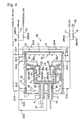
- Fig. 1 shows two sets of connecting passages, that is, a single connecting passage comprised of the first opening 30a, the inter-die passage 31a and the internal pipe 32a, and another single connecting passage comprised of the first opening 30b, the inter-die passage 31b and the internal pipe 32b, but the present invention is not restricted by this aspect, and three or more sets, or a single set can be used according to the shape and size of the molded foam body to be obtained.
- first openings 30 When a plurality of the first openings 30 are formed, a pair of the first openings 30a and 30b, for example, it is preferable to dispose the openings opposite each other at the joint of the dies 2 and 3 located on the opposite sides at both opposing ends of the cavity 4.
- the length of the first openings 30a and 30b is not especially restricted, but this configuration is preferable because the utility fluid, such as steam, can be supplied from one of the first openings to the other first opening via the cavity 4, and particularly, operation for substituting air among the material beads 5 filled in the cavity 4 with steam, or operation for heating the material beads 5, can be carried out quickly.
- the temperature of the set of the dies 2 and 3 can be adjusted independently for each die by steam to be supplied to the two chambers 13 and 14 so as to adjust the surface property of the molded foam product contacting the dies 2 and 3, and the material beads filled in the cavity 4 are heated, expanded and fused by steam to be supplied to the cavity 4, so as to adjust the fusion rate of the material beads 5 independently from the surface property.
- This makes it possible to manufacture molded foam products with a beautiful surface while keeping the internal fusion rate of the molded foam product low to decrease the cycle time of molding, and as a result, both productivity and commercial value can be implemented.
- inter-die passages 33a and 33b are formed along the joint portion of the dies 2 and 3 from the cavity 4 side to the outside, and inter-die spaces 34a and 34b are formed surrounded by the joint portion of the frames 10 when the dies are closed, as shown in Fig. 3. Since the other structure is the same as the die-expanded molded foaming apparatus 1, identical parts are denoted by the same reference characters for which a detailed description is omitted.
- conventional vent holes are not formed in the dies 2 and 3, and when the dies are closed, the cavity 4 is formed air-tightly isolated from both chambers 13 and 14, and the first openings 30a and 30b and the connecting passages for connecting these first openings 30a and 30b to the utility pipes 15 ⁇ 18, that is, inter-die passages 33a and 33b and inter-die spaces 34a and 34b, are formed along the joint of both dies 2 and 3 and the frame from the cavity 4 side to the outside, in a mode which is different from the first type die-expanded molded foaming apparatus 1.
- the utility fluid can be operated during molding, just like the die-expanded molded foaming apparatus 1, therefore all the above mentioned advantages, (1) ⁇ (6), are also available here, and in addition, independent internal pipes 32a and 32b, which would require piping working at manufacturing, are unnecessary, therefore manufacturing cost of the molded foaming apparatus is decreased and maintenance is also unnecessary.
- the first openings 30c and 30d opening to the cavity 4 are formed in the core die 2 near the joint of the core die 2 and the cavity die 3, connecting spaces 39a and 39b made of the passage formation element 38 fixed inside the core die so as to surround the first openings 30c and 30d and the internal pipes 40a and 40b for connecting the connecting spaces 39a and 39b to the external utility pipes 15 ⁇ 18 are disposed, as connecting passages for connecting the first openings 30c and 30d to the external utility pipes 15 ⁇ 18, so that the utility fluid can be supplied or exhausted independently to the first openings 30c and 30d via the connecting spaces 39a and 39b and the internal pipes 40a and 40b. Since the other structure is the same as the die-expanded molded foaming apparatus 1, identical parts are denoted by the same reference characters for which a detailed description is omitted.
- through holes or slits may be formed directly in the core die 2, but in this case, the inner surface may be worn out by the passing steam, so it is preferable to form core vent attachment holes corresponding to the first openings 30c and 30d and to attach removable core vents just like a conventional molded foaming apparatus.
- the utility fluid can be operated during molding, just like the die-expanded molded foaming apparatus 1, therefore the above mentioned advantages, (5) and (6), are also available here. Since the core vents for connecting the cavity 4 and the connecting spaces 39a and 39b are formed, the above mentioned advantages, (1) ⁇ (4), are not available, but the number of the core vents can be much less because the core vents are not formed uniformly on the entire surface of the dies as conventional types. Also the abrasion of the first openings 30c and 30d by steam can be easily prevented, which makes design more practical. In this third type molded foaming apparatus 1B as well, it is possible to form inter-die spaces between the joints of the left and right frames 10, just like the second type molded foaming apparatus, omitting the internal pipes 32a and 32b.
- the first openings 30c and 30d are formed at the core die 2 side, but if the inner surface side (core die 2 side) of the molded foam product is exposed to the outside, it is preferable to form the first openings 30c and 30d at the cavity die 3 side in terms of improving the beauty of the molded foam product.
- the object of the present invention can be achieved by disposing the first openings 30e and 30f alone without disposing the first openings 30a ⁇ 30d, but it is preferable to dispose the first openings 30a ⁇ 30d as well.
- first openings 30e and 30f near the tip of the filling unit 23 and the ejector pin 24 along with the above described first openings 30a ⁇ 30d, as shown in Fig. 1, Fig. 3 and Fig. 4, and form independent passages connecting the respective first openings 30 to the external utility pipes 15 ⁇ 18.
- the first opening 30 which can supply utility fluid is disposed to at least three locations, which is at both opposing ends of the cavity 4 and at the center part of the cavity 4, therefore utility fluid can be supplied as the demanded quality and the flexibility of control operation expands, such as to supply and stop utility fluid, and as a consequence, an optimum utility operation is carried out according to the type and shape of the molded foam body.
- the first openings 30e and 30f are disposed near the tip of the filling unit 23 and the ejector pin 24, but the present invention is not restricted by this mode, and it is also possible to use other accessory parts which are attachable to the dies, such as the cooling water pipe fitting.
- the connecting passages 42 and 43 it is unnecessary to form the connecting passages 42 and 43 outside the filling unit 23 and the ejector 24, and one or both of the first openings 30e and 30f can be omitted, where the first openings 30e and 30f are formed appropriately according to e.g. the shape of the molded foam product to be molded.
- the first openings 30a ⁇ 30d may be formed as dedicated openings for exhausting steam supplied from the first openings 30e and 30f to the cavity 4.
- the filling unit 23 and the ejector pin 24 are formed at the cavity die 3 side, but if the outer surface side (cavity die 3 side) of the molded foam product is exposed to the outside, it is preferable to dispose the filling unit 23 and the ejector pin 24 at the core die 2 side in terms of improving the beauty of the molded foam product.
- the second openings 50 in a portion of the dies 2 and 3 where the flow of the utility fluid becomes non-uniform in the cavity 4, and the connecting passages for connecting the second openings 50 and the external utility pipes 15 ⁇ 18 are disposed so as to supply or exhaust the utility fluid.
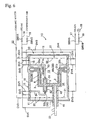
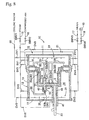
- Portions where the flow of the utility fluid become nonuniform are, for example, the inner parts of concave areas 51 and 52 when the concave areas 51 and 52 are formed in the dies 2 and 3, as shown in Fig. 6 ⁇ Fig. 8, and the center portion of the dies 2 and 3, as shown in Fig. 8, but there may be other portions as well.
- the second openings 50 can be point shaped similar to conventional core vents or slit shaped having some length, but in either case, the width of the opening at the cavity 4 side must be the outer diameter size or less of a material bead 5 to be filled, so that the opening is not clogged by the material bead 5.
- the second openings 50 are formed in the concave portions 51 and 52, the second openings 50a and 50b opening to the inner parts of the concave areas 51 and 52 are formed, as shown in the die-expanded molded foaming apparatus 1C in Fig. 6, where the second opening 50a is connected to the internal pipe 32a via the internal pipe 53, and the second opening 50b is connected to the independent internal pipe 54 and to the utility pipes 15 ⁇ 18 via the utility valve SV7.
- the second openings 50a and 50b may be connected to the utility pipes 15 ⁇ 18 via the internal pipes 32a and 32b, or may be directly connected to the utility pipes 15 ⁇ 18.
- the second openings 50a and 50b independently connected to the external utility pipes 15 ⁇ 18 are formed in the inner parts of the concave areas 51 and 52 where the flow of the utility fluid become non-uniform, such utility operations as the supply of steam, supply of compressed air, and exhaust for vacuuming the cavity 4, or the adjustment of pressure in the cavity 4 and discharge of draining from the cavity 4, can be carried out independently via the second openings 50a and 50b according to the requirement, just like the cases of the above first openings 30a and 30b, therefore the non-uniformity of the utility fluid can be solved.
- the die-expanded molded foaming apparatus 1C As the configuration clearly shows, the following matters become possible using the first openings 30a and 30b and the second openings 50a and 50b, instead of the conventional vent holes, in the molded foaming method where the above mentioned pre-expanded material beads 5 are filled in the cavity 4, pressure is reduced and exhausted, the beads are heated, expanded, and fused by the heating steam, then cooled down and solidified, and are taken out as a molded foam body made of the predetermined expandable synthetic resin.
- steam at fusing temperature can be directly supplied to the material beads 5 in the chamber 4 from one or both of the first openings 30a and 30b in the same manner, and steam is supplied to the concave areas 51 and 52 using the second openings 50a and 50b in the same manner so as to heat the portions where heat cannot easily reach merely by steam from the first openings 30a and 30b.
- all of dies 2 and 3 can be heated from the rear faces by supplying the required steam from the chambers 13 and 14 if necessary.
- the internal pipes 55 for connecting the second openings 50a and 50b and the inter-die spaces 34a are disposed as shown in the die-expanded molded foaming apparatus 1D in Fig. 7, for example.
- at least one of the internal pipes 55 may be connected to the utility pipes 15 ⁇ 18 independently via the utility valve, not illustrated here.
- molding operation time can be decreased because at heating or cooling for molding, the inter-die passages 33a and 33b, which are parts of the dies 2 and 3 where heat capacity is relatively large, and the peripheral area of the inter-die spaces 34a and 34b, can be heated or cooled efficiently.
- the second openings 50c are formed in the part where flow becomes non-uniform, so as to connect to the inter-die spaces via the internal pipe 56, or to connect to the internal pipes 32a and 32b, or to connect to the utility pipes 15 ⁇ 18 via the utility valves, as shown in the die-expanded molded forming apparatus 1E shown in Fig. 8.
- a non-uniform flow of the utility fluid is apt to occur when the space between the openings 30 and 50 for supplying or exhausting the utility fluid becomes 100mm or more, so when a pair of the first openings 30a and 30b are disposed at the opposing positions of the peripheral area, sandwiching the cavity 4, and the space between the first openings 30a and 30b is 100mm or more, as shown in Fig. 2, the second opening 50c may be formed at the intermediate position of the first openings 30a and 30b, as shown in Fig. 8. It is also preferable to form the second openings 50 such that the distance between the first opening 30 and the second opening 50 and the distance between the second openings 50 become 100mm or less.
- the required number of second openings 50 are formed at a maximum of 100mm spacing, which helps make the flow of the utility fluid smooth, preventing an uneven flow and uneven velocity of the utility fluid to be generated in the cavity 4.
- the flat portion at the center of the cavity has a shape with a high length/thickness ratio, 20 or more for example, density non-uniformity and foaming non-uniformity in the flat portion at the center can be controlled.
- the material beads are made of polystyrene unless otherwise specified, but the present invention can be applied just as well even if material beads made of polyolefine synthetic resin material are used.
- the method for molding is basically the same, so only the differences from the case of using the molded foaming apparatus 1 will be described.
- Fig. 9 shows the processes of the method for molded foaming of the present invention comparing with a conventional process shown at the left.
- the method for molded foaming of the present invention is carried out in the sequence of 1) die closing, 2) filling, 3) internal heating, 4) fusion heating, 5) cooling, 6) opening and releasing, and 7) after process, such as printing.
- the core die 2 and the cavity die 3 are closed. This forms the cavity 4 between the core die 2 and the cavity die 3, which is air tightly isolated from the chambers 13 and 14, and the first openings 30 connecting to the utility pipes 15 ⁇ 18.
- the slit shaped first openings 30a and 30b are formed along the joint of the dies 2 and 3, and the first openings 30a and 30b are connected to the utility pipes 15 ⁇ 18 via the connection passages, that is, the inter-die passages 31a and 31b and the internal pipes 32a and 32b.
- pressure in the cavity 4 is maintained to a minus pressure with respect to the pressure in the material tank, which is not illustrated, and the material beads in the material tank are supplied from the filling unit 23 to the cavity 4 and are filled in the cavity 4 by the differential pressure between the material tank and the cavity 4 using a part or all of the first openings 30.
- the material beads are supplied to the cavity while maintaining the pressure in the material tank at a predetermined pressure which is at the atmospheric pressure or higher, more preferably a predetermined atmospheric pressure in a ⁇ 5.0 kg/cm 2 range, or even more preferably in a 0.1 ⁇ 5.0 kg/cm 2 range, and maintaining the pressure in the cavity 4 at a pressurized state which is at the atmospheric pressure or more and less than 0.5 kg/cm 2 minus the pressure in the material tank.
- the reason for maintaining the pressure in the material tank at a predetermined atmospheric pressure in a ⁇ 5.0 kg/cm 2 range, more preferably in a 0.1 ⁇ 5.0 kg/cm 2 range, is that the material beads in the cavity in this range are compressed and capacity is decreased to an optimum diameter (capacity), and filling density becomes relatively uniform in the plane portions, the side face portions or even in the narrow portions of the cavity, which is preferable.
- the reason to create a differential pressure less than the pressure in the material tank minus 0.5 kg/cm 2 while maintaining the pressure in the cavity 4 at the atmospheric pressure or higher is that in the pressure state outside this range, the flow velocity of carrier air flow becomes excessive, and clogging of the material beads occur in the cavity 4 or in a narrow portion of the filling passage, which is not preferable.
- the pressure inside the material tank may be set based on the pressure in the cavity 4.
- the pressure in the cavity 4 is set at a predetermined pressure which is the atmospheric pressure or higher, more preferably 0.1 ⁇ 5.0 kg/cm 2 , and inside the tank is pressured in the range less than the pressure in the cavity plus 0.5 kg/cm 2 , so as to fill the material beads by the differential pressure.
- Another preferable filling method is supplying the material beads to the cavity 4 with maintaining the pressure in the cavity 4 in a pressure reduced state from the atmospheric pressure to an atmospheric pressure minus 1.0 kg/cm 2 range, while keeping the pressure in the material tank in an atmospheric pressure ⁇ 5.0 kg/cm 2 range.
- An advantage in maintaining the pressure in the cavity 4 at a negative pressure in the atmospheric pressure to a minus 1.0 kg/cm 2 range while keeping the pressure in the material tank in an atmospheric pressure ⁇ 5.0 kg/cm 2 range is that it is easy to maintain a negative pressure state during filling for the material beads which do not require compression and capacity reduction. Since only the pressure in the cavity 4 is reduced, filling density in the plane portions, the side face portions and even in the narrow portions of the cavity 4 become uniform, which is preferable.
- Such a filling method also has the following additional advantages.
- heating steam that is, saturated steam at 0.2 kg/cm 2 (terminal temperature: 104°C)
- 0.1 kg/cm 2 terminal temperature: 104°C
- This filling process completes in approximately five seconds, and in this stage, it is sufficient to raise the surface temperature of the dies 2 and 3 to 97 - 100°C. Since the object of preheating here is to let each part of the dies reach a uniform temperature as much as possible as the prestage for the expanding or fusing operation, it is important not to raise the temperature to a level where the material beads expand and fuse.
- the pressure of the second openings is adjusted to be a predetermined minus pressure with respect to the pressure in the material tank, inter-locking with the above mentioned pressure adjustment operation for the cavity 4 by the first openings 30 or prior to the pressure adjustment operation for the cavity 4 by the first openings 30, so as to adjust the flow of the material beads in the portion where the flow of the material beads is apt to be disturbed and to solve filling unevenness.
- the material beads in the cavity 4 are filled in a pressurized and compressed state and the percentage of voids drops to approximately 40% by the above filling process, it is not really necessary for the present invention to use the returning-to-atmosphere process or a conventional exhaust process here, but such a process may be used if necessary.
- the returning-to-atmosphere process here is a process for releasing the cavity 4 in a pressurized state during filling to atmospheric pressure, and during this operation, the pressurized and compressed particles of the material beads expand as the pressure reduces, filling the spaces among the particles, so the percentage of void decreases from 40% to 5 - 20%, decreasing the residual air content in the voids among particles which would cause problems with fusion in the after process, and uniformity inside the molded foam body is improved.
- the exhaust process here is a process for actively exhausting the air inside by reducing the pressure in the cavity 4 so as to decrease the percentage of the void and of the residual air content, but this operation for exhausting is normally unnecessary because the percentage of the void and the residual air content have already reached a rather low level by the returning-to-atmosphere process or the cavity 4 of the present invention is not connected to the chamber 13 or the chamber 14 which have large capacities and residual air can be easily exhausted in the prestage of the later mentioned internal heating process.
- the internal heating process which is the next process, may begin.
- This is a process for heating the filled material beads up to a temperature just before fusion by releasing the heating steam at a temperature less than the fusion temperature of the material beads to the cavity 4 via the connecting passages, by supplying from the first opening 30a and releasing from the first opening 30b, for example, and generating condensed water on the surfaces of the dies 2 and 3 enclosing the cavity 4.
- heating steam having a temperature which is a fusion temperature of the material beads or higher is suddenly supplied into the chambers 13 and 14, heat is conducted into the cavity 4, the above mentioned condensed water is evaporated into steam at high temperature, and is instantaneously infiltrated into the particles of the material beads so as to progress the expansion and fusion of the material beads.
- 109 ⁇ 120°C steam pressure: 0.4 ⁇ 1.0 kg/cm 2 ) is suitable for the temperature of the heating steam.
- the means for heating by evaporating the condensed water in the cavity 4 into steam at high temperature is used in this process because fusion among the material beads can be promoted while preventing non-uniform fusion by using steam which easily infiltrates into the material beads.
- Time required for achieving the purpose of the fusion heating process is very short, approximately fifteen seconds.
- the present invention is an indirect heating type, the time required for the fusion heating process is not so different from the case of a conventional method, twelve seconds, because preheating is possible in the filling process, the percentage of void in material beads can be decreased, and condensed water is utilized in the internal heating process.
- a method similar to a conventional method is used. After spraying cooling water from the cooling water pipe disposed in the chamber, so as to cool the molded foam body to some degree, moisture is evaporated by reducing the pressure inside to consume the latent heat, and as a result, the internal temperature is effectively decreased. Concretely, the cooling water valves CV1 and CV2 are opened and the cooling water is sprayed from the nozzle 24 to the core die 2 and the cavity die 3 so that the molded foam product in the cavity 4 is cooled down via the core die 2 and the cavity die 3.
- Time required for this cooling process is approximately fifty seconds, whereas it takes approximately 100 seconds conventionally. This is because the heating temperature itself can be kept low, and the cavity is sealed and temperature of the dies can be decreased by effectively using the cooling water.
- the dies 2 and 3 are opened by moving the core die 2 in Fig. 2 in the right direction, and the molded foam body is pushed out in the right direction by the eject pin attached to the cavity die 3 at the left, for example, to take out the molded foam body.
- the releasing of the molded foam body becomes easier if compressed air is supplied from the first openings 30e and 30f formed near the filling unit 23 and the eject pin 24.
- an after process according to the specifications such as a printing process, a labeling process or a packaging process is set, and in the case of the present invention, a drying process, which is necessary for a conventional method, can be omitted since the cooling water sprayed in the cooling process does not enter the cavity, and the moisture content of an obtained molded foam body is 4% or less, whereas in a conventional method this is 6 ⁇ 10%.
- the present invention can greatly contribute to the improvement of productivity.
- heating steam is supplied to the chambers 13 and 14 for indirectly heating inside the cavity in the fusion heating process, so as to evaporate the condensed water in the cavity 4 to steam at high temperature and to heat, expand and fuse the material beads by this steam at high temperature, but instead of the internal heating process and the fusion heating process, the following fusion heating process may be adopted where heating steam is directly supplied to the cavity 4 through the first openings 30 and the second openings 50 for heating, expanding and fusing the material beads.
- description is omitted.
- the utility valves SV1 and SV2 are opened in a state where the drain valves DV1 and DV2 are open, and steam is supplied to the chambers 13 and 14 so as to substitute air in the chambers 13 and 14 with steam. This process may be carried out in the filling process.
- the drain valves DV1 and DV2 are closed, and at the same time, steam is supplied to the chambers 13 and 14 for a predetermined heating time while controlling the utility valves SV1 and SV2 so that the inside of the chambers 13 and 14 become a predetermined steam pressure, where the core die 2 and the cavity die 3 are heated, and the material beads 5 contacting the core die 2 and the cavity die 3 are expanded and fused to mold the surface portion of the molded foam product.
- a process for heating the material beads filled in the cavity 4 is carried out in parallel, and this process is roughly divided into three steps.
- the drain valve D4 is opened while the drain valve DV3 is closed, and the utility valves SV3, SV5 and SV6 are opened while the utility valve SV4 is closed, so that steam is supplied to the cavity 4 to substitute the air among the material beads with steam.
- the drain valve DV4 is closed while the drain valve DV3 is opened, and the utility valve SV3 is closed while the utility valves SV4, SV5 and SV6 are opened, which is the opposite of the first step, so that steam is supplied to the cavity 4 to substitute the air among the material beads with steam.
- the second step may be omitted.
- the drain valves DV3 and DV4 are closed, and steam is supplied to the cavity 4 for a predetermined heating time, while controlling the utility valves SV3 ⁇ SV6 so that the inside of the cavity 4 becomes a predetermined steam pressure, where the material beads are heated, expanded and fused to mold inside the molded foam product.
- the surface portion of the molded foam product and inside the molded foam product can be independently heated by the steam to be supplied to the chambers 13 and 14 and the steam to be supplied to the cavity 4, it is possible to adjust the surface property of the molded foam product and the internal fusion rate of the molded foam product independently.
- the heating of the surface portion and heating inside the molded foam product can be carried out independently, therefore in the case of a molded foam product for which mechanical strength is not a major requirement, for example, the cycle time of molding can be decreased by keeping the internal fusion rate of the molded foam product low while maintaining sufficient surface property, and as a result, both productivity and commercial value can be implemented.
- the molded foam product molded in this manner becomes a molded foam product with a beautiful surface free from traces of core vents and core vent holes on the outer surface.
- the surface property can be set equivalent to an equal heating molded foam product manufactured based on conventional molding technology, whereas the internal fusion rate can be set lower or higher than that of the equal heating molded foam product with the above surface property.
- Setting the internal fusion rate low can be suitably applied to molded foam products for which high surface property is demanded but mechanical strength is not a major requirement, such as a decorative form for the surface of concrete, or the cover of a container and heat insulating material
- setting the internal fusion rate high can be suitably applied to molded foam products for which surface property is not a major requirement but high mechanical strength is, or for molded foam products which can withstand repeated use, such as molded foam products for various components for automobiles and returnable containers.
- the present invention is more effective and useful for relatively large molded foam products with a complicated shape, rather than for small molded foam products with a simple shape, such as a container for instant noodles packaged in a cup.
- the present invention is particularly useful for a molded foam product having both thick and thin wall portions.
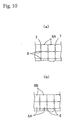
- the surface property here was evaluated in five rankings according to the frequency of occurrence of dents 7 shown in Fig. 10 (a), where the higher value indicates better surface property with less frequency of occurrence of dents 7.
- the fusion rate was based on the evaluation of beads status in the cross-section when the molded foam product is split, and more concretely, the ratio of broken beads determined by measurement, regarding a bead as not fused when the bead itself is not broken but has a crack along its surface, and regarding a bead as fused when the bead itself is broken.
- Case Utility chambers 13, 14 Cavity 4 Surface property Fusion rate% 3. 0 2. 5 2 10 130 A 3. 0 2 50 210 B 3. 5 2 80 240 C 3. 5 2. 5 3 10 150 D 3. 0 3 50 220 E 3. 5 3 80 250 F 4. 0 2. 5 4 10 170 G 3. 0 4 50 230 H 3. 5 4 80 260 I
- the surface property and the internal fusion rate of a molded foam product can be independently controlled by controlling the heating conditions for the chambers 13 and 14 and the heating conditions for the cavity 4 by steam from the first openings 30a and 30b.
- the conventional molding method only molded foam products with a quality corresponding to cases B and F in Table 1 can be manufactured, but with the present invention, molded foam products corresponding to cases A ⁇ I, can be manufactured with various combinations of surface properties and fusion rates, and flexibility of molding considerably expands.
- a molded foam product having good surface property with a low internal fusion rate can be manufactured.
- mechanical strength is low since the internal fusion rate is low, but the heating, expanding and fusing time and the cooling time can be decreased, and productivity can be increased while maintaining good surface property, therefore these molded foam products can be suitably used for molded foam products for which mechanical strength is not a major requirement, such as a decorative frame for the surface of concrete, or the cover of a container and heat insulating material.
- 250 sec In order to manufacture such a molded foam product using the conventional molding method, 250 sec.
- cycle time of molding is required as case F shows, if products with a surface property evaluated at 3 or higher are regarded as non-defective, but with the molding method of the present invention, such a product can be molded at 150 sec., 220 sec., 170 sec. and 230 sec. of cycle time respectively as cases D, E, G and H show, therefore productivity increases. Also the energy cost can be decreased since heating more than necessary is not carried out.
- molded foam products where the internal fusion rate is set high and the surface property is set somewhat low, as shown in case C, can be manufactured.
- mechanical strength is high since the internal fusion rate is high, but expanding and fusing time and cooling time can be decreased, steam pressure in the first openings 30a and 30b can be set low, and productivity is improved and energy is saved while sufficiently increasing the mechanical strength, therefore these molded foam products can be suitably used for molded foam products for which surface property is not a major requirement but mechanical strength is, such as molded foam products for various components for automobiles and returnable containers.
- 250 sec In order to manufacture such a molded foam product using the conventional molding method, 250 sec.
- cycle time of molding is required, as case F shows, if products with a fusion rate of 80 are regarded as non-defective, but with the molding method of the present invention, such a product can be molded with 240 sec. of cycle time, as case C shows, therefore productivity increases. Also energy cost can be decreased by lowering the steam pressure in the chambers 13 and 14, since steam pressure in the chambers 13 and 14 can be set at 3.5 kg/cm 2 for case F, whereas 3.0 kg/cm 2 for case C.
- the chambers and the cavity are air tightly isolated, that is, a molded foaming apparatus to be used does not have vent holes for connecting the chambers and the cavity in the dies, therefore the problems caused when forming the vent holes can be fundamentally solved.
- Filling the material beads, which utilizes differential pressure between the material tank and the cavity, can be easily carried out by adjusting the pressure of the material tank and the cavity.
- filling density becomes relatively uniform in the plane portions, the side face portions or even in the narrow portions of the cavity, by compressing and decreasing the capacity of the material beads in the cavity to be an optimum outer diameter (capacity).
- the material beads can be filled uniformly into the cavity or narrow portions of the filling passages by setting the flow velocity of the carrier air flow to be optimum, which is preferable.
- the pressure in the cavity is maintained in a reduced pressure state, which is from the atmospheric pressure to a minus 1.0 kg/cm 2 , as described in the fourth aspect, pressure only in the cavity is reduced for the material beads which do not need compression and decreasing capacity, so it is easy to maintain a negative pressure state during filling, and filling density becomes uniform in the plane portions or the side face portions or even in the narrow portions of the cavity, which is preferable.
- the chambers and the cavity are air tightly isolated, that is, the molded foaming apparatus to be used does not have vent holes for connecting the chambers and the cavity in the dies, and steam and air are supplied to or exhausted from the cavity, not through vent holes but through utility passages directly connected to the cavity, therefore the above mentioned problems caused when forming the vent holes can be fundamentally solved.
- filling can easily be uniform by adjusting the pressure of the material tank and the cavity.
- the utility field can be supplied to the cavity and the chambers independently, therefore preheating of the dies can be operated with supplying heating steam to the chambers separately from the filling operation, which is preferable.
- the core vent attachment holes can be completely eliminated, therefore the manufacturing cost can be decreased by constituting the dies thin, and control accuracy of such utility fluid as steam can be improved. Since the operation for forming core vent attachment holes and the operation for attaching core vents are decreased or eliminated, productivity of the dies can be improved, and the maintenance operation required for the clogging of vent holes by scales can be decreased or eliminated.
- the openings formed at such positions do not drop beauty in appearance of the molded foam product, and such utility fluid as steam can be supplied to the cavity uniformly, which is preferable.
- the accessory part is the material beads filling unit, as described in the eighth aspect, a drop in appearance of the molded foam product can be prevented since traces of the openings are not outstanding.
- the returning-to-atmosphere process for releasing the inside of the cavity from a pressurized state to an atmospheric pressure state or for the exhaust process for reducing the pressure inside the cavity and exhausting the air inside is added between the filling process and the internal heating process, as described in the ninth aspect, the residual air content in the voids among particles, which will be a problem during fusion in the after process, is decreased and the uniformity inside the molded foam body is improved.
- steam can be supplied to the pair of chambers and the cavity independently, and the heating conditions for the respective spaces can be adjusted independently, which makes it possible to decrease the cycle time of molding while keeping the internal fusion rate of the molded foam product low, and to manufacture molded foam products with a beautiful surface as well, and consequently both productivity and commercial value can be implemented.
- the surface property of one surface and the surface property of the other surface of the molded foam product contacting the set of the dies can be controlled independently, which is preferable.
- the material beads are polyolefine synthetic resin material, as described in the thirteenth aspect, filling property can be improved since the material itself is soft and has high gas permeability, which makes it much easier to change the shape of particles than material beads made of polystyrene synthetic resin material having the same expansion ratio.
- the molded foam product has a beautiful surface free from traces of core vents and core vent holes, therefore clean printing is possible on the outer surface, which is preferable.
- Such molded foam products can be easily manufactured by a molding method according to one of the tenth ⁇ thirteen aspects.
- the internal fusion rate is lower than an equal heating molded foam product having the same surface property setting as described in the fifteenth aspect, heating, expanding and fusing time during molding and cooling time can be decreased, and productivity can be improved by decreasing the cycle time for molding. Also both productivity and commercial value can be implemented since the surface property can be sufficiently maintained while setting the internal fusion rate low, without dropping commercial value.
- the mechanical strength of the molded foam product becomes higher, which is suitable when only strength is required, and surface property of the molded foam product is not.
- Such a molded foam product has a higher mechanical strength since the internal fusion rate is higher than an equal heating molded foam product having the same surface property setting, and when this molded foam product is manufactured by a molding method according to the tenth aspect, heating steam pressure in the heating process can be set high only for the cavity, and therefore the amount of steam to be used is less than the case of molding an equal heating molded foam product, and energy can be saved.
Landscapes
- Moulds For Moulding Plastics Or The Like (AREA)
Applications Claiming Priority (5)
| Application Number | Priority Date | Filing Date | Title |
|---|---|---|---|
| JP08626698A JP4090105B2 (ja) | 1998-03-31 | 1998-03-31 | 発泡成形方法 |
| JP8626698 | 1998-03-31 | ||
| JP12016598 | 1998-04-30 | ||
| JP12016598A JP4251509B2 (ja) | 1998-04-30 | 1998-04-30 | 発泡成型用金型装置および原料ビーズの充填方法 |
| PCT/JP1999/001710 WO1999051415A1 (en) | 1998-03-31 | 1999-03-31 | Material bead charging method, synthetic resin mold foam forming method using this method, and mold foam formed product obtained by this method |
Publications (2)
| Publication Number | Publication Date |
|---|---|
| EP1114708A1 true EP1114708A1 (de) | 2001-07-11 |
| EP1114708A4 EP1114708A4 (de) | 2002-10-23 |
Family
ID=26427420
Family Applications (1)
| Application Number | Title | Priority Date | Filing Date |
|---|---|---|---|
| EP99910797A Withdrawn EP1114708A4 (de) | 1998-03-31 | 1999-03-31 | Verfahren zur beladung mit materialkügelchen, kunststoffschäumgiessmethode, die dieses verfahren benutzt, und durch die kunststoffschäumgiessmethode erhaltenes produkt |
Country Status (4)
| Country | Link |
|---|---|
| US (1) | US6800227B1 (de) |
| EP (1) | EP1114708A4 (de) |
| CN (1) | CN1230290C (de) |
| WO (1) | WO1999051415A1 (de) |
Cited By (1)
| Publication number | Priority date | Publication date | Assignee | Title |
|---|---|---|---|---|
| WO2010079212A3 (de) * | 2009-01-12 | 2011-02-03 | Fagerdala Capital Ab | Verfahren und vorrichtung zur herstellung von formteilen aus partikelschäumen |
Families Citing this family (18)
| Publication number | Priority date | Publication date | Assignee | Title |
|---|---|---|---|---|
| JP4017558B2 (ja) * | 2003-05-20 | 2007-12-05 | 株式会社ジェイエスピー | 型内発泡成形装置及び成形方法 |
| WO2010088365A2 (en) * | 2009-01-29 | 2010-08-05 | Radva Corporation | Dual platen molding machine |
| DE102013002519B4 (de) | 2013-02-13 | 2016-08-18 | Adidas Ag | Herstellungsverfahren für Dämpfungselemente für Sportbekleidung |
| BR112015022947A2 (pt) | 2013-03-15 | 2017-07-18 | Miller Herman Inc | componente de espuma de partículas possuindo uma superfície texturizada |
| JP6471748B2 (ja) * | 2014-04-15 | 2019-02-20 | 株式会社カネカ | ポリオレフィン系樹脂型内発泡成形用金型及び型内発泡成形品の製造方法並びに型内発泡成形品 |
| DE102015202013B4 (de) | 2015-02-05 | 2019-05-09 | Adidas Ag | Verfahren zur Herstellung eines Kunststoffformteils, Kunststoffformteil und Schuh |
| EP3088153B1 (de) * | 2015-04-27 | 2018-06-06 | Overath GmbH | Formwerkzeug |
| DE102016209044B4 (de) * | 2016-05-24 | 2019-08-29 | Adidas Ag | Sohlenform zum Herstellen einer Sohle und Anordnung einer Vielzahl von Sohlenformen |
| DE102016209045B4 (de) | 2016-05-24 | 2022-05-25 | Adidas Ag | Verfahren und vorrichtung zum automatischen herstellen von schuhsohlen, sohlen und schuhe |
| DE102016209046B4 (de) | 2016-05-24 | 2019-08-08 | Adidas Ag | Verfahren zur herstellung einer schuhsohle, schuhsohle, schuh und vorgefertigte tpu-gegenstände |
| DE102016223980B4 (de) | 2016-12-01 | 2022-09-22 | Adidas Ag | Verfahren zur Herstellung eines Kunststoffformteils |
| DE102017205830B4 (de) | 2017-04-05 | 2020-09-24 | Adidas Ag | Verfahren für die Nachbehandlung einer Vielzahl einzelner expandierter Partikel für die Herstellung mindestens eines Teils eines gegossenen Sportartikels, Sportartikel und Sportschuh |
| EP3488723B1 (de) * | 2017-11-22 | 2019-10-16 | Werkzeugbau Siegfried Hofmann GmbH | Form zur herstellung einer sohle |
| CN109732832B (zh) * | 2019-01-16 | 2024-08-30 | 翡柯机械(福建)有限公司 | 一种发泡成型方法 |
| CN119078086A (zh) * | 2019-03-19 | 2024-12-06 | 皮亚纳非织布有限公司 | 自发膨胀板模塑 |
| IT202000000175A1 (it) * | 2020-01-08 | 2021-07-08 | Persico Spa | Processo di stampaggio e relativa macchina di stampaggio |
| CN113910549B (zh) * | 2021-10-11 | 2023-08-08 | 四川大学华西医院 | 一种植入式柔性磁控膀胱泵的热塑成型模具 |
| CN113997484B (zh) * | 2021-11-02 | 2023-09-15 | 晋江邦达塑料有限公司 | 全自动鞋底发泡成型生产工艺 |
Family Cites Families (20)
| Publication number | Priority date | Publication date | Assignee | Title |
|---|---|---|---|---|
| US3971471A (en) * | 1973-04-16 | 1976-07-27 | Owens-Illinois, Inc. | Close-nesting, light-weight, one-piece drinking cup and apparatus for the manufacture thereof |
| JPS5542916Y2 (de) * | 1976-10-05 | 1980-10-08 | ||
| SE403959B (sv) | 1976-10-21 | 1978-09-11 | Per Olle Magnus Wolkert | Anordning for hantering, i synnerhet for montering pa monsterkort, av elektriska komponenter |
| CA1222856A (en) * | 1983-11-02 | 1987-06-16 | Larry V. Crabtree | Expanded polystyrene mold for producing parts with smooth surfaces |
| US4627946A (en) * | 1983-11-07 | 1986-12-09 | Morval-Durofoam Ltd. | Method and molding apparatus for molding expanded polystyrene articles having smooth surfaces |
| JPS61140821A (ja) | 1984-12-13 | 1986-06-27 | Matsushita Electric Ind Co Ltd | 光学変換装置 |
| JPS61162430A (ja) | 1984-12-28 | 1986-07-23 | Mita Ind Co Ltd | 給紙カセツト |
| JPS61140821U (de) * | 1985-02-22 | 1986-09-01 | ||
| JPS61211019A (ja) * | 1985-03-18 | 1986-09-19 | Meiwa Sangyo Kk | 表皮層付ビ−ズ発泡成形体の製造方法 |
| JPS61162430U (de) * | 1985-03-29 | 1986-10-08 | ||
| US4818451A (en) * | 1986-04-02 | 1989-04-04 | Mitsubishi Yuka Badische Co., Ltd. | Method of preparing a foamed molded article and blow-filling gun apparatus for use therein |
| JPH01171841A (ja) * | 1987-12-25 | 1989-07-06 | Sekisui Plastics Co Ltd | 発泡成形機の原料充填方法 |
| EP0495125B1 (de) * | 1990-08-06 | 1996-11-27 | Kanegafuchi Kagaku Kogyo Kabushiki Kaisha | Schaum-formkörper aus olefinischem kunstharz und verfahren zu dessen herstellung |
| CA2052754C (en) * | 1991-10-03 | 1994-11-01 | Ken Yamamoto | Expansion molding method and apparatus |
| US5298208A (en) * | 1991-11-01 | 1994-03-29 | Athletic Helmet, Inc. | Method for molding a protective helmet |
| US6033770A (en) * | 1992-04-23 | 2000-03-07 | Kanegafuchi Kagaku Kogyo Kabushiki Kaisha | Polypropylene resin cellular molded article having a skin and production method therefor |
| US5858288A (en) * | 1996-07-18 | 1999-01-12 | Bullard; Calvin P. | Method for molding expandable polystyrene foam articles |
| FR2772300A1 (fr) * | 1997-12-12 | 1999-06-18 | Reydel Sa | Procede de fabrication, par moulage, d'une piece en materiau expanse |
| JP4120068B2 (ja) * | 1998-11-17 | 2008-07-16 | 株式会社カネカ | 合成樹脂の型内発泡成形装置及び方法並びに型内発泡 成形品 |
| EP1114707A4 (de) * | 1998-03-31 | 2002-03-20 | Daisen Industry Co Ltd | Vorrichtung und verfahren zum internen schaumformen eines synthetischen kunststoffes |
-
1999
- 1999-03-31 WO PCT/JP1999/001710 patent/WO1999051415A1/ja not_active Ceased
- 1999-03-31 US US09/647,247 patent/US6800227B1/en not_active Expired - Fee Related
- 1999-03-31 CN CNB998047503A patent/CN1230290C/zh not_active Expired - Fee Related
- 1999-03-31 EP EP99910797A patent/EP1114708A4/de not_active Withdrawn
Cited By (1)
| Publication number | Priority date | Publication date | Assignee | Title |
|---|---|---|---|---|
| WO2010079212A3 (de) * | 2009-01-12 | 2011-02-03 | Fagerdala Capital Ab | Verfahren und vorrichtung zur herstellung von formteilen aus partikelschäumen |
Also Published As
| Publication number | Publication date |
|---|---|
| WO1999051415A1 (en) | 1999-10-14 |
| US6800227B1 (en) | 2004-10-05 |
| EP1114708A4 (de) | 2002-10-23 |
| CN1295508A (zh) | 2001-05-16 |
| CN1230290C (zh) | 2005-12-07 |
Similar Documents
| Publication | Publication Date | Title |
|---|---|---|
| EP1114708A1 (de) | Verfahren zur beladung mit materialkügelchen, kunststoffschäumgiessmethode, die dieses verfahren benutzt, und durch die kunststoffschäumgiessmethode erhaltenes produkt | |
| EP1114707A1 (de) | Vorrichtung und verfahren zum internen schaumformen eines synthetischen kunststoffes | |
| US20040004313A1 (en) | Process for gas assisted and water assisted injection molding | |
| WO1999056931A1 (en) | Device and method for synthetic resin internal die foam molding and internal die foam molded product obtained by these device and method | |
| JP4090105B2 (ja) | 発泡成形方法 | |
| KR101032535B1 (ko) | 열간 프레스 성형장치 | |
| KR900001905B1 (ko) | 발포수지제 컵의 성형방법 및 성형장치 | |
| US6500368B1 (en) | Polyolefin synthetic resin in-mold foam molding method | |
| JP3769681B2 (ja) | 発泡成型材の製造方法 | |
| JP2001096559A (ja) | ポリオレフィン系樹脂の型内発泡成形方法 | |
| EP3881998B1 (de) | Formverfahren zum betrieb einer gussvorrichtung | |
| JP4251509B2 (ja) | 発泡成型用金型装置および原料ビーズの充填方法 | |
| JP4120068B2 (ja) | 合成樹脂の型内発泡成形装置及び方法並びに型内発泡 成形品 | |
| JP2001088157A (ja) | ポリオレフィン系樹脂の型内発泡成形装置及び型内発泡成形方法 | |
| JPS6145940B2 (de) | ||
| JPH11309734A (ja) | 発泡成形方法 | |
| JP2569241B2 (ja) | ブロー成形方法 | |
| JP2001079869A (ja) | ポリオレフィン系合成樹脂の型内発泡成形装置及び型内発泡成形方法 | |
| JP2001113552A (ja) | ポリオレフィン系合成樹脂の型内発泡成形装置及び型内発泡成形方法 | |
| CA1102067A (en) | Method and apparatus for molding expandable polystyrene | |
| JP3099005B1 (ja) | 発泡成形用金型装置 | |
| JP2000176956A (ja) | 原料ビーズの充填方法 | |
| JP2001096557A (ja) | ポリオレフィン系樹脂の型内発泡成形方法及び型内発泡成形装置 | |
| JP2001079871A (ja) | ポリオレフィン系樹脂の型内発泡成形方法 | |
| JP4251510B2 (ja) | 発泡成形方法における充填方法 |
Legal Events
| Date | Code | Title | Description |
|---|---|---|---|
| PUAI | Public reference made under article 153(3) epc to a published international application that has entered the european phase |
Free format text: ORIGINAL CODE: 0009012 |
|
| 17P | Request for examination filed |
Effective date: 20001030 |
|
| AK | Designated contracting states |
Kind code of ref document: A1 Designated state(s): BE DE FR GB |
|
| A4 | Supplementary search report drawn up and despatched |
Effective date: 20020905 |
|
| AK | Designated contracting states |
Kind code of ref document: A4 Designated state(s): BE DE FR GB |
|
| RIC1 | Information provided on ipc code assigned before grant |
Free format text: 7B 29C 44/00 A, 7B 29C 44/44 B, 7B 29C 44/08 B, 7B 29C 44/34 B, 7B 29C 44/42 B |
|
| 17Q | First examination report despatched |
Effective date: 20031205 |
|
| STAA | Information on the status of an ep patent application or granted ep patent |
Free format text: STATUS: THE APPLICATION IS DEEMED TO BE WITHDRAWN |
|
| 18D | Application deemed to be withdrawn |
Effective date: 20081001 |