EP1116751B1 - Polycarbonatharz-zusammensetzung, optisches auzeichnungsmedium sowie substrat dafür - Google Patents
Polycarbonatharz-zusammensetzung, optisches auzeichnungsmedium sowie substrat dafür Download PDFInfo
- Publication number
- EP1116751B1 EP1116751B1 EP00931538A EP00931538A EP1116751B1 EP 1116751 B1 EP1116751 B1 EP 1116751B1 EP 00931538 A EP00931538 A EP 00931538A EP 00931538 A EP00931538 A EP 00931538A EP 1116751 B1 EP1116751 B1 EP 1116751B1
- Authority
- EP
- European Patent Office
- Prior art keywords
- carbon atoms
- compound
- group
- aromatic polycarbonate
- acid
- Prior art date
- Legal status (The legal status is an assumption and is not a legal conclusion. Google has not performed a legal analysis and makes no representation as to the accuracy of the status listed.)
- Expired - Lifetime
Links
- 239000000203 mixture Substances 0.000 title claims abstract description 47
- 230000003287 optical effect Effects 0.000 title claims abstract description 42
- 229920005668 polycarbonate resin Polymers 0.000 title claims abstract description 36
- 239000004431 polycarbonate resin Substances 0.000 title claims abstract description 36
- 239000000758 substrate Substances 0.000 title claims abstract description 21
- -1 cyclic carbonate compound Chemical class 0.000 claims abstract description 82
- 125000003118 aryl group Chemical group 0.000 claims abstract description 75
- 229920000515 polycarbonate Polymers 0.000 claims abstract description 58
- 239000004417 polycarbonate Substances 0.000 claims abstract description 58
- 125000004432 carbon atom Chemical group C* 0.000 claims abstract description 57
- 150000001875 compounds Chemical class 0.000 claims abstract description 50
- VEXZGXHMUGYJMC-UHFFFAOYSA-N Hydrochloric acid Chemical compound Cl VEXZGXHMUGYJMC-UHFFFAOYSA-N 0.000 claims abstract description 8
- 150000003863 ammonium salts Chemical class 0.000 claims abstract description 8
- RTZKZFJDLAIYFH-UHFFFAOYSA-N ether Substances CCOCC RTZKZFJDLAIYFH-UHFFFAOYSA-N 0.000 claims abstract description 7
- DNIAPMSPPWPWGF-GSVOUGTGSA-N (R)-(-)-Propylene glycol Chemical compound C[C@@H](O)CO DNIAPMSPPWPWGF-GSVOUGTGSA-N 0.000 claims abstract description 6
- NBIIXXVUZAFLBC-UHFFFAOYSA-N Phosphoric acid Chemical compound OP(O)(O)=O NBIIXXVUZAFLBC-UHFFFAOYSA-N 0.000 claims abstract description 6
- 229910000147 aluminium phosphate Inorganic materials 0.000 claims abstract description 3
- KGBXLFKZBHKPEV-UHFFFAOYSA-N boric acid Chemical compound OB(O)O KGBXLFKZBHKPEV-UHFFFAOYSA-N 0.000 claims abstract description 3
- 239000004327 boric acid Substances 0.000 claims abstract description 3
- ISIJQEHRDSCQIU-UHFFFAOYSA-N tert-butyl 2,7-diazaspiro[4.5]decane-7-carboxylate Chemical compound C1N(C(=O)OC(C)(C)C)CCCC11CNCC1 ISIJQEHRDSCQIU-UHFFFAOYSA-N 0.000 claims abstract description 3
- 239000003054 catalyst Substances 0.000 claims description 19
- 150000002148 esters Chemical group 0.000 claims description 19
- 150000001923 cyclic compounds Chemical class 0.000 claims description 17
- 125000004435 hydrogen atom Chemical group [H]* 0.000 claims description 15
- 150000001339 alkali metal compounds Chemical class 0.000 claims description 13
- 125000000217 alkyl group Chemical group 0.000 claims description 13
- 229910052784 alkaline earth metal Inorganic materials 0.000 claims description 7
- 150000002736 metal compounds Chemical class 0.000 claims description 7
- 239000010410 layer Substances 0.000 claims description 5
- 125000002947 alkylene group Chemical group 0.000 claims description 4
- 239000003607 modifier Substances 0.000 claims description 4
- 125000001118 alkylidene group Chemical group 0.000 claims description 3
- 125000003710 aryl alkyl group Chemical group 0.000 claims description 3
- 150000004650 carbonic acid diesters Chemical class 0.000 claims description 3
- 125000002993 cycloalkylene group Chemical group 0.000 claims description 3
- 239000011229 interlayer Substances 0.000 claims description 3
- XYFCBTPGUUZFHI-UHFFFAOYSA-O phosphonium Chemical group [PH4+] XYFCBTPGUUZFHI-UHFFFAOYSA-O 0.000 claims description 3
- QGZKDVFQNNGYKY-UHFFFAOYSA-O Ammonium Chemical group [NH4+] QGZKDVFQNNGYKY-UHFFFAOYSA-O 0.000 claims description 2
- 229910006127 SO3X Inorganic materials 0.000 claims description 2
- 238000002156 mixing Methods 0.000 claims description 2
- 125000004430 oxygen atom Chemical group O* 0.000 claims description 2
- 125000001424 substituent group Chemical group 0.000 claims description 2
- 125000001174 sulfone group Chemical group 0.000 claims description 2
- 125000003375 sulfoxide group Chemical group 0.000 claims description 2
- 229910052717 sulfur Inorganic materials 0.000 claims description 2
- 125000004434 sulfur atom Chemical group 0.000 claims description 2
- 125000001183 hydrocarbyl group Chemical group 0.000 claims 5
- RSWGJHLUYNHPMX-UHFFFAOYSA-N Abietic-Saeure Natural products C12CCC(C(C)C)=CC2=CCC2C1(C)CCCC2(C)C(O)=O RSWGJHLUYNHPMX-UHFFFAOYSA-N 0.000 claims 1
- KHPCPRHQVVSZAH-HUOMCSJISA-N Rosin Natural products O(C/C=C/c1ccccc1)[C@H]1[C@H](O)[C@@H](O)[C@@H](O)[C@@H](CO)O1 KHPCPRHQVVSZAH-HUOMCSJISA-N 0.000 claims 1
- KHPCPRHQVVSZAH-UHFFFAOYSA-N trans-cinnamyl beta-D-glucopyranoside Natural products OC1C(O)C(O)C(CO)OC1OCC=CC1=CC=CC=C1 KHPCPRHQVVSZAH-UHFFFAOYSA-N 0.000 claims 1
- 238000000465 moulding Methods 0.000 abstract description 16
- 238000004383 yellowing Methods 0.000 abstract description 7
- 238000004519 manufacturing process Methods 0.000 abstract description 6
- 125000001931 aliphatic group Chemical group 0.000 abstract description 5
- 125000002887 hydroxy group Chemical group [H]O* 0.000 abstract description 5
- 230000014759 maintenance of location Effects 0.000 abstract description 4
- 230000002265 prevention Effects 0.000 abstract description 2
- 125000001820 oxy group Chemical group [*:1]O[*:2] 0.000 abstract 1
- 238000000034 method Methods 0.000 description 17
- 238000006068 polycondensation reaction Methods 0.000 description 13
- ISWSIDIOOBJBQZ-UHFFFAOYSA-N Phenol Chemical compound OC1=CC=CC=C1 ISWSIDIOOBJBQZ-UHFFFAOYSA-N 0.000 description 12
- 239000003795 chemical substances by application Substances 0.000 description 12
- 229910052783 alkali metal Inorganic materials 0.000 description 10
- 229910052800 carbon group element Inorganic materials 0.000 description 10
- 238000006243 chemical reaction Methods 0.000 description 10
- 230000000737 periodic effect Effects 0.000 description 10
- 238000006116 polymerization reaction Methods 0.000 description 10
- 239000004615 ingredient Substances 0.000 description 9
- LYCAIKOWRPUZTN-UHFFFAOYSA-N Ethylene glycol Chemical compound OCCO LYCAIKOWRPUZTN-UHFFFAOYSA-N 0.000 description 8
- IISBACLAFKSPIT-UHFFFAOYSA-N bisphenol A Chemical compound C=1C=C(O)C=CC=1C(C)(C)C1=CC=C(O)C=C1 IISBACLAFKSPIT-UHFFFAOYSA-N 0.000 description 8
- 150000002430 hydrocarbons Chemical group 0.000 description 8
- 229920000642 polymer Polymers 0.000 description 8
- 150000005846 sugar alcohols Polymers 0.000 description 8
- YGYAWVDWMABLBF-UHFFFAOYSA-N Phosgene Chemical compound ClC(Cl)=O YGYAWVDWMABLBF-UHFFFAOYSA-N 0.000 description 7
- 239000002253 acid Substances 0.000 description 7
- 0 */C1=C\C(\O)=C/C(/*)=C/C(/N/C2=C/C(/*)=C/C(/O)=C\C(\*)=C2)=C1 Chemical compound */C1=C\C(\O)=C/C(/*)=C/C(/N/C2=C/C(/*)=C/C(/O)=C\C(\*)=C2)=C1 0.000 description 6
- ZMANZCXQSJIPKH-UHFFFAOYSA-N Triethylamine Chemical compound CCN(CC)CC ZMANZCXQSJIPKH-UHFFFAOYSA-N 0.000 description 6
- 229910052751 metal Inorganic materials 0.000 description 6
- 239000002184 metal Substances 0.000 description 6
- 229910052698 phosphorus Inorganic materials 0.000 description 6
- BVKZGUZCCUSVTD-UHFFFAOYSA-L Carbonate Chemical compound [O-]C([O-])=O BVKZGUZCCUSVTD-UHFFFAOYSA-L 0.000 description 5
- 239000007983 Tris buffer Substances 0.000 description 5
- 125000004429 atom Chemical group 0.000 description 5
- 239000003426 co-catalyst Substances 0.000 description 5
- 235000014113 dietary fatty acids Nutrition 0.000 description 5
- 239000000194 fatty acid Substances 0.000 description 5
- 229930195729 fatty acid Natural products 0.000 description 5
- 125000002496 methyl group Chemical group [H]C([H])([H])* 0.000 description 5
- 239000008188 pellet Substances 0.000 description 5
- 150000004714 phosphonium salts Chemical group 0.000 description 5
- 229920006395 saturated elastomer Polymers 0.000 description 5
- 239000003381 stabilizer Substances 0.000 description 5
- BTBUEUYNUDRHOZ-UHFFFAOYSA-N Borate Chemical compound [O-]B([O-])[O-] BTBUEUYNUDRHOZ-UHFFFAOYSA-N 0.000 description 4
- PEDCQBHIVMGVHV-UHFFFAOYSA-N Glycerine Chemical compound OCC(O)CO PEDCQBHIVMGVHV-UHFFFAOYSA-N 0.000 description 4
- PXHVJJICTQNCMI-UHFFFAOYSA-N Nickel Chemical compound [Ni] PXHVJJICTQNCMI-UHFFFAOYSA-N 0.000 description 4
- KKEYFWRCBNTPAC-UHFFFAOYSA-N Terephthalic acid Chemical compound OC(=O)C1=CC=C(C(O)=O)C=C1 KKEYFWRCBNTPAC-UHFFFAOYSA-N 0.000 description 4
- WNLRTRBMVRJNCN-UHFFFAOYSA-N adipic acid Chemical compound OC(=O)CCCCC(O)=O WNLRTRBMVRJNCN-UHFFFAOYSA-N 0.000 description 4
- 150000001340 alkali metals Chemical class 0.000 description 4
- DIOQZVSQGTUSAI-UHFFFAOYSA-N decane Chemical compound CCCCCCCCCC DIOQZVSQGTUSAI-UHFFFAOYSA-N 0.000 description 4
- SNRUBQQJIBEYMU-UHFFFAOYSA-N dodecane Chemical compound CCCCCCCCCCCC SNRUBQQJIBEYMU-UHFFFAOYSA-N 0.000 description 4
- 230000000694 effects Effects 0.000 description 4
- QQVIHTHCMHWDBS-UHFFFAOYSA-N isophthalic acid Chemical compound OC(=O)C1=CC=CC(C(O)=O)=C1 QQVIHTHCMHWDBS-UHFFFAOYSA-N 0.000 description 4
- 150000004715 keto acids Chemical class 0.000 description 4
- 229910052757 nitrogen Inorganic materials 0.000 description 4
- 229910017464 nitrogen compound Inorganic materials 0.000 description 4
- 150000002830 nitrogen compounds Chemical class 0.000 description 4
- 239000011574 phosphorus Substances 0.000 description 4
- WGTYBPLFGIVFAS-UHFFFAOYSA-M tetramethylammonium hydroxide Chemical compound [OH-].C[N+](C)(C)C WGTYBPLFGIVFAS-UHFFFAOYSA-M 0.000 description 4
- YMWUJEATGCHHMB-UHFFFAOYSA-N Dichloromethane Chemical compound ClCCl YMWUJEATGCHHMB-UHFFFAOYSA-N 0.000 description 3
- QXNVGIXVLWOKEQ-UHFFFAOYSA-N Disodium Chemical class [Na][Na] QXNVGIXVLWOKEQ-UHFFFAOYSA-N 0.000 description 3
- WMFOQBRAJBCJND-UHFFFAOYSA-M Lithium hydroxide Chemical compound [Li+].[OH-] WMFOQBRAJBCJND-UHFFFAOYSA-M 0.000 description 3
- 229910019142 PO4 Inorganic materials 0.000 description 3
- HEMHJVSKTPXQMS-UHFFFAOYSA-M Sodium hydroxide Chemical compound [OH-].[Na+] HEMHJVSKTPXQMS-UHFFFAOYSA-M 0.000 description 3
- ATJFFYVFTNAWJD-UHFFFAOYSA-N Tin Chemical compound [Sn] ATJFFYVFTNAWJD-UHFFFAOYSA-N 0.000 description 3
- YXFVVABEGXRONW-UHFFFAOYSA-N Toluene Chemical compound CC1=CC=CC=C1 YXFVVABEGXRONW-UHFFFAOYSA-N 0.000 description 3
- 125000002877 alkyl aryl group Chemical group 0.000 description 3
- QRUDEWIWKLJBPS-UHFFFAOYSA-N benzotriazole Chemical compound C1=CC=C2N[N][N]C2=C1 QRUDEWIWKLJBPS-UHFFFAOYSA-N 0.000 description 3
- 239000012964 benzotriazole Substances 0.000 description 3
- 230000015572 biosynthetic process Effects 0.000 description 3
- 239000004305 biphenyl Substances 0.000 description 3
- 235000010290 biphenyl Nutrition 0.000 description 3
- 239000007809 chemical reaction catalyst Substances 0.000 description 3
- 230000000052 comparative effect Effects 0.000 description 3
- 238000011161 development Methods 0.000 description 3
- MTHSVFCYNBDYFN-UHFFFAOYSA-N diethylene glycol Chemical compound OCCOCCO MTHSVFCYNBDYFN-UHFFFAOYSA-N 0.000 description 3
- ROORDVPLFPIABK-UHFFFAOYSA-N diphenyl carbonate Chemical compound C=1C=CC=CC=1OC(=O)OC1=CC=CC=C1 ROORDVPLFPIABK-UHFFFAOYSA-N 0.000 description 3
- POULHZVOKOAJMA-UHFFFAOYSA-N dodecanoic acid Chemical compound CCCCCCCCCCCC(O)=O POULHZVOKOAJMA-UHFFFAOYSA-N 0.000 description 3
- 150000004665 fatty acids Chemical class 0.000 description 3
- YBMRDBCBODYGJE-UHFFFAOYSA-N germanium dioxide Chemical compound O=[Ge]=O YBMRDBCBODYGJE-UHFFFAOYSA-N 0.000 description 3
- 239000000155 melt Substances 0.000 description 3
- 150000002762 monocarboxylic acid derivatives Chemical class 0.000 description 3
- 239000000178 monomer Substances 0.000 description 3
- WQEPLUUGTLDZJY-UHFFFAOYSA-N pentadecanoic acid Chemical compound CCCCCCCCCCCCCCC(O)=O WQEPLUUGTLDZJY-UHFFFAOYSA-N 0.000 description 3
- 125000001997 phenyl group Chemical group [H]C1=C([H])C([H])=C(*)C([H])=C1[H] 0.000 description 3
- ZUOUZKKEUPVFJK-UHFFFAOYSA-N phenylbenzene Natural products C1=CC=CC=C1C1=CC=CC=C1 ZUOUZKKEUPVFJK-UHFFFAOYSA-N 0.000 description 3
- 235000021317 phosphate Nutrition 0.000 description 3
- 235000012239 silicon dioxide Nutrition 0.000 description 3
- 239000007790 solid phase Substances 0.000 description 3
- 125000000999 tert-butyl group Chemical group [H]C([H])([H])C(*)(C([H])([H])[H])C([H])([H])[H] 0.000 description 3
- 150000003512 tertiary amines Chemical class 0.000 description 3
- DZLFLBLQUQXARW-UHFFFAOYSA-N tetrabutylammonium Chemical compound CCCC[N+](CCCC)(CCCC)CCCC DZLFLBLQUQXARW-UHFFFAOYSA-N 0.000 description 3
- 229910052718 tin Inorganic materials 0.000 description 3
- LDVVTQMJQSCDMK-UHFFFAOYSA-N 1,3-dihydroxypropan-2-yl formate Chemical compound OCC(CO)OC=O LDVVTQMJQSCDMK-UHFFFAOYSA-N 0.000 description 2
- YBYIRNPNPLQARY-UHFFFAOYSA-N 1H-indene Chemical compound C1=CC=C2CC=CC2=C1 YBYIRNPNPLQARY-UHFFFAOYSA-N 0.000 description 2
- RNFJDJUURJAICM-UHFFFAOYSA-N 2,2,4,4,6,6-hexaphenoxy-1,3,5-triaza-2$l^{5},4$l^{5},6$l^{5}-triphosphacyclohexa-1,3,5-triene Chemical compound N=1P(OC=2C=CC=CC=2)(OC=2C=CC=CC=2)=NP(OC=2C=CC=CC=2)(OC=2C=CC=CC=2)=NP=1(OC=1C=CC=CC=1)OC1=CC=CC=C1 RNFJDJUURJAICM-UHFFFAOYSA-N 0.000 description 2
- ICKWICRCANNIBI-UHFFFAOYSA-N 2,4-di-tert-butylphenol Chemical compound CC(C)(C)C1=CC=C(O)C(C(C)(C)C)=C1 ICKWICRCANNIBI-UHFFFAOYSA-N 0.000 description 2
- VJIDDJAKLVOBSE-UHFFFAOYSA-N 2-ethylbenzene-1,4-diol Chemical compound CCC1=CC(O)=CC=C1O VJIDDJAKLVOBSE-UHFFFAOYSA-N 0.000 description 2
- BRPSWMCDEYMRPE-UHFFFAOYSA-N 4-[1,1-bis(4-hydroxyphenyl)ethyl]phenol Chemical compound C=1C=C(O)C=CC=1C(C=1C=CC(O)=CC=1)(C)C1=CC=C(O)C=C1 BRPSWMCDEYMRPE-UHFFFAOYSA-N 0.000 description 2
- FJKROLUGYXJWQN-UHFFFAOYSA-N 4-hydroxybenzoic acid Chemical compound OC(=O)C1=CC=C(O)C=C1 FJKROLUGYXJWQN-UHFFFAOYSA-N 0.000 description 2
- 125000004203 4-hydroxyphenyl group Chemical group [H]OC1=C([H])C([H])=C(*)C([H])=C1[H] 0.000 description 2
- LSNNMFCWUKXFEE-UHFFFAOYSA-M Bisulfite Chemical class OS([O-])=O LSNNMFCWUKXFEE-UHFFFAOYSA-M 0.000 description 2
- HEDRZPFGACZZDS-UHFFFAOYSA-N Chloroform Chemical compound ClC(Cl)Cl HEDRZPFGACZZDS-UHFFFAOYSA-N 0.000 description 2
- ROSDSFDQCJNGOL-UHFFFAOYSA-N Dimethylamine Chemical compound CNC ROSDSFDQCJNGOL-UHFFFAOYSA-N 0.000 description 2
- OAKJQQAXSVQMHS-UHFFFAOYSA-N Hydrazine Chemical compound NN OAKJQQAXSVQMHS-UHFFFAOYSA-N 0.000 description 2
- QIGBRXMKCJKVMJ-UHFFFAOYSA-N Hydroquinone Chemical compound OC1=CC=C(O)C=C1 QIGBRXMKCJKVMJ-UHFFFAOYSA-N 0.000 description 2
- OFOBLEOULBTSOW-UHFFFAOYSA-N Malonic acid Chemical compound OC(=O)CC(O)=O OFOBLEOULBTSOW-UHFFFAOYSA-N 0.000 description 2
- GLUUGHFHXGJENI-UHFFFAOYSA-N Piperazine Chemical compound C1CNCCN1 GLUUGHFHXGJENI-UHFFFAOYSA-N 0.000 description 2
- NQRYJNQNLNOLGT-UHFFFAOYSA-N Piperidine Chemical compound C1CCNCC1 NQRYJNQNLNOLGT-UHFFFAOYSA-N 0.000 description 2
- ZLMJMSJWJFRBEC-UHFFFAOYSA-N Potassium Chemical compound [K] ZLMJMSJWJFRBEC-UHFFFAOYSA-N 0.000 description 2
- ATUOYWHBWRKTHZ-UHFFFAOYSA-N Propane Chemical compound CCC ATUOYWHBWRKTHZ-UHFFFAOYSA-N 0.000 description 2
- JUJWROOIHBZHMG-UHFFFAOYSA-N Pyridine Chemical compound C1=CC=NC=C1 JUJWROOIHBZHMG-UHFFFAOYSA-N 0.000 description 2
- VYPSYNLAJGMNEJ-UHFFFAOYSA-N Silicium dioxide Chemical compound O=[Si]=O VYPSYNLAJGMNEJ-UHFFFAOYSA-N 0.000 description 2
- BQCADISMDOOEFD-UHFFFAOYSA-N Silver Chemical compound [Ag] BQCADISMDOOEFD-UHFFFAOYSA-N 0.000 description 2
- KEAYESYHFKHZAL-UHFFFAOYSA-N Sodium Chemical class [Na] KEAYESYHFKHZAL-UHFFFAOYSA-N 0.000 description 2
- CDBYLPFSWZWCQE-UHFFFAOYSA-L Sodium Carbonate Chemical compound [Na+].[Na+].[O-]C([O-])=O CDBYLPFSWZWCQE-UHFFFAOYSA-L 0.000 description 2
- KDYFGRWQOYBRFD-UHFFFAOYSA-N Succinic acid Natural products OC(=O)CCC(O)=O KDYFGRWQOYBRFD-UHFFFAOYSA-N 0.000 description 2
- WYURNTSHIVDZCO-UHFFFAOYSA-N Tetrahydrofuran Chemical compound C1CCOC1 WYURNTSHIVDZCO-UHFFFAOYSA-N 0.000 description 2
- 239000000654 additive Substances 0.000 description 2
- 239000001361 adipic acid Substances 0.000 description 2
- 235000011037 adipic acid Nutrition 0.000 description 2
- 150000001447 alkali salts Chemical class 0.000 description 2
- LJCFOYOSGPHIOO-UHFFFAOYSA-N antimony pentoxide Chemical compound O=[Sb](=O)O[Sb](=O)=O LJCFOYOSGPHIOO-UHFFFAOYSA-N 0.000 description 2
- ADCOVFLJGNWWNZ-UHFFFAOYSA-N antimony trioxide Chemical compound O=[Sb]O[Sb]=O ADCOVFLJGNWWNZ-UHFFFAOYSA-N 0.000 description 2
- 239000002216 antistatic agent Substances 0.000 description 2
- QMKYBPDZANOJGF-UHFFFAOYSA-N benzene-1,3,5-tricarboxylic acid Chemical compound OC(=O)C1=CC(C(O)=O)=CC(C(O)=O)=C1 QMKYBPDZANOJGF-UHFFFAOYSA-N 0.000 description 2
- 125000006267 biphenyl group Chemical group 0.000 description 2
- PXKLMJQFEQBVLD-UHFFFAOYSA-N bisphenol F Chemical compound C1=CC(O)=CC=C1CC1=CC=C(O)C=C1 PXKLMJQFEQBVLD-UHFFFAOYSA-N 0.000 description 2
- WERYXYBDKMZEQL-UHFFFAOYSA-N butane-1,4-diol Chemical compound OCCCCO WERYXYBDKMZEQL-UHFFFAOYSA-N 0.000 description 2
- KDYFGRWQOYBRFD-NUQCWPJISA-N butanedioic acid Chemical compound O[14C](=O)CC[14C](O)=O KDYFGRWQOYBRFD-NUQCWPJISA-N 0.000 description 2
- 125000000484 butyl group Chemical group [H]C([*])([H])C([H])([H])C([H])([H])C([H])([H])[H] 0.000 description 2
- 230000006866 deterioration Effects 0.000 description 2
- JQVDAXLFBXTEQA-UHFFFAOYSA-N dibutylamine Chemical compound CCCCNCCCC JQVDAXLFBXTEQA-UHFFFAOYSA-N 0.000 description 2
- 150000001990 dicarboxylic acid derivatives Chemical class 0.000 description 2
- UKMSUNONTOPOIO-UHFFFAOYSA-N docosanoic acid Chemical compound CCCCCCCCCCCCCCCCCCCCCC(O)=O UKMSUNONTOPOIO-UHFFFAOYSA-N 0.000 description 2
- 230000003028 elevating effect Effects 0.000 description 2
- 125000001495 ethyl group Chemical group [H]C([H])([H])C([H])([H])* 0.000 description 2
- 238000011156 evaluation Methods 0.000 description 2
- 239000003063 flame retardant Substances 0.000 description 2
- 229910052732 germanium Inorganic materials 0.000 description 2
- GNPVGFCGXDBREM-UHFFFAOYSA-N germanium atom Chemical compound [Ge] GNPVGFCGXDBREM-UHFFFAOYSA-N 0.000 description 2
- PVADDRMAFCOOPC-UHFFFAOYSA-N germanium monoxide Inorganic materials [Ge]=O PVADDRMAFCOOPC-UHFFFAOYSA-N 0.000 description 2
- 235000011187 glycerol Nutrition 0.000 description 2
- KEMQGTRYUADPNZ-UHFFFAOYSA-N heptadecanoic acid Chemical compound CCCCCCCCCCCCCCCCC(O)=O KEMQGTRYUADPNZ-UHFFFAOYSA-N 0.000 description 2
- IPCSVZSSVZVIGE-UHFFFAOYSA-N hexadecanoic acid Chemical compound CCCCCCCCCCCCCCCC(O)=O IPCSVZSSVZVIGE-UHFFFAOYSA-N 0.000 description 2
- 239000012535 impurity Substances 0.000 description 2
- 230000000415 inactivating effect Effects 0.000 description 2
- 239000003112 inhibitor Substances 0.000 description 2
- 238000001746 injection moulding Methods 0.000 description 2
- JVTAAEKCZFNVCJ-UHFFFAOYSA-N lactic acid Chemical compound CC(O)C(O)=O JVTAAEKCZFNVCJ-UHFFFAOYSA-N 0.000 description 2
- 229910052759 nickel Inorganic materials 0.000 description 2
- 125000004433 nitrogen atom Chemical group N* 0.000 description 2
- ISYWECDDZWTKFF-UHFFFAOYSA-N nonadecanoic acid Chemical compound CCCCCCCCCCCCCCCCCCC(O)=O ISYWECDDZWTKFF-UHFFFAOYSA-N 0.000 description 2
- BDJRBEYXGGNYIS-UHFFFAOYSA-N nonanedioic acid Chemical compound OC(=O)CCCCCCCC(O)=O BDJRBEYXGGNYIS-UHFFFAOYSA-N 0.000 description 2
- 239000002667 nucleating agent Substances 0.000 description 2
- QIQXTHQIDYTFRH-UHFFFAOYSA-N octadecanoic acid Chemical compound CCCCCCCCCCCCCCCCCC(O)=O QIQXTHQIDYTFRH-UHFFFAOYSA-N 0.000 description 2
- 125000002347 octyl group Chemical group [H]C([*])([H])C([H])([H])C([H])([H])C([H])([H])C([H])([H])C([H])([H])C([H])([H])C([H])([H])[H] 0.000 description 2
- 239000003921 oil Substances 0.000 description 2
- OIPPWFOQEKKFEE-UHFFFAOYSA-N orcinol Chemical compound CC1=CC(O)=CC(O)=C1 OIPPWFOQEKKFEE-UHFFFAOYSA-N 0.000 description 2
- 238000006053 organic reaction Methods 0.000 description 2
- 239000010452 phosphate Substances 0.000 description 2
- XYFCBTPGUUZFHI-UHFFFAOYSA-N phosphine group Chemical group P XYFCBTPGUUZFHI-UHFFFAOYSA-N 0.000 description 2
- 125000004437 phosphorous atom Chemical group 0.000 description 2
- 230000000704 physical effect Effects 0.000 description 2
- 229920000728 polyester Polymers 0.000 description 2
- 238000012545 processing Methods 0.000 description 2
- 239000001294 propane Substances 0.000 description 2
- CYIDZMCFTVVTJO-UHFFFAOYSA-N pyromellitic acid Chemical compound OC(=O)C1=CC(C(O)=O)=C(C(O)=O)C=C1C(O)=O CYIDZMCFTVVTJO-UHFFFAOYSA-N 0.000 description 2
- 150000003242 quaternary ammonium salts Chemical class 0.000 description 2
- 230000009467 reduction Effects 0.000 description 2
- 229920005989 resin Polymers 0.000 description 2
- 239000011347 resin Substances 0.000 description 2
- 150000003839 salts Chemical group 0.000 description 2
- CXMXRPHRNRROMY-UHFFFAOYSA-N sebacic acid Chemical compound OC(=O)CCCCCCCCC(O)=O CXMXRPHRNRROMY-UHFFFAOYSA-N 0.000 description 2
- RMAQACBXLXPBSY-UHFFFAOYSA-N silicic acid Chemical compound O[Si](O)(O)O RMAQACBXLXPBSY-UHFFFAOYSA-N 0.000 description 2
- 229910052709 silver Inorganic materials 0.000 description 2
- 239000004332 silver Substances 0.000 description 2
- 239000000344 soap Substances 0.000 description 2
- LPXPTNMVRIOKMN-UHFFFAOYSA-M sodium nitrite Chemical compound [Na+].[O-]N=O LPXPTNMVRIOKMN-UHFFFAOYSA-M 0.000 description 2
- GEHJYWRUCIMESM-UHFFFAOYSA-L sodium sulfite Chemical compound [Na+].[Na+].[O-]S([O-])=O GEHJYWRUCIMESM-UHFFFAOYSA-L 0.000 description 2
- 239000000243 solution Substances 0.000 description 2
- TYFQFVWCELRYAO-UHFFFAOYSA-N suberic acid Chemical compound OC(=O)CCCCCCC(O)=O TYFQFVWCELRYAO-UHFFFAOYSA-N 0.000 description 2
- VDZOOKBUILJEDG-UHFFFAOYSA-M tetrabutylammonium hydroxide Chemical compound [OH-].CCCC[N+](CCCC)(CCCC)CCCC VDZOOKBUILJEDG-UHFFFAOYSA-M 0.000 description 2
- BJQWBACJIAKDTJ-UHFFFAOYSA-N tetrabutylphosphanium Chemical compound CCCC[P+](CCCC)(CCCC)CCCC BJQWBACJIAKDTJ-UHFFFAOYSA-N 0.000 description 2
- BXYHVFRRNNWPMB-UHFFFAOYSA-N tetramethylphosphanium Chemical compound C[P+](C)(C)C BXYHVFRRNNWPMB-UHFFFAOYSA-N 0.000 description 2
- 238000005979 thermal decomposition reaction Methods 0.000 description 2
- XOLBLPGZBRYERU-UHFFFAOYSA-N tin dioxide Chemical compound O=[Sn]=O XOLBLPGZBRYERU-UHFFFAOYSA-N 0.000 description 2
- CNHDIAIOKMXOLK-UHFFFAOYSA-N toluquinol Chemical compound CC1=CC(O)=CC=C1O CNHDIAIOKMXOLK-UHFFFAOYSA-N 0.000 description 2
- IMFACGCPASFAPR-UHFFFAOYSA-N tributylamine Chemical compound CCCCN(CCCC)CCCC IMFACGCPASFAPR-UHFFFAOYSA-N 0.000 description 2
- ARCGXLSVLAOJQL-UHFFFAOYSA-N trimellitic acid Chemical compound OC(=O)C1=CC=C(C(O)=O)C(C(O)=O)=C1 ARCGXLSVLAOJQL-UHFFFAOYSA-N 0.000 description 2
- GETQZCLCWQTVFV-UHFFFAOYSA-N trimethylamine Chemical compound CN(C)C GETQZCLCWQTVFV-UHFFFAOYSA-N 0.000 description 2
- HVLLSGMXQDNUAL-UHFFFAOYSA-N triphenyl phosphite Chemical compound C=1C=CC=CC=1OP(OC=1C=CC=CC=1)OC1=CC=CC=C1 HVLLSGMXQDNUAL-UHFFFAOYSA-N 0.000 description 2
- 229940124543 ultraviolet light absorber Drugs 0.000 description 2
- FMZUHGYZWYNSOA-VVBFYGJXSA-N (1r)-1-[(4r,4ar,8as)-2,6-diphenyl-4,4a,8,8a-tetrahydro-[1,3]dioxino[5,4-d][1,3]dioxin-4-yl]ethane-1,2-diol Chemical compound C([C@@H]1OC(O[C@@H]([C@@H]1O1)[C@H](O)CO)C=2C=CC=CC=2)OC1C1=CC=CC=C1 FMZUHGYZWYNSOA-VVBFYGJXSA-N 0.000 description 1
- GPFJHNSSBHPYJK-UHFFFAOYSA-N (3-methylphenyl) hydrogen carbonate Chemical compound CC1=CC=CC(OC(O)=O)=C1 GPFJHNSSBHPYJK-UHFFFAOYSA-N 0.000 description 1
- NRLOQEQAWOKEJF-UHFFFAOYSA-N (6-methyl-1,1-diphenylheptyl) dihydrogen phosphite Chemical compound C=1C=CC=CC=1C(OP(O)O)(CCCCC(C)C)C1=CC=CC=C1 NRLOQEQAWOKEJF-UHFFFAOYSA-N 0.000 description 1
- HFBBZLLZOJFFSJ-UHFFFAOYSA-N (6-methyl-1-phenylheptyl) dihydrogen phosphite Chemical compound CC(C)CCCCC(OP(O)O)C1=CC=CC=C1 HFBBZLLZOJFFSJ-UHFFFAOYSA-N 0.000 description 1
- HCNHNBLSNVSJTJ-UHFFFAOYSA-N 1,1-Bis(4-hydroxyphenyl)ethane Chemical compound C=1C=C(O)C=CC=1C(C)C1=CC=C(O)C=C1 HCNHNBLSNVSJTJ-UHFFFAOYSA-N 0.000 description 1
- DEIGXXQKDWULML-UHFFFAOYSA-N 1,2,5,6,9,10-hexabromocyclododecane Chemical compound BrC1CCC(Br)C(Br)CCC(Br)C(Br)CCC1Br DEIGXXQKDWULML-UHFFFAOYSA-N 0.000 description 1
- PXGZQGDTEZPERC-UHFFFAOYSA-N 1,4-cyclohexanedicarboxylic acid Chemical compound OC(=O)C1CCC(C(O)=O)CC1 PXGZQGDTEZPERC-UHFFFAOYSA-N 0.000 description 1
- 125000004955 1,4-cyclohexylene group Chemical group [H]C1([H])C([H])([H])C([H])([*:1])C([H])([H])C([H])([H])C1([H])[*:2] 0.000 description 1
- RTBFRGCFXZNCOE-UHFFFAOYSA-N 1-methylsulfonylpiperidin-4-one Chemical compound CS(=O)(=O)N1CCC(=O)CC1 RTBFRGCFXZNCOE-UHFFFAOYSA-N 0.000 description 1
- KGRVJHAUYBGFFP-UHFFFAOYSA-N 2,2'-Methylenebis(4-methyl-6-tert-butylphenol) Chemical compound CC(C)(C)C1=CC(C)=CC(CC=2C(=C(C=C(C)C=2)C(C)(C)C)O)=C1O KGRVJHAUYBGFFP-UHFFFAOYSA-N 0.000 description 1
- TXYQFJWVHVYIHB-UHFFFAOYSA-N 2,6-dichloro-4-(3,5-dichloro-4-hydroxyphenoxy)phenol Chemical compound C1=C(Cl)C(O)=C(Cl)C=C1OC1=CC(Cl)=C(O)C(Cl)=C1 TXYQFJWVHVYIHB-UHFFFAOYSA-N 0.000 description 1
- AZYODYPUWJPKOI-UHFFFAOYSA-N 2-(2-bromophenoxy)acetic acid Chemical compound OC(=O)COC1=CC=CC=C1Br AZYODYPUWJPKOI-UHFFFAOYSA-N 0.000 description 1
- LUELYTMQTXRXOI-UHFFFAOYSA-N 2-(2-phenylpropan-2-yl)benzene-1,4-diol Chemical compound C=1C(O)=CC=C(O)C=1C(C)(C)C1=CC=CC=C1 LUELYTMQTXRXOI-UHFFFAOYSA-N 0.000 description 1
- ZMWRRFHBXARRRT-UHFFFAOYSA-N 2-(benzotriazol-2-yl)-4,6-bis(2-methylbutan-2-yl)phenol Chemical compound CCC(C)(C)C1=CC(C(C)(C)CC)=CC(N2N=C3C=CC=CC3=N2)=C1O ZMWRRFHBXARRRT-UHFFFAOYSA-N 0.000 description 1
- LHPPDQUVECZQSW-UHFFFAOYSA-N 2-(benzotriazol-2-yl)-4,6-ditert-butylphenol Chemical compound CC(C)(C)C1=CC(C(C)(C)C)=CC(N2N=C3C=CC=CC3=N2)=C1O LHPPDQUVECZQSW-UHFFFAOYSA-N 0.000 description 1
- IYAZLDLPUNDVAG-UHFFFAOYSA-N 2-(benzotriazol-2-yl)-4-(2,4,4-trimethylpentan-2-yl)phenol Chemical compound CC(C)(C)CC(C)(C)C1=CC=C(O)C(N2N=C3C=CC=CC3=N2)=C1 IYAZLDLPUNDVAG-UHFFFAOYSA-N 0.000 description 1
- WBIQQQGBSDOWNP-UHFFFAOYSA-N 2-dodecylbenzenesulfonic acid Chemical class CCCCCCCCCCCCC1=CC=CC=C1S(O)(=O)=O WBIQQQGBSDOWNP-UHFFFAOYSA-N 0.000 description 1
- HPHBKRQUHGHVEO-UHFFFAOYSA-L 2-ethylhexan-1-amine;nickel(2+);2-[2-oxido-5-(2,4,4-trimethylpentan-2-yl)phenyl]sulfanyl-4-(2,4,4-trimethylpentan-2-yl)phenolate Chemical compound [Ni+2].CCCCC(CC)CN.CC(C)(C)CC(C)(C)C1=CC=C([O-])C(SC=2C(=CC=C(C=2)C(C)(C)CC(C)(C)C)[O-])=C1 HPHBKRQUHGHVEO-UHFFFAOYSA-L 0.000 description 1
- XKZGIJICHCVXFV-UHFFFAOYSA-N 2-ethylhexyl diphenyl phosphite Chemical compound C=1C=CC=CC=1OP(OCC(CC)CCCC)OC1=CC=CC=C1 XKZGIJICHCVXFV-UHFFFAOYSA-N 0.000 description 1
- XCZKKZXWDBOGPA-UHFFFAOYSA-N 2-phenylbenzene-1,4-diol Chemical compound OC1=CC=C(O)C(C=2C=CC=CC=2)=C1 XCZKKZXWDBOGPA-UHFFFAOYSA-N 0.000 description 1
- 125000000094 2-phenylethyl group Chemical group [H]C1=C([H])C([H])=C(C([H])=C1[H])C([H])([H])C([H])([H])* 0.000 description 1
- YMTYZTXUZLQUSF-UHFFFAOYSA-N 3,3'-Dimethylbisphenol A Chemical compound C1=C(O)C(C)=CC(C(C)(C)C=2C=C(C)C(O)=CC=2)=C1 YMTYZTXUZLQUSF-UHFFFAOYSA-N 0.000 description 1
- UAVUNEWOYVVSEF-UHFFFAOYSA-N 3,5-dihydroxybiphenyl Chemical compound OC1=CC(O)=CC(C=2C=CC=CC=2)=C1 UAVUNEWOYVVSEF-UHFFFAOYSA-N 0.000 description 1
- YEXOWHQZWLCHHD-UHFFFAOYSA-N 3,5-ditert-butyl-4-hydroxybenzoic acid Chemical compound CC(C)(C)C1=CC(C(O)=O)=CC(C(C)(C)C)=C1O YEXOWHQZWLCHHD-UHFFFAOYSA-N 0.000 description 1
- VPWNQTHUCYMVMZ-UHFFFAOYSA-N 4,4'-sulfonyldiphenol Chemical compound C1=CC(O)=CC=C1S(=O)(=O)C1=CC=C(O)C=C1 VPWNQTHUCYMVMZ-UHFFFAOYSA-N 0.000 description 1
- VWGKEVWFBOUAND-UHFFFAOYSA-N 4,4'-thiodiphenol Chemical compound C1=CC(O)=CC=C1SC1=CC=C(O)C=C1 VWGKEVWFBOUAND-UHFFFAOYSA-N 0.000 description 1
- NZGQHKSLKRFZFL-UHFFFAOYSA-N 4-(4-hydroxyphenoxy)phenol Chemical compound C1=CC(O)=CC=C1OC1=CC=C(O)C=C1 NZGQHKSLKRFZFL-UHFFFAOYSA-N 0.000 description 1
- RQCACQIALULDSK-UHFFFAOYSA-N 4-(4-hydroxyphenyl)sulfinylphenol Chemical compound C1=CC(O)=CC=C1S(=O)C1=CC=C(O)C=C1 RQCACQIALULDSK-UHFFFAOYSA-N 0.000 description 1
- RSSGMIIGVQRGDS-UHFFFAOYSA-N 4-[(4-hydroxyphenyl)-phenylmethyl]phenol Chemical compound C1=CC(O)=CC=C1C(C=1C=CC(O)=CC=1)C1=CC=CC=C1 RSSGMIIGVQRGDS-UHFFFAOYSA-N 0.000 description 1
- OVVCSFQRAXVPGT-UHFFFAOYSA-N 4-[1-(4-hydroxyphenyl)cyclopentyl]phenol Chemical compound C1=CC(O)=CC=C1C1(C=2C=CC(O)=CC=2)CCCC1 OVVCSFQRAXVPGT-UHFFFAOYSA-N 0.000 description 1
- XHQYAMKBTLODDV-UHFFFAOYSA-N 4-[2-(4-hydroxyphenyl)heptan-2-yl]phenol Chemical compound C=1C=C(O)C=CC=1C(C)(CCCCC)C1=CC=C(O)C=C1 XHQYAMKBTLODDV-UHFFFAOYSA-N 0.000 description 1
- RQTDWDATSAVLOR-UHFFFAOYSA-N 4-[3,5-bis(4-hydroxyphenyl)phenyl]phenol Chemical compound C1=CC(O)=CC=C1C1=CC(C=2C=CC(O)=CC=2)=CC(C=2C=CC(O)=CC=2)=C1 RQTDWDATSAVLOR-UHFFFAOYSA-N 0.000 description 1
- CIEGINNQDIULCT-UHFFFAOYSA-N 4-[4,6-bis(4-hydroxyphenyl)-4,6-dimethylheptan-2-yl]phenol Chemical compound C=1C=C(O)C=CC=1C(C)CC(C)(C=1C=CC(O)=CC=1)CC(C)(C)C1=CC=C(O)C=C1 CIEGINNQDIULCT-UHFFFAOYSA-N 0.000 description 1
- IFXCFXBIEFACDX-UHFFFAOYSA-N 4-[5-(4-hydroxyphenyl)-5-methyl-2-propan-2-ylcyclohexyl]phenol Chemical compound CC(C)C1CCC(C)(C=2C=CC(O)=CC=2)CC1C1=CC=C(O)C=C1 IFXCFXBIEFACDX-UHFFFAOYSA-N 0.000 description 1
- IZHWVJYOHQYQQV-UHFFFAOYSA-N 4-[5-[2-(4-hydroxyphenyl)propan-2-yl]-2-methylcyclohexyl]phenol Chemical compound CC1CCC(C(C)(C)C=2C=CC(O)=CC=2)CC1C1=CC=C(O)C=C1 IZHWVJYOHQYQQV-UHFFFAOYSA-N 0.000 description 1
- SMUNZPHNSOBXBQ-UHFFFAOYSA-N 4-[[4-(4-hydroxyphenyl)-4-methylcyclohexyl]methyl]-2,3-dimethylphenol Chemical compound C1=C(O)C(C)=C(C)C(CC2CCC(C)(CC2)C=2C=CC(O)=CC=2)=C1 SMUNZPHNSOBXBQ-UHFFFAOYSA-N 0.000 description 1
- 229940090248 4-hydroxybenzoic acid Drugs 0.000 description 1
- GQJVFURWXXBJDD-UHFFFAOYSA-N 5-(2-phenylpropan-2-yl)benzene-1,3-diol Chemical compound C=1C(O)=CC(O)=CC=1C(C)(C)C1=CC=CC=C1 GQJVFURWXXBJDD-UHFFFAOYSA-N 0.000 description 1
- MSFGJICDOLGZQK-UHFFFAOYSA-N 5-ethylbenzene-1,3-diol Chemical compound CCC1=CC(O)=CC(O)=C1 MSFGJICDOLGZQK-UHFFFAOYSA-N 0.000 description 1
- XOIZPYZCDNKYBW-UHFFFAOYSA-N 5-tert-butylbenzene-1,3-diol Chemical compound CC(C)(C)C1=CC(O)=CC(O)=C1 XOIZPYZCDNKYBW-UHFFFAOYSA-N 0.000 description 1
- KAUQJMHLAFIZDU-UHFFFAOYSA-N 6-Hydroxy-2-naphthoic acid Chemical compound C1=C(O)C=CC2=CC(C(=O)O)=CC=C21 KAUQJMHLAFIZDU-UHFFFAOYSA-N 0.000 description 1
- QTBSBXVTEAMEQO-UHFFFAOYSA-M Acetate Chemical compound CC([O-])=O QTBSBXVTEAMEQO-UHFFFAOYSA-M 0.000 description 1
- VHUUQVKOLVNVRT-UHFFFAOYSA-N Ammonium hydroxide Chemical class [NH4+].[OH-] VHUUQVKOLVNVRT-UHFFFAOYSA-N 0.000 description 1
- 235000021357 Behenic acid Nutrition 0.000 description 1
- 229930185605 Bisphenol Natural products 0.000 description 1
- SDDLEVPIDBLVHC-UHFFFAOYSA-N Bisphenol Z Chemical compound C1=CC(O)=CC=C1C1(C=2C=CC(O)=CC=2)CCCCC1 SDDLEVPIDBLVHC-UHFFFAOYSA-N 0.000 description 1
- RTBXYNMZRNCYQF-UHFFFAOYSA-N C(C)(C)(C)C1=CC=C(C=C1)OP(OC1=CC=C(C=C1)C(C)(C)C)=O.[Na] Chemical compound C(C)(C)(C)C1=CC=C(C=C1)OP(OC1=CC=C(C=C1)C(C)(C)C)=O.[Na] RTBXYNMZRNCYQF-UHFFFAOYSA-N 0.000 description 1
- 229920001651 Cyanoacrylate Polymers 0.000 description 1
- FBPFZTCFMRRESA-FSIIMWSLSA-N D-Glucitol Natural products OC[C@H](O)[C@H](O)[C@@H](O)[C@H](O)CO FBPFZTCFMRRESA-FSIIMWSLSA-N 0.000 description 1
- LFQSCWFLJHTTHZ-UHFFFAOYSA-N Ethanol Chemical compound CCO LFQSCWFLJHTTHZ-UHFFFAOYSA-N 0.000 description 1
- 101150096839 Fcmr gene Proteins 0.000 description 1
- 238000012695 Interfacial polymerization Methods 0.000 description 1
- 239000005639 Lauric acid Substances 0.000 description 1
- 235000021353 Lignoceric acid Nutrition 0.000 description 1
- CQXMAMUUWHYSIY-UHFFFAOYSA-N Lignoceric acid Natural products CCCCCCCCCCCCCCCCCCCCCCCC(=O)OCCC1=CC=C(O)C=C1 CQXMAMUUWHYSIY-UHFFFAOYSA-N 0.000 description 1
- 239000012448 Lithium borohydride Substances 0.000 description 1
- MWCLLHOVUTZFKS-UHFFFAOYSA-N Methyl cyanoacrylate Chemical compound COC(=O)C(=C)C#N MWCLLHOVUTZFKS-UHFFFAOYSA-N 0.000 description 1
- 229910002651 NO3 Inorganic materials 0.000 description 1
- NHNBFGGVMKEFGY-UHFFFAOYSA-N Nitrate Chemical compound [O-][N+]([O-])=O NHNBFGGVMKEFGY-UHFFFAOYSA-N 0.000 description 1
- IOVCWXUNBOPUCH-UHFFFAOYSA-M Nitrite anion Chemical compound [O-]N=O IOVCWXUNBOPUCH-UHFFFAOYSA-M 0.000 description 1
- 235000021314 Palmitic acid Nutrition 0.000 description 1
- JKIJEFPNVSHHEI-UHFFFAOYSA-N Phenol, 2,4-bis(1,1-dimethylethyl)-, phosphite (3:1) Chemical compound CC(C)(C)C1=CC(C(C)(C)C)=CC=C1OP(OC=1C(=CC(=CC=1)C(C)(C)C)C(C)(C)C)OC1=CC=C(C(C)(C)C)C=C1C(C)(C)C JKIJEFPNVSHHEI-UHFFFAOYSA-N 0.000 description 1
- NBIIXXVUZAFLBC-UHFFFAOYSA-L Phosphate ion(2-) Chemical compound OP([O-])([O-])=O NBIIXXVUZAFLBC-UHFFFAOYSA-L 0.000 description 1
- 239000002202 Polyethylene glycol Substances 0.000 description 1
- XUIMIQQOPSSXEZ-UHFFFAOYSA-N Silicon Chemical group [Si] XUIMIQQOPSSXEZ-UHFFFAOYSA-N 0.000 description 1
- VMHLLURERBWHNL-UHFFFAOYSA-M Sodium acetate Chemical compound [Na+].CC([O-])=O VMHLLURERBWHNL-UHFFFAOYSA-M 0.000 description 1
- UIIMBOGNXHQVGW-DEQYMQKBSA-M Sodium bicarbonate-14C Chemical compound [Na+].O[14C]([O-])=O UIIMBOGNXHQVGW-DEQYMQKBSA-M 0.000 description 1
- 235000021355 Stearic acid Nutrition 0.000 description 1
- LSNNMFCWUKXFEE-UHFFFAOYSA-N Sulfurous acid Chemical compound OS(O)=O LSNNMFCWUKXFEE-UHFFFAOYSA-N 0.000 description 1
- BGNXCDMCOKJUMV-UHFFFAOYSA-N Tert-Butylhydroquinone Chemical compound CC(C)(C)C1=CC(O)=CC=C1O BGNXCDMCOKJUMV-UHFFFAOYSA-N 0.000 description 1
- KYPYTERUKNKOLP-UHFFFAOYSA-N Tetrachlorobisphenol A Chemical compound C=1C(Cl)=C(O)C(Cl)=CC=1C(C)(C)C1=CC(Cl)=C(O)C(Cl)=C1 KYPYTERUKNKOLP-UHFFFAOYSA-N 0.000 description 1
- ZMZDMBWJUHKJPS-UHFFFAOYSA-M Thiocyanate anion Chemical compound [S-]C#N ZMZDMBWJUHKJPS-UHFFFAOYSA-M 0.000 description 1
- ZJCCRDAZUWHFQH-UHFFFAOYSA-N Trimethylolpropane Chemical compound CCC(CO)(CO)CO ZJCCRDAZUWHFQH-UHFFFAOYSA-N 0.000 description 1
- STLLXWLDRUVCHL-UHFFFAOYSA-N [2-[1-[2-hydroxy-3,5-bis(2-methylbutan-2-yl)phenyl]ethyl]-4,6-bis(2-methylbutan-2-yl)phenyl] prop-2-enoate Chemical compound CCC(C)(C)C1=CC(C(C)(C)CC)=CC(C(C)C=2C(=C(C=C(C=2)C(C)(C)CC)C(C)(C)CC)OC(=O)C=C)=C1O STLLXWLDRUVCHL-UHFFFAOYSA-N 0.000 description 1
- IORUEKDKNHHQAL-UHFFFAOYSA-N [2-tert-butyl-6-[(3-tert-butyl-2-hydroxy-5-methylphenyl)methyl]-4-methylphenyl] prop-2-enoate Chemical compound CC(C)(C)C1=CC(C)=CC(CC=2C(=C(C=C(C)C=2)C(C)(C)C)OC(=O)C=C)=C1O IORUEKDKNHHQAL-UHFFFAOYSA-N 0.000 description 1
- YIMQCDZDWXUDCA-UHFFFAOYSA-N [4-(hydroxymethyl)cyclohexyl]methanol Chemical compound OCC1CCC(CO)CC1 YIMQCDZDWXUDCA-UHFFFAOYSA-N 0.000 description 1
- PWAXUOGZOSVGBO-UHFFFAOYSA-N adipoyl chloride Chemical compound ClC(=O)CCCCC(Cl)=O PWAXUOGZOSVGBO-UHFFFAOYSA-N 0.000 description 1
- 238000013019 agitation Methods 0.000 description 1
- 150000001335 aliphatic alkanes Chemical class 0.000 description 1
- 150000007933 aliphatic carboxylic acids Chemical class 0.000 description 1
- 150000004703 alkoxides Chemical class 0.000 description 1
- WNROFYMDJYEPJX-UHFFFAOYSA-K aluminium hydroxide Chemical compound [OH-].[OH-].[OH-].[Al+3] WNROFYMDJYEPJX-UHFFFAOYSA-K 0.000 description 1
- 125000003368 amide group Chemical group 0.000 description 1
- 150000001412 amines Chemical class 0.000 description 1
- 235000011114 ammonium hydroxide Nutrition 0.000 description 1
- JFCQEDHGNNZCLN-UHFFFAOYSA-N anhydrous glutaric acid Natural products OC(=O)CCCC(O)=O JFCQEDHGNNZCLN-UHFFFAOYSA-N 0.000 description 1
- 239000003963 antioxidant agent Substances 0.000 description 1
- 230000003078 antioxidant effect Effects 0.000 description 1
- 125000004104 aryloxy group Chemical group 0.000 description 1
- 229940067597 azelate Drugs 0.000 description 1
- 229940116226 behenic acid Drugs 0.000 description 1
- FDQSRULYDNDXQB-UHFFFAOYSA-N benzene-1,3-dicarbonyl chloride Chemical compound ClC(=O)C1=CC=CC(C(Cl)=O)=C1 FDQSRULYDNDXQB-UHFFFAOYSA-N 0.000 description 1
- SRSXLGNVWSONIS-UHFFFAOYSA-N benzenesulfonic acid Chemical class OS(=O)(=O)C1=CC=CC=C1 SRSXLGNVWSONIS-UHFFFAOYSA-N 0.000 description 1
- 229940092714 benzenesulfonic acid Drugs 0.000 description 1
- 229940050390 benzoate Drugs 0.000 description 1
- WPYMKLBDIGXBTP-UHFFFAOYSA-N benzoic acid Chemical compound OC(=O)C1=CC=CC=C1 WPYMKLBDIGXBTP-UHFFFAOYSA-N 0.000 description 1
- RWCCWEUUXYIKHB-UHFFFAOYSA-N benzophenone Chemical compound C=1C=CC=CC=1C(=O)C1=CC=CC=C1 RWCCWEUUXYIKHB-UHFFFAOYSA-N 0.000 description 1
- 239000012965 benzophenone Substances 0.000 description 1
- 125000001797 benzyl group Chemical group [H]C1=C([H])C([H])=C(C([H])=C1[H])C([H])([H])* 0.000 description 1
- KVXFBKPMKYHETJ-UHFFFAOYSA-M benzyl(trimethyl)azanium;benzoate Chemical compound [O-]C(=O)C1=CC=CC=C1.C[N+](C)(C)CC1=CC=CC=C1 KVXFBKPMKYHETJ-UHFFFAOYSA-M 0.000 description 1
- XQNNSZOASLKPGA-UHFFFAOYSA-M benzyl(trimethyl)phosphanium;hydroxide Chemical compound [OH-].C[P+](C)(C)CC1=CC=CC=C1 XQNNSZOASLKPGA-UHFFFAOYSA-M 0.000 description 1
- NDKBVBUGCNGSJJ-UHFFFAOYSA-M benzyltrimethylammonium hydroxide Chemical compound [OH-].C[N+](C)(C)CC1=CC=CC=C1 NDKBVBUGCNGSJJ-UHFFFAOYSA-M 0.000 description 1
- VCCBEIPGXKNHFW-UHFFFAOYSA-N biphenyl-4,4'-diol Chemical group C1=CC(O)=CC=C1C1=CC=C(O)C=C1 VCCBEIPGXKNHFW-UHFFFAOYSA-N 0.000 description 1
- MUCRFDZUHPMASM-UHFFFAOYSA-N bis(2-chlorophenyl) carbonate Chemical compound ClC1=CC=CC=C1OC(=O)OC1=CC=CC=C1Cl MUCRFDZUHPMASM-UHFFFAOYSA-N 0.000 description 1
- FLLNLJJKHKZKMB-UHFFFAOYSA-N boron;tetramethylazanium Chemical compound [B].C[N+](C)(C)C FLLNLJJKHKZKMB-UHFFFAOYSA-N 0.000 description 1
- OCWYEMOEOGEQAN-UHFFFAOYSA-N bumetrizole Chemical compound CC(C)(C)C1=CC(C)=CC(N2N=C3C=C(Cl)C=CC3=N2)=C1O OCWYEMOEOGEQAN-UHFFFAOYSA-N 0.000 description 1
- FJDQFPXHSGXQBY-UHFFFAOYSA-L caesium carbonate Chemical compound [Cs+].[Cs+].[O-]C([O-])=O FJDQFPXHSGXQBY-UHFFFAOYSA-L 0.000 description 1
- 229910000024 caesium carbonate Inorganic materials 0.000 description 1
- CJZGTCYPCWQAJB-UHFFFAOYSA-L calcium stearate Chemical compound [Ca+2].CCCCCCCCCCCCCCCCCC([O-])=O.CCCCCCCCCCCCCCCCCC([O-])=O CJZGTCYPCWQAJB-UHFFFAOYSA-L 0.000 description 1
- 239000008116 calcium stearate Substances 0.000 description 1
- 235000013539 calcium stearate Nutrition 0.000 description 1
- GQPLZGRPYWLBPW-UHFFFAOYSA-N calix[4]arene Chemical compound C1C(C=2)=CC=CC=2CC(C=2)=CC=CC=2CC(C=2)=CC=CC=2CC2=CC=CC1=C2 GQPLZGRPYWLBPW-UHFFFAOYSA-N 0.000 description 1
- MMYYTPYDNCIFJU-UHFFFAOYSA-N calix[6]arene Chemical compound C1C(C=2)=CC=CC=2CC(C=2)=CC=CC=2CC(C=2)=CC=CC=2CC(C=2)=CC=CC=2CC(C=2)=CC=CC=2CC2=CC=CC1=C2 MMYYTPYDNCIFJU-UHFFFAOYSA-N 0.000 description 1
- VTJUKNSKBAOEHE-UHFFFAOYSA-N calixarene Chemical compound COC(=O)COC1=C(CC=2C(=C(CC=3C(=C(C4)C=C(C=3)C(C)(C)C)OCC(=O)OC)C=C(C=2)C(C)(C)C)OCC(=O)OC)C=C(C(C)(C)C)C=C1CC1=C(OCC(=O)OC)C4=CC(C(C)(C)C)=C1 VTJUKNSKBAOEHE-UHFFFAOYSA-N 0.000 description 1
- 150000004651 carbonic acid esters Chemical class 0.000 description 1
- 125000003178 carboxy group Chemical group [H]OC(*)=O 0.000 description 1
- 239000007795 chemical reaction product Substances 0.000 description 1
- 238000003776 cleavage reaction Methods 0.000 description 1
- 239000003086 colorant Substances 0.000 description 1
- XLJMAIOERFSOGZ-UHFFFAOYSA-M cyanate Chemical compound [O-]C#N XLJMAIOERFSOGZ-UHFFFAOYSA-M 0.000 description 1
- 150000001924 cycloalkanes Chemical class 0.000 description 1
- KZZKOVLJUKWSKX-UHFFFAOYSA-N cyclobutanamine Chemical compound NC1CCC1 KZZKOVLJUKWSKX-UHFFFAOYSA-N 0.000 description 1
- AKNSPOIOVXTGSF-UHFFFAOYSA-N cyclobutane-1,3-dicarbonyl chloride Chemical compound ClC(=O)C1CC(C(Cl)=O)C1 AKNSPOIOVXTGSF-UHFFFAOYSA-N 0.000 description 1
- WYHYNUWZLKTEEY-UHFFFAOYSA-N cyclobutane-1,3-dicarboxylic acid Chemical compound OC(=O)C1CC(C(O)=O)C1 WYHYNUWZLKTEEY-UHFFFAOYSA-N 0.000 description 1
- QYQADNCHXSEGJT-UHFFFAOYSA-N cyclohexane-1,1-dicarboxylate;hydron Chemical compound OC(=O)C1(C(O)=O)CCCCC1 QYQADNCHXSEGJT-UHFFFAOYSA-N 0.000 description 1
- WLPXOECYEATUCV-UHFFFAOYSA-N cyclohexane-1,3-dicarbonyl chloride Chemical compound ClC(=O)C1CCCC(C(Cl)=O)C1 WLPXOECYEATUCV-UHFFFAOYSA-N 0.000 description 1
- XBZSBBLNHFMTEB-UHFFFAOYSA-N cyclohexane-1,3-dicarboxylic acid Chemical compound OC(=O)C1CCCC(C(O)=O)C1 XBZSBBLNHFMTEB-UHFFFAOYSA-N 0.000 description 1
- HXTYZWJVMWWWDK-UHFFFAOYSA-N cyclohexane-1,4-dicarbonyl chloride Chemical compound ClC(=O)C1CCC(C(Cl)=O)CC1 HXTYZWJVMWWWDK-UHFFFAOYSA-N 0.000 description 1
- JWNAMEREUVNQAD-UHFFFAOYSA-N cyclopentane-1,3-dicarbonyl chloride Chemical compound ClC(=O)C1CCC(C(Cl)=O)C1 JWNAMEREUVNQAD-UHFFFAOYSA-N 0.000 description 1
- LNGJOYPCXLOTKL-UHFFFAOYSA-N cyclopentane-1,3-dicarboxylic acid Chemical compound OC(=O)C1CCC(C(O)=O)C1 LNGJOYPCXLOTKL-UHFFFAOYSA-N 0.000 description 1
- XBJXTLGNVAYKDY-UHFFFAOYSA-N cyclopropane-1,1-dicarbonyl chloride Chemical compound ClC(=O)C1(C(Cl)=O)CC1 XBJXTLGNVAYKDY-UHFFFAOYSA-N 0.000 description 1
- FDKLLWKMYAMLIF-UHFFFAOYSA-N cyclopropane-1,1-dicarboxylic acid Chemical compound OC(=O)C1(C(O)=O)CC1 FDKLLWKMYAMLIF-UHFFFAOYSA-N 0.000 description 1
- FOTKYAAJKYLFFN-UHFFFAOYSA-N decane-1,10-diol Chemical compound OCCCCCCCCCCO FOTKYAAJKYLFFN-UHFFFAOYSA-N 0.000 description 1
- WMPOZLHMGVKUEJ-UHFFFAOYSA-N decanedioyl dichloride Chemical compound ClC(=O)CCCCCCCCC(Cl)=O WMPOZLHMGVKUEJ-UHFFFAOYSA-N 0.000 description 1
- GLOQRSIADGSLRX-UHFFFAOYSA-N decyl diphenyl phosphite Chemical compound C=1C=CC=CC=1OP(OCCCCCCCCCC)OC1=CC=CC=C1 GLOQRSIADGSLRX-UHFFFAOYSA-N 0.000 description 1
- 125000002704 decyl group Chemical group [H]C([H])([H])C([H])([H])C([H])([H])C([H])([H])C([H])([H])C([H])([H])C([H])([H])C([H])([H])C([H])([H])C([H])([H])* 0.000 description 1
- 230000002950 deficient Effects 0.000 description 1
- 229940087101 dibenzylidene sorbitol Drugs 0.000 description 1
- QLVWOKQMDLQXNN-UHFFFAOYSA-N dibutyl carbonate Chemical compound CCCCOC(=O)OCCCC QLVWOKQMDLQXNN-UHFFFAOYSA-N 0.000 description 1
- 150000001991 dicarboxylic acids Chemical class 0.000 description 1
- FYIBPWZEZWVDQB-UHFFFAOYSA-N dicyclohexyl carbonate Chemical compound C1CCCCC1OC(=O)OC1CCCCC1 FYIBPWZEZWVDQB-UHFFFAOYSA-N 0.000 description 1
- NMAKPIATXQEXBT-UHFFFAOYSA-N didecyl phenyl phosphite Chemical compound CCCCCCCCCCOP(OCCCCCCCCCC)OC1=CC=CC=C1 NMAKPIATXQEXBT-UHFFFAOYSA-N 0.000 description 1
- HPNMFZURTQLUMO-UHFFFAOYSA-N diethylamine Chemical compound CCNCC HPNMFZURTQLUMO-UHFFFAOYSA-N 0.000 description 1
- 150000005205 dihydroxybenzenes Chemical class 0.000 description 1
- SMBQBQBNOXIFSF-UHFFFAOYSA-N dilithium Chemical class [Li][Li] SMBQBQBNOXIFSF-UHFFFAOYSA-N 0.000 description 1
- IEJIGPNLZYLLBP-UHFFFAOYSA-N dimethyl carbonate Chemical compound COC(=O)OC IEJIGPNLZYLLBP-UHFFFAOYSA-N 0.000 description 1
- XXBDWLFCJWSEKW-UHFFFAOYSA-N dimethylbenzylamine Chemical compound CN(C)CC1=CC=CC=C1 XXBDWLFCJWSEKW-UHFFFAOYSA-N 0.000 description 1
- LAWOZCWGWDVVSG-UHFFFAOYSA-N dioctylamine Chemical compound CCCCCCCCNCCCCCCCC LAWOZCWGWDVVSG-UHFFFAOYSA-N 0.000 description 1
- FHESUNXRPBHDQM-UHFFFAOYSA-N diphenyl benzene-1,3-dicarboxylate Chemical compound C=1C=CC(C(=O)OC=2C=CC=CC=2)=CC=1C(=O)OC1=CC=CC=C1 FHESUNXRPBHDQM-UHFFFAOYSA-N 0.000 description 1
- HPGJOUYGWKFYQW-UHFFFAOYSA-N diphenyl benzene-1,4-dicarboxylate Chemical compound C=1C=C(C(=O)OC=2C=CC=CC=2)C=CC=1C(=O)OC1=CC=CC=C1 HPGJOUYGWKFYQW-UHFFFAOYSA-N 0.000 description 1
- KGFZVGIDGHAAIX-UHFFFAOYSA-N diphenyl cyclobutane-1,3-dicarboxylate Chemical compound C1C(C(=O)OC=2C=CC=CC=2)CC1C(=O)OC1=CC=CC=C1 KGFZVGIDGHAAIX-UHFFFAOYSA-N 0.000 description 1
- HCCHYUDXRSZACZ-UHFFFAOYSA-N diphenyl cyclohexane-1,3-dicarboxylate Chemical compound C1CCC(C(=O)OC=2C=CC=CC=2)CC1C(=O)OC1=CC=CC=C1 HCCHYUDXRSZACZ-UHFFFAOYSA-N 0.000 description 1
- RBSWFNKEWQOEJF-UHFFFAOYSA-N diphenyl cyclohexane-1,4-dicarboxylate Chemical compound C1CC(C(=O)OC=2C=CC=CC=2)CCC1C(=O)OC1=CC=CC=C1 RBSWFNKEWQOEJF-UHFFFAOYSA-N 0.000 description 1
- UXZRFCBFKYAVHN-UHFFFAOYSA-N diphenyl cyclopentane-1,3-dicarboxylate Chemical compound C1CC(C(=O)OC=2C=CC=CC=2)CC1C(=O)OC1=CC=CC=C1 UXZRFCBFKYAVHN-UHFFFAOYSA-N 0.000 description 1
- JWWKFJFNPVDNSR-UHFFFAOYSA-N diphenyl cyclopropane-1,1-dicarboxylate Chemical compound C1CC1(C(=O)OC=1C=CC=CC=1)C(=O)OC1=CC=CC=C1 JWWKFJFNPVDNSR-UHFFFAOYSA-N 0.000 description 1
- ODVYFOLTLWONHF-UHFFFAOYSA-N diphenyl decanedioate Chemical compound C=1C=CC=CC=1OC(=O)CCCCCCCCC(=O)OC1=CC=CC=C1 ODVYFOLTLWONHF-UHFFFAOYSA-N 0.000 description 1
- BNIILDVGGAEEIG-UHFFFAOYSA-L disodium hydrogen phosphate Chemical compound [Na+].[Na+].OP([O-])([O-])=O BNIILDVGGAEEIG-UHFFFAOYSA-L 0.000 description 1
- WGMBWDBRVAKMOO-UHFFFAOYSA-L disodium;4-[2-(4-oxidophenyl)propan-2-yl]phenolate Chemical compound [Na+].[Na+].C=1C=C([O-])C=CC=1C(C)(C)C1=CC=C([O-])C=C1 WGMBWDBRVAKMOO-UHFFFAOYSA-L 0.000 description 1
- XKYIQGHWOQHYGP-UHFFFAOYSA-N disodium;dihydroxy(dioxido)silane Chemical compound [Na+].[Na+].O[Si](O)([O-])[O-] XKYIQGHWOQHYGP-UHFFFAOYSA-N 0.000 description 1
- CGTFJFMQVDMOQB-UHFFFAOYSA-N disodium;dioxido(phenoxy)borane Chemical compound [Na+].[Na+].[O-]B([O-])OC1=CC=CC=C1 CGTFJFMQVDMOQB-UHFFFAOYSA-N 0.000 description 1
- 238000004821 distillation Methods 0.000 description 1
- VBVCYAZECWLFHP-UHFFFAOYSA-N dodecyl benzenesulfonate;tetrabutylphosphanium Chemical compound CCCC[P+](CCCC)(CCCC)CCCC.CCCCCCCCCCCCOS(=O)(=O)C1=CC=CC=C1 VBVCYAZECWLFHP-UHFFFAOYSA-N 0.000 description 1
- 125000003438 dodecyl group Chemical group [H]C([H])([H])C([H])([H])C([H])([H])C([H])([H])C([H])([H])C([H])([H])C([H])([H])C([H])([H])C([H])([H])C([H])([H])C([H])([H])C([H])([H])* 0.000 description 1
- 229940060296 dodecylbenzenesulfonic acid Drugs 0.000 description 1
- MCPKSFINULVDNX-UHFFFAOYSA-N drometrizole Chemical compound CC1=CC=C(O)C(N2N=C3C=CC=CC3=N2)=C1 MCPKSFINULVDNX-UHFFFAOYSA-N 0.000 description 1
- FARYTWBWLZAXNK-WAYWQWQTSA-N ethyl (z)-3-(methylamino)but-2-enoate Chemical compound CCOC(=O)\C=C(\C)NC FARYTWBWLZAXNK-WAYWQWQTSA-N 0.000 description 1
- IAJNXBNRYMEYAZ-UHFFFAOYSA-N ethyl 2-cyano-3,3-diphenylprop-2-enoate Chemical compound C=1C=CC=CC=1C(=C(C#N)C(=O)OCC)C1=CC=CC=C1 IAJNXBNRYMEYAZ-UHFFFAOYSA-N 0.000 description 1
- 125000000524 functional group Chemical group 0.000 description 1
- 229940119177 germanium dioxide Drugs 0.000 description 1
- IMJFOQOIQKIVNJ-UHFFFAOYSA-N germanium(2+) Chemical compound [Ge+2] IMJFOQOIQKIVNJ-UHFFFAOYSA-N 0.000 description 1
- CULSIAXQVSZNSV-UHFFFAOYSA-N germanium(4+) Chemical compound [Ge+4] CULSIAXQVSZNSV-UHFFFAOYSA-N 0.000 description 1
- 230000009477 glass transition Effects 0.000 description 1
- 150000004820 halides Chemical class 0.000 description 1
- 229910052736 halogen Inorganic materials 0.000 description 1
- 150000002367 halogens Chemical class 0.000 description 1
- WJLUBOLDZCQZEV-UHFFFAOYSA-M hexadecyl(trimethyl)azanium;hydroxide Chemical compound [OH-].CCCCCCCCCCCCCCCC[N+](C)(C)C WJLUBOLDZCQZEV-UHFFFAOYSA-M 0.000 description 1
- DUVPWNLGOZEUAV-UHFFFAOYSA-M hexadecyl(trimethyl)phosphanium;hydroxide Chemical compound [OH-].CCCCCCCCCCCCCCCC[P+](C)(C)C DUVPWNLGOZEUAV-UHFFFAOYSA-M 0.000 description 1
- 125000004051 hexyl group Chemical group [H]C([H])([H])C([H])([H])C([H])([H])C([H])([H])C([H])([H])C([H])([H])* 0.000 description 1
- 239000012433 hydrogen halide Substances 0.000 description 1
- 229910000039 hydrogen halide Inorganic materials 0.000 description 1
- ZMZDMBWJUHKJPS-UHFFFAOYSA-N hydrogen thiocyanate Natural products SC#N ZMZDMBWJUHKJPS-UHFFFAOYSA-N 0.000 description 1
- 230000007062 hydrolysis Effects 0.000 description 1
- 238000006460 hydrolysis reaction Methods 0.000 description 1
- XLYOFNOQVPJJNP-UHFFFAOYSA-M hydroxide Chemical compound [OH-] XLYOFNOQVPJJNP-UHFFFAOYSA-M 0.000 description 1
- WGCNASOHLSPBMP-UHFFFAOYSA-N hydroxyacetaldehyde Natural products OCC=O WGCNASOHLSPBMP-UHFFFAOYSA-N 0.000 description 1
- VKOBVWXKNCXXDE-UHFFFAOYSA-N icosanoic acid Chemical compound CCCCCCCCCCCCCCCCCCCC(O)=O VKOBVWXKNCXXDE-UHFFFAOYSA-N 0.000 description 1
- 238000002347 injection Methods 0.000 description 1
- 239000007924 injection Substances 0.000 description 1
- 150000002484 inorganic compounds Chemical class 0.000 description 1
- 239000011256 inorganic filler Substances 0.000 description 1
- 229910003475 inorganic filler Inorganic materials 0.000 description 1
- 229910010272 inorganic material Inorganic materials 0.000 description 1
- 239000004310 lactic acid Substances 0.000 description 1
- 235000014655 lactic acid Nutrition 0.000 description 1
- 238000004811 liquid chromatography Methods 0.000 description 1
- XIXADJRWDQXREU-UHFFFAOYSA-M lithium acetate Chemical compound [Li+].CC([O-])=O XIXADJRWDQXREU-UHFFFAOYSA-M 0.000 description 1
- 229940031993 lithium benzoate Drugs 0.000 description 1
- IDNHOWMYUQKKTI-UHFFFAOYSA-M lithium nitrite Chemical compound [Li+].[O-]N=O IDNHOWMYUQKKTI-UHFFFAOYSA-M 0.000 description 1
- 229910003002 lithium salt Chemical class 0.000 description 1
- 159000000002 lithium salts Chemical class 0.000 description 1
- VVNXEADCOVSAER-UHFFFAOYSA-N lithium sodium Chemical class [Li].[Na] VVNXEADCOVSAER-UHFFFAOYSA-N 0.000 description 1
- LDJNSLOKTFFLSL-UHFFFAOYSA-M lithium;benzoate Chemical compound [Li+].[O-]C(=O)C1=CC=CC=C1 LDJNSLOKTFFLSL-UHFFFAOYSA-M 0.000 description 1
- POMZBEGASDKMRR-UHFFFAOYSA-M lithium;cyanate Chemical compound [Li+].[O-]C#N POMZBEGASDKMRR-UHFFFAOYSA-M 0.000 description 1
- 239000000314 lubricant Substances 0.000 description 1
- 230000001050 lubricating effect Effects 0.000 description 1
- 239000000463 material Substances 0.000 description 1
- 238000002844 melting Methods 0.000 description 1
- CRNJBCMSTRNIOX-UHFFFAOYSA-N methanolate silicon(4+) Chemical compound [Si+4].[O-]C.[O-]C.[O-]C.[O-]C CRNJBCMSTRNIOX-UHFFFAOYSA-N 0.000 description 1
- 239000011259 mixed solution Substances 0.000 description 1
- NHLUVTZJQOJKCC-UHFFFAOYSA-N n,n-dimethylhexadecan-1-amine Chemical compound CCCCCCCCCCCCCCCCN(C)C NHLUVTZJQOJKCC-UHFFFAOYSA-N 0.000 description 1
- ITFGZZGYXVHOOU-UHFFFAOYSA-N n,n-dimethylmethanamine;methyl hydrogen sulfate Chemical compound C[NH+](C)C.COS([O-])(=O)=O ITFGZZGYXVHOOU-UHFFFAOYSA-N 0.000 description 1
- 125000004108 n-butyl group Chemical group [H]C([H])([H])C([H])([H])C([H])([H])C([H])([H])* 0.000 description 1
- MJCJUDJQDGGKOX-UHFFFAOYSA-N n-dodecyldodecan-1-amine Chemical compound CCCCCCCCCCCCNCCCCCCCCCCCC MJCJUDJQDGGKOX-UHFFFAOYSA-N 0.000 description 1
- 125000004123 n-propyl group Chemical group [H]C([H])([H])C([H])([H])C([H])([H])* 0.000 description 1
- RXOHFPCZGPKIRD-UHFFFAOYSA-N naphthalene-2,6-dicarboxylic acid Chemical compound C1=C(C(O)=O)C=CC2=CC(C(=O)O)=CC=C21 RXOHFPCZGPKIRD-UHFFFAOYSA-N 0.000 description 1
- 125000001624 naphthyl group Chemical group 0.000 description 1
- SLCVBVWXLSEKPL-UHFFFAOYSA-N neopentyl glycol Chemical compound OCC(C)(C)CO SLCVBVWXLSEKPL-UHFFFAOYSA-N 0.000 description 1
- JMWUYEFBFUCSAK-UHFFFAOYSA-L nickel(2+);octadecanoate Chemical compound [Ni+2].CCCCCCCCCCCCCCCCCC([O-])=O.CCCCCCCCCCCCCCCCCC([O-])=O JMWUYEFBFUCSAK-UHFFFAOYSA-L 0.000 description 1
- IJGRMHOSHXDMSA-UHFFFAOYSA-N nitrogen Substances N#N IJGRMHOSHXDMSA-UHFFFAOYSA-N 0.000 description 1
- QJGQUHMNIGDVPM-UHFFFAOYSA-N nitrogen group Chemical group [N] QJGQUHMNIGDVPM-UHFFFAOYSA-N 0.000 description 1
- ODUCDPQEXGNKDN-UHFFFAOYSA-N nitroxyl Chemical compound O=N ODUCDPQEXGNKDN-UHFFFAOYSA-N 0.000 description 1
- HGEVGSTXQGZPCL-UHFFFAOYSA-N nonanedioyl dichloride Chemical compound ClC(=O)CCCCCCCC(Cl)=O HGEVGSTXQGZPCL-UHFFFAOYSA-N 0.000 description 1
- QUAMTGJKVDWJEQ-UHFFFAOYSA-N octabenzone Chemical compound OC1=CC(OCCCCCCCC)=CC=C1C(=O)C1=CC=CC=C1 QUAMTGJKVDWJEQ-UHFFFAOYSA-N 0.000 description 1
- OQCDKBAXFALNLD-UHFFFAOYSA-N octadecanoic acid Natural products CCCCCCCC(C)CCCCCCCCC(O)=O OQCDKBAXFALNLD-UHFFFAOYSA-N 0.000 description 1
- PUIBKAHUQOOLSW-UHFFFAOYSA-N octanedioyl dichloride Chemical compound ClC(=O)CCCCCCC(Cl)=O PUIBKAHUQOOLSW-UHFFFAOYSA-N 0.000 description 1
- 239000012766 organic filler Substances 0.000 description 1
- DXGLGDHPHMLXJC-UHFFFAOYSA-N oxybenzone Chemical compound OC1=CC(OC)=CC=C1C(=O)C1=CC=CC=C1 DXGLGDHPHMLXJC-UHFFFAOYSA-N 0.000 description 1
- 239000012188 paraffin wax Substances 0.000 description 1
- WXZMFSXDPGVJKK-UHFFFAOYSA-N pentaerythritol Chemical compound OCC(CO)(CO)CO WXZMFSXDPGVJKK-UHFFFAOYSA-N 0.000 description 1
- 150000002989 phenols Chemical class 0.000 description 1
- QCDYQQDYXPDABM-UHFFFAOYSA-N phloroglucinol Chemical compound OC1=CC(O)=CC(O)=C1 QCDYQQDYXPDABM-UHFFFAOYSA-N 0.000 description 1
- 229960001553 phloroglucinol Drugs 0.000 description 1
- DJFBJKSMACBYBD-UHFFFAOYSA-N phosphane;hydrate Chemical class O.P DJFBJKSMACBYBD-UHFFFAOYSA-N 0.000 description 1
- NBIIXXVUZAFLBC-UHFFFAOYSA-K phosphate Chemical compound [O-]P([O-])([O-])=O NBIIXXVUZAFLBC-UHFFFAOYSA-K 0.000 description 1
- AQSJGOWTSHOLKH-UHFFFAOYSA-N phosphite(3-) Chemical class [O-]P([O-])[O-] AQSJGOWTSHOLKH-UHFFFAOYSA-N 0.000 description 1
- 150000003013 phosphoric acid derivatives Chemical class 0.000 description 1
- OJMIONKXNSYLSR-UHFFFAOYSA-N phosphorous acid Chemical compound OP(O)O OJMIONKXNSYLSR-UHFFFAOYSA-N 0.000 description 1
- 229910000073 phosphorus hydride Inorganic materials 0.000 description 1
- 229920001223 polyethylene glycol Polymers 0.000 description 1
- 239000002685 polymerization catalyst Substances 0.000 description 1
- BITYAPCSNKJESK-UHFFFAOYSA-N potassiosodium Chemical class [Na].[K] BITYAPCSNKJESK-UHFFFAOYSA-N 0.000 description 1
- 229910052700 potassium Inorganic materials 0.000 description 1
- 239000011591 potassium Substances 0.000 description 1
- 239000011736 potassium bicarbonate Substances 0.000 description 1
- 229910000028 potassium bicarbonate Inorganic materials 0.000 description 1
- 235000015497 potassium bicarbonate Nutrition 0.000 description 1
- GKKCIDNWFBPDBW-UHFFFAOYSA-M potassium cyanate Chemical compound [K]OC#N GKKCIDNWFBPDBW-UHFFFAOYSA-M 0.000 description 1
- TYJJADVDDVDEDZ-UHFFFAOYSA-M potassium hydrogencarbonate Chemical compound [K+].OC([O-])=O TYJJADVDDVDEDZ-UHFFFAOYSA-M 0.000 description 1
- ZNNZYHKDIALBAK-UHFFFAOYSA-M potassium thiocyanate Chemical compound [K+].[S-]C#N ZNNZYHKDIALBAK-UHFFFAOYSA-M 0.000 description 1
- 229940116357 potassium thiocyanate Drugs 0.000 description 1
- 239000000047 product Substances 0.000 description 1
- 125000001501 propionyl group Chemical group O=C([*])C([H])([H])C([H])([H])[H] 0.000 description 1
- 125000001436 propyl group Chemical group [H]C([*])([H])C([H])([H])C([H])([H])[H] 0.000 description 1
- 238000000746 purification Methods 0.000 description 1
- UMJSCPRVCHMLSP-UHFFFAOYSA-N pyridine Natural products COC1=CC=CN=C1 UMJSCPRVCHMLSP-UHFFFAOYSA-N 0.000 description 1
- 230000009257 reactivity Effects 0.000 description 1
- 239000011342 resin composition Substances 0.000 description 1
- GHMLBKRAJCXXBS-UHFFFAOYSA-N resorcinol Chemical compound OC1=CC=CC(O)=C1 GHMLBKRAJCXXBS-UHFFFAOYSA-N 0.000 description 1
- 229960001755 resorcinol Drugs 0.000 description 1
- RTHYXYOJKHGZJT-UHFFFAOYSA-N rubidium nitrate Inorganic materials [Rb+].[O-][N+]([O-])=O RTHYXYOJKHGZJT-UHFFFAOYSA-N 0.000 description 1
- YGSDEFSMJLZEOE-UHFFFAOYSA-M salicylate Chemical compound OC1=CC=CC=C1C([O-])=O YGSDEFSMJLZEOE-UHFFFAOYSA-M 0.000 description 1
- 150000003335 secondary amines Chemical class 0.000 description 1
- 229910052710 silicon Inorganic materials 0.000 description 1
- 239000010703 silicon Substances 0.000 description 1
- 239000000377 silicon dioxide Substances 0.000 description 1
- HHPNYFDTNQDEKB-UHFFFAOYSA-J silicon(4+);tetraphenoxide Chemical compound [Si+4].[O-]C1=CC=CC=C1.[O-]C1=CC=CC=C1.[O-]C1=CC=CC=C1.[O-]C1=CC=CC=C1 HHPNYFDTNQDEKB-UHFFFAOYSA-J 0.000 description 1
- 229920002545 silicone oil Polymers 0.000 description 1
- 239000001632 sodium acetate Substances 0.000 description 1
- 235000017281 sodium acetate Nutrition 0.000 description 1
- WXMKPNITSTVMEF-UHFFFAOYSA-M sodium benzoate Chemical compound [Na+].[O-]C(=O)C1=CC=CC=C1 WXMKPNITSTVMEF-UHFFFAOYSA-M 0.000 description 1
- 239000004299 sodium benzoate Substances 0.000 description 1
- 235000010234 sodium benzoate Nutrition 0.000 description 1
- 229910000033 sodium borohydride Inorganic materials 0.000 description 1
- 239000012279 sodium borohydride Substances 0.000 description 1
- 229910000029 sodium carbonate Inorganic materials 0.000 description 1
- 235000017550 sodium carbonate Nutrition 0.000 description 1
- ZVCDLGYNFYZZOK-UHFFFAOYSA-M sodium cyanate Chemical compound [Na]OC#N ZVCDLGYNFYZZOK-UHFFFAOYSA-M 0.000 description 1
- 235000010288 sodium nitrite Nutrition 0.000 description 1
- RYYKJJJTJZKILX-UHFFFAOYSA-M sodium octadecanoate Chemical compound [Na+].CCCCCCCCCCCCCCCCCC([O-])=O RYYKJJJTJZKILX-UHFFFAOYSA-M 0.000 description 1
- 159000000000 sodium salts Chemical class 0.000 description 1
- 235000010265 sodium sulphite Nutrition 0.000 description 1
- VGTPCRGMBIAPIM-UHFFFAOYSA-M sodium thiocyanate Chemical compound [Na+].[S-]C#N VGTPCRGMBIAPIM-UHFFFAOYSA-M 0.000 description 1
- 239000007787 solid Substances 0.000 description 1
- 239000002904 solvent Substances 0.000 description 1
- 239000000600 sorbitol Substances 0.000 description 1
- 239000008117 stearic acid Substances 0.000 description 1
- BDHFUVZGWQCTTF-UHFFFAOYSA-M sulfonate Chemical compound [O-]S(=O)=O BDHFUVZGWQCTTF-UHFFFAOYSA-M 0.000 description 1
- 150000003457 sulfones Chemical class 0.000 description 1
- 150000003460 sulfonic acids Chemical class 0.000 description 1
- 150000003462 sulfoxides Chemical class 0.000 description 1
- LXEJRKJRKIFVNY-UHFFFAOYSA-N terephthaloyl chloride Chemical compound ClC(=O)C1=CC=C(C(Cl)=O)C=C1 LXEJRKJRKIFVNY-UHFFFAOYSA-N 0.000 description 1
- KDTSLAYRBDKGOF-UHFFFAOYSA-N tetra(nonoxy)stannane Chemical compound CCCCCCCCCO[Sn](OCCCCCCCCC)(OCCCCCCCCC)OCCCCCCCCC KDTSLAYRBDKGOF-UHFFFAOYSA-N 0.000 description 1
- WXYNMTGBLWPTNQ-UHFFFAOYSA-N tetrabutoxygermane Chemical compound CCCCO[Ge](OCCCC)(OCCCC)OCCCC WXYNMTGBLWPTNQ-UHFFFAOYSA-N 0.000 description 1
- UQMOLLPKNHFRAC-UHFFFAOYSA-N tetrabutyl silicate Chemical compound CCCCO[Si](OCCCC)(OCCCC)OCCCC UQMOLLPKNHFRAC-UHFFFAOYSA-N 0.000 description 1
- UVVFKNZCYIIHGM-UHFFFAOYSA-L tetrabutylazanium;carbonate Chemical compound [O-]C([O-])=O.CCCC[N+](CCCC)(CCCC)CCCC.CCCC[N+](CCCC)(CCCC)CCCC UVVFKNZCYIIHGM-UHFFFAOYSA-L 0.000 description 1
- DFQPZDGUFQJANM-UHFFFAOYSA-M tetrabutylphosphanium;hydroxide Chemical compound [OH-].CCCC[P+](CCCC)(CCCC)CCCC DFQPZDGUFQJANM-UHFFFAOYSA-M 0.000 description 1
- 229940073455 tetraethylammonium hydroxide Drugs 0.000 description 1
- LRGJRHZIDJQFCL-UHFFFAOYSA-M tetraethylazanium;hydroxide Chemical compound [OH-].CC[N+](CC)(CC)CC LRGJRHZIDJQFCL-UHFFFAOYSA-M 0.000 description 1
- QBFHVLJPBLSAJC-UHFFFAOYSA-M tetraethylazanium;phenoxide Chemical compound [O-]C1=CC=CC=C1.CC[N+](CC)(CC)CC QBFHVLJPBLSAJC-UHFFFAOYSA-M 0.000 description 1
- ZOMVKCHODRHQEV-UHFFFAOYSA-M tetraethylphosphanium;hydroxide Chemical compound [OH-].CC[P+](CC)(CC)CC ZOMVKCHODRHQEV-UHFFFAOYSA-M 0.000 description 1
- YLQBMQCUIZJEEH-UHFFFAOYSA-N tetrahydrofuran Natural products C=1C=COC=1 YLQBMQCUIZJEEH-UHFFFAOYSA-N 0.000 description 1
- ACOVYJCRYLWRLR-UHFFFAOYSA-N tetramethoxygermane Chemical compound CO[Ge](OC)(OC)OC ACOVYJCRYLWRLR-UHFFFAOYSA-N 0.000 description 1
- QEMXHQIAXOOASZ-UHFFFAOYSA-N tetramethylammonium Chemical compound C[N+](C)(C)C QEMXHQIAXOOASZ-UHFFFAOYSA-N 0.000 description 1
- MRYQZMHVZZSQRT-UHFFFAOYSA-M tetramethylazanium;acetate Chemical compound CC([O-])=O.C[N+](C)(C)C MRYQZMHVZZSQRT-UHFFFAOYSA-M 0.000 description 1
- CRUVUWATNULHFA-UHFFFAOYSA-M tetramethylphosphanium;hydroxide Chemical compound [OH-].C[P+](C)(C)C CRUVUWATNULHFA-UHFFFAOYSA-M 0.000 description 1
- 229920001169 thermoplastic Polymers 0.000 description 1
- 239000004416 thermosoftening plastic Substances 0.000 description 1
- 150000003568 thioethers Chemical class 0.000 description 1
- JOXIMZWYDAKGHI-UHFFFAOYSA-M toluene-4-sulfonate Chemical compound CC1=CC=C(S([O-])(=O)=O)C=C1 JOXIMZWYDAKGHI-UHFFFAOYSA-M 0.000 description 1
- JOXIMZWYDAKGHI-UHFFFAOYSA-N toluene-4-sulfonic acid Chemical class CC1=CC=C(S(O)(=O)=O)C=C1 JOXIMZWYDAKGHI-UHFFFAOYSA-N 0.000 description 1
- 125000003944 tolyl group Chemical group 0.000 description 1
- 238000012546 transfer Methods 0.000 description 1
- HQUQLFOMPYWACS-UHFFFAOYSA-N tris(2-chloroethyl) phosphate Chemical compound ClCCOP(=O)(OCCCl)OCCCl HQUQLFOMPYWACS-UHFFFAOYSA-N 0.000 description 1
- BRAZJWSWBBLGAH-UHFFFAOYSA-N tris(2-ethylphenyl) phosphite Chemical compound CCC1=CC=CC=C1OP(OC=1C(=CC=CC=1)CC)OC1=CC=CC=C1CC BRAZJWSWBBLGAH-UHFFFAOYSA-N 0.000 description 1
- XKEHGKBYZJWLQC-UHFFFAOYSA-N tris(2-hydroxyphenyl) phosphite Chemical compound OC1=CC=CC=C1OP(OC=1C(=CC=CC=1)O)OC1=CC=CC=C1O XKEHGKBYZJWLQC-UHFFFAOYSA-N 0.000 description 1
- WGKLOLBTFWFKOD-UHFFFAOYSA-N tris(2-nonylphenyl) phosphite Chemical compound CCCCCCCCCC1=CC=CC=C1OP(OC=1C(=CC=CC=1)CCCCCCCCC)OC1=CC=CC=C1CCCCCCCCC WGKLOLBTFWFKOD-UHFFFAOYSA-N 0.000 description 1
- RYFMWSXOAZQYPI-UHFFFAOYSA-K trisodium phosphate Chemical compound [Na+].[Na+].[Na+].[O-]P([O-])([O-])=O RYFMWSXOAZQYPI-UHFFFAOYSA-K 0.000 description 1
- KHAUBYTYGDOYRU-IRXASZMISA-N trospectomycin Chemical compound CN[C@H]([C@H]1O2)[C@@H](O)[C@@H](NC)[C@H](O)[C@H]1O[C@H]1[C@]2(O)C(=O)C[C@@H](CCCC)O1 KHAUBYTYGDOYRU-IRXASZMISA-N 0.000 description 1
- 239000006097 ultraviolet radiation absorber Substances 0.000 description 1
- 238000010518 undesired secondary reaction Methods 0.000 description 1
- 238000005406 washing Methods 0.000 description 1
- XLYOFNOQVPJJNP-UHFFFAOYSA-N water Substances O XLYOFNOQVPJJNP-UHFFFAOYSA-N 0.000 description 1
- 239000001993 wax Substances 0.000 description 1
- 150000003732 xanthenes Chemical class 0.000 description 1
- BOXSVZNGTQTENJ-UHFFFAOYSA-L zinc dibutyldithiocarbamate Chemical compound [Zn+2].CCCCN(C([S-])=S)CCCC.CCCCN(C([S-])=S)CCCC BOXSVZNGTQTENJ-UHFFFAOYSA-L 0.000 description 1
Images

Classifications
-
- C—CHEMISTRY; METALLURGY
- C08—ORGANIC MACROMOLECULAR COMPOUNDS; THEIR PREPARATION OR CHEMICAL WORKING-UP; COMPOSITIONS BASED THEREON
- C08L—COMPOSITIONS OF MACROMOLECULAR COMPOUNDS
- C08L69/00—Compositions of polycarbonates; Compositions of derivatives of polycarbonates
-
- C—CHEMISTRY; METALLURGY
- C08—ORGANIC MACROMOLECULAR COMPOUNDS; THEIR PREPARATION OR CHEMICAL WORKING-UP; COMPOSITIONS BASED THEREON
- C08K—Use of inorganic or non-macromolecular organic substances as compounding ingredients
- C08K5/00—Use of organic ingredients
- C08K5/0008—Organic ingredients according to more than one of the "one dot" groups of C08K5/01 - C08K5/59
-
- C—CHEMISTRY; METALLURGY
- C08—ORGANIC MACROMOLECULAR COMPOUNDS; THEIR PREPARATION OR CHEMICAL WORKING-UP; COMPOSITIONS BASED THEREON
- C08K—Use of inorganic or non-macromolecular organic substances as compounding ingredients
- C08K5/00—Use of organic ingredients
- C08K5/04—Oxygen-containing compounds
- C08K5/06—Ethers; Acetals; Ketals; Ortho-esters
-
- C—CHEMISTRY; METALLURGY
- C08—ORGANIC MACROMOLECULAR COMPOUNDS; THEIR PREPARATION OR CHEMICAL WORKING-UP; COMPOSITIONS BASED THEREON
- C08K—Use of inorganic or non-macromolecular organic substances as compounding ingredients
- C08K5/00—Use of organic ingredients
- C08K5/04—Oxygen-containing compounds
- C08K5/10—Esters; Ether-esters
- C08K5/101—Esters; Ether-esters of monocarboxylic acids
- C08K5/103—Esters; Ether-esters of monocarboxylic acids with polyalcohols
-
- C—CHEMISTRY; METALLURGY
- C08—ORGANIC MACROMOLECULAR COMPOUNDS; THEIR PREPARATION OR CHEMICAL WORKING-UP; COMPOSITIONS BASED THEREON
- C08K—Use of inorganic or non-macromolecular organic substances as compounding ingredients
- C08K5/00—Use of organic ingredients
- C08K5/04—Oxygen-containing compounds
- C08K5/13—Phenols; Phenolates
-
- C—CHEMISTRY; METALLURGY
- C08—ORGANIC MACROMOLECULAR COMPOUNDS; THEIR PREPARATION OR CHEMICAL WORKING-UP; COMPOSITIONS BASED THEREON
- C08K—Use of inorganic or non-macromolecular organic substances as compounding ingredients
- C08K5/00—Use of organic ingredients
- C08K5/04—Oxygen-containing compounds
- C08K5/15—Heterocyclic compounds having oxygen in the ring
- C08K5/156—Heterocyclic compounds having oxygen in the ring having two oxygen atoms in the ring
- C08K5/1565—Five-membered rings
-
- C—CHEMISTRY; METALLURGY
- C08—ORGANIC MACROMOLECULAR COMPOUNDS; THEIR PREPARATION OR CHEMICAL WORKING-UP; COMPOSITIONS BASED THEREON
- C08K—Use of inorganic or non-macromolecular organic substances as compounding ingredients
- C08K5/00—Use of organic ingredients
- C08K5/16—Nitrogen-containing compounds
- C08K5/17—Amines; Quaternary ammonium compounds
-
- C—CHEMISTRY; METALLURGY
- C08—ORGANIC MACROMOLECULAR COMPOUNDS; THEIR PREPARATION OR CHEMICAL WORKING-UP; COMPOSITIONS BASED THEREON
- C08K—Use of inorganic or non-macromolecular organic substances as compounding ingredients
- C08K5/00—Use of organic ingredients
- C08K5/36—Sulfur-, selenium-, or tellurium-containing compounds
- C08K5/41—Compounds containing sulfur bound to oxygen
- C08K5/42—Sulfonic acids; Derivatives thereof
-
- C—CHEMISTRY; METALLURGY
- C08—ORGANIC MACROMOLECULAR COMPOUNDS; THEIR PREPARATION OR CHEMICAL WORKING-UP; COMPOSITIONS BASED THEREON
- C08K—Use of inorganic or non-macromolecular organic substances as compounding ingredients
- C08K5/00—Use of organic ingredients
- C08K5/49—Phosphorus-containing compounds
- C08K5/50—Phosphorus bound to carbon only
-
- C—CHEMISTRY; METALLURGY
- C08—ORGANIC MACROMOLECULAR COMPOUNDS; THEIR PREPARATION OR CHEMICAL WORKING-UP; COMPOSITIONS BASED THEREON
- C08K—Use of inorganic or non-macromolecular organic substances as compounding ingredients
- C08K5/00—Use of organic ingredients
- C08K5/49—Phosphorus-containing compounds
- C08K5/51—Phosphorus bound to oxygen
- C08K5/52—Phosphorus bound to oxygen only
- C08K5/524—Esters of phosphorous acids, e.g. of H3PO3
- C08K5/526—Esters of phosphorous acids, e.g. of H3PO3 with hydroxyaryl compounds
-
- C—CHEMISTRY; METALLURGY
- C08—ORGANIC MACROMOLECULAR COMPOUNDS; THEIR PREPARATION OR CHEMICAL WORKING-UP; COMPOSITIONS BASED THEREON
- C08K—Use of inorganic or non-macromolecular organic substances as compounding ingredients
- C08K5/00—Use of organic ingredients
- C08K5/49—Phosphorus-containing compounds
- C08K5/51—Phosphorus bound to oxygen
- C08K5/53—Phosphorus bound to oxygen bound to oxygen and to carbon only
-
- G—PHYSICS
- G11—INFORMATION STORAGE
- G11B—INFORMATION STORAGE BASED ON RELATIVE MOVEMENT BETWEEN RECORD CARRIER AND TRANSDUCER
- G11B7/00—Recording or reproducing by optical means, e.g. recording using a thermal beam of optical radiation by modifying optical properties or the physical structure, reproducing using an optical beam at lower power by sensing optical properties; Record carriers therefor
- G11B7/24—Record carriers characterised by shape, structure or physical properties, or by the selection of the material
- G11B7/241—Record carriers characterised by shape, structure or physical properties, or by the selection of the material characterised by the selection of the material
- G11B7/252—Record carriers characterised by shape, structure or physical properties, or by the selection of the material characterised by the selection of the material of layers other than recording layers
- G11B7/253—Record carriers characterised by shape, structure or physical properties, or by the selection of the material characterised by the selection of the material of layers other than recording layers of substrates
- G11B7/2533—Record carriers characterised by shape, structure or physical properties, or by the selection of the material characterised by the selection of the material of layers other than recording layers of substrates comprising resins
- G11B7/2534—Record carriers characterised by shape, structure or physical properties, or by the selection of the material characterised by the selection of the material of layers other than recording layers of substrates comprising resins polycarbonates [PC]
Definitions
- the present invention relates to a polycarbonate resin composition, an optical recording medium comprising the same and a substrate for the optical recording medium. More specifically, it relates to a novel polycarbonate resin composition which is satisfactory in terms of thermal stability such as color retention during molding and excellent in moldability such as releasability and transferability, an optical recording medium comprising the composition and a substrate for the optical recording medium.
- Aromatic polycarbonates are widely used in various fields including optical parts, mechanical parts and auto parts, thanks to their excellent mechanical properties such as impact resistance, heat resistance and transparency.
- aromatic polycarbonates have recently been in great demand as optical moldings owing to their excellent optical properties and widely used in optical disks, information disks, optical lenses, prisms and the like. Along with this, higher thermal stability, releasability and transferability have been required of the aromatic polycarbonates.
- optical disks, information disks, optical lenses and the like are mainly produced by injection molding, if mold release resistance is large when these moldings are removed from a mold, they are warped, causing optical distortion. Therefore, a release agent must be used.
- an optical recording disk such as a compact disk (CD) or laser disk (LD)
- it is injection molded at a temperature higher than 300°C to accurately transfer 1 ⁇ m or less fine irregularities of a stamper. Therefore, thermal stability is also required of a resin used in addition to releasability.
- Paraffin, silicone oil, fatty acid, fatty acid esters, fatty acid partial esters and the like have been known as release agents for polycarbonate resins.
- fatty acid esters, specifically partial esters of polyhydric alcohols have recently been used to improve the releasability of polycarbonate resins for optical disks.
- JP-B 47-41092 discloses a lubricating polycarbonate resin composition prepared by adding 0.05 to 5 wt% of an ester or partial ester of an aliphatic saturated monocarboxylic acid having 12 to 30 carbon atoms and an aliphatic saturated monohydric alcohol or polyhydric alcohol having 30 or less carbon atoms to a polycarbonate resin.
- JP-B 2-48081 discloses a polycarbonate resin composition which contains a monoglyceride of a saturated monovalent fatty acid having 16 to 22 carbon atoms in an amount of 0.01 to 0.2 part by weight based on 100 parts by weight of a polycarbonate having a viscosity average molecular weight of about 12,000 to about 19,000 and provides moldings having excellent mold transferability and an unscratched surface as well as optical moldings thereof.
- JP-A 8-73724 discloses a polycarbonate resin composition which contains a partial ester of an aliphatic carboxylic acid and a polyhydric alcohol in an amount of 0.01 to 0.1 part by weight based on 100 parts by weight of an aromatic polycarbonate resin having a terminal hydroxyl concentration of 2 to 40 mol% and a molecular weight distribution (Mw/Mn) of 2.0 to 2.8 and has excellent releasability, heat resistance and transferability.
- Mw/Mn molecular weight distribution
- JP-B 55-4141 discloses an antistatic polycarbonate composition which contains an aliphatic monoglyceride in an amount of 0.1 to 5 parts by weight based on 100 parts by weight of a polycarbonate to improve the antistatic properties of the polycarbonate.
- the partial ester of a saturated aliphatic monocarboxylic acid and a polyhydric alcohol disclosed by the above prior art readily thermally decomposes of itself or readily reacts with a polymer to cause thermal decomposition or ester exchange reaction. Therefore, when a conventional partial ester of a saturated monocarboxylic acid and a polyhydric alcohol is added to a polycarbonate resin, such inconvenience may occur as an increase in the amount of the residual phenol, deterioration in the quality of a molded product at the time of melt molding at a high temperature, and the formation of a silver streak as the case may be.
- an aromatic polycarbonate resin composition (may be referred to as "first composition of the present invention” hereinafter) comprising:
- a substrate for optical recording media made from the first composition of the present invention.
- an optical recording medium comprising the substrate for optical recording media of the present invention and an optical recording layer formed on one side of the substrate directly or through an interlayer.
- a releasability modifier for aromatic polycarbonates which is the compound (B) constituting the first composition of the present invention.
- the aromatic polycarbonate (A) is a thermoplastic polycarbonate comprising a carbonic acid ester of an aromatic diol compound as the main recurring unit.
- the recurring unit is represented by the following formula (2): wherein R 4 , R 5 , R 6 and R 7 are independently a hydrogen atom, alkyl group having 1 to 10 carbon atoms, aryl group having 6 to 10 carbon atoms or aralkyl group having 7 to 10 carbon atoms, and W is an alkylene group having 1 to 10 carbon atoms, alkylidene group having 2 to 10 carbon atoms, cycloalkylene group having 6 to 10 carbon atoms, cycloalkylidene group having 6 to 10 carbon atoms, alkylene-arylene-alkylene group having 8 to 15 carbon atoms, oxygen atom, sulfur atom, sulfoxide group or sulfone group.
- the alkyl group having 1 to 10 carbon atoms may be linear or branched.
- Examples of the alkyl group include methyl, ethyl, propyl, butyl, octyl, decyl and the like.
- Examples of the aryl group having 6 to 10 carbon atoms include phenyl, tolyl, cumyl, naphthyl and the like.
- Examples of the aralkyl group having 7 to 10 carbon atoms include benzyl, 2-phenethyl, 2-methyl, 2-phenylethyl and the like.
- R 4 , R 5 , R 6 and R 7 are preferably independently a hydrogen atom, methyl group or t-butyl group, particularly preferably a hydrogen atom.
- W is as defined hereinabove.
- the alkylene group having 1 to 10 carbon atoms may be linear or branched.
- Examples of the alkylene group include methylene, 1,2-ethylene, 2,2-propylene, 2,2-butylene, 1,1-decylene and the like.
- alkylidene group having 2 to 10 carbon atoms examples include ethylidene, propylidene, butylidene, hexylidene and the like.
- Examples of the cycloalkylene group having 6 to 10 carbon atoms include 1,4-cyclohexylene, 2-isopropyl-1,4-cyclohexylene and the like.
- Examples of the cycloalkylidene group having 6 to 10 carbon atoms include cyclohexylidene, isopropylcyclohexylidene and the like.
- alkylene-arylene-alkylene group having 8 to 15 carbon atoms examples include m-diisopropylphenylene group and the like.
- W is preferably a cyclohexylidene group or 2,2-propylidene group, particularly preferably 2,2-propylidene group.
- the aromatic polycarbonate contains the recurring unit represented by the above formula (2) in an amount of 50 mol% or more, preferably 70 mol% or more, particularly preferably 80 mol% or more based on the total of all the recurring units.
- recurring units which may be optionally contained other than the recurring unit represented by the above formula (2) from the following description.
- the aromatic polycarbonate used in the present invention has a viscosity average molecular weight of preferably 5,000 to 100,000, more preferably 7,000 to 50,000, much more preferably 10,000 to 18,000.
- the aromatic polycarbonate used in the present invention comprises an aryloxy group (a) and a phenolic OH group (b) as the main terminal group structure and the molar ratio of the component (a) to the component (b) is preferably 95/5 to 40/60. That is, the phenolic terminal group concentration is preferably 60 mol% or less, more preferably 40 mol% or less, much more preferably 30 mol% or less.
- the ratio (Mw/Mn) of weight average molecular weight (Mw) to number average molecular weight (Mn) of the aromatic polycarbonate is preferably 3.6 or less, more preferably 3 or less.
- the aromatic polycarbonate used in the present invention may be preferably produced from an aromatic dihydroxy compound and a carbonate bond forming compound by conventionally known methods such as interfacial polymerization using phosgene, melt polymerization and solid-phase polymerization.
- the aromatic dihydroxy compound is preferably a compound represented by the following formula (2)-1. wherein R 4 , R 5 , R 6 , R 7 and W are as defined in the above formula (2).
- aromatic dihydroxy compound (2)-1 examples include bis(4-hydroxyaryl)alkanes such as bis(4-hydroxyphenyl)methane, 2,2-bis(4-hydroxyphenyl)propane, 1,1-bis(4-hydroxyphenyl)ethane, 2,2-bis(4-hydroxy-3-methylphenyl)propane, 2,2-bis(4-hydroxyphenyl)heptane, 2,2-bis(4-hydroxy-3,5-dichlorophenyl)propane, bis(4-hydroxyphenyl)phenylmethane, 4,4'-dihydroxyphenyl-1,1'-m-diisopropylbenzene and 4,4'-dihydroxyphenyl-9,9-fluorene; bis(hydroxyaryl)cycloalkanes such as 1,1-bis(4-hydroxyphenyl)cyclopentane, 1,1-bis(4-hydroxyphenyl)cyclohexane, 1-methyl-1-(4-hydroxyphenyl)-4-(di
- 2,2-bis(4-hydr6xyphenyl)propane is preferred because it has stability as a monomer and a small content of impurities and is easily acquired.
- At least one monomer may be optionally contained in the molecule of the aromatic polycarbonate to control glass transition temperature, improve flowability or control optical properties such as an increase in refractive index or a reduction in birefringence.
- Examples of the monomer include aliphatic dihydroxy compounds such as ethylene glycol, 1,4-butanediol, 1,4-cyclohexane dimethanol, 2,2-dimethyl-1,3-propanediol, 1,10-decanediol, diethylene glycol, polyethylene glycol and polytetramethylene glycol; dicarboxylic acids such as succinic acid, isophthalic acid, 2,6-naphthalenedicarboxylic acid, adipic acid, cyclohexanedicarboxylic acid and terephthalic acid; and oxyacids such as p-hydroxybenzoic acid, 6-hydroxy-2-naphthoic acid and lactic acid.
- dicarboxylic acids such as succinic acid, isophthalic acid, 2,6-naphthalenedicarboxylic acid, adipic acid, cyclohexanedicarboxylic acid and terephthalic acid
- oxyacids such as
- a carbonyl halide such as phosgene or haloformate compound is used as the carbonate bond forming compound in the phosgene method.
- An aromatic carbonic acid ester such as diphenyl carbonate, ditolyl carbonate, bis(2-chlorophenyl)carbonate or m-cresyl carbonate is used as the carbonate bond forming compound in the melt polymerization method. Also, dimethyl carbonate, dibutyl carbonate or dicyclohexyl carbonate may be used as desired.
- diphenyl carbonate is particularly preferred from the viewpoints of reactivity, stability against the color development of the obtained resin and costs.
- an aromatic carbonate oligomer having a low molecular weight produced by the phosgene method or melt polymerization method is crystallized and polymerized in a solid state at a high temperature and optionally at a reduced pressure to produce an aromatic polycarbonate having a recurring unit structure represented by the formula (2).
- an aromatic polyester carbonate can be produced by using a dicarboxylic acid or a dicarboxylic acid derivative such as a dicarboxylic acid halide or dicarboxylic acid ester in conjunction with phosgene or carbonic acid diester.
- This aromatic polyester carbonate may be used as the aromatic polycarbonate in the present invention.
- dicarboxylic acid or dicarboxylic acid derivative examples include aromatic dicarboxylic acids such as terephthalic acid, isophthalic acid, terephthalic acid chloride, isophthalic acid chloride, diphenyl terephthalate and diphenyl isophthalate; aliphatic dicarboxylic acids such as succinic acid, glutaric acid, adipic acid, suberic acid, azelaic acid, sebacic acid, decane diacid, dodecane diacid, adipic acid chloride, suberic acid chloride, azelaic acid chloride, sebacic acid chloride, diphenyl azelate, diphenyl sebacate, decane diacid diphenyl and dodecane diacid diphenyl; and alicyclic dicarboxylic acids such as cyclopropanedicarboxylic acid, 1,3-cyclobutanedicarboxylic acid, 1,3-cyclopentan
- a polyfunctional compound having three or more functional groups in the molecular may be used in conjunction with the above dihydroxy compound.
- the functional compound is preferably a compound having a phenolic hydroxyl group or carboxyl group.
- polyfunctional compound examples include 1,1,1-tris(4-hydroxyphenyl)ethane, 2,2',2''-tris(4-hydroxyphenyl)-m-diisopropylbenzene, 2,2',2''-tris(4-hydroxyphenyl)-p-diisopropylbenzene, ⁇ -methyl- ⁇ , ⁇ ', ⁇ ''-tris(4-hydroxyphenyl)-1,4-diethylbenzene, a, a', ⁇ ''-tris(4-hydroxyphenyl)-1,3,5-triisopropylbenzene, phloroglucin, 4,6-dimethyl-2,4,6-tris(4-hydroxyphenyl)-heptane, 1,3,5-tris(4-hydroxyphenyl)benzene, 2,2-bis[4,4-(4-hydroxyphenyl)-cyclohexyl]-propane, trimellitic acid, 1,3,5
- 1,1,1-tris(4-hydroxyphenyl)ethane and a, ⁇ ', ⁇ ''-tris(4-hydroxyphenyl)-1,3,5-triisopropylbenzene are preferred.
- a polyfunctional compound When a polyfunctional compound is used in combination, it is used in an amount of 0.03 mol or less, preferably 0.00005 to 0.02 mol, more preferably 0.0001 to 0.01 mol based on 1 mol of the aromatic dihydroxy compound to improve the melt viscosity of the polycarbonate.
- a tertiary amine, quaternary ammonium salt, tertiary phosphine, quaternary phosphonium salt, nitrogen-containing heterocyclic compound or salt thereof, iminoether or salt thereof, or a compound having an amide group is used as a catalyst.
- an alkali metal compound or an alkali earth metal compound is used as an agent for trapping a hydrogen halide such as hydrochloric acid formed during a reaction in this phosgene method, it is preferred to carry out washing and purification thoroughly so as to prevent the above impurity from remaining in a polymer after production.
- an ester exchange catalyst containing an alkali metal compound or an alkali earth metal compound is preferably used.
- the alkali metal compound or alkali earth metal compound used as a catalyst is used in an amount of 1 x 10 -8 to 1 x 10 -5 mol based on 1 mol of the aromatic dihydroxy compound.
- a carbonic acid diester is preferably used in an amount of 1.0 to 1.1 mols. Outside the above range, the alkali metal compound or alkali earth metal compound may exert a bad influence upon the physical properties of the obtained aromatic polycarbonate, an ester exchange reaction may not proceed fully, and an aromatic polycarbonate having a high molecular weight may not be obtained disadvantageously.
- An alkali metal compound is preferred as an ester exchange catalyst.
- the ester exchange catalyst When the ester exchange catalyst is used in the above range, the production of the aromatic polycarbonate can be carried out efficiently at a high yield, and the physical properties of the obtained aromatic polycarbonate become preferred to attain the object of the present invention.
- the alkali metal compound used as the ester exchange catalyst is, for example, a hydroxide, hydrocarbon compound, carbonate, acetate, nitrate, nitrite, sulfite, cyanate, thiocyanate, stearate, borohydride, benzoate, hydrogenphosphate, bisphenol or phenol salt of an alkali metal.
- alkali metal compound examples include sodium hydroxide, lithium hydroxide, sodium bicarbonate, potassium bicarbonate, sodium carbonate, cesium carbonate, sodium acetate, lithium acetate, rubidium nitrate, sodium nitrite, lithium nitrite, sodium sulfite, sodium cyanate, potassium cyanate, lithium cyanate, sodium thiocyanate, potassium thiocyanate, cesium thiocyanate, sodium stearate, sodium borohydride, potassium borohydride, lithium borohydride, sodium phenyl borate, sodium benzoate, lithium benzoate, disodium hydrogenphosphate, disodium salts, dilithium salts, monosodium salts, monopotassium salts, sodium potassium salts and sodium lithium salts of bisphenol A, and sodium salts and lithium salts of phenol.
- a basic nitrogen compound and/or basic phosphorus compound are/is preferably used in combination as an ester exchange catalyst.
- examples of the basic nitrogen compound include ammonium hydroxides having an alkyl, aryl or alkylaryl group such as tetramethyl ammonium hydroxide (Me 4 NOH), tetraethyl ammonium hydroxide (Et 4 NOH), tetrabutyl ammonium hydroxide (Bu 4 NOH), benzyltrimethyl ammonium hydroxide (Ph-CH 2 (Me) 3 NOH) and hexadecyltrimethyl ammonium hydroxide; basic ammonium salts having an alkyl, aryl or alkylaryl group such as tetramethyl ammonium acetate, tetraethyl ammonium phenoxide, tetrabutyl ammonium carbonate, benzyltrimethyl ammonium benzoate and - hexadecyltrimethyl ammonium ethoxide; tertiary amines such as triethylamine, tributylamines
- Examples of the basic phosphorus compound include phosphonium hydroxides having an alkyl, aryl or alkylaryl group such as tetramethyl phosphonium hydroxide (Me 4 POH), tetraethyl phosphonium hydroxide (Et 4 POH), tetrabutyl phosphonium hydroxide (Bu 4 POH), benzyltrimethyl phosphonium hydroxide (Ph-CH 2 (Me) 3 POH) and hexadecyltrimethyl phosphonium hydroxide; and basic salts such as tetramethyl phosphonium borohydride (Me 4 PBH 4 ), tetrabutyl phosphonium borohydride (Bu 4 PBH 4 ), tetrabutyl phosphonium tetraphenyl borate (Bu 4 PBPh 4 ) and tetramethyl phosphonium tetraphenyl borate (Me 4 PBPh 4 ).
- the basic nitrogen compound and/or basic phosphorus compound are/is used in such an amount that the amount of the basic nitrogen atom or basic phosphorus atom becomes 1 x 10 -5 to 5 x 10 -4 mol based on 1 mol of the aromatic dihydroxy compound.
- the amount of the basic nitrogen compound and/or basic phosphorus compound are/is more preferably such that the amount of the basic nitrogen atom or basic phosphorus atom becomes 2 x 10 -5 to 5 x 10 -4 , particularly preferably 5 x 10 -5 to 5 x 10 -4 based on the same standard.
- the alkali metal compound used as a catalyst may be the ate-complex alkali metal salt of the group XIV element of the periodic table or the alkali metal salt of the oxo acid of the group XIV element of the periodic table as desired.
- the group XIV element of the periodic table is silicon, germanium or tin.
- JP-A 7-268091 may be used as the ate-complex alkali metal salt of the group XIV element of the periodic table, as exemplified by NaGe(OMe) 5 , NaGe(OPh) 5 , LiGe(OMe) 5 , LiGe(OPh) 5 , NaSn(OMe) 3 , NaSn(OMe) 5 , NaSN(OPh) 5 and the like.
- the alkali metal salt of the oxo acid of the group XIV element of the periodic table is preferably the alkali metal salt of silicic acid, stannic acid, germanium (II) acid or germanium (IV) acid.
- alkali metal salt examples include disodium orthosilicate, disodium monostannate, tetrasodium monostannate, monosodium germanate(II) (NaHGeO 2 ), disodium orthogermanate(IV), tetrasodium orthogermanate(IV) and the like.
- At least one compound selected from the group consisting of oxo acids and oxides of the group XIV elements of the periodic table and alkoxides and phenoxides of the same elements may be optionally existent as a co-catalyst together with the above alkali metal compound catalyst.
- the oxo acids of the group XIV elements of the periodic table include silicic acid, stannic acid and germanic acid.
- the oxides of the group XIV elements of the periodic table include silicon dioxide, tin dioxide, germanium monoxide, germanium dioxide, silicon tetramethoxide, silicon tetrabutoxide, silicon tetraphenoxide, tetraethoxy tin, tetranonyloxy tin, tetraphenoxy tin, tetramethoxy germanium, tetrabutoxy germanium, tetraphenoxy germanium and condensates thereof.
- the co-catalyst is preferably existent in such a proportion that the amount of the group XIV element of the periodic table becomes 50 molar atoms or less based on 1 molar atom of an alkali metal element contained in the polycondensation reaction catalyst.
- the co-catalyst is more preferably existent in such a proportion that the amount of the group XIV element of the periodic table becomes 0.1 to 30 molar atoms based on 1 molar atom of the alkali metal element contained in the polycondensation reaction catalyst.
- the aromatic polycarbonate when it is a polymer produced by the above melt polycondensation method, it preferably further contains a sulfonic acid compound represented by the following formula (4): A 1 -SO 3 X 1 (4) wherein A 1 is a monovalent hydrocarbon group having 1 to 30 carbon atoms which may have a substituent, and X 1 is a ammonium cation, phosphonium cation or monovalent hydrocarbon group having 1 to 10 carbon atoms.
- a 1 is a monovalent hydrocarbon group having 1 to 30 carbon atoms which may have a substituent
- X 1 is a ammonium cation, phosphonium cation or monovalent hydrocarbon group having 1 to 10 carbon atoms.
- the sulfonic acid compound is preferably a phosphonium sulfonate represented by the following formula (4)-1 because it has a great effect: wherein A 2 , A 3 , A 4 , A 5 and A 6 are independently a monovalent hydrocarbon group having 1 to 20 carbon atoms.
- a 2 in the above formula (4)-1 is preferably a group selected from hydrogen atom, methyl group, hexyl group and dodecyl group, and each of A 3 to A 6 are preferably independently a group selected from methyl group, butyl group and octyl group.
- the sulfonic acid compound functions as a deactivator for an ester exchange polymerization catalyst remaining in a polymer.
- Known catalyst deactivators disclosed, for example, by JP-A 8-59975 may be effectively used, out of which ammonium salts of sulfonic acid and phosphonium salts of sulfonic acid are particularly preferred.
- Specific examples of the sulfonic acid compound include ammonium salts and phosphonium salts of dodecylbenzenesulfonic acid, ammonium salts and phosphonium salts of paratoluenesulfonic acid and ammonium salts and phosphonium salts of benzenesulfonic acid.
- sulfonic acid compounds represented by the above formula (4)-1 are the most preferably used out of these catalyst deactivators.
- the catalyst deactivator greatly lowers the activity of a catalyst.
- the catalyst deactivator may be added to a polycarbonate resin, or a mixed solution of water and the catalyst deactivator may be added to a polycarbonate resin.
- the amount of the catalyst deactivator added to the polycarbonate resin obtained by melt polymerization is 0.5 to 50 mols, preferably 0.5 to 10 mols, more preferably 0.8 to 5 mols based on 1 mol of the main polycondensation catalyst selected from alkali metal compounds and alkali earth metal compounds.
- the amount is equivalent to 1 x 10 -2 to 1 x 10 -5 part by weight based on 100 parts by weight of the polycarbonate resin.
- the compound (B) is a cyclic carbonate compound.
- the cyclic carbonate compound is represented by the following formula (1): wherein R 1 is a linear alkyl group having 10 to 20 carbon atoms, R 2 and R 3 are the same or different and each a hydrogen atom or monovalent hydrocarbon group having 1 to 10 carbon atoms, and Y is a single bond, ether bond, ester bond or carbonate bond.
- the cyclic compound does not have a hydroxyl group in the molecule, it can greatly suppress an increase in the amount of the residual phenol which is seen when a partial ester of a saturated monocarboxylic acid by using of cyclic compound and a polyhydric alcohol is used, or yellowing at the time of high-temperature molding caused by thermal decomposition due to a reaction with a polymer or the like.
- R 1 is a linear alkyl group having 10 to 20 carbon atoms
- R 2 and R 3 are preferably a hydrogen atom or linear or branched alkyl having 1 to 6 carbon atoms.
- cyclic compounds represented by the following formula (1)-1 are particularly preferred: wherein R 1 , R 2 and R 3 are as defined hereinabove.
- the cyclic compounds represented by the above formula (1) include the following compounds.
- the above cyclic compounds can be easily obtained by a commonly used organic reaction.
- the compound (B) is used in an amount of 5 x 10 -4 to 0.5 part by weight based on 100 parts by weight of the aromatic polycarbonate (A). Outside the above range, the heat resistance of the obtained polycarbonate composition deteriorates and sufficient releasability cannot be obtained.
- the amount of the compound (B) is preferably 5 x 10 -4 to 0.3 part by weight, more preferably 5 x 10 -4 to 0.1 part by weight, much more preferably 7 x 10 -4 to 8 x 10 -2 part by weight, particularly preferably 1 x 10 -3 to 7 x 10 -2 part by weight based on the same standard.
- the compound (B) used in the first composition of the present invention improves the releasability of the aromatic polycarbonate.
- Use of the compound (B) as a releasability modifier is new and first provided by the present invention.
- the first composition of the present invention may further contain a partial ester compound (D) of an aliphatic alcohol having a valence of 2 to 6 and 2 to 14 carbon atoms and an aliphatic monocarboxylic acid having 12 to 24 carbon atoms as an optional component.
- D a partial ester compound of an aliphatic alcohol having a valence of 2 to 6 and 2 to 14 carbon atoms and an aliphatic monocarboxylic acid having 12 to 24 carbon atoms as an optional component.
- Examples of the aliphatic alcohol having a valence of 2 to 6 and 2 to 14 carbon atoms include ethylene glycol, glycerin, trimethylolpropane and pentaerythritol. Out of these, aliphatic alcohols having a valence of 3 to 6 and 3 to 14 carbon atoms are preferred and glycerin is particularly preferred.
- Examples of the aliphatic monocarboxylic acid having 12 to 24 carbon atoms are lauric acid, dodecylic acid, pentadecylic acid, palmitic acid, heptadecylic acid, stearic acid, nonadecanoic acid, arachic acid, behenic acid and lignoceric acid.
- the partial ester compound as an optional component is used in an amount of preferably 5 x 10 -4 to 0.5 part by weight, more preferably 5 x 10 -4 to 0.3 part by weight based on 100 parts by weight of the aromatic polycarbonate (A).
- the partial ester compound (D) is used in such an amount that the total amount of the compound (D) and the above compound (B) becomes 1x10 -3 to 0.7 part by weight.
- the weight ratio of the above compound (B) to the partial ester compound (D) as an optional component is preferably 80/20 to 20/80, more preferably 50/50 to 30/70.
- the first composition of the present invention may further contain a cyclic compound represented by the following formula (3) as an optional component: wherein R 8 is a hydrogen atom or hydrocarbon group having 1 to 4 carbon atoms, and n is a number of 4 to 20, in an amount of 1 x 10 -5 to 1 x 10 -2 part by weight based on 100 parts by weight of the aromatic polycarbonate.
- R 8 is a hydrogen atom or hydrocarbon group having 1 to 4 carbon atoms
- n is a number of 4 to 20, in an amount of 1 x 10 -5 to 1 x 10 -2 part by weight based on 100 parts by weight of the aromatic polycarbonate.
- this cyclic compound is effective in eliminating such inconvenience as an increase in the amount of the residual phenol in the first composition, color development or quality deterioration at the time of melt molding at a high temperature, particularly a temperature higher than 300°C, or the formation of a silver streak.
- R 8 in the above formula (3) is a hydrocarbon group having 1 to 4 carbon atoms typified by a hydrogen atom or alkyl group such as methyl, ethyl, n-propyl, n-butyl or t-butyl. Out of these, a hydrogen atom and t-butyl group are preferred.
- n is the number of repetitions of the unit represented by the formula (3) and an integer of 4 to 20, preferably 4 to 10.
- a ring is formed by connecting an "n" number of the units of the above formula (3) at both ends of bonds.
- the above cyclic compound used in the present invention is preferably a calix arene, such as calix [4] arene of the above formula (3) in which R 8 is a hydrogen atom and n is 4 or calix [6] arene of the formula (3) in which R 8 is a hydrogen atom and n is 6.
- calix [4] arene of the above formula (3) in which R 8 is a hydrogen atom and n is 4
- calix [6] arene of the formula (3) in which R 8 is a hydrogen atom and n is 6.
- the above cyclic compound can be obtained by a commonly used organic reaction.
- the amount of the above cyclic compound is preferably 1 x 10 -4 to 5 x 10 -3 part by weight based on 100 parts by weight of the aromatic polycarbonate (A). Within the above range, the cyclic compound can exhibit the effect of reducing the amount of the residual phenol in the polymer and improving thermal stability to the full.
- the first composition of the present invention may further contain at least one compound selected from the group consisting of hydrochloric acid, phosphoric acid, phosphorous acid, boric acid and amines salts and ammonium salts thereof as an optional component in an amount of 1 x 10 -5 to 1 x 10 -2 part by weight based on 100 parts by weight of the aromatic polycarbonate (A).
- Amines constituting the above amine salts are secondary amines such as dimethylamine, diethylamine, dibutylamine, dioctylamine, dilaurylamine, piperazine, piperidine and cyclobutylamine; and tertiary amines such as trimethylamine, triethylamine, tributylamine and pyridine.
- the compound as an optional component is used in an amount of 1 x 10 -4 to 5 x 10 -3 part by weight based on 100 parts by weight of the aromatic polycarbonate.
- the first composition of the present invention may further contain an aromatic phosphorous acid ester in an amount of 1 x 10 -4 to 0.1 part by weight based on 100 parts by weight of the aromatic polycarbonate (A).
- aromatic phosphorous acid ester examples include triaryl phosphites such as triphenyl phosphite, tricresyl phosphite, tris(ethylphenyl)phosphite, tris(2,4-di-t-butylphenyl)phosphite, tris(nonylphenyl)phosphite and tris(hydroxyphenyl)phosphite; and arylalkyl phosphites such as phenyldidecyl phosphite, diphenyldecyl phosphite, diphenylisooctyl phosphite, phenylisooctyl phosphite and 2-ethylhexyldiphenyl phosphite.
- triaryl phosphites such as triphenyl phosphite, tricresyl phosphite, tris
- the aromatic phosphorous acid ester is preferably contained in an amount of 1 x 10 -3 to 5 x 10 -2 part by weight based on 100 parts by weight of the aromatic polycarbonate (A).
- the first composition of the present invention may contain other additives such as processing stabilizer, heat resistant stabilizer, antioxidant, optical stabilizer, ultraviolet light absorber, metal inactivating agent, metal soap, nucleating agent, antistatic agent, lubricant, flame retardant, release agent, mildewproofing agent, colorant, antifogging agent, natural oil, synthetic oil, wax, organic filler, inorganic filler and the like in limits that do not impair the object of the present invention.
- additives such as processing stabilizer, heat resistant stabilizer, antioxidant, optical stabilizer, ultraviolet light absorber, metal inactivating agent, metal soap, nucleating agent, antistatic agent, lubricant, flame retardant, release agent, mildewproofing agent, colorant, antifogging agent, natural oil, synthetic oil, wax, organic filler, inorganic filler and the like in limits that do not impair the object of the present invention.
- processing stabilizer examples include 2-t-butyl-6-(3-t-butyl-2-hydroxy-5-methylbenzyl)-4-methylphenyl acrylate and 2-[1-(2-hydroxy-3,5-di-t-pentylphenyl)ethyl]-4,6-di-t-pentylphenyl acrylate.
- optical stabilizer examples include benzotriazole-based compounds such as 2-(3-t-butyl-2-hydroxy-5-methylphenyl)-5-chlorobenzotriazole, 2-(3,5-di-t-butyl-2-hydroxyphenyl)benzotriazole, 2-(2-hydroxy-5-methylphenyl)benzotriazole, 2-(2-hydroxy-5-t-octylphenyl)benzotriazole, 2-(3,5-di-t-pentyl-2-hydroxyphenyl)benzotriazole, 2-[2-hydroxy-3-(3,4,5,6-tetrahydrophthalimidemethyl)phenyl]benzotriazole and 2-[2-hydroxy-3,5-bis( ⁇ , ⁇ -dimethylbenzyl)phenyl]benzotriazole; benzophenone-based compounds such as 2-hydroxy-4-octyloxybenzophenone and 2-hydroxy-4-methoxybenzophenone; hydroxybenzoate-based compounds such as 2,4-di
- metal inactivating agent examples include N,N'-[3-(3,5-di-t-butyl-4-hydroxyphenyl)propionyl]hydrazine and the like.
- metal soap examples include calcium stearate, nickel stearate and the like.
- nucleating agent examples include sorbitol-based and phosphate-based compounds such as sodium di(4-t-butylphenyl)phosphonate, dibenzylidene sorbitol and methylenebis(2,4-di-t-butylphenol)acid phosphate sodium salt.
- antistatic agent examples include quaternary ammonium salt-based compounds such as ( ⁇ -lauramidepropyl)trimethyl ammonium methyl sulfate and alkyl phosphate-based compounds.
- the flame retardant examples include halogen-containing phosphates such as tris(2-chloroethyl)phosphate; halides such as hexabromocyclododecane and decabromophenyl oxide; metal inorganic compounds such as antimony trioxide, antimony pentoxide and aluminum hydroxide, and mixtures thereof.
- halogen-containing phosphates such as tris(2-chloroethyl)phosphate
- halides such as hexabromocyclododecane and decabromophenyl oxide
- metal inorganic compounds such as antimony trioxide, antimony pentoxide and aluminum hydroxide, and mixtures thereof.
- the method of producing the resin composition of the present invention from the above components is not particularly limited.
- the blending order of the above components is arbitrary.
- essential ingredients and optional ingredients may be added to and kneaded with the aromatic polycarbonate in a molten state, or may be added to or kneaded with a solution of the aromatic polycarbonate.
- a method in which essential ingredients and optional ingredients are directly added to and kneaded with an aromatic polycarbonate which is the reaction- product in a reactor or extruder obtained in a molten state after the end of a polymerization reaction separately or simultaneously a method in which the obtained aromatic polycarbonate is pelletized and the pellets are supplied to a single-screw or double-screw extruder together with essential ingredients and optional ingredients to be molten and kneaded, and a method in which the obtained aromatic polycarbonate is dissolved in an appropriate solvent (for example, methylene chloride, chloroform, toluene, tetrahydrofuran, etc.) and essential ingredients and optional ingredients are added to this solution separately or simultaneously and stirred.
- an appropriate solvent for example, methylene chloride, chloroform, toluene, tetrahydrofuran, etc.
- the method in which a sulfonic acid compound and essential ingredients are added to and kneaded with an aromatic polycarbonate obtained in a molten state by melt polymerization and the resulting composition is pelletized is preferred to reduce the heat history time in a molten state and the number of times of re-melting.
- the thus obtained polycarbonate composition is excellent in terms of heat stability such as no reduction in molecular weight at the time of molding and color retention as well as moldability such as releasability and transferability, it can be preferably used in optical materials, particularly optical recording disk substrates. That is, since the polycarbonate composition obtained by the present invention has excellent thermal stability and releasability when it is molded into a disk, it can be preferably used in optical recording disk substrates.
- a substrate for optical recording media made from the polycarbonate composition of the present invention and an optical recording medium comprising the above substrate for optical recording media and an optical recording layer formed on one side of the substrate directly or through an interlayer.
- This optical recording medium may have a dielectric layer and a reflective layer as required like a known optical recording medium.
- BPA bisphenol A
- DPC diphenyl carbonate
- 0.009 part by weight of tetramethyl ammonium hydroxide and 0.00014 part by weight of a bisphenol A disodium salt were charged into a reactor equipped with a stirrer, distillation column and decompressor, the inside of the reactor was substituted with nitrogen, and the above components were dissolved at 140°C. After 30 minutes of agitation, the inside temperature was elevated to 180°C, a reaction was carried out at an inside pressure of 100 mmHg for 30 minutes, and the generated phenol was distilled off.
- the reaction was continued while the phenol was distilled off for 30 minutes by elevating the inside temperature to 200°C and gradually reducing the pressure to 50 mmHg.
- the reaction was further continued by elevating the temperature to 0°C and reducing the pressure to 30 mmHg, maintaining that temperature and pressure for 30 minutes, raising the temperature to 240°C and reducing the pressure to 10 mmHg and further to 260° C and 1 mmHg repeatedly.
- the polycondensation of a polycarbonate was continued at a temperature of 270°C.
- the viscosity average molecular weight of the obtained polycarbonate was 15,500.
- This polymer was inserted into a double-screw extruder (L/D of 17.5, barrel temperature of 270°C) by a gear pump in a molten state, a cyclic carbonate compound, monoester compound, ether compound, cyclic compound, amine salt of acid/acid, partial ester compound, sulfonic acid compound and aromatic phosphorous acid ester shown in Table 1 were added to and kneaded with the polymer in predetermined amounts, and the resulting composition was passed through a die to be formed into a strand which was then cut by a cutter to produce pellets.
- L/D double-screw extruder
Landscapes
- Chemical & Material Sciences (AREA)
- Health & Medical Sciences (AREA)
- Chemical Kinetics & Catalysis (AREA)
- Medicinal Chemistry (AREA)
- Polymers & Plastics (AREA)
- Organic Chemistry (AREA)
- Compositions Of Macromolecular Compounds (AREA)
- Optical Record Carriers And Manufacture Thereof (AREA)
- Polyesters Or Polycarbonates (AREA)
Claims (15)
- Aromatische Polycarbonatharzzusammensetzung, umfassend:(A) 100 Gew.-Teile eines aromatischen Polycarbonats, und(B) 5 x 10⁻⁴ bis 0,5 Gew.-Teile einer cyclischen Carbonatverbindung, dargestellt durch die folgende Formel (1):

- Aromatische Polycarbonatharzzusammensetzung gemäß Anspruch 1, wobei das aromatische Polycarbonat (A) hauptsächlich eine wiederkehrende Einheit, dargestellt durch die folgende Formel (2) umfaßt:

- Aromatische Polycarbonatharzzusammensetzung gemäß Anspruch 1 oder 2, wobei das aromatische Polycarbonat (A) durch Umsetzen einer aromatischen Dihydroxyverbindung mit einem Kohlensäurediester in einer Menge von 1,0 bis 1,1 Mol, bezogen auf 1 Mol der aromatischen Ddihydroxyverbindung, in der Gegenwart von 1 x 10⁻⁸ bis 1 x 10⁻⁵ von mindestens einem Esteraustauschkatalysator, ausgewählt aus der Gruppe, bestehend aus Alkalimetallverbindungen und Erdalkalimetallverbindungen, erhalten wird.
- Aromatische Polycarbonatharzzusammensetzung gemäß Anspruch 1, wobei die cyclische Carbonatverbindung, dargestellt durch die vorgenannte Formel (1), durch die folgende Formel (1-1) dargestellt wird:

- Aromatische Polycarbonatharzzusammensetzung gemäß Anspruch 1, welche (D) 5 x 10⁻⁴ bis 0,5 Gew.-Teile einer Teilesterverbindung eines aliphatischen Alkohols mit einer Wertigkeit von 2 bis 6 und 2 bis 14 Kohlenstoffatomen und einer aliphatischen Monocarbonsäure mit 12 bis 24 Kohlenstoffatomen umfaßt.
- Aromatische Polycarbonatharzzusammensetzung gemäß Anspruch 9, welche die Teilesterverbindung und die vorstehende Verbindung (B) in einer Gesamtmenge von 1 x 10⁻³ bis 0,7 Gew.-Teile umfaßt.
- Aromatische Polycarbonatharzzusammensetzung gemäß Anspruch 1 oder 5, welche weiter 1 x 10⁻⁵ bis 1 x 10⁻² Gew.-Teile einer cyclischen Verbindung, dargestellt durch die folgende Formel (3), umfaßt:

- Aromatische Polycarbonatharzzusammensetzung gemäß Anspruch 1 oder 5, welche weiter 1 x 10⁻⁵ bis 1 x 10⁻² Gew.-Teile mindestens einer Verbindung, ausgewählt aus der Gruppe, bestehend aus Chlorwasserstoff, Phosphorsäure, Phosphonsäure, Borsäure und Aminsalzen und Ammoniumsalzen davon, umfaßt.
- Aromatische Polycarbonatharzzusammensetzung gemäß Anspruch 3, welche weiter 1 x 10⁻⁵ bis 1 x 10⁻² Gew.-Teile einer Sulfonsäureverbindung, dargestellt durch die folgende Formel (4):
A1-SO3X1 (4)
worin A1 eine einwertige Kohlenwasserstoffgruppe mit 1 bis 30 Kohlenstoffatomen, welche einen Substituenten haben können, und X1 ein Ammoniumkation, Phosphoniumkation oder einwertige Kohlenwasserstoffgruppe mit 1 bis 10 Kohlenstoffatomen ist, umfaßt. - Aromatische Polycarbonatharzzusammensetzung gemäß Anspruch 9, wobei die Sulfonsäureverbindung der vorstehenden Formel (4) durch die folgende Formel (4)-1 dargestellt wird:
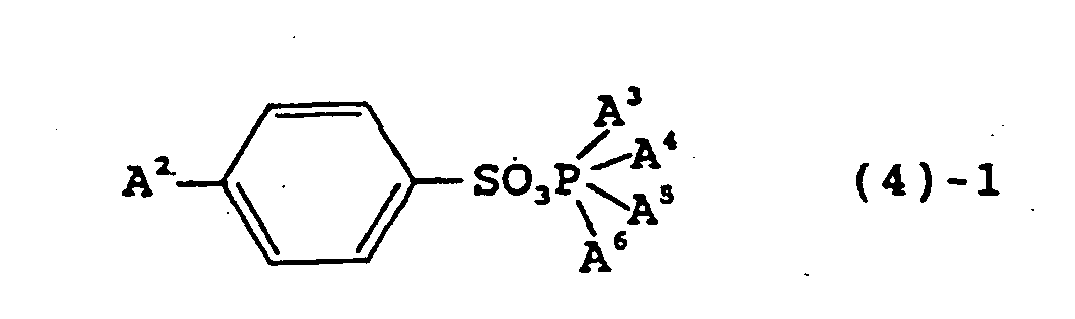
- Aromatische Polycarbonatharzzusammensetzung gemäß Anspruch 1, welche weiter einen aromatischen Phosphorsäureester in einer Menge von 1 x 10⁻⁴ bis 0,1 Gew.-Teilen umfaßt.
- Verwendung der vorstehenden Verbindung (B) zum Verbessern der Trenn- bzw. Ablösbarkeit eines aromatischen Polycarbonats durch Mischen mit dem aromatischen Polycarbonat.
- Ablösbarkeit-Modifizierungsmittel für aromatische Polycarbonate, welche die vorstehende Verbindung (B) umfaßt.
- Substrat für optische Aufzeichnungsmedien, welches aus der aromatischen Polycarbonatharzzusammensetzung gemäß Anspruch 1 ist.
- Optisches Aufzeichnungsmedium, umfassend das Substrat gemäß Anspruch 14 und eine optische Aufzeichnungsschicht, gebildet auf einer Seite des Substrats, direkt oder durch eine Zwischenschicht.
Applications Claiming Priority (11)
| Application Number | Priority Date | Filing Date | Title |
|---|---|---|---|
| JP14804999 | 1999-05-27 | ||
| JP14804899 | 1999-05-27 | ||
| JP14804999 | 1999-05-27 | ||
| JP14804899 | 1999-05-27 | ||
| JP36270199 | 1999-12-21 | ||
| JP36270299 | 1999-12-21 | ||
| JP36270099 | 1999-12-21 | ||
| JP36270099 | 1999-12-21 | ||
| JP36270199 | 1999-12-21 | ||
| JP36270299 | 1999-12-21 | ||
| PCT/JP2000/003313 WO2000073387A1 (en) | 1999-05-27 | 2000-05-24 | Polycarbonate resin composition, optical recording medium, and substrate therefor |
Publications (3)
| Publication Number | Publication Date |
|---|---|
| EP1116751A1 EP1116751A1 (de) | 2001-07-18 |
| EP1116751A4 EP1116751A4 (de) | 2004-05-06 |
| EP1116751B1 true EP1116751B1 (de) | 2009-07-29 |
Family
ID=27527826
Family Applications (1)
| Application Number | Title | Priority Date | Filing Date |
|---|---|---|---|
| EP00931538A Expired - Lifetime EP1116751B1 (de) | 1999-05-27 | 2000-05-24 | Polycarbonatharz-zusammensetzung, optisches auzeichnungsmedium sowie substrat dafür |
Country Status (9)
| Country | Link |
|---|---|
| US (1) | US6407199B1 (de) |
| EP (1) | EP1116751B1 (de) |
| JP (1) | JP4617042B2 (de) |
| CN (1) | CN1250646C (de) |
| AT (1) | ATE437913T1 (de) |
| DE (1) | DE60042638D1 (de) |
| ES (1) | ES2329111T3 (de) |
| TW (1) | TWI282805B (de) |
| WO (1) | WO2000073387A1 (de) |
Families Citing this family (15)
| Publication number | Priority date | Publication date | Assignee | Title |
|---|---|---|---|---|
| US5758644A (en) * | 1995-06-07 | 1998-06-02 | Masimo Corporation | Manual and automatic probe calibration |
| EP1274798A1 (de) * | 2000-04-10 | 2003-01-15 | General Electric Company | Polycarbonat mit hervorragender hydrolytischer stabilität |
| JP4798839B2 (ja) * | 2000-11-16 | 2011-10-19 | 帝人化成株式会社 | ポリカーボネート樹脂組成物および情報記録媒体用基板 |
| DE10114803A1 (de) * | 2001-03-26 | 2002-10-10 | Bayer Ag | Neue Polymergemische |
| JP2002294061A (ja) * | 2001-03-28 | 2002-10-09 | Teijin Ltd | 光学用成形物用ポリカーボネート樹脂組成物、光記録媒体用基板および光記録媒体 |
| US20040198884A1 (en) * | 2002-06-24 | 2004-10-07 | Yuichi Kageyama | Polycarbonate composition with excellent releasability from mold |
| DE10246139A1 (de) * | 2002-10-01 | 2004-04-15 | Basf Ag | Alkylglycidolcarbonate als Co-Tenside |
| JP4267363B2 (ja) * | 2003-05-07 | 2009-05-27 | 旭化成ケミカルズ株式会社 | 光学情報基板用ポリカーボネート組成物 |
| EP1541568A1 (de) * | 2003-12-09 | 2005-06-15 | Deutsches Wollforschungsinstitut an der Rheinisch-Westfälischen Technischen Hochschule Aachen e.V. | Reaktive cyclische Carbonate und Harnstoffe zur Modifizierung von Biomolekülen, Polymeren und Oberflächen |
| KR100858264B1 (ko) * | 2004-06-17 | 2008-09-11 | 아사히 가세이 케미칼즈 가부시키가이샤 | 방향족 카르보네이트의 제조 방법 |
| JP5319174B2 (ja) * | 2008-06-17 | 2013-10-16 | 出光興産株式会社 | ポリカーボネート樹脂組成物及びその成形体 |
| JP5617186B2 (ja) * | 2009-04-20 | 2014-11-05 | 三菱瓦斯化学株式会社 | ポリカーボネート樹脂組成物 |
| KR101681879B1 (ko) * | 2013-12-10 | 2016-12-01 | 수미카 스타이론 폴리카보네이트 주식회사 | 폴리카르보네이트 수지 조성물 및 광학용 성형품 |
| WO2022077450A1 (zh) * | 2020-10-16 | 2022-04-21 | 万华化学集团股份有限公司 | 聚碳酸酯及其制备方法和应用 |
| JP7856089B2 (ja) * | 2021-02-17 | 2026-05-11 | 三菱瓦斯化学株式会社 | 樹脂組成物並びにそれを用いた印刷用インキ及び導電性ペースト |
Family Cites Families (17)
| Publication number | Priority date | Publication date | Assignee | Title |
|---|---|---|---|---|
| DE1283432B (de) * | 1963-04-11 | 1968-11-21 | Bayer Ag | Verfahren zur Herstellung von Faeden oder Filmen durch Verformen von hochmolekularenlinearen Polycarbonaten |
| GB1567517A (en) * | 1976-07-02 | 1980-05-14 | Gen Electric | Polycarbonate moulding compositions |
| JPS554141A (en) | 1978-06-27 | 1980-01-12 | Toshiba Corp | Still picture receiver circuit |
| JPS5586837A (en) * | 1978-12-26 | 1980-07-01 | Teijin Chem Ltd | Polycarbonate resin composition |
| US4409349A (en) * | 1982-04-22 | 1983-10-11 | The Dow Chemical Company | Stabilized polycarbonate compositions |
| JPS6264860A (ja) * | 1985-09-17 | 1987-03-23 | Teijin Chem Ltd | 光学用成形材料 |
| JPH0739537B2 (ja) * | 1987-07-07 | 1995-05-01 | 三菱化学株式会社 | ポリカ−ボネ−ト樹脂組成物 |
| JPH01315460A (ja) * | 1988-06-16 | 1989-12-20 | Mitsubishi Gas Chem Co Inc | ポリカーボネート樹脂成形材料 |
| JPH01315459A (ja) * | 1988-06-16 | 1989-12-20 | Mitsubishi Gas Chem Co Inc | 光学用成形材料 |
| JPH0248081A (ja) | 1988-08-10 | 1990-02-16 | Kubota Ltd | セメント賦形体の化粧方法 |
| JP3008508B2 (ja) * | 1991-02-14 | 2000-02-14 | 大日本インキ化学工業株式会社 | 熱硬化性樹脂組成物 |
| JP2976562B2 (ja) * | 1991-04-09 | 1999-11-10 | 大日本インキ化学工業株式会社 | 硬化性樹脂組成物 |
| JPH05171024A (ja) * | 1991-12-26 | 1993-07-09 | Mitsubishi Kasei Corp | ポリカーボネート樹脂組成物 |
| EP0640646B1 (de) * | 1993-08-26 | 2002-11-06 | Teijin Limited | Verfahren zur Herstellung von stabilisiertem Polycarbonat |
| DE69527163T2 (de) | 1994-02-10 | 2003-01-09 | Teijin Ltd., Osaka | Verfahren zur Herstellung von aromatischen Polycarbonaten |
| JP3187272B2 (ja) | 1994-02-10 | 2001-07-11 | 帝人株式会社 | 芳香族ポリカーボネートの製造法 |
| JP3394336B2 (ja) | 1994-09-05 | 2003-04-07 | 日本ジーイープラスチックス株式会社 | ポリカーボネート樹脂組成物 |
-
2000
- 2000-05-24 AT AT00931538T patent/ATE437913T1/de not_active IP Right Cessation
- 2000-05-24 JP JP2001500708A patent/JP4617042B2/ja not_active Expired - Fee Related
- 2000-05-24 WO PCT/JP2000/003313 patent/WO2000073387A1/ja not_active Ceased
- 2000-05-24 EP EP00931538A patent/EP1116751B1/de not_active Expired - Lifetime
- 2000-05-24 CN CNB008015392A patent/CN1250646C/zh not_active Expired - Fee Related
- 2000-05-24 ES ES00931538T patent/ES2329111T3/es not_active Expired - Lifetime
- 2000-05-24 DE DE60042638T patent/DE60042638D1/de not_active Expired - Lifetime
- 2000-05-24 US US09/744,559 patent/US6407199B1/en not_active Expired - Lifetime
- 2000-05-26 TW TW089110307A patent/TWI282805B/zh not_active IP Right Cessation
Also Published As
| Publication number | Publication date |
|---|---|
| JP4617042B2 (ja) | 2011-01-19 |
| ES2329111T3 (es) | 2009-11-23 |
| EP1116751A4 (de) | 2004-05-06 |
| WO2000073387A1 (en) | 2000-12-07 |
| TWI282805B (en) | 2007-06-21 |
| CN1250646C (zh) | 2006-04-12 |
| DE60042638D1 (de) | 2009-09-10 |
| ATE437913T1 (de) | 2009-08-15 |
| CN1319123A (zh) | 2001-10-24 |
| US6407199B1 (en) | 2002-06-18 |
| WO2000073387A9 (en) | 2001-03-01 |
| EP1116751A1 (de) | 2001-07-18 |
Similar Documents
| Publication | Publication Date | Title |
|---|---|---|
| US6407199B1 (en) | Polycarbonate resin composition optical recording medium, and substrate therefor | |
| EP1191064B1 (de) | Aromatische polycarbonatzusammensetzung | |
| JP2000129112A (ja) | 安定化ポリカーボネート樹脂組成物および成形品 | |
| US20040147655A1 (en) | Aromatic polycarbonate resin composition | |
| JPWO2001072901A1 (ja) | 芳香族ポリカーボネート組成物、その製造法およびその成形品 | |
| JP3394336B2 (ja) | ポリカーボネート樹脂組成物 | |
| JPWO2000073387A1 (ja) | ポリカーボネート樹脂組成物、光記録媒体およびその基板 | |
| JP3399803B2 (ja) | 芳香族ポリカーボネート組成物 | |
| JP2000239511A (ja) | 安定化芳香族ポリカーボネート組成物及びそれよりの射出成型品 | |
| JP2000212271A (ja) | 成形性、安定性、及び透明性が良好な芳香族ポリカ―ボネ―ト樹脂 | |
| JP3866934B2 (ja) | 光学用ポリカーボネートおよびその用途 | |
| JP2000239510A (ja) | 安定化芳香族ポリカーボネート組成物及びそれよりの射出成型品 | |
| JP3494789B2 (ja) | 樹脂組成物 | |
| JP2000327895A (ja) | ポリカーボネート樹脂組成物 | |
| JP4259662B2 (ja) | 安定性に優れたポリカーボネート組成物及び該組成物の成形品 | |
| JP4361200B2 (ja) | ポリカーボネート樹脂組成物 | |
| US20040198884A1 (en) | Polycarbonate composition with excellent releasability from mold | |
| JP2002234994A (ja) | ポリカーボネート樹脂組成物、光記録媒体およびその基板 | |
| JP2002294061A (ja) | 光学用成形物用ポリカーボネート樹脂組成物、光記録媒体用基板および光記録媒体 | |
| JP4180719B2 (ja) | ポリカーボネート樹脂組成物 | |
| JP4376359B2 (ja) | ポリカーボネート樹脂組成物の連続製造方法 | |
| JP2000204148A (ja) | 成形性、熱安定性、及び透明性が良好な芳香族ポリカ―ボネ―ト樹脂 | |
| US6720404B2 (en) | Polycarbonates for optical use, and their applications | |
| JP3971383B2 (ja) | 金型離型性に優れたポリカーボネート組成物 | |
| JPH11209597A (ja) | 安定化された芳香族ポリカーボネート組成物 |
Legal Events
| Date | Code | Title | Description |
|---|---|---|---|
| PUAI | Public reference made under article 153(3) epc to a published international application that has entered the european phase |
Free format text: ORIGINAL CODE: 0009012 |
|
| 17P | Request for examination filed |
Effective date: 20010124 |
|
| AK | Designated contracting states |
Kind code of ref document: A1 Designated state(s): AT BE CH CY DE DK ES FI FR GB GR IE IT LI LU MC NL PT SE |
|
| RIC1 | Information provided on ipc code assigned before grant |
Ipc: 7G 02B 1/00 B Ipc: 7G 11B 7/00 B Ipc: 7C 08K 5/103 B Ipc: 7C 08K 5/1565 A Ipc: 7C 08K 5/13 B Ipc: 7C 08L 69/00 B Ipc: 7C 08K 5/06 B |
|
| A4 | Supplementary search report drawn up and despatched |
Effective date: 20040318 |
|
| 17Q | First examination report despatched |
Effective date: 20061207 |
|
| GRAP | Despatch of communication of intention to grant a patent |
Free format text: ORIGINAL CODE: EPIDOSNIGR1 |
|
| GRAS | Grant fee paid |
Free format text: ORIGINAL CODE: EPIDOSNIGR3 |
|
| GRAA | (expected) grant |
Free format text: ORIGINAL CODE: 0009210 |
|
| AK | Designated contracting states |
Kind code of ref document: B1 Designated state(s): AT BE CH CY DE DK ES FI FR GB GR IE IT LI LU MC NL PT SE |
|
| REG | Reference to a national code |
Ref country code: GB Ref legal event code: FG4D |
|
| REG | Reference to a national code |
Ref country code: CH Ref legal event code: EP |
|
| REG | Reference to a national code |
Ref country code: IE Ref legal event code: FG4D |
|
| REF | Corresponds to: |
Ref document number: 60042638 Country of ref document: DE Date of ref document: 20090910 Kind code of ref document: P |
|
| REG | Reference to a national code |
Ref country code: ES Ref legal event code: FG2A Ref document number: 2329111 Country of ref document: ES Kind code of ref document: T3 |
|
| PG25 | Lapsed in a contracting state [announced via postgrant information from national office to epo] |
Ref country code: FI Free format text: LAPSE BECAUSE OF FAILURE TO SUBMIT A TRANSLATION OF THE DESCRIPTION OR TO PAY THE FEE WITHIN THE PRESCRIBED TIME-LIMIT Effective date: 20090729 Ref country code: AT Free format text: LAPSE BECAUSE OF FAILURE TO SUBMIT A TRANSLATION OF THE DESCRIPTION OR TO PAY THE FEE WITHIN THE PRESCRIBED TIME-LIMIT Effective date: 20090729 Ref country code: SE Free format text: LAPSE BECAUSE OF FAILURE TO SUBMIT A TRANSLATION OF THE DESCRIPTION OR TO PAY THE FEE WITHIN THE PRESCRIBED TIME-LIMIT Effective date: 20090729 |
|
| PG25 | Lapsed in a contracting state [announced via postgrant information from national office to epo] |
Ref country code: PT Free format text: LAPSE BECAUSE OF FAILURE TO SUBMIT A TRANSLATION OF THE DESCRIPTION OR TO PAY THE FEE WITHIN THE PRESCRIBED TIME-LIMIT Effective date: 20091129 |
|
| PG25 | Lapsed in a contracting state [announced via postgrant information from national office to epo] |
Ref country code: DK Free format text: LAPSE BECAUSE OF FAILURE TO SUBMIT A TRANSLATION OF THE DESCRIPTION OR TO PAY THE FEE WITHIN THE PRESCRIBED TIME-LIMIT Effective date: 20090729 |
|
| PLBE | No opposition filed within time limit |
Free format text: ORIGINAL CODE: 0009261 |
|
| STAA | Information on the status of an ep patent application or granted ep patent |
Free format text: STATUS: NO OPPOSITION FILED WITHIN TIME LIMIT |
|
| 26N | No opposition filed |
Effective date: 20100503 |
|
| PG25 | Lapsed in a contracting state [announced via postgrant information from national office to epo] |
Ref country code: GR Free format text: LAPSE BECAUSE OF FAILURE TO SUBMIT A TRANSLATION OF THE DESCRIPTION OR TO PAY THE FEE WITHIN THE PRESCRIBED TIME-LIMIT Effective date: 20091030 |
|
| PG25 | Lapsed in a contracting state [announced via postgrant information from national office to epo] |
Ref country code: MC Free format text: LAPSE BECAUSE OF NON-PAYMENT OF DUE FEES Effective date: 20100531 |
|
| REG | Reference to a national code |
Ref country code: CH Ref legal event code: PL |
|
| REG | Reference to a national code |
Ref country code: FR Ref legal event code: ST Effective date: 20110131 |
|
| PG25 | Lapsed in a contracting state [announced via postgrant information from national office to epo] |
Ref country code: CH Free format text: LAPSE BECAUSE OF NON-PAYMENT OF DUE FEES Effective date: 20100531 Ref country code: LI Free format text: LAPSE BECAUSE OF NON-PAYMENT OF DUE FEES Effective date: 20100531 |
|
| PG25 | Lapsed in a contracting state [announced via postgrant information from national office to epo] |
Ref country code: IT Free format text: LAPSE BECAUSE OF FAILURE TO SUBMIT A TRANSLATION OF THE DESCRIPTION OR TO PAY THE FEE WITHIN THE PRESCRIBED TIME-LIMIT Effective date: 20090729 |
|
| PG25 | Lapsed in a contracting state [announced via postgrant information from national office to epo] |
Ref country code: IE Free format text: LAPSE BECAUSE OF NON-PAYMENT OF DUE FEES Effective date: 20100524 |
|
| PG25 | Lapsed in a contracting state [announced via postgrant information from national office to epo] |
Ref country code: FR Free format text: LAPSE BECAUSE OF NON-PAYMENT OF DUE FEES Effective date: 20100531 |
|
| PG25 | Lapsed in a contracting state [announced via postgrant information from national office to epo] |
Ref country code: CY Free format text: LAPSE BECAUSE OF FAILURE TO SUBMIT A TRANSLATION OF THE DESCRIPTION OR TO PAY THE FEE WITHIN THE PRESCRIBED TIME-LIMIT Effective date: 20090729 |
|
| PG25 | Lapsed in a contracting state [announced via postgrant information from national office to epo] |
Ref country code: LU Free format text: LAPSE BECAUSE OF NON-PAYMENT OF DUE FEES Effective date: 20100524 |
|
| PGFP | Annual fee paid to national office [announced via postgrant information from national office to epo] |
Ref country code: ES Payment date: 20120522 Year of fee payment: 13 |
|
| PGFP | Annual fee paid to national office [announced via postgrant information from national office to epo] |
Ref country code: BE Payment date: 20130506 Year of fee payment: 14 Ref country code: NL Payment date: 20130418 Year of fee payment: 14 |
|
| REG | Reference to a national code |
Ref country code: NL Ref legal event code: V1 Effective date: 20141201 |
|
| PG25 | Lapsed in a contracting state [announced via postgrant information from national office to epo] |
Ref country code: NL Free format text: LAPSE BECAUSE OF NON-PAYMENT OF DUE FEES Effective date: 20141201 |
|
| REG | Reference to a national code |
Ref country code: ES Ref legal event code: FD2A Effective date: 20150626 |
|
| PG25 | Lapsed in a contracting state [announced via postgrant information from national office to epo] |
Ref country code: ES Free format text: LAPSE BECAUSE OF NON-PAYMENT OF DUE FEES Effective date: 20140525 |
|
| PG25 | Lapsed in a contracting state [announced via postgrant information from national office to epo] |
Ref country code: BE Free format text: LAPSE BECAUSE OF NON-PAYMENT OF DUE FEES Effective date: 20140531 |
|
| PGFP | Annual fee paid to national office [announced via postgrant information from national office to epo] |
Ref country code: GB Payment date: 20170519 Year of fee payment: 18 |
|
| PGFP | Annual fee paid to national office [announced via postgrant information from national office to epo] |
Ref country code: DE Payment date: 20170622 Year of fee payment: 18 |
|
| REG | Reference to a national code |
Ref country code: DE Ref legal event code: R119 Ref document number: 60042638 Country of ref document: DE |
|
| GBPC | Gb: european patent ceased through non-payment of renewal fee |
Effective date: 20180524 |
|
| PG25 | Lapsed in a contracting state [announced via postgrant information from national office to epo] |
Ref country code: DE Free format text: LAPSE BECAUSE OF NON-PAYMENT OF DUE FEES Effective date: 20181201 Ref country code: GB Free format text: LAPSE BECAUSE OF NON-PAYMENT OF DUE FEES Effective date: 20180524 |