EP1120436B1 - Verfahren zur herstellung von granulat aus einem thermoplastischen harz - Google Patents
Verfahren zur herstellung von granulat aus einem thermoplastischen harz Download PDFInfo
- Publication number
- EP1120436B1 EP1120436B1 EP00929858A EP00929858A EP1120436B1 EP 1120436 B1 EP1120436 B1 EP 1120436B1 EP 00929858 A EP00929858 A EP 00929858A EP 00929858 A EP00929858 A EP 00929858A EP 1120436 B1 EP1120436 B1 EP 1120436B1
- Authority
- EP
- European Patent Office
- Prior art keywords
- rolls
- concavities
- thermoplastic resin
- raw material
- granules
- Prior art date
- Legal status (The legal status is an assumption and is not a legal conclusion. Google has not performed a legal analysis and makes no representation as to the accuracy of the status listed.)
- Expired - Lifetime
Links
- 239000008187 granular material Substances 0.000 title claims description 41
- 229920005992 thermoplastic resin Polymers 0.000 title claims description 31
- 238000000034 method Methods 0.000 title claims description 8
- 239000002994 raw material Substances 0.000 claims description 31
- 239000000463 material Substances 0.000 claims description 14
- 238000000748 compression moulding Methods 0.000 claims description 9
- 238000001035 drying Methods 0.000 claims description 8
- 229920000642 polymer Polymers 0.000 claims description 4
- 238000002156 mixing Methods 0.000 claims description 3
- 230000000379 polymerizing effect Effects 0.000 claims description 3
- 238000003825 pressing Methods 0.000 claims description 2
- 239000000047 product Substances 0.000 description 28
- 239000008188 pellet Substances 0.000 description 12
- 238000004519 manufacturing process Methods 0.000 description 11
- 238000000465 moulding Methods 0.000 description 8
- 229920005989 resin Polymers 0.000 description 6
- 239000011347 resin Substances 0.000 description 6
- 239000004734 Polyphenylene sulfide Substances 0.000 description 4
- 239000004417 polycarbonate Substances 0.000 description 4
- 229920000515 polycarbonate Polymers 0.000 description 4
- -1 polyethylene Polymers 0.000 description 4
- 229920000069 polyphenylene sulfide Polymers 0.000 description 4
- 238000010008 shearing Methods 0.000 description 4
- 239000003381 stabilizer Substances 0.000 description 4
- 239000004033 plastic Substances 0.000 description 3
- 229920003023 plastic Polymers 0.000 description 3
- 238000006116 polymerization reaction Methods 0.000 description 3
- 238000000071 blow moulding Methods 0.000 description 2
- 239000007795 chemical reaction product Substances 0.000 description 2
- 238000001816 cooling Methods 0.000 description 2
- 238000010586 diagram Methods 0.000 description 2
- 238000001746 injection moulding Methods 0.000 description 2
- 239000000088 plastic resin Substances 0.000 description 2
- 239000004014 plasticizer Substances 0.000 description 2
- 238000003860 storage Methods 0.000 description 2
- ZOXJGFHDIHLPTG-UHFFFAOYSA-N Boron Chemical compound [B] ZOXJGFHDIHLPTG-UHFFFAOYSA-N 0.000 description 1
- 239000004484 Briquette Substances 0.000 description 1
- 229920000049 Carbon (fiber) Polymers 0.000 description 1
- 239000004696 Poly ether ether ketone Substances 0.000 description 1
- 229930182556 Polyacetal Natural products 0.000 description 1
- 239000004952 Polyamide Substances 0.000 description 1
- 239000004698 Polyethylene Substances 0.000 description 1
- 239000004793 Polystyrene Substances 0.000 description 1
- 229920002978 Vinylon Polymers 0.000 description 1
- 238000010521 absorption reaction Methods 0.000 description 1
- 229920000122 acrylonitrile butadiene styrene Polymers 0.000 description 1
- 239000003963 antioxidant agent Substances 0.000 description 1
- 230000003078 antioxidant effect Effects 0.000 description 1
- 235000006708 antioxidants Nutrition 0.000 description 1
- 239000002216 antistatic agent Substances 0.000 description 1
- 229920006231 aramid fiber Polymers 0.000 description 1
- 229910052796 boron Inorganic materials 0.000 description 1
- 238000003490 calendering Methods 0.000 description 1
- 239000004917 carbon fiber Substances 0.000 description 1
- 239000003086 colorant Substances 0.000 description 1
- 238000013329 compounding Methods 0.000 description 1
- 230000006835 compression Effects 0.000 description 1
- 238000007906 compression Methods 0.000 description 1
- 238000009826 distribution Methods 0.000 description 1
- 230000000694 effects Effects 0.000 description 1
- 238000001125 extrusion Methods 0.000 description 1
- 239000000835 fiber Substances 0.000 description 1
- 239000000945 filler Substances 0.000 description 1
- 239000010419 fine particle Substances 0.000 description 1
- 238000005187 foaming Methods 0.000 description 1
- 239000003365 glass fiber Substances 0.000 description 1
- 239000004615 ingredient Substances 0.000 description 1
- 239000003112 inhibitor Substances 0.000 description 1
- 230000001788 irregular Effects 0.000 description 1
- 238000005461 lubrication Methods 0.000 description 1
- VNWKTOKETHGBQD-UHFFFAOYSA-N methane Chemical compound C VNWKTOKETHGBQD-UHFFFAOYSA-N 0.000 description 1
- 239000000203 mixture Substances 0.000 description 1
- 238000012986 modification Methods 0.000 description 1
- 230000004048 modification Effects 0.000 description 1
- 230000003647 oxidation Effects 0.000 description 1
- 238000007254 oxidation reaction Methods 0.000 description 1
- 229920002492 poly(sulfone) Polymers 0.000 description 1
- 229920002647 polyamide Polymers 0.000 description 1
- 229920001707 polybutylene terephthalate Polymers 0.000 description 1
- 229920000728 polyester Polymers 0.000 description 1
- 229920002530 polyetherether ketone Polymers 0.000 description 1
- 229920000573 polyethylene Polymers 0.000 description 1
- 229920000139 polyethylene terephthalate Polymers 0.000 description 1
- 239000005020 polyethylene terephthalate Substances 0.000 description 1
- 229920006324 polyoxymethylene Polymers 0.000 description 1
- 229920001955 polyphenylene ether Polymers 0.000 description 1
- 229920002223 polystyrene Polymers 0.000 description 1
- 239000004800 polyvinyl chloride Substances 0.000 description 1
- 229920000915 polyvinyl chloride Polymers 0.000 description 1
- 239000000843 powder Substances 0.000 description 1
- 230000002787 reinforcement Effects 0.000 description 1
- 230000035939 shock Effects 0.000 description 1
- 229920002994 synthetic fiber Polymers 0.000 description 1
- 239000012209 synthetic fiber Substances 0.000 description 1
- 239000012815 thermoplastic material Substances 0.000 description 1
- 239000012801 ultraviolet ray absorbent Substances 0.000 description 1
Images


Classifications
-
- C—CHEMISTRY; METALLURGY
- C08—ORGANIC MACROMOLECULAR COMPOUNDS; THEIR PREPARATION OR CHEMICAL WORKING-UP; COMPOSITIONS BASED THEREON
- C08J—WORKING-UP; GENERAL PROCESSES OF COMPOUNDING; AFTER-TREATMENT NOT COVERED BY SUBCLASSES C08B, C08C, C08F, C08G or C08H
- C08J3/00—Processes of treating or compounding macromolecular substances
- C08J3/12—Powdering or granulating
-
- B—PERFORMING OPERATIONS; TRANSPORTING
- B29—WORKING OF PLASTICS; WORKING OF SUBSTANCES IN A PLASTIC STATE IN GENERAL
- B29B—PREPARATION OR PRETREATMENT OF THE MATERIAL TO BE SHAPED; MAKING GRANULES OR PREFORMS; RECOVERY OF PLASTICS OR OTHER CONSTITUENTS OF WASTE MATERIAL CONTAINING PLASTICS
- B29B9/00—Making granules
- B29B9/08—Making granules by agglomerating smaller particles
-
- B—PERFORMING OPERATIONS; TRANSPORTING
- B30—PRESSES
- B30B—PRESSES IN GENERAL
- B30B11/00—Presses specially adapted for forming shaped articles from material in particulate or plastic state, e.g. briquetting presses, tabletting presses
- B30B11/16—Presses specially adapted for forming shaped articles from material in particulate or plastic state, e.g. briquetting presses, tabletting presses using pocketed rollers, e.g. two co-operating pocketed rollers
-
- B—PERFORMING OPERATIONS; TRANSPORTING
- B30—PRESSES
- B30B—PRESSES IN GENERAL
- B30B15/00—Details of, or accessories for, presses; Auxiliary measures in connection with pressing
- B30B15/30—Feeding material to presses
- B30B15/302—Feeding material in particulate or plastic state to moulding presses
- B30B15/308—Feeding material in particulate or plastic state to moulding presses in a continuous manner, e.g. for roller presses, screw extrusion presses
Definitions
- the present invention relates to a process for producing thermoplastic resin granules to be supplied to a granulating machine or secondary molding machine.
- thermoplastic resin In the production process of a thermoplastic resin, a powdery raw material of the thermoplastic resin, which is obtained by polymerizing a plurality of materials and then drying the obtained polymer, is cooled, is then mixed with an auxiliary material such as a plasticizer or another resin material, and is then granulated by a screw extruder into pellets having grain diameters of approximately 10 mm or less.
- the thus obtained pellets are supplied to a secondary molding machine such as an injection molding machine or blow molding machine so as to be molded into the shape of an end product.
- the powdery raw material of a thermoplastic resin just after drying and cooling as described above has a low bulk density, and thus requires unduly large pieces of equipment for its transportation and storage. Moreover, in a screw extruder, the low bulk density of the powdery raw material incurs not only large slippage between the screw and the casing thereof but also a large compression ratio, which leads to unduly high power consumption by the screw extruder when it is driven.
- US 4 424 016 relates to the production of high density pellets comprising compression-molding a powdery raw material by passing it between 2 rolls with opposed interstices.
- a briquetting apparatus comprising a pair of rolls defining a plurality of pockets extending in a line along a nip of said rolls transverse to the direction of descent of the material, the feed material being distributed uniformly across the width of the briquetting rolls; therefore, the resulting briquettes have uniform density, regardless of the pocket, in which they are formed.
- a first object of the present invention is to provide thermoplastic resin granules having a satisfactorily high bulk density.
- a second object of the present invention is to efficiently provide thermoplastic resin granules having satisfactorily uniform grain sizes.
- thermoplastic resin granules According to the present invention, a process for producing thermoplastic resin granules is disclosed following claim 1.
- the process for producing thermoplastic resin granules includes mixing the powdery raw material with an auxiliary material at a temperature of 40 °C or higher before compression-molding.
- the minimum gap between d the two rolls is adjusted in the range from 0.5 mm to 1.0 mm (0.5 mm ⁇ d ⁇ 1.0 mm).
- thermoplastic resin pellet production process shown in Fig. 1, a powdery raw material of a thermoplastic resin, which is obtained by polymerizing a plurality of materials and then drying the obtained polymer, is compression-molded by being passed between two rolls arranged parallel with a minute gap therebetween without being cooled, specifically at a temperature of 40 °C or higher, and preferably 50 °C or higher.
- the obtained compression-molded product is then crushed into granules having grain diameters of 10 mm or less.
- the thus obtained granules are mixed with an auxiliary material and then supplied to a screw extruder so as to be granulated into pellets.
- thermoplastic resin pellet production process shown in Fig. 2
- a powdery raw material of a thermoplastic resin after polymerization and drying is mixed with an auxiliary material without being cooled, specifically at a temperature of 40 °C or higher, and preferably 50 °C or higher, and is then compression-molded by being passed between two rolls arranged parallel with a minute gap therebetween.
- the obtained compression-molded product is then crushed into granules having grain diameters of 10 mm or less.
- the thus obtained granules are supplied to a screw extruder so as to be granulated into pellets.
- thermoplastic resin used here may be of any kind, for example, polyethylene, polyethylene terephthalate, polystyrene, ABS resin, metacrylate resin, polyamide, polycarbonate, polyacetal, polyphenylene ether, polyphenylene sulfide, polyether ether ketone, polysulfone, fluororesin, polybutylene terephthalate, or the like.
- the auxiliary material added here may be, for example, a plasticizer, stabilizer (polyvinyl chloride stabilizer, softening stabilizer, hardening stabilizer), flame retarder, anti-oxidant (oxidation inhibitor), ultraviolet ray absorbent, colorant, antistatic agent, reinforcer (glass fiber, carbon fiber, aramid fiber, boron fiber, synthetic fiber (vinylon, polyester)), filler (for the purpose of reinforcement, shielding, electric conduction, lubrication, absorption, anti-dripping, weather resistance, thermal expansion coefficient adjustment, improved printability or adhesiveness, extending, or other), or the like.
- stabilizer polyvinyl chloride stabilizer, softening stabilizer, hardening stabilizer
- flame retarder anti-oxidant (oxidation inhibitor)
- ultraviolet ray absorbent colorant
- antistatic agent reinforcer
- reinforcer glass fiber, carbon fiber, aramid fiber, boron fiber, synthetic fiber (vinylon, polyester)
- filler for the purpose of reinforcement, shielding, electric conduction, lubrication,
- the obtained pellets are supplied to a secondary molding machine so as to be molded into the shape of an end product.
- the secondary molding machine here may be, for example, a compression molding machine, calendering machine, extrusion molding machine, blow molding machine, vacuum or compressed-air molding machine, foaming machine, injection molding machine, or the like.
- the granules may be supplied intact, i.e. without being granulated into pellets, to the secondary molding machine.
- thermoplastic resin becomes plastic at high temperatures, by compression-molding a powdery raw material thereof just after drying by passing it between rolls without cooling it, i.e. at a temperature of 40 °C or higher, it is possible to obtain granules having a high bulk density.
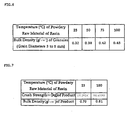
- Fig. 6 shows the relationship between the bulk density of the obtained granules and the temperature of the powdery raw material when a powdery raw material of polycarbonate, having a bulk density of 0.21 g/cm 3 after polymerization and drying, is first compression-molded into 4 mm thick flakes by being passed between two rolls under compressive force of 39.23kN (4 t as originally filed) for every 1 cm width along the axes of the rolls, and is then crushed and sifted to obtain granules having grain diameters of 3 to 5 mm.
- Fig. 6 shows that, the higher the temperature of the powdery raw material, the higher the bulk density of the obtained granule.
- the preferable temperature of the powdery raw material is 100 °C or higher.
- Fig. 7 shows the data of the crush strength and density of the product obtained when a cylinder measuring 25 mm in diameter and 25 mm in height is filled with a powdery raw material of a polyphenylene sulfide resin and then the resin is compression-molded under pressure of 98.067 MPa (1t/cm 2 ) applied thereto by a piston, separately for cases where the temperature of the powdery raw material is 25 °C and 100 °C respectively.
- the rolls may have flat, smooth circumferential surfaces, or have fine grooves formed in the circumferential surfaces thereof along the axis or circumference thereof, or have undulate circumferential surfaces.
- the two rolls are arranged with a gap of about 2 to 5 mm therebetween.
- the crushed product With a highly plastic resin, however, the crushed product has irregular shapes and very rugged cut surfaces, which often leads to an unexpectedly low bulk density.
- the crushed product exhibits an unduly wide grain size distribution, and thus, to obtain granules having uniform grain sizes, the crushed product needs to be sifted so that granules having grain sizes larger than desired are crushed again and that granules having grain sizes smaller than desired are circulated so as to be compression-molded between the rolls and then crushed. This leads to low yields.
- the concavities 1a formed on the outer circumferential surfaces of the rolls 1 and 1 help obtain the product in the form of a large number of briquettes connected together.
- This product is then crushed by a crushing machine that breaks it at the borders between briquettes, i.e. at the thin portions of the product that are formed by the round portions 1b of the outer circumferential surfaces of the rolls 1 where there are no concavities 1a, into separate briquettes.
- the thus obtained briquettes are not flat, but have smooth surfaces, and thus have a higher bulk density and better fluidity than irregularly-shaped granules obtained by crushing flakes as described earlier. This makes uniform discharge of the product from a hopper and uniform supply thereof to a screw extruder possible.
- the concavities 1a, 1'a are each so formed as to have a curved surface of which the section on a plane parallel to the circumference of the outer circumference surfaces of the rolls 1, 1' is arc-shaped This permits the product to slip on the surfaces of the concavities 1a, 1'a and thereby prevents generation of unduly strong shearing force.
- the round portions 1b, 1'b need to be made as small as possible.
- the concavities 1a, 1'a, ... are arranged in such a way that the minimum distance h between any two adjacent concavities 1a and 1'a is 0.5 mm or less.
- the gap d between the rolls is made to be 0.5 mm or more.
- the gap d is made to be 1.0 mm or less.
- the raw material charged into a hopper 3 through a raw material inlet 2 is then supplied by a screw 4 to between the rolls 1 and 1', where the raw material is compression-molded by the rolls 1 and 1' rotating as indicated by arrows.
- the product slips on the surfaces of the concavities 1a, 1'a and thus it does not develop unduly strong shearing force inside itself.
- the round portions 1b between the concavities 1a are small, the product is obtained in the form of a large number of briquettes connected together by thin portions. When crushed, the product is broken at the thin portions into separate briquettes.
- a powdery raw material of a polyphenylene sulfide resin after polymerization and drying was compression-molded into flakes by being passed between a pair of rolls arranged parallel with a gap of 4 mm therebetween and having flat, smooth outer circumferential surface at a high temperature of 75 °C under compressive force of 39.23 kN (4 t) for every 1 cm width along the axes of the rolls.
- the obtained flakes were crushed and sifted to obtain irregularly-shaped granules having grain diameters of 3 to 5 mm.
- the bulk density of the thus obtained granules was 0.42 g/cm 3 .
- the same material was compression-molded into a product in the form of a large number of briquettes connected together by being passed, at the same temperature and under compressive force of 39.23 kN for every 1cm width (4 t/cm), between a pair of rolls arranged parallel with a gap of 1 mm therebetween and having a large number of concavities 1a, 1'a, ...
- a powdery raw material was compression-molded into flakes by being passed between rolls having flat, smooth outer circumferential surfaces, and then the obtained flakes were crushed and sifted so that granules having grain diameters of 4 to 6 mm were collected, that granules having grain diameters larger than 6 mm were crushed again, and that granules having grain diameters smaller than 4 mm were circulated so as to be compression-molded again.
- This attempt resulted in a yield of about 30%.
- the powdery raw material was compression-molded into briquettes measuring 6 mm in length, 4.5 mm in width, and 4.5 mm in thickness by being passed between rolls having concavities, measuring 6 mm in major-axis diameter and 4 mm in minor-axis diameter, formed in the outer circumferential surfaces thereof, and then the obtained briquettes were sifted with a sieve having 4 mm meshes so as to remove small burrs between briquettes and fine particles that have escaped through the gaps at both sides of the rolls.
- This attempt resulted in a yield of 90% or more.
- thermoplastic resin granule production process embodying the present invention it is possible to obtain thermoplastic resin granules having a high bulk density, and thereby reduce the sizes of pieces of equipment for its transportation and storage, and in addition reduce the power consumption by a screw extruder.
- thermoplastic resin granule production process of the invention even with a highly plastic thermoplastic resin, it is possible to permit, during compression molding, the product to slip on the surfaces of concavities, and thus prevent generation of unduly strong shearing force in the product and thereby reduce development of cracks therein. Moreover, since the distances between adjacent concavities are small, it is possible to make the portions connecting briquettes together so thin as to reduce the possibility of briquettes themselves being broken when the product is crushed. Furthermore, it is possible to efficiently obtain thermoplastic resin granules having uniform grain sizes.
- thermoplastic resin granule production process of claim 3 it is possible to reduce the possibility of unduly strong compressive force causing cracks in briquettes, or breakage thereof that may cause broken briquettes to attach to concavities, and in addition further reduce the possibility of briquettes themselves being broken when the product is crushed.
Landscapes
- Engineering & Computer Science (AREA)
- Mechanical Engineering (AREA)
- Chemical & Material Sciences (AREA)
- Health & Medical Sciences (AREA)
- Chemical Kinetics & Catalysis (AREA)
- Medicinal Chemistry (AREA)
- Polymers & Plastics (AREA)
- Organic Chemistry (AREA)
- Processing And Handling Of Plastics And Other Materials For Molding In General (AREA)
- Processes Of Treating Macromolecular Substances (AREA)
- Rolls And Other Rotary Bodies (AREA)
Claims (3)
- Verfahren zur Herstellung von Granulat aus einem thermoplastischen Harz, das die folgenden Schritte umfasst:dadurch gekennzeichnet, dass:Formpressen eines pulverförmigen Rohmaterials aus einem thermoplastischen Harz, das hergestellt wird, indem mehrere Materialien polymerisiert und das erhaltene Polymer dann getrocknet wird,Formen des Granulats aus thermoplastischem Harz, indem das pulverförmige Rohmaterial bei einer Temperatur von 40 °C oder darüber zwischen zwei Walzen (1, 1'), die in einem minimalen Abstand (d) parallel angeordnet sind, hindurchgeleitet wird, wobei die Walzen (1, 1') jeweils eine große Zahl von identisch geformten, elliptischen, konkaven Vertiefungen (1a, 1'a) gleicher Größe aufweisen, die über die gesamte umlaufende Oberfläche ausgebildet sind, wobei eine konkave Vertiefung (1a) an einer Walze (1) einer konkaven Vertiefung (1'a) an der anderen Walze (1') gegenüberliegt, undZerkleinern des erhaltenen formgepressten Produkts in Form von Granulat mit einem Korndurchmesser von 10 mm oder darunter,bei der Formung das pulverförmige Rohmaterial in die Hohlräume der Walzen gepresst wird, wobei die konkaven Vertiefungen (1a, 1'a) jeweils eine elliptische Öffnung besitzen, deren Hauptachsendurchmesser 10 mm oder darunter beträgt und in Richtung des Umfangs der äußeren umlaufenden Oberfläche der Walze ausgerichtet ist,die konkaven Vertiefungen (1a, 1'a) jeweils eine gekrümmte Oberfläche aufweisen, bei der ein Bereich in einer Ebene parallel zur Umfangsrichtung in Form eines Bogens geformt ist, unddie konkaven Vertiefungen so angeordnet sind, dass der minimale Abstand (h) zwischen zwei angrenzenden Hohlräumen 0,5 mm oder darunter beträgt.
- Verfahren nach Anspruch 1, das umfasst, das pulverförmige Ausgangsmaterial vor dem Formpressen bei einer Temperatur von 40 °C oder darüber mit einem Hilfsstoff zu vermischen.
- Verfahren nach Anspruch 1 oder 2, wobei während der Formung der minimale Abstand (d) zwischen den beiden Walzen (1, 1') im Bereich von 0,5 bis 1,0 mm eingestellt wird.
Applications Claiming Priority (3)
| Application Number | Priority Date | Filing Date | Title |
|---|---|---|---|
| JP11142593A JP2000327792A (ja) | 1999-05-24 | 1999-05-24 | 熱可塑性樹脂顆粒物の生成方法 |
| JP14259399 | 1999-05-24 | ||
| PCT/JP2000/003339 WO2000071610A1 (en) | 1999-05-24 | 2000-05-24 | Method for forming granule of thermoplastic resin |
Publications (3)
| Publication Number | Publication Date |
|---|---|
| EP1120436A1 EP1120436A1 (de) | 2001-08-01 |
| EP1120436A4 EP1120436A4 (de) | 2003-02-19 |
| EP1120436B1 true EP1120436B1 (de) | 2005-12-28 |
Family
ID=15318923
Family Applications (1)
| Application Number | Title | Priority Date | Filing Date |
|---|---|---|---|
| EP00929858A Expired - Lifetime EP1120436B1 (de) | 1999-05-24 | 2000-05-24 | Verfahren zur herstellung von granulat aus einem thermoplastischen harz |
Country Status (6)
| Country | Link |
|---|---|
| US (1) | US6523763B1 (de) |
| EP (1) | EP1120436B1 (de) |
| JP (1) | JP2000327792A (de) |
| CA (1) | CA2337943C (de) |
| DE (1) | DE60025151T2 (de) |
| WO (1) | WO2000071610A1 (de) |
Cited By (1)
| Publication number | Priority date | Publication date | Assignee | Title |
|---|---|---|---|---|
| WO2014031501A1 (en) * | 2012-08-20 | 2014-02-27 | Cellulosetek Llc. | Manufacturing polymer coated controlled release fertilizers |
Families Citing this family (21)
| Publication number | Priority date | Publication date | Assignee | Title |
|---|---|---|---|---|
| DE10045794A1 (de) * | 2000-09-15 | 2002-04-04 | Fraunhofer Ges Forschung | Verfahren zur Herstellung eines Zwischenproduktes für die Erzeugung von Kunststoff-Formkörpern |
| US6605242B2 (en) * | 2001-03-06 | 2003-08-12 | Idemitsu Petrochemical Co., Ltd. | Method of producing styrenic resin granulate and shaped article |
| DE10126629C1 (de) * | 2001-05-31 | 2002-12-12 | Ticona Gmbh | Verfahren zur Herstellung gratarmer Formteile |
| FR2846273A1 (fr) * | 2002-10-29 | 2004-04-30 | Michel Bertrand Mezza | Procede de production de melange-maitres et liste des produits utilises pour la production de melanges biodegradables |
| US7588206B2 (en) * | 2003-12-31 | 2009-09-15 | Armex, Inc. | Material processing apparatus and methods |
| DE102004061767A1 (de) * | 2004-12-22 | 2006-07-06 | Fraunhofer-Gesellschaft zur Förderung der angewandten Forschung e.V. | Thermoplastischer Verbundwerkstoff und Verfahren zu dessen Herstellung |
| JP4830327B2 (ja) * | 2005-03-24 | 2011-12-07 | 東レ株式会社 | ポリフェニレンスルフィド樹脂組成物の製造方法 |
| DE102006036203A1 (de) * | 2006-08-03 | 2008-02-07 | Elringklinger Ag | Verfahren zum Herstellen eines rieselfähigen Pulvers eines Fluorpolymer-Compounds und nach dem Verfahren hergestelltes rieselfähiges Pulver |
| DE102006036204A1 (de) * | 2006-08-03 | 2008-02-07 | Elringklinger Ag | Verfahren zum Herstellen eines rieselfähigen Pulvers eines Fluorpolymers und nach dem Verfahren hergestelltes rieselfähiges Pulver |
| JP5251098B2 (ja) * | 2007-12-06 | 2013-07-31 | トヨタ紡織株式会社 | 熱可塑性組成物成形体の製造方法 |
| JP5498402B2 (ja) * | 2011-01-18 | 2014-05-21 | 電気化学工業株式会社 | ポリビニルアルコール樹脂の製造方法 |
| WO2013179356A1 (ja) * | 2012-05-31 | 2013-12-05 | 日鉄ハード株式会社 | 食品加工用ロールおよび食品加工用ロールの製造方法 |
| JP2016500401A (ja) * | 2012-12-21 | 2016-01-12 | ソルベイ スペシャルティ ポリマーズ イタリー エス.ピー.エー. | 熱可塑性ポリマー粉末の製造方法 |
| EP2982486B1 (de) | 2014-08-04 | 2018-02-21 | Andras Szücs | Verfahren und Vorrichtung zum Herstellen von umgeformtem Kunststoffgranulat, und danach erhaltenes umgeformtes Kunststoffgranulat |
| JP2017535643A (ja) * | 2014-11-03 | 2017-11-30 | アーケマ・インコーポレイテッド | ポリマーフレーク及び粉体の密度を高めるためのプロセス |
| US10596727B2 (en) | 2014-11-07 | 2020-03-24 | Sabic Global Technologies B.V. | Process for manufacturing a densified polymer powder, and process of melt processing a densified polymer powder |
| WO2017077446A1 (en) * | 2015-11-05 | 2017-05-11 | Sabic Global Technologies B.V. | Process for manufacturing a polymer composition comprising a densified polymer and a conversion material |
| US11591276B2 (en) | 2018-09-09 | 2023-02-28 | Cotex Technologies Inc. | System and method for manufacturing polymer coated controlled release fertilizers |
| DE102019203285A1 (de) * | 2019-03-11 | 2020-09-17 | Ford Global Technologies, Llc | Verfahren zur Aufbereitung von thermoplastischen Restpulvern |
| CN113695045B (zh) * | 2021-10-29 | 2022-02-22 | 杭州富阳锋拓机械有限公司 | 一种颗粒饲料研磨系统 |
| WO2025022693A1 (ja) * | 2023-07-26 | 2025-01-30 | 旭化成株式会社 | ポリアミド固形物の製造方法、ポリアミド固形物、及びポリアミド繊維の製造方法 |
Family Cites Families (22)
| Publication number | Priority date | Publication date | Assignee | Title |
|---|---|---|---|---|
| GB593924A (en) * | 1944-06-22 | 1947-10-29 | Leonard Smidth | Process of forming granulated aminoplast resin compositions and products so produced |
| JPS403526B1 (de) * | 1960-08-31 | 1965-02-24 | ||
| US3822177A (en) * | 1971-06-01 | 1974-07-02 | Union Carbide Corp | Thermoplastic pellets and method of producing shaped articles therefrom |
| AU461278B2 (en) * | 1971-06-03 | 1975-04-28 | Compacting of thermoplastic material | |
| US3791802A (en) * | 1972-03-27 | 1974-02-12 | Inland Steel Co | Briquetting apparatus |
| US4454089A (en) * | 1978-07-07 | 1984-06-12 | Plastics Engineering Company | Process for the production of pellets of a heat fusible thermosettable molding composition |
| JPS57105233A (en) * | 1980-12-23 | 1982-06-30 | Hitachi Ltd | Granulating apparatus |
| JPS58215620A (ja) * | 1982-06-09 | 1983-12-15 | Konishiroku Photo Ind Co Ltd | 小型な可変焦点距離レンズ系 |
| JPS58219932A (ja) * | 1982-06-15 | 1983-12-21 | Shintou Baauindo Kk | ブリケツテイングマシン |
| JPH0759637B2 (ja) * | 1986-07-09 | 1995-06-28 | 日本カーバイド工業株式会社 | メラミン樹脂顆粒状成形材料 |
| JPH0313304A (ja) * | 1989-06-13 | 1991-01-22 | Idemitsu Kosan Co Ltd | 熱可塑性樹脂の造粒方法 |
| JP3139554B2 (ja) * | 1991-02-13 | 2001-03-05 | 電気化学工業株式会社 | 造粒されたポリビニルアセタール樹脂およびその製造方法 |
| JP2520518B2 (ja) * | 1991-03-29 | 1996-07-31 | 信越ポリマー株式会社 | ポリビニルアルコ―ル系成形物の製造方法 |
| JP2885970B2 (ja) * | 1991-07-09 | 1999-04-26 | 帝人化成株式会社 | ポリカーボネートの造粒法 |
| JPH05222205A (ja) * | 1992-02-10 | 1993-08-31 | Mitsubishi Kasei Vinyl Co | 顆粒状塩化ビニル系樹脂の製造方法 |
| JP2556432B2 (ja) * | 1993-04-22 | 1996-11-20 | 日本製紙株式会社 | 塩化ゴム造粒物及び造粒方法 |
| JPH07290446A (ja) * | 1994-04-20 | 1995-11-07 | Hosokawa Micron Corp | 高分子化合物の造粒方法 |
| JPH10113557A (ja) * | 1996-10-07 | 1998-05-06 | Toagosei Co Ltd | 粒状吸水性樹脂の製造方法 |
| EP0844270B1 (de) * | 1996-11-20 | 2004-11-17 | Sanyo Chemical Industries, Ltd. | Wasserabsorbierendes Mittel und Verfahren zu seiner Herstellung |
| JP3135878B2 (ja) * | 1996-11-20 | 2001-02-19 | 三洋化成工業株式会社 | 吸水剤およびその製造方法 |
| GB2320456B (en) * | 1996-12-18 | 2001-09-05 | Fip Holdings Ltd | Polymer processing method |
| JP2000169592A (ja) * | 1998-12-10 | 2000-06-20 | Teijin Chem Ltd | ポリカーボネート樹脂粒状体の製造方法 |
-
1999
- 1999-05-24 JP JP11142593A patent/JP2000327792A/ja active Pending
-
2000
- 2000-05-24 US US09/720,253 patent/US6523763B1/en not_active Expired - Lifetime
- 2000-05-24 CA CA002337943A patent/CA2337943C/en not_active Expired - Fee Related
- 2000-05-24 WO PCT/JP2000/003339 patent/WO2000071610A1/ja not_active Ceased
- 2000-05-24 EP EP00929858A patent/EP1120436B1/de not_active Expired - Lifetime
- 2000-05-24 DE DE60025151T patent/DE60025151T2/de not_active Expired - Lifetime
Cited By (2)
| Publication number | Priority date | Publication date | Assignee | Title |
|---|---|---|---|---|
| WO2014031501A1 (en) * | 2012-08-20 | 2014-02-27 | Cellulosetek Llc. | Manufacturing polymer coated controlled release fertilizers |
| CN104837790A (zh) * | 2012-08-20 | 2015-08-12 | 普兰塔科特有限公司 | 制造聚合物包覆控释肥料 |
Also Published As
| Publication number | Publication date |
|---|---|
| DE60025151D1 (de) | 2006-02-02 |
| CA2337943C (en) | 2008-11-18 |
| WO2000071610A1 (en) | 2000-11-30 |
| EP1120436A4 (de) | 2003-02-19 |
| CA2337943A1 (en) | 2000-11-30 |
| JP2000327792A (ja) | 2000-11-28 |
| EP1120436A1 (de) | 2001-08-01 |
| DE60025151T2 (de) | 2006-08-24 |
| US6523763B1 (en) | 2003-02-25 |
Similar Documents
| Publication | Publication Date | Title |
|---|---|---|
| EP1120436B1 (de) | Verfahren zur herstellung von granulat aus einem thermoplastischen harz | |
| EP0825919B1 (de) | Einschneckenextruder und verfahren zur herstellung von pulver durch extrudieren mit scherbeanspruchung von polymeren im festen zustand | |
| US20050127555A1 (en) | Filled granulates consisting of high or ultra-high molecular weight polyethylenes and method for producing said granulates | |
| US5395055A (en) | Solid state shear extrusion pulverization | |
| US9266255B2 (en) | Apparatus for pretreatment and subsequent conveying, plastification or agglomeration of plastic material | |
| CA2851661C (en) | Apparatus for the pretreatment and subsequent conveying, plastification or agglomeration of plastics | |
| CA2851662C (en) | Apparatus for pretreatment and subsequent conveying of plastic material having a pocket | |
| CN103958141B (zh) | 用于制备塑料材料的装置 | |
| CA2851665C (en) | Apparatus for the treatment of plastics material | |
| CA2852329C (en) | Apparatus for the pretreatment and subsequent conveying, plastification, or agglomeration of plastics | |
| JP5457933B2 (ja) | 押出成形用複合ペレットの製造方法,及び前記方法で製造された押出成形用の複合ペレット | |
| JP2001506195A (ja) | ポリマー処理方法及びタブレット形成装置 | |
| US5415354A (en) | Solid state shear extrusion pulverization | |
| US20040012114A1 (en) | Method for producing a granulated intermediate product that is to be subjected to a subsequent processing in oder to form plastic shaped bodies | |
| CA2290493C (en) | Method of recycling polyester foam | |
| JPH0313304A (ja) | 熱可塑性樹脂の造粒方法 | |
| KR20050037334A (ko) | 폐 플라스틱 압출 성형장치 및 이를 이용한 폐 플라스틱압출 성형방법 | |
| KR100531490B1 (ko) | 폐 플라스틱 압출 성형장치 및 이를 이용한 폐 플라스틱압출 성형방법 | |
| JP2005335321A (ja) | 樹脂成形材料の製造方法及び製造装置 | |
| JPH01230670A (ja) | 熱可塑性樹脂組成物の製造方法 | |
| EP3411153A1 (de) | Verfahren zur herstellung von pellets aus shredderfaserabfall von fahrzeugen | |
| JPH0780833A (ja) | 合成樹脂塊粒とその塊粒の製造方法 | |
| JPH0747544A (ja) | 熱硬化性樹脂成形材料用押出機 | |
| PL229489B1 (pl) | Sposób przetwarzania odpadów elastycznych pianek poliuretanowych z polimerami termoplastycznymi metodą wytłaczania |
Legal Events
| Date | Code | Title | Description |
|---|---|---|---|
| PUAI | Public reference made under article 153(3) epc to a published international application that has entered the european phase |
Free format text: ORIGINAL CODE: 0009012 |
|
| 17P | Request for examination filed |
Effective date: 20010518 |
|
| AK | Designated contracting states |
Kind code of ref document: A1 Designated state(s): AT BE CH CY DE DK ES FI FR GB GR IE IT LI LU MC NL PT SE |
|
| A4 | Supplementary search report drawn up and despatched |
Effective date: 20030109 |
|
| RIC1 | Information provided on ipc code assigned before grant |
Ipc: 7B 29B 9/00 B Ipc: 7B 30B 11/16 A Ipc: 7C 08J 3/12 B Ipc: 7B 29B 9/08 B |
|
| 17Q | First examination report despatched |
Effective date: 20030306 |
|
| RBV | Designated contracting states (corrected) |
Designated state(s): DE FR GB NL |
|
| GRAP | Despatch of communication of intention to grant a patent |
Free format text: ORIGINAL CODE: EPIDOSNIGR1 |
|
| RTI1 | Title (correction) |
Free format text: METHOD FOR FORMING GRANULES OF THERMOPLASTIC RESIN |
|
| GRAS | Grant fee paid |
Free format text: ORIGINAL CODE: EPIDOSNIGR3 |
|
| GRAA | (expected) grant |
Free format text: ORIGINAL CODE: 0009210 |
|
| AK | Designated contracting states |
Kind code of ref document: B1 Designated state(s): DE FR GB NL |
|
| PG25 | Lapsed in a contracting state [announced via postgrant information from national office to epo] |
Ref country code: NL Free format text: LAPSE BECAUSE OF FAILURE TO SUBMIT A TRANSLATION OF THE DESCRIPTION OR TO PAY THE FEE WITHIN THE PRESCRIBED TIME-LIMIT Effective date: 20051228 |
|
| REG | Reference to a national code |
Ref country code: GB Ref legal event code: FG4D |
|
| REF | Corresponds to: |
Ref document number: 60025151 Country of ref document: DE Date of ref document: 20060202 Kind code of ref document: P |
|
| PG25 | Lapsed in a contracting state [announced via postgrant information from national office to epo] |
Ref country code: GB Free format text: LAPSE BECAUSE OF NON-PAYMENT OF DUE FEES Effective date: 20060524 |
|
| NLV1 | Nl: lapsed or annulled due to failure to fulfill the requirements of art. 29p and 29m of the patents act | ||
| PLBE | No opposition filed within time limit |
Free format text: ORIGINAL CODE: 0009261 |
|
| STAA | Information on the status of an ep patent application or granted ep patent |
Free format text: STATUS: NO OPPOSITION FILED WITHIN TIME LIMIT |
|
| 26N | No opposition filed |
Effective date: 20060929 |
|
| GBPC | Gb: european patent ceased through non-payment of renewal fee |
Effective date: 20060524 |
|
| PG25 | Lapsed in a contracting state [announced via postgrant information from national office to epo] |
Ref country code: FR Free format text: LAPSE BECAUSE OF FAILURE TO SUBMIT A TRANSLATION OF THE DESCRIPTION OR TO PAY THE FEE WITHIN THE PRESCRIBED TIME-LIMIT Effective date: 20070216 |
|
| PG25 | Lapsed in a contracting state [announced via postgrant information from national office to epo] |
Ref country code: FR Free format text: LAPSE BECAUSE OF FAILURE TO SUBMIT A TRANSLATION OF THE DESCRIPTION OR TO PAY THE FEE WITHIN THE PRESCRIBED TIME-LIMIT Effective date: 20051228 |
|
| PGFP | Annual fee paid to national office [announced via postgrant information from national office to epo] |
Ref country code: DE Payment date: 20140531 Year of fee payment: 15 |
|
| REG | Reference to a national code |
Ref country code: DE Ref legal event code: R119 Ref document number: 60025151 Country of ref document: DE |
|
| PG25 | Lapsed in a contracting state [announced via postgrant information from national office to epo] |
Ref country code: DE Free format text: LAPSE BECAUSE OF NON-PAYMENT OF DUE FEES Effective date: 20151201 |