EP1123281B1 - 3-(substituiertes phenyl)-5-(substituiertes cyclopropyl)-1,2,4-triazolverbindungen - Google Patents
3-(substituiertes phenyl)-5-(substituiertes cyclopropyl)-1,2,4-triazolverbindungen Download PDFInfo
- Publication number
- EP1123281B1 EP1123281B1 EP99970986A EP99970986A EP1123281B1 EP 1123281 B1 EP1123281 B1 EP 1123281B1 EP 99970986 A EP99970986 A EP 99970986A EP 99970986 A EP99970986 A EP 99970986A EP 1123281 B1 EP1123281 B1 EP 1123281B1
- Authority
- EP
- European Patent Office
- Prior art keywords
- compound
- formula
- compounds
- mites
- mmol
- Prior art date
- Legal status (The legal status is an assumption and is not a legal conclusion. Google has not performed a legal analysis and makes no representation as to the accuracy of the status listed.)
- Expired - Lifetime
Links
Classifications
-
- C—CHEMISTRY; METALLURGY
- C07—ORGANIC CHEMISTRY
- C07D—HETEROCYCLIC COMPOUNDS
- C07D249/00—Heterocyclic compounds containing five-membered rings having three nitrogen atoms as the only ring hetero atoms
- C07D249/02—Heterocyclic compounds containing five-membered rings having three nitrogen atoms as the only ring hetero atoms not condensed with other rings
- C07D249/08—1,2,4-Triazoles; Hydrogenated 1,2,4-triazoles
-
- A—HUMAN NECESSITIES
- A01—AGRICULTURE; FORESTRY; ANIMAL HUSBANDRY; HUNTING; TRAPPING; FISHING
- A01N—PRESERVATION OF BODIES OF HUMANS OR ANIMALS OR PLANTS OR PARTS THEREOF; BIOCIDES, e.g. AS DISINFECTANTS, AS PESTICIDES OR AS HERBICIDES; PEST REPELLANTS OR ATTRACTANTS; PLANT GROWTH REGULATORS
- A01N43/00—Biocides, pest repellants or attractants, or plant growth regulators containing heterocyclic compounds
- A01N43/64—Biocides, pest repellants or attractants, or plant growth regulators containing heterocyclic compounds having rings with three nitrogen atoms as the only ring hetero atoms
- A01N43/647—Triazoles; Hydrogenated triazoles
- A01N43/653—1,2,4-Triazoles; Hydrogenated 1,2,4-triazoles
-
- C—CHEMISTRY; METALLURGY
- C07—ORGANIC CHEMISTRY
- C07C—ACYCLIC OR CARBOCYCLIC COMPOUNDS
- C07C327/00—Thiocarboxylic acids
- C07C327/58—Derivatives of thiocarboxylic acids, the doubly-bound oxygen atoms being replaced by nitrogen atoms, e.g. imino-thio ethers
Definitions
- This invention provides new compounds that are useful as insecticides and acaricides, new synthetic procedures and intermediates for preparing the compounds, pesticide compositions containing the compounds, and methods of controlling insects and mites using the compounds.
- This invention provides novel compounds especially useful for the control of insects and mites.
- the invention provides novel insecticidally active compounds of the formula (1) wherein Ar is a group of the formula wherein R 7 and R 3 are independently H, Cl, F, methyl, halomethyl, methoxy, or halomethoxy; R 1 is CH 3 , C 2 H 5 , C 3 H 7 , C 4 H 9 , CH 2 Br, CH 2 Cl, CH 2 CF 3 , cyclohexyl, or benzyl; Hal is halogen; and or a phytologically acceptable acid addition salt thereof.
- Preferred compounds of formula (1) include the following classes:
- the invention also provides new processes and intermediates for preparing compounds of formula (1) as well as new compositions and methods of use, which will be described in detail hereinafter.
- halomethyl refers to a methyl, group substituted with one or more halo atoms.
- halomethoxy refers to a methoxy group substituted with one or more halo atoms.
- N-methyl-N- t -butoxycarbony-2,6-difluorophenylamidrazone (5.9 mmol., 1.68 g.), 2,2-dichloro-1-methylcyclopropanecarbonyl chloride ( 5.9 mmol., 1.106 g.), and potassium carbonate ( 5.9 mmol., 0.814 g.) were combined in toluene ( 60 ml.) and refluxed overnight. Solvent was removed. Chromatography (SiO 2 , 5 - 10% EtOAc-CH 2 Cl 2 ) afforded the product as a white solid (260 mg., 0.82 mmol., 14% yield). MP 77-80 °C.
- Aryl acyl(thio)imidates of type (8) are known in the literature and can be used as their acid addition salt. In this case, tetrafluoroboric acid, hydrogen chloride, hydrogen bromide, hydrogen iodide, or the like, may be used.
- Aryl acylimidates are available through the nitrile, as illustrated in J.Org.Chem. Vol. 33, p.1679, 1968, and are also available through a process outlined in US Patent No. 4,025,504.
- Thioimidates are readily available through alkylation of the corresponding thioamides which are themselves commercially available or can be made from the amide (Phosphorus Sulfur (1985), 25(3), 297-305) or nitrile (Chem.-Ztg. (1980), 104(12), 365-7); J. Chem. Soc. (1952), 742; Can. J. Chem. (1985), 63, 3075).
- Reaction of the cyclopropyl acid chloride (2) and the imidate (8) to give the adduct (4) can generally be accomplished in any inert solvent with any organic or inorganic base.
- reaction mixture was washed with 2N NaOH (2 X 150 mL), with 2N HCl, brine, and then dried (Na 2 SO 4 ). The solvent was evaporated and the residue was chromatographed on silica gel (hexanes/ethyl acetate, 10:90 to 15:85 to give the product (9.25 g) as white crystals, mp 106-108.
- the compounds of the formulae (1) are suitable for controlling pests on animals and plants.
- pests belong mainly to the arthropod family, such as, especially, insects of the orders Lepidoptera, Coleoptera, Homoptera, Heteroptera, Diptera, Thysanoptera, Orthoptera, Anoplura, Siphonaptera, Mallophaga, Thysanura, Isoptera, Psocoptera or Hymenoptera, and arachnids of the order Acarina, such as, for example, mites, aphids, and ticks.
- the present invention also is directed to a method for inhibiting an insect, mite, or aphid which comprises applying to a locus of the insect or mite an insect- or mite-inhibiting amount of a compound of formula (1).
- the compounds are useful for reducing populations of insects and mites and are useful in a method of inhibiting an insect or mite population which comprises applying to a locus of the insect or mite an effective insect- or mite-inactivating amount of a compound of formula (1).
- locus of insects or mites is a term used herein to refer to the environment in which the insects or mites live or where their eggs are present, including the air surrounding them, the food they eat, or objects which they contact.
- plant-ingesting insects or mites can be controlled by applying the active compound to plant parts that the insects or mites eat, particularly the foliage. It is contemplated that the compounds might also be useful to protect textiles, paper, stored grain, or seeds by applying an active compound to such substance.
- inhibiting an insect or mite refers to a decrease in the numbers of living insects or mites, or a decrease in the number of viable insect or mite eggs.
- the extent of reduction accomplished by a compound depends, of course, upon the application rate of the compound, the particular compound used, and the target insect or mite species. At least an inactivating amount should be used.
- the terms “insect-inactivating amount” and “mite-inactivating amount” are used to describe the amount, which is sufficient to cause a measurable reduction in the treated insect or mite, population. Generally an amount in the range from about 1 to about 1000 ppm active compound is used.
- the present invention is directed to a method for inhibiting a mite or aphid which comprises applying to a plant an effective mite- or aphid- inactivating amount of a compound of formula (1).
- Squash cotyledons were infested with cotton aphid (all life stages)16-20 hours prior to application of spray solution.
- the solution was sprayed on both sides of each infested squash cotyledon (0.5 mL X 2 each side) with a sweeping action until runoff.
- the plants were allowed to air dry and held for 3 days in a controlled room at 26° C and 40 % RH after which time the test was graded. Grading was by actual count using a dissecting microscope and comparison of test counts to the untreated check. Results are given in Table 1 as percent control based on population reduction versus the untreated.
- each test compound was dissolved by adding 4 ml of a 90:10 acetone:ethanol solvent mixture to the vial containing the sample compound. This solution was added to 16 ml of water containing 0.05% Tween 20 surfactant to produce 20 ml of an 200 ppm spray solution.
- Another aspect of the invention is a method of protecting a plant from insects which comprises treating plant seed prior to planting it, treating soil where plant seed is to be planted, or treating soil at the roots of a plant after it is planted, with an effective amout of a compound of formula (1).
- compositions which are important embodiments of the invention, and which comprise a compound of this invention and a phytologically-acceptable inert carrier.
- the compositions are either concentrated formulations which are dispersed in water for application, or are dust or granular formulations which are applied without further treatment.
- the compositions are prepared according to procedures and formulae which are conventional in the agricultural chemical art, but which are novel and important because of the presence therein of the compounds of this invention. Some description of the formulation of the compositions will be given, however, to assure that agricultural chemists can readily prepare any desired composition.
- the dispersions in which the compounds are applied are most often aqueous suspensions or emulsions prepared from concentrated formulations of the compounds.
- Such water-soluble, water-suspendable or emulsifiable formulations are either solids, usually known as wettable powders, or liquids usually known as emulsifiable concentrates or aqueous suspensions.
- Wettable powders which may be compacted to form water dispersible granules, comprise an intimate mixture of the active compound, an inert carrier, and surfactants.
- the concentration of the active compound is usually from about 10% to about 90% by weight.
- the inert carrier is usually chosen from among the attapulgite clays, the montmorillonite clays, the diatomaceous earths, or the purified silicates.
- Effective surfactants comprising from about 0.5% to about 10% of the wettable powder, are found among the sulfonated lignins, the condensed naphthalenesulfonates, the naphthalenesulfonates, the alkylbenzenesulfonates, the alkyl sulfates, and nonionic surfactants such as ethylene oxide adducts of alkyl phenols.
- Emulsifiable concentrates of the compounds comprise a convenient concentration of a compound, such as from about 50 to about 500 grams per liter of liquid, equivalent to about 10% to about 50%, dissolved in an inert carrier which is either a water miscible solvent or a mixture of water-immiscible organic solvent and emulslfiers.
- a compound such as from about 50 to about 500 grams per liter of liquid, equivalent to about 10% to about 50%, dissolved in an inert carrier which is either a water miscible solvent or a mixture of water-immiscible organic solvent and emulslfiers.
- Useful organic solvents include aromatics, especially the xylenes, and the petroleum fractions, especially the high-boiling naphthalenic and olefinic portions of petroleum such as heavy aromatic naphtha.
- organic solvents may also be used, such as the terpenic solvents including rosin derivatives, aliphatic ketones such as cyclohexanone, and complex alcohols such as 2-ethoxyethanol.
- Suitable emulsifiers for emulsifiable concentrates are chosen from conventional nonionic surfactants, such as those discussed above.
- Aqueous suspensions comprise suspensions of water-insoluble compounds of this invention, dispersed in an aqueous vehicle at a concentration in the range from about 5% to about 50% by weight.
- Suspensions are prepared by finely grinding the compound, and vigorously mixing it into a vehicle comprised of water and surfactants chosen from the same types discussed above.
- Inert ingredients such as inorganic salts and synthetic or natural gums, may also be added, to increase the density and viscosity of the aqueous vehicle. It is often most effective to grind and mix the compound at the same time by preparing the aqueous mixture, and homogenizing it in an implement such as a sand mill, ball mill, or piston-type homogenizer.
- the compounds may also be applied as granular compositions, which are particularly useful for applications to the soil.
- Granular compositions usually contain from about 0.5% to about 10% by weight of the compound, dispersed in an inert carrier which consists entirely or in large part of clay or a similar inexpensive substance.
- Such compositions are usually prepared by dissolving the compound in a suitable solvent and applying it to a granular carrier which has been preformed to the appropriate particle size, in the range of from about 0.5 to 3 mm.
- Such compositions may also be formulated by making a dough or paste of the carrier and compound and crushing and drying to obtain the desired granular particle size.
- Dusts containing the compounds are prepared simply by intimately mixing the compound in powdered form with a suitable dusty agricultural carrier, such as kaolin clay, ground volcanic rock, and the like. Dusts can suitably contain from about 1% to about 10% of the compound.
- Insecticides and acaricides are generally applied in the form of a dispersion of the active ingredient in a liquid carrier. It is conventional to refer to application rates in terms of the concentration of active ingredient in the carrier. The most widely used carrier is water.
- the compounds of the invention can also be applied in the form of an aerosol composition.
- the active compound is dissolved or dispersed in an inert carrier, which is a pressure-generating propellant mixture.
- the aerosol composition is packaged in a container from which the mixture is dispensed through an atomizing valve.
- Propellant mixtures comprise either low-boiling halocarbons, which may be mixed with organic solvents, or aqueous suspensions pressurized with inert gases or gaseous hydrocarbons.
- the actual amount of compound to be applied to loci of insects, mites, and aphids is not critical and can readily be determined by those skilled in the art in view of the examples above. In general, concentrations of from 10 ppm to 5000 ppm of compound are expected to provide good control. With many of the compounds, concentrations of from 100 to 1500 ppm will suffice.
- a suitable application rate for the compounds is about 0.5 to 1.5 lb/A, typically applied in 5-20 gal/A of spray formulation containing 1200 to 3600 ppm of compound.
- a suitable application rate is from about 100 to 1500 gal/A spray formulation, which is a rate of 100 to 1000 ppm.
- the locus to which a compound is applied can be any locus inhabited by an insect or arachnid, for example, vegetable crops, fruit and nut trees, grape vines, and ornamental plants.
- an insect or arachnid for example, vegetable crops, fruit and nut trees, grape vines, and ornamental plants.
- mite species are specific to a particular host, the foregoing list of mite species provides exemplification of the wide range of settings in which the present compounds can be used.
- Aqueous Suspension Compound of formula (1) 12.50% "MAKON 10" (10 moles ethyloneoxide nonylphenol 1.00% surfactant "ZEOSYL 200" (silica 1.00% “AF-100” 0.20% “AGRIWET FR” (surfactant 3.00% 2% xanthan hydrate 10.00% water 72.30% F. 1.0 Aqueous Suspension Compound of formula (1) 12.50% “MAKON 10" 1.50% “ZEOSYL 200" (silica 1.00% “AF-100” 0.20% “POLYFON H” (lignosulfonate dispersing agent 0.20% 2% xanthan hydrate 10.00% water 74.60% G.
- Wettable Powder Compound of formula (1) 25.80% "POLYFON H” 3.50% "SELLOGEN HR” 5.00% "STEPANOL ME DRY” 1.00% gum arabic 0.50% "HISIL 233" 2.50% Barden clay 61.70% H.
- Aqueous Suspension Compound of formula (1) 12.40% "TERGITOL 158-7" 5.00% " ZEOSYL 200 " 1.0% “AF-lG0” 0.20% "POLYFON H” 0.50% 2% xanthan solution 10.00% tap water 70.90% I.
- Emulsifiable Concentrate Compound of formula (1) 12.40% “TOXIMUL D” 2.50% “TOXIMUL H” 2.50% “EXXON 200" 82.60% J.
- Wettable Powder Compound of formula (1) 25.80% “SELLOGEN HR” 5.00% “POLYFON H” 4.00% “STEPANOL ME DRY” 2.00% “HISIL 233" 3.00% Barden clay 60.20% K.
- Emulsifiable Concentrate Compound of formula (1) 6.19% "TOXIMUL H” 3.60% “TOXIMUL D” 0.40% “EXXON 200" 89.81% L.
- Emulsifiable Concentrate Compound of formula (1) 5 to 48% surfactant or surfactant blend 2 to 20% Aromatic Solvent or Mixture 55 to 75%
Landscapes
- Chemical & Material Sciences (AREA)
- Organic Chemistry (AREA)
- Life Sciences & Earth Sciences (AREA)
- Agronomy & Crop Science (AREA)
- Pest Control & Pesticides (AREA)
- Plant Pathology (AREA)
- Health & Medical Sciences (AREA)
- Engineering & Computer Science (AREA)
- Dentistry (AREA)
- General Health & Medical Sciences (AREA)
- Wood Science & Technology (AREA)
- Zoology (AREA)
- Environmental Sciences (AREA)
- Agricultural Chemicals And Associated Chemicals (AREA)
- Plural Heterocyclic Compounds (AREA)
Claims (7)
- Verbindung der Formel (1)worin Ar eine Gruppe der Formel
 ist, worin R7 und R8 unabhängig voneinander H, Cl, F, Methyl, Halogenmethyl, Methoxy oder Halogenmethoxy sind;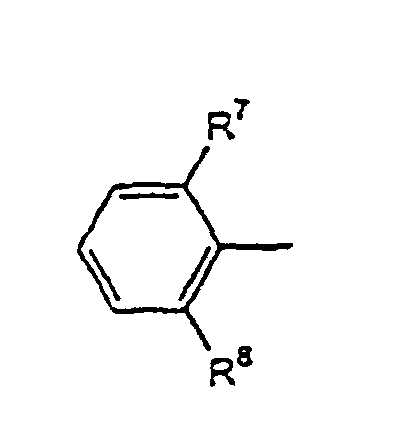
R1 gleich CH3, C2H5, C3H7, C4H9, CH2Br, CH2Cl, CH2CF3, Cyclohexyl oder Benzyl ist;
Hal gleich Halogen ist,
oder ein phytologisch akzeptables Säureadditionssalz davon. - Verbindung nach Anspruch 1, worin Hal gleich Cl ist.
- Verbindung nach Anspruch 1, worin R7 und R8 beide F sind; R7 und R8 beide Cl sind; oder R7 gleich F ist und R8 gleich Cl ist.
- Zusammensetzung zur Bekämpfung von Insekten oder Milben, umfassend eine Verbindung nach einem der Ansprüche 1 bis 3 in Kombination mit einem phytologisch akzeptablen Träger.
- Verfahren zur Bekämpfung von Insekten oder Milben, umfassend das Aufbringen einer Insekten- oder Milbeninaktivierenden Menge einer Verbindung nach einem der Ansprüche 1 bis 3 auf eine Stelle, an der eine Bekämpfung erwünscht ist.
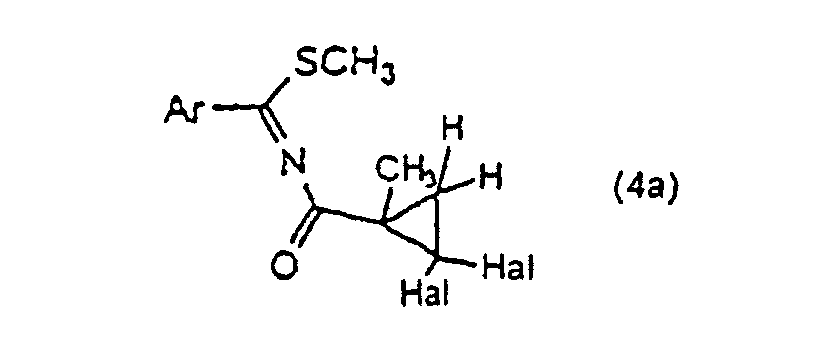
- Verfahren zur Herstellung einer Verbindung nach Anspruch 1, umfassend das Umsetzen einer Verbindung der Formelworin Ar und Hal wie in Anspruch 1 definiert sind, mit Methylhydrazin in einem nicht-reaktiven organischen Lösungsmittel.

- Verbindung der Formelworin Ar und Hal wie in Anspruch 1 definiert sind.
Applications Claiming Priority (3)
| Application Number | Priority Date | Filing Date | Title |
|---|---|---|---|
| US10533898P | 1998-10-23 | 1998-10-23 | |
| US105338P | 1998-10-23 | ||
| PCT/US1999/024939 WO2000024720A1 (en) | 1998-10-23 | 1999-10-22 | 3-(substituted phenyl)-5-(substituted cyclopropyl)-1,2,4-triazole compounds |
Publications (2)
| Publication Number | Publication Date |
|---|---|
| EP1123281A1 EP1123281A1 (de) | 2001-08-16 |
| EP1123281B1 true EP1123281B1 (de) | 2003-10-22 |
Family
ID=22305252
Family Applications (1)
| Application Number | Title | Priority Date | Filing Date |
|---|---|---|---|
| EP99970986A Expired - Lifetime EP1123281B1 (de) | 1998-10-23 | 1999-10-22 | 3-(substituiertes phenyl)-5-(substituiertes cyclopropyl)-1,2,4-triazolverbindungen |
Country Status (8)
| Country | Link |
|---|---|
| US (1) | US6262099B1 (de) |
| EP (1) | EP1123281B1 (de) |
| JP (1) | JP4677100B2 (de) |
| AU (1) | AU1228100A (de) |
| BR (1) | BR9914709B1 (de) |
| ES (1) | ES2205944T3 (de) |
| PT (1) | PT1123281E (de) |
| WO (1) | WO2000024720A1 (de) |
Families Citing this family (6)
| Publication number | Priority date | Publication date | Assignee | Title |
|---|---|---|---|---|
| PE20030701A1 (es) | 2001-12-20 | 2003-08-21 | Schering Corp | Compuestos para el tratamiento de trastornos inflamatorios |
| US6573286B1 (en) | 2002-06-21 | 2003-06-03 | Dow Agrosciences Llc | 2-(2,6-disubstituted phenyl)-4-aryl-5-alkyl-1,3-oxazoline compounds |
| MX2007014295A (es) * | 2005-06-03 | 2008-02-08 | Basf Ag | Derivados de un 1-feniltriazol. |
| EP3404032B1 (de) * | 2013-03-13 | 2025-07-02 | F. Hoffmann-La Roche AG | Verfahren zur herstellung von benzoxazepin-verbindungen |
| CN109053624B (zh) * | 2018-09-26 | 2022-11-22 | 河南师范大学 | 具有ido抑制活性的噻唑类衍生化合物、制备方法及其用途 |
| JPWO2024106438A1 (de) | 2022-11-15 | 2024-05-23 |
Family Cites Families (9)
| Publication number | Priority date | Publication date | Assignee | Title |
|---|---|---|---|---|
| DE3173083D1 (en) * | 1980-03-22 | 1986-01-16 | Fbc Ltd | Pesticidal heterocyclic compounds, processes for preparing them, compositions containing them, and their use |
| JPS62149673A (ja) | 1985-09-05 | 1987-07-03 | Sumitomo Chem Co Ltd | ピリジン誘導体、その製造法およびそれを有効成分とする植物病害防除剤 |
| DE4208050A1 (de) * | 1992-03-13 | 1993-09-23 | Bayer Ag | Azolylmethyl-fluorcyclopropyl-derivate |
| TW226993B (de) | 1992-05-29 | 1994-07-21 | Kumiai Chemical Industry Co | |
| JPH0641093A (ja) * | 1992-07-24 | 1994-02-15 | Kumiai Chem Ind Co Ltd | シクロアルキルトリアゾール誘導体および害虫防除剤 |
| ES2095657T3 (es) * | 1992-07-24 | 1997-02-16 | Kumiai Chemical Industry Co | Derivado de triazol, procedimiento de obtencion del mismo, un agente de control de plagas y metodo de control de plagas. |
| JPH08245315A (ja) * | 1995-03-16 | 1996-09-24 | Nippon Soda Co Ltd | トリアゾール誘導体および有害生物防除剤 |
| JPH08283261A (ja) | 1995-04-07 | 1996-10-29 | Kumiai Chem Ind Co Ltd | 3−フェニルトリアゾール誘導体および殺虫、殺ダニ剤 |
| JP4306806B2 (ja) | 1997-04-24 | 2009-08-05 | ダウ・アグロサイエンス・エル・エル・シー | 有害生物防除性 3―(置換フェニル)―5―(チエニルまたはフリル)―1,2,4―トリアゾール |
-
1999
- 1999-10-22 EP EP99970986A patent/EP1123281B1/de not_active Expired - Lifetime
- 1999-10-22 PT PT99970986T patent/PT1123281E/pt unknown
- 1999-10-22 AU AU12281/00A patent/AU1228100A/en not_active Abandoned
- 1999-10-22 WO PCT/US1999/024939 patent/WO2000024720A1/en not_active Ceased
- 1999-10-22 ES ES99970986T patent/ES2205944T3/es not_active Expired - Lifetime
- 1999-10-22 JP JP2000578290A patent/JP4677100B2/ja not_active Expired - Fee Related
- 1999-10-22 BR BRPI9914709-2A patent/BR9914709B1/pt not_active IP Right Cessation
- 1999-10-22 US US09/426,077 patent/US6262099B1/en not_active Expired - Lifetime
Also Published As
| Publication number | Publication date |
|---|---|
| PT1123281E (pt) | 2004-03-31 |
| JP2002528440A (ja) | 2002-09-03 |
| BR9914709B1 (pt) | 2011-09-06 |
| BR9914709A (pt) | 2001-07-31 |
| US6262099B1 (en) | 2001-07-17 |
| JP4677100B2 (ja) | 2011-04-27 |
| EP1123281A1 (de) | 2001-08-16 |
| ES2205944T3 (es) | 2004-05-01 |
| WO2000024720A1 (en) | 2000-05-04 |
| AU1228100A (en) | 2000-05-15 |
Similar Documents
| Publication | Publication Date | Title |
|---|---|---|
| EP1123287B1 (de) | Insektizide 3- (substituierte pyridyl) -1, 2, 4-triazole | |
| EP0922043B1 (de) | Pestizide 3-(substituiertes phenyl)-5-(thienyl oder furyl)-1,2,4-triazole | |
| RU2055070C1 (ru) | N-(4-пиридил- или 4-хинолинил)арилацетамидные производные | |
| US6417187B2 (en) | 1,2,4-triazole based compounds that can be used as insecticides or acaricides and processes | |
| JP5437411B2 (ja) | 2−(3,5−二置換−4−ピリジル)−4−(チエニル、チアゾリルまたはアリールフェニル)−1,3−オキサゾリン化合物 | |
| US6413997B1 (en) | 3-(substituted phenyl)-5-(substituted heterocyclyl)-1,2,4-triazole compounds | |
| EP1123290B1 (de) | 3-(substituierte phenyl)-5-thienyl-1,2,4-triazolverbindungen mit wirkung gegen weissfliegen | |
| EP1635639A1 (de) | Verwendung von isoindolinonderivaten als insektizide | |
| US6262099B1 (en) | 3-(substituted phenyl)-5-(substituted cyclopropyl)-1,2,4-triazole compounds | |
| CA1211117A (en) | 3-acylaminobenzisothiazole-s, s-dioxides and their use as pesticides | |
| US5015649A (en) | Plant-protective compositions | |
| CN1060615C (zh) | 胍衍生物杀虫剂组合物 | |
| US5502054A (en) | 6-substituted-3,5-diamino-1,2,4-triazines as insecticides | |
| JPH0629258B2 (ja) | 殺虫性ニトロメチレン誘導体 |
Legal Events
| Date | Code | Title | Description |
|---|---|---|---|
| PUAI | Public reference made under article 153(3) epc to a published international application that has entered the european phase |
Free format text: ORIGINAL CODE: 0009012 |
|
| 17P | Request for examination filed |
Effective date: 20010324 |
|
| AK | Designated contracting states |
Kind code of ref document: A1 Designated state(s): AT BE CH CY DE DK ES FI FR GB GR IE IT LI LU MC NL PT SE |
|
| AX | Request for extension of the european patent |
Free format text: AL;LT;LV;MK;RO;SI |
|
| 17Q | First examination report despatched |
Effective date: 20020114 |
|
| GRAH | Despatch of communication of intention to grant a patent |
Free format text: ORIGINAL CODE: EPIDOS IGRA |
|
| GRAH | Despatch of communication of intention to grant a patent |
Free format text: ORIGINAL CODE: EPIDOS IGRA |
|
| GRAA | (expected) grant |
Free format text: ORIGINAL CODE: 0009210 |
|
| AK | Designated contracting states |
Kind code of ref document: B1 Designated state(s): ES FR IT PT |
|
| REG | Reference to a national code |
Ref country code: IE Ref legal event code: FG4D |
|
| LTIE | Lt: invalidation of european patent or patent extension |
Effective date: 20031022 |
|
| REG | Reference to a national code |
Ref country code: PT Ref legal event code: SC4A Free format text: AVAILABILITY OF NATIONAL TRANSLATION Effective date: 20040115 |
|
| REG | Reference to a national code |
Ref country code: ES Ref legal event code: FG2A Ref document number: 2205944 Country of ref document: ES Kind code of ref document: T3 |
|
| ET | Fr: translation filed | ||
| REG | Reference to a national code |
Ref country code: IE Ref legal event code: MM4A |
|
| PLBE | No opposition filed within time limit |
Free format text: ORIGINAL CODE: 0009261 |
|
| STAA | Information on the status of an ep patent application or granted ep patent |
Free format text: STATUS: NO OPPOSITION FILED WITHIN TIME LIMIT |
|
| 26N | No opposition filed |
Effective date: 20040723 |
|
| PGFP | Annual fee paid to national office [announced via postgrant information from national office to epo] |
Ref country code: ES Payment date: 20140911 Year of fee payment: 16 |
|
| PGFP | Annual fee paid to national office [announced via postgrant information from national office to epo] |
Ref country code: FR Payment date: 20141008 Year of fee payment: 16 |
|
| PGFP | Annual fee paid to national office [announced via postgrant information from national office to epo] |
Ref country code: PT Payment date: 20141022 Year of fee payment: 16 |
|
| PGFP | Annual fee paid to national office [announced via postgrant information from national office to epo] |
Ref country code: IT Payment date: 20141021 Year of fee payment: 16 |
|
| REG | Reference to a national code |
Ref country code: PT Ref legal event code: MM4A Free format text: LAPSE DUE TO NON-PAYMENT OF FEES Effective date: 20160422 |
|
| PG25 | Lapsed in a contracting state [announced via postgrant information from national office to epo] |
Ref country code: IT Free format text: LAPSE BECAUSE OF NON-PAYMENT OF DUE FEES Effective date: 20151022 |
|
| REG | Reference to a national code |
Ref country code: FR Ref legal event code: ST Effective date: 20160630 |
|
| PG25 | Lapsed in a contracting state [announced via postgrant information from national office to epo] |
Ref country code: FR Free format text: LAPSE BECAUSE OF NON-PAYMENT OF DUE FEES Effective date: 20151102 Ref country code: PT Free format text: LAPSE BECAUSE OF NON-PAYMENT OF DUE FEES Effective date: 20160422 |
|
| PG25 | Lapsed in a contracting state [announced via postgrant information from national office to epo] |
Ref country code: ES Free format text: LAPSE BECAUSE OF NON-PAYMENT OF DUE FEES Effective date: 20151023 |