EP1124100B1 - Machine frigorifique a absorption - Google Patents
Machine frigorifique a absorption Download PDFInfo
- Publication number
- EP1124100B1 EP1124100B1 EP99947919A EP99947919A EP1124100B1 EP 1124100 B1 EP1124100 B1 EP 1124100B1 EP 99947919 A EP99947919 A EP 99947919A EP 99947919 A EP99947919 A EP 99947919A EP 1124100 B1 EP1124100 B1 EP 1124100B1
- Authority
- EP
- European Patent Office
- Prior art keywords
- absorber
- condenser
- cooling water
- plate type
- refrigerating machine
- Prior art date
- Legal status (The legal status is an assumption and is not a legal conclusion. Google has not performed a legal analysis and makes no representation as to the accuracy of the status listed.)
- Expired - Lifetime
Links
Images

Classifications
-
- F—MECHANICAL ENGINEERING; LIGHTING; HEATING; WEAPONS; BLASTING
- F28—HEAT EXCHANGE IN GENERAL
- F28D—HEAT-EXCHANGE APPARATUS, NOT PROVIDED FOR IN ANOTHER SUBCLASS, IN WHICH THE HEAT-EXCHANGE MEDIA DO NOT COME INTO DIRECT CONTACT
- F28D9/00—Heat-exchange apparatus having stationary plate-like or laminated conduit assemblies for both heat-exchange media, the media being in contact with different sides of a conduit wall
-
- F—MECHANICAL ENGINEERING; LIGHTING; HEATING; WEAPONS; BLASTING
- F25—REFRIGERATION OR COOLING; COMBINED HEATING AND REFRIGERATION SYSTEMS; HEAT PUMP SYSTEMS; MANUFACTURE OR STORAGE OF ICE; LIQUEFACTION SOLIDIFICATION OF GASES
- F25B—REFRIGERATION MACHINES, PLANTS OR SYSTEMS; COMBINED HEATING AND REFRIGERATION SYSTEMS; HEAT PUMP SYSTEMS
- F25B15/00—Sorption machines, plants or systems, operating continuously, e.g. absorption type
-
- F—MECHANICAL ENGINEERING; LIGHTING; HEATING; WEAPONS; BLASTING
- F25—REFRIGERATION OR COOLING; COMBINED HEATING AND REFRIGERATION SYSTEMS; HEAT PUMP SYSTEMS; MANUFACTURE OR STORAGE OF ICE; LIQUEFACTION SOLIDIFICATION OF GASES
- F25B—REFRIGERATION MACHINES, PLANTS OR SYSTEMS; COMBINED HEATING AND REFRIGERATION SYSTEMS; HEAT PUMP SYSTEMS
- F25B15/00—Sorption machines, plants or systems, operating continuously, e.g. absorption type
- F25B15/02—Sorption machines, plants or systems, operating continuously, e.g. absorption type without inert gas
-
- F—MECHANICAL ENGINEERING; LIGHTING; HEATING; WEAPONS; BLASTING
- F25—REFRIGERATION OR COOLING; COMBINED HEATING AND REFRIGERATION SYSTEMS; HEAT PUMP SYSTEMS; MANUFACTURE OR STORAGE OF ICE; LIQUEFACTION SOLIDIFICATION OF GASES
- F25B—REFRIGERATION MACHINES, PLANTS OR SYSTEMS; COMBINED HEATING AND REFRIGERATION SYSTEMS; HEAT PUMP SYSTEMS
- F25B37/00—Absorbers; Adsorbers
-
- F—MECHANICAL ENGINEERING; LIGHTING; HEATING; WEAPONS; BLASTING
- F25—REFRIGERATION OR COOLING; COMBINED HEATING AND REFRIGERATION SYSTEMS; HEAT PUMP SYSTEMS; MANUFACTURE OR STORAGE OF ICE; LIQUEFACTION SOLIDIFICATION OF GASES
- F25B—REFRIGERATION MACHINES, PLANTS OR SYSTEMS; COMBINED HEATING AND REFRIGERATION SYSTEMS; HEAT PUMP SYSTEMS
- F25B39/00—Evaporators; Condensers
- F25B39/04—Condensers
-
- F—MECHANICAL ENGINEERING; LIGHTING; HEATING; WEAPONS; BLASTING
- F25—REFRIGERATION OR COOLING; COMBINED HEATING AND REFRIGERATION SYSTEMS; HEAT PUMP SYSTEMS; MANUFACTURE OR STORAGE OF ICE; LIQUEFACTION SOLIDIFICATION OF GASES
- F25B—REFRIGERATION MACHINES, PLANTS OR SYSTEMS; COMBINED HEATING AND REFRIGERATION SYSTEMS; HEAT PUMP SYSTEMS
- F25B49/00—Arrangement or mounting of control or safety devices
- F25B49/04—Arrangement or mounting of control or safety devices for sorption type machines, plants or systems
- F25B49/043—Operating continuously
-
- Y—GENERAL TAGGING OF NEW TECHNOLOGICAL DEVELOPMENTS; GENERAL TAGGING OF CROSS-SECTIONAL TECHNOLOGIES SPANNING OVER SEVERAL SECTIONS OF THE IPC; TECHNICAL SUBJECTS COVERED BY FORMER USPC CROSS-REFERENCE ART COLLECTIONS [XRACs] AND DIGESTS
- Y02—TECHNOLOGIES OR APPLICATIONS FOR MITIGATION OR ADAPTATION AGAINST CLIMATE CHANGE
- Y02A—TECHNOLOGIES FOR ADAPTATION TO CLIMATE CHANGE
- Y02A30/00—Adapting or protecting infrastructure or their operation
- Y02A30/27—Relating to heating, ventilation or air conditioning [HVAC] technologies
-
- Y—GENERAL TAGGING OF NEW TECHNOLOGICAL DEVELOPMENTS; GENERAL TAGGING OF CROSS-SECTIONAL TECHNOLOGIES SPANNING OVER SEVERAL SECTIONS OF THE IPC; TECHNICAL SUBJECTS COVERED BY FORMER USPC CROSS-REFERENCE ART COLLECTIONS [XRACs] AND DIGESTS
- Y02—TECHNOLOGIES OR APPLICATIONS FOR MITIGATION OR ADAPTATION AGAINST CLIMATE CHANGE
- Y02B—CLIMATE CHANGE MITIGATION TECHNOLOGIES RELATED TO BUILDINGS, e.g. HOUSING, HOUSE APPLIANCES OR RELATED END-USER APPLICATIONS
- Y02B30/00—Energy efficient heating, ventilation or air conditioning [HVAC]
- Y02B30/62—Absorption based systems
Definitions
- the present invention relates to an absorption refrigerating machine, and more particularly to an absorption refrigerating machine characterized by a system for supply of cooling water to an absorber and a condenser.
- cooling water for an absorption refrigerating machine has heretofore been flowed in series to an absorber A and a condenser C by a shell and tube system, as shown in FIG. 4.
- a concentrated solution changes into a dilute solution by absorbing, in the absorber A, a refrigerant vapor evaporated in an evaporator E.
- the dilute solution is passed through a passage 1 and a heated side of a solution heat exchanger SH, and then introduced into a regenerator G via a passage 2 by a solution pump SP.
- the dilute solution introduced into the regenerator G is heated by a heat source 12 to evaporate the refrigerant, so that the dilute solution changes into a concentrated solution.
- the concentrated solution is passed through a passage 3 and a heating side of the solution heat exchanger SH, and then introduced via a passage 4 into the absorber A, where the concentrated solution absorbs a refrigerant vapor again to change into a dilute solution.
- the solution is circulated.
- the refrigerant becomes a refrigerant vapor by being evaporated in the regenerator G.
- the refrigerant vapor reaches the condenser C, where the refrigerant vapor is condensed into a refrigerant liquid, which is introduced into the evaporator E via a passage 5.
- the refrigerant liquid is circulated into the evaporator E via a passage 6 by a refrigerant pump FP
- the refrigerant liquid is evaporated in the evaporator E for cooling chilled water 11.
- the evaporated refrigerant reaches the absorber A, where the refrigerant is absorbed into the concentrated solution.
- the absorbed refrigerant reaches the regenerator G, where the refrigerant is evaporated.
- the cooling water is introduced through a passage 7, passed through the absorber A and the condenser C, and is discharged through a passage 10.
- the amount of cooling water flowed is determined one-sidedly by the required amount of cooling water in one of the absorber and the condenser.
- a flow regulating valve may be provided in a cooling water passage to adjust the flow rates by a passage resistance generated by the flow regulating valve.
- it is complicated to adjust the flow regulating valve based on fluctuations in the water pressure, causing operational problems.
- the present invention has been made in view of the above drawbacks, and it is therefore an object of the present invention to provide an absorption refrigerating machine which uses plate type heat exchangers in an absorber and a condenser, and can adjust the amount of distribution of cooling water without a flow regulating valve provided in a cooling water passage, and has no operational problem.
- an absorption refrigerating machine using plate type heat exchangers at least in an absorber and a condenser characterized in that cooling water is supplied in parallel to the plate type heat exchangers in the absorber and the condenser, and amounts of cooling water distributed to the absorber and the condenser are determined mainly based on fluid resistance of each of the plate type heat exchangers.
- an absorption refrigerating machine using plate type heat exchangers in an absorber and a condenser characterized in that cooling water is supplied in parallel to the plate type heat exchangers in the absorber and the condenser via a cooling water passage, and a flow regulating valve for distributing cooling water to the absorber and the condenser is not provided in the cooling water passage, but cooling water is directly supplied via the cooling water passage to the absorber and the condenser.
- the plate type heat exchangers used in the absorber and the condenser should preferably have the same shape of the plates and the different number of plates. Further, a ratio of the number of plates in the absorber to the number of plates in the condenser should preferably be in the range of 67:33 to 60:40.
- the amount of distribution of cooling water is adjusted in consideration of the fluid resistance of a plate type heat exchanger. Its principle makes use of the fact that the fluid resistance in the heat exchanger portion is higher than the fluid resistance in piping, and is thus predominant.
- COP about 1.15 to about 1.3.
- QE/QG 1.25
- QA/QE about 1.25
- QC/QE about 0.55.
- the absorber is constituted by a plate type heat exchanger
- cooling water and an absorption solution can form complete counter flows.
- the cooling water at the outlet can be maintained at a high temperature to a certain degree.
- the outlet temperature of the cooling water in the absorber is also equal to the outlet temperature of the cooling water in the condenser.
- GA represents the flow rate of cooling water flowed to the absorber
- GC the flow rate of the cooling water flowed to the condenser
- Cp specific heat represents the difference between the inlet temperature and the outlet temperature of the cooling water in the absorber
- ⁇ TC represents the difference between the inlet temperature and the outlet temperature of the cooling water in the condenser.
- the condensation temperature can be lowered. Consequently, the pressure and the solution temperature in the high temperature regenerator can be lowered to effectively suppress corrosion. This can be realized by the condition of ⁇ TA > ⁇ TC.
- cooling water was flowed in amounts of distribution of about 60 % to about 67 % to the absorber, and about 40 % to about 33 % to the condenser, and the outlet temperature of the absorber is made higher than the outlet temperature of the condenser. It was confirmed that the pressure and the solution temperature of the high temperature regenerator could be lowered to suppress corrosion.
- the fluid resistance of water is mainly determined based on the resistance of the heat exchanger portion. Therefore, when the ratio of the number of plates in a plate type heat exchanger for the absorber to the number of plates in a plate type heat exchanger for the condenser is in the range of 67:33 to 60:40, the amount of about 60 % to about 67 % of the cooling water can be flowed to the absorber, and the amount of about 40 % to about 33 % of the cooling water can be flowed to the condenser.
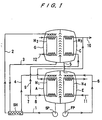
- FIG. 1 is an entire configurational view of a single effect absorption refrigerating machine showing an example of an absorption refrigerating machine using plate type heat exchangers according to the present invention.
- A denotes an absorber, G a regenerator, C a condenser, E an evaporator, SH a solution heat exchanger, SP a solution pump, FP a refrigerant pump, H 1 to H 4 plate type heat exchangers, 1 to 4 solution passages, 5 and 6 refrigerant passages, 7 to 10 cooling water passages, 11 a chilled water passage, and 12 a heat source passage.
- a concentrated solution changes into a dilute solution by absorbing, in the absorber A, a refrigerant vapor evaporated in the evaporator E.
- the dilute solution is passed through the passage 1 and a heated side of the solution heat exchanger SH, and then introduced into the regenerator G via the passage 2 by the solution pump SP.
- the dilute solution introduced into the regenerator G is heated by the heat source 12 to evaporate the refrigerant, so that the dilute solution changes into a concentrated solution.
- the concentrated solution is passed through the passage 3 and the heating side of the solution heat exchanger SH, and then introduced via the passage 4 into the absorber A, where the concentrated solution absorbs a refrigerant vapor again to change into a dilute solution.
- the solution is circulated.
- the refrigerant becomes a refrigerant vapor by being evaporated in the regenerator G.
- the refrigerant vapor reaches the condenser C, where the refrigerant vapor is condensed into a refrigerant liquid, which is introduced into the evaporator E via the passage 5.
- the refrigerant liquid is circulated into the evaporator E via the passage 6 by the refrigerant pump FP, the refrigerant liquid is evaporated in the evaporator E for cooling chilled water 11.
- the evaporated refrigerant reaches the absorber A, where the refrigerant is absorbed into the concentrated solution.
- the absorbed refrigerant reaches the regenerator G, where the refrigerant is evaporated.
- the refrigerant is circulated.
- the cooling water is introduced through the passage 7 and branched into a flow through the passage 8 and a flow through the passage 9. These flows are respectively introduced into the absorber A and the condenser C and discharged through the passage 10.
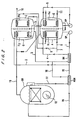
- FIG. 2 is an entire configurational view of a double effect absorption heater chiller showing another example of an absorption refrigerating machine using plate type heat exchangers according to the present invention.
- A denotes an absorber, G a low temperature regenerator, C a condenser, E an evaporator, GH a high temperature regenerator, HSH a high temperature solution heat exchanger, SH a low temperature solution heat exchanger, SP a solution pump, FP a refrigerant pump, H 1 to H 4 plate type heat exchangers, 1 to 4 and 15 to 18 solution passages, 5, 6, 13 and 14 refrigerant passages, 7 to 10 cooling water passages, 11 a chilled water passage, and 12 a heating source.
- a concentrated solution changes into a dilute solution by absorbing, in the absorber A, a refrigerant vapor evaporated in the evaporator E.
- the dilute solution is passed through the passage 1 and a heated side of the low temperature solution heat exchanger SH, and then branched.
- a part of the solution is passed through a conduit 15 and a heated side of the high temperature solution heat exchanger HSH, and then introduced the high temperature regenerator GH via a conduit 16.
- the dilute solution is heated by the heating source 12 to evaporate the refrigerant, so that the dilute solution changes into a concentrated solution.
- the concentrated solution is passed through a conduit 17, exchanged heat in the high temperature solution heat exchanger HSH, and joined at a conduit 18 into the concentrated solution conduit 3 extending from the low temperature regenerator G.
- the rest of the dilute solution branched is introduced via the conduit 2 into the low temperature regenerator G, where the dilute solution is heated and concentrated by a refrigerant vapor 13 from the high temperature regenerator. Then, the concentrated solution is joined into the concentrated solution conduit 18 at the conduit 3, and passes through a heating side of the low temperature solution heat exchanger SH. Then, the concentrated solution is introduced into the absorber A via the conduit 4, and absorbs a refrigerant vapor again to change into a dilute solution. Thus, the solution is circulated.
- a refrigerant vapor generated in the high temperature regenerator GH is introduced via the conduit 13 into the low temperature regenerator G, where the dilute solution is heated and concentrated to generate a refrigerant vapor and condense the introduced refrigerant vapor. Then, the condensed refrigerant reaches the condenser C via the conduit 14.
- the refrigerant vapor generated in the low temperature regenerator G is condensed into a refrigerant liquid in the condenser C, and the refrigerant liquid is introduced into the evaporator E via the passage 5 together with the refrigerant from the high temperature regenerator.
- the introduced refrigerant liquid is circulated into the evaporator E via the passage 6 by the refrigerant pump FP and evaporated therein to cool the chilled water 11.
- the evaporated refrigerant reaches the absorber A, and is absorbed into the concentrated solution.
- the absorbed refrigerant further reaches the high temperature regenerator GH and the low temperature regenerator G, where the refrigerant is evaporated.
- the refrigerant is circulated.
- the cooling water is introduced through the passage 7 and branched into a flow through the passage 8 and a flow through the passage 9. These flows are respectively introduced into the absorber A and the condenser C and discharged through the passage 10.
- the plate type heat exchangers H 1 , H 2 , H 3 and H 4 for exchanging heat in the absorber A, the regenerator G (low temperature regenerator), the condenser C, and the evaporator E.
- FIG. 3 is an enlarged cross-sectional view showing an example of only the plate type heat exchanger portion of each of the absorber A and the condenser C through which cooling water is passed.
- the number of plates P of the plate type heat exchangers H 1 for the absorber A is twelve
- the number of plates P of the plate type heat exchangers H 3 for the condenser C is six.
- a plate type heat exchanger used in the present invention may comprise any known plate type heat exchanger, as long as it has a flow resistance to a certain degree and is composed of the same plates, and plate type heat exchangers having the different number of plates are used in both of an absorber and a condenser.
- a refrigerating machine is constituted by a simple configuration such that a plate type heat exchanger is used for an absorber and a condenser, and the number of plates of the heat exchanger is deferent between the absorber and the condenser.
- This configuration can adjust the amounts of distribution of cooling water passed through the absorber and the condenser and dispense with a flow regulating valve for adjusting the amount of distribution, and hence a refrigerating machine having no operational problem can be provided.
- the present invention can be used for an absorption refrigerating machine or an absorption heater chiller having an absorber and a condenser.
Landscapes
- Engineering & Computer Science (AREA)
- Physics & Mathematics (AREA)
- Thermal Sciences (AREA)
- Mechanical Engineering (AREA)
- General Engineering & Computer Science (AREA)
- Sorption Type Refrigeration Machines (AREA)
Claims (4)
- Machine réfrigérante à absorption utilisant des échangeurs de chaleur de type plaque (H1 à H4) au moins dans un absorbeur (A) et un condenseur (C), caractérisée en ce que de l'eau de refroidissement est alimentée en parallèle auxdits échangeurs de chaleur de type plaque (H1 à H4) dans ledit absorbeur (A) et ledit condenseur (C), et des quantités d'eau de refroidissement réparties vers ledit absorbeur (A) et ledit condenseur (C) sont déterminées principalement sur la base de la résistance fluidique de chacun desdits échangeurs de chaleur de type plaque (H1 à H4).
- Machine réfrigérante à absorption selon la revendication 1, caractérisée en ce que lesdits échangeurs de chaleur de type plaque utilisés dans ledit absorbeur (A)' et ledit condenseur (C) ont des plaques (P) de la même forme, et des nombres de plaques (P) différents.
- Machine réfrigérante à absorption selon la revendication 2, caractérisée en ce qu'un rapport du nombre de plaques (P) dans l'absorbeur (A) sur le nombre de plaques (P) dans le condenseur (C) est dans la plage de 67:33 à 60:40.
- Machine réfrigérante à absorption selon la revendication 1, caractérisée en ce qu'une vanne de régulation d'écoulement pour répartir de l'eau de refroidissement vers ledit absorbeur (A) et ledit condenseur (C) n'est pas agencée dans un passage d'eau de refroidissement pour alimenter de l'eau de refroidissement vers ledit absorbeur (A) et ledit condenseur (C), mais de l'eau de refroidissement est directement alimentée via ledit passage d'eau de refroidissement (7, 8, 9) vers ledit absorbeur (A) et ledit condenseur (C).
Applications Claiming Priority (3)
| Application Number | Priority Date | Filing Date | Title |
|---|---|---|---|
| JP29349498 | 1998-10-15 | ||
| JP29349498 | 1998-10-15 | ||
| PCT/JP1999/005701 WO2000022357A1 (fr) | 1998-10-15 | 1999-10-15 | Machine frigorifique a absorption |
Publications (3)
| Publication Number | Publication Date |
|---|---|
| EP1124100A1 EP1124100A1 (fr) | 2001-08-16 |
| EP1124100A4 EP1124100A4 (fr) | 2003-05-28 |
| EP1124100B1 true EP1124100B1 (fr) | 2007-02-14 |
Family
ID=17795472
Family Applications (1)
| Application Number | Title | Priority Date | Filing Date |
|---|---|---|---|
| EP99947919A Expired - Lifetime EP1124100B1 (fr) | 1998-10-15 | 1999-10-15 | Machine frigorifique a absorption |
Country Status (6)
| Country | Link |
|---|---|
| US (1) | US6442964B1 (fr) |
| EP (1) | EP1124100B1 (fr) |
| JP (1) | JP3910014B2 (fr) |
| CN (1) | CN1174202C (fr) |
| DE (1) | DE69935151T2 (fr) |
| WO (1) | WO2000022357A1 (fr) |
Families Citing this family (5)
| Publication number | Priority date | Publication date | Assignee | Title |
|---|---|---|---|---|
| JP2003106702A (ja) * | 2001-09-26 | 2003-04-09 | Daikin Ind Ltd | 吸収式冷凍装置 |
| JP5261111B2 (ja) | 2008-09-29 | 2013-08-14 | 三洋電機株式会社 | 吸収式冷凍機 |
| TW201202636A (en) * | 2010-07-09 | 2012-01-16 | Chung Hsin Elec & Mach Mfg | Separable solid adsorption cooling system |
| JP5761960B2 (ja) * | 2010-10-29 | 2015-08-12 | 三菱重工業株式会社 | 熱源装置 |
| CN111023625A (zh) * | 2018-10-09 | 2020-04-17 | 荏原冷热系统株式会社 | 吸收式热交换系统 |
Family Cites Families (18)
| Publication number | Priority date | Publication date | Assignee | Title |
|---|---|---|---|---|
| GB2076304B (en) * | 1980-05-26 | 1984-02-22 | Univ Sydney | Heat exchange (evaporator) device |
| DE3113063A1 (de) * | 1981-04-01 | 1982-10-14 | Dürr Innovation GmbH, 7000 Stuttgart | Vorrichtung zur erhoehung der temperatur eines waermetraegers auf der grundlage von absorption und austreibung, verdampfung und verfluessigung eines kaeltemittels |
| FR2509846A1 (fr) * | 1981-07-16 | 1983-01-21 | Inst Francais Du Petrole | Procede de production de froid et/ou de chaleur mettant en oeuvre un cycle a absorption utilisant le dioxyde de carbone comme fluide de travail |
| GB2132326B (en) * | 1982-12-14 | 1986-05-14 | Apv Co Ltd | Vapour separator |
| JPH0730970B2 (ja) * | 1988-09-16 | 1995-04-10 | 株式会社日立製作所 | 吸収式冷凍機 |
| JP2719408B2 (ja) * | 1989-07-18 | 1998-02-25 | 三洋電機株式会社 | 吸収冷凍機 |
| JPH04313652A (ja) * | 1991-04-11 | 1992-11-05 | Sanyo Electric Co Ltd | 吸収式冷凍機 |
| US5282507A (en) * | 1991-07-08 | 1994-02-01 | Yazaki Corporation | Heat exchange system |
| DE69432431T2 (de) * | 1993-11-29 | 2004-01-29 | Maekawa Seisakusho Kk | Adsorbtionskältevorrichtung und Verfahren zur Regelung der Kälteleistung derselben. |
| US5782097A (en) * | 1994-11-23 | 1998-07-21 | Phillips Engineering Co. | Generator-absorber-heat exchange heat transfer apparatus and method and use thereof in a heat pump |
| JPH0942795A (ja) * | 1995-08-01 | 1997-02-14 | Sanyo Electric Co Ltd | 吸収式冷凍装置 |
| JP3302869B2 (ja) | 1995-11-15 | 2002-07-15 | 株式会社荏原製作所 | プレート式熱交換器及びその製造方法 |
| JPH09273825A (ja) * | 1996-04-03 | 1997-10-21 | Hitachi Ltd | 吸収式冷温水機 |
| JP3712775B2 (ja) * | 1996-04-17 | 2005-11-02 | 大阪瓦斯株式会社 | 吸収式冷凍機のためのプレート型蒸発・吸収器 |
| JPH09318184A (ja) * | 1996-05-27 | 1997-12-12 | Mitsubishi Heavy Ind Ltd | 吸収式冷凍機 |
| JPH109705A (ja) * | 1996-06-20 | 1998-01-16 | Hitachi Ltd | 吸収式冷凍機 |
| FI106577B (fi) * | 1996-09-04 | 2001-02-28 | Abb Installaatiot Oy | Sovitelma lämmitys- ja jäähdytystehon siirtämiseksi |
| JPH10300260A (ja) * | 1997-04-24 | 1998-11-13 | Hitachi Ltd | 吸収冷温水機 |
-
1999
- 1999-10-15 EP EP99947919A patent/EP1124100B1/fr not_active Expired - Lifetime
- 1999-10-15 JP JP2000576220A patent/JP3910014B2/ja not_active Expired - Fee Related
- 1999-10-15 CN CNB998119903A patent/CN1174202C/zh not_active Expired - Fee Related
- 1999-10-15 WO PCT/JP1999/005701 patent/WO2000022357A1/fr not_active Ceased
- 1999-10-15 DE DE69935151T patent/DE69935151T2/de not_active Expired - Lifetime
- 1999-10-15 US US09/806,504 patent/US6442964B1/en not_active Expired - Lifetime
Also Published As
| Publication number | Publication date |
|---|---|
| DE69935151D1 (de) | 2007-03-29 |
| US6442964B1 (en) | 2002-09-03 |
| EP1124100A4 (fr) | 2003-05-28 |
| WO2000022357A1 (fr) | 2000-04-20 |
| CN1174202C (zh) | 2004-11-03 |
| CN1323384A (zh) | 2001-11-21 |
| DE69935151T2 (de) | 2007-10-31 |
| JP3910014B2 (ja) | 2007-04-25 |
| EP1124100A1 (fr) | 2001-08-16 |
Similar Documents
| Publication | Publication Date | Title |
|---|---|---|
| US4475361A (en) | Multi-effect heat-pump for heating and cooling | |
| JP3932241B2 (ja) | 吸収式冷凍機 | |
| WO2000023754A1 (fr) | Echangeur de chaleur pour solution destine a des machines refrigerantes a absorption | |
| KR100418993B1 (ko) | 흡수식냉동장치 | |
| JPS5913670B2 (ja) | 二重効用吸収冷凍装置 | |
| EP1124100B1 (fr) | Machine frigorifique a absorption | |
| JP3445941B2 (ja) | 多段蒸発吸収型の吸収冷温水機及びそれを備えた大温度差空調システム | |
| US5507158A (en) | Device for indirect production of cold for refrigerating machine | |
| JPWO2000022357A1 (ja) | 吸収冷凍機 | |
| US3550394A (en) | Condensate heating of intermediate strength solution in two-stage absorption machine | |
| JP4031684B2 (ja) | 蒸発器及び冷凍機 | |
| KR100213780B1 (ko) | 흡수식 냉난방기의 급탕시스템. | |
| KR20080094985A (ko) | 온수 이용 흡수식 냉동장치 | |
| GB2314149A (en) | Thermosyphon refrigeration apparatus | |
| JP2005300126A (ja) | 吸収式冷凍機 | |
| US5605057A (en) | Absorption refrigerating machine | |
| JP3429905B2 (ja) | 吸収式冷凍機 | |
| JP2815933B2 (ja) | 吸収冷凍機 | |
| KR0139349Y1 (ko) | 흡수식 냉난방기용 증발기의 증발수 순환장치 | |
| JP3852891B2 (ja) | 吸収冷凍機用溶液熱交換器 | |
| KR100360449B1 (ko) | 흡수식 냉난방기의 일체형 열교환기 | |
| JPH0830631B2 (ja) | 冷温切換型吸収冷凍機 | |
| JP2517421B2 (ja) | 吸収冷凍機 | |
| JPS6022251B2 (ja) | 吸収式冷凍機 | |
| KR100213781B1 (ko) | 급탕 기능이 부가된 흡수식 냉난방 시스템 |
Legal Events
| Date | Code | Title | Description |
|---|---|---|---|
| PUAI | Public reference made under article 153(3) epc to a published international application that has entered the european phase |
Free format text: ORIGINAL CODE: 0009012 |
|
| 17P | Request for examination filed |
Effective date: 20010412 |
|
| AK | Designated contracting states |
Kind code of ref document: A1 Designated state(s): AT BE CH CY DE DK ES FI FR GB GR IE IT LI LU MC NL PT SE |
|
| RIC1 | Information provided on ipc code assigned before grant |
Ipc: 7F 25B 30/04 B Ipc: 7F 25B 29/00 B Ipc: 7F 25B 15/02 B Ipc: 7F 25B 15/00 A |
|
| A4 | Supplementary search report drawn up and despatched |
Effective date: 20030416 |
|
| RBV | Designated contracting states (corrected) |
Designated state(s): DE FR IT SE |
|
| GRAP | Despatch of communication of intention to grant a patent |
Free format text: ORIGINAL CODE: EPIDOSNIGR1 |
|
| GRAS | Grant fee paid |
Free format text: ORIGINAL CODE: EPIDOSNIGR3 |
|
| GRAA | (expected) grant |
Free format text: ORIGINAL CODE: 0009210 |
|
| AK | Designated contracting states |
Kind code of ref document: B1 Designated state(s): DE FR IT SE |
|
| REF | Corresponds to: |
Ref document number: 69935151 Country of ref document: DE Date of ref document: 20070329 Kind code of ref document: P |
|
| REG | Reference to a national code |
Ref country code: SE Ref legal event code: TRGR |
|
| ET | Fr: translation filed | ||
| PLBE | No opposition filed within time limit |
Free format text: ORIGINAL CODE: 0009261 |
|
| STAA | Information on the status of an ep patent application or granted ep patent |
Free format text: STATUS: NO OPPOSITION FILED WITHIN TIME LIMIT |
|
| 26N | No opposition filed |
Effective date: 20071115 |
|
| PGFP | Annual fee paid to national office [announced via postgrant information from national office to epo] |
Ref country code: FR Payment date: 20101020 Year of fee payment: 12 |
|
| PGFP | Annual fee paid to national office [announced via postgrant information from national office to epo] |
Ref country code: DE Payment date: 20101013 Year of fee payment: 12 |
|
| PGFP | Annual fee paid to national office [announced via postgrant information from national office to epo] |
Ref country code: IT Payment date: 20101018 Year of fee payment: 12 Ref country code: SE Payment date: 20101012 Year of fee payment: 12 |
|
| REG | Reference to a national code |
Ref country code: SE Ref legal event code: EUG |
|
| REG | Reference to a national code |
Ref country code: FR Ref legal event code: ST Effective date: 20120629 |
|
| PG25 | Lapsed in a contracting state [announced via postgrant information from national office to epo] |
Ref country code: DE Free format text: LAPSE BECAUSE OF NON-PAYMENT OF DUE FEES Effective date: 20120501 |
|
| REG | Reference to a national code |
Ref country code: DE Ref legal event code: R119 Ref document number: 69935151 Country of ref document: DE Effective date: 20120501 |
|
| PG25 | Lapsed in a contracting state [announced via postgrant information from national office to epo] |
Ref country code: IT Free format text: LAPSE BECAUSE OF NON-PAYMENT OF DUE FEES Effective date: 20111015 Ref country code: FR Free format text: LAPSE BECAUSE OF NON-PAYMENT OF DUE FEES Effective date: 20111102 |
|
| PG25 | Lapsed in a contracting state [announced via postgrant information from national office to epo] |
Ref country code: SE Free format text: LAPSE BECAUSE OF NON-PAYMENT OF DUE FEES Effective date: 20111016 |