EP1124549B1 - Wassermischbare pharmazeutische zusammensetzungen enthaltend paclitaxel - Google Patents
Wassermischbare pharmazeutische zusammensetzungen enthaltend paclitaxel Download PDFInfo
- Publication number
- EP1124549B1 EP1124549B1 EP99951559A EP99951559A EP1124549B1 EP 1124549 B1 EP1124549 B1 EP 1124549B1 EP 99951559 A EP99951559 A EP 99951559A EP 99951559 A EP99951559 A EP 99951559A EP 1124549 B1 EP1124549 B1 EP 1124549B1
- Authority
- EP
- European Patent Office
- Prior art keywords
- composition
- paclitaxel
- pharmaceutically
- acceptable
- water
- Prior art date
- Legal status (The legal status is an assumption and is not a legal conclusion. Google has not performed a legal analysis and makes no representation as to the accuracy of the status listed.)
- Expired - Lifetime
Links
- RCINICONZNJXQF-MZXODVADSA-N taxol Chemical compound O([C@@H]1[C@@]2(C[C@@H](C(C)=C(C2(C)C)[C@H](C([C@]2(C)[C@@H](O)C[C@H]3OC[C@]3([C@H]21)OC(C)=O)=O)OC(=O)C)OC(=O)[C@H](O)[C@@H](NC(=O)C=1C=CC=CC=1)C=1C=CC=CC=1)O)C(=O)C1=CC=CC=C1 RCINICONZNJXQF-MZXODVADSA-N 0.000 title claims abstract description 123
- 229930012538 Paclitaxel Natural products 0.000 title claims abstract description 122
- 229960001592 paclitaxel Drugs 0.000 title claims abstract description 122
- 239000008194 pharmaceutical composition Substances 0.000 title description 6
- 239000000203 mixture Substances 0.000 claims abstract description 195
- 239000003125 aqueous solvent Substances 0.000 claims abstract description 33
- 238000000034 method Methods 0.000 claims abstract description 31
- SECXISVLQFMRJM-UHFFFAOYSA-N N-Methylpyrrolidone Chemical compound CN1CCCC1=O SECXISVLQFMRJM-UHFFFAOYSA-N 0.000 claims description 45
- 239000002904 solvent Substances 0.000 claims description 36
- URAYPUMNDPQOKB-UHFFFAOYSA-N triacetin Chemical compound CC(=O)OCC(OC(C)=O)COC(C)=O URAYPUMNDPQOKB-UHFFFAOYSA-N 0.000 claims description 32
- IAZDPXIOMUYVGZ-UHFFFAOYSA-N Dimethylsulphoxide Chemical compound CS(C)=O IAZDPXIOMUYVGZ-UHFFFAOYSA-N 0.000 claims description 29
- 239000001087 glyceryl triacetate Substances 0.000 claims description 16
- 235000013773 glyceryl triacetate Nutrition 0.000 claims description 16
- 239000008389 polyethoxylated castor oil Substances 0.000 claims description 16
- 229960002622 triacetin Drugs 0.000 claims description 16
- XLYOFNOQVPJJNP-UHFFFAOYSA-N water Substances O XLYOFNOQVPJJNP-UHFFFAOYSA-N 0.000 claims description 13
- FXHOOIRPVKKKFG-UHFFFAOYSA-N N,N-Dimethylacetamide Chemical compound CN(C)C(C)=O FXHOOIRPVKKKFG-UHFFFAOYSA-N 0.000 claims description 11
- 239000003814 drug Substances 0.000 claims description 10
- 206010028980 Neoplasm Diseases 0.000 claims description 8
- ULQISTXYYBZJSJ-UHFFFAOYSA-N 12-hydroxyoctadecanoic acid Polymers CCCCCCC(O)CCCCCCCCCCC(O)=O ULQISTXYYBZJSJ-UHFFFAOYSA-N 0.000 claims description 6
- 201000011510 cancer Diseases 0.000 claims description 6
- 239000002552 dosage form Substances 0.000 claims description 4
- 238000004519 manufacturing process Methods 0.000 claims description 2
- 238000011534 incubation Methods 0.000 claims 1
- 239000003921 oil Substances 0.000 claims 1
- LFQSCWFLJHTTHZ-UHFFFAOYSA-N Ethanol Chemical compound CCO LFQSCWFLJHTTHZ-UHFFFAOYSA-N 0.000 description 69
- 238000009472 formulation Methods 0.000 description 41
- 239000000126 substance Substances 0.000 description 31
- 238000013019 agitation Methods 0.000 description 26
- 239000007788 liquid Substances 0.000 description 20
- 238000010790 dilution Methods 0.000 description 19
- 239000012895 dilution Substances 0.000 description 19
- 229960004756 ethanol Drugs 0.000 description 18
- 238000001802 infusion Methods 0.000 description 17
- 229920002675 Polyoxyl Polymers 0.000 description 14
- FAPWRFPIFSIZLT-UHFFFAOYSA-M Sodium chloride Chemical compound [Na+].[Cl-] FAPWRFPIFSIZLT-UHFFFAOYSA-M 0.000 description 13
- RCINICONZNJXQF-XAZOAEDWSA-N taxol® Chemical compound O([C@@H]1[C@@]2(CC(C(C)=C(C2(C)C)[C@H](C([C@]2(C)[C@@H](O)C[C@H]3OC[C@]3(C21)OC(C)=O)=O)OC(=O)C)OC(=O)[C@H](O)[C@@H](NC(=O)C=1C=CC=CC=1)C=1C=CC=CC=1)O)C(=O)C1=CC=CC=C1 RCINICONZNJXQF-XAZOAEDWSA-N 0.000 description 13
- WVDDGKGOMKODPV-UHFFFAOYSA-N Benzyl alcohol Chemical compound OCC1=CC=CC=C1 WVDDGKGOMKODPV-UHFFFAOYSA-N 0.000 description 12
- 239000000463 material Substances 0.000 description 11
- 239000003981 vehicle Substances 0.000 description 11
- 239000000243 solution Substances 0.000 description 10
- 206010020751 Hypersensitivity Diseases 0.000 description 9
- 229940113088 dimethylacetamide Drugs 0.000 description 8
- 229920000858 Cyclodextrin Polymers 0.000 description 7
- -1 dexamethasone) Chemical class 0.000 description 7
- 229940079593 drug Drugs 0.000 description 7
- 238000001990 intravenous administration Methods 0.000 description 7
- BJQHLKABXJIVAM-BGYRXZFFSA-N 1-o-[(2r)-2-ethylhexyl] 2-o-[(2s)-2-ethylhexyl] benzene-1,2-dicarboxylate Chemical compound CCCC[C@H](CC)COC(=O)C1=CC=CC=C1C(=O)OC[C@H](CC)CCCC BJQHLKABXJIVAM-BGYRXZFFSA-N 0.000 description 6
- BJQHLKABXJIVAM-UHFFFAOYSA-N Diethylhexyl phthalate Natural products CCCCC(CC)COC(=O)C1=CC=CC=C1C(=O)OCC(CC)CCCC BJQHLKABXJIVAM-UHFFFAOYSA-N 0.000 description 6
- XEKOWRVHYACXOJ-UHFFFAOYSA-N Ethyl acetate Chemical compound CCOC(C)=O XEKOWRVHYACXOJ-UHFFFAOYSA-N 0.000 description 6
- 229920002685 Polyoxyl 35CastorOil Polymers 0.000 description 6
- DNIAPMSPPWPWGF-UHFFFAOYSA-N Propylene glycol Chemical compound CC(O)CO DNIAPMSPPWPWGF-UHFFFAOYSA-N 0.000 description 6
- 238000002347 injection Methods 0.000 description 6
- 239000007924 injection Substances 0.000 description 6
- QUANRIQJNFHVEU-UHFFFAOYSA-N oxirane;propane-1,2,3-triol Chemical compound C1CO1.OCC(O)CO QUANRIQJNFHVEU-UHFFFAOYSA-N 0.000 description 6
- 239000003978 infusion fluid Substances 0.000 description 5
- 239000000047 product Substances 0.000 description 5
- 231100000419 toxicity Toxicity 0.000 description 5
- 230000001988 toxicity Effects 0.000 description 5
- HBXWUCXDUUJDRB-UHFFFAOYSA-N 1-octadecoxyoctadecane Chemical compound CCCCCCCCCCCCCCCCCCOCCCCCCCCCCCCCCCCCC HBXWUCXDUUJDRB-UHFFFAOYSA-N 0.000 description 4
- UYXTWWCETRIEDR-UHFFFAOYSA-N Tributyrin Chemical compound CCCC(=O)OCC(OC(=O)CCC)COC(=O)CCC UYXTWWCETRIEDR-UHFFFAOYSA-N 0.000 description 4
- 235000019445 benzyl alcohol Nutrition 0.000 description 4
- SESFRYSPDFLNCH-UHFFFAOYSA-N benzyl benzoate Chemical compound C=1C=CC=CC=1C(=O)OCC1=CC=CC=C1 SESFRYSPDFLNCH-UHFFFAOYSA-N 0.000 description 4
- 239000004359 castor oil Substances 0.000 description 4
- 235000019438 castor oil Nutrition 0.000 description 4
- 230000015556 catabolic process Effects 0.000 description 4
- 238000006731 degradation reaction Methods 0.000 description 4
- 229960000935 dehydrated alcohol Drugs 0.000 description 4
- 230000000694 effects Effects 0.000 description 4
- ZEMPKEQAKRGZGQ-XOQCFJPHSA-N glycerol triricinoleate Natural products CCCCCC[C@@H](O)CC=CCCCCCCCC(=O)OC[C@@H](COC(=O)CCCCCCCC=CC[C@@H](O)CCCCCC)OC(=O)CCCCCCCC=CC[C@H](O)CCCCCC ZEMPKEQAKRGZGQ-XOQCFJPHSA-N 0.000 description 4
- 239000004800 polyvinyl chloride Substances 0.000 description 4
- 239000004094 surface-active agent Substances 0.000 description 4
- FFJCNSLCJOQHKM-CLFAGFIQSA-N (z)-1-[(z)-octadec-9-enoxy]octadec-9-ene Chemical compound CCCCCCCC\C=C/CCCCCCCCOCCCCCCCC\C=C/CCCCCCCC FFJCNSLCJOQHKM-CLFAGFIQSA-N 0.000 description 3
- FDCJDKXCCYFOCV-UHFFFAOYSA-N 1-hexadecoxyhexadecane Chemical compound CCCCCCCCCCCCCCCCOCCCCCCCCCCCCCCCC FDCJDKXCCYFOCV-UHFFFAOYSA-N 0.000 description 3
- ZWEHNKRNPOVVGH-UHFFFAOYSA-N 2-Butanone Chemical compound CCC(C)=O ZWEHNKRNPOVVGH-UHFFFAOYSA-N 0.000 description 3
- QTBSBXVTEAMEQO-UHFFFAOYSA-N Acetic acid Chemical compound CC(O)=O QTBSBXVTEAMEQO-UHFFFAOYSA-N 0.000 description 3
- CSCPPACGZOOCGX-UHFFFAOYSA-N Acetone Chemical compound CC(C)=O CSCPPACGZOOCGX-UHFFFAOYSA-N 0.000 description 3
- WQZGKKKJIJFFOK-GASJEMHNSA-N Glucose Natural products OC[C@H]1OC(O)[C@H](O)[C@@H](O)[C@@H]1O WQZGKKKJIJFFOK-GASJEMHNSA-N 0.000 description 3
- PEDCQBHIVMGVHV-UHFFFAOYSA-N Glycerine Chemical compound OCC(O)CO PEDCQBHIVMGVHV-UHFFFAOYSA-N 0.000 description 3
- OKKJLVBELUTLKV-UHFFFAOYSA-N Methanol Chemical compound OC OKKJLVBELUTLKV-UHFFFAOYSA-N 0.000 description 3
- 241000202349 Taxus brevifolia Species 0.000 description 3
- 150000001875 compounds Chemical class 0.000 description 3
- 239000008121 dextrose Substances 0.000 description 3
- 239000004615 ingredient Substances 0.000 description 3
- 230000007246 mechanism Effects 0.000 description 3
- QIQXTHQIDYTFRH-UHFFFAOYSA-N octadecanoic acid Chemical compound CCCCCCCCCCCCCCCCCC(O)=O QIQXTHQIDYTFRH-UHFFFAOYSA-N 0.000 description 3
- 239000000546 pharmaceutical excipient Substances 0.000 description 3
- 239000004014 plasticizer Substances 0.000 description 3
- 235000010482 polyoxyethylene sorbitan monooleate Nutrition 0.000 description 3
- 229920000053 polysorbate 80 Polymers 0.000 description 3
- 229920000915 polyvinyl chloride Polymers 0.000 description 3
- 238000009101 premedication Methods 0.000 description 3
- IAKHMKGGTNLKSZ-INIZCTEOSA-N (S)-colchicine Chemical compound C1([C@@H](NC(C)=O)CC2)=CC(=O)C(OC)=CC=C1C1=C2C=C(OC)C(OC)=C1OC IAKHMKGGTNLKSZ-INIZCTEOSA-N 0.000 description 2
- CMCBDXRRFKYBDG-UHFFFAOYSA-N 1-dodecoxydodecane Chemical compound CCCCCCCCCCCCOCCCCCCCCCCCC CMCBDXRRFKYBDG-UHFFFAOYSA-N 0.000 description 2
- 206010006187 Breast cancer Diseases 0.000 description 2
- 208000026310 Breast neoplasm Diseases 0.000 description 2
- 208000030808 Clear cell renal carcinoma Diseases 0.000 description 2
- XTHFKEDIFFGKHM-UHFFFAOYSA-N Dimethoxyethane Chemical compound COCCOC XTHFKEDIFFGKHM-UHFFFAOYSA-N 0.000 description 2
- NTYJJOPFIAHURM-UHFFFAOYSA-N Histamine Chemical compound NCCC1=CN=CN1 NTYJJOPFIAHURM-UHFFFAOYSA-N 0.000 description 2
- 229940122957 Histamine H2 receptor antagonist Drugs 0.000 description 2
- 102000029749 Microtubule Human genes 0.000 description 2
- 108091022875 Microtubule Proteins 0.000 description 2
- 241000699666 Mus <mouse, genus> Species 0.000 description 2
- 206010033128 Ovarian cancer Diseases 0.000 description 2
- RVGRUAULSDPKGF-UHFFFAOYSA-N Poloxamer Chemical compound C1CO1.CC1CO1 RVGRUAULSDPKGF-UHFFFAOYSA-N 0.000 description 2
- WYURNTSHIVDZCO-UHFFFAOYSA-N Tetrahydrofuran Chemical compound C1CCOC1 WYURNTSHIVDZCO-UHFFFAOYSA-N 0.000 description 2
- 238000004458 analytical method Methods 0.000 description 2
- 230000001028 anti-proliverative effect Effects 0.000 description 2
- 229940125715 antihistaminic agent Drugs 0.000 description 2
- 239000000739 antihistaminic agent Substances 0.000 description 2
- 239000002246 antineoplastic agent Substances 0.000 description 2
- 229960002903 benzyl benzoate Drugs 0.000 description 2
- 238000002144 chemical decomposition reaction Methods 0.000 description 2
- 239000003795 chemical substances by application Substances 0.000 description 2
- 206010073251 clear cell renal cell carcinoma Diseases 0.000 description 2
- 239000006184 cosolvent Substances 0.000 description 2
- 229940097362 cyclodextrins Drugs 0.000 description 2
- 238000000586 desensitisation Methods 0.000 description 2
- 238000011161 development Methods 0.000 description 2
- 238000007865 diluting Methods 0.000 description 2
- 239000000839 emulsion Substances 0.000 description 2
- JBKVHLHDHHXQEQ-UHFFFAOYSA-N epsilon-caprolactam Chemical compound O=C1CCCCCN1 JBKVHLHDHHXQEQ-UHFFFAOYSA-N 0.000 description 2
- 238000012395 formulation development Methods 0.000 description 2
- 230000005484 gravity Effects 0.000 description 2
- 238000000338 in vitro Methods 0.000 description 2
- 210000004688 microtubule Anatomy 0.000 description 2
- 239000003960 organic solvent Substances 0.000 description 2
- 239000000825 pharmaceutical preparation Substances 0.000 description 2
- WVDDGKGOMKODPV-ZQBYOMGUSA-N phenyl(114C)methanol Chemical compound O[14CH2]C1=CC=CC=C1 WVDDGKGOMKODPV-ZQBYOMGUSA-N 0.000 description 2
- 229920001223 polyethylene glycol Polymers 0.000 description 2
- 239000000244 polyoxyethylene sorbitan monooleate Substances 0.000 description 2
- 229940068968 polysorbate 80 Drugs 0.000 description 2
- 238000002360 preparation method Methods 0.000 description 2
- 230000001105 regulatory effect Effects 0.000 description 2
- 229920006395 saturated elastomer Polymers 0.000 description 2
- 239000011780 sodium chloride Substances 0.000 description 2
- 230000007928 solubilization Effects 0.000 description 2
- 238000005063 solubilization Methods 0.000 description 2
- 150000003431 steroids Chemical class 0.000 description 2
- HHVIBTZHLRERCL-UHFFFAOYSA-N sulfonyldimethane Chemical compound CS(C)(=O)=O HHVIBTZHLRERCL-UHFFFAOYSA-N 0.000 description 2
- 125000002456 taxol group Chemical group 0.000 description 2
- 238000012360 testing method Methods 0.000 description 2
- ODLHGICHYURWBS-LKONHMLTSA-N trappsol cyclo Chemical compound CC(O)COC[C@H]([C@H]([C@@H]([C@H]1O)O)O[C@H]2O[C@@H]([C@@H](O[C@H]3O[C@H](COCC(C)O)[C@H]([C@@H]([C@H]3O)O)O[C@H]3O[C@H](COCC(C)O)[C@H]([C@@H]([C@H]3O)O)O[C@H]3O[C@H](COCC(C)O)[C@H]([C@@H]([C@H]3O)O)O[C@H]3O[C@H](COCC(C)O)[C@H]([C@@H]([C@H]3O)O)O3)[C@H](O)[C@H]2O)COCC(O)C)O[C@@H]1O[C@H]1[C@H](O)[C@@H](O)[C@@H]3O[C@@H]1COCC(C)O ODLHGICHYURWBS-LKONHMLTSA-N 0.000 description 2
- WRIDQFICGBMAFQ-UHFFFAOYSA-N (E)-8-Octadecenoic acid Natural products CCCCCCCCCC=CCCCCCCC(O)=O WRIDQFICGBMAFQ-UHFFFAOYSA-N 0.000 description 1
- LZDKZFUFMNSQCJ-UHFFFAOYSA-N 1,2-diethoxyethane Chemical compound CCOCCOCC LZDKZFUFMNSQCJ-UHFFFAOYSA-N 0.000 description 1
- AXTGDCSMTYGJND-UHFFFAOYSA-N 1-dodecylazepan-2-one Chemical compound CCCCCCCCCCCCN1CCCCCC1=O AXTGDCSMTYGJND-UHFFFAOYSA-N 0.000 description 1
- NZJXADCEESMBPW-UHFFFAOYSA-N 1-methylsulfinyldecane Chemical compound CCCCCCCCCCS(C)=O NZJXADCEESMBPW-UHFFFAOYSA-N 0.000 description 1
- ULQISTXYYBZJSJ-UHFFFAOYSA-M 12-hydroxyoctadecanoate Polymers CCCCCCC(O)CCCCCCCCCCC([O-])=O ULQISTXYYBZJSJ-UHFFFAOYSA-M 0.000 description 1
- JVKUCNQGESRUCL-UHFFFAOYSA-N 2-Hydroxyethyl 12-hydroxyoctadecanoate Chemical compound CCCCCCC(O)CCCCCCCCCCC(=O)OCCO JVKUCNQGESRUCL-UHFFFAOYSA-N 0.000 description 1
- OIALAIQRYISUEV-UHFFFAOYSA-N 2-[2-[2-[2-[2-[2-[2-[2-[2-[2-[2-[2-[2-[2-[2-[2-[2-[2-[2-[2-[2-[2-[2-[2-[2-[2-[2-[2-[2-[2-[2-[2-[2-[2-[2-[2-[2-[2-[2-[2-[2-[2-[2-[2-[2-[2-[2-[2-[2-(2-hydroxyethoxy)ethoxy]ethoxy]ethoxy]ethoxy]ethoxy]ethoxy]ethoxy]ethoxy]ethoxy]ethoxy]ethoxy]ethoxy]ethoxy]e Polymers CCCCCCCCCCCCCCCCCC(=O)OCCOCCOCCOCCOCCOCCOCCOCCOCCOCCOCCOCCOCCOCCOCCOCCOCCOCCOCCOCCOCCOCCOCCOCCOCCOCCOCCOCCOCCOCCOCCOCCOCCOCCOCCOCCOCCOCCOCCOCCOCCOCCOCCOCCOCCOCCOCCOCCOCCOCCO OIALAIQRYISUEV-UHFFFAOYSA-N 0.000 description 1
- ZNQVEEAIQZEUHB-UHFFFAOYSA-N 2-ethoxyethanol Chemical compound CCOCCO ZNQVEEAIQZEUHB-UHFFFAOYSA-N 0.000 description 1
- 229940093475 2-ethoxyethanol Drugs 0.000 description 1
- SVONRAPFKPVNKG-UHFFFAOYSA-N 2-ethoxyethyl acetate Chemical compound CCOCCOC(C)=O SVONRAPFKPVNKG-UHFFFAOYSA-N 0.000 description 1
- LQJBNNIYVWPHFW-UHFFFAOYSA-N 20:1omega9c fatty acid Natural products CCCCCCCCCCC=CCCCCCCCC(O)=O LQJBNNIYVWPHFW-UHFFFAOYSA-N 0.000 description 1
- XZIIFPSPUDAGJM-UHFFFAOYSA-N 6-chloro-2-n,2-n-diethylpyrimidine-2,4-diamine Chemical compound CCN(CC)C1=NC(N)=CC(Cl)=N1 XZIIFPSPUDAGJM-UHFFFAOYSA-N 0.000 description 1
- QSBYPNXLFMSGKH-UHFFFAOYSA-N 9-Heptadecensaeure Natural products CCCCCCCC=CCCCCCCCC(O)=O QSBYPNXLFMSGKH-UHFFFAOYSA-N 0.000 description 1
- PAYRUJLWNCNPSJ-UHFFFAOYSA-N Aniline Chemical compound NC1=CC=CC=C1 PAYRUJLWNCNPSJ-UHFFFAOYSA-N 0.000 description 1
- 241000282472 Canis lupus familiaris Species 0.000 description 1
- 206010007269 Carcinogenicity Diseases 0.000 description 1
- 241000196324 Embryophyta Species 0.000 description 1
- 206010053759 Growth retardation Diseases 0.000 description 1
- 241000282412 Homo Species 0.000 description 1
- 208000001953 Hypotension Diseases 0.000 description 1
- 208000007766 Kaposi sarcoma Diseases 0.000 description 1
- 206010067125 Liver injury Diseases 0.000 description 1
- 206010058467 Lung neoplasm malignant Diseases 0.000 description 1
- 206010050513 Metastatic renal cell carcinoma Diseases 0.000 description 1
- 241001465754 Metazoa Species 0.000 description 1
- 241000699670 Mus sp. Species 0.000 description 1
- MMOXZBCLCQITDF-UHFFFAOYSA-N N,N-diethyl-m-toluamide Chemical compound CCN(CC)C(=O)C1=CC=CC(C)=C1 MMOXZBCLCQITDF-UHFFFAOYSA-N 0.000 description 1
- 239000005642 Oleic acid Substances 0.000 description 1
- ZQPPMHVWECSIRJ-UHFFFAOYSA-N Oleic acid Natural products CCCCCCCCC=CCCCCCCCC(O)=O ZQPPMHVWECSIRJ-UHFFFAOYSA-N 0.000 description 1
- 206010061535 Ovarian neoplasm Diseases 0.000 description 1
- NBIIXXVUZAFLBC-UHFFFAOYSA-N Phosphoric acid Chemical compound OP(O)(O)=O NBIIXXVUZAFLBC-UHFFFAOYSA-N 0.000 description 1
- 229920002507 Poloxamer 124 Polymers 0.000 description 1
- 229920002511 Poloxamer 237 Polymers 0.000 description 1
- 229920002517 Poloxamer 338 Polymers 0.000 description 1
- 229920002556 Polyethylene Glycol 300 Polymers 0.000 description 1
- 229920002565 Polyethylene Glycol 400 Polymers 0.000 description 1
- 239000002202 Polyethylene glycol Substances 0.000 description 1
- 229920002701 Polyoxyl 40 Stearate Polymers 0.000 description 1
- 229920001213 Polysorbate 20 Polymers 0.000 description 1
- 229920001219 Polysorbate 40 Polymers 0.000 description 1
- 229920001214 Polysorbate 60 Polymers 0.000 description 1
- 229920002642 Polysorbate 65 Polymers 0.000 description 1
- XBDQKXXYIPTUBI-UHFFFAOYSA-M Propionate Chemical compound CCC([O-])=O XBDQKXXYIPTUBI-UHFFFAOYSA-M 0.000 description 1
- CDBYLPFSWZWCQE-UHFFFAOYSA-L Sodium Carbonate Chemical compound [Na+].[Na+].[O-]C([O-])=O CDBYLPFSWZWCQE-UHFFFAOYSA-L 0.000 description 1
- 229920001304 Solutol HS 15 Polymers 0.000 description 1
- NWGKJDSIEKMTRX-AAZCQSIUSA-N Sorbitan monooleate Chemical compound CCCCCCCC\C=C/CCCCCCCC(=O)OC[C@@H](O)[C@H]1OC[C@H](O)[C@H]1O NWGKJDSIEKMTRX-AAZCQSIUSA-N 0.000 description 1
- 206010043275 Teratogenicity Diseases 0.000 description 1
- 206010043298 Testicular atrophy Diseases 0.000 description 1
- 102000004243 Tubulin Human genes 0.000 description 1
- 108090000704 Tubulin Proteins 0.000 description 1
- JXLYSJRDGCGARV-WWYNWVTFSA-N Vinblastine Natural products O=C(O[C@H]1[C@](O)(C(=O)OC)[C@@H]2N(C)c3c(cc(c(OC)c3)[C@]3(C(=O)OC)c4[nH]c5c(c4CCN4C[C@](O)(CC)C[C@H](C3)C4)cccc5)[C@@]32[C@H]2[C@@]1(CC)C=CCN2CC3)C JXLYSJRDGCGARV-WWYNWVTFSA-N 0.000 description 1
- 230000001133 acceleration Effects 0.000 description 1
- KXKVLQRXCPHEJC-UHFFFAOYSA-N acetic acid trimethyl ester Natural products COC(C)=O KXKVLQRXCPHEJC-UHFFFAOYSA-N 0.000 description 1
- 230000002378 acidificating effect Effects 0.000 description 1
- 239000008186 active pharmaceutical agent Substances 0.000 description 1
- 125000005907 alkyl ester group Chemical group 0.000 description 1
- 208000026935 allergic disease Diseases 0.000 description 1
- 208000030961 allergic reaction Diseases 0.000 description 1
- 230000007815 allergy Effects 0.000 description 1
- 230000001668 ameliorated effect Effects 0.000 description 1
- 238000010171 animal model Methods 0.000 description 1
- 230000001093 anti-cancer Effects 0.000 description 1
- 230000000719 anti-leukaemic effect Effects 0.000 description 1
- 229940044684 anti-microtubule agent Drugs 0.000 description 1
- 230000000118 anti-neoplastic effect Effects 0.000 description 1
- 239000000063 antileukemic agent Substances 0.000 description 1
- 150000004982 aromatic amines Chemical class 0.000 description 1
- 201000010788 atrophy of testis Diseases 0.000 description 1
- JPNZKPRONVOMLL-UHFFFAOYSA-N azane;octadecanoic acid Polymers [NH4+].CCCCCCCCCCCCCCCCCC([O-])=O JPNZKPRONVOMLL-UHFFFAOYSA-N 0.000 description 1
- 230000008901 benefit Effects 0.000 description 1
- 230000015572 biosynthetic process Effects 0.000 description 1
- 239000010836 blood and blood product Substances 0.000 description 1
- 229940125691 blood product Drugs 0.000 description 1
- 201000008275 breast carcinoma Diseases 0.000 description 1
- CJZGTCYPCWQAJB-UHFFFAOYSA-L calcium stearate Polymers [Ca+2].CCCCCCCCCCCCCCCCCC([O-])=O.CCCCCCCCCCCCCCCCCC([O-])=O CJZGTCYPCWQAJB-UHFFFAOYSA-L 0.000 description 1
- 231100000260 carcinogenicity Toxicity 0.000 description 1
- 230000007670 carcinogenicity Effects 0.000 description 1
- 230000001684 chronic effect Effects 0.000 description 1
- 229960001380 cimetidine Drugs 0.000 description 1
- CCGSUNCLSOWKJO-UHFFFAOYSA-N cimetidine Chemical compound N#CNC(=N/C)\NCCSCC1=NC=N[C]1C CCGSUNCLSOWKJO-UHFFFAOYSA-N 0.000 description 1
- 229960001338 colchicine Drugs 0.000 description 1
- 239000012141 concentrate Substances 0.000 description 1
- 239000000287 crude extract Substances 0.000 description 1
- 231100000433 cytotoxic Toxicity 0.000 description 1
- 239000002254 cytotoxic agent Substances 0.000 description 1
- 229940127089 cytotoxic agent Drugs 0.000 description 1
- 230000001472 cytotoxic effect Effects 0.000 description 1
- 230000003247 decreasing effect Effects 0.000 description 1
- UREBDLICKHMUKA-CXSFZGCWSA-N dexamethasone Chemical compound C1CC2=CC(=O)C=C[C@]2(C)[C@]2(F)[C@@H]1[C@@H]1C[C@@H](C)[C@@](C(=O)CO)(O)[C@@]1(C)C[C@@H]2O UREBDLICKHMUKA-CXSFZGCWSA-N 0.000 description 1
- 229960003957 dexamethasone Drugs 0.000 description 1
- 239000003085 diluting agent Substances 0.000 description 1
- 229960001760 dimethyl sulfoxide Drugs 0.000 description 1
- ZZVUWRFHKOJYTH-UHFFFAOYSA-N diphenhydramine Chemical compound C=1C=CC=CC=1C(OCCN(C)C)C1=CC=CC=C1 ZZVUWRFHKOJYTH-UHFFFAOYSA-N 0.000 description 1
- 229960000520 diphenhydramine Drugs 0.000 description 1
- 239000002612 dispersion medium Substances 0.000 description 1
- 229930004069 diterpene Natural products 0.000 description 1
- 150000004141 diterpene derivatives Chemical class 0.000 description 1
- 230000009977 dual effect Effects 0.000 description 1
- 238000005516 engineering process Methods 0.000 description 1
- 150000002148 esters Chemical class 0.000 description 1
- LZCLXQDLBQLTDK-BYPYZUCNSA-N ethyl (2S)-lactate Chemical compound CCOC(=O)[C@H](C)O LZCLXQDLBQLTDK-BYPYZUCNSA-N 0.000 description 1
- 239000000284 extract Substances 0.000 description 1
- 231100000001 growth retardation Toxicity 0.000 description 1
- 201000010536 head and neck cancer Diseases 0.000 description 1
- 208000014829 head and neck neoplasm Diseases 0.000 description 1
- 230000036541 health Effects 0.000 description 1
- 231100000234 hepatic damage Toxicity 0.000 description 1
- 238000004128 high performance liquid chromatography Methods 0.000 description 1
- 229960001340 histamine Drugs 0.000 description 1
- 230000036543 hypotension Effects 0.000 description 1
- 230000001939 inductive effect Effects 0.000 description 1
- 230000005764 inhibitory process Effects 0.000 description 1
- 238000011835 investigation Methods 0.000 description 1
- 238000002955 isolation Methods 0.000 description 1
- QXJSBBXBKPUZAA-UHFFFAOYSA-N isooleic acid Natural products CCCCCCCC=CCCCCCCCCC(O)=O QXJSBBXBKPUZAA-UHFFFAOYSA-N 0.000 description 1
- 238000002386 leaching Methods 0.000 description 1
- 210000004185 liver Anatomy 0.000 description 1
- 230000008818 liver damage Effects 0.000 description 1
- 201000005296 lung carcinoma Diseases 0.000 description 1
- 230000014759 maintenance of location Effects 0.000 description 1
- 238000005259 measurement Methods 0.000 description 1
- 230000010534 mechanism of action Effects 0.000 description 1
- 238000002483 medication Methods 0.000 description 1
- 230000025090 microtubule depolymerization Effects 0.000 description 1
- 208000002154 non-small cell lung carcinoma Diseases 0.000 description 1
- 239000002736 nonionic surfactant Substances 0.000 description 1
- 239000007764 o/w emulsion Substances 0.000 description 1
- QIQXTHQIDYTFRH-UHFFFAOYSA-M octadecanoate Polymers CCCCCCCCCCCCCCCCCC([O-])=O QIQXTHQIDYTFRH-UHFFFAOYSA-M 0.000 description 1
- ZQPPMHVWECSIRJ-KTKRTIGZSA-N oleic acid Chemical compound CCCCCCCC\C=C/CCCCCCCC(O)=O ZQPPMHVWECSIRJ-KTKRTIGZSA-N 0.000 description 1
- 238000007911 parenteral administration Methods 0.000 description 1
- 125000000538 pentafluorophenyl group Chemical group FC1=C(F)C(F)=C(*)C(F)=C1F 0.000 description 1
- 239000008177 pharmaceutical agent Substances 0.000 description 1
- 239000008029 phthalate plasticizer Substances 0.000 description 1
- XNGIFLGASWRNHJ-UHFFFAOYSA-L phthalate(2-) Chemical compound [O-]C(=O)C1=CC=CC=C1C([O-])=O XNGIFLGASWRNHJ-UHFFFAOYSA-L 0.000 description 1
- 229920001983 poloxamer Polymers 0.000 description 1
- 229940093448 poloxamer 124 Drugs 0.000 description 1
- 229920001993 poloxamer 188 Polymers 0.000 description 1
- 229940044519 poloxamer 188 Drugs 0.000 description 1
- 229920001992 poloxamer 407 Polymers 0.000 description 1
- 229940044476 poloxamer 407 Drugs 0.000 description 1
- 229920000642 polymer Polymers 0.000 description 1
- 229920000056 polyoxyethylene ether Polymers 0.000 description 1
- 239000000256 polyoxyethylene sorbitan monolaurate Substances 0.000 description 1
- 235000010486 polyoxyethylene sorbitan monolaurate Nutrition 0.000 description 1
- 239000000249 polyoxyethylene sorbitan monopalmitate Substances 0.000 description 1
- 235000010483 polyoxyethylene sorbitan monopalmitate Nutrition 0.000 description 1
- 239000001818 polyoxyethylene sorbitan monostearate Substances 0.000 description 1
- 235000010989 polyoxyethylene sorbitan monostearate Nutrition 0.000 description 1
- 239000001816 polyoxyethylene sorbitan tristearate Substances 0.000 description 1
- 235000010988 polyoxyethylene sorbitan tristearate Nutrition 0.000 description 1
- 229940099429 polyoxyl 40 stearate Drugs 0.000 description 1
- 229920000136 polysorbate Polymers 0.000 description 1
- 229940068977 polysorbate 20 Drugs 0.000 description 1
- 229940101027 polysorbate 40 Drugs 0.000 description 1
- 229940113124 polysorbate 60 Drugs 0.000 description 1
- 229940099511 polysorbate 65 Drugs 0.000 description 1
- 229940068965 polysorbates Drugs 0.000 description 1
- 239000011148 porous material Substances 0.000 description 1
- ANBFRLKBEIFNQU-UHFFFAOYSA-M potassium;octadecanoate Polymers [K+].CCCCCCCCCCCCCCCCCC([O-])=O ANBFRLKBEIFNQU-UHFFFAOYSA-M 0.000 description 1
- 239000002244 precipitate Substances 0.000 description 1
- 238000001556 precipitation Methods 0.000 description 1
- 239000000651 prodrug Substances 0.000 description 1
- 229940002612 prodrug Drugs 0.000 description 1
- HNJBEVLQSNELDL-UHFFFAOYSA-N pyrrolidin-2-one Chemical compound O=C1CCCN1 HNJBEVLQSNELDL-UHFFFAOYSA-N 0.000 description 1
- VMXUWOKSQNHOCA-LCYFTJDESA-N ranitidine Chemical compound [O-][N+](=O)/C=C(/NC)NCCSCC1=CC=C(CN(C)C)O1 VMXUWOKSQNHOCA-LCYFTJDESA-N 0.000 description 1
- 229960000620 ranitidine Drugs 0.000 description 1
- 230000009467 reduction Effects 0.000 description 1
- 230000008521 reorganization Effects 0.000 description 1
- 230000004044 response Effects 0.000 description 1
- HFHDHCJBZVLPGP-UHFFFAOYSA-N schardinger α-dextrin Chemical class O1C(C(C2O)O)C(CO)OC2OC(C(C2O)O)C(CO)OC2OC(C(C2O)O)C(CO)OC2OC(C(O)C2O)C(CO)OC2OC(C(C2O)O)C(CO)OC2OC2C(O)C(O)C1OC2CO HFHDHCJBZVLPGP-UHFFFAOYSA-N 0.000 description 1
- 238000012216 screening Methods 0.000 description 1
- RYYKJJJTJZKILX-UHFFFAOYSA-M sodium octadecanoate Polymers [Na+].CCCCCCCCCCCCCCCCCC([O-])=O RYYKJJJTJZKILX-UHFFFAOYSA-M 0.000 description 1
- 230000003381 solubilizing effect Effects 0.000 description 1
- 229940035044 sorbitan monolaurate Drugs 0.000 description 1
- 238000001228 spectrum Methods 0.000 description 1
- 230000006641 stabilisation Effects 0.000 description 1
- 238000012430 stability testing Methods 0.000 description 1
- 238000011105 stabilization Methods 0.000 description 1
- 239000008223 sterile water Substances 0.000 description 1
- 150000004579 taxol derivatives Chemical class 0.000 description 1
- 231100000211 teratogenicity Toxicity 0.000 description 1
- 231100001044 testicular atrophy Toxicity 0.000 description 1
- YLQBMQCUIZJEEH-UHFFFAOYSA-N tetrahydrofuran Natural products C=1C=COC=1 YLQBMQCUIZJEEH-UHFFFAOYSA-N 0.000 description 1
- 238000011287 therapeutic dose Methods 0.000 description 1
- 231100000331 toxic Toxicity 0.000 description 1
- 230000002588 toxic effect Effects 0.000 description 1
- 208000029729 tumor suppressor gene on chromosome 11 Diseases 0.000 description 1
- 229960003048 vinblastine Drugs 0.000 description 1
- JXLYSJRDGCGARV-XQKSVPLYSA-N vincaleukoblastine Chemical compound C([C@@H](C[C@]1(C(=O)OC)C=2C(=CC3=C([C@]45[C@H]([C@@]([C@H](OC(C)=O)[C@]6(CC)C=CCN([C@H]56)CC4)(O)C(=O)OC)N3C)C=2)OC)C[C@@](C2)(O)CC)N2CCC2=C1NC1=CC=CC=C21 JXLYSJRDGCGARV-XQKSVPLYSA-N 0.000 description 1
- 229960004528 vincristine Drugs 0.000 description 1
- OGWKCGZFUXNPDA-XQKSVPLYSA-N vincristine Chemical compound C([N@]1C[C@@H](C[C@]2(C(=O)OC)C=3C(=CC4=C([C@]56[C@H]([C@@]([C@H](OC(C)=O)[C@]7(CC)C=CCN([C@H]67)CC5)(O)C(=O)OC)N4C=O)C=3)OC)C[C@@](C1)(O)CC)CC1=C2NC2=CC=CC=C12 OGWKCGZFUXNPDA-XQKSVPLYSA-N 0.000 description 1
- OGWKCGZFUXNPDA-UHFFFAOYSA-N vincristine Natural products C1C(CC)(O)CC(CC2(C(=O)OC)C=3C(=CC4=C(C56C(C(C(OC(C)=O)C7(CC)C=CCN(C67)CC5)(O)C(=O)OC)N4C=O)C=3)OC)CN1CCC1=C2NC2=CC=CC=C12 OGWKCGZFUXNPDA-UHFFFAOYSA-N 0.000 description 1
- XOOUIPVCVHRTMJ-UHFFFAOYSA-L zinc stearate Polymers [Zn+2].CCCCCCCCCCCCCCCCCC([O-])=O.CCCCCCCCCCCCCCCCCC([O-])=O XOOUIPVCVHRTMJ-UHFFFAOYSA-L 0.000 description 1
Images
Classifications
-
- A—HUMAN NECESSITIES
- A61—MEDICAL OR VETERINARY SCIENCE; HYGIENE
- A61K—PREPARATIONS FOR MEDICAL, DENTAL OR TOILETRY PURPOSES
- A61K31/00—Medicinal preparations containing organic active ingredients
- A61K31/33—Heterocyclic compounds
- A61K31/335—Heterocyclic compounds having oxygen as the only ring hetero atom, e.g. fungichromin
- A61K31/337—Heterocyclic compounds having oxygen as the only ring hetero atom, e.g. fungichromin having four-membered rings, e.g. taxol
-
- A—HUMAN NECESSITIES
- A61—MEDICAL OR VETERINARY SCIENCE; HYGIENE
- A61K—PREPARATIONS FOR MEDICAL, DENTAL OR TOILETRY PURPOSES
- A61K47/00—Medicinal preparations characterised by the non-active ingredients used, e.g. carriers or inert additives; Targeting or modifying agents chemically bound to the active ingredient
- A61K47/06—Organic compounds, e.g. natural or synthetic hydrocarbons, polyolefins, mineral oil, petrolatum or ozokerite
- A61K47/22—Heterocyclic compounds, e.g. ascorbic acid, tocopherol or pyrrolidones
-
- A—HUMAN NECESSITIES
- A61—MEDICAL OR VETERINARY SCIENCE; HYGIENE
- A61K—PREPARATIONS FOR MEDICAL, DENTAL OR TOILETRY PURPOSES
- A61K9/00—Medicinal preparations characterised by special physical form
- A61K9/0012—Galenical forms characterised by the site of application
- A61K9/0019—Injectable compositions; Intramuscular, intravenous, arterial, subcutaneous administration; Compositions to be administered through the skin in an invasive manner
-
- A—HUMAN NECESSITIES
- A61—MEDICAL OR VETERINARY SCIENCE; HYGIENE
- A61P—SPECIFIC THERAPEUTIC ACTIVITY OF CHEMICAL COMPOUNDS OR MEDICINAL PREPARATIONS
- A61P35/00—Antineoplastic agents
Definitions
- compositions that may be used as pharmaceutical compositions, methods and kits, more particularly to improved pharmaceutical compositions, methods and kits including paclitaxel and pharmaceutically-acceptable, water-miscible, non-aqueous solvents.
- Paclitaxel is a unique diterpene anticancer compound derived from the bark of the Taxus brevifolia (Pacific yew) tree. A crude extract of the bark demonstrated antineoplastic activity in preclinical tumor screening 30 years ago as part of the National Cancer Institute's (NCI's) large-scale screening program. The active component of the extract, paclitaxel, was isolated and described by M. C. Wani et al, Plant antitumor agents, VI: The isolation and structure of Paclitaxel. a novel antileukemic and antitumor agent from Taxus brevifolia , J. Am. Chem. Soc. 93 :2325-2327 (1971).
- Paclitaxel stabilizes the tubulin polymer and promotes microtubule assembly, rather than inducing microtubule disassembly like the antimicrotubule agents colchicine, vincristine, and vinblastine. This stabilization results in the inhibition of the normal dynamic reorganization of the microtubule network.
- Encouraging response rates have been reported in single-agent phase II studies of paclitaxel in breast cancer, previously untreated non-small-cell lung cancer, head and neck cancer, and refractory ovarian cancer.
- paclitaxel is poorly soluble in water (less than 0.01 mg/mL) and other common vehicles used for the parenteral administration of drugs.
- Certain organic solvents may at least partially dissolve paclitaxel.
- a water-miscible organic solvent containing paclitaxel at near its saturation solubility is diluted with water, the drug may precipitate. Solubilization of compounds with surfactants allows for dilution of saturated or near-saturated formulations.
- paclitaxel formulations using 50% Cremophor EL/50% dehydrated alcohol, USP, diluted in NS or D5W to a final concentration of 5% Cremophor EL/5% dehydrated alcohol or less, for the intravenous administration of drug to humans in initial clinical trials.
- Cremophor EL Badische Anilin und Soda Fabrik AG [BASF], Ludwigshafen, Federal Republic of Germany.
- Paclitaxel for injection concentrate is currently available from Bristol-Myers Squibb Co. (New York, NY) in 30-mg (5-mL) single-dose vials.
- Each milliliter of formulation contains approximately 6 mg Paclitaxel, 527 mg of Cremophor EL, and 49.7% (vol/vol) dehydrated alcohol. This concentrated formulation must be further diluted with NS, D5W, D5NS, or D5W-R prior to administration. Additional information regarding Cremophor formulations of paclitaxel may be found in Agharkar et al., U.S. Patent No. 5,504,102. An unexpectedly high incidence of serious hypersensitivity reactions was noted in phase I studies of the paclitaxel/Cremophor formulations. At least one patient's death was caused by an allergic reaction induced by the formulation. It is not clear whether the hypersensitivity reactions were related to the Cremophor EL vehicle or to the paclitaxel. D.
- paclitaxel was administered after premedication with steroids (such as dexamethasone), antihistamines (such as diphenhydramine), and H2-antagonists (such as cimetidine or ranitidine), and the infusion time was extended to 24 hours in an attempt to eliminate the most serious allergic reactions.
- steroids such as dexamethasone
- antihistamines such as diphenhydramine
- H2-antagonists such as cimetidine or ranitidine
- paclitaxel is still administered in a Cremophor-containing formulation that is believed by many clinicians to promote hypersensitivity reactions in certain patients despite pretreatment.
- Trissel et al. discloses a palictaxel formulation that combines paclitaxel, a surfactant such as polyoxyethylated castor oil (i.e., Cremophor®) and dehydrated alcohol such as propylene glycol and polyethylene glycol.
- a surfactant such as polyoxyethylated castor oil (i.e., Cremophor®)
- dehydrated alcohol such as propylene glycol and polyethylene glycol.
- Pahala et al. discloses an emulsion formulation for intravenous administration of paclitaxel.
- the formulation does not contain Cremphor® but includes oily, water immiscible liquid as solvent such as benzyl benzoate and tributyrin, and non-ionic surfactant such as polysorbate 80 (Tween 80) and sorbitan monolaurate (Arlacel 80) to stabilize the oil-in-water emulsion.
- US Patent 5,877,205 discloses a paclitaxel formulation having paclitaxel dissolved in a primary solvent of dimethylacetamide (NMA) and DMSO. Anderssen also teaches that other solvents were ineffective as the primary vehicle and it is only after dissolving paclitaxel in the primary solvent that a secondary solvent such as NMP is employed.
- NMA dimethylacetamide
- DMSO dimethylacetamide
- Polyvinylchloride (PVC) infusion bags and intravenous administration sets usually contain diethylhexylphthalate (DEHP) as a plasticizer to maximize component flexibility.
- DEHP diethylhexylphthalate
- Exposure of animals to chronic high doses (more than 100 mg/kg) of DEHP has resulted in toxic effects including growth retardation, liver weight increase, liver damage, testicular atrophy, teratogenicity, and carcinogenicity.
- Cosolvents and surfactants may increase the amount of plasticizer leached.
- the invention relates to a composition
- a composition comprising: paclitaxel; and a pharmaceutically-acceptable, water-miscible, non-aqueous solvent comprising: N-methyl pyrrolidone and excluding dimethylacetamide or dimethylsulfoxide; wherein the composition is suitable for administration to a host in need thereof, and wherein the composition has a concentration of paclitaxel greater than or equal to about 1.5 mg/mL.
- the composition has a viscosity less than or equal to about 3.0 cp, as determined by the pipette/capillary method.
- the composition is substantially stable for four weeks at 50°C.
- the invention relates to a composition
- a composition comprising: a pharmaceutically-acceptable, water-miscible, non-aqueous solvent consisting of N-methyl-2-pyrrolidone and paclitaxel in a concentration greater than or equal to about 1.5 mg/mL.
- the invention in another aspect, relates to a composition made by the acts comprising: providing paclitaxel; combining the paclitaxel with a pharmaceutically-acceptable, water-miscible, non-aqueous solvent comprising: N-methyl pyrrolidone and excluding dimethylacetamide or dimethylsulfoxide; wherein the composition is suitable for administration to a host in need thereof, and wherein the composition has a concentration of paclitaxel greater than or equal to about 1.5 mg/mL.
- the pharmaceutically-acceptable, water-miscible, non-aqueous solvent consists of N-methyl-2-pyrrolidone.
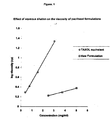
- FIG. 1 is a graph showing the effect of aqueous dilution on the viscosity of paclitaxel formulations.
- compositions comprising paclitaxel (abbreviated as "PCT" on occasion) and these solvents.
- PCT paclitaxel
- the invention relates to a composition
- a composition comprising: paclitaxel; and a pharmaceutically-acceptable, water-miscible, non-aqueous solvent comprising: N-methyl pyrrolidone and excluding dimethylacetamide or dimethylsulfoxide; wherein the composition is suitable for administration to a host in need thereof, and wherein the composition has a concentration of paclitaxel greater than or equal to about 1.5 mg/mL.
- the composition has a viscosity less than or equal to about 3.0 cp, as determined by the pipette/capillary method.
- the composition is substantially stable for four weeks at 50°C.
- the invention relates to the composition, wherein the pharmaceutically-acceptable, water-miscible, non-aqueous solvent consists of N-methyl pyrrolidone.
- the invention relates to the composition, further comprising a pharmaceutically-acceptable solubilizer.
- the invention relates to the composition, wherein the pharmaceutically-acceptable solubilizer comprises triacetin or polyethoxylated 12-hydroxy stearic acid.
- the invention relates to the composition, with the proviso that pharmaceutically-acceptable solubilizers are excluded from the composition.
- the invention relates to the composition, with the proviso that polyoxyethylated castor oil is excluded from the composition.
- the invention relates to a composition made by the acts comprising providing paclitaxel; combining the paclitaxel with a pharmaceutically-acceptable, water-miscible, non-aqueous solvent comprising: N-methyl pyrrolidone and excluding dimethylacetamide or dimethylsulfoxide; wherein the composition is suitable for administration to a host in need thereof, and wherein the composition has a concentration of paclitaxel greater than or equal to about 1.5 mg/mL.
- the pharmaceutically-acceptable, water-miscible, non-aqueous solvent consists of N-methyl pyrrolidone.
- the method further comprises combining a pharmaceutically-acceptable solubilizer with the pharmaceutically-acceptable, water-miscible, non-aqueous solvent after dissolving the paclitaxel.
- the invention relates to the use of a composition
- a composition comprising a pharmaceutically-acceptable, water miscible, non-aqueous solvent comprising N-methyl pyrrolidone and excluding dimethylacetamide or dimethylsulfoxide, and paclitaxel in a concentration greater than or equal to about 1.5 mg/mL for the manufacture of a medicament for treating cancer.
- the composition is in a pharmaceutically acceptable dosage form.
- the invention relates to a composition
- a composition comprising paclitaxel; and a pharmaceutically-acceptable, water-miscible, non-aqueous solvent consisting of N-methyl pyrrolidone; and paclitaxel in a concentration greater than or equal to about 1.5 mg/mL.
- the invention relates to the composition, further comprising a pharmaceutically-acceptable solubilizer.
- the invention relates to the composition, wherein the pharmaceutically-acceptable solubilizer comprises triacetin or polyethoxylated 12-hydroxy stearic acid.
- the invention relates to the composition, with the proviso that pharmaceutically-acceptable solubilizers are excluded from the composition.
- the invention relates to the composition, with the proviso that polyoxyethylated castor oil is excluded from the composition.
- paclitaxel suitable for use in this invention may be obtained from a variety of sources, including the National Cancer Institute (Bethesda, Md.). In the context of this invention, paclitaxel may be taken to mean paclitaxel proper, and paclitaxel derivatives, analogs, and prodrugs thereof.
- Solvents usable in the practice of this invention include pharmaceutically-acceptable, water-miscible, non-aqueous solvents.
- these solvents should be taken to include solvents that are generally acceptable for pharmaceutical use, substantially water-miscible, and substantially non-aqueous.
- these solvents are also non-phthalate plasticizer leaching solvents, so that, when used in medical equipment, they substantially do not leach phthalate plasticizers that may be present in the medical equipment.
- the pharmaceutically-acceptable, water-miscible, non-aqueous solvents usable in the practice of this invention include, but are not limited to, N-methyl pyrrolidone (NMP); propylene glycol; ethyl acetate; dimethyl sulfoxide; dimethyl acetamide; benzyl alcohol; 2-pyrrolidone; benzyl benzoate; C 2-6 alkanols; 2-ethoxyethanol; alkyl esters such as 2-ethoxyethyl acetate, methyl acetate, ethyl acetate, ethylene glycol diethyl ether, or ethylene glycol dimethyl ether; (s)-(-)-ethyl lactate; acetone; glycerol; alkyl ketones such as methylethyl ketone or dimethyl sulfone; tetrahydrofuran; cyclic alkyl amides such as caprolactam; decylmethyl
- the most preferred pharmaceutically-acceptable, water-miscible, non-aqueous solvents comprise N-methyl pyrrolidone and exclude dimethylacetamide or dimethylsulfoxide or consist of N-methyl pyrrolidone.
- Ethanol may also be used as a pharmaceutically-acceptable, water-miscible, non-aqueous solvent according to the invention, despite its negative impact on stability.
- triacetin may also be used as a pharmaceutically-acceptable, water-miscible, non-aqueous solvent, as well as functioning as a solubilizer in certain circumstances.
- NMP may be available as Pharmasolve® from International Specialty Products (Wayne, N.J.). Benzyl alcohol may be available from J. T. Baker, Inc. Ethanol may be available from Spectrum, Inc. Triacetin may be available from Mallinkrodt, Inc.
- Solubilizers may also be used in the practice of this invention. Solubilization is a phenomenon that enables the formation of a solution. It is related to the presence of amphiphiles-- those molecules that have the dual properties of being both polar and non-polar--in the solution that have the ability to increase the solubility of materials that are normally insoluble or only slightly soluble, in the dispersion medium. Solubilizers often have surfactant properties. Their function may be to enhance the solubility of a solute in a solution, rather than acting as a solvent, although in exceptional circumstances, a single compound may have both solubilizing and solvent characteristics.
- Solubilizers useful in the practice of this invention include, but are not limited to, triacetin, polyethylene glycols (such as PEG 300, PEG 400, or their blend with 3350), polysorbates (such as Polysorbate 20, Polysorbate 40, Polysorbate 60, Polysorbate 65, or Polysorbate 80), poloxamers (such as Poloxamer 124, Poloxamer 188, Poloxamer 237, Poloxamer 338, or Poloxamer 407), polyoxyethylene ethers (such as Polyoxyl 2 cetyl ether, Polyoxyl 10 cetyl ether, and Polyoxyl 20 cetyl ether, Polyoxyl 4 lauryl ether, Polyoxyl 23 lauryl ether, Polyoxyl 2 oleyl ether, Polyoxyl 10 oleyl ether, Polyoxyl 20 oleyl ether, Polyoxyl 2 stearyl ether, Polyoxyl 10 stearyl ether, Polyoxyl 20 stearyl ether, Polyoxyl 100 steary
- compositions are excluded from the inventive composition.
- polyoxyethylated castor oil is excluded from the inventive composition.
- Other materials that may be added to the invention compositions include cyclodextrins, and cyclodextrin analogs and derivatives, and other soluble excipients that could enhance the stability of the inventive composition, maintain the product in solution, or prevent side effects associated with the administration of the inventive composition. Cyclodextrins may be available as Encapsin® from Janssen Pharmaceuticals.
- the inventive compositions may be prepared by dissolving paclitaxel in a small quantity of the pharmaceutically-acceptable, water-miscible, non-aqueous solvent with moderate agitation.
- the volume of the inventive composition is then made up with the remaining solvent and ingredients and mixed thoroughly.
- the excipients such as hydroxypropyl cyclodextrin
- the excipients may be dissolved in an aliquot of the pharmaceutically-acceptable, water-miscible, non-aqueous solvent. This aliquot may then be mixed with a premixed solution of paclitaxel and pharmaceutically-acceptable, water-miscible, non-aqueous solvent as described above. The mixed aliquots are then mixed together, and the remaining volume is made up, all under moderate agitation.
- the inventive compositions may contain varying amounts of each of the paclitaxel, the pharmaceutically-acceptable, water-miscible, non-aqueous solvent, and other ingredients.
- the inventive compositions comprise paclitaxel in an amount ranging from about 0.001 to about 1% w/v, more preferably from about 0.01 to about 0.8%w/v.
- the composition comprises paclitaxel in an amount greater than or equal to about 1.5 mg/ml, more preferably in an amount greater than or equal to about 2.5 mg/ml.
- the inventive compositions comprise the pharmaceutically-acceptable, water-miscible, non-aqueous solvent in an amount ranging from about 25%w/v to about 99.999% w/v, more preferably from about 50 to about 99.99% w/v, and still more preferably from about 75 to about 99% w/v.
- the inventive compositions comprise a solubilizer in an amount ranging from about 0.001 to about 50% w/v, more preferably from about 0.01 to about 30% w/v.
- the ratio of w/v in this context refers to the weight of the material divided by the total volume of the solution or formulation.
- compositions may be used in the treatment of a variety of cancers, including, but not limited to ovarian carcinoma, breast carcinoma, lung carcinoma and Kaposi's sarcoma.
- the compositions according to the invention may be administered in any medically suitable manner, preferably parenterally or orally, more preferably parenterally, and still more preferably intravenously.
- the compositions may be diluted with sterile water, normal saline, D5W, Ringer's solution or other equivalent infusion liquids.
- Preferable dilutions range from about 5:1 to about 1:10 v/v of the inventive composition to the diluting infusion liquids. More preferably, the dilution ranges from about 2:1 to 1:2. Most preferably, the dilution may be 1:1.
- the ratio of v/v in this context refers to the ratio of the volume of the composition before dilution with the infusion fluids to the total volume of the composition following dilution with the infusion fluid.
- inventive compositions may be administered in a bolus fashion.
- a therapeutic dose of paclitaxel ranges from about 135 to about 175 mg/m 2 of paclitaxel. This dosage may be administered over a range of time from approximately thirty minutes to approximately 24 hours.
- An advantage of this invention is that relatively little dilution with infusion fluids may need to be made as part of the administration procedure, although larger dilution volumes may be contemplated as within the scope of the invention
- Conventional pre-medication optionally may be performed before administering the inventive compositions to a patient, to reduce the chance of hypersensitivity reactions. Additionally, desensitization procedures optionally may be performed.
- the inventive compositions are substantially ethanol-free, although various other embodiments of the invention comprise compositions that comprise ethanol.
- Preferable inventive compositions that are substantially ethanol-free surprisingly and unexpectedly exhibit superior chemical stability of paclitaxel compared to compositions that are not substantially ethanol-free.
- Chemical stability generally refers to the amount of chemical degradation of a particular material. Obviously, when administering materials such as paclitaxels, a highly stable formulation is desirable. Chemical stability of a pharmaceutical preparation depends upon the amount of chemical degradation of the active pharmaceutical ingredient in that preparation. Commonly, stability analysis of a pharmaceutical preparation, such as a liquid parenteral product, may be performed under accelerated temperature conditions, such as in a 50°C oven.
- the kinetic methods used in the accelerated stability analysis need not involve detailed studies of mechanism of degradation to be able to predict stability, but they are preferably based upon sound scientific principles and compliance with regulatory requirements. Developing formulations of acceptable chemical stability may be important, especially in cases where the composition comprises a cytotoxic drug like the paclitaxels. Physicians will find undesirable those products for which they must determine the exact amount of paclitaxel present before using the products. Additionally, regulatory requirements may specify minimum stability requirements. Therefore, discovery of variables that impact stability is a useful step in development of new pharmaceutical formulations. The inventors do not wish to be bound by a particular explanation of the mechanism by which ethanol may be responsible for degradation of paclitaxel, as such explanation is not necessary to practice the invention.
- paclitaxel degradation in the presence of ethanol.
- Those pharmaceutical agents that have an ester linkage, such as paclitaxel can be cleaved by an alcohol, specifically ethanol.
- the presence of ethanol therefore may serve to increase the rate of degradation of paclitaxel with concomitant reduction in stability.
- Acceptable stability varies from case to case, but is a term reasonably well understood by one of skill to mean chemical stability that is sufficient for the material to be well accepted in clinical use.
- the chemical stability of paclitaxel in a 50°C oven over four weeks is greater than about 85%.
- the chemical stability of paclitaxel in a 50°C oven over four weeks is greater than about 90%. In a still more preferred embodiment, the chemical stability of paclitaxel in a 50°C oven over four weeks is greater than about 93%. In a most preferred embodiment, the chemical stability of paclitaxel in a 50°C oven over four weeks is greater than about 96%.
- vehicle toxicity While varying amounts of toxicity are acceptable, especially in cytotoxic formulations, it is nevertheless desirable to reduce vehicle toxicity whenever practical.
- One surrogate measurement for vehicle toxicity is the LD50 -- the dosage at which 50% of the test subject die from being administered the vehicle. Common models for LD50 include well-accepted animal models such as the mouse.
- Mouse intravenous LD50 values can serve to quantify the levels of vehicle toxicity between different vehicles, and serve a useful role in selecting appropriate vehicles for pharmaceutical formulation development.
- the pharmaceutically-acceptable, water-miscible, non-aqueous solvents according to the invention have an intravenous LD50 in mice of greater than or equal to about 0.5 ml/kg, more preferably greater than or equal to about 1.5 ml/kg, still more preferably greater than or equal to about 2.0 ml/kg, and most preferably greater than or equal to about 2.5 ml/kg.
- Another interesting characteristic of the present invention is that the inventive compositions are of relatively low viscosities, even at high paclitaxel concentrations. This is in contrast to Taxol®, which is of relatively high viscosity at high paclitaxel concentrations.
- the viscosity of paclitaxel-containing formulation was investigated as follows.
- the viscosity of a Newtonian liquid may be determined by measuring the time required for the liquid to pass between two marks as it flows by gravity through a vertical capillary tube. The time of flow of liquid under the test is compared with the time required for a liquid of known viscosity (usually water) to pass between the two marks.
- Viscosities may be measured using the pipette/capillary method. In this method, the time of flow for 1mL of a particular formulation or liquid with unknown viscosity may be measured with a stopwatch using a standard volumetric pipette of constant length, diameter, and volume, such as a 1mL volumetric pipette. This time of flow may be compared against the time of flow for a liquid of known viscosity to arrive at a viscosity determination for the unknown liquid.
- Taxol® may be diluted in 0.9% Sodium Chloride for Injection USP, 5% Dextrose for Injection USP, 5% Dextrose and 0.9% Sodium Chloride for Injection USP, or 5% Dextrose in Ringer's Solution for Injection USP to a final concentration of 0.3 - 1.2 mg/ml.
- the solutions may be physically and chemically stable for up to 27 hours at room temperature and room lighting conditions.
- Taxol® or Taxol® equivalent formulations of paclitaxel containing Cremophor when diluted 1:3 or 1:4 with 0.9% NaCl to achieve a drug concentration of 0.75 or 0.38 mg/mL, respectively, may remain clear for 24 ⁇ 3 hr.
- those diluted 1:1 or 1:2 with 0.9% NaCl to achieve a drug concentration of 3.0 or 1.5 mg/mL respectively show signs of precipitation within this time.
- the inventive compositions when diluted 1:1 to achieve a concentration range of 2.5-4 mg/mL (depending on the cosolvent composition) are able to remain clear for 24 ⁇ 3 hr.
- the viscosities of these diluted formulations are comparable to the 1:3 and 1:4 dilutions of the earlier Cremophor containing formulations facilitating intravenous administration. Therefore, the inventive compositions may be diluted to equivalent viscosities of diluted, conventional, Taxol® or Taxol® equivalent formulations, using smaller volumes of diluting infusion fluids.
- the diluted inventive formulations may have acceptable physical stability for up to 24 hours.
- the viscosities of a Taxol® equivalent paclitaxel formulation (including Cremophor®, ethanol and paclitaxel) and of compositions according to the invention were tested at various dilution amounts.
- the viscosity determinations were performed according to the pipette/capillary method, discussed above, under the assumption that the formulations were Newtonian liquids.
- the time of flow for 1mL of various diluted formulations with unknown viscosities was measured with a stopwatch using a standard volumetric pipette of constant length, diameter, and volume of I mL. Similarly, time taken for water, with a known viscosity of 0.89 cp, to flow through the same tube was recorded.
Landscapes
- Health & Medical Sciences (AREA)
- Chemical & Material Sciences (AREA)
- Veterinary Medicine (AREA)
- Medicinal Chemistry (AREA)
- Pharmacology & Pharmacy (AREA)
- Life Sciences & Earth Sciences (AREA)
- Animal Behavior & Ethology (AREA)
- General Health & Medical Sciences (AREA)
- Public Health (AREA)
- Epidemiology (AREA)
- Chemical Kinetics & Catalysis (AREA)
- General Chemical & Material Sciences (AREA)
- Dermatology (AREA)
- Engineering & Computer Science (AREA)
- Oil, Petroleum & Natural Gas (AREA)
- Nuclear Medicine, Radiotherapy & Molecular Imaging (AREA)
- Organic Chemistry (AREA)
- Pharmaceuticals Containing Other Organic And Inorganic Compounds (AREA)
- Medicinal Preparation (AREA)
Claims (25)
- Zusammensetzung mit
einem pharmazeutisch verträglichen, mit Wasser mischbaren, nicht wäßrigen Lösungsmitteln, umfassend N-Methylpyrrolidon und ausgenommen Dimethylacetamid oder Dimethylsulfoxid,
und mit
Paclitaxel in einer Konzentration größer als oder gleich etwa 1,5 mg/ml. - Zusammensetzung nach Anspruch 1, wobei die Zusammensetzung eine Viskosität geringer als oder gleich etwa 3,0 cp hat, bestimmt nach dem Pipetten-/Kapillaren-Venfahren.
- Zusammensetzung nach Anspruch 1 oder Anspruch 2, wobei die Zusammensetzung nach Inkubation für vier Wochen bei 50°C wenigstens zu 84% stabil ist.
- Zusammensetzung nach einem der vorangegangenen Ansprüche, wobei die Zusammensetzung für eine Verabreichung an einen Wirt geeignet ist.
- Zusammensetzung nach einem der vorangegangenen Ansprüche, welche weiterhin einen pharmazeutisch verträglich Lösungsverbesserer umfaßt.
- Zusammensetzung nach Anspruch 5, wobei der pharmazeutisch verträgliche Lösungsverbesserer Triacetin oder polyethoxylierte 12-Hydroxystearinsäure umfaßt.
- Zusammensetzung nach einem der Ansprüche 1 bis 4, wobei in der Zusammensetzung keine pharmazeutisch verträglichen Lösungsverbesserer enthalten sind.
- Zusammensetzung nach einem der vorangegangenen Ansprüche, wobei in der Zusammensetzung kein polyethoxyliertes Kastoröl enthalten ist.
- Zusammensetzung nach einem der vorangegangenen Ansprüche, wobei die Zusammensetzung in einer pharmazeutisch verträglichen Arzneiform vorliegt.
- Zusammensetzung mit
einem pharmazeutisch verträglichen, mit Wasser mischbaren, nicht wäßrigen Lösungsmittel, bestehend aus N-Methylpyrrolidon, und
Paclitaxel in einer Konzentration größer als oder gleich etwa 1,5 mg/ml. - Zusammensetzung nach Anspruch 10, wobei die Zusammensetzung eine Viskosität kleiner als oder gleich etwa 3,0 cp hat, bestimmt nach dem Pipetten-/Kapillaren-Verfahren.
- Zusammensetzung nach Anspruch 10 oder Anspruch 11, wobei die Zusammensetzung für vier Wochen bei 50°C im wesentlichen stabil ist.
- Zusammensetzung nach einem der Ansprüche 10 bis 12, wobei die Zusammensetzung für eine Verabreichung an einen Wirt geeignet ist.
- Zusammensetzung nach einem der Ansprüche 10 bis 13, welche weiterhin einen pharmazeutisch verträglichen Lösungsverbesserer umfaßt.
- Zusammensetzung nach Anspruch 14, wobei der pharmazeutisch verträgliche Lösungsverbesserer Triacetin oder polyethoxylierte 12-Hydroxystearinsäure umfaßt.
- Zusammensetzung nach einem der Ansprüche 10 bis 13, wobei in der Zusammensetzung keine pharmazeutisch verträglichen Lösungsverbesserer enthalten sind.
- Zusammensetzung nach einem der Ansprüche 10 bis 16, wobei in der Zusammensetzung kein polyethoxyliertes Kastoröl enthalten ist.
- Zusammensetzung nach einem der Ansprüche 10 bis 17, wobei die Zusammensetzung in einer pharmazeutisch verträglichen Arzneiform vorliegt.
- Verfahren zur Herstellung einer Zusammensetzung, bei dem man Paclitaxel in einem pharmazeutisch verträglichen, mit Wasser mischbaren, nicht wäßrigen Lösungsmittel, umfassend N-Methylpyrrolidon und ausgenommen Dimethylacetamid oder Dimethylsulfoxid, mit einer Paclitaxel-Konzentration größer als oder gleich etwa 1,5 mg/ml löst.
- Verfahren nach Anspruch 19, wobei das pharmazeutisch verträgliche, mit Wasser mischbare, nicht wäßrige Lösungsmittel aus N-Methylpyrrolidon besteht.
- Verfahren nach Anspruch 19 oder Anspruch 20, welches weiterhin das Kombinieren eines pharmazeutisch verträglichen Lösungsverbesserers mit dem pharmazeutisch verträglichen, mit Wasser mischbaren, nicht wäßrigen Lösungsmittel nach dem Lösen des Paclitaxels umfaßt.
- Verfahren nach Anspruch 21, wobei der pharmazeutisch verträgliche Lösungsverbesserer Triacetin oder polyethoxylierte 12-Hydroxystearinsäure umfaßt.
- Verwendung einer Zusammensetzung mit einem pharmazeutisch verträglichen, mit Wasser mischbaren, nicht wäßrigen Lösungsmittel, umfassend N-Methylpyrrolidon und ausgenommen Dimethylacetamid oder Dimethylsulfoxid, und mit Paclitaxel in einer Konzentration größer als oder gleich etwa 1,5 mg/ml zur Herstellung eines Medikaments für die Behandlung von Krebs.
- Verwendung nach Anspruch 23, wobei das pharmazeutisch verträgliche, mit Wasser mischbare, nicht wäßrige Lösungsmittel aus N-Methylpyrrolidon besteht.
- Verwendung nach Anspruch 23 oder Anspruch 24, wobei die Zusammensetzung in einer pharmazeutisch verträglichen Arzneiform vorliegt.
Applications Claiming Priority (3)
| Application Number | Priority Date | Filing Date | Title |
|---|---|---|---|
| US183199 | 1998-10-30 | ||
| US09/183,199 US6017948A (en) | 1998-10-30 | 1998-10-30 | Water-miscible pharmaceutical compositions |
| PCT/US1999/021990 WO2000025775A1 (en) | 1998-10-30 | 1999-09-22 | Water-miscible pharmaceutical compositions of paclitaxel |
Publications (2)
| Publication Number | Publication Date |
|---|---|
| EP1124549A1 EP1124549A1 (de) | 2001-08-22 |
| EP1124549B1 true EP1124549B1 (de) | 2003-11-19 |
Family
ID=22671864
Family Applications (1)
| Application Number | Title | Priority Date | Filing Date |
|---|---|---|---|
| EP99951559A Expired - Lifetime EP1124549B1 (de) | 1998-10-30 | 1999-09-22 | Wassermischbare pharmazeutische zusammensetzungen enthaltend paclitaxel |
Country Status (11)
| Country | Link |
|---|---|
| US (1) | US6017948A (de) |
| EP (1) | EP1124549B1 (de) |
| JP (1) | JP2002528494A (de) |
| CN (1) | CN1178655C (de) |
| AT (1) | ATE254455T1 (de) |
| AU (1) | AU775158B2 (de) |
| CA (1) | CA2345697A1 (de) |
| DE (1) | DE69912983D1 (de) |
| IL (1) | IL142720A (de) |
| MX (1) | MXPA01004268A (de) |
| WO (1) | WO2000025775A1 (de) |
Families Citing this family (23)
| Publication number | Priority date | Publication date | Assignee | Title |
|---|---|---|---|---|
| US6774278B1 (en) * | 1995-06-07 | 2004-08-10 | Cook Incorporated | Coated implantable medical device |
| US6071952A (en) * | 1998-12-02 | 2000-06-06 | Mylan Pharmaceuticals, Inc. | Stabilized injectable pharmaceutical compositions containing taxoid anti-neoplastic agents |
| WO2002085337A1 (en) | 2001-04-20 | 2002-10-31 | The University Of British Columbia | Micellar drug delivery systems for hydrophobic drugs |
| US6040330A (en) * | 1999-01-08 | 2000-03-21 | Bionumerik Pharmaceuticals, Inc. | Pharmaceutical formulations of taxanes |
| US6828346B2 (en) * | 1999-10-25 | 2004-12-07 | Supergen, Inc. | Methods for administration of paclitaxel |
| US6136846A (en) | 1999-10-25 | 2000-10-24 | Supergen, Inc. | Formulation for paclitaxel |
| DE60131537T2 (de) | 2000-06-22 | 2008-10-23 | Nitromed, Inc., Lexington | Nitrosierte und nitrosylierte taxane, zubereitungen und methoden der verwendung |
| EP1418945A2 (de) * | 2001-03-13 | 2004-05-19 | Angiotech Pharmaceuticals, Inc. | Mizellare arzneimittelabgabe vehikel und ihre anwendungen |
| DE10115740A1 (de) * | 2001-03-26 | 2002-10-02 | Ulrich Speck | Zubereitung für die Restenoseprophylaxe |
| US20030126788A1 (en) * | 2001-11-07 | 2003-07-10 | Colloid Tech. Inc. | Storage stable translucent flammable article |
| EP1451168A4 (de) * | 2001-11-30 | 2005-08-24 | Bristol Myers Squibb Co | Paclitaxelsolvate |
| US6537985B1 (en) | 2001-11-30 | 2003-03-25 | Phoenix Scientific, Inc. | Antibiotic formulation and a method of making this formulation |
| JP4454019B2 (ja) * | 2002-07-15 | 2010-04-21 | アルコン,インコーポレイテッド | 眼薬送達のための生体侵食性フィルム |
| DE10244847A1 (de) * | 2002-09-20 | 2004-04-01 | Ulrich Prof. Dr. Speck | Medizinische Vorrichtung zur Arzneimittelabgabe |
| US8003625B2 (en) | 2005-06-29 | 2011-08-23 | Threshold Pharmaceuticals, Inc. | Phosphoramidate alkylator prodrugs |
| US9943490B2 (en) | 2007-11-05 | 2018-04-17 | The Trustees Of Princeton University | Composite flash-precipitated nanoparticles |
| AP2895A (en) * | 2007-12-24 | 2014-05-31 | Sun Pharma Advanced Res Co Ltd | Nanodispersion |
| EP2350664B1 (de) | 2008-10-21 | 2021-05-19 | ImmunoGenesis, Inc. | Behandlung von krebs anhand vom hypoxie-aktivierten promedikament th-302 in kombinatin mit docetaxel oder pemetrexed |
| US8778364B2 (en) | 2009-06-19 | 2014-07-15 | Sun Pharma Advanced Research Company Ltd. | Nanodispersion of a drug and process for its preparation |
| JP5824511B2 (ja) | 2010-05-03 | 2015-11-25 | テイコク ファーマ ユーエスエー インコーポレーテッド | 非水タキサンプロエマルジョン配合物ならびにそれを調製および使用する方法 |
| US20120172796A1 (en) | 2010-12-30 | 2012-07-05 | Chappa Ralph A | Composition for intravascular delivery of therapeutic composition |
| JO3685B1 (ar) | 2012-10-01 | 2020-08-27 | Teikoku Pharma Usa Inc | صيغ التشتيت الجسيمي للتاكسين غير المائي وطرق استخدامها |
| CN112972419B (zh) * | 2019-12-02 | 2024-03-08 | 四川科伦药物研究院有限公司 | 一种白蛋白纳米药物组合物的制备方法 |
Citations (1)
| Publication number | Priority date | Publication date | Assignee | Title |
|---|---|---|---|---|
| WO1998000128A1 (en) * | 1996-06-28 | 1998-01-08 | Board Of Regents, The University Of Texas System | Parenteral paclitaxel in a stable non-toxic formulation |
Family Cites Families (16)
| Publication number | Priority date | Publication date | Assignee | Title |
|---|---|---|---|---|
| IE74244B1 (en) * | 1985-10-01 | 1997-07-16 | Bimeda Res Dev Ltd | A process for preparing an antibiotic composition |
| US5034397A (en) * | 1985-12-12 | 1991-07-23 | Bristol-Myers Squibb Co. | Stable, water soluble salt compositions of M-AMSA in 1-methyl-2-pyrrolidinone |
| US4772589A (en) * | 1986-10-29 | 1988-09-20 | Bristol-Myers | Etoposide solution in NMP |
| KR920700655A (ko) * | 1989-05-26 | 1992-08-10 | 찰스 엠. 브럭 | 주사가능한 클라리트로마이신 조성물 |
| US5082863A (en) * | 1990-08-29 | 1992-01-21 | Schering Corporation | Pharmaceutical composition of florfenicol |
| CA2086874E (en) * | 1992-08-03 | 2000-01-04 | Renzo Mauro Canetta | Methods for administration of taxol |
| EP0626171A1 (de) * | 1993-05-26 | 1994-11-30 | Winfried Dörnhöfer | Injektionslösung für die intravenöse oder intramuskuläre Verabreichung an Tiere |
| TW406020B (en) * | 1993-09-29 | 2000-09-21 | Bristol Myers Squibb Co | Stabilized pharmaceutical composition and its method for preparation and stabilizing solvent |
| SK280278B6 (sk) * | 1994-09-01 | 1999-10-08 | Pharmacia + Upjohn Company | Sterilná vodná farmaceutická kompozícia na parente |
| AU4652596A (en) * | 1995-01-09 | 1996-07-31 | Atrix Laboratories, Inc. | Liquid polymer delivery system |
| US5681846A (en) * | 1995-03-17 | 1997-10-28 | Board Of Regents, The University Of Texas System | Extended stability formulations for paclitaxel |
| US5726181A (en) * | 1995-06-05 | 1998-03-10 | Bionumerik Pharmaceuticals, Inc. | Formulations and compositions of poorly water soluble camptothecin derivatives |
| ATE212551T1 (de) * | 1995-12-21 | 2002-02-15 | Pfizer | Injizierbare quinolonformulierungen |
| US5773422A (en) * | 1996-01-29 | 1998-06-30 | Komer; Gene | Avermectin formulation |
| CA2211949A1 (en) * | 1997-07-21 | 1999-01-29 | David Farley Johnson | Nonaqueous compositions for parenteral administration |
| US5922754A (en) * | 1998-10-02 | 1999-07-13 | Abbott Laboratories | Pharmaceutical compositions containing paclitaxel |
-
1998
- 1998-10-30 US US09/183,199 patent/US6017948A/en not_active Expired - Fee Related
-
1999
- 1999-09-22 WO PCT/US1999/021990 patent/WO2000025775A1/en not_active Ceased
- 1999-09-22 AT AT99951559T patent/ATE254455T1/de not_active IP Right Cessation
- 1999-09-22 CA CA002345697A patent/CA2345697A1/en not_active Abandoned
- 1999-09-22 DE DE69912983T patent/DE69912983D1/de not_active Expired - Lifetime
- 1999-09-22 CN CNB998126624A patent/CN1178655C/zh not_active Expired - Fee Related
- 1999-09-22 IL IL14272099A patent/IL142720A/xx not_active IP Right Cessation
- 1999-09-22 MX MXPA01004268A patent/MXPA01004268A/es not_active IP Right Cessation
- 1999-09-22 EP EP99951559A patent/EP1124549B1/de not_active Expired - Lifetime
- 1999-09-22 JP JP2000579216A patent/JP2002528494A/ja active Pending
- 1999-09-22 AU AU63977/99A patent/AU775158B2/en not_active Ceased
Patent Citations (1)
| Publication number | Priority date | Publication date | Assignee | Title |
|---|---|---|---|---|
| WO1998000128A1 (en) * | 1996-06-28 | 1998-01-08 | Board Of Regents, The University Of Texas System | Parenteral paclitaxel in a stable non-toxic formulation |
Also Published As
| Publication number | Publication date |
|---|---|
| JP2002528494A (ja) | 2002-09-03 |
| AU775158B2 (en) | 2004-07-22 |
| EP1124549A1 (de) | 2001-08-22 |
| MXPA01004268A (es) | 2002-06-04 |
| CN1368880A (zh) | 2002-09-11 |
| IL142720A0 (en) | 2002-03-10 |
| IL142720A (en) | 2005-03-20 |
| CA2345697A1 (en) | 2000-05-11 |
| ATE254455T1 (de) | 2003-12-15 |
| DE69912983D1 (de) | 2003-12-24 |
| US6017948A (en) | 2000-01-25 |
| CN1178655C (zh) | 2004-12-08 |
| AU6397799A (en) | 2000-05-22 |
| WO2000025775A1 (en) | 2000-05-11 |
Similar Documents
| Publication | Publication Date | Title |
|---|---|---|
| US6017948A (en) | Water-miscible pharmaceutical compositions | |
| US6319943B1 (en) | Oral formulation for paclitaxel | |
| AU724842B2 (en) | Taxane composition and method | |
| DE69931617T2 (de) | Taxan-mikroemulsionen | |
| US20040110828A1 (en) | Tetrahydrocannabinol compositions and methods of manufacture and use thereof | |
| US20120065255A1 (en) | Cabazitaxel formulations and methods of preparing thereof | |
| US8912228B2 (en) | Docetaxel formulations with lipoic acid | |
| US20250235455A1 (en) | Aqueous ticagrelor solutions, method of manufacturing and uses | |
| JP2009509942A (ja) | フルベストラント製剤 | |
| EP2306976A2 (de) | Injizierbare pharmazeutische taxanzusammensetzung | |
| US10398785B2 (en) | Pharmaceutical compositions containing taxane-cyclodextrin complexes, method of making and methods of use | |
| HUP0303089A2 (hu) | Rák elleni szer stabil gyógyszerformája | |
| US20070032438A1 (en) | Pharmaceutical compositions containing taxanes and methods for preparing the pharmaceutical compositions | |
| US20210015783A1 (en) | Pharmaceutical Compositions Containing Taxane-Cyclodextrin Complexes, Method of Making and Methods of Use | |
| TWI246927B (en) | One kind of concentrated emulsion containing Paclitaxel (taxane) | |
| HK40029332A (en) | Pharmaceutical compositions containing taxane-cyclodextrin complexes, method of making and methods of use | |
| HK40031246A (en) | Pharmaceutical compositions containing taxane-cyclodextrin complexes, method of making and methods of use |
Legal Events
| Date | Code | Title | Description |
|---|---|---|---|
| PUAI | Public reference made under article 153(3) epc to a published international application that has entered the european phase |
Free format text: ORIGINAL CODE: 0009012 |
|
| 17P | Request for examination filed |
Effective date: 20010522 |
|
| AK | Designated contracting states |
Kind code of ref document: A1 Designated state(s): AT BE CH CY DE DK ES FI FR GB GR IE IT LI LU MC NL PT SE |
|
| 17Q | First examination report despatched |
Effective date: 20020404 |
|
| GRAH | Despatch of communication of intention to grant a patent |
Free format text: ORIGINAL CODE: EPIDOS IGRA |
|
| RIC1 | Information provided on ipc code assigned before grant |
Ipc: 7A 61P 35/00 B Ipc: 7A 61K 47/20 B Ipc: 7A 61K 47/18 B Ipc: 7A 61K 47/16 B Ipc: 7A 61K 47/14 B Ipc: 7A 61K 47/10 B Ipc: 7A 61K 31/335 A |
|
| RIC1 | Information provided on ipc code assigned before grant |
Ipc: 7A 61P 35/00 B Ipc: 7A 61K 47/20 B Ipc: 7A 61K 47/18 B Ipc: 7A 61K 47/16 B Ipc: 7A 61K 47/14 B Ipc: 7A 61K 47/10 B Ipc: 7A 61K 31/337 A |
|
| GRAS | Grant fee paid |
Free format text: ORIGINAL CODE: EPIDOSNIGR3 |
|
| GRAA | (expected) grant |
Free format text: ORIGINAL CODE: 0009210 |
|
| AK | Designated contracting states |
Kind code of ref document: B1 Designated state(s): AT BE CH CY DE DK ES FI FR GB GR IE IT LI LU MC NL PT SE |
|
| PG25 | Lapsed in a contracting state [announced via postgrant information from national office to epo] |
Ref country code: NL Free format text: LAPSE BECAUSE OF FAILURE TO SUBMIT A TRANSLATION OF THE DESCRIPTION OR TO PAY THE FEE WITHIN THE PRESCRIBED TIME-LIMIT Effective date: 20031119 Ref country code: LI Free format text: LAPSE BECAUSE OF FAILURE TO SUBMIT A TRANSLATION OF THE DESCRIPTION OR TO PAY THE FEE WITHIN THE PRESCRIBED TIME-LIMIT Effective date: 20031119 Ref country code: IT Free format text: LAPSE BECAUSE OF FAILURE TO SUBMIT A TRANSLATION OF THE DESCRIPTION OR TO PAY THE FEE WITHIN THE PRE;WARNING: LAPSES OF ITALIAN PATENTS WITH EFFECTIVE DATE BEFORE 2007 MAY HAVE OCCURRED AT ANY TIME BEFORE 2007. THE CORRECT EFFECTIVE DATE MAY BE DIFFERENT FROM THE ONE RECORDED.SCRIBED TIME-LIMIT Effective date: 20031119 Ref country code: FR Free format text: LAPSE BECAUSE OF FAILURE TO SUBMIT A TRANSLATION OF THE DESCRIPTION OR TO PAY THE FEE WITHIN THE PRESCRIBED TIME-LIMIT Effective date: 20031119 Ref country code: FI Free format text: LAPSE BECAUSE OF FAILURE TO SUBMIT A TRANSLATION OF THE DESCRIPTION OR TO PAY THE FEE WITHIN THE PRESCRIBED TIME-LIMIT Effective date: 20031119 Ref country code: CY Free format text: LAPSE BECAUSE OF FAILURE TO SUBMIT A TRANSLATION OF THE DESCRIPTION OR TO PAY THE FEE WITHIN THE PRESCRIBED TIME-LIMIT Effective date: 20031119 Ref country code: CH Free format text: LAPSE BECAUSE OF FAILURE TO SUBMIT A TRANSLATION OF THE DESCRIPTION OR TO PAY THE FEE WITHIN THE PRESCRIBED TIME-LIMIT Effective date: 20031119 Ref country code: BE Free format text: LAPSE BECAUSE OF FAILURE TO SUBMIT A TRANSLATION OF THE DESCRIPTION OR TO PAY THE FEE WITHIN THE PRESCRIBED TIME-LIMIT Effective date: 20031119 Ref country code: AT Free format text: LAPSE BECAUSE OF FAILURE TO SUBMIT A TRANSLATION OF THE DESCRIPTION OR TO PAY THE FEE WITHIN THE PRESCRIBED TIME-LIMIT Effective date: 20031119 |
|
| REG | Reference to a national code |
Ref country code: GB Ref legal event code: FG4D |
|
| REG | Reference to a national code |
Ref country code: CH Ref legal event code: EP |
|
| REF | Corresponds to: |
Ref document number: 69912983 Country of ref document: DE Date of ref document: 20031224 Kind code of ref document: P |
|
| REG | Reference to a national code |
Ref country code: IE Ref legal event code: FG4D |
|
| PG25 | Lapsed in a contracting state [announced via postgrant information from national office to epo] |
Ref country code: SE Free format text: LAPSE BECAUSE OF FAILURE TO SUBMIT A TRANSLATION OF THE DESCRIPTION OR TO PAY THE FEE WITHIN THE PRESCRIBED TIME-LIMIT Effective date: 20040219 Ref country code: GR Free format text: LAPSE BECAUSE OF FAILURE TO SUBMIT A TRANSLATION OF THE DESCRIPTION OR TO PAY THE FEE WITHIN THE PRESCRIBED TIME-LIMIT Effective date: 20040219 Ref country code: DK Free format text: LAPSE BECAUSE OF FAILURE TO SUBMIT A TRANSLATION OF THE DESCRIPTION OR TO PAY THE FEE WITHIN THE PRESCRIBED TIME-LIMIT Effective date: 20040219 |
|
| PG25 | Lapsed in a contracting state [announced via postgrant information from national office to epo] |
Ref country code: DE Free format text: LAPSE BECAUSE OF FAILURE TO SUBMIT A TRANSLATION OF THE DESCRIPTION OR TO PAY THE FEE WITHIN THE PRESCRIBED TIME-LIMIT Effective date: 20040220 |
|
| PG25 | Lapsed in a contracting state [announced via postgrant information from national office to epo] |
Ref country code: ES Free format text: LAPSE BECAUSE OF FAILURE TO SUBMIT A TRANSLATION OF THE DESCRIPTION OR TO PAY THE FEE WITHIN THE PRESCRIBED TIME-LIMIT Effective date: 20040302 |
|
| NLV1 | Nl: lapsed or annulled due to failure to fulfill the requirements of art. 29p and 29m of the patents act | ||
| REG | Reference to a national code |
Ref country code: CH Ref legal event code: PL |
|
| PG25 | Lapsed in a contracting state [announced via postgrant information from national office to epo] |
Ref country code: LU Free format text: LAPSE BECAUSE OF NON-PAYMENT OF DUE FEES Effective date: 20040922 Ref country code: IE Free format text: LAPSE BECAUSE OF NON-PAYMENT OF DUE FEES Effective date: 20040922 |
|
| PLBE | No opposition filed within time limit |
Free format text: ORIGINAL CODE: 0009261 |
|
| STAA | Information on the status of an ep patent application or granted ep patent |
Free format text: STATUS: NO OPPOSITION FILED WITHIN TIME LIMIT |
|
| PG25 | Lapsed in a contracting state [announced via postgrant information from national office to epo] |
Ref country code: MC Free format text: LAPSE BECAUSE OF NON-PAYMENT OF DUE FEES Effective date: 20040930 |
|
| 26N | No opposition filed |
Effective date: 20040820 |
|
| EN | Fr: translation not filed | ||
| REG | Reference to a national code |
Ref country code: IE Ref legal event code: MM4A |
|
| PGFP | Annual fee paid to national office [announced via postgrant information from national office to epo] |
Ref country code: GB Payment date: 20060925 Year of fee payment: 8 |
|
| PG25 | Lapsed in a contracting state [announced via postgrant information from national office to epo] |
Ref country code: PT Free format text: LAPSE BECAUSE OF NON-PAYMENT OF DUE FEES Effective date: 20040419 |
|
| GBPC | Gb: european patent ceased through non-payment of renewal fee |
Effective date: 20070922 |
|
| PG25 | Lapsed in a contracting state [announced via postgrant information from national office to epo] |
Ref country code: GB Free format text: LAPSE BECAUSE OF NON-PAYMENT OF DUE FEES Effective date: 20070922 |