EP1127597A2 - Dispositif récréatif, support d'enregistrement et programme informatique - Google Patents
Dispositif récréatif, support d'enregistrement et programme informatique Download PDFInfo
- Publication number
- EP1127597A2 EP1127597A2 EP01104061A EP01104061A EP1127597A2 EP 1127597 A2 EP1127597 A2 EP 1127597A2 EP 01104061 A EP01104061 A EP 01104061A EP 01104061 A EP01104061 A EP 01104061A EP 1127597 A2 EP1127597 A2 EP 1127597A2
- Authority
- EP
- European Patent Office
- Prior art keywords
- identification information
- image
- level signal
- entertainment
- push operation
- Prior art date
- Legal status (The legal status is an assumption and is not a legal conclusion. Google has not performed a legal analysis and makes no representation as to the accuracy of the status listed.)
- Granted
Links
Images






Classifications
-
- A—HUMAN NECESSITIES
- A63—SPORTS; GAMES; AMUSEMENTS
- A63F—CARD, BOARD, OR ROULETTE GAMES; INDOOR GAMES USING SMALL MOVING PLAYING BODIES; VIDEO GAMES; GAMES NOT OTHERWISE PROVIDED FOR
- A63F13/00—Video games, i.e. games using an electronically generated display having two or more dimensions
- A63F13/40—Processing input control signals of video game devices, e.g. signals generated by the player or derived from the environment
- A63F13/42—Processing input control signals of video game devices, e.g. signals generated by the player or derived from the environment by mapping the input signals into game commands, e.g. mapping the displacement of a stylus on a touch screen to the steering angle of a virtual vehicle
-
- A—HUMAN NECESSITIES
- A63—SPORTS; GAMES; AMUSEMENTS
- A63F—CARD, BOARD, OR ROULETTE GAMES; INDOOR GAMES USING SMALL MOVING PLAYING BODIES; VIDEO GAMES; GAMES NOT OTHERWISE PROVIDED FOR
- A63F13/00—Video games, i.e. games using an electronically generated display having two or more dimensions
- A63F13/20—Input arrangements for video game devices
- A63F13/21—Input arrangements for video game devices characterised by their sensors, purposes or types
- A63F13/218—Input arrangements for video game devices characterised by their sensors, purposes or types using pressure sensors, e.g. generating a signal proportional to the pressure applied by the player
-
- A—HUMAN NECESSITIES
- A63—SPORTS; GAMES; AMUSEMENTS
- A63F—CARD, BOARD, OR ROULETTE GAMES; INDOOR GAMES USING SMALL MOVING PLAYING BODIES; VIDEO GAMES; GAMES NOT OTHERWISE PROVIDED FOR
- A63F13/00—Video games, i.e. games using an electronically generated display having two or more dimensions
- A63F13/50—Controlling the output signals based on the game progress
- A63F13/52—Controlling the output signals based on the game progress involving aspects of the displayed game scene
-
- A—HUMAN NECESSITIES
- A63—SPORTS; GAMES; AMUSEMENTS
- A63F—CARD, BOARD, OR ROULETTE GAMES; INDOOR GAMES USING SMALL MOVING PLAYING BODIES; VIDEO GAMES; GAMES NOT OTHERWISE PROVIDED FOR
- A63F13/00—Video games, i.e. games using an electronically generated display having two or more dimensions
- A63F13/50—Controlling the output signals based on the game progress
- A63F13/52—Controlling the output signals based on the game progress involving aspects of the displayed game scene
- A63F13/525—Changing parameters of virtual cameras
- A63F13/5255—Changing parameters of virtual cameras according to dedicated instructions from a player, e.g. using a secondary joystick to rotate the camera around a player's character
-
- A—HUMAN NECESSITIES
- A63—SPORTS; GAMES; AMUSEMENTS
- A63F—CARD, BOARD, OR ROULETTE GAMES; INDOOR GAMES USING SMALL MOVING PLAYING BODIES; VIDEO GAMES; GAMES NOT OTHERWISE PROVIDED FOR
- A63F13/00—Video games, i.e. games using an electronically generated display having two or more dimensions
- A63F13/80—Special adaptations for executing a specific game genre or game mode
- A63F13/833—Hand-to-hand fighting, e.g. martial arts competition
-
- A—HUMAN NECESSITIES
- A63—SPORTS; GAMES; AMUSEMENTS
- A63F—CARD, BOARD, OR ROULETTE GAMES; INDOOR GAMES USING SMALL MOVING PLAYING BODIES; VIDEO GAMES; GAMES NOT OTHERWISE PROVIDED FOR
- A63F2300/00—Features of games using an electronically generated display having two or more dimensions, e.g. on a television screen, showing representations related to the game
- A63F2300/10—Features of games using an electronically generated display having two or more dimensions, e.g. on a television screen, showing representations related to the game characterized by input arrangements for converting player-generated signals into game device control signals
- A63F2300/1056—Features of games using an electronically generated display having two or more dimensions, e.g. on a television screen, showing representations related to the game characterized by input arrangements for converting player-generated signals into game device control signals involving pressure sensitive buttons
-
- A—HUMAN NECESSITIES
- A63—SPORTS; GAMES; AMUSEMENTS
- A63F—CARD, BOARD, OR ROULETTE GAMES; INDOOR GAMES USING SMALL MOVING PLAYING BODIES; VIDEO GAMES; GAMES NOT OTHERWISE PROVIDED FOR
- A63F2300/00—Features of games using an electronically generated display having two or more dimensions, e.g. on a television screen, showing representations related to the game
- A63F2300/60—Methods for processing data by generating or executing the game program
- A63F2300/6045—Methods for processing data by generating or executing the game program for mapping control signals received from the input arrangement into game commands
-
- A—HUMAN NECESSITIES
- A63—SPORTS; GAMES; AMUSEMENTS
- A63F—CARD, BOARD, OR ROULETTE GAMES; INDOOR GAMES USING SMALL MOVING PLAYING BODIES; VIDEO GAMES; GAMES NOT OTHERWISE PROVIDED FOR
- A63F2300/00—Features of games using an electronically generated display having two or more dimensions, e.g. on a television screen, showing representations related to the game
- A63F2300/60—Methods for processing data by generating or executing the game program
- A63F2300/6045—Methods for processing data by generating or executing the game program for mapping control signals received from the input arrangement into game commands
- A63F2300/6054—Methods for processing data by generating or executing the game program for mapping control signals received from the input arrangement into game commands by generating automatically game commands to assist the player, e.g. automatic braking in a driving game
-
- A—HUMAN NECESSITIES
- A63—SPORTS; GAMES; AMUSEMENTS
- A63F—CARD, BOARD, OR ROULETTE GAMES; INDOOR GAMES USING SMALL MOVING PLAYING BODIES; VIDEO GAMES; GAMES NOT OTHERWISE PROVIDED FOR
- A63F2300/00—Features of games using an electronically generated display having two or more dimensions, e.g. on a television screen, showing representations related to the game
- A63F2300/60—Methods for processing data by generating or executing the game program
- A63F2300/66—Methods for processing data by generating or executing the game program for rendering three dimensional images
- A63F2300/6661—Methods for processing data by generating or executing the game program for rendering three dimensional images for changing the position of the virtual camera
- A63F2300/6676—Methods for processing data by generating or executing the game program for rendering three dimensional images for changing the position of the virtual camera by dedicated player input
-
- A—HUMAN NECESSITIES
- A63—SPORTS; GAMES; AMUSEMENTS
- A63F—CARD, BOARD, OR ROULETTE GAMES; INDOOR GAMES USING SMALL MOVING PLAYING BODIES; VIDEO GAMES; GAMES NOT OTHERWISE PROVIDED FOR
- A63F2300/00—Features of games using an electronically generated display having two or more dimensions, e.g. on a television screen, showing representations related to the game
- A63F2300/80—Features of games using an electronically generated display having two or more dimensions, e.g. on a television screen, showing representations related to the game specially adapted for executing a specific type of game
- A63F2300/8029—Fighting without shooting
-
- A—HUMAN NECESSITIES
- A63—SPORTS; GAMES; AMUSEMENTS
- A63F—CARD, BOARD, OR ROULETTE GAMES; INDOOR GAMES USING SMALL MOVING PLAYING BODIES; VIDEO GAMES; GAMES NOT OTHERWISE PROVIDED FOR
- A63F2300/00—Features of games using an electronically generated display having two or more dimensions, e.g. on a television screen, showing representations related to the game
- A63F2300/80—Features of games using an electronically generated display having two or more dimensions, e.g. on a television screen, showing representations related to the game specially adapted for executing a specific type of game
- A63F2300/807—Role playing or strategy games
Definitions
- the present invention relates to an entertainment device such as a video game device, which produces the game, and a personal computer, which can execute a program for a game.
- an entertainment device such as a video game device
- it is general to be able to operate an entertainment image displayed on a display unit by using an operation device, which can be operated by an operation person with both hands.
- a plurality of operation buttons are provided on the operation device, and the operation person controls a representation style of the entertainment device by operating these operation buttons variously and diversely.
- Most of operation buttons are buttons each having a cross-shaped or a round-shaped direction indicating operation button and a plurality of multipurpose buttons as operation buttons. Predetermined binary signals are output from any one of these buttons by a push operation.
- a function of a conventional entertainment device is formed on the assumption that the operation device is constructed with the direction indicating operation button and the multipurpose button.
- a signal output by the push operation of each of these operation buttons is either one of on or off signal. Therefore, the control mode of the display image displayed on the display unit becomes digital.
- an analog input device which is constructed by a track ball and a joystick, etc., is added to the operation device and the display pattern of the display image can be controlled in an analog fashion, can be seen.
- a digital input device such as the direction indicating operation button and multipurpose button in operativeness, it is inconvenience to operate according to the use of both of input devices.
- a main subject matter of the present invention is to provide an entertainment device, which can diversify a representation style of an entertainment image and a computer program to achieve the entertainment device with the computer.
- An entertainment device is characterized by comprising: an operation device comprising a plurality of push operation mechanisms, each of which outputs a multi-level signal indicating one of three or more values, which change according to the amount of the push operation; data hold means, which holds an image expression data to display one entertainment image by a different representation style by associating with an identification information of the corresponding representation style and an identification information of said push operation mechanism to which an input is scheduled, and a value of a multi-level signal; detection means to detect a value of the identification information and the multi-level signal of said push operation mechanism input from said operation device; data retrieval means, which specifies the identification information of the detected said push operation mechanism and the identification information of said representation style corresponding to the value of the multi-level signal and retrieves an image expression data corresponding to the identification information of the specified representation style from said data hold means; display control means to change the representation style of a displayed entertainment image based on the retrieved image expression data; and display means to display the entertainment image on a predetermined display unit. It is preferable
- An “entertainment image” is an image, which produces the game or other amusement.
- An “image expression data” is data for displaying the entertainment image on the display unit and expressing a change in the image.
- the player character which is operated by the operation person through the operation device, the possession goods, and the image of an object around the corresponding player character are listed as an example of the entertainment image.
- the data hold means holds the image expression data to change one of an expression aspect of these images, an action pattern of the player character, an action power of the player character, an effect of possession goods, an action degree of the player characters and the possession goods to the object according to the value of said multi-level signal by associating with the identification information of each of the representation style.
- the expression aspect is, for example, one of an aspect, which subjectively looks at a circumference from eyes of the player character, an aspect, which objectively looks at a circumference including the player character, and an aspect, in which the player character looks at the object fixedly.
- An effect of the possession goods is, for example, a size and a power of the possession goods, which continuously change according to the value of the multi-level signal.
- One of the action degrees of the player character to the object restrains a movement of the player character centering on the specified object.
- a multi-level signal corresponding to the change is input thereto.
- the image expression data is specified by a value of the multi-level signal and the entertainment image of the predetermined expression is displayed on the display unit. Since a multi-level signal has one of three or more values, the display of the image of various patterns becomes possible.
- Each of said plurality of push operation mechanisms in the operation device comprises a control button, which enables a operation person the push operation, a conductive material fitted to the control button, a resistance arranged to a position opposed to the conductive material, a push detection circuit, which outputs an analog electric signal corresponding to a contact area of the conductive material and the resistive element changed according to the amount of the push operation of said control button, and a signal conversion circuit, which converts detected electric signals into a multi-level signal, which shows either of a digital value being three or more values, and the multi-level signal output from said signal conversion circuit is input to said detection means one by one.
- Another entertainment device is characterized by comprising: an operation device comprising a push operation mechanism, which outputs a multi-level signal indicating one of three or more values which change according to an amount of a push operation and a signal selection mechanism which selectively outputs one of a predetermined plurality of kinds of binary signals; data hold means, which holds an image expression data to display one entertainment image by a different representation style by associating with an identification information of the corresponding representation style and a combination pattern of a value of a multi-level signal and a binary signal to which an input is scheduled; detection means to detect a value of the multi-level signal and the binary signal input from said operation device; data retrieval means which specifies the identification information corresponding to the detected combination pattern and retrieves an image expression data according to a specified identification information from the data hold means; display control means which displays an entertainment image on a display unit and changes a representation style of the displayed entertainment image based on the retrieved image expression data; and display means to display the entertainment image on a predetermined display unit.
- a multi-level signal corresponding to the change thereof is input.
- the image expression data is specified by a value of this multi-level signal and the entertainment image of the predetermined expression is displayed on the display unit. Since a multi-level signal has one of three or more values, the display of the image of various patterns becomes possible.
- the entertainment device of the present invention can be achieved by reading and executing the program for the entertainment on the computer for the entertainment with which a display unit and above-mentioned operation device are connected.
- This program usually is a program recorded on a computer readable record medium. If it is a computer readable configuration, it does not necessarily require being recorded on the record medium.
- the processing, which the computer executes by this program is the following.
- the video game machine expresses an image such as player characters, possession goods, and objects around the player characters (in this embodiment, it may be called as a "game image") on the display unit by the game program recorded on a disk such as CD-ROM and DVD-ROM.
- FIG. 1 is an entire configuration figure of a video game machine according to the embodiment.
- the video game machine comprises a game machine main body 100 connected with a display unit (not shown in the figure) and an operation device 200 connected with the game machine main body 100.
- a connection of the operation device 200 to the game machine main body 100 is performed through a connection code 202 extended from the device main body 201.
- a connector 203 is provided to an end of the connection code 202, and the operation device 200 is connected with the game machine main body 100 by inserting the connector 203 in a jack provided on one side of the game machine main body 100.
- the game machine main body 100 comprises a main controller 110, a image processing section 120, an acoustic controller 130, a disk controller 140, a communication controller 150, an interface section 160, and a main bus B which connects each of above-mentioned sections 110 to 160 with two-way communicable, as shown in FIG. 2.
- the main controller 110 comprises a CPU, a peripheral device controller, which performs an interruption control and a DMA (direct memory access) transfer control etc., a RAM (main memory) to temporarily record a game program etc., and a ROM etc., in which a control program etc. performing a generalized management and controlling each section of devices are stored.
- the CPU is a RISC (reduced instruction set computer) CPU and achieves a plurality of functions described later based on the control program recorded on the ROM and the game program developed on the main memory.
- the image processing section 120 comprises a geometry transfer engine, which performs a coordinate transformation of the image data to be displayed, etc., a graphics processing unit, which performs a drawing processing of the game image, which consists of the combination of polygon and sprite (polygon, which is triangular and is the quadrangle, etc.), etc. based on the drawing instruction from the main controller 110, a frame buffer which temporarily records the game image to which the drawing processing is performed, and an image decoder etc. performing a decode processing of the image data if necessary.
- a display unit DP reads and displays the image recorded on the frame buffer.
- the game image which includes a moving image element, for instance, the movement of the character and the change of the expression, etc. can be displayed on the display unit DP by continuously performing such a drawing processing and the record on the frame buffer.
- the acoustic controller 130 comprises a sound reproduction processing processor, which reproduces a music by controlling the main controller 110 and a sound buffer etc. to temporarily record the music data.
- the music data recorded on the sound buffer is output to a speaker SP.
- the disk controller 140 comprises a disk drive device to reproduce the game program and the data recorded on the disks such as CD-ROM and DVD-ROM to be recognized by the main controller 110 (hereafter, the reproduced data is called as a "reproduction data"), a CD-ROM decoder, which decodes an ECC (error correction code) when the ECC is added to the reproduction data, and a buffer etc. which temporarily record the reproduction data before the reproduction data from the disk drive device is recorded on the main memory.
- ECC error correction code
- the communication controller 150 comprises a communication control device, which performs the communication control to the main controller 110 through the main bus B.
- the operation device 200 and an exchangeable memory card MC which is one of the nonvolatile record media, are detachably fitted to the communication controller 150.
- the content operated with the operation device 200 is transmitted to the communication control device by a synchronous communication.
- the communication control device transmits the content of the operation sent from the operation device 200 to the main controller 110. Thereby, the intention of the operation person is transmitted to the main controller 110, and the main controller 110 can perform the processing according to the intention of the operation person based on the executed game program.
- the communication control device records the data on the memory card MC and reads the data recorded thereon based on the instruction from the main controller 110. Since the memory card MC is separated from the main bus B, it can be detached at a power on state.
- the interface section 160 connects an external electronic equipment, and takes the external data from the connected external electronic equipment.
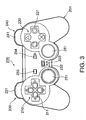
- FIG. 3 is a front figure of the operation device 200.
- the first operation section 210 and the second operation section 220 are provided on an upper surface of the device main body 201 of the operation device 200, and the third operation section 230 and the fourth operation section 240 are provided on the side surface thereof.
- the first operation section 210 comprises a cross-shaped four operation bodies 211 for the push operation to form a control button with the operation bodies 211.
- the first operation section 210 is an operation section to give a predetermined operation to the image, for instance, the player character displayed on the screen of the display unit DP, and the function to move the player character or the aspect up and down and right and left is allocated by performing push operations of the operation bodies 211.
- the second operation section 220 comprises column-shaped four operation buttons 221 for the push operation. Since an identification mark is fixed to a head of each operation button 221, and a function allocated to each operation button 221 can be easily identified. A function according to the game program recorded on the disk is set to the second operation section 220. For example, a function to change the state of the player character is allocated to each operation button 221.
- the third operation section 230 and the fourth operation section 240 have almost the same structure, and comprise two operation buttons 231, 241 (total: 4 buttons), in which two buttons are aligned, for the push operation.
- the functions of the third operation section 230 and the fourth operation section 240 are set by the program recorded on the disk.
- a couple of joysticks 251 are further provided for analog operation to the operation device main body 201.
- the joystick 251 becomes possible to use by switching to or with the first and second operation sections 210, 220. Switching is performed by an analog select switch 252 provided on the device main body 201.
- an analog select switch 252 provided on the device main body 201.
- a display part 253 which is provided on the operation device main body 201, is lightened and the selection of the joystick 251 is displayed.
- a start switch 254 which directs a start of the game, and a select switch 255 to select difficulty etc. of the game at the game initiation, etc. are provided to the operation device main body 201.
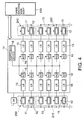
- FIG. 4 is an internal configuration figure of the operation device 200.
- Each of the operation sections 210, 220, 230, 240 in the operation device 200 comprises the control buttons 11, which are constructed by operation body 211 and operation buttons 221, 231, 241, and a push detection circuits 12, which detect the amount of the push operation by the operation person therein, respectively.
- the push detection circuit 12 has a configuration, which forms a conductive material with elasticity at one of two end portions positioned at the opposed position in each control button 11 and the resistive element at another end thereof.
- the resistive element is connected with the power supply line 13, and the predetermined voltage is applied thereto from the power supply (Vcc).
- the electric resistance between a conductive material and the resistive element changes in an analog fashion according to the amount of the push power, which acts to the control button 11.
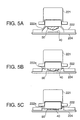
- the push detection circuit 12 in the second operation section 220 will be explained referring to FIG. 5A to FIG. 5C and FIG. 6 as an example.
- FIG. 5A shows a state before a push operation
- FIG. 5B and FIG. 5C show a state and a push operation.
- the operation button 221 is supported by the upper wall of an elasticity part 222a, which projects above an elasticity body 222, which consists of an insulation rubber etc.
- a first conductive material 50 provided on a lower wall of an elasticity part 222a and a resistive element 40 provided on an internal substrate 204 are separated.
- the conductive material 50 consists of, for example, a conductive rubber with elasticity.
- the conductive material 50 is formed in a conical shape whose center is a top thereof.
- a slope part in the elasticity part 222a warps and moves the upper wall downward with the operation button 221, and the conductive material 50 contacts with the resistive element 40.
- the conductive material 50 deforms according to the push power of the operation button 221 (that is, a contact pressure with the resistive element 40), and changes a contact area to the resistive element 40 as shown in FIG. 5B and FIG. 5C. That is, when the push power of the operation button 221 is weak, as shown in FIG. 5B, the vicinity of the top of the conical-shaped conductive material 50 contacts with the resistive element 40.
- the push power of the operation button 221 is further strengthened, the conductive material 50 is gradually deformed from the top part and the contact area extends. Since the power supply line 13 (see FIG. 4) is connected with the resistive element 40 as mentioned above, the contact part with the conductive material 50 becomes equivalent to the variable resistance. That is, when the conductive material 50 contacts with the resistive element 40, since the conductive material 50 becomes a bridge to flow current, a resistance of the contact part becomes small. Therefore, the resistance of the resistive element 40 decreases by enlarging the contact area of the conductive material 50. This resistance becomes reversible for the amount of the push operation.
- the output terminal is provided to the vicinity of an intermediate part of the resistive element 40.
- An analog signal which corresponds to the push power of the operation button 221, is output to the MPU 14 described later from the output terminal.
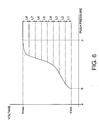
- FIG. 6 is a figure, which shows an analog signal (voltage) characteristic output from the output terminal of the resistive element 40. Since the voltage is applied to the resistive element 40 when the power supply is turned on, even if the operation button 221 is not pushed, a constant analog signal (voltage) Vmin is output from the output terminal ( a in the figure). The resistance of the resistive element 40 does not change until the conductive material 50 contacts with the resistive element 40 even when the operation button 221 is pushed. Therefore, the output from the resistive element 40 is Vmin and is not changed.
- the above-mentioned operation principle in the push detection circuit 12 is similar in the control button of other operation sections 210, 230, 240.
- an MPU (microprocessor unit) 14, which controls the operation device 200, is provided in an internal substrate of the operation device 200.
- the MPU 14 identifies each of operation sections 210, 220, 230, 240 and the control buttons thereof.
- the MPU 14 comprises each function of a level division part (LS) 15, which divides the output level of the analog signal output from the push detection circuit 12 of each control button into a plurality of output levels, an A/D converter section 16, which converts the analog signal output from the push detection circuit 12 to the digital signal according to each output level divided by the level division part 15, and a switching device 18.
- LS level division part
- the level division part 15 divides a preset range of the level of the analog signal (voltage) by even width.
- the number of division can be arbitrarily set.
- the range of the level of an analog signal (voltage) is evenly divided into eight.
- the individual output levels L1 to L8 evenly divided as described above is transmitted to the A/D converter section 16.
- the range of the level of the analog signal evenly divided by the level division part 15 can be arbitrarily changed.
- the A/D converter section 16 converts the analog signal to the digital signal and outputs it according to the output level of the analog signal, which is divided by the level division part 15. For example, a digital multi-level signal in 16-bits is allocated to each above-mentioned output level, and a multi-level signal such as "if" in level 1, "3f” in level 2, ..., "ff” in level 8.
- the A/D converter section 16 has a function to output the binarized digital signal (that is, "1" or "0") according to the change of the analog signal output from the push detection circuit 12.
- One of a multi-level signal or a binary signal is output from the A/D converter section 16 by the switch operation of the switching device 18.
- a binary signal is used to select only the one typical function when only one function is allocated to a certain control button or when the plurality of functions are allocated at one control button.
- the switching device 18 is usually controlled by the control signal sent from game machine main body 100 based on the game program recorded on the disk. That is, the control signal, which specifies whether A/D converter section 16 is functioned as means to output a multi-level signal or means to output a binary signal function is output from the game machine main body 100 according to the content of the game program.
- the switching device 18 switches the function of the function of the A/D converter section 16 to the specified function based on the control signal.
- the switching device 18 is controlled by a manual operation of the operation person.
- a configuration, which switches the function of A/D converter section 16 can be achieved by allocating the function of switching the switching device 18 to the analog select switch 252 provided on the operation device 200 and operating the switching device 18 by the manual operation of this switch 252.
- the multi-level signal or the binary signal output from the A/D converter section 16 is sent to the game machine main body 100 through an interface circuit (not shown in the figure) provided on an internal substrate of the operation device 200.
- the display control of the game image is performed by these signals.
- the CPU of the main controller 110 executes the OS recorded on the ROM.
- the CPU initializes the entire device of the operation confirmation etc., and controls the disk controller 140 to develop the game program recorded on the disk to the main memory and execute it.
- the data recorded on the memory card MC is read at any time if necessary.
- the CPU forms the function block shown in FIG. 7 to achieve the video game machine 300 by executing this game program.
- This video game machine 300 has functions of a data management section 301, an instruction content analysis section 302, a retrieval section 303, and a display controller 304 as shown in FIG. 7.
- the data management section 301 displays the game image on the display unit DP, and manages the image expression data to control the representation style.
- the data management section 301 comprises a function table 311 in this embodiment.
- the storage address of the image expression data in the image expression data storage section 312, which is associated with the identification information of the representation style, the identification information of the control button to which an input is scheduled and the output level, are recorded on this function table 311.
- the content of the function table 311 is different by the executed game program.
- An example of the representation style is taken by a change of one of a player character and the possession goods thereof (for example, arms), an expression aspect of an image of a peripheral object of the corresponding player character (other party character etc.), an action pattern of the player character, an action power of the player character, an effect of one of the possession goods or an action degree of the player character or possession goods to object.
- the identification information to identify these representation styles to the other representation styles and the storage address of the image expression data are associated with each other, are recorded (set) on the function table 311. Thereby, since the corresponding image expression data is promptly retrieved, the image display to the display unit DP is promptly performed.
- the content of the function table 311 can be updated in ex post.
- the above-mentioned expression aspect may be, for example, an aspect, which subjectively looks at the circumference from eyes of the player character, an aspect, which objectively looks at a circumference including the player character, or, an aspect to which the player character looks at the object fixedly.
- a flexible image expression according to the game development becomes possible by being possible to express such an aspect.
- One of the effects of the possession goods is assumed to be a size and a power of the corresponding possession goods continuously changed according to the value of the multi-level signal.
- one of the action degrees of the player character to objects is assumed to restrain the movement of the player character centering on the specified object.
- the data of the content shown in FIG. 8A to FIG. 8E is specifically set in the function table 311.
- (1-1) and (1-2) show contents for a first game program
- (2-1) and (2-2) show contents for a second game program
- (3-1) and (3-2) show contents for a third game program
- (4-1) and (4-2) show contents for a fourth game program
- (5-1) to (5-3) show contents for a fifth game program.
- FIG. 9A and FIG. 9B are screen explanation figures before and after push operations, respectively.
- (1-2) is a setting example when the operation button 231 is pushed and the output level is 4f or more, and the image expression data moves to the position (subjective aspect), where the aspect subjectively looks at from eyes of the player character, can be output.
- the circumference of the player character can be looked by operating a directional key of the operation button 211.
- FIG. 10A to FIG. 10E is figures, which show an appearance
- FIG. 10A is a screen explanation figure, which shows a subjective aspect
- FIG. 10B is a screen explanation figure, which shows a surrounding of the left side of the player character
- FIG. 10C is a screen explanation figure, which shows a surrounding of the right side of the player character
- FIG. 10D is a screen explanation figure, which shows one's feet of the player character
- FIG. 10E is a screen explanation figure, which shows the sky above the player character.
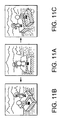
- (2-2) is a setting example when the aspect is locked-on at the position which looks at the object with a high importance degree in the screen (other party character and signboard, etc.), and the image expression data to which the player character moves and rotates around the locked-on object with a directional key to the operation button 211 can be output.
- FIG. 11A to FIG. 11C are screen explanation figures, which show an appearance.
- FIG. 11A shows a state to lock-on the other party character.
- FIG. 11B shows a state that the player character turns left around the other party character.
- FIG. 11C shows a state that the player character turns right around the other party character.
- (3-1) is a setting example when " ⁇ " of the operation button 221 is pushed and the output level is less than 5f, and data of the expression of the image of the representation style in which the player character watches the object in vicinity thereof can be output.
- (3-2) is a setting example when " ⁇ " of the operation button 221 is pushed and the output level is 5f or more, and data of the expression of the image of the representation style in which the player character checks the object in vicinity thereof can be output.
- (4-1) is a setting example when " ⁇ " of the operation button 221 is pushed and the output level is less than 5f, and data of the expression of the image of the representation style in which the player character runs can be output.
- (4-2) is a setting example when " ⁇ " of the operation button 221 is pushed and the output level is 5f or more, and data of the expression of the image of the representation style in which the player character jumps can be output.
- (5-1) is a setting example when " ⁇ " of the operation button 221 is pushed and the output level is less than 2f, and data of the expression of the image of the representation style, in which the player character attacks to the other party character with weak powers can be output.
- (5-2) is a setting example when " ⁇ " of the operation button 221 is pushed and the output level is less than 6f from 2f, and data of the expression of the image of the representation style in which attacks to the other party character with medium powers can be output.
- (5-3) is a setting example when " ⁇ " of the operation button 221 is pushed and the output level is 6f or more, and data of the expression of the image of the representation style in which the player attacks to the other party character with strong powers can be output.
- the intensity of powers is postponed arms by strengthening of powers when. attacking, for example, with arms (sword and spear, etc.) and reaches the enemy (other party character) in the distance.
- the size of arms are continuously zoomed-in according to the output level.
- the instruction content analysis section 302 detects the value of identification information and the multi-level signal of the control button actually input from the operation device 200. The detection result is passed to the retrieval section 303.
- the retrieval section 303 refers above-mentioned function table 311 and retrieves the corresponding image expression data from the image expression data storage section 312 by setting the value of identification information and a multi-level signal of detected control button as a key.
- the display controller 304 changes the representation style of the displayed entertainment image based on the image expression data, which is retrieved.
- an initial processing is performed as shown in FIG. 12 (step S101).
- the initial processing is an environmental construction processing in the game machine main body 100 for the operation person to be able to start or restart the game after the game program is started.
- the content of this environmental construction processing is determined according to the read game program.
- an input event processing which is the image processing based on the content directed by the operation person through the operation device 200 is performed (step S102).
- the content of the input event processing is a processing as shown in FIG. 13. That is, the content of the instruction input of the operation device 200 is analyzed (step S201, S202), the identification information on the control button actually operated from the total number of the control buttons of the operation device 200 is specified, and whether a plurality of functions are allocated to the control button (operation button) specified by the identification information referring to above-mentioned function table 311 is checked (step S203).
- step S203, S204 whether the control button is pushed by the operation person is judged (Yes in step S203, S204), the output level is detected when the control button is pushed. A processing according to the set content of the function based on the detected output level is performed (Yes in step S204, S205).
- the operated control button is " ⁇ " of the operation button 221 to which the plurality of functions are allocated, and these operation buttons 221 are one of above-mentioned (5-1) to (5-3)
- the image processing is performed so that the image processing for "weak power attack", that is, in which the player character displayed on the display unit DP attacks to the other party character with weak powers (5-1).
- the image processing for "medium power attack” is performed (5-2).
- the image processing for "strong power attack” is performed (5-3).
- step S203 when the plurality of functions are not allocated, a usual data processing allocated to the corresponding control button with a binary signal is performed (No in step S203, S206).
- step S204 when the control button is not pushed, the data processing, for instance, the idling processing is performed (No in step S204, S207).
- the above-mentioned processings are performed to the corresponding control buttons (step s208, S209).
- step S103 after finishing the input event processing, other data processings are performed (step S103) if necessary and the game image is displayed on the display unit DP (step S103). This processing is repeated until the instruction of the game end is input (step S105).
- the explanation of the above-mentioned is an example for providing the push operation mechanism, which outputs a multi-level signal to an individual operation button.
- a principal object of the present invention is to provide the push operation mechanism, which outputs a multi-level signal, which becomes a value different according to the amount of the push operation, and to change the representation style of the image depending on this multi-level signal. Therefore, the push operation mechanism is provided to the only a part of the operation button, and various representation styles can be produced by the combinations of the contents of the operations of the operation buttons with the push operation mechanism and the contents of the operations of other operation buttons without the push operation mechanism.
- buttons may be functioned as a signal selection mechanism, which selectively outputs either of two or more kinds of binary signals, which are prepared beforehand, and may be recorded on the above-mentioned function table 311 by associating with the address of the image expression data and the combination pattern of a value of a multi-level signal in which the identification information of the representation style and the input are scheduled and a binary signal.
- the conductive material 50 and the resistive element 40 are used and the value of the analog signal is determined by bigness and smallness of the contact area thereof.
- a general-purpose pressure sensitive element may be used and the push power detected with the pressure sensitive element may be converted into an analog signal.
- the entertainment device of the present invention can be also achieved in the personal computer, etc., by loading a program for entertainment recorded on the computer readable record medium or, the program for the entertainment acquired through the network etc.
- the operation device in this case may be special goods of the corresponding personal computer specification which is equal to the operation device 200 explained by the embodiment, and may be the one that the function like above-mentioned the operation device 200 adding the above-mentioned push operation mechanism to the type face part of the keyboard is provided.
Landscapes
- Engineering & Computer Science (AREA)
- Multimedia (AREA)
- Human Computer Interaction (AREA)
- User Interface Of Digital Computer (AREA)
- Input From Keyboards Or The Like (AREA)
Applications Claiming Priority (2)
| Application Number | Priority Date | Filing Date | Title |
|---|---|---|---|
| JP2000048346 | 2000-02-24 | ||
| JP2000048346A JP2001236162A (ja) | 2000-02-24 | 2000-02-24 | エンタテインメント装置、記録媒体及びコンピュータプログラム |
Publications (3)
| Publication Number | Publication Date |
|---|---|
| EP1127597A2 true EP1127597A2 (fr) | 2001-08-29 |
| EP1127597A3 EP1127597A3 (fr) | 2002-02-13 |
| EP1127597B1 EP1127597B1 (fr) | 2009-04-01 |
Family
ID=18570445
Family Applications (1)
| Application Number | Title | Priority Date | Filing Date |
|---|---|---|---|
| EP01104061A Expired - Lifetime EP1127597B1 (fr) | 2000-02-24 | 2001-02-20 | Dispositif récréatif, support d'enregistrement et programme informatique |
Country Status (4)
| Country | Link |
|---|---|
| US (1) | US6780112B2 (fr) |
| EP (1) | EP1127597B1 (fr) |
| JP (1) | JP2001236162A (fr) |
| DE (1) | DE60138152D1 (fr) |
Families Citing this family (14)
| Publication number | Priority date | Publication date | Assignee | Title |
|---|---|---|---|---|
| JP4069119B2 (ja) * | 2002-08-20 | 2008-04-02 | ヴィヴェンディ ユニバーサル ゲームズ, インコーポレイテッド | 感情ベースのキャラクタ・インタラクションを有するコンピュータ・ゲーム |
| JP2004126786A (ja) | 2002-09-30 | 2004-04-22 | Konami Co Ltd | 通信装置、プログラム、ならびに通信方法 |
| JP2004237022A (ja) * | 2002-12-11 | 2004-08-26 | Sony Corp | 情報処理装置および方法、プログラム、並びに記録媒体 |
| EP1484693A1 (fr) * | 2003-06-04 | 2004-12-08 | Sony NetServices GmbH | Appareil pour recommander des donnees avec un module d'agencement |
| EP1484692B1 (fr) * | 2003-06-04 | 2013-07-24 | Intel Corporation | Appareil pour recommander des donnees par feedback de l'utilisateur |
| JP4177275B2 (ja) * | 2003-11-13 | 2008-11-05 | 株式会社リコー | 通信装置 |
| US20050174337A1 (en) * | 2004-02-11 | 2005-08-11 | Nielsen Paul S. | Electronic handheld drawing and gaming system using television monitor |
| JP4445826B2 (ja) * | 2004-10-06 | 2010-04-07 | 任天堂株式会社 | ゲーム装置およびゲームプログラム |
| JP5396006B2 (ja) * | 2006-05-09 | 2014-01-22 | 任天堂株式会社 | ゲームプログラム及びゲーム装置 |
| JP5103343B2 (ja) * | 2008-09-30 | 2012-12-19 | 任天堂株式会社 | 情報処理プログラムおよび情報処理装置 |
| US8641525B2 (en) * | 2011-06-17 | 2014-02-04 | Ironburg Inventions Ltd. | Controller for video game console |
| US8894491B2 (en) * | 2011-12-09 | 2014-11-25 | Microsoft Corporation | Multi-stage variable resistance trigger |
| US8961310B2 (en) * | 2012-09-28 | 2015-02-24 | Video Gaming Technologies, Inc. | Multi-action switch for a gaming device |
| WO2020013039A1 (fr) * | 2018-07-12 | 2020-01-16 | 株式会社ソニー・インタラクティブエンタテインメント | Dispositif de traitement d'informations et procédé de commande de dispositif de commande |
Family Cites Families (9)
| Publication number | Priority date | Publication date | Assignee | Title |
|---|---|---|---|---|
| JPH0340155A (ja) | 1989-07-07 | 1991-02-20 | Matsushita Electric Ind Co Ltd | プロトコルデータユニット編集解析装置 |
| JP3040155B2 (ja) | 1990-11-29 | 2000-05-08 | 御木本製薬株式会社 | スクラブ洗浄料 |
| US6102802A (en) * | 1997-10-01 | 2000-08-15 | Armstrong; Brad A. | Game controller with analog pressure sensor(s) |
| US6283857B1 (en) * | 1996-09-24 | 2001-09-04 | Nintendo Co., Ltd. | Three-dimensional image processing apparatus with enhanced automatic and user point of view control |
| FR2740242B3 (fr) * | 1995-10-23 | 1997-10-31 | Primax Electronics Ltd | Dispositif de commande de curseur |
| CN1132646C (zh) * | 1996-10-11 | 2003-12-31 | 索尼计算机娱乐株式会社 | 游戏机用操作装置 |
| US6306036B1 (en) * | 1998-05-18 | 2001-10-23 | Vis Interactive | Computer game with replaceable character heads |
| JP3171575B2 (ja) * | 1998-07-31 | 2001-05-28 | 株式会社ソニー・コンピュータエンタテインメント | エンタテインメントシステム及びプログラム供給媒体 |
| US6617982B1 (en) * | 1999-04-23 | 2003-09-09 | Sony Computer Entertainment Inc. | Operating device |
-
2000
- 2000-02-24 JP JP2000048346A patent/JP2001236162A/ja active Pending
-
2001
- 2001-02-20 DE DE60138152T patent/DE60138152D1/de not_active Expired - Lifetime
- 2001-02-20 EP EP01104061A patent/EP1127597B1/fr not_active Expired - Lifetime
- 2001-02-22 US US09/792,277 patent/US6780112B2/en not_active Expired - Lifetime
Also Published As
| Publication number | Publication date |
|---|---|
| EP1127597A3 (fr) | 2002-02-13 |
| US6780112B2 (en) | 2004-08-24 |
| EP1127597B1 (fr) | 2009-04-01 |
| DE60138152D1 (de) | 2009-05-14 |
| US20010023205A1 (en) | 2001-09-20 |
| JP2001236162A (ja) | 2001-08-31 |
Similar Documents
| Publication | Publication Date | Title |
|---|---|---|
| EP1127597B1 (fr) | Dispositif récréatif, support d'enregistrement et programme informatique | |
| US6254477B1 (en) | Portable electronic device, entertainment system and method of operating the same | |
| US20030064803A1 (en) | Method for changing viewpoints using pressure-sensitive means, recording medium providing software program therefor, and entertainment system | |
| JP2000181876A (ja) | 情報追加方法、情報追加システム及び記録媒体 | |
| CN102600609A (zh) | 电子纸游戏系统及其更新游戏界面的方法 | |
| EP1183082B1 (fr) | Support d'enregistrement, methode d'utilisation d'ordinateur et ordinateur permettant d'executer des jeux de roles | |
| US20010008398A1 (en) | Recording medium, a method and a computer for executing a fighting game | |
| US20010023204A1 (en) | Recording medium, computer, method for executing processes thereon, and method of selecting and executing processes on the computer | |
| WO2005025706A1 (fr) | Programme, dispositif et procede de jeu video | |
| US20010009037A1 (en) | Recording medium recorded with a program that performs processing depending on a plurality of outputs from pressure-sensitive means, computer that executes the processing and method of using same | |
| US7671846B1 (en) | Computer system having a pressure-sensitive controller, setup method for a pressure-sensitive controller and recording medium that records this method | |
| JP2004329682A (ja) | ゲームシステムおよびゲームプログラム | |
| JP2002210233A (ja) | エンタテインメント装置、記録媒体及びプログラム | |
| JP4920942B2 (ja) | ゲームシステム | |
| JP3454359B2 (ja) | 設定画面表示プログラム、設定画面表示方法及びビデオゲーム装置 | |
| JP2003099182A (ja) | エンタテインメント装置及び記録媒体 | |
| US7027034B2 (en) | Method of moving objects on TV monitor, the computer and recording medium for executing the method | |
| US20010008403A1 (en) | Method, computer and recording medium for controlling message display quantity in game software | |
| JPH11313980A (ja) | ゲーム装置および情報記録媒体 | |
| NZ501434A (en) | Video game controller, with plug-in portable game console, receives character information from controller |
Legal Events
| Date | Code | Title | Description |
|---|---|---|---|
| PUAI | Public reference made under article 153(3) epc to a published international application that has entered the european phase |
Free format text: ORIGINAL CODE: 0009012 |
|
| AK | Designated contracting states |
Kind code of ref document: A2 Designated state(s): AT BE CH CY DE DK ES FI FR GB GR IE IT LI LU MC NL PT SE TR Kind code of ref document: A2 Designated state(s): DE ES FR GB IT |
|
| AX | Request for extension of the european patent |
Free format text: AL;LT;LV;MK;RO;SI |
|
| 17P | Request for examination filed |
Effective date: 20010827 |
|
| PUAL | Search report despatched |
Free format text: ORIGINAL CODE: 0009013 |
|
| AK | Designated contracting states |
Kind code of ref document: A3 Designated state(s): DE ES FR GB IT |
|
| AX | Request for extension of the european patent |
Free format text: AL;LT;LV;MK;RO;SI |
|
| AKX | Designation fees paid |
Free format text: DE ES FR GB IT |
|
| 17Q | First examination report despatched |
Effective date: 20030221 |
|
| GRAP | Despatch of communication of intention to grant a patent |
Free format text: ORIGINAL CODE: EPIDOSNIGR1 |
|
| GRAS | Grant fee paid |
Free format text: ORIGINAL CODE: EPIDOSNIGR3 |
|
| GRAA | (expected) grant |
Free format text: ORIGINAL CODE: 0009210 |
|
| AK | Designated contracting states |
Kind code of ref document: B1 Designated state(s): DE ES FR GB IT |
|
| REG | Reference to a national code |
Ref country code: GB Ref legal event code: FG4D |
|
| REF | Corresponds to: |
Ref document number: 60138152 Country of ref document: DE Date of ref document: 20090514 Kind code of ref document: P |
|
| PG25 | Lapsed in a contracting state [announced via postgrant information from national office to epo] |
Ref country code: ES Free format text: LAPSE BECAUSE OF FAILURE TO SUBMIT A TRANSLATION OF THE DESCRIPTION OR TO PAY THE FEE WITHIN THE PRESCRIBED TIME-LIMIT Effective date: 20090712 |
|
| PLBE | No opposition filed within time limit |
Free format text: ORIGINAL CODE: 0009261 |
|
| STAA | Information on the status of an ep patent application or granted ep patent |
Free format text: STATUS: NO OPPOSITION FILED WITHIN TIME LIMIT |
|
| 26N | No opposition filed |
Effective date: 20100105 |
|
| PG25 | Lapsed in a contracting state [announced via postgrant information from national office to epo] |
Ref country code: IT Free format text: LAPSE BECAUSE OF FAILURE TO SUBMIT A TRANSLATION OF THE DESCRIPTION OR TO PAY THE FEE WITHIN THE PRESCRIBED TIME-LIMIT Effective date: 20090401 |
|
| REG | Reference to a national code |
Ref country code: FR Ref legal event code: PLFP Year of fee payment: 16 |
|
| REG | Reference to a national code |
Ref country code: FR Ref legal event code: PLFP Year of fee payment: 17 |
|
| REG | Reference to a national code |
Ref country code: FR Ref legal event code: PLFP Year of fee payment: 18 |
|
| PGFP | Annual fee paid to national office [announced via postgrant information from national office to epo] |
Ref country code: GB Payment date: 20200212 Year of fee payment: 20 Ref country code: DE Payment date: 20200204 Year of fee payment: 20 |
|
| PGFP | Annual fee paid to national office [announced via postgrant information from national office to epo] |
Ref country code: FR Payment date: 20200113 Year of fee payment: 20 |
|
| REG | Reference to a national code |
Ref country code: DE Ref legal event code: R071 Ref document number: 60138152 Country of ref document: DE |
|
| REG | Reference to a national code |
Ref country code: GB Ref legal event code: PE20 Expiry date: 20210219 |
|
| PG25 | Lapsed in a contracting state [announced via postgrant information from national office to epo] |
Ref country code: GB Free format text: LAPSE BECAUSE OF EXPIRATION OF PROTECTION Effective date: 20210219 |