EP1127748B1 - Dispositif et méthode de la commande par voix - Google Patents
Dispositif et méthode de la commande par voix Download PDFInfo
- Publication number
- EP1127748B1 EP1127748B1 EP01102015A EP01102015A EP1127748B1 EP 1127748 B1 EP1127748 B1 EP 1127748B1 EP 01102015 A EP01102015 A EP 01102015A EP 01102015 A EP01102015 A EP 01102015A EP 1127748 B1 EP1127748 B1 EP 1127748B1
- Authority
- EP
- European Patent Office
- Prior art keywords
- display
- voice
- processor
- appliance
- voice control
- Prior art date
- Legal status (The legal status is an assumption and is not a legal conclusion. Google has not performed a legal analysis and makes no representation as to the accuracy of the status listed.)
- Expired - Lifetime
Links
- 238000000034 method Methods 0.000 title claims description 23
- 230000014509 gene expression Effects 0.000 claims description 3
- 230000002207 retinal effect Effects 0.000 claims description 3
- 238000004891 communication Methods 0.000 description 22
- 238000012545 processing Methods 0.000 description 13
- 230000005540 biological transmission Effects 0.000 description 9
- 230000008921 facial expression Effects 0.000 description 9
- 230000003287 optical effect Effects 0.000 description 4
- 230000006870 function Effects 0.000 description 3
- 238000003860 storage Methods 0.000 description 3
- 230000000007 visual effect Effects 0.000 description 3
- 230000004913 activation Effects 0.000 description 2
- 230000008901 benefit Effects 0.000 description 2
- 230000004044 response Effects 0.000 description 2
- 230000001755 vocal effect Effects 0.000 description 2
- 241001465754 Metazoa Species 0.000 description 1
- 230000009471 action Effects 0.000 description 1
- 238000004378 air conditioning Methods 0.000 description 1
- 238000013459 approach Methods 0.000 description 1
- 230000006399 behavior Effects 0.000 description 1
- 230000003139 buffering effect Effects 0.000 description 1
- 230000007547 defect Effects 0.000 description 1
- 230000001419 dependent effect Effects 0.000 description 1
- 238000011161 development Methods 0.000 description 1
- 230000018109 developmental process Effects 0.000 description 1
- 238000009826 distribution Methods 0.000 description 1
- 230000000694 effects Effects 0.000 description 1
- 238000004519 manufacturing process Methods 0.000 description 1
- 238000012544 monitoring process Methods 0.000 description 1
- 210000001525 retina Anatomy 0.000 description 1
- 238000012546 transfer Methods 0.000 description 1
- XLYOFNOQVPJJNP-UHFFFAOYSA-N water Substances O XLYOFNOQVPJJNP-UHFFFAOYSA-N 0.000 description 1
Images



Classifications
-
- B—PERFORMING OPERATIONS; TRANSPORTING
- B60—VEHICLES IN GENERAL
- B60R—VEHICLES, VEHICLE FITTINGS, OR VEHICLE PARTS, NOT OTHERWISE PROVIDED FOR
- B60R16/00—Electric or fluid circuits specially adapted for vehicles and not otherwise provided for; Arrangement of elements of electric or fluid circuits specially adapted for vehicles and not otherwise provided for
- B60R16/02—Electric or fluid circuits specially adapted for vehicles and not otherwise provided for; Arrangement of elements of electric or fluid circuits specially adapted for vehicles and not otherwise provided for electric constitutive elements
- B60R16/037—Electric or fluid circuits specially adapted for vehicles and not otherwise provided for; Arrangement of elements of electric or fluid circuits specially adapted for vehicles and not otherwise provided for electric constitutive elements for occupant comfort, e.g. for automatic adjustment of appliances according to personal settings, e.g. seats, mirrors, steering wheel
- B60R16/0373—Voice control
Definitions
- the invention relates to a device for voice control of a device or a method for voice control of a device according to the preamble of the independent claims.
- driver assistance systems in vehicles, with infotainment (car radio, playback devices and hi-fi systems), communication means (mobile phone, location device and navigation), sensors and actuators are controlled by a voice control.
- infotainment car radio, playback devices and hi-fi systems
- communication means mobile phone, location device and navigation
- sensors and actuators are controlled by a voice control.
- speech input from a user is recorded, converted into electrical signals and interpreted as an execution command. If appropriate, a voice output is made via loudspeakers, which refers in particular to the feasibility of the execution commands.
- a device is known with a Fahrzengelektroniks announced; the e.g. has a navigation device.
- a figure is shown in a display, e.g. a human or an animal or an imaginary figure, who should be able to communicate feedback in different ways of behavior and expression.
- the inventive device for voice control of a device or the inventive method for Voice control of a device with the features of the independent claims have the advantage that the linguistic communication between the device, for example, the driver assistance system, and the user is supported by improved pictorial evidence in a non-verbal way.
- These improved pictorial references in the form of a symbolically represented face, have a high information content and a high recognition value, so that they lead to a rapid acquisition of the information for the user.
- the acceptance for users also advantageously increases because users are usually used to interpersonal communication and prefer this type of communication.
- the pictorial instructions are displayed in two dimensions, whereby a clear, unambiguous and clear statement is made. Furthermore, a two-dimensional representation is easily detectable for a user and leads to a clear indication.
- three-dimensional pictorial references provide a realistic depiction, which leads to a large acceptance among users.
- a user will always prefer human-to-human communication to man-machine communication.
- the pictorial notes are displayed with moving representations, which further increases the lifelongness of the pictorial cues, as this, for example, an artificial face is displayed, which supports voice output through facial expressions.
- the visual cues are represented by artificial facial expressions and / or gestures, so that the lifelike and thus the acceptance of the users of voice-controlled devices is greatly increased.
- three-dimensional visual cues are generated by retinal projectors or stereoscopic screens as displays, so that in a simple manner three-dimensional artificial pictorial cues are generated, which find a high acceptance among users and mean a clear statement for the user.
- the device according to the invention or the method according to the invention are used in a vehicle, where the voice control is increased in terms of its acceptance by a livelier dialogue and increased safety of the driver.
- FIG. 2 shows the device according to the invention for voice control of a device, the components of the device and components connected to the device being connected via a bus
- FIG Scene and Figure 5 is a flow chart of the method according to the invention.
- Human-to-human communication shows a high proportion of non-verbal communication that supports linguistic communication. Gestures, facial expressions and movements alone, without the linguistic communication, reflect a significant portion of the transmitted information, so that almost no linguistic communication can be dispensed with. Man-machine dialogs, however, when voice control is present, are characterized solely by voice input and voice output. A high background noise level complicates this purely linguistic man-machine communication.
- the man-machine dialogue is supported in a voice control in a vehicle by pictorial references, so an optical component.
- pictorial references so an optical component.
- the pictorial indications are displayed either two-dimensionally or three-dimensionally, this being possibly supported by moving representations, so that the lifelong life of the pictorial indications is increased.
- an artificial face is selected for this purpose, which reproduces particularly expressively voice output of the device according to the invention for voice control of a device and supports it by artificial facial expressions and gestures.
- FIG. 1 shows the device according to the invention for voice control of a device in a vehicle.
- the device and the components connected to the device make a driver's front-end system as the voice-controlled device in the vehicle.
- a processor 1 is connected via its first data input to a signal processor 2, and a microphone 3 is connected to a data input of the signal processor 2. Only one microphone is connected here. However, several microphones can be connected, in which case the signal processing 2 also acts as a demultiplexer.
- the processor 1 is connected to a signal processor 4 via a first data output.
- a loudspeaker 5 is connected via a data output of the signal processor 4. Alternatively, several speakers can be connected here, in which case the Signal processing 4 also acts as a multiplexer.
- the loudspeaker system of an infotainment system 11, which is connected to the processor 1 via a first data input / output can be used.
- the processor 1 is connected to a signal processor 6.
- controls 7 are connected.
- the controls 7 represent here haptic controls that can serve the driver in the vehicle or passenger.
- the processor 1 is connected to a signal processor 9.
- sensors 8 are connected.
- a memory 10 is connected to the processor 1 via a second data input / output of the processor 1.
- the processor 1 is connected to a signal processor 12 via a second data output, and actuators 13 are connected to its data output.
- Via a third data input / output the processor 1 is connected to a navigation system 15.
- a communication system 14 is connected to the processor 1.
- a location device 16 is connected to the processor 1 via a fourth data input.
- a fifth data output of the processor 1 leads to a signal processing 50, which outputs signals to a display 51.
- Speech inputs are converted into electrical signals by means of the microphone 3 and connected electronics, and then digitized by the signal processor 2 and finally transmitted to the processor 1. Furthermore, the signal processing 2 has a speech processor which converts the speech signals into data suitable for the processor 1 transforms. In this case, in particular, a source coding of the speech signals is carried out in a format known to the processor 1.
- the processor 1 evaluates the voice input and compares this signal with signals stored in the memory 10 to find out which input command it is. It should be noted that a voice-controlled system must first be activated in order not to receive random commands by talking in the car. This activation takes place, for example, by means of a haptic control element which is fastened to the steering wheel of the vehicle, e.g. by a push button, which is mounted analogous to a button for a horn.
- This pushbutton then belongs to the operating elements 7, wherein the operating elements 7 convert and amplify a haptic movement that is performed on them into an electrical signal by means of connected electronics in order to transfer it to the signal processing 6, which evaluates and digitizes this signal. to then pass it to the processor 1, so that in the case of activation of the voice control by the controls 7, the processor 1 now accepts signals from the signal processor 2 as a voice input command.
- the digital signals that are generated due to haptic inputs to the controls 7, have a fixed coding, for example, unique bit sequences that uniquely identify the haptic inputs.
- the processor 1 recognizes which execution command he has to perform. For this purpose, the processor 1 now checks whether this command is executable. Are eg appropriate Components that are necessary to execute this execution command ready, then this execution command is performed. However, if the execution command is impracticable, then the processor 1 hands over a corresponding message via the signal processor 4 to the loudspeaker 5 to indicate acoustically that this command is not executable, in particular by indicating what the reason for the non-feasibility is, eg if the handbrake is still pulled. These answers are taken by the processor 1 from the memory 10.
- the answers are linked with the recognized execution instructions for executability or non-executability, with non-feasibility multiple answers are possible, which are linked to other technical features that have a corresponding indication to remedy the defect. Is e.g. the handbrake pulled, this is detected by the sensors 8 and the processor 1 via the signal processing 9 transmitted.
- the sensors 8 here represent various sensors, oil, water, tire pressure, engine function capability, functionality of the electrical components and also whether the handbrake is pulled.
- the processor 1 selects corresponding responses from the memory 10.
- the processor 1 loads from the memory 10 pictorial cues, which are displayed via the signal processing 50 by means of the display 51.
- a linguistic output is supported with a pictorial indication, in which case it may be possible to dispense with a voice output.
- pictorial representations are described in more detail below. These can be two-dimensional, three-dimensional and animated representations.
- a three-dimensional representation either a retinal projector or a stereoscopic screen is required as the display 51.
- a three-dimensional representation enhances the reality effect of the presentation, especially if it is an artificial face that supports the speech output by appropriate gestures and facial expressions.
- the execution command which the processor 1 received either by means of the microphone 3 or the operating elements 7, can be carried out, then by means of the actuators 13, which prepare the signals from the processor 1 via the signal processor 12, which prepares the signals for the actuators 13, get the execution command translated into action.
- the actuators 13 are mounted for mechanical movements of parts that are electronically controlled. This includes a door lock, windscreen wipers, a seat adjustment, windows, a fresh air and temperature supply and air conditioning. If the execution command does not concern the actuators 13 but a navigation device 15, in particular in order to generate route suggestions, then the processor 1 transmits data corresponding to the navigation device 15.
- the navigation device 15 will optionally request further data from the user and thereby use the loudspeaker 5 and / or the display 51.
- the navigation device 15 itself has memory to determine appropriate routes.
- the location device 16 indicates the current location, the location device 16 here being a GPS (Global Positioning System) receiver, which determines the location coordinates of the vehicle.
- GPS Global Positioning System
- the navigation device 15 is able to from the current location and its memory to determine an optimal route from various points of view.
- Such aspects include driver preferences and also traffic messages that are determined by means of the infotainment system 11 and / or the communication system 14.
- the traffic information is determined in the infotainment system 11 by means of a car radio belonging to the infotainment system 11, and then transmitted to the processor 1.
- the processor 1 transmits this corresponding message to the navigation system 15, which modifies route suggestions by means of the message.
- the communication system 14 is a mobile telephone, that is to say a transmitting / receiving station with which either telephony is carried out or data is called up.
- the infotainment system 11 is in addition to the car radio, which may also be designed as a digital radio receiver, playback devices for storage media containing music in particular. Such playback devices include cassettes, players, minidisc players, CD players or an MPEG3 player. If the radio receiver of the infotainment system 11 is designed as a digital radio receiver, in particular for receiving DAB (Digital Audio Broadcasting), then the digital radio receiver is also suitable as a broadband receiver of data.
- DAB Digital Audio Broadcasting
- DAB is a digital transmission method that is suitable not only for the digital transmission of audio data but also for the transmission of multimedia data.
- traffic information may be included, but also other data that serve for the entertainment or information of the driver and the front passenger.
- DAB are also DRM (Digital Radio Mondial) and DVB (Digital Video Broadcasting) for the receipt of digital Radio programs and multimedia data. They differ from DAB in terms of transmission frequencies, frame structure and transmission rate.
- the memory 10 which is used in particular for buffering data and for retrieving stored data, here represents a system which has a plurality of storage media. These include a hard drive as a rewritable memory and fixed storage such as CD-ROMs.
- bus 17 is designed here as an electrical line system. Alternatively, however, it is also possible to implement the bus 17 as an optical transmission system or as a radio-based bus.
- the stations connected to the bus 17 have bus controllers which control the communication via the bus 17. If an optical bus is present, then these bus controllers are provided with optocouplers. If there is a radio-based bus, the bus controllers are implemented with transceiver stations.
- a processor 18, the signal processing 19, 21, 23, 25, 28 and 52 are connected, and a memory 27, a communication system 30, an infotainment system 31 and a Navigation system 32.
- a microphone 20 is connected to a data input of the signal processor 19.
- a speaker 22 is connected to a data output of the signal processor 19.
- Via a data input of the signal processing 23 controls 24 are connected.
- with a data input of the signal processing 25 sensors 26 are connected.
- actuators 29 are connected to the signal processor 28.
- a display 53 is connected to a data output of the signal processing 52.
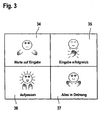
- FIG. 3 illustrates a set of pictorial notes issued in a vehicle for assisting speech output.
- the pictorial reference 34 indicates by gestures and symbolic hands waiting for an input.
- the pictorial reference 35 indicates by gestures, facial expressions and an implied clapping by the symbolic hands the response to a successful input.
- the pictorial reference 36 indicates by gestures and facial expressions of the symbolic face and raised symbolic hands a warning to the driver.
- the pictorial reference 37 indicates that everything is alright by the gestures and facial expressions of the symbolic face and folded symbolic hands. Important for the selection of the symbolic representations is that it is not too many different visual cues, not to overtax a driver by too many gradations in its capacity and that they easily and clearly recognizable are. By moving the symbolic hands or the symbolic face, in particular by a more lifelike face that further supports the facial expressions and the various gestures, alternatives are possible. By using a retina projector or a stereoscopic screen for the display 51, the pictorial references shown in Figure 3 can also be shown in perspective, so as to convey a greater lifelong life.
- FIG. 4 schematically shows an exemplary scene in a vehicle.
- the speech output of the device according to the invention are shown, in the middle of the corresponding pictorial notes to support the speech outputs of the device according to the invention and in the left column are voice inputs of the driver specified.
- the device asks where the driver wants to go. This is supported in the second column by the pictorial reference 34 to encourage an input.
- the driver gives the driving desire to Hildesheim linguistically.
- the device recognizes this destination as possible in the second line and supports this by the pictorial reference 35, since the entry was successful.
- the machine indicates that the handbrake is still on and supports this by pictorial reference 36, which expects an immediate reaction from the driver.
- the driver then releases by means of the controls 7, the handbrake, and the device then indicates in the last line with the pictorial reference 37, that now everything is OK. This may possibly be supported by a voice output. Warning can be additionally signaled by further optical messages or warning tones.
- the inventive method for voice control in a vehicle is shown as a flow chart.
- the voice control of the vehicle indicates that it is awaiting an input, e.g. with respect to the destination to calculate a route by means of the navigation device 15.
- this is supported by pictorial reference 34.
- the driver carries out a speech and / or haptic input, which is checked in step 41 for its feasibility. If the input of the driver is executable, then this is communicated in a speech output in method step 42 and supported in method step 43 by means of pictorial reference 35.
- method step 43 If it was recognized in method step 43 that the executable command of the driver is not given, then it is indicated in method step 45 by means of a speech output that this is not possible and in method step 46 this is supported by the pictorial reference 36, and then by method step 40 back to wait for a new input.
- the device according to the invention or the method according to the invention can also be used for voice control of other devices, for example in production units and monitoring systems.
- voice control of other devices for example in production units and monitoring systems.
- the use in intelligent central communication and control systems is conceivable here.
Landscapes
- Engineering & Computer Science (AREA)
- Mechanical Engineering (AREA)
- Navigation (AREA)
- Communication Control (AREA)
- User Interface Of Digital Computer (AREA)
Claims (9)
- Dispositif de commande vocale d'un appareil, présentant au moins un microphone (3, 20) pour les entrées vocales et au moins un haut-parleur (5, 22) pour les émissions vocales, le dispositif étant relié à un processeur (1, 18), à des éléments de commande (7, 24), à des capteurs (8, 26), à au moins une mémoire (10, 27) et à un dispositif d'affichage (51, 53) de l'appareil, le processeur (1, 18) étant conçu de telle sorte qu'en fonction d'émissions vocales, il affiche sur le dispositif d'affichage (51, 53) des indications imagées au moyen d'un visage représenté artificiellement, le visage restituant et soutenant par des mimiques et des gestes artificiels des émissions vocales du dispositif de commande vocale d'un appareil,
caractérisé en ce que
le visage est représenté de manière symbolique. - Dispositif selon la revendication 1,
caractérisé en ce que
le dispositif d'affichage (51, 53) affiche les indications imagées sous forme de représentations bidimensionnelles. - Dispositif selon la revendication 1 ou 2,
caractérisé en ce que
le dispositif d'affichage (51, 53) est configuré de telle sorte qu'il affiche les indications imagées sous forme tridimensionnelle. - Dispositif selon la revendication 2 ou 3,
caractérisé en ce que
le dispositif d'affichage (51, 53) est configuré de telle sorte qu'il affiche les indications imagées (34 à 37) avec des représentations mobiles. - Dispositif selon l'une des revendications précédentes,
caractérisé en ce que
le dispositif d'affichage (51, 53) est configuré sous forme de projecteur rétinien. - Dispositif selon l'une des revendications 1 à 4,
caractérisé en ce que
le dispositif d'affichage (51, 53) est configuré sous forme d'écran stéréoscopique. - Utilisation d'un dispositif selon l'une des revendications précédentes dans un véhicule.
- Procédé de commande vocale d'un appareil, des entrées vocales devant être réalisées pour la commande de l'appareil, les entrées vocales étant converties en ordres d'exécution, les ordres d'exécution étant contrôlés vis-à-vis de leur faisabilité, des émissions vocales étant réalisées en fonction de la faisabilité et/ou d'un état de l'appareil, des indications imagées étant affichées sur le dispositif d'affichage (5) au moyen d'un visage représenté artificiellement, en fonction de l'état de l'appareil et/ou de la faisabilité des ordres d'exécution, le visage reproduisant et soutenant par des mimiques et des gestes artificiels des émissions vocales du dispositif de commande vocale d'un appareil,
caractérisé en ce que
le visage est représenté de manière symbolique. - Procédé selon la revendication 8,
caractérisé en ce que
les indications imagées (34 à 37) sont affichées sous forme bidimensionnelle.
Applications Claiming Priority (2)
| Application Number | Priority Date | Filing Date | Title |
|---|---|---|---|
| DE10008226 | 2000-02-22 | ||
| DE10008226A DE10008226C2 (de) | 2000-02-22 | 2000-02-22 | Vorrichtung zur Sprachsteuerung und Verfahren zur Sprachsteuerung |
Publications (3)
| Publication Number | Publication Date |
|---|---|
| EP1127748A2 EP1127748A2 (fr) | 2001-08-29 |
| EP1127748A3 EP1127748A3 (fr) | 2004-03-17 |
| EP1127748B1 true EP1127748B1 (fr) | 2006-05-03 |
Family
ID=7631954
Family Applications (1)
| Application Number | Title | Priority Date | Filing Date |
|---|---|---|---|
| EP01102015A Expired - Lifetime EP1127748B1 (fr) | 2000-02-22 | 2001-01-30 | Dispositif et méthode de la commande par voix |
Country Status (3)
| Country | Link |
|---|---|
| EP (1) | EP1127748B1 (fr) |
| JP (1) | JP2001255890A (fr) |
| DE (2) | DE10008226C2 (fr) |
Families Citing this family (21)
| Publication number | Priority date | Publication date | Assignee | Title |
|---|---|---|---|---|
| DE10120513C1 (de) | 2001-04-26 | 2003-01-09 | Siemens Ag | Verfahren zur Bestimmung einer Folge von Lautbausteinen zum Synthetisieren eines Sprachsignals einer tonalen Sprache |
| EP1342605B1 (fr) | 2002-03-04 | 2006-07-26 | Ford Global Technologies, LLC | Dispositif de commande d'écran de visualisation |
| DE10220797A1 (de) * | 2002-05-10 | 2003-12-24 | Audi Ag | Kraftfahrzeug |
| WO2003100760A1 (fr) * | 2002-05-29 | 2003-12-04 | Yamaha Hatsudoki Kabushiki Kaisha | Systeme d'indication de l'etat de produits, programme pour systeme d'indication de l'etat de produits, support d'enregistrement pour systeme d'indication de l'etat de produits |
| JP3724461B2 (ja) | 2002-07-25 | 2005-12-07 | 株式会社デンソー | 音声制御装置 |
| DE10338512A1 (de) * | 2003-08-22 | 2005-03-17 | Daimlerchrysler Ag | Unterstützungsverfahren für Sprachdialoge zur Bedienung von Kraftfahrzeugfunktionen |
| DE102005007317A1 (de) * | 2005-02-17 | 2006-08-24 | Robert Bosch Gmbh | Verfahren und Vorrichtung zur Sprachsteuerung eines Gerätes oder eines Systems in einem Kraftfahrzeug |
| DE102005049386A1 (de) * | 2005-10-15 | 2007-04-19 | GM Global Technology Operations, Inc., Detroit | Kraftfahrzeug mit beleuchtbaren Bedienelementen |
| JP2007326491A (ja) * | 2006-06-08 | 2007-12-20 | Toyota Motor Corp | 車両用入力装置 |
| DE102007042583B4 (de) * | 2007-09-07 | 2010-12-09 | Audi Ag | Verfahren zur Kommunikation zwischen einer natürlichen Person und einem künstlichen Sprachsystem sowie Kommunikationssystem |
| DE102008027827B4 (de) * | 2008-06-11 | 2025-02-06 | Volkswagen Ag | Audiovisuelles Assistenzsystem und Verfahren zum unterstützen eins Nutzers in einem Kraftfahrzeug |
| DE102008028512A1 (de) | 2008-06-16 | 2009-12-17 | Audi Ag | Kommunikationssystem und Verfahren zur Darstellung von Informationen bei einer Kommunikation |
| DE102009011395A1 (de) * | 2009-03-03 | 2010-09-09 | Rohde & Schwarz Gmbh & Co. Kg | System zur sprachgesteuerten Steuerung von Messgeräten |
| DE102011121110B4 (de) | 2011-12-14 | 2025-11-20 | Volkswagen Aktiengesellschaft | Verfahren zum Betreiben eines Sprachdialogsystems in einem Fahrzeug und dazugehöriges Sprachdialogsystem |
| DE102013013695B4 (de) * | 2013-08-16 | 2019-05-23 | Audi Ag | Kraftfahrzeug mit Spracherkennung |
| DE102014018423B4 (de) * | 2014-12-11 | 2021-03-25 | Audi Ag | Kraftfahrzeug mit durch peripheres Sehen interpretierbarer Zustandsanzeige sowie entsprechendes Verfahren |
| DE102015007244A1 (de) * | 2015-06-05 | 2016-12-08 | Audi Ag | Zustandsindikator für ein Datenverarbeitungssystem |
| DE102016124700A1 (de) * | 2016-12-16 | 2018-06-21 | ic audio GmbH | Alarmeinheit und Alarmsystem |
| DE102022107293A1 (de) * | 2022-03-28 | 2023-09-28 | Bayerische Motoren Werke Aktiengesellschaft | Assistenzsystem und Assistenzverfahren für ein Fahrzeug |
| DE102023200302B3 (de) * | 2023-01-16 | 2024-06-06 | Volkswagen Aktiengesellschaft | Verfahren zur Interaktion mit einem Benutzer, Computerprogrammprodukt sowie Fahrzeug |
| JP2025067660A (ja) * | 2023-10-13 | 2025-04-24 | トヨタ自動車株式会社 | 音声認識装置、車両、プログラム、及び制御方法 |
Family Cites Families (13)
| Publication number | Priority date | Publication date | Assignee | Title |
|---|---|---|---|---|
| DE3712170A1 (de) * | 1987-04-10 | 1989-02-09 | Holtronic Gmbh | Stereoskopisches display-system |
| JP2985231B2 (ja) * | 1990-05-17 | 1999-11-29 | ソニー株式会社 | 映像表示装置 |
| US5621424A (en) * | 1992-08-24 | 1997-04-15 | Olympus Optical Co., Ltd. | Head mount display apparatus allowing easy switching operation from electronic image to external field image |
| US5883739A (en) * | 1993-10-04 | 1999-03-16 | Honda Giken Kogyo Kabushiki Kaisha | Information display device for vehicle |
| JPH07319500A (ja) * | 1994-05-24 | 1995-12-08 | Matsushita Electric Ind Co Ltd | 車載用電子機器 |
| DE19533541C1 (de) * | 1995-09-11 | 1997-03-27 | Daimler Benz Aerospace Ag | Verfahren zur automatischen Steuerung eines oder mehrerer Geräte durch Sprachkommandos oder per Sprachdialog im Echtzeitbetrieb und Vorrichtung zum Ausführen des Verfahrens |
| JPH09102098A (ja) * | 1995-10-03 | 1997-04-15 | Honda Motor Co Ltd | 車両用情報表示装置 |
| JP3965538B2 (ja) * | 1998-02-27 | 2007-08-29 | 株式会社エクォス・リサーチ | エージェント装置 |
| US6249720B1 (en) * | 1997-07-22 | 2001-06-19 | Kabushikikaisha Equos Research | Device mounted in vehicle |
| JPH11296190A (ja) * | 1998-04-14 | 1999-10-29 | Sony Corp | 車載用情報処理装置及び自動車 |
| JPH11337362A (ja) * | 1998-05-29 | 1999-12-10 | Clarion Co Ltd | ナビゲーションシステム及び方法並びにナビゲーション用ソフトウェアを記録した記録媒体 |
| DE19825560A1 (de) * | 1998-06-08 | 1999-12-09 | Kt Elektronik Klaucke Und Part | Analog-Digital-Wandler |
| DE19845560A1 (de) * | 1998-10-02 | 2000-04-13 | Axel Susen | Virtueller Gesprächspartner |
-
2000
- 2000-02-22 DE DE10008226A patent/DE10008226C2/de not_active Expired - Fee Related
-
2001
- 2001-01-30 EP EP01102015A patent/EP1127748B1/fr not_active Expired - Lifetime
- 2001-01-30 DE DE50109658T patent/DE50109658D1/de not_active Expired - Lifetime
- 2001-02-19 JP JP2001042135A patent/JP2001255890A/ja active Pending
Also Published As
| Publication number | Publication date |
|---|---|
| DE50109658D1 (de) | 2006-06-08 |
| EP1127748A3 (fr) | 2004-03-17 |
| DE10008226A1 (de) | 2001-09-06 |
| DE10008226C2 (de) | 2002-06-13 |
| JP2001255890A (ja) | 2001-09-21 |
| EP1127748A2 (fr) | 2001-08-29 |
Similar Documents
| Publication | Publication Date | Title |
|---|---|---|
| EP1127748B1 (fr) | Dispositif et méthode de la commande par voix | |
| EP1986889B1 (fr) | Dispositif et procede pour l'edition interactive d'informations et/ou l'assistance a l'utilisateur d'un véhicule | |
| EP1123842B1 (fr) | Système d'assistance au conducteur et méthode pour commander une représentation d'informations, de moyens de communication et d'actionneurs dans un véhicule | |
| DE10230228B4 (de) | Verfahren und Vorrichtung zur Übermittlung von Informationen an einen Insassen eines Fahrzeuges | |
| EP1342054B1 (fr) | Procede de commande d'entree et de sortie vocale | |
| EP2026328B1 (fr) | Procédé de commande multimodale d'au moins un appareil dans un véhicule automobile | |
| DE102018127443A1 (de) | Bordeigenes System zum Kommunizieren mit den Insassen | |
| DE102012013503A1 (de) | Verfahren und Steuerungssystem zum Betreiben eines Kraftwagens | |
| DE112020007096T5 (de) | Systeme und verfahren zum bereitstellen eines personalisierten virtuellen persönlichen assistenten | |
| DE102012004601A1 (de) | Fahrerassistenzsystem und Verfahren zum Anbieten und/oder Signalisieren von Informationen an einen Insassen eines Kraftfahrzeugs, sowie Kraftfahrzeug mit dem Fahrerassistenzsystem | |
| DE102012008260A1 (de) | Verfahren zum interaktiven Erlernen eines in einem Fahrzeug vorhandenen Fahrerassistenzsystems im Fahrbetrieb | |
| EP3099521A1 (fr) | Système de commande d'un tableau de bord d'un véhicule et d'un dispositif électronique mobile, lequel dispositif peut être maintenu de manière amovible par un élément de retenue côté véhicule | |
| EP1121684B1 (fr) | Procede et dispositif permettant de sortir des informations et/ou des messages par langue | |
| DE102013014887B4 (de) | Kraftfahrzeug-Bedienvorrichtung mit ablenkungsarmem Eingabemodus | |
| DE102018216621B3 (de) | Verfahren zum Bereitstellen eines interaktiven Feedbacks für Fahrzeuginsassen, eine Steuereinheit, eine Sprachausgabeeinrichtung und ein Fahrzeug | |
| DE102014019192A1 (de) | Darstellung des Online-Status einer hypriden Sprachbedienung | |
| EP1624566A1 (fr) | Contrôle de volume dépendant de la vitesse et assisté par système de navigation | |
| DE102009018468A1 (de) | Verfahren zur selektiven Wiedergabe von Außengeräuschen und/oder wenigstens einer daraus abgeleiteten Information in einem schallgedämpften Innenraum eines Kraftfahrzeugs, Fahrerassistenzsystem und Kraftfahrzeug | |
| WO2016156448A1 (fr) | Système de calcul pour un véhicule | |
| DE102015013205A1 (de) | Verfahren zum Aktivieren eines Informationsmodus zum Ausgeben von für einen Insassen eines Kraftfahrzeugs wahrnehmbaren Informationen und Informationssystem | |
| DE102020001658B3 (de) | Verfahren zur Absicherung der Übernahme der Kontrolle über ein Fahrzeug | |
| EP3469581A1 (fr) | Procédé permettant de faire fonctionner un véhicule automobile à l'aide d'un dispositif de commande | |
| EP2362186A1 (fr) | Dispositif de commande pour fonctions d'appareils électroniques dans un véhicule automobile | |
| DE102008002718A1 (de) | Navigationsvorrichtung | |
| DE102019203533A1 (de) | Verfahren zur Wiedergabe von Audioinhalten und Audiowiedergabesystem |
Legal Events
| Date | Code | Title | Description |
|---|---|---|---|
| PUAI | Public reference made under article 153(3) epc to a published international application that has entered the european phase |
Free format text: ORIGINAL CODE: 0009012 |
|
| AK | Designated contracting states |
Kind code of ref document: A2 Designated state(s): AT BE CH CY DE DK ES FI FR GB GR IE IT LI LU MC NL PT SE TR |
|
| AX | Request for extension of the european patent |
Free format text: AL;LT;LV;MK;RO;SI |
|
| PUAL | Search report despatched |
Free format text: ORIGINAL CODE: 0009013 |
|
| AK | Designated contracting states |
Kind code of ref document: A3 Designated state(s): AT BE CH CY DE DK ES FI FR GB GR IE IT LI LU MC NL PT SE TR |
|
| AX | Request for extension of the european patent |
Extension state: AL LT LV MK RO SI |
|
| 17P | Request for examination filed |
Effective date: 20040917 |
|
| AKX | Designation fees paid |
Designated state(s): DE FR GB |
|
| 17Q | First examination report despatched |
Effective date: 20050422 |
|
| GRAP | Despatch of communication of intention to grant a patent |
Free format text: ORIGINAL CODE: EPIDOSNIGR1 |
|
| GRAS | Grant fee paid |
Free format text: ORIGINAL CODE: EPIDOSNIGR3 |
|
| GRAA | (expected) grant |
Free format text: ORIGINAL CODE: 0009210 |
|
| AK | Designated contracting states |
Kind code of ref document: B1 Designated state(s): DE FR GB |
|
| REG | Reference to a national code |
Ref country code: GB Ref legal event code: FG4D Free format text: NOT ENGLISH |
|
| REF | Corresponds to: |
Ref document number: 50109658 Country of ref document: DE Date of ref document: 20060608 Kind code of ref document: P |
|
| GBT | Gb: translation of ep patent filed (gb section 77(6)(a)/1977) |
Effective date: 20060824 |
|
| ET | Fr: translation filed | ||
| PLBE | No opposition filed within time limit |
Free format text: ORIGINAL CODE: 0009261 |
|
| STAA | Information on the status of an ep patent application or granted ep patent |
Free format text: STATUS: NO OPPOSITION FILED WITHIN TIME LIMIT |
|
| 26N | No opposition filed |
Effective date: 20070206 |
|
| PGFP | Annual fee paid to national office [announced via postgrant information from national office to epo] |
Ref country code: FR Payment date: 20140124 Year of fee payment: 14 |
|
| PGFP | Annual fee paid to national office [announced via postgrant information from national office to epo] |
Ref country code: GB Payment date: 20140123 Year of fee payment: 14 |
|
| PGFP | Annual fee paid to national office [announced via postgrant information from national office to epo] |
Ref country code: DE Payment date: 20150324 Year of fee payment: 15 |
|
| GBPC | Gb: european patent ceased through non-payment of renewal fee |
Effective date: 20150130 |
|
| PG25 | Lapsed in a contracting state [announced via postgrant information from national office to epo] |
Ref country code: GB Free format text: LAPSE BECAUSE OF NON-PAYMENT OF DUE FEES Effective date: 20150130 |
|
| REG | Reference to a national code |
Ref country code: FR Ref legal event code: ST Effective date: 20150930 |
|
| PG25 | Lapsed in a contracting state [announced via postgrant information from national office to epo] |
Ref country code: FR Free format text: LAPSE BECAUSE OF NON-PAYMENT OF DUE FEES Effective date: 20150202 |
|
| REG | Reference to a national code |
Ref country code: DE Ref legal event code: R119 Ref document number: 50109658 Country of ref document: DE |
|
| PG25 | Lapsed in a contracting state [announced via postgrant information from national office to epo] |
Ref country code: DE Free format text: LAPSE BECAUSE OF NON-PAYMENT OF DUE FEES Effective date: 20160802 |