EP1129971A2 - Dispositif pour freiner un rouleau de papier - Google Patents
Dispositif pour freiner un rouleau de papier Download PDFInfo
- Publication number
- EP1129971A2 EP1129971A2 EP00311468A EP00311468A EP1129971A2 EP 1129971 A2 EP1129971 A2 EP 1129971A2 EP 00311468 A EP00311468 A EP 00311468A EP 00311468 A EP00311468 A EP 00311468A EP 1129971 A2 EP1129971 A2 EP 1129971A2
- Authority
- EP
- European Patent Office
- Prior art keywords
- web
- section
- tension
- paper roll
- braking device
- Prior art date
- Legal status (The legal status is an assumption and is not a legal conclusion. Google has not performed a legal analysis and makes no representation as to the accuracy of the status listed.)
- Granted
Links
- 230000007246 mechanism Effects 0.000 claims abstract description 13
- 239000012530 fluid Substances 0.000 claims description 57
- 238000006073 displacement reaction Methods 0.000 claims description 51
- 230000002093 peripheral effect Effects 0.000 claims description 14
- 230000008859 change Effects 0.000 claims description 12
- 230000004044 response Effects 0.000 claims description 3
- 238000012544 monitoring process Methods 0.000 claims description 2
- 230000005540 biological transmission Effects 0.000 claims 1
- 238000000034 method Methods 0.000 description 6
- 230000009467 reduction Effects 0.000 description 5
- 238000010276 construction Methods 0.000 description 4
- 238000010586 diagram Methods 0.000 description 4
- 238000011144 upstream manufacturing Methods 0.000 description 4
- 230000008569 process Effects 0.000 description 2
- 230000006866 deterioration Effects 0.000 description 1
Images


Classifications
-
- B—PERFORMING OPERATIONS; TRANSPORTING
- B65—CONVEYING; PACKING; STORING; HANDLING THIN OR FILAMENTARY MATERIAL
- B65H—HANDLING THIN OR FILAMENTARY MATERIAL, e.g. SHEETS, WEBS, CABLES
- B65H23/00—Registering, tensioning, smoothing or guiding webs
- B65H23/04—Registering, tensioning, smoothing or guiding webs longitudinally
- B65H23/06—Registering, tensioning, smoothing or guiding webs longitudinally by retarding devices, e.g. acting on web-roll spindle
- B65H23/08—Registering, tensioning, smoothing or guiding webs longitudinally by retarding devices, e.g. acting on web-roll spindle acting on web roll being unwound
- B65H23/085—Registering, tensioning, smoothing or guiding webs longitudinally by retarding devices, e.g. acting on web-roll spindle acting on web roll being unwound and controlling web tension
-
- B—PERFORMING OPERATIONS; TRANSPORTING
- B65—CONVEYING; PACKING; STORING; HANDLING THIN OR FILAMENTARY MATERIAL
- B65H—HANDLING THIN OR FILAMENTARY MATERIAL, e.g. SHEETS, WEBS, CABLES
- B65H2301/00—Handling processes for sheets or webs
- B65H2301/40—Type of handling process
- B65H2301/41—Winding, unwinding
- B65H2301/415—Unwinding
- B65H2301/4152—Finishing unwinding process
- B65H2301/41522—Detecting residual amount of web
-
- B—PERFORMING OPERATIONS; TRANSPORTING
- B65—CONVEYING; PACKING; STORING; HANDLING THIN OR FILAMENTARY MATERIAL
- B65H—HANDLING THIN OR FILAMENTARY MATERIAL, e.g. SHEETS, WEBS, CABLES
- B65H2403/00—Power transmission; Driving means
- B65H2403/70—Clutches; Couplings
- B65H2403/72—Clutches, brakes, e.g. one-way clutch +F204
- B65H2403/725—Brakes
- B65H2403/7253—Brakes pneumatically controlled
-
- B—PERFORMING OPERATIONS; TRANSPORTING
- B65—CONVEYING; PACKING; STORING; HANDLING THIN OR FILAMENTARY MATERIAL
- B65H—HANDLING THIN OR FILAMENTARY MATERIAL, e.g. SHEETS, WEBS, CABLES
- B65H2403/00—Power transmission; Driving means
- B65H2403/70—Clutches; Couplings
- B65H2403/72—Clutches, brakes, e.g. one-way clutch +F204
- B65H2403/725—Brakes
- B65H2403/7255—Disc brakes
-
- B—PERFORMING OPERATIONS; TRANSPORTING
- B65—CONVEYING; PACKING; STORING; HANDLING THIN OR FILAMENTARY MATERIAL
- B65H—HANDLING THIN OR FILAMENTARY MATERIAL, e.g. SHEETS, WEBS, CABLES
- B65H2511/00—Dimensions; Position; Numbers; Identification; Occurrences
- B65H2511/10—Size; Dimensions
- B65H2511/14—Diameter, e.g. of roll or package
-
- B—PERFORMING OPERATIONS; TRANSPORTING
- B65—CONVEYING; PACKING; STORING; HANDLING THIN OR FILAMENTARY MATERIAL
- B65H—HANDLING THIN OR FILAMENTARY MATERIAL, e.g. SHEETS, WEBS, CABLES
- B65H2515/00—Physical entities not provided for in groups B65H2511/00 or B65H2513/00
- B65H2515/30—Forces; Stresses
- B65H2515/32—Torque e.g. braking torque
Definitions
- the present invention relates to a paper roll braking device for rotary presses. Such devices are adapted to brake the rotating supply roll so as to control the running tension of the paper web being drawn therefrom.
- Paper roll braking devices are known, for example from Japanese Published Utility Model Application No: Hei-4(1992)-16762, for example.
- This publication discloses an arrangement in which a brake disc is fitted to an end of the supply roll supporting shaft and braked by a pneumatic cylinder operated brake shoe in response to signals from a paper web tension sensor, and an arrangement in which a plurality of lining belts are urged against the outer periphery of the supply roll.
- Both the above arrangements may be included in one device, with the tension of the paper web being controlled by using the surface braking device until the diameter of the paper roll reaches a predetermined value, and using the shaft-end braking device after the diameter of the paper roll is smaller than the predetermined value.
- the braking force takes no account of changes in the diameter of the supply roll ranging from a relatively large diameter of a new roll to a smaller diameter immediately before it is used up and spliced to a new one. This has led to hunting in the travelling tension of the web; too strong or too weak tension; and instability in the travelling tension.
- Using the combination of the third arrangement can relieve the problem inherent in the paper roll braking device of the first arrangement, but cannot resolve the problem inherent in the second, and there will be particular instability as the braking switches from one device to the other.
- the present invention addresses these drawbacks and seeks to provide a paper roll braking device that makes it possible to adjust and quickly stabilize the travelling tension of a web drawn from a supply roll. This is accomplished without any damage being caused on the surface of the paper web or sudden changes in the braking force applied to the supply roll.
- such a braking device comprises braking sections provided at a plurality of locations along the outer periphery of a rotor mounted on a supporting member for the supply roll and having friction pads for selective engagement with the rotor at each said location, a changeover section for controlling the engagement of the friction pads with the rotor, an adjusting section having a mechanism for sensing a change in the travelling tension of the web and means for operating the changeover sections to adjust the contact pressure of the friction pads with the rotor in accordance with sensed changes in the travelling tension of the web, a diameter section for monitoring the outside diameter of the supply roll, and an operation control section for at least changing the changeover section when the monitored outside diameter of the supply roll reaches a predetermined diameter.
- Each friction disc in the braking sections can engage with and disengage from both sides of the rotors.
- a signal might be to control an emergency stop in the event of failure of the rotary press.
- Another might be a correction signal for preventing the slack of the web.
- a paper roll braking device for rotary presses in which a web is paid off from a paper roll supported between frames and caused to travel to be printed in printing units, may comprise a braking section having rotors provided on supply roll supporting members and frictional discs that are provided at a plurality of locations along the outer periphery of the rotors and can be engaged with and disengaged from the rotors at their respective locations.
- a changeover section is provided for controlling the engagement of the friction discs to the rotors, and a contact pressure adjusting section having a tension sensing mechanism for sensing changes in the travelling tension of the web adjusts the contact pressure of the friction discs on the rotors, while an outside diameter detecting section monitors the outside diameter of the paper roll.
- An operation controlling section switches the changeover section when the paper roll outside diameter reaches a predetermined diameter.
- a rotary press RP has at least one unit of a paper feeding unit S, a printing unit P, a processing unit that is a folding unit, for example.
- a paper web W is paid off from a paper roll mounted on the paper feeding unit S, caused to travel to the processing unit F via the printing unit P so that the web W is printed in the printing unit P and processed (cut and folded in this embodiment) in the processing unit F to produce printed matter.
- the paper feeding unit S has a paper roll supporting section SP to which two paper rolls WR and WR can be loaded, and a splicing means PA for spicing an end of a traveling paper web W paid off from one paper roll WR to an end of another web of the other paper roll WR before the traveling web WR is used up. Consequently, the rotary press RP continuously pays off a web W sequentially from the two paper rolls WR and WR, and causes the web W to travel to produce printed matter continuously.
- each set of the supporting members 1 and 1 supporting the paper roll WR at the both ends thereof.
- a braking section 2 which will be described later in reference to FIGS. 1 and 2, for example, is fitted to one end each of the supporting members 1 and 1.
- a tension sensor 41 (FIG. 1) or an angle displacement arm 91 (FIG. 2) that is a tension sensing mechanism for sensing changes in the traveling tension of the web W, which will be described later in reference to FIGS. 1 and 2, for example.
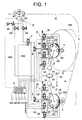
- the first embodiment of the paper roll braking device installed on the rotary press RP will be described in the following, referring to FIG. 1.
- the paper roll braking device comprises a braking section 2, an engage/disengage changeover section 3, a contact pressure adjusting section 4, an outside diameter detecting section 5 and an operation control section 6.
- the braking section 2 comprises two sets of supporting members 1 and 1 that form the paper roll supporting members SP, rotors 25 that are rotatable together with the supporting member 1, and fitted to one end each, opposite to the paper roll supporting side, of the supporting members 1 and 1, and a plurality of pairs (4 pairs in the embodiment shown in FIG. 1) of friction discs 21, 22, 23 and 24 provided facing each other with each rotor 25 interposed therebetween in such a manner that the friction discs 21, 22, 23 and 24 can be engaged with and disengaged from both sides of the rotors 25 by a drive unit operated by fluid pressure, such as pneumatic pressure.
- fluid pressure such as pneumatic pressure
- the engage/disengage changeover section 3 has solenoid valves 31, 32, 33 and 34 that can switch over the supply of fluid pressure to the drive unit (not shown, and hereinafter referred to as "friction disc drive unit") for driving the friction discs 21, 22, 23 and 24 of the braking section 2 to cause them to engage with and disengage from both sides of the rotor 25.
- the drive unit not shown, and hereinafter referred to as "friction disc drive unit"
- the contact pressure adjusting section 4 comprises a tension sensor 41 as a tension sensing mechanism for sensing changes in the traveling tension of the web W that travels during operation of the rotary press RP and converting the changes into a tension signal S0 (S in S0 shown in FIG. 1 represents a signal. The same applies to all symbols prefixed with S used throughout the figure, and in FIG.
- the outside diameter detecting section 5 comprises a rotation signal output means 51 for generating a rotation signal S2 as an electrical signal proportional to the rotational speed of the supporting member 1, and a predetermined diameter signal output means 52 that receives a rotation signal S2 and a rotary press operation signal S3, detects the outside diameter of the paper roll WR from which the traveling web W is paid off based on the operation speed of the rotary press and the rotational speed of the supporting member 1, and generates a predetermined diameter signal S4 when the outside diameter of the paper roll WR reaches a predetermined size.
- the operation control section 6 comprises an operation control section 6 that is connected to the predetermined diameter signal output means 52 of the outside diameter detecting section 5, and when a predetermined diameter signal S4 is produced, transmits an operation signal S5 to some of the solenoid valves 31, 32, 33 and 34 of the engage/disengage changeover section 3 to cause the friction discs 21, 22, 23 and 24 to disengage from the rotor 25 in accordance with the predetermined diameter signal S4.
- the paper roll braking device according to the present invention having the aforementioned construction is operated as follows:
- the operation control section 6 demagnetizes the electromagnet parts of the solenoid valves 31, 32, 33 and 34 provided in the fluid pressure supply pipe line between the fluid pressure supply source AS and the friction disc drive units so that all the friction discs 21, 22, 23 and 24 of the braking section 2 provided on a set of the supporting members 1 and 1 supporting the paper roll WR from which the web W is paid off in the course of printing operation among the braking sections provided for each of the two sets of the supporting members 1 and 1 of the paper roll supporting section SP are caused to come in contact with the rotor 25.
- the operation control section 6 transmits an operation signal S50 to the solenoid valve 7 provided in the fluid pressure supply pipe line between the electric-pneumatic converter 44, which will be described later, to excite electromagnet part thereof to change over the solenoid valve 7.
- the traveling tension generated on the web W is detected by the tension sensor 41 of the contact pressure adjusting section 4, converted into a tension signal S0 in accordance with its size, and transmitted to the tension control signal output means 42.
- the tension control signal output means 42 to which the tension signal S0 in accordance with the size of the tension is entered, transmits an appropriate tension control signal S1 in accordance with the size of the tension to the electric-pneumatic converters 43 and 44 provided in the fluid pressure supply pipe line between the fluid pressure supply source As and the solenoid valves 31, 32, 33 and 34.
- the electric-pneumatic converters 43 and 44 adjust and set the fluid pressure fed to the solenoid valves 31, 32, 33 and 34 to a fluid pressure in accordance with the aforementioned tension control signal S1.
- the electric-pneumatic converter 43 sets a fluid pressure to control the traveling tension of the web W during normal operation of the rotary press RP, while the electric-pneumatic converter 44 sets a fluid pressure higher than the fluid pressure set by the electric-pneumatic converter 43 to prepare for an emergency stop as needed in a failure of the rotary press.
- the fluid whose pressure is adjusted by the electric-pneumatic converters 43 and 44 is fed to the solenoid valves 31, 32, 33 and 34 and to the friction disc drive units via a shuttle valve 8.
- the upstream fluid pressure supply pipe line is disconnected from the downstream fluid pressure supply pipe line as the electromagnet part of the solenoid valve 7 is excited, as described above, in the normal operation of the rotary press RP, the fluid pressure set by the electric-pneumatic converter 43 is supplied to the friction disc drive units, and as a result, the rotation of the paper roll WR is braked so that the traveling tension of the web W is maintained with a predetermined proper range.
- the rotation signal output means 51 such as a rotary encoder, connected to the supporting member 1 generates a rotation signal S2 proportional to the rotational speed of the paper roll WR. Furthermore, the predetermined diameter signal output means 52 to which the rotary press operation speed signal S3 is entered, together with the rotation signal S2 keeps detecting the outside diameter of the paper roll WR based on the rotation signal S2 and the operation signal S3.
- the paper roll WR is consumed as the web W is paid off from the paper roll WR in the course of printing operation.
- the predetermined diameter signal output means 52 detects that the paper roll WR reaches a first predetermined diameter D1
- the predetermined diameter signal output means 52 transmits a predetermined diameter signal, that is, a first predetermined diameter signal S4 to the operation control section 6.
- a control signal S5 is generated to the engage/disengage changeover section 3 of the braking section of the supporting members 1 and 1 supporting the paper roll WR from which the current web W is paid off, so that the electromagnet parts of the solenoid valves 31 and 32 are excited to change over the solenoid valves 31 and 32 to disengage the friction discs 21 and 22 from the rotor 25.
- the operation control section 6 transmits a predetermined correction signal, that is, a first correction signal S60 for correcting the tension control signal S1 that is being generated by the tension control signal output means 42 to the tension control signal output means 42, together with the control signal S5.
- the first correction signal S60 adjusts the fluid pressure set by the electric-pneumatic converters 43 and 44 to cope with a reduction in the braking force to the rotation of the paper roll WR caused in a moment the friction disc 23 of the braking section 2 is disengaged from the rotor 25, so that the web W is prevented from being slackened due to a great fluctuation in the traveling tension of the web W.
- the paper roll WR whose outside diameter is reduced to less than the first predetermined diameter D1 is kept consumed as the rotation thereof is braked by the friction between the friction discs 23 and 24 and the rotor 25.
- the predetermined diameter signal output means 52 detects that the paper roll WR reaches the second predetermined diameter D2 (D2 ⁇ D1), at which the paper roll WR is ready for splicing, the predetermined diameter signal output means 52 transmits the second predetermined diameter signal S4 again to the operation control section 6.
- the operation control section 6 Upon receipt of the second predetermined diameter signal S4, the operation control section 6 transmits a control signal S5 to the engage/disengage changeover section 3 of the braking section 2 on the supporting members 1 and 1 supporting the paper roll WR from which the web W is currently paid off to change over the solenoid valve 33, for example, by exciting the electromagnet part of the solenoid valve 33, thereby disengaging the friction disc 23 from the rotor 25.
- the operation control section 6 transmits to the tension control signal output means 42 a predetermined correction signal for correcting the tension control signal S1 that is currently being generated, that is a second correction signal S60.
- the second correction signal S60 adjusts the fluid pressure set by the electric-pneumatic converters 43 and 44 to cope with a reduction in the braking force to the rotation of the paper roll WR caused in a moment the friction disc 23 of the braking section 2 is disengaged from the rotor 25, so that the web W is prevented from being slackened due to a great fluctuation in the traveling tension of the web W.
- the paper roll supporting section SP is caused to move to a splicing-ready position shown in FIGS. 1 and 3.
- the operation control section 6 transmits a control signal S5 to the engage/disengage changeover section 3 of the braking section 2 that is currently braking the rotation of the paper roll WR from which the web W is not currently paid off to excite the electromagnet parts of the solenoid valves 31, 32, 33 and 34 of the engage/disengage changeover section 3, thereby causing the friction discs 21, 22, 23 and 24 to disengage from the rotor 25.
- the paper roll WR from which the web W is not currently paid off is caused to rotate by an appropriate means (not shown) so that the peripheral rotational speed thereof agrees with the traveling speed of the paper roll W that is now traveling. Since the method of causing the paper roll W from which the web W is not currently paid off is out of scope of the present invention, further description of the method is omitted.
- a splicing signal is generated at a predetermined timing from an appropriate device. Based on the splicing signal, the traveling web W is forced onto the peripheral surface of the paper roll WR from which the web W is not currently paid off, and spliced to the traveling web W at the paste-coated area at an end of the web W, and the web W that has been traveling is cut off at the upstream side from the splicing position by a cutter. Thus, the splicing operation is completed.
- a signal to operate the cutter is entered into the operation control section 6 as a splicing-end signal S20.
- the operation control section 6 demagnetizes the electromagnet parts of the solenoid valves 31, 32, 33 and 34 each of the two engage/disengage changeover sections 3 to cause the friction discs 21, 22, 23 and 24 each of the braking sections 2 and 2 to come in contact with the rotor 25.
- the paper roll WR that had stopped rotating is removed and replaced with a new paper roll WR.
- the braking section 2 on the supporting section 1 on the side of the paper roll WR that is to be replaced can be changed over to a desired state by manually entering the braking section manual signal S40 into the operation control section 6.
- the aforementioned braking control is carried out during the period in which the rotary press RP is decelerated to a halt to maintain the traveling tension of the web W is kept in a predetermined range.
- a rotary press stop signal S10 for stopping the rotary press RP is entered into the operation control section 6, the electromagnet parts of the solenoid valves 31, 32, 33 and 34 each of the two engage/disengage changeover sections 3 and 3 are demagnetized, bringing all the friction discs 21, 22, 23 and 24 each of the braking sections 2 and 2 in contact with the rotor 25, thereby stopping the rotation of the paper roll WR simultaneously with the stop of the rotary press RP.
- the operation control section 6 demagnetizes the electromagnet parts of the solenoid valves 31, 32, 33 and 34 each of the two engage/disengage changeover sections 3 and 3, and also demagnetizes the electromagnet parts of a solenoid valve 7 provided on a fluid pressure supply pipe line between the electric-pneumatic converter 44 and the shuttle valve 8, allowing a higher fluid pressure set by the electric-pneumatic converter 44 to be fed to the friction disc drive units en bloc to forcibly stop the paper roll WR simultaneously with the emergency stop of the rotary press RP.
- FIG. 2 is a schematic diagram of another example of the paper roll braking device according to the present invention.
- FIG. 1 In the figure, like parts are indicated by like numerals used in FIG. 1, and the only difference between FIGS. 1 and 2 is a contact pressure adjusting section 9.
- the contact pressure adjusting section 9 shown in FIG. 2 comprises an angular displacement arm 91 that is angularly displaceable and imparted by a fluid pressure cylinder 95 a force resisting to the traveling tension of the web W during the operation of the rotary press RP, a guide roller 92 rotatably provided at a free end of the angular displacement arm 91 and outer peripheral cams 93 and 94 that displaces following the angular displacement of the angular displacement arm 91, and displacement rod type regulators 96 and 97 provided in a fluid pressure supply pipe line between a fluid pressure supply source AS and an engage/disengage changeover section 3 in such a manner that the displacement rod thereof is brought into contact with the outer peripheral cams 93 and 94; the displacement rod thereof being operated by the displacement of the outer peripheral cams 93 and 94 caused as a result of the angular displacement of the angular displacement arm 91 so that the fluid pressure, such as air pressure, supplied from the fluid pressure supply source AS to the friction disc drive unit of the
- the angular displacement arm 91 in the contact pressure adjusting section 9 forms a tension sensing mechanism that senses changes in the traveling tension of the web W with the degree of angular displacement as a balance between the traveling tension of the web W and the force of the fluid pressure cylinder 95.
- the operation control section 6 demagnetizes the electromagnet parts of the solenoid valves 31, 32, 33 and 34 provided in the fluid pressure supply pipe line between the fluid pressure supply source AS and the friction disc drive units so that all the friction discs 21, 22, 23 and 24 of at least the braking section 2 provided on a set of the supporting members 1 and 1 supporting the paper roll WR from which the web W is paid off during printing, among the braking sections 2 provided on each set of the two sets of the supporting members 1 and 1 for the paper roll WR and the supporting section SP, can be brought in contact with the rotor 25.
- the operation control section 6 transmits an operation signal S50 to the solenoid valve 7 provided in the fluid pressure supply pipe line between the displacement rod type regulator 97, which will be described later, and the shuttle valve 8 to excite the electromagnet part thereof to change over the solenoid valve 7.
- the traveling tension produced on the web W is detected by the angular displacement arm 91 of the contact pressure adjusting section 9, and the angular displacement arm 91 is angularly displaced in accordance with the size of the tension. This in turn causes an angular displacement of the outer peripheral cams 93 and 94.
- the outer peripheral cams 93 and 94 angularly displaced in accordance with the size of the tension actuate via the cam surfaces thereof the displacement rods of the displacement rod type regulators 96 and 97 provided in the fluid pressure supply pipe line between the fluid pressure supply source AS and the solenoid valves 31,32, 33 and 34.
- the displacement rod type regulators 96 and 97 adjust and set the fluid pressure supplied to the solenoid valves 31, 32, 33 and 34 to a fluid pressure corresponding to the displacement of the displacement rods.
- the displacement rod type regulator 96 sets the fluid pressure for controlling the traveling tension of the web W during the normal operation of the rotary press RP, while the displacement rod type regulator 97 sets a higher fluid pressure than the fluid pressure set by the displacement rod type regulator 96 in preparation for an emergency stop at the time of a failure of the rotary press RP.
- the fluid whose supply pressure is adjusted and set by the displacement rod type regulators 96 and 97 is supplied to the solenoid valves 31, 32, 33 and 34 and to the friction disc drive units via the shuttle valve 8.
- the electromagnet part of the solenoid valve 7 is excited to cut off the upstream and downstream fluid pressure supply pipe lines during the normal operation of the rotary press RP, the fluid pressure set by the displacement rod type regulator 96 is supplied to the fiction disc drive units, and thereby the rotation of the paper roll WR is braked so that the traveling tension of the web W can be kept within a predetermined proper range.
- a rotation signal output means 51 that is a rotary encoder, for example, connected to the supporting member 1 generates a rotation signal S2 proportional to the rotating speed of the paper roll WR. Furthermore, a predetermined diameter signal output means 52 to which a rotary press operating speed signal S3 is entered, together with the rotation signal S2 keeps detecting the outside diameter of the paper roll WR based on the rotation signal S2 and the rotary press operating speed signal S3.
- the predetermined diameter signal output means 52 detects that the paper roll WR reaches a first predetermined diameter D1
- the predetermined diameter signal output means 52 transmits a predetermined diameter signal, that is, a first predetermined diameter signal S4 to the operation control section 6.
- the operation control section 6 Upon receipt of the first predetermined diameter signal S4, the operation control section 6 transmits a control signal S5 to the engage/disengage changeover section 3 of the braking section 2 on the supporting members 1 and 1 supporting the paper roll WR from which the web W is currently being paid off to excite the electromagnet parts of the solenoid valves 31 and 32, for example, changing over the solenoid valves 31 and 32 to disengage the friction discs 21 and 22 from the rotor 25.
- the angular displacement arm 91 copes with the reduction in braking force by angular displacement, absorbing the slack of the web W, and the outer peripheral cams 93 and 94 are also angularly displaced along with the angular displacement of the angular displacement arm 91, actuating the displacement rods of the displacement rod type regulators 96 and 97 to adjust the fluid pressure set by the displacement rod type regulators 96 and 97.
- the traveling tension of the web W is prevented from fluctuating greatly.
- the paper roll WR After the outside diameter of the paper roll WR has been reduced to less than the first predetermined diameter D1, the paper roll WR is kept consumed as the rotation thereof is braked by the frictional force between the friction discs 23 and 24 and the rotor 25.
- the predetermined diameter signal output means 52 detects that the paper roll WR reaches a splicing-ready second predetermined diameter D2 (D2 ⁇ D1), the predetermined diameter signal output means 52 transmits a second predetermined diameter signal S4 to the operation control section 6.
- the operation control section 6 Upon receipt of the second predetermined diameter signal S4, the operation control section 6 transmits a control signal S5 to the engage/disengage changeover section 3 of the braking section 2 on the supporting members 1 and 1 supporting the paper roll WR from which the web W is currently paid off to change over the solenoid valve 33, for example, by exciting the electromagnet part of the solenoid valve 33, thereby disengaging the friction disc 23 from the rotor 25.
- the angular displacement arm 91 copes with the reduction in braking force by angular displacement, absorbing the slack of the web W, and the outer peripheral cams 93 and 94 are also angularly displaced along with the angular displacement of the angular displacement arm 91, actuating the displacement rods of the displacement rod type regulators 96 and 97 to adjust the fluid pressure set by the displacement rod type regulators 96 and 97.
- the traveling tension of the web W is prevented from fluctuating greatly, as in the case of the first predetermined diameter, described above.
- the paper roll supporting section SP is caused to move to a splicing-ready position shown in FIGS. 2 and 3.
- the operation control section 6 transmits a control signal S5 to the engage/disengage changeover section 3 of the braking section 2 that is currently braking the rotation of the paper roll WR from which the web W is not currently paid off to excite the electromagnet parts of the solenoid valves 31, 32, 33 and 34 of the engage/disengage changeover section 3, thereby causing the friction discs 21, 22, 23 and 24 to disengage from the rotor 25.
- the paper roll WR from which the web W is not currently paid off is caused to rotate by an appropriate means (not shown) so that the peripheral rotational speed thereof agrees with the traveling speed of the paper roll W that is now traveling. Since the method of causing the paper roll W from which the web W is not currently paid off is out of scope of the present invention, further description of the method is omitted.
- a splicing signal is generated at a predetermined timing from an appropriate device. Based on the splicing signal, the traveling web W is forced onto the peripheral surface of the paper roll WR from which the web W is not currently paid off, and spliced to the traveling web W at the paste-coated area at an end of the web W, and the web W that has been traveling is cut off at the upstream side from the splicing position by a cutter. Thus, the splicing operation is completed.
- a signal to operate the cutter is entered into the operation control section 6 as a splicing-end signal S20.
- the operation control section 6 demagnetizes the electromagnet parts of the solenoid valves 31, 32, 33 and 34 each of the two engage/disengage changeover sections 3 to cause the friction discs 21, 22, 23 and 24 each of the braking sections 2 and 2 to come in contact with the rotor 25.
- the paper roll WR that had stopped rotating is removed and replaced with a new paper roll WR.
- the braking section 2 on the supporting section 1 on the side of the paper roll WR that is to be replaced can be changed over to a desired state by manually entering the braking section manual signal S40 into the operation control section 6.
- the aforementioned braking control is carried out during the period in which the rotary press RP is decelerated to a halt to maintain the traveling tension of the web W is kept in a predetermined range.
- a rotary press stop signal S10 for stopping the rotary press RP is entered into the operation control section 6, the electromagnet parts of the solenoid valves 31, 32, 33 and 34 each of the two engage/disengage changeover sections 3 and 3 are demagnetized, bringing all the friction discs 21, 22, 23 and 24 each of the braking sections 2 and 2 in contact with the rotor 25, thereby stopping the rotation of the paper roll WR simultaneously with the stop of the rotary press RP.
- the operation control section 6 demagnetizes the electromagnet parts of the solenoid valves 31, 32, 33 and 34 each of the two engage/disengage changeover sections 3 and 3, and also demagnetizes the electromagnet parts of a solenoid valve 7 provided on a fluid pressure supply pipe line between the electric-pneumatic converter 44 and the shuttle valve 8, allowing a higher fluid pressure set by the electric-pneumatic converter 44 to be fed to the friction disc drive units en bloc to forcibly stop the paper roll WR simultaneously with the emergency stop of the rotary press RP.
- the present invention is not limited to the aforementioned embodiments, but may be of such a construction that the paper roll supporting section can accommodate more than two paper rolls.
- the number of friction discs that can engage with, or disengage from, the rotor is not limited to four.
- the tension sensing mechanism may be of any construction so long as it does some work in response to the traveling tension of the traveling web.
- the outside diameter detecting section may be of such a construction that a signal is generated as the outside diameter of the paper roll is directly detected with reflection-type or transmission-type phototubes disposed facing each other at the position of the first predetermined diameter and that of the second predetermined diameter on the end face of the paper roll, for example.
- the present invention makes it possible to quickly stabilize the traveling tension of the web since the traveling tension of the web paid off from the paper roll can be meticulously adjusted, including at the time of paper roll changeover, by meticulously braking the rotation of the paper roll regardless of the diameter thereof, ranging from the paper roll of a large diameter to that of a small diameter.
- no force is exerted on the surface of the paper roll in accomplishing the aforementioned braking, no damage is caused on the surface of the web paid off from the paper roll.
- the traveling tension of the traveling web paid off from the paper roll can be kept in a proper and stable state at all times.
Landscapes
- Controlling Rewinding, Feeding, Winding, Or Abnormalities Of Webs (AREA)
- Replacement Of Web Rolls (AREA)
- Registering, Tensioning, Guiding Webs, And Rollers Therefor (AREA)
- Inking, Control Or Cleaning Of Printing Machines (AREA)
- Unwinding Webs (AREA)
Applications Claiming Priority (2)
| Application Number | Priority Date | Filing Date | Title |
|---|---|---|---|
| JP36410299 | 1999-12-22 | ||
| JP36410299A JP3394931B2 (ja) | 1999-12-22 | 1999-12-22 | 巻取紙制動装置 |
Publications (3)
| Publication Number | Publication Date |
|---|---|
| EP1129971A2 true EP1129971A2 (fr) | 2001-09-05 |
| EP1129971A3 EP1129971A3 (fr) | 2003-02-26 |
| EP1129971B1 EP1129971B1 (fr) | 2006-04-12 |
Family
ID=18480985
Family Applications (1)
| Application Number | Title | Priority Date | Filing Date |
|---|---|---|---|
| EP00311468A Expired - Lifetime EP1129971B1 (fr) | 1999-12-22 | 2000-12-20 | Dispositif pour freiner un rouleau de papier |
Country Status (5)
| Country | Link |
|---|---|
| US (1) | US6408757B2 (fr) |
| EP (1) | EP1129971B1 (fr) |
| JP (1) | JP3394931B2 (fr) |
| AT (1) | ATE323053T1 (fr) |
| DE (1) | DE60027264T2 (fr) |
Cited By (1)
| Publication number | Priority date | Publication date | Assignee | Title |
|---|---|---|---|---|
| WO2024039484A1 (fr) * | 2022-08-17 | 2024-02-22 | Paper Converting Machine Company | Machine de déroulement d'épissage automatique à bande unique et procédé |
Families Citing this family (12)
| Publication number | Priority date | Publication date | Assignee | Title |
|---|---|---|---|---|
| JP2003182896A (ja) * | 2001-12-20 | 2003-07-03 | Hitachi Printing Solutions Ltd | 用紙走行位置検出装置を有する印刷装置 |
| JP3539565B2 (ja) * | 2002-02-05 | 2004-07-07 | 株式会社東京機械製作所 | 輪転機のウェブ紙保持装置 |
| US6851367B2 (en) * | 2002-08-08 | 2005-02-08 | Presstek, Inc. | Web handling cylinder with modulated tension loss |
| US7118062B2 (en) * | 2002-08-08 | 2006-10-10 | Presstek, Inc. | Web handling with tension sensing and adjustment |
| US20060150836A1 (en) * | 2003-07-29 | 2006-07-13 | Oce Printing Systems Gmbh | Device and method for electrophoretic liquid development |
| JP4426370B2 (ja) * | 2004-04-30 | 2010-03-03 | 株式会社小森コーポレーション | 帯状体供給装置の制動力制御方法及び装置 |
| WO2007050677A2 (fr) * | 2005-10-25 | 2007-05-03 | Formax, Inc. | Dispositif d'intercalage de feuilles pour appareil a trancher |
| JP5070118B2 (ja) * | 2008-04-23 | 2012-11-07 | 株式会社リコー | ロール紙タイプ記録媒体送り出し機構及び画像形成装置 |
| US8770878B2 (en) | 2011-02-08 | 2014-07-08 | Xerox Corporation | System and method for monitoring a web member and applying tension to the web member |
| US9033200B2 (en) | 2012-02-20 | 2015-05-19 | Xerox Corporation | Method and device for controlling tension applied to a media web |
| US10974409B2 (en) | 2018-10-08 | 2021-04-13 | Provisur Technologies, Inc. | Cartridge for a food processing machine |
| CN115320242A (zh) * | 2022-05-17 | 2022-11-11 | 温州立胜印刷包装机械有限公司 | 一种印刷机用一体化传动制动装置 |
Family Cites Families (11)
| Publication number | Priority date | Publication date | Assignee | Title |
|---|---|---|---|---|
| US1780194A (en) * | 1929-05-03 | 1930-11-04 | Phonodisc Corp | Sound-reproducing machine |
| US3822838A (en) * | 1972-03-20 | 1974-07-09 | Butler Automatic Inc | Web handling apparatus |
| SE366007B (fr) * | 1972-09-11 | 1974-04-08 | Wifag Maschf | |
| FI51463C (fi) * | 1974-04-02 | 1979-05-15 | Valmet Oy | Bromsanordning foer rullpartiet i en pappers- eller kartongmaskin |
| US4286757A (en) * | 1980-04-03 | 1981-09-01 | The Black Clawson Company | Method and apparatus for controlling the braking system for an unwinder |
| US4337904A (en) * | 1980-10-22 | 1982-07-06 | Owens-Illinois, Inc. | Web tension control method and apparatus |
| US4494710A (en) * | 1983-11-02 | 1985-01-22 | Harris Michael J | Reel brake apparatus |
| DE3608182A1 (de) * | 1986-03-12 | 1987-10-01 | Roland Man Druckmasch | Vorrichtung zur regelung der spannung einer drucktraegerbahn mit einer notstoppeinrichtung |
| JPH0416762A (ja) | 1990-05-11 | 1992-01-21 | Shimadzu Corp | 超臨界流体クロマトグラフ用試料導入装置 |
| GB9400083D0 (en) * | 1994-01-05 | 1994-03-02 | Wichita Company Ltd | Control system |
| US6293192B1 (en) * | 2000-04-03 | 2001-09-25 | Norman C. Bartlett | Newsprint core brake system for newspaper presses |
-
1999
- 1999-12-22 JP JP36410299A patent/JP3394931B2/ja not_active Expired - Fee Related
-
2000
- 2000-12-20 EP EP00311468A patent/EP1129971B1/fr not_active Expired - Lifetime
- 2000-12-20 AT AT00311468T patent/ATE323053T1/de not_active IP Right Cessation
- 2000-12-20 DE DE60027264T patent/DE60027264T2/de not_active Expired - Fee Related
- 2000-12-21 US US09/751,921 patent/US6408757B2/en not_active Expired - Fee Related
Cited By (2)
| Publication number | Priority date | Publication date | Assignee | Title |
|---|---|---|---|---|
| WO2024039484A1 (fr) * | 2022-08-17 | 2024-02-22 | Paper Converting Machine Company | Machine de déroulement d'épissage automatique à bande unique et procédé |
| US12384640B2 (en) | 2022-08-17 | 2025-08-12 | Bw Converting, Inc. | Single web automatic splicing unwind machine and method |
Also Published As
| Publication number | Publication date |
|---|---|
| EP1129971A3 (fr) | 2003-02-26 |
| DE60027264D1 (de) | 2006-05-24 |
| US20010006029A1 (en) | 2001-07-05 |
| EP1129971B1 (fr) | 2006-04-12 |
| ATE323053T1 (de) | 2006-04-15 |
| DE60027264T2 (de) | 2007-01-04 |
| JP3394931B2 (ja) | 2003-04-07 |
| JP2001171874A (ja) | 2001-06-26 |
| US6408757B2 (en) | 2002-06-25 |
Similar Documents
| Publication | Publication Date | Title |
|---|---|---|
| EP1129971B1 (fr) | Dispositif pour freiner un rouleau de papier | |
| JP2819283B2 (ja) | 連続紙走行張力制御装置 | |
| US3871598A (en) | Winding tension control system | |
| CA1107845A (fr) | Trancheuse a lames menees | |
| US5671895A (en) | System and method for controlling the speed and tension of an unwinding running web | |
| US20050242224A1 (en) | Braking force control method and device for strip-shaped material feeding device | |
| US20070278341A1 (en) | Strip continuous supply method and apparatus | |
| JPH0146427B2 (fr) | ||
| EP0329830B1 (fr) | Dispositif pour régler la tension d'une bande | |
| US4709872A (en) | Web tension control and emergency stop system | |
| EP0264189A1 (fr) | Appareil pour manipuler une bande | |
| KR19990007925A (ko) | 푸는 압력을 제어하기 위한 시스템을 구비한, 두루마리 소재의 릴을 풀기위한 장치 | |
| US20040262361A1 (en) | Web tensioning device with plural control inputs | |
| WO1995018762A1 (fr) | Procede de regulation du freinage d'une bobine de papier | |
| CN204096723U (zh) | 一种同步接纸机的张力控制结构 | |
| US6405098B1 (en) | Control arrangement for unwinding equipment for webs | |
| US6168108B1 (en) | Web tension control apparatus and method | |
| EP1507726B1 (fr) | Dispositif et procede de regulation de la tension d'un materiau en bande | |
| US6615730B2 (en) | Method and apparatus for controlling rotary presses in power failure | |
| US20110295429A1 (en) | Method for Controlling a Processing Machine with Driven Axes | |
| JPS6016593Y2 (ja) | 巻戻シ−トの張力制御装置 | |
| WO1993004967A1 (fr) | Procede et appareil pour le raccordement synchronise de deux bandes | |
| JPH1128804A (ja) | テンション制御方法および装置 | |
| JPH1045290A (ja) | ウェブ自動継ぎ装置 | |
| JPH07110733B2 (ja) | ブレーキ装置の劣化判定装置 |
Legal Events
| Date | Code | Title | Description |
|---|---|---|---|
| PUAI | Public reference made under article 153(3) epc to a published international application that has entered the european phase |
Free format text: ORIGINAL CODE: 0009012 |
|
| 17P | Request for examination filed |
Effective date: 20010102 |
|
| AK | Designated contracting states |
Kind code of ref document: A2 Designated state(s): AT BE CH CY DE DK ES FI FR GB GR IE IT LI LU MC NL PT SE TR |
|
| AX | Request for extension of the european patent |
Free format text: AL;LT;LV;MK;RO;SI |
|
| PUAL | Search report despatched |
Free format text: ORIGINAL CODE: 0009013 |
|
| AK | Designated contracting states |
Designated state(s): AT BE CH CY DE DK ES FI FR GB GR IE IT LI LU MC NL PT SE TR Kind code of ref document: A3 Designated state(s): AT BE CH CY DE DK ES FI FR GB GR IE IT LI LU MC NL PT SE TR |
|
| AX | Request for extension of the european patent |
Extension state: AL LT LV MK RO SI |
|
| AKX | Designation fees paid |
Designated state(s): AT CH DE FR GB LI |
|
| 17Q | First examination report despatched |
Effective date: 20040225 |
|
| GRAP | Despatch of communication of intention to grant a patent |
Free format text: ORIGINAL CODE: EPIDOSNIGR1 |
|
| GRAS | Grant fee paid |
Free format text: ORIGINAL CODE: EPIDOSNIGR3 |
|
| GRAA | (expected) grant |
Free format text: ORIGINAL CODE: 0009210 |
|
| AK | Designated contracting states |
Kind code of ref document: B1 Designated state(s): AT CH DE FR GB LI |
|
| PG25 | Lapsed in a contracting state [announced via postgrant information from national office to epo] |
Ref country code: AT Free format text: LAPSE BECAUSE OF FAILURE TO SUBMIT A TRANSLATION OF THE DESCRIPTION OR TO PAY THE FEE WITHIN THE PRESCRIBED TIME-LIMIT Effective date: 20060412 Ref country code: LI Free format text: LAPSE BECAUSE OF FAILURE TO SUBMIT A TRANSLATION OF THE DESCRIPTION OR TO PAY THE FEE WITHIN THE PRESCRIBED TIME-LIMIT Effective date: 20060412 Ref country code: CH Free format text: LAPSE BECAUSE OF FAILURE TO SUBMIT A TRANSLATION OF THE DESCRIPTION OR TO PAY THE FEE WITHIN THE PRESCRIBED TIME-LIMIT Effective date: 20060412 |
|
| REG | Reference to a national code |
Ref country code: GB Ref legal event code: FG4D |
|
| REG | Reference to a national code |
Ref country code: CH Ref legal event code: EP |
|
| REF | Corresponds to: |
Ref document number: 60027264 Country of ref document: DE Date of ref document: 20060524 Kind code of ref document: P |
|
| REG | Reference to a national code |
Ref country code: CH Ref legal event code: PL |
|
| PGFP | Annual fee paid to national office [announced via postgrant information from national office to epo] |
Ref country code: GB Payment date: 20061220 Year of fee payment: 7 |
|
| PLBE | No opposition filed within time limit |
Free format text: ORIGINAL CODE: 0009261 |
|
| STAA | Information on the status of an ep patent application or granted ep patent |
Free format text: STATUS: NO OPPOSITION FILED WITHIN TIME LIMIT |
|
| 26N | No opposition filed |
Effective date: 20070115 |
|
| EN | Fr: translation not filed | ||
| PG25 | Lapsed in a contracting state [announced via postgrant information from national office to epo] |
Ref country code: FR Free format text: LAPSE BECAUSE OF FAILURE TO SUBMIT A TRANSLATION OF THE DESCRIPTION OR TO PAY THE FEE WITHIN THE PRESCRIBED TIME-LIMIT Effective date: 20070309 |
|
| GBPC | Gb: european patent ceased through non-payment of renewal fee |
Effective date: 20071220 |
|
| PG25 | Lapsed in a contracting state [announced via postgrant information from national office to epo] |
Ref country code: FR Free format text: LAPSE BECAUSE OF FAILURE TO SUBMIT A TRANSLATION OF THE DESCRIPTION OR TO PAY THE FEE WITHIN THE PRESCRIBED TIME-LIMIT Effective date: 20060412 |
|
| PG25 | Lapsed in a contracting state [announced via postgrant information from national office to epo] |
Ref country code: GB Free format text: LAPSE BECAUSE OF NON-PAYMENT OF DUE FEES Effective date: 20071220 |
|
| PGFP | Annual fee paid to national office [announced via postgrant information from national office to epo] |
Ref country code: DE Payment date: 20081219 Year of fee payment: 9 |
|
| PG25 | Lapsed in a contracting state [announced via postgrant information from national office to epo] |
Ref country code: DE Free format text: LAPSE BECAUSE OF NON-PAYMENT OF DUE FEES Effective date: 20100701 |